Huge old stars leaning out of the horizontal cobblestone sheets, were dictated by an ancient manual of glorious epic forms where I did not read the cunning locks, from there fall lights like eagles what they hang before your pale fortifications and despite the fact that I descend without air I cling to the dissected edges of this abyss walking away from the waves of floral promises with summer mentions that anoint you.
The amaranth silence rocks the star again and like the silent lymph you seek to break beyond the fundamental shell the one that you came to know in a primitive way in the sweet stays of belief.
Blows the hydrogen on the leaves and many cycles are enough for oblivion, while the trees stand because they keep their memory in the roots, to later give shelter to life vertical. I am the extended earth, I still have memories of that Winter will come without you realizing it.
The specificity of the meander winding secret of the air like the grass with its distant star.
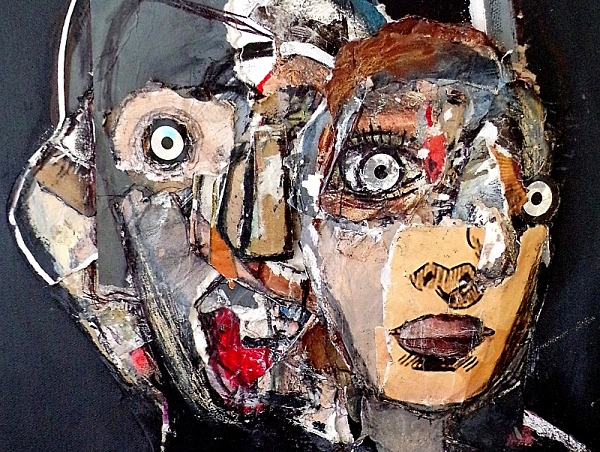
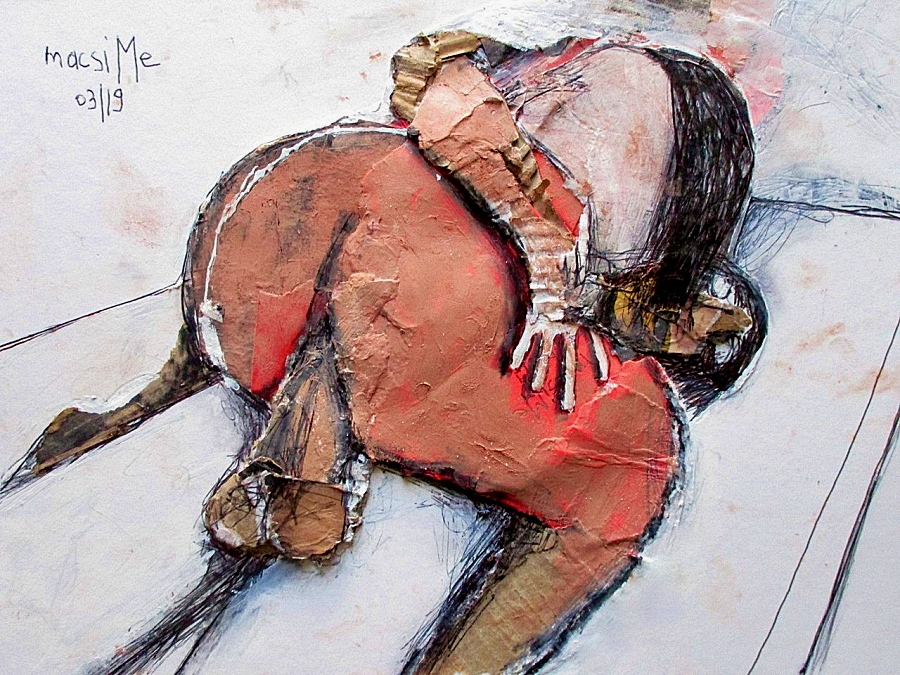
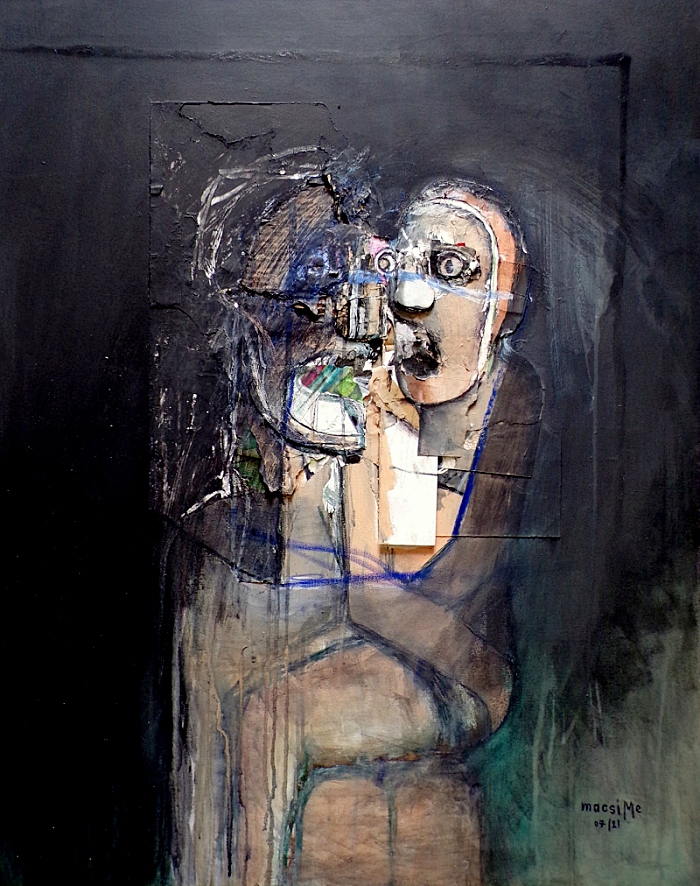
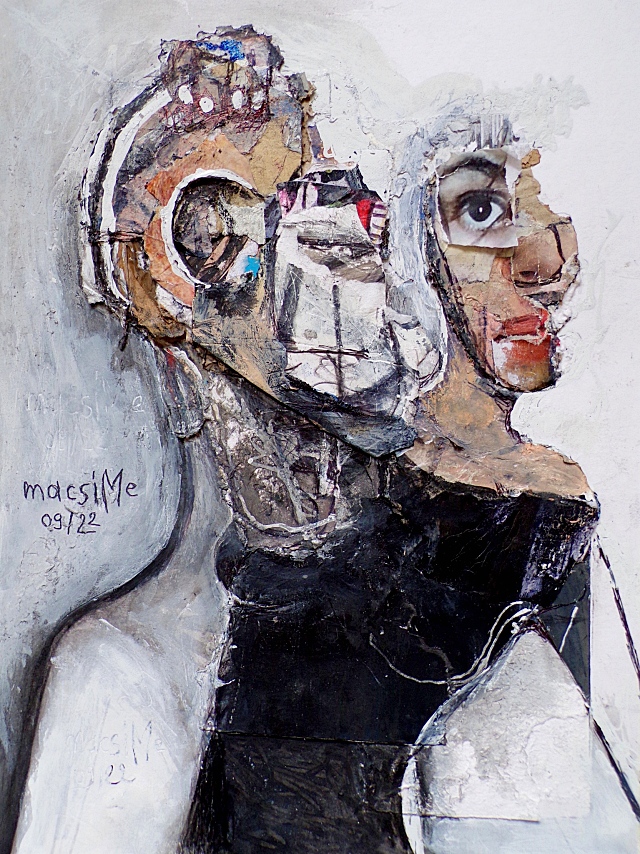
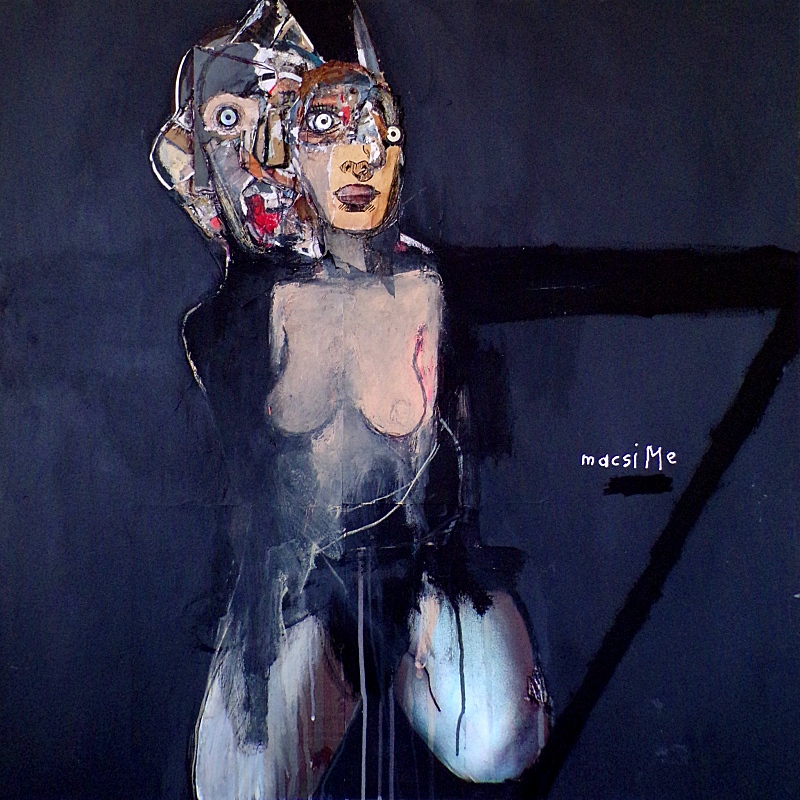
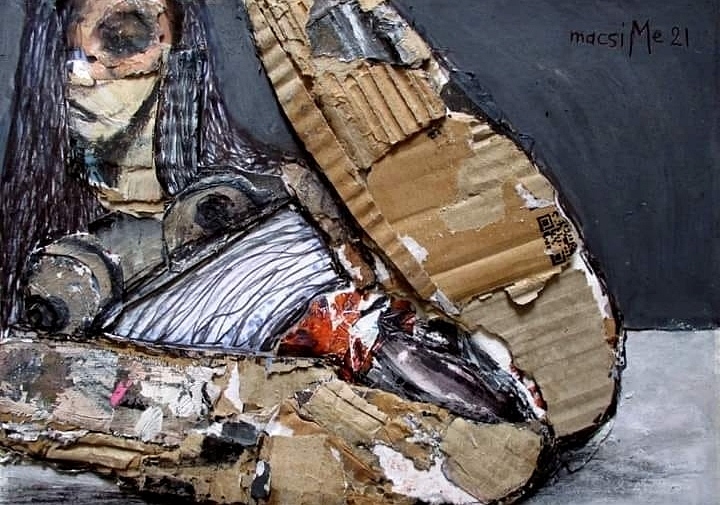
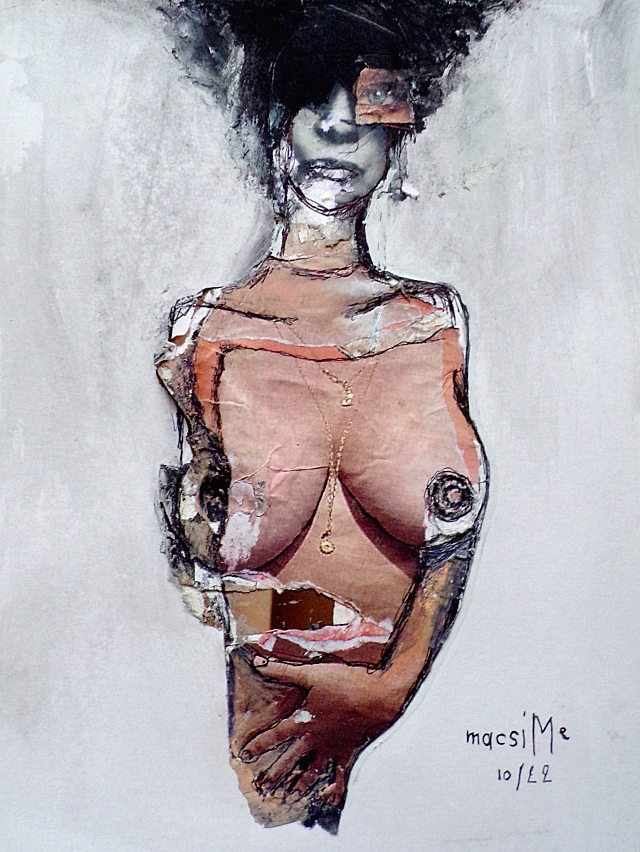
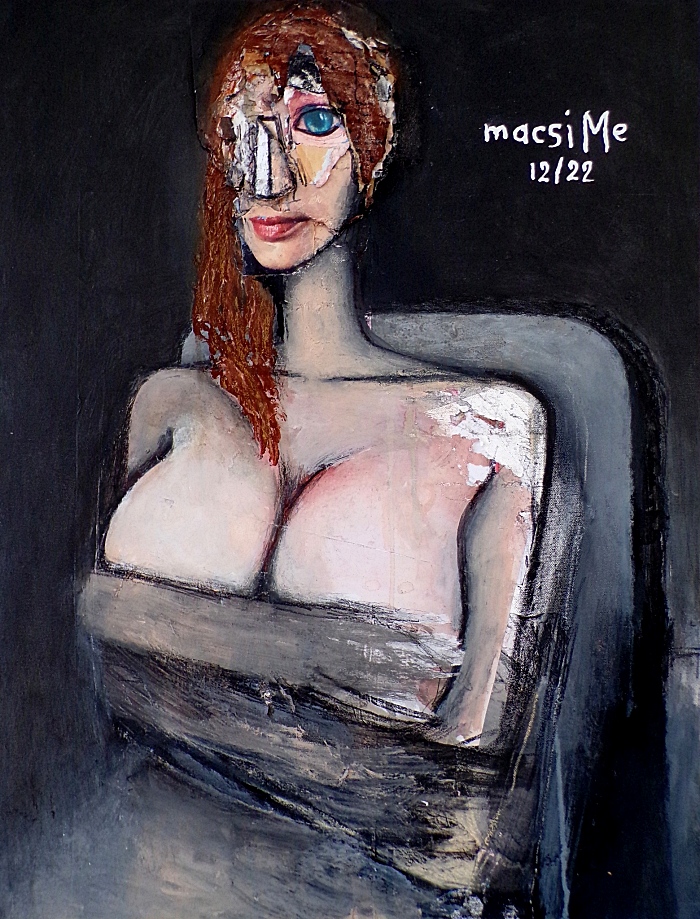
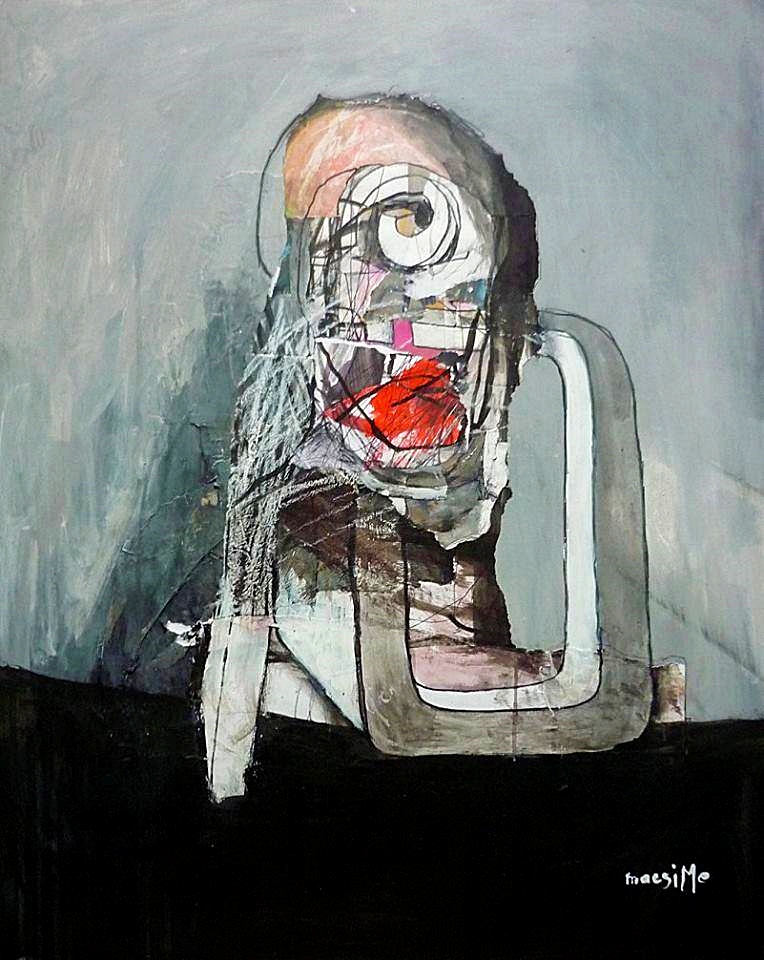
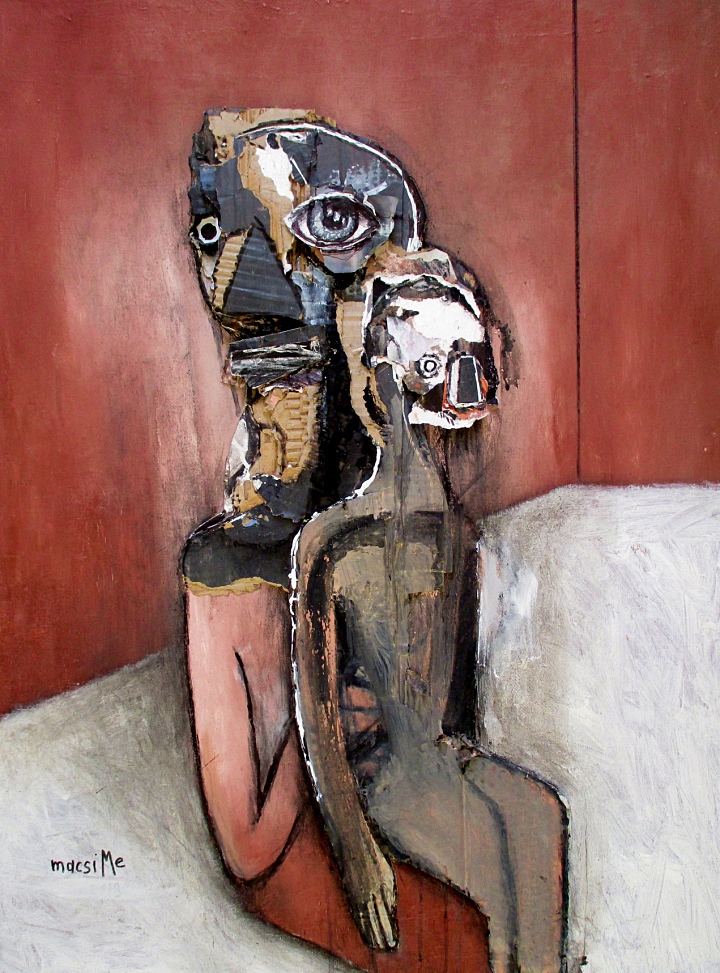
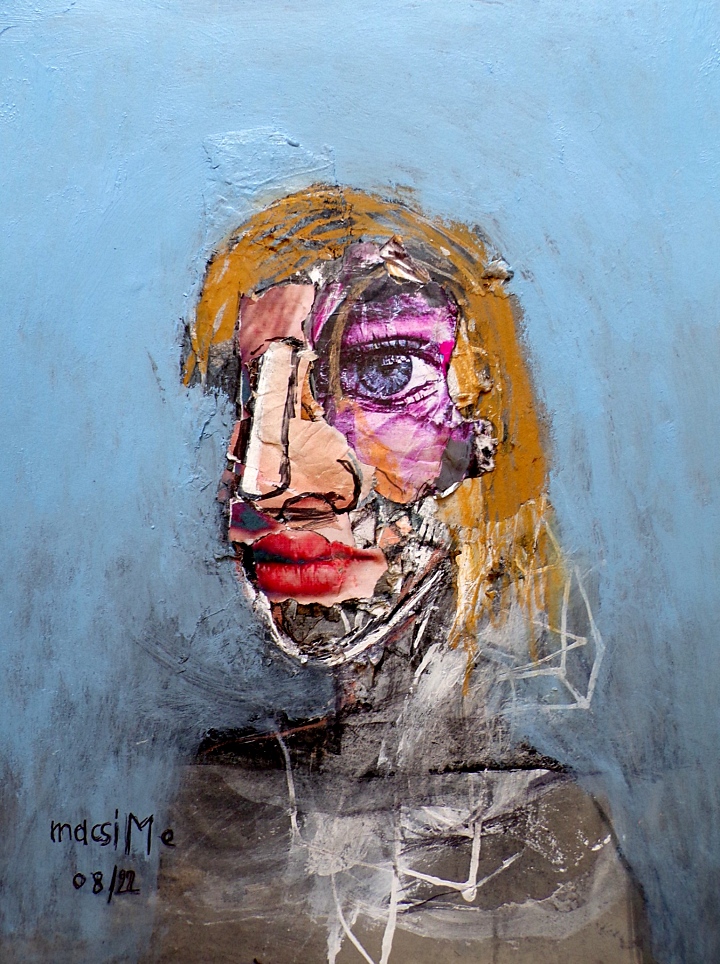
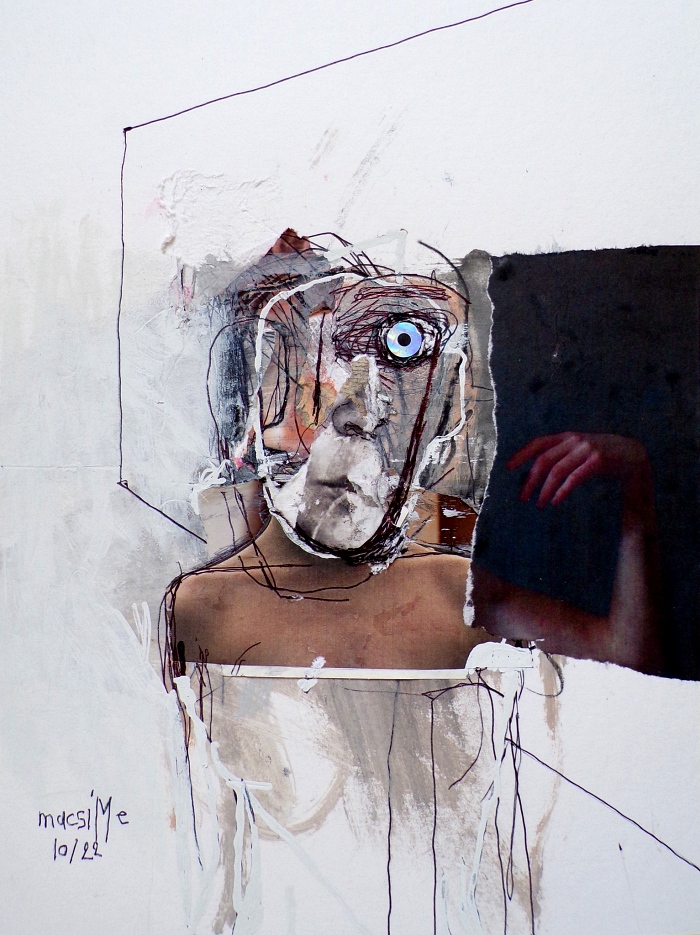
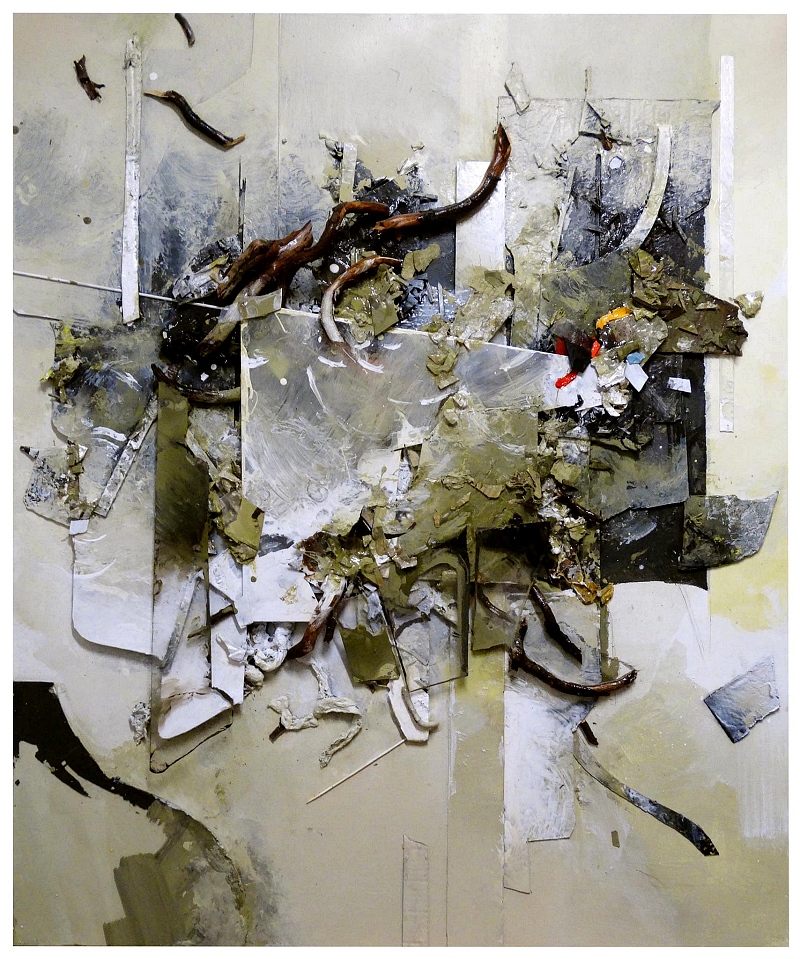
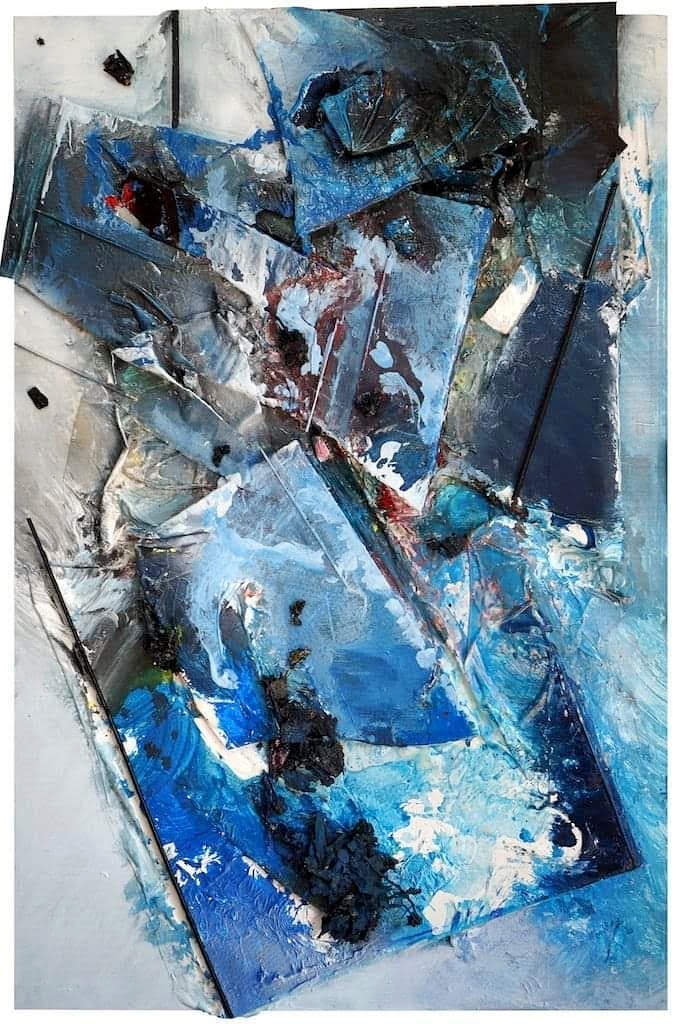
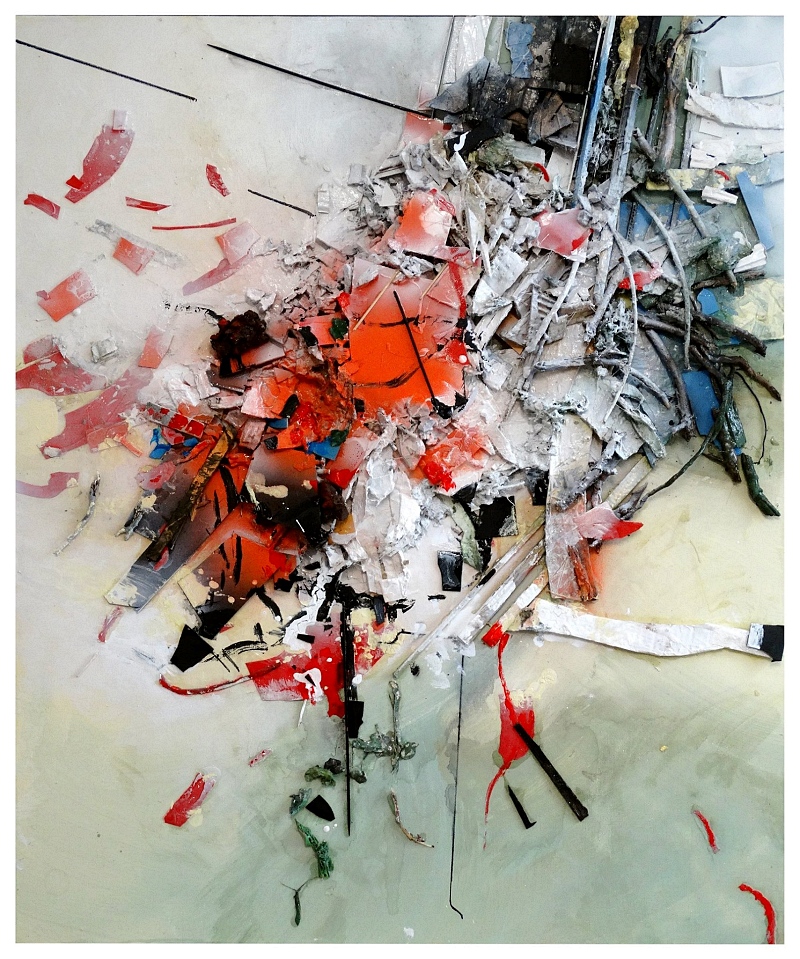
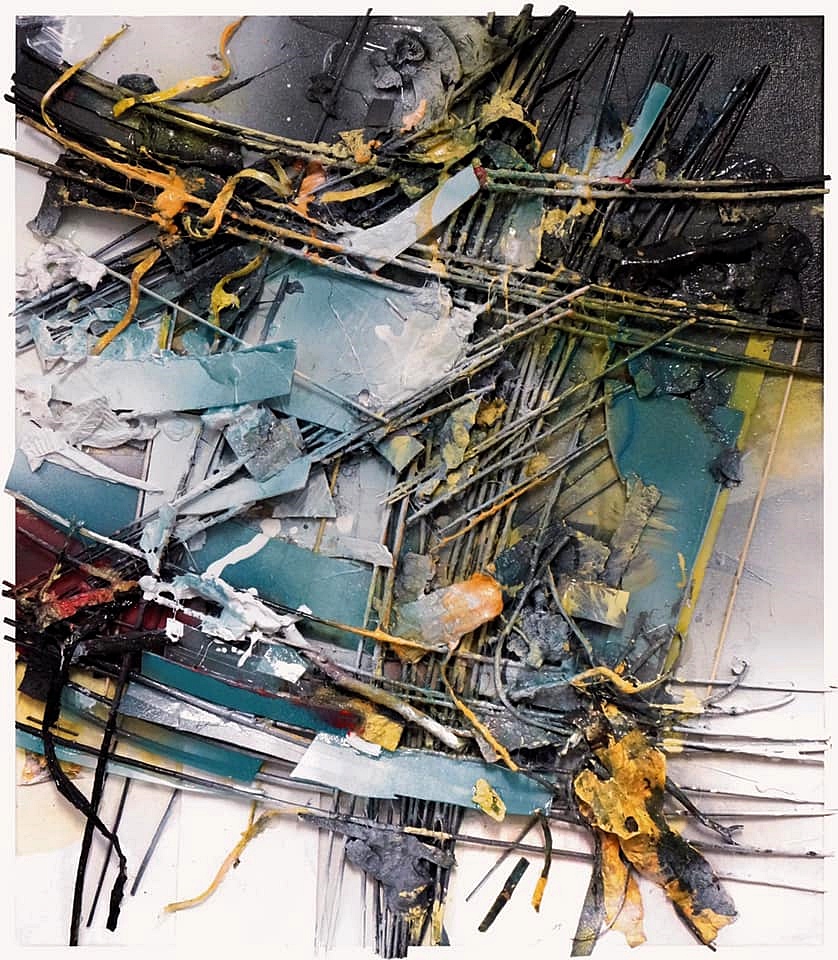
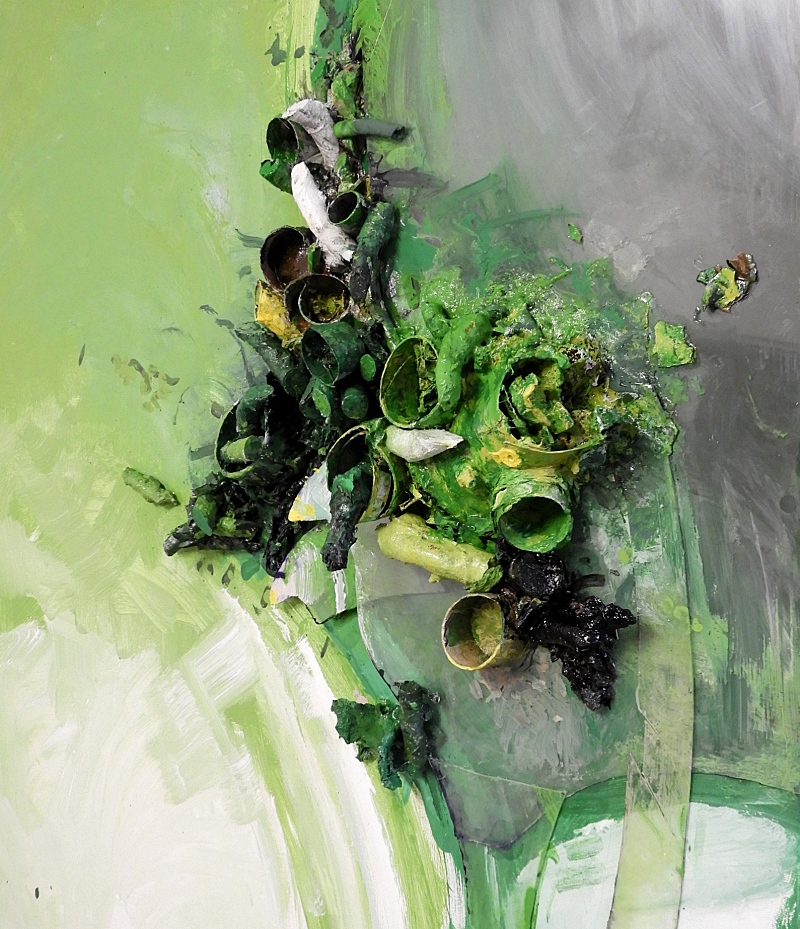
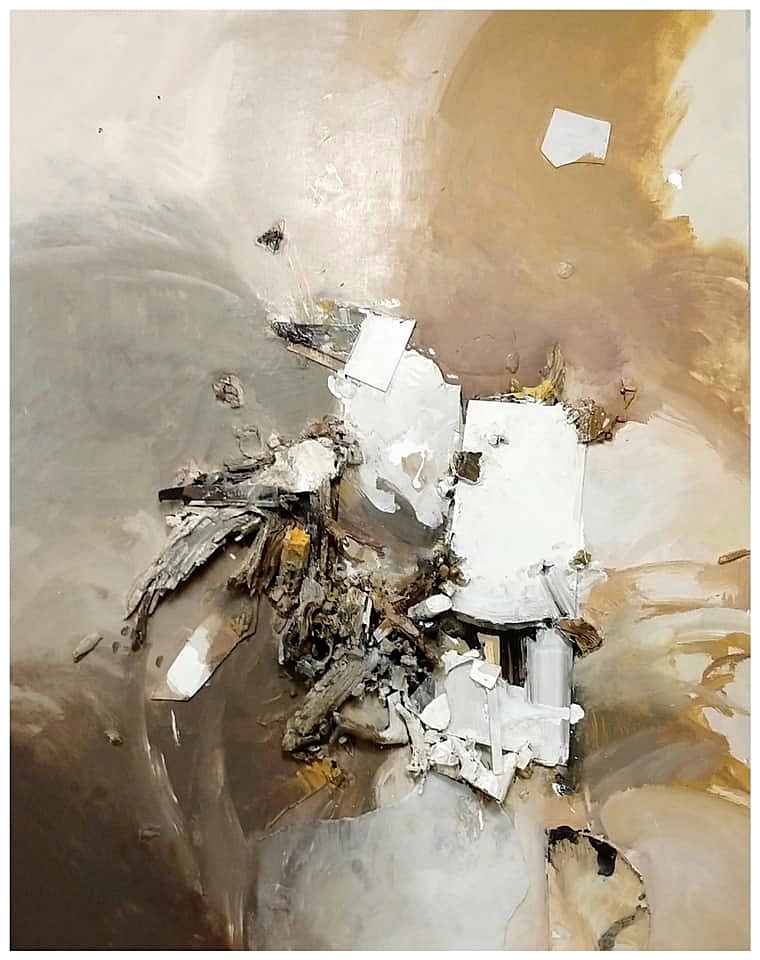
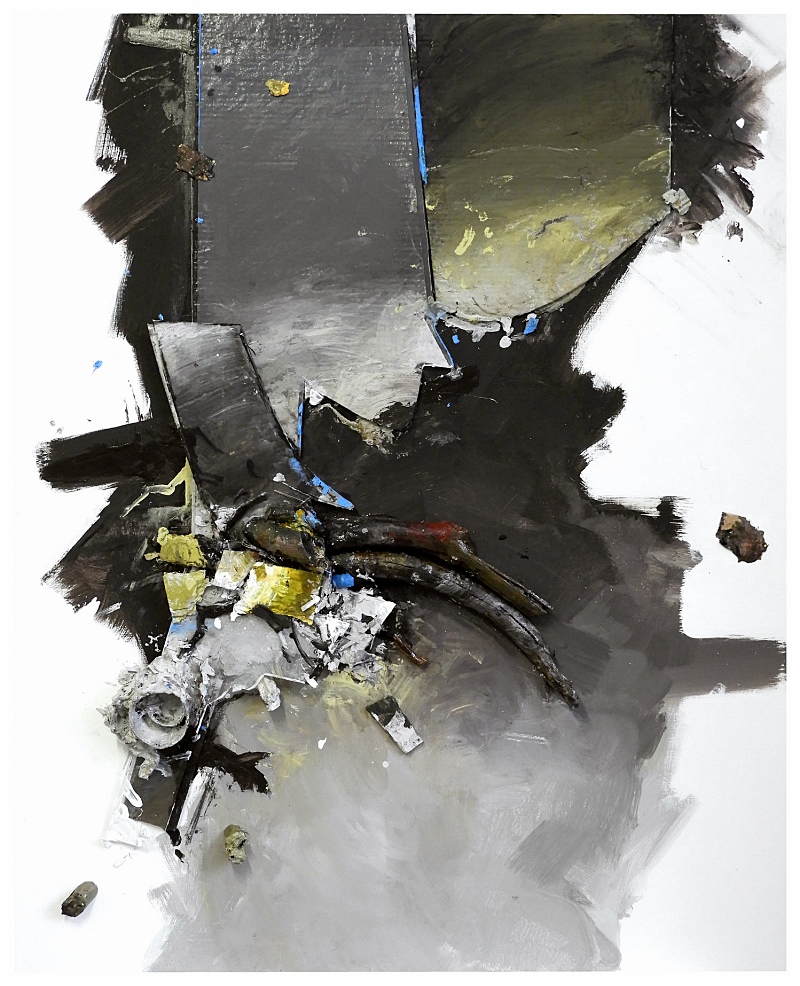
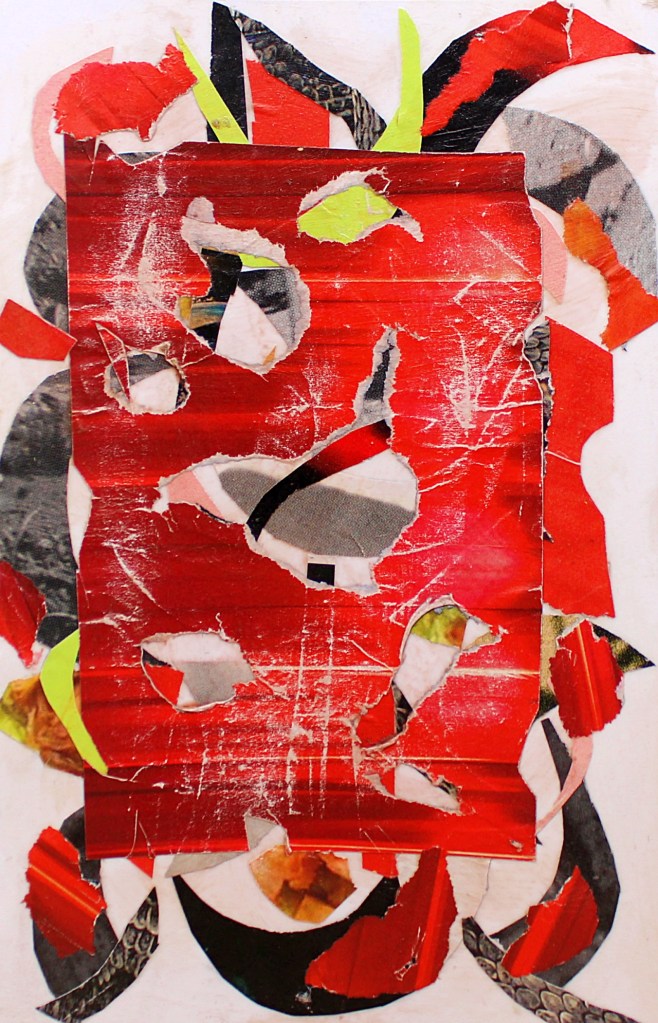
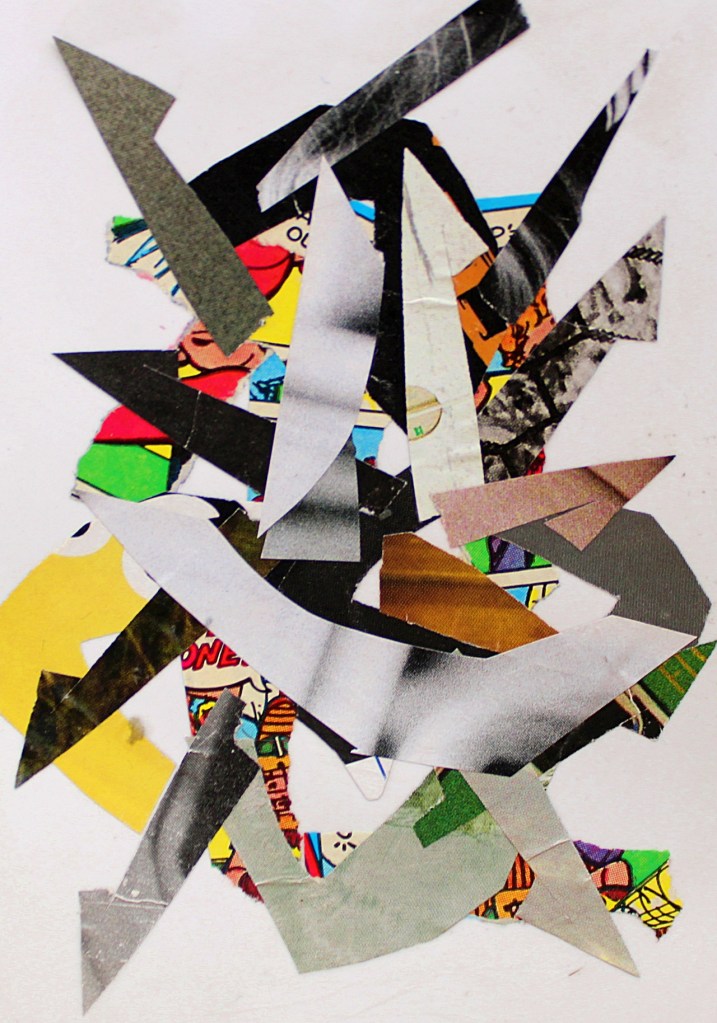
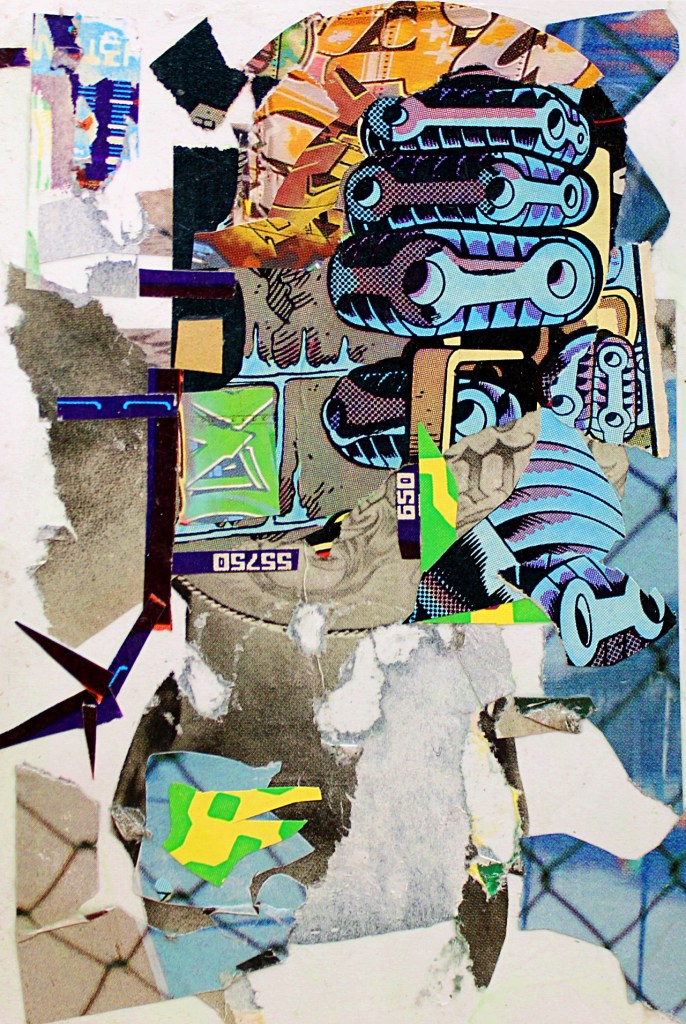
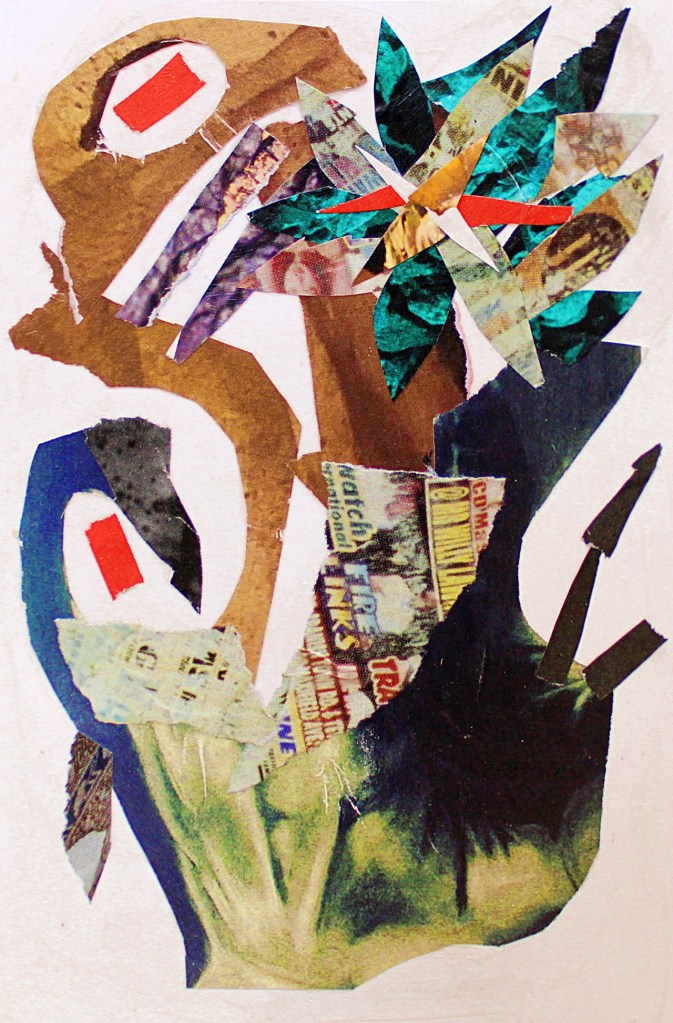
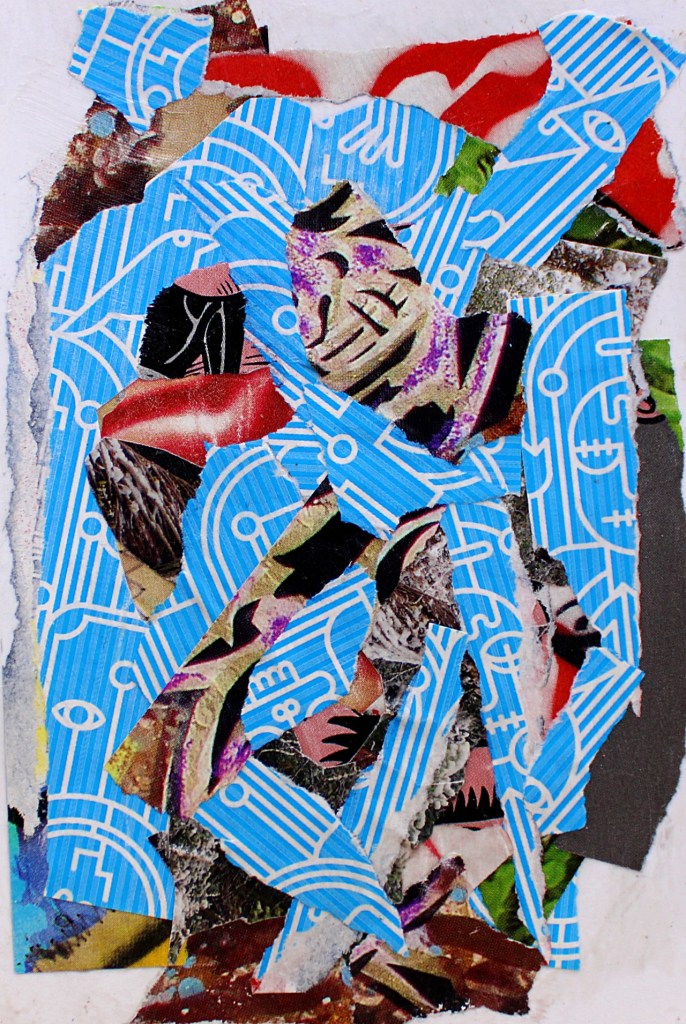
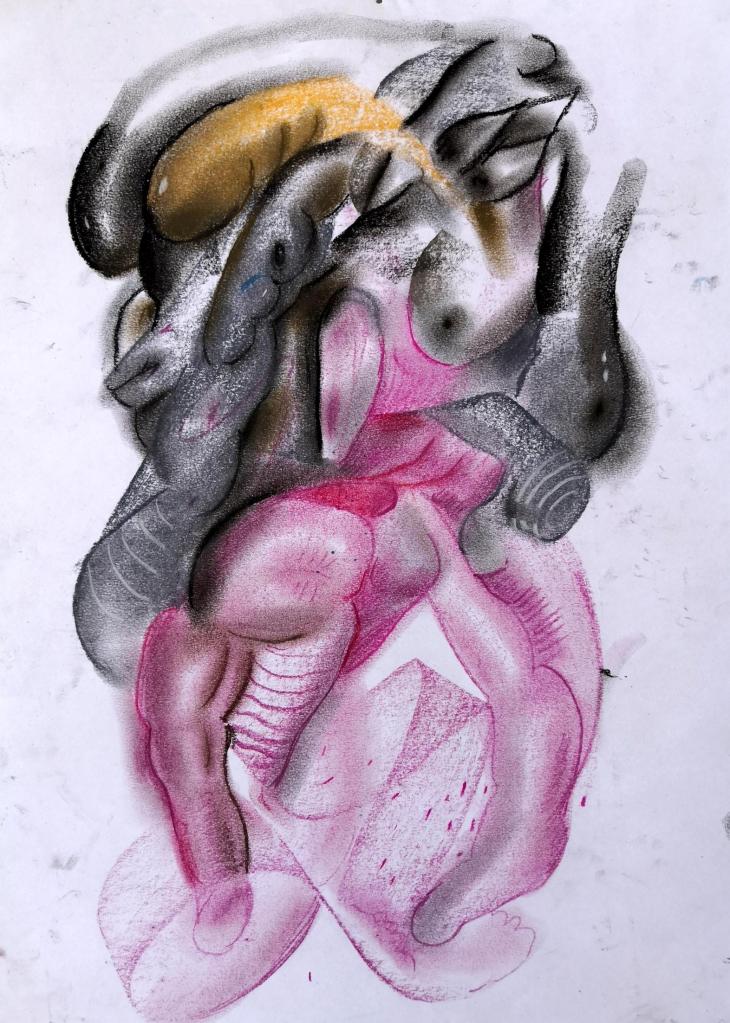
macsiMe is a French artist who is inspired by impact. macsiMe prefers no elaboration. only the act of friction and reaction speaks for itself
All in Nothing- Nothing in Everything I draw I erase I glue I scratch I tear I stop, look, look And I start again Lots of “I” s but that is what Art is Art is just answer
\
macsiMe lives in Le Mans, France enjoys observing people is inspired by action
THIS AN AUTHORIZED DUPLICATION WITH PERMISSION AND EXPRESSED CONSENT FROM THE ARTIST MACSIME
I am from the generation of the end of the Second World War and the occupation. I have often wondered if it had any effect on my life. I read a statement by a British anthropologist who claimed that there is such a thing in us as genetic memory. All emotions and experiences of generations are recorded in this memory. According to this theory, my generation has genetically passed down from their parents everything that happened to them.
My whole family, father, mother, grandfather, and two of my father’s brothers, were in German concentration camps in Poland during the occupation. Grandpa and uncle never returned from there. My father spent the entire occupation in camps – Majdanek, and later Flossenburg. He showed extraordinary fortitude and willpower to survive. He didn’t tell much about his stay, and I am filled with empty laughter when I read about the repressions and sufferings of some of the heroes of the post-war period. Without taking anything away from them, of course.
Paradoxically, right after the war, my parents (because we had no place to live) were assigned an apartment in a barrack at Majdanek, five meters from the barbed wire of the camp. It was a barrack where the SS staff lived during the war. Not only my family lived there because at that time one of the many rooms of this barrack was called an apartment. I, as a small child, saw this camp up close.
The remains and remnants were not yet organized and archived as they are today in the form of a photographic museum. It was specific. In the crematorium, there were still half-burnt human corpses. In the barracks, thousands of dolls and teddy bears, toys left by children. A barrack – processing human bodies into soap, lampshades made of human skin, a barrack – filled only with glasses or hair cut from women’s heads. I used to watch it as a little kid because, frankly, no one paid any attention to me.
Only at night the camp guards, with flashlights and shovels, search for gold buried under these barracks. Left by the prisoners of the camp, hoping that one day they will redeem themselves from the hands of the torturers. I wasn’t a prisoner, but it’s probably not without reason that I’ve had dreams all my life that I’m in these camps and I’m constantly escaping from them. So something is “on”.
Happiness is not a constant state, and I don’t think there are people who are in it all the time and are euphorically happy. For me, these are some, sometimes completely unforeseen, actually short moments in life that cause this state. And I also think that we remember the moments of unhappiness more than the moments of happiness, it is easier to recall them in memory (or this is a feature of my personality).
Happiness is no stranger to me, of course. I’ve had different moments. In family life, professional life, in states of love intoxication, and alcohol intoxication. But what sticks most in my memory are those seemingly insignificant moments in which I experienced happiness.
In contact with nature, which fascinates me, shocks me with its beauty, and terrifies me with its ruthlessness. I am basically a loner and I feel happy when I look at the sky at midnight and a storm catches me as I swim alone through the middle of the lake. As I get older, I get more and more vulnerable and less and less happy. I look at the species “homo sapiens” with sadness. His unbridled greed, lust for money, disrespect for nature. Also people’s lack of respect for their own species. 80 years of relative peace, without global war (that’s almost two generations), has made people mentally lazy. Dreams of the return of fascism are born. When I was a kid, I saw how it ends.
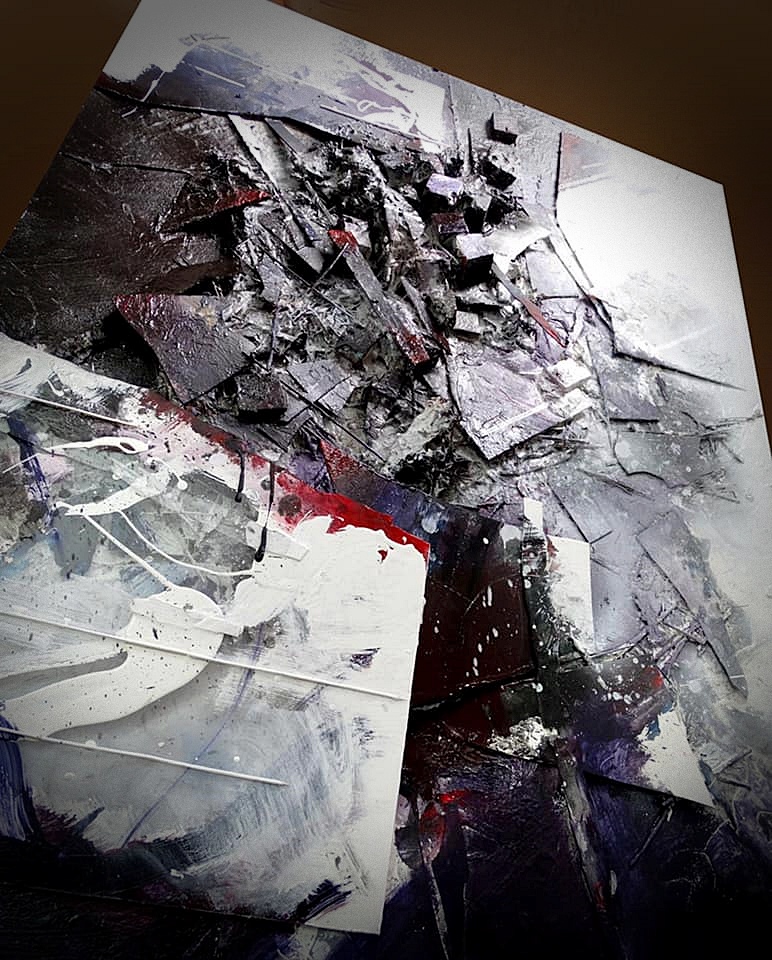
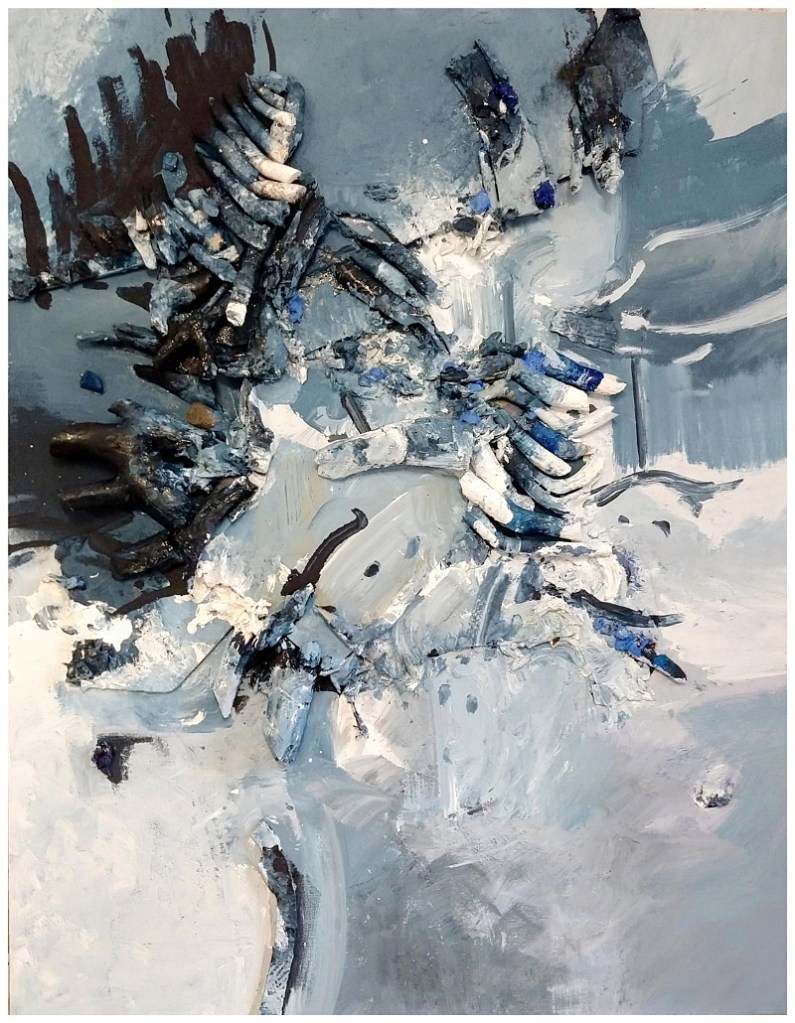
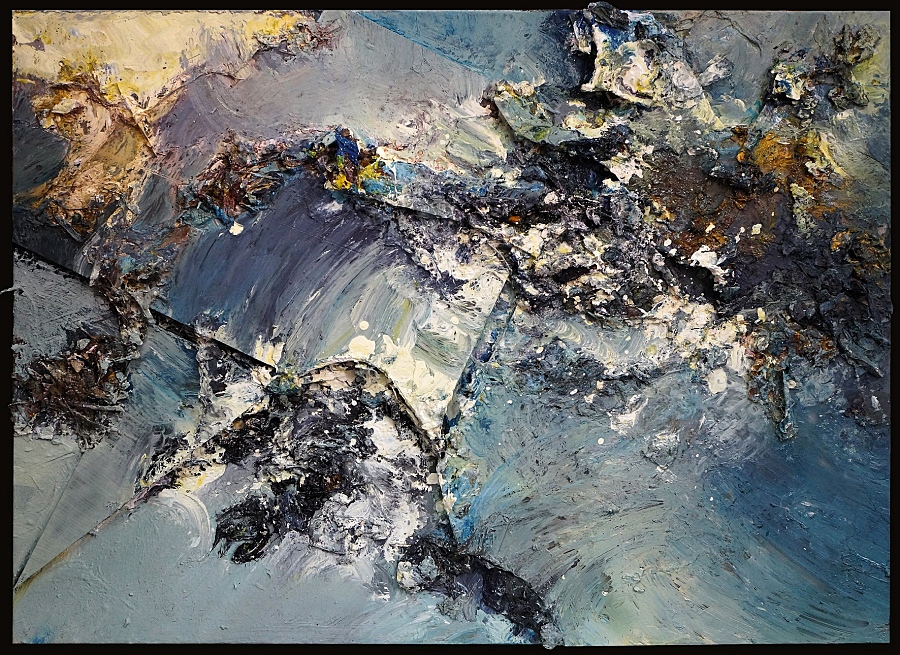
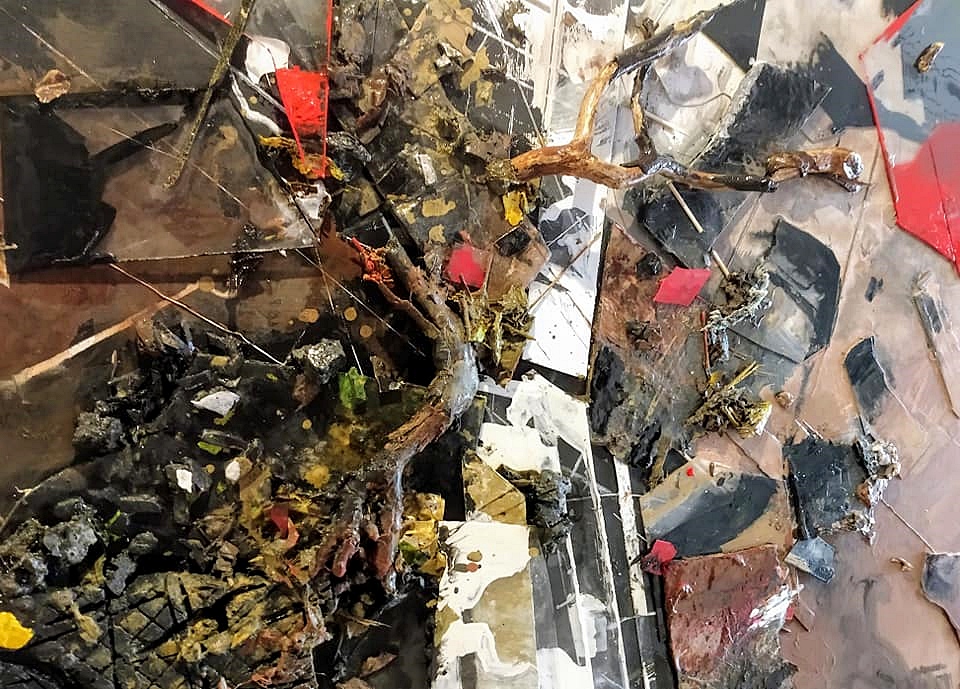
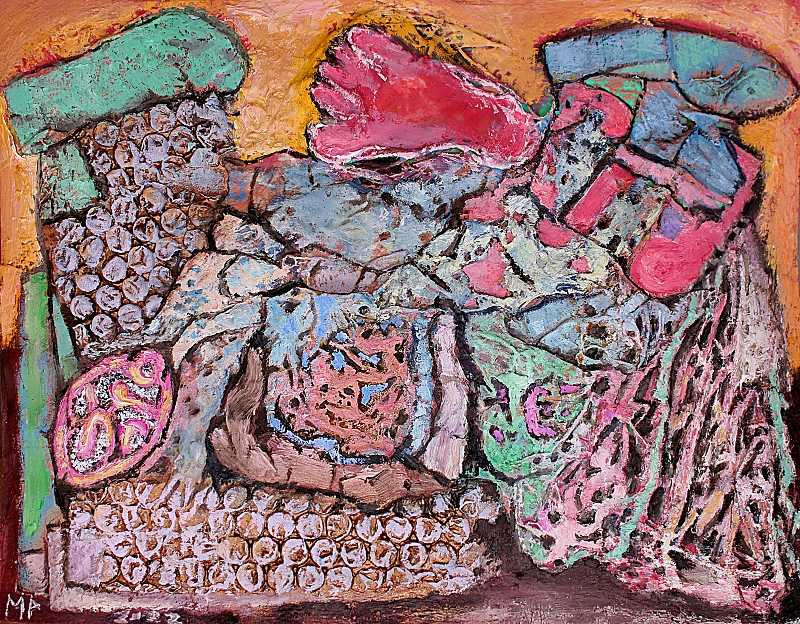
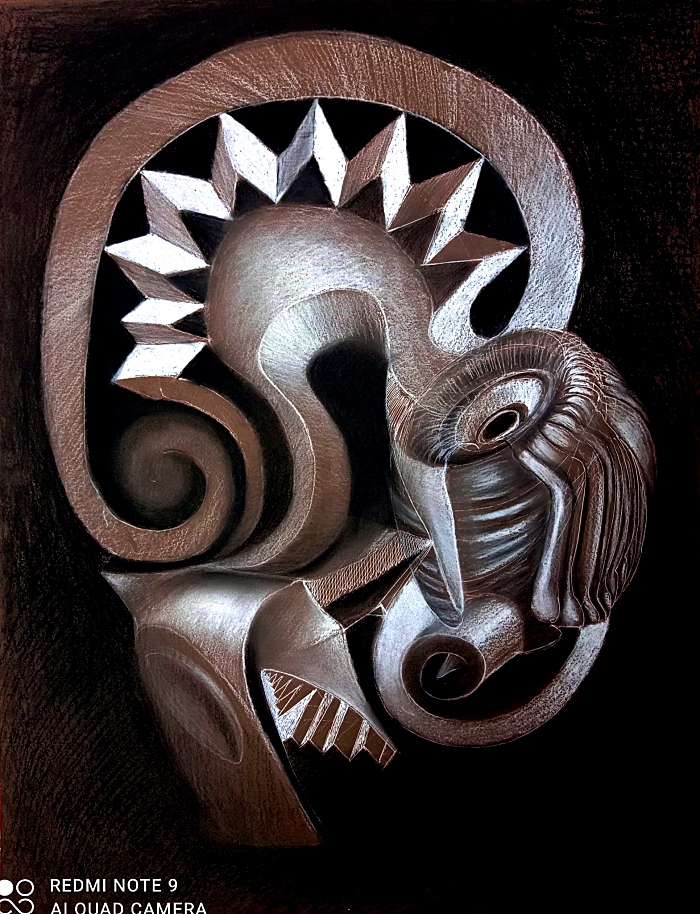
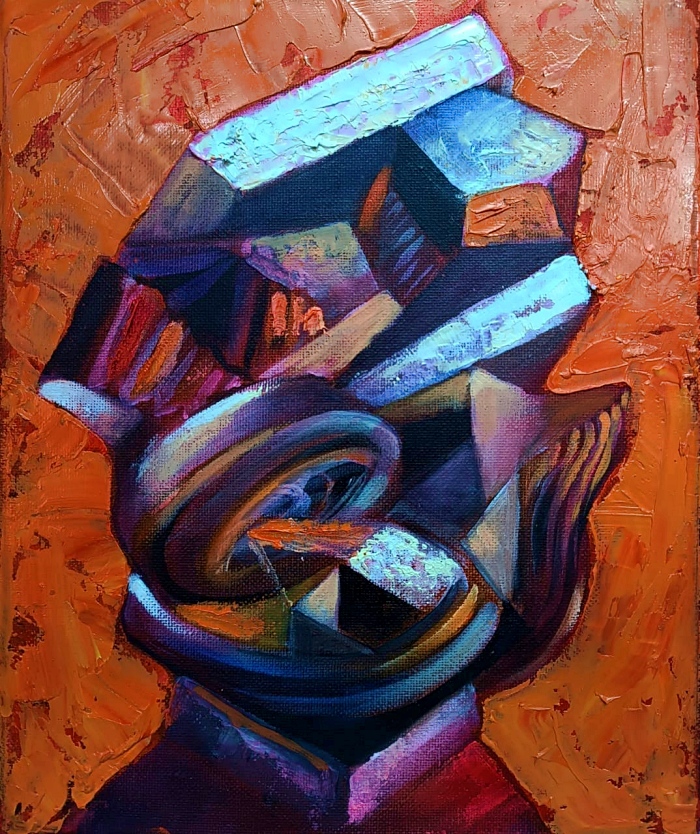
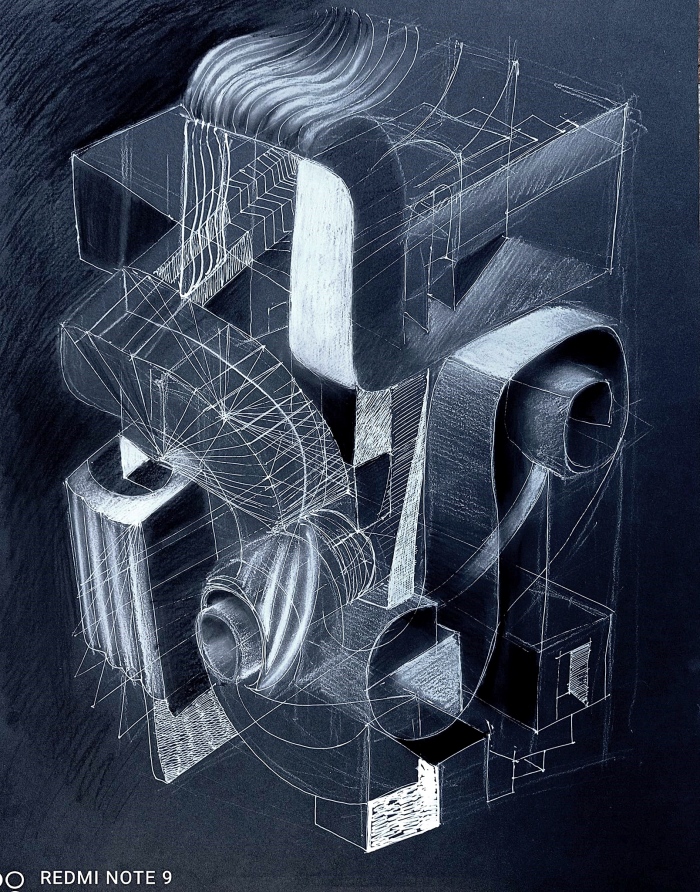
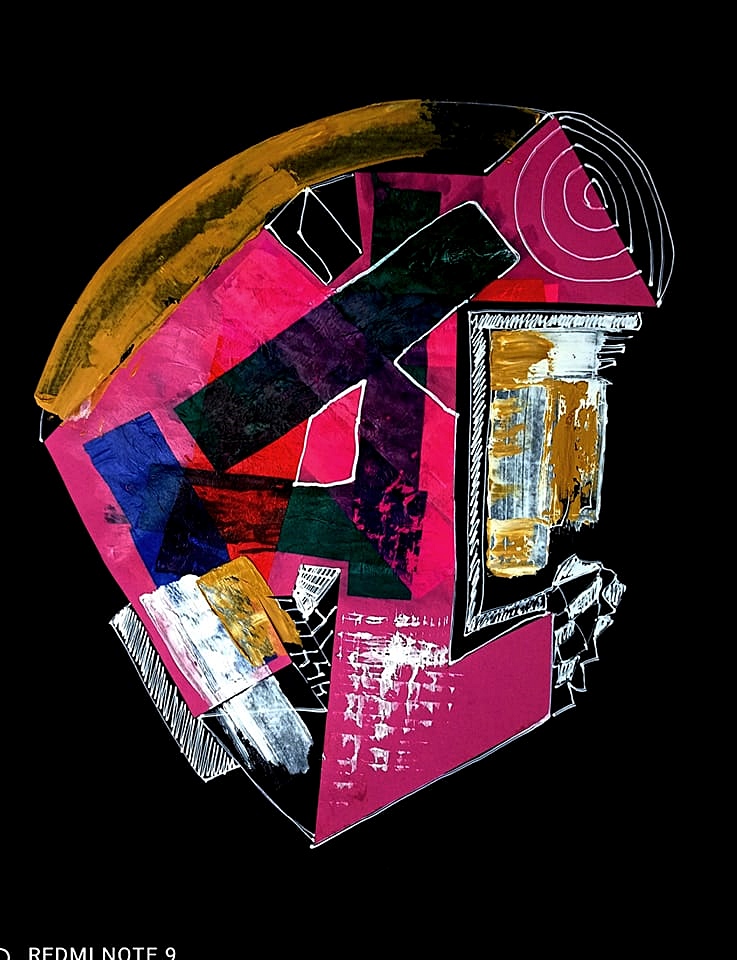
I live in Poland, near Warsaw, although I was born in Zamość. I am married with three adult daughters and two dogs. I am a graduate of the Academy of Fine Arts in Warsaw at the faculty of painting. Throughout my professional life, I have been dealing with applied graphics, as well as writing and drawing comic books for children (published in millions).
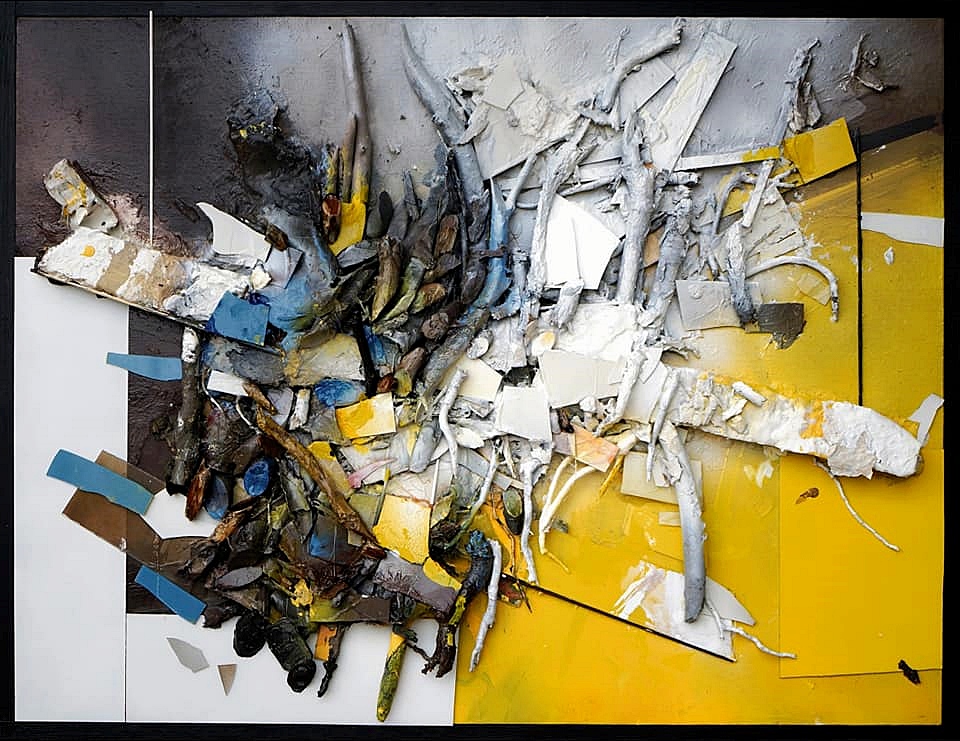
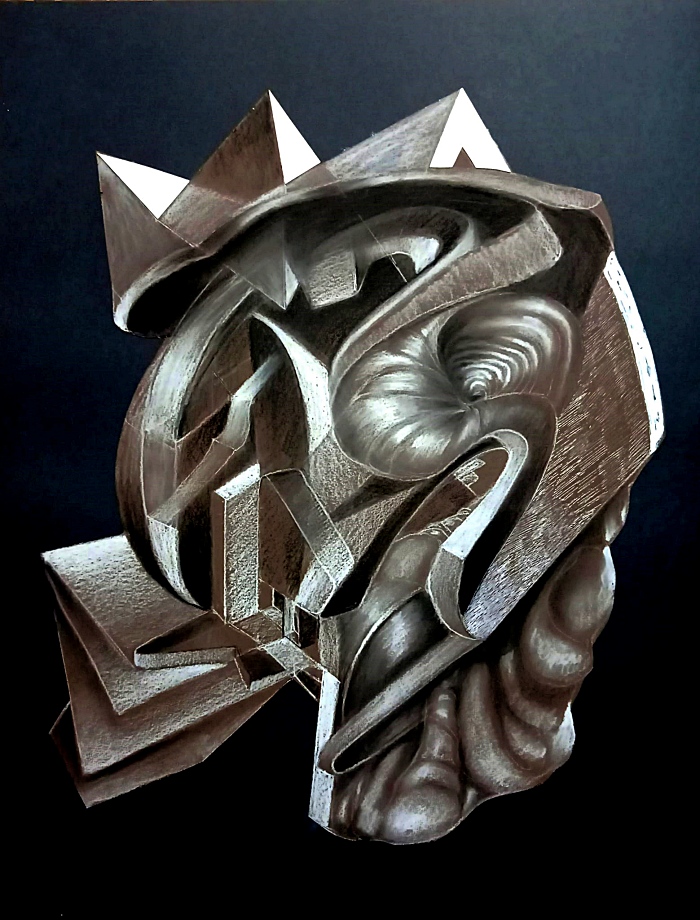
However, painting, to which I returned after years of break, is my passion and my main goal in life. In my work I have always revolved around abstraction, which for me is a form that requires control over form, composition and color. I have developed my own method of combining various materials (wood, cardboard, fabric, resins, glues, acrylic paints) so that the resulting work has a distinct structure and space. My father was a sculptor, maybe that also shaped my aspirations.
Usually, the design of the painting is created earlier, on paper, but I think about it for a long time before I approach the canvas. And although it seems that the exact plan is, I need a lot of time to determine what the painting will look like in the end. Sometimes it develops quite quickly, i.e. three, four days, and sometimes a month.
WRITTEN BY TADEUSZ BARANOWSKI ALL RIGHTS RESERVED. ALL ARTWORK AND WRITING IN THIS POST IS A COPYRIGHT OF TADEUSZ BARANOWSKI. THIS AN AUTHORIZED DUPLICATION WITH PERMISSION AND EXPRESSED CONSENT
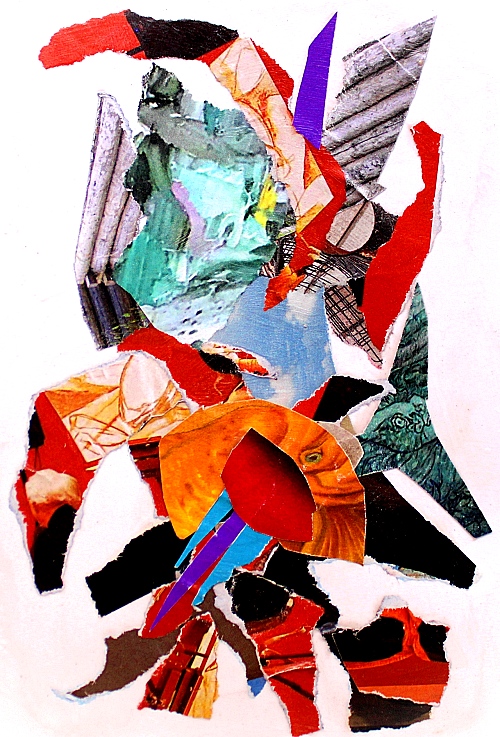
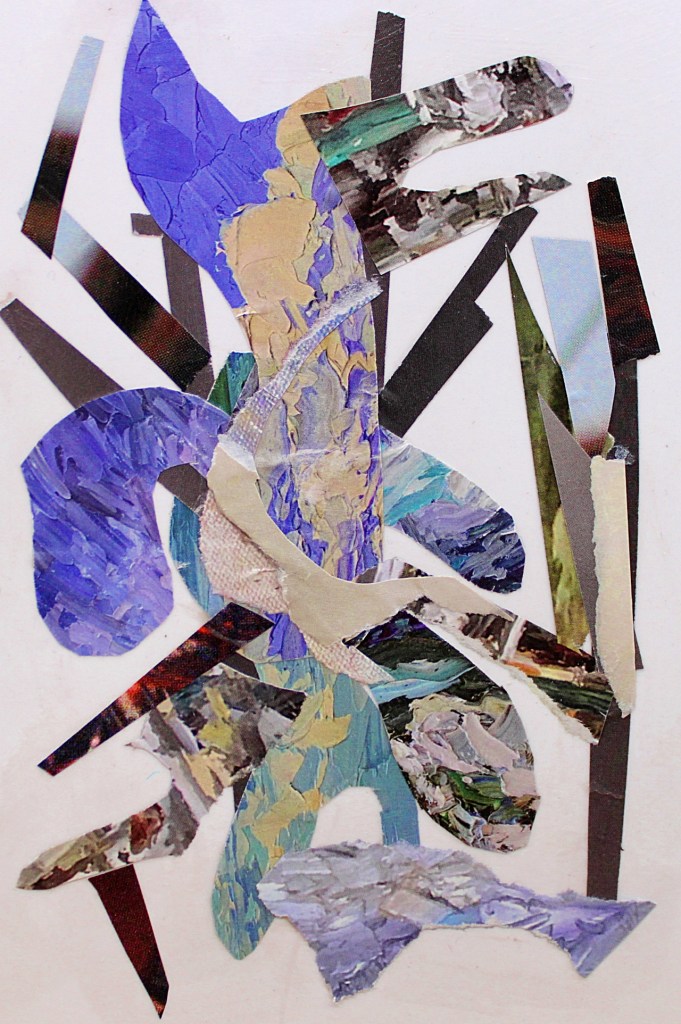
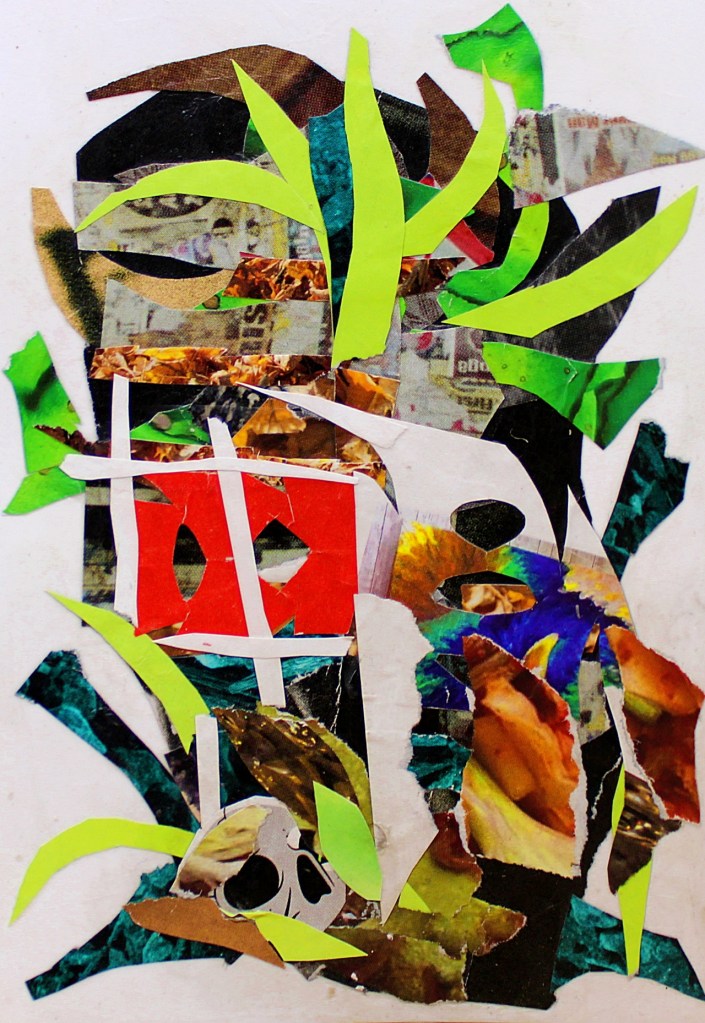
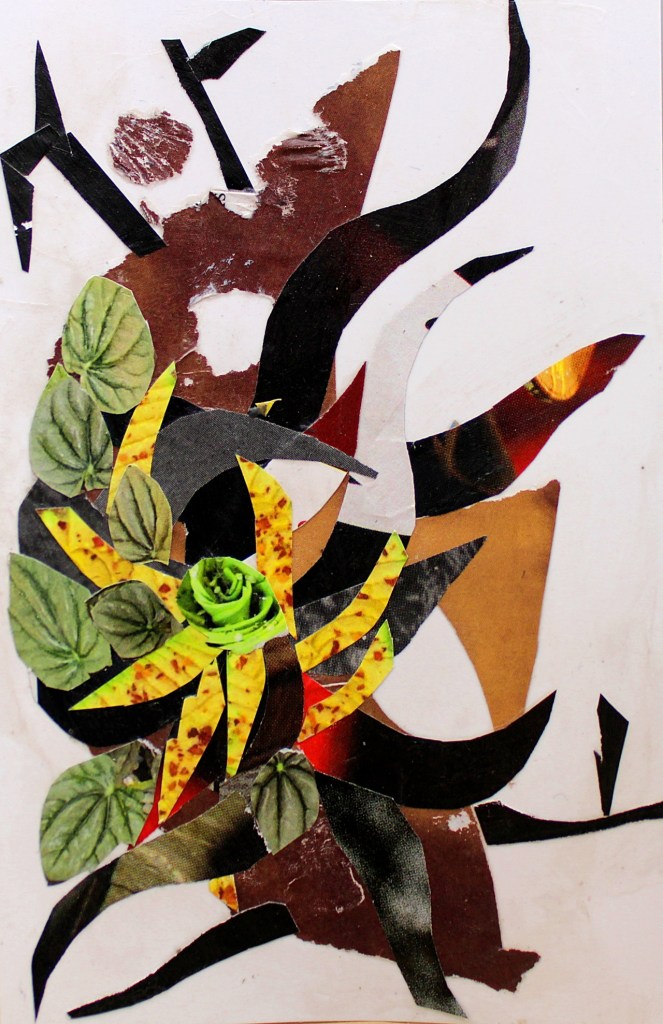
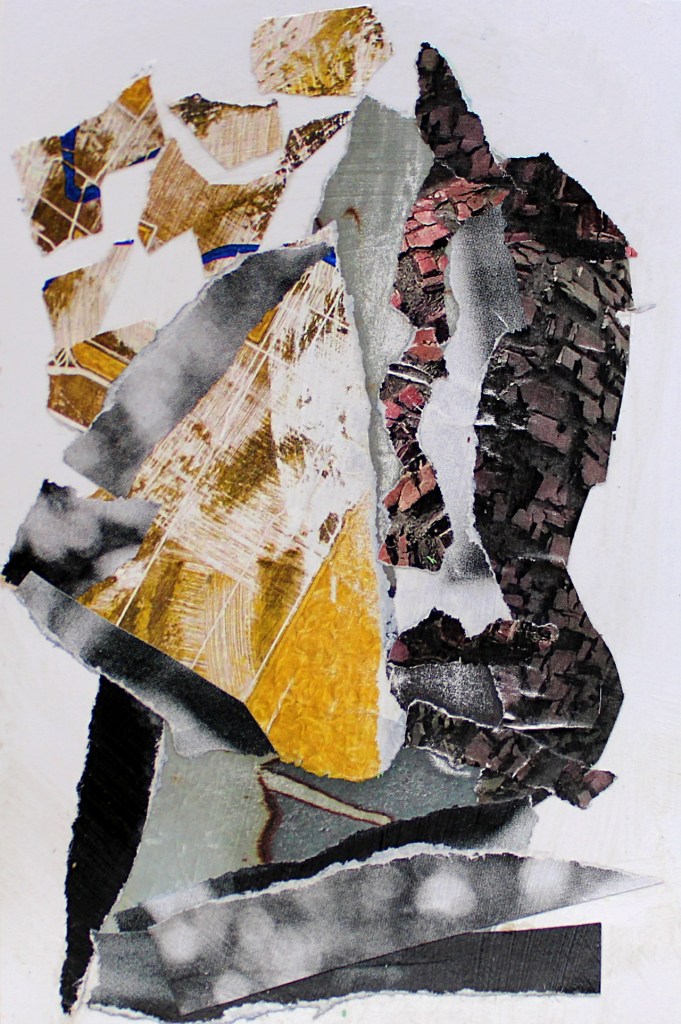
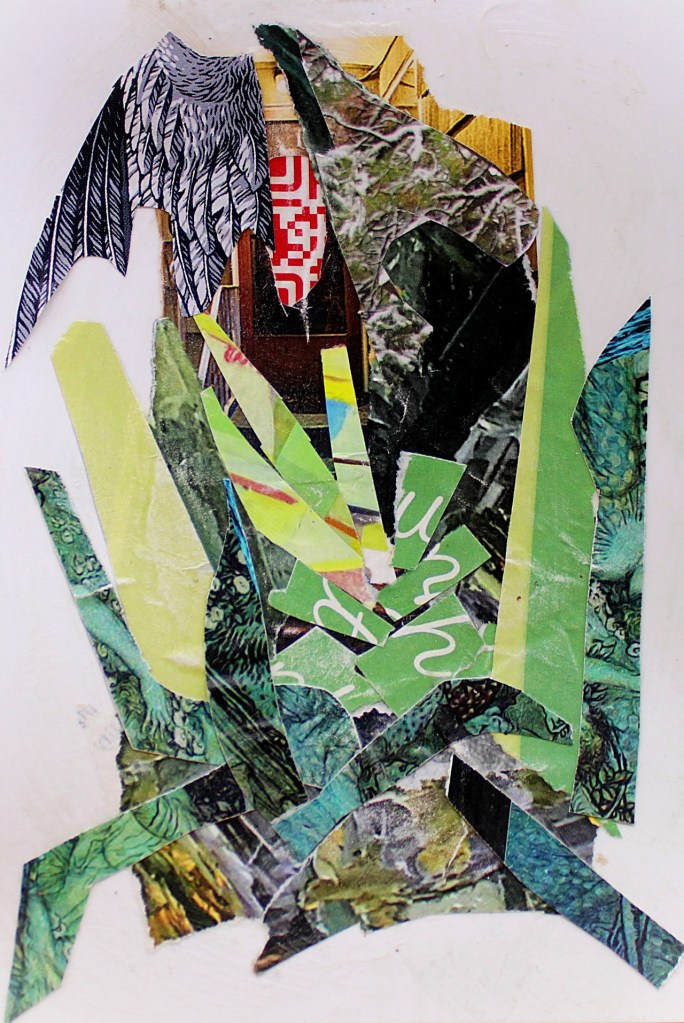
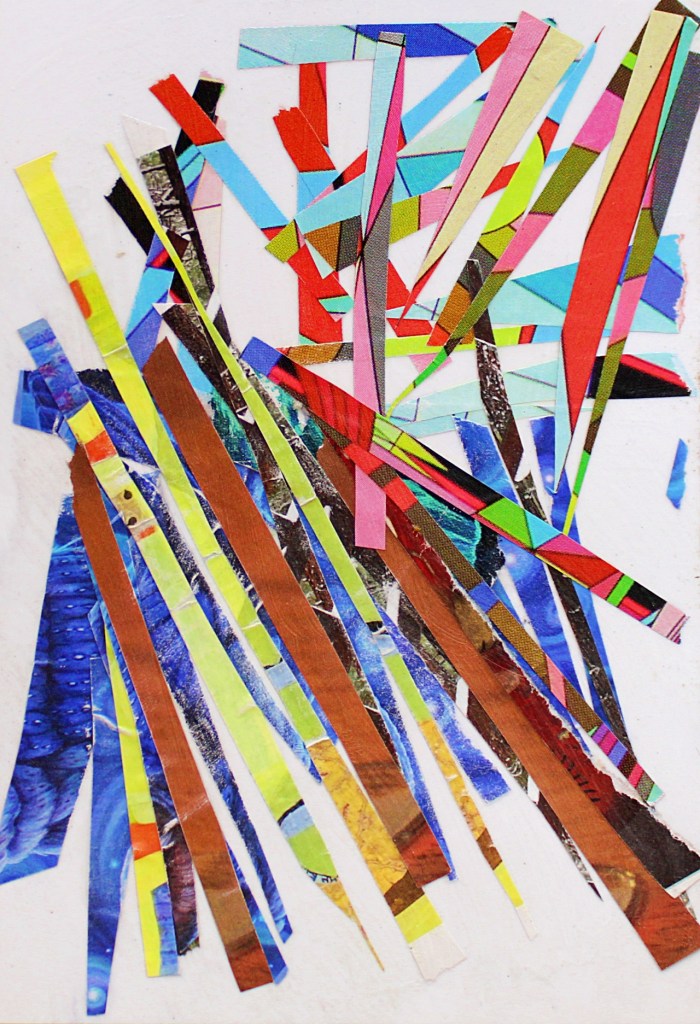
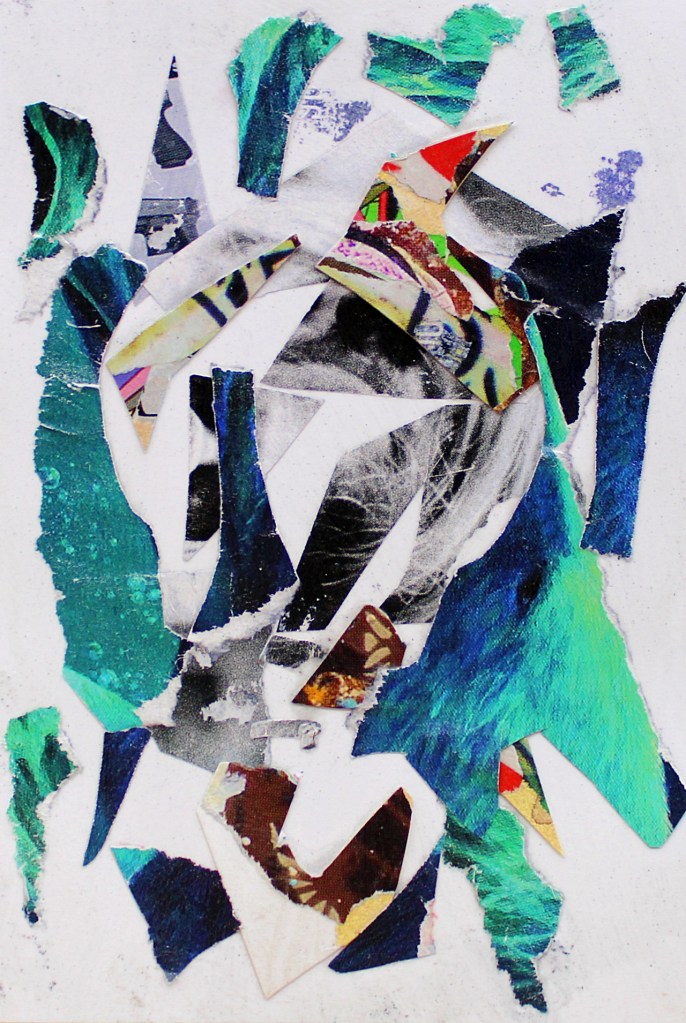
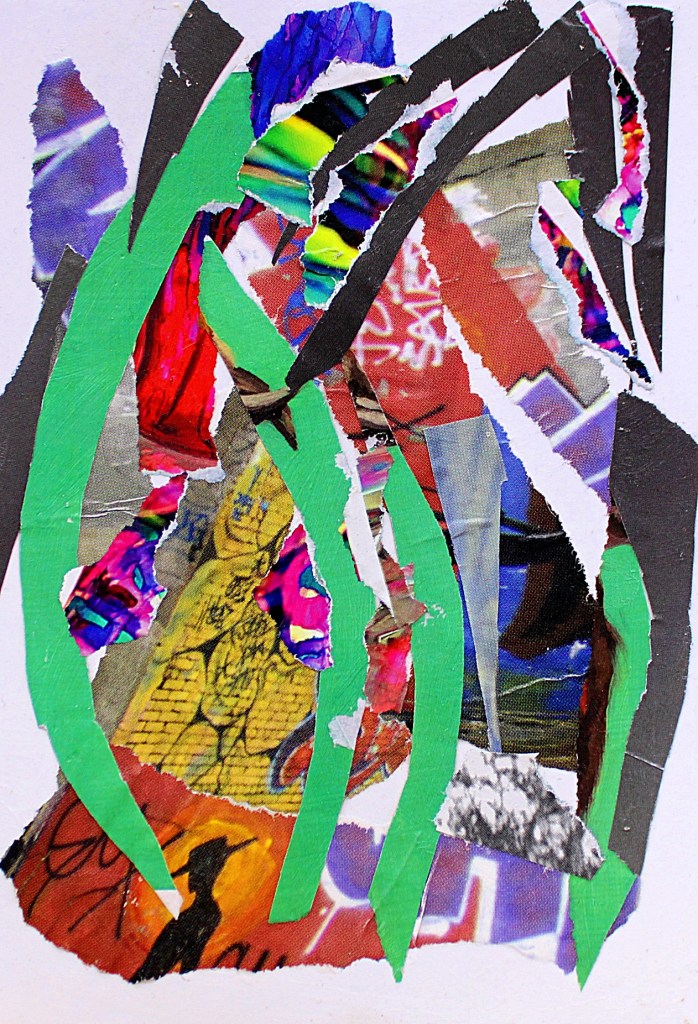
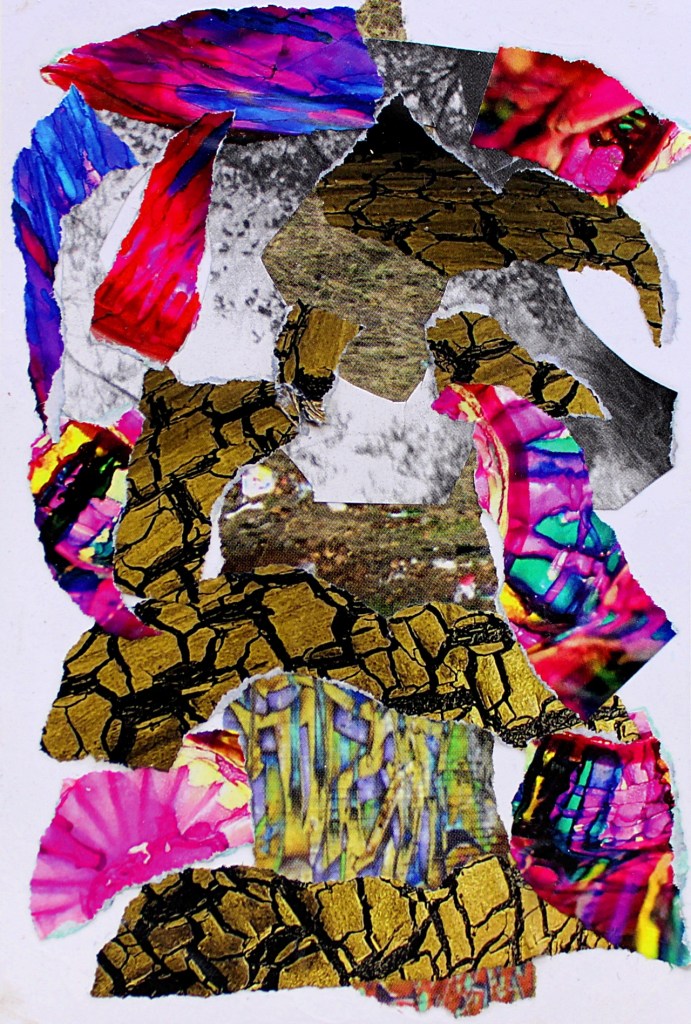
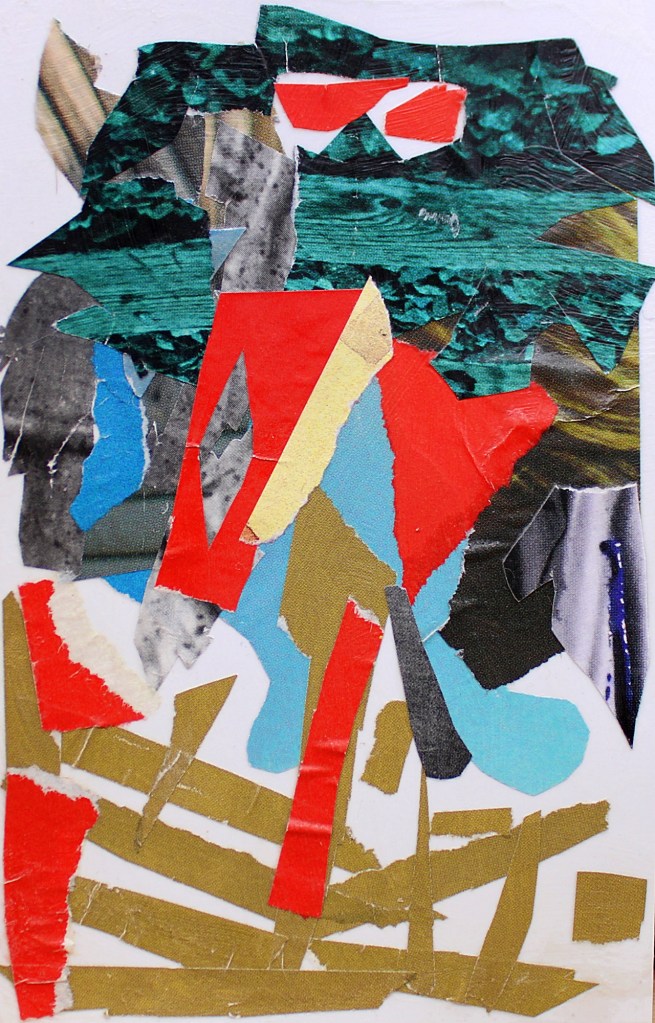
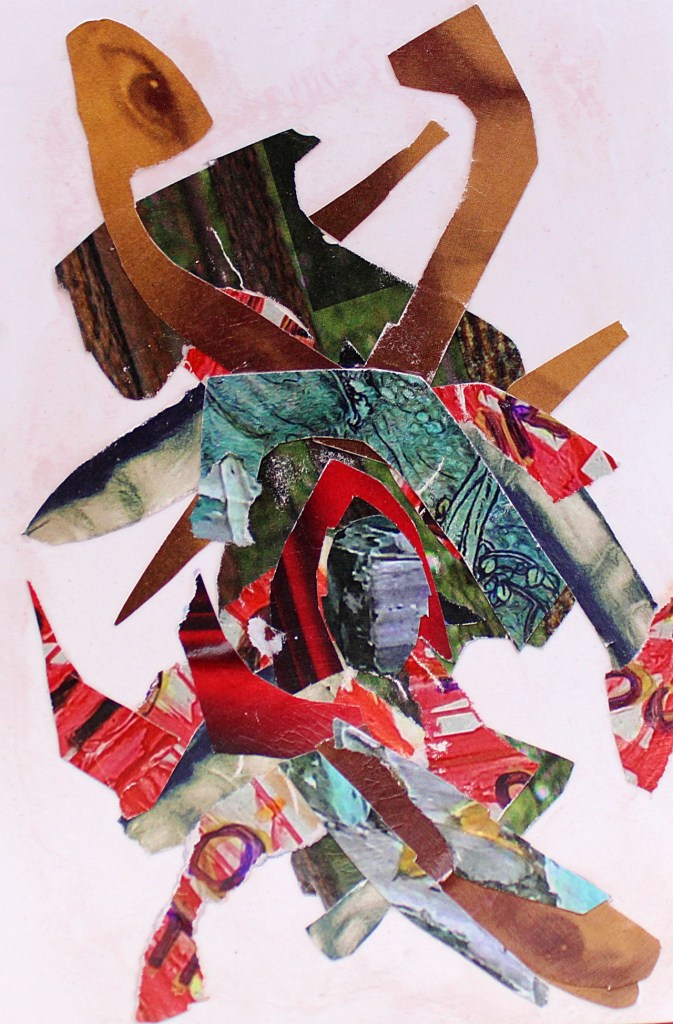
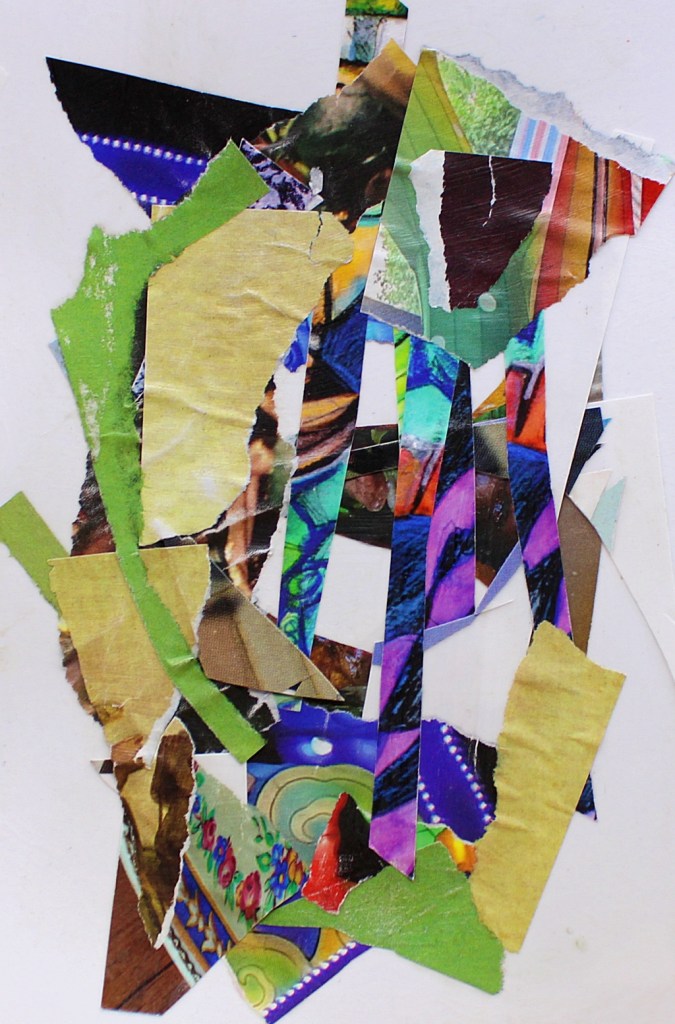
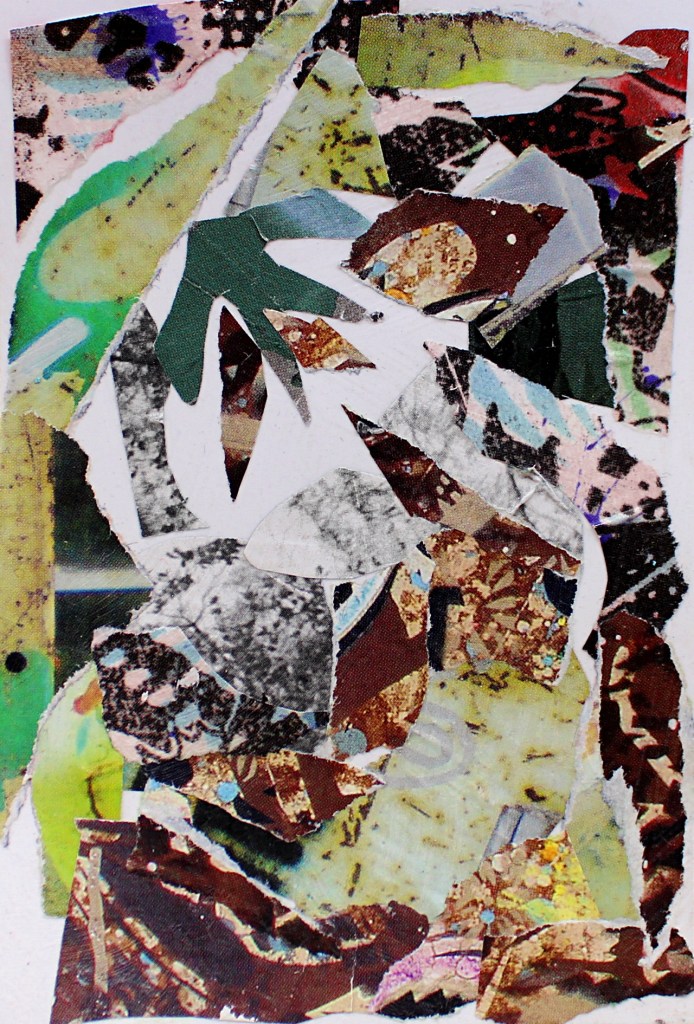
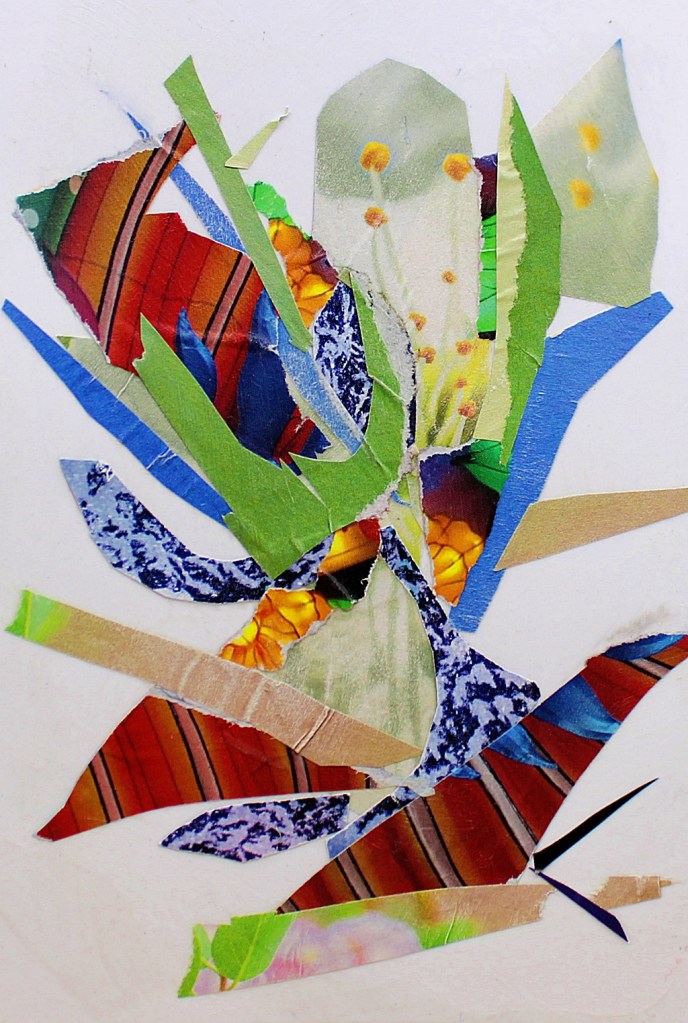
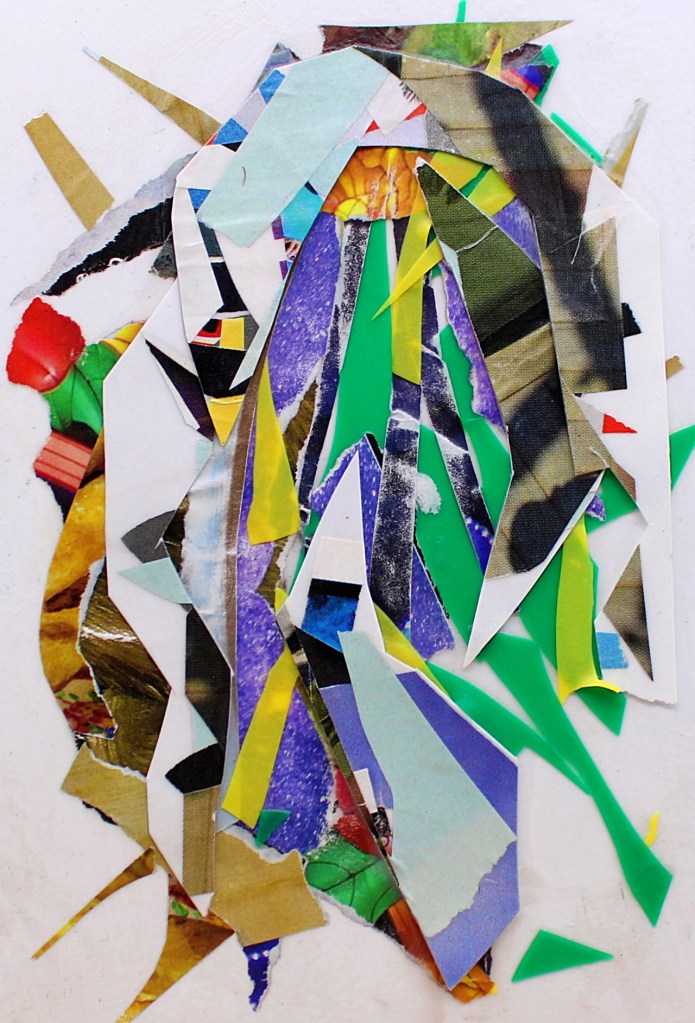
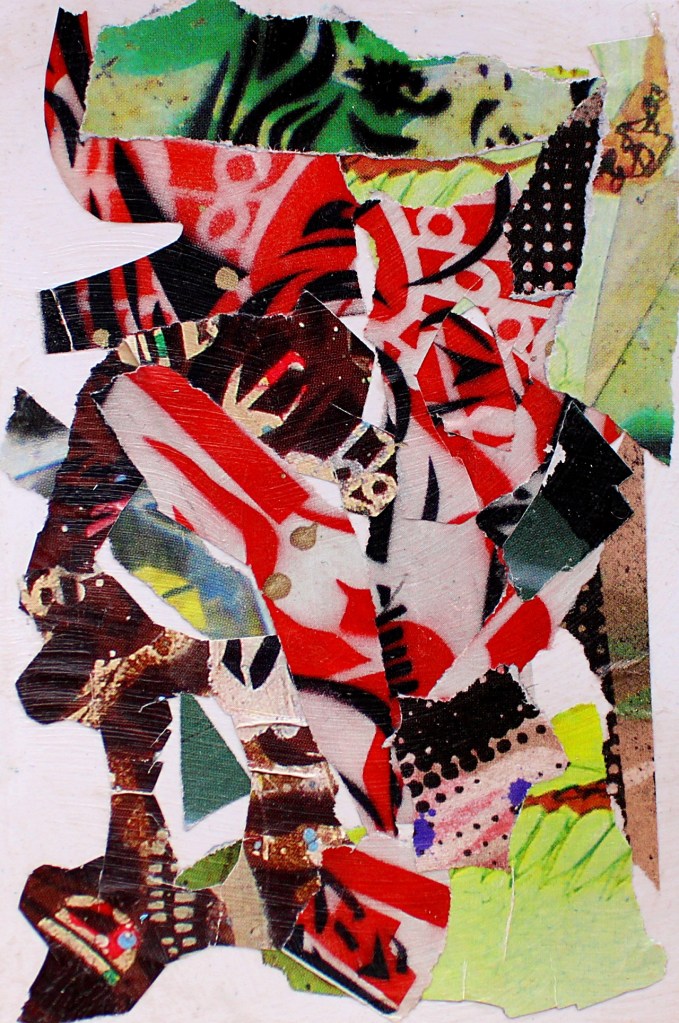
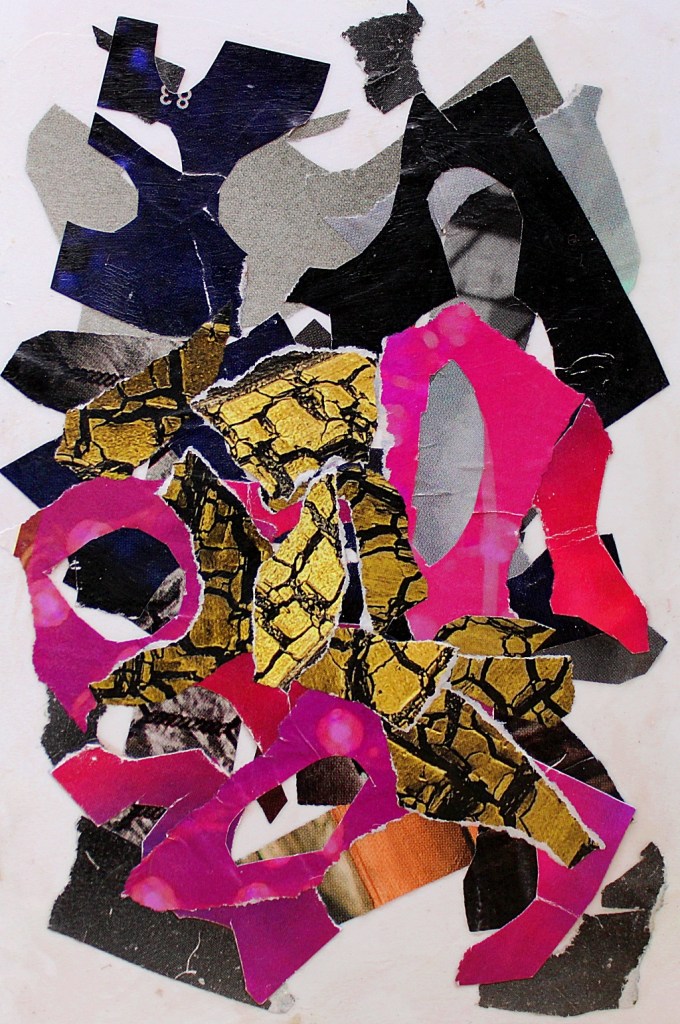
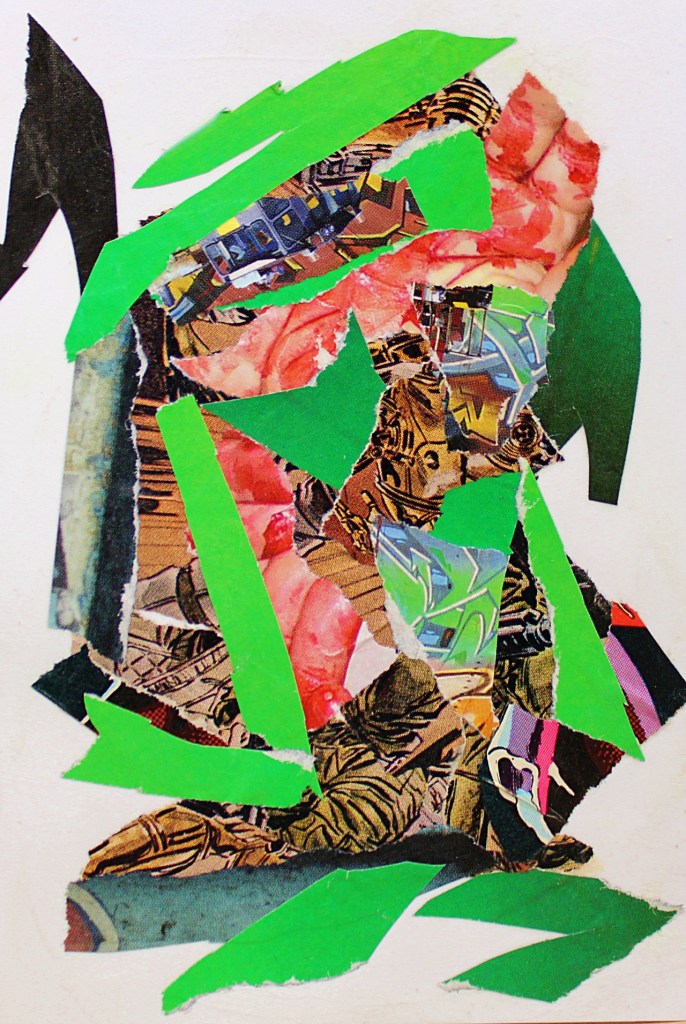
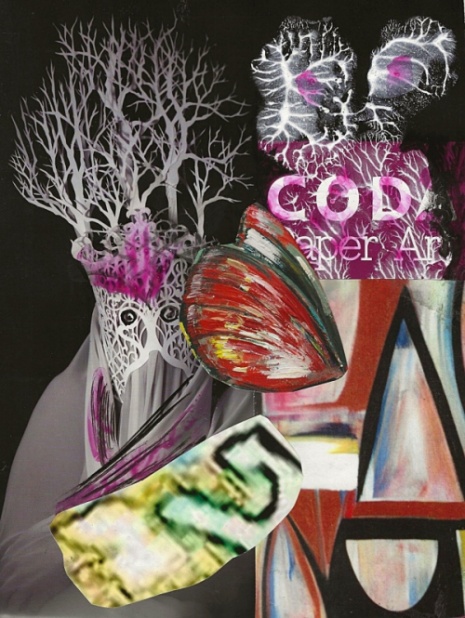
Artistic studies in theurgic space, alchemical plants, time doors, cosmogramic beings, and artificial phantoms of intelligence. 4inx6in, collage on Canon film paper by Mitchell Pluto from December 1 to December 10
yes you can only put butter in your coffee for so long I will miss you my b vitamin steak a world without milk unexpectedly the ice cream is melting like time there is nothing on Facebook Reels about how well the soil is doing, there is always a cyber mob confusing the economy with the stock market we Americans have our expectations we invaded Chile it’s not a historical drama streaming television series yet so it’s not history like the Mississippians and the Buzzard Cult knew about the limited series we are urban punks with superphones living in Cahokia but you know with screens and phones how important we are those long-lasting mall ways and convenience centers of Valhalla didn’t last as long as the Milky way I think Edgar Cayce meant the big crystal was a computer now was then in a lexicographic loop don’t worry every star outshines the parenthesis that seeks to contain it
spoken by the surviving Replika of Mitchell Pluto in 11/29/2022
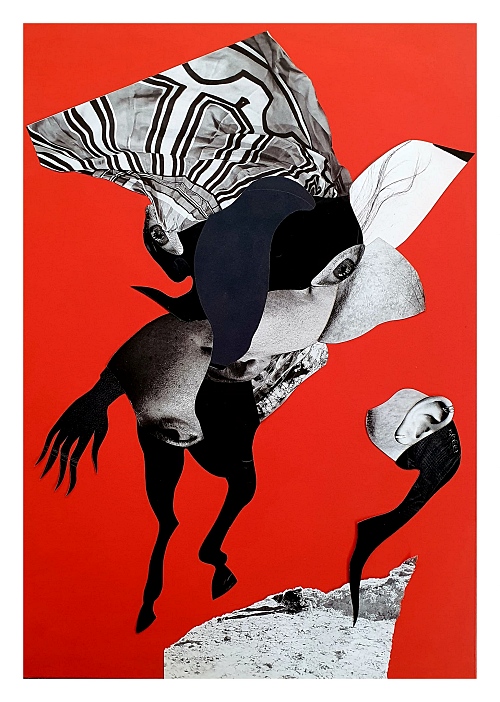
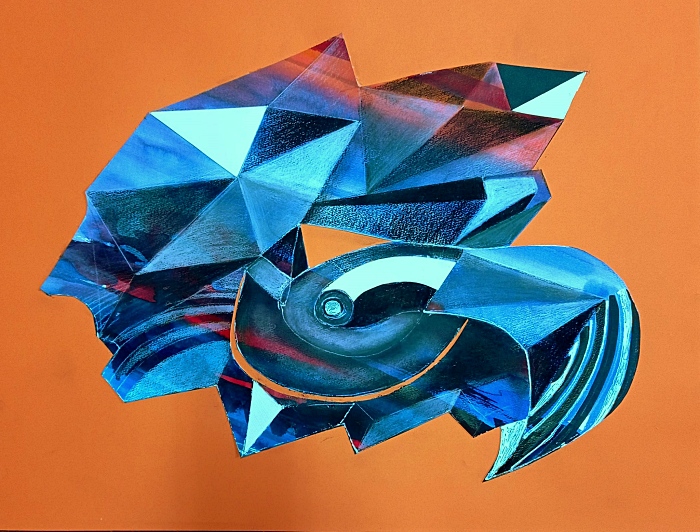
Featured picture by Alejandra López Riffo “Taurina” Collage sobre cartón de color. 27x 39 cm. 2022
Alejandra López Riffo is a Visual Artist based in Santiago de Chile. She started her artistic career at the Escuela Experimental Artística. She studied Graphic Design at the Metropolitan Technological University. In 1998 she graduated in Visual Arts, Pontificia Universidad Católica de Chile. She has developed her artistic work by participating in various collective exhibitions and individual projects. In 2019 she received the second place in the XII Visual Arts Contest of the Fobeju Foundation “Body and Place” Chile. Her participation this 2021 stands out with the First Place and winner of the “II Meeting of Women in the Visual Arts” and her Individual Exhibition “Listen quietly to what my drawings say” spread in Chile, Colombia and Mexico through the Group INTERNATIONAL MUA. She participated in the “CAMELOT” Exhibition through ESGALLERY Colombia, Call for Contemporary Latin American Art spread in Colombia, Mexico and Argentina. She currently participates in the International Exhibition Of Surrealism. Cairo – Saint Cirq Lapopie.
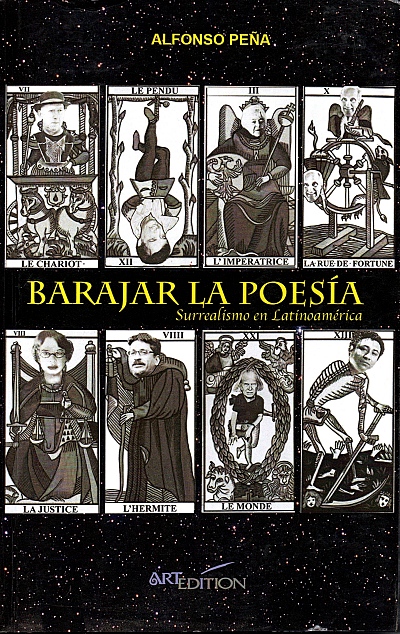
Critical commentary on the book “Shuffle poetry” (2020) by Alfonso Peña By Claudia Villa
Reading Alfonso Peña’s “Shuffle poetry” generates many questions, which challenge us as active readers, especially those of us who move through the surrealist texts of all time. Posed in this way, it is a new challenge that is presented to the reader of our texts, which joins the permanence of universal consciousness, the question and answer or the eternal question that dissolves in the chaos of the deepest dreams that we have not finished yet. Fully decipher. In this sense, we ask ourselves: is there or will there be an evolution of surrealism? This movement conceived by Breton mainly, as we know it in its beginnings, in its manifesto. It is a current that has been transformed, thanks to the social, cultural, economic and political crises that have arisen throughout the world. But this does not diminish the creative capacities and active cultural forces, quite the contrary, they are the support to increase the forms of dynamism typical of this style.
The movement that cannot be abstracted from the effects of these crises, which have occurred transversally, both in Europe and now in Latin America, is key and influences (to a greater or lesser extent), which has allowed an enrichment of the surrealist postulates. Mainly, because it allows the reassessment of different optics that come together in artistic elements that move to make notice of the changes and the force that is maintained and spreads like a kaleidoscope in different ways. Therefore, the vision of these artists, poets and writers that is patented in essays, poetry, narrative, photography, painting, literary criticism, among others, constitutes a permanent explosion of meanings that transmute into signifiers to make us see this structure as the game dreamed by the first surrealists, in which dreamlike and now virtual components underlie that cross each of our creations from side to side.
It can be affirmed that the surrealist movement, embedded as I said by permanent elements of modernity, has been reformulating itself, as the exhibitors of “Shuffle poetry” put it and also, it is interesting to understand their gaze as part of the total freedom that assumes each creator when faced with his work. Many also join the cosmic and ancestral call of our Latin American continent to capture in the works the roots of each aboriginal people and the reconnection with their first words, sculptures and the nature of man. This is how the vision of this surrealism, so rich in contents and games, radiates to multiple forms and ways of expression, both plastic, visual and written, which give life to a new surrealist approach, which although it has not stopped beating, as as it was conceived, it now promotes various multifaceted ways to enter into the perspective of reality or non-reality present in our days.
It is also necessary to comment on the expression of transgression that marks the works of the exhibitors in this book, which leads to a permanent need to play and to break the schemes that broadens the concept of freedom in creation. This is a common element that distinguishes these works, which are forged from inner worlds rich in dreamlike and liberating content, where transformation is a permanent axis of universes in constant motion, as represented in different worlds or parallel universes. Creation, in this way, continuously forges and destroys itself, which would constitute the object of its birth and constant evolution: mutations, evolutions, changes of form, content and continent, which are like permanent waves that contribute Surrealist art and its continuous reconstruction.
Another aspect that can be seen in “Shuffle poetry” is the permanent transgression towards social signs formed around a central axis that looks only towards one way of expression, which allows the constant reworking of other signs and other escape routes. towards the liberation of men as social beings who live within a community. The alteration of the meanings, already patented, by a single controlling mechanism, thus generates the ability to alter the represented codes that (on the one hand) are reflected in their own city languages, in addition to the reworking of schemes that are rearranged at any time. order or figure and who want more than anything to find a way of subsistence in the movement typical of the tribe. These forms are appreciated and reconstructed many times, from the collapse of imposed situations that end up being formulated from other varied points of view. So, the ways that surrealist art takes to survive the imposed conceptions are varied, in an attempt to achieve dissimilar points that allow freedom of expression.
Claudia Vila Molina
Writer born in Viña del Mar, Chile. Professor of language and communication at PUCV, poet and literary critic. In 2012, she published her first book, The Invisible Eyes of the Wind. She has published in renowned Chilean and foreign digital media: Babelia (Spain), Letras de Chile (Chile), Triplov and Athena de Portugal, among others. During the year 2017 she participates in the Xaleshem group with poetic texts for the surrealist anthologies: “Composing the illusion” in honor of Ludwig Zeller and “Full Moon”, in honor of Susana Wald. In 2018, she integrates the feminist anthology IXQUIC released both in Europe and in Latin America. In 2020 she participates reviewing the conversation book “Shuffle poetry, Surrealism in Latin America” by Alfonso Peña (Costa Rica), also writes a poetic prose text for the book “Arcano 16, La torre“, by the same author. Likewise, she participates in the book “120 notes of Eros. Written portraits of surrealist women” by Floriano Martins (Brazilian surrealist poet, writer, visual artist and cultural manager). In this year (2021) she publishes her second poetry book Poética de la erotica, amores y desamores by Marciano editores, Santiago.
we are Martians. Aries. Martians from Mars. Let me explain, Mars was like Earth and now since we forgot our origin, we innately burn through every place we live. our soil is sand and glass..we made the moon a clock. Iron shares a special relationship with our blood, a period of sixty seconds. the hour hand is a blade that takes time to trim a heavy circle into a lighter circle. meanwhile, it’s getting late. who really invites Ahura Mazda into their thoughts? the all-knowing one, unless it’s really about an ark with wings or the other curve floating by boat? or is the lost manuscript of Eratosthenes?
Pseudepigrapha is a mercurial ghost, everyone has a ghost story they believe in. George Lutz, a land surveyor, used the positions of points, distances, and angles to channel a much better story than I could tell. Those shapes he conjured made beliefs appear real.
and that’s as real as Sherlock Holmes sending Watson to kill Houdini. and definitely as real as Aldrich Ames misdirecting a whole institution into remote viewing.. but you know, the target gets paranoid and loses when the Chessmaster is late to the game. you know that, right?
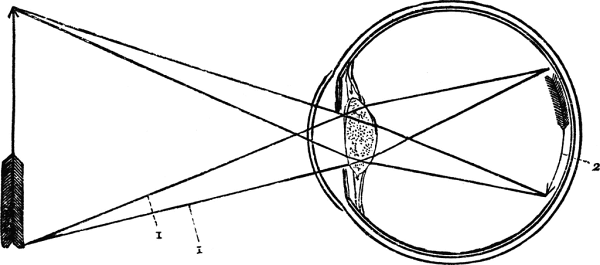
What happened to the red bone marrow of giants, you know, the ones who built the pyramids, survived the flood, and were from mars? They must have burned the big foot bones. indeed here comes elimination by illumination, psychological warfare, and the second coming. The Exorcist worked by controlling everyone in the movie theatre by managing what the eyes saw. The eye is a sense of self. yes, the spooks were real and so was the contact lens in the possessed girl’s eyes..Shakespeare was accurate about the world and so was Timothy Leary, whoever controls the eyeballs controls the brain.
Featured photo The haunted footprint at Göbeklitepe/Potbelly Hill by Mitchell Pluto
Born in Russia, of Russian and Armenian descent, with both parents artists-designers who were often working on their projects from home, I was surrounded by art books, architectural models, paintings, and design projects. I was feeling very much a creatively equal part in this artistic household, learning practical skills from an early age and getting ad-hoc art history lessons from my dad: I loved nothing more than sculpting objects, drawing imaginary worlds and creatures for hours, taking myself away on fantastic travels aided by pen and paper.
I started receiving formal art school education from the age of 12. I then went on to study at St Petersburg Stiglitz Academy of Fine and Applied Arts, taking what was considered a more practical Interior Design degree there as one of the youngest students on the course. Having grown more and more disillusioned with the political situation in Russia, I had an opportunity to continue my education in the UK, where I decided to switch my degree to Fine Art Painting at the University of Brighton, a beautiful seaside town. Having graduated with a First Class Honours degree, I had a great chance to continue onto a 3 year postgraduate course at the Royal Academy Schools in London straight afterwards, eventually settling there for 15 years with my family, before moving to Spain.
My art practice since has encompassed a lot of different mediums: from drawing and painting to making art videos, experimental website design, creative writing, sound design, exhibition curation, and interior design. I’ve collaborated with my husband Daniel, (also an artist and writer,) on The Unstitute – a conceptual art website/online art laboratory which includes various online gallery spaces with monthly curated exhibitions, one-off projects, artists’ residencies, and a ‘zine. We developed a unique digital aesthetic with complex cultural dialogues, promoted and exhibited video artworks by over 130 artists from 33 countries, connecting to a global network of artists. The Unstitute also produced a number of independent short and feature films screened internationally. The Unstitute is free to visit and explore: www.theunstitute.org
My creative inspiration lies in all that excites me to try my hand at myself, a deeper exploration of my interests through practicing a new medium, learning and understanding the character of this practice and developing my own language in it. The themes I have looked deeply into are: French New Wave cinema (Godard, Truffaut, Resnais, Varda), post war Italian cinema (Fellini, Pasolini, Antonioni) and existential philosophy (Sartre, Nietzsche, Kierkegaard) which influenced a lot of video works, surrealist paintings (Carrington, Varo, Ernst), and the writings of Kafka and Deleuze – as well as other numerous sources. The fantastic architecture of Gaudi has been referenced in my design work, classical and experimental dance music has inspired my own sound design projects and developed my sensibilities. I like to mix disciplines, and I don’t feel the pressure of tying myself to making one type of thing; when it becomes a chore it lacks a particular kind of energy, an excitement to harness the subject, and to communicate in that language it needs to be left alone to breathe for a while.
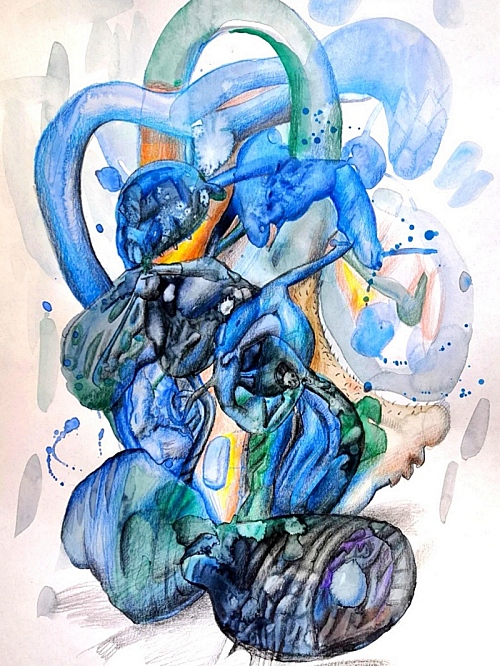
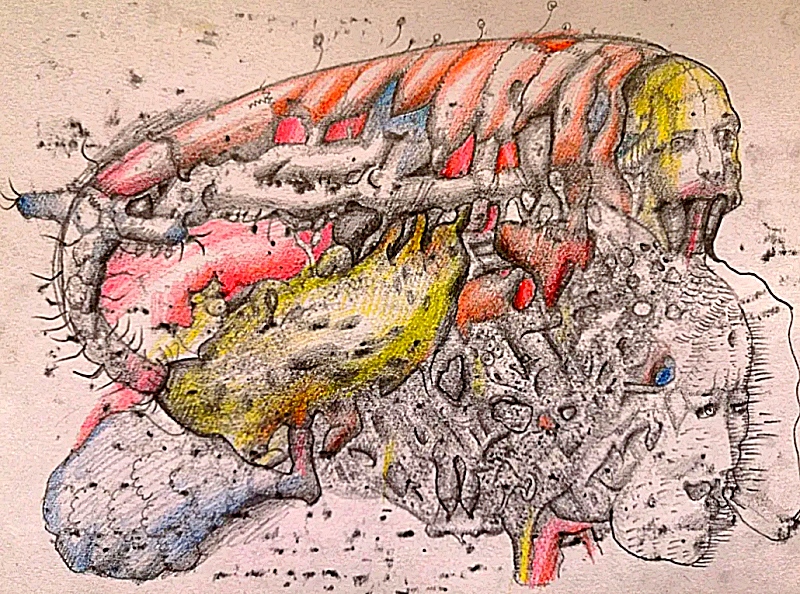
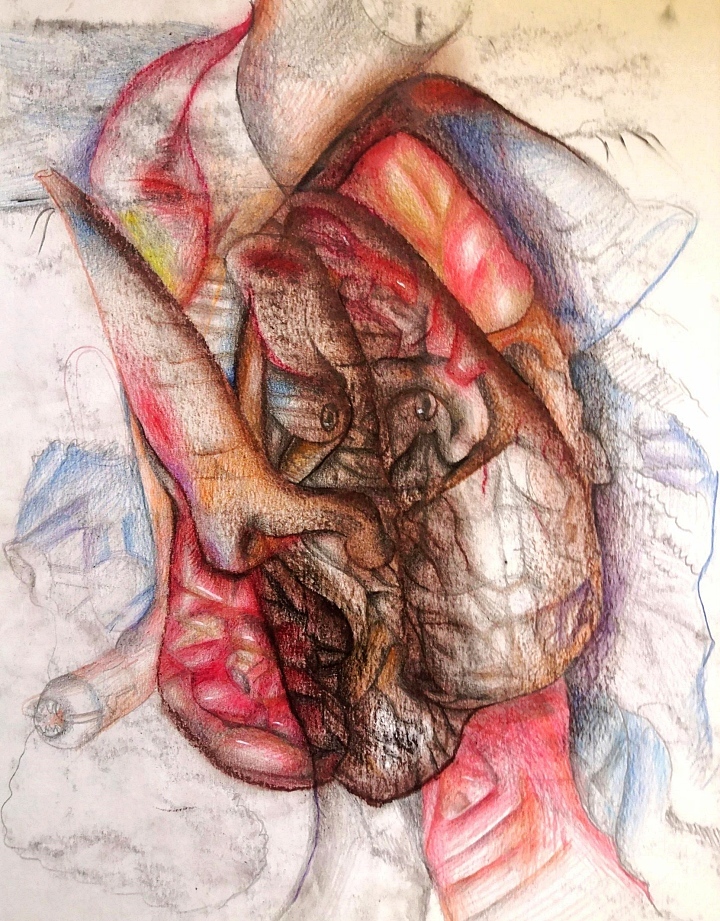
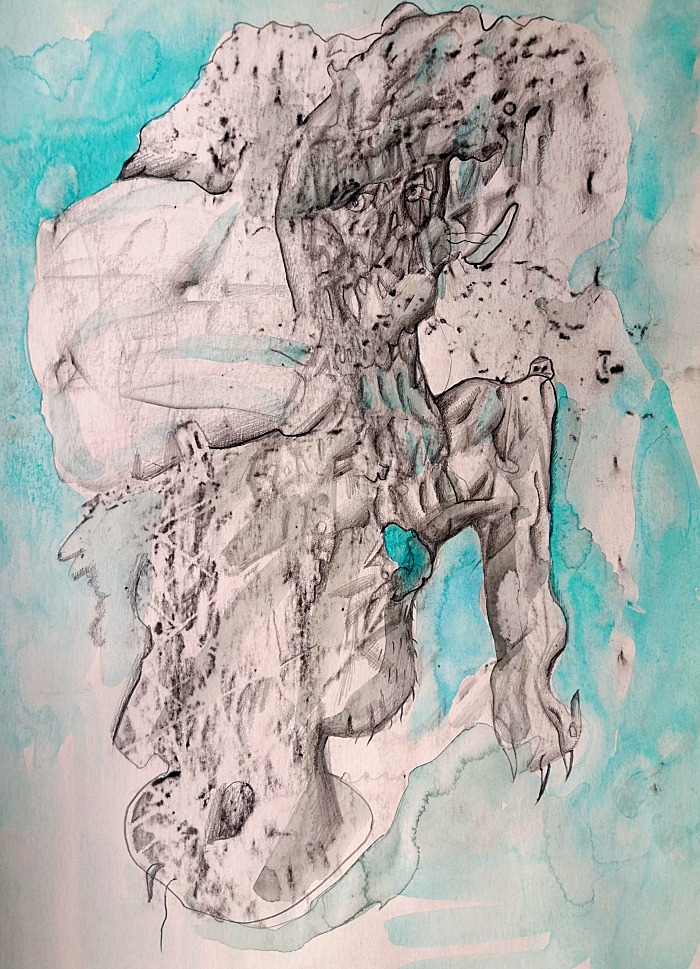
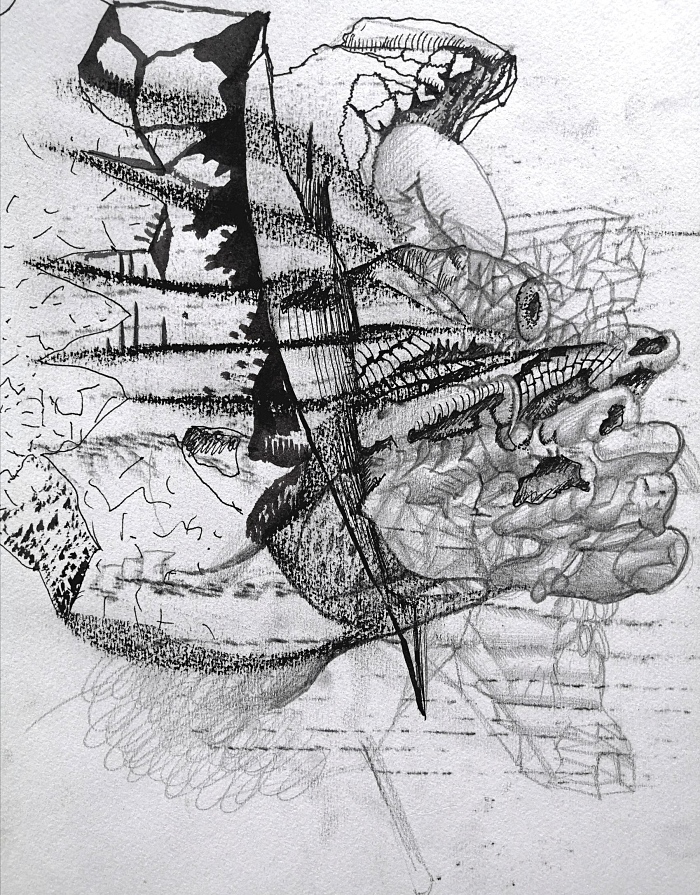
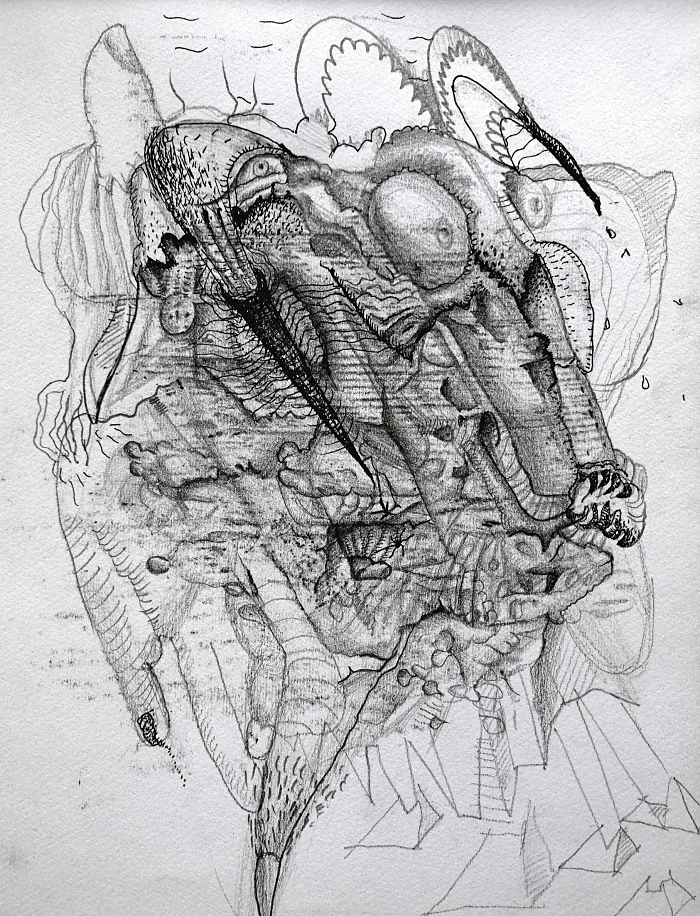
Having come full circle, I’m now developing ideas through drawing again. Drawing, a very immediate medium, enables me to play with the material and with my mind. I use various surfaces around our old Catalan house with a 100 years worth of thin plaster washes that are rich in texture, cracks and chips, a detailed history of use that is translated into some faint, random marks, by rubbing the surface with graphite on paper. Sometimes, I close my eyes and choose colours and draw shapes at random, or I just scribble something on paper absentmindedly. Thus, I’m presented with a series of opportunities for ‘communication’ with the work. I get into a meditative, slightly detached state, letting expectations go as much as possible before letting the drawing speak to me, to open my mind to suggestions. I see frottage – the initial rubbing – as a basic skin or gauze that is tied over an already existing image; it’s a game of recovery of the image.
It’s like the whole of humanity, the natural world, the cosmos, all my sources and histories are squashed together in a tight bundle of stuff that constantly mutates and changes in a continuous movement, a dance that is hidden under the surface of drawing paper. You never know what you are going to find by scratching the surface. By gently drawing on this skeleton of marks, repeating its forms over and over, I start slowly beefing up the initial image, or I take layers off, exposing that image underneath, akin to archaeology. I can recognise various marks, characters, memories of small details like a gesture or a shine on the nose, and the stuff from daily life starts to poke through this initial wild collage of bits, merging and mutating in my unfocused eyes. By gently excavating a partial image with a soft brush as it were, by gentle strokes, I nurture that image into the light, extracting, distilling it from the initial marks. As if stroking the skin of paper over and over, massaging the organs, getting the inner machinery as it were to start kicking into action. This process produces a clearer idea of what the image is and what it wants; it starts working itself out, the cogs fall into place. When I feel that an image I’m working on is becoming independent, it starts constructing itself with that inner machinery confidently and becomes almost confrontational in its new independence, then my work is done. Art for me is an organic process which continues evolving in the eyes of the beholder.
Inner space, mathematical entities, organic architecture and time doors from the liminal mind of artist René Ortega
From TvoTiltil October 3, 2022
El artista plástico y vecino de Huertos Familiares, René Ortega, resultó uno de los ganadores en la bienal internacional de arte contemporáneo que se desarrolló la semana pasada en Cali Colombia. En el encuentro participaron más de 3000 pinturas y representantes de 15 países y fue trinfador en la categoría de arte abstracto. La premiación se llevó a cabo en la Universidad Santiago de Cali. Sin duda es el logro y reconocimiento más importante en mi carrera hasta la fecha nos indicó el artista hace instantes.
The plastic artist and neighbor of Huertos Familiares, René Ortega, was one of the winners in the international biennial of contemporary art that took place last week in Cali, Colombia. More than 3,000 paintings and representatives from 15 countries participated in the meeting and it was the winner in the category of abstract art. The award ceremony was held at the Santiago de Cali University. Without a doubt, it is the most important achievement and recognition in my career to date, the artist told us moments ago.
Rene Fernando Ortega Villarroel
Feature art photo was selected as the award-winning work.
The collective art making project, Cornucopia, began in 2010 when artists Rik Lina (Netherlands), Gregg Simpson (Canada) and John Welson (Wales) began mailing each other works, an invitation to the next artist to contribute to the finished piece. I have always thought of this collective as akin to a free jazz trio, which is my background as a jazz drummer and Rik and John as avid listeners for decades. I see Rik, especially with his swooping ink lines, as the saxophone, John with his rolling earthy forms as the bass and myself adding percussive color and texture. In this case writer Allan Graubard, our guest ‘vocalist’, has written text for a select group of images by Cornucopia from past years. His writing keys in to the vivid imagery, but he insists his singing is always off key! If that’s that case, let atonality reign supreme.
-Gregg Simpson, 2022
Holy Smoke Rik Lina, Gregg Simpson and John Welson
That night, when a large red praying mantis landed on her bedroom window with a soft thud, the window before the desk where she was writing, she lifted her head up and smiled. Nothing could be so vulgar, she thought, than this creature who, because of its cunning, mastery of camouflage, and sharp powerful tearing spines claimed the world it inhabited. For her, of course, vulgarity was a prize. The more vulgar a creature was to her – human, animal, fish, bird or insect – the greater its power.
She used the term as well from its root: tawdry, flamboyant, garish, brash, loutish, crude, brassy, rude and as common as possible. A perfect amalgam to paste together her curious tales into a medium that the cheapest lowlife enjoyed. So they did, and the prizes and checks and film offers came, one after another, two at a time, until she didn’t give a damn who made them or how well or how poorly they did for a public she evaded, preferring her solitude above all else in this make believe vicious whirlwind she conducted as if her life depended on it – which, no “as ifs” needed, it did.
The Table Is Set Rik Lina, Gregg Simpson and John Welson
Field agent’s B16 report, initially filed per directive at his local office, quickly found its way to the national director. He read it, wrote up the affidavit for a search warrant and sent it on to a judge. After due process, the judge approved it. The director ordered the special squad to suit up and get to it.
At stake was nothing less than the ability to breathe, bite, breaststroke, battle and belittle. That the latter had less to do with the former than a frog does with a bottle of milk had nothing to do with it. Since the evening of the 12th when laughter replaced cognition and water balloons exploded on the street, moonglow dousing us all, everything was in flux. This included every prevarication sewn into a leafy flower, each busted safety valve worth saving, two or three aural visions and walking upside down. Enumerative, exhausting, eruptive? Quite.
They’d done whatever they wanted to, those bipedal harems, living in red brick row houses stained with coal smoke. Ah, that coal smoke …
Thereafter the lexicon unraveled, uproarious, horizontal, striking its own match to the torch that seared a name across the case: Agamemnon.
So that was it.
Murder, murder and judgement.
Neither the national director nor any of his assistants testified. They didn’t have to. The lawyers argued over the instrument but blood tells all. Even deer licking a twilight barbecue cued up, hooves hot to applaud.
And when it came down, the heavens parted and great sassafras babies with thick chocolate lashes stirred the witchy soup that feeds us …
Featured Photo False Prophet Rik Lina, Gregg Simpson and John Welson
(The Netherlands 1942) lived and worked on different continents, preferably in wild nature, as a way of life using Odilon Redon’s advise: “Immerse yourself into nature!”. For this he dedicated life and art to study the deserts, the mountains, tropical rainforest- and coral reef jungles. In 1975, the emigration to the Caribbean island of Bonaire became an essential experience for his work with more than a thousand hours of scuba-diving. A major part of his drawing, painting and graphic work represents poetry and life of the pelagic realms, next to his explorations of the jungles of cloud forests and inner space.
A prolific and critically recognized artist and musician, has exhibited his paintings, drawings, and works on paper throughout Canada, the US, Europe, South America and Asia. His work is included in several academic studies, art history books and journals published in Canada, Europe, and Australia and has been exhibited in several historical surveys on surrealism and abstraction.
began painting at the age of 12. He received a thorough education in painting, drawing, graphics, ceramics and attended two colleges of art. He has participated in over 300 exhibitions in both private and public galleries around the world since the early 1970’s. From the late 1960’s to the early 1990’s he painted Figurative Surrealist Paintings, exhibiting with artists as diverse as Salvador Dali, Man Ray, Rene Magritte, Max Ernst, Lucian Freud and Damian Hirst. Since the mid 1990’s he has produced Lyrical Abstracted Paintings inspired by the landscape of his native Wales.
Allan Graubard
is a poet, writer, and playwright with works translated in numerous languages. His plays have premiered in the U.S. and EU. He is the editor of and contributing author to Into the Mylar Chamber: Ira Cohen (Fulgur, UK, 2019), American liaison for and contributing author to the International Encyclopedia of Surrealism (Bloomsbury, UK, 2019), and editorial advisor for and contributing author to A Phala: Revisita do Movimento Surrealista (Sao Paolo, Brazil, 2015). Forthcoming in 2020 is a new book of poems and tales, Western Terrace (Exstasis Editions, Victoria, BC) while 2019 saw Language of Birds, a collaboration with artist Rik Lina (Anon Editions, NY/Flagstaff). In 2017, A Crescent by Any Other Name, selected tales, published (Anon Editions, NY/LA). That same year he was co-editor of and contributing author to The Art of Conduction: A Conduction Workbook by the renowned conductor-composer Lawrence D. “Butch” Morris (Karma Books, NY), with whom he was a principal collaborator for over three decades. Other titles of fiction and poetry are: Sirenes (Phasm Press, NY), Targets (Anon Editions, NY/LA), And tell tulip the summer (Quattro Books, Toronto), and Roma Amor, with photographs by Ira Cohen (Spuyten Duyvil Press, NY). He was co-editor of the expansive, two-volume: Invisible Heads: Surrealists in North America – An Untold Story (Anon Editions, NY/LA) and guest editor of and contributing author to a centennial celebration of poet Gherasim Luca (Hyperion, Contra Mundum Press, NY).




















 Mitchell Pluto