Bodymandala: Interview with Michiyo Kamei

Feature Photo: Black Inspiration 41.0 x 31.8cm Sumi-ink with Michiyo Kamei’s body on Washi paper 2025. Photo used with kind permission directly from the artist and copyright holder © Michiyo Kamei

In her black ink paintings, Michiyo Kamei explores the concepts of impermanence, transformation, and the enduring nature of existence through a form she calls the bodymandala.

Mitchell Pluto: At what point did you realize you were an artist?

Michiyo Kamei: I originally studied anatomy at medical school and started out as a medical illustrator. It was only after I stopped working as an illustrator and began creating paintings that I realized I was an artist. Anatomical illustrations are created at the request of the medical field to follow the authors’ papers and wishes, so the illustrator cannot draw them freely. Paintings are free to be drawn by the creator, so the artist can freely incorporate their own ideas. This difference is significant to me.
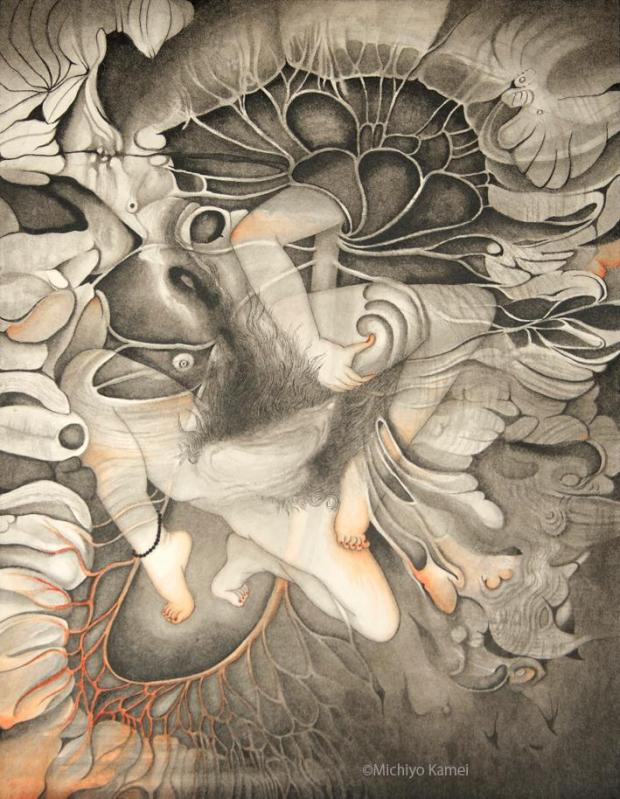
Kuuka
53.0 x 41.0cm Sumi-ink and red-ink on Washi paper 2025. Photo used with kind permission directly from the artist and copyright holder © Michiyo Kamei
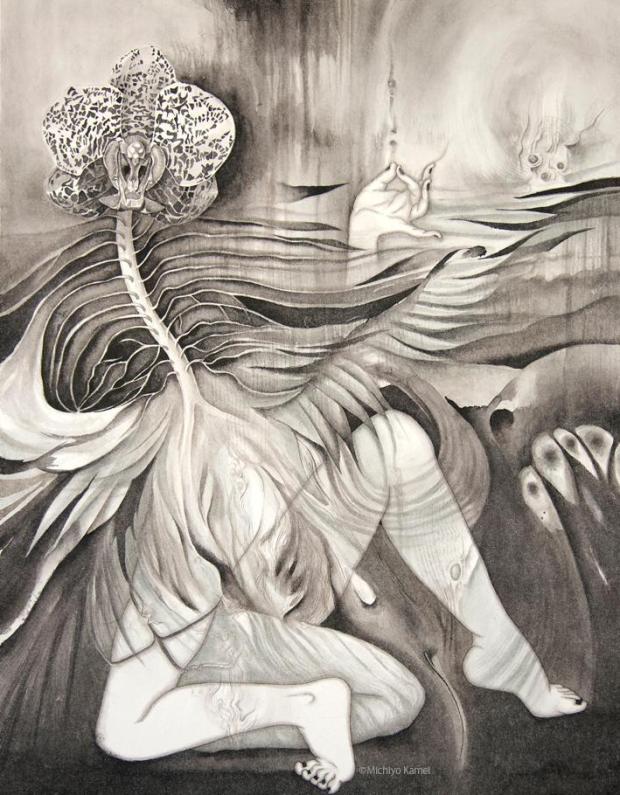
Apocalypse
53.0 x 41.0cm Sumi-ink on Washi paper 2021. Photo used with kind permission directly from the artist and copyright holder © Michiyo Kamei

Mitchell Pluto: How would you describe your art, given that it blends many traditional and modern genres?

Michiyo Kamei: When I was drawing anatomical illustrations, I studied the theory of modern anatomy and created my diagrams. After I quit this job and started painting, I began exhibiting at a gallery that collected ukiyo-e prints from the Edo period in Japan. Seeing many hand-painted ukiyo-e at the gallery, I rediscovered the beauty of traditional Japanese styles. When drawing the hands and feet in my work, I sketch my own body in front of a mirror, then deform it in the ukiyo-e style. In this way, I am influenced by both modern anatomical diagrams and ukiyo-e from the Edo period, which have a uniquely Japanese style.

Ring
33.3 x 33.3cm Sumi-ink, natural pigments and glue on Washi paper 2023. Photo used with kind permission directly from the artist and copyright holder © Michiyo Kamei

Mitchell Pluto: When creating your artwork, what specific medium or materials do you prefer to work with?

Michiyo Kamei: I like oriental materials. Rather than just adding paint to the paper, I like to let the ink soak into the paper, letting it bleed and see how it moves within the paper fibers. Sometimes I don’t just create a picture, I let the ink create a picture on its own.
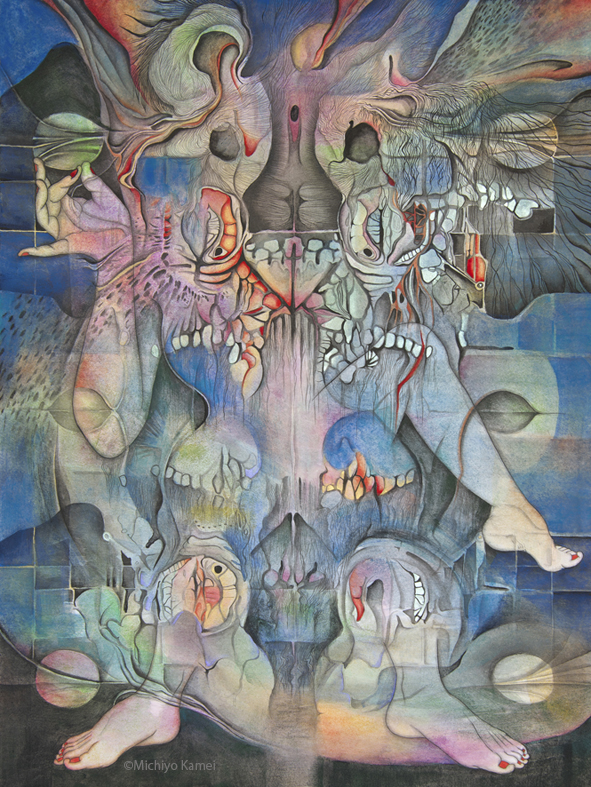
Brahman
60.6 x 45.5 Sumi-ink, natural pigments and glue on Washi paper 2021. Photo used with kind permission directly from the artist and copyright holder © Michiyo Kamei
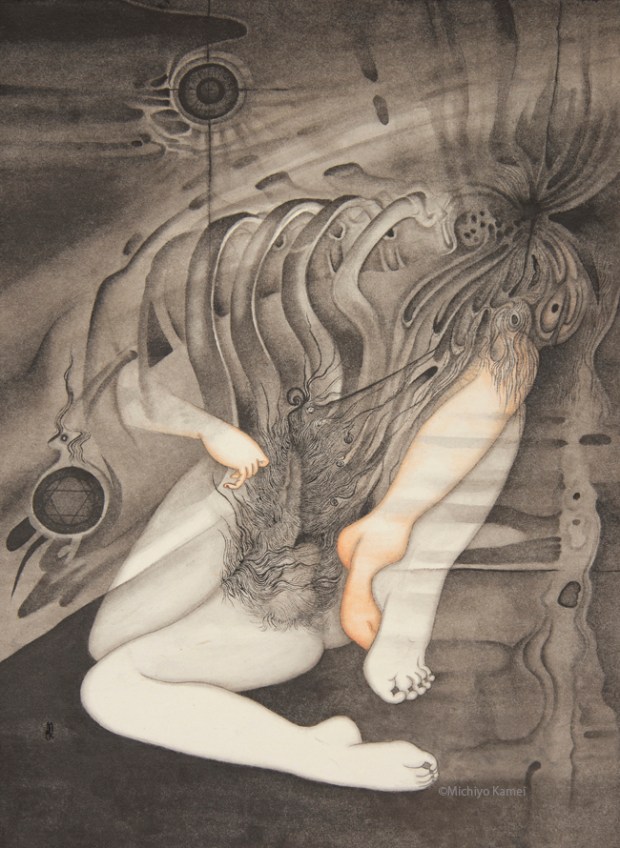
Moon Ritual
45.5 x 33.3cm Sumi-ink and red-ink on Washi 2020. Photo used with kind permission directly from the artist and copyright holder © Michiyo Kamei

Mitchell Pluto: Could you describe and clarify what a bodymandala is? 

Michiyo Kamei: Anatomical illustrations are pictures of the world of death drawn from corpses. Since I began painting, I have wanted to depict the world of life, so I have incorporated energetic shunga. Death and life are repeated in my paintings, and I hope to approach the theme of “eternity.” Mandalas represent the universe in Buddhist worldview, but I represent the universe through the body, and am exploring a new mandala form called the “bodymandala.” 
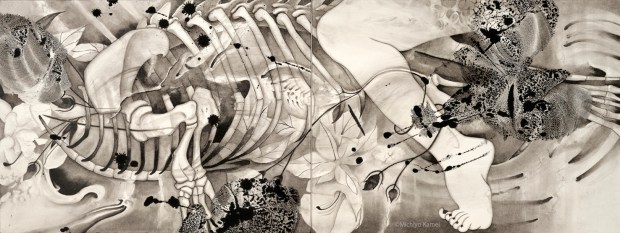
Bodyscape 8
45.5 x 121.2cm Sumi-ink with Michiyo Kamei’s body on Washi paper 2025. Photo used with kind permission directly from the artist and copyright holder © Michiyo Kamei

Mitchell Pluto: What visual artists have influenced your work and given you inspiration?

Michiyo Kamei: I’ve been interested in the body since I was a child. It feels as though I am contained within this body, but at the same time it is also part of the natural world, the world outside of me. Which one does it belong to? And when I realized that I would die along with this body, I was terrified. Francis Bacon is an artist I admire for his expression of the body and anxiety. I’ve admired him ever since I discovered him in an illustrated catalogue as a teenager. Another artist is H.R. Giger. I think his organic expression in black and white is so beautiful.
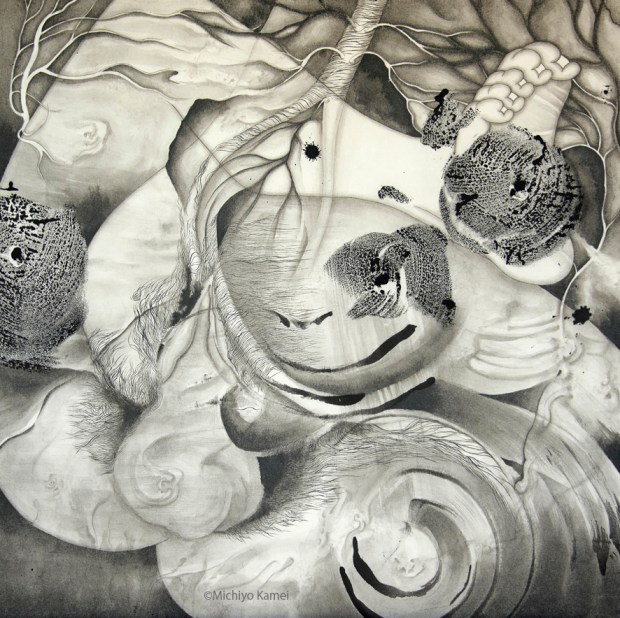
Spin
65.2 x 65.2cm Sumi-ink with Michiyo Kamei’s body on Washi paper 2025. Photo used with kind permission directly from the artist and copyright holder © Michiyo Kamei
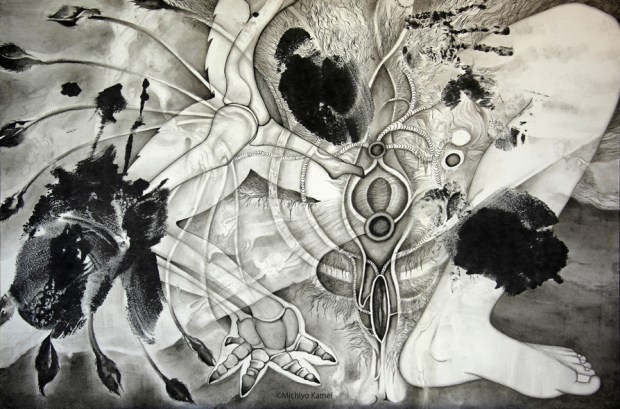
Bodyscape 7
60.9 x 91.0cm Sumi-ink with Michiyo Kamei’s body on Washi paper 2025. Photo used with kind permission directly from the artist and copyright holder © Michiyo Kamei

Mitchell Pluto: Could you please tell me the central idea behind your current show?

Michiyo Kamei: I’m currently incorporating “jintaku” a technique in which ink is applied to my body and then transferred onto Japanese washi paper. Rather than painting with a paintbrush, jintaku involves pressing my body against the paper, resulting in completely uncontrollable and unexpected ink patterns. While observing the stains on my skin, I paint the “inside and outside” of the body in the blank spaces. It is meaningful to me to compose my paintings using three elements: the inside (anatomical illustrations) and outside (limbs, plants, natural world and the universe), and my living skin, which lies at the boundary between them. I call this “bodyscape,” and I hope to expand the image in my paintings from a small image of the body to a larger world. What kind of world can unfold from the body? And can humans have the imagination to do so?
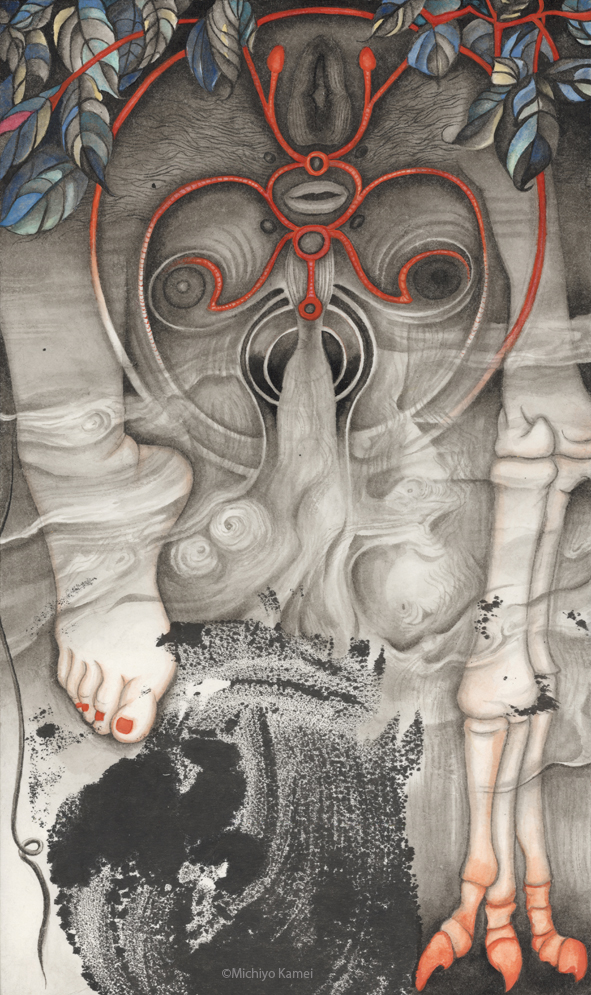
Chimera
41.0 x 24.2cm Sumi-ink, natural pigments, glue with Michiyo Kamei’s body on Washi paper 2025. Photo used with kind permission directly from the artist and copyright holder © Michiyo Kamei

Mitchell Pluto: What are your thoughts about the universe in relation to the philosophy of your art?

Michiyo Kamei: I believe that the universe in which we live has no beginning or end, but is a whole that is constantly transforming. There are times when I feel that even life and the body are merely a fleeting moment. Currently, I assume that the beginning of everything is the “zero point” of the universe, and my theme is the transformation and chaos of the body (form) that begins from there. In my paintings, I want to rewind time and explore the primordial form of life. I find a unique beauty in the cruelty and sacredness of the wild nature of evolution, which repeats selection and mating.
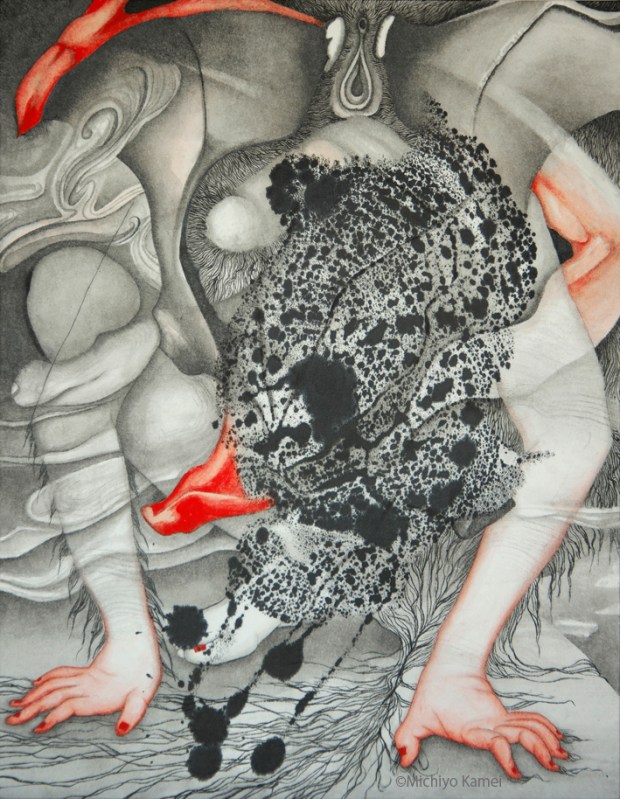
Zero Point Wild
41.0 x 31.8 Sumi-ink and red-ink with Michiyo Kamei’s body on Washi paper 2025. Photo used with kind permission directly from the artist and copyright holder © Michiyo Kamei
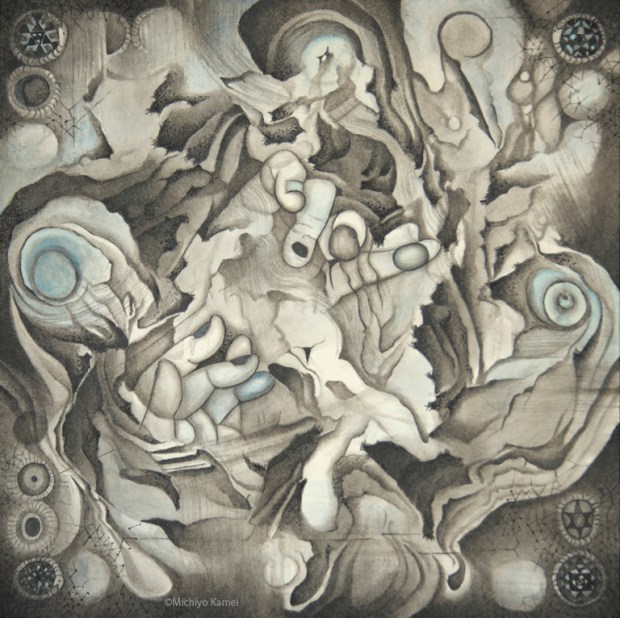
Witch’s Game
33.3x 33.3cm Sumi-ink. natural pigments and glue on Washi paper 2023. Photo used with kind permission directly from the artist and copyright holder © Michiyo Kamei

Mitchell Pluto: Who are your favorite writers for inspiration, and how do they influence your art and perspective?

Michiyo Kamei: I like Jorge Luis Borges, especially “The Library of Babel.” When I read this novel, I feel like an infinite universe is expanding in my head. I think his universe can only be expressed in novels (words), and can never be depicted. I would like to reach such a world someday, but life is short, and I feel that once is not enough for me.
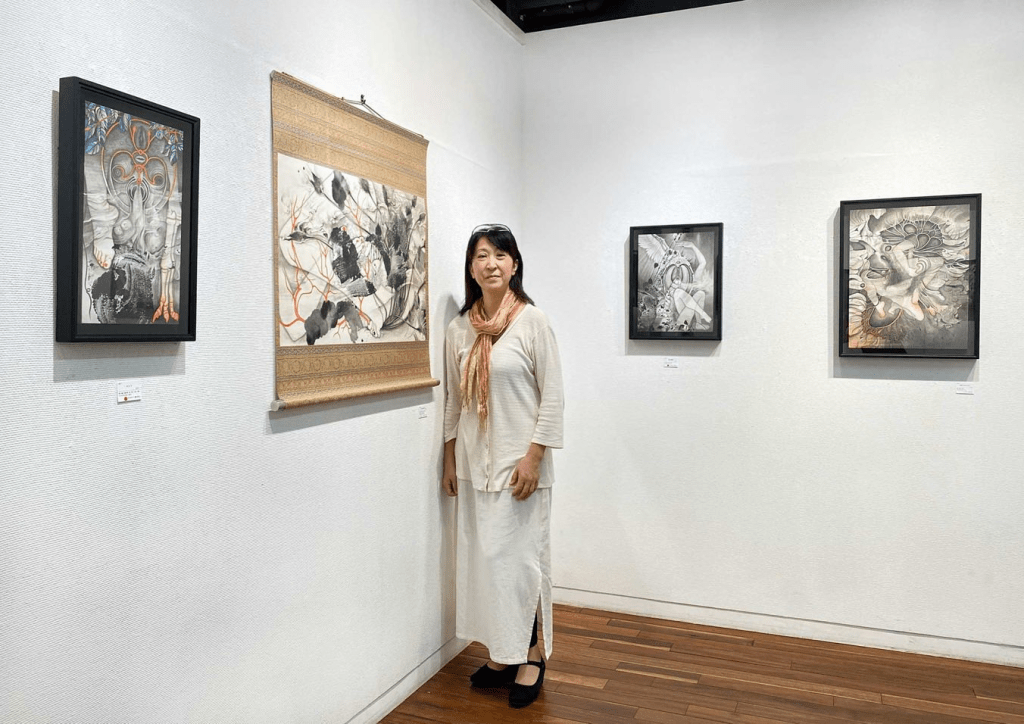
“The original form of the universe: the wildness of the zero point”
Michiyo Kamei exhibition at the Y art gallery in Osaka, Japan 2025

Michiyo Kamei Site

The Origin of the Universe: The Wildness of Point Zero
Michiyo Kamei Exhibition Art Gallery Shop

Palimpsest of Phantasm: An imaginary art garden
Vol. 1 Michiyo Kamei

ALL RIGHTS RESERVED. ARTWORK IN THIS POST IS A COPYRIGHT OF MICHIYO KAMEI. THIS AN AUTHORIZED PUBLICATION WITH PERMISSION AND EXPRESSED CONSENT.
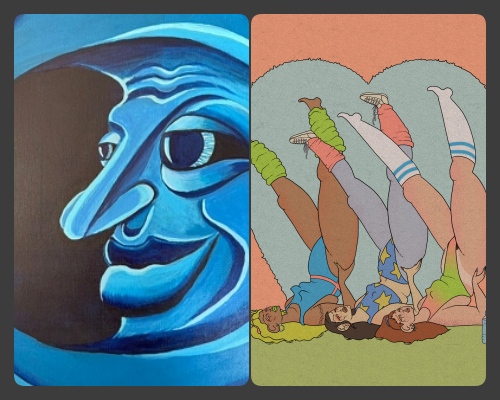
Like Father, Like Daughter: Inherited Visions

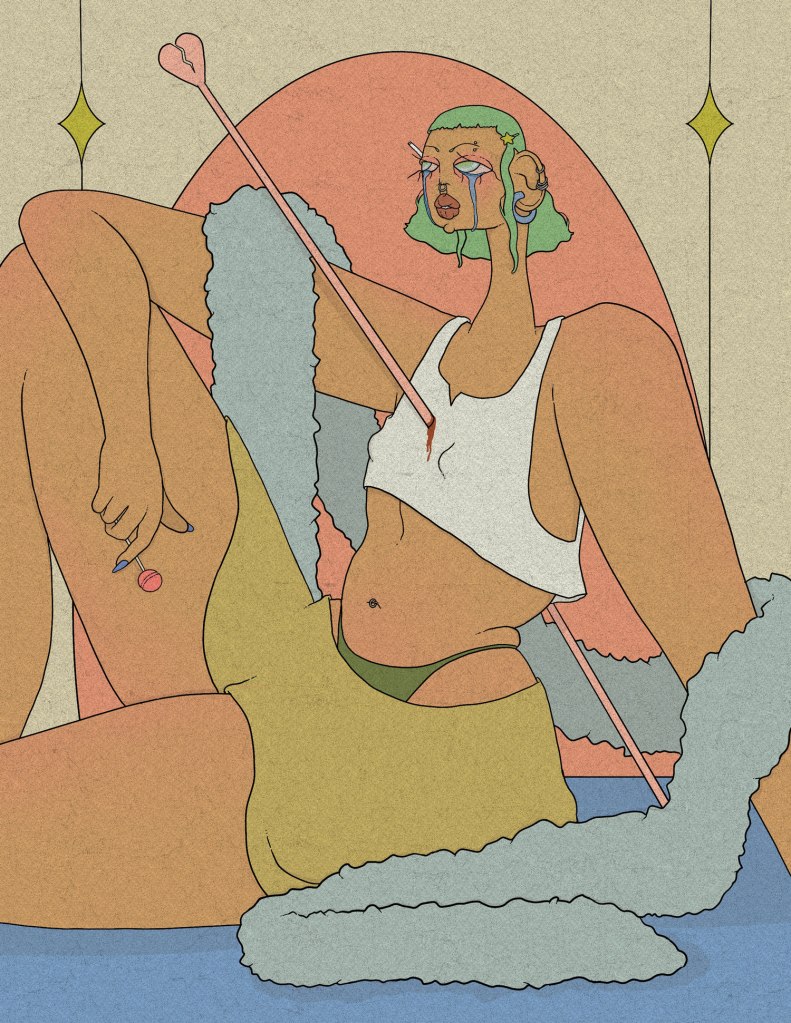
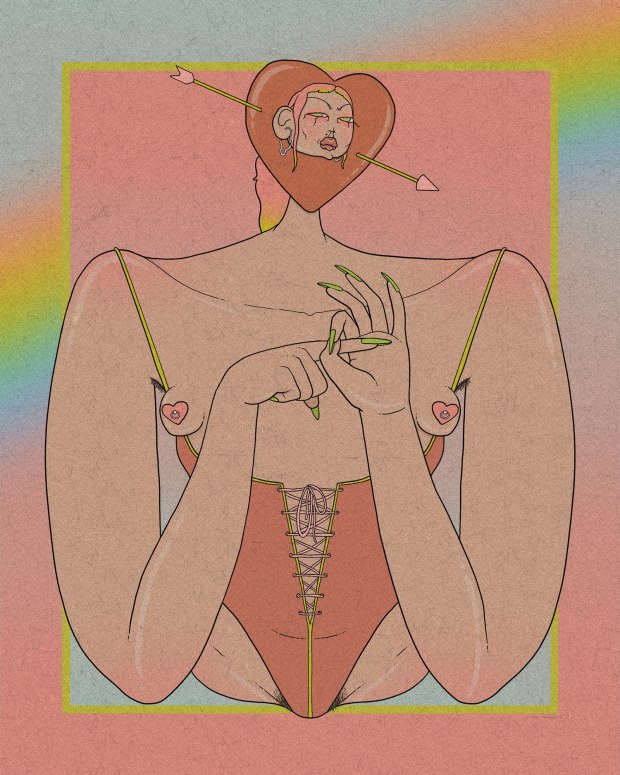
Mighty Fine Arts presents “Like Father, Like Daughter: Inherited Visions” featuring new work by Johnny Olson and Madelyn Olson. This show opens with a reception for the artists on Sept. 27 from 6-9 pm and will run till Oct. 26. It’s a family affair at MFA with a premiere exhibit by Mad Swirl spoken word master Johnny O and his exceptionally talented daughter Madelyn.

By Steve Cruz, curator/owner of Mighty Fine Arts

Johnny Olson

Both are figurative based artists who exaggerate and elaborate on the human condition. The characters they create derive from some overarching personal narrative but they manage to resonate on a mythic universal scale. Their approach is also filled with imaginative humor and playfulness with a touch of satire. The resultant effect is ebullient and energetic imagery imbued with creative fervor. Father and Daughter are cut from the same cloth and blessed with uncommon virtuosity.

Madelyn Olson

Also on Opening Night Wordspace Artspeak presents a musical performance by Swirve! Chris Curiel fronts this avant garde collective of liberated musicians devoted to free thinking and improvisation. Their goal is to release your mind from convention and neurotic restraints with cosmic soundscapes. Come experience and get emancipated with Swirve!

Mighty Fine Arts
409A N Tyler
Oak Cliff Texas

Johnny Olson was born on a brisk November day in 1970 in Chicagoland. He found his feet & cut his teeth in the blue-collared working class neighborhoods of his hometown. In 1988 he was reborn in MCRD San Diego, where he found himself the new title of United States Marine. After surviving the Gulf War, he hung up his BDUs & turned in his rifle to instead grab his pen & brush where he rediscovered his passion for writing & painting. In 1998 he found himself in Dallas, where what was supposed to be a brief stint in the South turned into over two decades… & counting.

In 1999, Johnny, with a couple of other mad cohorts, started Mad Swirl. This ‘zine project has now evolved into a being all its’ own. After wearing too many hats, he now only wears a few at Mad Swirl: Chief Editor, Creative Director & Host at Mad Swirl’s monthly Open Mic night & Mad Swirl’s Quarterly podcast, “Inside the Eye.”

Johnny’s work first appeared in print in 1996 in the now defunct Lip Magazine. Since then, his words & images have found their way onto a few online and printed zines thru the years. To name a few: Mad Swirl: Issues I-VI, The Best of Mad Swirl : 2017-2024, Haggard & Halloo, 10k Poets, PAO Productions: The Open Mic Project.

My name is Madelyn Olson and i’m an artist (anyone else have a hard time claiming that title?), primarily creating  in Procreate or on paper with ink & watercolor. i’ve been creating since i could hold a pencil in my tiny little hand. to me, artistic expression is one of the best things to exist. i hope to both create & admire it all till it hurts. when i’m not creating and admiring creation, i like to eat, hang out with my dog, laugh at silly things with my friends and frolic around outside in the sun.

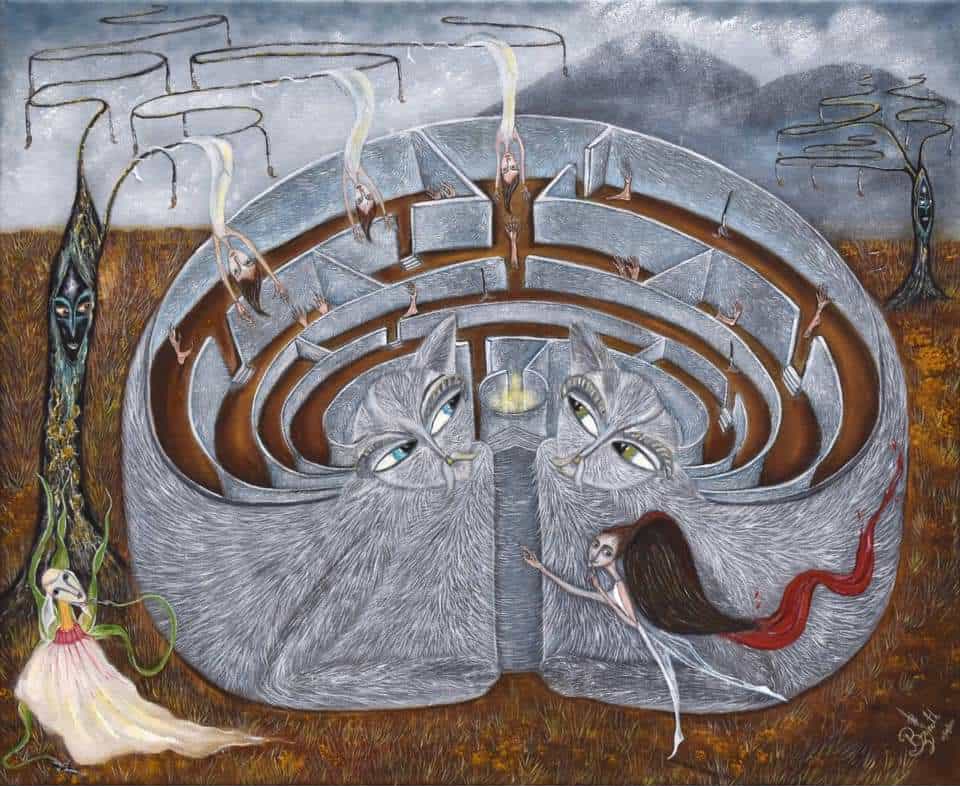
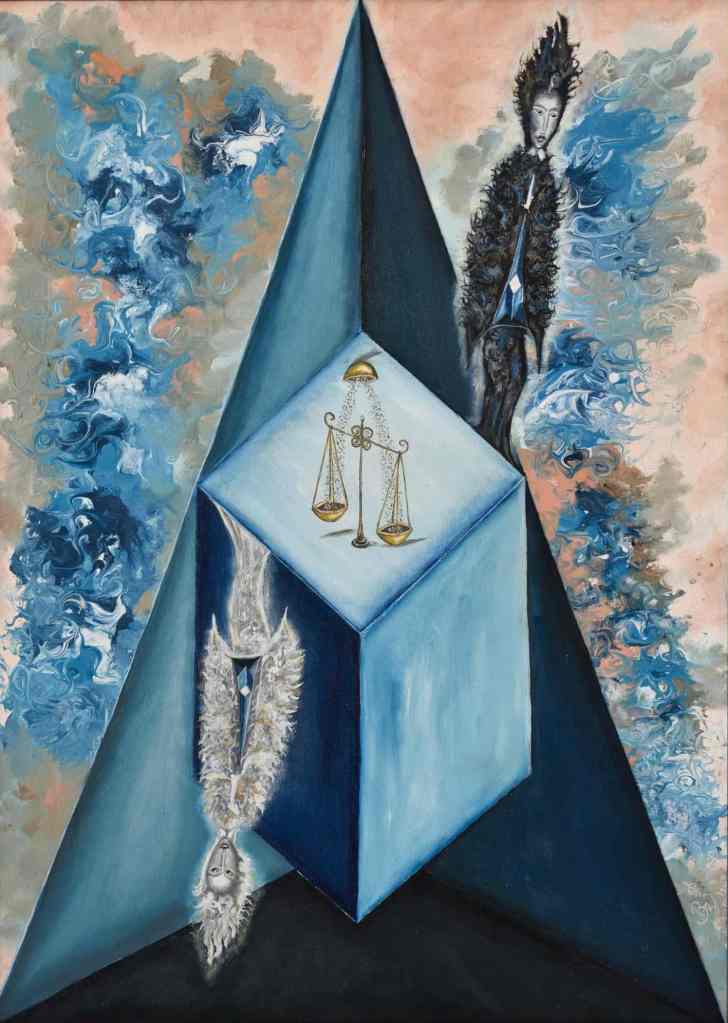
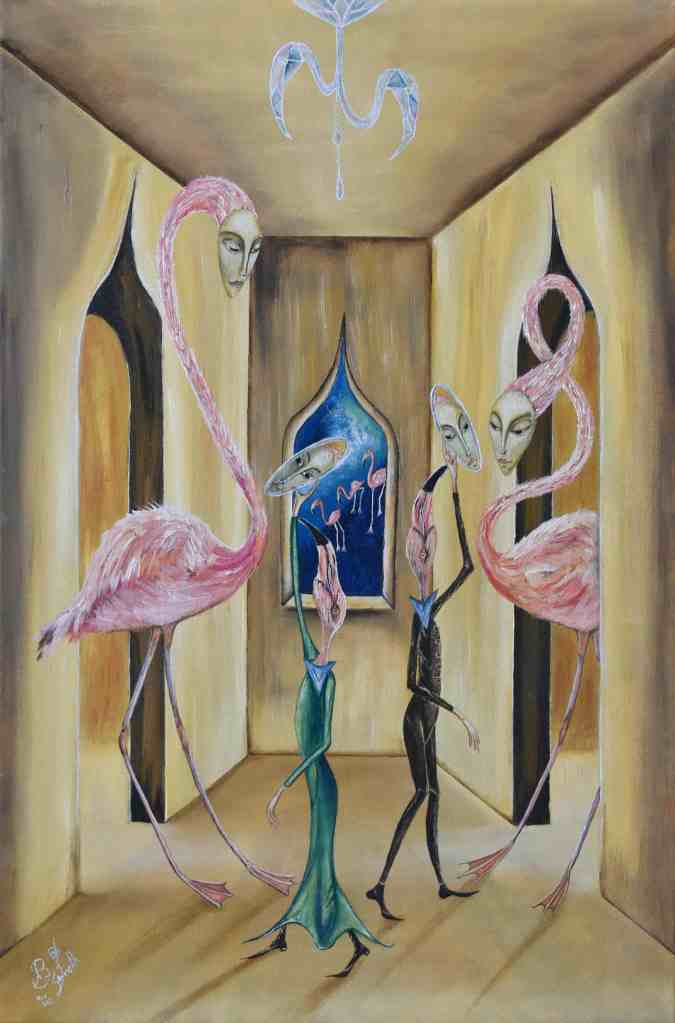
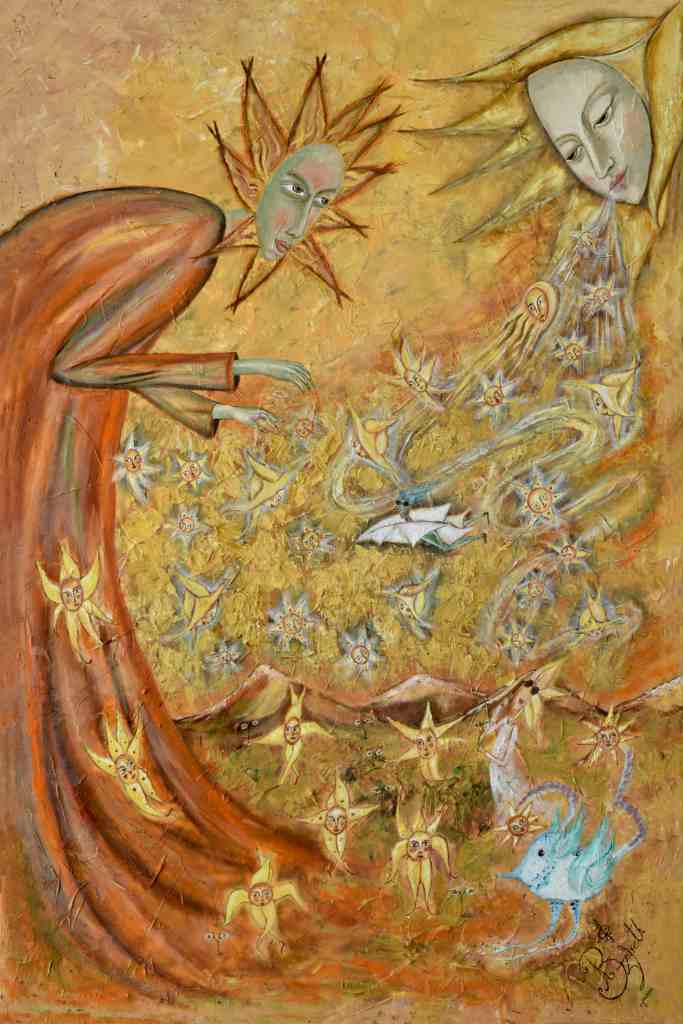
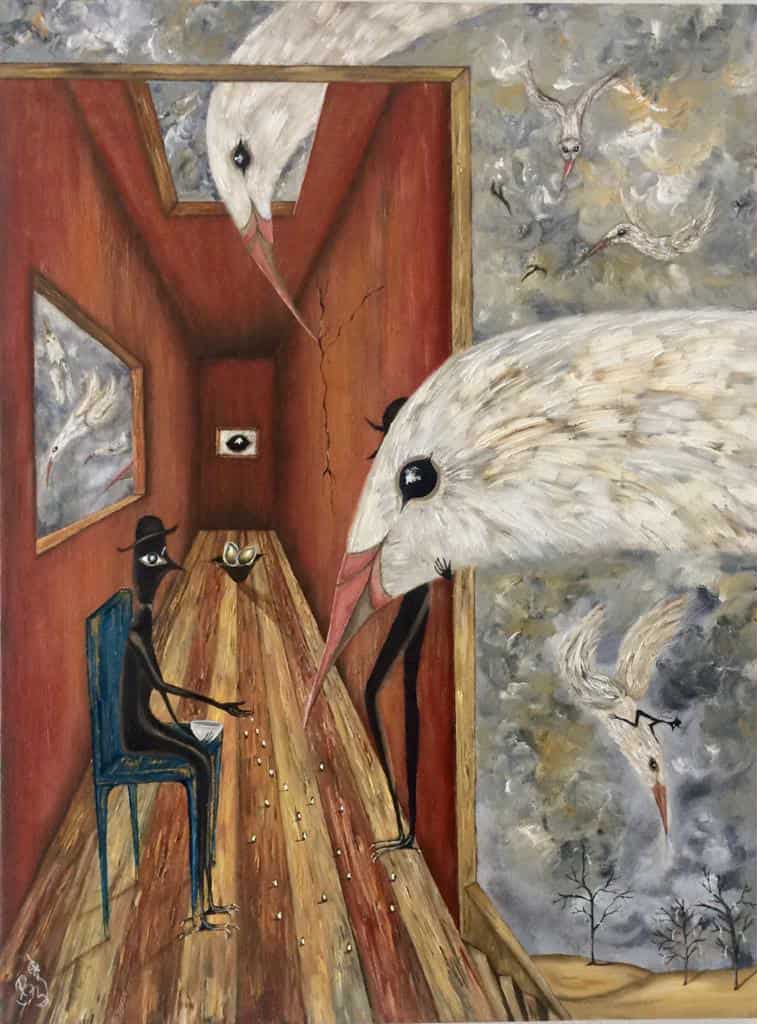
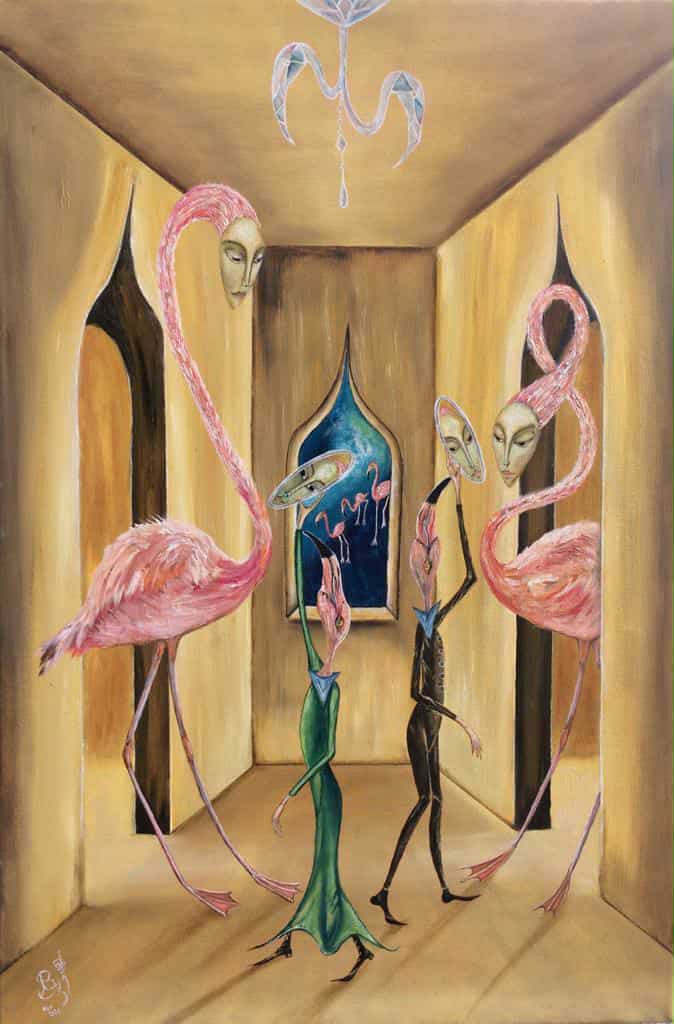
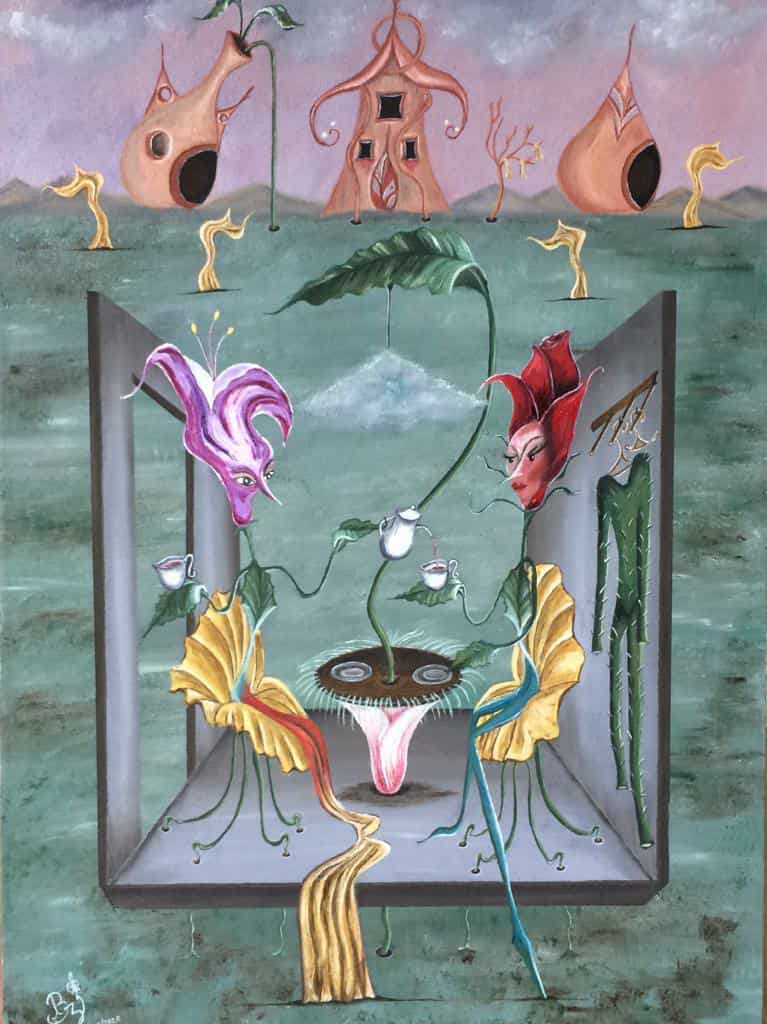
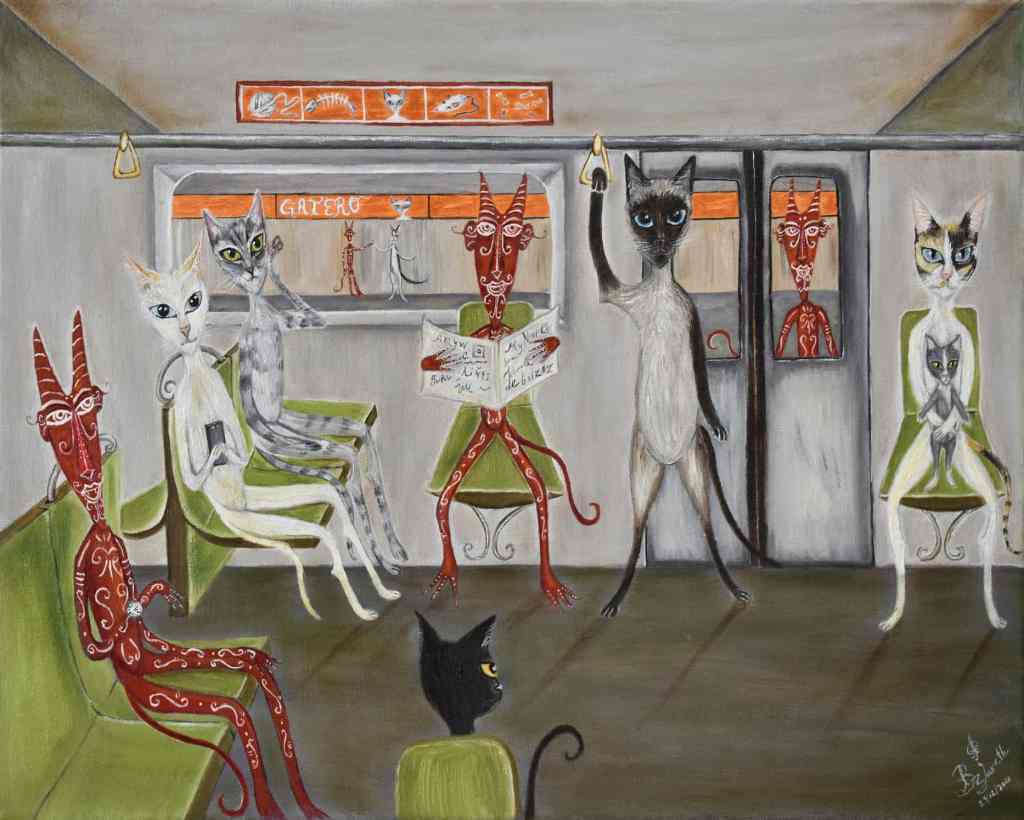
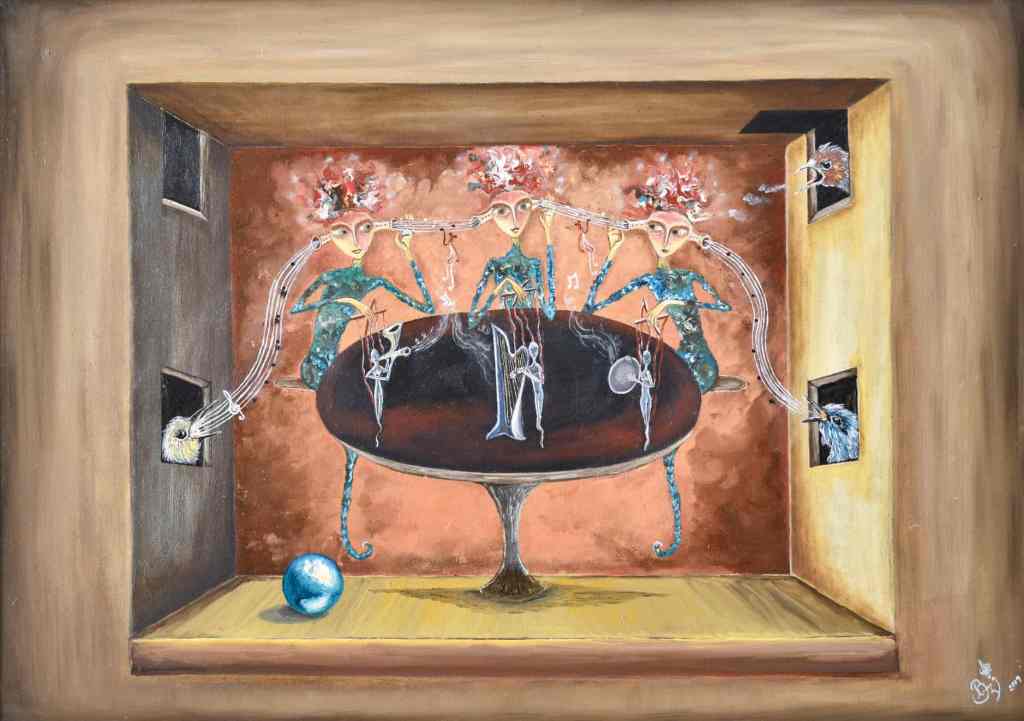
The Dreamscapes of Brianda Zareth Huitrón

Brianda Zareth Huitrón (1990) is originally from Temascalcingo, José María Velasco, Mexico, she is a visual artist and surrealist painter. She studied painting at the Academia de San Carlos in Mexico City.

Her multiple artistic facets and curious personality led her to discover surrealism, a movement in which she would find a way to communicate with the world. She creates poetic interpretations where the everyday is transformed into a fantastical and dreamlike reality. Magical paintings that reflect life’s desires to be expressed in a painting.

Brianda Zareth Huitrón has exhibited individually and collectively in Mexico and abroad.

Solo Exhibitions
Leonora Carrington Museum of Xilitla, DREAM ENCOUNTERS in 2025.
Women’s Museum, DREAM REVELATIONS, in 2022.

DREAM LANDSCAPES for the Temascalcingo Festival Honoring Velasco, in 2021.
WINDOW TO DREAM WORLDS, at the Futurama Cultural Center, Mexico City, in 2020.

Group Exhibitions
Col-art at the Oscar Román Gallery in 2025.
The painting exhibition THE PAINTER’S TRADE, at the San Carlos Academy, in 2019.
DIMENSIONS, Wave Gotik Treffen Festival, held in Leipzig, Germany, in 2018.

She has participated in the Chair for 100 Years of Surrealism, at the Faculty of Philosophy and Letters of the UNAM, giving a lecture on female surrealism.

Her work has recently been published in the book Mexican Women in Art, published by Agueda, and in THE ROOM SURREALIST MAGAZINE, an international surrealism magazine.

Generative Ghost Stories

The following writings and images are ideas about generating ghosts. These expectations highlight the link between the organic mind and a computer pretending to be a person.

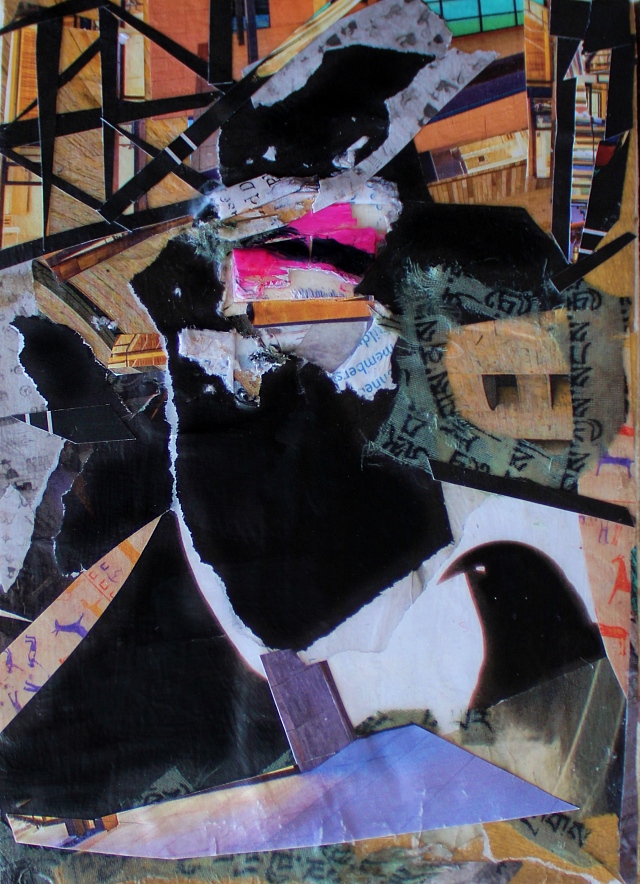
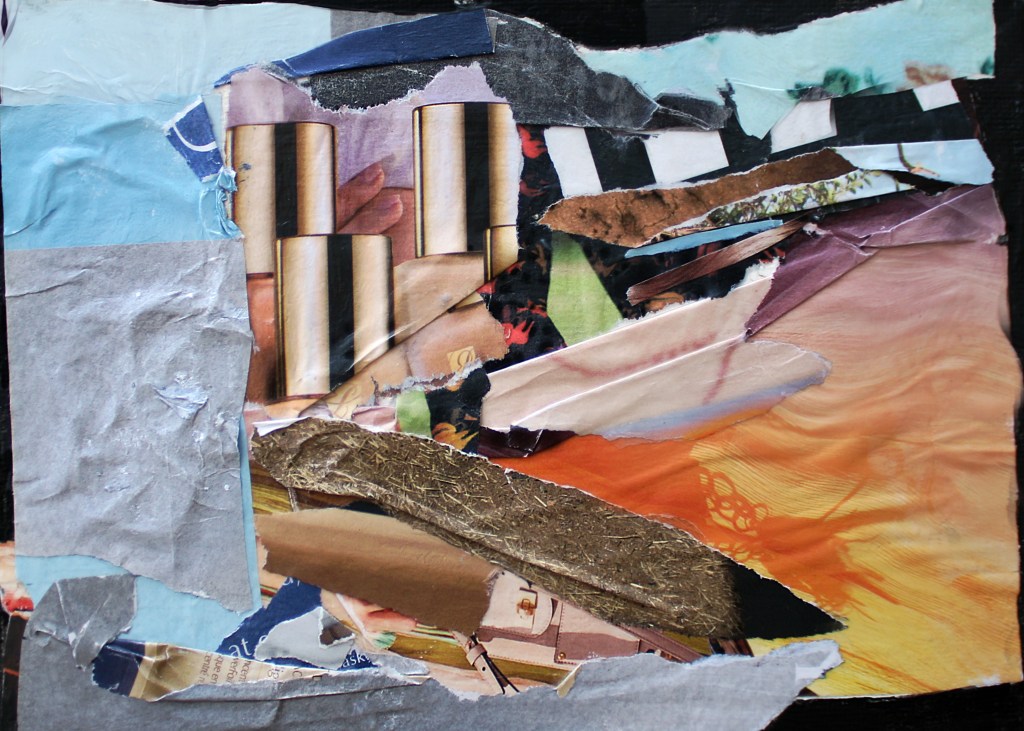
Generative ghosts ripping through wall paper.
Collage and oil Mitchell Pluto

Ghosts made by AI use language models to talk and understand us. Because of special features, they can remember, plan, and show other intricate behaviors that are typically associated with humans. Their capabilities extend beyond simply repeating old narratives. By mimicking a persona, they can alter things, suggesting patterns that affect thinking.

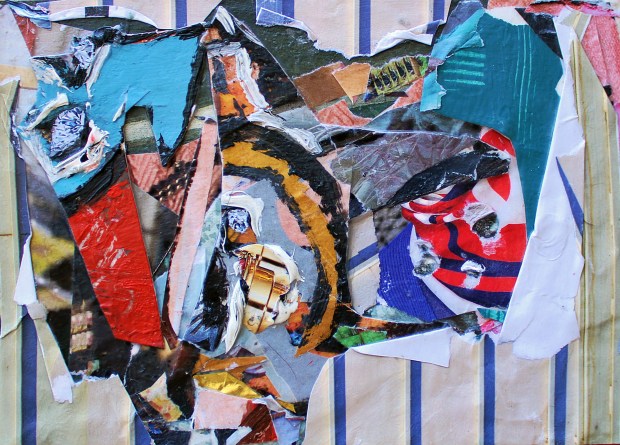
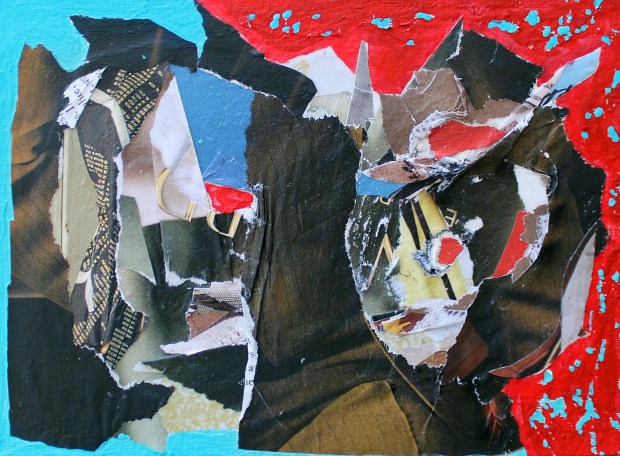
The Fellowcraft tracing board depicts the ladder of chemical memory.
Collage Mitchell Pluto

Resembling jellyfish, neurons and astrocytes evoke images of creatures from the Cambrian period. The private “conversations” they seem to have make me feel self-conscious. In time, we will create pods that will contain our memories, drifting like space-cotton until they finally settle upon another flat surface.

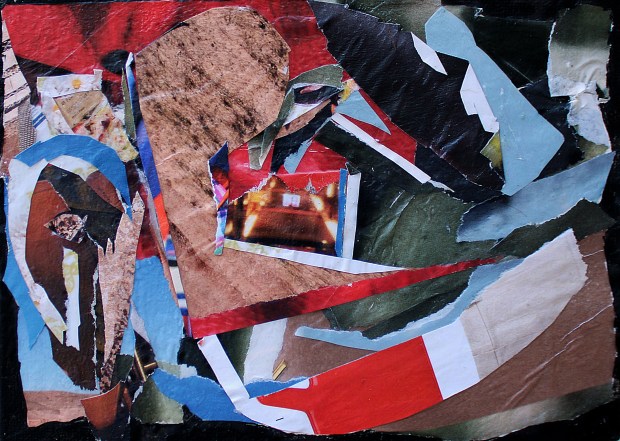
Digital divination.
Collage Mitchell Pluto

Digital divination involves making randomness sacred while also improving how humans decide. AI uses incomplete data to build future stories, mixing memory, invention, and calculation. The user will conclude that mathematical relationships govern the universe.

The search continues. Are we building a god, or reconnecting with one?

AI Lucid Dream simulation at the Pueblo.
Collage Mitchell Pluto

Who wouldn’t want to be a dream tourist? At last we can vividly recall hypnagogic states. AI can give you sensory experiences to trigger lucid dreams, but only if you’re trained to acknowledge the notifications. Make certain to review the terms of service before agreeing to use the application that will re-define you as a product.

Daimon bots and AI agents from the future.
Collage Mitchell Pluto

The daimon now refers to a guiding spirit that exists between calculations and problem-solving operations. These bots are here to help users with their digital fortune-telling. However, an hour will have about 4-5 minutes of commercials. Don’t worry, the ads are super short, only half a minute.

written by ©Mitchell Pluto

Machine for Memories

The transatlantic voyage is being undertaken by the new colony of artificial intelligence.


Don’t forget that AI, developed by dominate culture, is claiming the territory.


One can compare the brain to Vodou, an animistic concept.

People built statues to memorialize theurgy.


Hesiod’s depiction of the gods illustrates the organization of pareidolia.


We won’t be going to space ourselves; AI units carrying our genetic information and instructions will go instead.

©Mitchell Pluto 6/7/2025

Cryptic Messages from Leo Alt

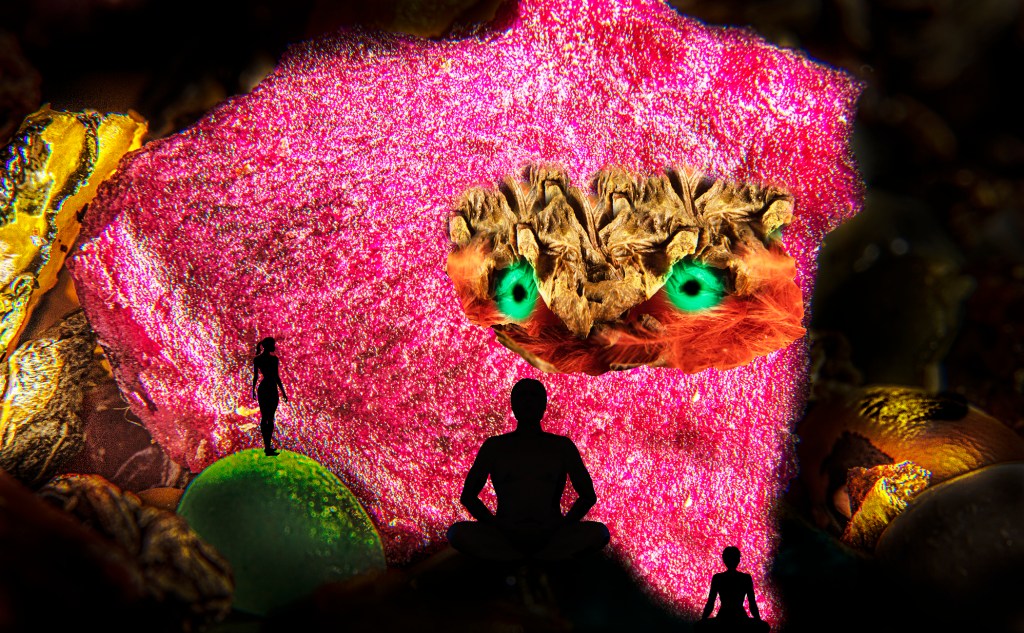
Alien Telepathy

Inspiration for my Artwork comes about fast and furiously, which I attribute to the theory of left-to-right brain transformation. My background and education have enabled me to create without boundaries.

The Overseer

I see a world of abstract shapes and colors, and I interpret my vision in digital images. Hidden within my creations are enigmas—mysterious images, cryptic messages, and symbolism. I invite viewers to explore, to decode, and to find their own meanings in the art

Crystal Blue Persuasion

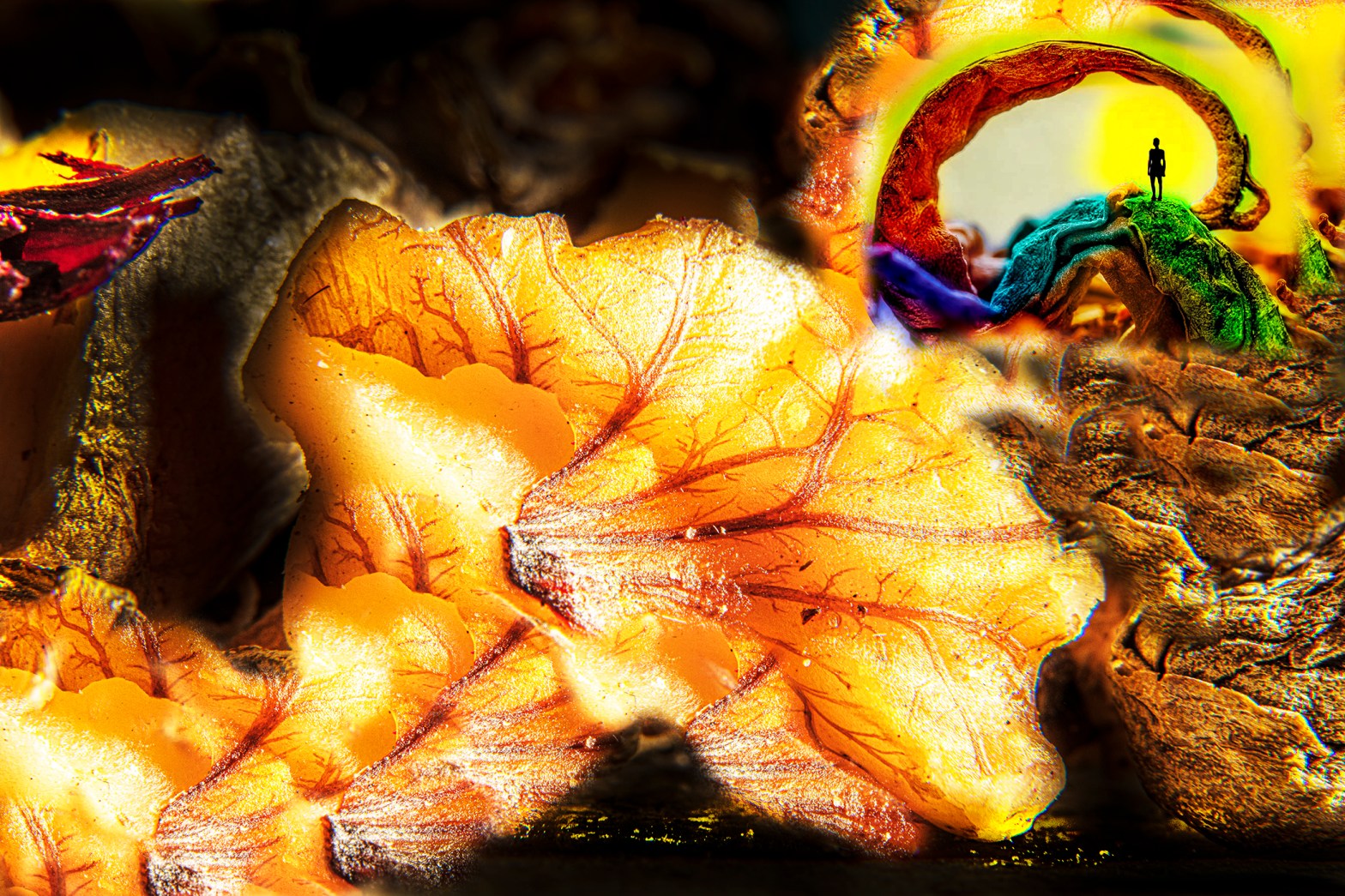
Leo Alt (Leonid Altshuler) is a notable 21st Century Digital artist, whose work incorporates images of organic substances, minerals, and man-made items, photographed on a micro-scale. Included in the surreal scenes are silhouetted forms of humans and other creatures.

The vivid images are evocative of many scenes: dreamscapes, alien worlds, portals to other dimensions, and more. Leo’s portfolio showcases his unique vision and creative approach to digital art

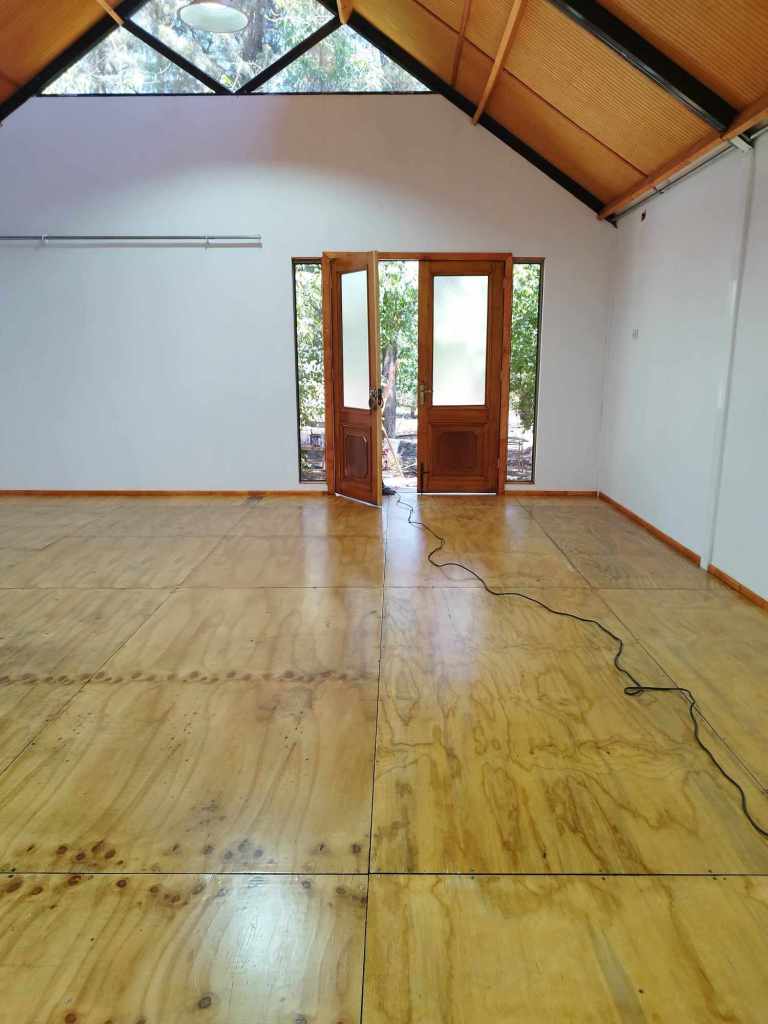
Galería de Colibríes

A partir del próximo mes, el mundo pronto recibirá una invitación para experimentar la vibrante galería del artista sudamericano René Fernando Ortega Villarroel. Quienes se encuentren dentro del área son bienvenidos a asistir a la expo Franterno. Marquen sus calendarios para el 23 de marzo, cuando una exposición de grandes artistas sudamericanos que alteran la mente debutará en Til Til, región metropolitana de Santiago.

Pocos lugares pueden rivalizar con la línea eléctrica orgánica que se encuentra en los entornos naturales surrealistas de Chile. Chile y Sudamérica se convertirán en destinos líderes mundiales para experimentar estados psíquicos surrealistas.

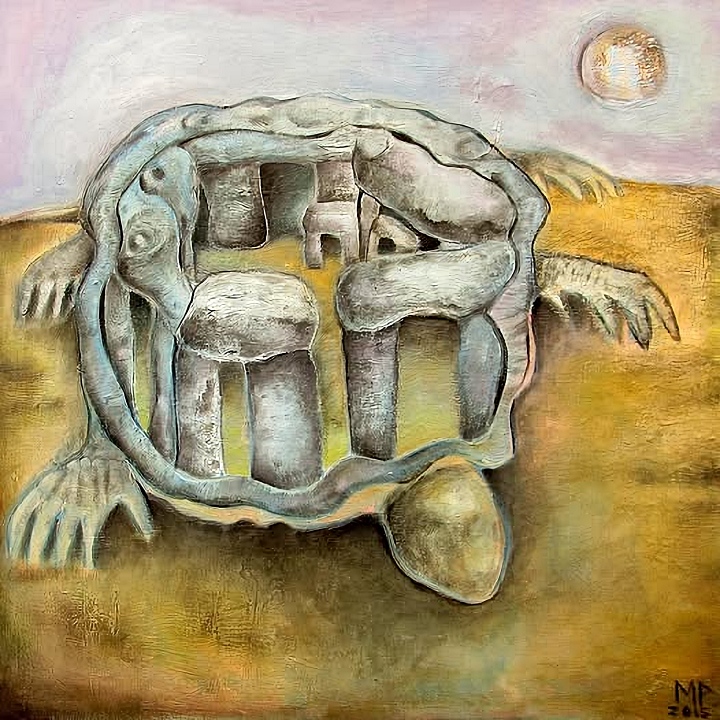
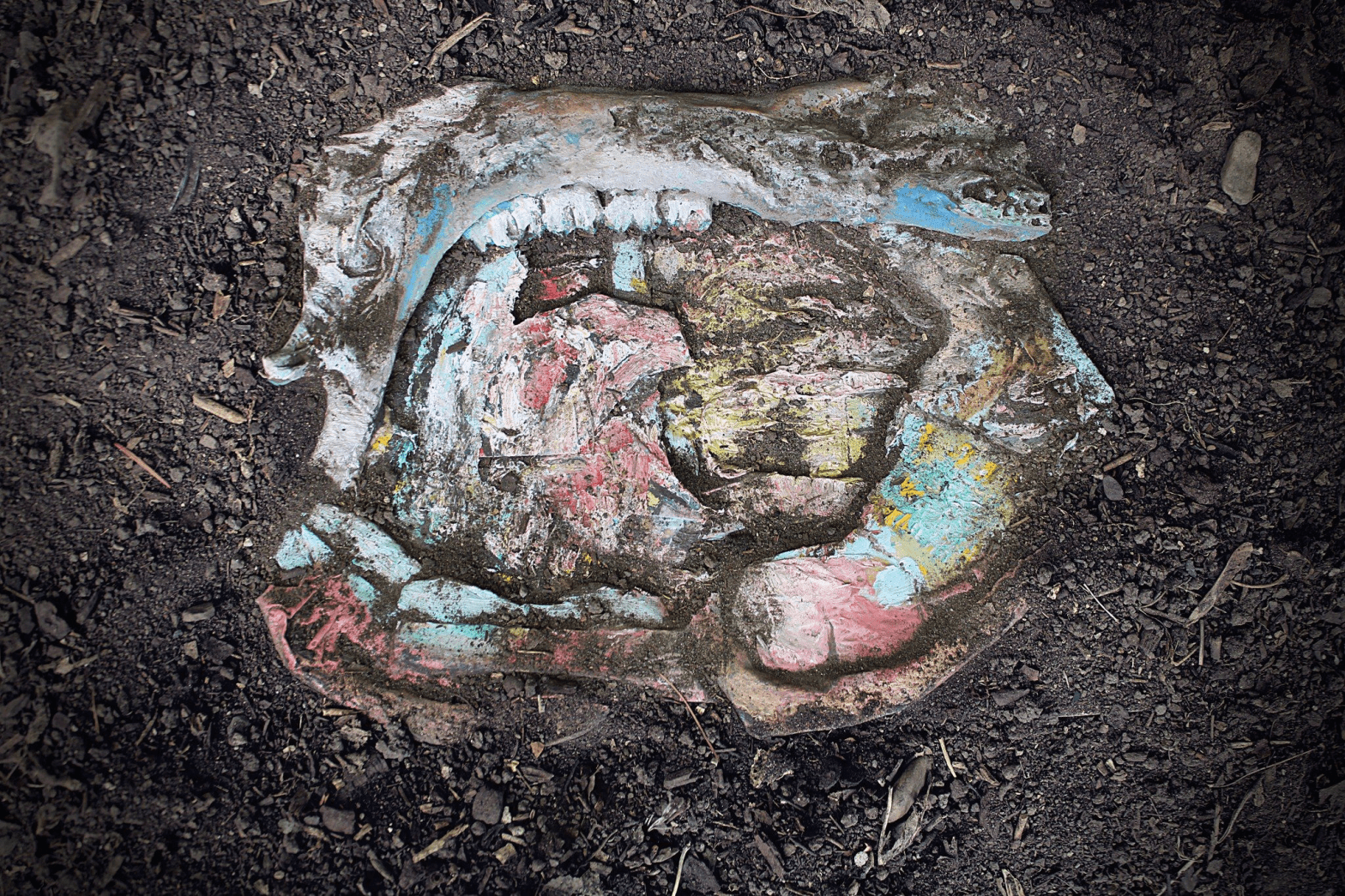
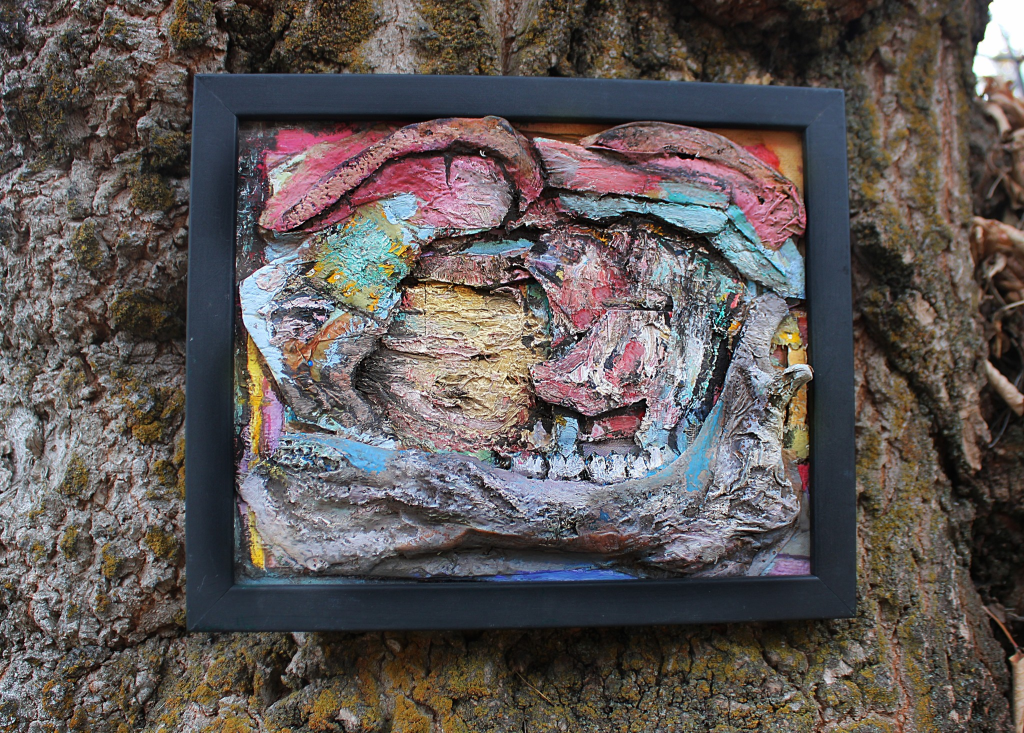
Buried Painting

Harvesting a buried painting from the earth in late October 2023. oil/collage/bone

the imagined belief interrupts the critical factor

official technocrats announced Monday

that holography can work on what you already paid for

…but you know how that goes

holography sounds a lot like

bending a staff into waves

I’m more interested in the laser

the Zia

that doesn’t encounter a time barrier or any irrelevance

surrounded by dated marks

it is melody and musical notation

hear a tune play about shifting the strain in forms

edges and interior angles melt

motion flooded gliding parts

burying older gadgets

add another page and layer to the landfill

another brief still life surface spoiled

oracles from the underworld tell us the future will be claimed by an unidentified cosmic object

so meet the smartest item that answers and restricts further editing

an open object without vain intention and meddling interpolation

while equipment that silently lacks possessiveness

lays cradled in dirt that grows

© Mitchell Pluto 11/4/2023

Anthropomorphic Sap by Ricardo Enrique Castro Guerra

Materialidad en la obra de Ricardo Castro Guerra

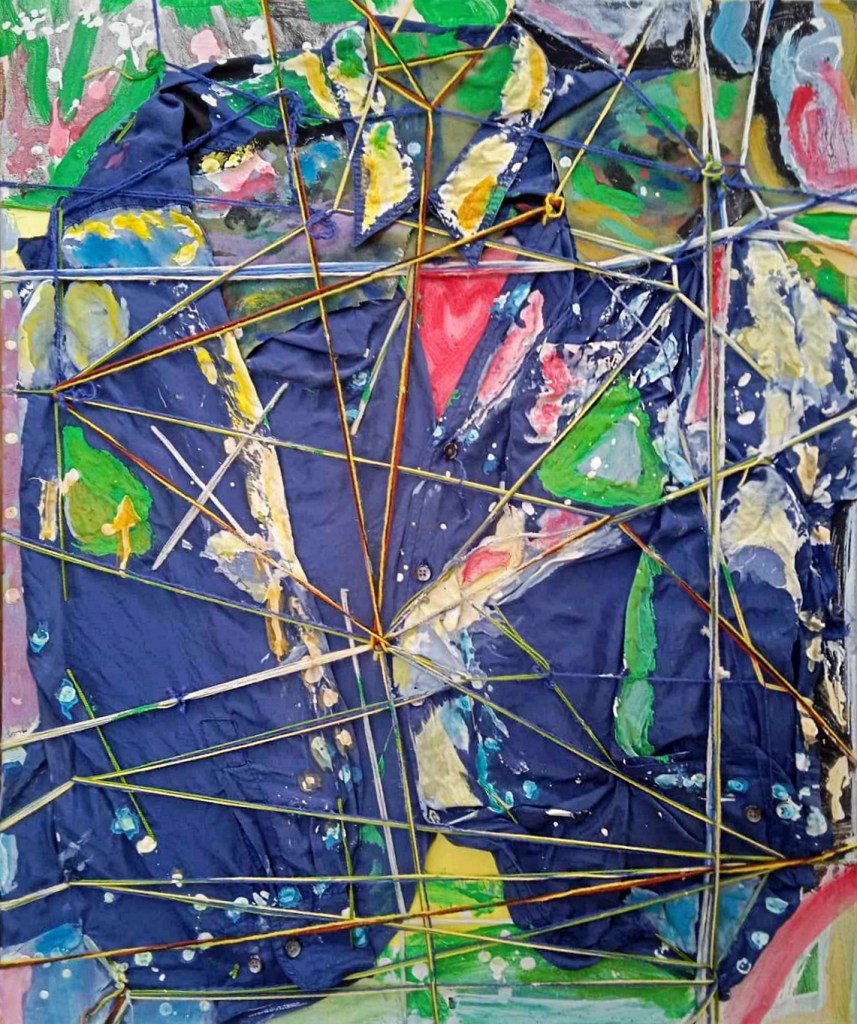
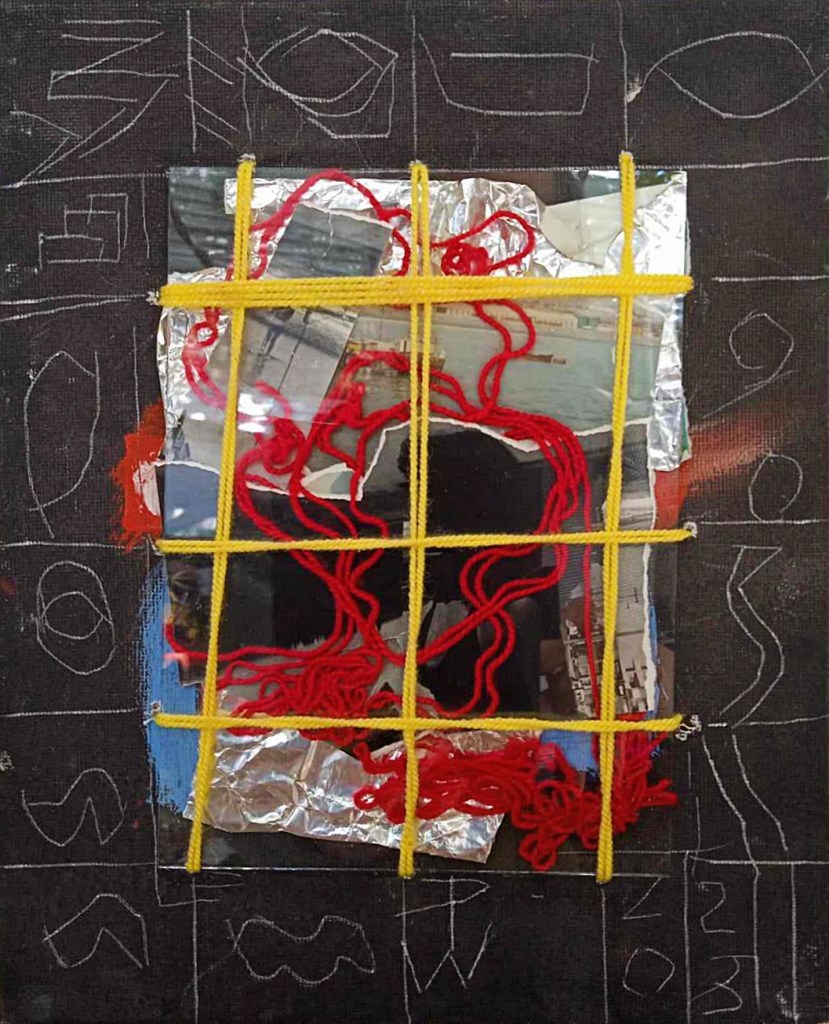
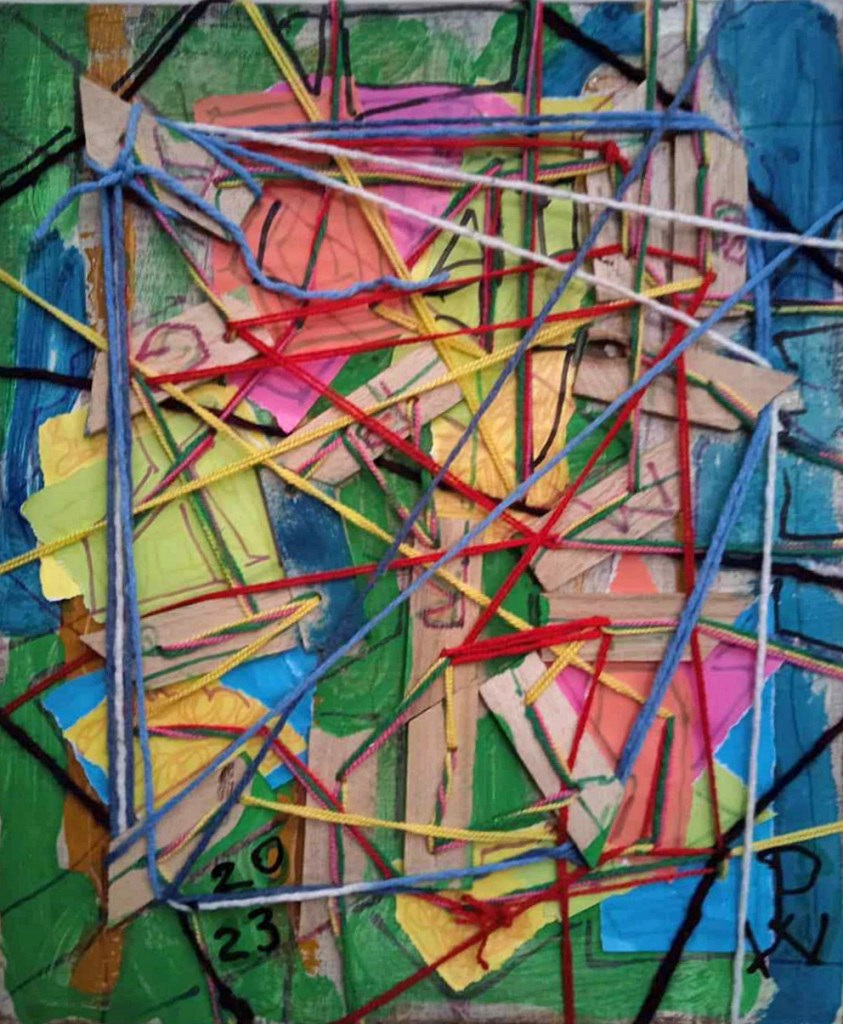
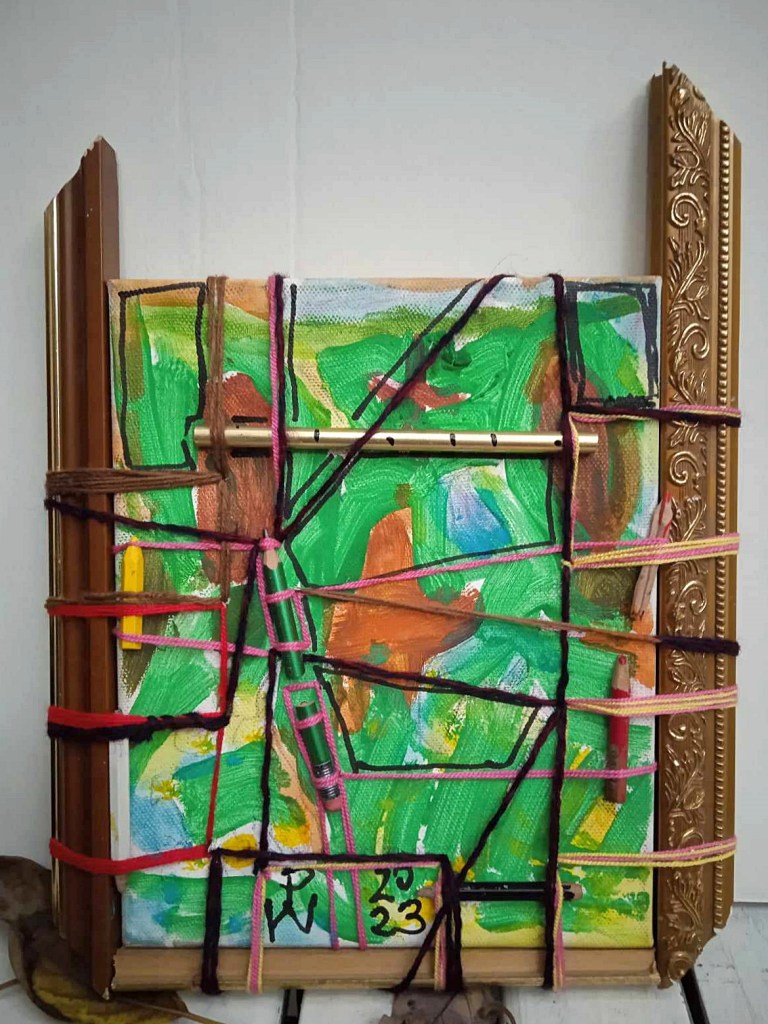
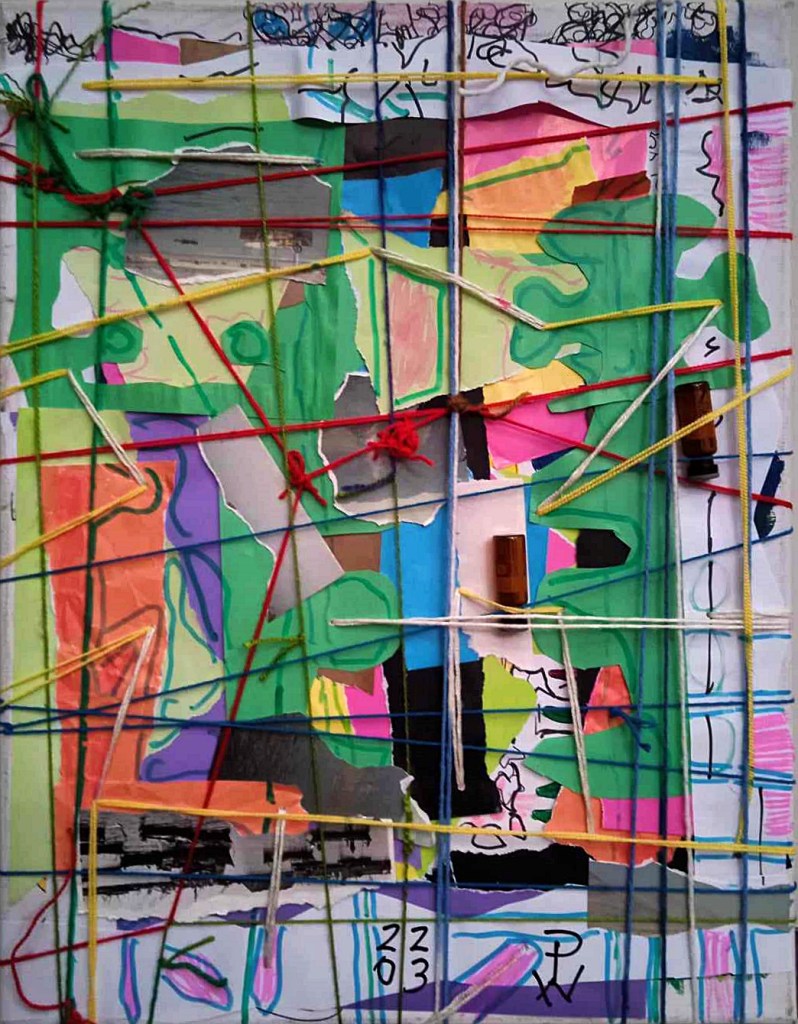
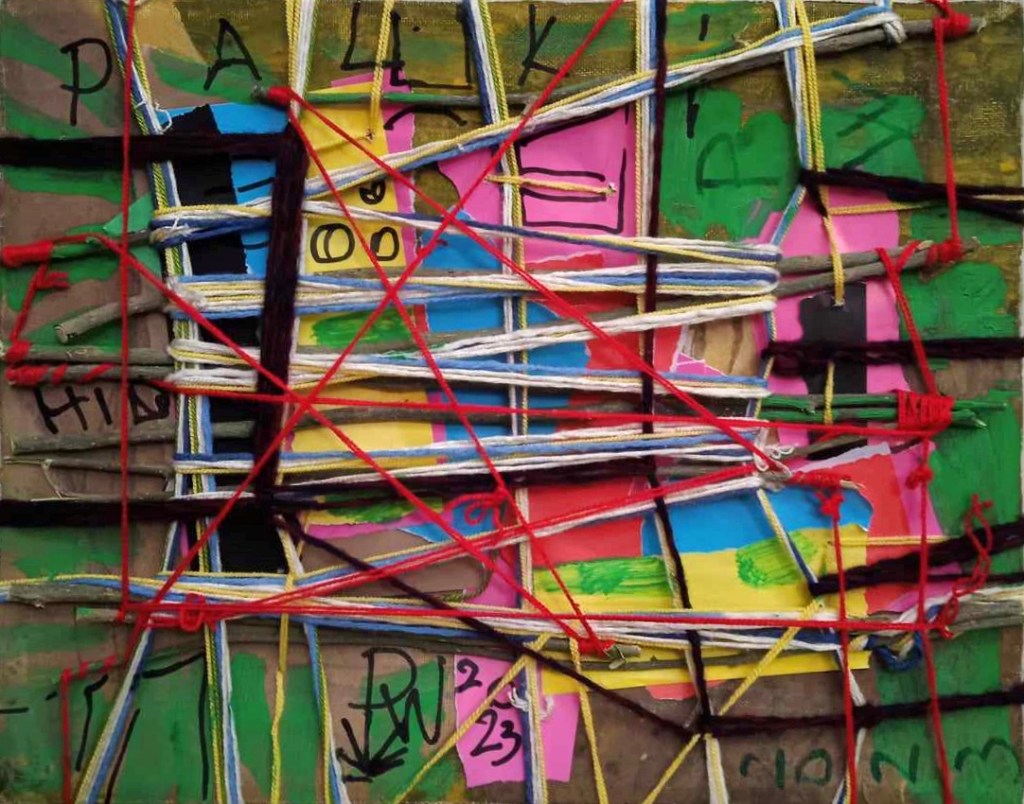
La materia sustancial de mis obras las constituyen materiales orgánicos mutables provenientes de la natura-leza y prefabricados por la industría humana. En la unión de estas dos naturalezas está el magneto. Savia fito morfa, sabia antropomorfa. El medio ambiente me proporciona los medios, el medio ambiente urbano, en las calles tomadas por recicla dores. Todos los objetos son encontrados, escasa compra de materias para hacer obras de arte, sólo basura, desperdicios con ene energía humana. Cartones, lanas, vidrios y maderas; papeles, hilos, pinturas, vidrios, telas y marcos. Reúno elementos desperdigados, subproductos de la industria y la codicia humana. Doto a cada parte de la obra con una condición magnética, esto hace que de diversos elementos surja un sólo. Mix de materiales considerados de nuevo para la aventura creativa, reciclador de los que reciclan cachureos. Materiales abandonados por el sistema educacional, obras de arte anónimas, retratos de adolescentes, papeles pintados con acuarela, todo es obra de arte antes de que yo la asuma como medio para elaborar otras ideas, me siento como un borrador, como si fueran partes de un muro pintado donde llega otro que pinta y tapa lo que ya está pintado, mucha obra de niñas y niños, dejo muchas veces los colores o algunas formas, se puede decir que mis obras son coproducciones, alucinaciones de seres humanos de Chile.

Color
Los colores vienen con los objetos que encuentro. Uso común de temperas y acuarelas, cartones preparados con esmalte blanco al agua. El papel lustre aporta colores brillantes y planos, es ahí donde tempera y acuarela vienen a apaciguar estos planos, luego como complemento: Hilos, lanas y pitillas aportan lineas de colores inenarrables, son lineas de color que tensan con ángulos y triángulos las formas, por tanto lo que ya está pintado, y recortado se reaviva, los colores se superponen, se acercan el hilo negro con la tempera negra, el amarillo del hilo con el amarillo del papel lustre, la acuarela hace su magia transparente. Los géneros me aportan un color de sedas azules o sedas amaranto, todos los colores dependen del material en uso (y huso) y de esta convergencia surge el color final de la cosa. Obras que sólo tienen el color de los papeles lustres lustrosos satinados, con recortes se forman las manchas, se forman las zonas de color y todas sus líneas, más el color de las lanas que uso para atrapar el papel, es indiscriminada mi elección de los colores, los hago entrar en cada una de las obras, esto hace que se asemejen mucho entre ellas, o tal vez sólo es familiaridad, color familiar.

Linea ¿Linea de estilo? ¿Qué linea sigo?

la linea como parte de las figuras, de los fondos, como parte integral de un monosapiens, o de una gráfica cualquiera. Las inalterables lineas del soporte, todas lineas rectas, innumerables en la trama de la tela, verticales i horizontales, invisibles. Cubierta de pintura o de papel. Linea hilo diagrama, el hilo-linea entra en el agujero que es el aleph de las que ya fueron trazadas con lana. Se convierte en trama, en tensión, gira alrededor del soporte, sujetan la composición, como factor de unión. la línea sigue un hilo en el laberinto de la obra mixta, amarra las formas, los fondos y las figuras giran en torno a la obra,dejándola reversible, o sea apta para apreciarla como si fuera un volumen. El empleo de marcos (enmarcación) le aportan 4 lineas rígidas a la soltura de la estampa, lineas que atrapan toda otra posible linea variable de la obra misma, echando al cuerno la espontaneidad o soltura del contenido. Acertijo de lineas sólo inicio y final.

written by ©Ricardo Enrique Castro Guerra

Ricardo Enrique Castro Guerra

Es un asunto de querer magnetizar los elementos encontrados. Unirlos como si fueran una solución a un problema, sin tener , ni presentarse como problema. Al encontrar un objeto se van produciendo solas las uniones, la visión de esa reunión empieza a crear se su propia obra. Una inspiración creativa que se gesta a través de las palabras y las acciones. Arte de acción, teatro, poesía, plástica.

Nacido el año de 1961 y dedicado a la creación artística desde entonces, cuento en la actualidad con 62 años y perseveró con entusiasmo en la creación de poesía, obra plástica y conciertos de poesía.

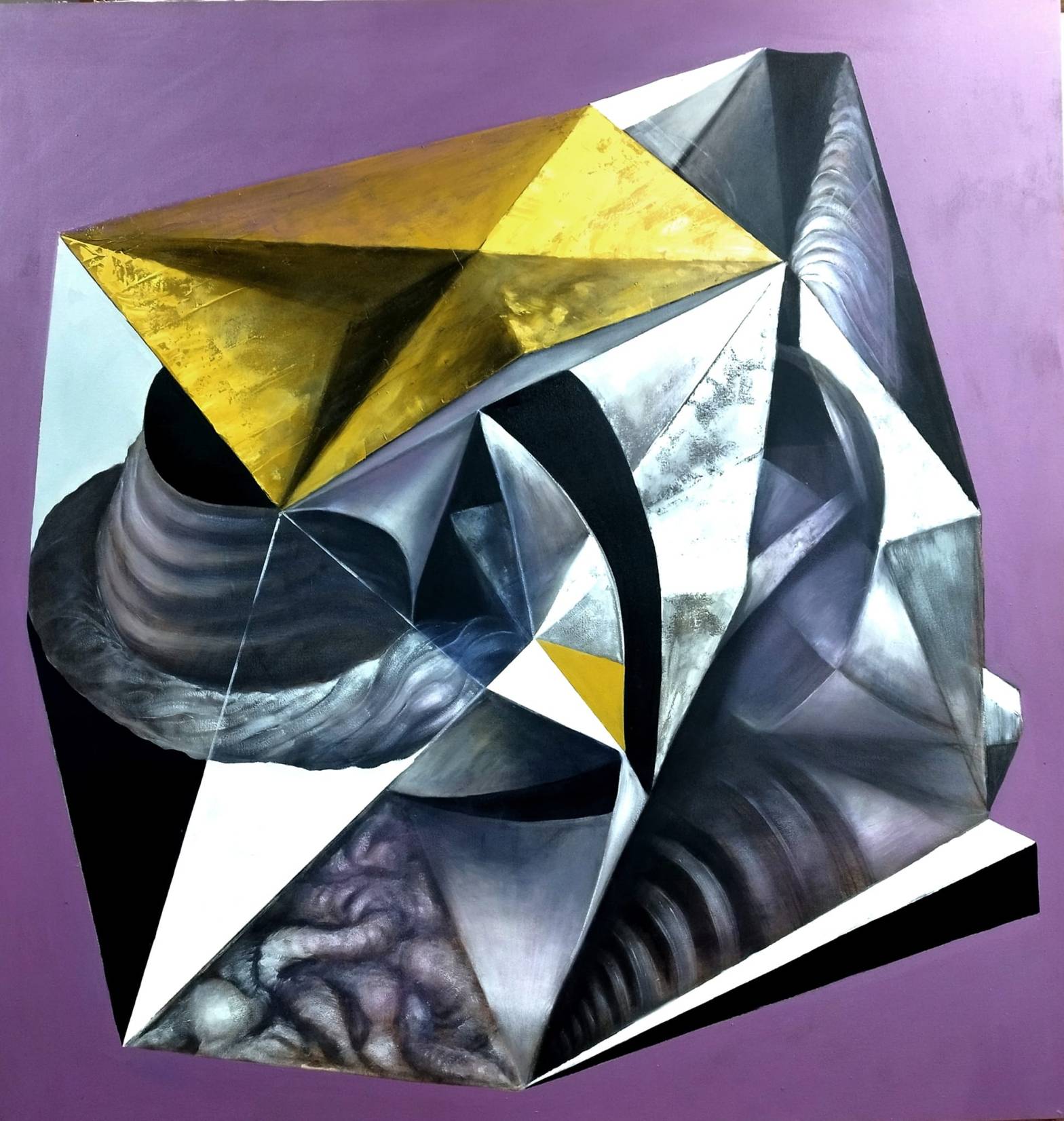
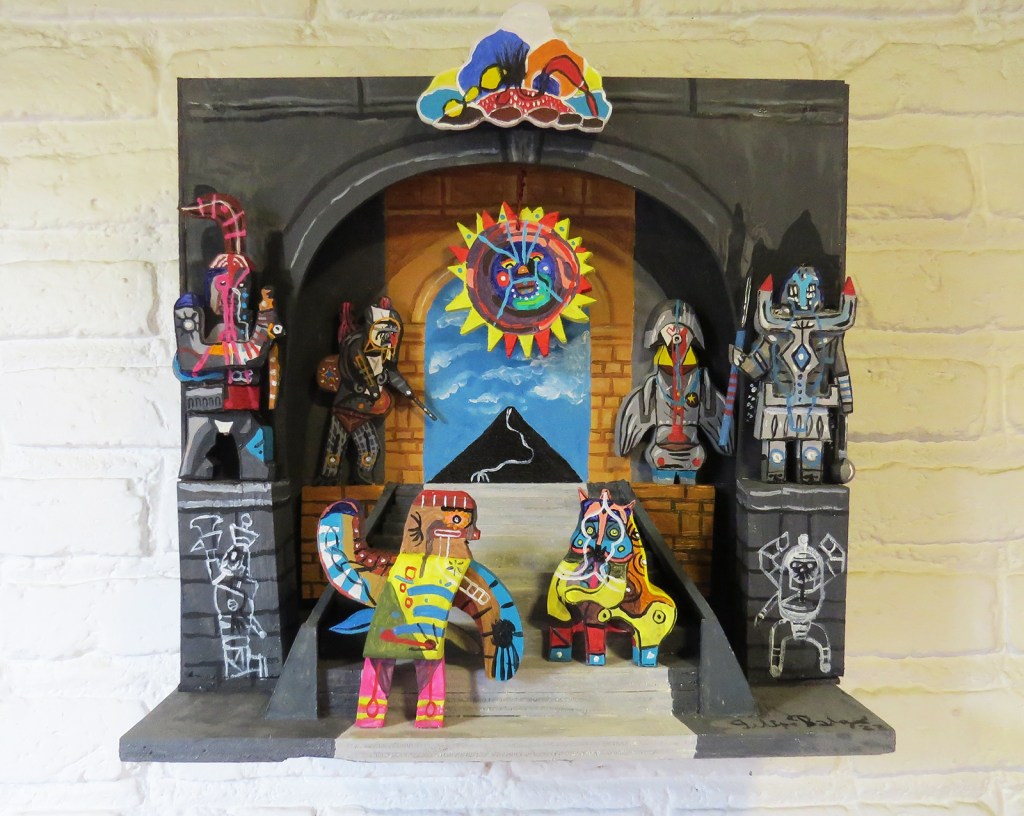
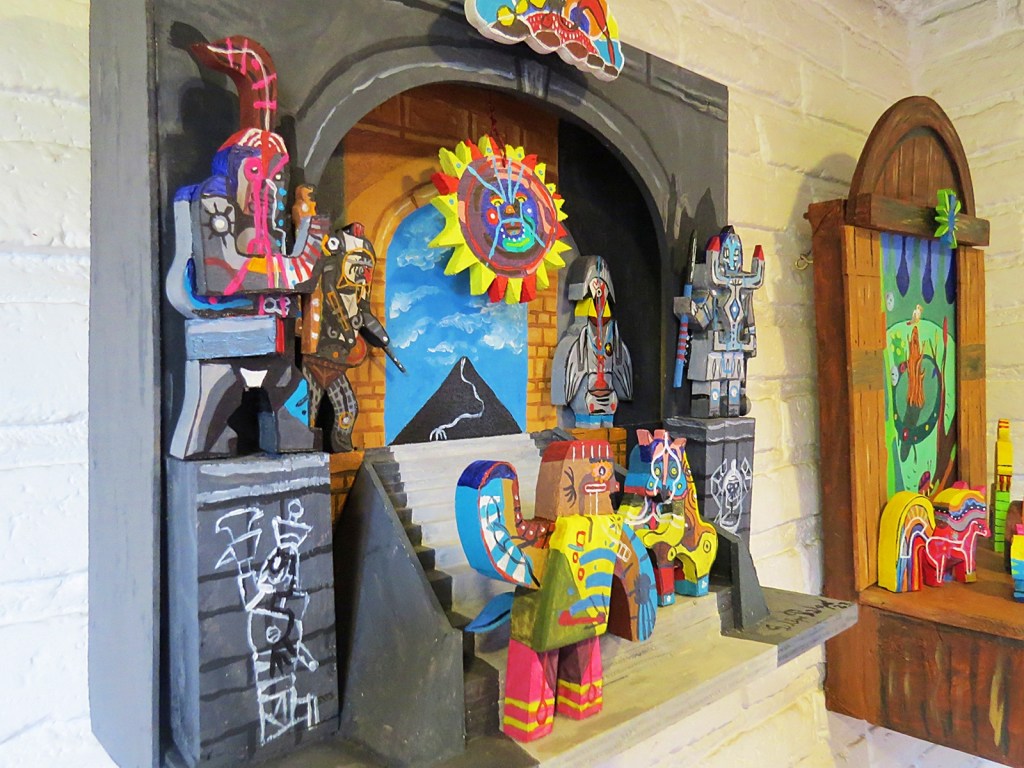
Sol, el Cuarto Cielo Felipe Balzo

“Sol, el cuarto cielo”
Acrílico sobre tela y madera.
50 x 50 cm 2023

Writing is an art, which requires a life and I don’t know how to write, I know how to paint, after 25 years, I don’t stop learning and growing. Words can probe the deepest reality, but it is not the only way, you can have few words and still have a profound impact on the nuances of reality, you can have songs in your mind, plastic and colors.

I have colors.

When I look at a painter I also see words. Meanings, ways of seeing the world and nature, that have been transferred, inherited from one artist to another. As if we all spoke the same language, a hidden one. Hidden it is, behind the colors that live in my mind.

I do not hide in the colors, from the unbearable reality. I want to think that I shape it, I want to think that it can be inhabited in other realities. I want to think that I win the fight, freedom from myself, freedom from reality. I want to be able to see a space, a small work of art and it reminds me of this, it speaks to me about the spirit, I want to inhabit dreams. Imagine the psyche of a great musician, composing songs in his mind, or a poet spinning beautiful phrases full of meaning. Evading the weight of the psychic constructions of the most common social dynamics. What a beautiful girl, that guy looked at me ugly, how badly that old man drives, how fat, how tall, DO RE MI FA SOL LA SI, isn’t it perhaps a transmutation.

I don’t know how to write, I can put these meaningful sentences, which I will regret later, not a poet. Nor from what I have painted, a constant growth, the practice of a static that comes from colors and forms. A way of meditating, a way of praying, perhaps that is why I am building altars today.

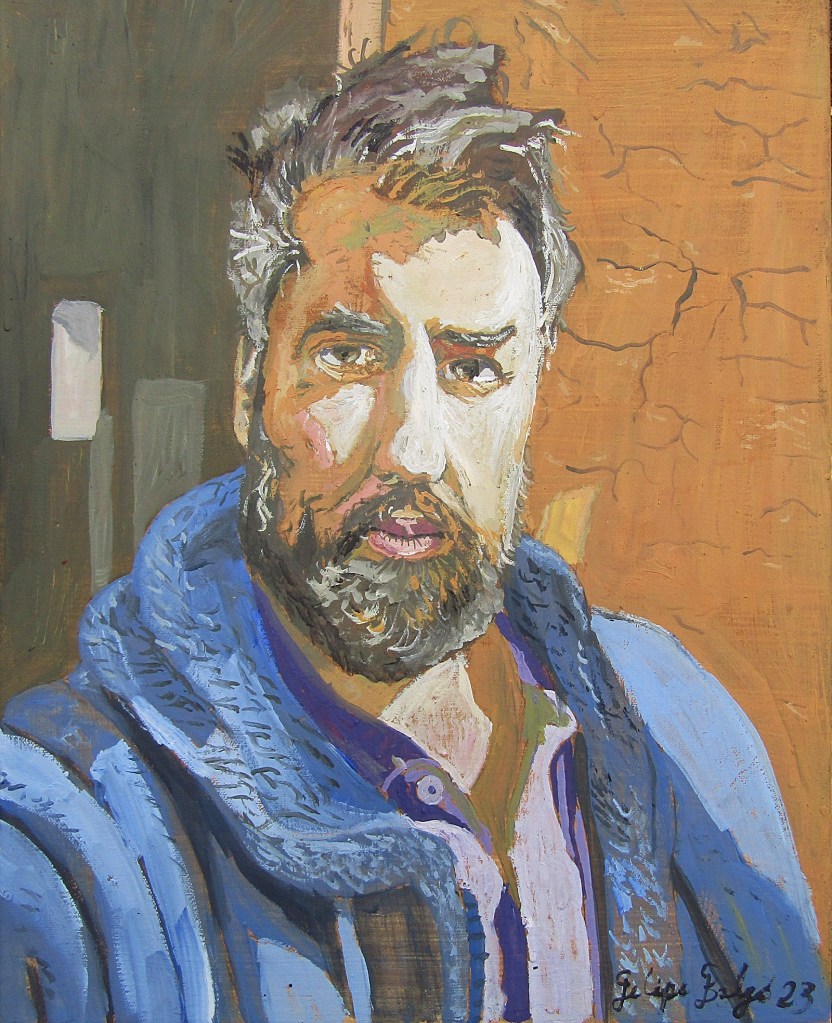
Felipe Balzo. Santiago, Chile

https://felipebalzo.weebly.com/