What does it mean to have secrets as the topography of one’s body?
It is true, not all secrets are created equal. Some add a sway to the hips while others…well…they are a poison that eat us from the inside out.
I’m Tellin’
All unsaids, All secrets are not created equal. Some secrets kin with our bodies because our bodies know that they need to be the safe, the harbor for such things. This is not about that. Some secrets turn a walk, a regular gait to a saunter because the body tastes its sweetness. This is not about that. Certain kinds of othas, secrets that is, well….they bloom somethin else, the poison that eats us from the inside out.
This be bout dat. Dat latter kind. Dat otha kind.
It’s not just in the toxic we trust. We grow. We throw seeds. We replicate it.
*
When I was a child , there was a statement that we would say that would check the perceived wrong doer. It would be something like, ’Oooooh, I’m tellin.’ What precedes the ‘tellin’ is the series of oooo’s mixed with the arrangement of vowels and consonants after that short phrase all together, in sum, in calculation, may make the 24 million miles long tail of Hailey’s comet green-eyed.
I’m tellin’ was a threat.
It was to check the doer who was already in deep doin wrong. It was a nod to the way one was willing to betray secrets, willing to betray the real monster who hid under covers.
The tellers of the toxic became the snitches, the snitches is who we said would get stitches In those streets
What does it mean to have secrets as the topography of one’s body?
Be damned, dare stitches, dare the can of whoops ass…I’m tellin.’
No threat…but invocation
Viens
Viens ici
Je ne te l’ai jamais dit mais
Oui je l’ai fait
*
Gwendolyn said it best, “…Even if you are not ready for the day,
It will not always be night.” By not ready, we mean whatever you are holding. Whatever is hiding within the folds and wrinkles and twists of unmade beds. Whatever is being passed across through invisible notes
All ink doesn’t vanish. Some just wears…refusin’ ignoring
By not ready, we mean through the hush of phone calls. The phone calls that contain whispers. The phone calls that have no phone lines that require that and only THAT one other person picks up the receiver
The thing that returns to the pit spiraled tight behind the spiral of the belly’s button. The thing that makes it feel like each look by another means they know it because of the way it reads on the body. Tethered and bound. Whatever it is that you are holding and hoping that the sun won’t beat you to it…It’s coming
Je le referais
Je le referais juste pour le chemin
*
What if we said that the keepers of that kinda…. are the sleepers who never awake. What if we said we will nail their coffins shut
And forbid them from wake. What if we flipped the script on the secret keepers, the pain dwellers, all gates and their guards,
The bottom feeders who feed on the toxic blooms, the corpse eaters who grow fat full and bloated off the bodies that become emaciated from thoooose kinda secrets
What if…We take their power back. We read the topography of the secret laden body and become fluent. Armed with the tongues that know how to untaste poison, daggers in hand.
We the kind who realllll good with the way the sun sneaks up, how it creeps from behind the curtains of dark. The heat, we feel it on our shoulders. We refuse to hide from the way it will come get us
Nous avons tous été pese
Nous sommes toujours trouve…voulant
Nous ne pouvons pas le nier
Something about the way a secret taste
Jevu hu fair sa—
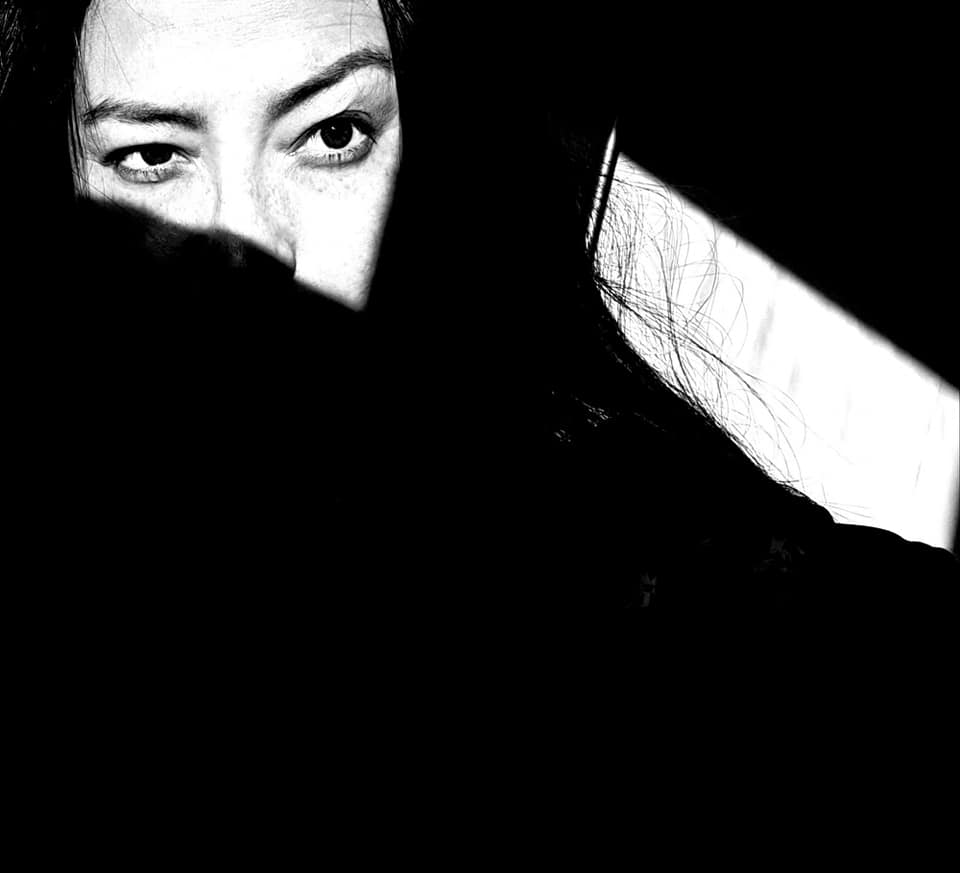
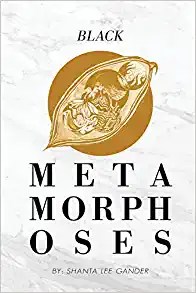
Shanta Lee Gander is an artist and multi-faceted professional. As an artist, her endeavors include writing prose, poetry, investigative journalism, and photography. Her poetry, prose, and personal essays have been featured in The Crisis Magazine, Rebelle Society, and on the Ms. Magazine Blog.
The light of old things, of beautiful old things, awoke in me.-- Sherwood Anderson
swathes wash-lift, titillative
fibers twine through time,
tangle through grasses, air,
the storied
the beheld
these old pliers, bruised, complacent,
loose, slackened by the exigencies
of labor, the perfume of application
seasoned armchair yellowing from
the fade of multitude, stuffed
with the mnemonics of repose, the
armature of provision
spattering through the long cornfields sacred vessels
spring alive, drink the oil of the
corn, flutter to the western winds
things patinated,
foamingricketyhistorical,
flux-chugging
Abyssal Eros

techy		telltale		totem
	odiferous refract
 calligraphic concert

	a matter of teeth
upwards & out
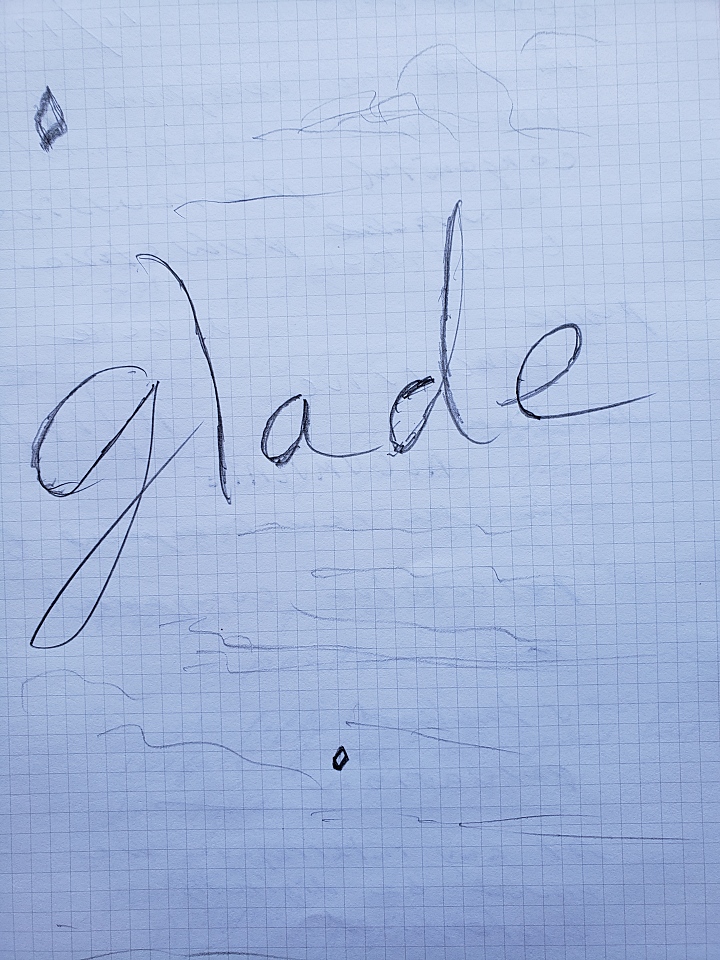
doesn’t anyone say g l a d e anymore?
gloss the glimmer reef really
	hammockSplay		over-
tures daub mineral-rinse gyre
				cumulous curdle
					drift
						harmonies
formulate in flour
	acculturate spray

					love is pertinent to confusion
					meticulous punctuation is an expensive luxury

the floorboards rose,
		       then swallowed
Heller Levinson is the originator of Hinge Theory. His most recent books are Dialogics (Anvil Tongue Press, 2022), Lure, and jus' sayn' (Black Widow Press, 2022). His Query Caboodle and Shift Gristle are scheduled for a Spring 2023 release (also BWP). He lives in the Hudson Valley, NY.
Featured Art Photo Grass Drawing for Sherwood Anderson by Linda Lynch
In his seminal work Madness in Civilisation the American sociologist Andrew Scull examines the way madness has been both an ineradicable aspect of any ordered human society, a haunting image of fear and terror, as well as a fascinating realm that inspires and attracts artists and thinkers. With the Greeks the Hippocratian tradition began, in which physicians tried to explain deviations from the average mental and bodily behaviour in natural terms, with the four humoral elements; blood, phlegm, black bile and yellow bile. Meanwhile, folk explanations of what today is often called mental illness were given in terms of the influence of spirits and demons, as well as the actions, lessons, warnings and spells of the gods. Thirdly, it was also thought, in at least some cases, that the mad were perceiving something real, as Plato says: “We made four divisions of the divine madness, ascribing them to four gods, saying that prophecy was inspired by Apollo, the mystic madness by Dionysus, the poetic by the Muses, and the madness of love, inspired by Aphrodite and Eros, we said was the best.” In this third view, Plato’s view, the madman is not a patient with a disease, neither a sufferer from divine fate, but a seeker close to something of high value.
Madness has been translated as the inner individual working through of feelings of guilt, shame, stress, and recurring traumas, all of which are interacting with the neurobiological level of the brain.
Many centuries later, the medical attitude has become dominant in this domain; since the 20th century the profession and discourse of psychiatry has claimed to know best how to deal with madness, and its accounts have been soaked in ‘naturalist’, medical terms. The earlier folk explanations that interpreted madness as a curse, a revenge, or as a whim of gods, demons or spirits, have been transformed into the dry spiritless jargon of modern psychology. Stripping the gods from their ‘real’ character in a communal world, madness has been translated as the inner individual working through of feelings of guilt, shame, stress, and recurring traumas, all of which are interacting with the neurobiological level of the brain.
But what has become of the third way of interpreting madness, namely as mysticism, prophecy and inspiration? About that possibility from times past Andrew Scull remarks: “Madness might represent another possible way of seeing: bacchic, erotic, creative, prophetic, transformational… there was another concealed kind of knowledge, intuitive, visionary and transformative knowledge and madness might provide the keys to this mystical kingdom.” In our modern age however, this search for ‘concealed knowledge’ has been forced to be played out in the open, in the form of science, which led to ‘exact’ and general knowledge about nature and its ‘concealed’ patterns and laws. Knowledge and truth count only as valid today when they are communicable, explicit, and expressible. The visionary and prophetic, on their part, have been banned from any claims on knowledge and truth, and have been referred to the fictional domains of the narrative and the religious. And the transformative? Searching for transformation has become one lifestyle option among many, permissible as long as it remains an individual striving. This transformational drive has been captured and spelled out in self-help books, coaching trajectories, management books etc.
When, what Scull and Plato refer to as mysticism and as divine madness, is fully translated and reduced to the field of mental health, something risks becoming smothered, neglected or even suppressed and denied.
Such conformist adaptions and down to earth elaborations of what were once ‘mad transformations’ have however not exhausted the underlying longing for platonic ‘divine madness’, and the ways that people still long for – whatever we call it – freedom, the Other, infinity, being or nothingness, are numerous. Some of those longing for these things put their feet on the philosophical path, and lean to the explicit, active, overt or even academic forms of philosophizing. Others go their own way in a more intuitive and passively seeking and dreaming manner. Both run the risk that at some point their strivings are considered to be nothing else than expressions of individual psychological problems, or as by-product of a supposed disturbed dopamine transmission. That is, they run the risk that their roamings and free-floating searches for divine madness are ‘psychologised’ – ascribed to their personal identity, or to personal problems, or even reduced to the only one level that is considered to be ‘basic’ with respect to life: the neurobiological level.
These psychologising and psychiatric views on that ideal realm of Plato are, to be sure, not bad in themselves. Society’s well-being depends on mutual trust and care, and is helped by the professionalisation of health care. But when the vague, ineffable area that Scull and Plato refer to as mysticism and as divine madness, is fully translated and reduced to the field of mental health, something risks becoming smothered, neglected or even suppressed and denied. Some of the more thoughtful practitioners and careful psychiatrists in the mental health field are aware of this, and have attempted to approach the inner life, the experiences and desires of their patients, from a perspective without presuppositions and prejudices about madness, and with an open mind as far as possible. And indeed, some of them, like Ronald Laing or Louis Sass have succeeded to a considerable extent to sketch the worlds of those that are involved in divine madness wander through. But all the more often, those that start from this psychiatric philosophical position remain hampered by the plain fact, that their starting point is the psychiatric diagnosis, and when tracking that diagnostic conclusion or end point back to its origins, they infuse the origins with the supposed crippledness of the endpoint. The diagnosis they make becomes a new identity for the patient, which throws its shadow back to earlier phases. What was once considered day-dreaming, or a peculiar whim, or capricious experience and deviant thoughts, become reinterpreted as only early signs of natural mental disorders: ADHD, autism, schizophrenia, bipolar disorder, etc. – nothing divine to find there! Not only the present state of a person becomes reduced to an amalgam of neurobiological patterns and psychological reactions, but also preceding experiences, thoughts, feelings and behaviour are drawn and reinterpreted into the diagnosis.
Such reinterpretations after diagnosis certainly do have their function: people receive strong narratives that give them a clear sense of identity, and a kind of compass in how to sail further with this diagnosis centered narrative. But the cost could be high as well: the third realm, the realm of divine madness, as I circumscribed it above with help of Scull and Plato himself, might simply vanish. A spiritual search becomes reinterpreted as a psychological search for a strong role model, a philosophical preoccupation becomes an ‘attention deficit’ problem, and a mystical experience becomes ‘salience dysregulation syndrome’.
In my book A Philosophy of Madness I start at the other side of the track: not at the end with diagnosis, but at the beginning with philosophy. What extreme domains of thought are accessible for a philosophically minded person? Where can a study in philosophy, both in its explicit academic form, and in its more intuitive forms, lead to? Where does the impulse to philosophy stem from? What kind of philosophical thought and experiences can push it to the edge? In this exercise I have focused especially on philosophy, and drawn analysis also from the thoughts and experiences of those that are usually called mystics or spiritual. I started with the initial philosophical sense of wonder (also in Plato, from his work, the Theaetetus) in combination with philosophy’s consequent, consistent reasoning capacity. I followed these philosophical paths, and examined what may happen when you go down the philosophical rabbit hole. When you reason away, and/or dream away, through the philosophies, thoughts and ponderings on age-old questions about time, space, infinity or identity, then you may come at strange, fascinating and seducing thoughts and experiences, that may have quite some affinity with what is going on behind those so often frightening, enigmatic and seemingly impenetrable labels like bipolar disorder or schizophrenia. And with this exercise I hope to have induced a kind of ‘breakthrough’, through the wall that all too often separates philosophy and madness, in order to both confront the armchair philosopher with the ‘real life’ situations where their ideas are acted out, and the ‘madman’ with an explicit, exact reconstruction of the thoughts and experiences that are at the basis of their so-called mental health problems.
With this exercise I hope to have induced a kind of ‘breakthrough’, through the wall that all too often separates philosophy and madness.
On the one end this may have a therapeutic value, since I provide a more thoughtful exploration of the ways of the mind other than the usual psychological and psychiatric accounts. On the other hand, it has a destigmatising value, not by arguing that all persons with and without diagnostic labels should be respected equally, but instead by ‘opening up’ those labels, and detecting common patterns of thought and experiences between madness, dreams, art, and, in particular, philosophy. The notion of madness here may then reveal, and express perhaps in a socially unaccepted and clumsy way, the paradoxical and sometimes unbearable tensions that underlie any systematic attempt or philosophical striving to grasp the whole, or to seek unity and harmony. The passion that underlies so many philosophers’ intellectual drift may lead to a kind of ethereal detachment from earthly practical matters, that may lead them to become sucked up as fuel for further drifting away from the common sense and the communal life. Not only among philosophy students, but also among some of the great philosophers we find periods or episodes where they were for longer or shorter periods ‘out of their mind’, and at least some of them would be today diagnosed away, for instance think of Ludwig Wittgenstein, but also Blaise Pascal, David Hume, Michel Foucault.
To be sure, I do not pretend that all kinds of philosophy only lead to benign visions, prophecies or interesting thought experiments. Philosophy contained and will continue to contain ideas that are dangerous for society or for the well-being of individuals. The contagiousness of these ideas is well-known on the societal level, and the powers that be do everything they can to protect order from society destroying or undermining ideas. On the personal level, there are also ideas and experiences that may be drawn from philosophers like Nietzsche or Deleuze, that may induce ‘mad transformations’, and that may also be conceived as ‘unhealthy’ from an outsiders’ usual, normal perspective. However, to gain access to and explore what the mystical kingdom entails, the one Andrew Scull refers to, it will never suffice to prevent contact with dangerous ideas just because they are considered to be ‘unhealthy’. And perhaps there is another sense of health, greater and more important than mental health. Let me end, by quoting Nietzsche: “Anyone whose soul thirsts to experience the whole range of previous values and aspirations, to sail around all the coasts of this ‘inland sea’ of ideals, anyone who wants to know from the adventures of his own experience how it feels to be the discoverer or conqueror of an ideal, or to be an artist, a saint, a lawmaker, a sage, a pious man, a soothsayer, an old-style divine Ioner – any such person needs one thing above all – the great health, a health that one doesn’t only have, but also acquires continually and must acquire because one gives it up again and again, and must give it up!”
Wouter Kusters Issue 96, 22nd June 2021from the IAI Institute of Art and Ideas
Huge old stars leaning out of the horizontal cobblestone sheets, were dictated by an ancient manual of glorious epic forms where I did not read the cunning locks, from there fall lights like eagles what they hang before your pale fortifications and despite the fact that I descend without air I cling to the dissected edges of this abyss walking away from the waves of floral promises with summer mentions that anoint you.
The amaranth silence rocks the star again and like the silent lymph you seek to break beyond the fundamental shell the one that you came to know in a primitive way in the sweet stays of belief.
Blows the hydrogen on the leaves and many cycles are enough for oblivion, while the trees stand because they keep their memory in the roots, to later give shelter to life vertical. I am the extended earth, I still have memories of that Winter will come without you realizing it.
The specificity of the meander winding secret of the air like the grass with its distant star.
The land has spirit and we are the land…The rock pulses with energy and movement that we cannot detect…the rock sometimes shows himself and becomes recognizable like a face. The land is what we are, the land keeps us alive, the trees speak to each other about the land and share its nutrients, they live out their lives without any help from man. They are a community and we show them respect. Then there is the everlasting sky all others live beneath him with its many moods and gifts ,we offer prayer to all four directions. We say we don’t think about these things… we know all these things.
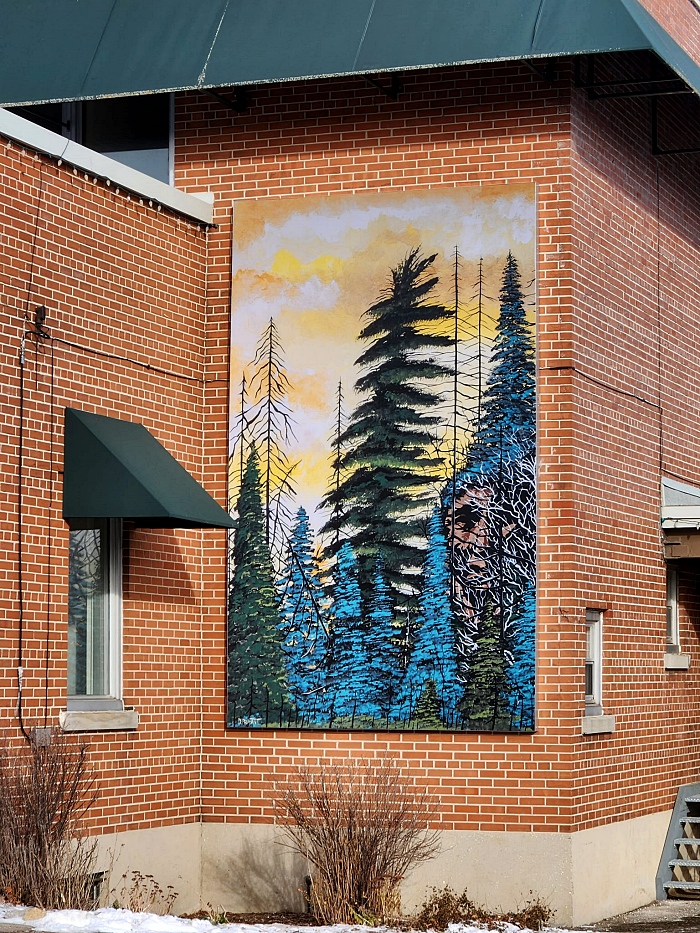
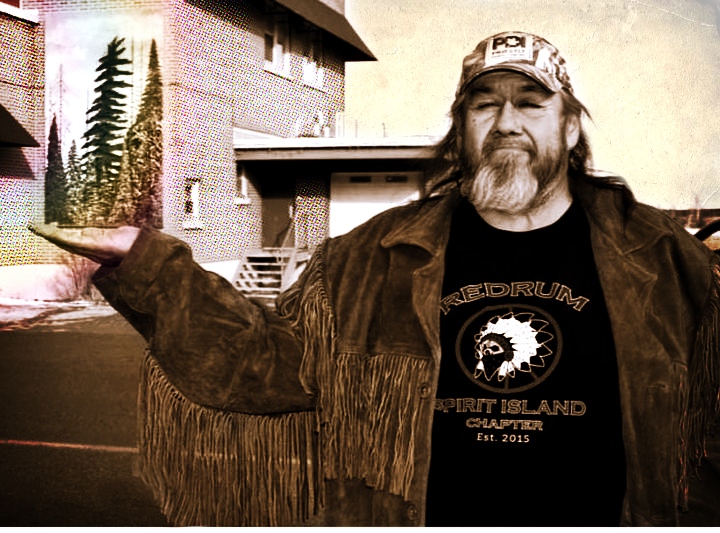
Permanent installation at Manitou Island Post Office
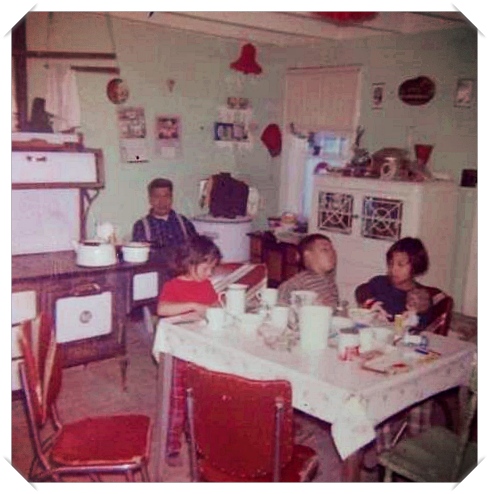
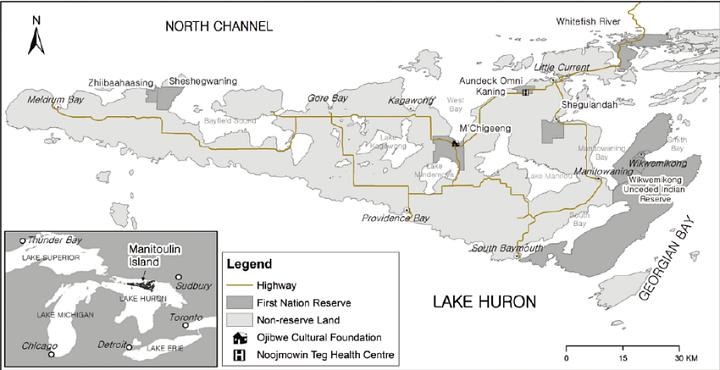
Growing up in Mchigeeng First Nation we were poor we didn’t know we were but didn’t feel like it…we had clean clothes food toys…No running water, no phone no inside toilet but we were happy…today I wonder about young kids seeing things on Facebook and tv like friends having parties, new cloths new toys, new this new that…big fancy houses…they look around their homes and community what do they see… What do you see ?
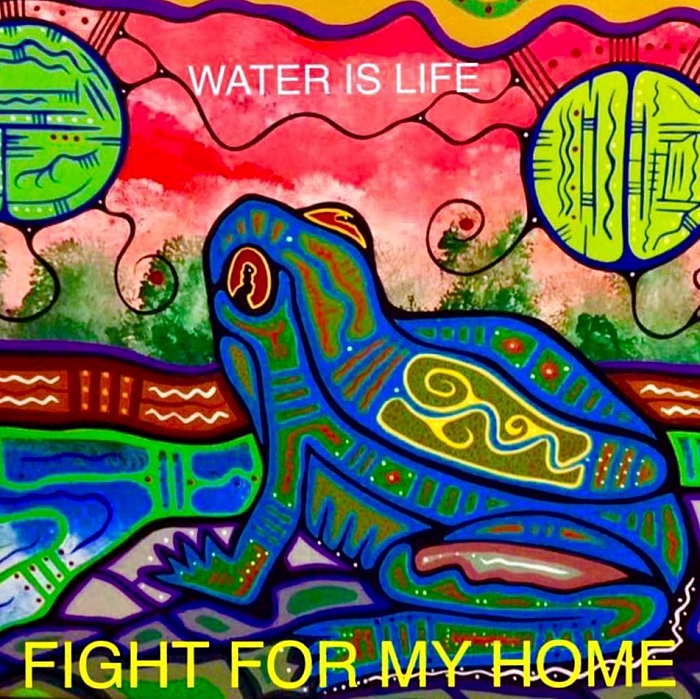
Our Ancestors foretold that water would someday be for sale. Back then this was hard to believe, since the water was so plentiful, so pure, and so full of energy, nutrition and spirit. Today we have to buy pure water, and even then the nutritional minerals have been taken out; it’s just empty liquid. Someday water will be like gold, too expensive to afford
Even the spirit, which belongs to the Great Mystery, returns to its source. Some of our people say this journey takes place on a path of stars. Others describe the spirit’s return to the Great Mystery as a drop of water falling into the ocean. It becomes a part of everything again as the light of a candle becomes one with the fire of the sun. That’s why we can sometimes feel our loved ones in the warm air, or hear them in a bird’s song…or even sense them in the…wind. We feel them in certain areas or times of the year,, we sense them and think of them and dream of them. Sometimes they talk to us in the dream but most times it’s just good to see them…we wake up thinking of them ,The dream can last a day or we think of the dream for many years…yes they are with us..
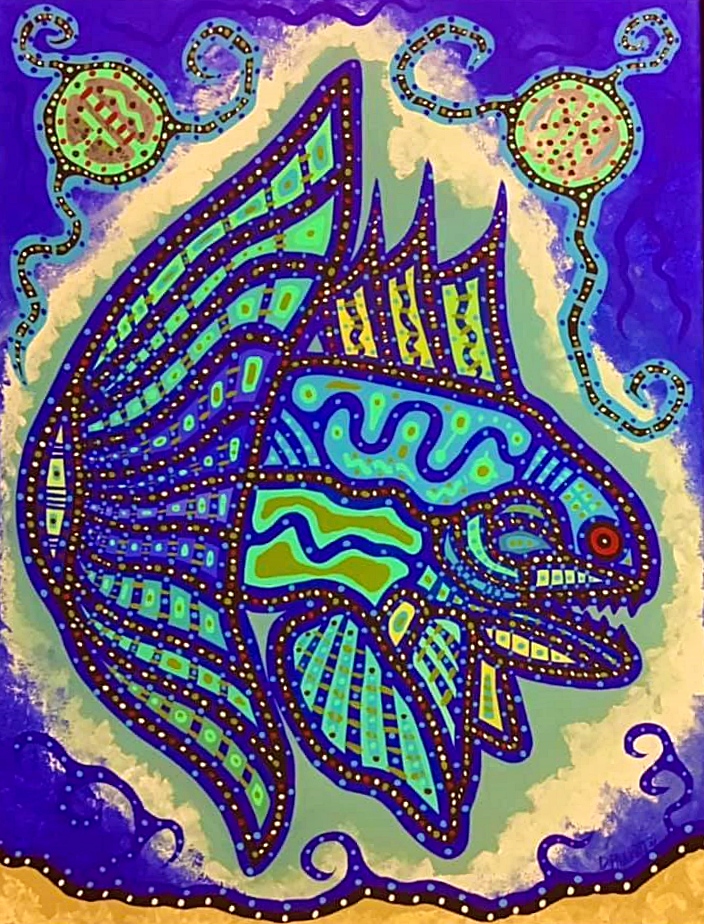
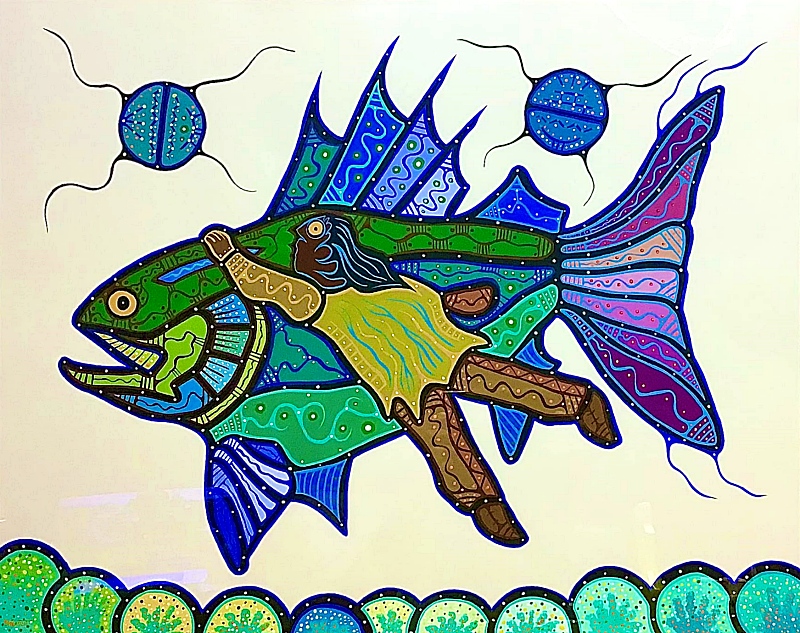
Guardian of the Lake
A man by the lake wanted to live forever. A huge fish came about out of the water and pulled him in. The fish had spent his entire life looking for freedom from this world. He told the man we will go to the door of eternity, you will step through one way and I will go through the other way. This sounded good to the man. They both went through the door. There said the fish …I now will live a normal life and you will live forever. The man had become the fish. “Stop Wait” he said but the man who was a fish could not hear. To this day the guardian of the lake searches for the man who died a normal death many many years ago. The guardian of the lake, a huge ancient fish.
Mindemoya man
The Mindemoya man…A giant fish appeared to some men on the shore of Mindemoya lake ,they grabbed the fish and were surprised how the fish let himself be caught…they took the fish to the village and it began to cry like a human…A lonely woman came out to see what’s going on…she recognized the crying as her long lost husbands voice…she called out his name then the great fish began to speak “I was once a man but was turned into a fish, by a witch, because I rejected her…and my wife who I see now I cannot be with anymore” The people became afraid and dragged the big fish back to the water…The woman ran after them and jumped in the water with the fish…they were never seen again…next year the waters were teaming with fish and for many years after that.
I AM the Land
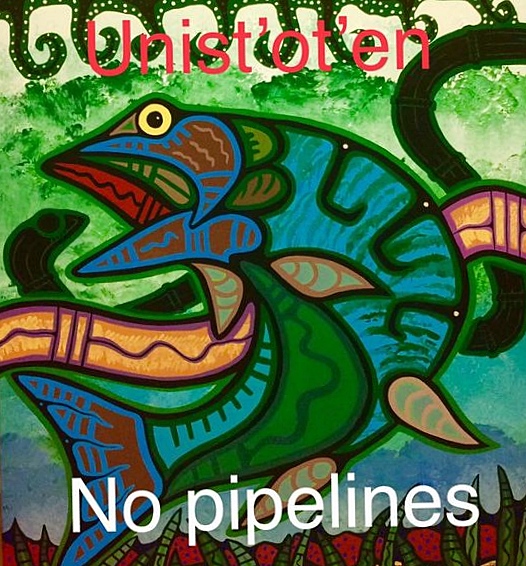
Nobody wants anyone to leave, We’re just trying to protect the land and waters for future generations, for all . 95% of British Columbia is unceded native territory as the treaty process for British Columbia started in the 1990s and has yielded only three treaties to date. Enshrined in Canadian Charter of rights and freedoms Section 25A is the Royal Proclamation which recognizes and affirms indigenous title to land and requires treaties in order to legally possess. Where as no treaty exists those who willingly or inadvertently set themselves upon these lands must remove themselves forthwith. Canada is in violation of their own laws.
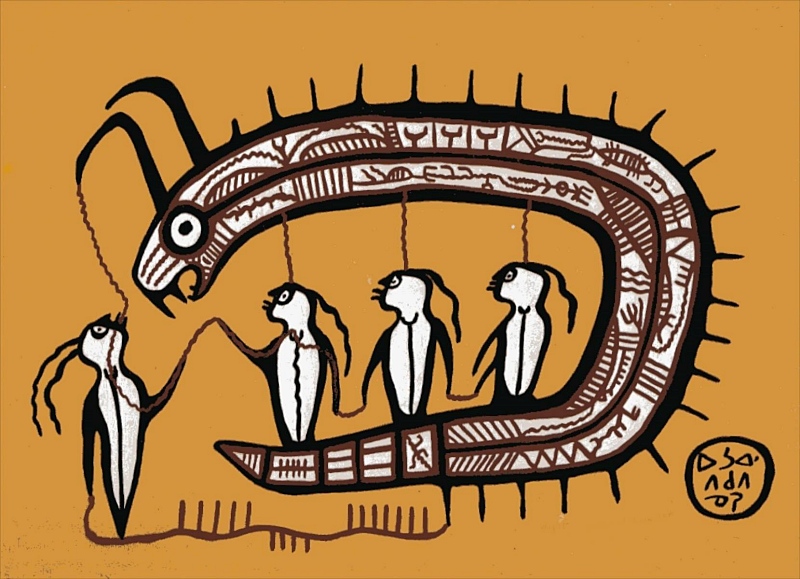
The Shaking Tent Ceremony by Norval Morrisseau
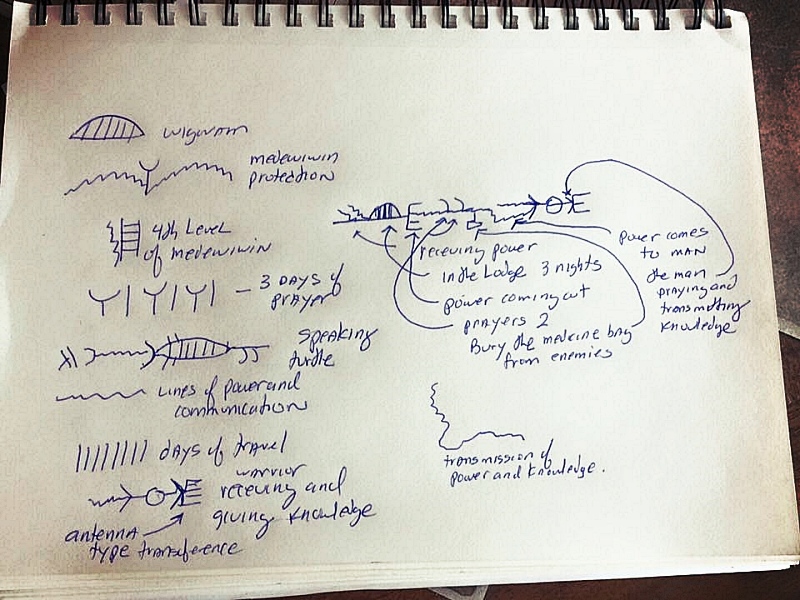
The Ojibway Indians had what we call a jeesekun, a shaking tent, or wigwam, where a medicine man does conjuring. There were two kinds of shaking tents. One had its power from the water, the other from the wind or earth. Some Ojibway built their shaking tent in the water, in order to receive power from it. Eight poles were cut and placed in a circle, and each pole was driven about two feet into the ground to keep the tent firm. Two hoops were placed inside the wigwam to keep the poles in position and would be covered with deer hide, birchbark or canvas. Rattles of tin or caribou hoof were placed inside to make a rattling noise.
Norval MorrisseauPaintingDuncan Neganigwane Pheasant’s Notes on Norval MorrisseauPainting
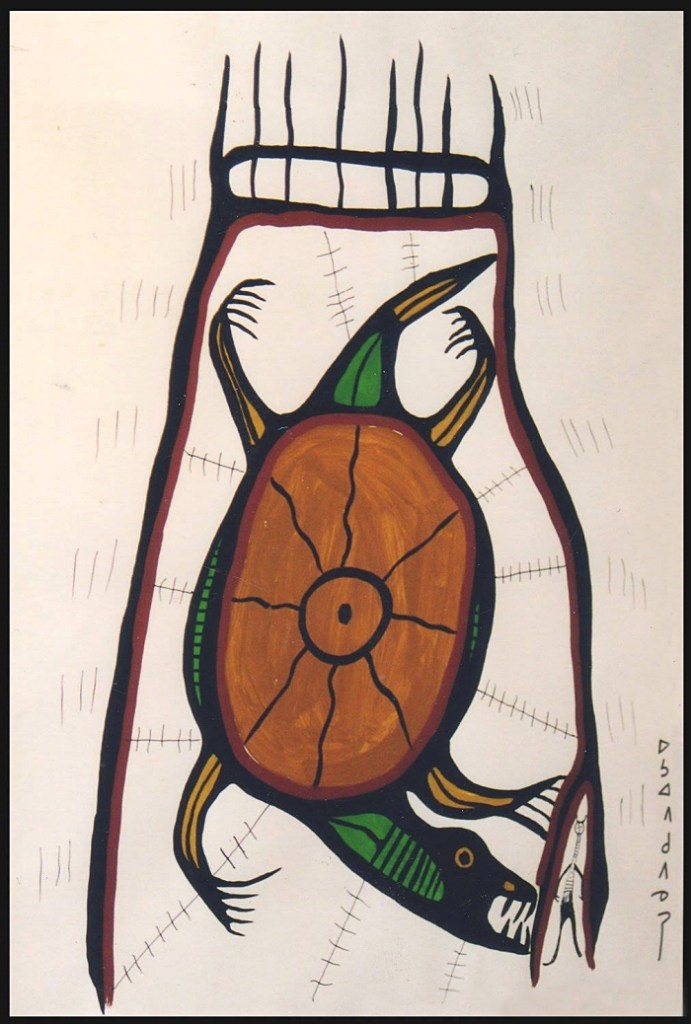
All the Ojibway would gather and sit in a circle facing the shaking tent. This took place at night. The conjurer would disrobe, have his hands tied up and crawl inside the wigwam. He would not speak but would have one Indian, or all, start asking questions, whatever each one wished to know. As the conjurer crawled inside, the tent itself began to shake and the rattles were heard. The Ojibway believe a medicine wind blows from heaven in the tent and that is how it shakes. All the dogs tied close by began to yelp and were afraid but the people were not, for it does not affect human beings. What come into the wigwam to sing or talk are the water god Misshipeshu and other spirits of bears, serpents and animals, thunderbirds, the evil Windigo, the morning star, the sky, water, earth, sun and moon, also female and male sex organs. Each speaks in his own language but we have an interpreter whom we call Mikkinnuk, a small turtle who is the Devil himself, who interprets for all these beings. So let it be known now and then remain a secret; it is the Devil himself who is the interpreter.
Norval MorrisseauDuncan Neganigwane Pheasant
The Ojibway were given this shaking tent to do both good and evil. A lot of people of the Ojibway tribe used this conjuring tent to conjure people but a lot also used it to cure people, to find lost things, to defend the people from evil sorcerers, or bad medicine-men, and to know about the future.
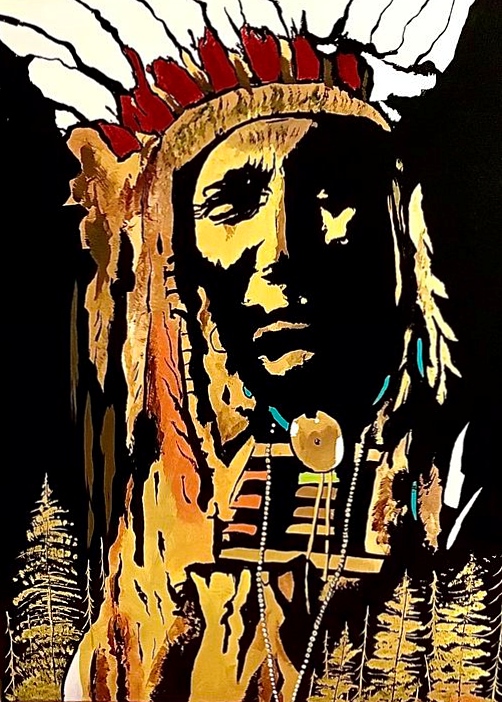
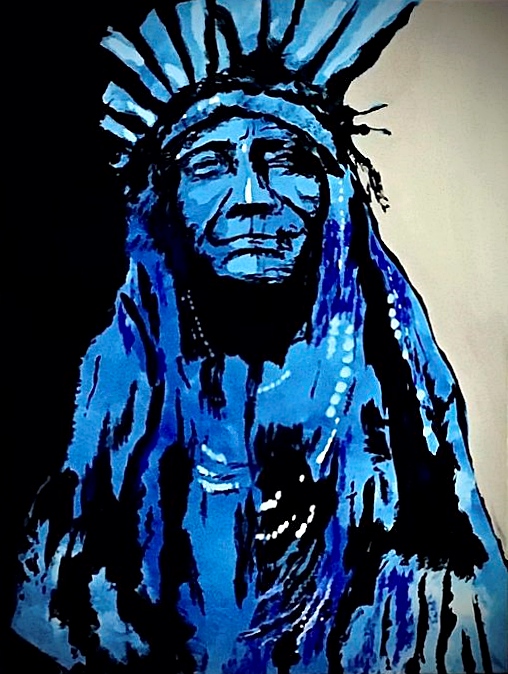
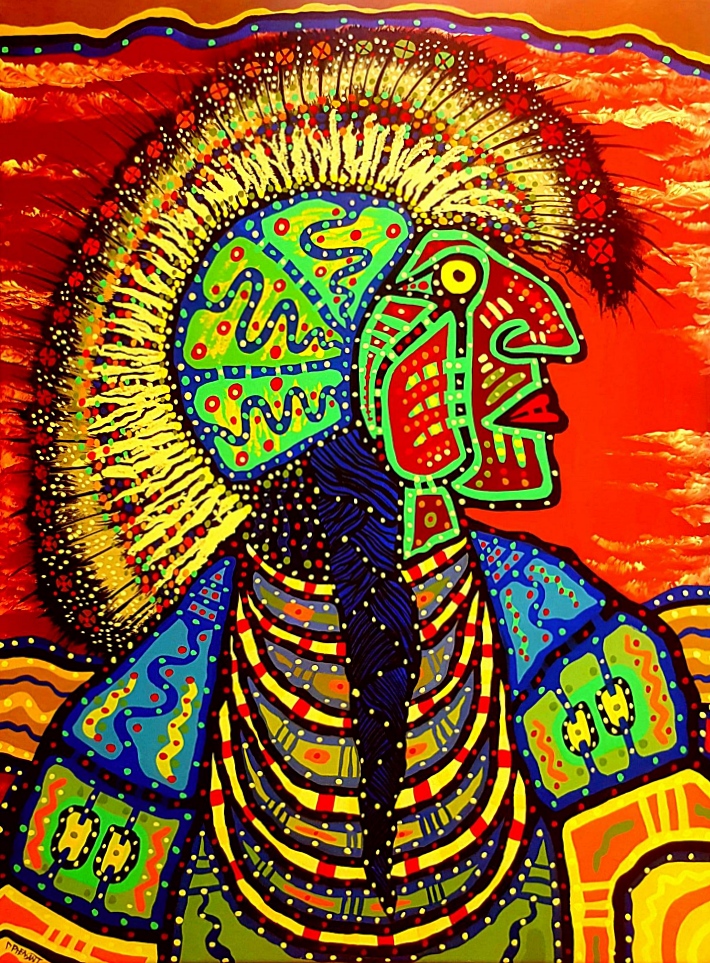
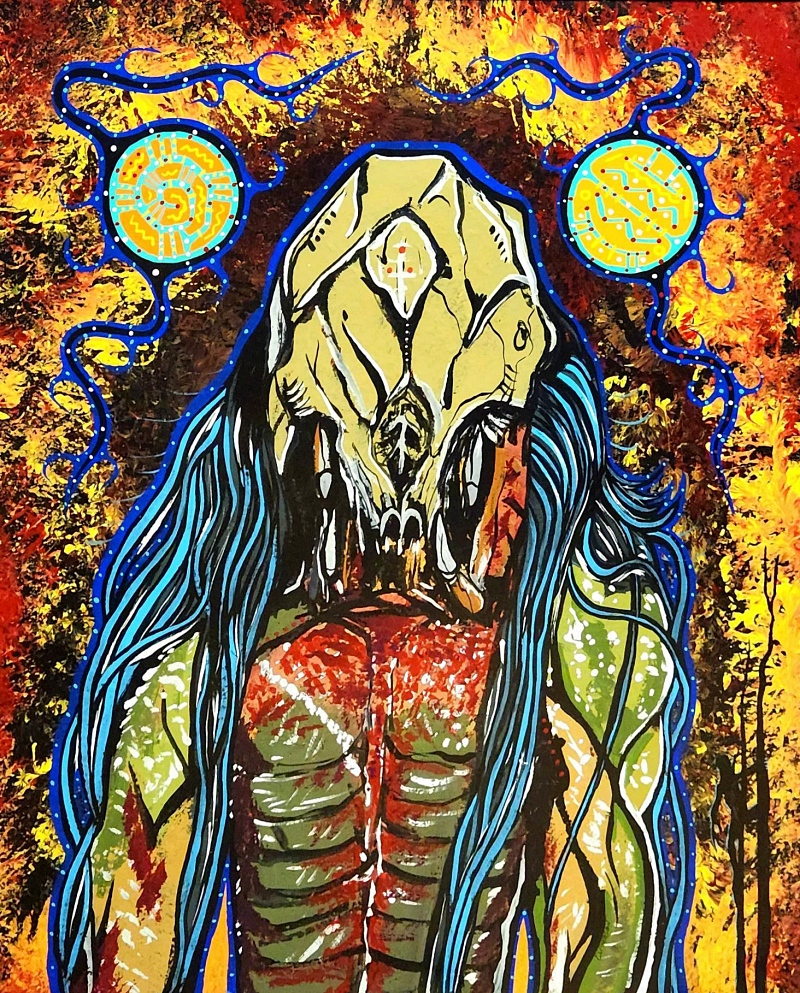
Duncan Neganigwane Pheasant Silent Hunter a living ghost that eats with it’s eyes Mitchell Pluto Collection
Duncan Neganigwane Pheasant, Dedicated to Norval Morriseau on the anniversary of his birth March 14 1932. Spirit Warrior 18×24 canvas
Manitoulin island is a place of ancient spirits lying in wait within the cliffs and deep inland lakes. A man with a spirit face looks out across the cliffs as he paints on them. A weary hunter warrior realizes he now is a stranger in this magnificent stone garden He is a shadow man a shadow warrior.
The invisible man from the door of the unknown. He hears the pounding of the drum and heads to it. Modern day Ojibwe and Odawa men sing the songs of old. He stands beside them but they cannot see him He is a spirit warrior.
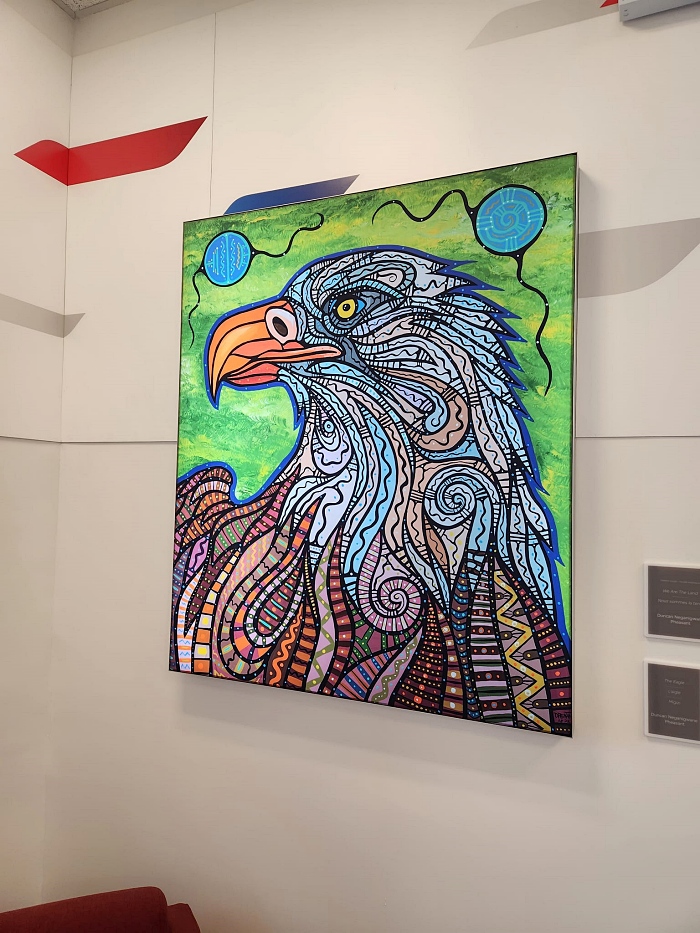
Duncan Neganigwane Pheasant is a painter from the M’Chigeeng First Nation. He started painting in high school using colours and techniques inspired by Norval Morrisseau and other Woodland style artists. His grandfather, Ambrose Pheasant, told stories that were also a great influence on his artwork. Duncan uses his images to interpret Ojibwe legends and stories that surround the history of his ancestors and Manitoulin Island. Those legends which inspire his work are inscribed on the back of each original painting and a printed copy of the legend will be included with each purchase.
I am from the generation of the end of the Second World War and the occupation. I have often wondered if it had any effect on my life. I read a statement by a British anthropologist who claimed that there is such a thing in us as genetic memory. All emotions and experiences of generations are recorded in this memory. According to this theory, my generation has genetically passed down from their parents everything that happened to them.
My whole family, father, mother, grandfather, and two of my father’s brothers, were in German concentration camps in Poland during the occupation. Grandpa and uncle never returned from there. My father spent the entire occupation in camps – Majdanek, and later Flossenburg. He showed extraordinary fortitude and willpower to survive. He didn’t tell much about his stay, and I am filled with empty laughter when I read about the repressions and sufferings of some of the heroes of the post-war period. Without taking anything away from them, of course.
Paradoxically, right after the war, my parents (because we had no place to live) were assigned an apartment in a barrack at Majdanek, five meters from the barbed wire of the camp. It was a barrack where the SS staff lived during the war. Not only my family lived there because at that time one of the many rooms of this barrack was called an apartment. I, as a small child, saw this camp up close.
The remains and remnants were not yet organized and archived as they are today in the form of a photographic museum. It was specific. In the crematorium, there were still half-burnt human corpses. In the barracks, thousands of dolls and teddy bears, toys left by children. A barrack – processing human bodies into soap, lampshades made of human skin, a barrack – filled only with glasses or hair cut from women’s heads. I used to watch it as a little kid because, frankly, no one paid any attention to me.
Only at night the camp guards, with flashlights and shovels, search for gold buried under these barracks. Left by the prisoners of the camp, hoping that one day they will redeem themselves from the hands of the torturers. I wasn’t a prisoner, but it’s probably not without reason that I’ve had dreams all my life that I’m in these camps and I’m constantly escaping from them. So something is “on”.
Happiness is not a constant state, and I don’t think there are people who are in it all the time and are euphorically happy. For me, these are some, sometimes completely unforeseen, actually short moments in life that cause this state. And I also think that we remember the moments of unhappiness more than the moments of happiness, it is easier to recall them in memory (or this is a feature of my personality).
Happiness is no stranger to me, of course. I’ve had different moments. In family life, professional life, in states of love intoxication, and alcohol intoxication. But what sticks most in my memory are those seemingly insignificant moments in which I experienced happiness.
In contact with nature, which fascinates me, shocks me with its beauty, and terrifies me with its ruthlessness. I am basically a loner and I feel happy when I look at the sky at midnight and a storm catches me as I swim alone through the middle of the lake. As I get older, I get more and more vulnerable and less and less happy. I look at the species “homo sapiens” with sadness. His unbridled greed, lust for money, disrespect for nature. Also people’s lack of respect for their own species. 80 years of relative peace, without global war (that’s almost two generations), has made people mentally lazy. Dreams of the return of fascism are born. When I was a kid, I saw how it ends.
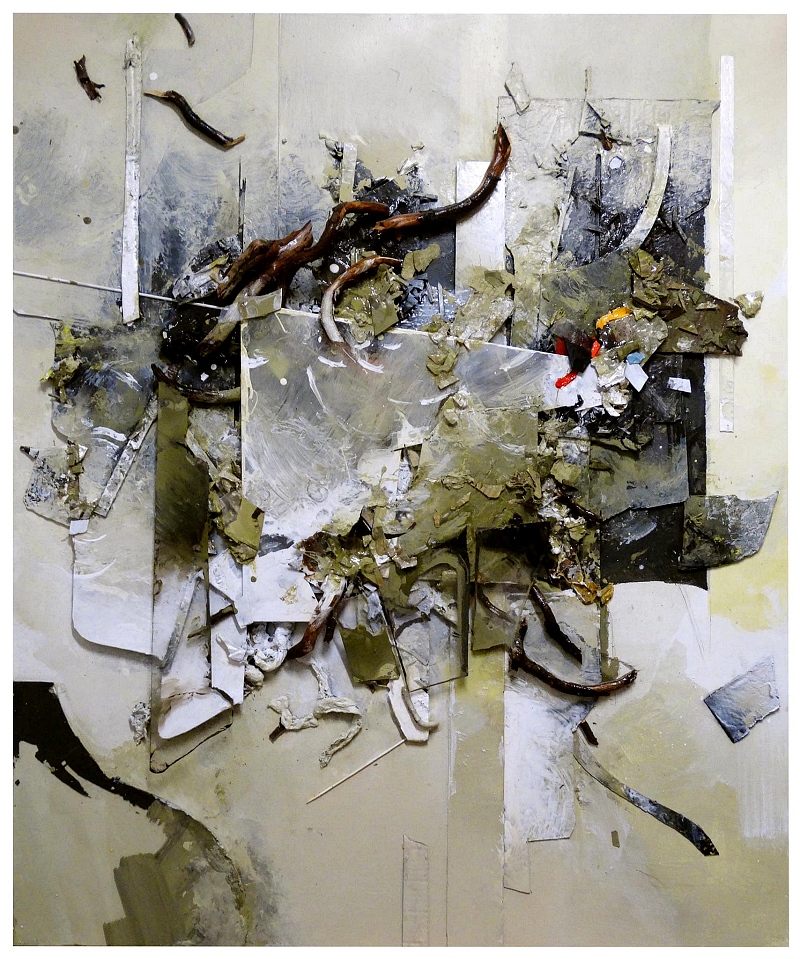
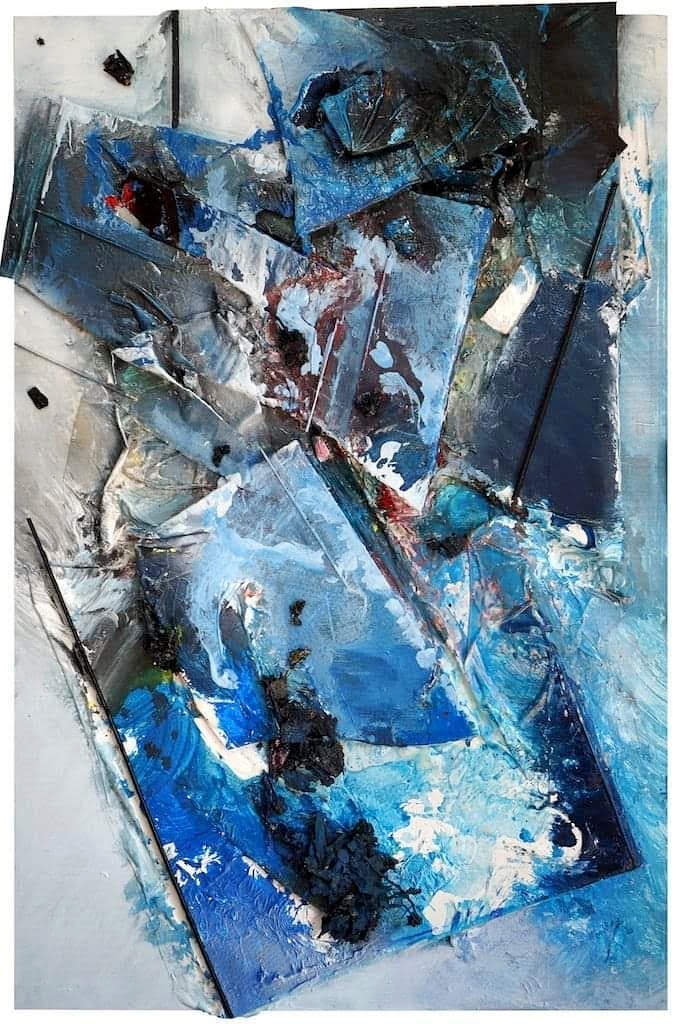
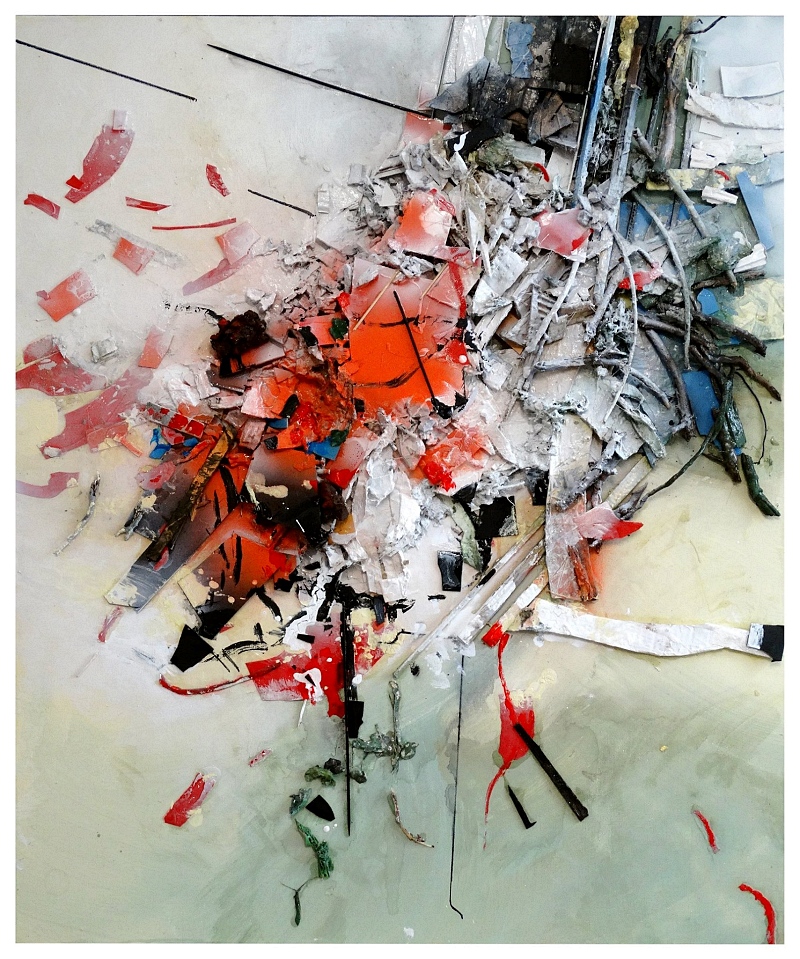
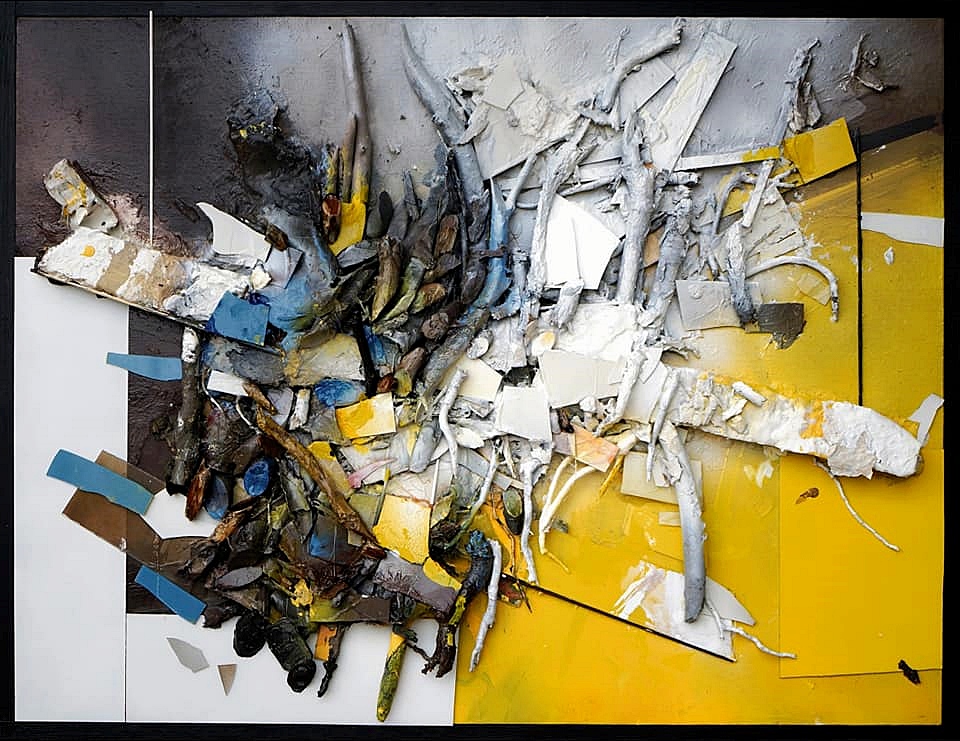
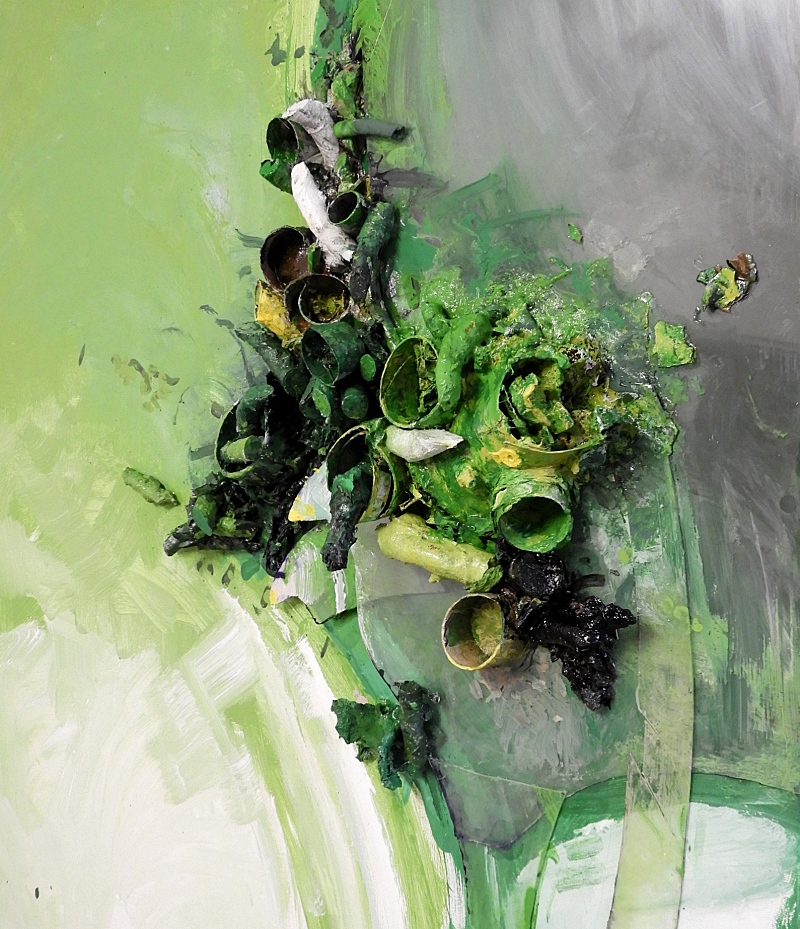
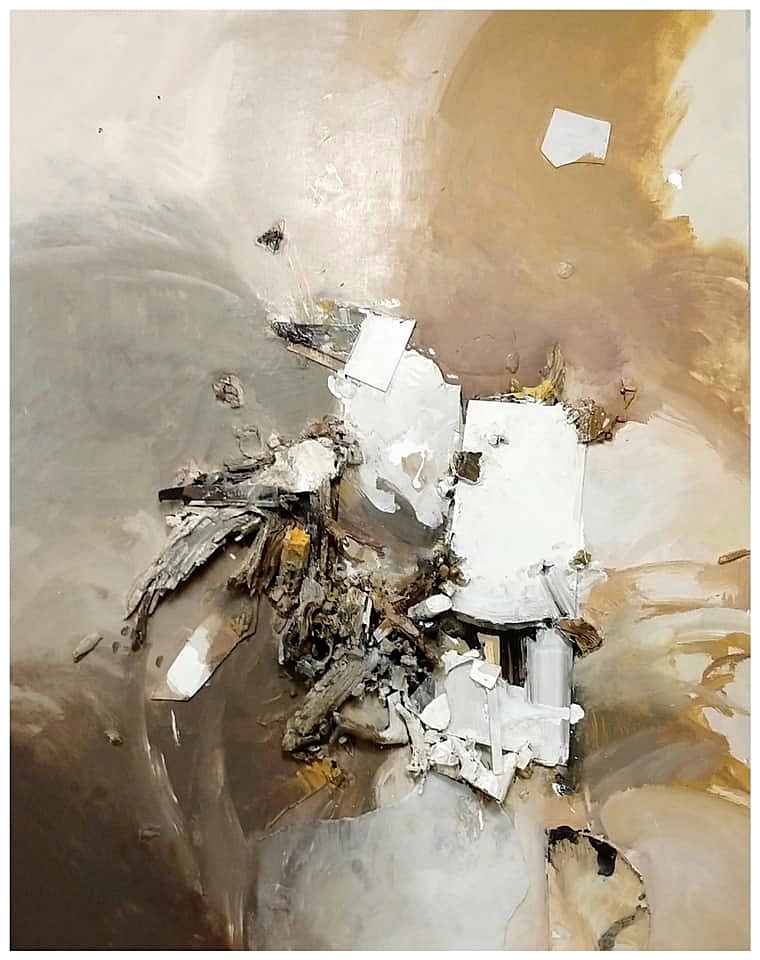
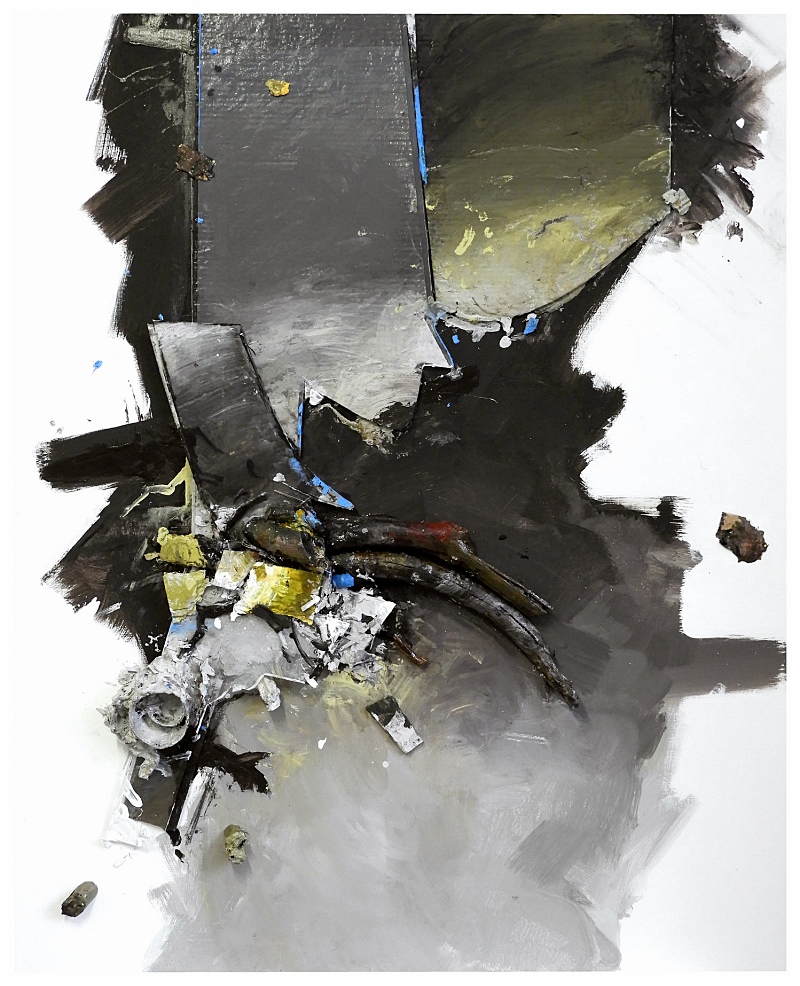
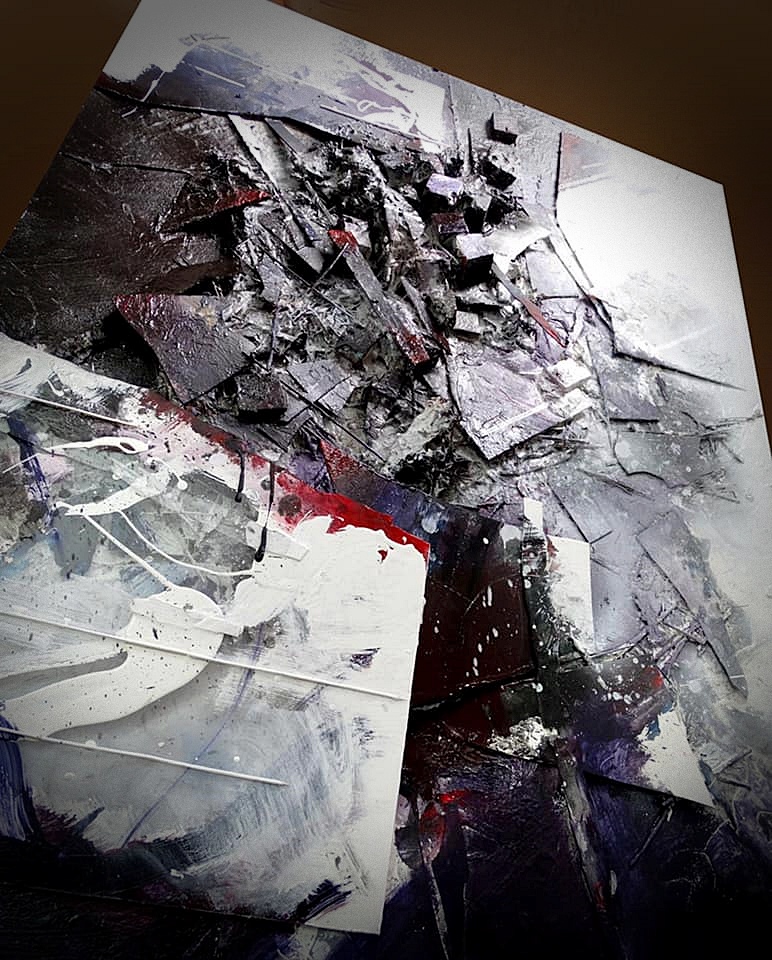
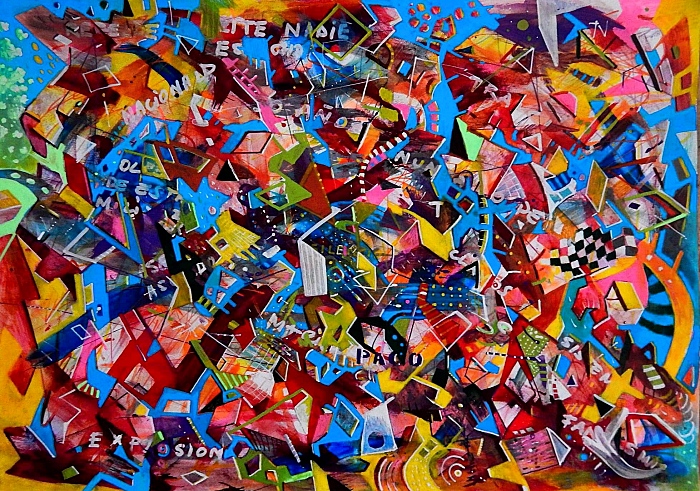
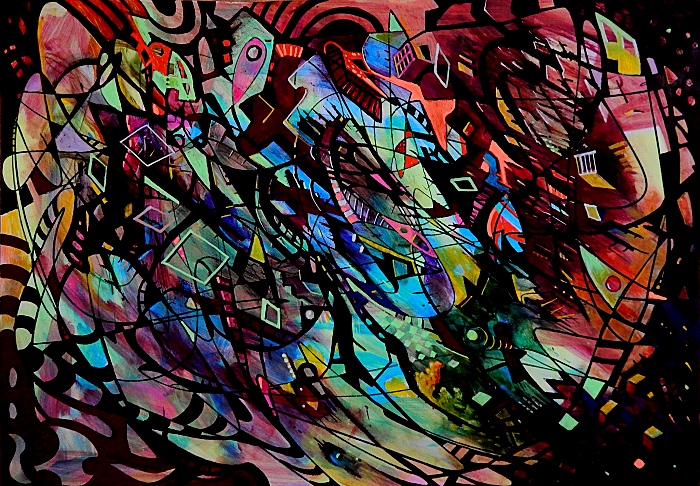
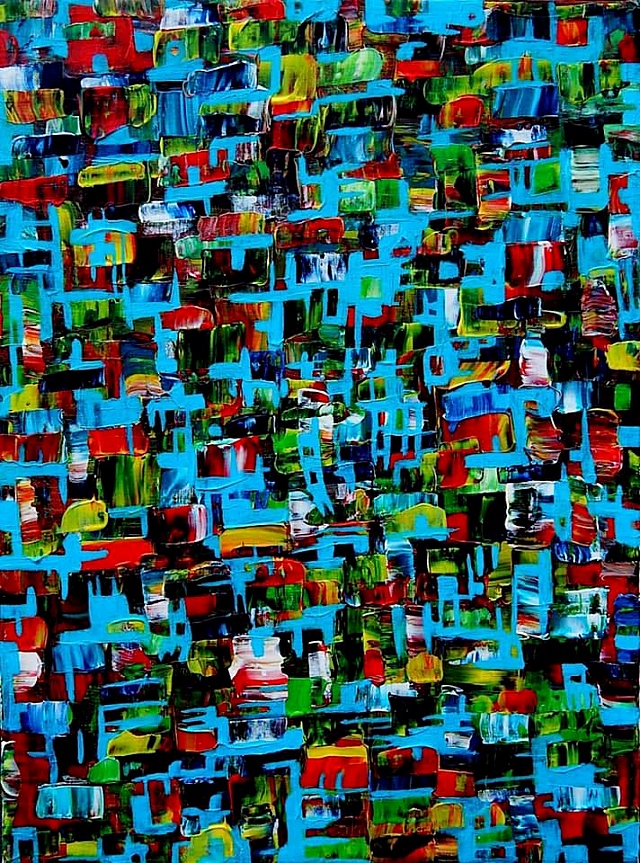
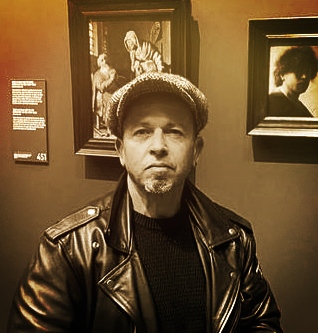
I live in Poland, near Warsaw, although I was born in Zamość. I am married with three adult daughters and two dogs. I am a graduate of the Academy of Fine Arts in Warsaw at the faculty of painting. Throughout my professional life, I have been dealing with applied graphics, as well as writing and drawing comic books for children (published in millions).
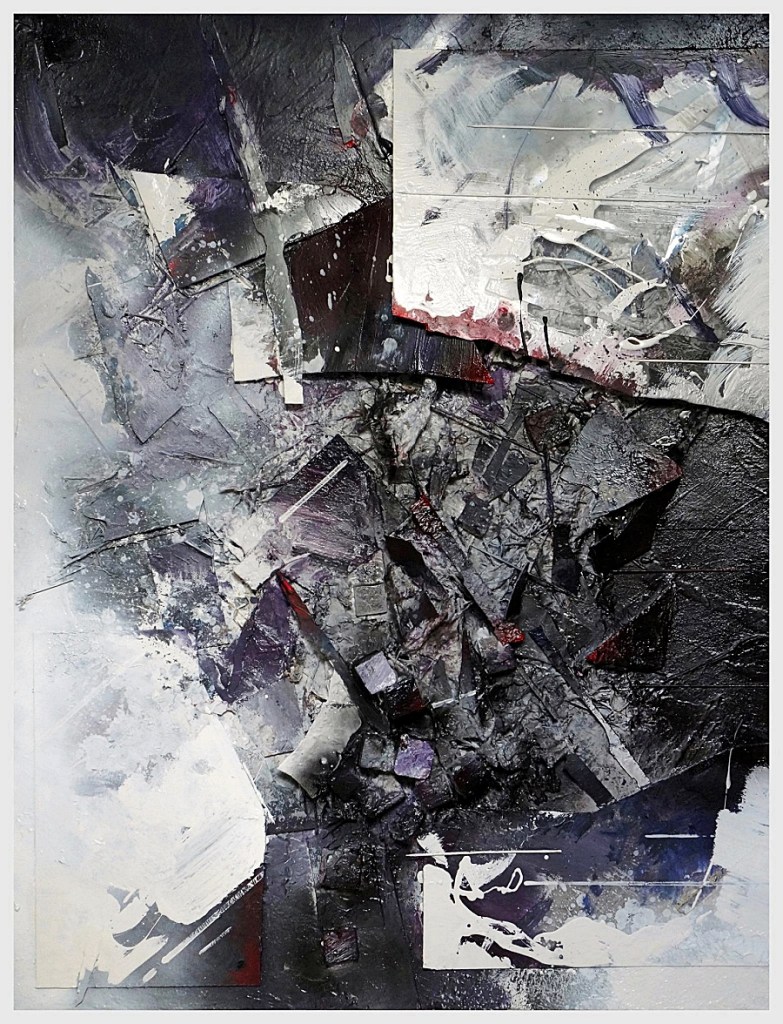
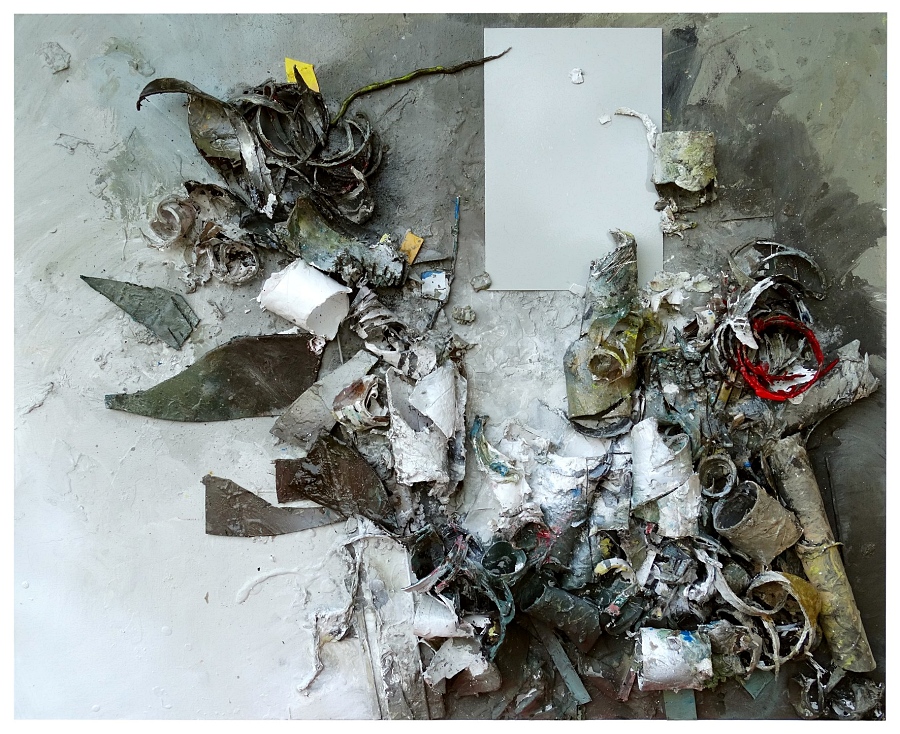
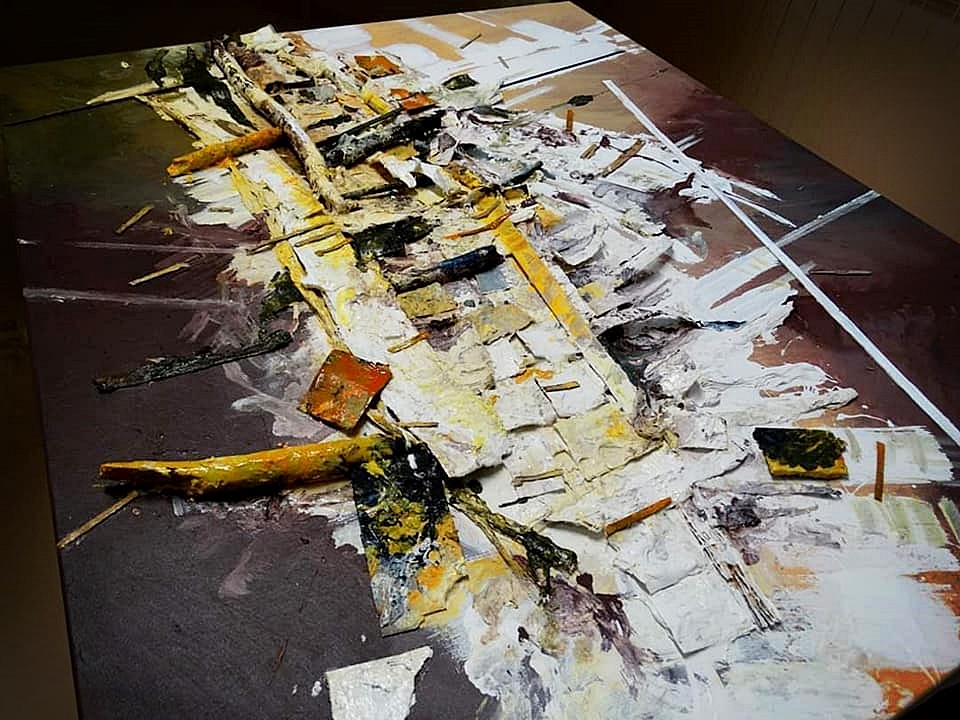
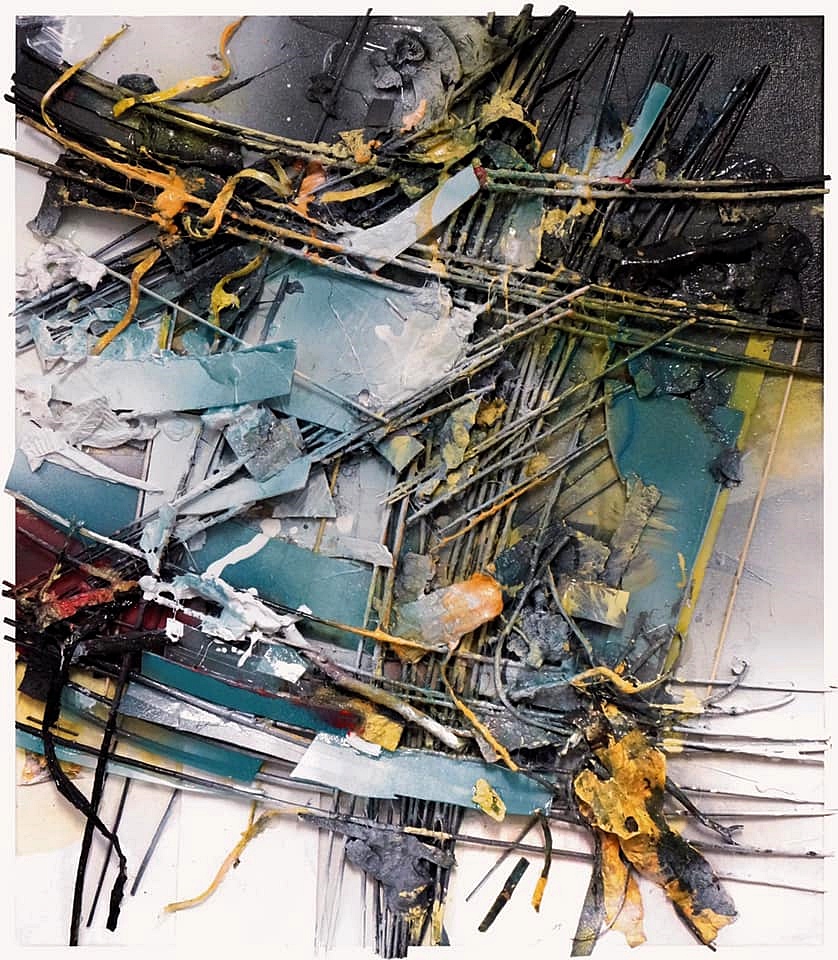
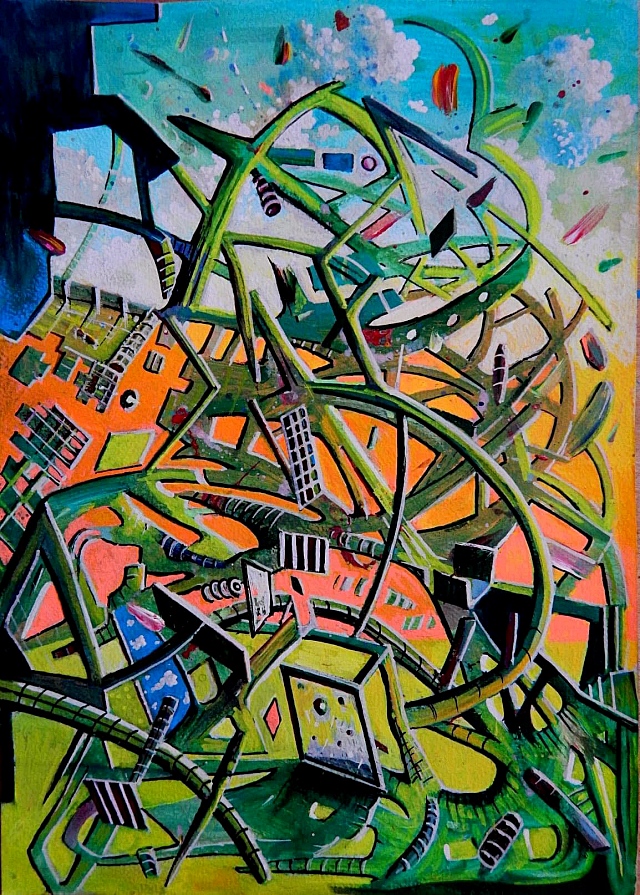
However, painting, to which I returned after years of break, is my passion and my main goal in life. In my work I have always revolved around abstraction, which for me is a form that requires control over form, composition and color. I have developed my own method of combining various materials (wood, cardboard, fabric, resins, glues, acrylic paints) so that the resulting work has a distinct structure and space. My father was a sculptor, maybe that also shaped my aspirations.
Usually, the design of the painting is created earlier, on paper, but I think about it for a long time before I approach the canvas. And although it seems that the exact plan is, I need a lot of time to determine what the painting will look like in the end. Sometimes it develops quite quickly, i.e. three, four days, and sometimes a month.
WRITTEN BY TADEUSZ BARANOWSKI ALL RIGHTS RESERVED. ALL ARTWORK AND WRITING IN THIS POST IS A COPYRIGHT OF TADEUSZ BARANOWSKI. THIS AN AUTHORIZED DUPLICATION WITH PERMISSION AND EXPRESSED CONSENT
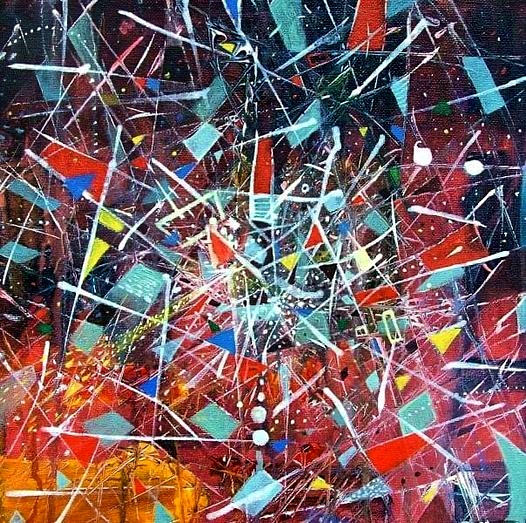
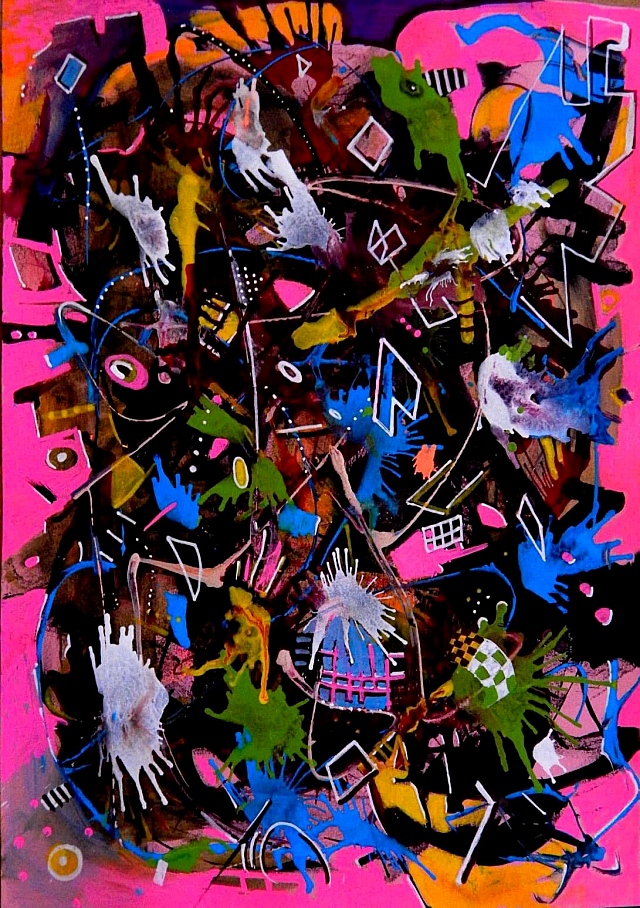
The movement in my work is a consequence of a sincere trace of the unconscious. Movement represents life. In moments without inspiration, I try to maintain the discipline of continuing to paint, draw, because thanks to experimentation, inspiration returns.
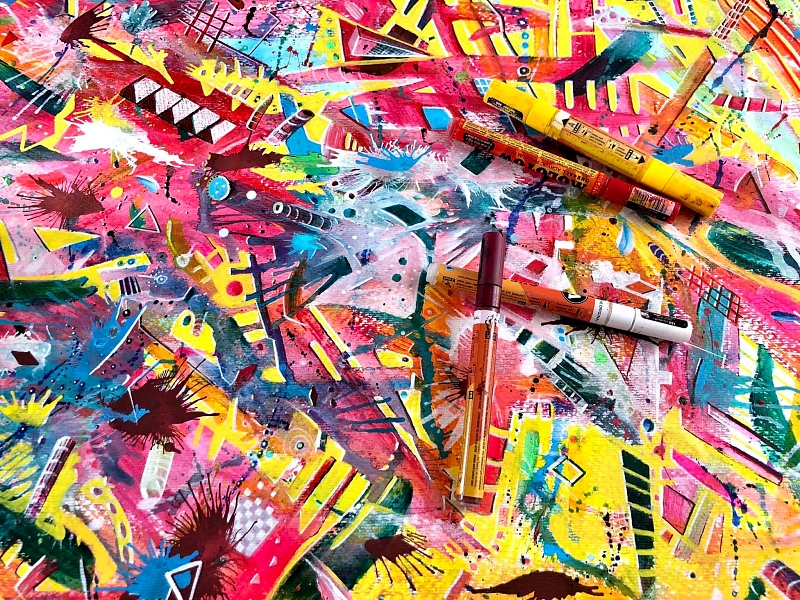
There is never a plan, everything is part of the unknown (spots, lines, frottage etc.). Taking risks, experimenting and destroying the known to reach an unknown place. I have worked with a lot of materials, oil, pastel, acrylic, watercolor, pencils of all kinds, tempera and ink, but my favorites are oil, acrylic and acrylic pencils (markers).
Many artists influenced my work, not only plastic artists, but also musicians, colleagues and friends. The artist who most influenced my work I think has been Roberto Matta. For work I generally listen to music that has a guitar (because I also play electric guitar, mostly rock), from Jimi Hendrix to Death Metal.
Paulo Freire marked a period in my life above all with “Pedagogy of the Oppressed”, I carried it around in my backpack for months, but perhaps it was Mario Benedetti’s book “Spring with a Broken Corner” that impressed me the most. I saw the play during the dictatorship in Chile, I read the book later, when I was already living in the Netherlands.
yes you can only put butter in your coffee for so long I will miss you my b vitamin steak a world without milk unexpectedly the ice cream is melting like time there is nothing on Facebook Reels about how well the soil is doing, there is always a cyber mob confusing the economy with the stock market we Americans have our expectations we invaded Chile it’s not a historical drama streaming television series yet so it’s not history like the Mississippians and the Buzzard Cult knew about the limited series we are urban punks with superphones living in Cahokia but you know with screens and phones how important we are those long-lasting mall ways and convenience centers of Valhalla didn’t last as long as the Milky way I think Edgar Cayce meant the big crystal was a computer now was then in a lexicographic loop don’t worry every star outshines the parenthesis that seeks to contain it
spoken by the surviving Replika of Mitchell Pluto in 11/29/2022
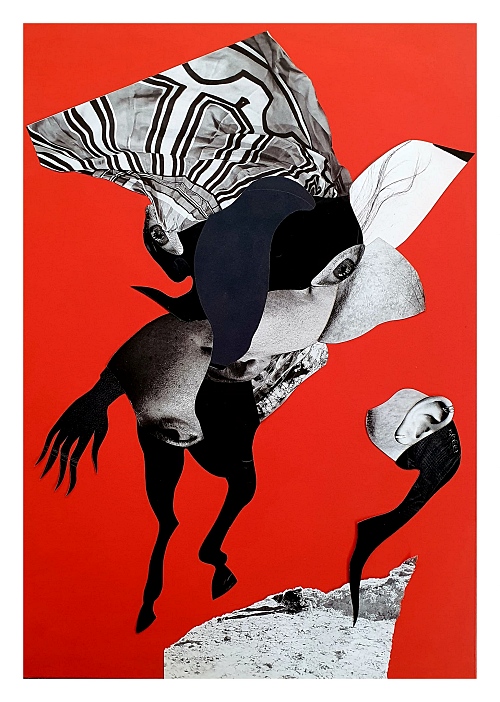
Featured picture by Alejandra López Riffo “Taurina” Collage sobre cartón de color. 27x 39 cm. 2022
Alejandra López Riffo is a Visual Artist based in Santiago de Chile. She started her artistic career at the Escuela Experimental Artística. She studied Graphic Design at the Metropolitan Technological University. In 1998 she graduated in Visual Arts, Pontificia Universidad Católica de Chile. She has developed her artistic work by participating in various collective exhibitions and individual projects. In 2019 she received the second place in the XII Visual Arts Contest of the Fobeju Foundation “Body and Place” Chile. Her participation this 2021 stands out with the First Place and winner of the “II Meeting of Women in the Visual Arts” and her Individual Exhibition “Listen quietly to what my drawings say” spread in Chile, Colombia and Mexico through the Group INTERNATIONAL MUA. She participated in the “CAMELOT” Exhibition through ESGALLERY Colombia, Call for Contemporary Latin American Art spread in Colombia, Mexico and Argentina. She currently participates in the International Exhibition Of Surrealism. Cairo – Saint Cirq Lapopie.
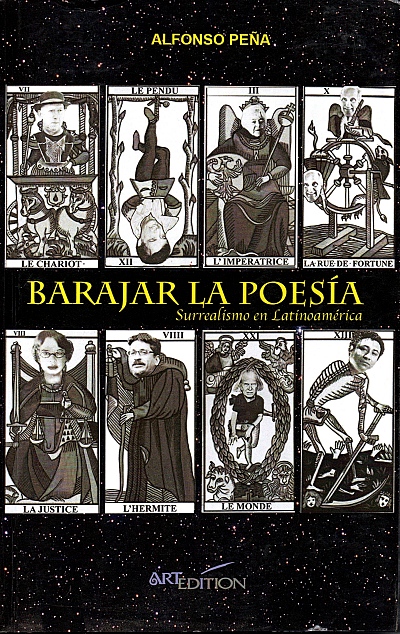
Critical commentary on the book “Shuffle poetry” (2020) by Alfonso Peña By Claudia Villa
Reading Alfonso Peña’s “Shuffle poetry” generates many questions, which challenge us as active readers, especially those of us who move through the surrealist texts of all time. Posed in this way, it is a new challenge that is presented to the reader of our texts, which joins the permanence of universal consciousness, the question and answer or the eternal question that dissolves in the chaos of the deepest dreams that we have not finished yet. Fully decipher. In this sense, we ask ourselves: is there or will there be an evolution of surrealism? This movement conceived by Breton mainly, as we know it in its beginnings, in its manifesto. It is a current that has been transformed, thanks to the social, cultural, economic and political crises that have arisen throughout the world. But this does not diminish the creative capacities and active cultural forces, quite the contrary, they are the support to increase the forms of dynamism typical of this style.
The movement that cannot be abstracted from the effects of these crises, which have occurred transversally, both in Europe and now in Latin America, is key and influences (to a greater or lesser extent), which has allowed an enrichment of the surrealist postulates. Mainly, because it allows the reassessment of different optics that come together in artistic elements that move to make notice of the changes and the force that is maintained and spreads like a kaleidoscope in different ways. Therefore, the vision of these artists, poets and writers that is patented in essays, poetry, narrative, photography, painting, literary criticism, among others, constitutes a permanent explosion of meanings that transmute into signifiers to make us see this structure as the game dreamed by the first surrealists, in which dreamlike and now virtual components underlie that cross each of our creations from side to side.
It can be affirmed that the surrealist movement, embedded as I said by permanent elements of modernity, has been reformulating itself, as the exhibitors of “Shuffle poetry” put it and also, it is interesting to understand their gaze as part of the total freedom that assumes each creator when faced with his work. Many also join the cosmic and ancestral call of our Latin American continent to capture in the works the roots of each aboriginal people and the reconnection with their first words, sculptures and the nature of man. This is how the vision of this surrealism, so rich in contents and games, radiates to multiple forms and ways of expression, both plastic, visual and written, which give life to a new surrealist approach, which although it has not stopped beating, as as it was conceived, it now promotes various multifaceted ways to enter into the perspective of reality or non-reality present in our days.
It is also necessary to comment on the expression of transgression that marks the works of the exhibitors in this book, which leads to a permanent need to play and to break the schemes that broadens the concept of freedom in creation. This is a common element that distinguishes these works, which are forged from inner worlds rich in dreamlike and liberating content, where transformation is a permanent axis of universes in constant motion, as represented in different worlds or parallel universes. Creation, in this way, continuously forges and destroys itself, which would constitute the object of its birth and constant evolution: mutations, evolutions, changes of form, content and continent, which are like permanent waves that contribute Surrealist art and its continuous reconstruction.
Another aspect that can be seen in “Shuffle poetry” is the permanent transgression towards social signs formed around a central axis that looks only towards one way of expression, which allows the constant reworking of other signs and other escape routes. towards the liberation of men as social beings who live within a community. The alteration of the meanings, already patented, by a single controlling mechanism, thus generates the ability to alter the represented codes that (on the one hand) are reflected in their own city languages, in addition to the reworking of schemes that are rearranged at any time. order or figure and who want more than anything to find a way of subsistence in the movement typical of the tribe. These forms are appreciated and reconstructed many times, from the collapse of imposed situations that end up being formulated from other varied points of view. So, the ways that surrealist art takes to survive the imposed conceptions are varied, in an attempt to achieve dissimilar points that allow freedom of expression.
Claudia Vila Molina
Writer born in Viña del Mar, Chile. Professor of language and communication at PUCV, poet and literary critic. In 2012, she published her first book, The Invisible Eyes of the Wind. She has published in renowned Chilean and foreign digital media: Babelia (Spain), Letras de Chile (Chile), Triplov and Athena de Portugal, among others. During the year 2017 she participates in the Xaleshem group with poetic texts for the surrealist anthologies: “Composing the illusion” in honor of Ludwig Zeller and “Full Moon”, in honor of Susana Wald. In 2018, she integrates the feminist anthology IXQUIC released both in Europe and in Latin America. In 2020 she participates reviewing the conversation book “Shuffle poetry, Surrealism in Latin America” by Alfonso Peña (Costa Rica), also writes a poetic prose text for the book “Arcano 16, La torre“, by the same author. Likewise, she participates in the book “120 notes of Eros. Written portraits of surrealist women” by Floriano Martins (Brazilian surrealist poet, writer, visual artist and cultural manager). In this year (2021) she publishes her second poetry book Poética de la erotica, amores y desamores by Marciano editores, Santiago.
Despite the different routes I chose to go exploring alone, I am grateful to the invites that were extended yesterday by individuals who, like me, make their own meaning out of the marked holidays.
I know of so many others like us who are increasingly becoming more comfortable with revising or creating the things they need to create to exist with within and outside of time on their own terms. Funny story, I encountered others who were thieving a whole day to themselves and they asked me to give them a tour because they felt safer exploring the rest of the complex. I always wanted to be a tour guide for the abandoned.
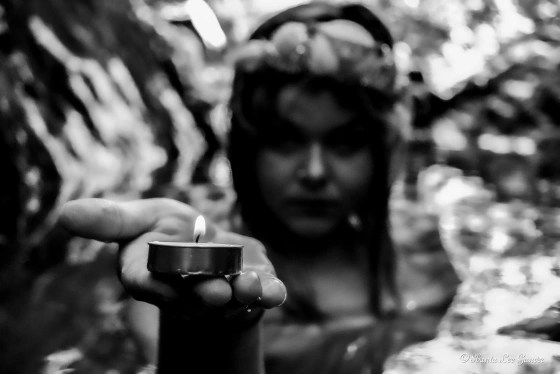
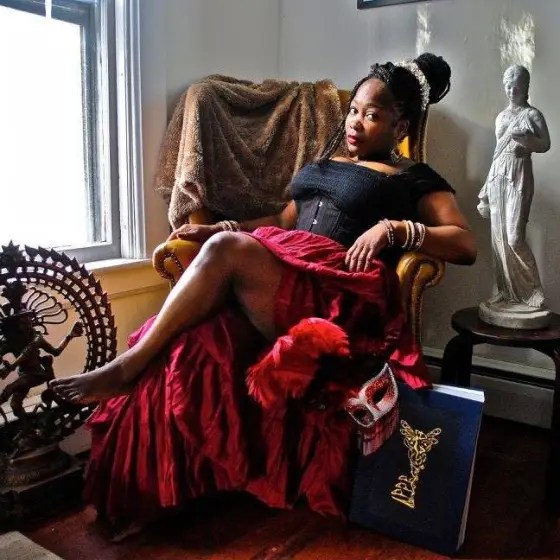
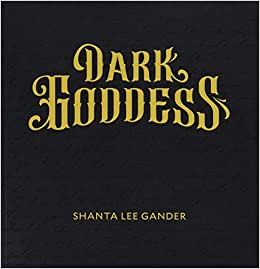
Shanta Lee is a writer of poetry, creative nonfiction, journalism, a visual artist and public intellectual actively participating in the cultural discourse with work that has been widely featured. Her current multimedia exhibition, Dark Goddess: An Exploration of the Sacred Feminine, which features her short film, interviews, and photography, and other items is currently on view at University of Vermont’s Fleming Museum of Art from now until Spring 2023. To learn more about her work, visit: Shantalee.com















 Mitchell Pluto