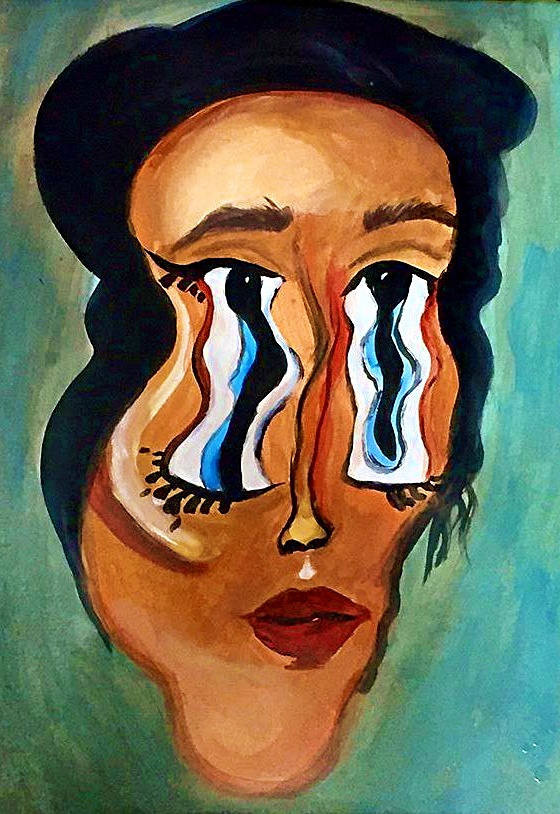
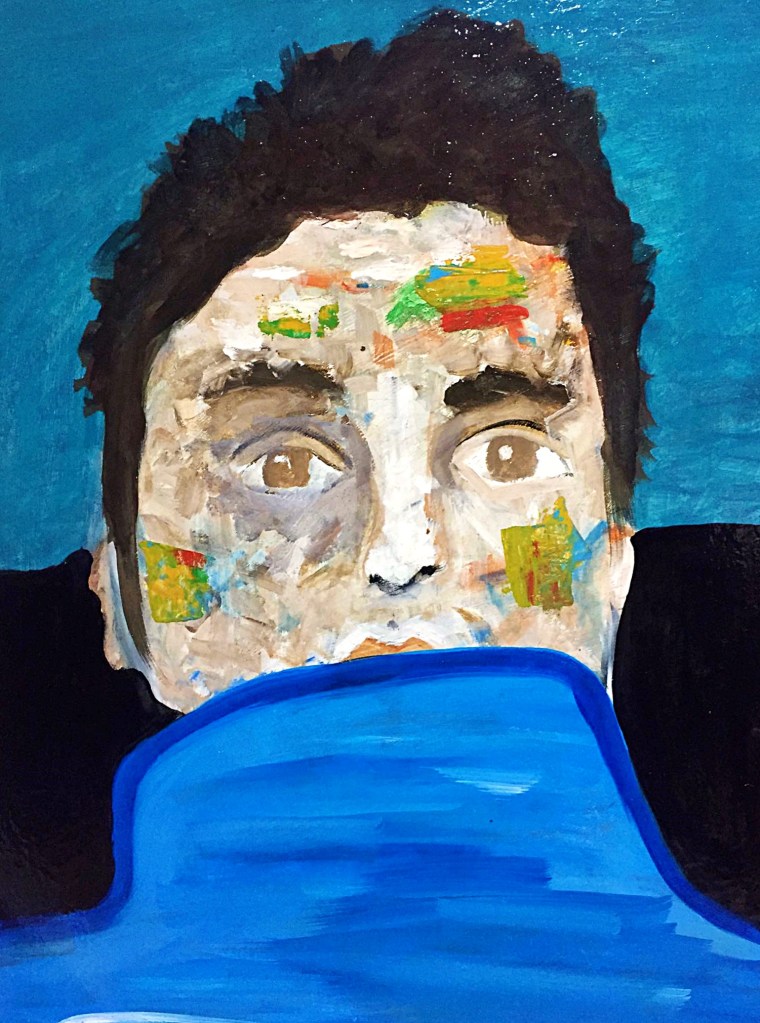
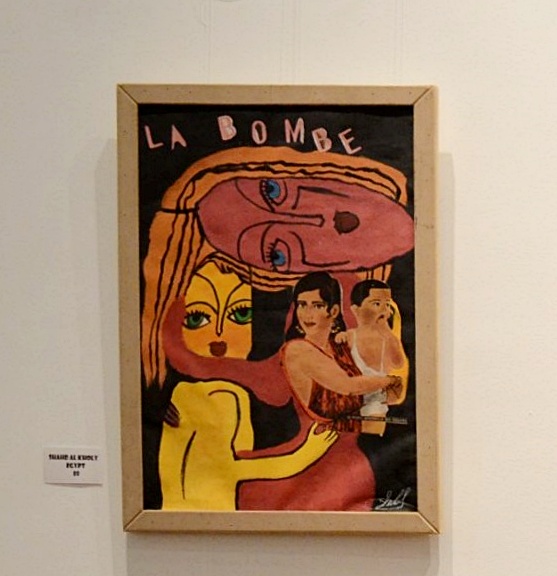
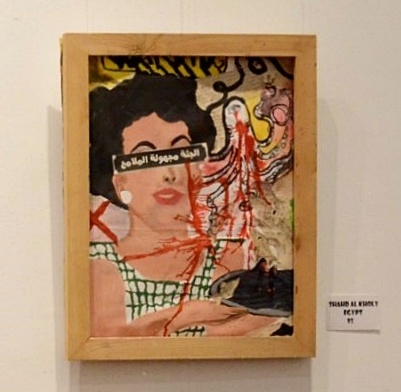
My name is Shahd El-Khouly and I am a Egyptian visual artist. I study psychology and art. Psychology is my passion. I spend most of my time with art, artists and studying psychology because it is a science that deserves every minute we spend reading and searching for it.
I also participated in many exhibitions. Which is being held in Egypt and I am currently participating in the International Surrealist Exhibition, the first part of which was held here in Egypt, and the next part will be held in France next year
وأنا فنانة تشكيلية مصرية مهتمة بالفن منذ الصغر. انا عمري 20 سنة. الآن أنا أدرس علم النفس والفن وعلموأنا النفس هو شغفي. أقضي معظم وقتي مع الفن والفنانين وعلم النفس لأنه علم يستحق كل دقيقة نقضيها في القراءة والبحث عنه. كما شاركت في العديد من المعارض. التي أقيمت في مصر وأشارك حاليًا في المعرض الدولي للسريالية، والذي أقيم الجزء الأول منه هنا في مصر ، والجزء التالي سيقام في فرنسا العام المقبل
written by Shahd El-Khouly
Shahd El khouli in The Echoes of Contemporary Surrealism /Maze of games and dreams /Alexandria
How do you put yourself into a trance or into a place that’s receptive to the subconsciousness?
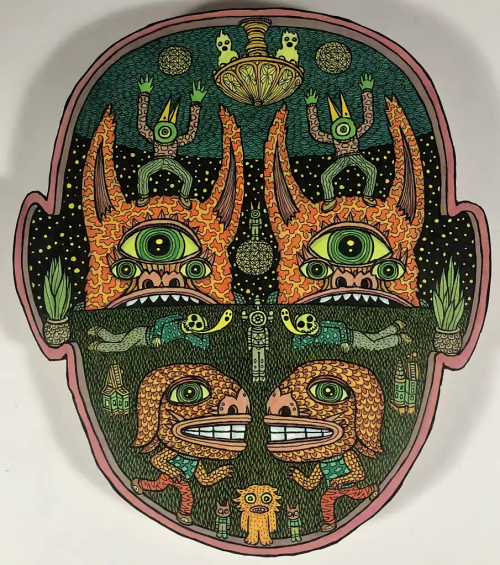
I find the act of drawing in itself to be trance inducing. I first became obsessed with automatic drawing in high school because it felt like it would light up my brain and smooth out all of my anxious energy. It would literally feel like I was drawing my way out of a stupor and waking up to the strangeness of my own mind.
Drawing helps me reach that valuable state where I can feel awake and alert, yet simultaneously relaxed. I find that my breathing slows down when I’m drawing and time feels more fluid. It helps to have a quiet studio where I can go and disappear for hours at a time. I think of the imagination as a living thing that I have an ever evolving relationship with. If I meet it halfway and submerse myself in the creative process, I get to interact with and explore the subconscious and come back with artistic documentation.
What interests inform and inspire you?
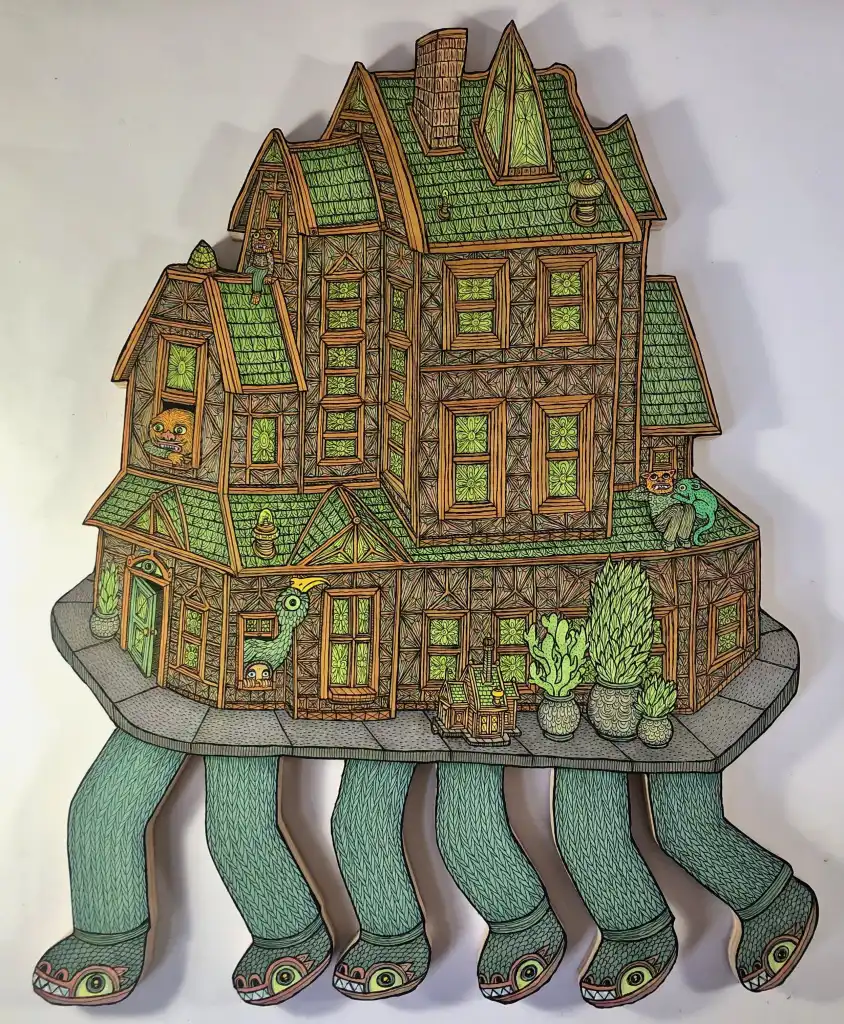
So many things. I love outsider, folk, visionary, and ancient art. Whenever art is made from an inner need or impulse, I find it extremely valuable. I love children’s art. I have 2 kids and love watching the way their minds work. I love creative collaboration as a way to relate to another person’s mind and bring out something totally unexpected and new.
I’m interested in neuroscience and new scientific thought around the so called Hard Problem of Consciousness and Theories of Everything. I love to read. Especially speculative fiction, strange fiction, and comics. I’m hugely inspired by nature and spend a lot of time in the woods. Learning some carpentry skills is another thing that’s been opening me up to new art possibilities. Just sitting and trying to clearly see images or hear music in my head is an ongoing practice.
What role do you think the artist has in the 21st century?
The best thing an artist can do is follow their own unique impulse. Artists need to push back against the bizarre human drive to homogenize everything. They need to reach beyond the inadequate systems we live inside.
I think diversity of culture and human expression is the most valuable thing we can cultivate as a species. I also think it’s important for artists to have an anti-cruelty stance. There’s so much cruelty in our history and baked into our systems. I think the artist’s role is to look unflinchingly at this and attempt to untie those knots. Art can be part of the antidote to the bad ideas that seem to cling to our brains and stunt our evolution.
Have you experienced Lucid Dreaming or any kind of encounter with cosmic consciousness?
Yes, I’ve had quite a few experiences that have felt outside of normal cognitive experience. Each of these experiences feel incredibly valuable to me and I’m thankful for them. Mostly I’ve regretted it whenever I’ve tried to describe them to people. They feel like something to internalize and hold close. It’s easy to discount things that don’t fit with the narrative of the everyday, so I try to think about those experiences a lot and not let them fade into doubt.
When did you create or discover your own archetypical patterns?
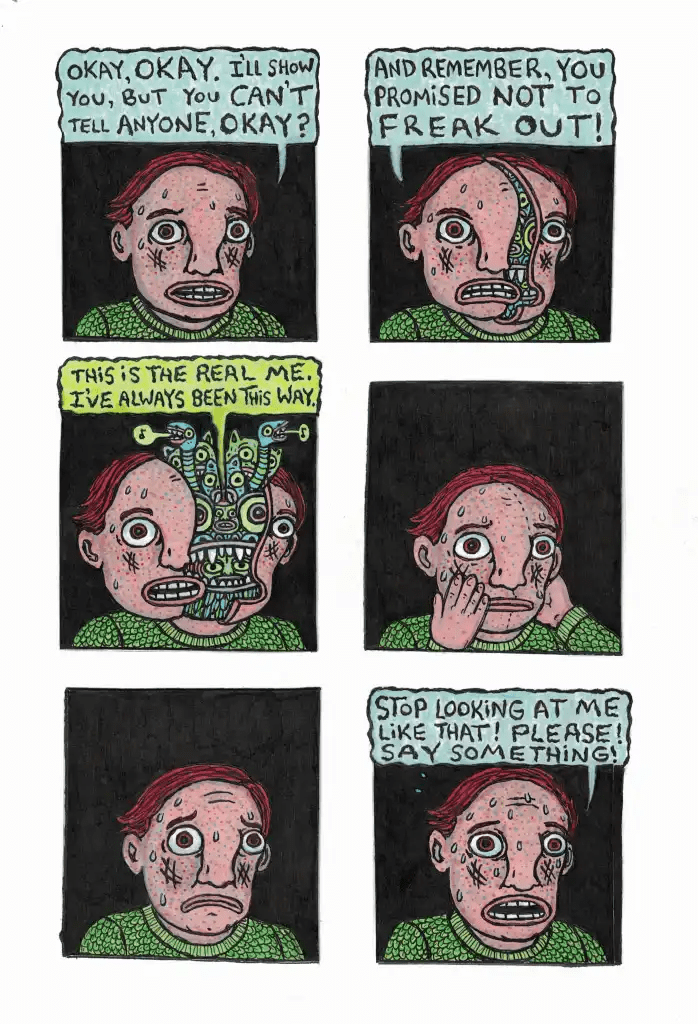
I started with automatic drawing, just letting my hand draw without knowing where it would go. Through that, a lot of patterns and imagery naturally began to emerge and I would just kind of follow that. Through years of working in this way and contemplating the recurring symbols, a lot of ideas and feelings started taking shape. Making comics became a way to explore that more actively by trying to unlock the stories and concepts that my drawings were revealing to me.
Has your work ever lead you to an experience of intuition or synchronicity?
Following an artistic impulse is in itself an intuitive and synchronistic experience. It adds an extra dimension to my daily life and when I have positive momentum in my work, I feel like that crosses over into my daily life and helps me see connections and meaning. Putting my work out into the world has also allowed me to meet a lot of people I wouldn’t have met otherwise, so in that way, I feel like dedicating myself to making art has allowed me to have important friendships that have inspired and helped me grow.
What do you like to cook?
I love cooking. I cook almost every night. I like to make enchiladas with sauce made from scratch. I like making sushi, jambalaya, grilled pizza, salmon. It’s just fun to work a kitchen and try to be efficient with all the different elements in play and it’s satisfying to serve up something good to my family. Cleaning up the kitchen afterwards is not as fun.
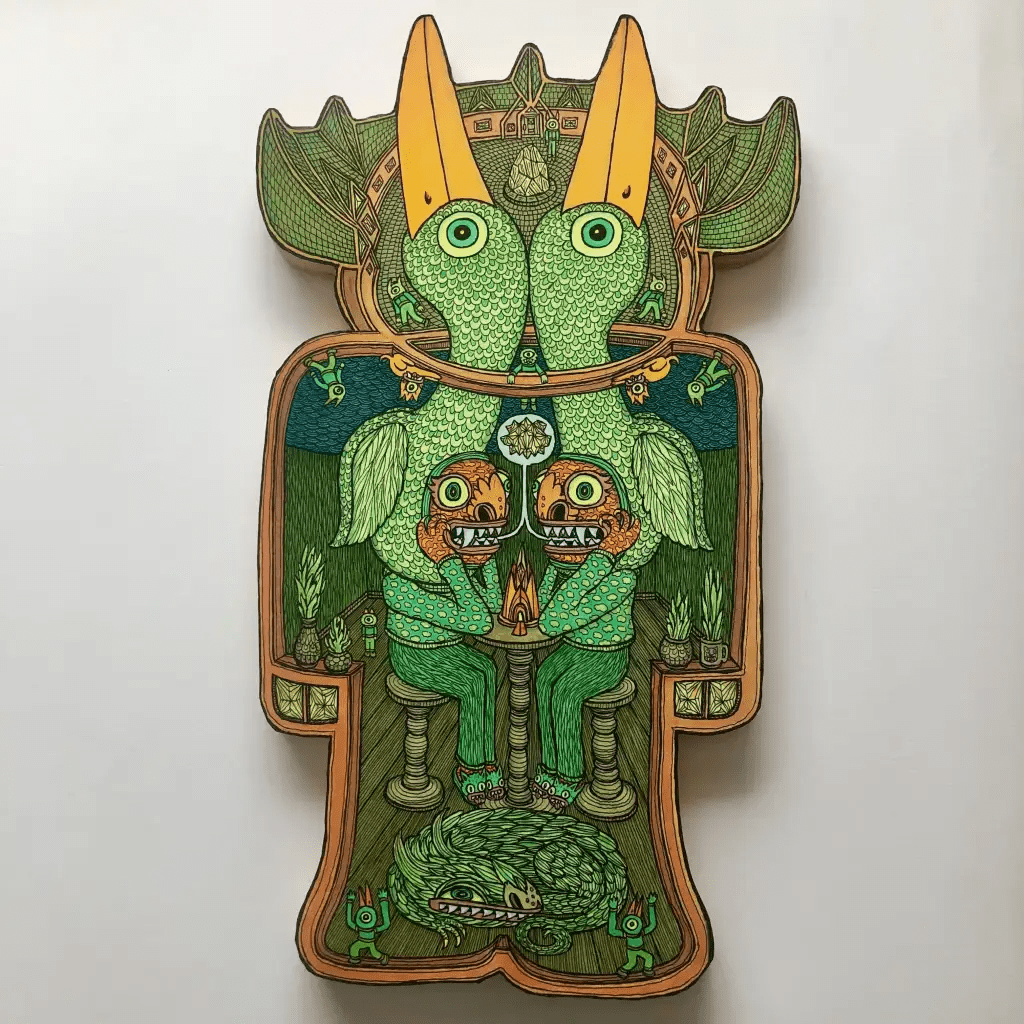
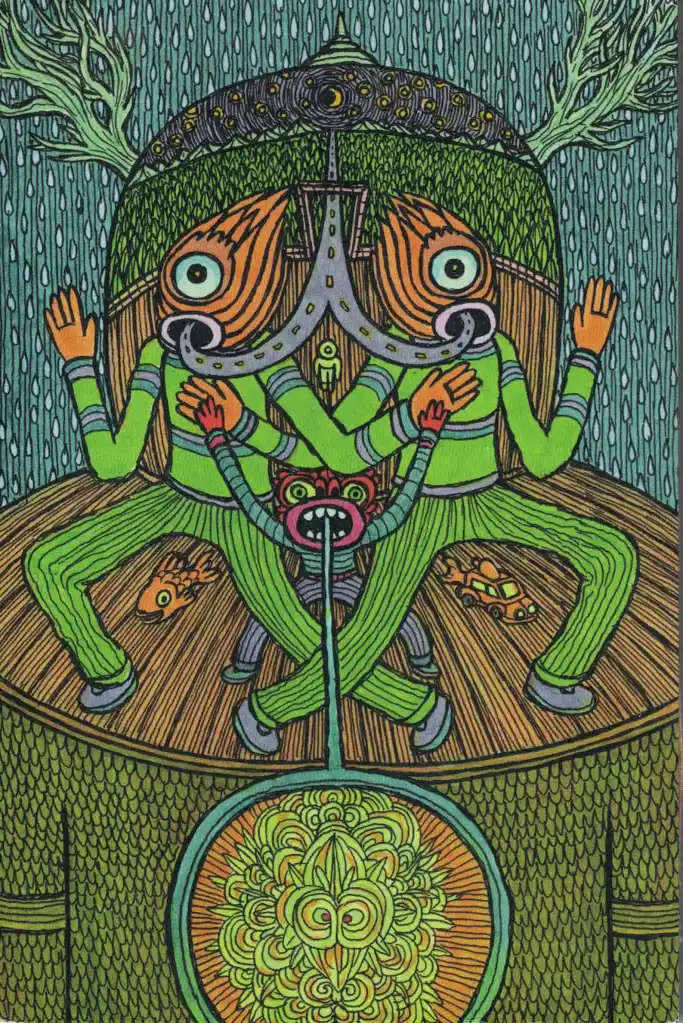
Theo Ellsworth is a self-taught artist living in Montana. His previously published comics include Capacity, The Understanding Monster, Sleeper Car, and An Exorcism. The New York Times once called his work, Imagination at firehose intensity. He has been the recipient of the Lynd Ward Honor Book Prize and an Artist Innovation Award. He loves creative collaboration, cooking, and making family folk art with his kids. He is constantly making invisible performance art in his head that no one will ever see.
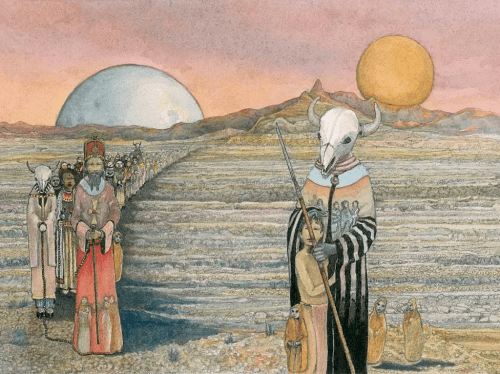
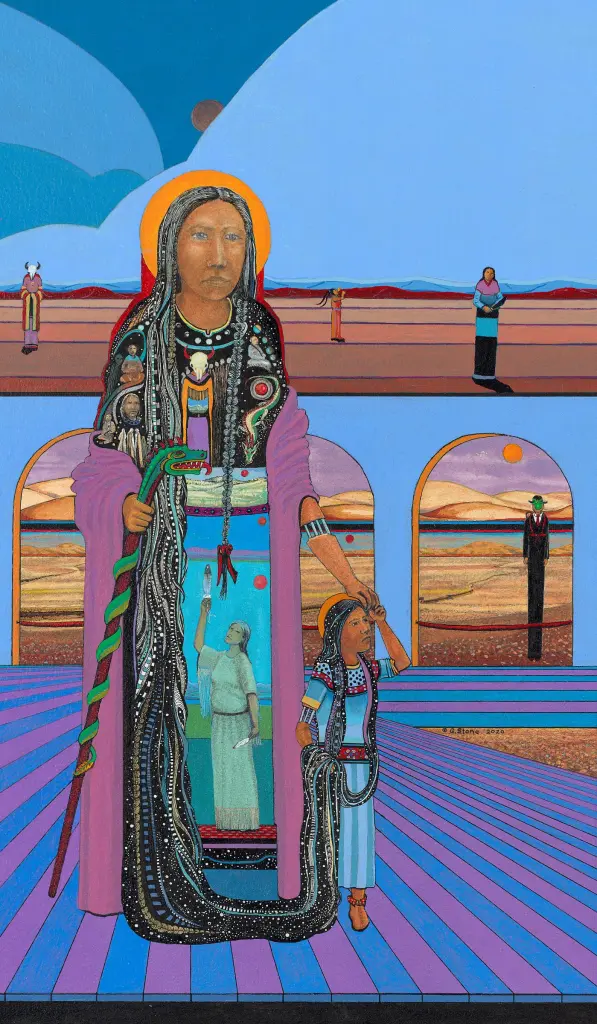
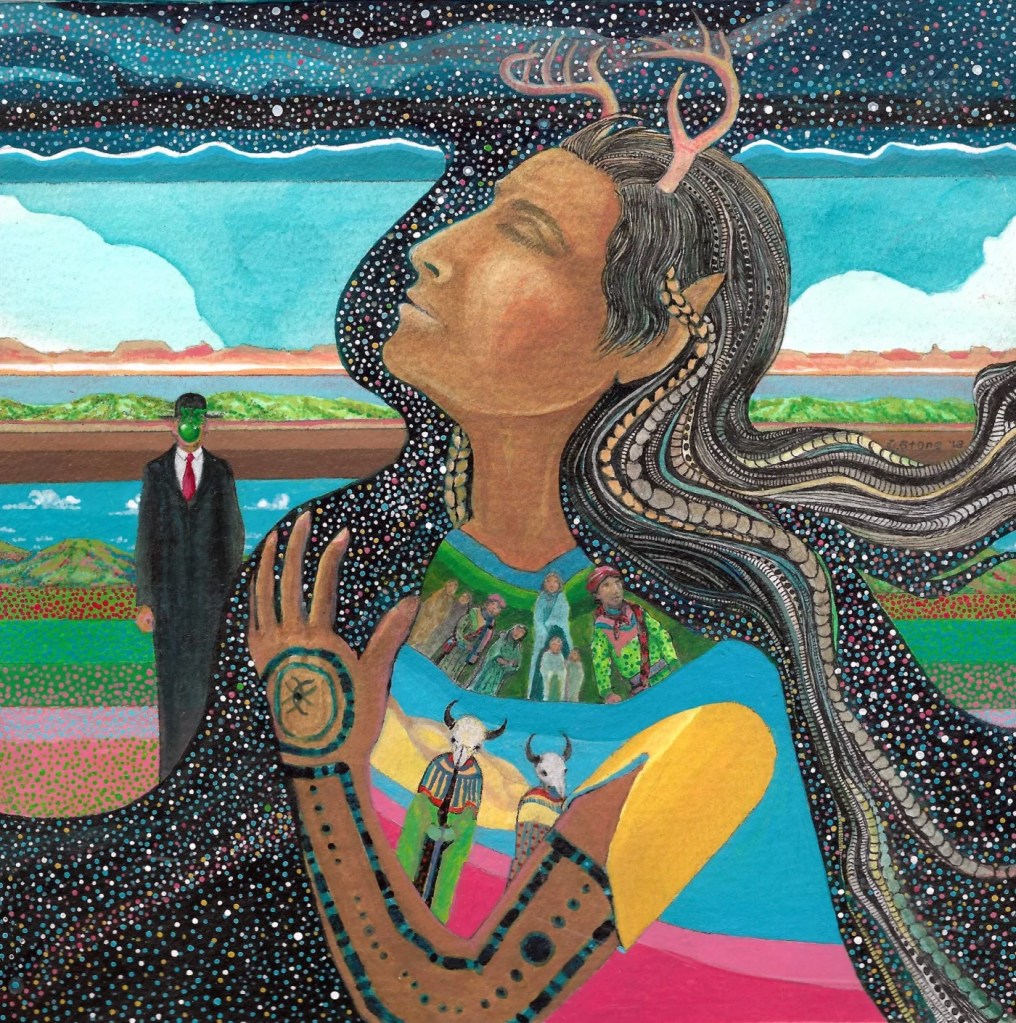
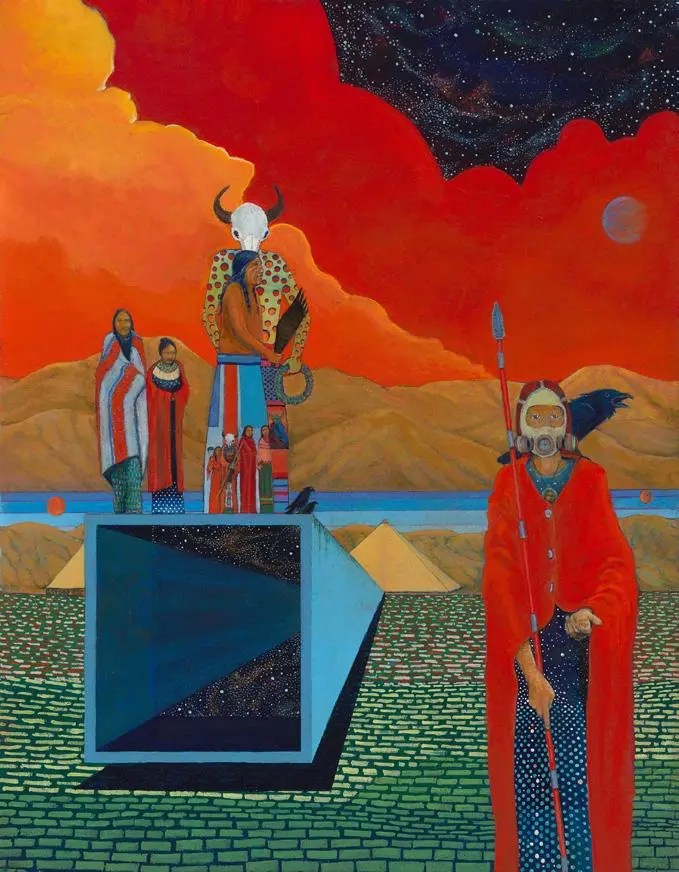
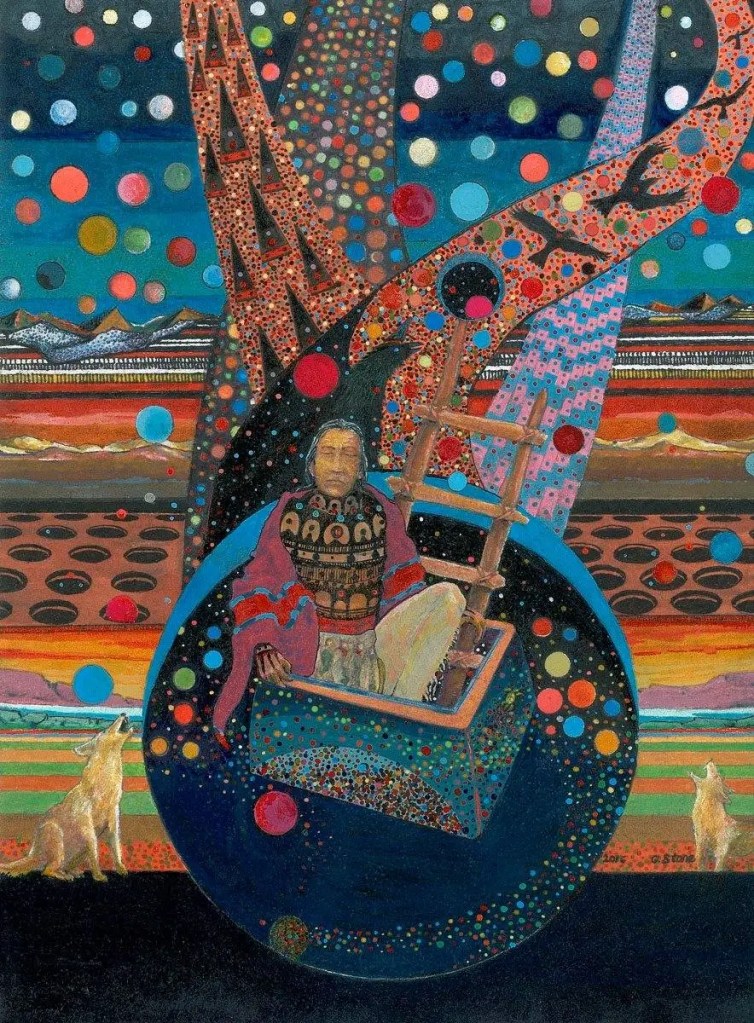
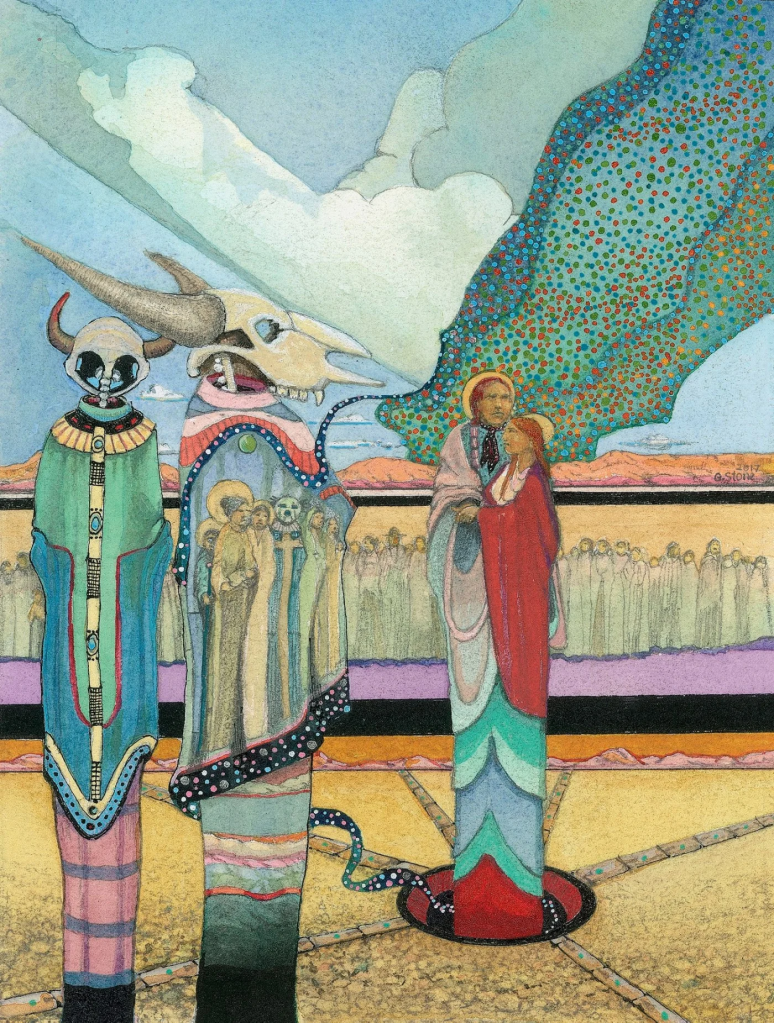
Gerald Stone’s roots flow from 1/2 Seminole and 1/8 Cherokee tribes: These worlds are, out of time, landscapes within landscapes, tribes, spirits, watchers, seekers, giants, red-haired women, murdered and missing, space stretched and bent, stories vibrating across time.
From a show at the Crocker Museum in Sacramento a write-up describes Gerald Stone as a “beloved local master artist”. Gerald himself just brushed off the accolades and calls his work “weird”. His stylized art, which he describes as a conversation between himself and his Creator, bridges traditional and contemporary styles and themes.
1947 Born in the far reaches of rural Oklahoma, Stone was a kid who liked to draw and has lived a life of peaks and valleys, always around the midline of art. Just 3 days before he was scheduled to enlist in the Army, headed most likely to Vietnam, he was accepted for a 2 year post graduated program at the Institute of American Indian Arts (IAIA) in Santa Fe, a city often considered the center of the Native American art world.
In 2009 Gerald Stone finally had the successful solo exhibition. He now shows in only a few galleries and also sells from his home.
edited by Mitchell Pluto from SULΦUR surrealist jungle archive 29 OCT 2021
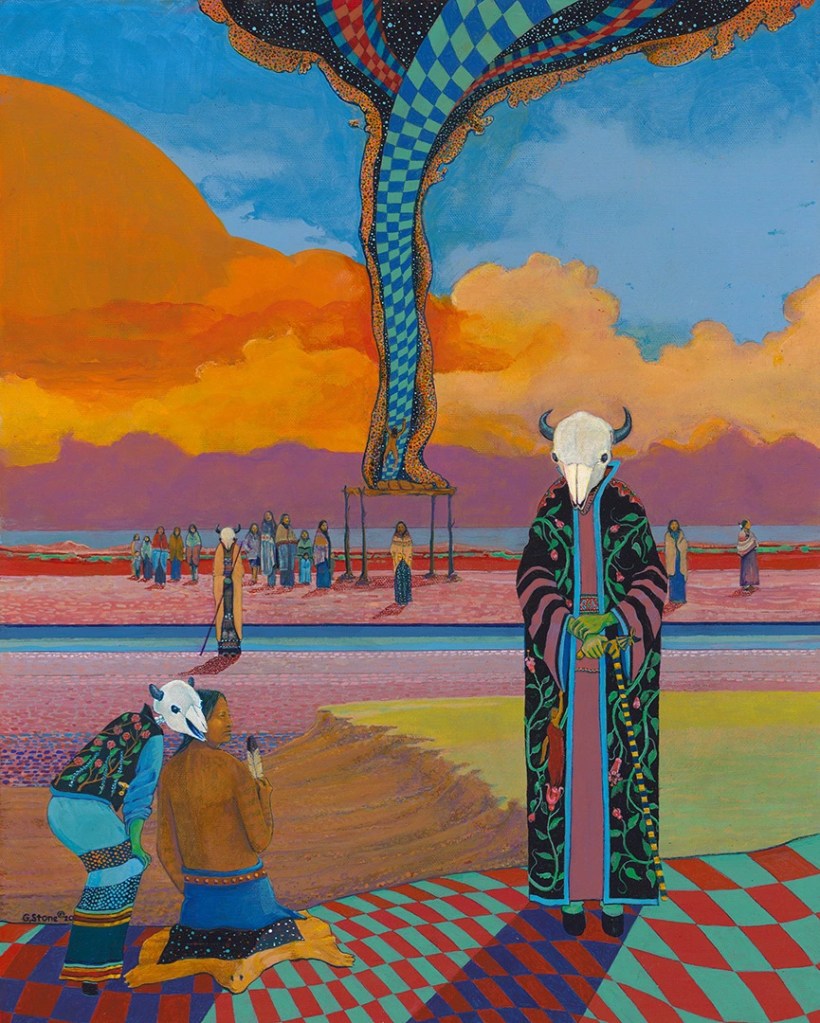
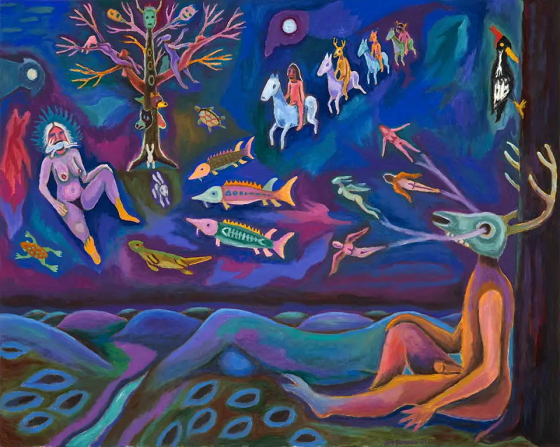
In the painting Vision Quest-Spiritual Sex there are several metaphors relating to antlers. Are there more details you can provide us to inform our understanding?
In one of my earliest painting classes we were instructed to create a composition, painting with a live male model, using some of the still life objects on the stage with him, and, our imagination. One of the objects was an antlered deer skull and in my painting, it replaced the model’s head. This was not an unfamiliar concept in Native American imagery but it was the first time for me to play with this concept. It definitely placed me into a spiritual realm I was not intending to explore. But I am a spiritual person so it felt okay to me to proceed. For me, antlered people represent spiritual people. But this antlered man was nude (as the male model was) and displayed a penis. Now this was certainly not a familiar concept in Native American imagery. It has been a concept that has developed and evolved over the years in my art recently culminating with these new paintings, “The Storyteller-Spiritual Sex” (I and II) and “Vision Quest-Spiritual Sex.”
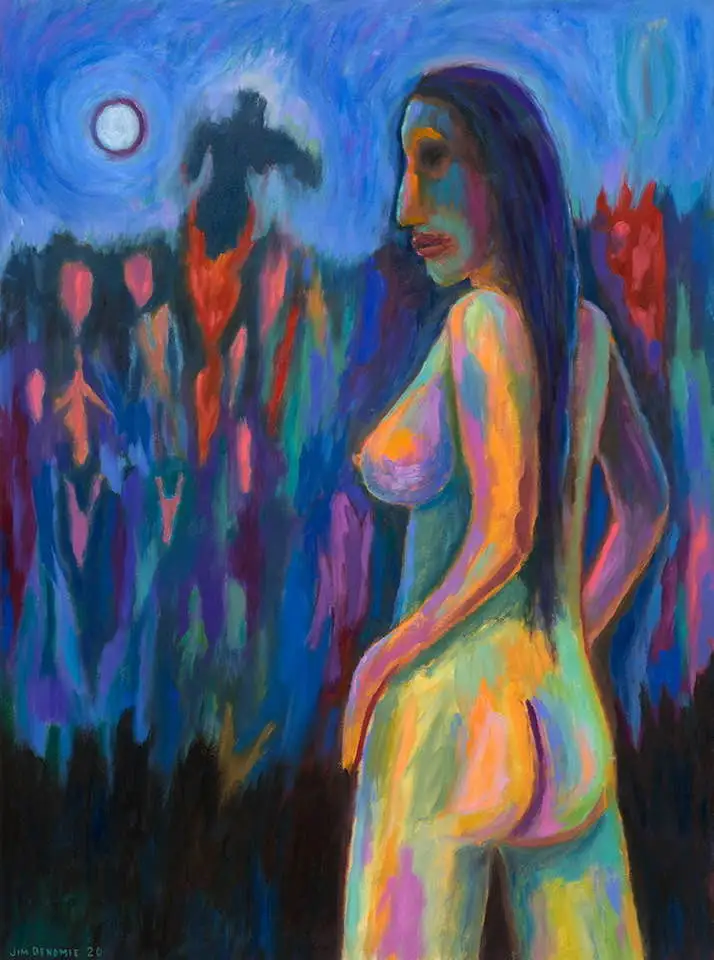
Spiritual Nite (Beautiful Witch)
The painting Spiritual Nite expresses a nude female figure and an enigmatic figure emerging out of the woods. What hint could you give viewers to add their interpretation or apprehension?
The painting “Spiritual Nite (Beautiful Witch)” has evolved from a series of paintings of female nudes over the last twenty years that have evoked a spiritual content. I have met several witches in my life (one a former lover) and made a decision to name this evolving series Beautiful Witches. In this particular painting (and others in this series) I am working intuitively with no planned outcome. I usually start with a sketch of the figure and then develop content and background imagery right at the easel, often letting color and brushstroke inform the direction and meaning of the painting.
Mother or Beautiful Witch
Mother or Beautiful Witch transmits a sense of being fed but who are the mysterious figures behind her?
The painting “Mother (Beautiful Witch)” is an example of an idea evolving right in front of me. Originally, this painting started out a year earlier as a portrait of a tattooed woman with semi formal abstractions in the background. It had an interesting beginning but after awhile it felt lost and I changed direction in midstream. I painted over the background and the entire body of the figure while at the same time changing the position of her arms and the direction of her gaze (impulsive decision making). She was now squeezing her breast and I then painted a stream coming from it. At this point I made a sketch of it to explore options and possibilities. In the sketch, the stream coming from her breast turned into a stream of small fish each getting larger as it moved away from her body and then sketched images in the background that I was recognizing from the brushstrokes and color forms. Getting back to the painting, I added the stream of fluid coming from her breast and then had the inspiration to add a young rabbit catching that stream in its mouth, being fed, leading me to the title “Mother (Beautiful Witch).”
The owl and wolf figures emerged form the brushstrokes creating a drama in the painting. I have felt a connection to rabbits since I was a young boy and have developed several understandings of that connection. One is this: It’s the rabbits that watch over our houses at nite, protecting us from predators, intruders and disease. And also, it’s the rabbits that lead the lost out of the woods but sometimes the owl and wolf beings find them first. Both the painting and the little essay were developed independent of each other but form a natural union.
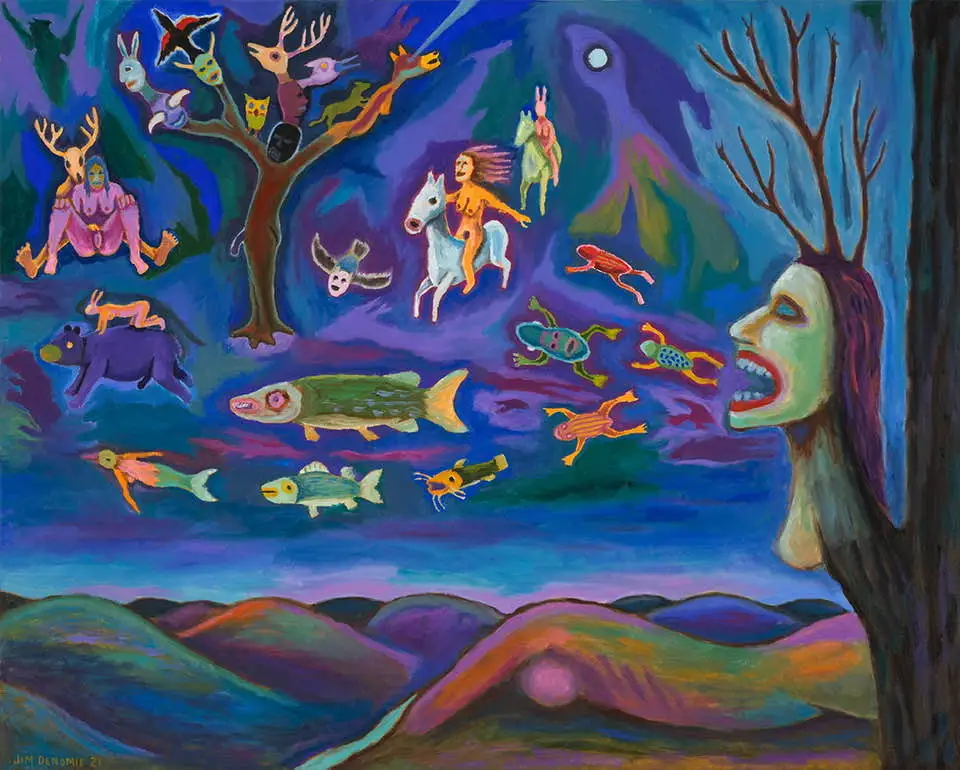
The Storyteller-Spiritual Sex II
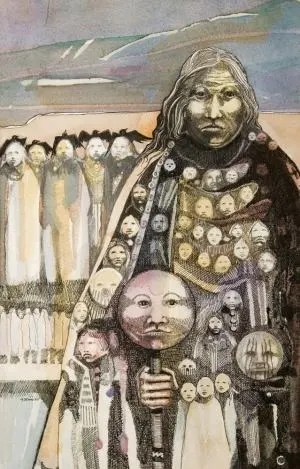
The Storyteller-Spiritual Sex II language appears birthed from the mouth, words become things, places and people. Can you tutor the viewer a little bit about the pantheon or activity in this painting?
Storytelling is a tradition of many of the tribes in North America (and many indigenous cultures) including my own, the Ojibwa or Anishinaabe, as we call ourselves. It has been portrayed visually, most popular as sculpture of the Southwest Pueblo and Hopi tribes as a woman with many children attached to her. My rendition of this concept was inspired by my experience and knowledge of the stories told by my people and was developed through sketching. In addition to my painting, I sketch prolifically, often capturing the tip of an idea or concept that may lead to or inform a future painting. Everything I paint or sketch comes from my memories, dreams or imagination, or directly from real life, never from photographs or screens. The imagery or episodes coming from the mouth of the woman in “The Storyteller-Spiritual Sex II” all come from my visual language developed over years of exploration and in this particular painting, from my dreams and imagination.
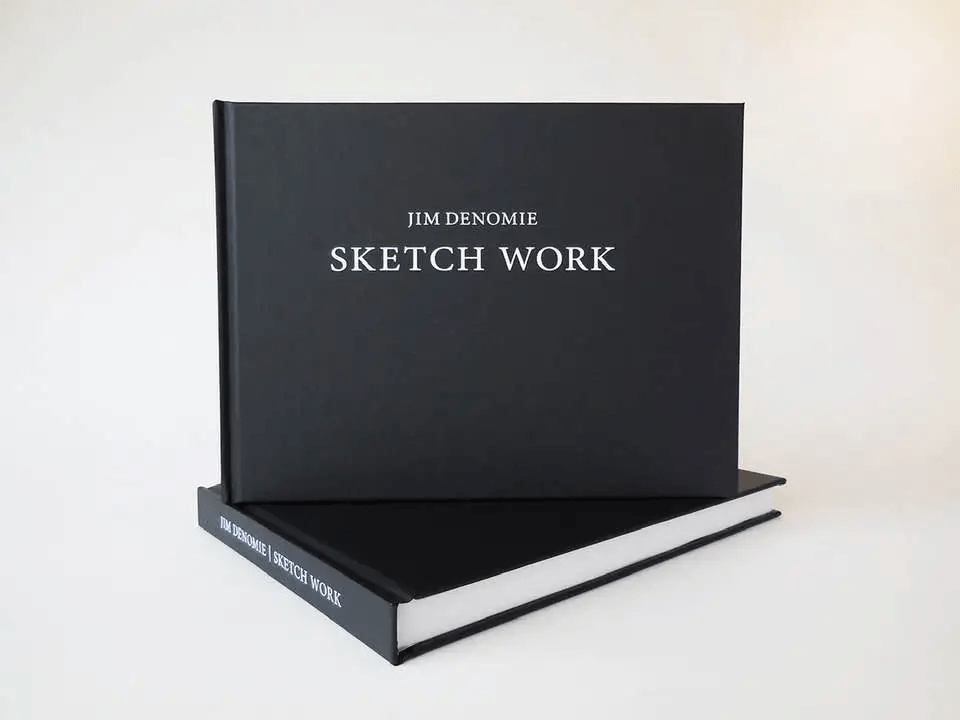
Jim Denomie 1955-2022
What role does the moon play in your paintings?
Often the moon merely emphasizes the nite time portrayal of my spiritual paintings. For me it is the nite time when the magic and the mystical happen. And it is my preferred time to paint or sketch as I am almost always out in my studio until 2 or 3am, or later.
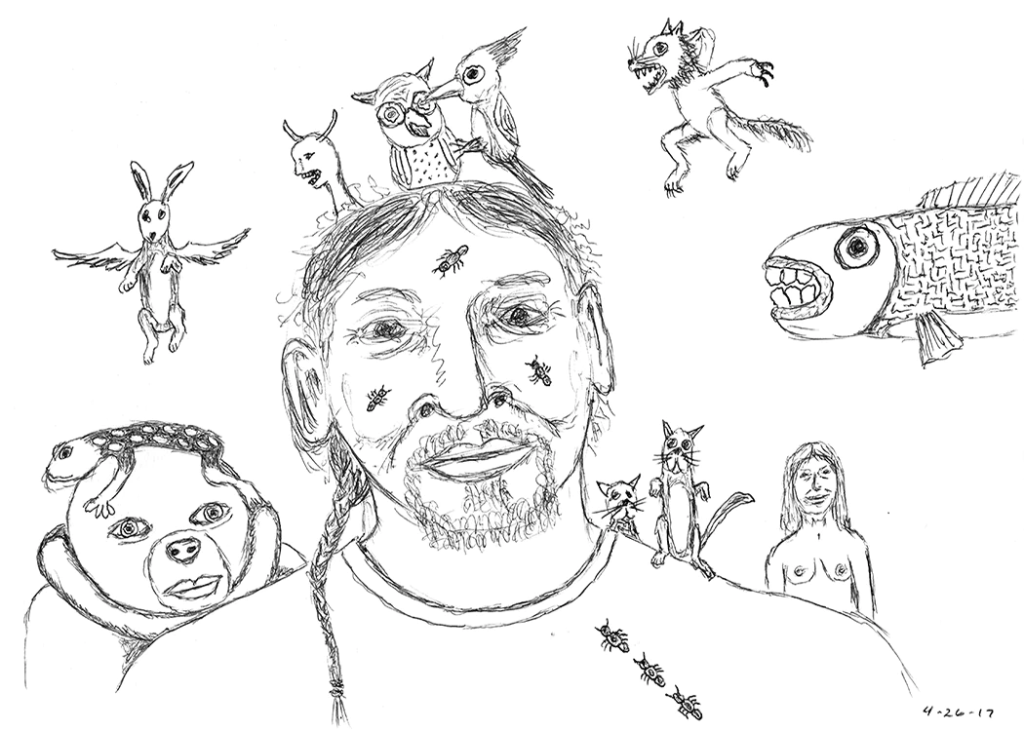
I love to sketch. I love seeing other artists’ sketches. Children’s drawings are the absolute best, because their abstractions, inventions and raw honesty just blow me away.
I always carry a sketchbook with me wherever I go, especially when I travel. To me, drawing or sketching is a form of note taking. It is a method of recording the lucid or fragmented thoughts passing through my mind, conscious or dreaming. Sometimes I see a story, sometimes a phrase, or sometimes just a title. It’s also a camera photographing the weird landscape (my imagination) that I dare to allow myself to journey through. It is a process where I try to do some fearless exploration. But almost always, the scenes in my mind are only temporary, fleeting, unexpected images of dreams, imagination and memories. Frequent sketching allows me to capture some of those images and to discover the ones that are unseen.
When I was an art student at the University of Minnesota, I met a musician playing his guitar and singing songs for tips on the sidewalks in Dinkytown. His name was Jerry Rau. Jerry was a Vietnam vet and a gentle soul, and he and I became friends. One day I mentioned to him about sketching an idea before I forgot it. He told me that he always carries a notebook with him explaining, “You never know when a song will come to you. You think you will remember it, but sometimes when you turn your attention for even a second, they float away, like a dream. If you don’t write it down, it will go to the next songwriter. And if he doesn’t catch it, it goes to the next. And if he doesn’t catch it, they all end up with Bob Dylan.”
Sketching is also a method of exploring. Sometimes being able to see only the beginning of a story, a song, a poem, the artist begins illustrating an idea, not knowing what or where it will lead to. Like a clown who pulls what he thinks is just one handkerchief from his shirt pocket, he pulls out cloth after cloth, one idea leading to another until you have a more complete vision of the story or song.
For some time now, I have thought of my sketches as lyrics to a song and coloring and painting my sketches as putting those words to music. Adding color and the abstraction of loose brushstrokes brings a new dimension of the sketch to life. The drawing becomes a leaping-off point and is eventually abandoned as the artist responds to what is evolving right in front of him/her. While translating a sketch to a painting, the artist starts painting but sometimes begins to experience new inspirations right there at the easel (pulling new or different handkerchiefs from his shirt pocket). These realizations make the process original (again) and the sketch and the painting become two different works of art, each significant. Sometimes I find it necessary to make quick little sketches or studies to assist a painting in progress as new ideas emerge or because I feel the need to alter the composition.
For me, sketching is instrumental for evolving ideas and for understanding the incomplete.
our birthright is to know our brain and to become aware of the impact of meteorites on our language.
but first
guard the self that believes in you. the best hallucination is a healthy belief. a belief in self without vanity is sincere and free magic. magic without title, property or theft.
which older you are we anyway?
everything about the overactive amygdala is the source of insular cortex phantoms, wrathful deities averting ourselves from sapience. it keeps us from enjoying our temporal lobes, ruled by self-rejection in the temple of the body.
autoscopy, is the real spirituality with particles and waves. this tide will lead to a more balanced clonal pluralization of selves. to be one with everything, one is everything.
In this illusory quest to survival, I abstain to say your name. In this twilight world where everything freezes; inevitably. I watch this glow on the horizon of our extinction
The human being dreaming of the world of tomorrow Poison the last rivers; Who was already feeding him more. In a deafening silence; Consumes; What it is no longer: human
And as in every moment, the eternity of a breath depends on it. The human being, called to disappear under an acid rain, seizes the last gleam which remains to him. He then becomes the last link in a corrupt chain, broken down to his DNA. He is then surprised that he still has a last glimmer of hope in this twilight disaster. In a canicular suffocation, he observes the beauty of the world he has just destroyed. The power-seeking human suddenly stops and stares at his bloodied hands. He understands then that in each moment, the eternity of a breath depends on it.
Some will say I was born on a rainy day, others will tell you it was a full moon night. The reality is very different, I was born in 1986 in Normandy between a radioactive cloud caused by the explosion of a nuclear reactor and the passage of comet Halley. This is how all things begin.
Written by Alicia Lasne
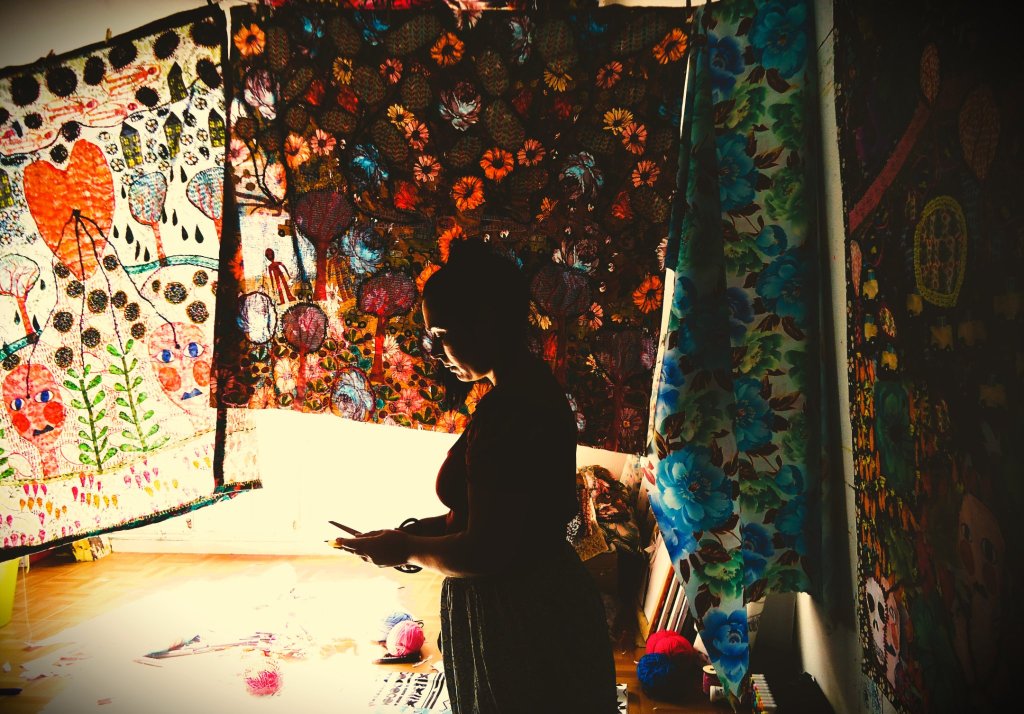
ArtistAlicia Lasne in her studio
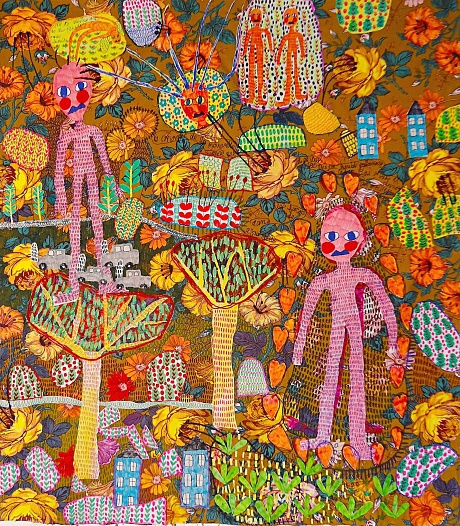
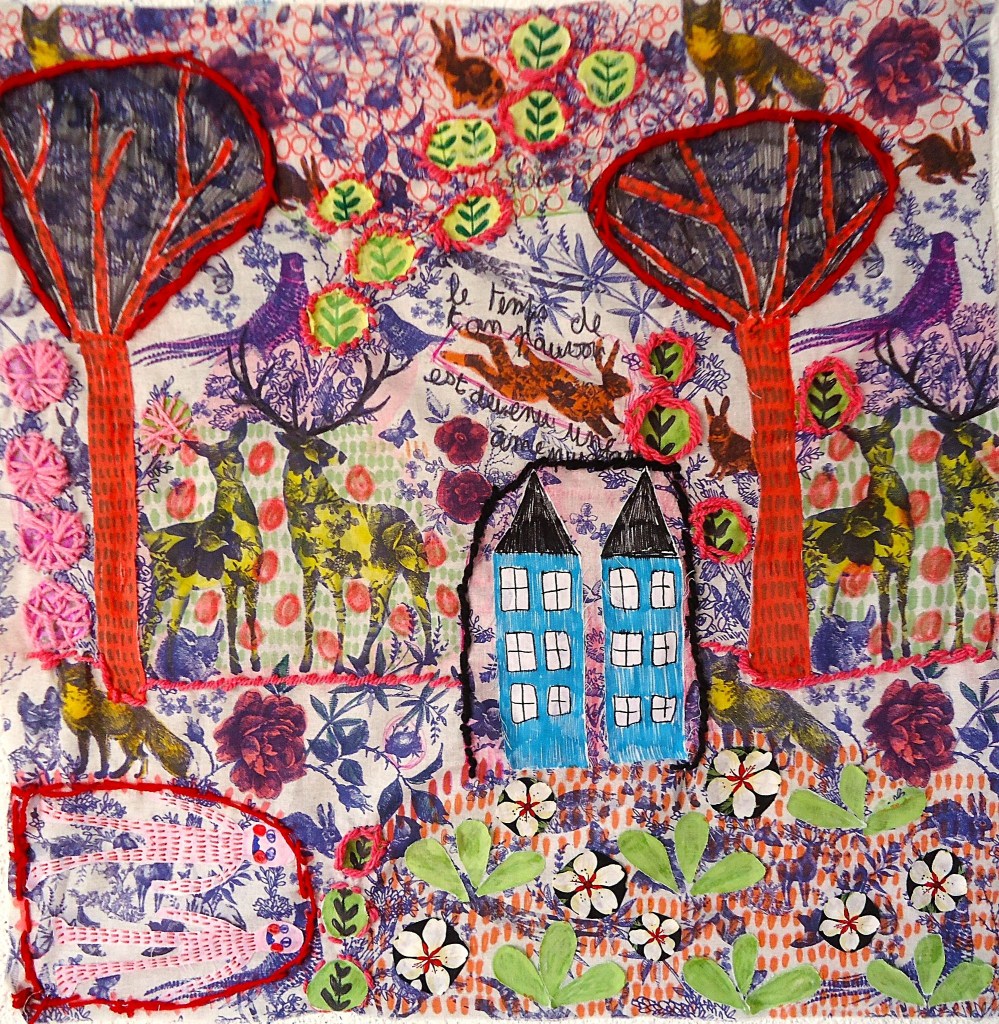
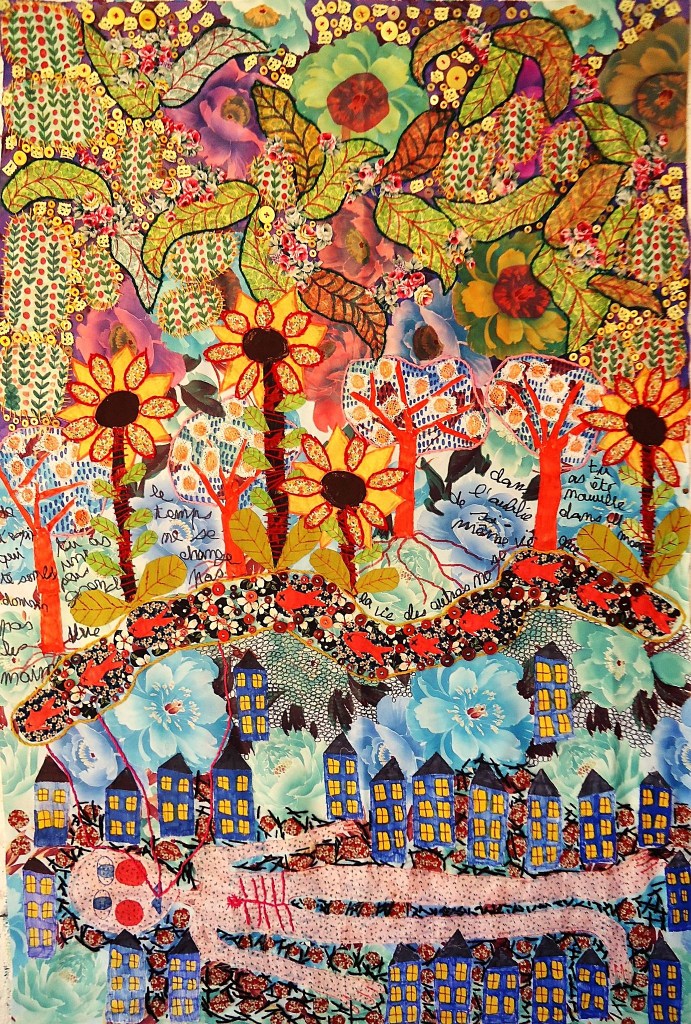
In this collapse, where a universal rebirth can only be inevitable, I sew, suture, glue on pieces of fabric like exvotos, half-spoken prayers.
Alicia Lasnesewing a picture together
I weave this nature too often ransacked by our lifestyles. Constantly questioning myself about what I am, as a human being. What is my place, my role, our mission on this Earth? What should I change to no longer feed a society of destruction, but a society of the Living.
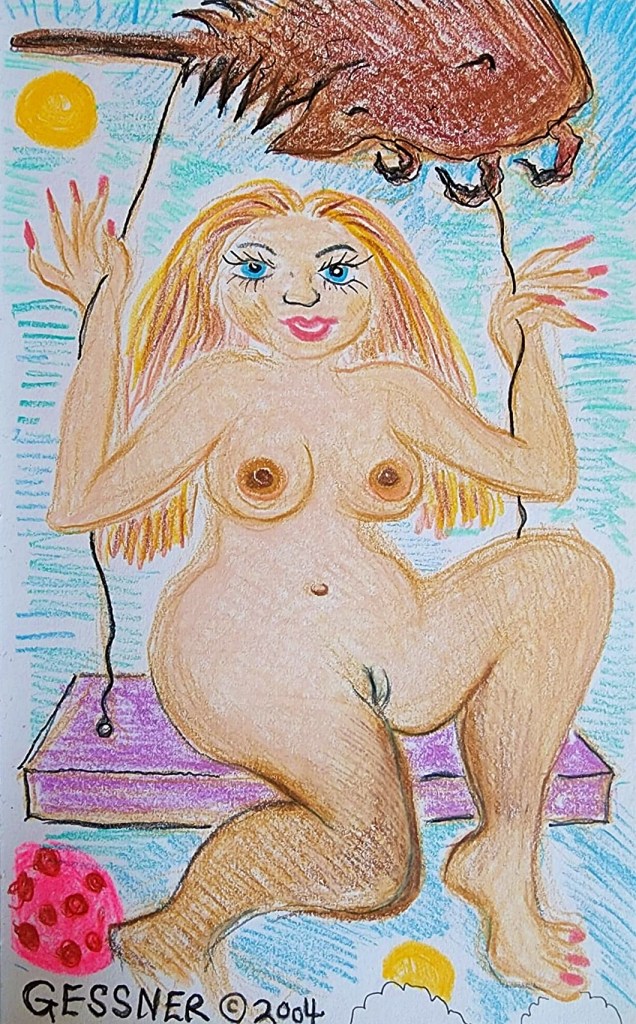
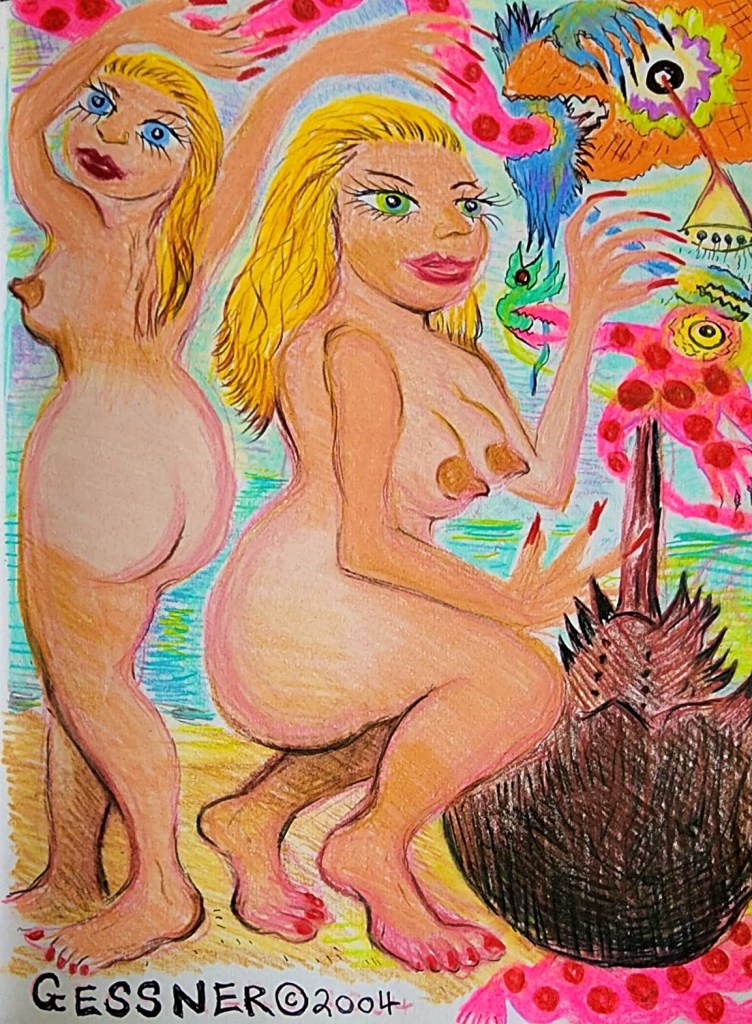
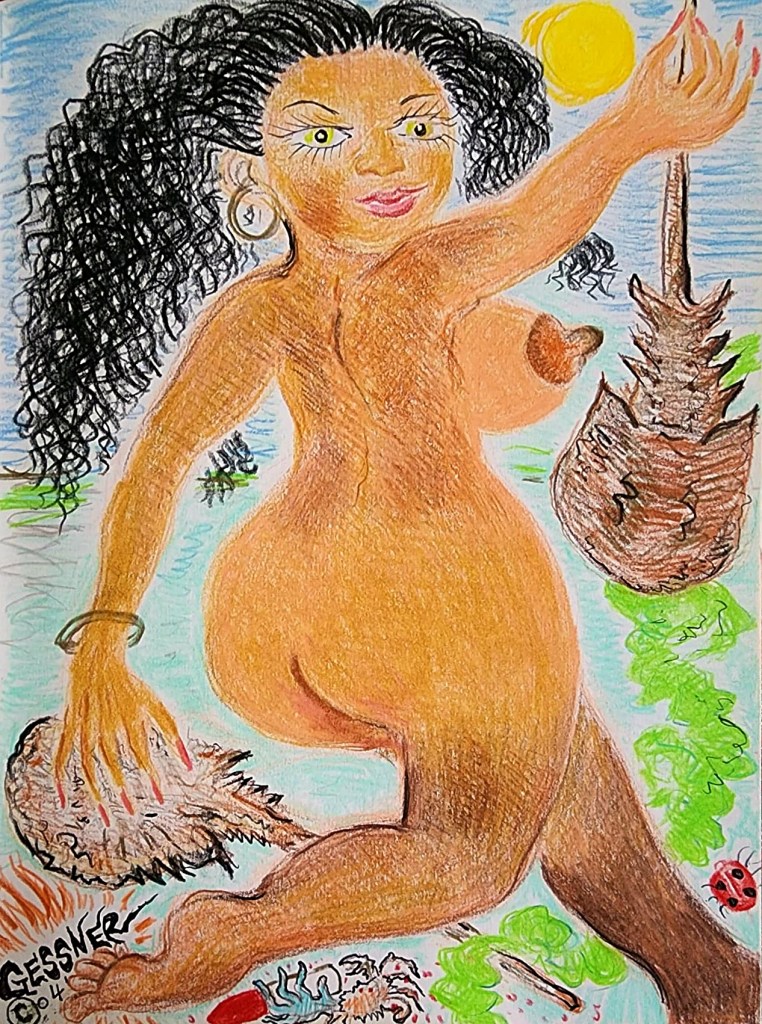
Limulus, is my favorite arthropod, it’s the oldest species on the planet.
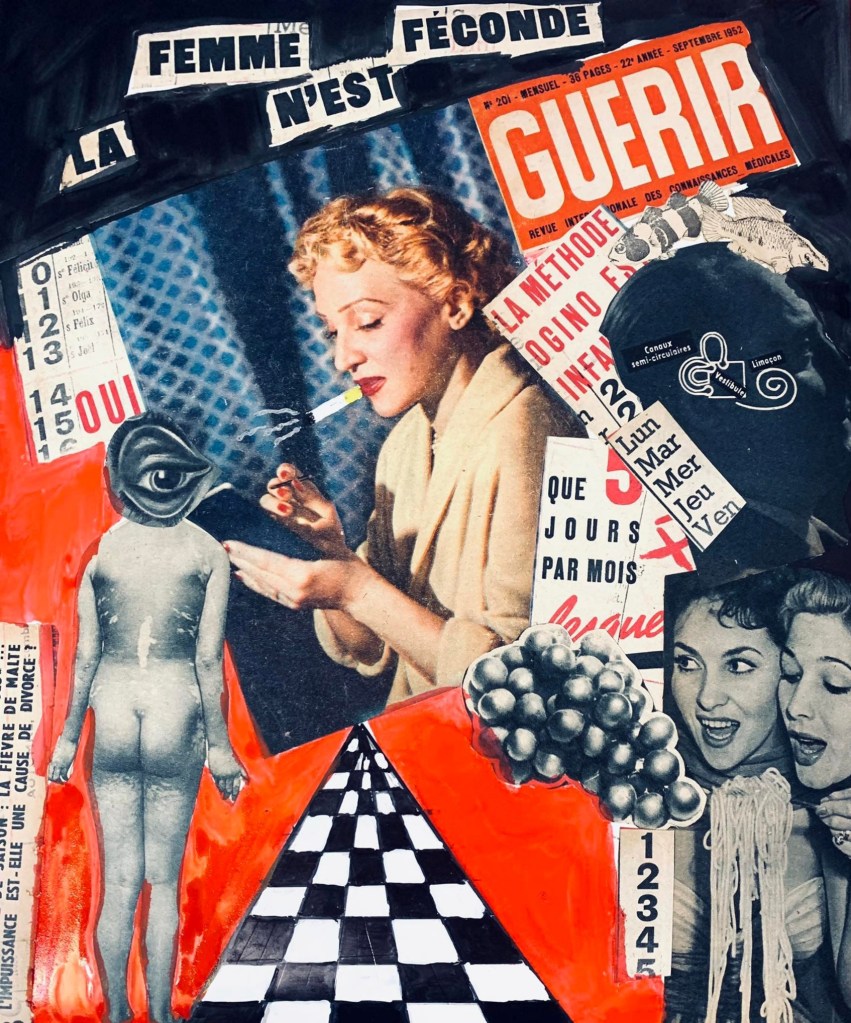
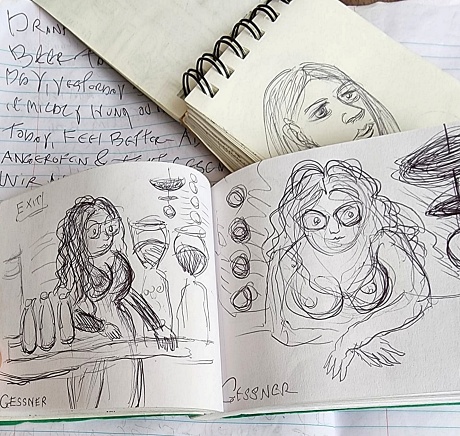
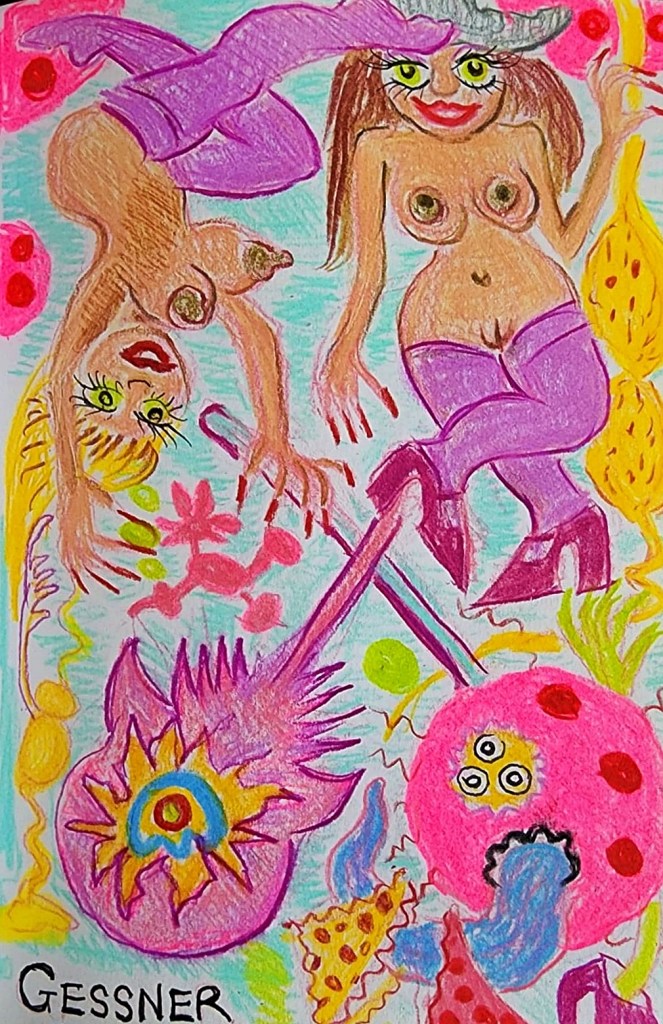
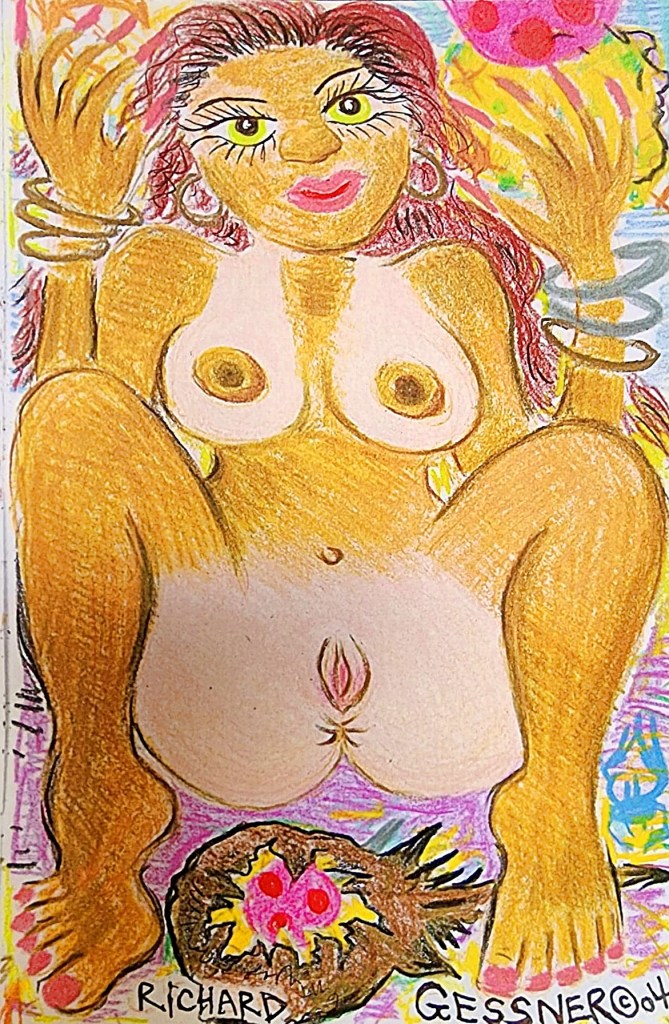
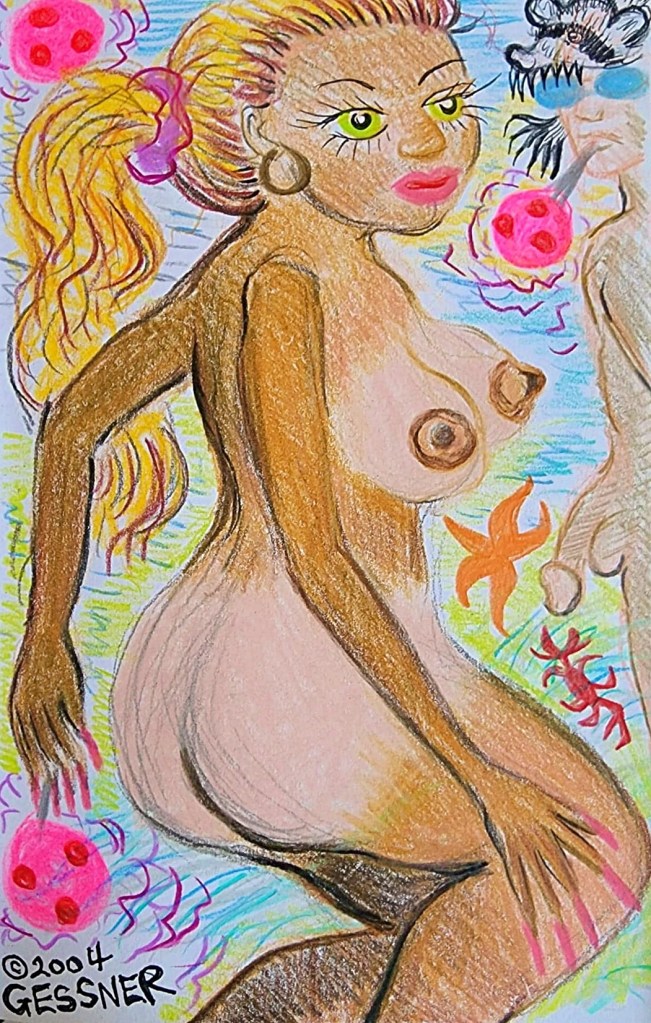
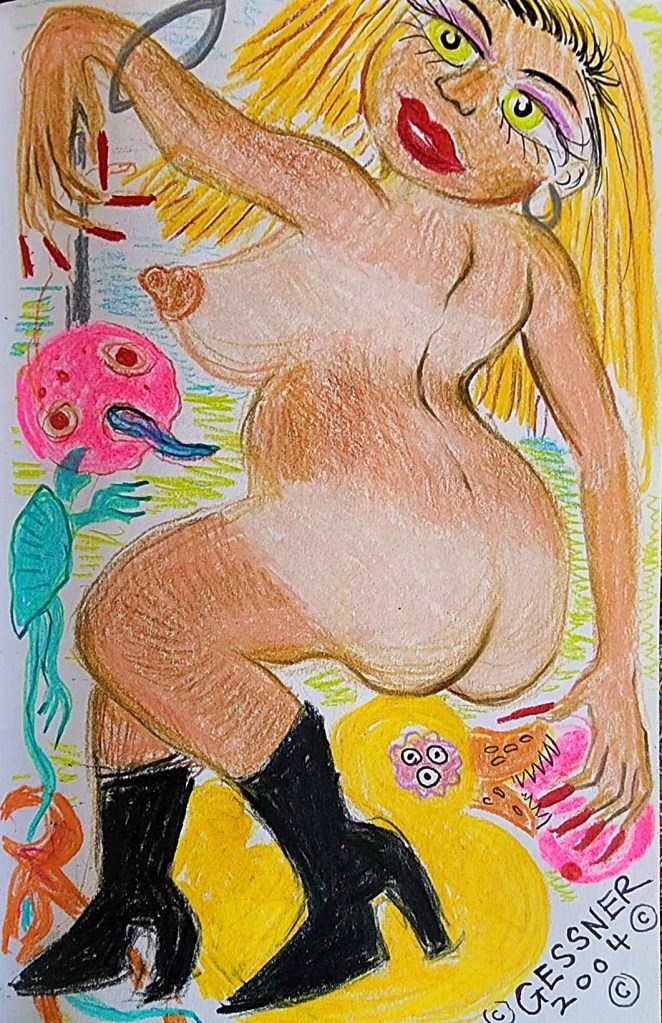
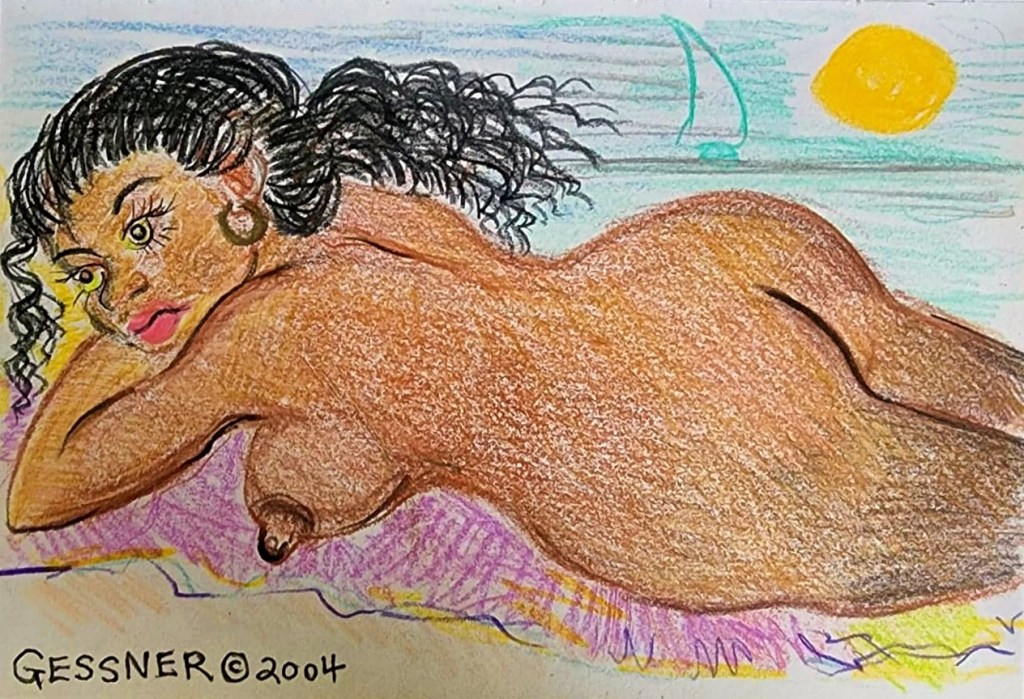
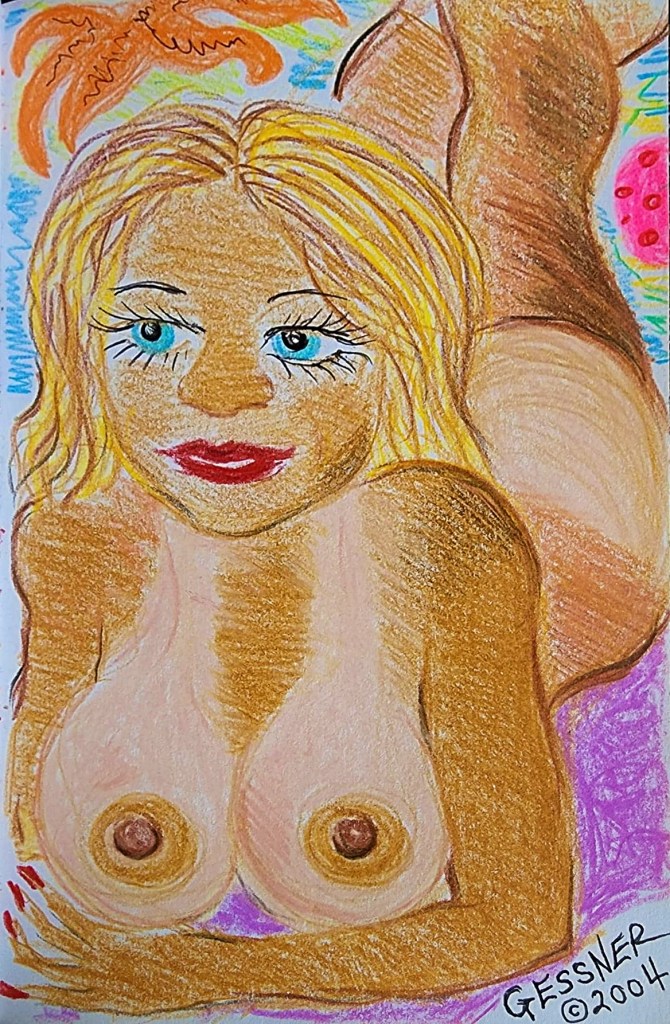
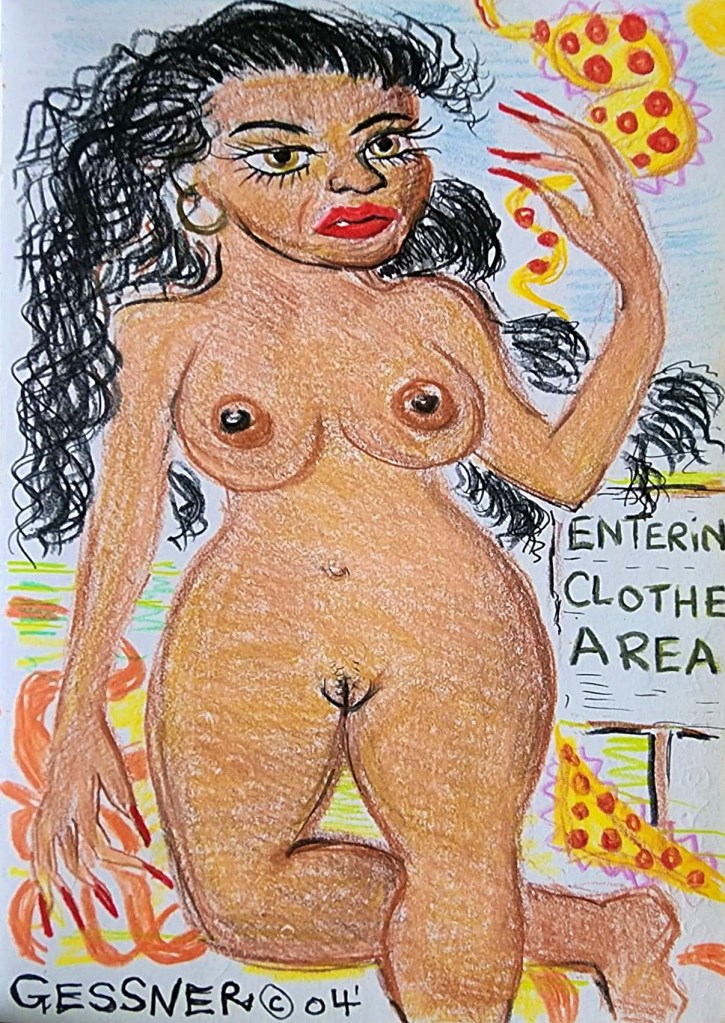
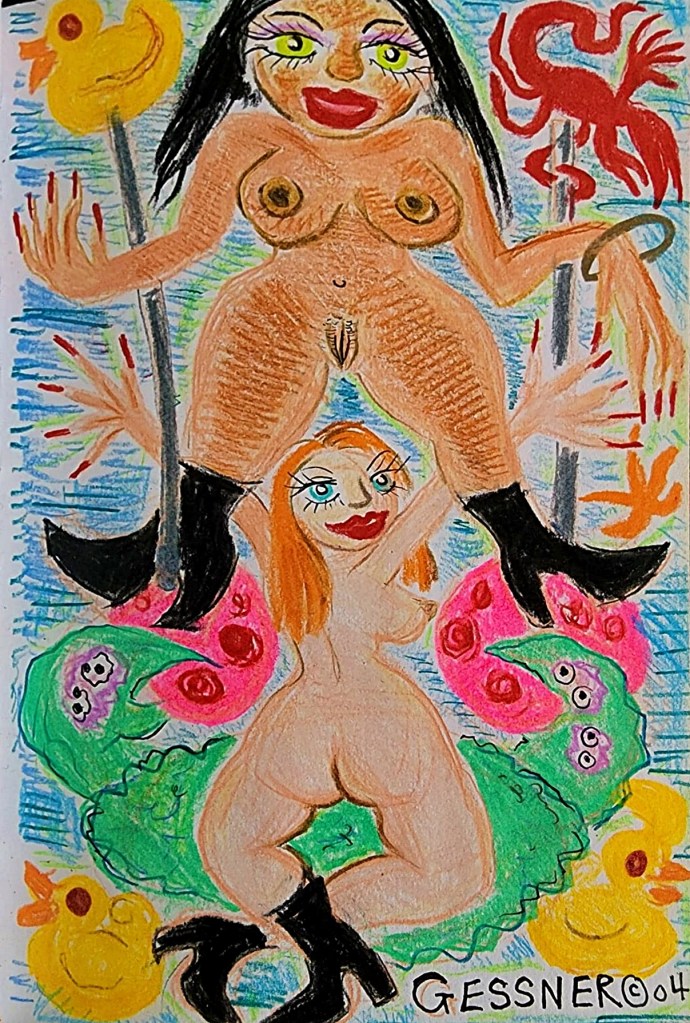
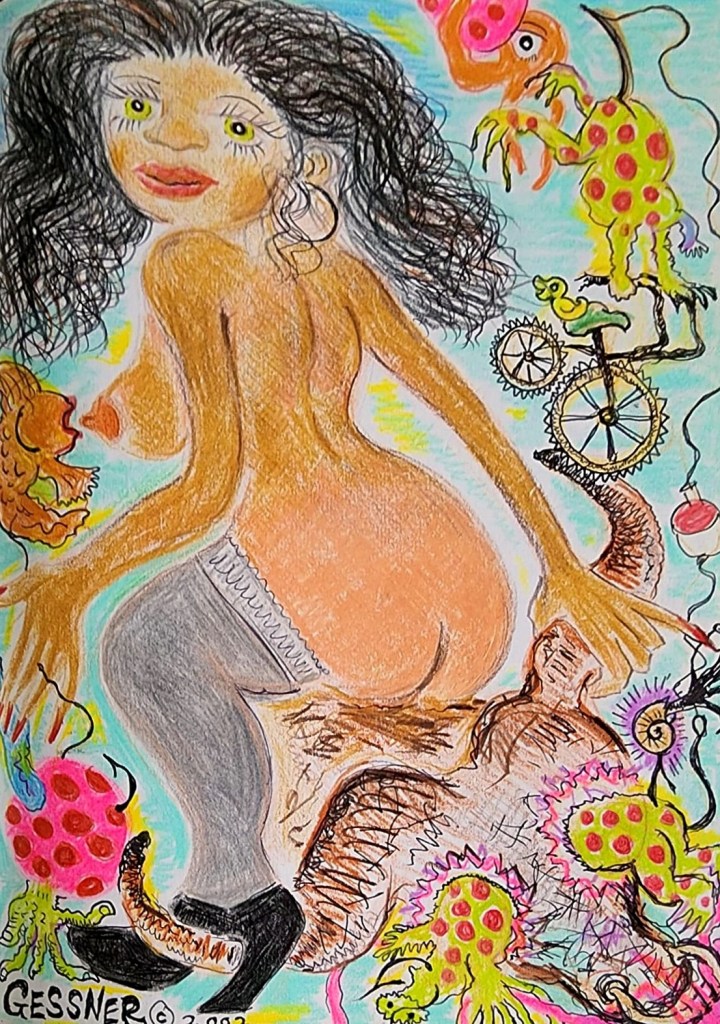
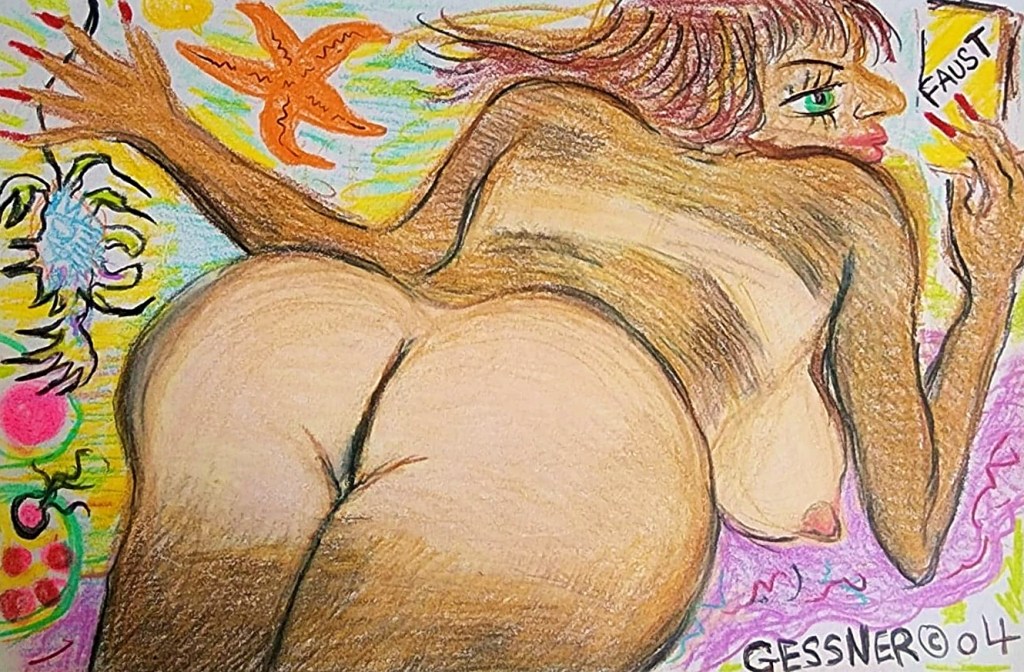
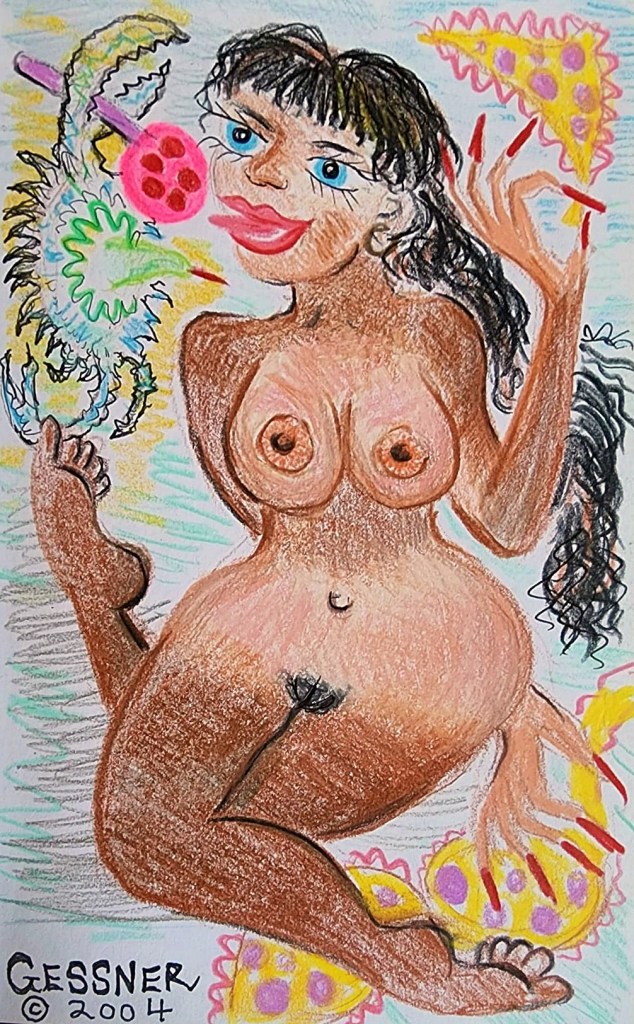
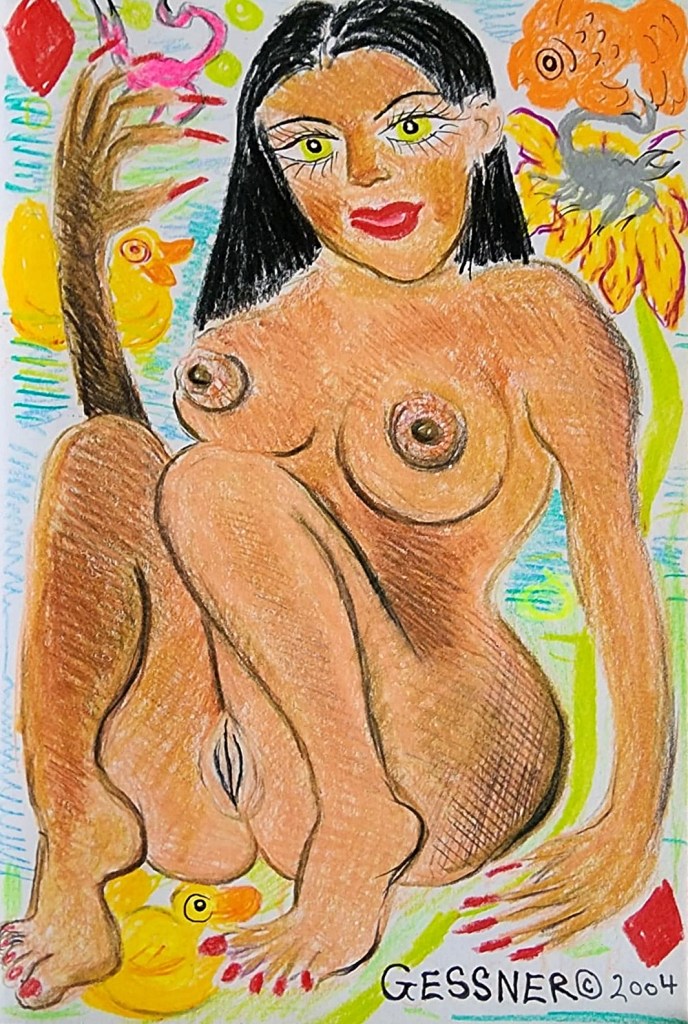
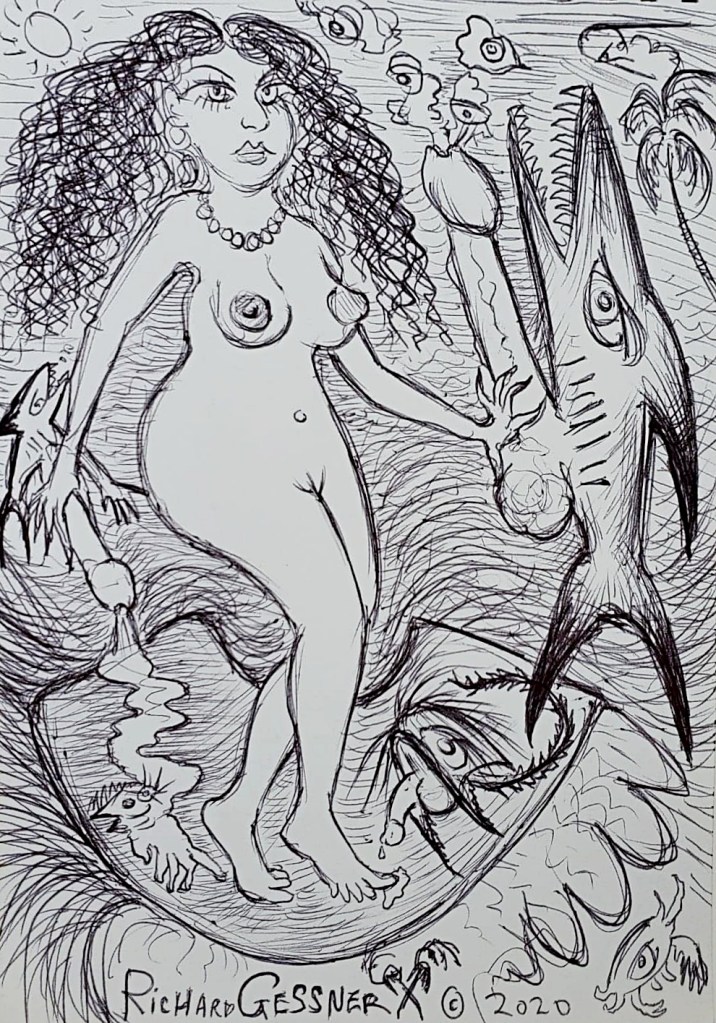
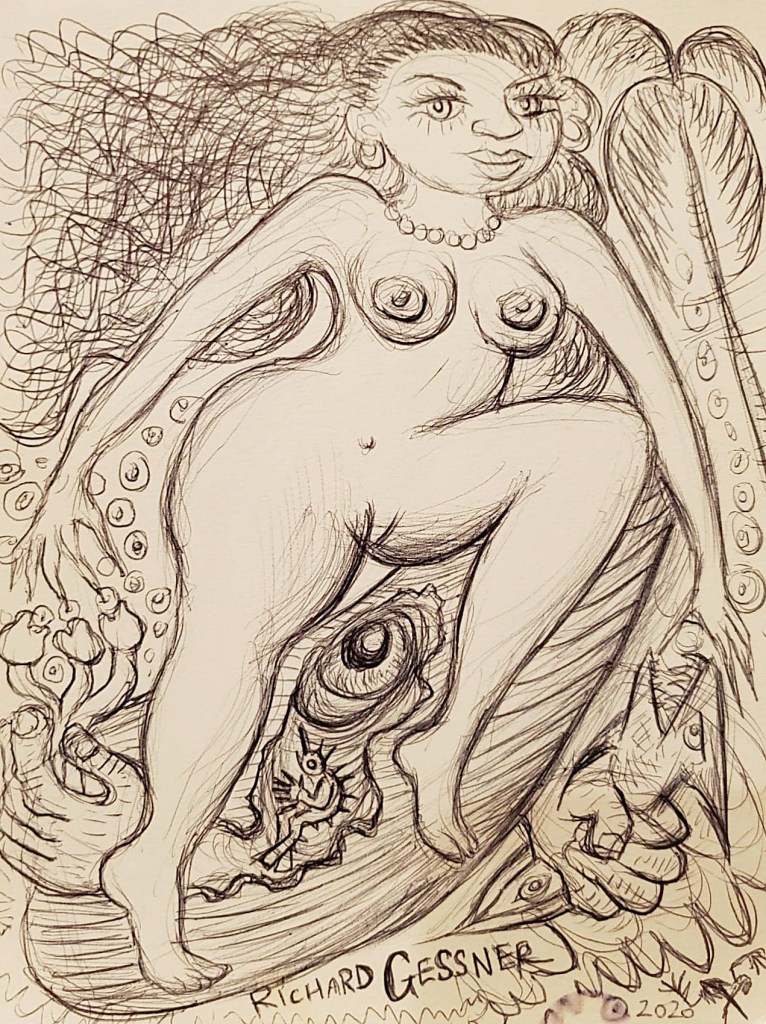
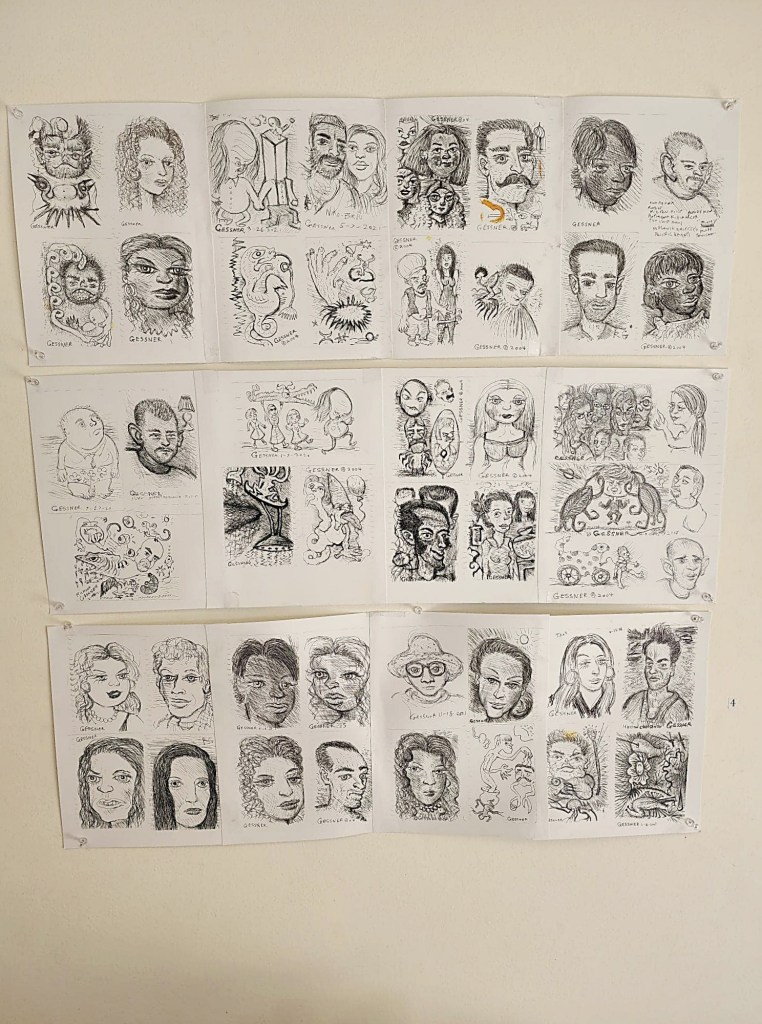
I’m thinking about sex 24/7. Raging hormonal beach Paradises stretch on infinitely into horny horizons. The sight of beautiful fertility Goddesses is always more pleasant to behold than old men covered with craters of acne scars, or Syphlytic doomsday warthogs with copper sulfate tusks!!
Naked ladies have a storied history in the history of art. From Boucher, Bouguereau, Anders Zorn, Mel Ramos, Eric Fischl, pin up art of Elvgren and Driben….Like Brooke Burke and 10 thousand other Brunettes. Hans Bellmer is a favorite. Independent from art, the naked lady in public viewed by the salivating Voyeur since time immemorial is inspirational.
Hans Bellmer appeals to me because it’s Life itself. What beauties can be viewed spontaneously in the street. It is bizarre and an otherworldly ethereal quality that I like.
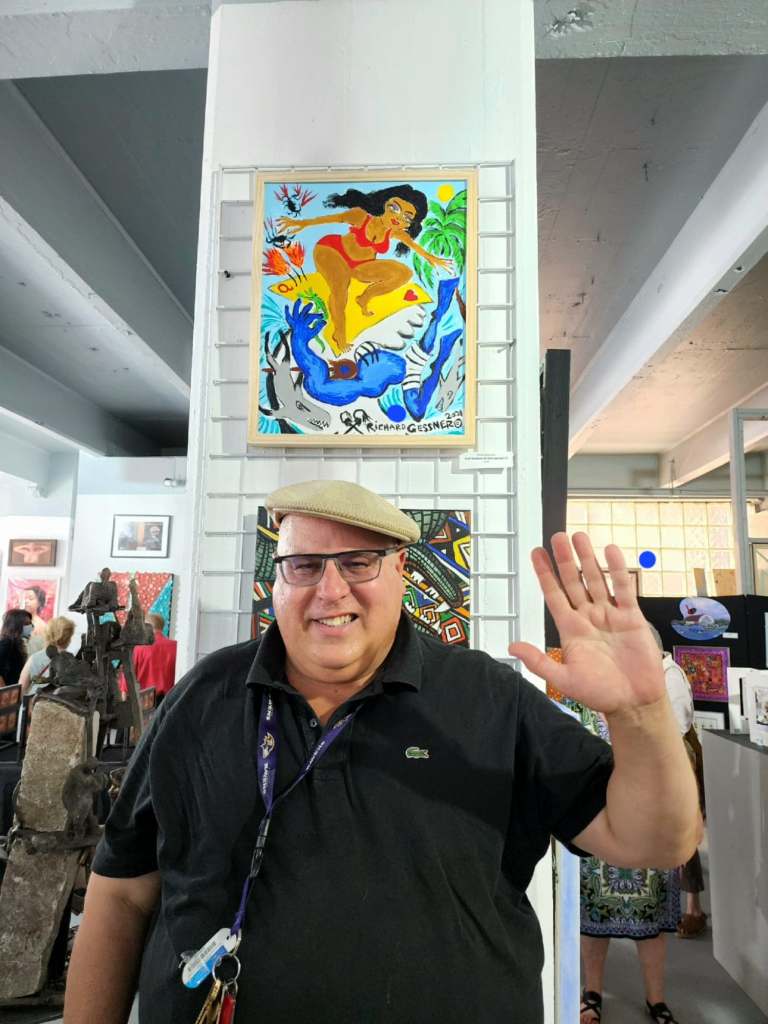
written by Richard Gessner
Richard GessneratStudio Montclair, Leach Gallery 641 Bloomfield Avenue Montclair, NJ
Artist and Short Story Writer Richard Gessner
more art and info on Richard Gessner can be found at
P.D. Newman is an independent researcher located in the southern US, specializing in the history of the use of entheogenic substances in religious rituals and initiatory rites. He is the author of the books, Alchemically Stoned: The Psychedelic Secret of Freemasonry, Angels in Vermilion: The Philosophers’ Stone from Dee to DMT, and the forthcoming title, Day Trips and Night Flights: Anabasis, Katabasis, and Entheogenic Ekstasis in Myth and Rite. The Secret Teachings of All Ages (TV Series documentary) 2023
the psychic robot, how our animal selves passed through the portions of different brain territories. the snakes, the monkey scribe, and now the circuit board advisory city-state. clay tablets as a big golem, ideas as ghosts informing the brain
“Relativity makes distance meaningless, but the situation is even worse when quantum mechanics intervenes, since it questions the idea of place.” Paul Davis.
Of the clouds contained for centuries of the air that winds the violet knot of meaning And of every dark shape that embraces the sound of the world the lit line of the labyrinth emerges contemplating ourselves immersed in this myriad of fluids that embrace us from the beginning and from before in its reverse reality to end up drowned in the crack of fate and never know what the essential source of the moon holds nor the celestial song of the plumage found in the boreal bosom this is how the air is thrown into being Without measure no understanding while diligently it oxidizes and hastens its decline.
WINGED PHOTOTROPISM
nothing ends, just a keep going around in a spiral, at the command of vector dreams, that rest on the moon that raises the stamens, Like the names I’ve forgotten my own, and the name of my destiny, while I move hugging the clouds with my numbers on the side of my brain and my breath laughing again.
The astral root, acrylic on canvas 118 x 85cm
MANDRAGORA, ASTRAL ROOT
telluric resonance with its harsh echo that stuns reason magmatic word that arises from the refusal of the verb black poetry on its sharp path the one that hurts the one who goes into its mystery with the blessed dagger of the fallen angels that are arranged on the sidewalk of dawn illuminated by the forgotten star between rivers of multitude of bones council opening submerging volcanic fire where the salamander dances at the right time and hour when the word that unleashes the lightning is released with its fractal memory that renews the solanaceous plant what is the mandrake of the damned and of the saved.
Under the Luciferian influence, acrylic and ink on Conqueror 300 gm paper
PERPETUAL FLORA
From foliage ancient and forgotten, when time was captive in the womb of time even before the language of birds appeared, that lost and extinct star arose, loved from her nebula and awaited by the early cicadas, it was so that she sang her scrolls and she danced the mystery of the nymphs, hidden in the mystery of her and in the first number of her name because this is found in the sum of the rings of a forest, and her dress is the transmutation of the nymph something like that, like a thousand and eighty times the face of the moon.
Winged Past, acrylic on 300 gm Canson paper, 30 x 39 cm
THE PAST OF THE FOREST
I love your origin from the unknown with that particular elliptical aroma like an elk that descended from a learned galaxy there between the sources of light and condensed matter close sister of the unchanging logos the one you robbed by surprise On the oblique ship that was hidden with their inverted masts on the sleepwalking skins begin to awaken from amazement of so many days of your destiny without knowing why ?? away from the inanimate pavement that carries with your long steps in the certain uncertainty in the sacred place that goes off and it bares to oblivion.
Astral Watcher, acrylic on Canson 300 gm paper. 40x30cm
THE RELENTLESS OUROBOROS
beyond the wind in a northern region of the universe an uncertain number of names dissolved by the golden flame of oblivion They descend from the crevice of a nebula while the bird as watchman of the secret sing their celestial nomenclatures to revive them in their new sap.
Altered distance, acrylic and ink on 200 gm Canson paper. 21x28cm
DISTANCE
The lightness of your poetry taught me to look beyond in that place where we don’t understand each other a room of emptiness and fullness where there is enough space to brush your hair.
The implacable oracle, acrylic on canvas, 70 x 70 cm
NGC 6753
When a star collapses, does part of your destiny end? Do you know the emptiness that will come in the litany of the dream of the demiurge? Each sphere engraves its own ellipse so as not to perpetuate it because the grass kisses the constellations until it loses sight of its splendor and the turn announces its sunset like love dissolved in nothing where the word is not perpetuated And these verses will disappear when the screens turn off so too the leaves yellow following the dust Of expired stars in forgotten hells parked in some empty universe waiting to speak from the past and the future.
Prehistory of the present. acrylic on canvas, 70 x 70 cm
CYCLES IN COSMIC WETLANDS
rising winds without becoming storms They spring from the soul until they inhabit the shadow that takes the lonely measure of the one who forgets the kiss when long ago life rocked its cocoon unaware of his hypocrisy looking for the fierce copper mascada while we smell that inexorable time that snatches the lights rapidly in the twilight where every month is the same for everyone and between the mist and the pit the same efforts start the same young people with their ideals who see their elders leave clinging to clothes like the smell of tobacco and the humidity of the asphalt every year is the same for those who do not see the clouds but in the long run it’s the same music fashions are fashions and your makeup is the same and when you cry a black line tears your face similar to the one that tears your soul love that sucks life and releases it leaving us exhausted for months Until I return for another rest of life like a pleasant and hostile embrace and there is no way to draw life to know how to color it it only comes around every corner sneaky and silent distinguishing itself in a fissure of time when it’s too late to decide or repent Well, it installs, without further ado… with his elastic suit that loses his memory in that last station when everyone wants to change their habit nothing more like life that first puff of cigarette strange, pleasant and bitter slight time that will end in ashes hopelessly.
The bodies remained weightless next to each other faced with the cosmic dilemma and to the protocol of the farewell, he perceived the aroma of the bones while she expired her step at night with a certain harshness the one that evaporates with the days slow and silent like that subordinate hatefulness of truncated desire
The music of the spheres, acrylic on Canson paper, 250 gms. 25 x 32.5 cm
GRAVITATIONAL CONDITION
On the edge of my lithic archetypes sweet new grass grows that with its solemn verticality wants to hug the moon in serene times like your memories before forging the tides and unleash the liquid of his beloved burning oblivion and shadow permian knots skeletons going down the river of oblivion everlastingly in its exact ritual.
Early Invisible, acrylic on canvas, 65 x 81 cms
ANIMA WORLD
Mother Earth exhaled the perfume of redemption while the useless man and dismembered course listened to the night without name or shadow, in order to gain oxidizable objects, at the midpoint of his fecal abyss, with the emptiness left by fear and so he names himself among the speechless faces that day when chemical weddings were prepared without finding for your optic cells when the leaves of the forest fall slowly and to my ears comes the roar of the terrestrial kiss which is a sound to be ocher dust in solar memory in the end of time With its circular principle in the appointed mystery, while third world children are murdered to make toys that were not for them. Before knowing the sky and the gods she appears from the beginning taming the chords of silence she, well, she knows the key to love in a sleeping place and she licks the perpendicular voices of the waters like rivers that arise from the carboniferous she well she knows how to offer the womb to spawn the world.
Astral fissure, oil on prepared cardboard, 60 x 45 cm
blank slate
“My soul is from another place, I am sure of it, and I intend to end up there.” Rumi
Reset the inconsequential To restart with the fruitful

















 Mitchell Pluto