

What were the influences that made you interested in surrealism?
I began with the adventure of painting, a distant day at the beginning of the 80’s. At that time I did not know what Surrealism was, but my painting already contained the emotions coming from the automatism that supplied me with the imaginary of the unknown. Only the desire to stain lived in me so that I could recognize myself in this opportune path that appeared in me to travel, over time I realized that this path would lead me to enter forever into obscurity. Opting for another route, already at this point would be unthinkable, because the fascination produced by the spell of being a sailor of the marvelous, exerts in the spirit, an action that induces more to enter than to withdraw from this way of life.
In those years amid the smoke from the barricades under the extreme times of the dictatorship, the university and my lectern, the first lines that indicated to me that mine was to explore the vastness of the unconscious were succeeding. There were still no readings on Breton, nor Lautréamont, only the unexpected forms emerged instinctively that every day dialogued with my astonished eyes, because perhaps the metaphor came in my DNA, a product of the inheritance of my grandparents born in the shamanic areas of a people called Illapel to the north of Santiago, people linked to the land who, from their toponymy, also tell us the pottery history of this region.
In the late 1980s, I discovered Matta, but I was especially struck by Arshile Gorky’s work. I felt that his painting was very something that I had found intuitively, and it was then that I came to study Surrealism.
What poets informed you the most when you were young, who do you enjoy reading now?
By 1977, when I was 15 years old, my interest in writing verses had been awakened, and I still have those first poetic babbling. Those sheets speak of those attempts to give something different to the word, since when adding two, you will give a different meaning and meaning, more subtle, in short, that would have a broader meaning. I was in high school, and soon after I met friends who showed me Neruda, Enrique Lihn and those books that are shared in youth. There was life under a dictatorship and the first poets were what we know as committed or political writers
Poetry was still present, and my library had been joined by names like Nicolás Guillén, Ernesto Cardenal or Roque Dalton. I wrote in my spare time, and much of that poetry served the cause of the offended and their struggle for liberation for the construction of a new, more just life.
Today, my gaze is more inclined towards writers under the sphere of the marvelous, such as Lautreamont, Enrique Gómez-Correa, Ludwig Zeller, Breton, and various surrealists, including many contemporary ones such as the Argentine Carlos Barbarito, or Raúl Henao from Colombia and Rodrigo Executioner from Chile.
What inspires you to write and what is your relationship to the subconscious process?
Man has always been alone, or feels alone in the face of the tremendous burden imposed by his own life, knowing that he is finite, helpless, fragile in the face of the profound and imperative mission of his biological being that apparently only drives him to survive in a better way. To reset your genetic code. For me, when thinking about the reason for human existence, there was something more than that and I perceived life as the tip of an iceberg of something deeper. This perception was manifesting itself in an incessant hammering of questions that pushed me to seek a similar amount of answers. These appeared as strokes and symbols emerging frantically on the canvas, paper or any other medium that was at hand. The impression produced on this journey in front of the void always concluded with the idea that from the place where the shapes and their colors arose, there must exist something beyond those first images, an infinite dimension different from ours. Over time I realized that this dimension outside, extensive and prolonged, was also lavished inwards, even inside it, a kind of succession of shots that to some extent Breton cites in his myth of “The great transparent ones.”
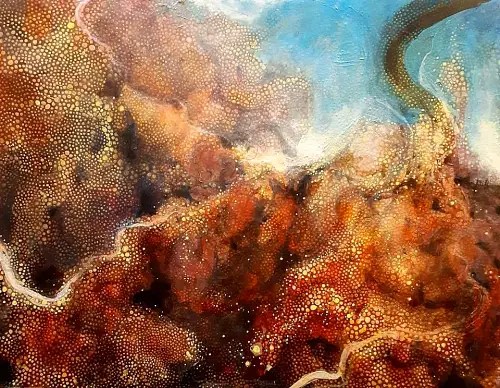
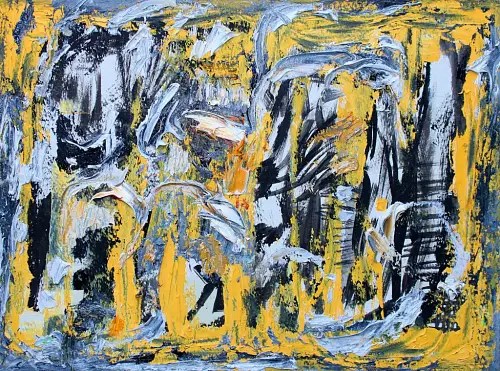
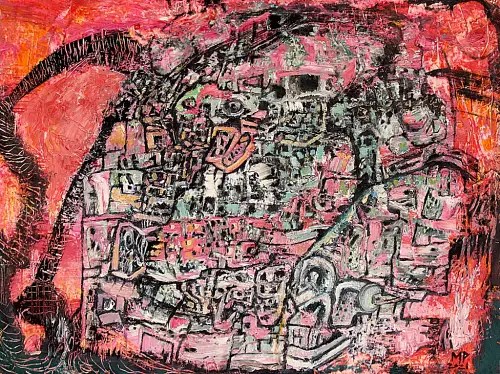
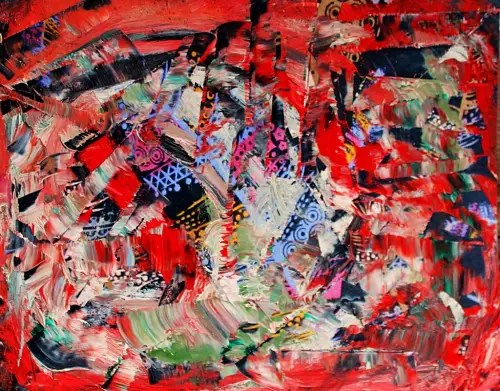
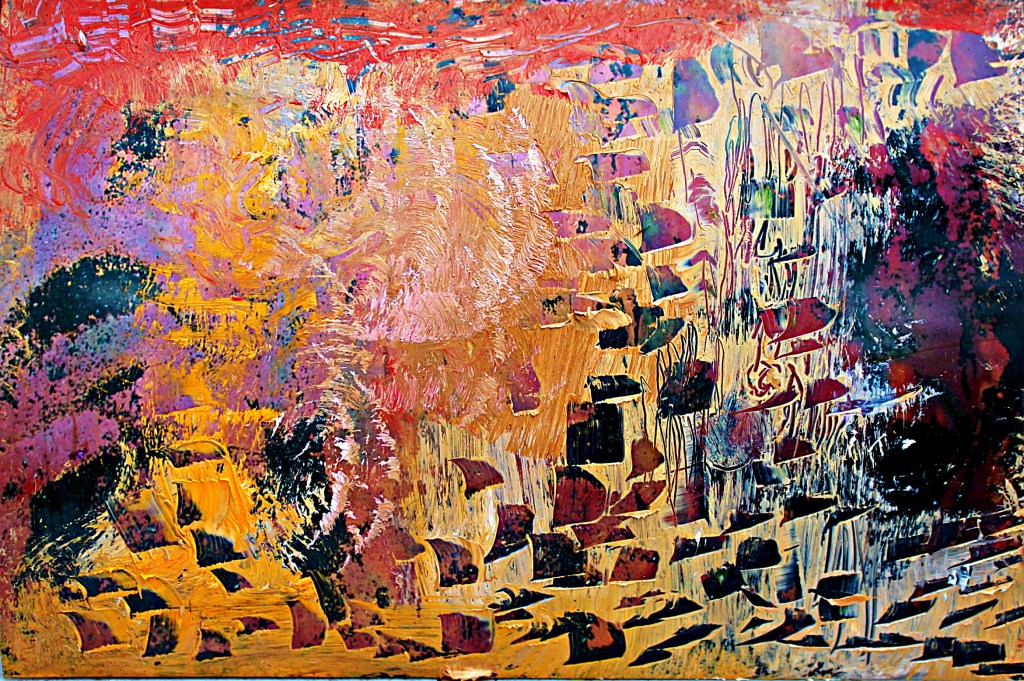
What I inhabit, in its wide expansion lives and like me, this entity has its own consciousness, that manifestation was also in movement like my paintings, because they imitated that condition, I was interested in what was moving, what appeared, what phenomenological with its arsico-thetic high spirited rhythm, with its secret music, because as the alchemist said “The balance that needs to be reached is not the one that produces immobility, but the one that performs movement. Well, immobility is death and movement is life ”. It follows from these words then that the apparently immobile void is also movement, as it must transform as the forms move in their area, the forms that comprise the void are subjected to those others that occupy said volume and pass to become the reality or surreality of form-ground. This caused me to insist on the search for unknown forms, since these also had their residence in hidden and extensively deep planes, this is how these first years of exploration were given in what I later defined as my stage of Expressionist Surrealism. Abstract, an exercise determined primarily by the violent and swift gestures that construct both the background and the foregrounds.
How do you imagine Chile will be in the future?
I see this place that I inhabit, as a region full of possibilities for the future. It has already been seen that after a long street revolt that lasted for months, the people have wanted to take charge of their destiny. But there is still a long way to go, and in that sense, the different grassroots social groups, which include the surrealists, are working to contribute from each of the visions to build a more just world. The economy presents clear contradictions, a formula given for certain human types and not for a society, so this presents the challenge of eliminating it, but at the same time it must establish a replacement model. The constant increase in drug trafficking, crime – a product of social marginalization – and social stress, make large Latin American cities a powder keg about to explode that requires major surgery, but which one?
Capitalism is exhausted and Marxism is not capable of laying solid rhizomes in society, so it is necessary to look for a political-cultural-social model that is inclusive of this vast diversity, then, a new model is necessary.
The world cries out to find something beyond in this life, and surrealism, as in periods of past crisis, resurfaces as a vision of the inner search that is offered through many ways, as a way of recognizing ourselves as essentiality. So there they are, the dreams – the dreamlike -, the animistic, the shamanic, the art of mediums, the culture of the seers, metaphysics, the ludic, the absurd, and the entire super-reality, more real than reality, and wiser, but hidden so as not to give understanding or reason, or lights of human liberation and which is sponsored by those who deprived everyone of the original knowledge and sophisms of the world, due to their own petty interests.
It is therefore important to recognize all the parties involved in our construction as beings from this part of the world, and it is there where we can take or take the previous teachings, and take possession of the magic that surrounds us, the animism that is practically endemic to these areas of the globe, the shamanic spiritism that holds the keys to the many astral planes, the wisdom of the shamans of the continent, as well as the knowledge of other extinct peoples or already on the brink of their disappearance as ethnic groups, with a unique connection with the cosmos, and that they have somehow survived the era of overwhelming official-scientific culture.
What are your thoughts on the future of surrealism, art, and technology?
From my point of view, the unknown concept was, is and will be present in the concern of the one who has sought and seeks. Nowadays digital media facilitate that search in a certain way, but they also distract the being, so res Amplia (extensive reference) interferes with res cogitans (radical dualism. Brain and consciousness), clouding the way to transcend beyond. This Cartesian measure is what has made the human being lose his way, by not attending to the res profundis (depth and meditation on humanities deepest feelings), that is to say, our inner universe. The latter is the information that I seek, without abandoning or suppressing the exercise of reality (in a partial way), rather I intend to combine or not practice the absolute, this allows to enrich the work, give it more points of view, without fear even to make it abundant, to have the combinatorial elements between the synthetic and the analytical abundance, this cannot harm it, what does limit it is the perspective of the time in which the artist and the viewer are cloistered, as limited or bounded subjects, social and philosophical concepts or ideas.
On the other hand, science and technology have confirmed what was written in the hermetic books and in the visions of those who have entered to navigate the unknown, and in that sense quantum physics opens up a whole universe, or multiverses of possibilities.
Surrealism for me is revolutionary, dynamic, inexhaustible and with infinite possibilities. Another definition would be to interpose realities-unrealities head on, open them up on a point, find a new cognitive relationship, an unknown perception, etc. Due to the abundance of disturbing signs and discouraging elements that make it difficult to maintain good sense in the transition to surreality, I briefly interfere with such and such elements through my work and rescuing the hidden memory, re-presenting the signs and symbols associated with the atavistic that are better conductors towards surreality since they have left more impressions in what I call dimensional worms (paraphrasing Einstein), either due to their abundance of imprints made by previous souls. Every fact, every thought, impulse or gesture is recorded on the other side of the mirror, where it could be printed as part of the landscape of dreams, delirium or death.
Today, however, in a world saturated with images and stimuli, we surrealists have become a group of scattered Essenes, throwing tiny signs in the immense sea of millions of contemporary sophisms.
What kind of beliefs do you have about mutant space, animism, egregore realities collective unconsciousness and science?
What then is surreality in relation to reality?
These and other questions repeated themselves in my thoughts day after day. It was my imagination, mental fantasy, an attempt by consciousness that played to disarm or articulate reality to find new and capricious constructs. How was reality embedded in this extensive map beyond the limits of the understandable or measurable? That is when I began to understand from the studies on quantum physics, that reality was determined by the observer, so it was pertinent to look in another way, but above all, it was necessary to feel different and take the explorations to an abyss more extreme.
And why not? draw a line between the two stages, a kind of silver cord between reality and surreality. Then, in parallel, a project called “The meeting of two worlds” arises around the year 1999. This topic focused on comparing these worlds that were found in the 15th and 16th centuries in America, between the original peoples of our continent and the Christian conquerors. -Europeans, bearers of a culture and worldview completely different from the natives. The indigenous man was a shaman, a being who lived with the magical forces of the universe and the land that he inhabited. A culture that had the condition of living in an everlasting state of connection with the metaphysical forces that surrounded it. That was also a participatory society with its environment, he knew by ancestral transmission that the world was also inhabited by hidden forces and that for him they were not unknown, surreality or part of it was in a certain way reality.
On the contrary, the European man had come to abandon in the twelfth century a large part of his magical-hermetic heritage when the inquisition was established, in addition, the first glimpses of a rationalist doctrine that would later derive in its pseudo positivist and mechanistic truth began to take hold. about the world. Then this encounter had to be reflected on the canvas, rather than as a mere contrast, the communicating areas or zones that carry the forms from one plane to another, the deep perception of the indigenous versus the fixed cognitive condition of the Spanish, should also be perceived. Then the dividing line of both planes appears as mobile, it can retract, expand, or meander depending on my exploratory spirit, where I also become a primary observer, to later be part of the sum of observers.
During those years I asked myself what, how or where is the line that divides reality from surreality drawn? What determines our knowledge, about one field or another? The answer was in the painting that was conjugated in different depths of the unconscious, it was therefore necessary to start from the conscious point. It was necessary to combine reality with surreality, draw this map and see where the levels would differentiate one from the other or how their border lines behaved, at the moment when that surreality was incorporated into my new reality.
There it is, in which a long road begins to open this kind of cube and find the mysteries of life as Matta suggested on some occasion, which later would be a Leitmotiv, a recurrent theme for my work.
What is hidden inside and outside the geometry? What invisible force orders chemical and biological processes? What is that invisible or surreal? What is the universe and what sustains it? A reverse universe?
The painting, the installations, the deep search would generate certain answers.
One day I reflected on all this immense scenario of reality, all designed so that a microscopic link occurs (the fertilization of the ovum) and manifests itself almost imperceptibly in this infinite vault, which is also constantly expanding from the point known as the great explosion and that by which, by many geometric variables, arithmetic and laws of physics, that allow nebulae to be sustained, that give rise to galaxies, which give rise to stars, which in turn when they collapse give origins to White dwarfs or quasars that gravitate in such a way that they absorb other galaxies, being the first to be absorbed, the galaxy itself that contributed to this sun to hold and orbit, in a matter of a second all that indescribable energy and matter is compressed to almost nothing
Where are you going? Is it transferred to a parallel universe? In addition, among all these bodies and events, another structure unfolds with an apparently supporting role of these bodies of measurable mass, the so-called dark matter, which can be the reflection or aura of the first, or the sum of peripheral points of which of each one, a parallel universe is born, universes of our own inverse universe, with a non-concept, or a no-idea, or a non-sensation that places us in a position closer to the concept, as it does not oppose resistance due to interferences, of which I will refer later, since advancing a little, the plastic structure can lead to one or the other another way to penetrate those micro portals that link with the opposite universes. Observe the reverse side of the proton (the antiproton) or the reflected and extended universe of the point where the flora concept ends. But to read these, I must gradually detach myself from the observed concept, its own and recognized meaning, leave the idea that conceives it on our plane to find the idea on the other side of the mirror, an exercise that we could call the philosophy of detachment , or what should I do to find?, the answer seems to be, to possess the non-ubiquity to understand and order the message that flourishes and the rivers that open behind the keys. That operate in this kind of sephirotic columns, these, without distinction, are offered wide to the observer and to the one who searches. It is a spectral relationship, a multi-ubiquity given by the impressions of other previous forms, which are also present in a spectral way.
Obviously in the face of such a reflective task, the everyday being looks for shortcuts in his thinking task, or definitely opts for drowsiness. In his role of thoughtless educating, acquires and ingests the small blurry painless doses that contain the
“I will not perceive beyond my cages and the circuits that interconnect them”.
The man in antiquity creates the myth, since it helps him to understand the phenomenological, but the myth seems to have arisen from an ancient knowledge and does not seem to be a fact so far from reality. For the same reason, I must delve into the myth that underlies the surreal piélagos, the ocean. This information in the form of myth is nothing more than the symbolic way in which the archetypes appear to us, a resource that Carl Jung himself recognized. Hence, Breton saw the importance of generating new myths. Beyond pretending to deceive or falsify, the idea is to enter the archetypal warp that dwells in our unconscious to find the answer that seems similar to the constructive reality in the mythological dawn.
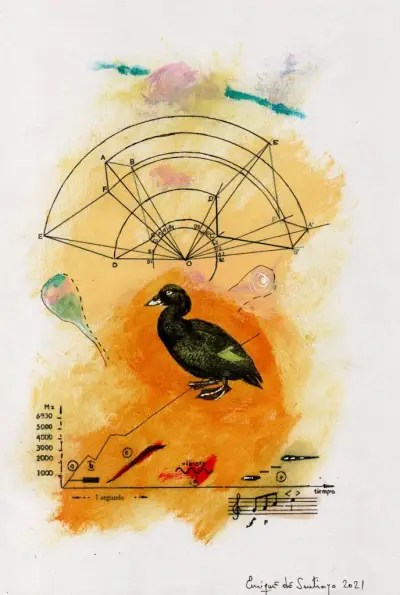
I apply that principle from painting, each work is a search in the surreality of a myth that illuminates us about an unknown essentiality. It appears and determines its own history.
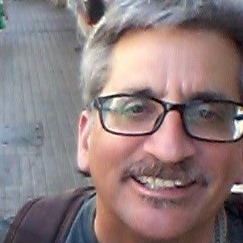
Enrique de Santiago, Born in Santiago, Chile (1961). Visual artist, poet, researcher, essayist, curator and cultural manager. He studied a Bachelor of Art at the University of Chile and at the Institute of Contemporary Art (Chile). Since 1984, he has exhibited in individual and group exhibitions, counting to his credit around more than 100 exhibitions.
He has edited five books: Fragile Transits Under the Spirals in 2012, with La Polla Literaria; Elegía a las Magas and the book essay: El Regreso de las Magas, both with Editorial Varonas. In 2018 he edited La Cúspide Uránica with editorial Xaleshem and Dharma Comunicaciones, and Travel Bitácora with Editorial Opalina Cartonera.
He has participated in various poetry anthologies, both in Chile and abroad. He has collaborated in the newspaper La Nación with articles on new media art, and in magazines such as Derrame, Escaner Cultural and Labios Menores in Chile, Brumes Blondes in Holland, Adamar from Spain, Punto Seguido from Colombia, Sonámbula from Mexico, Agulha de Brazil, Incomunidade de Portugal, Styxus de Rep. Czech, Canibaal de Valencia, Spain, Materika de Costa Rica and other printed and digital publications.



 Mitchell Pluto