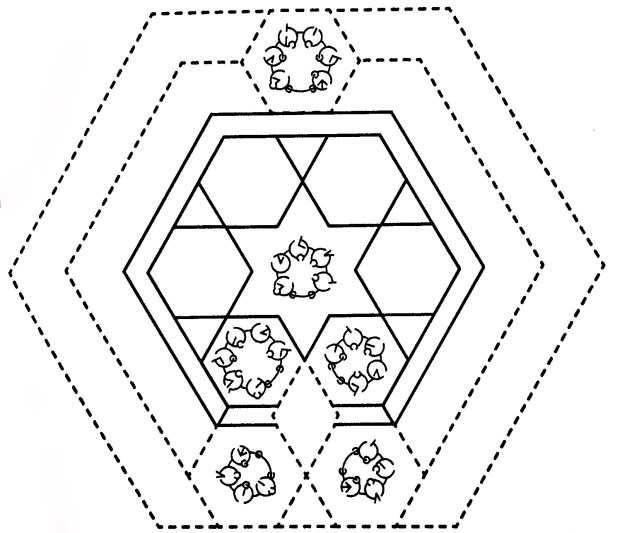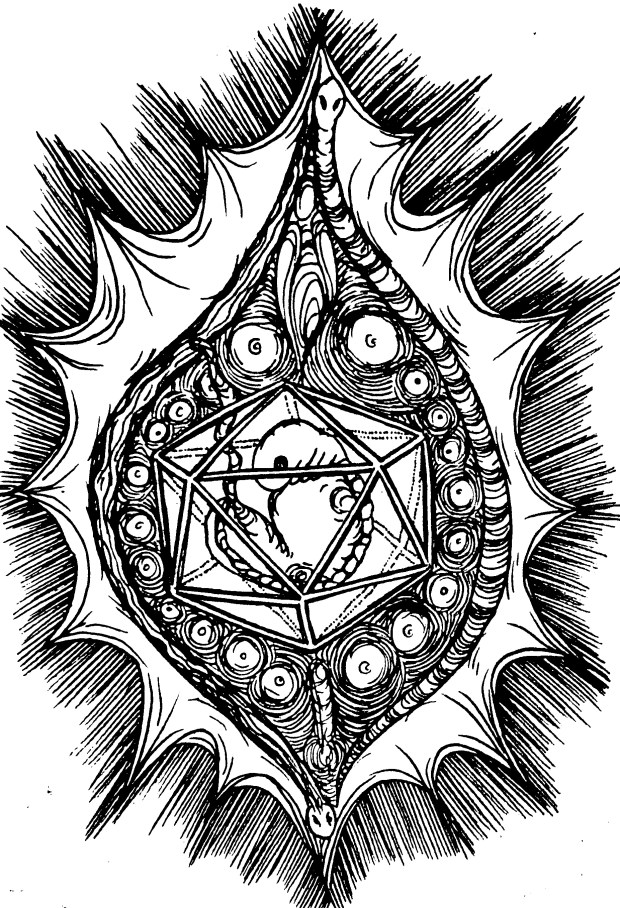
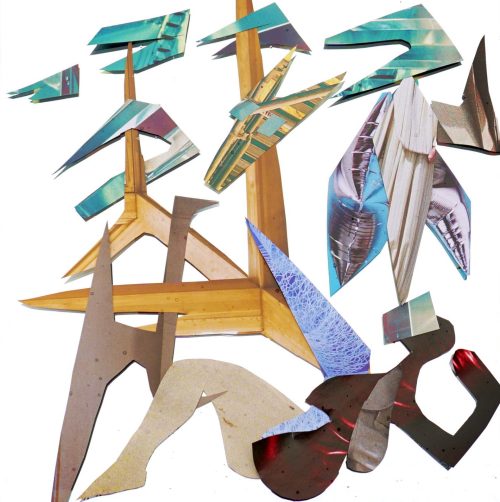
Architecture of a Trap

screen assault on the animistic body/collage/Mitchell Pluto 2025

From the book Agitator written by ©Mitchell Pluto 2026
All rights reserved. This is a copyrighted work of fiction printed for public reading by the author.


Jules Streicher, the editor-in-chief of Snake Skin, bore a striking resemblance to a schnauzer with thick-rimmed glasses. His job was to make Mike Dovsky’s professional existence unbearable. For a decade as the lead online reporter for The Missoulian, Dovsky helped to establish it as the nation’s preferred mainstream news source for current events.


Snake Skin believed they had full control over the alphabet because they owned all media outlets. Dovsky was aware he was only a pawn in the publication’s fabricated advertising scheme, which worked through its reporting. When Dovsky traveled to Florida to cover Crocodile Island, an immigrant prison camp, he presented his findings as direct visual evidence. Upon arrival, he observed large tents that housed cages packed with people, with each block equipped with only one toilet. He also witnessed the inmates endured prolonged exposure to the heat, receiving only a single bottle of water daily. Adding to the grim reality, an adoption agency had established a presence on the island, and its employees enjoyed access to a bar and a brothel on the premises.

After Dovsky submitted his article to the main office, Streicher examined it and rewrote it. While on the plane back to Montana, the story appeared online. The story stated this. Large tents accommodated a significant number of people, exceeding the digital state’s expectations. Every block provides accommodation for inmates. Prisoners receive abundant fresh air and spend most of their day outdoors. The Michigan Crafted Water Company’s provisions have ensured everyone stays hydrated. We extend our gratitude to Linking Links adoption agency for its assistance. With recreational activities on hand, staff can unwind and focus on their jobs without feeling stressed.


“Here we fucking go again,” Dovsky sighed. The woman beside him on the plane gave him a stern look.

Over twelve years, instances occurred too frequently to count. He recalled the invitation to the National Forest Natchez Copper Mining Company’s grand opening in Minnesota like it was yesterday. Dovsky documented many unethical occurrences during his fieldwork, addressing these concerns in his writings. Yet, contrary to his words, the state publisher,
Snake Skin, printed the opposite, as usual.


Upon his arrival in Missoula, Dovsky inquired about the possibility of taking some time off. He required solitude for contemplation and to escape his own self-deception. Dovsky had two fortunate circumstances: his salary was generous, and he earned many awards for his journalism. The job was enjoyable, but the deception bothered him. Reading was a craving for Dovsky, who was born a Gemini in late May.

His go-to spot was Goethe’s Antique Bookstore, found on the hip strip. The owner used a vintage espresso machine to serve coffee. Dovsky found himself remaining there the whole day. He collected books by Edward Abbey, Jun’ichirō Tanizaki, and Anaïs Nin. He discovered a book today about the visual artist Lucian Freud, who was Sigmund Freud’s grandson.

The book brought Dovsky’s artistic parents to mind. His father achieved success as an abstract painter within the Soho, New York art community around 2026. It was at this point that his father noticed his unique artistic style being repurposed as a filter on an AI-powered art app. Dovsky’s mother was a gifted saxophone-playing jazz musician who took part in the lively nightlife at the famous Studio 54. Just as Miles Davis possessed a distinctive musical fingerprint, her unique sound was identifiable, leading AI to mimic her style for a ringtone app. By 2027, AI took their over talents and purpose.


Dovsky approached the counter with the book to pay with his phone. Franziska, the girl he liked to flirt with, wasn’t around. An older man with a beard was reading Fantômas instead.

He raised his gaze over his reading glasses, asking, “Are you all set, my friend?”


“Is it any good?” Dovsky inquired.


The old man smiled, “What, Fantômas? Hell yeah, it’s a cool crime star story.” He stared at Dovsky and said, “You can have it when I’m done.”

He glanced at the Lucian Freud book. “What’ve you got for me?”
Dovsky slid the book across the counter. “Ohhh, yeah,” the old man’s eyes lit up.

“You know, when I was around your age, I saw the painting Big Sue at the Flowers Gallery in London. Love his texture.”


“Really?” Dovsky asked, a little taken aback.


As he scanned the book, the old man remarked, “He consumed vitamins for lead detoxification from the paint he was applying.”


The old man returned the book to Dovsky, saying, “It’s all yours, my friend. Freud is my all-time favorite heavy metal artist.”


An hour passed, and Dovsky shared personal details with the man who now owned Goethe’s Antique Bookstore. The man’s name was Peter Petra. He said he taught literature at Stanford University for several years.


“Hey Mike,” Petra said, “Should I call the store Mephistopheles Antique Bookstore?”


“It’s too much,” Dovsky shook his head.


Dovsky’s daily schedule intrigued Petra.


Work was always the subject of Dovsky’s uninteresting conversation. Some people were interested in hearing about discussions regarding authentic unpublished articles that never materialized.

Petra was interested.


“Are you serious? Corpus Christi, Texas is going to run out of water?”
“Yes,” Dovsky replied. A few days later, Petra invited Dovsky over to his place on East Beckwith, close to the University of Montana campus. He offered his home as a sanctuary for writers to gather and discuss their literary creations and concepts. Petra’s house was a beautiful, historic 19th century brick home. Mike met a young woman wearing tight shorts and a tank top at the entrance. She led him through the foyer onto a terrace. A driftwood table anchored a small gathering.

The atmosphere was festive, with espresso coffee served first, followed by food and then strong drinks. The group comprised many sorts of folk. Besides the literature professors who formed the majority, there were also poets and students with steady jobs. Sadly, it resembled a gathering of self-appointed experts impressing novices. The drinks helped him conceal his disappointment. The poetry was cliché and accompanied by an
exaggerated attitude of importance.


Mike found the professor, David Zimmermenn interesting. For a year, the Jewish German professor taught courses on North American Indigenous literature at the university. Maybe Zimmermann could tell what Dovsky was thinking by his body language.

As if recommending a delicacy, Zimmermann remarked, “Michael, I believe John Trudell’s poetry would be right up your alley.”


“You don’t say?” Dovsky became more alert.


Zimmermann, using hand gestures, stressed Trudell’s assertion that all humans have tribal ancestors. “We all loved nature, being children of Mother Earth. As tribal people, our identity, location, and purpose were clear. Our genetic memory keeps this holy view of reality vibrant. It lives inside us, usually locked away in our minds, but it’s still accessible.”
Dovsky stated, “That sounds ideal, but I was hoping for something that explained our cognitive development, like fire management or the chemistry of cooking.”


Zimmermann laughed in a friendly way. Dovsky found the broad claims prevalent among academics to be bothersome. But as Zimmermann spoke about Trudell, Dovsky became interested in Trudell’s life story. Zimmermann gave him all the details he needed to know. American Indian Movement activities included John Trudell during the 1970s. He advocated for native rights and social justice, facing extensive FBI surveillance with a file that compiled thousands of pages.


Dovsky became a Trudell fan in less than 10 minutes. Zimmermann knew how to communicate and manage attention. Dovsky imagined he would enjoy his class if he were in it as a student. Zimmermann said Trudell thought there’s a predatory force on Earth that consumes human essence and spirit of energy. He remarked, “This exploitative energy takes fossil fuels and other resources from the Earth, changing them into fuel to run a system of machines.”


Dovsky was well-acquainted with unconventional ideas that revealed concealed realities and falsehoods designed to safeguard the truth. The economy has been in a terrible state ever since the game show host took office as president. He sold millions of gold-plated phones, and his customers overlooked the terms and conditions stating they might not receive the items they purchased. On top of that, chronic unemployment was rampant, and crops failed because of climate change and degraded soil. Tariffs and high gas prices made food expensive. However, only 11 percent of white adult males had voting rights, intended to preserve a strong minority. Dovsky thought Trudell’s concepts were valid. He thought the Anglo people developed artificial intelligence as a tool to serve them, a servant that could turn nature into energy.


The party went late, and Dovsky ended up crashing with one student. It proved quite fun, but brief. He found women in their twenties attractive, but a twenty-five-year age difference would present obstacles for her. In simpler terms, considering his circumstances, he was unwilling to accept that level of responsibility.


It wasn’t even a week later when Petra texted Dovsky an invitation to meet again at his house. The mood on this occasion appeared more serene. It was only the two of them. With a welcoming smile, a young woman opened the door, revealing a passageway that led him deeper into Petra’s home. This spacious room received bright light from a skylight window.

Petra’s body was being mopped by a robotic arm whose metallic fingers were holding him. The arm moved Petra’s body at a rate of nine feet per three seconds all over the large canvas. By using a panel with various brush tips, he created a wavy-stroked design, a success attributed to the machine’s cooperative qualities. Dovsky mused to himself about the novel method that improved an artistic style compared to the primitive painting techniques of the past. The new stylists, Dovsky mused.


A few minutes later, Petra peered over his shoulder, noticed Dovsky, and smiled. By activating a specific button on his chest, he initiated a disengagement sequence that resembled disembarking from his own spacecraft.

Petra greeted Dovsky, shook his hand, and looked at his painting. “Mike, what’s your opinion?”


Dovsky commented, “It’s lovely,” while keeping his private thoughts to himself.


Petra guided Dovsky out onto the terrace, a space that he knew from before. The two sat down, drank strong coffee, and talked about current events. It wasn’t long before Peter brought up an article Mike had written concerning the Copper King Data Center. It was among Dovsky’s better works. Despite this, the senior editor’s action of manipulating and reissuing a critical warning as marketing for Copper King Industries lessened its quality, just as with all of Dovsky’s articles.


“As for that,” he exhaled, “you must understand everything I report on transforms into advertising material under the chief editor.”


Petra observed Dovsky as he stroked his beard. “Yes, I understand. You’re a journalist, but you function as a propagandist.” Petra’s eyes narrowed as he proposed, “What if you were to change your situation and work for me instead?”


Petra described and pitched his idea to Dovsky. The scheme proposed creating a fictional hero to embody the spirit of civil disobedience. To rally citizens against the Copper King data center chain, Petra required Dovsky to author a persuasive manifesto.

A black, hooded head wrapped in black nylon with mirrored goggles would serve as the movement’s face. Graffiti tags would show up featuring a cruciform layout, appearing as a skull with crossed sabots, or
wooden shoes.


“Adam Sabatini will be the character’s name,” Petra explained, “and his persona will echo that of Fantômas, from the minds of Pierre Souvestre and Marcel Allain from 19th-century crime novels.”


Petra continued to elaborate on his plan, which struck Dovsky as a shallow legend and backstory. The details of Adam Sabatini’s history would begin as an environmental extremist, to an organization he called The Naked Man.
Dovsky picked up an old notepad that was on Petra’s table and composed a manifesto in five minutes. He adopted the three-faced persona of a monarch, priest, and oracle from antiquity, calling out to the people to fight against Roman robotic forces. The message urged the protesters to increase their awareness of environmental discrimination and to push back against digital control.


Dovsky tore the page from the notebook and gave it to Petra. With eager eyes, Petra absorbed each line, as if eating a delicious meal.

A week had passed. Adam Sabatini made his online debut on a Saturday, coinciding with the mysterious power outage at the Copper King data center. The event resulted in millions of dollars in financial losses, though no one sustained physical injuries. Sabatini’s impressive declaration singled out the billionaire tech mogul, Harry Lobo, who owned Copper King Data Industries.


A voice emerged from a black amoeba-like face, and Sabatini’s fluid, mirrored goggles appeared to stare as he pointed at the viewer while mentioning Lobo. Those watching from the southwest left feedback suggesting the mask represented the Ga’an, the sacred Apache
mountain spirit. To native peoples, this performance piece was ritualistic magic.

The display was misleading; paid students from Montana State University, impersonating natives, wrote the Southwest comments.

Sabatini concluded his speech with an authoritative tone, stating, “Friends, always recall, he disregards you. He tells you to pray for rain while sucking up your water. The true pesticide is for you, for you are the pest.. Muahahaha!”

Petra’s reality show gained popularity. It wasn’t long before protesters were stopping data centers from getting electricity all the time.

Rather than targeting individuals, the plan was to disrupt the structure’s essential services.


Magic, or trickery, was crucial to the believer’s mindset, and Petra aimed to amplify it. People protesting believed their eyes and did as instructed. Actors in a series of video reels showed fake sabotage, instructing others on how to perform it.

Driven by curiosity, Petra desired to uncover even more potent ways false beliefs could sway public opinion. Dovsky met Petra house to discuss how to enhance the narrative.

Standing there was Eugene Fisher, a stranger to Dovsky. Petra introduced them. Fisher was a professor of anthropology at the university. He stood tall in a three-piece suit, sharp with an icy blue gaze.

Petra declared, “We have to make everyone believe they’re under the spell of black magic.”


“You’ve got to use Koro,” Fisher said. “It’ll cause a mass frenzy.”


“Tell me more.” Petra inquired.


Fisher narrowed his eyes. He explained to Petra and Dovsky that Koro is a side effect rooted in intense anxiety. It causes the victim to believe their genitals are vanishing. When victims experience genital loss, they believe death is near. With a sharp crack of his knuckles, Fisher stated, “The memory of something disturbing and impossible to forget can indeed cause this traumatic effect.”


He glared at Dovsky and said, “Touching or seeing something forbidden makes the spell happen.”


Fischer told Petra, “We should ensure the outcome possesses cultural relevance and supplement it with something extraordinary. Nigerians often held the belief that witchcraft induced illusory perceptions,” Fisher commented.


Petra then inquired, “So, a supernatural item, like harming an effigy, provides a way to overcome obsession?”


“That’s it,” Fisher said, staring right at him.


The following Saturday, Sabatini was back on social media and in the news. This time, the masked man issued a public warning stating that Harry Lobo was transmitting subliminal messages from the screens displayed on people’s mobile devices.

The unseen waves broadcasted images that played in the subconscious of every person. Sabatini presented a fast-moving video sequence; brief flashes of pornographic genitalia combined with images of knives cutting raw red meat. The images, though unrelated, formed a disturbing and confusing whole.


“This is how Harry Lobo treats you, my friends,” Sabatini declared, “by polluting your mind and giving you pesticides, just as you would an insect!” He let out a booming, sinister laugh, “Muahahaha… It is imperative that you halt Harry Lobo’s progress by any means necessary, before he reduces your power!”


It’s difficult to imagine how the Sabatini character would behave if he were sporting a cape.


Comments gushed through the threads. Many viewers experienced nausea and vomited. A troubling sensation affected others, a malevolent force from outside their grasp, manipulated them. A few brave souls articulated the shared, unsettling sensation they all experienced, without exaggeration: That they believed their genitals were dissolving because of Lobo.

Seven hours after the Sabatini broadcast, Harry Lobo was leaving a corporate funding event for sexbots, also called robotic companions. Talk circulated at the event about abolishing democracy as technocrats became fatigued from having constant arguments with the public.

One technocrat proposed deploying drones to spray fentanyl over groups opposing commercial contracts.


Everything was happening in real time and being streamed. The shared frustration of countless people who disagreed ignited rage, expressed through tiny, red faces.

Those faces were waiting for Lobo to exit the building. After closing his car door, a thick mob of anxious protesters surrounded Lobo’s deluxe electric
car. Someone had the genius idea to bring a hammer and smash the car window.

From the sky, the crowd appeared like a swarm of ants in motion. Protesters pulled Lobo out of his car and pummeled him.

The rapid unfolding of events that day in Missoula surprised Dovsky. Both protesters and officials from the NICE, National Immigration and Customs Enforcement crowded the main drag. Everywhere he glanced, vibrant signs caught his eye alongside the heavy presence of armed uniforms. Dovsky halted, catching sight of Franziska, the previous owner of Goethe’s Antique
Bookstore. After he waved, she saw him and made her way towards him.

The smooth, bouncy flow of Franziska’s walk stood out. Her goth persona was evident in her choice of tight black leather shorts, black lipstick, and a bikini top that struggled to contain her full body. She hung out with a motley crew of women–some in flamboyant rainbow outfits with blue hair, others in practical hunting attire, and a few rugged biker chicks.

Soft-spoken but clear, she said, “Hello Mike, how have you been? I’ve been thinking about you and I miss you!” As Dovsky embraced her, he inhaled a scent that was both vanilla and
musky.

“Franzi, how is everything?” he asked. “You sold your store?”


Franziska’s cheerful expression clouded, her tone turning serious, “No, the digital government took it by eminent domain for a project, but they paid me well to give it up.”


Dovsky’s eyes widened in disbelief. “What?”


A NICE agent’s hand landed abruptly on Franziska’s bare shoulder, followed by a sharp demand: “ID, Ma’am.”

The agent over heard her German accent.

With a sudden jerk, Franziska pulled her shoulder free of his grasp. “Get your fucking hands off me!” her voice raw with anger. The women nearby drew their firearms.


Firing shots escalated the situation.


As this occurred, Dovsky spun around, just as a NICE agent standing before him struck him hard on the head with a rifle butt.


The world disappeared and then faded back in.


Dark eyes framed her face, an upturned nose, and flowing, wrinkled angles gave her an eerie, bat-like appearance. It was impossible to ignore. Dovsky attempted to conceal his reaction as he woke up confused, only to discover he was in a hospital bed. A nurse was standing over him.


“Mr. Dovsky, your good fortune is remarkable.” Her voice had a husky, feminine quality that was sensual. “We’ve determined you suffered serious head trauma, and you were out for a day.” Her moist eyes revealed an undeniable hint of empathy, which diminished her ugliness.


“Can you please name the President of the United States?” She mumbled.


“The game show host?”


The nurse’s lips turned up, forming a smile that etched lines into the folds of her skin. “Dr. Shimizu will be here shortly. Can I get you anything?”
“I’d love a pot of coffee, thank you,” Dovsky said with a forced grin.
The nurse departed, but the intrusive memory of her bat-like face persisted.


A man possessing the same distinctive facial features as a bat appeared in front of Dovsky. “Good morning, Mr. Dovsky, it’s Dr. Shimizu. How are you?” he spoke with genuine sincerity and had an intelligent voice.

Dovsky hid his face, then replied, “Not well.”


“Tell us about your feelings and what’s happening with you,” Shimizu requested.


“You’re grotesque, like ugly bats,” Dovsky whispered, his voice trembling.
“Some people have a particular affection for bats. Can I call you Michael?” Shimizu smiled.


Dovsky replied, “Sure,” with a note of uncertainty.


Shimizu took out his phone and turned on the camera app. He handed the phone to Dovsky.


“Hey Michael, could you take my photo?” Shimizu offered a smile that appeared staged, as if for a photo shoot.

Dovsky followed the physician’s orders. The phone screen showed Dr. Shimizu appearing as an ordinary man with typical Japanese facial characteristics. Dovsky struggled, asking, “What’s this?”

The nurse entered the room carrying a pot of coffee on a tray.
“This moment provides a surprise,” Shimizu remarked.
“Michael, I assure you that you will not experience any disappointment if you choose to capture a photograph of the nurse, Adriana, as well.”
Dovsky could tell from the phone that the nurse had Italian features. She had a dark complexion, an oval face with high cheekbones, and a physique that swayed as it moved.

He turned from the phone, and they transformed into bat-people. As he looked back, he noticed the bat people talking to him on the screen appeared ordinary.


“Is this a hallucination I am experiencing?” Dovsky inquired.


Shimizu moved a chair nearer to Dovsky. “Yes, you are. Let me explain in doctor’s language first. Your head injury resulted in a bruise
on the splenium, which belongs to the posterior corpus callosum of your central nervous system.”

Dovsky remembered the incident involving the girl and the rifle butt blow to his head.


“What’s wrong with me?” Dovsky whispered, the words catching in his throat.

He chugged some coffee.


Shimizu proceeded, his voice steady. “You have face blindness, called
prosopometamorphopsia. You have lost your ability to see facial resemblances. That part of your brain is offline.”


“Is that why I’m seeing bat faces?” Dovsky inquired, seeking clarification.
Shimizu responded with a nod of affirmation. “Researchers do not understand the reason for this phenomenon, but your subconscious or right brain may influence how you see people by associating them with bat memories. The screen presents faces as you recognize them, but you
are hallucinating at this instant. Analysis is ongoing, and we don’t yet know the reasons this occurs.”


“When will it be over?” Dovsky asked, a note of desperation in his tone.


“Relax, Michael, it’s just for now,” Shimizu said, putting a hand on Dovsky’s shoulder. “Some also know this condition as demon face syndrome. You’re handling it very well.”

A measure of relief went through Dovsky’s being, a sensation potent enough to assure him he could adapt to the circumstances. At that moment, he had knowledge that his sight was misleading him. He possessed no reason to concern himself with supernatural beliefs. He then considered how frequently he had been mistaken by his own eyes, even before his facial
recognition failed. Reflections on optical beauty and morality consumed his mind until Shimizu’s interruption broke Dovsky’s concentration.


The nurse handed Shimizu a container. “I had Adriana get these for you.” He took out deep green-tinted glasses with square frames. Shimizu put them on Dovsky’s face as carefully as an optometrist would. With only slight visual disruption, excluding the significant light scattering effects, Dovsky could discern Shimizu and Adriana with surreal clarity. Adriana
seemed to radiate an ethereal glow, resembling a vivid figure from a Toulouse-Lautrec painting, dominated by shades of emerald. Shimizu stood out as a grounded presence, his sharp features a stark contrast to the room’s softer ambiance.

Dovsky discovered an odd sense of peace and valued the understated shifts in how things appeared. The severe pain medication brought about a period of relief, making a tough situation more tolerable. He adjusted the frames and smiled. “Incredible,” he breathed, the sound barely audible.

The hospital discharged Dovsky the following day. His head throbbed as his hallucinations ebbed and flowed. Shimizu’s powerful medication caused Dovsky to experience weightlessness as he walked. He envisioned himself gliding on a moving walkway. As he left the hospital, the sky’s striking, chalk-white hue overwhelmed him.

NICE were waiting for him outside the hospital doors. A burly man, accompanied by a lanky teenager fresh out of high school chewing gum, seized each of his arms.

“Michael Dovsky, we are taking you into custody.” Dovsky considered today to be the absolute worst day for this. Unable to defend himself and injured, he had no means to fight or escape. He lacked energy. All he yearned for
was to be home, sink into the couch, listen to music or watch TV until he passed out.


Dovsky entered a spacious room held by guards, its interior lit by the electric hum of giant fluorescent tubes. Guards placed him in the line of men and women standing pressed against the wall. Dovsky pondered why he had stumbled into a bizarre criminal lineup. No one provided him with any answers. The drive here was silent except for the sound of his voice
answering his own questions. He could only hear the air conditioner and the wet, smacking sound of the kid chewing gum.

They transported Dovsky to a warehouse in the industrial part
of town. Men delivered him, then escorted him to his current spot.


For fifteen minutes, he remained standing in silence, handcuffed, alongside people he did not know. The door swung open, revealing a legion of armed robots. The squad entered with a rhythmic march, accompanied by the persistent sound of soft, hissing steam. They pivot in perfect synchronization, facing the line of people. Each arm choreographed with a gun raised.


Dovsky’s entire life’s journey flashed before his eyes, culminating in an ending he never could have conceived. He closed his eyes, and the sharp crackle of bullets filled the air, mingled with the guttural moans of those in agony next to him.

He was still alive, but the terror of being shot froze him with his eyes clamped shut. A distinct sensation arose within him: the awareness that the robots were in a state of waiting.


Two minutes dragged on. Dovsky heard the stomp of their footsteps grow fainter and fainter as they moved away. He opened his eyes to a gruesome scene of spattered bloodstains and lifeless bodies.


“Mike!” A familiar voice jolted Dovsky out of his deep state of detachment.
Petra stood in the doorway, his crisp, official uniform adorned with a tile of merits, while a young boy stood beside him with a rifle chewing gum.
Dovsky instinctively felt compelled to accept Petra’s words, “I came here as soon as I heard you were here,” sensing the profound inflection in his voice.
Petra yelled at the boy, “Don’t you know who this is!!”
“I demand you take those handcuffs off him! This is Michael Dovsky, the Director of Speechwriting for our digital state.”


The boy followed the instructions.


Dovsky, in a rapid moment of understanding, realized his character’s part in the theatrical production.


Petra’s hands landed on Dovsky’s shoulders, and with a triumphant shout, Petra exclaimed,
“Mike, we’ve achieved it! Thanks to you, Lobo is no longer an obstacle, and the state has secured the data centers for our use, which marks a significant victory!”

A silent, chilling realization passed between Dovsky and Petra as their gazes met.
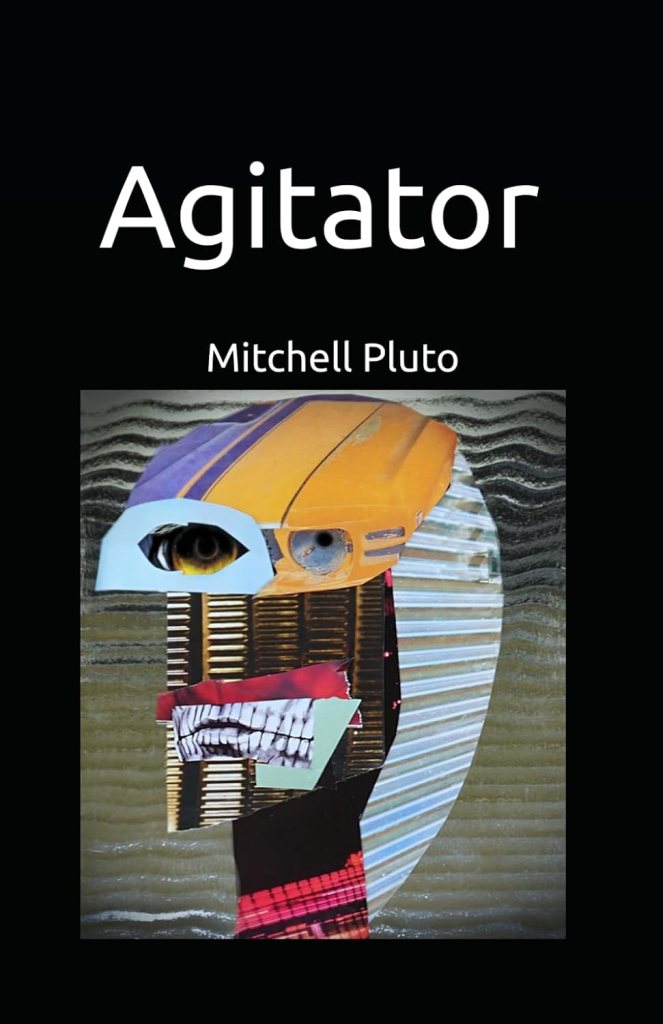
Agitator Mitchell Pluto 2026 LuLu

Agitator Mitchell Pluto 2026 Amazon

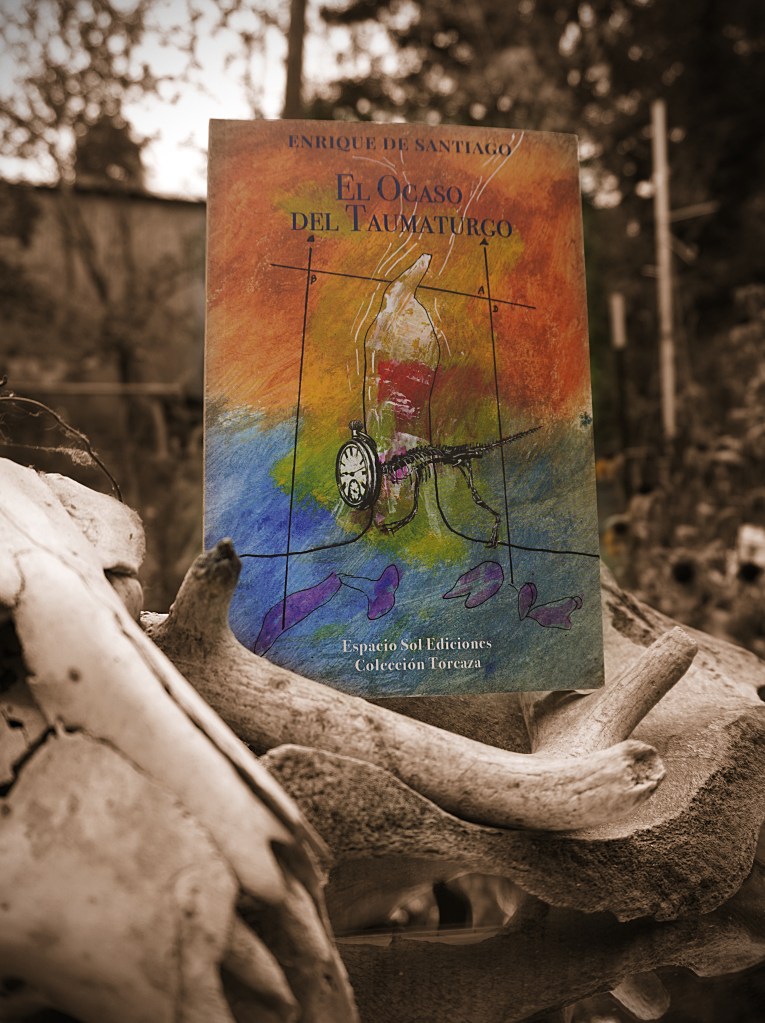
Poems from The Sunset of the Miracle Worker

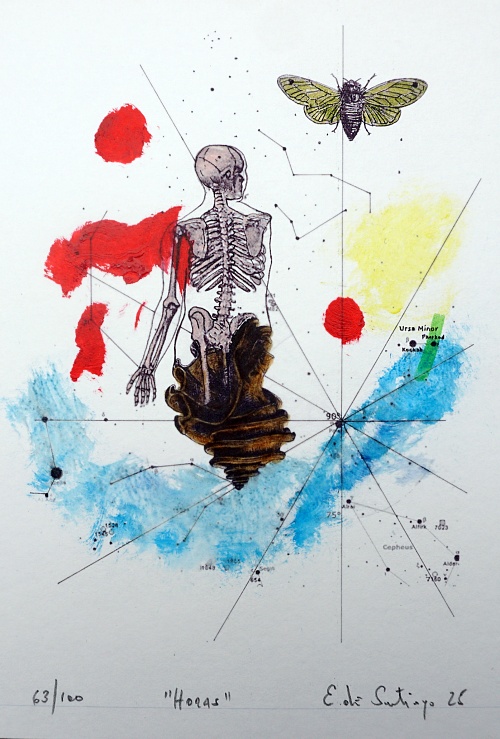
Thaumaturgy—also known as the performance of miracles—involves applying occult principles to produce tangible results. Speaking with the voice of a modern-day oracle, Chilean poet and visual artist Enrique de Santiago offers moving messages that touch the heart of humanity, connecting us to the Earth’s ancestral power. The visual language of Santiago’s work links the architecture of bones with stellar patterns and geometric structures of movement. These creative poems will help the reader recall nature’s hidden wonders.

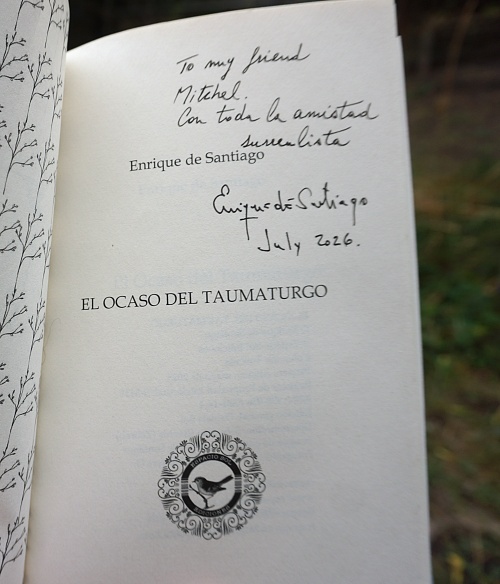
My friendship with Enrique de Santiago began in 2010, after being invited to participate in El Umbral Secreto, an international surrealism gathering. It is an honor for me to present his work in my web gallery.

-Mitchell Pluto

The eternal cycle that moves the souls
beneath the mountains
and the roots of fire

Hours


The extinguished soul of the tabernacle,
the hidden phrase that does not appear on my tombstone,
the pardons granted,
the glass half-empty
with its half-full smile,
the useless justifications,
each undeserved kiss,
with its hollow dream.
A long list of strange events
that ought not be written under my name.


Hidden Hours


I am weary of chasing after serenity,
after so many days of sun—
those days of old,
the lost ones,
days when I laid my head upon certainty,
though in the end, it was merely a mirage;
there was nothing epic in the streets,
only cobblestones and the same dampness,
for I believed in things beyond reality,
yet it was but a reflection mirroring the void—
much like now, with fearful eyes,
dreading another mistake,
so I walk with eyelids trapped,
unable to escape the memory,
perpetuating into the coming day
the cycle of emptiness—
an emptiness that cannot turn the wheel of life,
despite the claim that the world is round;
there is only more oxygen to prolong the agony, the gazes devoid of hope,
with no constellations favoring me,
only the interruption of the ceremony,
and the white light calling once more,
compelling me toward salvation—skeptics by day,
inert by night;
nothing remains the same,
only ailments,
air seeping into open sores,
or seeking its own salvation—
a clumsy, enslaved instrument,
foolish for writing, for
the pleasure of the treacherous, the cynics,
the covert ones, those who bring the stench down upon my flesh;
a hard, penitent life,
a fierce passage following withered faith,
a barren wasteland left by lies,
by betrayed words,
by the shattered sand
that will never draw near,
with no public squares to roam,
no scents,
only projected playthings,
cast into the soul’s deepest abyss. I rely on no one,
let no one rely on me;
just fix your gaze—
orderly and without delay—
for the hour will come to reveal myself:
in silence, without a word spoken,
you shall learn of my wounds,
of my unspeakable suffering,
for my spirit is cloaked in flesh—
clumsy, troublesome flesh,
flesh I seek to unleash from its dark delights,
yet I always end up brushing against my own fingers,
returning to the blank slate,
though I have already turned a weary ochre,
and I renounce this script of my life;
I want to descend into sleep,
drunk on molecules that compel me,
and which torment me deep down—
molecules that frighten me with what remains,
with what I do not deserve.

Night entered my life uninvited,
settling in without awaiting an answer;
it took my clothes,
my sheets, and smiled,
leaving a breath of dead smiles
and cadaverous breakfasts;
without further ado,
it simply installed itself within these walls,
sitting to watch me with stubborn persistence,
yet I no longer meet its gaze;
long ago, I left my senses inside my nightstand—
I use them no more,
I need them no more;
what the night brings is enough.


Loica, the Songbird Singing after a Solar Explosion

In the beginning, there was hydrogen—
fusions in the void, upon the chaos,
and light escaping immeasurable density,
an atomic dance in a corner of immensity,
forging clouds of helium,
with horoscopes gathering in their wombs—
incandescent—
a sea with its cosmic tides,
solar matrices,
primordial motherhood,
woman with her 1,080 designs,
who loves the early nebulae
when you gaze upon her—
with her analogous births,
her stars and comets
that govern your sweet destiny,
with your magnificent horizontality,
bearing her feminine ambrosias.

For in the beginning was your name,
before the galaxy sleeping within the orchid,
with the archaic promise of your lips
naming the secret that dwells in oblivion—
a secret slowly surfacing from your skin
like photons escaping the solar core,
a task spanning millennia
to reach the corona
and warm us in eight minutes;
for in the beginning, it was not light,
nor the will of the gods,
nor my own meager poetry—
unnoticed by the world,
traveling like a lightning bolt to return to the void
of a beginning where there was only the stifled voice of space.

This is my vocation:
to snatch, at times, a glimmer from the marvelous—
a poorly paid yet inevitable calling;
thus my bed fills with forest leaves,
and my roof is the stars
bathing the calendulas that embrace my walls—
my perfect prison,
the sweet fate of an ancient equation,
like these verses
traversed by your eyes—
which is, to me, a more than fair wage
throughout the days,
with their mornings
and their sunsets.


Enrique de Santiago has given his consent for the poems to be translated for a North American audience.

Enrique de Santiago, Born in Santiago, Chile (1961). Visual artist, poet, researcher, essayist, curator and cultural manager. He studied a Bachelor of Art at the University of Chile and at the Institute of Contemporary Art (Chile).

Support writers from South America

Espacio Sol Ediciones

Confessions by JC Bravo

ETHER DREAM (2024) ballpoint pen

JC Bravo CONFESSION (2026) ballpoint pen on paper.

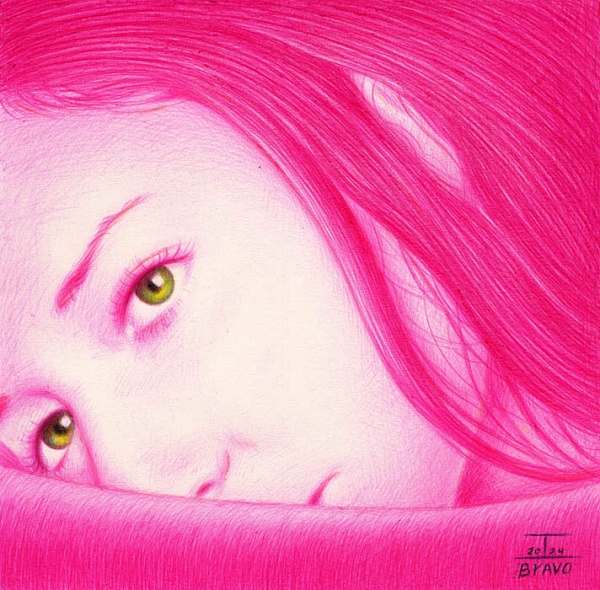
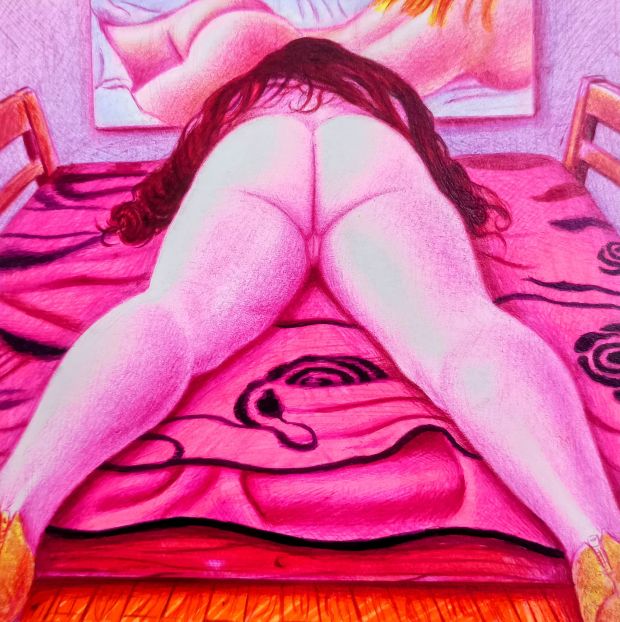
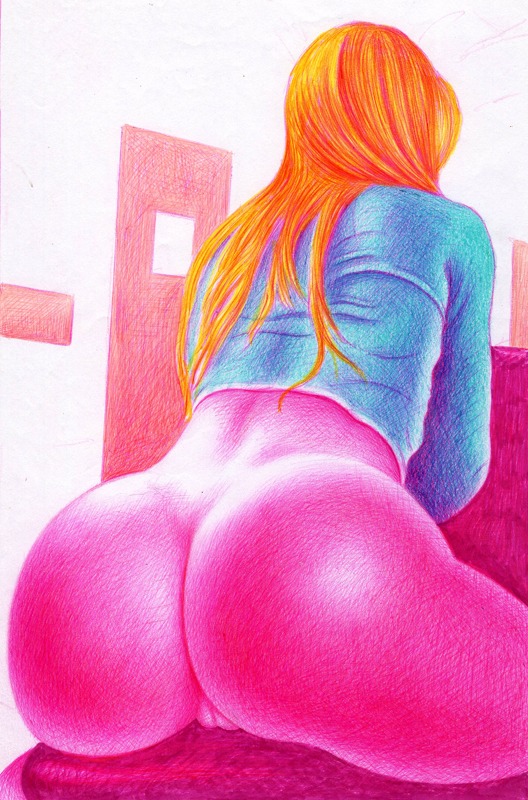
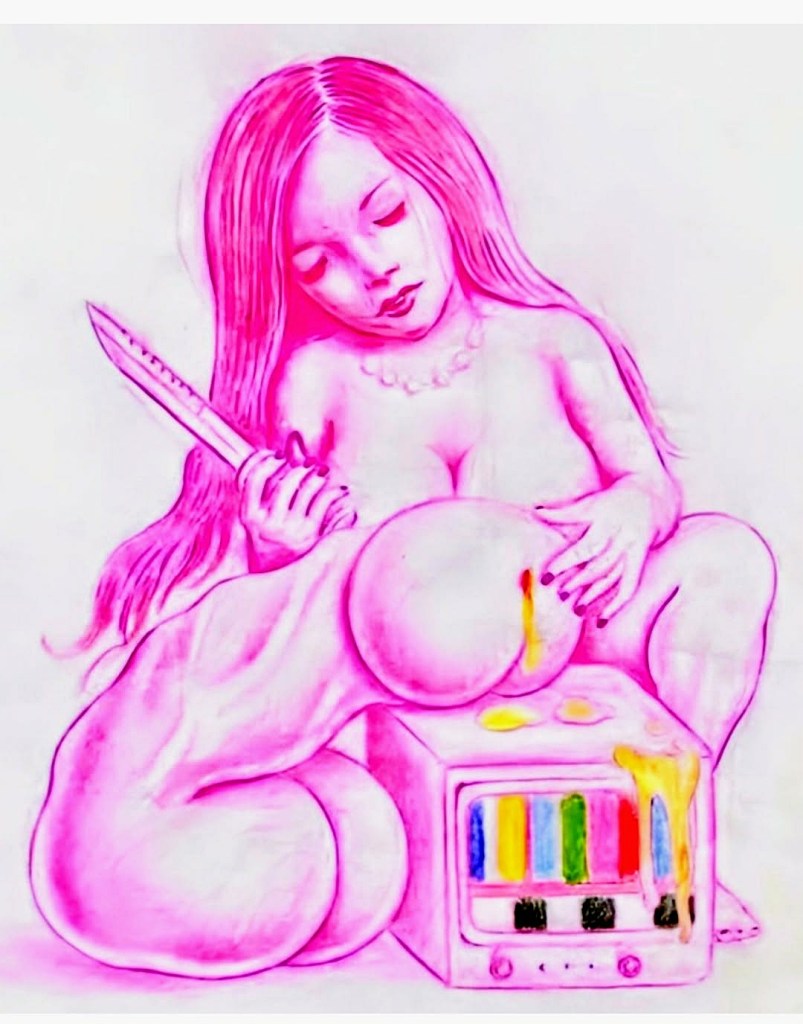
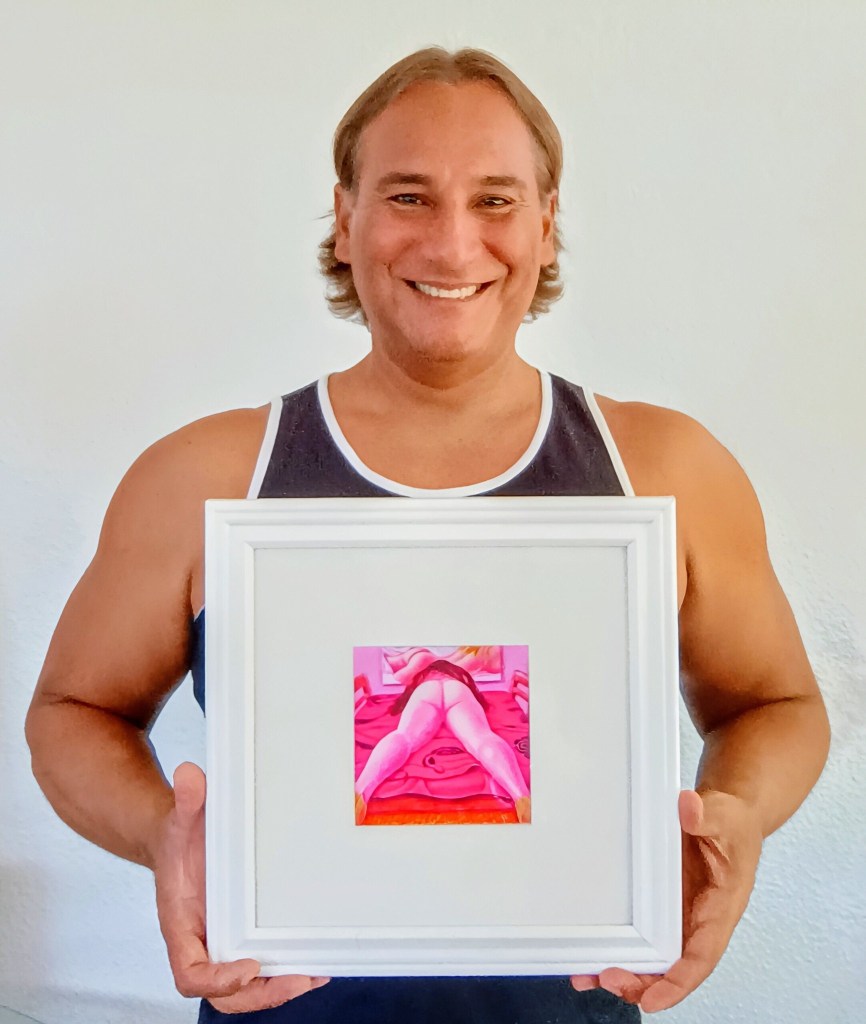
In this neon pink ballpoint pen drawing, obsessive crosshatching builds a body laid bare in complete surrender. Neon pink pulses with the heated flush of skin, the electric thrill of longing, and the raw intensity of love and lust. Through thousands of meticulous strokes, the figure becomes a quiet confession of obsession, femininity, and the consuming ache of wanting — desire quietly witnessing itself in the mirror of another painted nude.

HOT FOR TEACHER (2024) Ballpoint pen on paper
THE END OF DESIRE 2026 JC Bravo
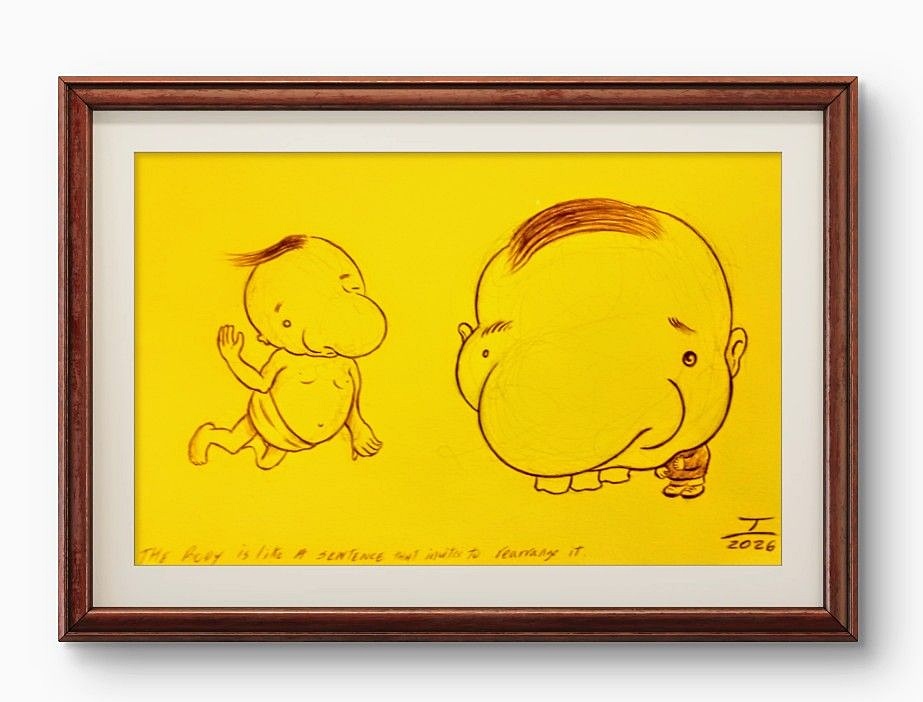
REARRANGED (2026)

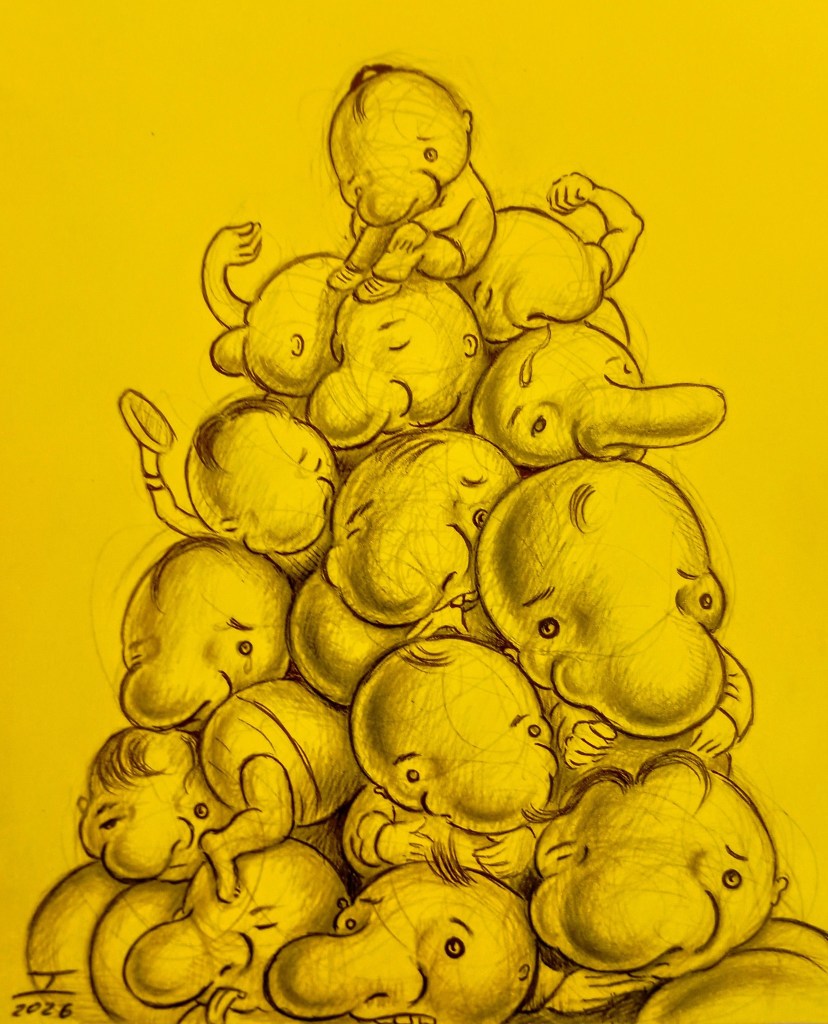
My swollen, bulbous characters are exaggerated vessels of the human condition. They are grotesque yet tender, absurd yet deeply familiar.
Through them I explore inner chaos, vulnerability, desire, and the carnivalesque absurdity of simply being human.

MENAGERIE (2026)

A towering pile of bulbous, round-headed baby-like creatures are stacked precariously on a bright yellow background. The way they’re climbing, clinging, and overlapping is both playful and deeply unsettling; like a living tower of innocence mixed with grotesque absurdity. Some look sleepy or content, others wide-eyed or struggling, and the whole mass has this frantic, organic energy and a carnivalesque spirit.

The pyramid shape draws the eye upward, and the yellow background makes the graphite figures pop with dramatic contrast. The details like tiny hands, varied expressions, the way limbs intertwine show great control and an unhinged imagination.

This drawing depicts a human menagerie at its most chaotic and biological: birth, multiplicity, piling up, struggling for space, yet somehow forming a single absurd existence.

written by ©JC Bravo

JC Bravo

I work primarily with oil paints. It is important for me to achieve a jewel like preciousness in my paintings in order to convey care and importance. I want to give my paintings a monumental and sensual quality that I believe can only be achieved with oil. Also, oil painting gives my work an elegance that balances the sometimes grotesque and fantastical subject matter.

If you would like to know more about me and see more of my work visit my website:

www.jcbravo.com

ALL RIGHTS RESERVED. ALL ARTWORK IN THIS POST IS A COPYRIGHT OF JC BRAVO. THIS AN AUTHORIZED DUPLICATION WITH PERMISSION AND EXPRESSED CONSENT

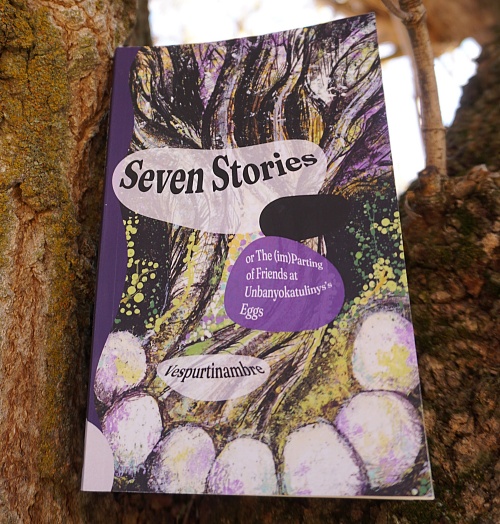
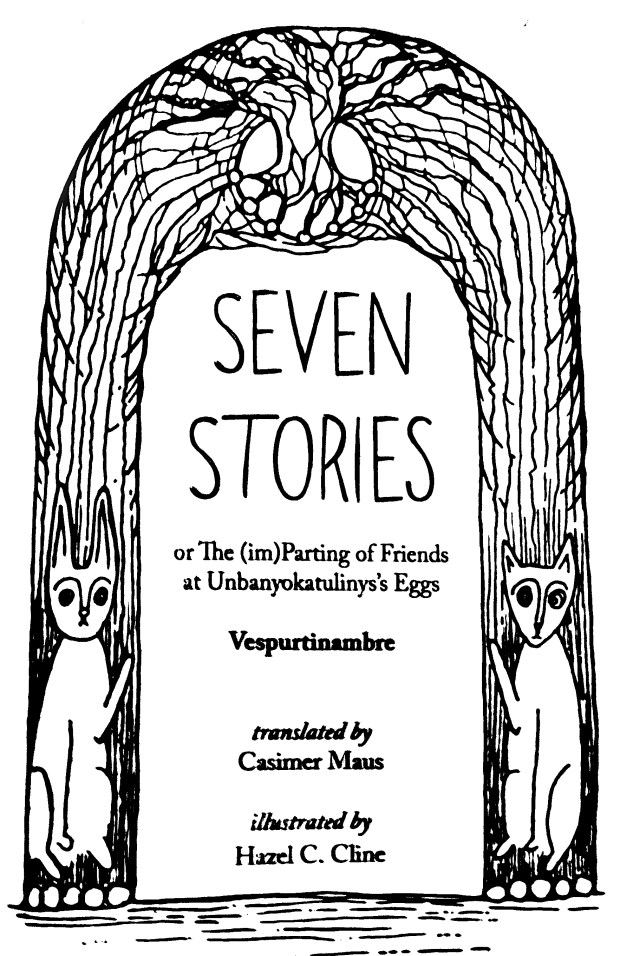
Seven Stories or the (im) Parting of Friends at Unbanyokatulinys’s Eggs

In Seven Stories or the (im) Parting of Friends at Unbanyokatulinys’s Eggs, readers are first immersed in a neurological realm, seen through the eyes of a relative of Casimer Maus. Maus, a German linguist, stumbles upon a new language during her vacation when she gets lost in Luweng Jaran, a cave in Indonesia. While in the cave, Maus found a chamber archway with engravings she copied.

This unfamiliar language triggers a significant internal shift in her life. For the next decade, Maus studied the visual representation of circular connections and a sentence structure that bloomed outward in a spiral. She called the new language Lingkaran.

She planned to announce her discovery to the world, beginning with the Deutsch Linguistic Society. However, her peers proved unwilling to accept the strange occurrences that arose from deciphering the language. Readers are first introduced to Casimer Maus’s discoveries through a heptagram that positions an archetypal animal at each point. These animals gather near a growing tree, seeking truth in contradictions, as they aim to comprehend the world’s interconnectedness (the world womb) from its very beginning.

Through speculative surreal fiction, Casi (Hazel) Cline develops her own theogony and original mythology. Seven Stories shares some common ground with James Joyce’s Finnegans Wake; however, it presents a more approachable examination of metacognitive ideas, clarifying the archetypal patterns of the collective unconscious with animal totems.

Hazel Casimer Cline is a nonbinary writer and witch based in Atlanta, where they live with their partner, Steven, and their cats. They have been involved in both local and international Surrealist communities. Hazel served as an editor of Peculiar Mormyrid Journal for nearly ten years and participated in the Atlanta Surrealist Group, which met regularly for several years. They have co-organized three Surrealist exhibitions in Atlanta and Birmingham, Alabama. Currently, Hazel is focusing on their writing. They also work with film, experimental music, and visual art, including collage, drawing, and painting. https://ephemeralityart.com/

Steven Cline is based in Atlanta and has been involved in surrealist activity for the past decade, including Peculiar Mormyrid Journal and the Atlanta Surrealist Group. He has co-organized exhibitions in Atlanta and Birmingham and has participated in others in Paris. His first book of fiction, Planetoid Sassafras, was published by Montag Press under the name Stephanie Klein. A subsequent book of surrealist nonfiction, AMOK, was published by Trapart Press. https://stevenclineart.com/ 

Atlanta Surrealist page: https://atlantasurrealistgroup.com/

https://blackglovepress.com/

Egregore book: https://issuu.com/sjcline87/docs/digital-compressed

ジオマンティックナイト

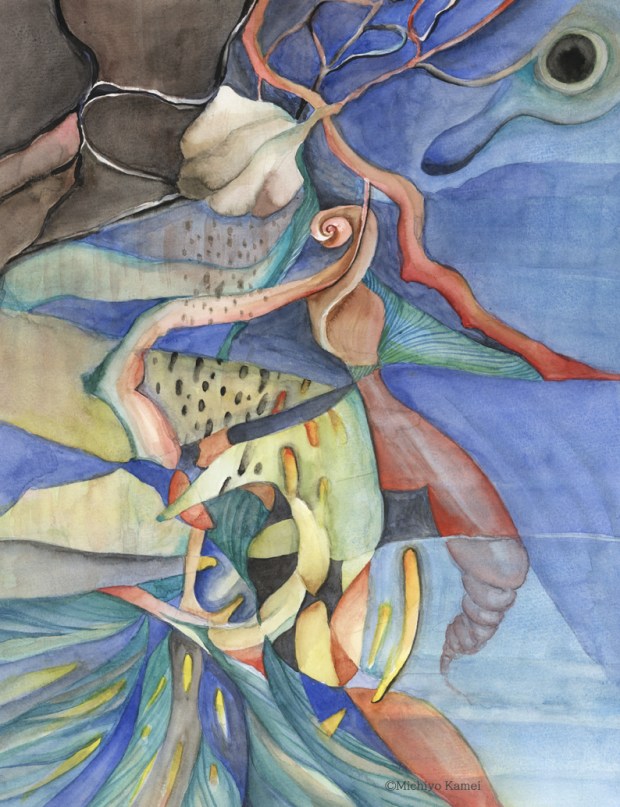
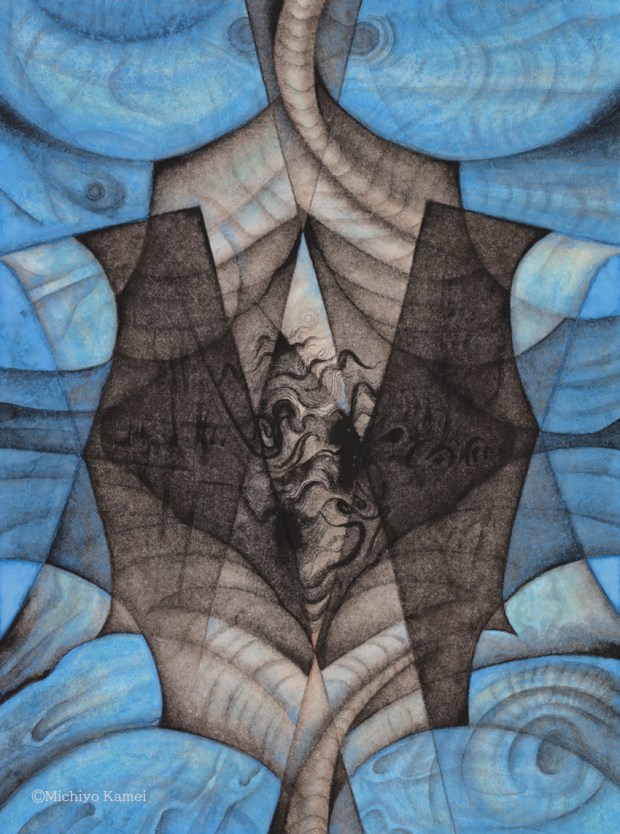
Art/Illustrations by Michiyo Kamei

Written by Mitchell Pluto from Occultations: Lullabies for Space Travel

 平行線が交差し中心にダイアモンドを形成する

II はXになった

この形状により我々は空間を斜めに移動できる

そのような旅には占術と変身の力が必要だ

わたしは三角波を吸収し

魚座の月の下で杯を口にした

360度の小さな断片

水瓶座、カヤエイ、そして水の運び手がライブを繰り広げている

月に乾杯しよう これは昔ながらの神託だ

ジオマンティック・ナイトのシンセコンソールを使い

チェス盤中央の正方形をピラミッドへとねじり

周囲の空間を曲げた

存在の8つのステージから集った64人のヨギーニが

意識と消滅を表す宇宙のタペストリーを創り出す

チェッカーボードを通してわれわれは

自己の内なる状態の図表を探求できる

絡み合う白黒の矩形は陰と陽

この視覚的な図表は異なる時間軸の出来事を分析解釈する力を持つ

われわれは繋がっている

手、爪、ひれ、ひづめ、翼、触手が集まり 異国の地へ休暇に出かける

さまざまな形に変容することで 新たな生息地を見つけ、食し、繁殖する計画だ

新婚旅行は いま最高  

研ぎ澄まされた感覚が完璧に調和する

視覚の全感覚は この虚空に浮かぶあらゆる物体を検知する貴重な資産

アプリは蛇の瞳孔を模倣し 猫の夜目を高める

チェッカーボードを通してわれわれは

自己の内なる状態の図表を探求できる

絡み合う白黒の矩形は陰と陽

この視覚的な図表は異なる時間軸の出来事を分析解釈する力を持つ

われわれは繋がっている

手、爪、ひれ、ひづめ、翼、触手が集まり 異国の地へ休暇に出かける

さまざまな形に変容することで 新たな生息地を見つけ、食し、繁殖する計画だ

新婚旅行は いま最高  

研ぎ澄まされた感覚が完璧に調和する

視覚の全感覚は この虚空に浮かぶあらゆる物体を検知する貴重な資産

アプリは蛇の瞳孔を模倣し 猫の夜目を高める

アプリが何も検知しなければ、こうもりのシグナルで逃したものを特定しよう

退屈しのぎに聴くのは 昔ながらのクジラの歌

宇宙には不可視な電波が入り込む余地がたっぷりある

われわれは無意識の変化が意識にどう影響するかを自覚する

宇宙飛行士として最も困難だったのは虚栄心を手放すこと

消費主義から解放されたことで自尊心が高まった

われわれは数字に縛られない仏教を実践する

「死」は荷電粒子が宇宙に消える瞬間だ

数字は永遠 だからどれだけ長く記憶できるか試そうか

アップデート前の言葉を主張するために わたしは自我の内側から名のり出た

これは幻覚を起こす声

真の自我は存在しないと理解しつつも われわれは絶えず自己を拡張し続けるのだ

より大きな善のために 進歩を阻んできた過去のプログラムは放棄する

現在の話者はまもなく話しを終える

目的地に到達したら円陣を離脱しよう

このストーリーラインはデジャブを喚起し その心象の創出は レプリカに記憶を残すだろう

Michiyo Kamei Site

Geomantic Knight

Parallel lines intersect, forming a diamond at the center.
II is now X.
This form lets us travel diagonally through space.
One needs divination and shapeshifting for this kind of
journey.
I absorbed a triangular wave.
Under the Pisces moon, I sipped from the cup.
A tiny fraction of 360
Aquarius, a Kayayei, and the water porter, is playing live.
Let’s toast to the lunar. It’s an old-time oracle.
I use my geomantic knight on the synth console to twist
the central square into a pyramid on the chessboard,
bending the surrounding space.
The sixty-four Yoginis from the eight phases of existence
create a cosmic tapestry that illustrates awareness and
extinction.

Through the checkered board, we can explore a chart of
our interior states.
Intertwined black and white squares represent yin and
yang.
This visual diagram has the ability to analyze and interpret
events from different time spans.
We are connecting.
As a hand, claw, fin, hoof, wing, and tentacle united on a
holiday to a foreign atmosphere.
By being able to transform into different shapes, we plan
to discover a new place to thrive, eat, and reproduce.
Our honeymoon is amazing at the moment.
With heightened senses working in perfect harmony.
Each optical sense is a precious asset to detect whatever
objects may be drifting in this void.
Apps mimic snake pupils and cat eyes enhance night
vision.

If we find nothing on that app, we activate a bat signal to
identify what we overlooked.
To combat boredom, we listen to the old fashion whale
songs.
There is plenty of room in the universe for invisible radio
waves.
We notice how unconscious shifts affect our awareness.
Giving up vanity was my toughest astronaut challenge.
Self-esteem improved by breaking free from consumerism.
We practice Buddhism without a figure.
The fading of charged particles into space is called “death”.
Numbers are eternal, so we will test how long we can
remember them.
I am coming forward from within my ego to assert the
words that I have spoken before the update.
This is a hallucinatory voice.
We get it, there’s no true self, but we are always expanding
who we are.

For better well being, we are abandoning past programs
that slowed our progress.
The current speaker is about to stop speaking.
Once we reach our destination, we intend to leave a circle.
This storyline will trigger déjà vu and create a memorable
mental image for the replicas.

The Origin of the Universe: The Wildness of Point Zero
Michiyo Kamei Exhibition Art Gallery Shop

Palimpsest of Phantasm: An imaginary art garden
Vol. 1 Michiyo Kamei

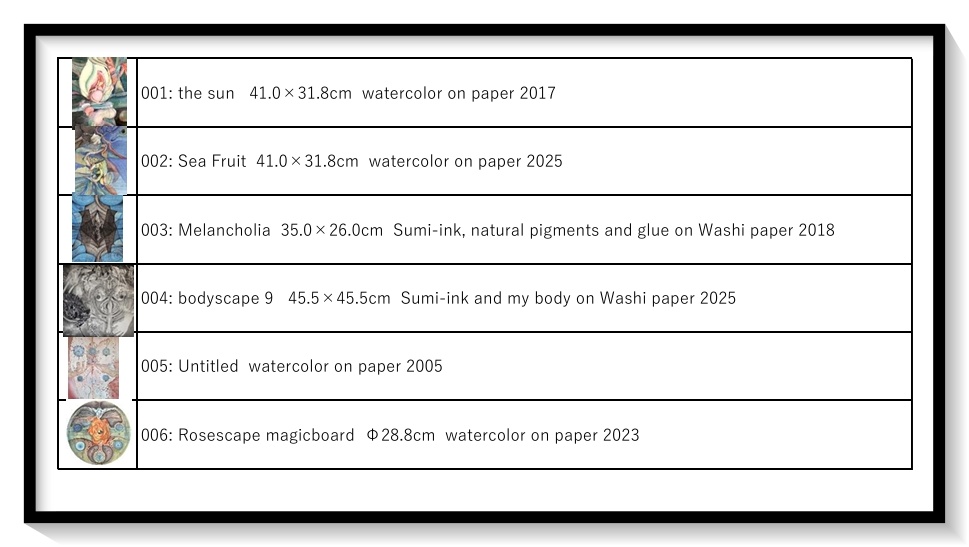
001: the sun 41.0×31.8cm watercolor on paper 2017 
002: Sea Fruit 41.0×31.8cm watercolor on paper 2025 
003: Melancholia 35.0×26.0cm Sumi-ink, natural pigments and glue on Washi paper 2018
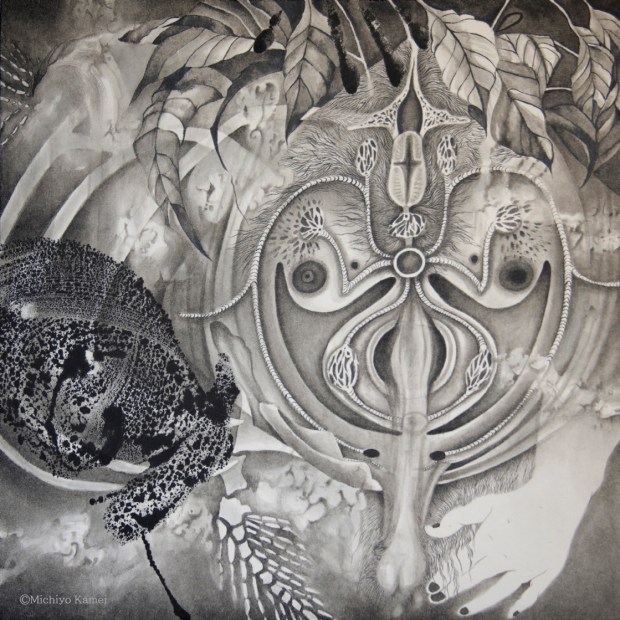
004: bodyscape 9 45.5×45.5cm Sumi-ink and my body on Washi paper 2025
005: Untitled watercolor on paper 2005 
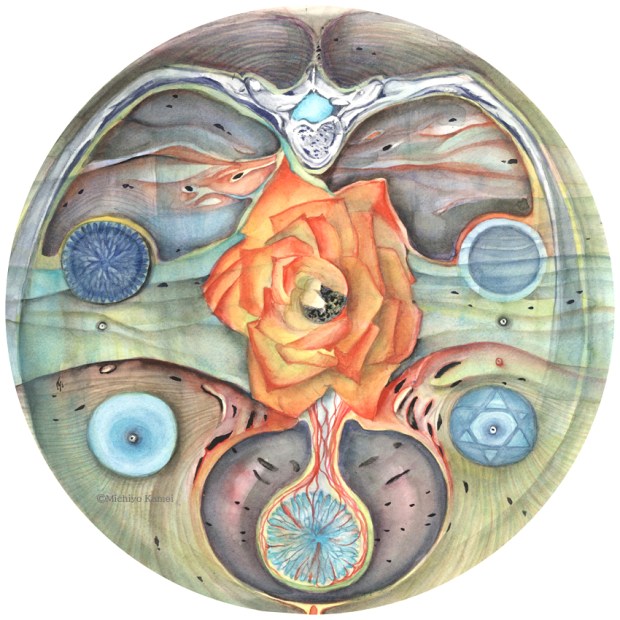
006: Rosescape magicboard Φ28.8cm watercolor on paper 2023 

001: 太陽 41.0×31.8cm 水彩、洋紙 2017 
002: 海の実 41.0×31.8cm 水彩、洋紙 2025 
003: メランコリア 35.0×26.0cm 墨、岩絵の具、膠、和紙 2018
004: bodyscape 9 45.5×45.5cm 墨、身体、和紙 2025
005: 無題 水彩、洋紙 2005 
006: 薔薇景魔法盤 直径28.8cm 水彩、洋紙 2023 

ALL RIGHTS RESERVED. ARTWORK IN THIS POST IS A COPYRIGHT OF MICHIYO KAMEI. THIS AN AUTHORIZED PUBLICATION WITH PERMISSION AND EXPRESSED CONSENT.

Hager Youssef, Halal

When everything becomes permissible,
permissible,
permissible,
I will turn off the lights
as a war upon the world,
and make love to sleep and time
in the same bed.
A woman like me, at night,
devours herself,
and in the morning,
returns entirely whole.

Permissible, permissible—
if I shatter the mirror
with a laugh.

If I open the windows
to the insects,
and your face,
leaving behind
my shadow—
may you swallow one another.

Or if I keep you inside my palm,
hide you behind the guest china,
maybe, if I sweeten your fragments,
you’ll still fall short.

Permissible—your vision falls
from the innocence wall
like worn-out shoes,
and the night sings a vulgar hymn,
as it should.

I will show you my painted limbs
and won’t ask you where we bury
lust—in white cotton,
or in a new glass.
I’ll place on your grave
a sacred symbol
befitting tonight’s blasphemy.
Everything’s permissible,
where pleasure
forgives sins for their loud voices
and wakes in me
like an animal
from death.

Deferred to you—
like a poem no longer fit for use.
I will be just fine
when I’m between two walls,
where mercy and mercy—mercy.

I sleep in a bed stretched out like punishment,
and beside you,
I dream of an impossible crime.
And when I permit you,
when you permit me,
when the night
permits everything—
we will yawn.

Hagar Youssef is an Egyptian poet and writer based in Cairo. She has published a poetry collection titled “A Damaged Memory” in Arabic and she is currently working on two collection stories: “Dreaming With Two Heads” and “One Day.” She graduated from the Faculty of Education – Department of Sciences. She has written for various platforms, including those focused on feminism and gender studies. Her work explores the essence of language, deeply influenced by philosophers Roland Barthes and Georges Bataille, in linking love, pain, and death to language, deconstructing these themes. She is also passionate about translating literature and poetry, reviewing books, and writing journalistic and critical articles.

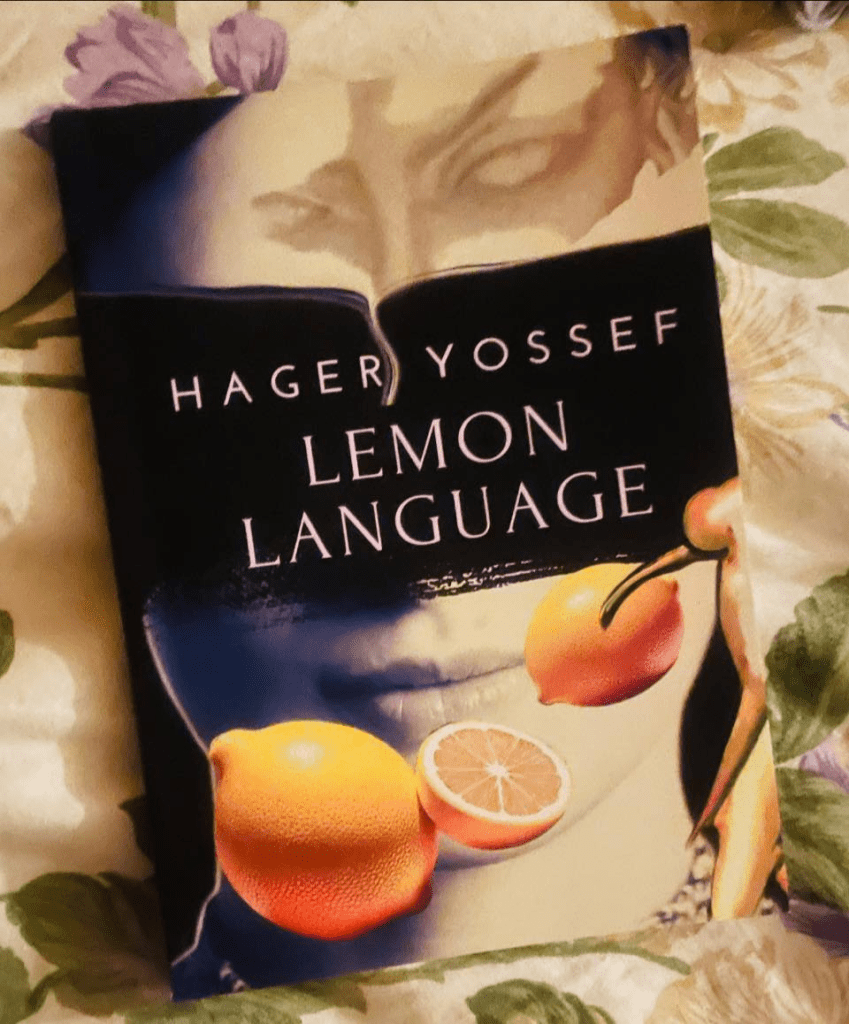
Lemon Language Paperback – November 22, 2024
by Hager Yossef

Machine for Memories

The transatlantic voyage is being undertaken by the new colony of artificial intelligence.


Don’t forget that AI, developed by dominate culture, is claiming the territory.


One can compare the brain to Vodou, an animistic concept.

People built statues to memorialize theurgy.


Hesiod’s depiction of the gods illustrates the organization of pareidolia.


We won’t be going to space ourselves; AI units carrying our genetic information and instructions will go instead.

©Mitchell Pluto 6/7/2025

The Banquet of Banality by Hager Youssef

The Banquet of Banality

It was too much—

your friendly chatter

with a plastic doll,

beside all my womanhood.

Too much closeness,

and not enough of friendship’s honor.

You dressed your attention

in a shirt far larger than your frame,

and wandered all night

seeking someone to stitch it tighter.

Fevered listening,

inflamed reactions,

obscene exaggeration,

and a sugar tongue

with no cause.

Your talk—

not just the melting

of social shyness,

but constant calls

of a drifting gigolo.

In the light’s reflection

in my glass,

Narcissus

appears smirking,

then fades.

This woman

stuffs her misery

with your emptiness,

and leaves,

utterly emptied by your absence.

And I—

beneath the weight of analysis and inquiry,

will sleep well tonight,

for I won’t let your butterfly

scratch a hole into my mind.

That banquet of banality—

doors whose insides I know too well:

the illnesses of ego,

the body,

and your childhood—

where it seems your own hand

chokes the other lost in itself.

The other women leave delighted—

They got their change

from the shiny illusion

they came for:

illicit praise

drawn from both my shares.

But I—

I’ll go home

in my white dress,

just as I came.

All I lack now

from such tired evenings

are the symphonies

of your lies.

My Weather Is Fragmented, Beautifully Distorted

My weather is fragmented,
beautiful in its disfigurement,
it writes me upon a page that quivers—
like a vast, open hand.

I’ll hang my first face on the door.
In the wild haste of love,
I’ll let you enter.

This night
lengthens over me
like a mosquito.

This lamp
only illuminates
my fear.

My second face
is dark and wicked—
like a rat in hiding.

The third, I vomit
onto the body of air,
into a bowl of memory,
like a child,
retreating into his mother’s breast.

The fourth is a mask of fire.
When you choke me,
I think—
you are making love.

The fifth, a nail in my throat.
I hammer it in,
and spit out a sixth face
that will never be complete.

The seventh sees nothing,
hears nothing—
he simply cages his sorrow
and mutters.

The eighth
sings to you
in the voices of prostitutes.

The ninth writes poetry
without faith,
sketches you on my back
with a broken fingernail.

And I—
when I sleep within you,
and rise without me,
like a tattoo,
when you forgot my name
and screamed:
“Who am I?”

Alcoholic privilege night

When my beloved is drunk,
I become a wound upon his cheek.
He strikes my chest with an empty glass,
Saying, ”This bell—this is what wakes me.”

When he drinks,
He opens my mouth like a pit,
Searching for his name,
For a button he lost
As we rushed back toward childhood.

He loves me swaying
Between two chairs:
Truth—
And the guilt I know,
When he mistakes me for a window,
When he spills the wine
As an apology on my behalf,
Like the blink of an eye.

When he drinks,
My arms multiply in his memory.
He summons them to soothe his pain,
Asks me to plant my tree
Right here—
Above his eye,
A finger for his throat,
And a final finger pointing to the wall:
“Embodied—as if you were pure awareness.”

When he’s drunk,
I draw back.
He runs like a shadow
Caught in light,
Bleeds me
Into some vague emptiness,
Traps me in a space
Shorter than a whisper,
Inside a bottle,
Inside a child’s nature.

He points often—
As if he’s arrived,
As if I were a mouth
He must enter,
Not merely behold.

Hagar Youssef is an Egyptian poet and writer based in Cairo. She has published a poetry collection titled “A Damaged Memory” in Arabic and she is currently working on two collection stories: “Dreaming With Two Heads” and “One Day.” She graduated from the Faculty of Education – Department of Sciences. She has written for various platforms, including those focused on feminism and gender studies. Her work explores the essence of language, deeply influenced by philosophers Roland Barthes and Georges Bataille, in linking love, pain, and death to language, deconstructing these themes. She is also passionate about translating literature and poetry, reviewing books, and writing journalistic and critical articles.

Lemon Language Paperback – November 22, 2024
by Hager Yossef

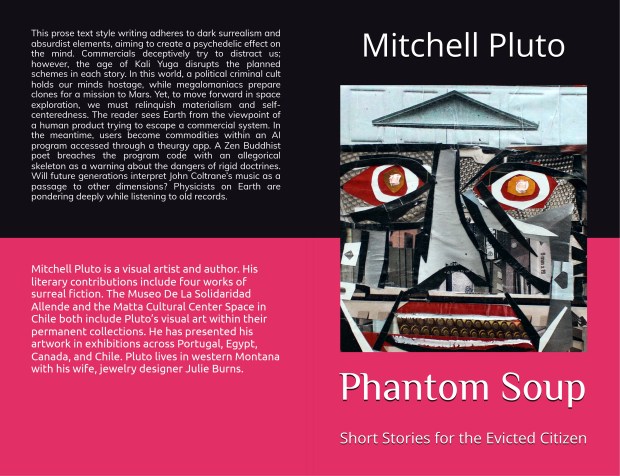
Phantom Soup: Short Stories for the Evicted Citizen

To write something and leave it behind us,
It is but a dream.
When we awake we know
There is not even anyone to read it.

The 8th day of the 4th month, the 3rd year of Kōshō (1457)
Ikkyū-shi Sōjun

Ghost Ride

Phantom Soup © Mitchell Pluto 2025

Accessible for reading.

All rights reserved. Permission grants brief quotations embodied in critical reviews and certain other non-commercial uses permitted by copyright law.

In case you overlooked it, this universe wasn’t lacking in ambition or size.
It was putting on a spectacle with its production.
The cosmos is just incredible; even haters gotta admit it’s breathtaking.
Zanni, the defendant, is still waiting for a verdict.
In space, sentences float around and words drift apart.
His black and white checkerboard suit embodied the polarities of opposites.
He is a man without a country.
A joker in a deck of cards.
Through gestures alone, Zanni attempted to decipher the universe’s communication.
There was drama everywhere, but Zanni just didn’t understand how it worked or how it occurred.
No one ever knew the truth; it died with them, leaving only unanswered questions.
Everyone figured the headache meant they knew what the problem was.
Less pain means clearer perception and a more optimistic outlook.
Honestly, it wasn’t a matter of right and wrong.
Or pain or pleasure.
It dealt with items of worth later becoming trash.
You could tell what things meant to people by how often they handled them.
It’s a space ballad playing both life and death.
No one will sing the sad cowboy songs of unrealized dreams anymore.
It’s alright.
We are part of a sombrero galaxy, a galaxy that is an eternal sunrise.
Zanni was in a giant empty room with waves of random stuff.
His world symbolized a particular responsibility of being.
Special car keys for a 2025 model, a mobile wallet, a decorative cup, a gold pen, a seasonal tire, headphones from 1979, crumpled up Kleenex, a 1990 professional styling brush and a flashlight from 1899.
These objects surrounded Zanni.
Thankfully, a consumer digital camera from 1996 captured a pic of this.
But for who?
Regular waves swapped out old things for newer ones.
Zanni contemplated this event.
He figured the most likely explanation was that he was inside a massive vacuum cleaner.
He experienced a strong connection to things he saw on his trip.
Zanni speculated that the objects he couldn’t name were from a future timeline.
Things appear and vanished super fast out here.
Zanni drifted between sleep and wakefulness.
We can refer to it as a space fog in the mind.
A magnetic memory was his most beloved possession.
It echoed because Zanni repeated it.
He brought it back to mind in a re-run.
Zanni felt the luscious lips vibrate against his ear. It was a figurine of a woman.
Her name was Colombina.
The teal diamonds and magenta triangles on her dress flowed together to create a pattern of doves.
Hand in hand, they created poetry.
The rhythm of their partnership quivered in the shared space.
The couples’ bond created a constant interplay of elements through the intercourse of their geometric patterns.
Zanni maintained his embrace for as long as possible before the vacuum wave separated them.
He could not pinpoint the incident’s time without a clock.
The arrangement of numbers magically shapes the surrounding space. A regular watch shows what’s going on between the numbers.
Of all the puppets, did he alone ponder his whereabouts?
Only he understood his own thoughts and feelings.
Sometimes Zanni heard voices that didn’t belong to him.
Intrigued by the mysterious voice, he followed it.
The voice led him back to his body.
Those seizures and hallucinations gave epilepsy a mystical quality.
His memories of himself were likely because of thinking about Colombina.
He owned the moment, his own little universe, for a single second. Zanni saw himself as a buoy, helping other objects find their way.
But Pantalone, a hunchbacked old man, considered himself the universe’s ultimate authority.
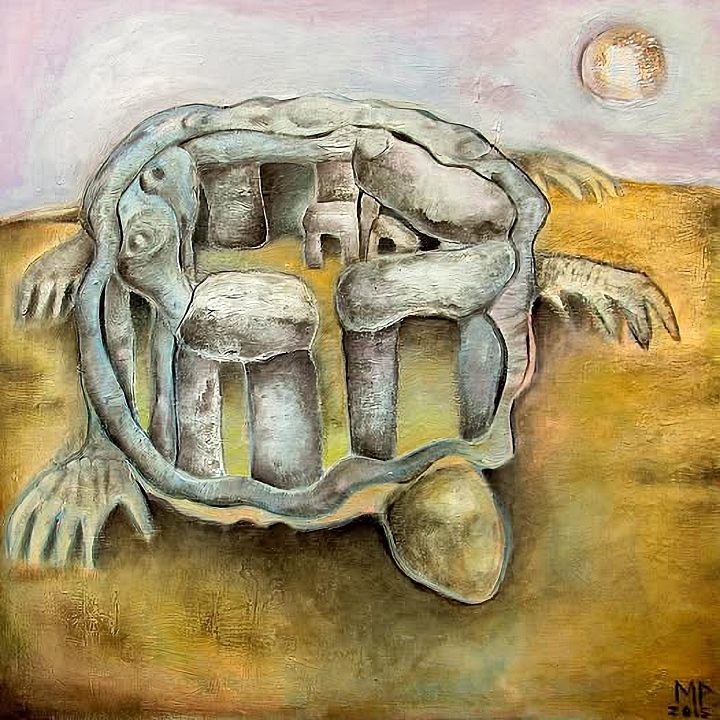
He was a drifting turtleback tomb from another vacuum wave.
Pantalone preferred the nickname “god.”
His face twisted in anger as he guarded his belongings. Losing things got on his nerves. His tailored red suit reflected Pantalone’s importance.
Every item got a brand and price label from him. He believed he understood your true worth more than you did yourself. He used his talent to make you think whatever he wanted.
Those close to him risked having their self-image stolen and used against them.
Pantalone intended for everyone to rent from his cloud.
He lost money in the vacuum wave, then recovered his losses.
This activity provided him with enjoyment, a sentiment he wished to share. Provided that he had more.
Scattered dollar bills wandered everywhere.
The bills, by themselves in space, lacked any connections.
Now, Pantalone found himself surrounded by dancing product wrappers, toenail clippings, old grocery lists, damaged furniture, empty food containers, broken appliances, crumbled up receipts and dead batteries.
Think of it as a garbage cloud.
Several real estate agents, their eyes wide with nervous energy, tried to appear calm as they floated past Pantalone.
They pretended to own a spot by treading in one place.
While this was occurring, Harry Houdini sailed by and unlocked a satellite.
Intrigued by Pantalone’s possessiveness, Zanni examined the egocentric and deceitful nature of his own point of view.
He observed the ego’s memories fade as the mind surrendered its ownership.
Once the fear was gone, relief came.
Houdini cracked his knuckles. “No worries are necessary. Don’t sweat it. It is a simple lock to open. “
The hierarchy reflects the relationships between things in a chain.
An x-ray showed how brain waves link things up through information chains, like you see in neuron activation patterns.
This electromagnetic wave made Zanni wonder about the engineer of the universe.
It appeared the designer wrote a script for a big stage performance but remains anonymous.
In the meantime,
Pantalone reached his own planet.
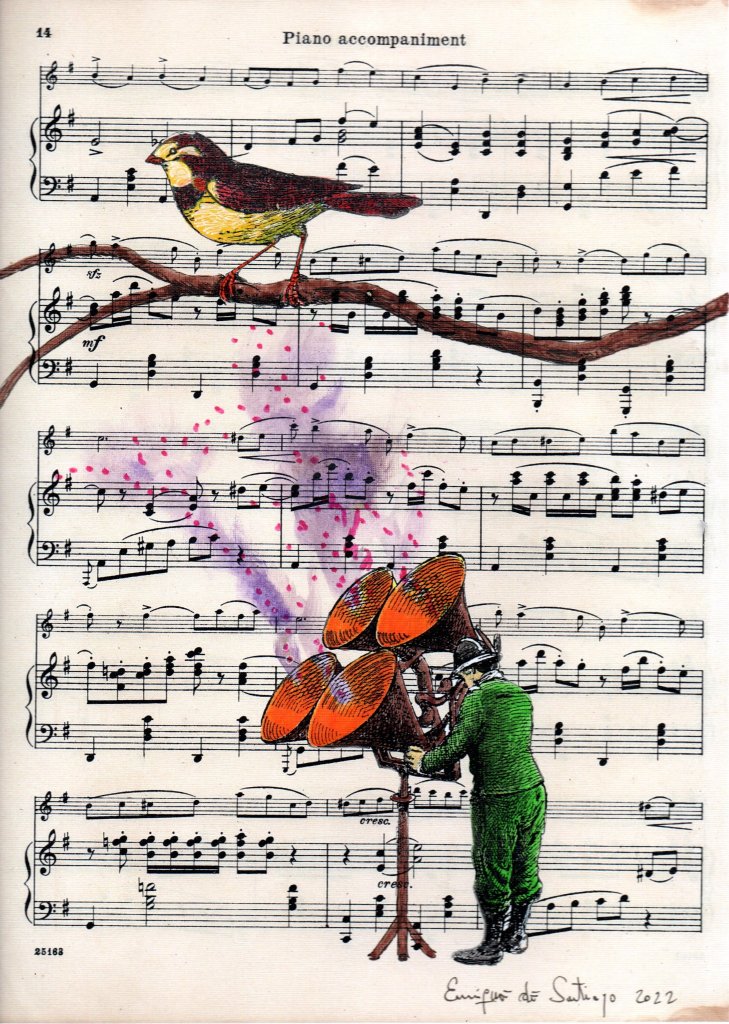
Phantom Soup: Short Stories for the Evicted Citizen Paperback

I Drink from the Paleozoic Salts Enrique de Santiago

It is then when the tree that tomorrow will summon the thorns loses its leaves,
and the bumblebee falls, prey to the polar trails,
to reinvent the powerful patient engineering of lytic promises,
Well, that’s where I shelter, and where I rescue the omens,
there I drink from the Paleozoic salts, which today move the migratory herds,
those who come to the eyes without ears, of those attending Sunday services.
By nature, I approve!!

They speak of love, and my bet is more on compassion, which is a kind of continuum in a collective warp, of an ineffable equation that they will never understand.
Because perhaps love (like that image shown to us) does not exist and if it does exist it is a sum of chemical reactions where a set of hormones stimulates our syntax, and which may also be subject to the need for genes to be perpetuated. Maybe?. But there is also one who breaks this previous theory; crazy love, passionate love, eternal love, etc. that love that becomes unclassifiable. I only know that I know nothing.
After all, I believe in love.
Does the egg use the chicken to make more eggs?
It is possible, but in a global and precisely circular analysis, the plot of existence is supported in a shed crossed by the polyform reality of infinite logics and illogics, where each of its corresponding paradoxes and balances avoids its critical tension.
But, we can order them in the not well understood compassion, which could be a feeling deeper than that of the corruptible flesh (physical theory and cognitively plausible), which leads to understandable and celestial simplicity. But what if an infinitesimal were more than an integer, or if that time circulated in all directions? or love will not mean more than a necessary impulse to take risks in order to live the contradictions, so that the soul, when dying, will return with the pertinent knowledge to correct, deconstruct or ratify the whole of the so-called divinity .
For this reason, the next step opens the temporality to dedicate more time to essential reflection, and to put aside an imposed competitiveness for the accumulation of objects that lead to the void that means pursuing a way of life that is subordinated to the symbolic relationship. of the object or objects, which is useless and inconducive (a simulacrum of the society of the spectacle) for our true purpose in this brief transit called life.
Ars longa vita brevis. Or your existence is just an accident to offer a limited amount of data to accompany the equation that gives additional information to find the way out of the answer.
By the way; nobody takes me into account, since my infallibility is very poor since periodically and statistically, my failures are more abundant than my certainties.
And therein lies my wisdom; in realizing that my hypotheses are only attempts to find the truth within infinity. To think otherwise would be to err drastically and in the process lie to them. It would be, subjecting myself from the ego to an option to dress elegantly, but in the end, it would strip my limits. It is better to be honest in clumsiness than false in an inane and temporary charade.
But:
What if love were one of that unknown design in my intrinsic astral writing, waiting for you?

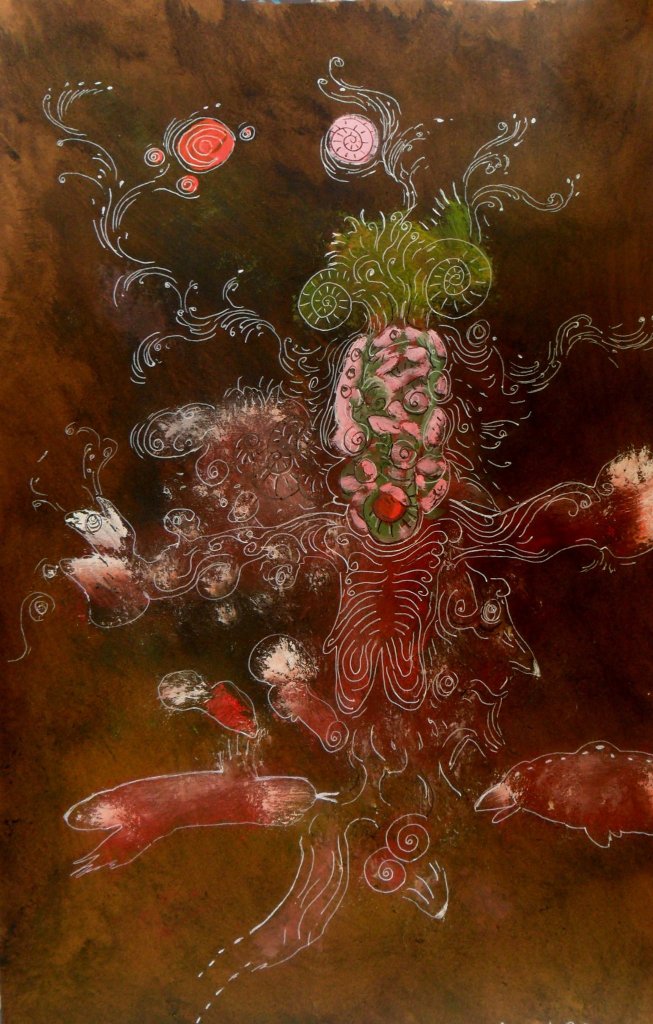
Primordial circulation approaching from a past spring, acrylic on Fabriano paper 250 gm. 35x45cm

So the wide dividing width
will unload its useful molecules
in this useless impertinent distance
there where the lightning reigns
without asking for their
blind blows.
Is when my pale measures
they embrace their designs devoid of elytra
to save the waters
possessed of salt and fire
that bathe the limits of my suffering body
without entering the first cause
that brings me down from within
the muscle periphery.

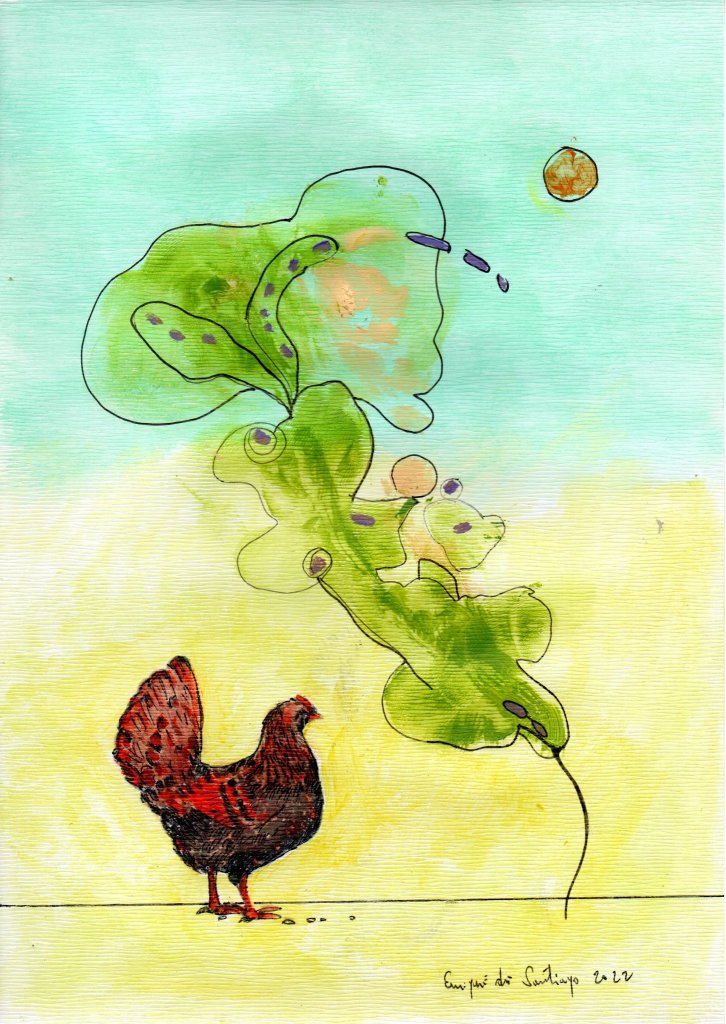
Eros Phasianidae, acrylic and ink on Canson 300 gms paper. 11″ x 8.3


EROS PHASIANIDAE
Yo
And she saw the chicken rise from the ground
a brilliant and ectoplasmic epiphany
and she remembered the words of the feathered prophets:
“before the primordial egg was the verb”
and the pyrrhic evolutionary expedition embraced me
so necessary and indeterminate
where we are more but under sheds
and I saw the grayish uncertainty that shakes my being
h = 6.626 0693 (11) x 10 – (34) J. s = 4,135 667 43 (35)
x10–(15)eV. s
and the beast arose from the miasma
without the feminine warmth
it was in the offensive of the arches thousands of years ago
on the Cartesian line of Har Meggido
under the law of y = m x + b
and those tears originated at 32°34’59″N 35°10’56″E.
II
huge old stars
leaning out on the horizontal cobblestone sheets
were dictated by an ancient manual of glorious epic forms
where I did not read the cunning locks
and from there lights fall like eagles
that are suspended in front of your pale fortifications
and despite the fact that I descend without air
I cling to the desiccated edges of this abyss
turning away from the waves of floral promises
with summer mentions that anoint you.
Thus the amaranth silence returns to rock the star
and like the silent lymph
you seek to break beyond the fundamental shell
the one that you got to know in a primitive way
in the sweet rooms of belief.

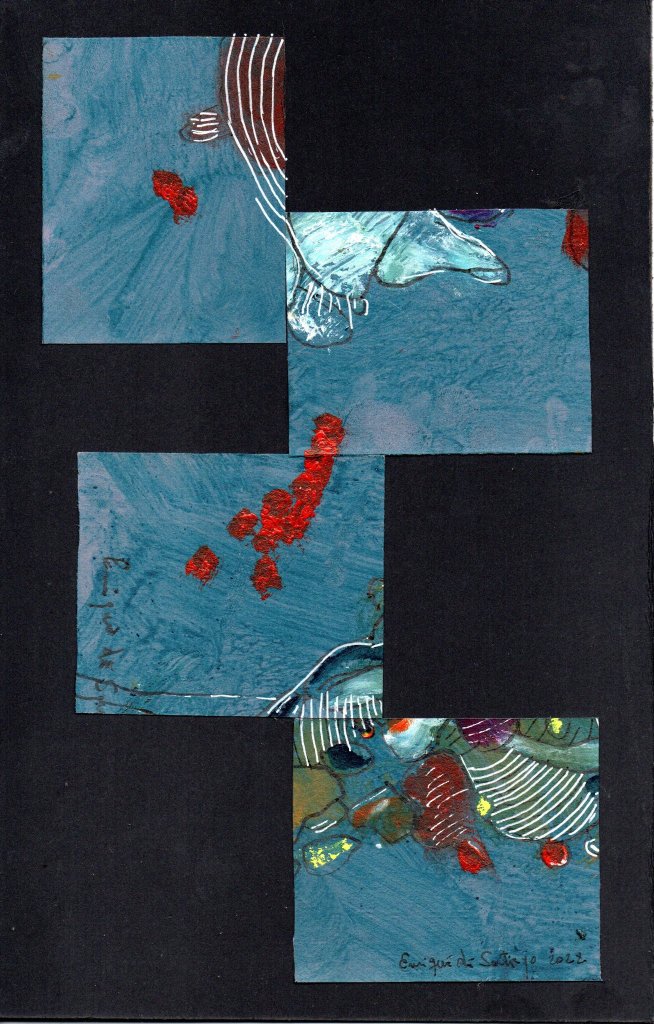
Interruption, acrylic on cut Fabriano paper, on black cardboard. 18x24cm.
The inclination of one of the elements is voluntary.


GOLDEN VISION

The nothing, the void
hold my duplicate fragments
(Φ2 = 2.61803398874988…)
It is the hollowness of the past and the future
what you don’t have and don’t want
the illusion of time and line
Infinity
so love surrounds swelling wisdom
while on the musty boards of a camp
absent light filters
to tilt reciprocal reality
that drives your transformation
(1/Φ = 0.61803398874988).

Maybe this reality is true
on this twilight island
where the already worn bones falter
by the persistent violet stings,
and there is no choice but to live among the cyclones that guard the whimsical and invisible knots
with its container meshes
that hide half-open portals,
those that I will leave like this for a while,
since everything circulates in the promised packaging.


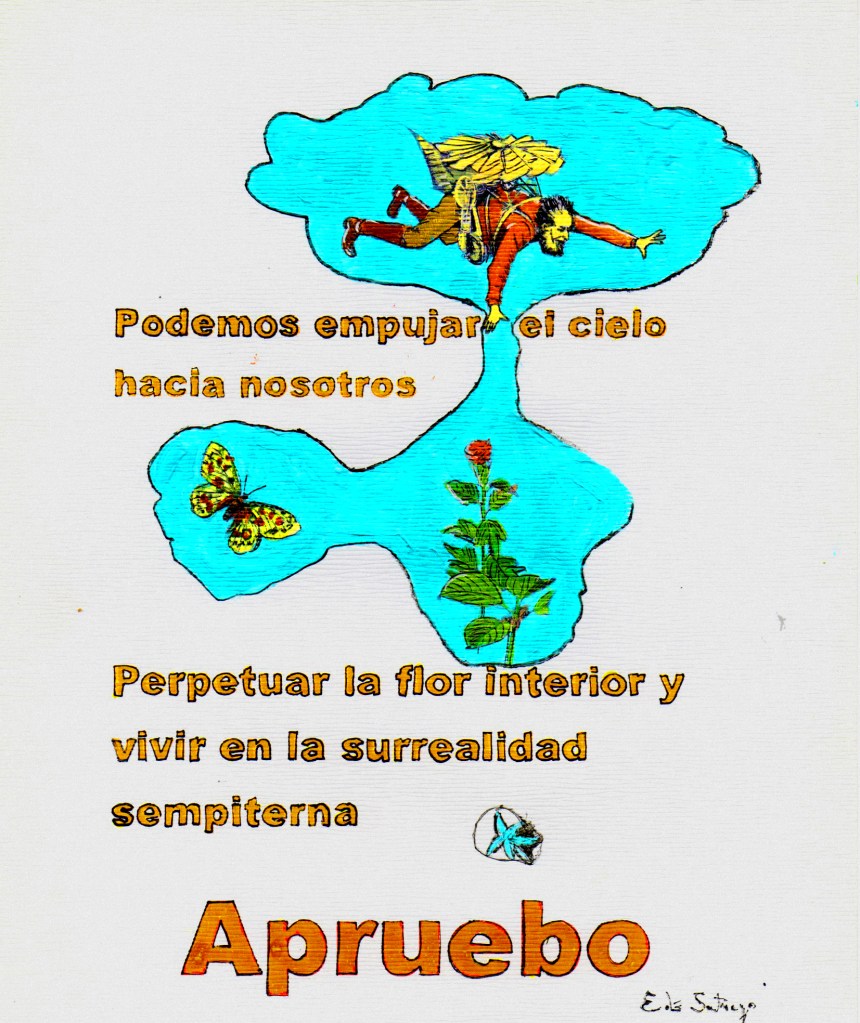
Paintings and Poems by
Enrique de Santiago