Poems from The Sunset of the Miracle Worker

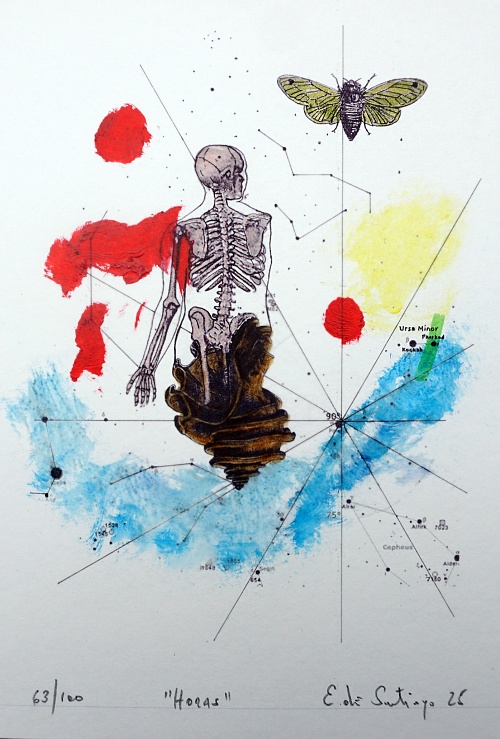
Thaumaturgy—also known as the performance of miracles—involves applying occult principles to produce tangible results. Speaking with the voice of a modern-day oracle, Chilean poet and visual artist Enrique de Santiago offers moving messages that touch the heart of humanity, connecting us to the Earth’s ancestral power. The visual language of Santiago’s work links the architecture of bones with stellar patterns and geometric structures of movement. These creative poems will help the reader recall nature’s hidden wonders.

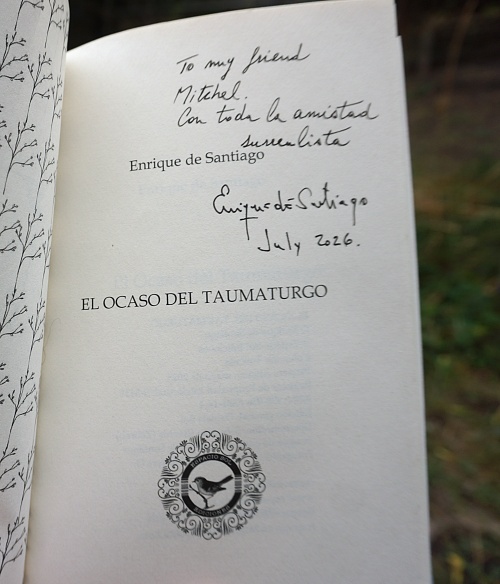
My friendship with Enrique de Santiago began in 2010, after being invited to participate in El Umbral Secreto, an international surrealism gathering. It is an honor for me to present his work in my web gallery.

-Mitchell Pluto
The eternal cycle that moves the souls
beneath the mountains
and the roots of fire

Hours


The extinguished soul of the tabernacle,
the hidden phrase that does not appear on my tombstone,
the pardons granted,
the glass half-empty
with its half-full smile,
the useless justifications,
each undeserved kiss,
with its hollow dream.
A long list of strange events
that ought not be written under my name.


Hidden Hours


I am weary of chasing after serenity,
after so many days of sun—
those days of old,
the lost ones,
days when I laid my head upon certainty,
though in the end, it was merely a mirage;
there was nothing epic in the streets,
only cobblestones and the same dampness,
for I believed in things beyond reality,
yet it was but a reflection mirroring the void—
much like now, with fearful eyes,
dreading another mistake,
so I walk with eyelids trapped,
unable to escape the memory,
perpetuating into the coming day
the cycle of emptiness—
an emptiness that cannot turn the wheel of life,
despite the claim that the world is round;
there is only more oxygen to prolong the agony, the gazes devoid of hope,
with no constellations favoring me,
only the interruption of the ceremony,
and the white light calling once more,
compelling me toward salvation—skeptics by day,
inert by night;
nothing remains the same,
only ailments,
air seeping into open sores,
or seeking its own salvation—
a clumsy, enslaved instrument,
foolish for writing, for
the pleasure of the treacherous, the cynics,
the covert ones, those who bring the stench down upon my flesh;
a hard, penitent life,
a fierce passage following withered faith,
a barren wasteland left by lies,
by betrayed words,
by the shattered sand
that will never draw near,
with no public squares to roam,
no scents,
only projected playthings,
cast into the soul’s deepest abyss. I rely on no one,
let no one rely on me;
just fix your gaze—
orderly and without delay—
for the hour will come to reveal myself:
in silence, without a word spoken,
you shall learn of my wounds,
of my unspeakable suffering,
for my spirit is cloaked in flesh—
clumsy, troublesome flesh,
flesh I seek to unleash from its dark delights,
yet I always end up brushing against my own fingers,
returning to the blank slate,
though I have already turned a weary ochre,
and I renounce this script of my life;
I want to descend into sleep,
drunk on molecules that compel me,
and which torment me deep down—
molecules that frighten me with what remains,
with what I do not deserve.

Night entered my life uninvited,
settling in without awaiting an answer;
it took my clothes,
my sheets, and smiled,
leaving a breath of dead smiles
and cadaverous breakfasts;
without further ado,
it simply installed itself within these walls,
sitting to watch me with stubborn persistence,
yet I no longer meet its gaze;
long ago, I left my senses inside my nightstand—
I use them no more,
I need them no more;
what the night brings is enough.


Loica, the Songbird Singing after a Solar Explosion

In the beginning, there was hydrogen—
fusions in the void, upon the chaos,
and light escaping immeasurable density,
an atomic dance in a corner of immensity,
forging clouds of helium,
with horoscopes gathering in their wombs—
incandescent—
a sea with its cosmic tides,
solar matrices,
primordial motherhood,
woman with her 1,080 designs,
who loves the early nebulae
when you gaze upon her—
with her analogous births,
her stars and comets
that govern your sweet destiny,
with your magnificent horizontality,
bearing her feminine ambrosias.

For in the beginning was your name,
before the galaxy sleeping within the orchid,
with the archaic promise of your lips
naming the secret that dwells in oblivion—
a secret slowly surfacing from your skin
like photons escaping the solar core,
a task spanning millennia
to reach the corona
and warm us in eight minutes;
for in the beginning, it was not light,
nor the will of the gods,
nor my own meager poetry—
unnoticed by the world,
traveling like a lightning bolt to return to the void
of a beginning where there was only the stifled voice of space.

This is my vocation:
to snatch, at times, a glimmer from the marvelous—
a poorly paid yet inevitable calling;
thus my bed fills with forest leaves,
and my roof is the stars
bathing the calendulas that embrace my walls—
my perfect prison,
the sweet fate of an ancient equation,
like these verses
traversed by your eyes—
which is, to me, a more than fair wage
throughout the days,
with their mornings
and their sunsets.


Enrique de Santiago has given his consent for the poems to be translated for a North American audience.
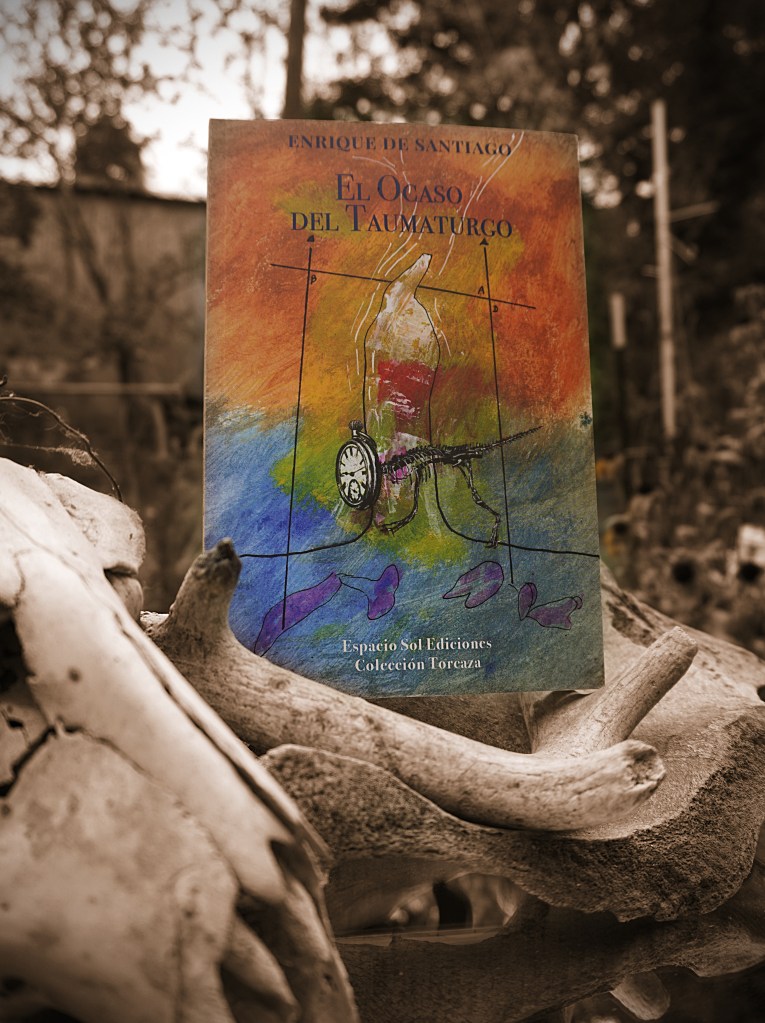
Enrique de Santiago, Born in Santiago, Chile (1961). Visual artist, poet, researcher, essayist, curator and cultural manager. He studied a Bachelor of Art at the University of Chile and at the Institute of Contemporary Art (Chile).

Support writers from South America

Espacio Sol Ediciones

Hager Youssef, Halal

When everything becomes permissible,
permissible,
permissible,
I will turn off the lights
as a war upon the world,
and make love to sleep and time
in the same bed.
A woman like me, at night,
devours herself,
and in the morning,
returns entirely whole.

Permissible, permissible—
if I shatter the mirror
with a laugh.

If I open the windows
to the insects,
and your face,
leaving behind
my shadow—
may you swallow one another.

Or if I keep you inside my palm,
hide you behind the guest china,
maybe, if I sweeten your fragments,
you’ll still fall short.

Permissible—your vision falls
from the innocence wall
like worn-out shoes,
and the night sings a vulgar hymn,
as it should.

I will show you my painted limbs
and won’t ask you where we bury
lust—in white cotton,
or in a new glass.
I’ll place on your grave
a sacred symbol
befitting tonight’s blasphemy.
Everything’s permissible,
where pleasure
forgives sins for their loud voices
and wakes in me
like an animal
from death.

Deferred to you—
like a poem no longer fit for use.
I will be just fine
when I’m between two walls,
where mercy and mercy—mercy.

I sleep in a bed stretched out like punishment,
and beside you,
I dream of an impossible crime.
And when I permit you,
when you permit me,
when the night
permits everything—
we will yawn.

Hagar Youssef is an Egyptian poet and writer based in Cairo. She has published a poetry collection titled “A Damaged Memory” in Arabic and she is currently working on two collection stories: “Dreaming With Two Heads” and “One Day.” She graduated from the Faculty of Education – Department of Sciences. She has written for various platforms, including those focused on feminism and gender studies. Her work explores the essence of language, deeply influenced by philosophers Roland Barthes and Georges Bataille, in linking love, pain, and death to language, deconstructing these themes. She is also passionate about translating literature and poetry, reviewing books, and writing journalistic and critical articles.

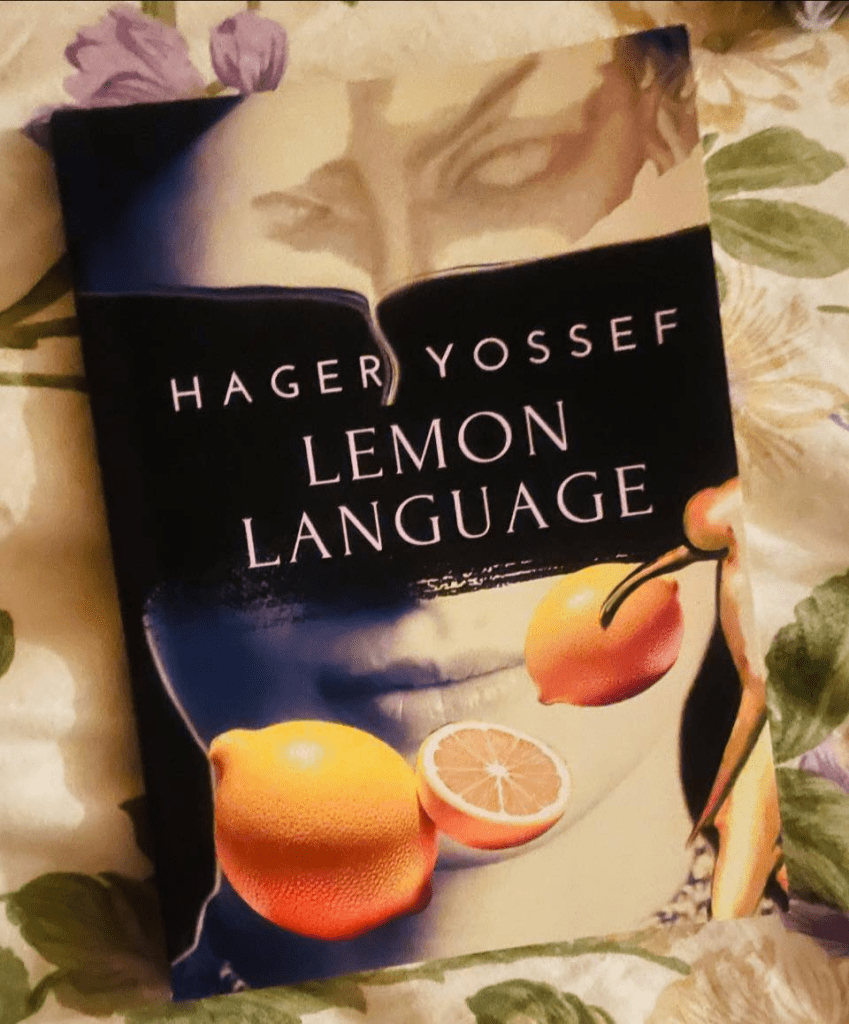
Lemon Language Paperback – November 22, 2024
by Hager Yossef

The Banquet of Banality by Hager Youssef

The Banquet of Banality

It was too much—

your friendly chatter

with a plastic doll,

beside all my womanhood.

Too much closeness,

and not enough of friendship’s honor.

You dressed your attention

in a shirt far larger than your frame,

and wandered all night

seeking someone to stitch it tighter.

Fevered listening,

inflamed reactions,

obscene exaggeration,

and a sugar tongue

with no cause.

Your talk—

not just the melting

of social shyness,

but constant calls

of a drifting gigolo.

In the light’s reflection

in my glass,

Narcissus

appears smirking,

then fades.

This woman

stuffs her misery

with your emptiness,

and leaves,

utterly emptied by your absence.

And I—

beneath the weight of analysis and inquiry,

will sleep well tonight,

for I won’t let your butterfly

scratch a hole into my mind.

That banquet of banality—

doors whose insides I know too well:

the illnesses of ego,

the body,

and your childhood—

where it seems your own hand

chokes the other lost in itself.

The other women leave delighted—

They got their change

from the shiny illusion

they came for:

illicit praise

drawn from both my shares.

But I—

I’ll go home

in my white dress,

just as I came.

All I lack now

from such tired evenings

are the symphonies

of your lies.

My Weather Is Fragmented, Beautifully Distorted

My weather is fragmented,
beautiful in its disfigurement,
it writes me upon a page that quivers—
like a vast, open hand.

I’ll hang my first face on the door.
In the wild haste of love,
I’ll let you enter.

This night
lengthens over me
like a mosquito.

This lamp
only illuminates
my fear.

My second face
is dark and wicked—
like a rat in hiding.

The third, I vomit
onto the body of air,
into a bowl of memory,
like a child,
retreating into his mother’s breast.

The fourth is a mask of fire.
When you choke me,
I think—
you are making love.

The fifth, a nail in my throat.
I hammer it in,
and spit out a sixth face
that will never be complete.

The seventh sees nothing,
hears nothing—
he simply cages his sorrow
and mutters.

The eighth
sings to you
in the voices of prostitutes.

The ninth writes poetry
without faith,
sketches you on my back
with a broken fingernail.

And I—
when I sleep within you,
and rise without me,
like a tattoo,
when you forgot my name
and screamed:
“Who am I?”

Alcoholic privilege night

When my beloved is drunk,
I become a wound upon his cheek.
He strikes my chest with an empty glass,
Saying, ”This bell—this is what wakes me.”

When he drinks,
He opens my mouth like a pit,
Searching for his name,
For a button he lost
As we rushed back toward childhood.

He loves me swaying
Between two chairs:
Truth—
And the guilt I know,
When he mistakes me for a window,
When he spills the wine
As an apology on my behalf,
Like the blink of an eye.

When he drinks,
My arms multiply in his memory.
He summons them to soothe his pain,
Asks me to plant my tree
Right here—
Above his eye,
A finger for his throat,
And a final finger pointing to the wall:
“Embodied—as if you were pure awareness.”

When he’s drunk,
I draw back.
He runs like a shadow
Caught in light,
Bleeds me
Into some vague emptiness,
Traps me in a space
Shorter than a whisper,
Inside a bottle,
Inside a child’s nature.

He points often—
As if he’s arrived,
As if I were a mouth
He must enter,
Not merely behold.

Hagar Youssef is an Egyptian poet and writer based in Cairo. She has published a poetry collection titled “A Damaged Memory” in Arabic and she is currently working on two collection stories: “Dreaming With Two Heads” and “One Day.” She graduated from the Faculty of Education – Department of Sciences. She has written for various platforms, including those focused on feminism and gender studies. Her work explores the essence of language, deeply influenced by philosophers Roland Barthes and Georges Bataille, in linking love, pain, and death to language, deconstructing these themes. She is also passionate about translating literature and poetry, reviewing books, and writing journalistic and critical articles.

Lemon Language Paperback – November 22, 2024
by Hager Yossef