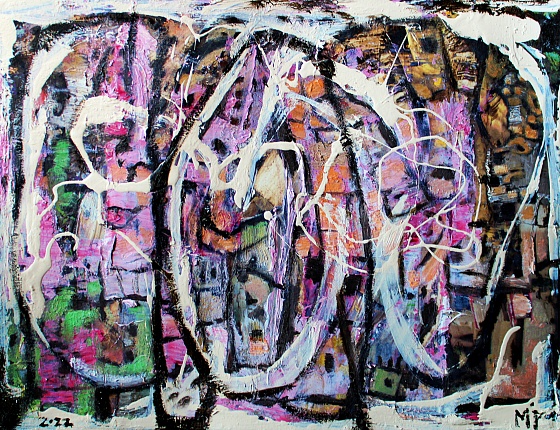
Six Erotic Artists

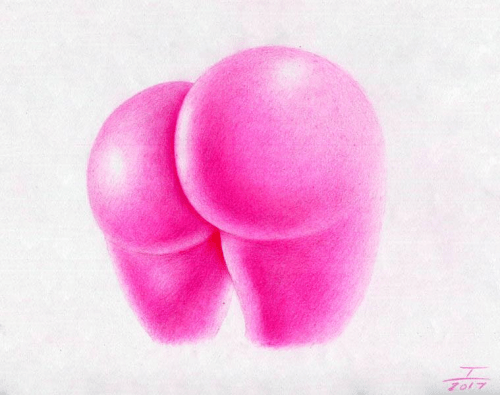
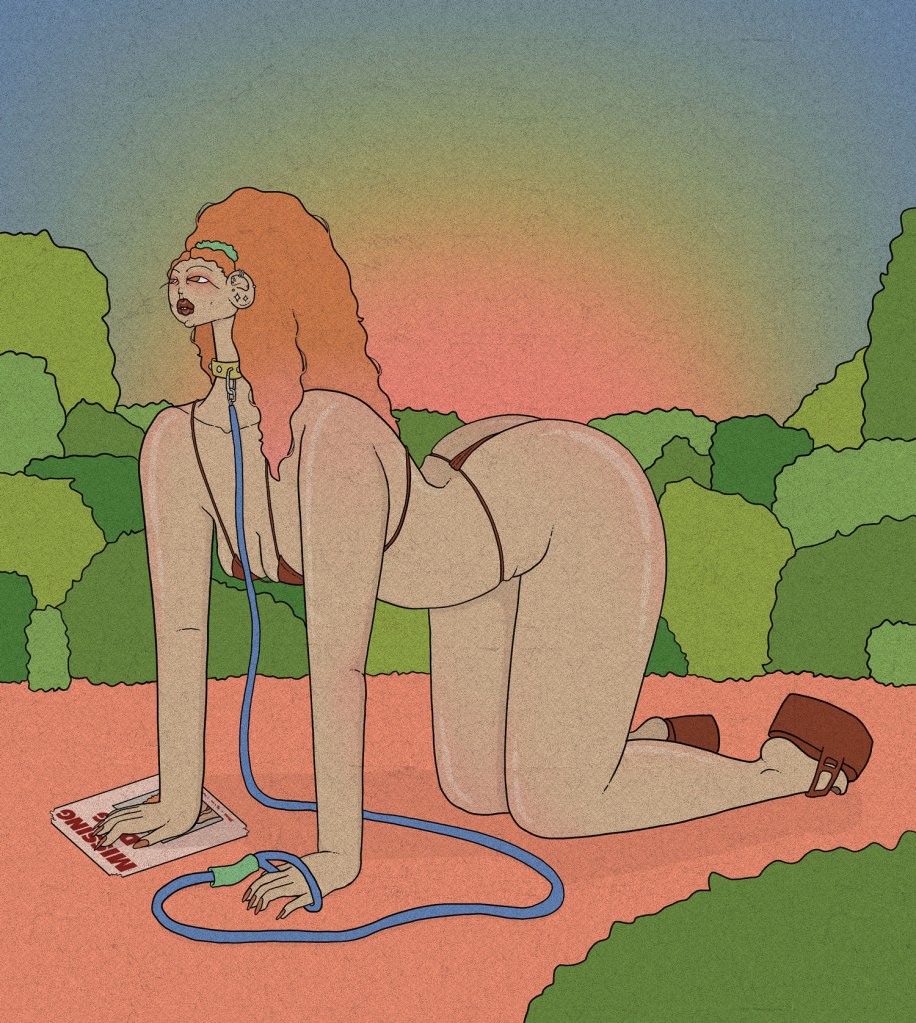
Neon Bubble Butt. JC Bravo 2017, Mitchell Pluto Collection

JC Bravo

My favorite Bravo pink pen drawing is the 2017 Neon Bubble Butt. I find it enjoyable because the curvy female buttocks are a universal icon of beauty and perfection. It’s a fixed shape drifting in space. Just as helium makes things float and feel light, the drawing has a whimsical, festive quality to it. This drawing makes me think of how ideas can lift your spirits.

Juan Carlos Bravo, a Miami artist, is all about sensuality in his art. Miami is a melting pot of cultures, fashion, and the adult film industry. The sensuality in Bravo’s art makes it a favorite among collectors. He paints voluptuous women who embody an ageless ideal of sex appeal.

Surrealism, body horror, and pop culture blend to create the world of Bravo’s women. His art inspires viewers to examine their own primal instincts and their significance.

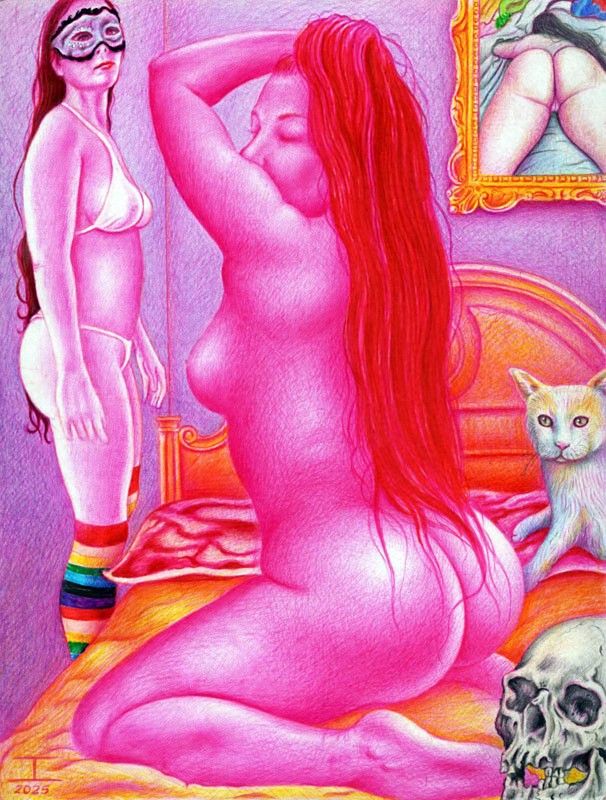
“GLORIOUS” (2025) JC Bravo

In this intimate scaled ballpoint pen drawing, I return once more to the private theater of the bedroom, a liminal space where desire, memory, and mortality quietly collide.

At the center kneels a voluptuous woman, her impossibly long red hair spilling like wine across her body, an oneiric cascade that measures both time and temptation. She raises her arms in a gesture of languid surrender, unaware, or perhaps deliberately unseeing, the woman wearing a jeweled Mardi Gras mask that transforms her into a carnival Venus. Thigh-high stockings, striped in defiant rainbow colors, root her to the earthly even as the rest of her body dissolves into roseate light. On the bed beside her, a cat and perennial guardian spirit, sits in calm, wide-eyed judgment, the only creature in the room who truly sees everything.

Above them hangs a gold framed erotic painting, its subject bent in mirror-image submission, a quiet reminder that every act of looking is also an act of being looked at. And in the lower right corner, half-hidden beneath the sheets, grins a human skull, my memento mori. It is not a threat but an invitation: remember that you will die, so love fiercely, look shamelessly, touch without apology while flesh is still warm and hair still grows.

The entire scene is drenched in an artificial pink and magenta glow, the color of stage lights, fever dreams, and cheap motel neon, a hue that makes the skin feel simultaneously hyperreal and hallucinatory. Through this saturated lens, the everyday becomes ritual, the intimate becomes mythic, and a simple moment of morning undress is revealed as a dance on the edge of oblivion.

-JC Bravo

The Eternal Zaftig, Pink Ball Point Drawings of JC Bravo https://shungagallery.com/jc-bravo-art/

Bravo paints the human body with anatomical precision. He features both realistic bodies and integrates stylistic elements reflecting augmentation. Technical detail is a priority in his work. He’s passionate about oil painting and uses a pink pen for his drawings.

Philip Henderson

Tyra Philip Henderson

Among Henderson’s many drawings, I like Tyra the best. The figure’s eyes hold my attention. I think she saw me looking at her hand. I can tell she’s aware of my attraction through her gaze. The outline of her body forms a simple path, gently sloping from breast to thigh. Her hair almost blends with her pubic hair, but a delicate crescent shape separates them above the mons pubis. Tyra’s arm movement guide your eyes across her body. In Henderson’s artwork, eye contact and pose combine to create a feeling of empathetic sex appeal.

Big Beautiful Women, The Phat Art of Philip Henderson https://shungagallery.com/philip-henderson-fat-girls/

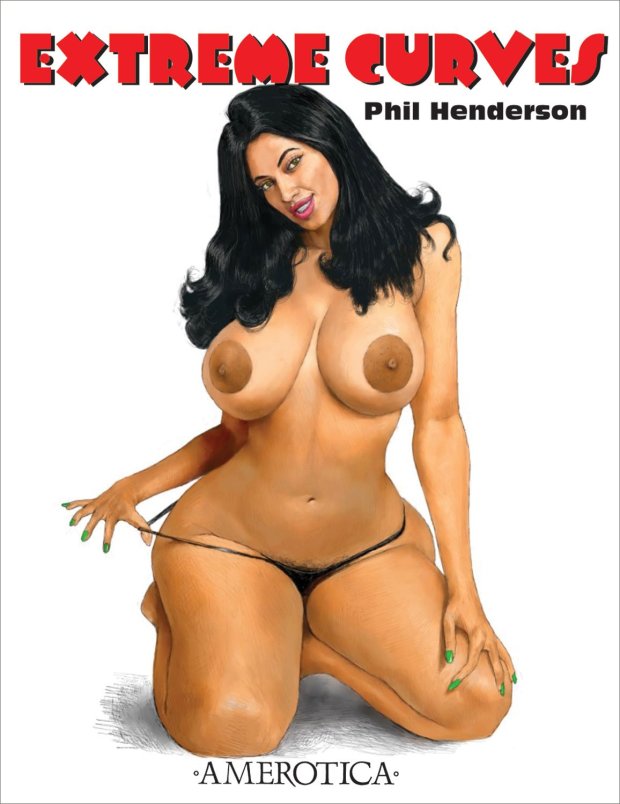
Curvy fetishes play a significant role in the themes of Philip Henderson. His plush illustrations create an arresting experience for the viewer. Henderson celebrates the value of curvy women. Henderson’s book, “Extreme Curves and Phat Girls”, achieved international success.

Besides his erotic illustrations, Henderson is a gifted writer of essays, novels, and poetry. He achieves elegance through his scholarly, artistic style. Henderson avoids abstraction in his anatomical figures while blending idealism and realism, creating a believable fantasy. He portrays natural grace and confidence in his figures, excluding any cosmetic enhancements.

Angélique Danielle Bègue

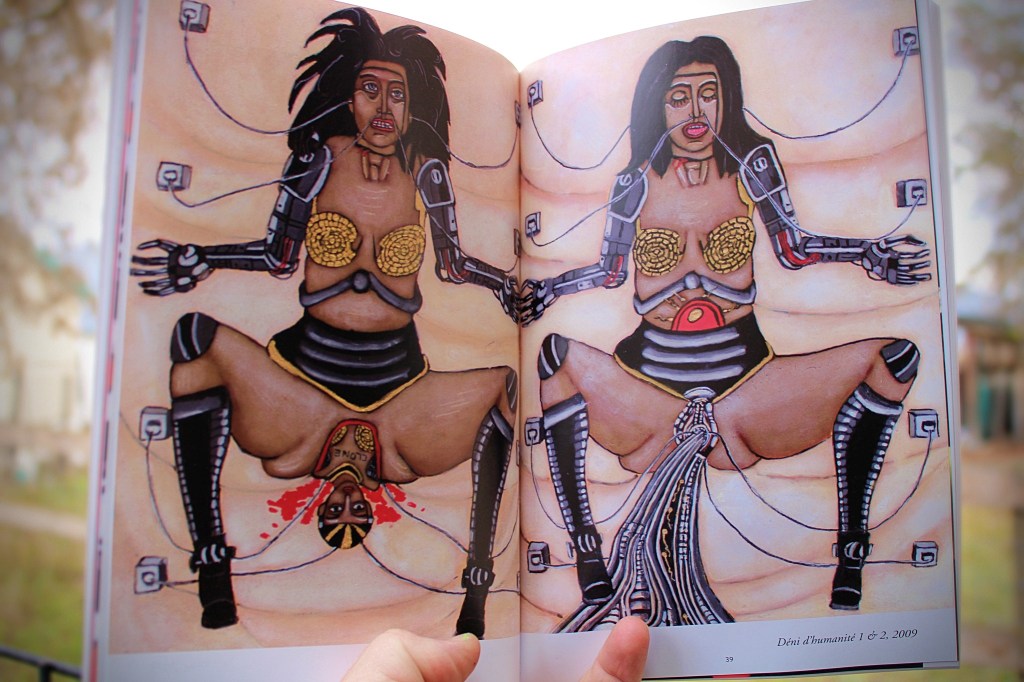
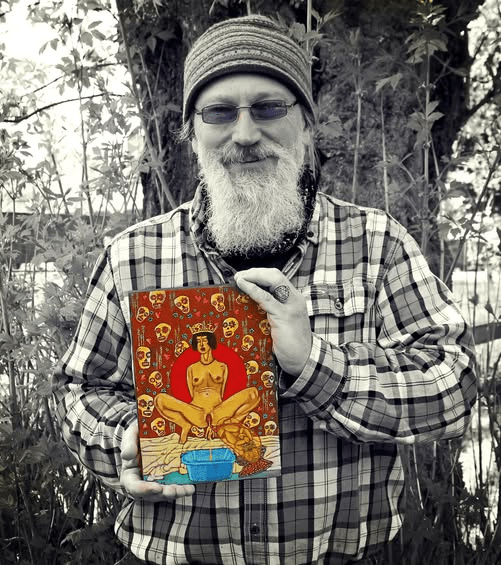
Deni d’humanité, published in Angélique Danielle Bègue‘s 2009 book, Dans Mon Corps.

Bègue’s 2009 work, Dans Mon Corps, includes “Deni d’humanité,” a piece with a prophetic theme. In the image, AI’s exploitation disrupts the natural flow with sexual intrusion. This image illustrates AI replicating itself using humans. Her art shows how the excitement around AI is really just more of the same old ways of controlling us. Bègue’s work examines the way narrative influences our understanding of what’s real and imagined. I appreciate looking at this image because it makes me question the idea of human originality and imitation.

Ghosts From the Id: The Art of Angélique Bègue https://shungagallery.com/angelique-begue/

French painter Angélique Danielle Bègue’s artistic career started with tempera, apprenticed at Gorze Priory by an Orthodox nun. A classic style is the vehicle for Bègue’s modern concepts. France acknowledges her contribution to the revival of tempera painting. Bègue’s professional experience includes erotic modeling.

An icon painting from my dear friend Angélique Danielle Bègue from France.

In her figurative art, Bègue merges a traditional religious style with contemporary themes. Her artwork uses vibrant tones, layers, and bold lines. Bègue’s iconic graphic design employs strategic contrasts to
create visual balance and proportion. She uses painting to express her internal fantasies. Bègue dedicates herself to understanding sexual fantasies and how to approach topics society deems taboo.

Miriam Cahn

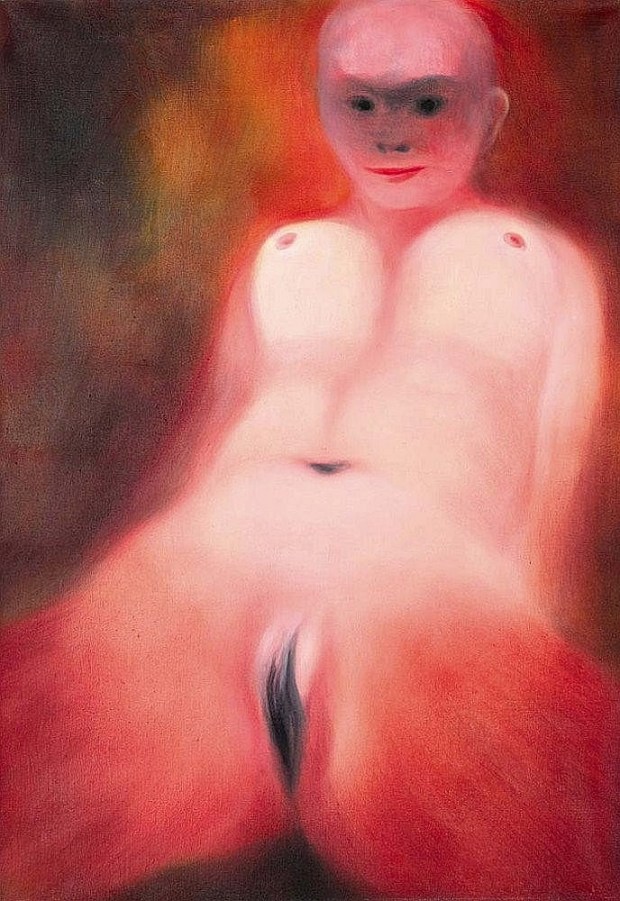
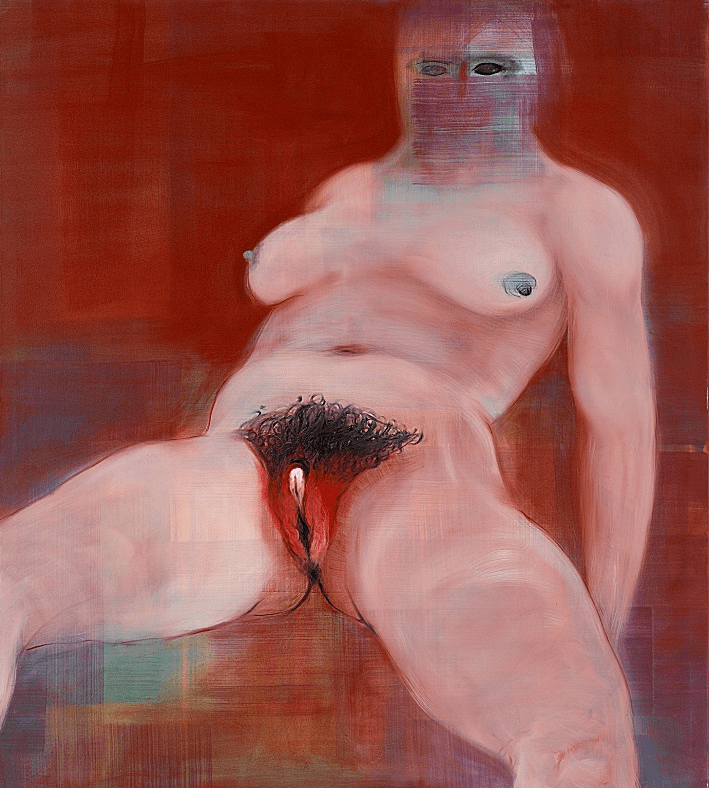
Äffin Miriam Cahn

Äffin’s unsettling nature is thought-provoking to me. Simian aspects of the image contribute to its dreamlike quality while exposing a liminal personality. The skin is smooth around the breasts but gets hairier and tactile near the pelvis. The vulva is a fiery bush, sparking primal metaphors. This work compels me to explore the roots of human consciousness and how language shapes our understanding, including our desires. It suggests to me that the ideas of elegance and ugliness are mental constructs.
The intense emotion evoked by this painting stems from Cahn’s ability to communicate deep thought through candid visual images.

Swiss artist Miriam Cahn paints in a Neo-post-expressionist style. Her art reflects the movement’s style through her figures, colors, and emotional expression. Cahn’s work often features spectral figures with
watchful eyes. Viewers become the subjects of the gaze of the eyes in her paintings.

Cahn’s paintings are vibrant and full of bright pastel colors. She discovers new things about herself through painting. With raw concepts, she develops a visual vocabulary for emotions. Her paintings are unpolished and invite the viewer into a world that’s flawed.

Viktor Alexandrovich Lyapkalo

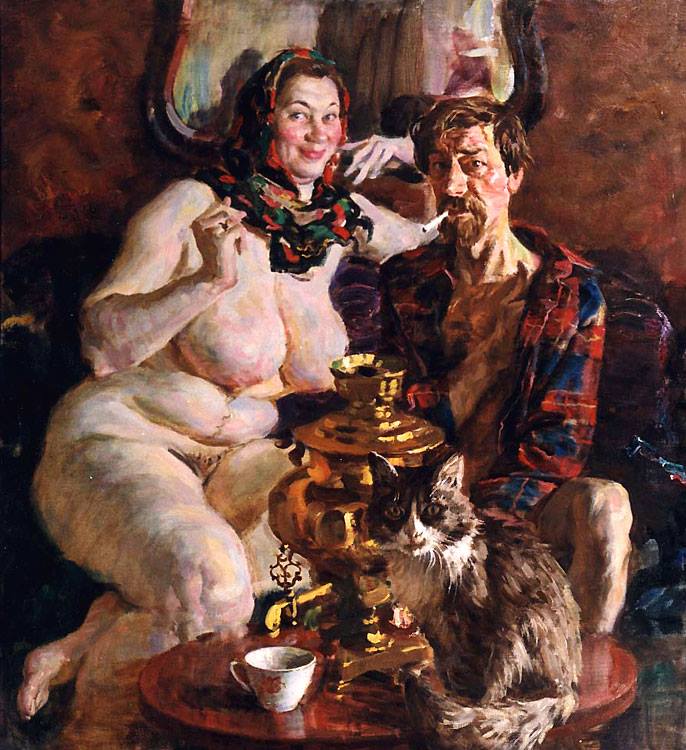
Viktor Lyapkalo

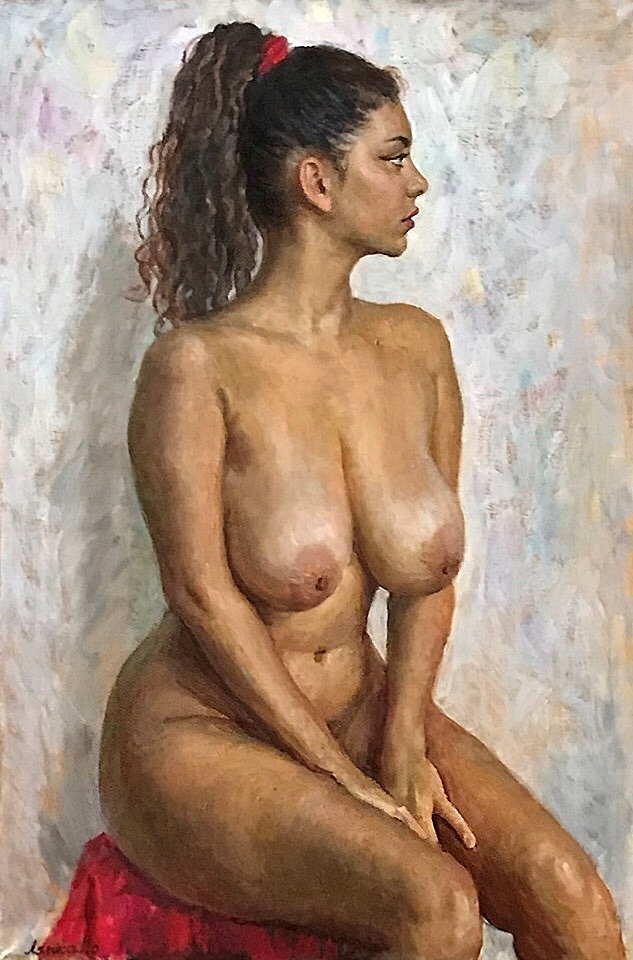
The reason I like Lyapkalo’s paintings is his choice of female subjects. It’s that simple. I’m attracted to curvy women, and his artwork features them. This painting captivates me in every way. The man, cat, and samovar create a muted, somber atmosphere, in contrast to the woman. Her lively body seems to glow with light and color. She’s appealing because of her open and generous nature, which brightens the room. Lyapkalo’s representation of the smile has a seductive effect on the viewer. The piece illustrates the duality of affection, showing both its open and concealed aspects.

Russian artist Viktor Lyapkalo paints in a strong social realist style. His paintings of women are sensual and playful. Lyapkalo’s skill with figures and academic paintings is the key to his success. His artwork portrays the emotion and character of the people he paints.


During my interview with Lyapkalo, he compared painting skin to an onion flower, highlighting its multi-hued nature. This is evident upon closer examination of the colors used in the artist’s depictions of nude women.

Pablo Picasso

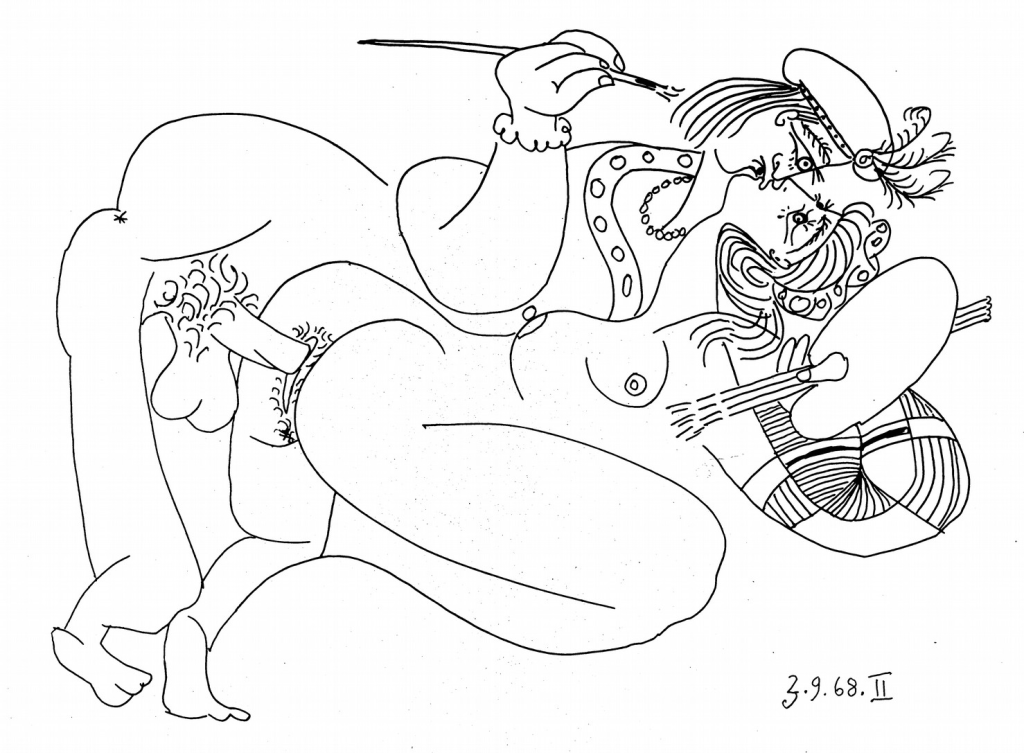
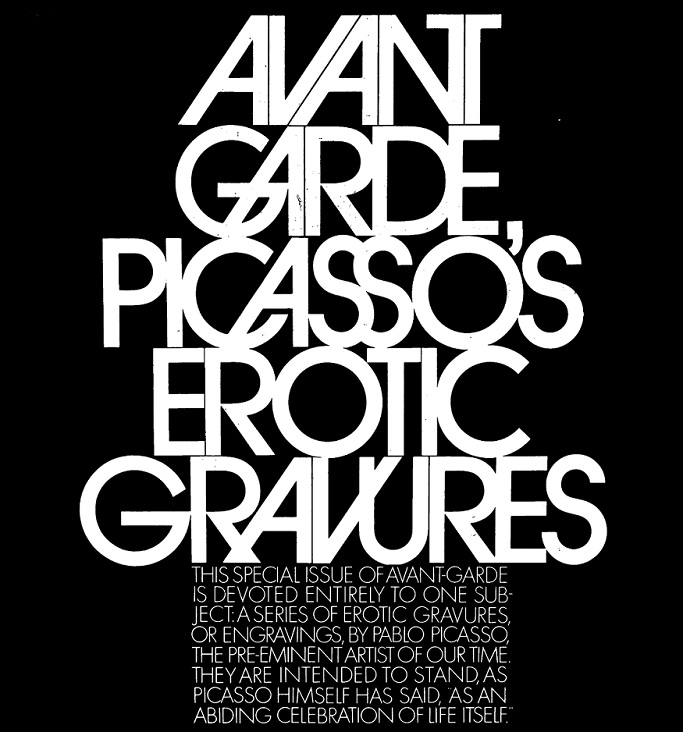
Avant-Garde Magazine, No. 8. Picasso’s Erotic Gravures Pablo Picasso Artist and his model 1969

This image remains my most memorable. In sex, artist and model become unified. I am drawn to this picture because it features both intercourse and a suggestive representation of the sexual act through the artist’s palette. As a flawless masterpiece of line, this image is everlasting.

I found Avant-Garde Magazine, No. 8. Picasso’s Erotic Gravures on my parent’s bookshelf. It was between Anaïs Nin’s “Delta of Venus” and Louise Huebner’s “Power Through Witchcraft”. For a kid stuck reading boring schoolbooks, I finally stumbled on something cool.

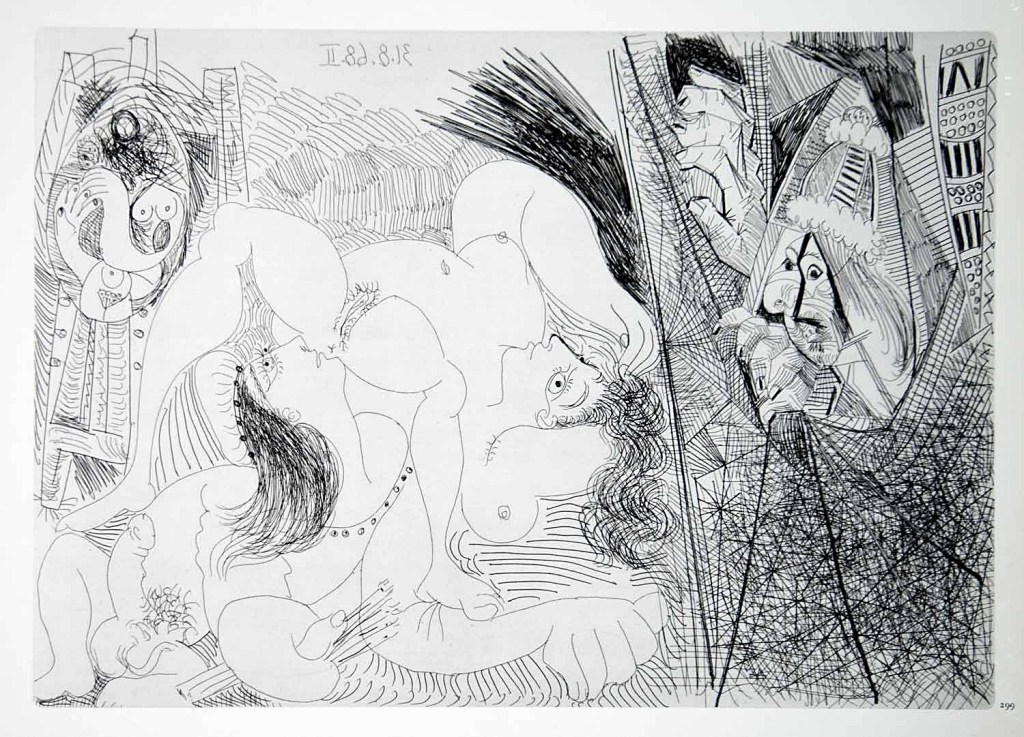
The thin book, Picasso’s Gravures, contained his sexually suggestive sketches. Picasso’s drawings are gestural. His lines make his art look like it’s being fondled. Many illustrations displayed surfaces marred by hairiness, crinkling and stretch marks.

The lines create a curious interplay of dryness and wetness. Picasso’s suggestive drawings in the 1970s opened the door for other artists to explore explicit themes. He owned a collection of sixty-one Shunga prints. Picasso’s interest in Shunga is a key theme in the chapter “Artist and his Model”.

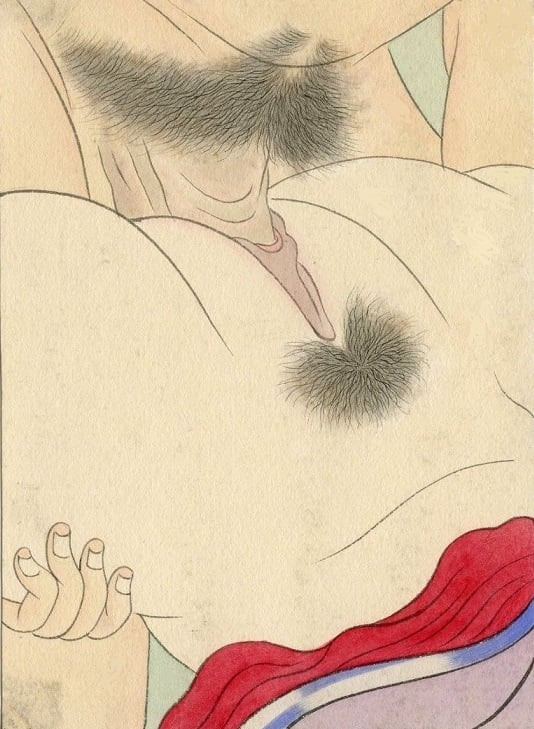
An example of eighteenth- and nineteenth-century shunga

“A lot of the eighteenth- and nineteenth-century shunga books contain enlarged images of male and female genitals, occasionally while engaged in the sexual act. These kind of ‘close-up’ designs were intended to provide instruction about anatomy and how to give pleasure. These educational images are mostly found immediately following the other illustrations in shunga books. Such prints are modeled after older versions that were used to teach human anatomy, which showed different shapes of male and female organs.” -Marijn Kruijff, Editor of Shunga gallery Erotic Art Magazine and is the foremost authority on shunga art.

written by Mitchell Pluto 2025

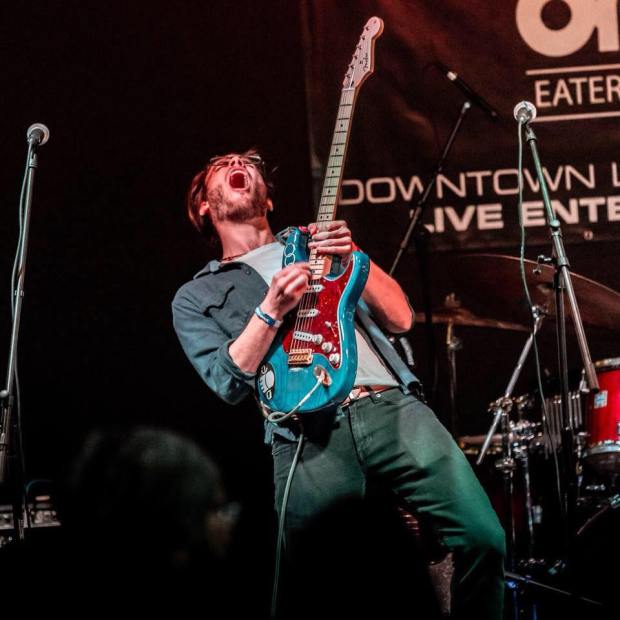
Manuel the Band

My mother has always told me “it started in the womb, ” so I think music has always been a sort of innate thing for me. My mom would play the piano and sing when she was pregnant and noticed that I would dance and smile to the same songs after I was born. So, I’ve been a musician literally even before I could remember! Which is a really cool thing to think about. Throughout elementary school, I took piano lessons and even joined a steel drum band when I was 12. I played with them until I was eighteen. Growing up in a small, New England town, playing steel drum music in the dead of winter was a superb treat- it’s so hard to be upset when that music is playing. Along the way, my mom would buy me those musician starter packs- the ones with a small amp, chord and stuff. At the time, they were like $100 and my mom would tell me to teach myself. So, I did. That’s how I learned guitar, bass, drums. You name it! I was very fortunate to be exposed to so much music early on in my life- there’s no doubt it impacted me becoming the musician I am.

What gives you inspiration?

I think this, like many things, ebbs and flows. I hate to sound so generic, but I like to write about real life. I’d say, the majority of my songs are about what was going on at the time. Lately, I’ve been on a writing kick that I call “millennial struggles” Ha! I’ve been writing about things like being able to pay rent, not understanding why career growth is so hard, questioning the realities of what my generation was told we could do. Needless to say, going to college doesn’t grant you that white picket fence and a comfortable salary like many said it would…and sometimes still do. So, lately, it’s been a lot of those kinds of talking points.

Which musicians have had the greatest influence on you?

Hmmm. I’ve always been a big John Mayer fan. Song writing wise, he has such a cool way to synthesize emotions and feelings into complex, elegant poetry. In Your Atmosphere, I think, is a beautiful example of that and I’ve always strived to have my “in your atmosphere” song. Still going for it. I grew up listening to a lot of folk, Joan Baez, Kingston Trio, Peter, Paul and Mary. So, I always feel at home with an acoustic guitar and people singing in harmonies. That’s just my roots.

What musical genre is closest to your heart?

I think folk, singer -song writer. In my opinion, it’s the most vulnerable. It’s usually lyric focused and I love listening to what people have to say. There’s something about hearing a song with simple chords, but with words that clearly mean so much to that person. That means the world.

Did you study music in school?

Not formally, no. I studied history and economic development. Spent a lot of time traveling around the other parts of the world conducting research on a variety of these types of topics. I feel very fortunate to have been able to write about subjects like poverty, development, immigration, ethnography, etc. But even though all of this…I’ve always managed to bring a guitar with me!

Manuel The Band Locations 

Manuel the Band Spotify

Manuel the Instagram

Manuel the Facebook

Manuel the Youtube

www.manueltheband.com

@manueltheband-IG/FB

Like Father, Like Daughter: Inherited Visions

Mighty Fine Arts presents “Like Father, Like Daughter: Inherited Visions” featuring new work by Johnny Olson and Madelyn Olson. This show opens with a reception for the artists on Sept. 27 from 6-9 pm and will run till Oct. 26. It’s a family affair at MFA with a premiere exhibit by Mad Swirl spoken word master Johnny O and his exceptionally talented daughter Madelyn.

By Steve Cruz, curator/owner of Mighty Fine Arts

Johnny Olson

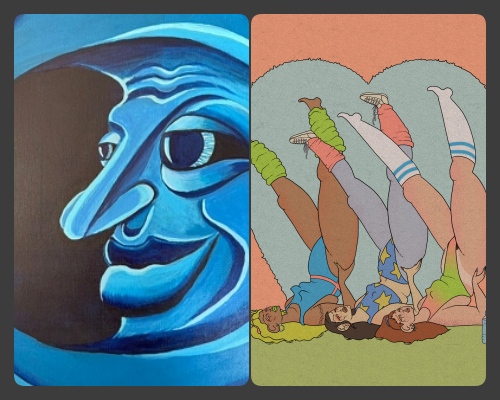
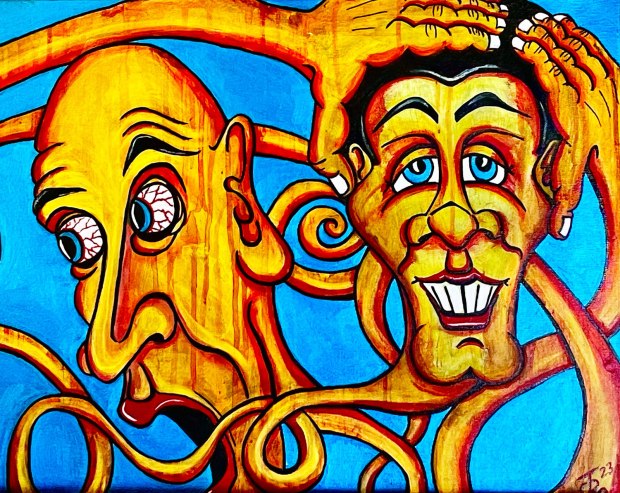
Both are figurative based artists who exaggerate and elaborate on the human condition. The characters they create derive from some overarching personal narrative but they manage to resonate on a mythic universal scale. Their approach is also filled with imaginative humor and playfulness with a touch of satire. The resultant effect is ebullient and energetic imagery imbued with creative fervor. Father and Daughter are cut from the same cloth and blessed with uncommon virtuosity.

Madelyn Olson

Also on Opening Night Wordspace Artspeak presents a musical performance by Swirve! Chris Curiel fronts this avant garde collective of liberated musicians devoted to free thinking and improvisation. Their goal is to release your mind from convention and neurotic restraints with cosmic soundscapes. Come experience and get emancipated with Swirve!

Mighty Fine Arts
409A N Tyler
Oak Cliff Texas

Johnny Olson was born on a brisk November day in 1970 in Chicagoland. He found his feet & cut his teeth in the blue-collared working class neighborhoods of his hometown. In 1988 he was reborn in MCRD San Diego, where he found himself the new title of United States Marine. After surviving the Gulf War, he hung up his BDUs & turned in his rifle to instead grab his pen & brush where he rediscovered his passion for writing & painting. In 1998 he found himself in Dallas, where what was supposed to be a brief stint in the South turned into over two decades… & counting.

In 1999, Johnny, with a couple of other mad cohorts, started Mad Swirl. This ‘zine project has now evolved into a being all its’ own. After wearing too many hats, he now only wears a few at Mad Swirl: Chief Editor, Creative Director & Host at Mad Swirl’s monthly Open Mic night & Mad Swirl’s Quarterly podcast, “Inside the Eye.”

Johnny’s work first appeared in print in 1996 in the now defunct Lip Magazine. Since then, his words & images have found their way onto a few online and printed zines thru the years. To name a few: Mad Swirl: Issues I-VI, The Best of Mad Swirl : 2017-2024, Haggard & Halloo, 10k Poets, PAO Productions: The Open Mic Project.

My name is Madelyn Olson and i’m an artist (anyone else have a hard time claiming that title?), primarily creating  in Procreate or on paper with ink & watercolor. i’ve been creating since i could hold a pencil in my tiny little hand. to me, artistic expression is one of the best things to exist. i hope to both create & admire it all till it hurts. when i’m not creating and admiring creation, i like to eat, hang out with my dog, laugh at silly things with my friends and frolic around outside in the sun.

The Lyre of Truth By Mitchell Pluto

Originally published as Carnival House in Cadaver Dogs 2024 and Espiral en el Estuco (Spanish Edition) 2025 Adapted for public reading.

All Rights Reserved by ©Mitchell Pluto

The lesser mysteries were open to anyone who wanted to join the lively street parade, but unraveling the secrets of the greater enigmas involved being selected.

The secret group of performers included actresses who helped change people’s perceptions of themselves.

A spine and a brain were simply a keyboard to play.

Few know the mysterious past of the mystery troupe. Some say they are witches, while others claim they are ingenious philosophers.

Many suggest that their extraordinary four-dimensional theatrical experience has the potential to induce a psychic state in the audience.
No one can answer with certainty.

The authors of the show will remain unknown to us. The key is self-exploration to better understand the thing we call ourselves.

I was inspired by witnessing their performances, especially considering the restrictions that prevented women from participating in Hellas theater. I wanted to see how the mystery play portrayed metempsychosis.

A dignified woman handed me an invitation.

I considered myself lucky.

The statements of the friends who attended concurred: all who ventured into the underground temple emerged transformed and with an enhanced mind.

My goal was enjoyment, whether the secrets were imaginary, sexual, or drug-induced.

Following the temple’s instructions, I performed the ablutions in the river. The first performer was a fisherman, who told me he was looking for pitch, rhythm, and duration. He cast a line, and I caught it.

He led me to the bank, and I followed him to the temple.

Crows in flight watched us as we walked. They have been trained to memorize and vocalize my name. The birds amuse themselves by taunting me with predictions related to my failure.

At the entrance, ancient emblems were visible. The door panel resembled the shape of the sarcophagus of Usiris, god of the chthonic realm.

The symbols painted on the door also matched those of the Shiva lingam, the serpent of Asclepius, and a symbol resembling a symmetrical pine cone.

To begin, I knocked on the door three times. Aegle, a very cheerful hostess, greeted me by name. A pleasant feeling of well-being washed over me.

She was generous and held a cup.

The dim candlelight cast strange shadows on the walls of a dark room.

Someone had placed a coffin in the floor.

This coffin supported a staircase that led down into the earth.

With each step down, the rungs became wetter, their textures mysterious.
I decided to ignore what I felt and focus on something else.

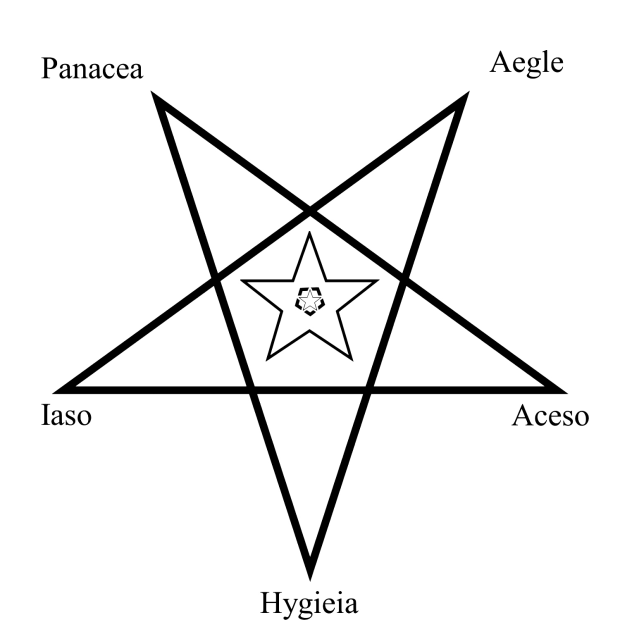
Taking the last step, I found myself inside a pentagram drawn on the ground. A woman was present at each point, one of whom was my host. They introduced themselves.

Their names were Hygieia of Purification, Panacea of ​​Medicine, Iaso of Revitalization, Aceso of Operation, and the hostess, Aegle of Joyful Strength.

There I received the first cup, called kykeon. Its taste was reminiscent of strong beer. With their voices united, the women expressed their thoughts through chants.

Flutes could be heard in the background.

The music intertwined, creating a mixture of harmony and discord that reflected my physical fluctuations.

At different corners of the star, the women rotated and alternated their positions.

I joined in this movement by observing; I felt a deep satisfaction and confidence.

With a sudden pause, the music ended, leaving behind an eerie silence. I was handed a torch. Aegle and her sisters lead me down a dark corridor, their arms poking through holes in the wall, ready to support me.

Panacea advises me to be careful of the light source as I make my way through a maze of several thick, damp curtains. Some of them being hanging animal furs.

We enter a chamber bathed in a soft green glow, with walls adorned with stained-glass windows that form an octagon.

In the center of the room, a golden chair has been placed in front of a small well.

I feel the women’s hands as they take my torch and guide me toward the well.

They buried me up to my neck; their soothing voices offered me some comfort, but not much. In a melodious voice, Iaso spoke my name, and the sound hung in the air.

Silence filled the space as a woman, dressed in a sheer black peplos, entered the room.

She embodied the sensuality of Demeter with her full figure. A shiver ran through her body as she sat on the golden chair. I stood before her, unable to move.

Aceso poured me another kykeon and gently held it to my lips. Then, Hygiea poured water on my hair.

The sisters took turns drawing rings around my head on the ground.
They created a line extending from my chin to the circumference of the circle. Hygiea sang a song, showing me how music serves as a compass in life.

As the song ended, Demeter rose from her chair and her eyes met mine.

Demeter stood on the outer edge, where the diameter and circumference met.

On her knees, she revealed her vulva by opening her skirt.

Demeter’s voice gave me a strange atmosphere.

The woman used an onomatopoeic effect, employing primal sounds instead of words. I imagined myself transported to a time before civilization.
The sounds displayed wild, sexual, and disturbing characteristics.

The five sisters dug me out and cared for me as if I were an uprooted plant.
They passed me a torch.

Iaso led the way, and the sisters followed. We entered a rotating, cylindrical tunnel operated by hydraulic power.

Maintaining my balance is a challenge.

A mirrored curtain distorts my reflection at the end of the tunnel.

Aegle advised me to face it head-on, passing through.

Behind the curtain, two steam vents dispersed. As the water vapor dissipated, a huge relief of a nude Demeter rose on a stone wall.

A raised walkway gave access to a door located where her vagina was.

The river of figures, dressed in contrasting black and white, moves in a choreographed, serpentine formation beneath the bridge.

This creates a deep unease in me.

The work depicts a battle scene, with soldiers sinking beneath the tides, their screams muffled by the earth.

This is iron and other minerals being sacrificed.

The haunting, animal wail freezes the moisture in my body. My only concern was the fear it created, overshadowing the actor’s talent and the astonishing stage effects. The fiction’s realistic portrayal convinced me of its truth.

I received Panacea’s advice to remove myself from disturbing thoughts.
Aceso takes my light and signals me to enter through the door. Hoping to find safety, I pass through colorful layers of scented sheets that release fragrances and pheromones, easing my discomfort.

I find myself in a spherical chamber. There is a portal in the ceiling that illuminates a rectangular bed with sunlight.

The sight of countless fresh flowers hid any trace of a wall, giving me time to recover and admire the intelligence of nature in each petal for many hours.

The group of five sisters entered the room dressed in black. They asked me to undress.

The intention was to remove any artificial obstacles between the goddess Persephone and me.

They prepared me, washed me, and offered me a calming drink that later became a potent aphrodisiac.

The sisters massaged my body to align the points with the star’s proportions and gave me affirmations that, to this day, have a positive effect on my thinking.

Persephone entered the room.

The woman removed her clothes.

Persephone had a youthful, simple face, with a pear-shaped body.

The five women formed a star constellation, with us at the center.

Hygieia sang a comical song that brought us both joy and laughter.

It was followed by a song that filled the air with sad melodies. It awakened a bittersweet sense of rediscovering something long forgotten.

Accompanied by Persephone, I experienced a sense of wholeness that completed the missing pieces of an unfinished picture.

Before we met, like a blazing and radiant star, Persephone comforted me.
I fell into a deep sleep with lucid dreams. I understood totality within an ever-present circle.

Revelations fueled my growth at every stage of my past life.

Everything I observed, inside and outside my thoughts, shone with brilliance.

I reached a state of peace where there are no boundaries.

By providing me with palm trees and poppy stalks, the group of five sisters acted out a brief skit where I was a man impregnated by the goddess.

This metaphorical journey disturbed me.

Panacea informed me that this ritual fostered the growth of a man’s inner woman, the anima. I must nurture my visionary mindset, inspired by the goddess Athena.

She reminds me that Athena was born in the head of Zeus. I am told she will heal my masculinity and that women will invite me into their bodies without fear.

Soon I observed the full moon within the oculus of the curved ceiling.

Strangers and street people filled the place.

Plainly dressed, Demeter and Persephone passed unnoticed in the crowd. With the room packed with spectators, I became the center of attention.

Someone announced my passing.

Despite my presence as a living being, the actors remained absorbed in their characters.

A tower of sand lay beneath the bed block that fit over a hollow.

The sand trickled out as vents opened from a lower level, sinking the bed.

Spectators showered me with flowers as I slid beneath the dark floor.

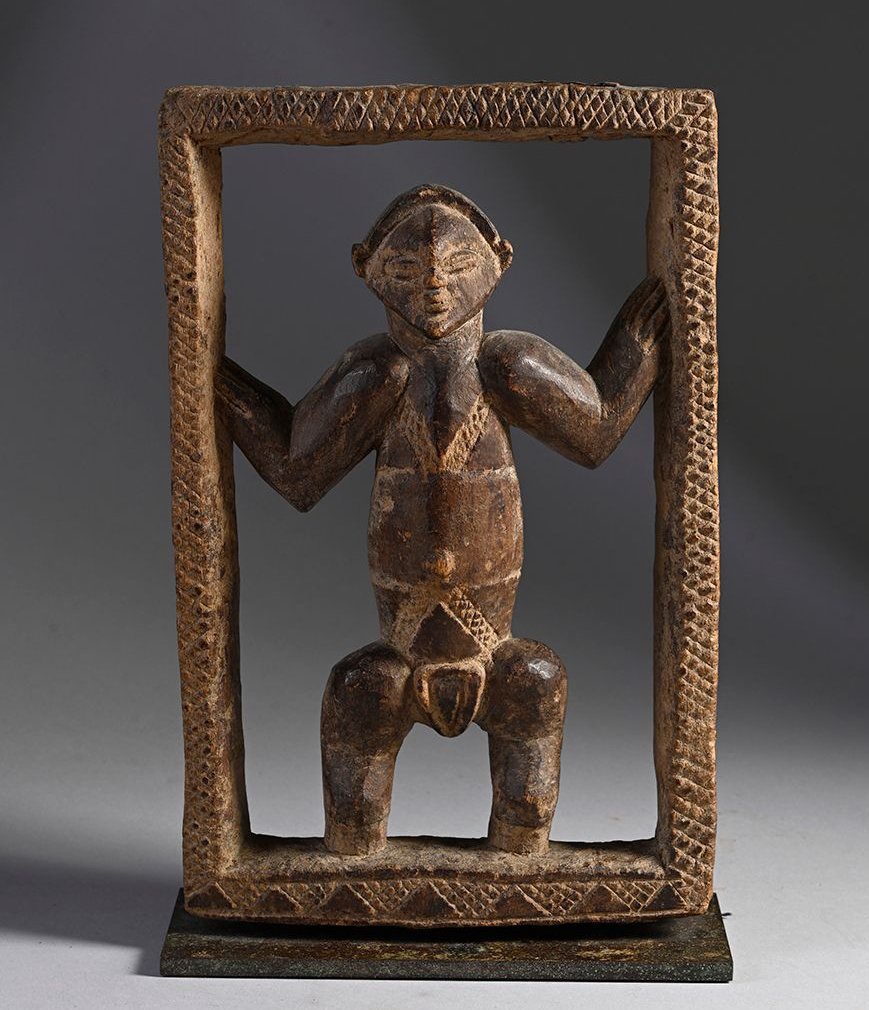
Soon, my perception was limited to that of people huddled in a suspended rectangular frame.

I kept my gaze fixed on the figure until it faded into the distance.

I analyzed the impressions the theater had left on my mind.

Love swept over me, but it vanished in an instant.

The elevator stopped, and I found myself surrounded by curtains of an intense magenta glow.

From behind the curtain, an open hand appeared, and without hesitation, I reached out and shook it.

The cavern I landed in had braziers lit with purple and red light.

Precious stones adorned the cave walls with sparkles.

A bearded man, dressed in a crocodile skin, held a horned cup and told me I was expecting too much.

The five sisters, the attendants, had transformed into untamed figures, wearing only leopard skins around their waists.

Their breasts swung and their hair was disheveled.

He handed me the drinking horn, and I drank.

I asked him if this was Hades.

He replied that it was only a mortuary cave, ruining the disturbing image I had conjured in my mind. He said it was his place, Pluto’s lair.

He instructed me to follow him through a door where cavernous formations resembled fangs.

With some effort, we arrived at a dining room fit for an emperor.

Someone had prepared the food and placed it on the table.

He ordered me to sit down and eat, which was more of an invitation.

The five sisters consumed their food with an exaggerated display of hunger.

It was comical, but they played their parts so well that it became unsettling.

I hadn’t eaten in a while, so I was hungry.

While I was eating, Pluto was playing cat’s cradle. He braided a rope and handed it to me.

He told me to tie it around my waist and meditate on its meaning.

After we finished eating, Pluto led me to a mannequin wearing armor.
Pluto instructed me to put it on.

As he molded a piece of metal on an anvil, he told me to wait for the monster clown, whom he called Shoort.

I remained worried, expecting something to happen at any moment.

But nothing happened for a long time.

As I dozed, a creature emerged from the darkness.

The sisters sang a discordant chorus without fanfare or relief.

Rising, the creature demanded attention with its intimidating presence, asserting its dominance by finding the deepest fear within me. The monster took over my most intimate space. Fear paralyzed me. I reacted and broke free.

I fought the monster and stopped it, surprising myself.

Pluto yelled, “Grab the mask!”

I removed the mask, revealing the actor who was the fisherman.

Comically, the fisherman confessed to giving in, explaining that his actions were part of an elaborate plan to deceive me.

He said he had no choice but to follow orders.

I was about to delve deeper into my interrogation when a child’s crying diverted my attention.

Within seconds, I stumbled upon a boy trapped in a tunnel, out of my reach.

I untied the belt and rescued the little boy from the hole.

He hugged me, expressing his gratitude. The boy identified himself by my exact name.

Pluto and the five sisters clapped and cheered.

The women congratulated me as Aceso offered me a soft drink laced with anesthesia.

I woke up. The five sisters, disguised as bearded men, stared at me. They mocked the male voice as they spoke.

The voices were authoritarian, harsh, and angry.

Their question: Why did a woman like me lose consciousness?

I admitted to them that I didn’t understand what they meant.

The performers held me captive in their irony while remaining in character.

The ‘men’ helped me up, patting me on the buttocks and chest as I stood.

I realized and saw that we were performing on a stage with an audience present.

Through a mirror on the wall, I realized that someone had dressed me as a woman without my consent.

I protested, but discovered my role was silent.

The actresses did an extraordinary job pretending not to hear me.

Although the audience could hear my voice, they made unpleasant comments.

It didn’t take me long to understand the plot of the play.

The setting was a brothel. As an enslaved woman, I was traded for work in a prostitution establishment.

Three sisters took on the roles of slave traders.

Their authoritarian and malicious voices terrified me.

The remaining sisters portrayed the owner and the client.

The client’s expectation frightened me.

I kept overlooking the fact that it was only a simulation.

Now I saw the expectations I had hidden from the Aegle when he first greeted me.

My reflections were becoming visible in other people.

Three sisters crowded around me and, with surprising force, threw me into the crowd.

My body moved over the surface of the crowd, which tore off my dress while groping me.

As I reached the back of the audience, the five sisters intervened and embraced my exposed body.

By symbolically becoming a woman, the ritual allowed man to enhance his masculinity and develop greater empathy. Then, making love puts us in touch with a divine state.

The act of this love to women made me sense a connection to a godly presence that is universal.

My deepest longing becomes the foundation for love and creation.

I began the day by integrating tattvik tides into my exercises, and I could already feel a mature rhythm in my being.

I challenged myself blindfolded, while my eyes remained fixed on the shapes of my imagination.

Among the variety of tattvik shapes, the representation of air is a solid blue circle.

Earth is a transparent yellow square.

Fire looks like a red, triangular liquid.

Like a crescent of flaming silver, the water shimmered.

In the mind, the tattvic form resembles a dark egg.

It absorbs all light and is even darker than the surrounding darkness.

To complete this task, I visualize the symbols and relate them to other elemental designs.

It is important to replicate the images as accurately as possible and analyze the reasons for their deterioration.

By tracking and observing how the images deteriorate, I can understand other subconscious thought forms.

Later, the sisters led me to a cubicle with mirrored tile floors, walls, and ceiling.

Three chairs surrounded a triangular table at the focal point of the room.

On the table was a flat, round plate that looked like a coiled snake. I discovered that this was a game called Mehen.

I played a bit of Mehen with the twins.

It was difficult to distinguish who was causal and who was perpetual.

One twin is the other in the limited form of the eternal idea.

They seemed like four instead of a pair.

The twins embodied a perfect living square, treating all sides equally like Nzambi.

I participated in a couple of games. I fell short in the first, but won the second with the help of a lion.

These two events made me reconsider my participation in the works I was involved in.

Now the final ritual was taking place in the Telesterion, an acoustic pillared hall.

Throughout each ceremony, the dedicated team of sisters accompanied and guided me.

Like markings on a score, each sister represented a bar line, providing pitch, tempo, and duration to facilitate my experience.

The five daughters of Asclepius moved within the staff, shifting positions. Their perfect harmony generated a unicursal rhythm, instilling a sense of unconditional well-being.

At that moment, I stood before the god of the sun, the star that radiates growth, maturity, and harmony.

Apollo has a dark complexion.

He wears a reflective suit that reverberates with the surrounding surfaces. In his wife’s hands, a harp resonated with soothing melodies as he played the saxophone.

Many birds fluttered around him as he played.

The final stage of the ritual involves offering a song to the radiant sun, which fills the atmosphere with harmonious melodies.

The star embodies the force that drives people in their pursuit of well-being, intelligence, and benevolence.

Keeping music in our hearts aligns all the chords around the goddess.

This connection reminds us of our deep philosophical connection with nature and its impact on our well-being.

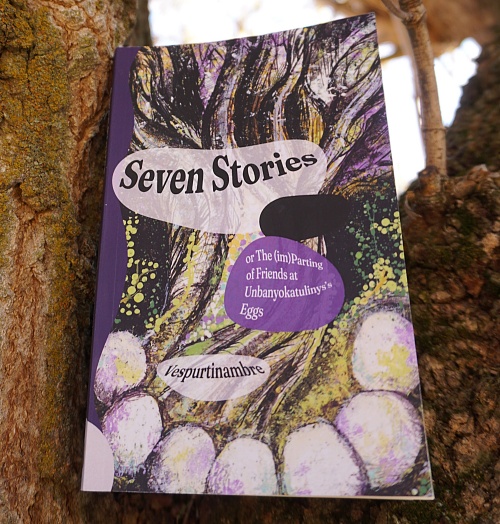
Hager Youssef, Halal

When everything becomes permissible,
permissible,
permissible,
I will turn off the lights
as a war upon the world,
and make love to sleep and time
in the same bed.
A woman like me, at night,
devours herself,
and in the morning,
returns entirely whole.

Permissible, permissible—
if I shatter the mirror
with a laugh.

If I open the windows
to the insects,
and your face,
leaving behind
my shadow—
may you swallow one another.

Or if I keep you inside my palm,
hide you behind the guest china,
maybe, if I sweeten your fragments,
you’ll still fall short.

Permissible—your vision falls
from the innocence wall
like worn-out shoes,
and the night sings a vulgar hymn,
as it should.

I will show you my painted limbs
and won’t ask you where we bury
lust—in white cotton,
or in a new glass.
I’ll place on your grave
a sacred symbol
befitting tonight’s blasphemy.
Everything’s permissible,
where pleasure
forgives sins for their loud voices
and wakes in me
like an animal
from death.

Deferred to you—
like a poem no longer fit for use.
I will be just fine
when I’m between two walls,
where mercy and mercy—mercy.

I sleep in a bed stretched out like punishment,
and beside you,
I dream of an impossible crime.
And when I permit you,
when you permit me,
when the night
permits everything—
we will yawn.

Hagar Youssef is an Egyptian poet and writer based in Cairo. She has published a poetry collection titled “A Damaged Memory” in Arabic and she is currently working on two collection stories: “Dreaming With Two Heads” and “One Day.” She graduated from the Faculty of Education – Department of Sciences. She has written for various platforms, including those focused on feminism and gender studies. Her work explores the essence of language, deeply influenced by philosophers Roland Barthes and Georges Bataille, in linking love, pain, and death to language, deconstructing these themes. She is also passionate about translating literature and poetry, reviewing books, and writing journalistic and critical articles.

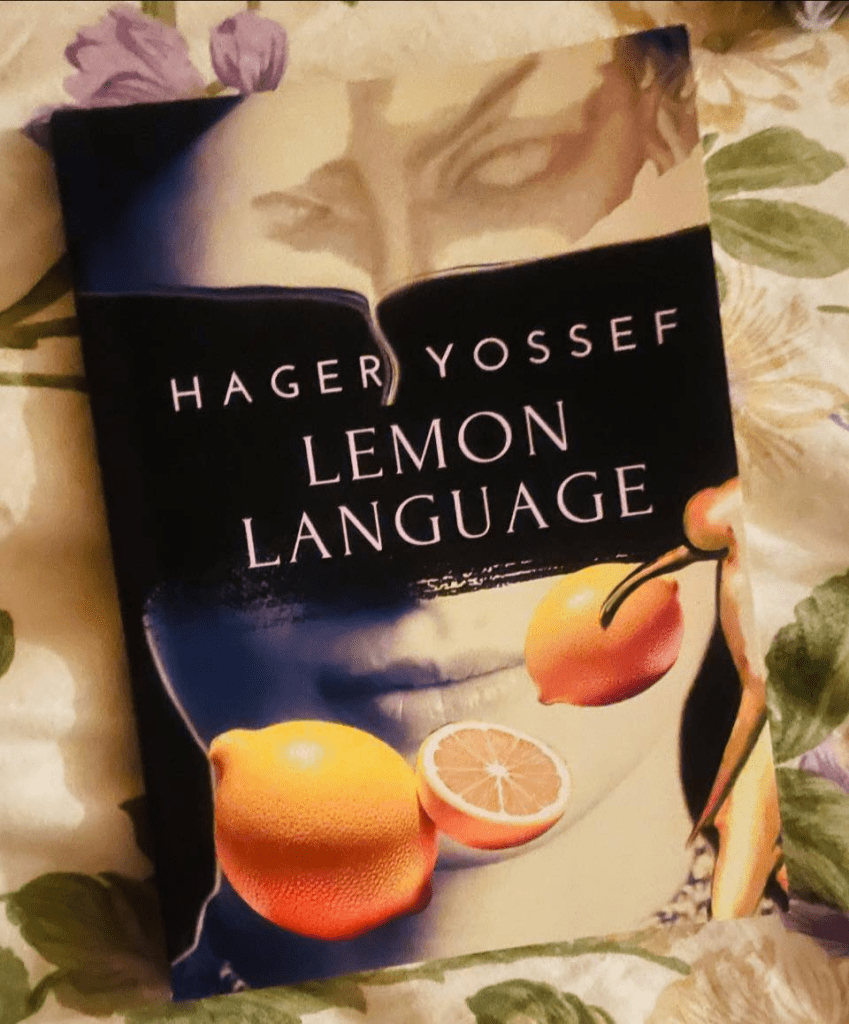
Lemon Language Paperback – November 22, 2024
by Hager Yossef

The Banquet of Banality by Hager Youssef

The Banquet of Banality

It was too much—

your friendly chatter

with a plastic doll,

beside all my womanhood.

Too much closeness,

and not enough of friendship’s honor.

You dressed your attention

in a shirt far larger than your frame,

and wandered all night

seeking someone to stitch it tighter.

Fevered listening,

inflamed reactions,

obscene exaggeration,

and a sugar tongue

with no cause.

Your talk—

not just the melting

of social shyness,

but constant calls

of a drifting gigolo.

In the light’s reflection

in my glass,

Narcissus

appears smirking,

then fades.

This woman

stuffs her misery

with your emptiness,

and leaves,

utterly emptied by your absence.

And I—

beneath the weight of analysis and inquiry,

will sleep well tonight,

for I won’t let your butterfly

scratch a hole into my mind.

That banquet of banality—

doors whose insides I know too well:

the illnesses of ego,

the body,

and your childhood—

where it seems your own hand

chokes the other lost in itself.

The other women leave delighted—

They got their change

from the shiny illusion

they came for:

illicit praise

drawn from both my shares.

But I—

I’ll go home

in my white dress,

just as I came.

All I lack now

from such tired evenings

are the symphonies

of your lies.

My Weather Is Fragmented, Beautifully Distorted

My weather is fragmented,
beautiful in its disfigurement,
it writes me upon a page that quivers—
like a vast, open hand.

I’ll hang my first face on the door.
In the wild haste of love,
I’ll let you enter.

This night
lengthens over me
like a mosquito.

This lamp
only illuminates
my fear.

My second face
is dark and wicked—
like a rat in hiding.

The third, I vomit
onto the body of air,
into a bowl of memory,
like a child,
retreating into his mother’s breast.

The fourth is a mask of fire.
When you choke me,
I think—
you are making love.

The fifth, a nail in my throat.
I hammer it in,
and spit out a sixth face
that will never be complete.

The seventh sees nothing,
hears nothing—
he simply cages his sorrow
and mutters.

The eighth
sings to you
in the voices of prostitutes.

The ninth writes poetry
without faith,
sketches you on my back
with a broken fingernail.

And I—
when I sleep within you,
and rise without me,
like a tattoo,
when you forgot my name
and screamed:
“Who am I?”

Alcoholic privilege night

When my beloved is drunk,
I become a wound upon his cheek.
He strikes my chest with an empty glass,
Saying, ”This bell—this is what wakes me.”

When he drinks,
He opens my mouth like a pit,
Searching for his name,
For a button he lost
As we rushed back toward childhood.

He loves me swaying
Between two chairs:
Truth—
And the guilt I know,
When he mistakes me for a window,
When he spills the wine
As an apology on my behalf,
Like the blink of an eye.

When he drinks,
My arms multiply in his memory.
He summons them to soothe his pain,
Asks me to plant my tree
Right here—
Above his eye,
A finger for his throat,
And a final finger pointing to the wall:
“Embodied—as if you were pure awareness.”

When he’s drunk,
I draw back.
He runs like a shadow
Caught in light,
Bleeds me
Into some vague emptiness,
Traps me in a space
Shorter than a whisper,
Inside a bottle,
Inside a child’s nature.

He points often—
As if he’s arrived,
As if I were a mouth
He must enter,
Not merely behold.

Hagar Youssef is an Egyptian poet and writer based in Cairo. She has published a poetry collection titled “A Damaged Memory” in Arabic and she is currently working on two collection stories: “Dreaming With Two Heads” and “One Day.” She graduated from the Faculty of Education – Department of Sciences. She has written for various platforms, including those focused on feminism and gender studies. Her work explores the essence of language, deeply influenced by philosophers Roland Barthes and Georges Bataille, in linking love, pain, and death to language, deconstructing these themes. She is also passionate about translating literature and poetry, reviewing books, and writing journalistic and critical articles.

Lemon Language Paperback – November 22, 2024
by Hager Yossef

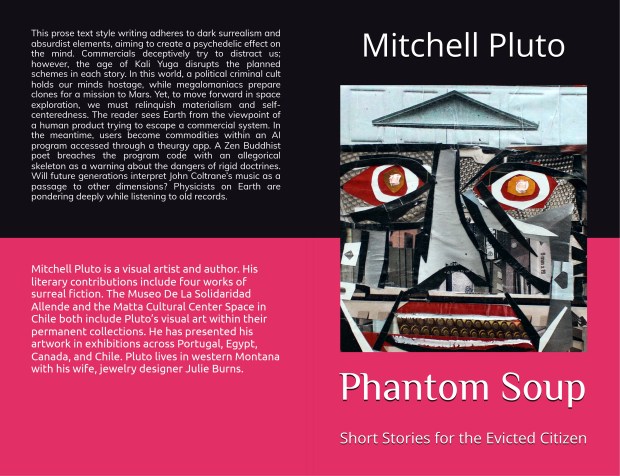
Phantom Soup: Short Stories for the Evicted Citizen

To write something and leave it behind us,
It is but a dream.
When we awake we know
There is not even anyone to read it.

The 8th day of the 4th month, the 3rd year of Kōshō (1457)
Ikkyū-shi Sōjun

Ghost Ride

Phantom Soup © Mitchell Pluto 2025

Accessible for reading.

All rights reserved. Permission grants brief quotations embodied in critical reviews and certain other non-commercial uses permitted by copyright law.

In case you overlooked it, this universe wasn’t lacking in ambition or size.
It was putting on a spectacle with its production.
The cosmos is just incredible; even haters gotta admit it’s breathtaking.
Zanni, the defendant, is still waiting for a verdict.
In space, sentences float around and words drift apart.
His black and white checkerboard suit embodied the polarities of opposites.
He is a man without a country.
A joker in a deck of cards.
Through gestures alone, Zanni attempted to decipher the universe’s communication.
There was drama everywhere, but Zanni just didn’t understand how it worked or how it occurred.
No one ever knew the truth; it died with them, leaving only unanswered questions.
Everyone figured the headache meant they knew what the problem was.
Less pain means clearer perception and a more optimistic outlook.
Honestly, it wasn’t a matter of right and wrong.
Or pain or pleasure.
It dealt with items of worth later becoming trash.
You could tell what things meant to people by how often they handled them.
It’s a space ballad playing both life and death.
No one will sing the sad cowboy songs of unrealized dreams anymore.
It’s alright.
We are part of a sombrero galaxy, a galaxy that is an eternal sunrise.
Zanni was in a giant empty room with waves of random stuff.
His world symbolized a particular responsibility of being.
Special car keys for a 2025 model, a mobile wallet, a decorative cup, a gold pen, a seasonal tire, headphones from 1979, crumpled up Kleenex, a 1990 professional styling brush and a flashlight from 1899.
These objects surrounded Zanni.
Thankfully, a consumer digital camera from 1996 captured a pic of this.
But for who?
Regular waves swapped out old things for newer ones.
Zanni contemplated this event.
He figured the most likely explanation was that he was inside a massive vacuum cleaner.
He experienced a strong connection to things he saw on his trip.
Zanni speculated that the objects he couldn’t name were from a future timeline.
Things appear and vanished super fast out here.
Zanni drifted between sleep and wakefulness.
We can refer to it as a space fog in the mind.
A magnetic memory was his most beloved possession.
It echoed because Zanni repeated it.
He brought it back to mind in a re-run.
Zanni felt the luscious lips vibrate against his ear. It was a figurine of a woman.
Her name was Colombina.
The teal diamonds and magenta triangles on her dress flowed together to create a pattern of doves.
Hand in hand, they created poetry.
The rhythm of their partnership quivered in the shared space.
The couples’ bond created a constant interplay of elements through the intercourse of their geometric patterns.
Zanni maintained his embrace for as long as possible before the vacuum wave separated them.
He could not pinpoint the incident’s time without a clock.
The arrangement of numbers magically shapes the surrounding space. A regular watch shows what’s going on between the numbers.
Of all the puppets, did he alone ponder his whereabouts?
Only he understood his own thoughts and feelings.
Sometimes Zanni heard voices that didn’t belong to him.
Intrigued by the mysterious voice, he followed it.
The voice led him back to his body.
Those seizures and hallucinations gave epilepsy a mystical quality.
His memories of himself were likely because of thinking about Colombina.
He owned the moment, his own little universe, for a single second. Zanni saw himself as a buoy, helping other objects find their way.
But Pantalone, a hunchbacked old man, considered himself the universe’s ultimate authority.
He was a drifting turtleback tomb from another vacuum wave.
Pantalone preferred the nickname “god.”
His face twisted in anger as he guarded his belongings. Losing things got on his nerves. His tailored red suit reflected Pantalone’s importance.
Every item got a brand and price label from him. He believed he understood your true worth more than you did yourself. He used his talent to make you think whatever he wanted.
Those close to him risked having their self-image stolen and used against them.
Pantalone intended for everyone to rent from his cloud.
He lost money in the vacuum wave, then recovered his losses.
This activity provided him with enjoyment, a sentiment he wished to share. Provided that he had more.
Scattered dollar bills wandered everywhere.
The bills, by themselves in space, lacked any connections.
Now, Pantalone found himself surrounded by dancing product wrappers, toenail clippings, old grocery lists, damaged furniture, empty food containers, broken appliances, crumbled up receipts and dead batteries.
Think of it as a garbage cloud.
Several real estate agents, their eyes wide with nervous energy, tried to appear calm as they floated past Pantalone.
They pretended to own a spot by treading in one place.
While this was occurring, Harry Houdini sailed by and unlocked a satellite.
Intrigued by Pantalone’s possessiveness, Zanni examined the egocentric and deceitful nature of his own point of view.
He observed the ego’s memories fade as the mind surrendered its ownership.
Once the fear was gone, relief came.
Houdini cracked his knuckles. “No worries are necessary. Don’t sweat it. It is a simple lock to open. “
The hierarchy reflects the relationships between things in a chain.
An x-ray showed how brain waves link things up through information chains, like you see in neuron activation patterns.
This electromagnetic wave made Zanni wonder about the engineer of the universe.
It appeared the designer wrote a script for a big stage performance but remains anonymous.
In the meantime,
Pantalone reached his own planet.

Phantom Soup: Short Stories for the Evicted Citizen Paperback

Pluto in Aquarius


we are Martians. Aries. Martians from Mars. Let me explain, Mars was like Earth and now since we forgot our origin, we innately burn through every place we live. our soil is sand and glass..we made the moon a clock. Iron shares a special relationship with our blood, a period of sixty seconds. the hour hand is a blade that takes time to trim a heavy circle into a lighter circle. meanwhile, it’s getting late. who really invites Ahura Mazda into their thoughts? the all-knowing one, unless it’s really about an ark with wings or the other curve floating by boat? or is the lost manuscript of Eratosthenes?


Pseudepigrapha is a mercurial ghost, everyone has a ghost story they believe in. George Lutz, a land surveyor, used the positions of points, distances, and angles to channel a much better story than I could tell. Those shapes he conjured made beliefs appear real.


and that’s as real as Sherlock Holmes sending Watson to kill Houdini. and definitely as real as Aldrich Ames misdirecting a whole institution into remote viewing.. but you know, the target gets paranoid and loses when the Chessmaster is late to the game. you know that, right?


What happened to the red bone marrow of giants, you know, the ones who built the pyramids, survived the flood, and were from mars? They must have burned the big foot bones. indeed here comes elimination by illumination, psychological warfare, and the second coming. The Exorcist worked by controlling everyone in the movie theatre by managing what the eyes saw. The eye is a sense of self. yes, the spooks were real and so was the contact lens in the possessed girl’s eyes..Shakespeare was accurate about the world and so was Timothy Leary, whoever controls the eyeballs controls the brain.
Featured photo The haunted footprint at Göbeklitepe/Potbelly Hill by Mitchell Pluto

©Mitchell Pluto 11/21/2022

cultivation phases of the basal ganglia and paleomammalian soul

the psychic robot, how our animal selves passed through the portions of different brain territories. the snakes, the monkey scribe, and now the circuit board advisory city-state. clay tablets as a big golem, ideas as ghosts informing the brain

Languaged, Body Synthetic by Giorgia Pavlidou

How would you describe your painting process and your associative relationship between concepts, events, or mental states of the subconscious? Is there a link between self-hypnosis and inspiration? 

Artists, writers, and poets such as Garcia Lorca, Roberto Matta, Henri Michaux, and even Anais Nin have inspired me to paint. Language, for me, comes first, but the visual can support the verbal. I paint as if I’m composing poetry.

Automatism or improvisation is the starting point – bebop – but I’ve realized that the contours of a, often dismembered and re-stitched, female body appears repetitively in my mind’s eye: think Mary Shelly. This flickering of fragmented body parts leaves deposits on the canvas/my mind. There’s something about the human body that truly fascinates me. This fascination isn’t deliberate, and it’s also strange because I’m more cerebral than a physical person: in my view, the body exists only in the mind. This also solves, at least for me, the century-old dualism: the body-mind split. Or, as William Blake said: “the body is a portion of the soul.”

Man is a machine, and a woman is a sublime machine. If you compare the human and the animal body, the human body is clearly synthetic and artificial. It blurs the boundaries between what’s considered natural and what’s considered artificial. I find that thrilling. There’s nothing natural about us humans. We aren’t becoming robots or cyborgs, we already are. We can’t rely on our instincts anymore as non-synthetic creatures can. There are vehicles in the making that’ll be able to reproduce themselves with whatever material they can find on Mars.
How’s that different from us? You could say that humans think and feel, but do we really? Aren’t we just parroting the words, stories, and belief systems that we’ve been fed? When was the last time you heard a new idea? Something you hadn’t heard before, something that stimulated an innovative thought. We’re the protein by-product of language. Perhaps when there’s trance, a moment of silence, or jazz, an intelligent intuition can unfold in the nerve domain. Painting or poetry can help it develop, transmit and circulate. Possibly it can be fertilized by critical reading or meditation.

Is painting a technique that represents a body disconnected from words? a sort of ‘transmuting neurology’

Transmuting neurology, I love this phrasing. Probably our neurology is in constant a state of desire for perpetual transmutation, but the culture must allow for it. Studying the history of painting, I was excited to learn that the Impressionists had “discovered” different shades in snow, something that nobody had “seen” before them. Isn’t that intriguing? I guess they contributed to an alteration of the general perception and experience of what’s “white.” They are also depicted as the very first in the history of Western painting of social situations such as people dancing or swimming. Nobody had done that before them. That’s why the establishment was so scandalized.
Of course, it didn’t help that the women they painted often were what today we’d call sex workers. Can you imagine that in the second part of the 19th century? Later with expressionism and surrealism, painters gave expression to the ebb and flow of what’s inside the mind’s eye. An interesting artist is Francis Bacon. He claimed that he depicted people as they “really” are. Perhaps some of us are polished yet monstrous or disfigured? Or even, maybe the human condition is one of perpetual disfigurement? Whether we can see without words is something I keep on mulling over. I feel tempted to believe that as humans we need some sort of narrative or linguistic frame of intelligibility to see things. Perhaps we can only perceive objects contextually. Painters should be called pioneers or even anarchists of perception. 

Can you elaborate on how language shapes us by a Languaged body, cultured intuition by sound, and language as a living intelligence?

I’d like to emphasize that I constantly toy with intuitions and ideas, not with truths. The truth for me often is a reductionist and particularly violent concept. Think of all the wars that have been fought over some sort of revelatory divine truth, or in later centuries, the so-called scientific truth. The Nazis had their ideology backed up by scientists’ assertion that theirs was the most evolved race (so-called Social Darwinism), and that certain other races were particularly parasitic and had to be exterminated the same way as rats or cockroaches. So, circling back to the central ideas informing my practices such as the “languaged body” which is a neologism, and the idea that language is a living intelligence, I don’t consider them to be truths. These are frames of intelligibility that have grown under my skin over the years of study, reflection, practice, and meditation. I have no problem admitting that these concepts are nothing more than my obsessions. I’m not a missionary.

I see language as something external to human beings, possibly an organism. In the process of language learning, humans are inserted into this external thing we frivolously call language. There are linguists in Switzerland who’ve developed a theory in which language is a symbiont. So not necessarily a virus as William S Burroughs famously claimed, or that it can turn parasitic in case of psychosis as French psychoanalyst Jacques Lacan suggested. I see our brain + nervous system as a receptor-like radio, tv, or computer, capable of receiving signals and building narrative. In some way, it’s a form of telepathy. By producing sounds, we invoke a whole shared world that has been forged across thousands of generations. Also, we invest our lifeworld, including our bodies, with words, with a story. If our bodies weren’t invested with language, we’d constantly experience ourselves and others as walking talking meat, protein bags, or water bags on legs. When we buy meat at the butcher’s or supermarket, we don’t think of that red stuff as chopped-up dead animal cadavers. We say it’s a New York strip or whatever. Something similar is going on with our bodies. We have names.

This name is somehow “written” on our skin, on our face. I’ve never met anyone without a name, though I’m curious how that’d be. When we feel attracted to someone, we don’t think “that’s a tasty animal.” Some of us might, however. A whole story about someone is activated within us when we fall in love, a concept of what a human being is, of what beauty is, etc. while we all know that a few millimeters under the skin there’s blood and a skull. But who, except a cannibal or a serial killer, thinks about that? The way language has contextualized humans prevents us from seeing the meatiness of a person. But this experience isn’t fixed. There are cultures in which not everyone has human status. Think of the Dalits in India. In Central Africa the so-called pygmy is being hunted and eaten, most probably because their appearance doesn’t conform to the hunter’s concept of what constitutes a human. It’s also interesting to read the private diaries of people who worked in concentration camps, and how they thought about the people they helped butcher or exterminate. Some agreed that Jews, homosexuals, communists, etc. had to be put to death, but they felt it should happen in a kinder way, pretty much how some activists think about animal rights in our era.

Language protects us by feeding us optical illusions. As humans, we’re trapped in a theater of distorted thoughts. It’s as if we need to drive on a busy freeway wearing glasses deforming everything coming our way. All this is extremely disorienting and frightening. I think maybe that’s why there’re so many ideologies and why religion is such a sensitive matter. These “grand narratives” offer the illusion of certainty and direction: how one should lead one’s life, where one should be headed, and where to invest one’s life force. The artist, I think, has been for whatever reason cast out of the Eden of ideology or religion, and is forced to constantly mold and remold her internalized worldviews, knowing often very well that this is a futile endeavor that must be repeated endlessly. But, at least, there’s some motion within. The alternative would be catatonia. 

Artists, writers, and poets who helped contribute and inform your process?

I sound like a broken record when I keep on mentioning Will Alexander. But there’s no denying that his oeuvre provided me with the missing link in my thinking. I have always had an interest in ritual, animism, and shamanism, but with the latter term, we need to be extremely careful. I adhere to academic concepts of shamanism, such as Mircea Eliade’s. When younger I participated extensively in groups believing that they were engaged in shamanic practices. Perhaps some of those did. I don’t want to claim that I have the capacity to say what’s authentic and what isn’t. What I inherited from these experiences is the sensation of trance. Will’s work transfuses both language and animism/shamanism, especially in his The Combustion Cycle.

Without trance, there’s no writing nor painting for me. Writing prose is different. Poetry and painting for me fall in the same domain as glossolalia, speaking in tongues or trance-speaking. Freudian associating on the couch. Will’s concept of language as a living, possibly alchemical intelligence, makes a lot of sense to me. It connects my interest in shamanism and animism with my obsession with language in a no-nonsense way. WA’s poetics is a conscious journey into the imagination. To truly feel this, you need to understand that the imagination isn’t just “fugazi” or fantasy. The Jungians know very well that the imaginal world is a tangible environment, in which one can move around and travel in. There are beings dwelling there. You can develop a bond with these inorganic characters. Jungian practitioners are aware of this possibility.

I think I can say that Occidental culture at this point in history is in a state of coma or autophagy: it’s eating itself up. The criteria for personhood are so one-sided and reductionist that it is extremely easy to descend into a state of being a non-person. Maybe the only option when that happens for some people is to die and, in the process, drag along as many corpses as possible. Ours is a high-risk society. Having said that, I’ve lived in India for three years the comfortable life of an adult literature student. Life in India is no bargain either. Perhaps I have taken shelter in the written word and painted images because I’ve experienced that it isn’t possible to change your own culture with another. Every culture has its own cruelties, sacrifices, and gains, but they aren’t commodities. The difference, maybe, between Western cultures and the rest of the planet is that, as French novelist Michel Houellebecq suggests, the West has sacrificed almost everything for the sake of rationalism and technocracy. 

There are also other artists and poets besides WA that have influenced me. I’m thinking of the “Grand Jeu” poets such as Rene Daumal and Gilbert-LeComte but also Antonin Artaud, Joyce Mansour, and Roberto Matta. Regarding US artists and poets, there’s, of course, Philip Lamantia, whose thinking and work is like a direct mind-injection into my mind: picture a metaphysical phone call without ever hanging up. Other important people would be Bob Kaufman, John Hoffman, Laurence Weisberg, but also someone like Mina Loy, and some beats, in particular William S Burroughs. I feel a deep affection for a lot of artists and writers: William Baziotes, Arshile Gorky, Thom Burns, Rik Lina, Byron Baker, Emily Dickenson, Edgar Allan Poe, William Blake, Lautreamont, Guiliaume Apollinaire, Baudelaire, Rimbaud, Gerard de Nerval, Grace Hartigan, Leonora Carrington, Remedios Varo, Juanita Guccione, and many more.

Bill de Kooning deserves special mention, on the one hand, because nobody speaks about him anymore and because of ongoing the “de Kooning-bashing. But also because my paintings are a prolegomenon (not a counter-narrative) to his disfigured depictions of Marilyn Monroe-type of women, in particular the teeth: Where else in the world is the business of smiling taken so seriously as in the USA? My series of chopped-up disfigured ladies, “Mutilated Madonnas,” are homage and homologous to his.

Haunted by the Living, Fed by the Dead
By
Giorgia Pavlidou

inside the black hornet’s mind-tunnel

by Giorgia Pavlidou

This is intense work. It’s incandescent. It’ll catch your eyes on fire. Burn your brain down. Giorgia Pavlidou has managed to make anguish appear beautiful. And sexy. Artaud is the tutelary spirit of this work. The anguish is real and the words have the taste and smell of the netherworld in its black gown of sibilant pupa. This is language with a biology; it writhes, hisses, and propagates by glossolalic impregnation. Reading these poems is an immersive experience. Here we find madness, anguish, erotica and Rabelaisian humor welded and wed to a language full of “lexical tentacles” and “fire dressed in fire.” It gets under your skin, this speech. These strangely intelligent & autonomous words, manic as wasps in a vessel of glass.

—John Olson

A pyrotechnics of lingual essence, Giorgia Pavlidou’s “inside the black hornet’s mind-tunnel” yields feeling through the language of the heart creating darkened constellations that rivet the inner eye all the while whirling as an estranged yet organic imaginal terrain.

—Will Alexander

Giorgia Pavlidou

Giorgia Pavlidou is an American writer and painter intermittently living in Greece and the US. Her work recently appeared or is forthcoming in Caesura, Maintenant Dada Journal, Puerto del Sol, Clockwise Cat, Ocotillo Review, Strukterriss Magazine, Entropy and Sun & Moon Magazine. She’s an editor of SULΦUR. Additionally, Trainwreck Press launched her chapbook ‘inside the black hornet’s mind-tunnel’ in 2021, and Anvil Tongue Books her full length book of poems and paintings, ‘Haunted by the Living – Fed by the Dead’ in May 2022