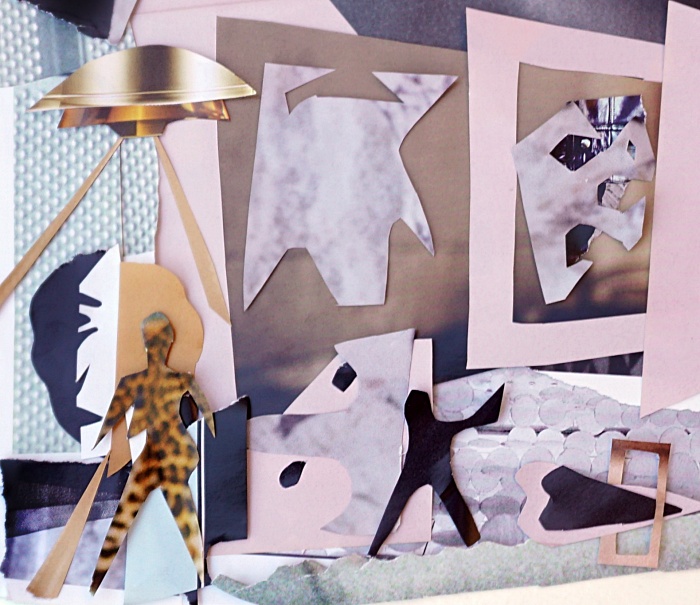
Cell Phone UFO abducting the animistic brain/collage/Mitchell Pluto/2026
Fiction written by ©Mitchell Pluto 2026
Over 11 million people tuned into Mark Burla’s podcast, Under the Light. On July 29, 2026, his most popular episode was with a psychonaut and two government officials. The time was 4:00 PM MT.
Joseph, the astrologer, was on the radio in the background and said, “Hey, it’s a full moon in Aquarius, and we’ve got a cool Sun-Jupiter conjunction in Leo, along with Pluto, Neptune, and Uranus all in sync.”
Burla recorded in his cool, air-conditioned studio while the Taos Mesa swelters in 109-degree heat. From Burla’s window, you could see the dry riverbed of the Rio Grande.
Burla’s podcast comes from New Mexico, also known as the Land of Enchantment.
“Under the Light” is a big hit with people who like occult, mystical topics and urban folklore vibes.
Listeners often recall the interview featuring Daniel Saltman, a former member of the All-domain Anomaly Resolution Office.
“You can totally lose yourself in a story,” Saltman said seriously.
According to Saltman, a large amount of classified data was fictional.
“Spreading lies can be a way to dodge actual problems and politics. Government research shows that odd experiences associated with traumatic memories can create false beliefs. Life’s traumas often lead people to develop coping mechanisms, with some forming extreme ideologies to manage their pain. Other people simply learn to move on.”
Burla thought back to the 1980s, “Yes, I recall when people believed aliens were haunting their thoughts while examining their bodies. But these days, everyone’s got a phone that follows them.”
“To put it simply,” Saltman explained, “our inner thoughts and feelings mold our outer experiences, forming a mental map that we superimpose onto reality. We want to make our fantasies real, to prop up our egos, making us feel special.”
Saltman took a break to drink some coffee.
“The Greek poet Hesiod provides another perspective on the animistic mindset. He’s famous for his poem Theogony, where he introduced the 12 Olympian gods.”
Burla wanted to know more. “What happened?”
“Mount Helicon was where Hesiod had a close encounter of the third kind with the Muses. Through this visitation, he gained poetic talent and divine insight. Each new generation after him put its spin on his tale. Plus, we’ve got ancient Greek theater, featuring amazing illusions such as a crane that lifts actors into the sky. You know, Magic, the reality differs from what you’re seeing.”
In a pic Burla shared, a crane was lifting someone dressed as a god above a crowd.
Burla inquired, “Your thoughts on Christianity?”
“Religion retells a story through its practices, much like Hesiod’s writings, making it more tangible,” Saltman clarified.
“The church has played a key role in Constantine’s empire for gathering information since the First Council of Nicaea. From another perspective, it means employing Christianity to secure political stability. Presently, supernatural concepts occupy people’s thoughts, much like unidentified flying objects.”
Burla nodded, “Tell me something we think is true, but it’s actually not.”
Saltman scratched his chin, “What’s there to say… something your viewers will understand.” His eyes widened as he exclaimed, “I know, the government declassified this… A CIA analyst named Aldrich Ames had a career from 1962 to 1994. Soviet intelligence hired him in 1985 to provide classified U.S. intelligence to them. It was a mystery to us how Russia had gained knowledge of our confidential information, which led us to start remote viewing…using ESP to spy on the Russians. We invested heavily in political narratives throughout the ‘70s, convinced a psychic war was underway. Star Gate was a program meant to stop psychic Russian spies, but it turned out to be Ames the whole time. In ’94, they caught Ames, which led to the permanent shutdown of the Stargate Project. It’s like, things look one way, but they’re really different underneath.”
“Wow,” Burla couldn’t believe it.
He had a podcast about remote viewing a month ago, and back then he thought it was legit.
Saltman quickly intervened to ease the tension. “Speaking of remote, there are these remote-controlled aircraft that can do amazing things. We view these crafts as foreign and domestic groups engaging in espionage. Nobody gets hurt if it’s shot down, but we’re also clueless about who it is.”
Saltman leaned in and said, “For instance, we intercepted a UFO drone collecting microbes from the Great Lakes…Therefore, the ship contained non-human entities.”
Suddenly, the screen went black, and a 15-second commercial for Uranium, a new neon green energy drink, appeared and then dissolved.
According to the podcast stats, Burla’s most replayed bit started with the interview of Terrence Dodge, the guy in charge of the Advanced Aerospace Threat Identification Program.
The fade-in revealed Dodge talking, “We’ve known aliens were real and hiding out here since Roswell. While we assume they’re from the sky, they live underground and use magma chambers and the ocean to get around.”
Thinking quickly about Derinkuyu, the underground city in Turkey, Burla wondered, “Just who are these people?”
“Long ago, before Earth had a moon regulating life, ancient people like the Aryans, Eloheinu, Vril-ya, and Dero lived on Venus, Mars, and Saturn.”
Burla asked in surprise, “The Aryans?” He shook his head, a gesture of utter disbelief.
“Yes, just like Ahura Mazda and Zarathustra. The Iranians are the architects of our social structures, our spiritual beliefs, and the written word that molded our very thinking,” Dodge affirmed.
Burla projected glowing visual effects for viewers as Dodge’s voice continued to weave his explanation.
The images displayed an eye idol from Tell Brak, various depictions of the swastika, and Burla’s contemporary illustrations for The Coming Race, an 1871 science fiction novel by British politician and writer Edward Bulwer-Lytton.
“To be clear,” Dodge added, “those shapes you’re seeing that look like swastikas in history are actually propellers.”
Burla cautiously asked, “Are the aliens white?”
“They looked very pale and old, with slender features and enormous eyes. A flexible cartilage structure supports their bodies, not bones. They can also sense electrical fields from muscle movements. We call this sense electroreception. They can better understand how we defend ourselves and what goes on in our minds to keep our sense of self intact,” Dodge said.
Burla couldn’t believe it and shook his head.
Dodge rubbed his eyes and added, “It’s vital to point out that they are communists and pursue the same aim because of their shared mindset.”
Burla inquired with a hint of sarcasm, “How do they communicate?”
Dodge solemnly stated, “They can duplicate any individual’s innermost thoughts and mentally guide a person’s choices and actions. They understand our brain’s bicameral structure. Here, the Eloheinu aspect commands Abraham, through a voice, to sacrifice his son.”
Dodge paused for a second.
Burla continued his questioning, irritated, “Regarding their ethics, are they driven by humanitarianism or racism?”
“Think of them as zookeepers,” Dodge stated bluntly.
Burla’s face suddenly appeared tense.
Dodge inhaled deeply and stated, “Where there is care, love is absent.”
“They claim they put the idea of God in our heads and that we belong to them… and they also made everyone on Earth using primate genetics. This just proves they think they’re in charge of us. They support eugenics because they believe they’re the best and should be flawless.”
Burla added visuals to this interview segment, overlaying cool images on Dodge’s narration to create a visual blend. These pictures drew inspiration from Richard Sharpe Shaver, an author for Amazing Stories during the late 1940s. Shaver made some wild claims about ancient beings living in huge cave systems underground. Their technology could control minds and cause strange health issues.
Dodge referred to these health issues as “anomalous health incidents.”
Someone in Burla’s live chat, a long-time subscriber, said the tech reminded them of directed-energy weapons, like the ones they think caused Havana Syndrome. This comment snagged way over 4K positive reactions.
The screen went black, then a dog food ad began, featuring a dog in a field.
Then Burla’s face appeared again with another guest.
Mark Burla finished up by talking with Lucian Laplume, a psychonaut who penned the bestseller “Light turns into a poem.”
Burla presented a book and said, “Prepare for a 360-page adventure based on DMT researcher Lucian Laplume. He found intricate communication within light frequencies, appearing as geometric glyphs. These symbols served as time machines, guiding readers from one event to the next. The book talks about how our brains connect with art through words. Laplume’s concept resembles the Vast Active Living Intelligence System conceived by Philip K. Dick. You know, where an orgone beam of light helps clear out energy blocks and makes you feel better.”
Laplume rested his head in his hands, his elbows on the worn surface of the table. “Despite wild ideas and peculiar sights,” he murmured, “those relentless phantoms haunting me–even with them present, I found myself here, repeating this same action. I felt compelled to construct coherent sentences, as if compelled by fate,” he sighed.
Burla inquired, “Do you think unusual aerial signals are altering our brainwaves?”
“It’s just a matter of tuning it in, like this,” Laplume gestured with his hand, tracing an invisible dial in the air. “The trick is knowing which frequency to hit. And that, my friend, is the art.” He then leaned back, a satisfied glint in his eye, as if he’d just revealed the universe’s most profound secret.
”Could you elaborate on why glowing glyphs matter?”, Burla asked, smiling.
“Under the influence of DMT, gazing at a laser on a surface presents what looks like alien script, a visual fusion of various letter shapes, comparable to polyglot portmanteaus created by combining parts of letters. I call it Unidentified Cosmogram Permanence.”
“What’s that?” Burla asked.
“Recollection of numbers and letters is possible without sight, yet thought visualizes light for remembrance. Modulation alters the functionality of a light source. It alters the light wave’s phase. This encodes stable information. The light is like a dancer, whose poses shift to convey a story that stays put. Geometric shapes seem to float within the story. It’s possible, we believe, that these shapes mirror our feelings and intentions, much like a bond with numerical concepts.”
Burla’s impatience was clear as he questioned, “What in the world is this agency enclosed in light?”
Laplume in a sympathetic voice, “I’m struggling to explain it, even to myself. My understanding of this relies on a comparison to James Joyce’s experimental work, Finnegans Wake. Joyce’s language acts as a self-sufficient, living linguistic system that induces synchronicity in the reader as a side effect. You don’t notice it while reading, but it sticks with you later. Meaningful coincidences appear twenty minutes after you read it, aligning your thoughts with your surroundings. Just as you envisioned an idea, it appears. It’s like the symbol went straight from your eye to your brain. Although we routinely think in words, this cosmogram invasion seems to modify the very language that governs our comprehension, which contains our perception.”
“What does this imply for future events?”, Burla asked.
“My understanding is that it’s about rethinking our whole mental architecture. It’s like our inner programming is shifting, making us see things in a new light with fresh ideas. When it all comes together, your inner self transforms, and your surroundings mirror that shift. If we had more time, we might figure some things out, but we might never know where the cosmogram came from or learn more about it. We’re greedy for knowledge, but it’s impossible to get it all. Guessing and being incorrect may somewhat increase our understanding as humans, but it won’t ever lead to complete enlightenment.”
Burla replied with a warm smile and a nod, “We have arrived at the Zen point, the place where fullness becomes emptiness. It’s been a pleasure having you, Lucien Laplume.”
Burla’s gaze moved across the paper on his desk as he read aloud.
This morning while reading, a question that came to mind struck me: “Do you use bitcoin?”
Bitcoin’s been on my radar lately. At first, its technology and potential were a bit fuzzy. Turns out, the deeper I dug, the more I saw just how amazingly practical it is. The ease with which we can now send, store, and utilize digital assets is revolutionary.
This is exactly why the Fedit app excites me so much. This thing is a lifesaver for getting and keeping track of those digital coins. Sending money with the Fedit App is super fast, just like electricity!
It’s super easy to use, so even if you’re new to crypto, you can totally figure out how to get around.
We’re excited to announce a special offer for a limited time to celebrate the launch and encourage people to jump in. You’ll get 100 free credits in your mobile wallet if you sign up for the Fed App today. This is a chance to discover how easy and powerful the Fed App is.
We think the Fed App and bitcoin’s growth are a big step forward for money tech. We hope you’ll check out this chance and join us in stepping into the future of digital money and data centers.
Burla grinned, saying, “If my content appealed to you, kindly hit the like button and subscribe to my channel.”