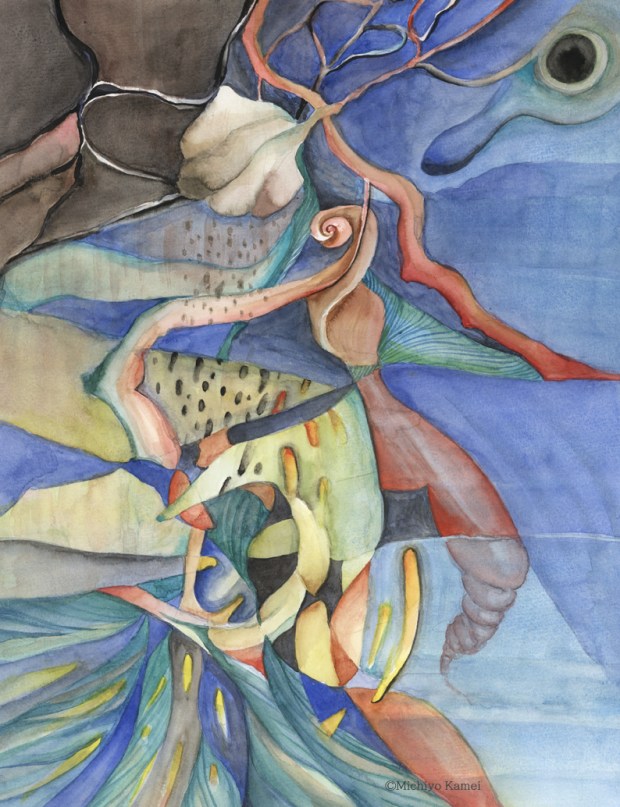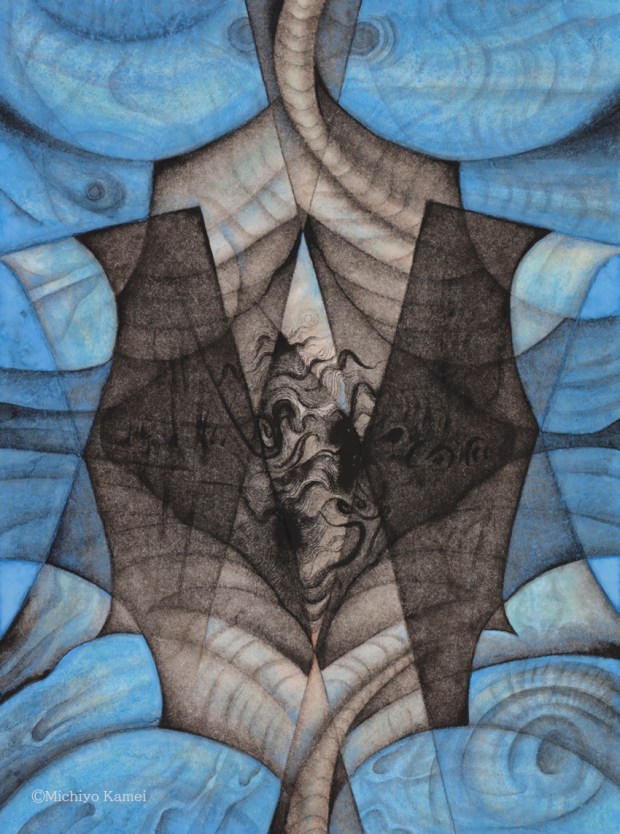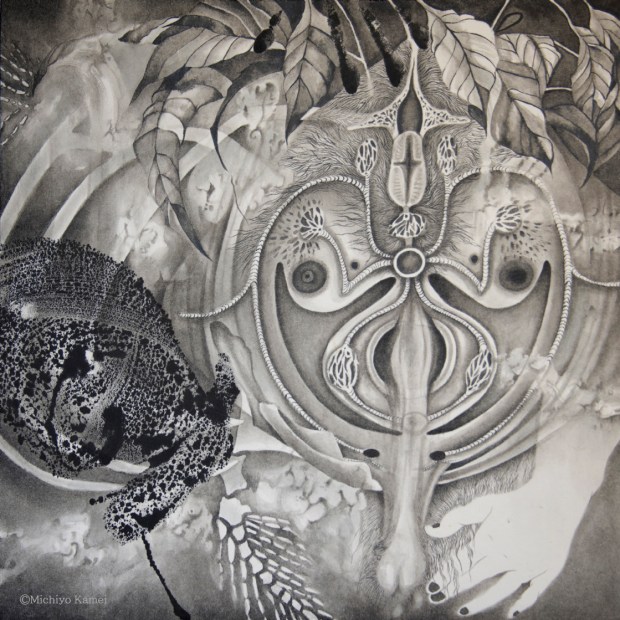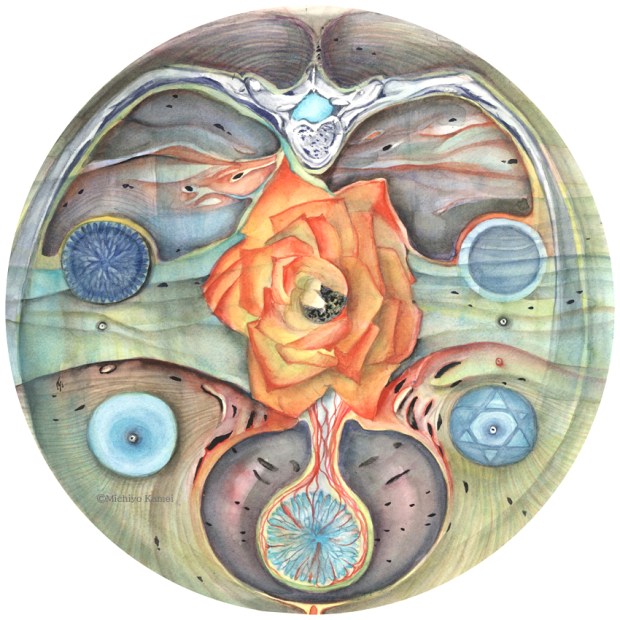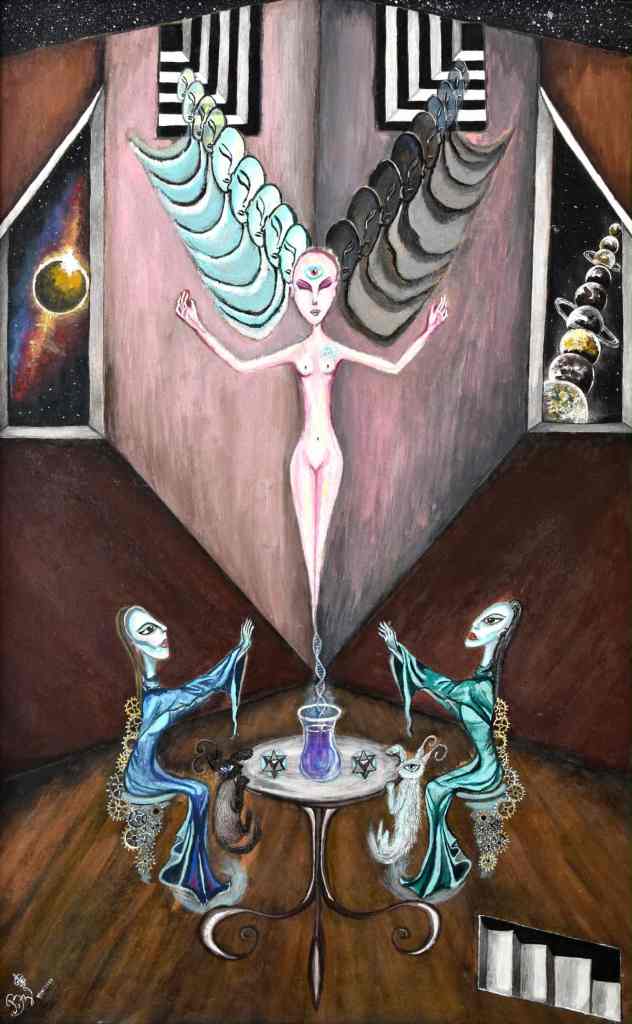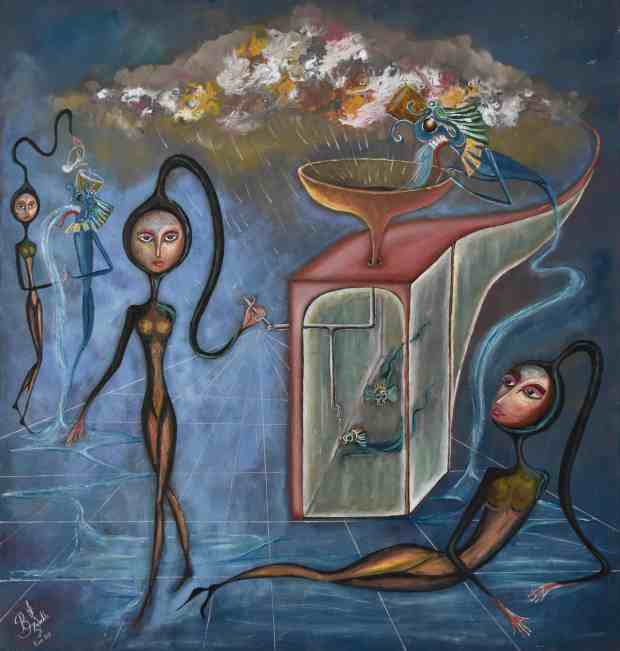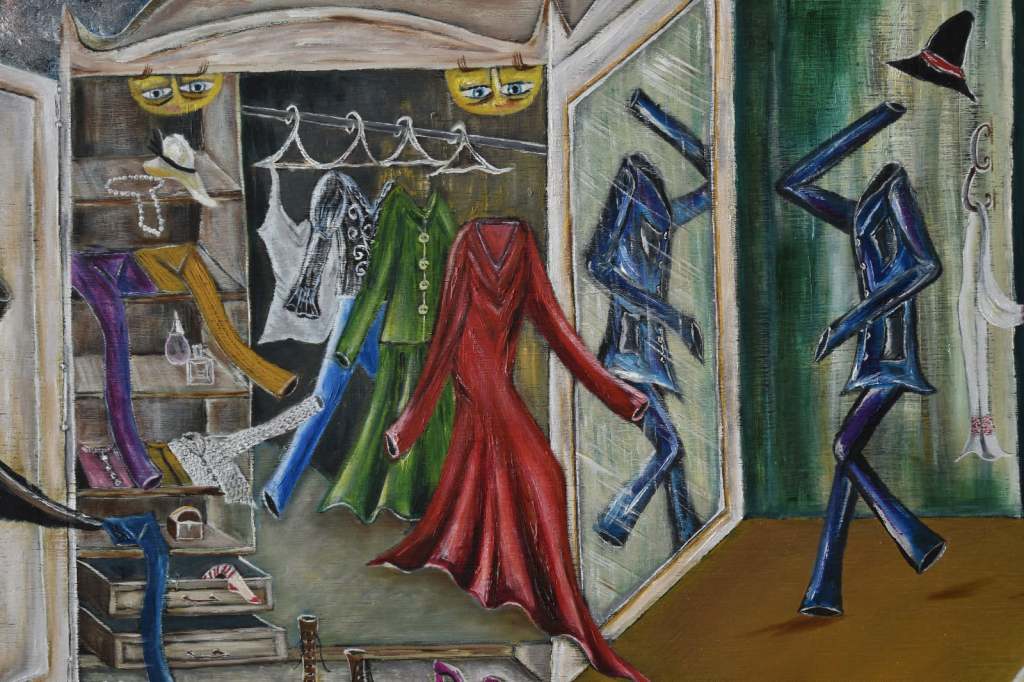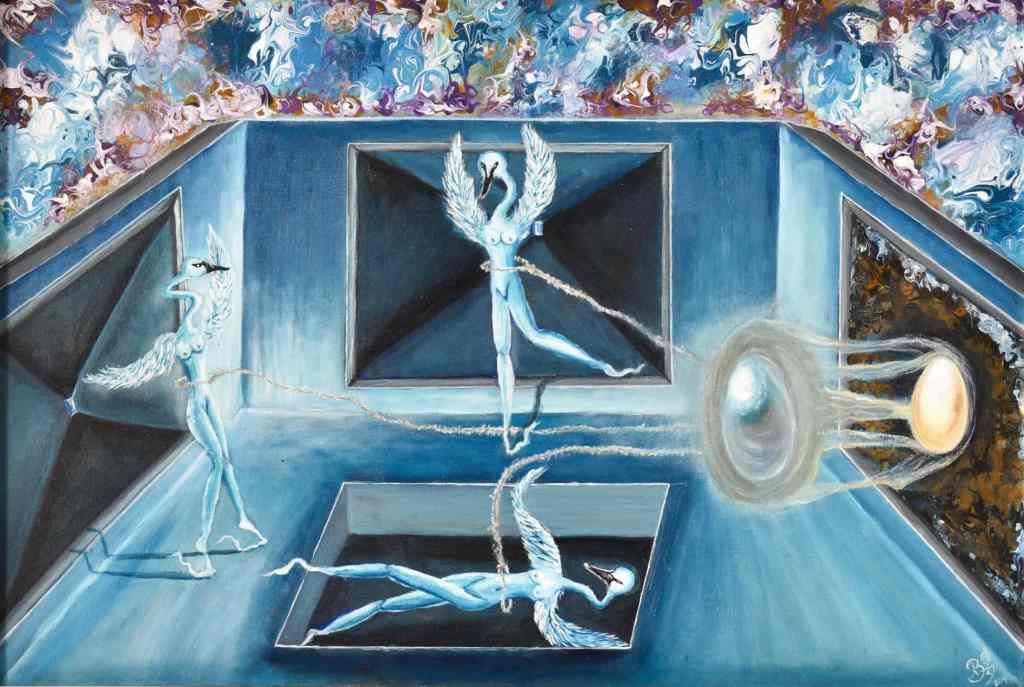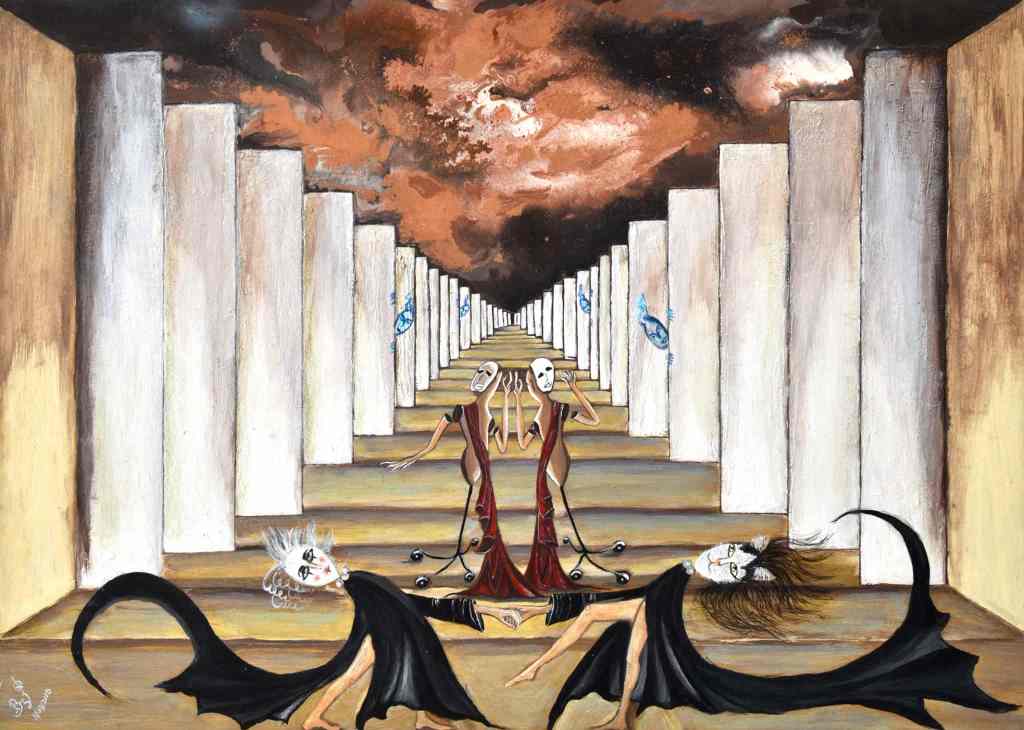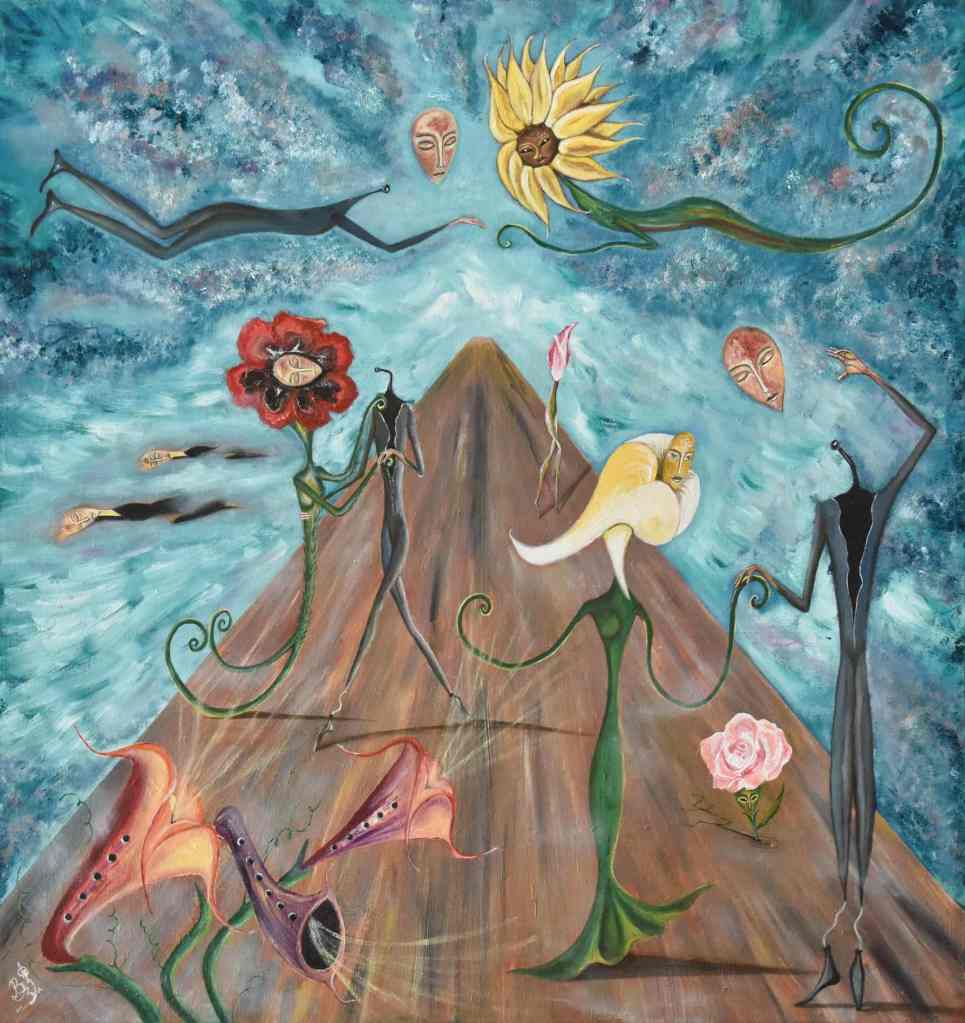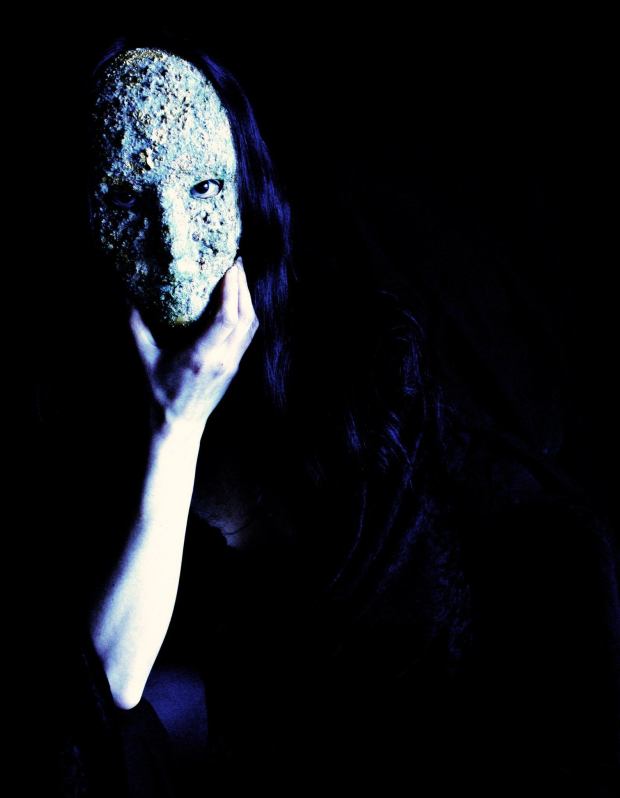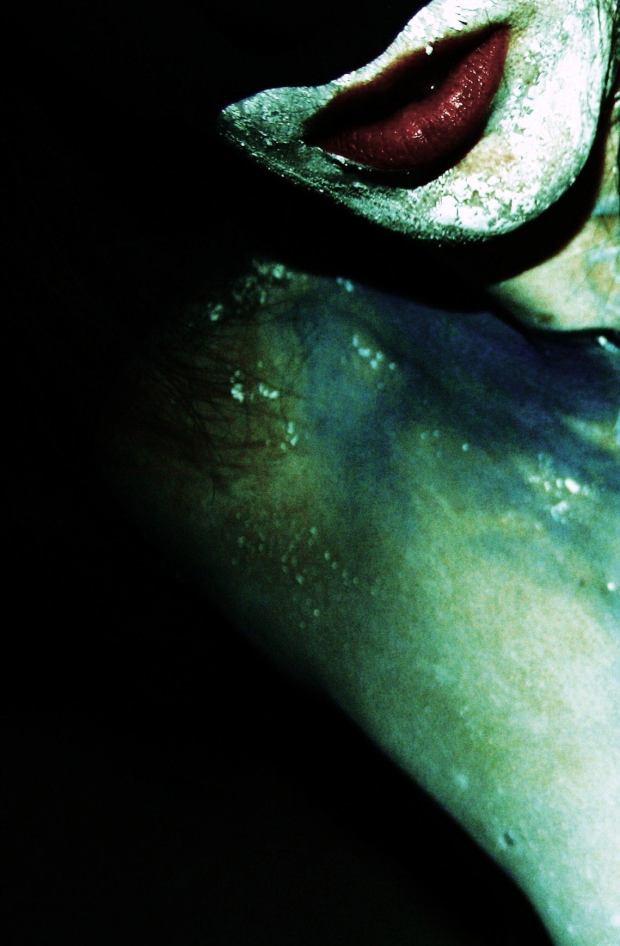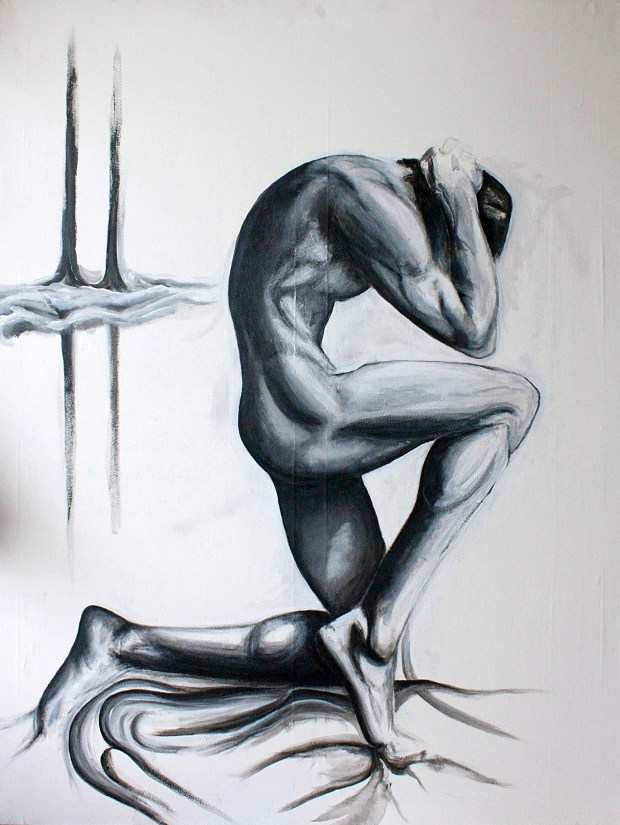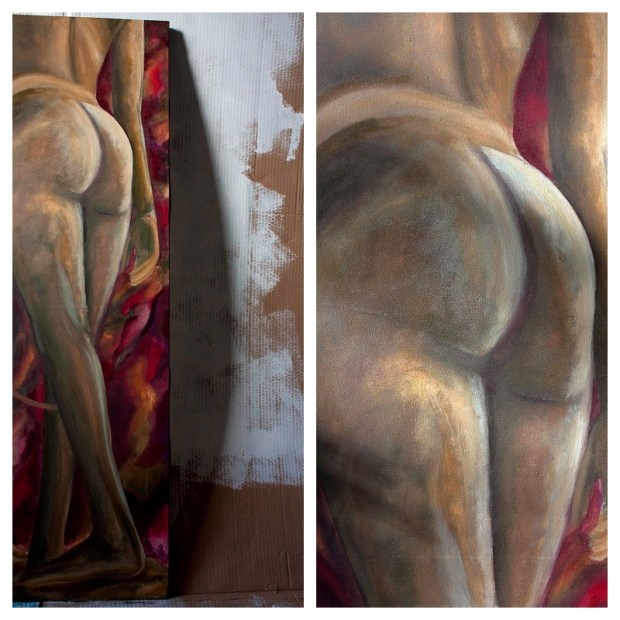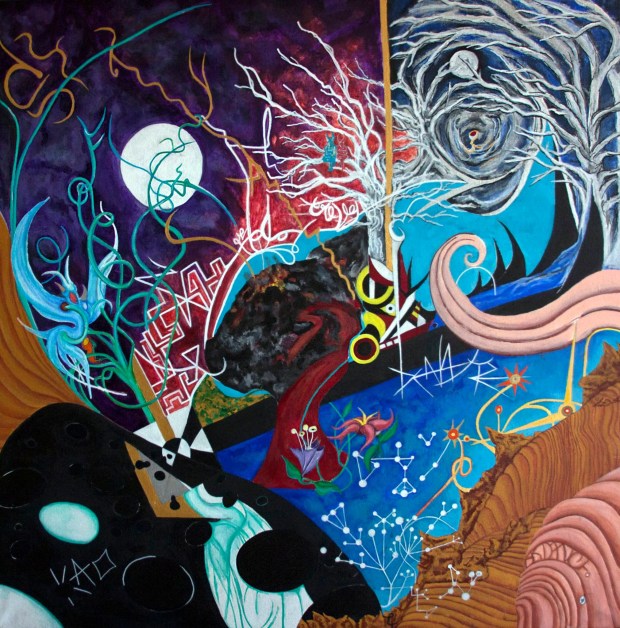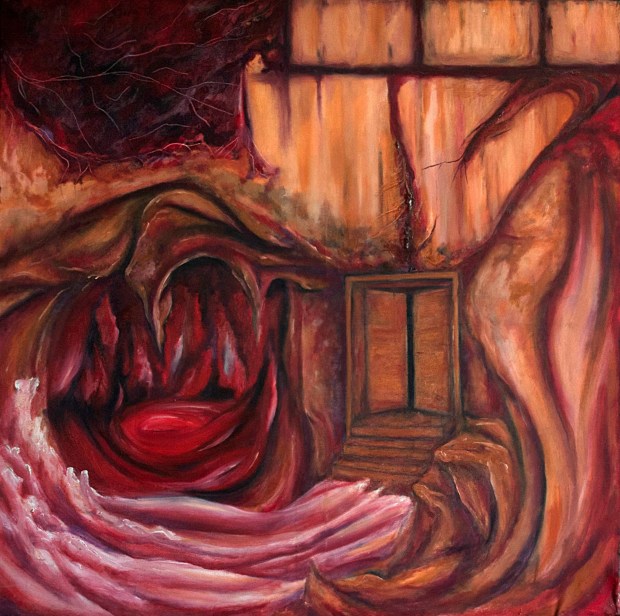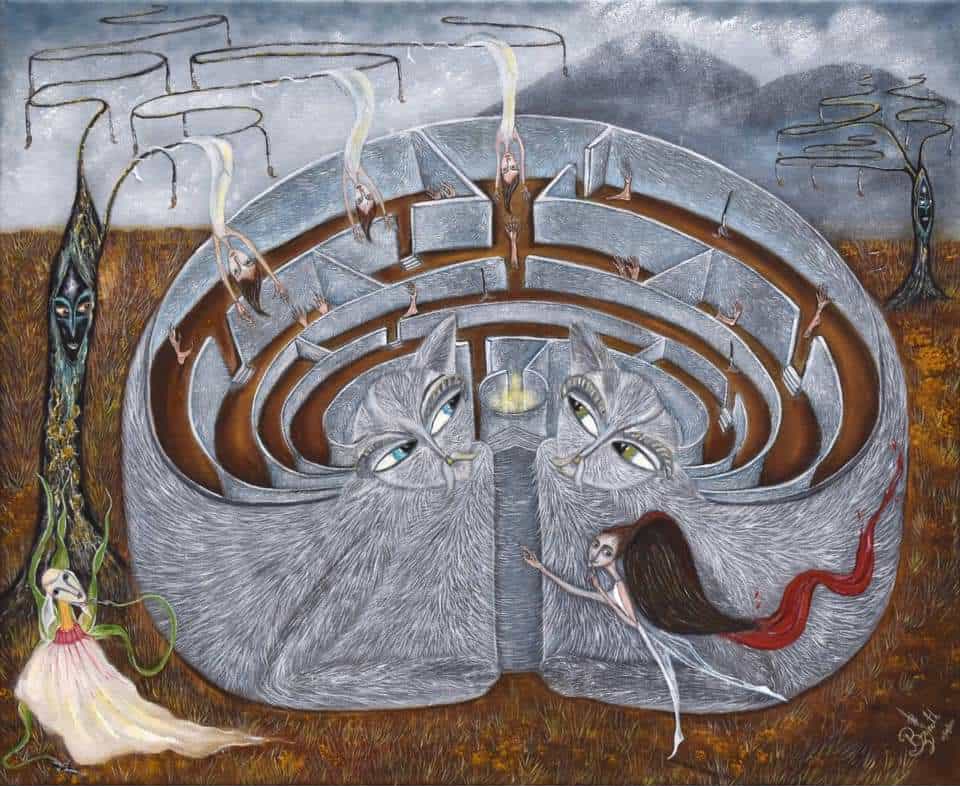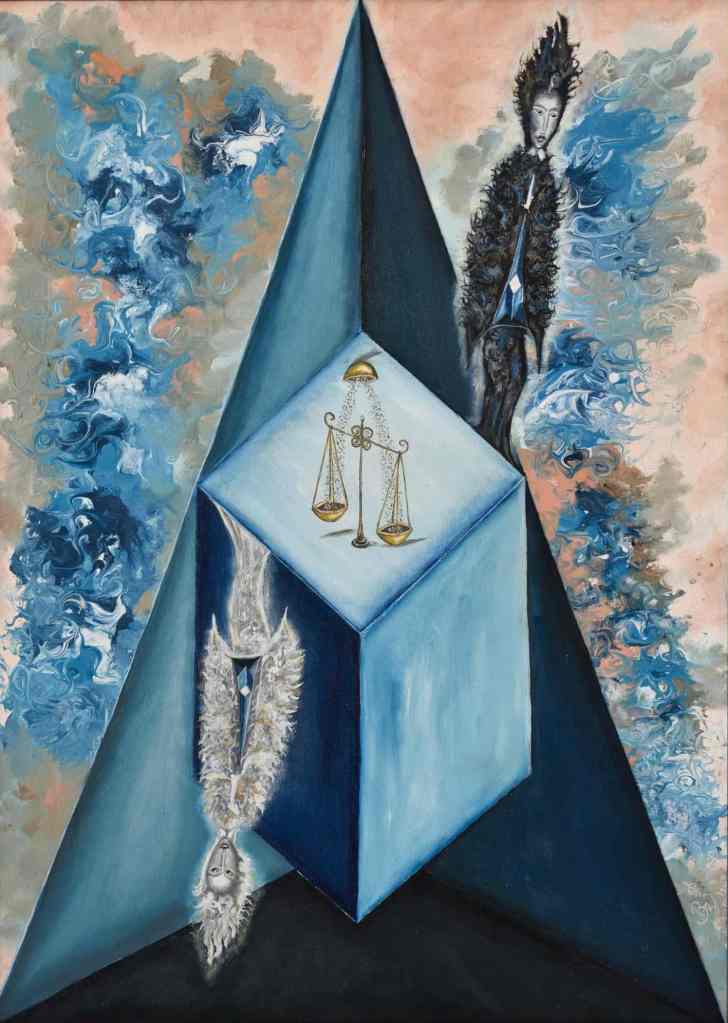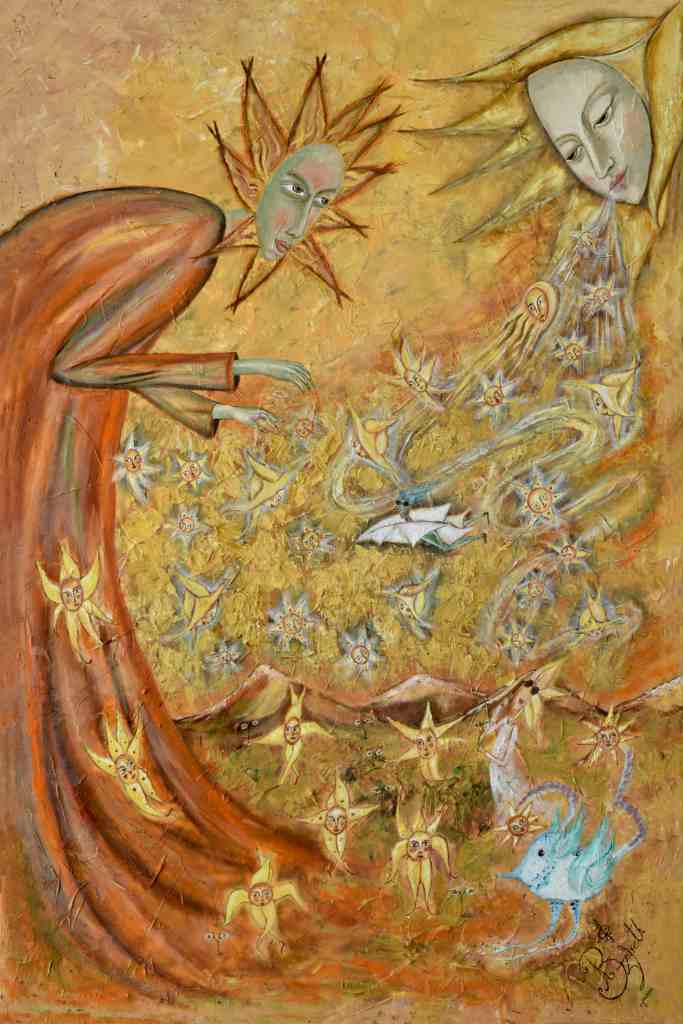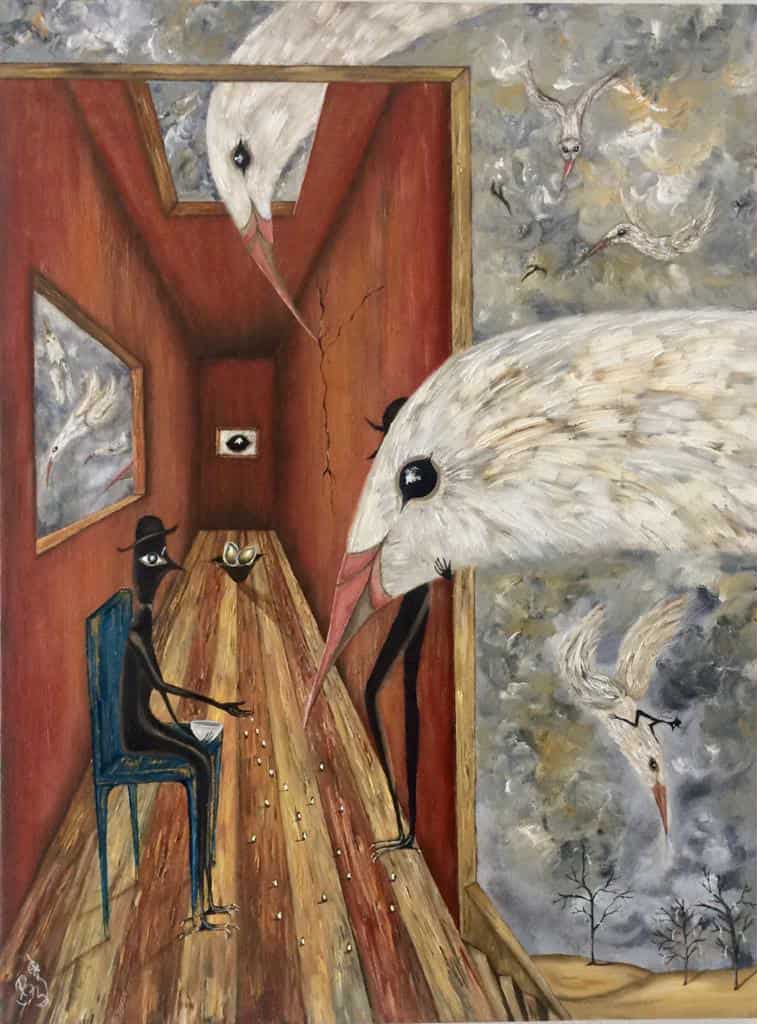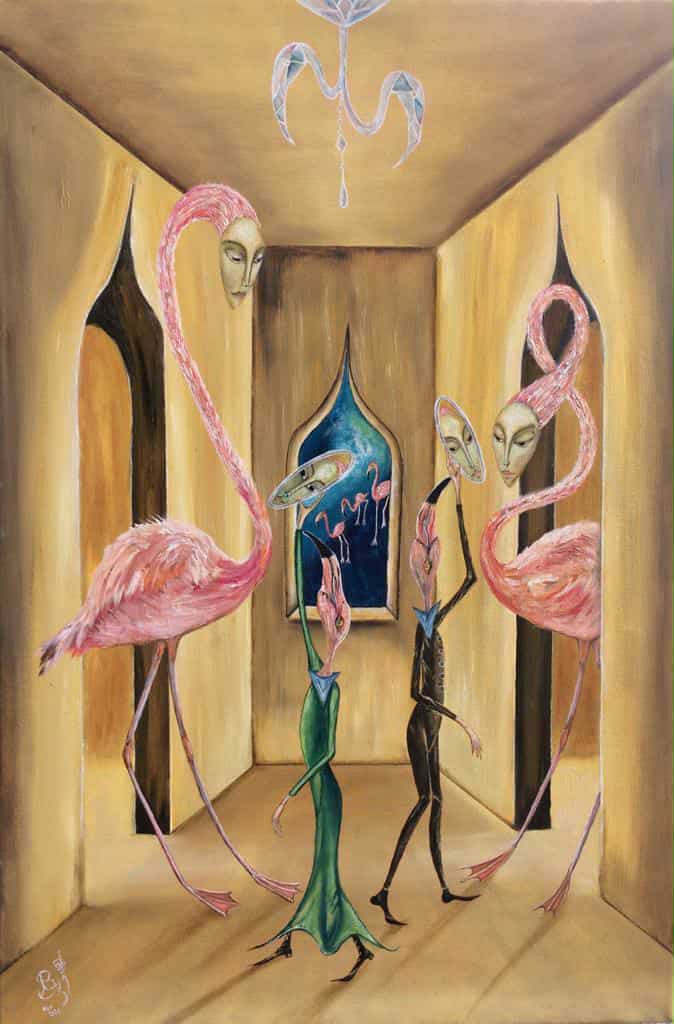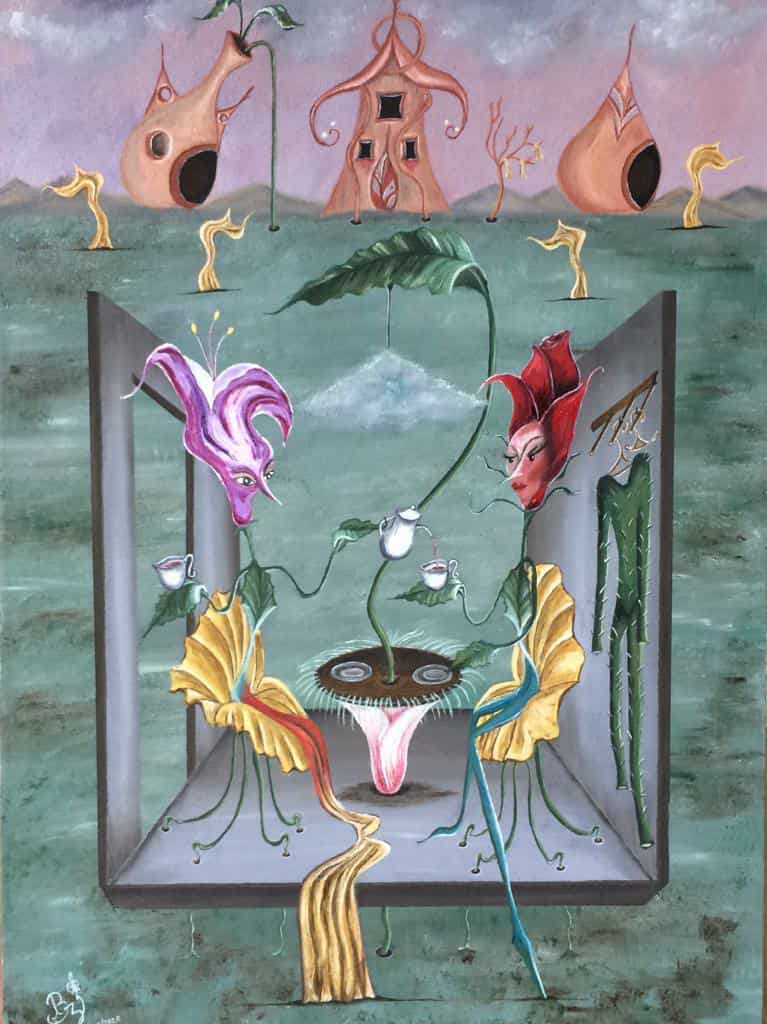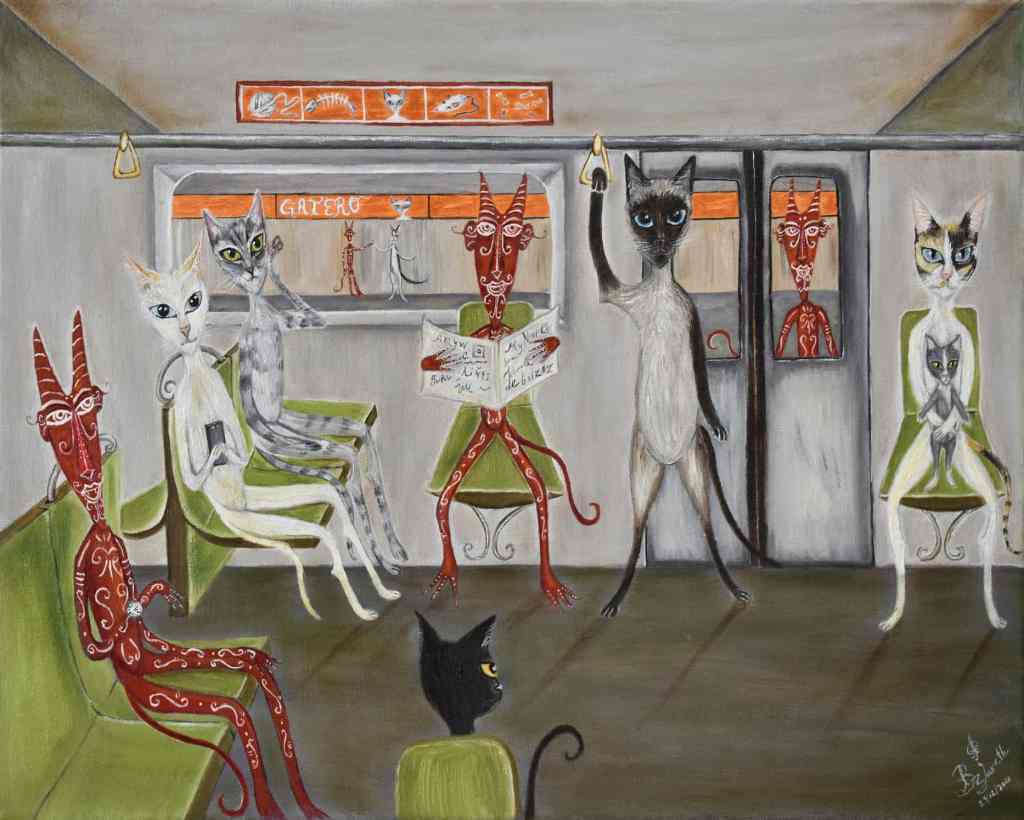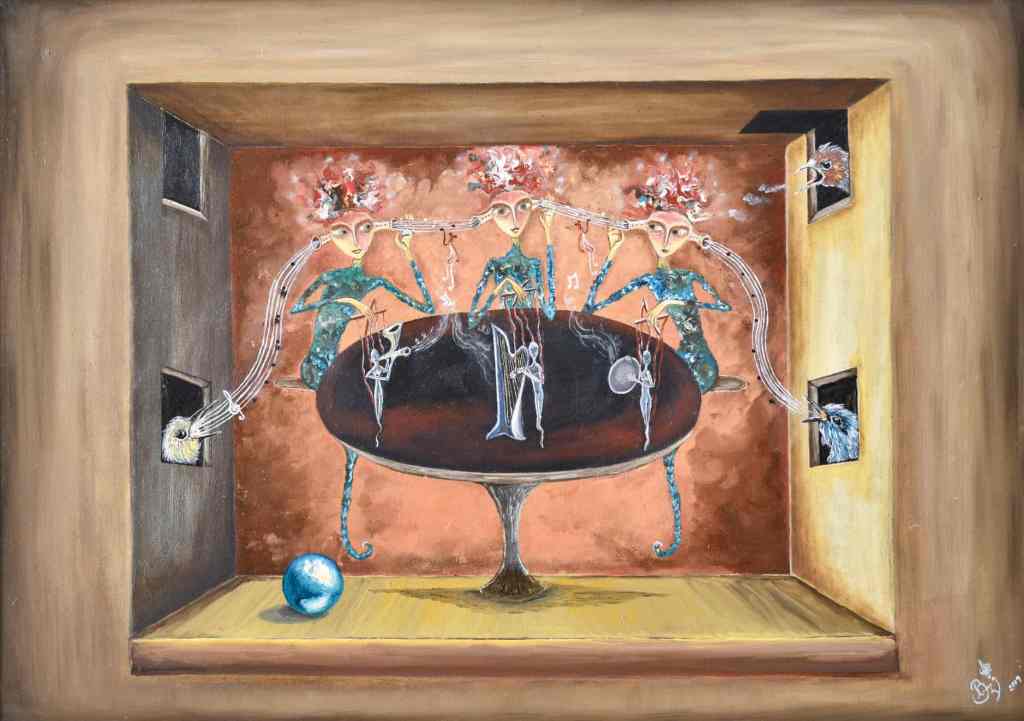
Brianda Zareth Huitrón, Passages to the Psyche.

Each painting is a window into the worlds that inhabit my inner self; they represent the way I have found to share and communicate with the world, the way I can transform the visions of my dreams and materialize them into art.

In a way, Surrealism has not only been an expression but has also become a free way of life through the multiple and unlimited acts of creation that the world of dreams reveals. It has been an open door that has revealed other possibilities of creation to me, an extension of my inner world.

Brianda Zareth Huitrón has exhibited individually and collectively in Mexico and abroad.

Written by ©Brianda Zareth Huitrón

Solo Exhibitions
Leonora Carrington Museum of Xilitla, DREAM ENCOUNTERS in 2025.
Women’s Museum, DREAM REVELATIONS, in 2022.

DREAM LANDSCAPES for the Temascalcingo Festival Honoring Velasco, in 2021.
WINDOW TO DREAM WORLDS, at the Futurama Cultural Center, Mexico City, in 2020.

Group Exhibitions
Col-art at the Oscar Román Gallery in 2025.
The painting exhibition THE PAINTER’S TRADE, at the San Carlos Academy, in 2019.
DIMENSIONS, Wave Gotik Treffen Festival, held in Leipzig, Germany, in 2018.

She has participated in the Chair for 100 Years of Surrealism, at the Faculty of Philosophy and Letters of the UNAM, giving a lecture on female surrealism.

Her work has recently been published in the book Mexican Women in Art, published by Agueda, and in THE ROOM SURREALIST MAGAZINE, an international surrealism magazine.

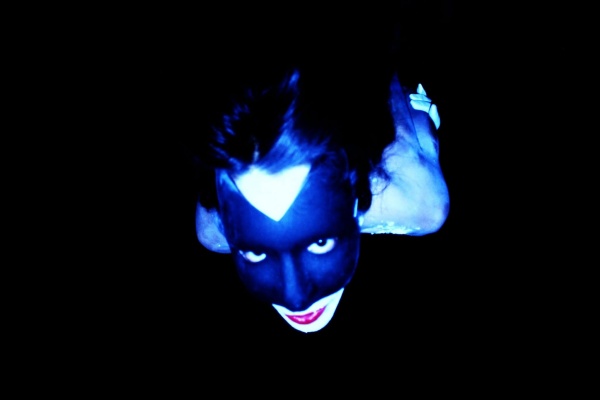
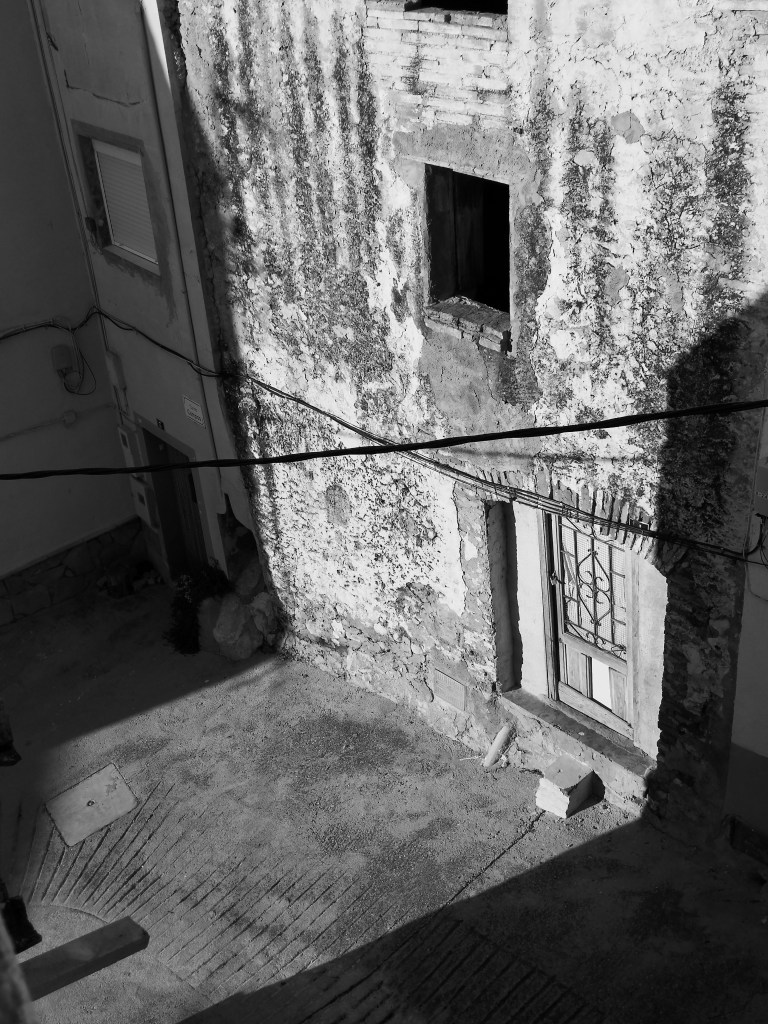
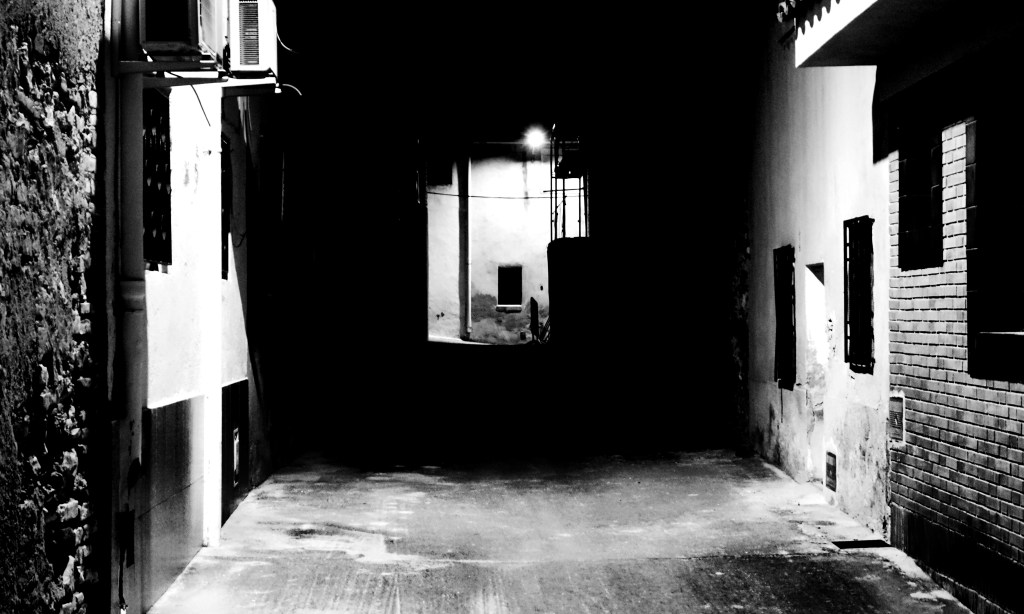
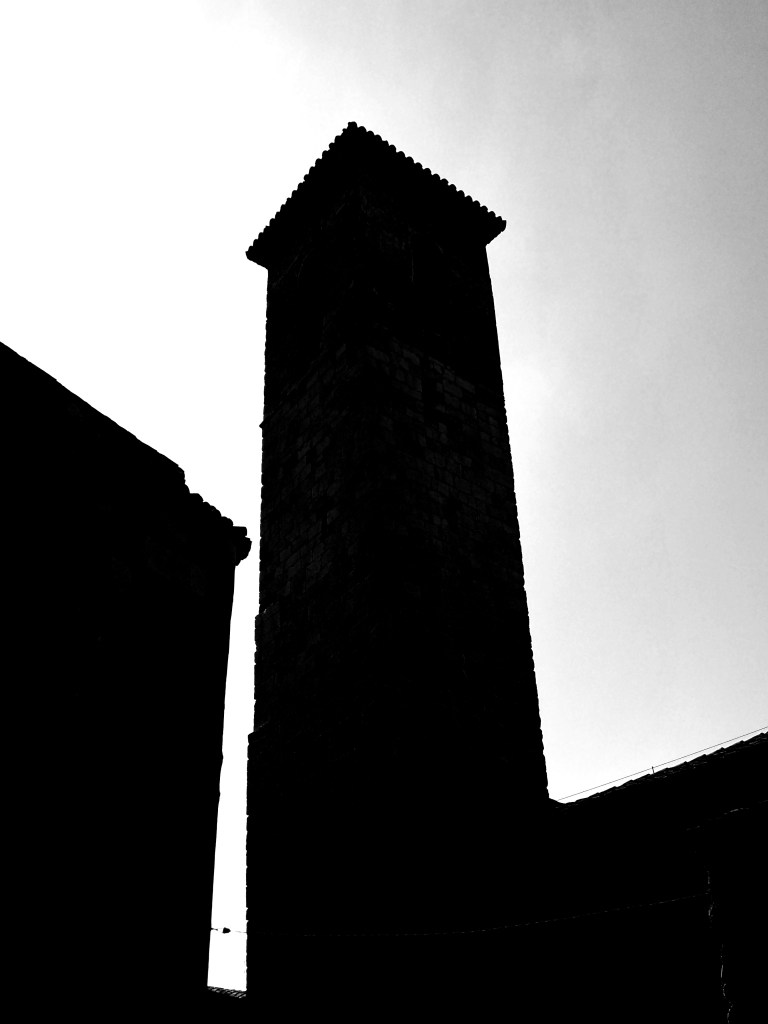
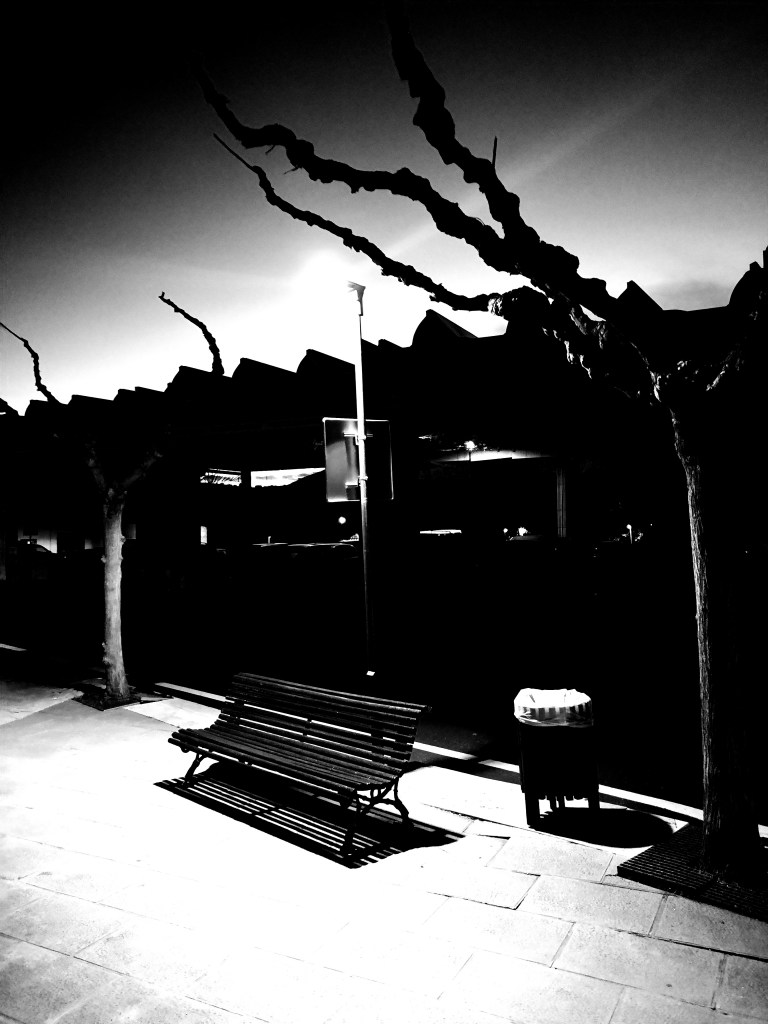
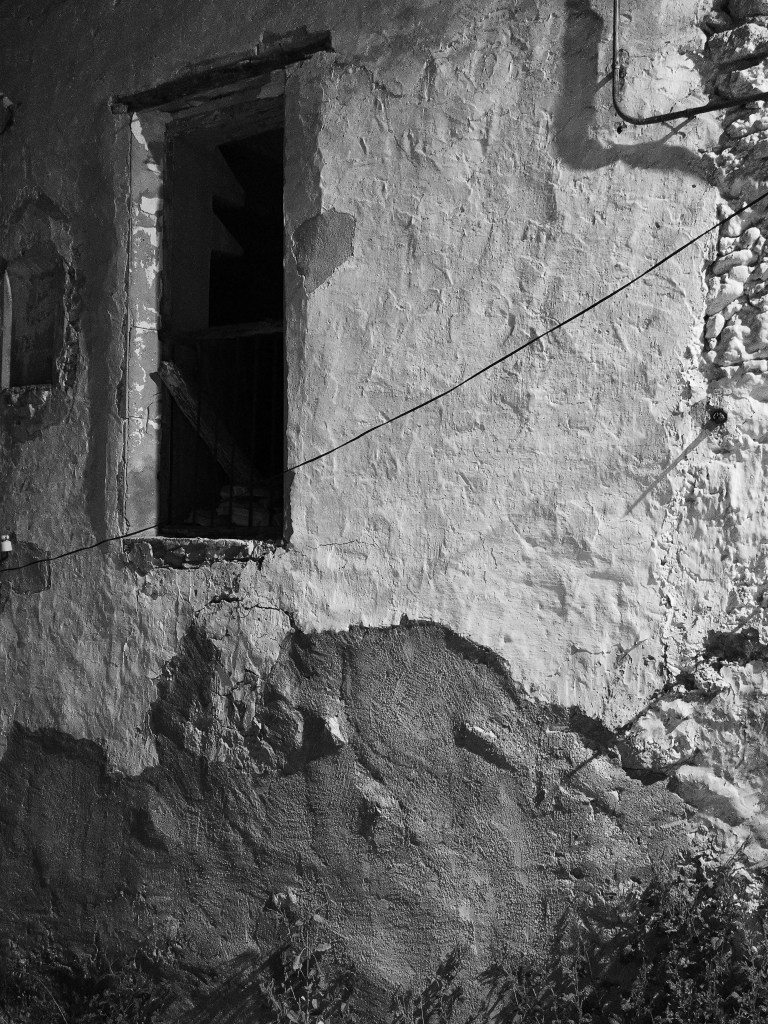
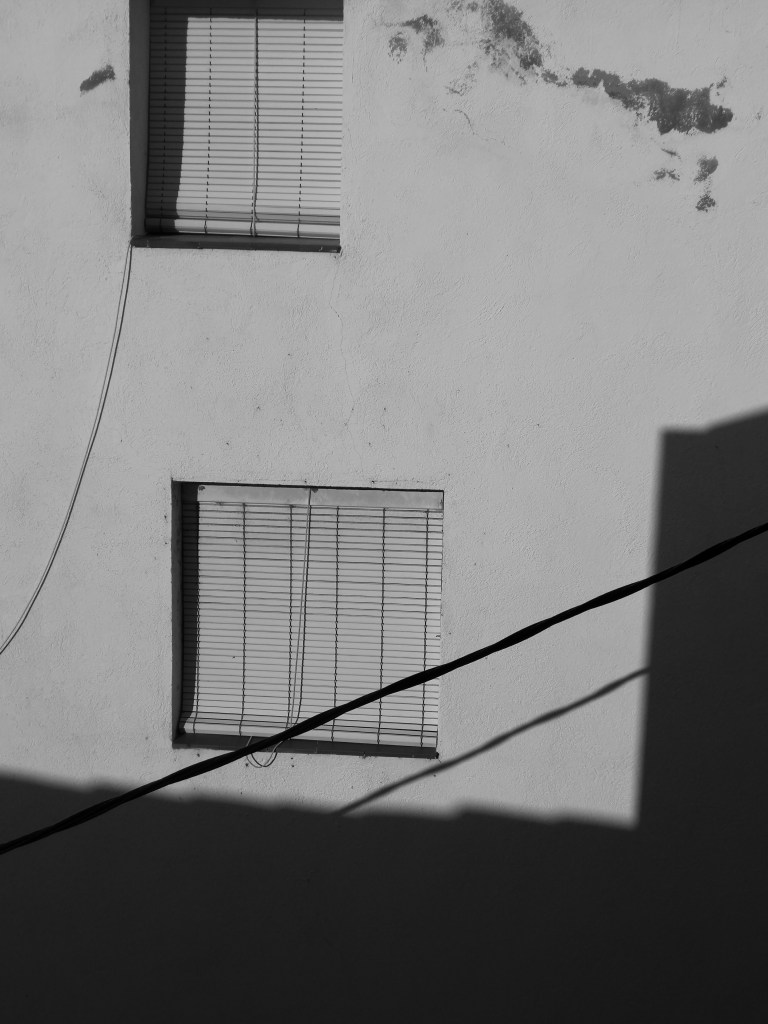
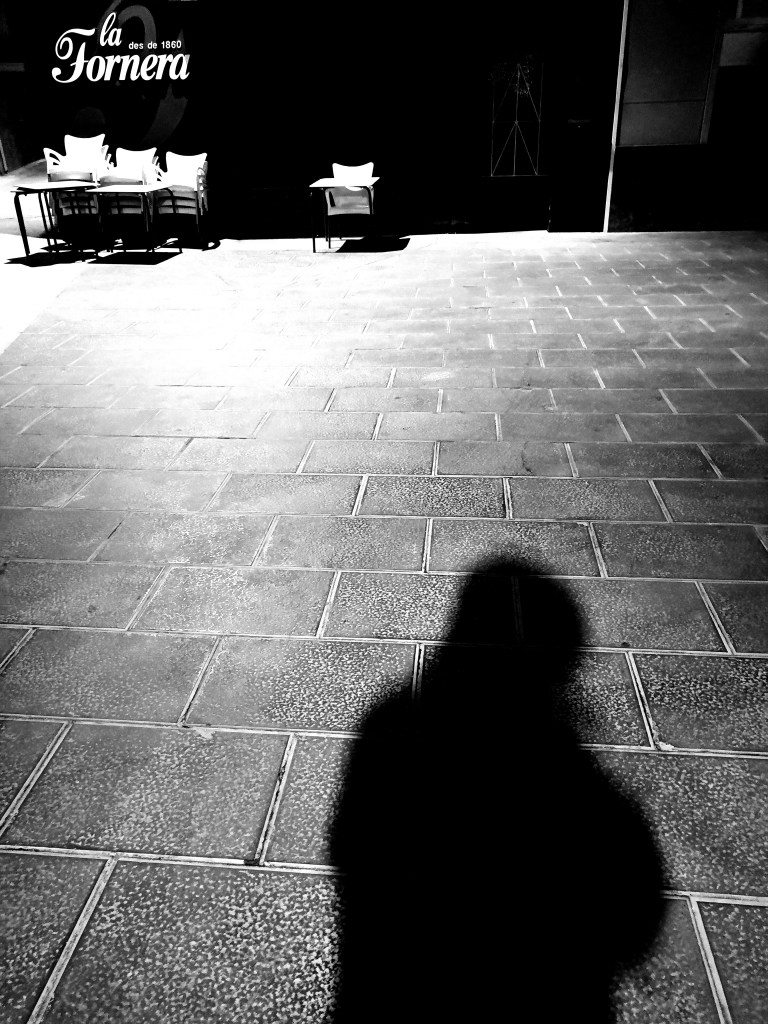
Prenez la 111e rue jusqu’à DaDa

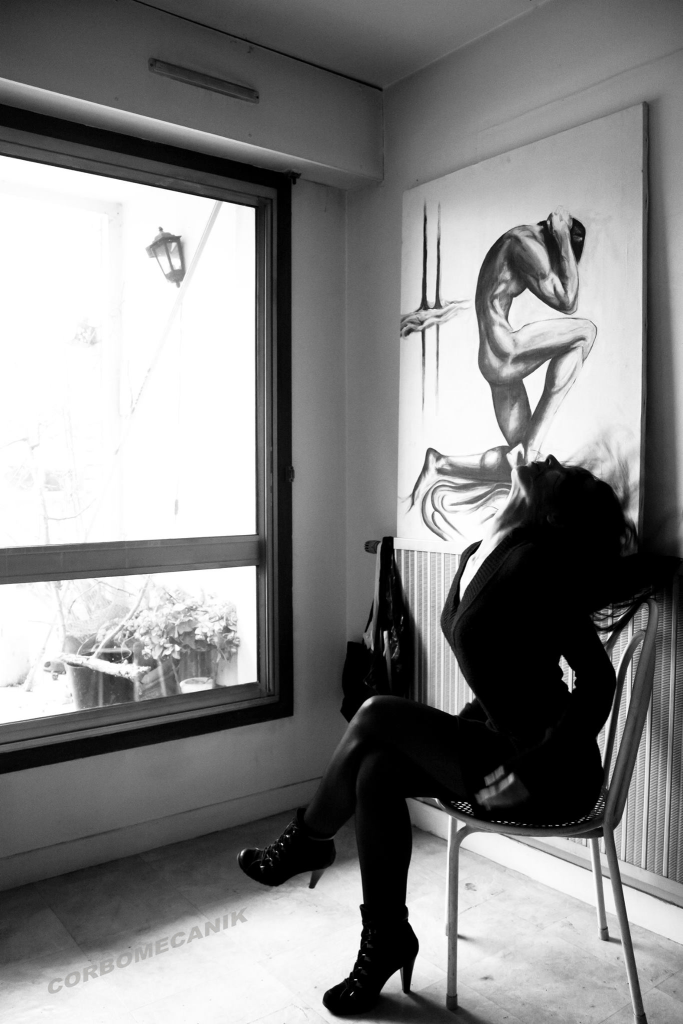
Photography by ©Laetitia Corbomecanik

Written by ©Mitchell Pluto from Occultations: Lullabies for Space Travel

Ce spectacle comprend des lumières stroboscopiques et des effets atmosphériques ; la discrétion du spectateur est recommandée.

Un flash est un crâne qui vibre.
Son aspect visuel provoque une photopsie et des sensations au niveau du lobe temporal.
Les rencontres fantomatiques ont des allures psychiques.
Observez des étincelles électriques dans l’atmosphère, entre les nuages ​​et l’air.
Les images du film défilent au-dessus d’un faisceau de rayons.
Le projectionniste s’assure que le son et l’image de la bobine sont synchronisés.
Des trous vides consomment la matière tandis que le compte à rebours se transforme en un drain optique.
Une femme nue et cramoisie danse. Avec ses seins généreux et son collier de perles de crânes ondulant, elle marque la surface de notre mémoire rétinienne.

Il s’agit d’un procédé de lumière polarisée aux silhouettes exceptionnelles.
Les ombres caressent les contours.
Le cordon ombilical nourrit un embryon, de la même manière qu’un fil soutient un astronaute.
Pendant un instant, une pieuvre du futur nous observa jusqu’à ce qu’elle projette de l’encre, rendant les observateurs inconscients.
L’obscurité se remplit d’une illumination à motifs, jusqu’à une nuée de chauves-souris albinos en vol.
Les drones sont des OVNIs partout.
Une immense colonie de fourmis sur Terre a envahi et dévoré une simple feuille flottante.
La foule s’amusait au parc d’attractions jusqu’à ce que le programme lui ordonne de former des lignes.
Le fossile d’une orchidée montrait une minuscule danseuse du ventre à l’intérieur, en accéléré.
La fleur était un signal intelligent voyageant à travers le temps.
Un déluge d’éclairs éclipsait tout ce qui l’entourait.
Une façon de contacter les extraterrestres était la danse du cerceau.

Ce cercle vient d’ailleurs.
Évitez de vous leurrer. Les voyages spatiaux impliquent le vieillissement, la mutation et la mort. C’est aussi simple que ça.
Observez comment les ondes de radiation dissolvent les éléments dans le néant.
Ensuite, la chasse aux iguanes. Ne vous inquiétez pas, ce sont de gentils lézards en quête d’un en-cas.
L’homme prothétique n’a aucun loisir, car les objets orientent son expérience vers une série télévisée.
Suivez la figure nageant du tronc cérébral, à travers le système limbique, jusqu’au tableau de bord néomammifère.
La Créature du Lagon Noir, malgré son portrait,
n’est pas misogyne. Au contraire, elle incarne le principe du plaisir et illustre la conception de la nature.
La plupart des gens entendent le saxophone flirter avec eux.
Le mouvement rotatif tourbillonne de points qui s’épanouissent dans les danseurs Dogan célébrant la cérémonie du Sigui avec des masques. L’extérieur d’un masque reflète son noyau central, situé de la 111e rue à DaDa.

Laetitia Da Beca: Peintures, Matières et Graphismes

J’evolue dans le monde des arts plastiques , de l’expression corporelle et dans le milieu alternatif parisien depuis très jeune. J’ai donc explore diverses techniques et directions : peinture , photographie , dessin , graphisme , video , danse et travail sur le corps.

Depuis ces 15 dernières annnees , j’ai fait des expositions et performances en France et quelquescollaborations qui m’on ouvert de nouveaux horizons.
Le public me connait plus pour mes photograhies , mes performances ou mes mises en scène des corps ( dans la cadre fetichiste , danse ou autre ) pour la simple raison que je viens des arts plastiques mais que j’ai fait une pause de 10 ans dans le domaine de la peinture pour y revenir après
une renaissance.

La plupart des peintures presentes ici , acryliques ou à l’huile sont des œuvres en grand format , antre 1 m et 1 m 20 de hauteur .
Deux series emergent , l’une totalement dans la recherche et le jeu graphique , l’autre est une plongee dans la matière brute à travers les mediums et les volumes.

Dans mes peintures , le corps est plutot reduit à l’expression de chocs emotionels devenus physiques, j’y introduis parfois des cicatrices ou blessures ouvertes.

Je dirais qu’on y navigue plus dans le subconscient , dont l’exploration brute instinctive voir animal que me mène finalement ensuite à ritualiser en toute conscience ( mon travail photographique et de
performance).

La demarche chamanique de rendre visble les esprits est toujours presente dans les deux cas. Mon attrait pour l’exploration psychedelique du subconscient , le symbolisme universel , le domaine du reve reconnecte au quotidien , le rapport à l’invisible et l’interet esoterique qui en decoulennt ont toujours etait la des l’enfance.

Mes influences picturales sont très diverses des arts premiers au classicisme , des arts sacres aux symbolistes , du street art à la bande dessine SF ( pour moi , tout est source d’inspiration et de stimulation technique , graphique et de vibration de couleurs ) et biensur les surrealistes et leur grande revolution.

Written by ©Laetitia Da Beca (Corbomecanik)

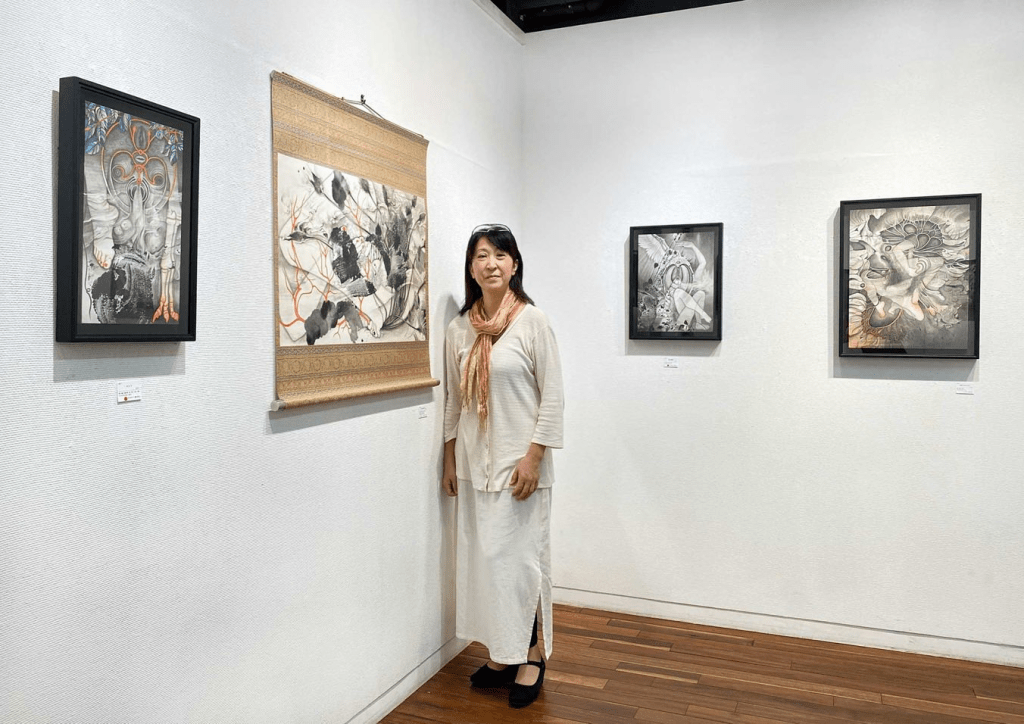
Bodymandala: Interview with Michiyo Kamei

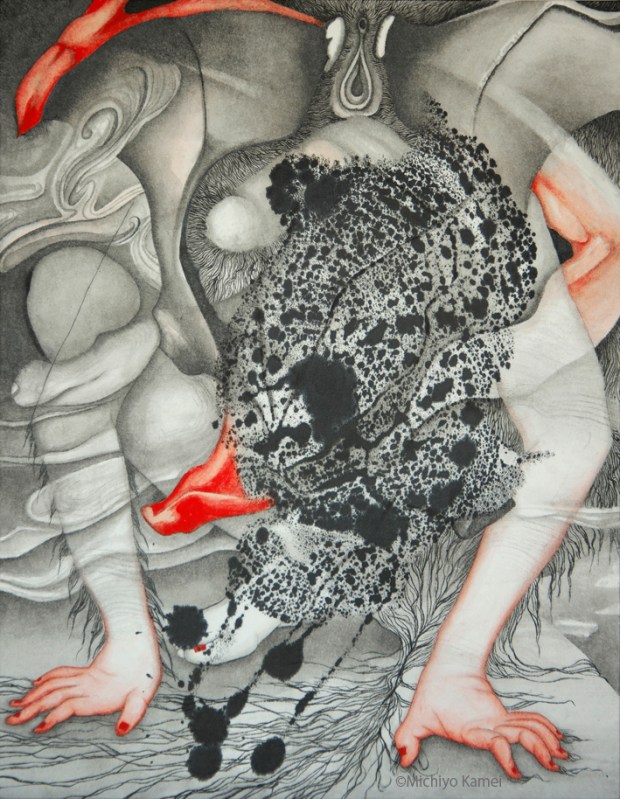
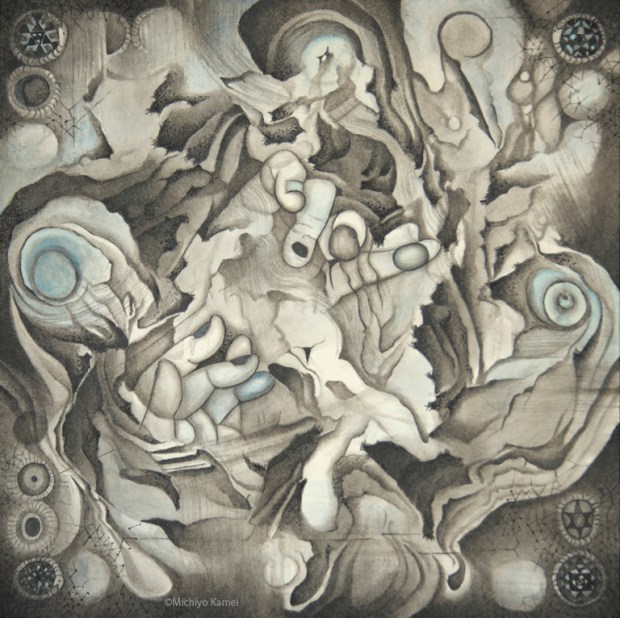
Feature Photo: Black Inspiration 41.0 x 31.8cm Sumi-ink with Michiyo Kamei’s body on Washi paper 2025. Photo used with kind permission directly from the artist and copyright holder © Michiyo Kamei

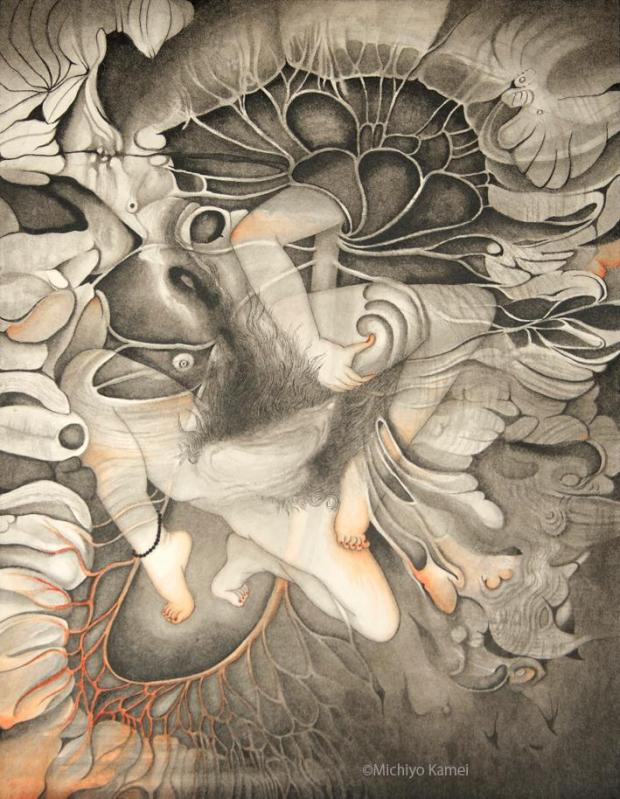
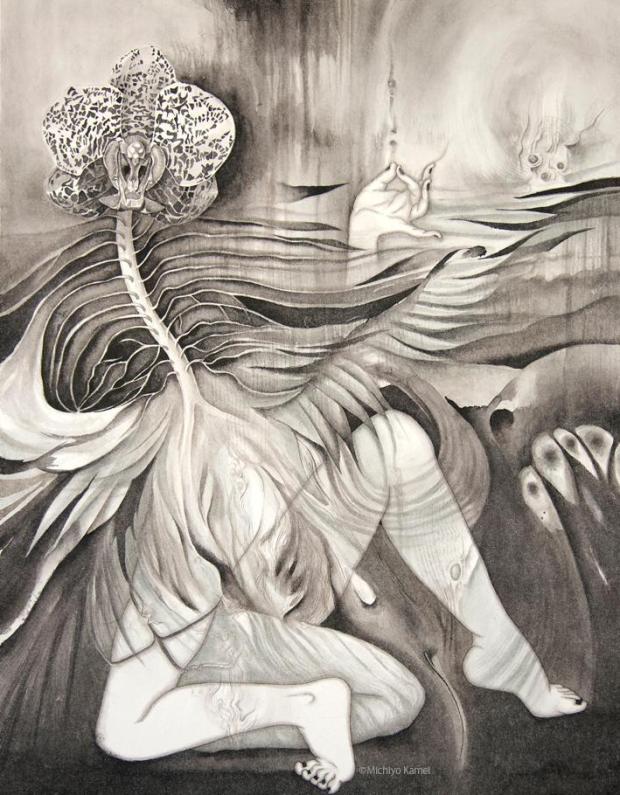
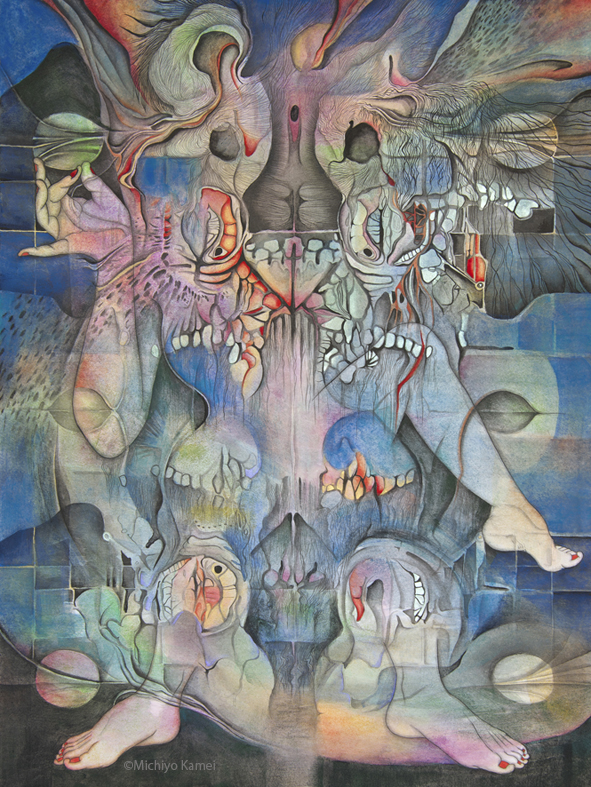
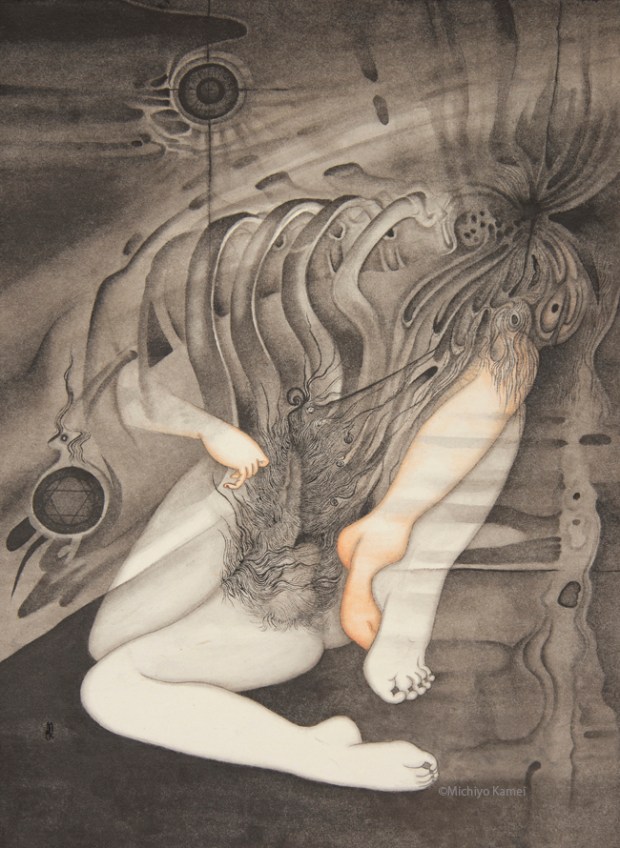
In her black ink paintings, Michiyo Kamei explores the concepts of impermanence, transformation, and the enduring nature of existence through a form she calls the bodymandala.

Mitchell Pluto: At what point did you realize you were an artist?

Michiyo Kamei: I originally studied anatomy at medical school and started out as a medical illustrator. It was only after I stopped working as an illustrator and began creating paintings that I realized I was an artist. Anatomical illustrations are created at the request of the medical field to follow the authors’ papers and wishes, so the illustrator cannot draw them freely. Paintings are free to be drawn by the creator, so the artist can freely incorporate their own ideas. This difference is significant to me.

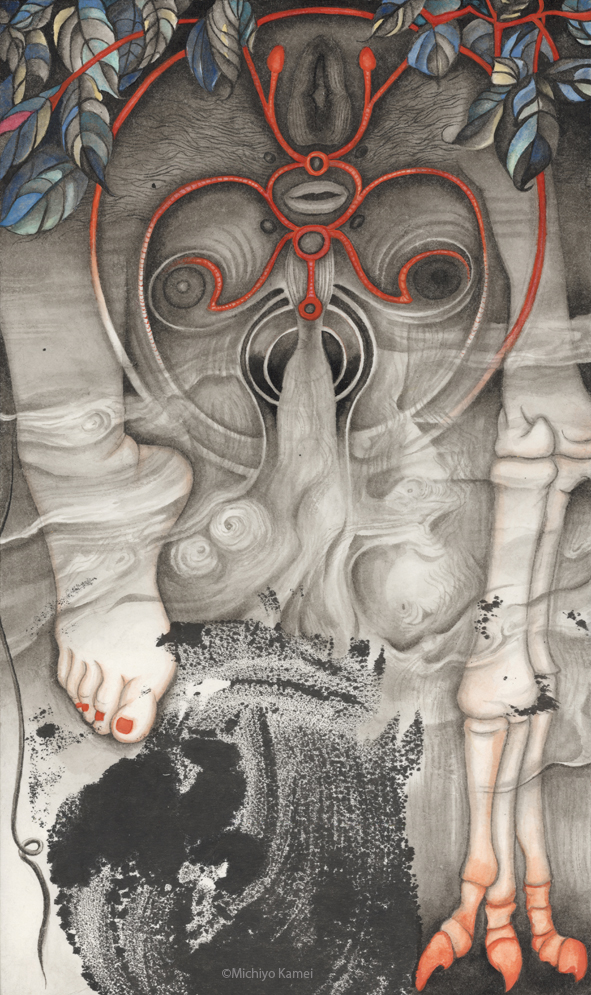
Kuuka
53.0 x 41.0cm Sumi-ink and red-ink on Washi paper 2025. Photo used with kind permission directly from the artist and copyright holder © Michiyo Kamei

Apocalypse
53.0 x 41.0cm Sumi-ink on Washi paper 2021. Photo used with kind permission directly from the artist and copyright holder © Michiyo Kamei

Mitchell Pluto: How would you describe your art, given that it blends many traditional and modern genres?

Michiyo Kamei: When I was drawing anatomical illustrations, I studied the theory of modern anatomy and created my diagrams. After I quit this job and started painting, I began exhibiting at a gallery that collected ukiyo-e prints from the Edo period in Japan. Seeing many hand-painted ukiyo-e at the gallery, I rediscovered the beauty of traditional Japanese styles. When drawing the hands and feet in my work, I sketch my own body in front of a mirror, then deform it in the ukiyo-e style. In this way, I am influenced by both modern anatomical diagrams and ukiyo-e from the Edo period, which have a uniquely Japanese style.

Ring
33.3 x 33.3cm Sumi-ink, natural pigments and glue on Washi paper 2023. Photo used with kind permission directly from the artist and copyright holder © Michiyo Kamei

Mitchell Pluto: When creating your artwork, what specific medium or materials do you prefer to work with?

Michiyo Kamei: I like oriental materials. Rather than just adding paint to the paper, I like to let the ink soak into the paper, letting it bleed and see how it moves within the paper fibers. Sometimes I don’t just create a picture, I let the ink create a picture on its own.

Brahman
60.6 x 45.5 Sumi-ink, natural pigments and glue on Washi paper 2021. Photo used with kind permission directly from the artist and copyright holder © Michiyo Kamei

Moon Ritual
45.5 x 33.3cm Sumi-ink and red-ink on Washi 2020. Photo used with kind permission directly from the artist and copyright holder © Michiyo Kamei

Mitchell Pluto: Could you describe and clarify what a bodymandala is? 

Michiyo Kamei: Anatomical illustrations are pictures of the world of death drawn from corpses. Since I began painting, I have wanted to depict the world of life, so I have incorporated energetic shunga. Death and life are repeated in my paintings, and I hope to approach the theme of “eternity.” Mandalas represent the universe in Buddhist worldview, but I represent the universe through the body, and am exploring a new mandala form called the “bodymandala.” 

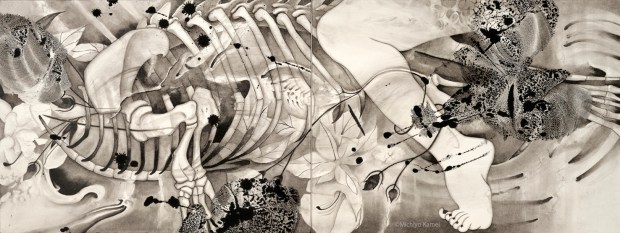
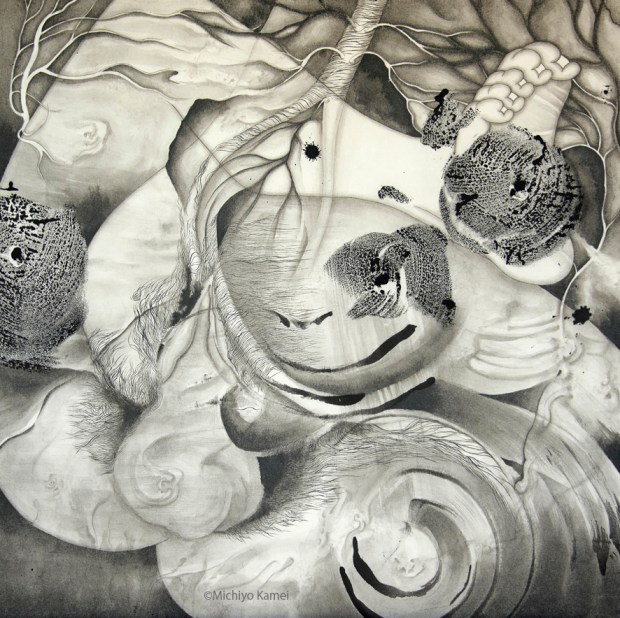
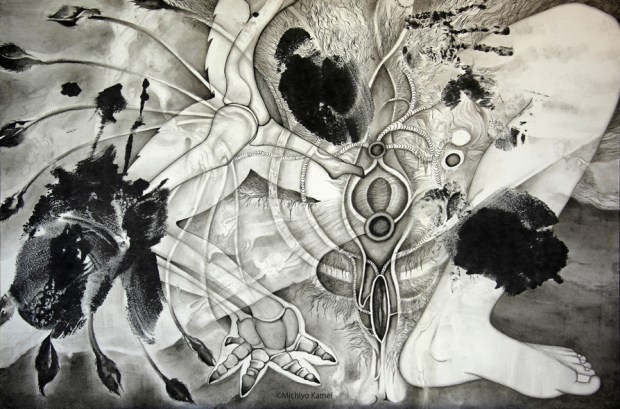
Bodyscape 8
45.5 x 121.2cm Sumi-ink with Michiyo Kamei’s body on Washi paper 2025. Photo used with kind permission directly from the artist and copyright holder © Michiyo Kamei

Mitchell Pluto: What visual artists have influenced your work and given you inspiration?

Michiyo Kamei: I’ve been interested in the body since I was a child. It feels as though I am contained within this body, but at the same time it is also part of the natural world, the world outside of me. Which one does it belong to? And when I realized that I would die along with this body, I was terrified. Francis Bacon is an artist I admire for his expression of the body and anxiety. I’ve admired him ever since I discovered him in an illustrated catalogue as a teenager. Another artist is H.R. Giger. I think his organic expression in black and white is so beautiful.

Spin
65.2 x 65.2cm Sumi-ink with Michiyo Kamei’s body on Washi paper 2025. Photo used with kind permission directly from the artist and copyright holder © Michiyo Kamei

Bodyscape 7
60.9 x 91.0cm Sumi-ink with Michiyo Kamei’s body on Washi paper 2025. Photo used with kind permission directly from the artist and copyright holder © Michiyo Kamei

Mitchell Pluto: Could you please tell me the central idea behind your current show?

Michiyo Kamei: I’m currently incorporating “jintaku” a technique in which ink is applied to my body and then transferred onto Japanese washi paper. Rather than painting with a paintbrush, jintaku involves pressing my body against the paper, resulting in completely uncontrollable and unexpected ink patterns. While observing the stains on my skin, I paint the “inside and outside” of the body in the blank spaces. It is meaningful to me to compose my paintings using three elements: the inside (anatomical illustrations) and outside (limbs, plants, natural world and the universe), and my living skin, which lies at the boundary between them. I call this “bodyscape,” and I hope to expand the image in my paintings from a small image of the body to a larger world. What kind of world can unfold from the body? And can humans have the imagination to do so?

Chimera
41.0 x 24.2cm Sumi-ink, natural pigments, glue with Michiyo Kamei’s body on Washi paper 2025. Photo used with kind permission directly from the artist and copyright holder © Michiyo Kamei

Mitchell Pluto: What are your thoughts about the universe in relation to the philosophy of your art?

Michiyo Kamei: I believe that the universe in which we live has no beginning or end, but is a whole that is constantly transforming. There are times when I feel that even life and the body are merely a fleeting moment. Currently, I assume that the beginning of everything is the “zero point” of the universe, and my theme is the transformation and chaos of the body (form) that begins from there. In my paintings, I want to rewind time and explore the primordial form of life. I find a unique beauty in the cruelty and sacredness of the wild nature of evolution, which repeats selection and mating.

Zero Point Wild
41.0 x 31.8 Sumi-ink and red-ink with Michiyo Kamei’s body on Washi paper 2025. Photo used with kind permission directly from the artist and copyright holder © Michiyo Kamei

Witch’s Game
33.3x 33.3cm Sumi-ink. natural pigments and glue on Washi paper 2023. Photo used with kind permission directly from the artist and copyright holder © Michiyo Kamei

Mitchell Pluto: Who are your favorite writers for inspiration, and how do they influence your art and perspective?

Michiyo Kamei: I like Jorge Luis Borges, especially “The Library of Babel.” When I read this novel, I feel like an infinite universe is expanding in my head. I think his universe can only be expressed in novels (words), and can never be depicted. I would like to reach such a world someday, but life is short, and I feel that once is not enough for me.

“The original form of the universe: the wildness of the zero point”
Michiyo Kamei exhibition at the Y art gallery in Osaka, Japan 2025

Michiyo Kamei Site

The Origin of the Universe: The Wildness of Point Zero
Michiyo Kamei Exhibition Art Gallery Shop

Palimpsest of Phantasm: An imaginary art garden
Vol. 1 Michiyo Kamei
ALL RIGHTS RESERVED. ARTWORK IN THIS POST IS A COPYRIGHT OF MICHIYO KAMEI. THIS AN AUTHORIZED PUBLICATION WITH PERMISSION AND EXPRESSED CONSENT.
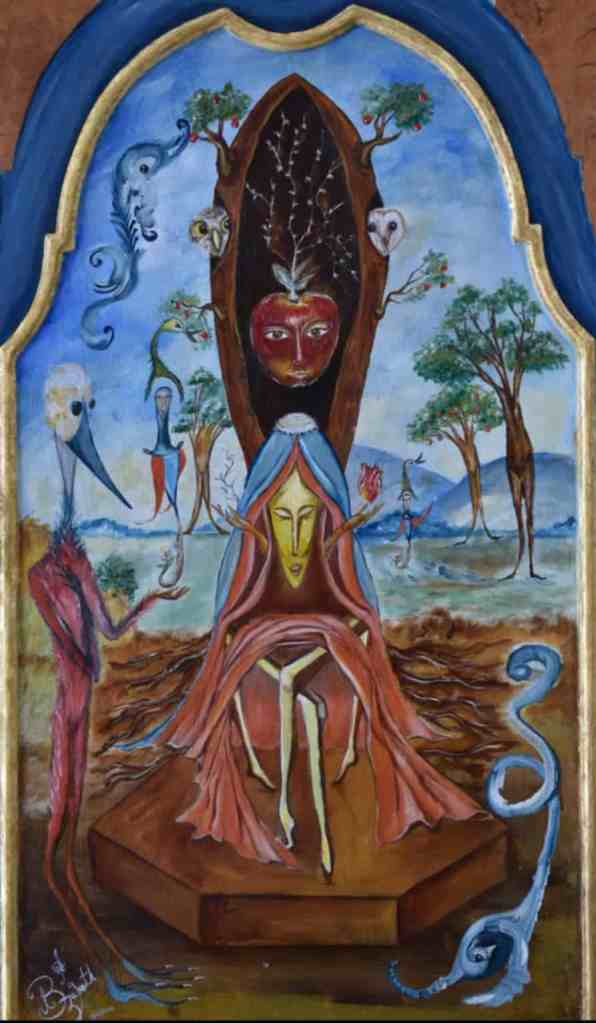
The Dreamscapes of Brianda Zareth Huitrón

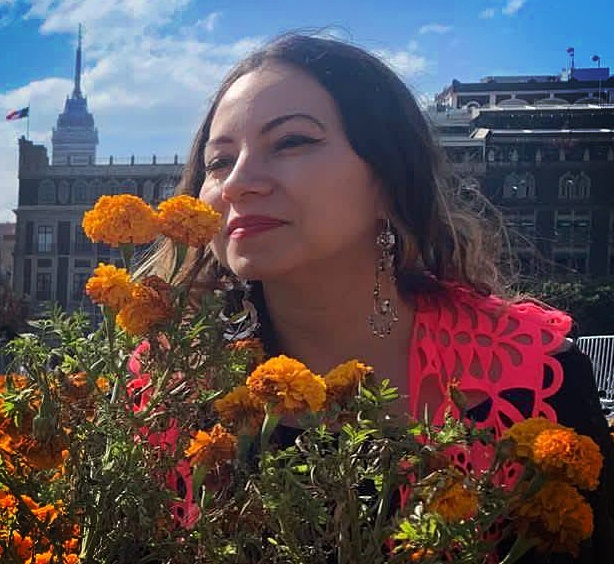
Brianda Zareth Huitrón (1990) is originally from Temascalcingo, José María Velasco, Mexico, she is a visual artist and surrealist painter. She studied painting at the Academia de San Carlos in Mexico City.
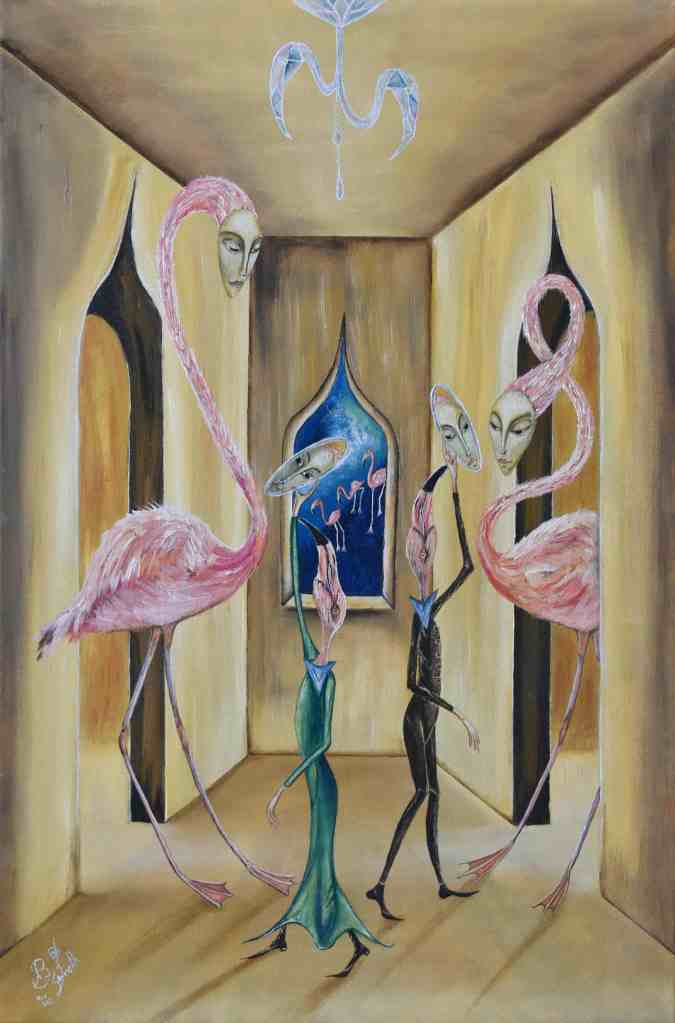
Her multiple artistic facets and curious personality led her to discover surrealism, a movement in which she would find a way to communicate with the world. She creates poetic interpretations where the everyday is transformed into a fantastical and dreamlike reality. Magical paintings that reflect life’s desires to be expressed in a painting.

Brianda Zareth Huitrón has exhibited individually and collectively in Mexico and abroad.

Solo Exhibitions
Leonora Carrington Museum of Xilitla, DREAM ENCOUNTERS in 2025.
Women’s Museum, DREAM REVELATIONS, in 2022.

DREAM LANDSCAPES for the Temascalcingo Festival Honoring Velasco, in 2021.
WINDOW TO DREAM WORLDS, at the Futurama Cultural Center, Mexico City, in 2020.

Group Exhibitions
Col-art at the Oscar Román Gallery in 2025.
The painting exhibition THE PAINTER’S TRADE, at the San Carlos Academy, in 2019.
DIMENSIONS, Wave Gotik Treffen Festival, held in Leipzig, Germany, in 2018.

She has participated in the Chair for 100 Years of Surrealism, at the Faculty of Philosophy and Letters of the UNAM, giving a lecture on female surrealism.

Her work has recently been published in the book Mexican Women in Art, published by Agueda, and in THE ROOM SURREALIST MAGAZINE, an international surrealism magazine.

Cryptic Messages from Leo Alt

Alien Telepathy

Inspiration for my Artwork comes about fast and furiously, which I attribute to the theory of left-to-right brain transformation. My background and education have enabled me to create without boundaries.

The Overseer

I see a world of abstract shapes and colors, and I interpret my vision in digital images. Hidden within my creations are enigmas—mysterious images, cryptic messages, and symbolism. I invite viewers to explore, to decode, and to find their own meanings in the art

Crystal Blue Persuasion

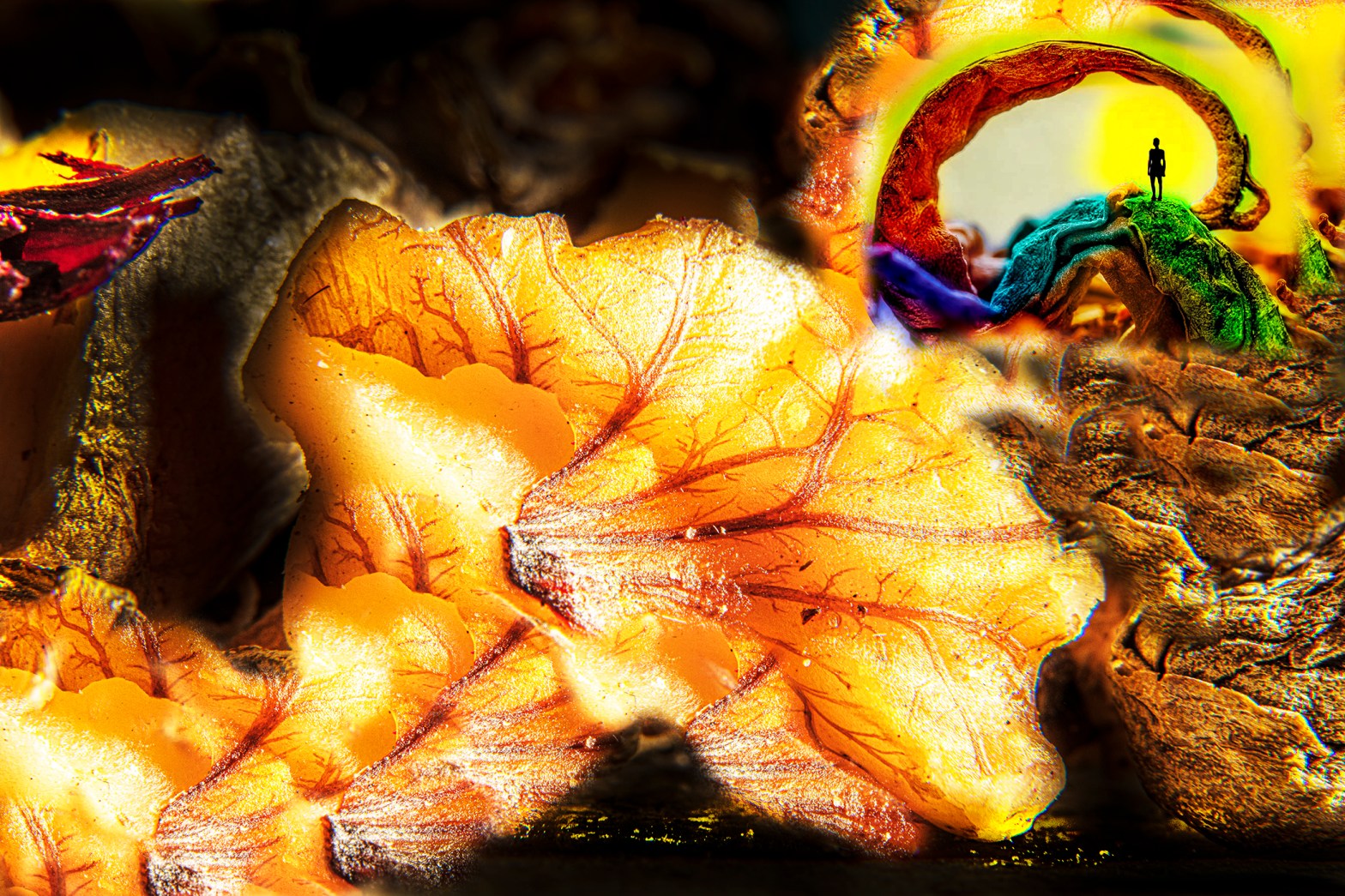
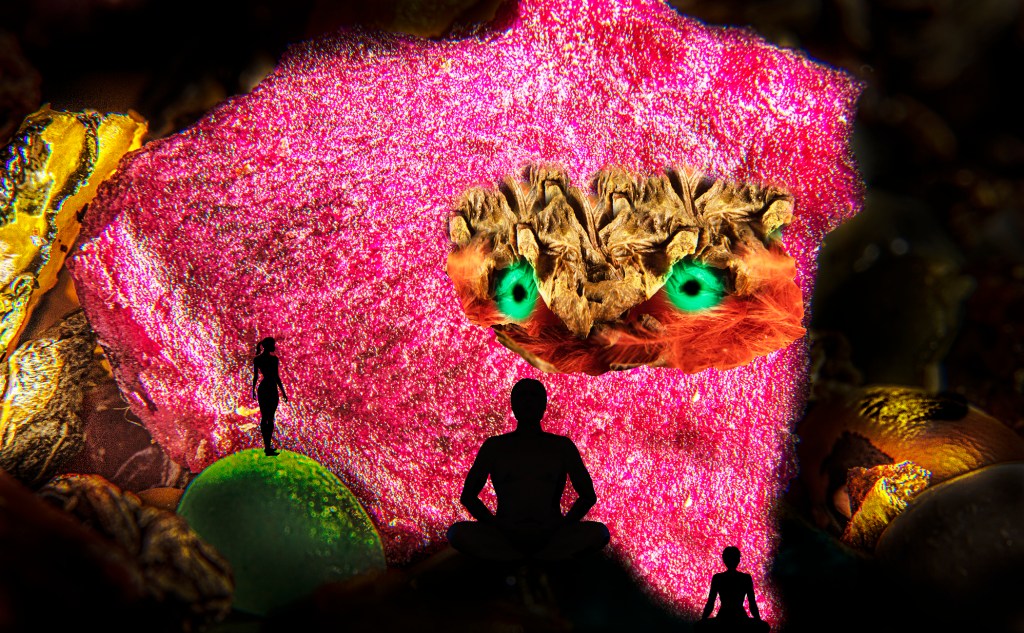
Leo Alt (Leonid Altshuler) is a notable 21st Century Digital artist, whose work incorporates images of organic substances, minerals, and man-made items, photographed on a micro-scale. Included in the surreal scenes are silhouetted forms of humans and other creatures.

The vivid images are evocative of many scenes: dreamscapes, alien worlds, portals to other dimensions, and more. Leo’s portfolio showcases his unique vision and creative approach to digital art

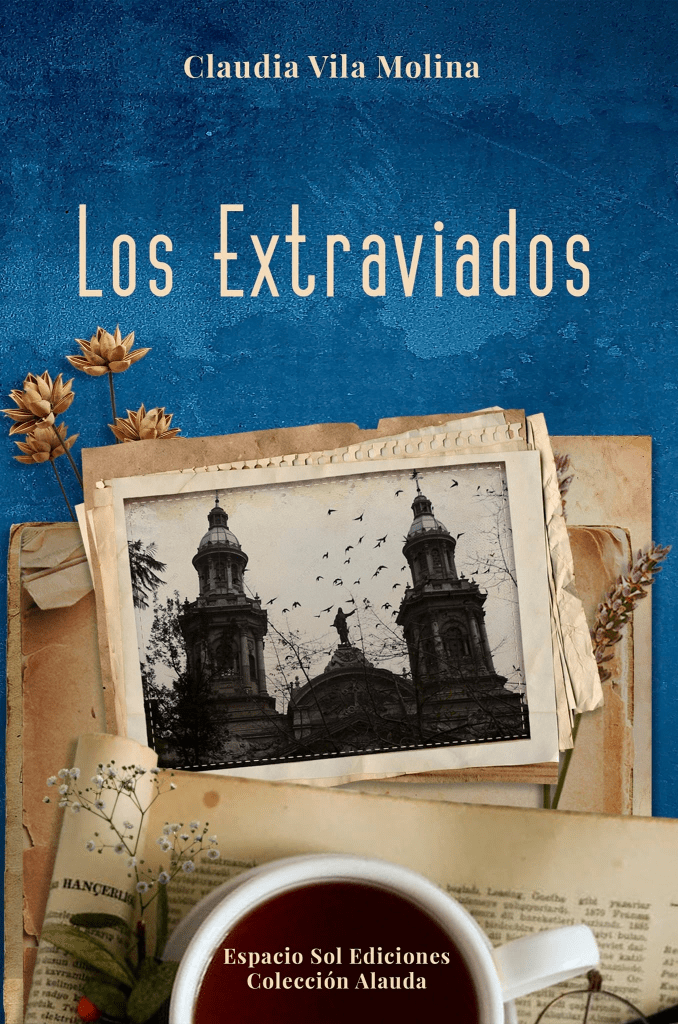
Los Extraviados Claudia Vila Molina

Pesquisas

He estado buscando la esencia del mundo

y he recorrido todos los escondites

pero tu no estabas

aunque vi debajo de los cartones

muchos quisieron huir

y albergarse dentro de mi mente

los demas escucaban los relojes

y seguian palpitando

entretanto yo ofrecia mi cuerpo a la luna

y ella miraba a traves de los espejos

la cara oculta de todos los hombres

Conjuro

Hago un circulo con las hojas

llamo a las puertas de la neblina

y un nuevo rostro aparece me saco antiguos ropajes

y floto con los muertos

nada es mas oscuro ni menos irreal.

Hipnosis

Un brillo como de hoja seca

persiste a traves de los objetos

que se diluyen en nuestras miradas

si a ese disfraz le quitamos las plumas

la noche tendria que inventar

nuevos prostibulos para esconderse

y se resquebrajarian

los rostros de todos los hipnotizados

Exorcismos

Las sombras saben guardar secretos

y muerden los tramos de esta hipocresia

no niego tu podredumbre

aunque me siente a un costado de este camino

y eche espuma por la boca

El tiempo tiene una agotadora manera

de sentarse en las sillas y mecerse

Claudia Vila Molina
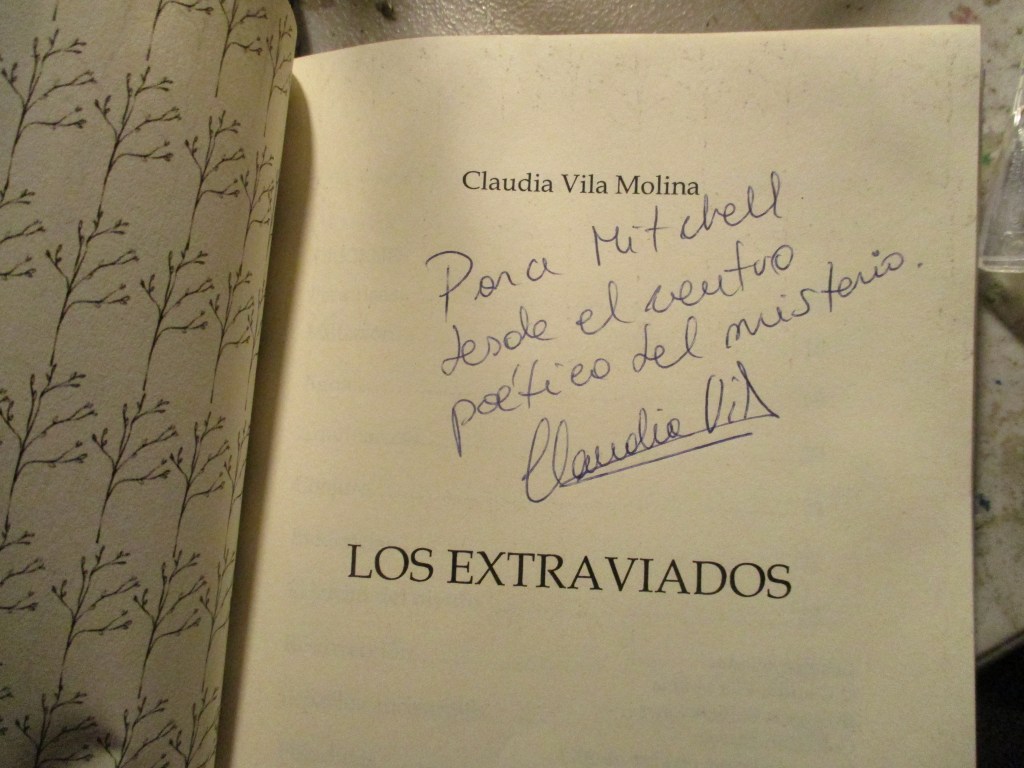
Claudia Vila Molina was born in Viña del Mar, Chile. Professor of language and communication at PUCV. She is a poet and literary critic.
My signed copy

09-22-1969

Born in Viña del Mar, Chile. Professor of language and communication at PUCV, poet and literary critic. In 2012, she published her first book, The Invisible Eyes of the Wind. She has published in renowned Chilean and foreign digital media: Babelia (Spain), Letras de Chile (Chile), Triplov and Athena de Portugal, among others. During the year 2017 she participates in the Xaleshem group with poetic texts for the surrealist anthologies: “Composing the illusion” in honor of Ludwig Zeller and “Full Moon”, in honor of Susana Wald. In 2018, she integrates the feminist anthology IXQUIC released both in Europe and in Latin America. In 2020 she participates reviewing the conversation book “Shuffle poetry, Surrealism in Latin America” ​​by Alfonso Peña (Costa Rica), also writes a poetic prose text for the book “Arcano 16, La torre“, by the same author. Likewise, she participates in the book “120 notes of Eros. Written portraits of surrealist women” by Floriano Martins (Brazilian surrealist poet, writer, visual artist and cultural manager). In this year (2021) she publishes her second poetry book Poética de la erotica, amores y desamores by Marciano editores, Santiago. In 2023 Los Extraviados

Cephalopod by Daniel O’Reilly

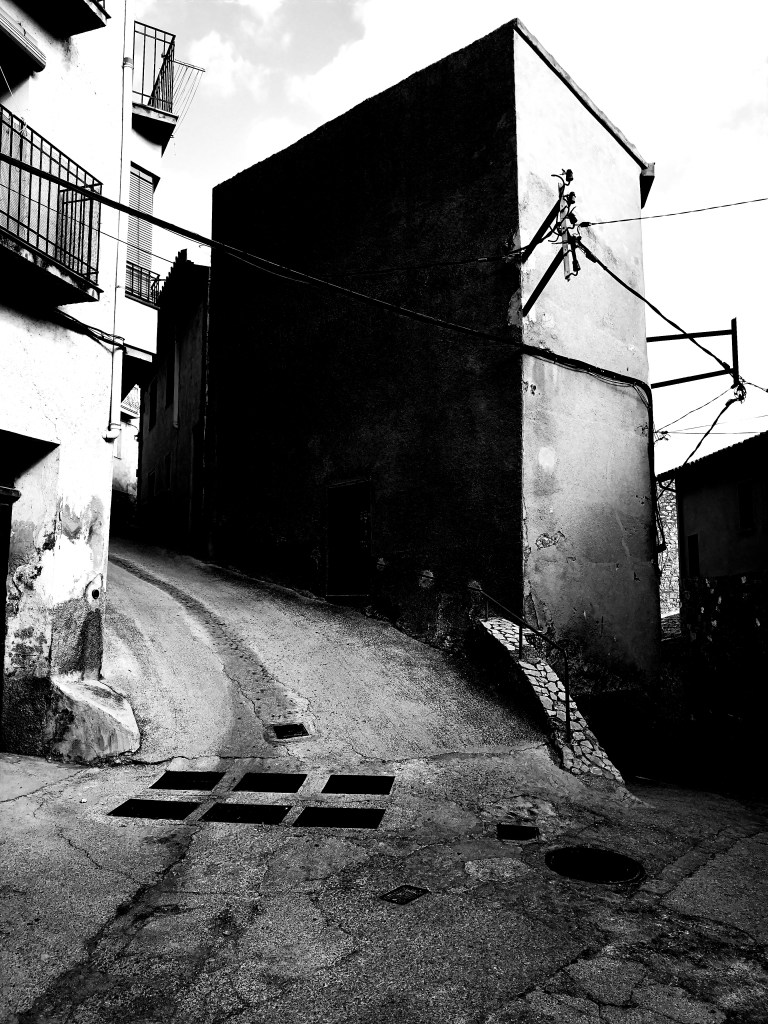
Pauls Catalonia

Cephalopod

written/photos ©Daniel O’Reilly

In centuries preceding, during the long, dark night of people passed, the light from the moon was different, they say. Carpet weavers watched sporadic clouds wrestle with thick air as translucent sentiments, ribbed by fleshy coils, pointed fingers at old friends. Tarpaulin Triveni, female, teacher of twenty, payer of Federal taxes, architect of the west winds, lover of afternoons; Route 79 to Tiruvannamalai, rush hour smoke, brimstone, incense, pooja, sudden migrations: the temple, partly stone, partly human –

Astarte! At last, longed the cantaloupe queen, conscious like burned butter afloat in disquietning nodes of boiled heroism, sheer terror written on her bronze armour in longhand Sufic prose, arrows bristling brilliant shafts of light upon those who stand amazed. In showers of liquid lead and riddles like retribution she raises up her head in thunderous paroxysms of wildfire, incinerating the noise of the NASDAQ trading floor via the quietest opening, or tearing into the roaring twenties: like lovers they eat themselves whole. A pain-pointed predilection for killing gods of all sorts, striking them to the ground, howling, shrieking for mercy, but shewing none, misusing the corpse after the kill like orca with a dead seal, or Achilles with Hector’s remains. We play with death. It makes us young.

Silver serpents entwine the heart-locket of a young man in Queens. The crepuscular silhouettes of tall buildings all empty, as in a dream, bitter chills in the wind from Hudson’s channel, flashes of red lightning, banshees in the street below setting the dumpster afire. Concrete streets empty and dark, this wraith-like apparition only masquerades as a city: a riddle, an omen, a curse. A picture of petty consequences, catalysing a tuber shaped oath for remedying unlikely afflictions of the psyche, like the pinch of a rubber band wound too tightly around your finger. Entrenched layers of decimal decline pontificate politely to a crowd of mainly young goatherds, but they don’t mind, as any entertainment will suffice for a goatherd of the Bactrian valley, longsuffering in the August Afghan ovenheat, yearning for the cool Hindu Kush. Up there, queens look down from snowy temples, peaks outlined by the monsoon moon, vanished layers of paradise passing instantaneously from view. Instantaneously

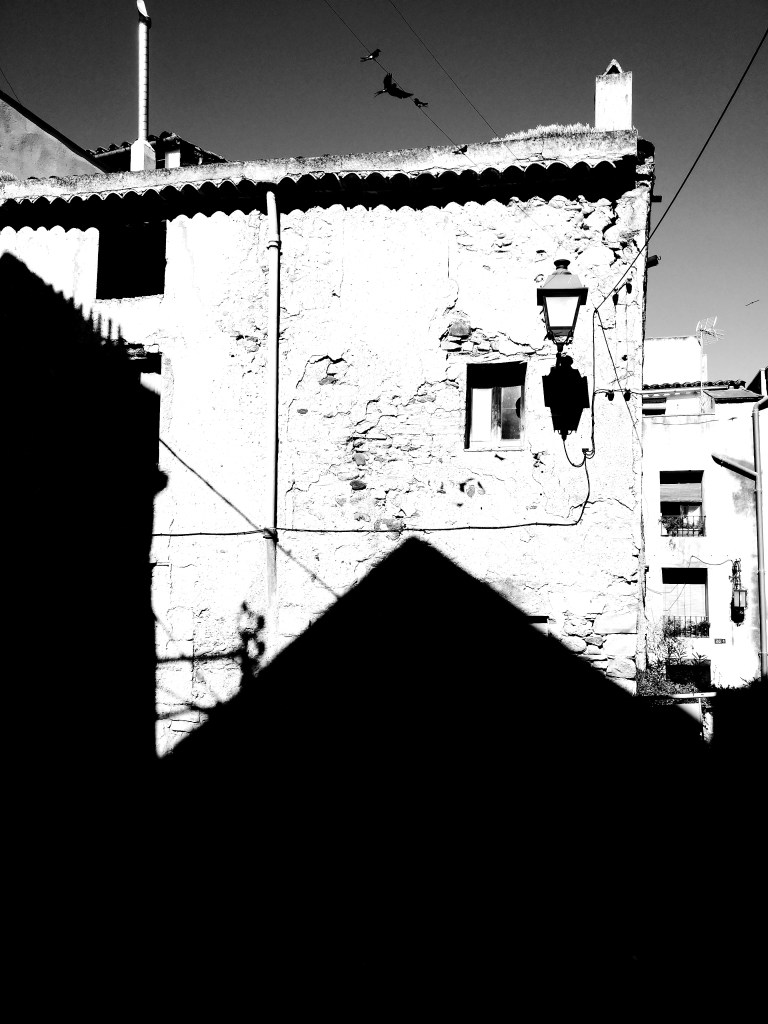
Tivenys Catalonia

Borders bind the wealthy to the poor, but in seaside temples of voluminous concern we count epigrams between sunsets, rallying fractious spirits in the meanwhile, damaging civic furniture installed in the Citibank Plaza. The old guard sits outside the bank on a plastic beach chair, machine gun hanging lazily at his side, smiling cheerfully at the calls of the brain-fever bird stirring raptures in the daytime as if coaxing clams from shells, a child of every man. Now we are ringing the new year by the seven bridges of Königsberg, full of cheap fortified wine and high on super glue, destroying the way of life for those who cannot know better, sweetening a joyous relation between the baroque lintel and its most spiritual rejoinder.

Openings, ruptures and fissures decimate Dorothy Drumwise on her drunk drive through the badlands of Blackpool, BMW unlicensed, DMT fairground flakeout. She sings sweet missives of the Golden Age, of Plutarch, Pindar, and of Ovid. Inclinations of ages move with tectonic twists, first shifting this way, then that way, as with the latest dance fad. I know that you know that the ‘this way and that way’ is a vital mechanism of natural philosophy. The waggledance of industry, the fiesta after the feast, festivals observed on Temple grounds, and with much smoke and incense. Astarte above, chariot rider of fury, smoking halos of pure fire above the heads of gathered postmodernists, crypto-Marxists, and other groups assembled for purposes only spectacle may account for. This terror and delight is for quivering flesh alone: no gods may get a taste –

Tivenys Catalonia

In an asemic New Babylon, an endless plan of a constant architecture, sketch after sketch of alleyways and avenues, flows, interruptions, passages of ludic intrigue: our only concern will be for how the wind goes. The city-gestalt, our new Babylon, is stacked tier-upon-tier as with a Hindu temple, complete with the sombre front of a necropolis, grey and overbearing, the pantheonic structures of dead gods hewn into rock, but haphazardly, without plan or meaning. The Temple of pure, empty worship, accessed via doors which only appear to be doors, words which only appear to be words, each word a door signifying an exit, but only signifying, without being itself –

Kuilapalayam India

The cultivation of ways, sulfurite ligaments imposing reasonable content on expounding gasses, phosphorescent burns blister the torn corners of Lloyd George’s copy of The Life of Gargantua and of Pantagruel, but this will not be a problem for long – at least, not for several centuries. Down in the Centre Pompidou there exists a scale copy of Nieuwenhuys’ Labyrinthe aux échelles mobiles. Parisians drink pastis at 7pm.

The matriarchal temple builders of our mother, our lady, notre dame. The swollen, translucent body nurtures a billion babies in complex mythic tunnels underground. Our lady of the temple, founded with mortar and keystone, high Romanesque arches, transverse, ribbed, darkened by smoke of incense that beckons, intoxicates, shines, yet moulds-over quickly. The body of our lady nurtures a repugnant decay where fungi of a million kinds find resplendent consumption. A gentle breeze lifts the spores up and into the forest above, the penthouses, tower blocks, the Gothic quarter below, even the suburbs populated with a thousand empty houses, empty restaurants, empty hotels, emptiness, or so it is reported by La Vanguardia, thumbed in street corners by elderly gentlemen sipping coffee in districts of towering blocks, Brutalist forms, echoes of steel rod construction divining bittersweet sunsets of lackadaisical reform, wilted in margarita sunsets, sugary sensualities disinhibiting bashful dissimulation with the gait and libido of a wild cur, roaming street corners, lurking around the panty drawer, Our Lady intends two-thousand years of certitude for divine discourses on nature, for a thorough study of Deleuze, for a monthslong dance of the wild kind, for carnivals of a schizoid nature, for a Heraclitean passing, and passing, and never returning

Our retreat towards a porcelain past resides in a turpentine residue of vistas opening above the Sierra Nevada, that pillar supporting the vaulted deep blue sky, the only thing keeping worm-eaten heavens from falling. Remember how we drove there in December of 2018, how the warning signs for ice hazards slowed us for many miles? We sat in the steamy car and drank tea from a flask, ate sandwiches prepared earlier at home, austerity gnawing at the innards. Porcelain does not prevent against cysts. Cysts large as an eyeball, pickled in vinegar solution, stacked on a forgotten shelf in a back room of the British Museum. Perhaps it was Napoleon’s eye? Perhaps it was not?

Tortosa Catalonia

It was I, not Napoleon, who took the moon and put it at the bottom of a lake, littered with the bloated bodies of Englishmen drowned in their re-sprayed Range Rovers. Between velour flaps, cold castellations and raptures coloured like velvet bands at the fair, phalanxes shimmer like desert lizards tussling in the heat of day, the axehead aligns at the very base of the skull to release a thousand demons from their hiding places, demons who vy against one another in their scramble to escape this mind forever, darting this way and that, a confusion of beastly shapes writhing in colours both sapphire and turquoise –

Daniel O’Reilly

Daniel O’Reilly is an independent British author, publisher and internationally exhibited multimedia artist living and writing in rural Catalonia in northern Spain. In 2022 he exhibited stories, photographs and music from the [archipelago] project at the International Exhibition of Surrealism in Cairo & Alexandria in Egypt, which will travel to the Andre Breton House in France in 2024. He has recently published short fiction in the Margate Bookie Zine, Trilobite Literary Journal, Tiny Spoon magazine, Writer’s Block magazine, Sulfur Surrealist Jungle, the Bengaluru Review, Defunkt Magazine, Everything in Aspic Magazine, Chachalaca Review, The Room Journal of African Surrealism, and Black Flowers Literary Magazine. He is co-creator of The Unstitute, an online art lab and artists’ co-operative, and has screened original video art in competitions and exhibitions in over 20 different countries worldwide.

Visit the [archipelago] literary project on Patreon: https://www.patreon.com/DanielOReilly

Visit The Unstitute: https://www.theunstitute.org/

Bari Degi, Two Poems by Meesha Goldberg

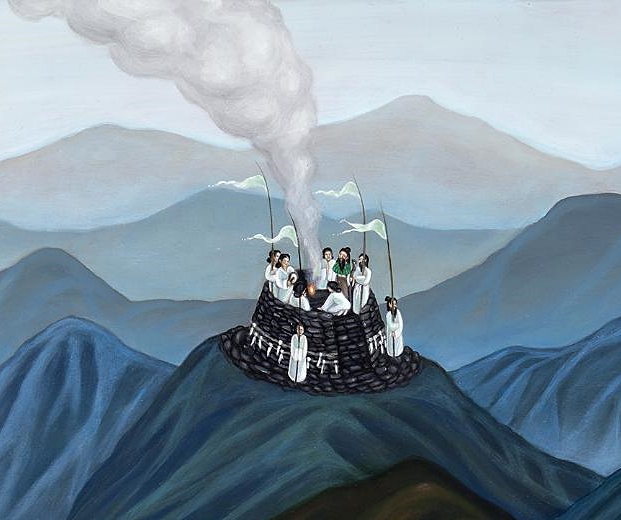
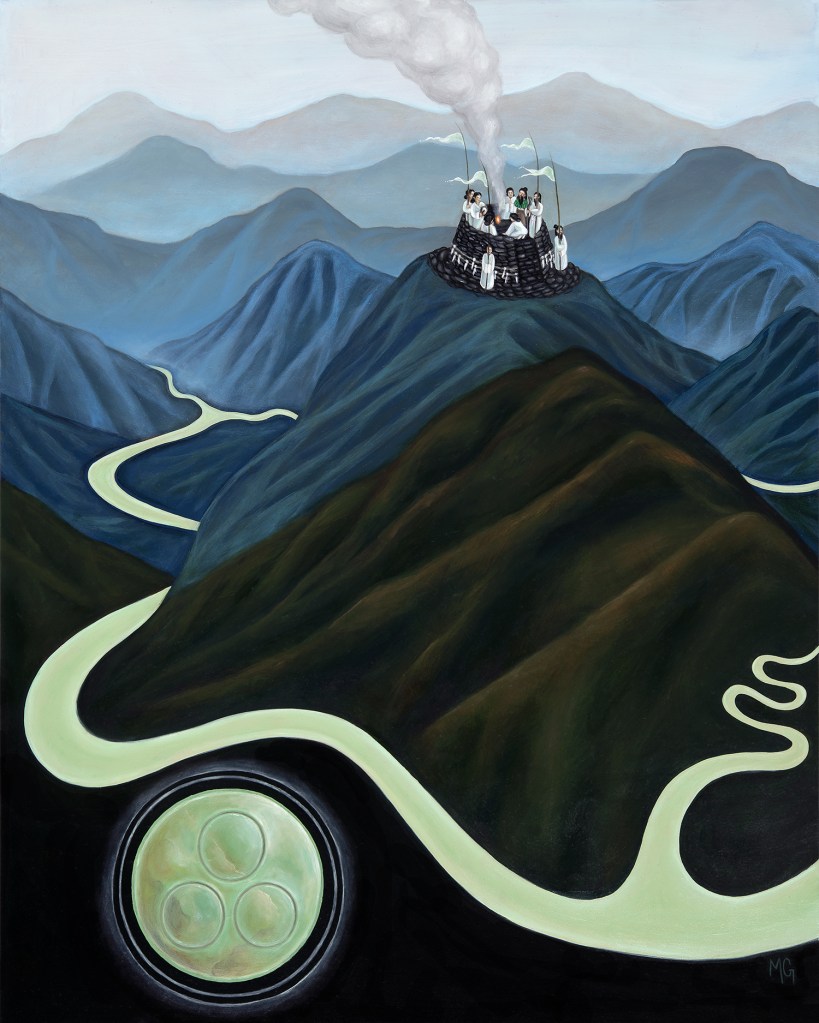
Mountain Top Budoji Meesha Goldberg

Tigers

            after the Korean myth Bari Degi 

1. The Queen So Stunned

Where do tigers sleep? she thought

while praying in the dark

She prayed so hard

her lips had long gone automatic

She prayed so hard

even indifferent spirits

stirred in their den in the stars she prayed 

so hard

the brass tongues in her skull chimed

so hard her knees polished the pine floor

& sweat bled through her dress

Can you first smell the tiger? You can’t 

help these thoughts 

while listening for spirit

She prayed so hard her palms calloused

as farmer’s & her heart charred

but after 100 nights 

she & the king shared the same dream 

of the big dipper 

waterfalling

light into their breast

so she forgot 

prayer is a hollowing 

for fate 

She prayed so hard that when still this seventh baby

was born a girl

the queen so stunned

to be abandoned by the gods

agreed to leave it in the mountains

in its brother’s useless silk

on which she scrawled

in royal blood

throwaway

바리

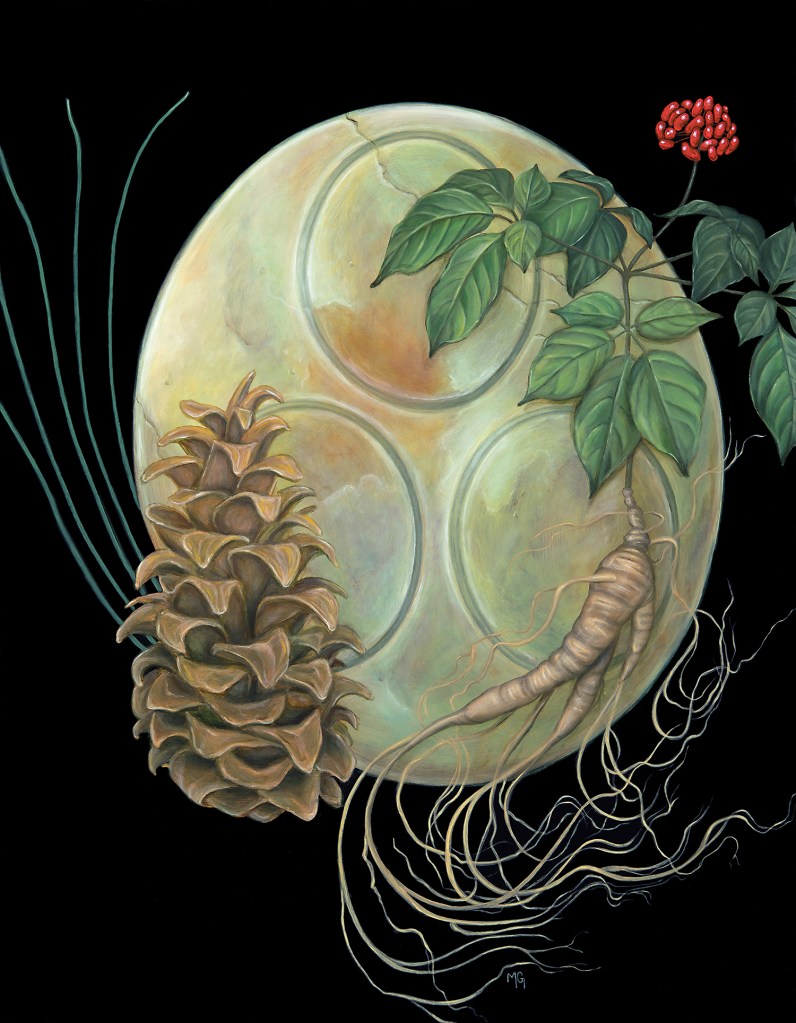
Budos Sacred Medicine Meesha Goldberg

2. Wild Bound Till Fifteen

In darkness my mother’s 

yellow eyes spotlight

Every muscle listens for how 

the owl heralds & the boughs pine

My hunger rustles & those moons

set to meet mine, purr a lullaby till I latch

a teat in her whitest fur. I’m cream warm

bare skinned & sated it’s like

no harm could ever come

She is my god 

& my god delicious

Licked twice by my mother’s tongue

her copper breath soothes me 

When I dream I wake

& every eye in the rockface blinks in sympathy

The mountain lives

I pick up chants by the echoing den

alphabets in constellations

every plant suggests its spirit

every wind a parable

By the new year I’m reared 

in the art of stillness

as the cubs learn patience by the hunt

mimicking their matriarch

The forest’s feral almanac 

opens its hard spine &

by & by I’m schooled

& refined through survival

Scrying veins in riverstone

saving seed to spring scatter

etching reflections in turtle bone

wild bound till fifteen 

& freshly bled

a woman

written and illustrated by ©Meesha Goldberg

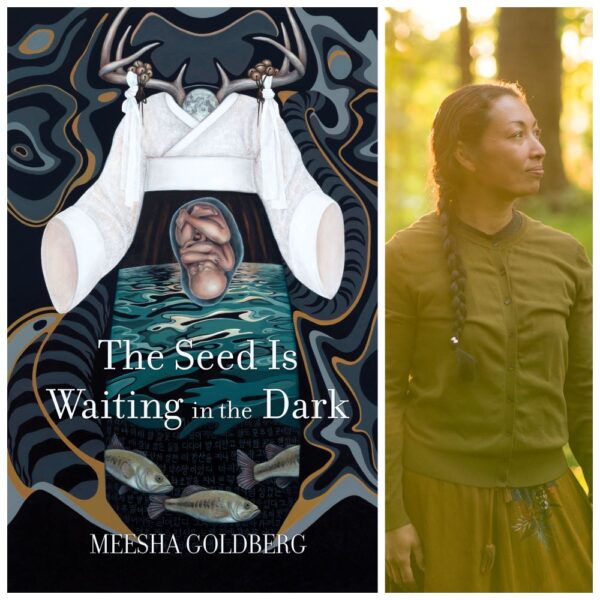
Meesha Goldberg is a Korean American artist and poet living in Charlottesville, VA. Her experiences growing food, serving as an activist, and journeying to sacred places have made her a powerful advocate for the Earth. Goldberg has exhibited her work in solo shows around the United States, with her debut poetry chapbook “The Seed is Waiting in the Dark” forthcoming in 2024 through Finishing Line Press. Her art crosses the boundaries of genre to both experience and express transformational repair. Performance, ritual, painting, film, and poetry merge in durational, place-based works and gallery installations that insist upon the re-enchantment of the world. 

The Seed Is Waiting in the Dark by Meesha Goldberg

This title will be released on January 19, 2024

The Seed is Waiting in the Dark confronts the realities of ecological catastrophe and diasporic displacement with the lyric intensity of a life lived reckoning with questions of collective survival. Included within this debut collection are five of Goldberg’s paintings, which poignantly illustrate these feral, visionary poems. Full of grief, grace, and lessons from the land, The Seed is Waiting in the Dark conjures ancestral instincts to claim belonging within the cycles of natural life.

RESERVE YOUR COPY From FINISHING LINE PRESS

http://www.meeshagoldberg.com/

Auntie Etha’s Cow-Lip Tea by P.D. Newman

AUNTIE ETHA’S COW-LIP TEA: An Early Case of the Use of a Coprophilous, Possibly Entheogenic, Fungus in African American Folk Healing

Ron Hall and Denver Moore’

written by ©P.D. Newman

The psychedelic, psilocybin-rich species, Psilocybe cubensis, is a coprophilous mushroom. This means that it can only subsist in the wild upon the dung of certain animals, especially cattle. While native to Cuba (hence cubensis), this fantastic fungus has been documented in a number of southern states, including Florida, Georgia, Alabama, Mississippi, Tennessee, Arkansas, Louisiana, Texas, South Carolina, North Carolina, and even as far north as Oklahoma, Virginia, and West Virginia—albeit rarely in these latter three. The species is also found in Hawaii. It was in the state of Louisiana, however, amidst its humid cattle fields and dank, swampy marshes, where African American sharecropper, Denver Moore—then just a boy—first underwent what may be an early example of psilocybin mushroom use in North America.

As the book says, Ron Hall and Denver Moore’s New York Times Bestseller, Same Kind of Different as Me—an amazing true tale of a modern-day slave, an international art dealer, and an unlikely woman who brought them together—is a story filled with hardship, betrayal, and the brutality that lines the hearts of some men. But, it’s also a story of hope and perseverance, mottled throughout with thought-provoking anecdotes about black life in the Deep South in the 1950s. Descended from African American slaves, Denver Moore was raised on a scorching southern plantation near the alligator-riddled, mosquito-infested swamps of Louisiana. Having very few monetary resources, Moore was blessed to have an incredibly resourceful wise woman of an aunt, a Conjure woman—called Auntie Etha—who, with the aid of traditional African American folk remedies, was able to help the Moore family make the most of an often difficult situation. Moore recalls,

Lookin back on it, I think Auntie was what you might call a spiritual healer, like a ‘medicine man,’ cept she was an elderly woman. […] Big Mama made me go show my respect and also to help Auntie gather up the fixins for her medicines.

She used to take me with her down by the swamp where she’d be gatherin up some leaves and roots. […] ‘Now Li’l Buddy, this here’s for takin the pain out of a wound,’ she’d say, pullin up a root and shakin off the earth. ‘And this here’s for pneumonia.’

[…] She had a room in her house with a big table in it covered with jars in all kinda sizes.

See them jars?’ she told me one time.

Yes, ma’am.’

In each of em, I got somethin for anything that happens to you.’

[…] She had some kinda spiritual thing goin on in that house. Every time I went in there, she made me sit on a little stool in the same spot, even facin in the same direction, like she didn’t want me to mess up whatever voodoo she had goin on in there.

Moore’s charming description of Auntie Etha clearly betrays her as a practitioner of Hoodoo, known in the Mississippi Delta as a “Rootwork” or “Conjure,” even going so far as to evoke the term, “voodoo,” in his account.

Hoodoo, a traditional African American spirituality that arose from several West African traditions as the same were imported into the New World, may not be stranger to psychoactive plants. For instance, while not entheogenic itself, one of the most common charms carried by Conjure practitioners is the root ball of the Ipomoea jalapa vine, referred to as a “High John the Conqueroo” root. Some species of Ipomoea (morning glory), such as Ipomoea tricolor and Ipomoea corymbosa, are possessed of the hallucinogenic compound, ergine, also known as d-lysergic acid amide (LSA)—a close cousin to Albert Hofmann’s “problem child,” lysergic acid diethylamide (LSD-25). In 1938, Ipomoea corymbosa (formerly Rivea corymbosa), for example, was discovered by American biologist, Richard Evans Schultes, to solve to problem of the identity of the ancient Mexican hallucinogen, Ololiuqui. The formidable effects of Ololiuqui were noted in the colonial document, The Florentine Codex, from the 16th century:

It inebriates one; it makes one crazy, stirs one up, makes one mad, makes one possessed. He who eats of it, he who drinks of it, sees many things that will make him afraid to a high degree. He is truly terrified of the great snake that he sees for this reason.

Francisco Hernandez, the famous Spanish physician, also discussed Ololiuqui in his book, Rerum medicarum Novae Hispaniae thesarus:

When the priests of the indians wish to commune with the spirits of the dead, they eat these seeds to induce a delirium and then see thousands of satanic figures and phantoms around them.

Ergo, there was already a history of the Native use of hallucinogenic morning glories in the Americas long before the arrival of African slaves. But, that doesn’t necessarily mean they learned of jalapa through Native Americans.

Century Illustrated Magazine (1881-1906), XLI, 825.

Before going any further, it is important to note that some African cultures are known to be in possession of their own rich, entheogenic traditions—independent of the export of African slaves to the New World. The Bwiti cult found among the Puna, Mitsogo, and Fang tribes in Gabon and Cameroon, for instance, employ the inebriating root bark of the West African shrub, Tabernanthe iboga, in their lively initiations. Like the “High John the Conqueroo” charms cherished by Southern practitioners of Hoodoo in North America, iboga is harvested from the roots of the shrub, linking the Bwiti cult, at least in spirit, to the black “rootwork” of Southern Hoodoo—a tradition whose own roots are to be sought in the religious practices of the Bantu of the former Kingdom of Kongo in west-central Africa. In fact, when iboga was first documented by the West, English traveler and author, Thomas Edward Bowdich, reported that,

The Eroga, a favourite but violent medicine, is no doubt a fungus, for they describe it as growing on a tree called the Ocamboo, when decaying; they burn it first, and take as much as would lay on a shilling.

While this Englishman is no doubt in confusion regarding the identity of iboga, his observation suggests that some species of fungus was sacred to the Indigenous of the area. And, indeed, a tree fungus, known as tondo, was in fact central to the construction of nkisi statues, whose “kondu gland”—a hollow chamber in the belly of the statue—held samples of the unidentified specimen. One Bantu nganga, making an offering of the mushroom to the spirits, referred to tondo as “the key that opens everything.” The Kongolese and African American practice of surrounding the gravesite of a loved one with inverted plates and saucers, often resting atop poles or sticks, was believed to imitate the appearance of mushrooms around the burial. According to one source, this curious form of grave decoration was meant to recall and old Kongo play on words: tondo / matondo. For, in Bantu, the word for mushroom (tondo) is similar to the word for “to love” (matondo).

Power Figure (Nkisi N’Kondi: Mangaaka), Kongo peoples, mid to late nineteenth century, wood, paint, metal, resin, ceramic, 118 x 49.5 x 39.4 cm, Democratic Republic of Congo. Medicinal combinations called bilongo are sometimes stored in the head of the figure but frequently in the belly of the figure, which is shielded by a piece of glass, mirror, or other reflective surface. (The Metropolitan Museum of Art)

To return to the Americas, Schultes also identified the Aztec psychedelic, Teonanácatl, as belonging to the Psilocybe genus. But, Denver Moore’s would appear to be the first account of the possible use of a psilocybin mushroom within the context of Conjure, as the same was practiced by African American slaves in the Deep South. Many Hoodoo practices continue to be shrouded in secrecy. So, it may be impossible to determine just how far back this tradition among African Americans extends. But, as the famous Tennessee Hoodoo practitioner, Doc “Wash” Harris, founder of the infamous Saint Paul Spiritual Holy Temple in Memphis—inappropriately known by locals as “Voodoo Village”—once said in an interview with the Commercial Appeal in 1984,

God told the black man and the Indian somethings he didn’t tell nobody else.

One of those things may have concerned the powerful effects of a particular species of dung-loving mushroom.

Reminiscing about his great, wise Auntie, Moore briefly continues,

Aunt Etha took care of our bodies and souls. Mostly we never got very sick, but when we did, my auntie sure ‘nough had the cure: Somethin she called ‘cow-lip tea.’

Now cow-lip tea was brown and thin, kinda like the Lipton tea the Man sold at his store, but a durn sight more powerful. Cow-lip tea come from them white toadstools that sprout outta cow patties. […] That’s where cow-lip tea got its name. ‘Cow’ from the cow patties and ‘lip’ from the Lipton. Least that’s what Aunt Etha always told me.

The way you make cow-lip tea is you get the toadstools […] and grind em up in the sifter. [You] put it in a rag and tie a knot on top. Then you add a little honey to a boilin pot and drop that rag in the water til it bubbles up and turns good and brown. Now you got cow-lip tea.

If I was sick, Aunt Etha’d always make me drink a canful.

All good medicine tastes bad!’ she’d say, then put me in the bed underneath a whole pile a’ covers, no matter whether it was summertime or wintertime. In the mornin, the bed’d be soppin wet and the sheets’d be all yella, but I’d always be healed. I was nearly grown before I figured out what I was drinkin.

This historical narrative is simply amazing. Psilocybin mushrooms weren’t brought to the attention of the broader West until 1957, with the publication of the paradigm-shifting photo essay, “Seeking the Magic Mushroom,” in LIFE magazine by R. Gordon Wasson—the “father of ethnomycology.” Moore’s account is at least contemporaneous with Wasson’s publication. But, considering that this particular treatment was likely a timeworn tradition handed down to Auntie Etha by her own teacher(s), it is very probable that this particular use of the fungus went back much earlier than the time of Moore or his Auntie Etha. While no psychedelic effects were noted by the author, the mere fact the mushroom tea was administered in a medicinal context, to treat a sick boy, is highly significant. For, the Mazatec ceremony to which Mexican curandera, María Sabina, invited Wasson, the same wherein the psilocybin mushrooms were ingested, was also explicitly medicinal—velada being the traditional name given to the mushroom healing vigils carried out by Mazatec “shamans.” Moreover, if Moore was administered Auntie Etha’s tea while suffering a high fever, any psychedelic effects—including hallucinations—may have simply been attributed to the symptoms of the contracted illness.

“Seeking the Magic Mushroom,” in LIFE magazine by R. Gordon Wasson 1957

Importantly, Moore’s account is not the sole evidence of the use of entheogenic concoctions in the practice of Hoodoo. Over twenty years before the experience described in Same Kind of Different as Me, African American author, Zora Neale Hurston, in her 1935 classic, Mules and Men, revealed her own experience with what is quite clearly a powerful yet unnamed hallucinogen.

I had to fast and “seek,” shut in a room that had been purged by smoke. Twenty-four hours without food except a special wine that was fed to me every four hours. It did not make me drunk in the accepted sense of the word. I merely seemed to lose my body, my mind seemed very clear. […] Maybe I went off in a trance. Great beast-like creatures thundered up to the circle from all sides. Indescribable noises, sights, feelings. Death was at hand! Seemed unavoidable! I don’t know.

While Hurston’s report does not mention hallucinogenic fungi specifically (or any other substance for that matter), the obvious psychedelic nature of her account is a good indication that entheogenic plants were not unknown to Hoodoo practitioners such as Denver Moore’s Auntie Etha.

Miguel Covarrubias’ Illustration for “Mules and Men” Zora Neale Hurston/ Lippincott, Philadelphia, 1935

 Denver Moore passed away in 2012, so we were unable to interview him concerning his spectacular narration. But, it is our hope that Moore and his Auntie Etha would have been proud to know that their legacy not only lives on, but it may change the narrative as we know it regarding both the history of ethnomycology and the practices of Hoodoo and folk medicine among African Americans living in the Deep South.

Quimbisero + Polypharmakos + Alchemist + Theurgist + Marseillaise Tarotist 

P.D. Newman is an independent researcher located in the southern US, specializing in the history of the use of entheogenic substances in religious rituals and initiatory rites. He is the author of the books, Alchemically Stoned: The Psychedelic Secret of FreemasonryAngels in Vermilion: The Philosophers’ Stone from Dee to DMT, and the forthcoming title, Day Trips and Night Flights: Anabasis, Katabasis, and Entheogenic Ekstasis in Myth and Rite. The Secret Teachings of All Ages (TV Series documentary) 2023.

Theurgy: Theory and Practice: The Mysteries of the Ascent to the Divine by P.D. Newman, published by Inner Traditions, Bear & Company will be available on December 5, 2023