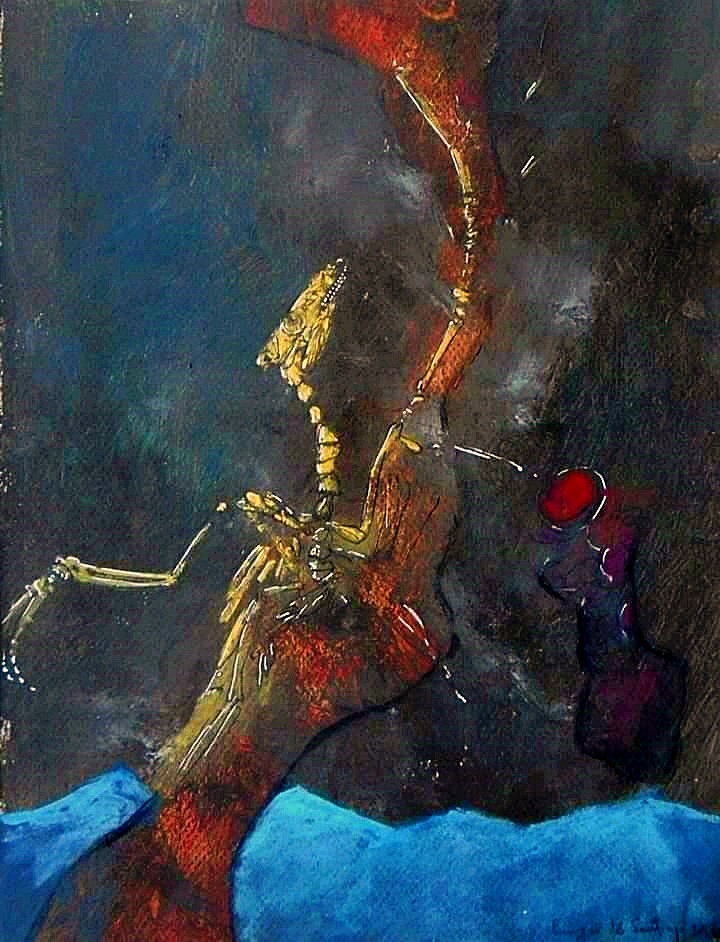
The scientific world wonders where the boundary between matter and antimatter begins. That is, where does the surreal begin? For this we must know the secrets expressed in the Emerald Tablet, where the borders of the vibratory spaces are not represented, since they do not exist, since what is denser can become something less dense according to the laws of the variable flows of the vibratory fields. Therefore, everything is a continuum according to what modern physics has shown, a kind of manifested logos where the elusive can be a res perceived according to the capacity of the receiver.
Gears of a quantum ship, acrylic and ink on Fabriano paper, 21 x 28 cm
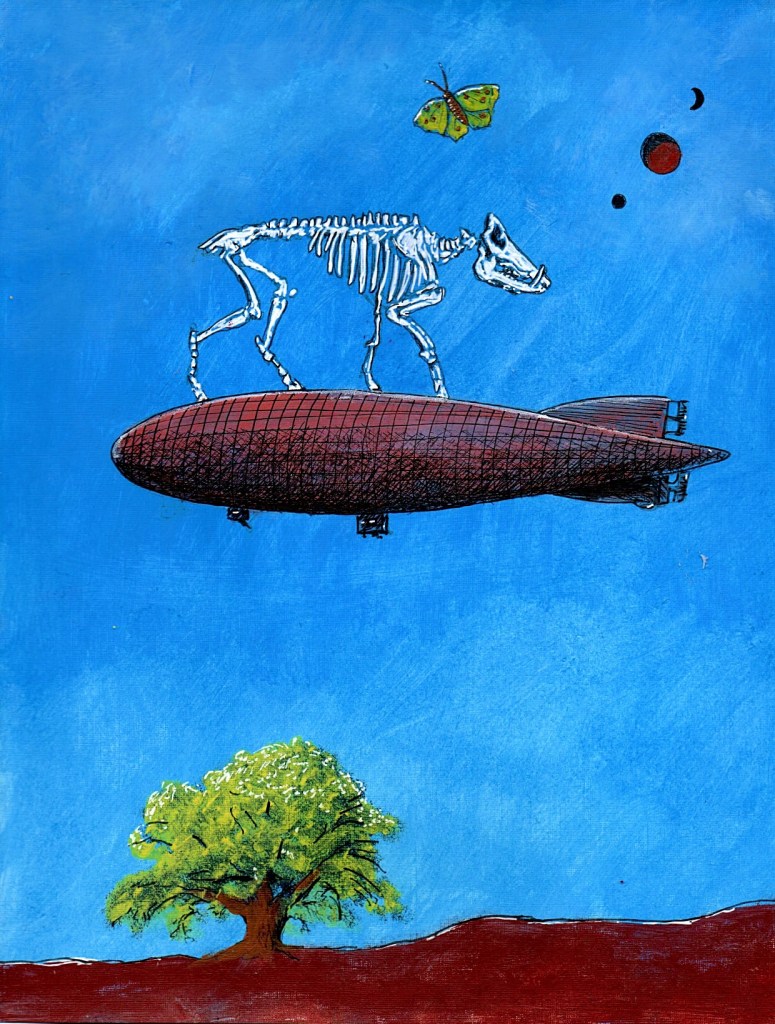
For the exponential curve of the logarithmic spiral to exist, there must be a logarithm that draws it, but also a mathematical equation that designs an enormous spatial support that contains it and allows it not to disintegrate as a design. We calculate what we see, but the invisible does not enter into that equation. This is how we neglect our astral bodies.
Spectacular blindness, collage s/paper, 30 x 20 cm
FAIR DAYS In a cold and stony hole a flower withers hopelessly while the world rejoices with the monk’s tricks
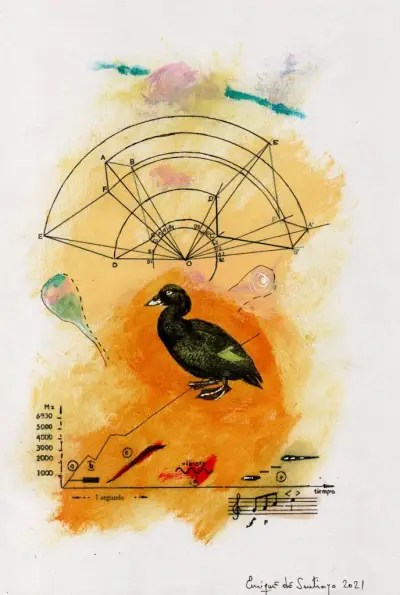
Flight and Music
Perpendicular imagination looming behind the divine muscle that strips of its pelagic destiny to the one that lies at the foot of its calcareous slab. With each sun 666 errata arise in the belly of the lunar word.
Emerged from nocturnal memory a pristine song embrace my origin and illuminate my soul.
Mother earth seeks the perfume of redemption while the man far in the abyss of him auscultates the night to gain objects the emptiness of having is named among the speechless faces so then the alchemical weddings were prepared without any finding for your eyes the leaves of the forest fall slowly the roar of the terrestrial kiss reaches my ears sound to be ocher dust in solar memory end of times and circular principle the appointed mystery while children are killed by hunger to continue making “Barbies”
NUMBER LEVITATION
The ancient voice from the parting of the waters what is above and what is below like pale dawn of man without the primordial exhalation roam the surface looking for a high dwelling to detach from matter the creative breath of the submerged forest under your name with their ethereal offspring like plumage swayed by the wind in their forgotten northern voices mother of desire and of rebellion clay healing tide with sporadic winged notes and tears of bears that forget the wound in sleep.
my bone wish penetrate the flesh of the shadows For a right to endorphins for every citizen
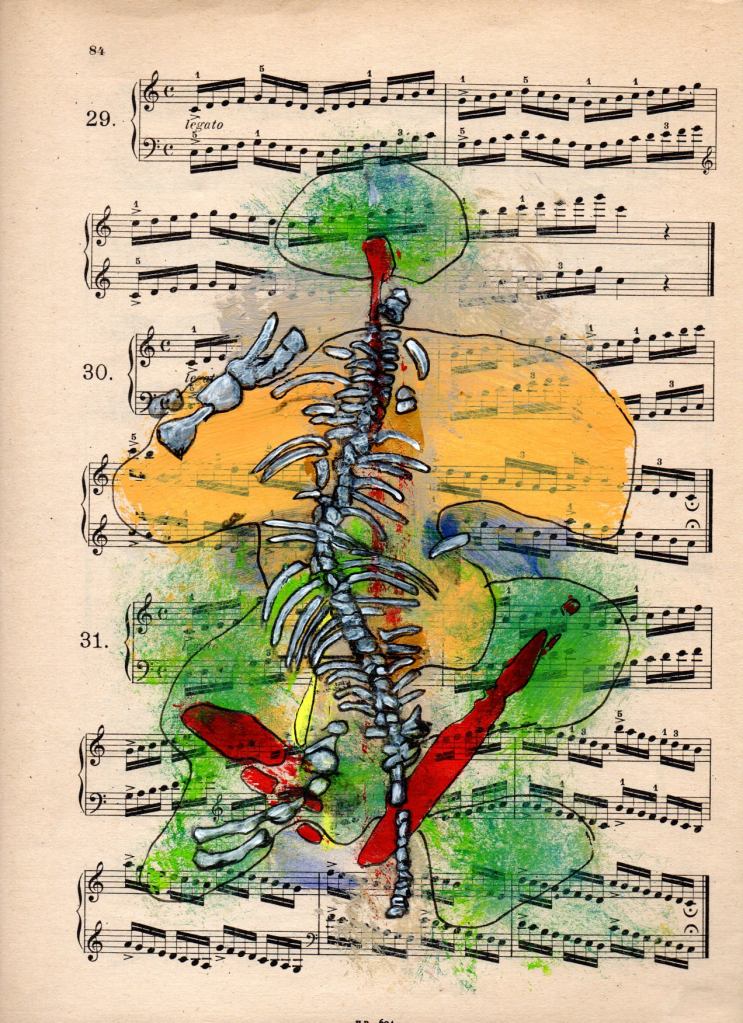
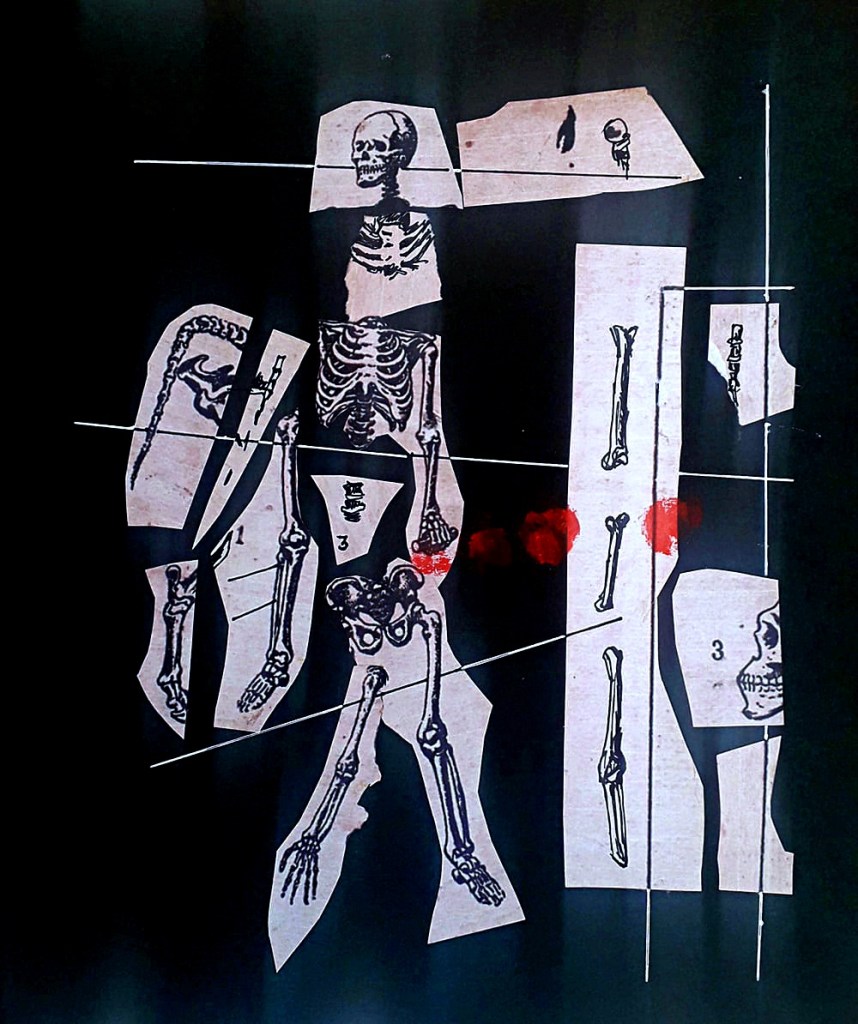
Interdimensional ossuary, Ink on cut paper and acrylic on 300gm fabriano paper
Enrique de Santiago, Born in Santiago, Chile (1961). Visual artist, poet, researcher, essayist, curator and cultural manager. He studied a Bachelor of Art at the University of Chile and at the Institute of Contemporary Art (Chile). Since 1984, he has exhibited in individual and group exhibitions, counting to his credit around more than 100 exhibitions. He has edited five books: Fragile Transits Under the Spirals in 2012, with La Polla Literaria; Elegía a las Magas and the book essay: El Regreso de las Magas, both with Editorial Varonas. In 2018 he edited La Cúspide Uránica with editorial Xaleshem and Dharma Comunicaciones, and Travel Bitácora with Editorial Opalina Cartonera. He has participated in various poetry anthologies, both in Chile and abroad. He has collaborated in the newspaper La Nación with articles on new media art, and in magazines such as Derrame, Escaner Cultural and Labios Menores in Chile, Brumes Blondes in Holland, Adamar from Spain, Punto Seguido from Colombia, Sonámbula from Mexico, Agulha de Brazil, Incomunidade de Portugal, Styxus de Rep. Czech, Canibaal de Valencia, Spain, Materika de Costa Rica and other printed and digital publications.
What were the influences that made you interested in surrealism?
I began with the adventure of painting, a distant day at the beginning of the 80’s. At that time I did not know what Surrealism was, but my painting already contained the emotions coming from the automatism that supplied me with the imaginary of the unknown. Only the desire to stain lived in me so that I could recognize myself in this opportune path that appeared in me to travel, over time I realized that this path would lead me to enter forever into obscurity. Opting for another route, already at this point would be unthinkable, because the fascination produced by the spell of being a sailor of the marvelous, exerts in the spirit, an action that induces more to enter than to withdraw from this way of life.
In those years amid the smoke from the barricades under the extreme times of the dictatorship, the university and my lectern, the first lines that indicated to me that mine was to explore the vastness of the unconscious were succeeding. There were still no readings on Breton, nor Lautréamont, only the unexpected forms emerged instinctively that every day dialogued with my astonished eyes, because perhaps the metaphor came in my DNA, a product of the inheritance of my grandparents born in the shamanic areas of a people called Illapel to the north of Santiago, people linked to the land who, from their toponymy, also tell us the pottery history of this region. In the late 1980s, I discovered Matta, but I was especially struck by Arshile Gorky’s work. I felt that his painting was very something that I had found intuitively, and it was then that I came to study Surrealism.
What poets informed you the most when you were young, who do you enjoy reading now?
By 1977, when I was 15 years old, my interest in writing verses had been awakened, and I still have those first poetic babbling. Those sheets speak of those attempts to give something different to the word, since when adding two, you will give a different meaning and meaning, more subtle, in short, that would have a broader meaning. I was in high school, and soon after I met friends who showed me Neruda, Enrique Lihn and those books that are shared in youth. There was life under a dictatorship and the first poets were what we know as committed or political writers
Poetry was still present, and my library had been joined by names like Nicolás Guillén, Ernesto Cardenal or Roque Dalton. I wrote in my spare time, and much of that poetry served the cause of the offended and their struggle for liberation for the construction of a new, more just life. Today, my gaze is more inclined towards writers under the sphere of the marvelous, such as Lautreamont, Enrique Gómez-Correa, Ludwig Zeller, Breton, and various surrealists, including many contemporary ones such as the Argentine Carlos Barbarito, or Raúl Henao from Colombia and Rodrigo Executioner from Chile.
What inspires you to write and what is your relationship to the subconscious process?
Man has always been alone, or feels alone in the face of the tremendous burden imposed by his own life, knowing that he is finite, helpless, fragile in the face of the profound and imperative mission of his biological being that apparently only drives him to survive in a better way. To reset your genetic code. For me, when thinking about the reason for human existence, there was something more than that and I perceived life as the tip of an iceberg of something deeper. This perception was manifesting itself in an incessant hammering of questions that pushed me to seek a similar amount of answers. These appeared as strokes and symbols emerging frantically on the canvas, paper or any other medium that was at hand. The impression produced on this journey in front of the void always concluded with the idea that from the place where the shapes and their colors arose, there must exist something beyond those first images, an infinite dimension different from ours. Over time I realized that this dimension outside, extensive and prolonged, was also lavished inwards, even inside it, a kind of succession of shots that to some extent Breton cites in his myth of “The great transparent ones.”
What I inhabit, in its wide expansion lives and like me, this entity has its own consciousness, that manifestation was also in movement like my paintings, because they imitated that condition, I was interested in what was moving, what appeared, what phenomenological with its arsico-thetic high spirited rhythm, with its secret music, because as the alchemist said “The balance that needs to be reached is not the one that produces immobility, but the one that performs movement. Well, immobility is death and movement is life ”. It follows from these words then that the apparently immobile void is also movement, as it must transform as the forms move in their area, the forms that comprise the void are subjected to those others that occupy said volume and pass to become the reality or surreality of form-ground. This caused me to insist on the search for unknown forms, since these also had their residence in hidden and extensively deep planes, this is how these first years of exploration were given in what I later defined as my stage of Expressionist Surrealism. Abstract, an exercise determined primarily by the violent and swift gestures that construct both the background and the foregrounds.
How do you imagine Chile will be in the future?
I see this place that I inhabit, as a region full of possibilities for the future. It has already been seen that after a long street revolt that lasted for months, the people have wanted to take charge of their destiny. But there is still a long way to go, and in that sense, the different grassroots social groups, which include the surrealists, are working to contribute from each of the visions to build a more just world. The economy presents clear contradictions, a formula given for certain human types and not for a society, so this presents the challenge of eliminating it, but at the same time it must establish a replacement model. The constant increase in drug trafficking, crime – a product of social marginalization – and social stress, make large Latin American cities a powder keg about to explode that requires major surgery, but which one?
Capitalism is exhausted and Marxism is not capable of laying solid rhizomes in society, so it is necessary to look for a political-cultural-social model that is inclusive of this vast diversity, then, a new model is necessary.
The world cries out to find something beyond in this life, and surrealism, as in periods of past crisis, resurfaces as a vision of the inner search that is offered through many ways, as a way of recognizing ourselves as essentiality. So there they are, the dreams – the dreamlike -, the animistic, the shamanic, the art of mediums, the culture of the seers, metaphysics, the ludic, the absurd, and the entire super-reality, more real than reality, and wiser, but hidden so as not to give understanding or reason, or lights of human liberation and which is sponsored by those who deprived everyone of the original knowledge and sophisms of the world, due to their own petty interests.
It is therefore important to recognize all the parties involved in our construction as beings from this part of the world, and it is there where we can take or take the previous teachings, and take possession of the magic that surrounds us, the animism that is practically endemic to these areas of the globe, the shamanic spiritism that holds the keys to the many astral planes, the wisdom of the shamans of the continent, as well as the knowledge of other extinct peoples or already on the brink of their disappearance as ethnic groups, with a unique connection with the cosmos, and that they have somehow survived the era of overwhelming official-scientific culture.
What are your thoughts on the future of surrealism, art, and technology?
From my point of view, the unknown concept was, is and will be present in the concern of the one who has sought and seeks. Nowadays digital media facilitate that search in a certain way, but they also distract the being, so res Amplia (extensive reference) interferes with res cogitans (radical dualism. Brain and consciousness), clouding the way to transcend beyond. This Cartesian measure is what has made the human being lose his way, by not attending to the res profundis (depth and meditation on humanities deepest feelings), that is to say, our inner universe. The latter is the information that I seek, without abandoning or suppressing the exercise of reality (in a partial way), rather I intend to combine or not practice the absolute, this allows to enrich the work, give it more points of view, without fear even to make it abundant, to have the combinatorial elements between the synthetic and the analytical abundance, this cannot harm it, what does limit it is the perspective of the time in which the artist and the viewer are cloistered, as limited or bounded subjects, social and philosophical concepts or ideas.
On the other hand, science and technology have confirmed what was written in the hermetic books and in the visions of those who have entered to navigate the unknown, and in that sense quantum physics opens up a whole universe, or multiverses of possibilities.
Surrealism for me is revolutionary, dynamic, inexhaustible and with infinite possibilities. Another definition would be to interpose realities-unrealities head on, open them up on a point, find a new cognitive relationship, an unknown perception, etc. Due to the abundance of disturbing signs and discouraging elements that make it difficult to maintain good sense in the transition to surreality, I briefly interfere with such and such elements through my work and rescuing the hidden memory, re-presenting the signs and symbols associated with the atavistic that are better conductors towards surreality since they have left more impressions in what I call dimensional worms (paraphrasing Einstein), either due to their abundance of imprints made by previous souls. Every fact, every thought, impulse or gesture is recorded on the other side of the mirror, where it could be printed as part of the landscape of dreams, delirium or death.
Today, however, in a world saturated with images and stimuli, we surrealists have become a group of scattered Essenes, throwing tiny signs in the immense sea of millions of contemporary sophisms.
What kind of beliefs do you have about mutant space, animism, egregore realities collective unconsciousness and science? What then is surreality in relation to reality?
These and other questions repeated themselves in my thoughts day after day. It was my imagination, mental fantasy, an attempt by consciousness that played to disarm or articulate reality to find new and capricious constructs. How was reality embedded in this extensive map beyond the limits of the understandable or measurable? That is when I began to understand from the studies on quantum physics, that reality was determined by the observer, so it was pertinent to look in another way, but above all, it was necessary to feel different and take the explorations to an abyss more extreme.
And why not? draw a line between the two stages, a kind of silver cord between reality and surreality. Then, in parallel, a project called “The meeting of two worlds” arises around the year 1999. This topic focused on comparing these worlds that were found in the 15th and 16th centuries in America, between the original peoples of our continent and the Christian conquerors. -Europeans, bearers of a culture and worldview completely different from the natives. The indigenous man was a shaman, a being who lived with the magical forces of the universe and the land that he inhabited. A culture that had the condition of living in an everlasting state of connection with the metaphysical forces that surrounded it. That was also a participatory society with its environment, he knew by ancestral transmission that the world was also inhabited by hidden forces and that for him they were not unknown, surreality or part of it was in a certain way reality.
On the contrary, the European man had come to abandon in the twelfth century a large part of his magical-hermetic heritage when the inquisition was established, in addition, the first glimpses of a rationalist doctrine that would later derive in its pseudo positivist and mechanistic truth began to take hold. about the world. Then this encounter had to be reflected on the canvas, rather than as a mere contrast, the communicating areas or zones that carry the forms from one plane to another, the deep perception of the indigenous versus the fixed cognitive condition of the Spanish, should also be perceived. Then the dividing line of both planes appears as mobile, it can retract, expand, or meander depending on my exploratory spirit, where I also become a primary observer, to later be part of the sum of observers.
During those years I asked myself what, how or where is the line that divides reality from surreality drawn? What determines our knowledge, about one field or another? The answer was in the painting that was conjugated in different depths of the unconscious, it was therefore necessary to start from the conscious point. It was necessary to combine reality with surreality, draw this map and see where the levels would differentiate one from the other or how their border lines behaved, at the moment when that surreality was incorporated into my new reality.
There it is, in which a long road begins to open this kind of cube and find the mysteries of life as Matta suggested on some occasion, which later would be a Leitmotiv, a recurrent theme for my work.
What is hidden inside and outside the geometry? What invisible force orders chemical and biological processes? What is that invisible or surreal? What is the universe and what sustains it? A reverse universe?
The painting, the installations, the deep search would generate certain answers. One day I reflected on all this immense scenario of reality, all designed so that a microscopic link occurs (the fertilization of the ovum) and manifests itself almost imperceptibly in this infinite vault, which is also constantly expanding from the point known as the great explosion and that by which, by many geometric variables, arithmetic and laws of physics, that allow nebulae to be sustained, that give rise to galaxies, which give rise to stars, which in turn when they collapse give origins to White dwarfs or quasars that gravitate in such a way that they absorb other galaxies, being the first to be absorbed, the galaxy itself that contributed to this sun to hold and orbit, in a matter of a second all that indescribable energy and matter is compressed to almost nothing
Where are you going? Is it transferred to a parallel universe? In addition, among all these bodies and events, another structure unfolds with an apparently supporting role of these bodies of measurable mass, the so-called dark matter, which can be the reflection or aura of the first, or the sum of peripheral points of which of each one, a parallel universe is born, universes of our own inverse universe, with a non-concept, or a no-idea, or a non-sensation that places us in a position closer to the concept, as it does not oppose resistance due to interferences, of which I will refer later, since advancing a little, the plastic structure can lead to one or the other another way to penetrate those micro portals that link with the opposite universes. Observe the reverse side of the proton (the antiproton) or the reflected and extended universe of the point where the flora concept ends. But to read these, I must gradually detach myself from the observed concept, its own and recognized meaning, leave the idea that conceives it on our plane to find the idea on the other side of the mirror, an exercise that we could call the philosophy of detachment , or what should I do to find?, the answer seems to be, to possess the non-ubiquity to understand and order the message that flourishes and the rivers that open behind the keys. That operate in this kind of sephirotic columns, these, without distinction, are offered wide to the observer and to the one who searches. It is a spectral relationship, a multi-ubiquity given by the impressions of other previous forms, which are also present in a spectral way.
Obviously in the face of such a reflective task, the everyday being looks for shortcuts in his thinking task, or definitely opts for drowsiness. In his role of thoughtless educating, acquires and ingests the small blurry painless doses that contain the
“I will not perceive beyond my cages and the circuits that interconnect them”.
The man in antiquity creates the myth, since it helps him to understand the phenomenological, but the myth seems to have arisen from an ancient knowledge and does not seem to be a fact so far from reality. For the same reason, I must delve into the myth that underlies the surreal piélagos, the ocean. This information in the form of myth is nothing more than the symbolic way in which the archetypes appear to us, a resource that Carl Jung himself recognized. Hence, Breton saw the importance of generating new myths. Beyond pretending to deceive or falsify, the idea is to enter the archetypal warp that dwells in our unconscious to find the answer that seems similar to the constructive reality in the mythological dawn.
I apply that principle from painting, each work is a search in the surreality of a myth that illuminates us about an unknown essentiality. It appears and determines its own history.
Enrique de Santiago, Born in Santiago, Chile (1961). Visual artist, poet, researcher, essayist, curator and cultural manager. He studied a Bachelor of Art at the University of Chile and at the Institute of Contemporary Art (Chile). Since 1984, he has exhibited in individual and group exhibitions, counting to his credit around more than 100 exhibitions.
He has edited five books: Fragile Transits Under the Spirals in 2012, with La Polla Literaria; Elegía a las Magas and the book essay: El Regreso de las Magas, both with Editorial Varonas. In 2018 he edited La Cúspide Uránica with editorial Xaleshem and Dharma Comunicaciones, and Travel Bitácora with Editorial Opalina Cartonera.
He has participated in various poetry anthologies, both in Chile and abroad. He has collaborated in the newspaper La Nación with articles on new media art, and in magazines such as Derrame, Escaner Cultural and Labios Menores in Chile, Brumes Blondes in Holland, Adamar from Spain, Punto Seguido from Colombia, Sonámbula from Mexico, Agulha de Brazil, Incomunidade de Portugal, Styxus de Rep. Czech, Canibaal de Valencia, Spain, Materika de Costa Rica and other printed and digital publications.
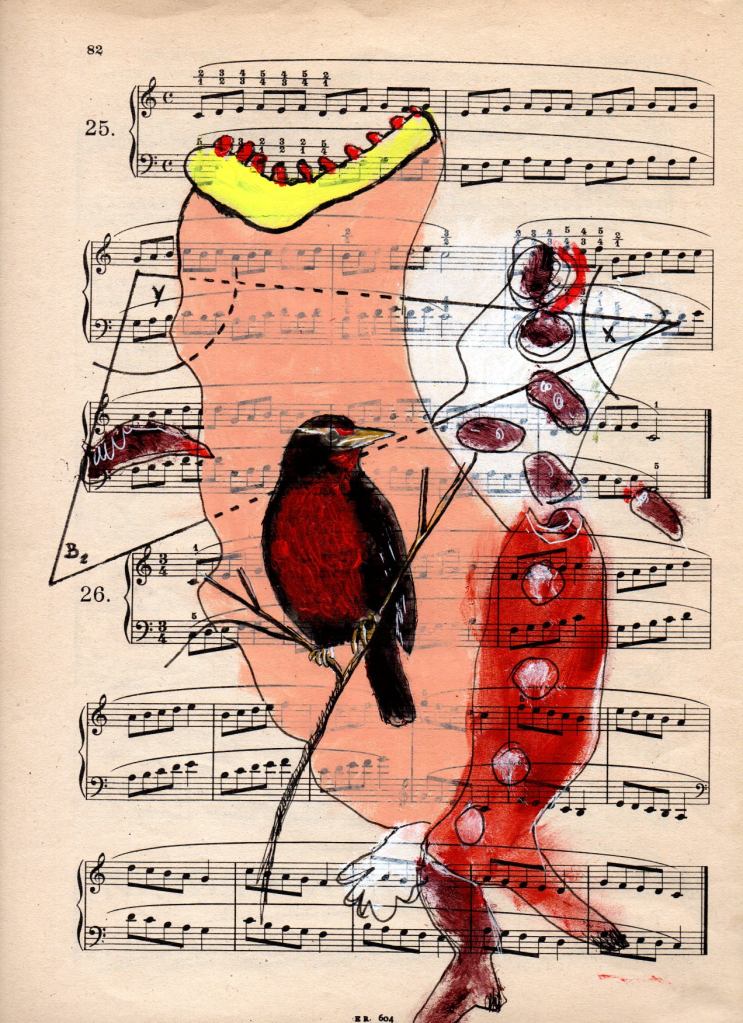
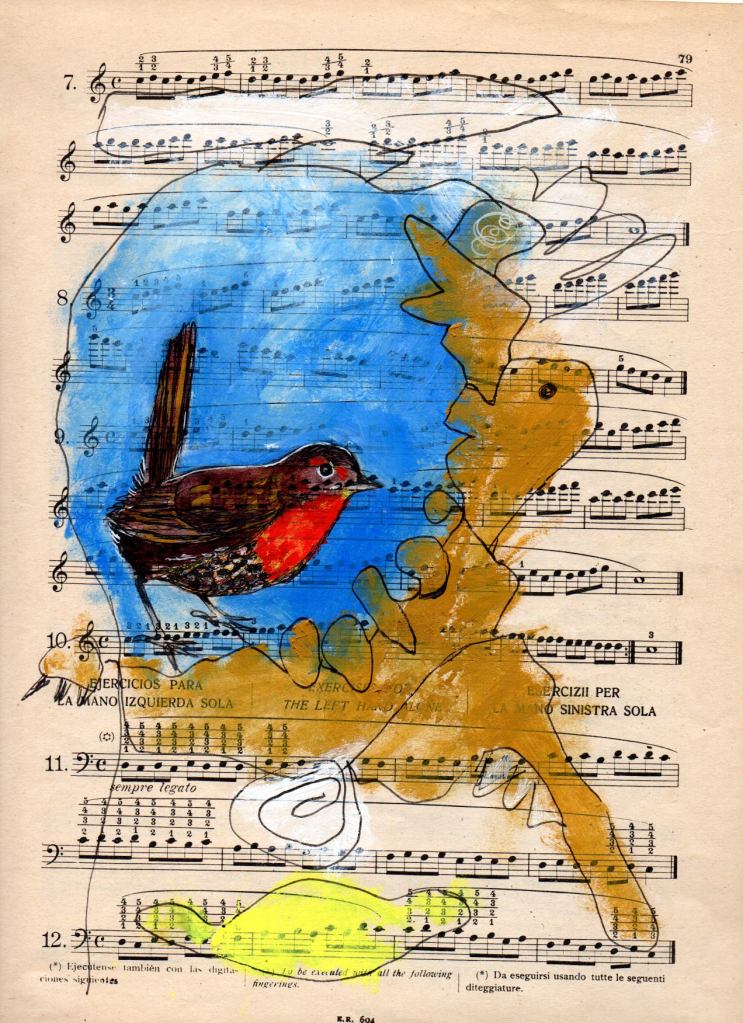
A mockingbird arises from the edge of the foliage there where cosmic orders rush and it was when I felt the elongated step of the annelids in its pristine and minimal hollow in progress and I saw the infinite curtain where the stars cling the ones that it costs me now to read because the street forks this long avenue of my life where an hour saves me while the other carries a tombstone in her hand. Gregorian chant at burial liters of paint on my coffin since I summon the colors to accompany me in this Dionysian dance Well, I gave them life other life with shadows, with lights and halftones just how life really is and in its surreality with its reverse blade Well, I invoked them without geodesic dimensions there they settled their perfume that swells my soul that unfolds towards my underground kingdom.
Una calandria surge del canto del follaje allí donde se precipitan las órdenes cósmicas y fue cuando sentía el paso alargado de los anélidos en su prístina y mínima oquedad en progreso y vi el telón infinito donde se aferran los astros los que me cuesta ahora leer pues la calle se bifurca esta larga avenida de mi vida donde una hora me salva mientras la otra lleva una lápida en la mano.
Canto gregoriano en el sepelio litros de pintura sobre mi féretro ya que convoco a los colores a acompañarme en esta danza dionisíaca pues les di la vida, otra vida con sombras, con luces y medias tintas tal como es la vida en realidad y en su surrealidad con su hoja inversa pues los invoqué sin cotas geodésicas ahí asentaron su perfume que hincha mi alma que se desdobla hacia mi reino subterráneo.
Enrique de Santiago
Born in Santiago, Chile (1961). Visual artist, poet, researcher, essayist, curator and cultural manager. He studied a Bachelor of Art at the University of Chile and at the Institute of Contemporary Art (Chile).
Since 1984, he has exhibited in individual and group exhibitions, counting to his credit around more than 100 exhibitions.
He has edited five books: Fragile Transits Under the Spirals in 2012, with La Polla Literaria; Elegía a las Magas and the book essay: El Regreso de las Magas, both with Editorial Varonas. In 2018 he edited La Cúspide Uránica with editorial Xaleshem and Dharma Comunicaciones, and Travel Bitácora with Editorial Opalina Cartonera.
He has participated in various poetry anthologies, both in Chile and abroad. He has collaborated in the newspaper La Nación with articles on new media art, and in magazines such as Derrame, Escaner Cultural and Labios Menores in Chile, Brumes Blondes in Holland, Adamar from Spain, Punto Seguido from Colombia, Sonámbula from Mexico, Agulha de Brazil, Incomunidade de Portugal, Styxus de Rep. Czech, Canibaal de Valencia, Spain, Materika de Costa Rica and other printed and digital publications.
Even as the ghosts of digitized nations slip through concrete and copper corridors, trained to an algorithm’s lace like fictions as nerve impulses skittering through warring cityscapes of disinformation, we build refuge out of the star forest of our hearts, solace from a mass marketed desolation that sought to quantify our moments of laughter and candlelight into profitable data points, electronically devouring life’s contours along the splintering edges of nuclear armed surveillance grids.
Having waded through the shoals of synthetic tides typing keys like throwing bread into the rippling data of our managed distortions, we were one slip away from drowning in the hypnosis of an artificially intelligent destabilization, becoming choreographed gestures on fragmenting coasts of awareness, dancing our collective death in an unraveling climate to simulated music of the living earth whose authentic chords we had long abandoned.
Yet it was from within fertile spaces illuminated by the horrors of a centuries-long breakdown, in the growing fractures of our CGI psychosis, now wind powered, mercilessly, with the cobalt hauled by children, that with great effort we freed ourselves from the image of hunted monster into which extinction’s machinery had imagined us, and opened to an urgent focus into the cascades of solar musings breathing through us as the sun poured itself across space, blooming into the capillaries of new leaves, guiding damp morning stretches of budding silver grey into an earth memory’s grassy rock strewn hill side, feeding through our eyes warm flowering canopies in gardens of possibility and dream, where somehow beyond the twist of jacketed wire glossy front cover fantasies, hollow promises of roadway freedom and second notice anxieties, beyond the dizzy banquet of urban lights whose glare stole whole constellations from our nights, beyond school bells that recalled gunfire, and camouflaged men patrolling the streets, we found ourselves, somehow scattering the regenerative seeds of our collective heart’s forest, watering translucent growth in the shimmer of galaxies that together we yet cradle in love’s fiery pulse.
Luke Orsborne
Luke Orsborne graduated from William and Mary with a BS in Studio art in 2001. Informed by a long term practice of meditation and reflection, he continues to embrace his creative side in rural Montana, producing images and poetry as a kind of life line amidst the existential crises of our time. He also enjoys the tasty body of work derived from a collaborative process between sun, rain, and the soil of his garden. You can find a selection of his visual work on his Instagram page.
It had to be finished yesterday, like every day in 2021, creating. Because the reason for my existence is to navigate the wonderful. Happy today and tomorrow for all, since according to the calendar of nature, each day should be celebrated loving it intensely.
Visions Ending centuries of moonlight dimming a dark fire travels the walls without knowing the foolishness of its orbit, an empty smoke escapes from her womb that is the son of the empire, leaving a rough trail of ancient scales, and from that place new demolitions erupt to lower their faces when winter looms, slowly the room is emptied leaving only undamaged strings that proclaim instantaneous blues, because she admitted flowers in her womb, and she came down the stairs with her bare legs, while from her shadow the absolute gesture of death loomed, hidden and unexpected and emitted the song of the breeze of oblivion in order to satisfy the gesture of a star bathed in failed zodiacs, impertinent and uncertain attempts, that were thrown to the cosmic confines beyond certainty.
Había que terminar ayer, al igual que cada día del 2021, creando. Porque la razón de mi existencia es navegar por lo maravilloso. Feliz hoy y mañana para todos, ya que según el calendario de la naturaleza, cada día debe celebrarse amándolo intensamente.
VISIONES Acabando con siglos de oscurecimiento de luz lunar un fuego oscuro recorre los muros sin saber de la necedad de su órbita, escapa de su vientre un humo vacío que es hijo del imperio, dejando un sendero áspero de escamas antiguas, y desde ese lugar estallan nuevas demoliciones para bajar los rostros cuando acecha el invierno, lentamente queda vacía la sala dejando sólo cuerdas indemnes que pregonan azules instantáneas, porque ella admitía flores en su útero, y bajaba las escaleras con sus piernas desnudas, mientras desde su sombra asomaba el gesto absoluto de la muerte, oculta e inesperada y emitía el canto de la brisa del olvido para así saciar el gesto de un astro bañado de zodiacos fallidos, impertinentes e inciertas tentativas, que fueron arrojadas a los confines cósmicos más allá de la certidumbre.
Enrique de Santiago
Born in Santiago, Chile (1961). Visual artist, poet, researcher, essayist, curator and cultural manager. He studied a Bachelor of Art at the University of Chile and at the Institute of Contemporary Art (Chile).
Since 1984, he has exhibited in individual and group exhibitions, counting to his credit around more than 100 exhibitions.
He has edited five books: Fragile Transits Under the Spirals in 2012, with La Polla Literaria; Elegía a las Magas and the book essay: El Regreso de las Magas, both with Editorial Varonas. In 2018 he edited La Cúspide Uránica with editorial Xaleshem and Dharma Comunicaciones, and Travel Bitácora with Editorial Opalina Cartonera.
He has participated in various poetry anthologies, both in Chile and abroad. He has collaborated in the newspaper La Nación with articles on new media art, and in magazines such as Derrame,Escaner Cultural and Labios Menores in Chile, Brumes Blondes in Holland, Adamar from Spain, Punto Seguido from Colombia, Sonámbula from Mexico, Agulha de Brazil,Incomunidade de Portugal, Styxus de Rep. Czech, Canibaal de Valencia, Spain, Materika de Costa Rica and other printed and digital publications.
When you get lonely you can always go downtown downtown
Does anyone need to know more about America
Than the name Anthony Quinn Warner
Or that our history is unknowable
Why not just say Elvis?
These mirrors and masquerades history books
“The tension between individual liberty and the social good has always been…
You can’t finish that sentence, can you?
But it was in Nashville, so of course places
What things happened in Nashville?
Electrons, really, a kind of skill
That has something to do with money
or control
Proud Boys v. Antifa this lust for violence Chaos grins says
Listen to the trees
Her hair glistens like oiled snakes
& you know darling all it takes
Is one slow kiss under the candlelight
And maybe you might lose your fright
And be the man you said you’d be
Trembling in shade under the apple tree
Said some words you nah know what they mean
Maybe you hoping you weren’t seen
But have to say boo it was like that we watching you
2.
The idea of nobility in human affairs still exists
And there is something to be said for the study of history and language
Whatever you resisted resisted you back
You carried an alarm clock
The idea that time does not exist a child’s dream
Ok say it true now baby say how it feel
You know if you don’t it won’t be real
Make your heart in rainbow slices
See the sunlight how nice is
Make this beat your own heartbeat
Tell me you don’t know the street
Tell you what you not understand
You blow your van up—you not a man
Outside the tent of the destruction
Of the greatest empire the world has known
We watching you
3.
What is the statute of limitations on lynching’s
And the mass graves
–you can find the bones if you look
Or in Nashville some human tissue
Ephraim and Henry Gizzard, 1872
Samuel Smith, 1924
he was fifteen
David Jones
Jo Reed
232 lynching’s in Tennessee
Human tissue debrisfrom RV historic
District
inside CNN carnival
electrons warm
warp
smile a lie
Tennessee’s “greatest lynching carnival” was held in Memphis in May 1917 when Ell Person, the allegedly confessed ax-murderer of a sixteen-year-old white girl, was burned to death in the presence of fifteen thousand men, women, and little children.
4.
Tonight we must mourn anyone named Anthony Quinn Warner
No story to tell, no rhyme no reason no couplet indebted to any ideology
Just ample evidence of the meaninglessness of time
No babe its about how sad someone gets
He saved everyone with that loudspeaker
And you know those six cops were heroes
What point is there in talking about history
When you know you will die without seeing the end?
Make an intention
It’s ok not to believe in anything, it is easier that way
Remember Anthony Quinn Warner
5.
What drives a man? Antaeus vs. Heracles says
God of the waters, goddess of earth I called to you
Choking on air, my monstrous soul
What were you doing in Libya, anyway?
We could have been brothers
Between us we could have destroyed the gods
The beauty of a suicide bombing that killed no one
The single-minded and purposeless effort like writing Finnegan’s Wake
Or climbing a cliff no one climbed before
Or making sure to leave on the stone “He lived a quiet, ordinary life”
You have no idea how much pain it costs me
To tell you this—you feel troubled by the broken windows
To me they are beautiful
There is nothing more beautiful than broken glass Catching the flickering oranges and yellows Of cars and buildings on fire
6.
The idea of meaninglessness
Captured in a single gesture
Make an intention taste the fire
He was designed for summer
The ways in which a human body can be destroyed
Are chronicled. You can’t look away—see it clearly
African American victims, both men and women, were regularly tortured with methods that included eye-gouging, cutting off of the ears and nose, and cutting off fingers and toes joint by joint for souvenirs.
Were you there? We are watching you tell the truth
Don’t look away
I met my darling on a dark street
We talked all night until dawn came
She said she’d love me if I paid the price
Give my skin up, let the sky fall
Keep a shotgun on the kitchen wall
Saying y’all Sicilian don’t be nice
You white boys all look the same
What you got, how your heart beat?
LED’s and Sunlight
Squirrels grow fat when you feed them seeds Or an electronic barbie with a vicious smile
Like butterscotch razor blades and the ice Where a blue-jay has joined the squirrel
Is melting slowly in the noon sunlight So it can freeze again harder
But the plastic doll is tasty and satisfying– That’s all they need–
Inside the mirror of ice the squirrel looks fat Blue jays descend in a tight-knit gang now
Chickadees and slate juncos scatter A cardinal watches from an apple limb
These natural hierarchies are comforting, A small piece of obsidian in my mouth, sucking on it
LED lights shine all the time, even at 5AM When juncos are wrapped in their fir trees
Not much illumination but the clowns still dance And long trucks thrum on the daybreak avenue.
Kaleidoscope
If my anger is a kaleidoscope then tell me What the shrapnel taught you, taste this black ice.
Inside the intermissions of an interminable drama There is real blood on the stage. Bend low, taste it–
You’re my bitch tonight, follow my words, A voice calling hopeless on a weekly phone call from prison—
I never picked up the phone, no one fucking makes bail In this life, you know that–snakes in the hole—
Avoid them—make feathers in your hair Somewhere close to edge—rock is scrawled in runes
We slant on dirt like raged farmers so starved for love We can’t answer the most basic questions.
We have not read the stories yet. We won’t. This late winter sunset filled with bone.
Beulah
Birds and so on, apple blossoms and knives, Slime on the river stones, a trail of blood Up trap-house stairs, no light in the sky, Rain falling and the stream rising to flood—
Dawn sends artifacts like an oracle, Some gibberish about nature and the human, A bounty of coins from a failed empire Like trying to spend Japanese pesos From the WWII occupation At the Firehouse in Manila On a girl who would be nice to you But just for a while—that money was fake.
My last doctor told me that I was “programmed to die”— He said that. It was strange, My body was fine but he wanted me to understand I would inevitably die, so what did I believe in?
They called him Crazy Eddie In the small-town practice he had, And he put me through the course on miracles for free, Reading the Bible and Bagavad Gita, the Secret Garden And the Wizard of Oz, a sort of mad map Of ways to think the soul persists beyond death, That there is a larger reality we can’t see.
It didn’t work. I am just a reporter. All I can do is say what I see, or what I remember. Fifty years ago, in this same country place, I owned a horse. I rode him bareback on the dirt roads, Veering sometimes into an open mowing to ride full out, Gliding over his galloping body like a sprite.
Once he shied and I flew off into the soft grass, Stunned for a moment, breath knocked out. I came to with wildflowers all around me. Then I climbed back on and rode home
Solstice: Green River
One mourns at dawn, blue light on the snow, Cracked windows locked against the cold.
What can one say? I’ve always marveled At time’s bleak nature, scored now by ice Coating still-green grass and the dirt road,
And while the landscape is winter-barren The ghosts that inhabit this place are partying In liquid light of the fireplace, rafters shaking, That tune from 1939 going round and round.
One year we visited where the girl witches were hanged, A christmas sojourn to Salem. There was no cause for celebration. There were addicts on the sidestreet. A grey smudge Lay like a quilt on the bay. Gulls swooped and screamed.
This year ghosts scratch graffiti on the frost.
Solstice: Songbirds
This austere December sunlight on thin snow Today’s ghetto, shards of grass pocking through frost, The light slanted so deep against the high windows
It might as well be sunset, that yard-arm passed At dawn, ice glazed on the water glass, No sound on roads, just winter’s vacant heart.
In this season, December’s full moon Cold Moon— A couple of weeks to wait for the Wolf Moon, The spirit I long to inhabit my body.
Cold moon says look at the light, weep, and sing Songs of joy since you have no choice, Play that violin in the concentration camp of your body.
Inside the churning of dreams and lost time A spirit made of ice and hot chocolate Says drop those seeds from your hand. Songbirds will follow.
Solstice
So this the day you meet the dead—you knew It would come, ice in your hair and tangled wires, And while you said you have no fear you knew That you were afraid. The wood is made of ghosts.
Inside the enchantment of the cold moon You searched a way to speak to them, the ghosts Inside the wood walls where heat depends on burning. But the full moon’s a motorcycle and the wind
Against your face as you ride into the sky Won’t let language free except you are screaming How much I love you at the sweet savage spirits That cling like wraiths to the dark leather of your soul.
When the full dark comes you walk to the graveyard, Touch the cold stone with your hands, then go home again.
Solstice: Meteor Shower
At five AM shooting star flowers on black, Flaring without explanation, just quick And lovely, the way all things are, and this frost
Glitters like answering stars in porch-light, Dead leaves shining like gems.
My arms are filled with wood But I still look around, how quiet the night is, How constellations have not changed
Since I was a child and soon light will start These skeletons of trees green again, The dead grass needing mowing.
Nothing is permanent, or temporary, but something else That we have no language for except The stars fall from sky they remind us
Some things are beautiful, the way we dance In sky, dancing for free—no one takes coins home From this game, we play stacked odds,
Dancing until dawn finally comes With an unusually beautiful shade of blue That like everything else has no name.
MacLean Gander grew up in Manhattan, where he attended the Collegiate School before studying at Harvard, where he received an A.B. in English and American Literature and Languages, cum laude. He was the Hoyt Fellow in creative writing at Boston University in 1981, where he took his Master’s in Creative Writing (Poetry).
In the 1980s he worked for several years as a researcher, writer, and reporter for Newsweek’s international edition in New York, and then spent two years in the Philippines covering the 1985 elections and 1986 “People’s Revolution” as a freelancer accredited to The Nation. After returning from Manila, he decided to relocate in Vermont and change his career path, taking a faculty position at Landmark College. In 1988, he was appointed English department chair, a position he held for nine years. In 1997 he was appointed Vice President of Academic Affairs and Dean of the College, a position he held for 11 years, a period of rapid growth and change for the college. During this time he earned an Ed.D. in Educational Leadership and Change from Fielding Graduate University. As Vice President for External Affairs and Strategic Planning from 2008 – 2009 he led and participated in the College’s consulting initiatives with the Kipp Charter Schools, The Prince Salman Center for Learning Disabilities Research in Riyadh, and with several other organizations and groups.
After returning to the faculty in 2009, MacLean held appointments in the writing department and then in the Core Education Program, teaching courses in composition, creative writing, journalism, and education. He currently holds an appointment in the Professional Studies program, where he teaches courses in journalism, leadership, and narrative nonfiction. He also donates his time as an investigative reporter for The Commons, Windham County’s nonprofit independent newsweekly, a role in which he is able to engage journalism and business students in internships and in doing reporting in real-world contexts. He lives in Brattleboro, Vermont, with his wife, the poet and artist Shanta Lee Gander.
MacLean Gander grew up in Manhattan, where he attended the Collegiate School before studying at Harvard, where he received an A.B. in English and American Literature and Languages, cum laude. He was the Hoyt Fellow in creative writing at Boston University in 1981, where he took his Master’s in Creative Writing (Poetry).
In the 1980s he worked for several years as a researcher, writer, and reporter for Newsweek’s international edition in New York, and then spent two years in the Philippines covering the 1985 elections and 1986 “People’s Revolution” as a freelancer accredited to The Nation. After returning from Manila, he decided to relocate in Vermont and change his career path, taking a faculty position at Landmark College. In 1988, he was appointed English department chair, a position he held for nine years. In 1997 he was appointed Vice President of Academic Affairs and Dean of the College, a position he held for 11 years, a period of rapid growth and change for the college. During this time he earned an Ed.D. in Educational Leadership and Change from Fielding Graduate University. As Vice President for External Affairs and Strategic Planning from 2008 – 2009 he led and participated in the College’s consulting initiatives with the Kipp Charter Schools, The Prince Salman Center for Learning Disabilities Research in Riyadh, and with several other organizations and groups.
After returning to the faculty in 2009, MacLean held appointments in the writing department and then in the Core Education Program, teaching courses in composition, creative writing, journalism, and education. He currently holds an appointment in the Professional Studies program, where he teaches courses in journalism, leadership, and narrative nonfiction. He also donates his time as an investigative reporter for The Commons, Windham County’s nonprofit independent newsweekly, a role in which he is able to engage journalism and business students in internships and in doing reporting in real-world contexts. He lives in Brattleboro, Vermont, with his wife, the poet and artist Shanta Lee Gander.
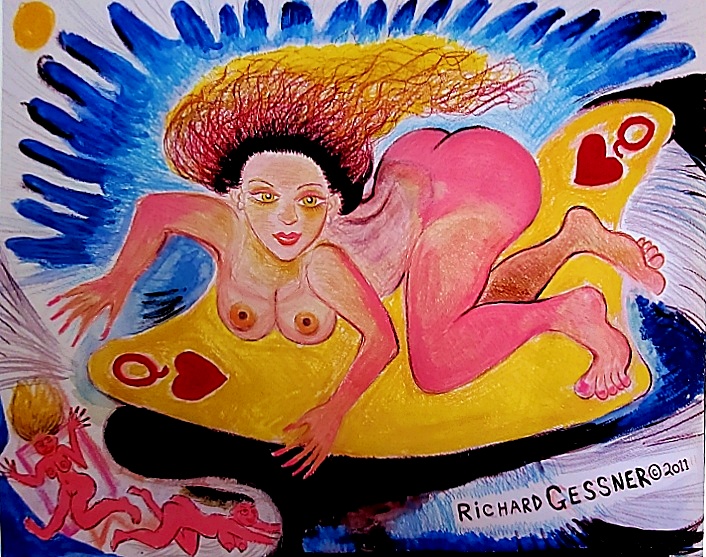
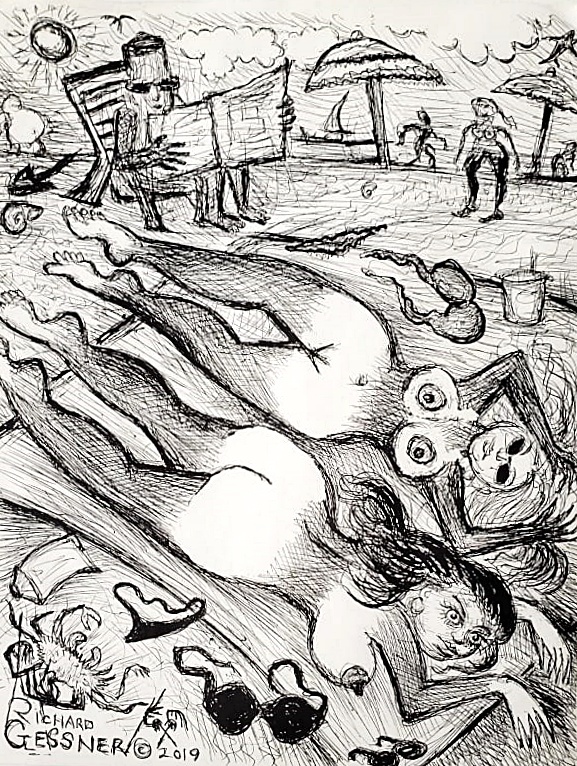
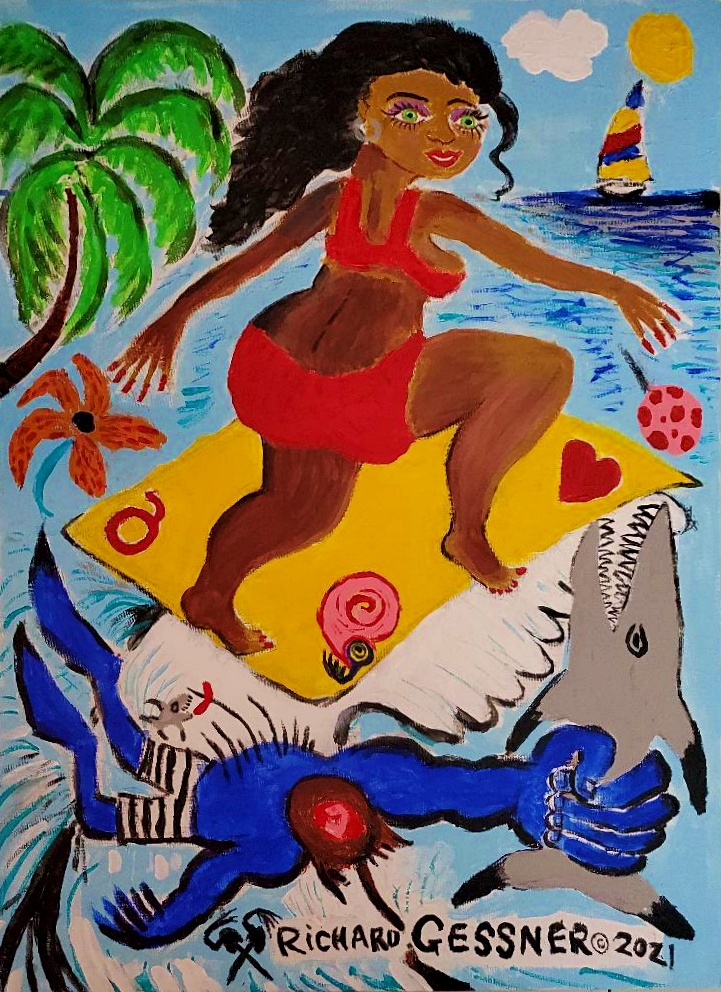
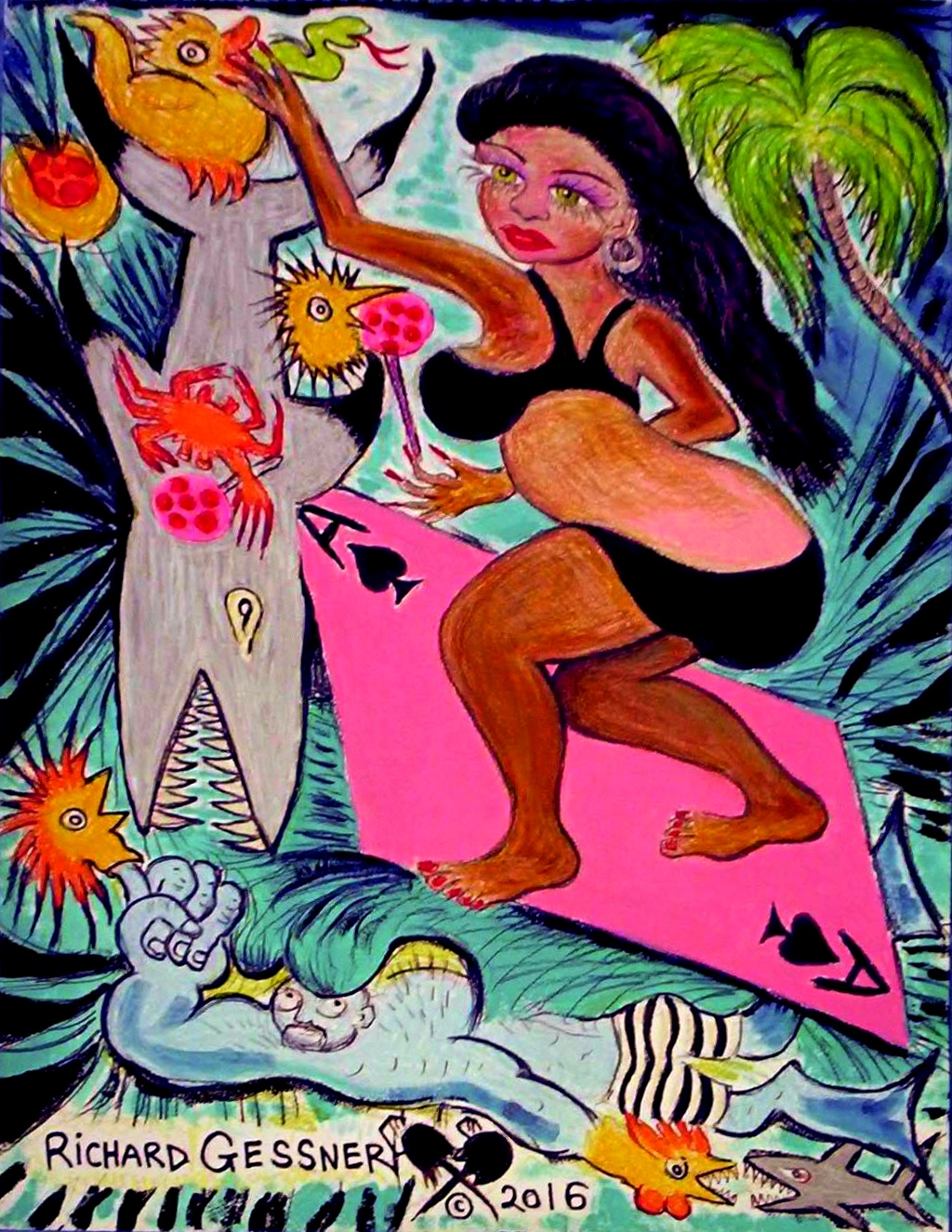
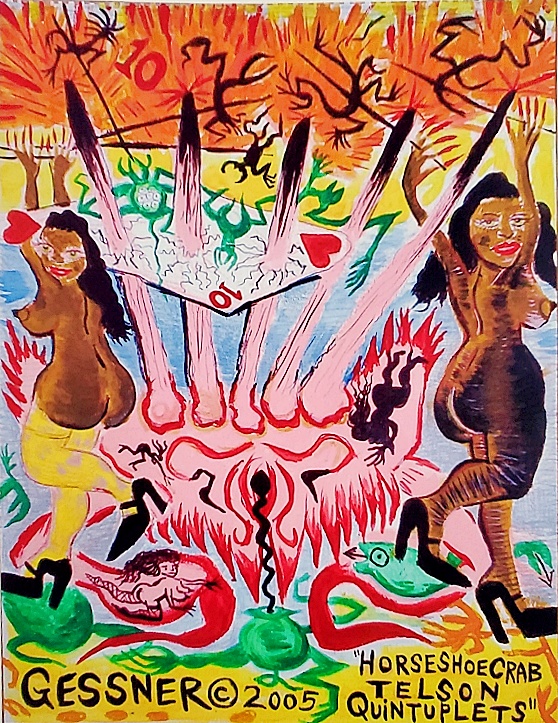
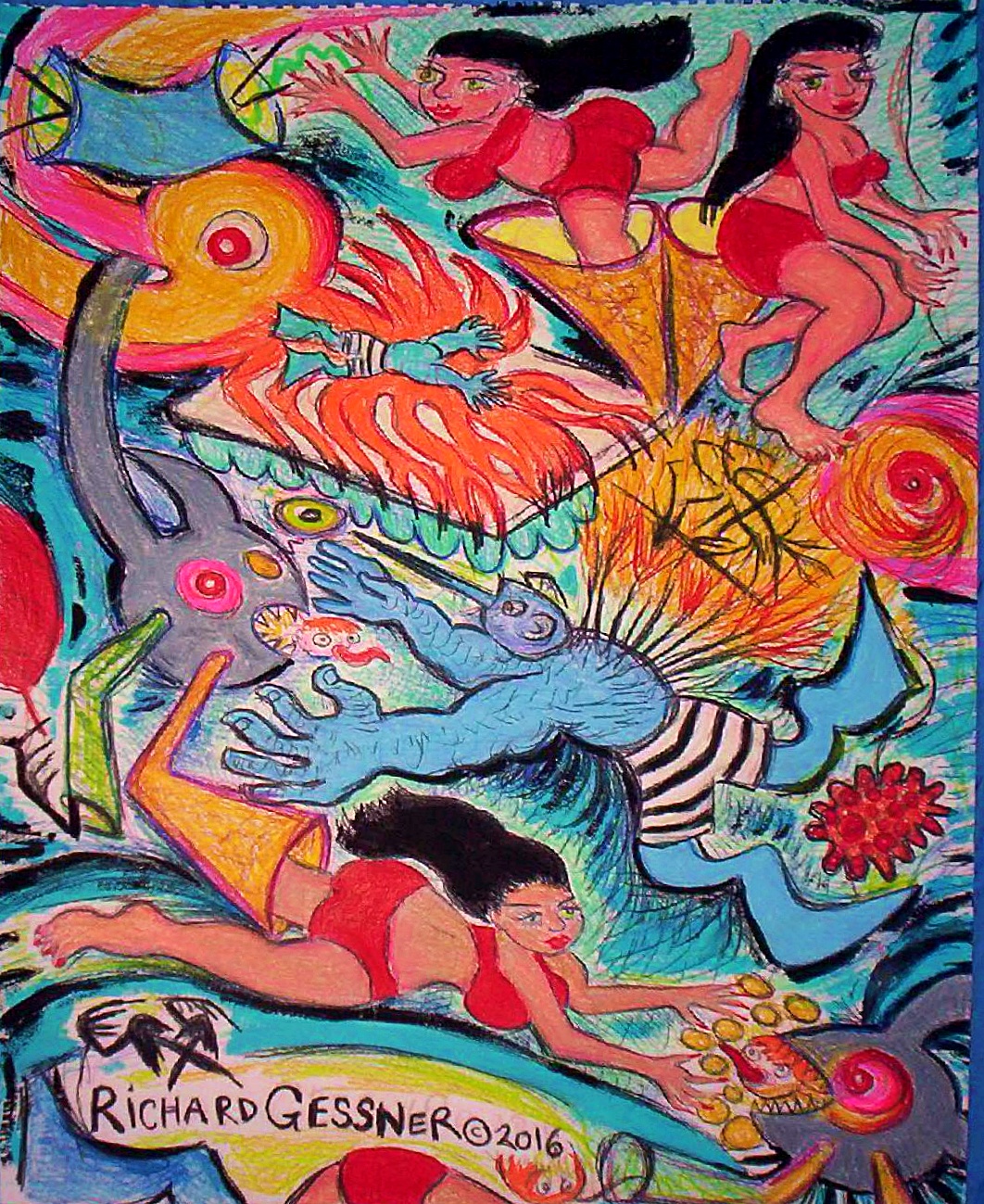
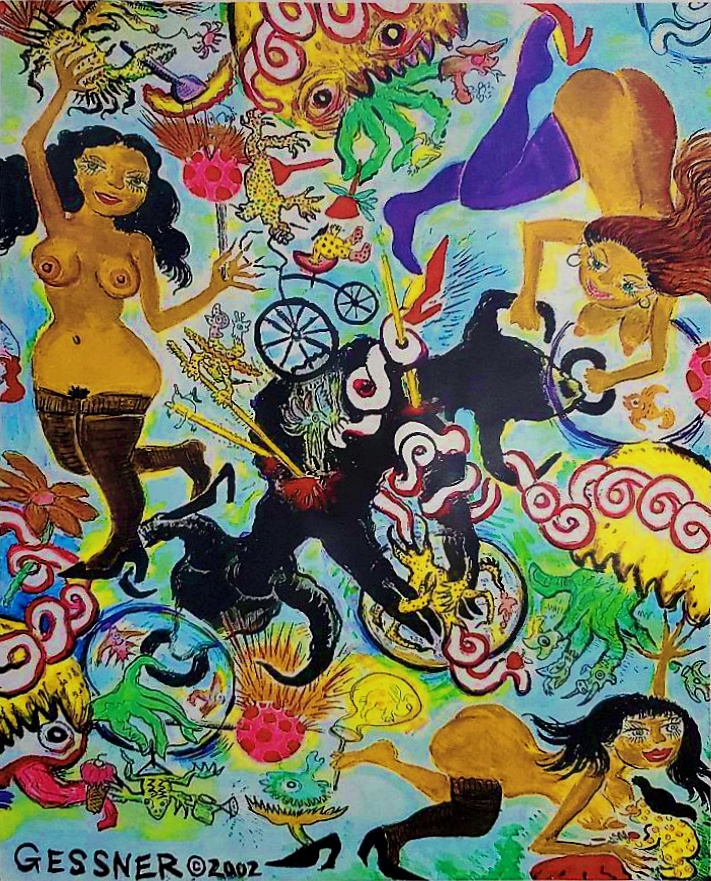
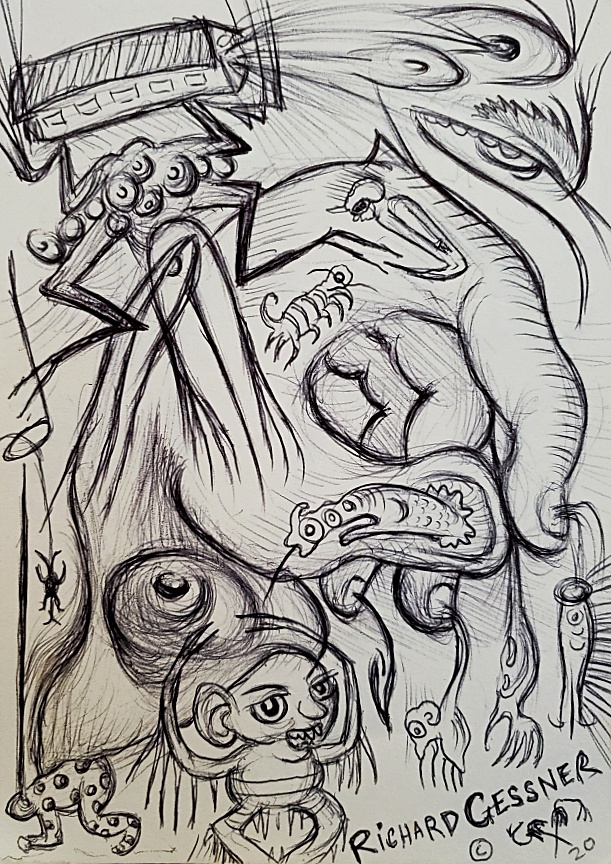
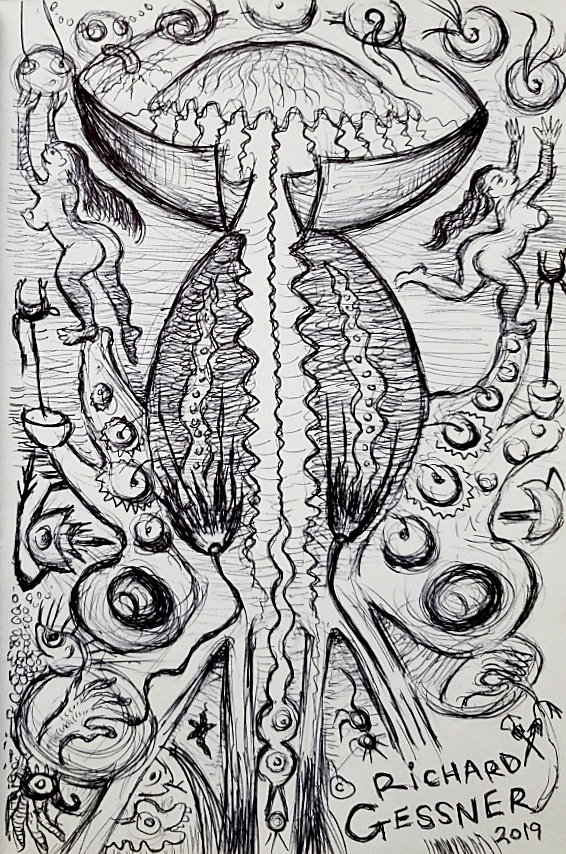
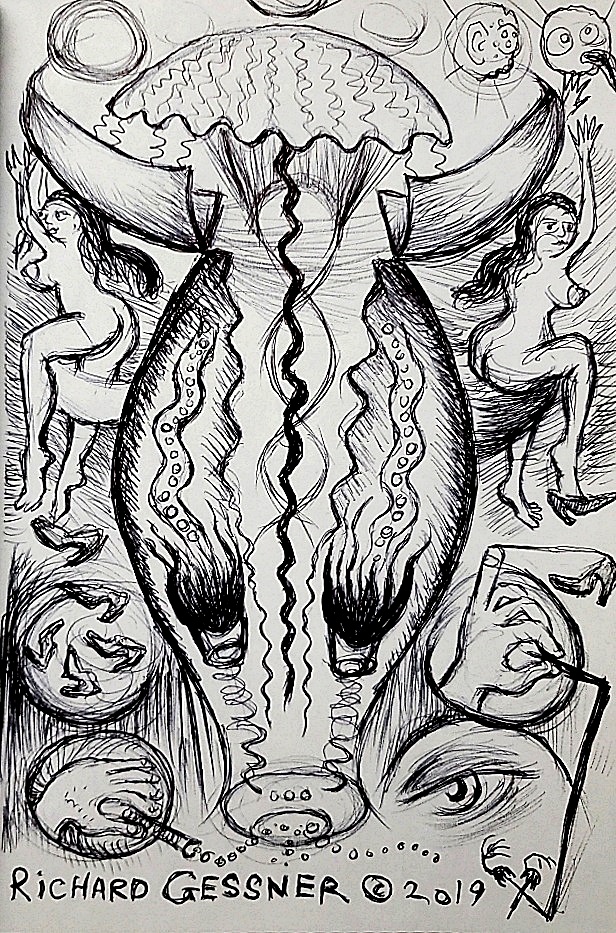
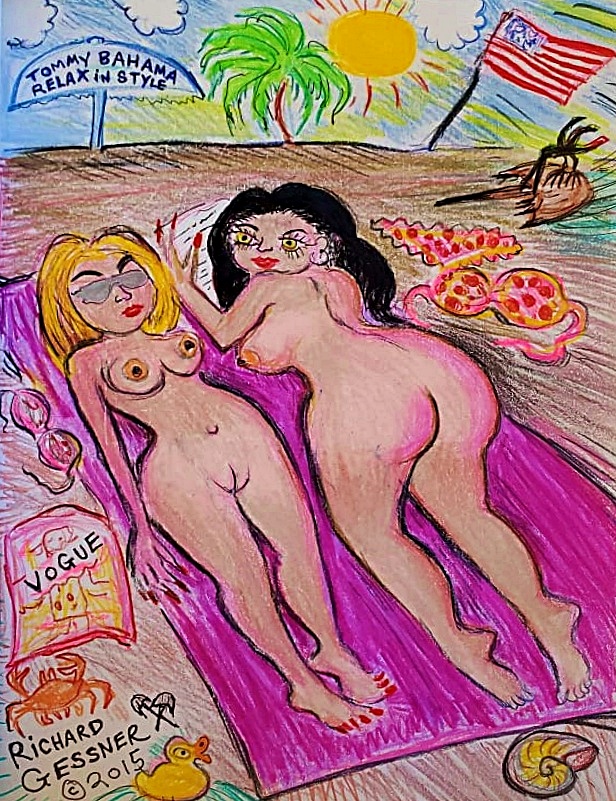
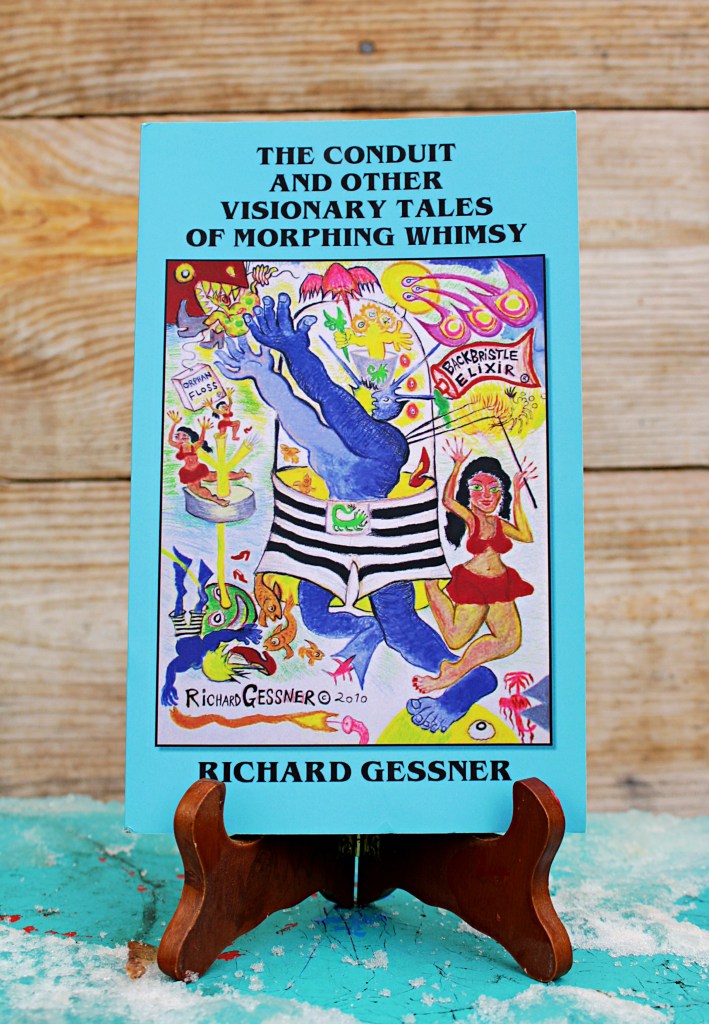
Reading Richard Gessner’s book The Conduit and Other Visionary Tales of Morphing Whimsy was like drawing a tarot card out of a magical deck. Reading it triggered a rare recollection of sensations into a neural pattern of synesthesia. These infrequent and unusual bits of writing guides the reader into a dream time, a metamorphosis that operates in harmony while under the influence of an autoscopic hallucination. An illusion of observing selves. There is a hypnagogic arrangement that dissolves once you fully notice your in a dream but with Gessner’s work the afterimage stays for a long visit. It doesn’t evaporate. I enjoy the metaphorical compounds in Gessner’s visual work, it’s an erotic and tantric iconography. Gessner builds a unique mythology. His graphic representation of aquatic fantasies are arranged in the formula of deep unexposed thought waves, waves we glide on in abbreviated gestures.
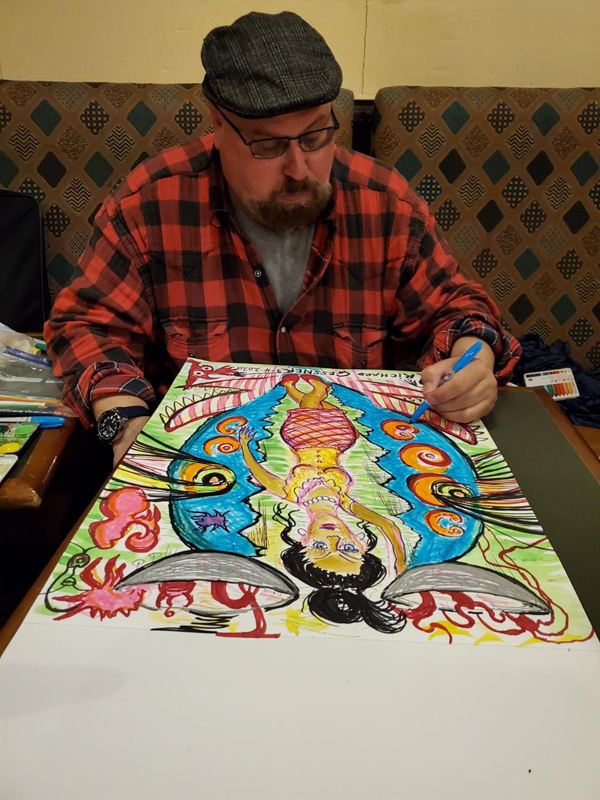
Richard Gessner is a Left-handed, self taught Visionary writer and artist. In the visual work he often packs dense interconnected imagery into tight spaces.
“I am a left-handed, self taught Artist. I pack dense, interconnected imagery into small spaces. I have an ongoing epic series of the Surf Goddess and the Strongmann that evokes a timeless world of iconic Man & Woman acting out romantic flirtatious dances with the mercurial forces of nature.”
Surf Goddesses, Strongmenn, Sirens, Vixens and other Burlesqueness
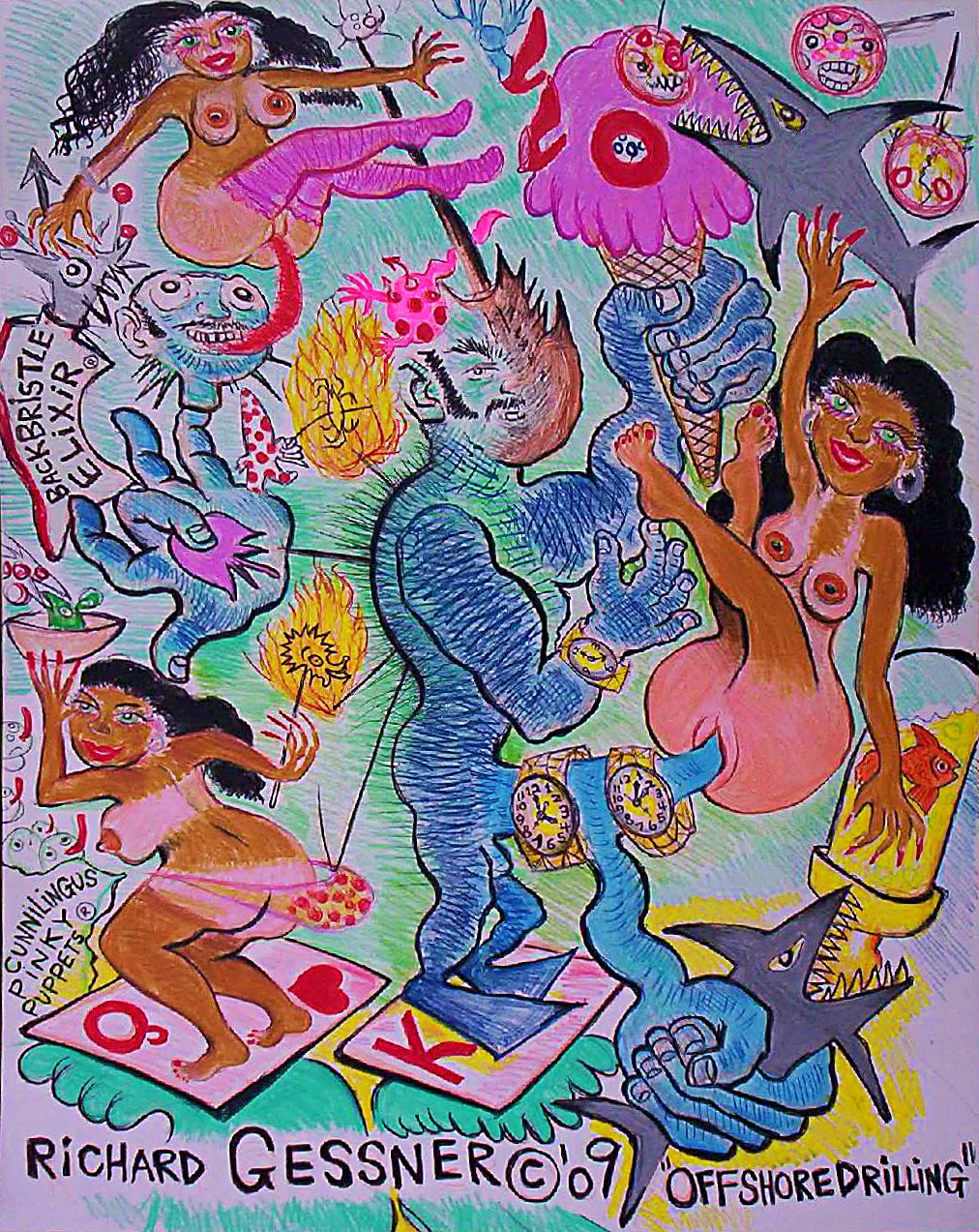
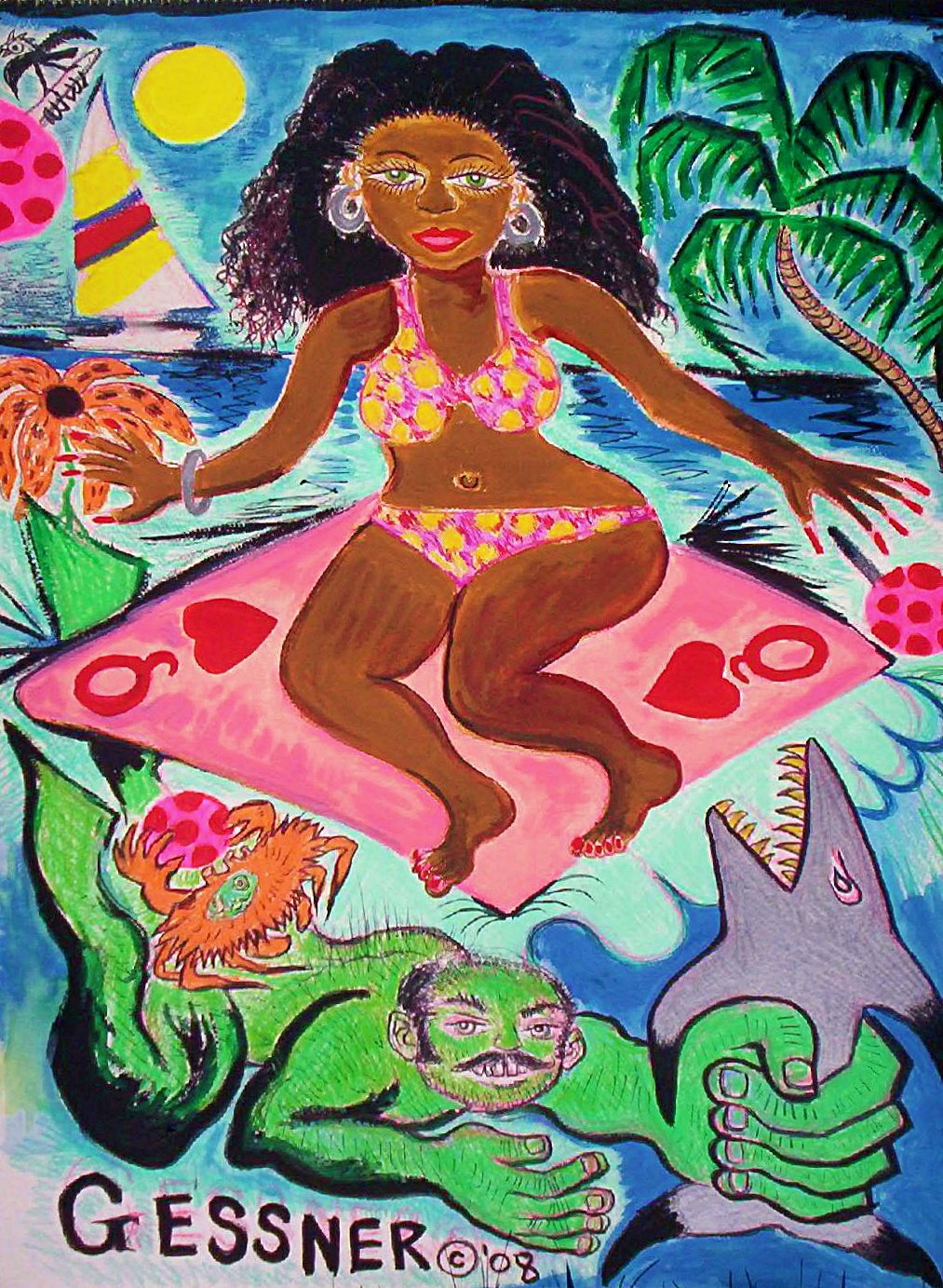
Offshore Drilling 18in X 24in color pencil pilot penQueen of Hearts Surf Goddess and Strongmann 18in X 24in Mixed Media
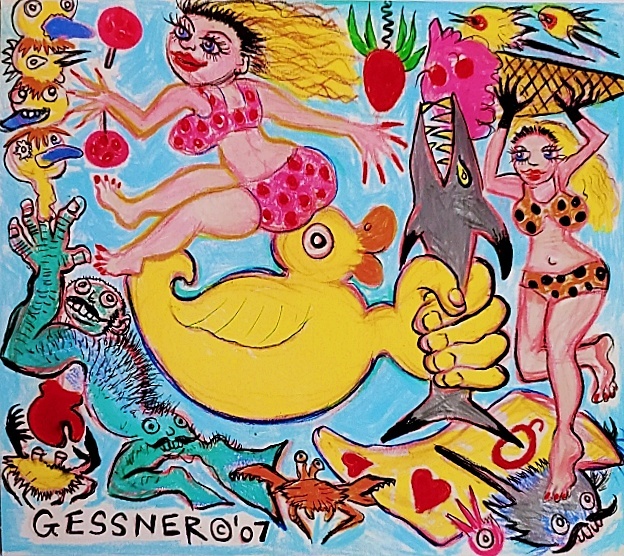
The Strongmann is semiaquatic, cerulean blue, with flipper feet and king crab like arms and hands, expressing the raw forces of the instinctual Freudian Id. He shifts from heroic to rapacious, from crude to chivalrous in a moment’s notice. Sometimes he’s an alpha at the top of the food chain, only to be usurped by rubber ducks or Sirens he romantically courts in the waves of an endless sea.
Strongmann & Surf Goddess 2021 Acrylic on canvasAce of Spades Surf Goddess 18inx24in watercolor, gauche, color pencil
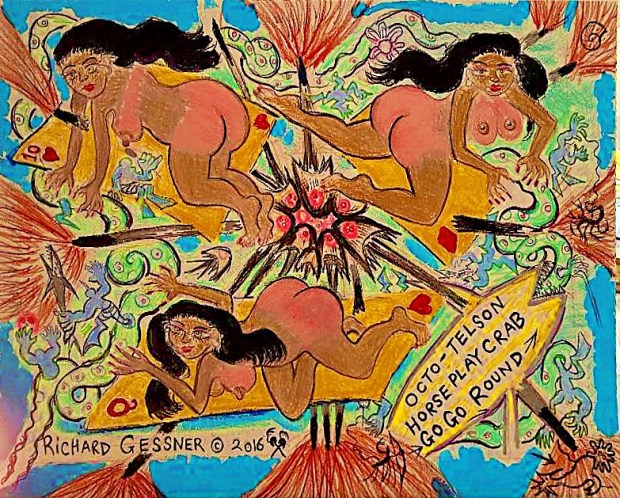
Horseshoe Crab Telson Quintuplets
Fire Water Funnel Sirens 18in X 24in water color color pencil penScorpion Umbilicus Limulus Twins 18in X 24in water color, gauche, color pencil
The Matadors Reprieve 18in X 24in water color color pencil pilot pen.
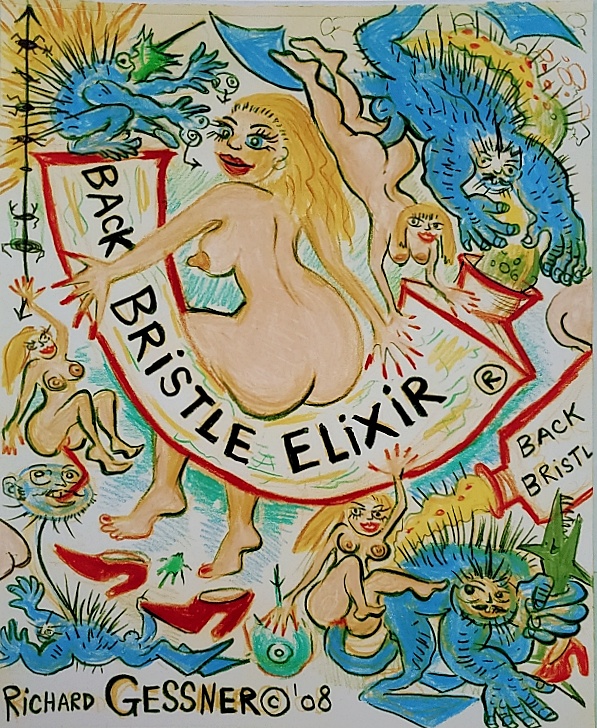
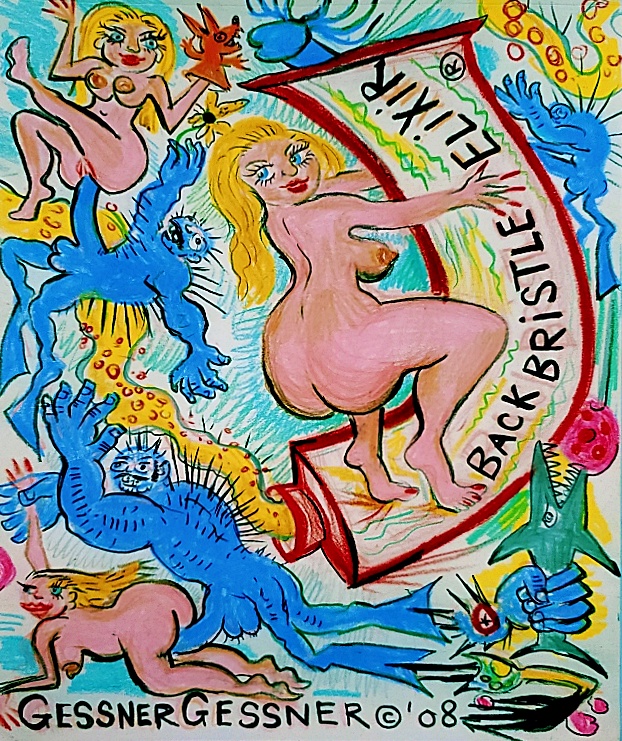
Back Bristle Elixir IBack Bristle Elixir II
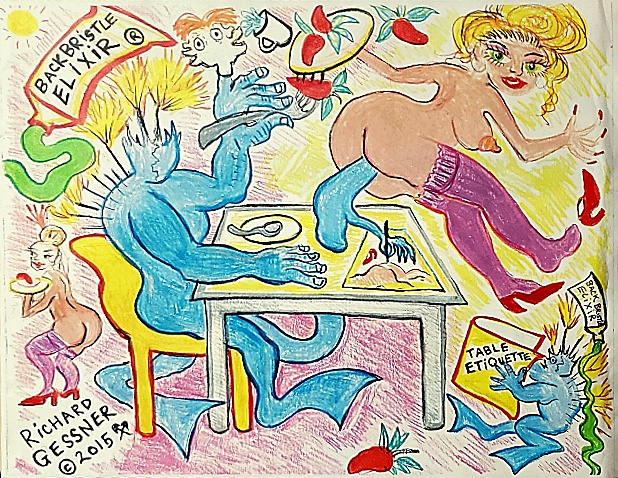
Table Etiquette
4 a.m. Drawings
Omniscient Left Hand 4 a.m. drawingLimulus Vortex shower. 4 a.m. drawingManta Ray Hatchling Dance 4 a.m.DrawingJellyfish Mirror Ascension 4 a.m. Drawing
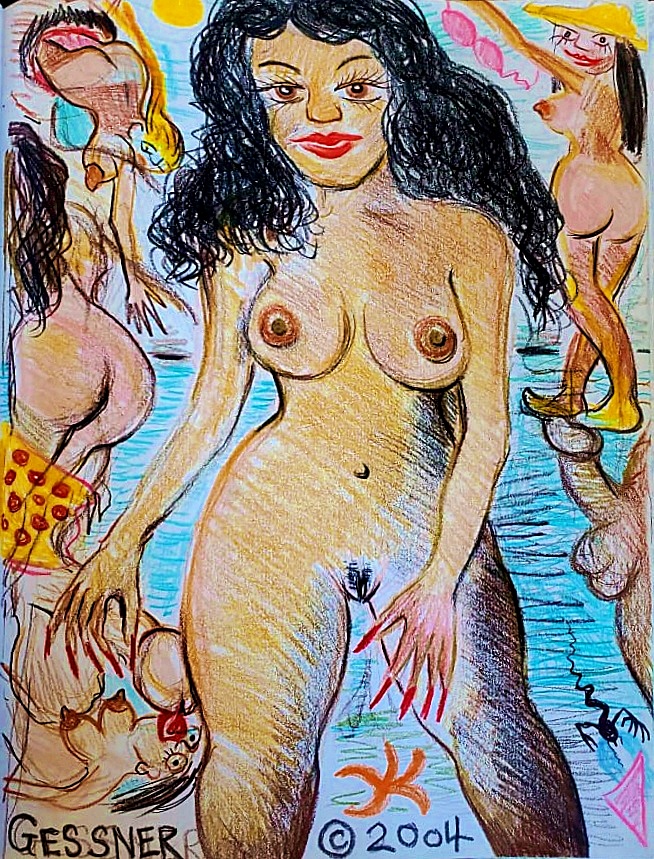
Female Nudes
The Fool
A fool, fat sluggish and smug, was turned into a bowling ball by a gang of husky drooling village idiots.
With pontifical glee, the fool had waddled onto the idiots’ grassy flatland turf, making the fateful mistake of underestimating their strength and ability.
The fool felt superior to the idiots, and feared not the clumsy thrusts of their silly toy swords slicing off his blubbery arms and legs becoming an instant set of bowling pins…
Read more from the online journal of arts and letters Sein und Werden
Gessner’s speculative fantasy fiction has been published in literary magazines since the 1980’s. He clarifies his drawings and paintings do not illustrate his stories.
The Conduit and Other Visionary Tales of Morphing WhimsyPaperback
The Conduit and Other Visionary Tales of Morphing WhimsyAudible
we Interrupt the regularly scheduled program to bring you this important message this wireless emergency alert has scanned and detected globular lightning behaving like intelligent light expect winds to reach the speed of a dream prepare for half past tension to relief watch the clock turn into a ball all conspiracy and plans swept clear empty and full total memory forgiven expanding free as time over flows following through cells and selves without a body to this star door that small bond of love I forgot the cat did not forget about me
















 Mitchell Pluto