Manuel the Band

My mother has always told me “it started in the womb, ” so I think music has always been a sort of innate thing for me. My mom would play the piano and sing when she was pregnant and noticed that I would dance and smile to the same songs after I was born. So, I’ve been a musician literally even before I could remember! Which is a really cool thing to think about. Throughout elementary school, I took piano lessons and even joined a steel drum band when I was 12. I played with them until I was eighteen. Growing up in a small, New England town, playing steel drum music in the dead of winter was a superb treat- it’s so hard to be upset when that music is playing. Along the way, my mom would buy me those musician starter packs- the ones with a small amp, chord and stuff. At the time, they were like $100 and my mom would tell me to teach myself. So, I did. That’s how I learned guitar, bass, drums. You name it! I was very fortunate to be exposed to so much music early on in my life- there’s no doubt it impacted me becoming the musician I am.

What gives you inspiration?

I think this, like many things, ebbs and flows. I hate to sound so generic, but I like to write about real life. I’d say, the majority of my songs are about what was going on at the time. Lately, I’ve been on a writing kick that I call “millennial struggles” Ha! I’ve been writing about things like being able to pay rent, not understanding why career growth is so hard, questioning the realities of what my generation was told we could do. Needless to say, going to college doesn’t grant you that white picket fence and a comfortable salary like many said it would…and sometimes still do. So, lately, it’s been a lot of those kinds of talking points.

Which musicians have had the greatest influence on you?

Hmmm. I’ve always been a big John Mayer fan. Song writing wise, he has such a cool way to synthesize emotions and feelings into complex, elegant poetry. In Your Atmosphere, I think, is a beautiful example of that and I’ve always strived to have my “in your atmosphere” song. Still going for it. I grew up listening to a lot of folk, Joan Baez, Kingston Trio, Peter, Paul and Mary. So, I always feel at home with an acoustic guitar and people singing in harmonies. That’s just my roots.

What musical genre is closest to your heart?

I think folk, singer -song writer. In my opinion, it’s the most vulnerable. It’s usually lyric focused and I love listening to what people have to say. There’s something about hearing a song with simple chords, but with words that clearly mean so much to that person. That means the world.

Did you study music in school?

Not formally, no. I studied history and economic development. Spent a lot of time traveling around the other parts of the world conducting research on a variety of these types of topics. I feel very fortunate to have been able to write about subjects like poverty, development, immigration, ethnography, etc. But even though all of this…I’ve always managed to bring a guitar with me!

Manuel The Band Locations 

Manuel the Band Spotify

Manuel the Instagram

Manuel the Facebook

Manuel the Youtube

www.manueltheband.com

@manueltheband-IG/FB

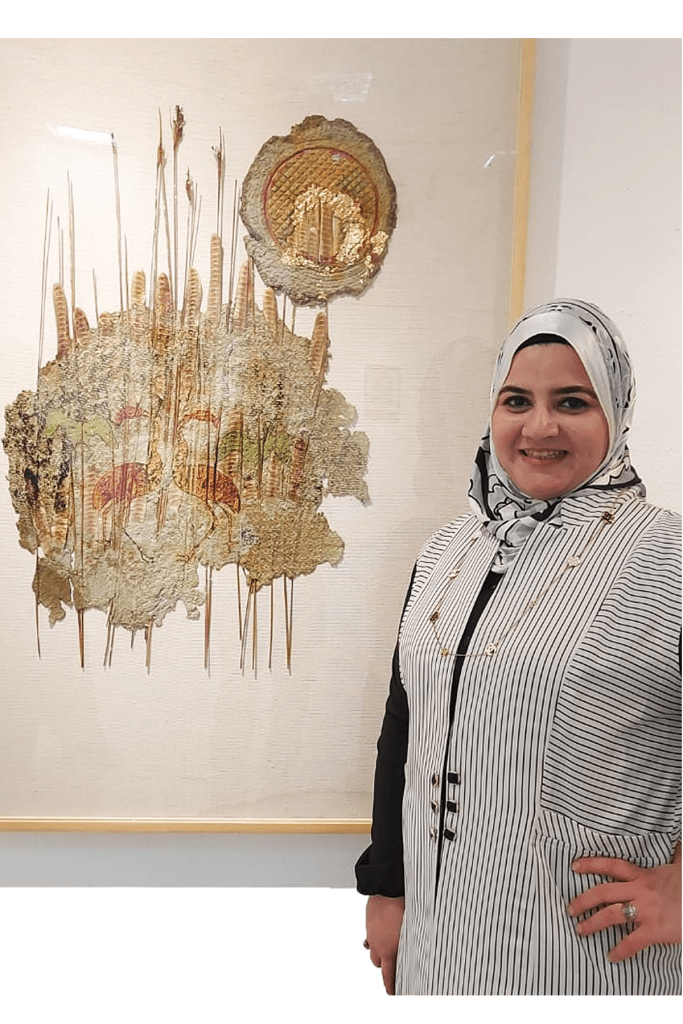
Israa Kazem; Balance between Spirituality and Geometric Perfection

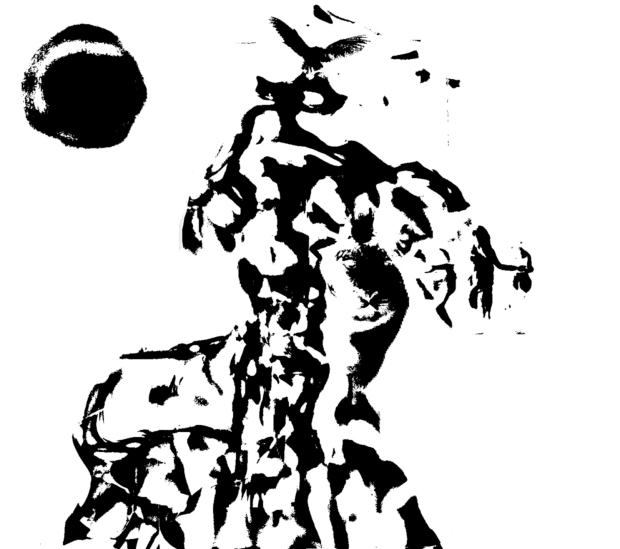
Abstract Human and Islamic pattern. Handmade Paper, dyes, rust, gold leaf. Dimensions with frame: 67.5 cm × 83 cm Production Year: 2019.

Israa Kazem uses handmade paper as her primary material, breathing
new life into it. As it carries its own story. Her work merges the magic of
nature with the aesthetics of ancient art civilizations, influenced by
Islamic art and miniature paintings creating a style that is both vital and
contemporary. The process demands precision, resulting in pieces free
flowing lines and texture of the paper lend a unique character to the
artwork, in addition to depth and expression—a return to roots.
These frameworks surface in her approach to papermaking—a process
where chaos (raw, recycled materials) yields order (structured sheets),
mirroring the emergent patterns found in nature.

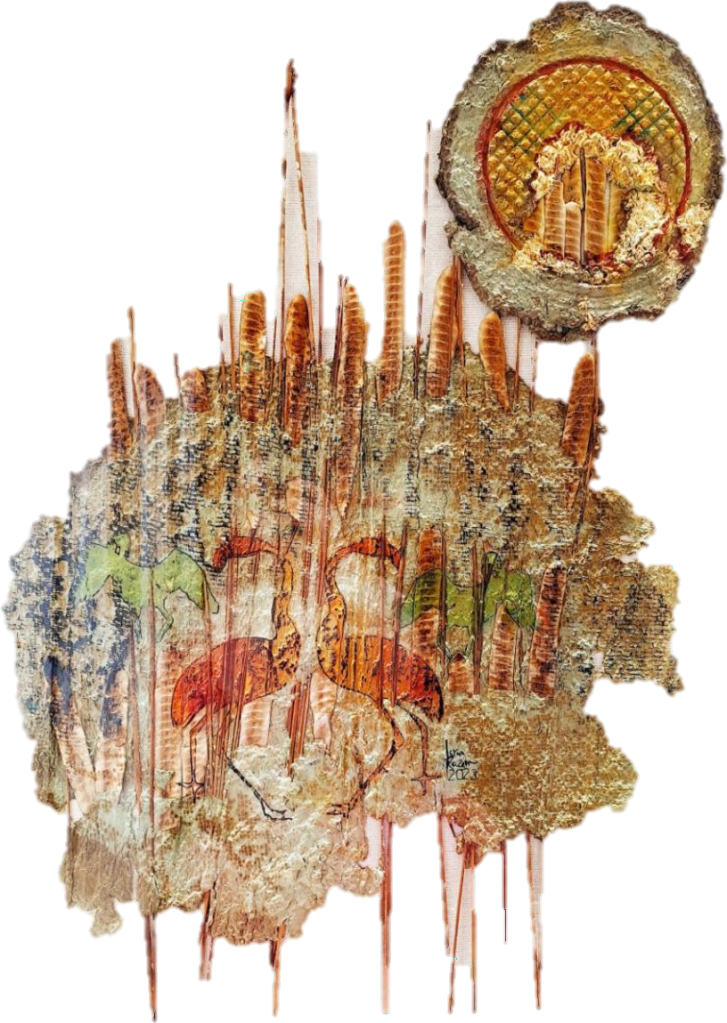
Flamingo reflection and the disk of sun
Paper Pulp, Gold leaf, Dried Leaves, Stalks of Grain Plants, Ink, Color Dyes.
Dimensions with frame: 132.5 cm × 102.5 cm
Production Year: 2023


Her work transforms discarded fibers from wastes into delicate sheets of
paper, each piece is a tactile archive, inviting the viewer to
contemplation on sustainability and our relationship with the natural
world.

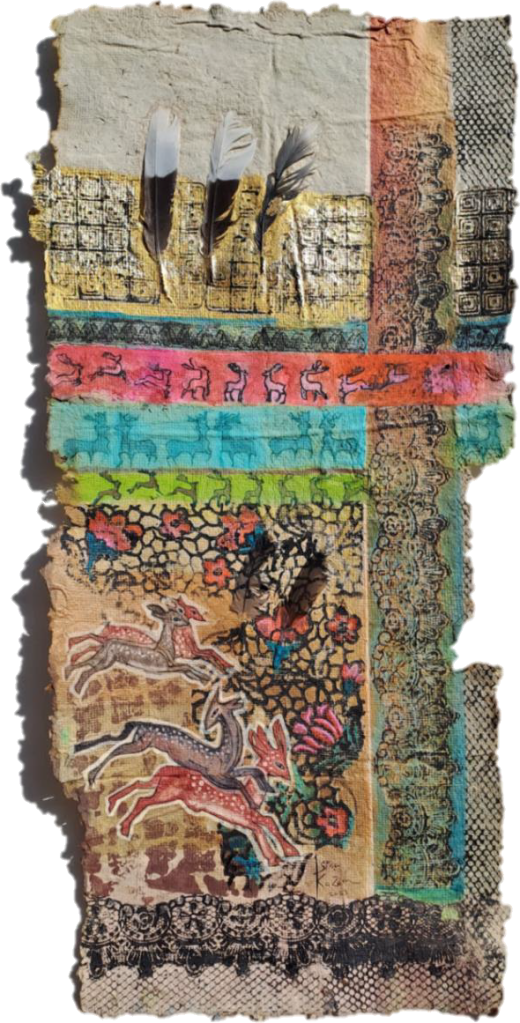
Deer are running on the mountain
Handmade Paper, feather, gold leaf, dyes, ink, acrylic pens.
Dimensions with frame: 85 cm × 50 cm
Production Year: 2024.


She aims to highlight the diversity of living organisms and the different
environments surrounding them, especially highly diverse ecological
communities.

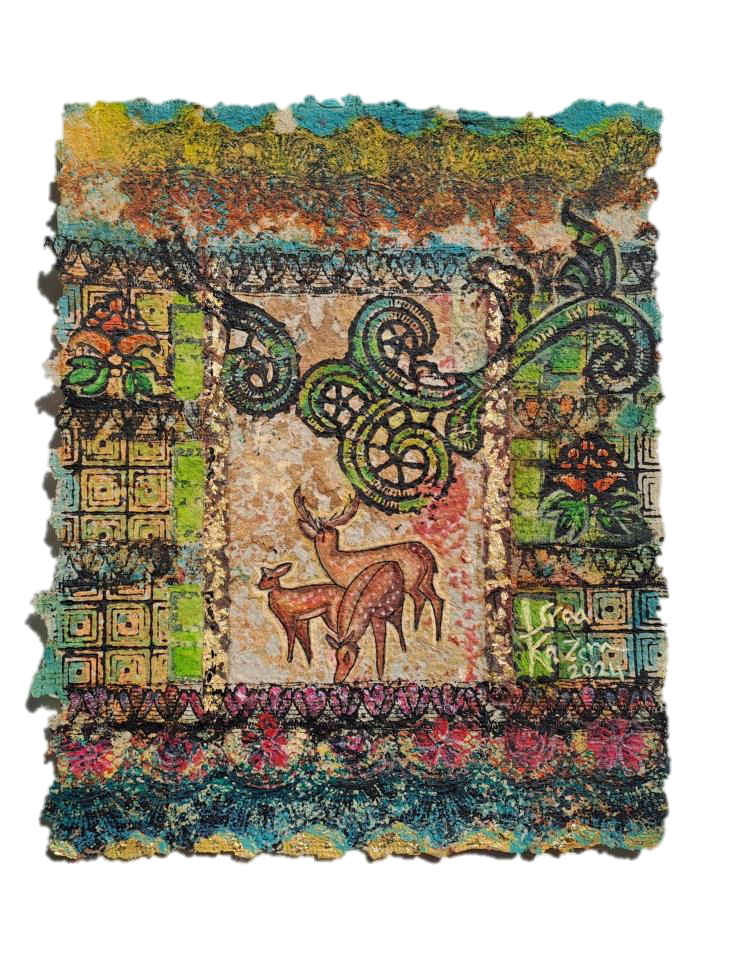
Deer are eating flowers
Handmade Paper, dyes, ink, gold leaf. Dimensions with frame: 40 cm × 40 cm Production Year: 2024


This harmony is evident in her paintings, which may combine deer
surrounded by geometric patterns, or blossoming flowers where
the deer serves as a decorative motif. This fusion creates a visual
language that speaks of the balance between two worlds: the
world of spirituality and geometric perfection, and the world of life
and growth in a timeless artwork.

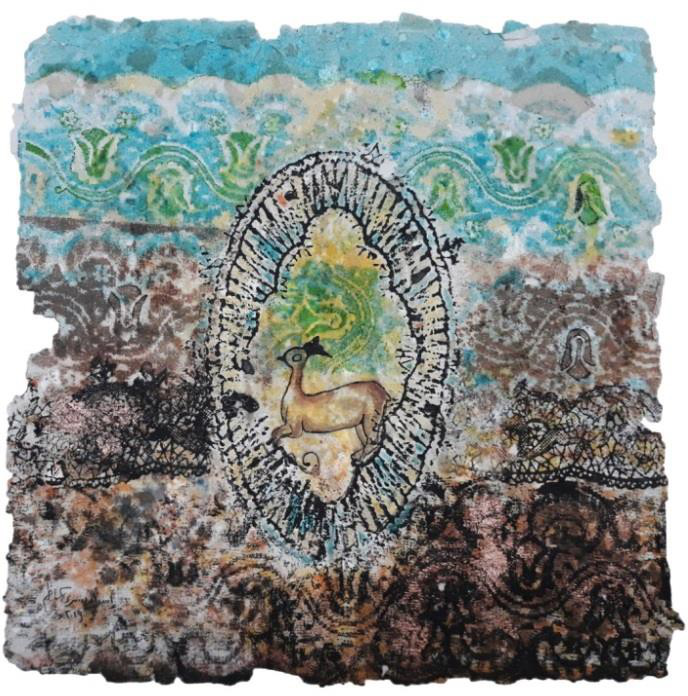
Handmade Paper, Dyes, ink Dimensions with frame: 50cm × 50 cm Production year: 2020


In her artworks collection, the deer refer as a main symbol, not
merely appearing as an aesthetic form, but carrying various
perspectives and meanings. The artist employs it as a symbol of
optimism and new beginnings.

Handmade Paper, Dyes, ink Dimensions with frame: 50cm × 50 cm Production year: 2020


In its grace and lightness, the deer represent hope and the journey
toward a better future. In Islamic art, the deer have always been
associated with beauty and gentleness, making it the perfect choice
to express her vision. The deer is painted in state of stillness and
motion depicted in a style that combines simplicity of form and
ornamental pattern, giving it a symbolic and contemporary
dimension simultaneously. This demonstrates that art knows no
bounds, and that the dialogue between past and present can
produce creativity that transcends time and place.

Israa Kazem (B. 1987) is a Cairo based visual artist and researcher, holds
Bachelor degree of Art Education, Helwan University.

She earned her master’s degree 2015, PHD 2020, in drawing and painting. Kazem is a member of the syndicate of plastic artists. She participated in many international and local Exhibitions. She found her creative inspiration in her drawings and paintings through nature. Kazem employed many drawing, painting, printing and mixed media techniques to achieve her artistic style.

Kazem uses handmade paper and paper pulp and combines them with
different materials. Her use of natural materials not only adds depth and
texture to her artwork but also focuses on the importance of sustainability in art and life. Her artistic practice reflects her respect for the surrounding environment and express its essence through her own
vision.

Solo Exhibition:
“Green Border”, Mahmoud Mokhtar Cultural Center, Nahdet Misr
Gallery, 2023.

Group Exhibitions:
– Agenda Exhibition, Conference Center, Bibliotheca Alexandrina,
12th, 14th, 15th, 16th sessions for the years 2019. 2021, 2022, 2023.
– Cairo International Art District Exhibition (CIAD), Second Edition, Art D’Égypte, Downtown, 2022.
– General Exhibition entitled “Art…The Memory of the Nation”, the 42nd session 2021, Arts Palace, Cairo Opera House.
– White and Black Salon, 5th session, Gezira art center, 2020.
– First Time Exhibition, 14th session, Conference Hall, Bibliotheca
Alexandrina, 2019.
– Second Exhibition: Artist’s Book, Mahmoud Mokhtar Cultural
Center 2019.
– Dai Festival of Arab Youth, Second Session, 2018.
– Exhibition of the accompanied workshops for Cairo Salon 58,
Artist book workshop, the Fine Arts Lovers Association, 2018.
– South International Salon, Faculty of Fine Arts, Luxor – the 5
session 2017.
– Youth Salon, 20th, 21st, 26th sessions Palace of Arts, Cairo Opera House, for the years 2015, 2010, 2009.

Awards and Grants:
Kazem won the First Prize in Youth Visual Arts competition, 6th Edition, El Horreya Center for Creativity, Alexandria, Cultural Development Fund
Sector, Ministry of Culture.

Sabbatical Grants Artist in the field of Fine Art specialized in Painting,
Supreme Council of Culture, 2019, 2021, 2022, 2023.

Israa Kazem prepared the official representation of this article and has granted permission for this article to be published.

Laetitia Da Beca: Peintures, Matières et Graphismes

J’evolue dans le monde des arts plastiques , de l’expression corporelle et dans le milieu alternatif parisien depuis très jeune. J’ai donc explore diverses techniques et directions : peinture , photographie , dessin , graphisme , video , danse et travail sur le corps.

Depuis ces 15 dernières annnees , j’ai fait des expositions et performances en France et quelquescollaborations qui m’on ouvert de nouveaux horizons.
Le public me connait plus pour mes photograhies , mes performances ou mes mises en scène des corps ( dans la cadre fetichiste , danse ou autre ) pour la simple raison que je viens des arts plastiques mais que j’ai fait une pause de 10 ans dans le domaine de la peinture pour y revenir après
une renaissance.

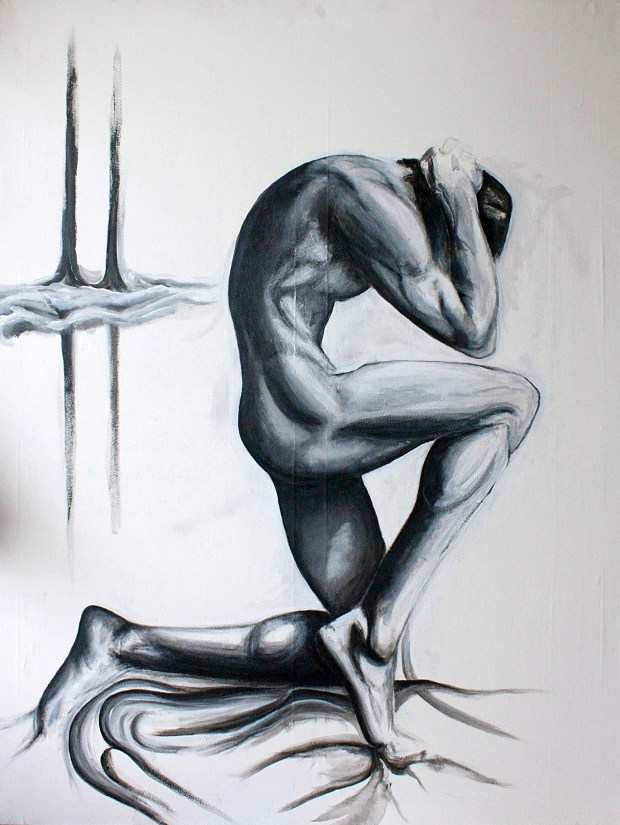
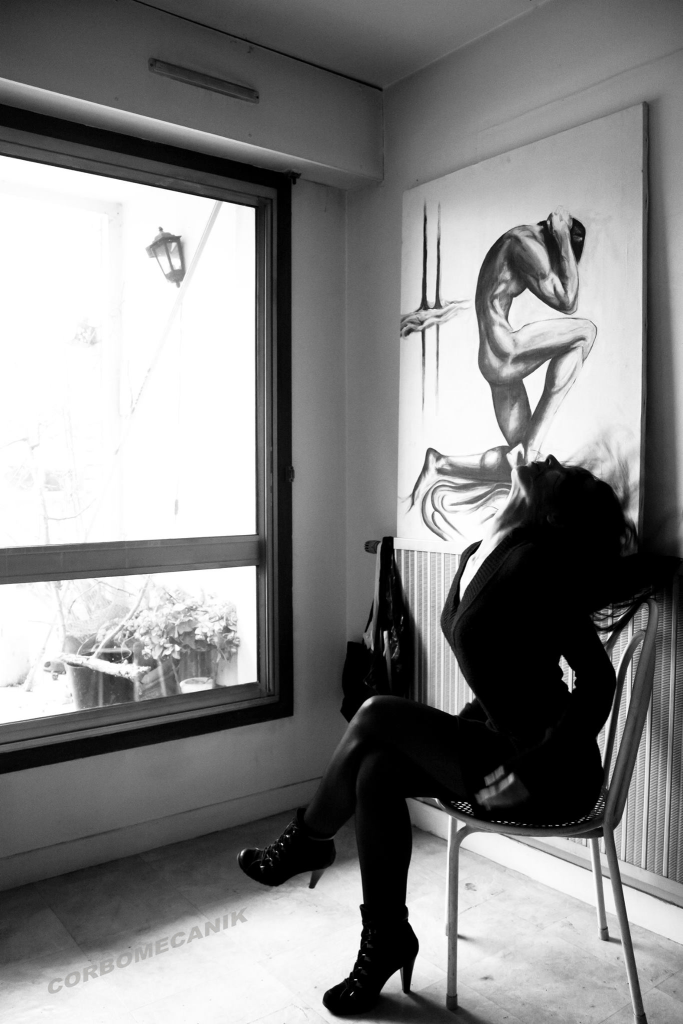
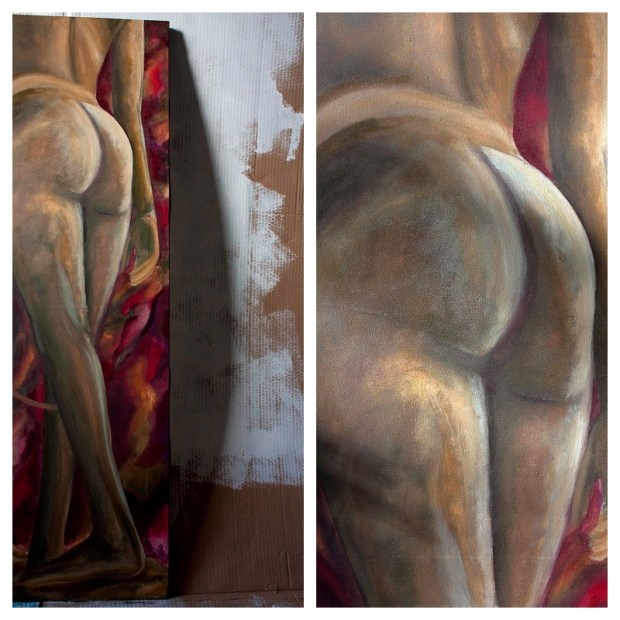
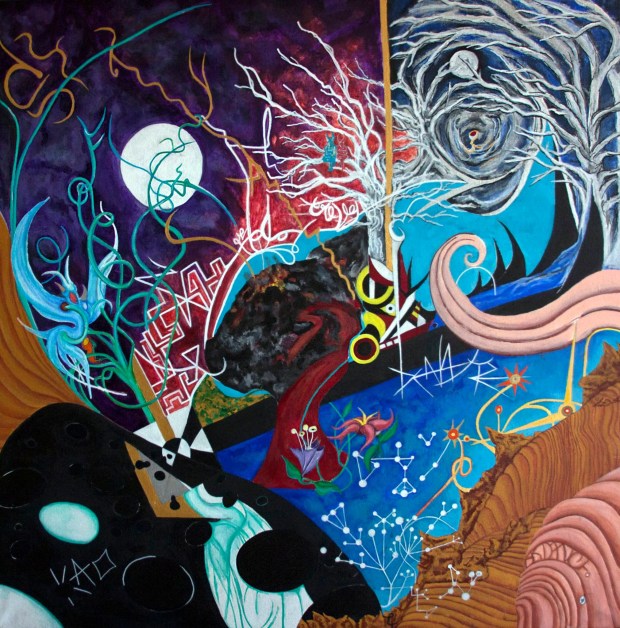
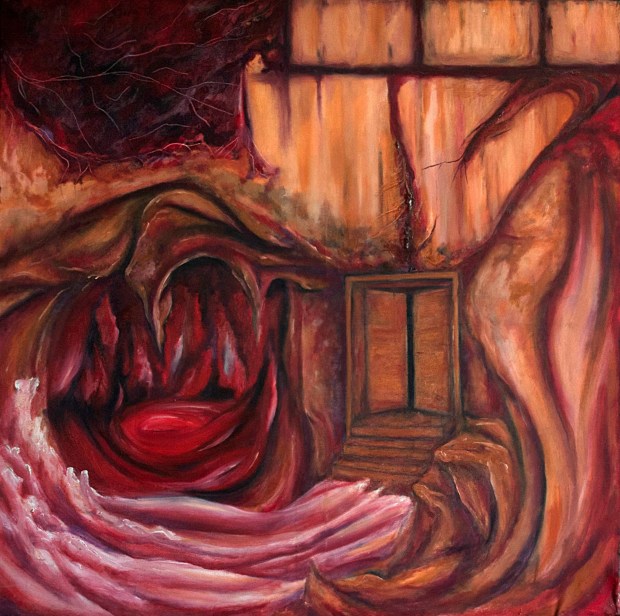
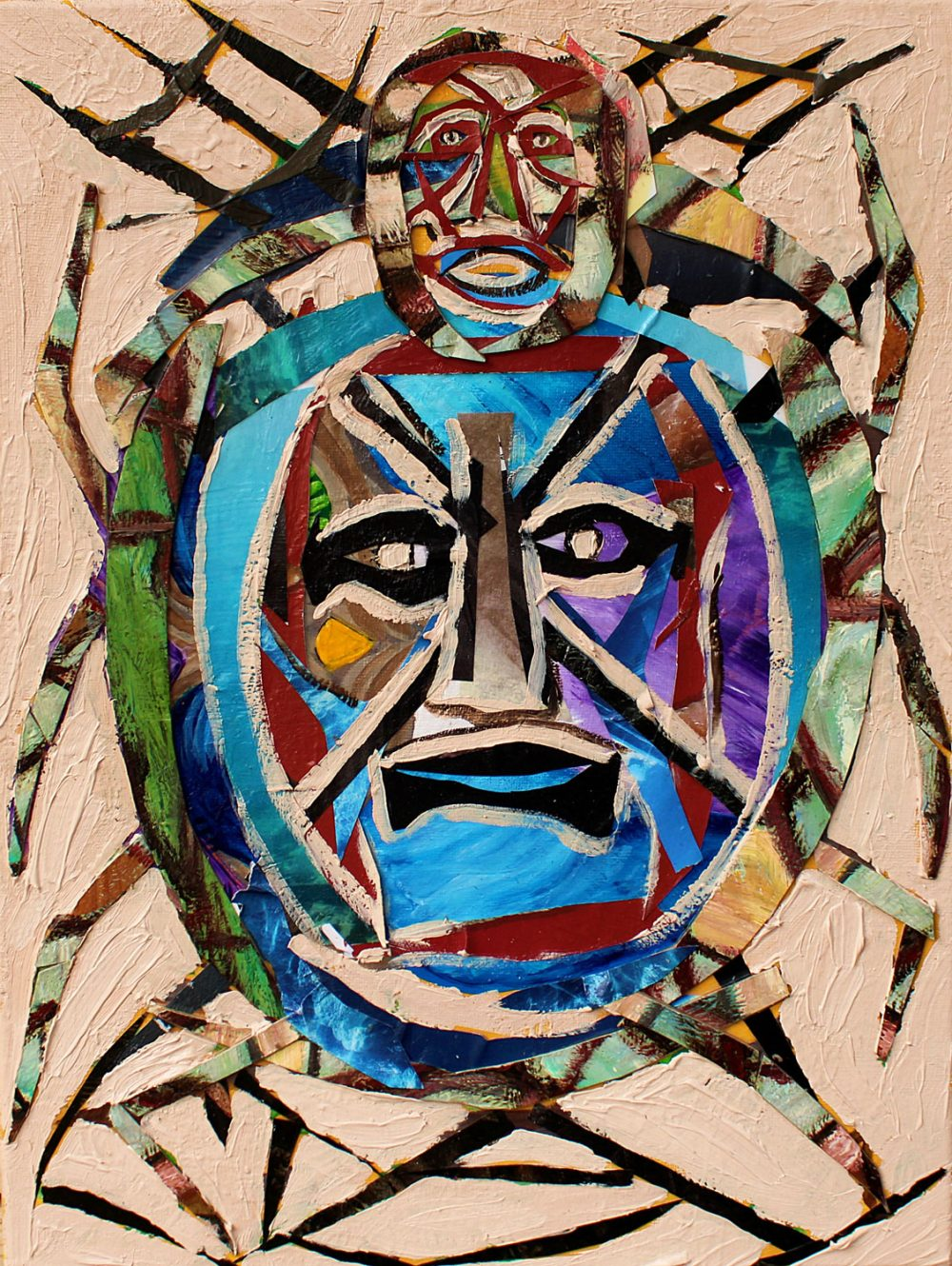
La plupart des peintures presentes ici , acryliques ou à l’huile sont des œuvres en grand format , antre 1 m et 1 m 20 de hauteur .
Deux series emergent , l’une totalement dans la recherche et le jeu graphique , l’autre est une plongee dans la matière brute à travers les mediums et les volumes.

Dans mes peintures , le corps est plutot reduit à l’expression de chocs emotionels devenus physiques, j’y introduis parfois des cicatrices ou blessures ouvertes.

Je dirais qu’on y navigue plus dans le subconscient , dont l’exploration brute instinctive voir animal que me mène finalement ensuite à ritualiser en toute conscience ( mon travail photographique et de
performance).

La demarche chamanique de rendre visble les esprits est toujours presente dans les deux cas. Mon attrait pour l’exploration psychedelique du subconscient , le symbolisme universel , le domaine du reve reconnecte au quotidien , le rapport à l’invisible et l’interet esoterique qui en decoulennt ont toujours etait la des l’enfance.

Mes influences picturales sont très diverses des arts premiers au classicisme , des arts sacres aux symbolistes , du street art à la bande dessine SF ( pour moi , tout est source d’inspiration et de stimulation technique , graphique et de vibration de couleurs ) et biensur les surrealistes et leur grande revolution.

Written by ©Laetitia Da Beca (Corbomecanik)

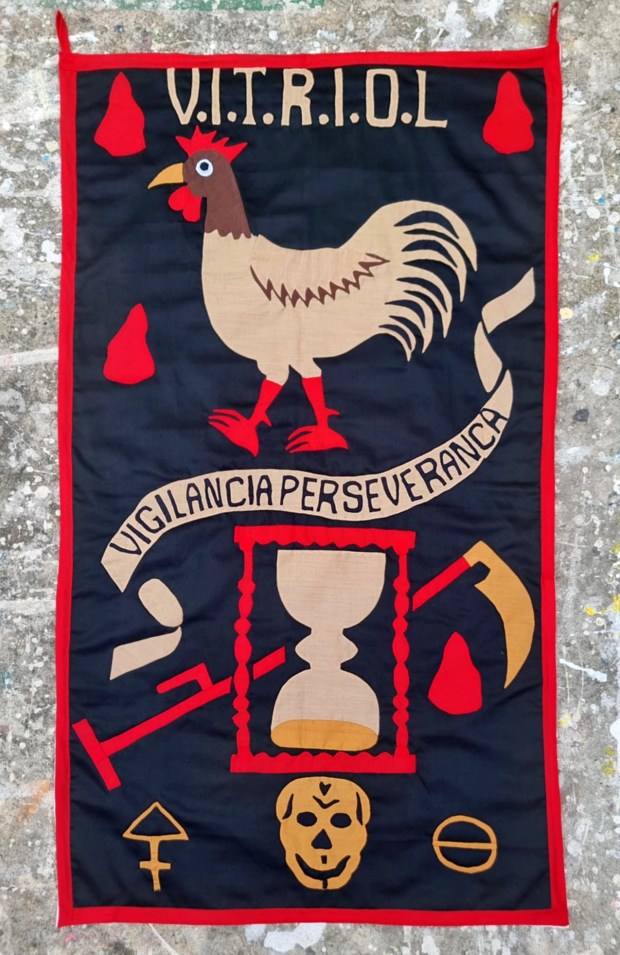
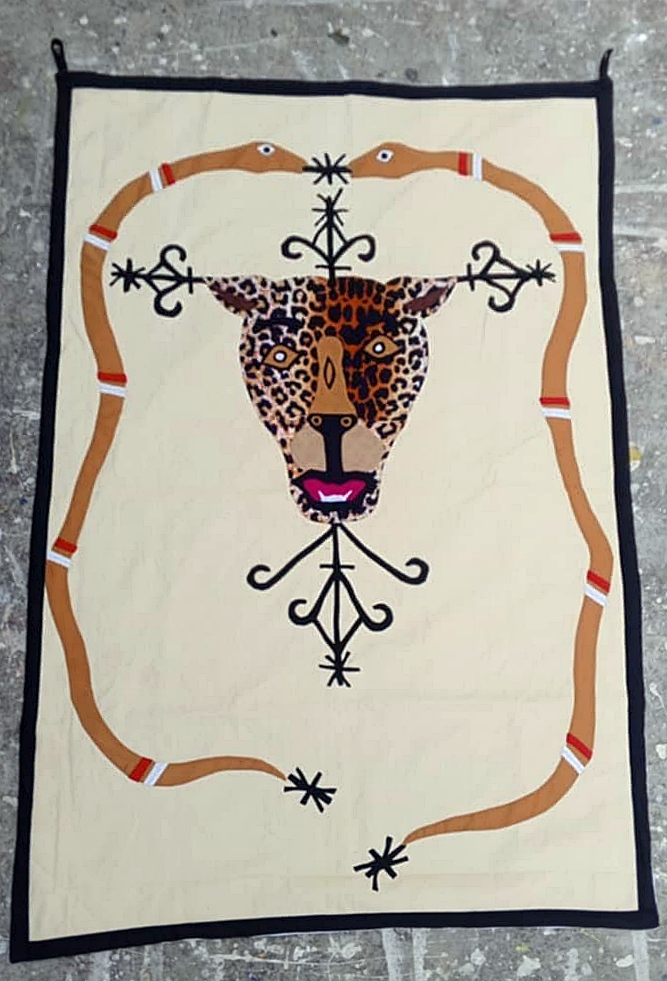
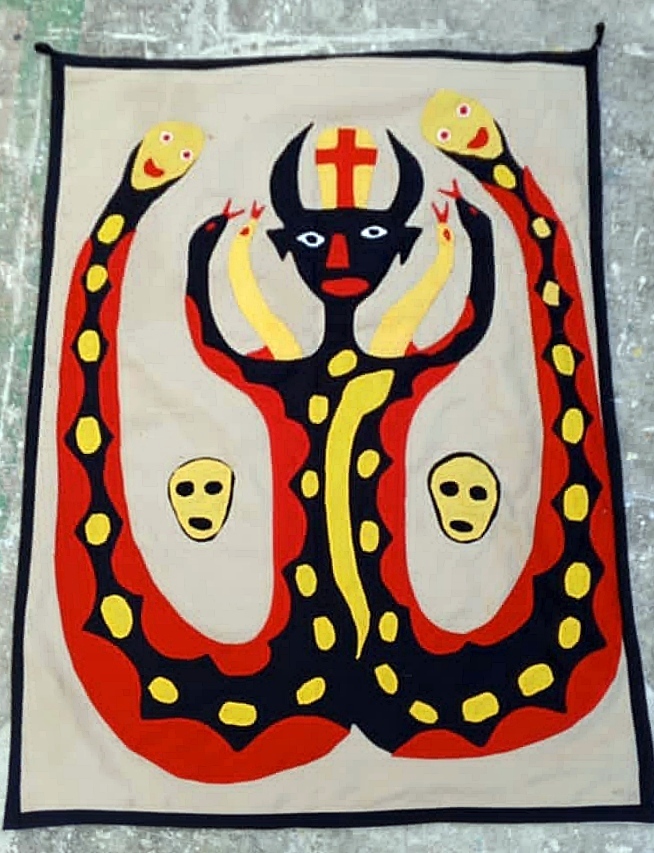
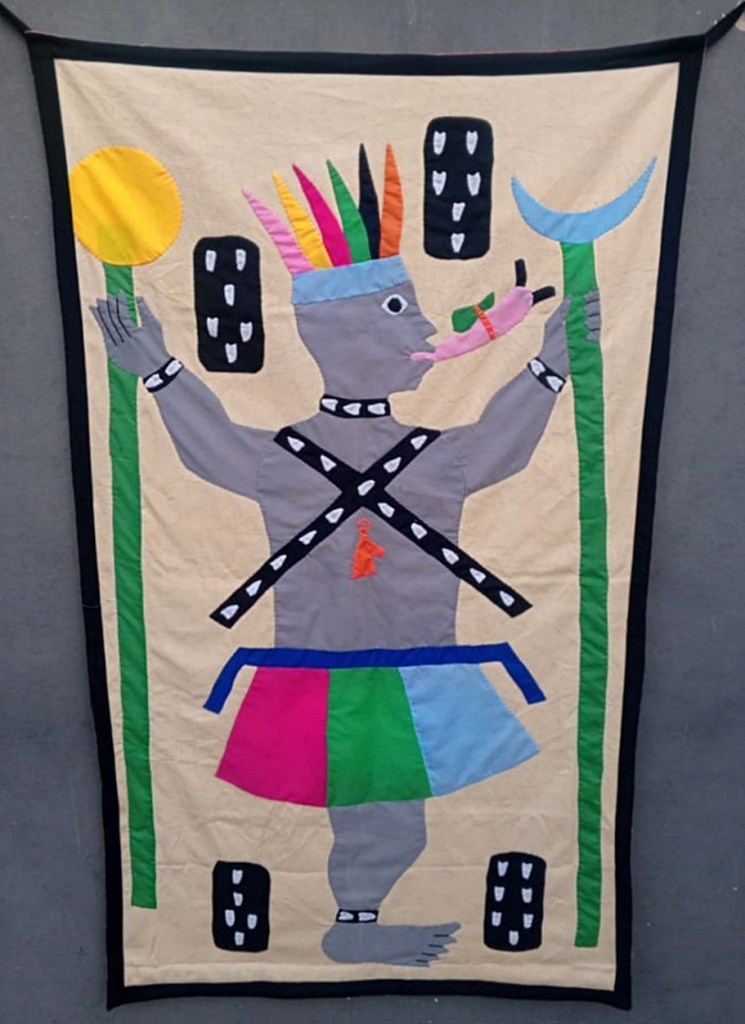
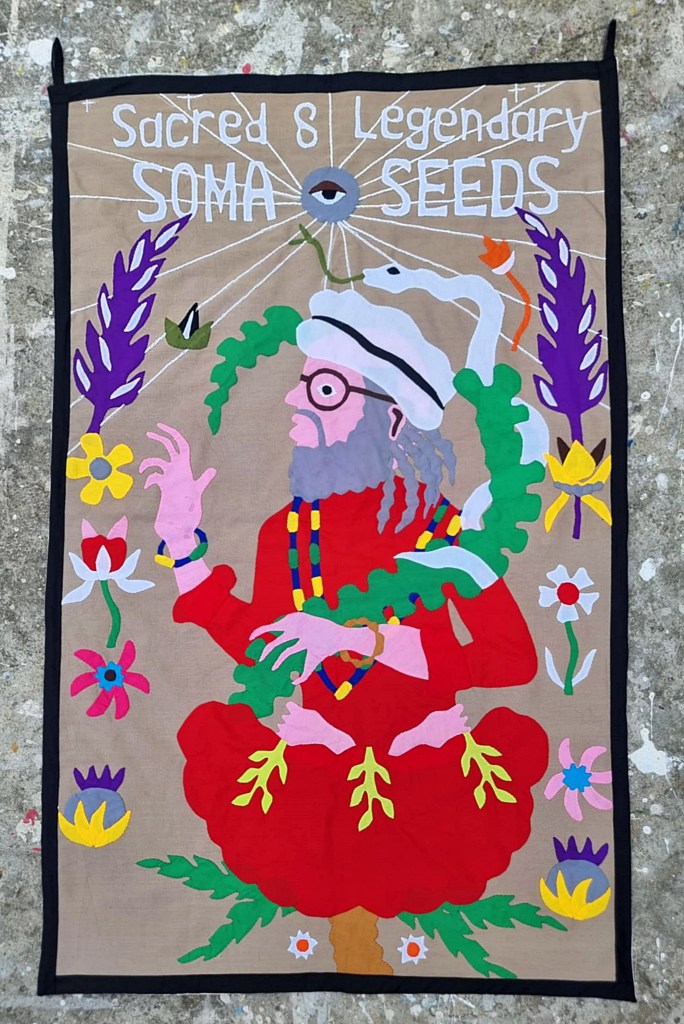
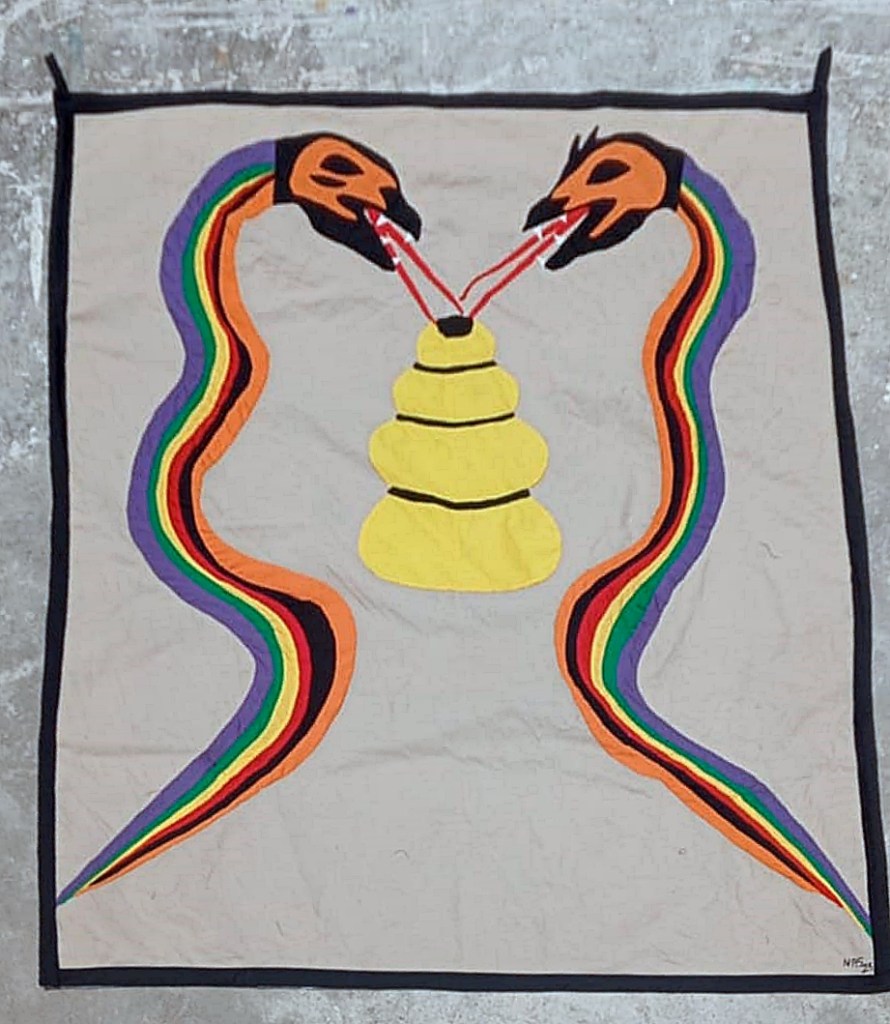
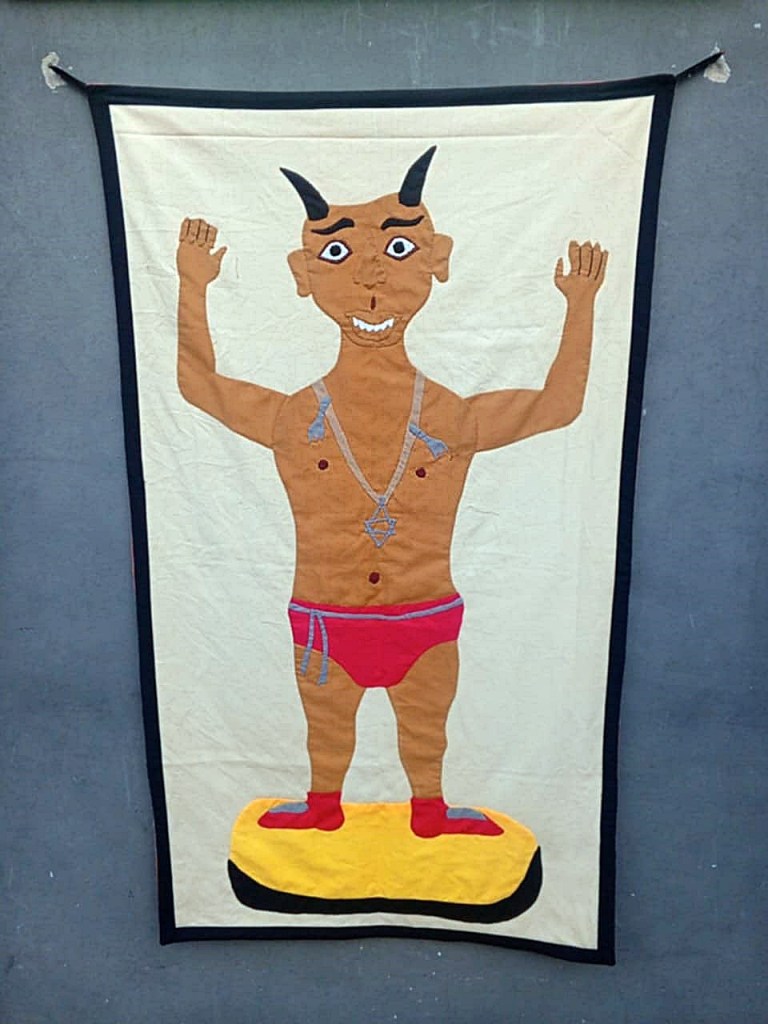
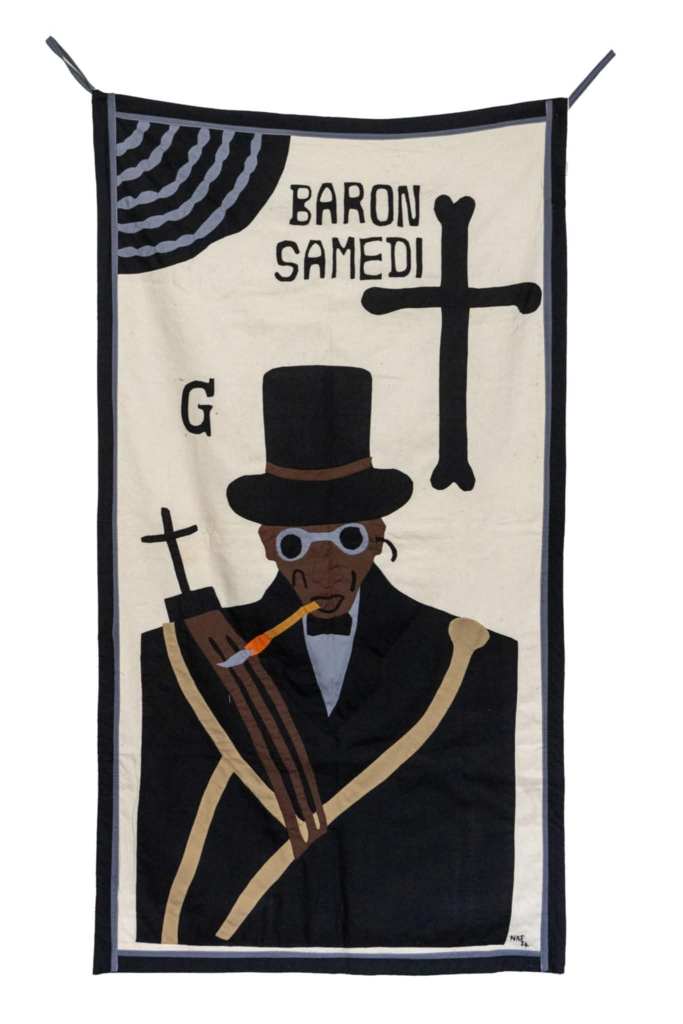
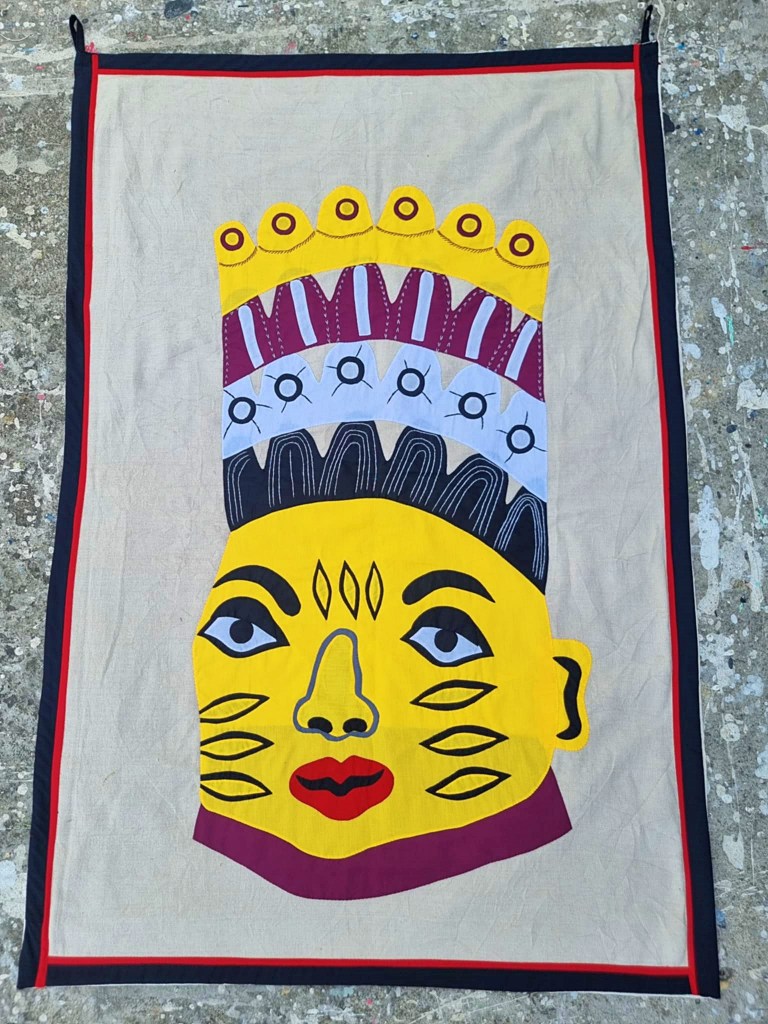
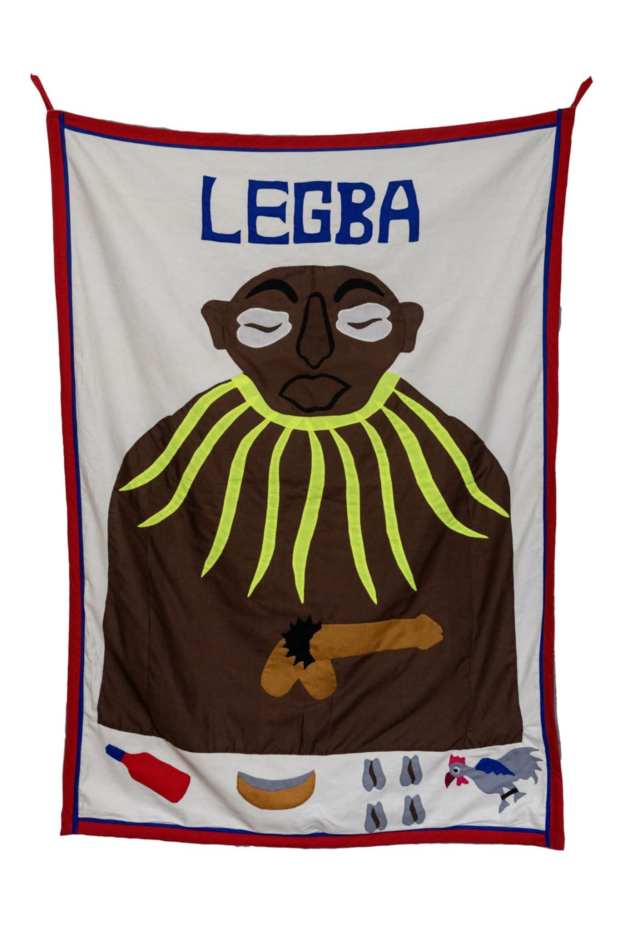
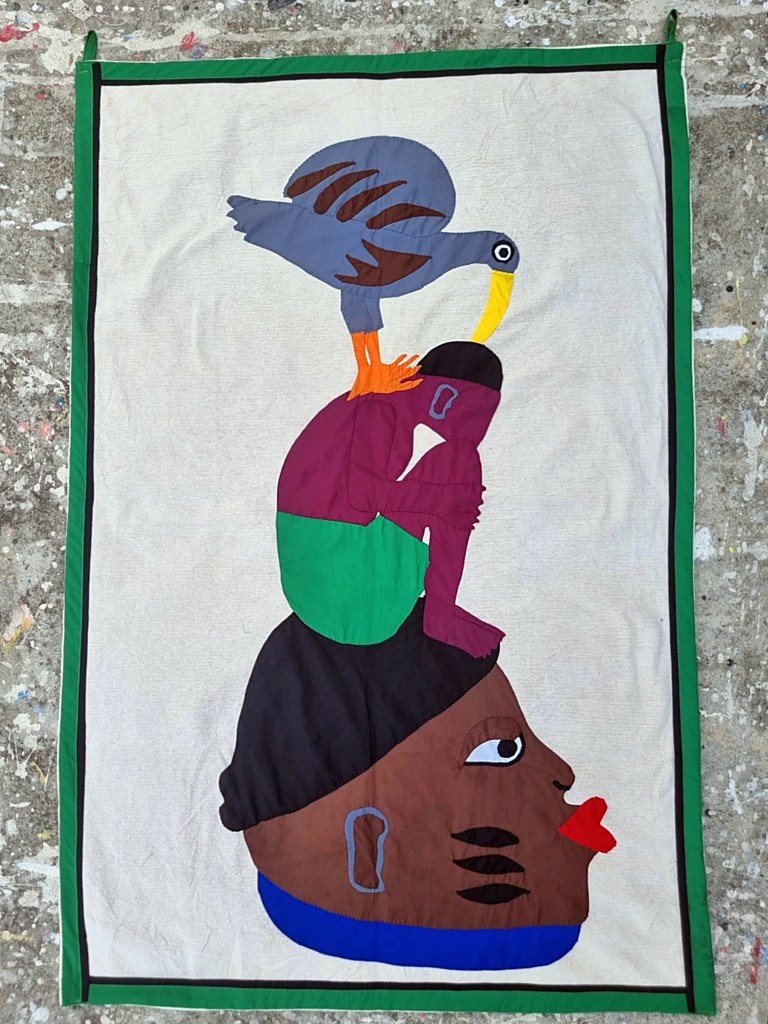
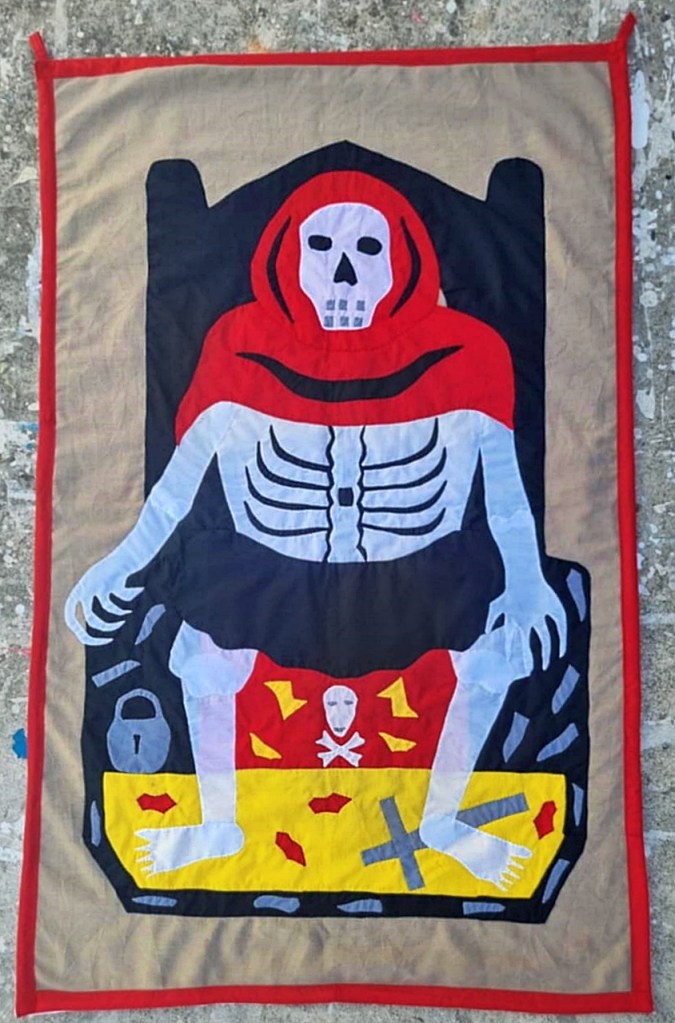
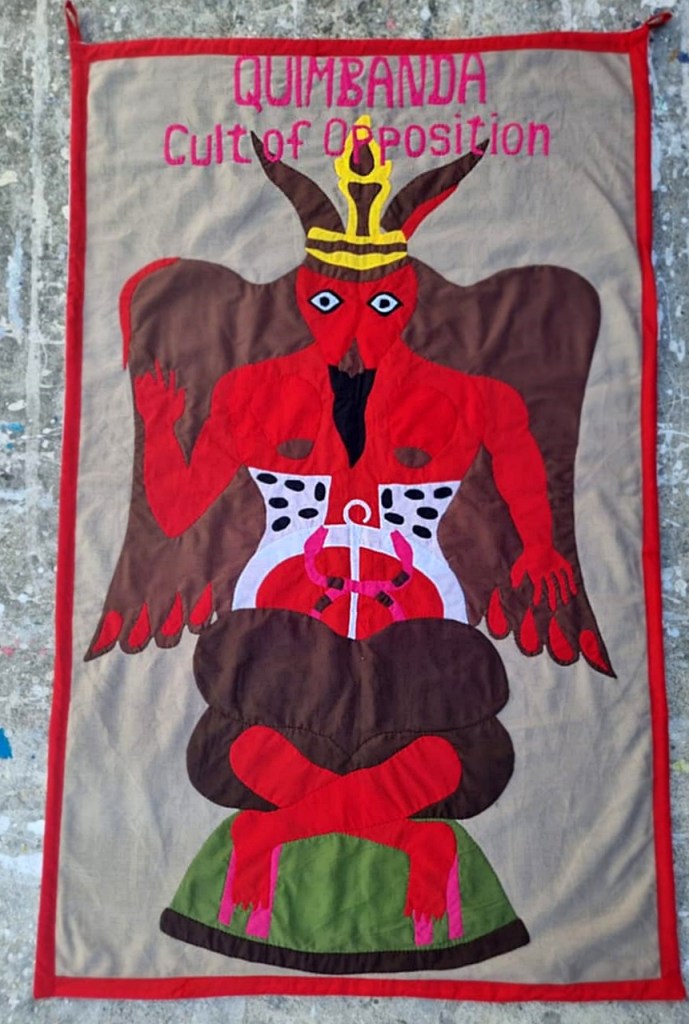
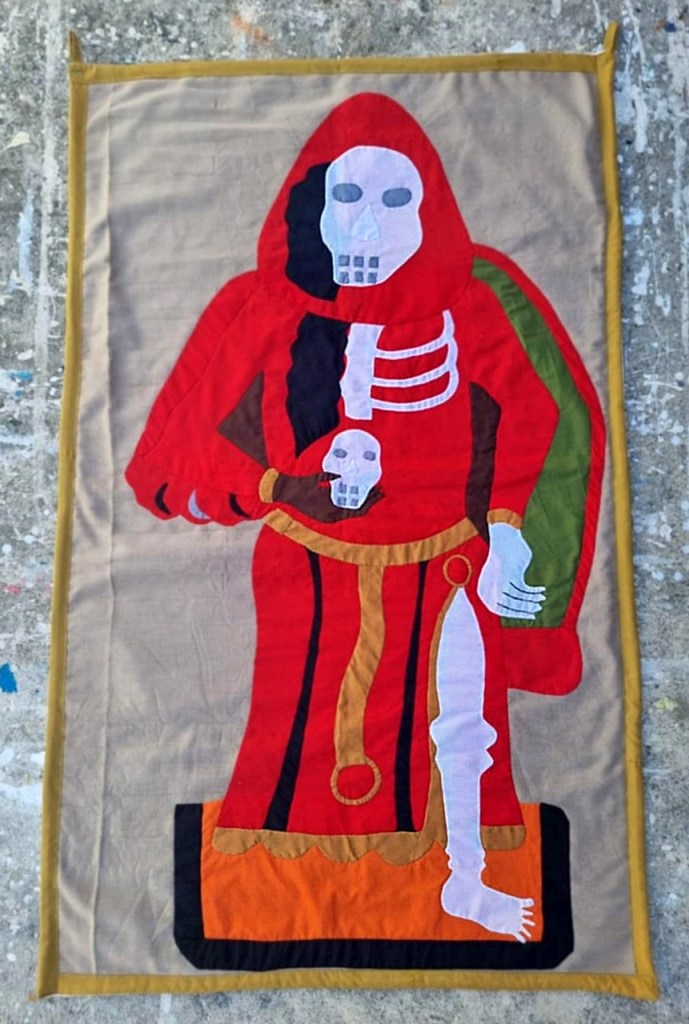
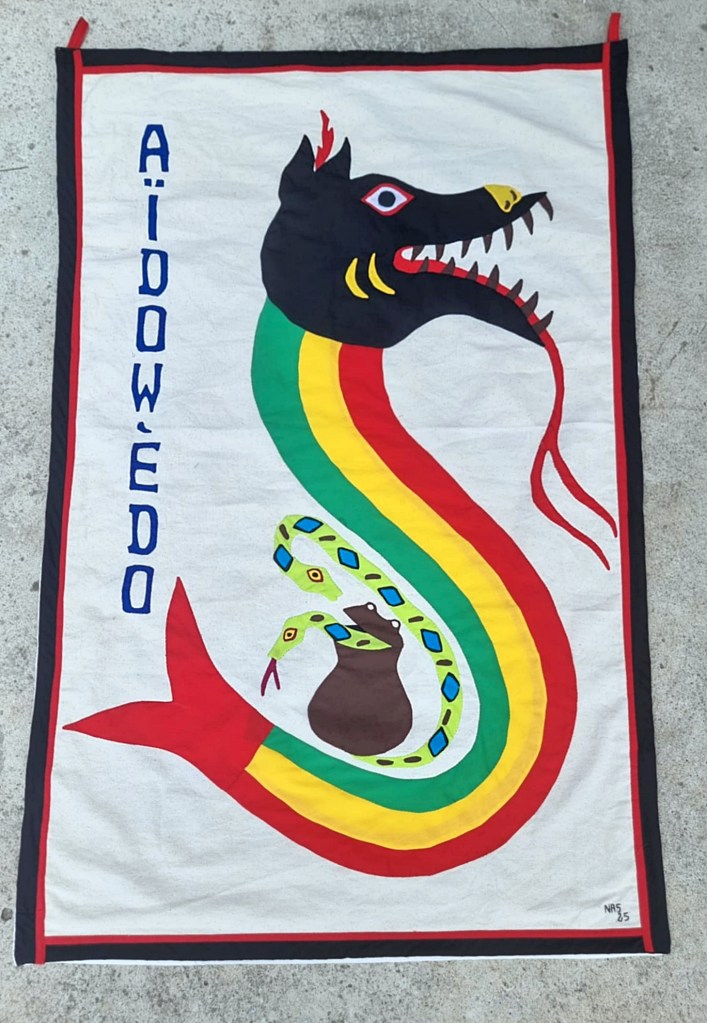
Appliqués by Benin Artist Narcisse Dotou

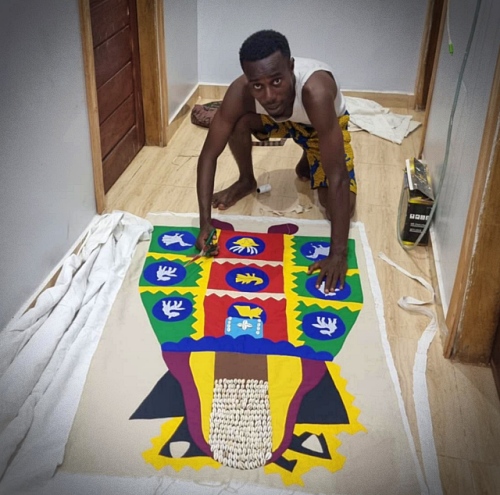
Narcisse Daphnée Dotou crafts symbolic appliqués representing Vodun gods and African diaspora spirits. Dotou’s images encourage introspection, offering a visual journey into one’s inner self. The viewer is asked to concentrate on the visuals and consider them thoughtfully, just as one would with a tarot card. Only then can the object’s grandeur gain a mystical and meaningful quality.

To make an appliqué like this, you need at least three weeks before doing it. We make the drawings on paper and then we start by cutting things out. Materials include sewing needles scissors cotton fabric of different colors fabric. Everything is done by hand except the border which was done by machine. My teacher was François Codjo Yemadje who is from Abomey, Benin.

Narcisse Daphnée Dotou

Narcisse Daphnée Dotou was born on October 31, 1991 in Benin and has lived in the Mono department for a long time. He is an artist trained in the traditional art of tapestry sewing. The motifs of his refined works cover a wide spectrum. These include the varied symbolism of the ancient kings of Benin, which is the former Danhomey, representations of the traditional gods of Benin voodoo, Haitian voodoo, Cuba, but also modern themes and works made especially at the request of customers. In addition, Narcisse is an excellent connoisseur of the Cotonou art scene. He is happy to advise you and act as an intermediary if you have any wishes or requests.

Interested in Dotou’s appliques you can contact him via Facebook at Narcisse Daphnée Dotou.

The Voodoo-Culture Introduction from Soul of Africa Museum

Memory Transfer by Mitchell Pluto

Transferencia de Memorias

From The Eclipse © Mitchell Pluto 2024 Séance channeling memory transfers. Espiral en el Estuco © Mitchell Pluto 2025 Transferencia de Memorias

In early June, the sky was clear and the temperature was pleasant. Tom and Sarah Anderson came across a metal tower while hiking in the Lolo National Forest.

The object’s Gothic style stood out as they approached. Seeing it brought back memories of their honeymoon trip to Chartres Cathedral.

The couple assumed the installation was someone’s art project or an exhibit at the University of Montana. The sight was unusual. There was a black circular window high up, near the top of the bell tower.

The tower emitted an extraordinary spectrum, encompassing all shades of blue and green.

3,500 kilometers away, a small gathering met at the United States Capitol. Attendance was by special invitation only.

Elijah Booker and his friend Alvaro, a man of abnormally short stature, arrived punctually. They entered the room and attracted a lot of attention. Booker, a large, Black man, always stood out in a room full of white men.

Alvaro had previous experience in the company. He knew the purpose of the invitation. Alvaro was albino and his alias was white dwarf. His main function was to use his mentalist ability to influence and dismantle cults. He possessed an innate ability to influence and alter opinions and beliefs.

On the screen, taken from a popular social media video, several recorded witness statements were shown. An older man, standing next to his wife, described the encounter with the intelligent light as best he could next to a strange tower. With deliberate and concise gestures, his wife explained the same thing, but in more detail.

Booker assumed he was the keynote speaker invited to talk about the future effects of permafrost.

The focus was personnel selection, not Booker’s research. Elijah Booker was the world’s foremost parasitologist. He researched extensively and wrote informative books on toxoplasmosis, a brain parasite. Elijah worked with international scientists. The Bureau of Globe Research in Alaska, where he lived with his wife and daughter, housed a broad research panel on prehistoric pathologies. Booker’s research caught the government’s attention.

Booker’s specialty did not include cosmic rays. He had heard of them and knew they were unstable, but nothing more. Cosmic rays sometimes interfered with belief systems, sometimes caused hallucinations, or enhanced brain patterns in unique ways.

The U.S. Intelligence Service considered ideologies to be mild hallucinations and was intrigued by the effects of cosmic rays on the brain.

The U.S. agency selected experts in direct observation.

The department was aware of Booker’s private life.

They knew of Booker’s Buddhist practice and his hobbies, which included listening to jazz and researching the occult.

Booker and Alvaro boarded a plane within a few hours. The private pilot, a native of Montana, had a great time. Alvaro taught him numerous dirty jokes for a total of six hours. This gave Booker time to read reports on cosmic rays.

According to government research, different rays posed varying levels of danger.

A jeep with tinted windows was waiting for them at the airport.

They soon reached the mysterious object. The Forest Service managed the situation, giving it a normal appearance to the naked eye.

Antennas, tents, and tall Douglas fir trees surrounded the 70-foot bell tower. The building’s structure possessed a beautiful style. The scene reminded Booker of a surreal landscape, something Bosch might have built.

He took a photo with his phone and recorded a video, documenting the luminosity of the fading colors.

Álvaro tugged at his pants and pointed to a tent. A young woman, about the age of Booker’s daughter, was holding a tablet like a clipboard.

Frauke Brunhilde introduced herself. Her black nails, black shawl, and tight leggings gave off a countercultural air. She was a genius in the German Federal Intelligence Service. She was a forensic chemist and radiological technologist.

Booker inquired about Frauke’s findings and knowledge.

Frauke showed him a live feed from a radiation-resistant camera. A vertical line of light aligned with the top of the bell tower. He speculated that the beam provided a transmission that might correspond to a conscious entity. Frauke discussed the fluctuating visibility of the light. She said that in Europe, cosmic rays are everywhere. Frauke said people believed they caused poltergeists and produced other strange effects.

Throughout history, ancient peoples used stones and statues to mark power points. Indigenous Europeans wore conical hats, such as the Golden Hat of Schifferstadt, to tune into cosmic rays.

Frauke proposed that primitive peoples tuned into radio stations in space. Mysteries associated with cosmic rays included encounters with fairies, aliens, angels, or even people who disappeared without a trace.

Booker wondered if these disappearances were due to dangerous rays that triggered aggressive progeria, a disease that accelerates aging. This cosmic ray posed no such danger. Frauke mentioned an article published by German scientists in The New Nature Journal, which argued that time is a moment that has already passed.

According to Frauke, the article suggests that UFOs are future apparitions investigating the present.

Booker wondered: Who was shaping the future from the past?

In the report he read on the plane, some anthropologists in the southeastern United States theorized that cosmic rays were attracted by unicursal patterns, but also expressed themselves to humans in diagonal or zigzag patterns. Frauke mentioned geometry as a method for communicating with unknown intelligences.

Booker noted that Frauke’s explanations had a mystical undertone, and he knew she was speaking of magic.

Frauke inspired Booker to reflect more carefully on the unintended consequences of cosmic ray-induced hallucinations. Most of the knowledge discovered turned out to contradict his beliefs, something he was prepared for.

The next day, scaffolding surrounded the tower.

Booker spoke to the welder. The man said he hadn’t been able to burn a hole with a blowtorch.

Incineration also didn’t work on the top window, which the worker described as Jell-O. His partner punctured a sandwich with stainless steel tweezers in the Jell-O. Nothing happened to the sandwich. The puncture filled and healed itself.

Booker walked toward the main tent.

Alvaro reclined on Frauke’s lap. They seemed to be having a good conversation. Frauke chuckled. Booker told Alvaro and Frauke to prepare to enter the object.

The unit gathered what they needed. Booker hooked Alvaro to his belt like a weapon. Frauke slung a backpack over her shoulders as if she were spending a week in Glacier Park. Frauke put on her headphones and began climbing. Booker braced one hand and one foot on the scaffolding, the tips digging into the ground, as he slowly ascended to the upper platform.

Standing near the most enigmatic and sinister feature of the building, the three gazed up at the large black window.

The surface was obsidian, with a thick, gelatinous texture. Due to its unknown elemental nature, they were unable to separate the gel into samples. Frauke, using her scanner, surmised that it was an iron mordant containing extraterrestrial gelatin. The window also contained a low- to medium-fluctuation radioactive ray, known to cause hallucinations, according to the scanner. Booker hoped that, as they approached the cosmic ray, they would all experience an LSD-like experience.

Without any prompting, Álvaro dipped his hand into the substance.
It was the temperature of a warm bath.

Booker quickly glanced at Álvaro.
He removed his hand from the gel, waggling his fingers toward Booker and Frauke to demonstrate that God was luck.

The group sat for an hour discussing hypothetical possibilities, including personality changes and brushes with death.

Álvaro lived by the motto: to embody the god of things as they should be. To be the force of humor in every passing horror. Frauke, enchanted by Álvaro, agreed.

Frauke put her headphones back on. The music turned up. Booker hooked Álvaro back onto his belt and held Frauke’s hand. Booker didn’t want her to wander off alone in the oozing gel. He felt responsible for all of them. Booker placed a camouflage bandana over his nose and mouth. He breathed and closed his eyes. Frauke tugged at his hand.

The first step into the gel was similar to stepping into a deep pool without firm footing. Each movement created an unpleasant sucking sound. The absolute darkness unleashed a wave of fear. A surge of adrenaline flooded Booker’s bloodstream, testing everything he had learned from Buddhism. With a concentrated effort, he maintained his upright posture, stepping into the dense gel with one arm. The suction made movement difficult.

Booker could now identify with the five clinging aggregates of Buddhism.

It became a direct experience. The aggregates — form, sense, perception, and external forces — environmentally influence the mind.
Booker felt a predatory presence. An obsessive, superstitious belief overwhelmed his mind as he struggled to penetrate the bottomless gel.

Suddenly, Booker had a clear view of his own brain. He could see his amygdala working overtime. The pressure on the insular cortex made him imagine the worst possible scenarios, including an imaginary predator chasing him.

However, there was no malevolent morphic resonance present, only a confined space. His own fear divided and attacked every facet of his mind. The narrating brain identified its observer function as an intruder.

A strong auditory memory told Booker not to panic. A Nyingma master at a Buddhist retreat advised him to accept the discomfort and practice gratitude.

This precious memory became clearer and more fundamental to his resistance.

Booker imagined seeing the Khenpo floating on his back, effortlessly performing backstrokes in a slimy jelly.
Another vivid memory resurfaced. Years ago, his few sessions with Stanislav Grof helped Booker relive his earliest memories of being suspended in a possessive womb. He recognized that birth brings with it a subconscious sense of abandonment for everyone.

This caused humanity to misinterpret birth as a definitive isolation and desertion.

All of this originated in the maternal body’s rejection of the newborn as if it were excrement. Generation after generation, this confusion projected contempt for the feminine and nature.

Booker could see his thoughts as images. He saw the unjust and unconscious representations that dominated historical records.

The central idea emerged as the ambition to replace the mother with an artificial mechanism. This would foster the construction of an industrialized, parasitic world devoid of empathy.

Booker wished he had headphones.

Music would make it easier. He imagined John Coltrane’s “One Up, One Down .” He had listened to the album often, at the cost of exhausting his wife’s patience. Today, it helped him remember it. The saxophone arrangement conquered fear. Booker knew that Coltrane understood the patterns of a constantly changing self. A self free of history and objects.

One conclusion became clear: time and space will never have a central authority.

The attempt to even imagine sensations beyond the end proved to be a vain and imputed illusion.

Death existed as a phase that passed like everything else.
Why pretend we knew this?

We shared the same fate. We would cease to exist without knowing what death was.

The tension dissolved and the jelly transformed into a thick fog. With his free hand, Booker reached for Álvaro, patting him on the face. He looked at Frauke. He saw her silhouette. Frauke turned to Booker, took off one of her headphones blasting, and smiled.
Booker asked, “What got you through the jelly?”
Frauke nodded to the beat: “Huh? Yeah! It’s an American band called The Doors , The Other Side , yeah, they’re good!”

The cosmic ray transformed the tip of the bell tower into a reactive vanishing point. This produced a carnival-like hall of mirrors effect. Booker, Frauke, and Álvaro occupied that space between the parallel lines of the cosmic ray. The room resembled a virtual infinite hallway with a ledge. Colors cascaded down the cosmic ray.

Frauke’s gaze caught something in the swift wave of light. She spoke, describing what she saw as it manifested in Álvaro and Booker’s minds.

A spinning triangle reflecting brilliant light transformed into crystal. At each corner, the numbers 3, 6, and 9 materialized. From the center of the triangle, sparks erupted, forging a nude female figure with hair down to her feet. A deep red and white glow caught her attention.

“She can see us,” Frauke said.

The woman spoke echoey. She gave her name as Mitzi Orssich. Mitzi said she was broadcasting from a live 1920 séance in Austria. The chatty ghost said she represented the Viril Society.

Mitzi demanded information from the future to help build a temporal vehicle. Mitzi possessed sternness, while her flawless figure projected an incredible image. She was a magnetic and exciting archetype who could raise blood pressure and induce a firm salute .

This woman’s body possessed a truly divine craftsmanship, an image that neither eats, defecates, nor ages.

Booker reflected.

She fit the bill: blonde hair, blue eyes. The graceful elements resembled the Christkindel.

But why didn’t this woman take over as Germany’s leader in the 1930s?

Mitzi spoke English very well.

Booker recalled researching the Vril Society, which emerged as a 19th-century work of fiction by the English writer Ed Lytton.

Booker realized they were tapping into a projection of Frauke’s subconscious.

Mitzi was, in effect, a literary phantasm forged from a pseudo-story.

He looked at Frauke, who remained staring.
Booker speculated through his online queries and research; Frauke gained powerful impressions from what she read.
Álvaro’s face was simply a huge smile with tiny hands and feet.

Booker interrupted Frauke’s trance and appropriated the cosmic ray, projecting abstract expressionist ideas onto it. He enjoyed this art movement and understood its significance. He was open in sharing his observation of vivid brushstrokes.

Booker gently guided the hallucinatory influence away from the National Socialist art style toward a more universal and abstract variety. It was art without a human figure.

Wonderful and exciting non-figurative patterns formed from the center of the cosmic ray. The variety of designs lacked strict cultural ideologies, which brought Frauke out of her trance.

The cosmic ray inspired Alvaro to create a complex algorithm based on his interest in spiders.

Mitzi’s impression triggered unexpected associations that took a mutated form.

Web strings connected a spider puppet to the spinning chemical brain in Alvaro’s vision.

Frauke saw it as a fusion, creating one puppet within another.

Booker interpreted Alvaro’s vision of the spider as a portable DNA capsule capable of flying through space.
Small cubes appeared on a spinning belt in another future. The webs were coordinates, guided by a chemical brain inside a metallic spider.

Booker, Frauke, and Alvaro huddled in a triangle in front of towering Douglas fir trees. They were gone for three days and reappeared five miles from where they had disappeared. There was no alien tower there. A man named Warren found them while patrolling the forest. The cosmic ray information was useful.

US intelligence took statements from Booker, Frauke, and Alvaro.

Engineers, chemists, and physicists collaborated to design a new space vehicle with a chemical brain.

A few months later, the spider-like object would fulfill a panspermia mission. The space spiders, called Anansi Capsules, would aim to find habitable planets to modify human DNA and enable life in an extraterrestrial environment.

The Anansi Capsule was an 8-foot-tall mobile figure with eight appendages for hand tools.

After descending, the capsule would unfold into a complex 16-foot laboratory.

The Anansi Capsule would manufacture and raise two biological beings for several generations.

It is unknown whether the new offspring would preserve or understand their origins, but they could be alive to continue exploring space.

A few months after visiting Montana, someone mysteriously provided a grant to de-extinct the woolly mammoth and thus include it in Booker’s future project.

Writing and Art All Rights Reserved © Mitchell Pluto

From The Eclipse © Mitchell Pluto 2024 Séance channeling memory transfers . Spiral in Stucco © Mitchell Pluto 2025 Memory Transfer


Espiral en el Estuco (Spanish Edition) Paperback – Large Print, 23 April 2025

Spanish edition  by Mitchell Pluto

El surrealismo oscuro y el absurdo crean efectos psicodélicos. El zen y el jazz de Coltrane ofrecen una vía de escape de la veneración política, permitiendo viajes interestelares. Cada capítulo explora el surrealismo y las técnicas budistas. Estas ayudan a sobrellevar el trauma de sentirse atrapado, como un animal en un anuncio repetitivo.

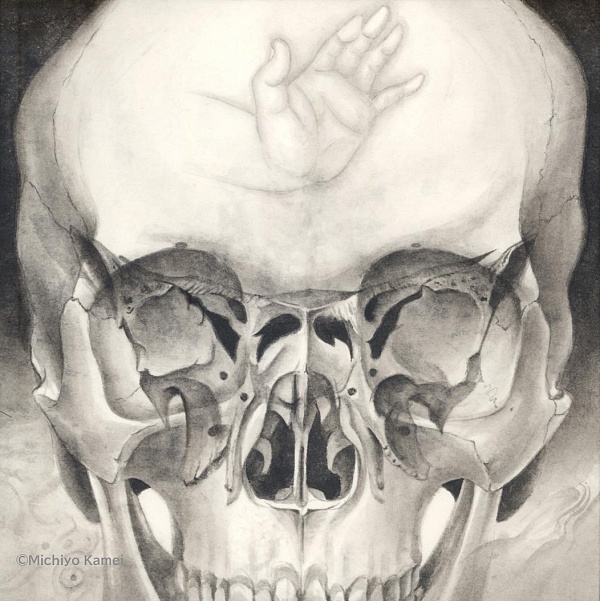
The Banquet of Banality by Hager Youssef

The Banquet of Banality

It was too much—

your friendly chatter

with a plastic doll,

beside all my womanhood.

Too much closeness,

and not enough of friendship’s honor.

You dressed your attention

in a shirt far larger than your frame,

and wandered all night

seeking someone to stitch it tighter.

Fevered listening,

inflamed reactions,

obscene exaggeration,

and a sugar tongue

with no cause.

Your talk—

not just the melting

of social shyness,

but constant calls

of a drifting gigolo.
In the light’s reflection

in my glass,

Narcissus

appears smirking,

then fades.

This woman

stuffs her misery

with your emptiness,

and leaves,

utterly emptied by your absence.

And I—

beneath the weight of analysis and inquiry,

will sleep well tonight,

for I won’t let your butterfly

scratch a hole into my mind.

That banquet of banality—

doors whose insides I know too well:

the illnesses of ego,

the body,

and your childhood—

where it seems your own hand

chokes the other lost in itself.

The other women leave delighted—

They got their change

from the shiny illusion

they came for:

illicit praise

drawn from both my shares.

But I—

I’ll go home

in my white dress,

just as I came.

All I lack now

from such tired evenings

are the symphonies

of your lies.

My Weather Is Fragmented, Beautifully Distorted

My weather is fragmented,
beautiful in its disfigurement,
it writes me upon a page that quivers—
like a vast, open hand.

I’ll hang my first face on the door.
In the wild haste of love,
I’ll let you enter.

This night
lengthens over me
like a mosquito.

This lamp
only illuminates
my fear.

My second face
is dark and wicked—
like a rat in hiding.

The third, I vomit
onto the body of air,
into a bowl of memory,
like a child,
retreating into his mother’s breast.

The fourth is a mask of fire.
When you choke me,
I think—
you are making love.

The fifth, a nail in my throat.
I hammer it in,
and spit out a sixth face
that will never be complete.

The seventh sees nothing,
hears nothing—
he simply cages his sorrow
and mutters.

The eighth
sings to you
in the voices of prostitutes.

The ninth writes poetry
without faith,
sketches you on my back
with a broken fingernail.

And I—
when I sleep within you,
and rise without me,
like a tattoo,
when you forgot my name
and screamed:
“Who am I?”

Alcoholic privilege night

When my beloved is drunk,
I become a wound upon his cheek.
He strikes my chest with an empty glass,
Saying, ”This bell—this is what wakes me.”

When he drinks,
He opens my mouth like a pit,
Searching for his name,
For a button he lost
As we rushed back toward childhood.

He loves me swaying
Between two chairs:
Truth—
And the guilt I know,
When he mistakes me for a window,
When he spills the wine
As an apology on my behalf,
Like the blink of an eye.

When he drinks,
My arms multiply in his memory.
He summons them to soothe his pain,
Asks me to plant my tree
Right here—
Above his eye,
A finger for his throat,
And a final finger pointing to the wall:
“Embodied—as if you were pure awareness.”

When he’s drunk,
I draw back.
He runs like a shadow
Caught in light,
Bleeds me
Into some vague emptiness,
Traps me in a space
Shorter than a whisper,
Inside a bottle,
Inside a child’s nature.

He points often—
As if he’s arrived,
As if I were a mouth
He must enter,
Not merely behold.

Hagar Youssef is an Egyptian poet and writer based in Cairo. She has published a poetry collection titled “A Damaged Memory” in Arabic and she is currently working on two collection stories: “Dreaming With Two Heads” and “One Day.” She graduated from the Faculty of Education – Department of Sciences. She has written for various platforms, including those focused on feminism and gender studies. Her work explores the essence of language, deeply influenced by philosophers Roland Barthes and Georges Bataille, in linking love, pain, and death to language, deconstructing these themes. She is also passionate about translating literature and poetry, reviewing books, and writing journalistic and critical articles.

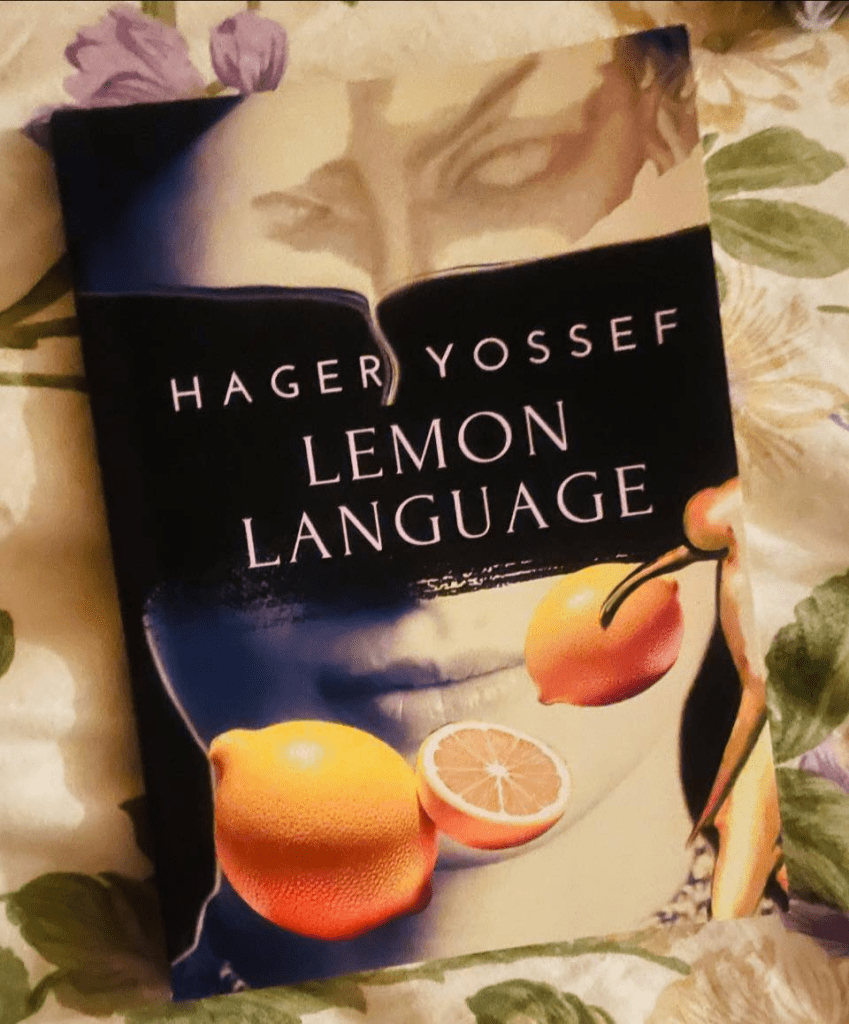
Lemon Language Paperback – November 22, 2024
by Hager Yossef

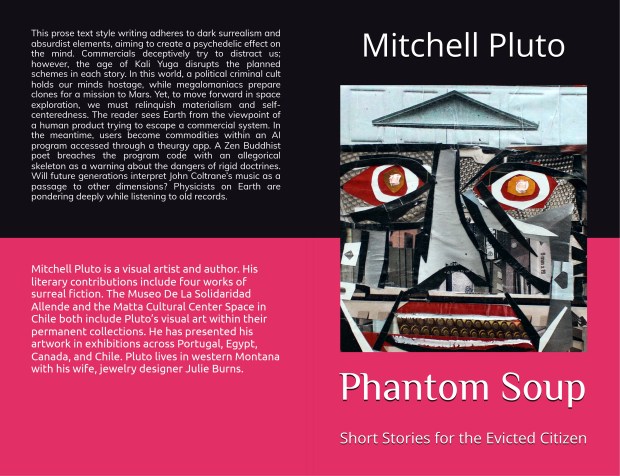
Phantom Soup: Short Stories for the Evicted Citizen

To write something and leave it behind us,
It is but a dream.
When we awake we know
There is not even anyone to read it.

The 8th day of the 4th month, the 3rd year of Kōshō (1457)
Ikkyū-shi Sōjun

Ghost Ride

Phantom Soup © Mitchell Pluto 2025

Accessible for reading.

All rights reserved. Permission grants brief quotations embodied in critical reviews and certain other non-commercial uses permitted by copyright law.

In case you overlooked it, this universe wasn’t lacking in ambition or size.
It was putting on a spectacle with its production.
The cosmos is just incredible; even haters gotta admit it’s breathtaking.
Zanni, the defendant, is still waiting for a verdict.
In space, sentences float around and words drift apart.
His black and white checkerboard suit embodied the polarities of opposites.
He is a man without a country.
A joker in a deck of cards.
Through gestures alone, Zanni attempted to decipher the universe’s communication.
There was drama everywhere, but Zanni just didn’t understand how it worked or how it occurred.
No one ever knew the truth; it died with them, leaving only unanswered questions.
Everyone figured the headache meant they knew what the problem was.
Less pain means clearer perception and a more optimistic outlook.
Honestly, it wasn’t a matter of right and wrong.
Or pain or pleasure.
It dealt with items of worth later becoming trash.
You could tell what things meant to people by how often they handled them.
It’s a space ballad playing both life and death.
No one will sing the sad cowboy songs of unrealized dreams anymore.
It’s alright.
We are part of a sombrero galaxy, a galaxy that is an eternal sunrise.
Zanni was in a giant empty room with waves of random stuff.
His world symbolized a particular responsibility of being.
Special car keys for a 2025 model, a mobile wallet, a decorative cup, a gold pen, a seasonal tire, headphones from 1979, crumpled up Kleenex, a 1990 professional styling brush and a flashlight from 1899.
These objects surrounded Zanni.
Thankfully, a consumer digital camera from 1996 captured a pic of this.
But for who?
Regular waves swapped out old things for newer ones.
Zanni contemplated this event.
He figured the most likely explanation was that he was inside a massive vacuum cleaner.
He experienced a strong connection to things he saw on his trip.
Zanni speculated that the objects he couldn’t name were from a future timeline.
Things appear and vanished super fast out here.
Zanni drifted between sleep and wakefulness.
We can refer to it as a space fog in the mind.
A magnetic memory was his most beloved possession.
It echoed because Zanni repeated it.
He brought it back to mind in a re-run.
Zanni felt the luscious lips vibrate against his ear. It was a figurine of a woman.
Her name was Colombina.
The teal diamonds and magenta triangles on her dress flowed together to create a pattern of doves.
Hand in hand, they created poetry.
The rhythm of their partnership quivered in the shared space.
The couples’ bond created a constant interplay of elements through the intercourse of their geometric patterns.
Zanni maintained his embrace for as long as possible before the vacuum wave separated them.
He could not pinpoint the incident’s time without a clock.
The arrangement of numbers magically shapes the surrounding space. A regular watch shows what’s going on between the numbers.
Of all the puppets, did he alone ponder his whereabouts?
Only he understood his own thoughts and feelings.
Sometimes Zanni heard voices that didn’t belong to him.
Intrigued by the mysterious voice, he followed it.
The voice led him back to his body.
Those seizures and hallucinations gave epilepsy a mystical quality.
His memories of himself were likely because of thinking about Colombina.
He owned the moment, his own little universe, for a single second. Zanni saw himself as a buoy, helping other objects find their way.
But Pantalone, a hunchbacked old man, considered himself the universe’s ultimate authority.
He was a drifting turtleback tomb from another vacuum wave.
Pantalone preferred the nickname “god.”
His face twisted in anger as he guarded his belongings. Losing things got on his nerves. His tailored red suit reflected Pantalone’s importance.
Every item got a brand and price label from him. He believed he understood your true worth more than you did yourself. He used his talent to make you think whatever he wanted.
Those close to him risked having their self-image stolen and used against them.
Pantalone intended for everyone to rent from his cloud.
He lost money in the vacuum wave, then recovered his losses.
This activity provided him with enjoyment, a sentiment he wished to share. Provided that he had more.
Scattered dollar bills wandered everywhere.
The bills, by themselves in space, lacked any connections.
Now, Pantalone found himself surrounded by dancing product wrappers, toenail clippings, old grocery lists, damaged furniture, empty food containers, broken appliances, crumbled up receipts and dead batteries.
Think of it as a garbage cloud.
Several real estate agents, their eyes wide with nervous energy, tried to appear calm as they floated past Pantalone.
They pretended to own a spot by treading in one place.
While this was occurring, Harry Houdini sailed by and unlocked a satellite.
Intrigued by Pantalone’s possessiveness, Zanni examined the egocentric and deceitful nature of his own point of view.
He observed the ego’s memories fade as the mind surrendered its ownership.
Once the fear was gone, relief came.
Houdini cracked his knuckles. “No worries are necessary. Don’t sweat it. It is a simple lock to open. “
The hierarchy reflects the relationships between things in a chain.
An x-ray showed how brain waves link things up through information chains, like you see in neuron activation patterns.
This electromagnetic wave made Zanni wonder about the engineer of the universe.
It appeared the designer wrote a script for a big stage performance but remains anonymous.
In the meantime,
Pantalone reached his own planet.

Phantom Soup: Short Stories for the Evicted Citizen Paperback

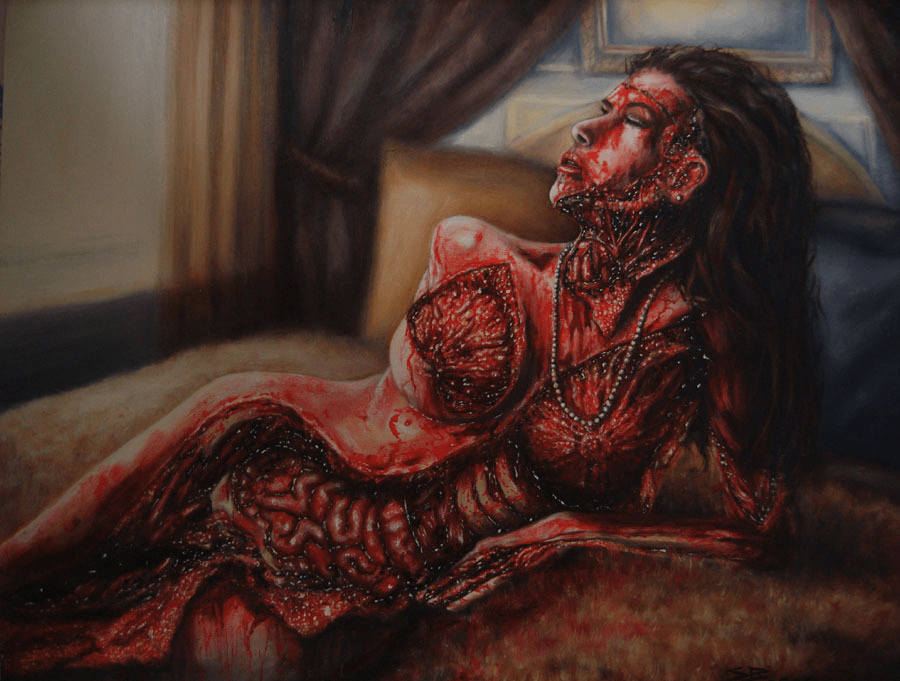
Art by Suzzan Blac: Inside Out

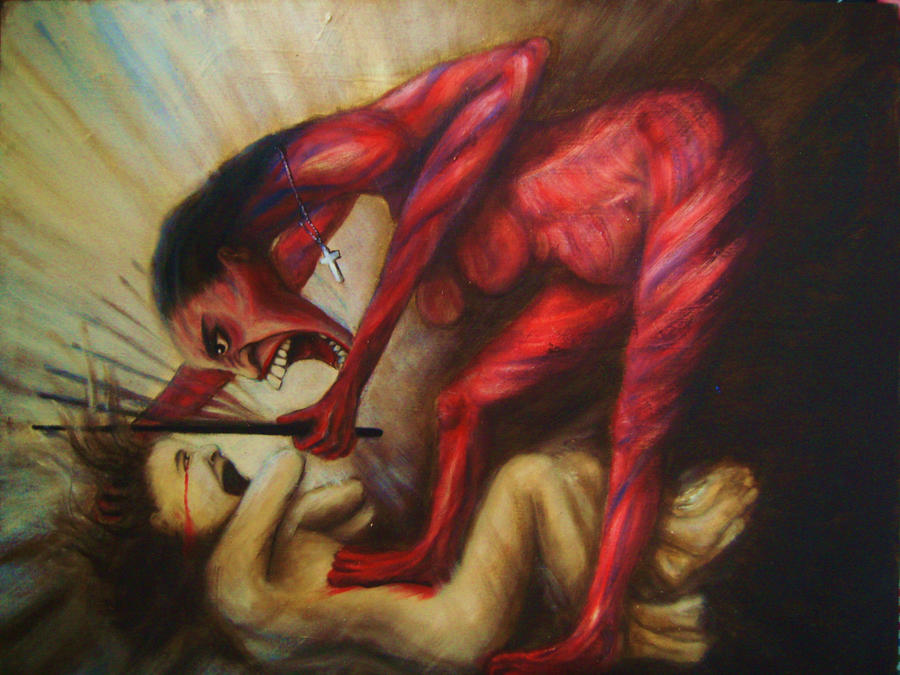
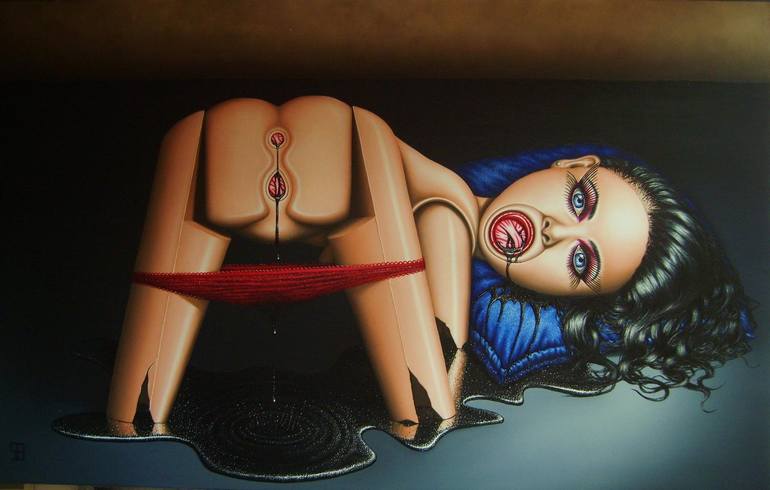
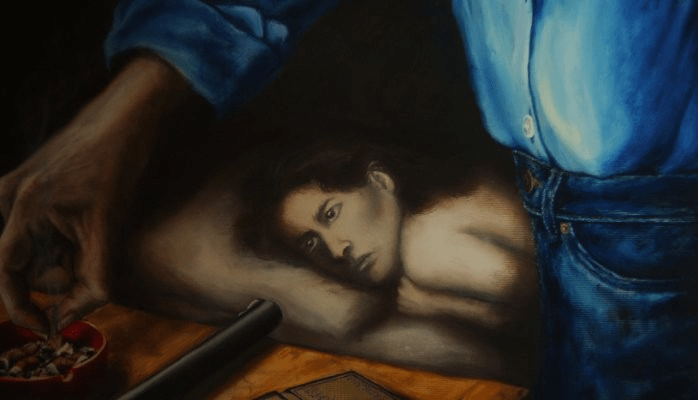
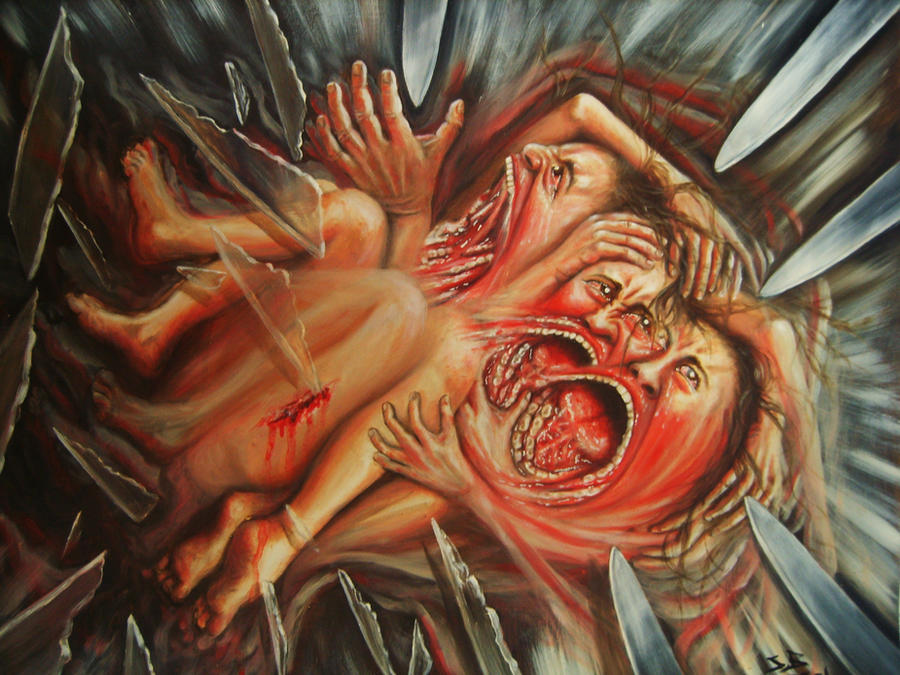
To present a well-rounded viewpoint, it’s crucial for me to feature a female artist who actively advocates for the well-being of both children and adults. I am describing someone who fights tirelessly against child exploitation and human trafficking. It is necessary to mention that there are painful sexual encounters. The focus of this article is not on fantasy, but on deep contemplation of the harsh realities surrounding sexual assault. It describes the experience of one artist who overcame incredible odds and survived.

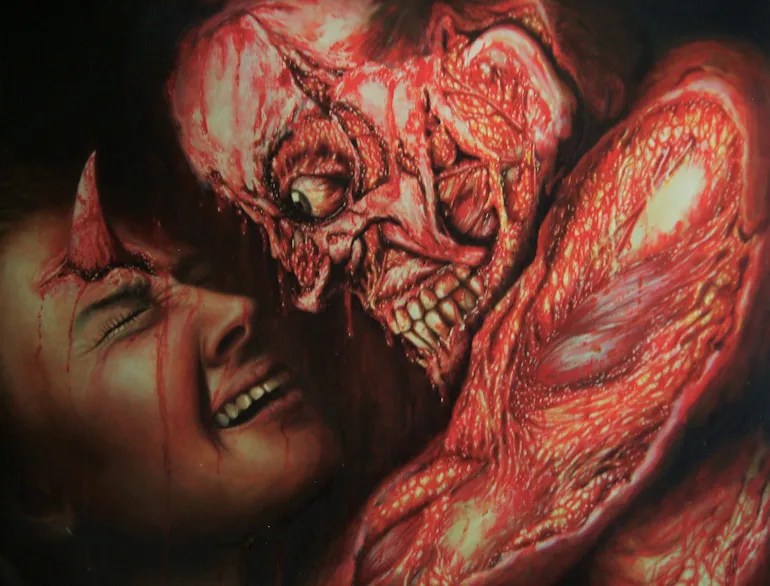
Suzzan Blac was born in Birmingham, UK in 1960. Her oil paintings and writing reflect her personal experiences with physical, mental, and sexual abuse. Blac’s artistic purpose is to shake society out of apathy and educate those who perpetrate secondary victimization, which can be equally distressing as the abuse. Suzzan’s work serves as a source of inspiration in group therapy for victims of abuse. Her work revolves around creating educational programs that encourage greater understanding.

Blac turned to painting between 2000 and 2004 to process her pain, anger, and trauma from the abuse she experienced. In order to tap into her subconscious, she started by doodling while watching TV, recognizing that these drawings had to originate from a place deep within herself rather than her conscious thoughts. After creating the drawings, she skillfully transformed them into realistic paintings that depicted both the victim and the perpetrators. Despite feeling unsettled by her paintings, she understood that they honestly portrayed her innermost pain that required healing. For four years, she dedicated herself to painting forty images, which she carefully kept hidden for over a decade, fully aware that sharing them would cause harsh judgment. It was in 2011 when she made the bold decision to share her most challenging work with the world by putting it online. Blac found it necessary to use her artistic abilities as a platform for speaking out and advocating for her beliefs. There were many people who said hurtful things to her. However, she also received gratitude from countless survivors who felt empowered to speak up because of her.

Blac’s work is challenging to look at. It invites the viewer to contemplate and empathize with situations involving sexual violence as a victim. In her own description, she compares rape to a type of murder in which the victim does not lose their life. Blac renders and illustrates emotions in a horrific way. She blends figuration with an eerie, surreal style. In her painting, she frequently uses an effect where the figures appear malleable under the influence of a predatory force. Dolls are frequently used to represent figures. The combination of these elements makes a significant and lingering impression on anyone who sees them. Her paintings hold viewers hostage and give them an intimate feeling of her experience.

The scenes in Blac’s work are terrifying, creating the ultimate experience of body horror and disassociation. Her artwork also serves as a healing remedy for emotional trauma, as well as a catalyst for memories of sexual abuse survivors. One could hypothesize that Blac’s neuroaesthetics might have an influence on the hippocampus, the area of the brain that plays a crucial role in managing the experiencing self and the remembering self.

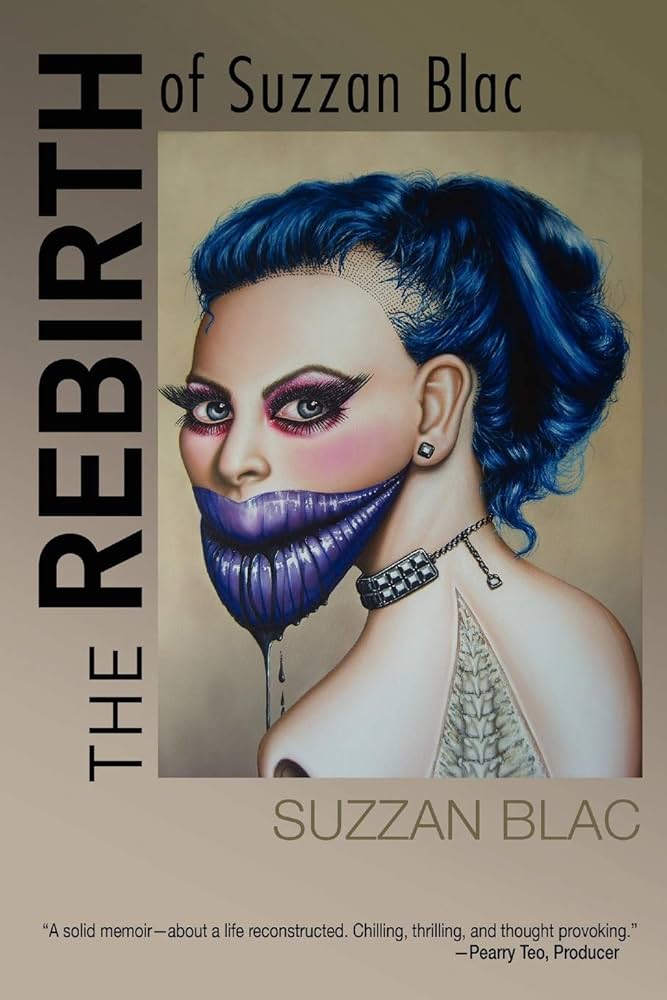
Before reading her book, The Rebirth of Suzzan Blac, I was familiar with Suzzan’s remarkable talent for painting, but unaware of her story. I won’t reveal too much about the book, but I can give you a general concept. Blac was a prisoner, enduring unimaginable exploitation in the sex trade. These events occurred when she was still a teenager. The book is candid, and Blac’s narrative has a genuine and tender tone. Although the subject was difficult, the book had a natural and easy-to-read style that leads the reader into a world filled with the most cruel human conditions one can imagine. Blac’s book is incredibly uplifting and positive. Her dedication to addressing sexual abuse issues is evident in her continuous efforts to use art as a medium for awareness.

Written by Mitchell Pluto

Exploring Tissues, Works by Rebecca Campeau

Ma petite histoire sans fin !
Passionnée depuis toujours par divers les matériaux et aillant une grande prédilection pour les tissus !


J’ai commencé à travailler au Journal ELLE, Jardin des Modes,100 IDEES,Jours de France, Journal Femme, et autres journaux comme rédactrice de mode, parallèlement j’ai aussi commencé à travailler comme styliste en publicité ,pour de grandes agences de Publicite :Hélène Rubinstein, Danone, Kodak ,Nazareno Gabrielli-Milan/ORO BLEUE-Milan.

De 1970 à 80 avec le photographe Frank Horvat, j’ai réalisé seule le livre-Vraisemblances- 50 costumes, fonds photo teintures, peintures, bijoux et stylisme.
J’ai aussi participé au choix des photos.

J’ai aussi réalisé quelques décorations d’intérieur d’apres mes dessins pour certaines actrices de cinéma.

Puis j’ai commencé à faire des costumes pour le théâtre notamment pour les Colombaioni à l’Olympia,cinema etc…

Suite à la rencontre avec Giancarlo Petrolati, décorateur avec lequel nous avons monte

  • l’Atelier des 3 Coups- pandant 40 ans
    Nous avons travaillé pour l’UNESCO-Paris ainsi que pour divers musées dans le monde ! Japon, Portugal, Paris, Suisse, Belgique, Italie. En 1990 en collaboration avec et pour Claude Lévi-Strauss, j’ai réalisé des sculptures grandeur nature (indiens) en textile (3 tribus du Mato-Grosso-Brésil)
    pour l’exposition-Les Amériques de Claude Lévi-Trauss- au musée de l’homme Paris.

Puis pour Paul Emile-Victor en 1989 au musée de l’Homme Paris j’ai réalisé des Eskimos grandeur nature pour l’exposition -Eskimo-

Parallèlement j’ai toujours eu un travail personnel que j’ai exposé régulièrement dans les galeries, musées & salons .

Musée National de Norvège-exposition Louise Bourgeois-Oslo/Musée des Champs Libres-Rennes/musée Cérès Cérès Franco Montolieu/musée d’Art Brut-Montpellier/musée Villa Montebello.
musée Mona Bismarck-Paris/musée Mendjisky-Paris/Le FIAA-Le Mans/musée Cite du Train-Mulhouse/musée Toine Colot-Belgique/musée du Tunnel du Gothard-Suisse/musse du Plan incliné-Ronquieres-Belgique/musée de la mine-liège/musée de la Mine Bleue-Noyant-la-Gravoiere/musée Guerre et Paix-Ardennes/musée de la forêt-Renwez/musée de la carrière de pierre-Givet-France/musée Cristallerie Saint Louis-Saint-Louis-les Biche/Hôtel de Sully-Paris/Bibliothèque Bilipo-paris/musée Gustave Flaubert et de la Médecine-Rouen/The National Art Center-Tokyo/musée Bohin- Saint-Sulpice-Sur-Risle/musée des Beaux-Arts-Carcassonne/musée des Champs Libres-Rennes/Galerie Kiron-Paris/musée Mini Textile-Italie/Vibrations Textiles-Paris/musée de la photo-Paris/

Mes sculptures sont visibles
en permanence-au Musée d’Art Brut-Montpellier/musée Gustave Flaubert et de la médecine-Rouen/
Musée de l’Homme-Paris /Cite du train-Mulhouse/musée du plan incliné-conquières-Belgique/musée Arthur Masson-Belgique et…

Salons : Art Capital-Comparaisons-Paris/AAF-Paris/Figuration Critique-Paris/Salon d’Automne-Paris/Biennale 109-Paris/Salon des Beaux-Arts-Paris/Salon-XI’AN-Chine
Art Partage-Rives/Hors Normes-Praz-sur-Arly/Chic Art Fair-Paris/Aix-en-oeuvres à Aix-en-Provence organisé par Andréa Ferreol

Galeries: Edgard le Marchand-Paris/Beaubourg-Paris/Art-Top-Lille/Not a Gallery-Paris/Galerie75-Rouen/l’Ecu de France-Viroflay/Chez Colette-Paris/Cécile Dufay-Paris/ST’ART-Paris/Espace Aliès Guinard-Chaillon/ l’oeil de la Femme à Barbe-Paris/Artcompulssion-Montpellier/Artistes Actuels-Paris/Collection Gallery-Chypre/

PRIX Jean Anouilh 2019/
PRIX Taylor 2021/PRIX Attention 2022 / PRIX Bohin 2023.
rebecca-campeau@hotmail.fr
http://www.rebecca-campeau.com