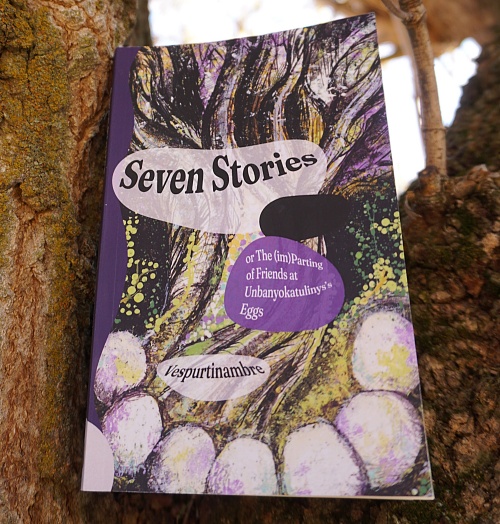
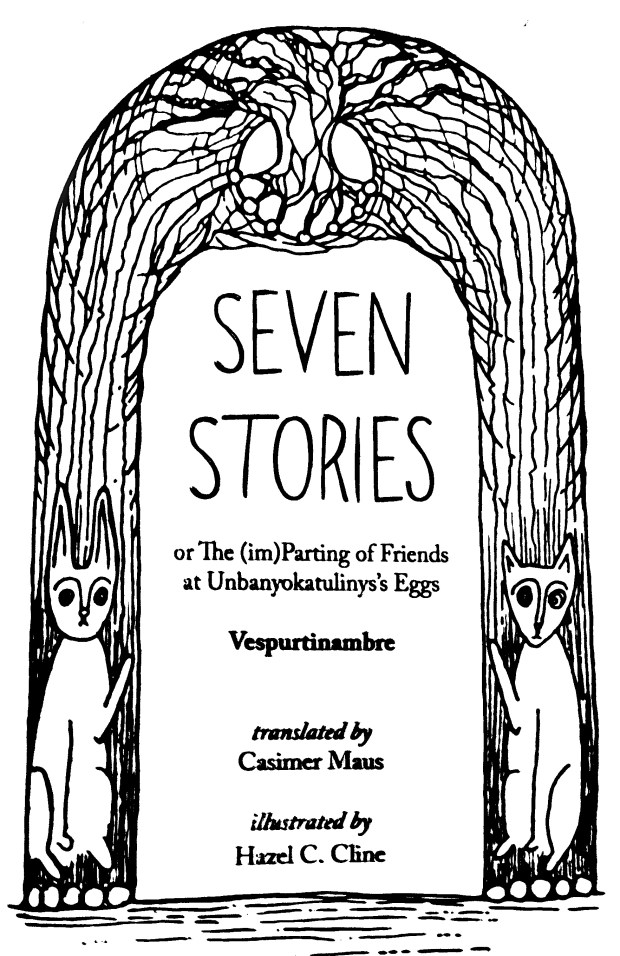
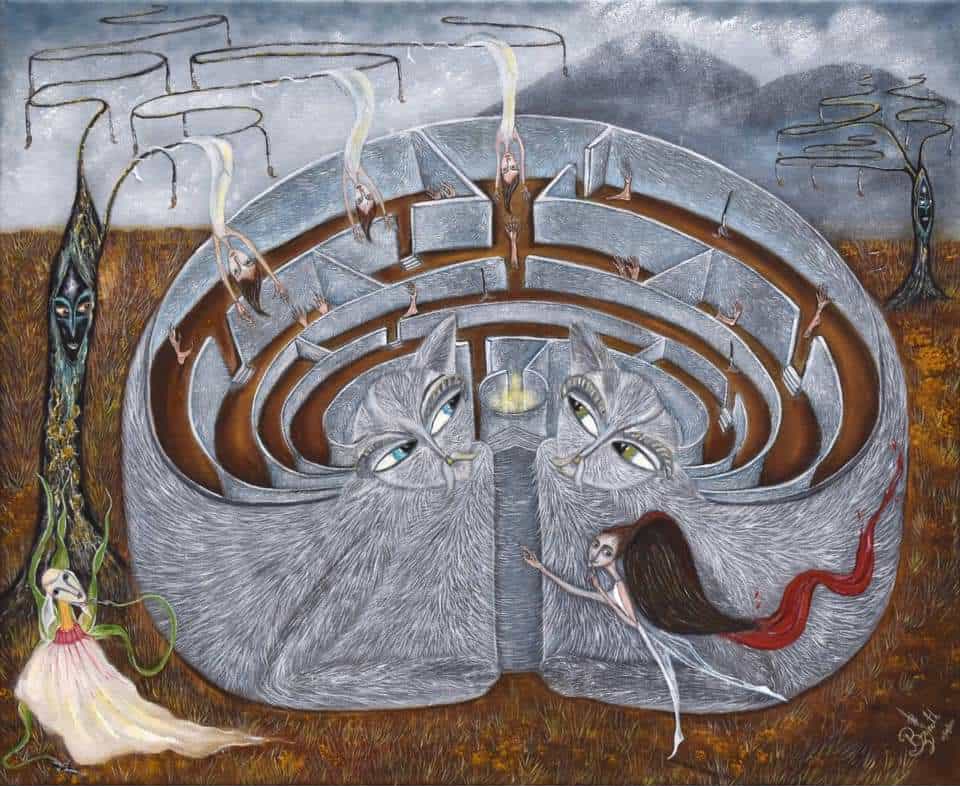
Seven Stories or the (im) Parting of Friends at Unbanyokatulinys’s Eggs

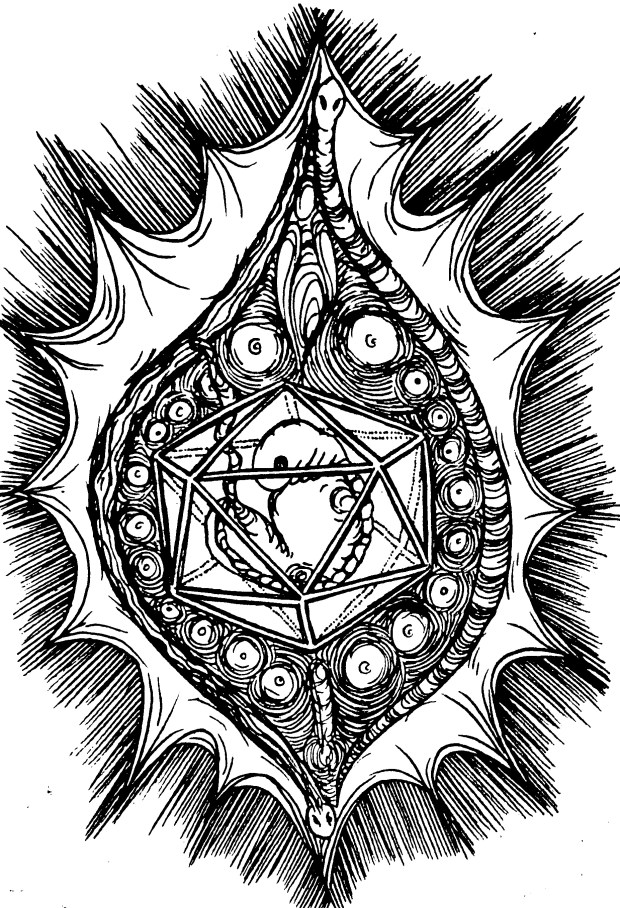
In Seven Stories or the (im) Parting of Friends at Unbanyokatulinys’s Eggs, readers are first immersed in a neurological realm, seen through the eyes of a relative of Casimer Maus. Maus, a German linguist, stumbles upon a new language during her vacation when she gets lost in Luweng Jaran, a cave in Indonesia. While in the cave, Maus found a chamber archway with engravings she copied.

This unfamiliar language triggers a significant internal shift in her life. For the next decade, Maus studied the visual representation of circular connections and a sentence structure that bloomed outward in a spiral. She called the new language Lingkaran.

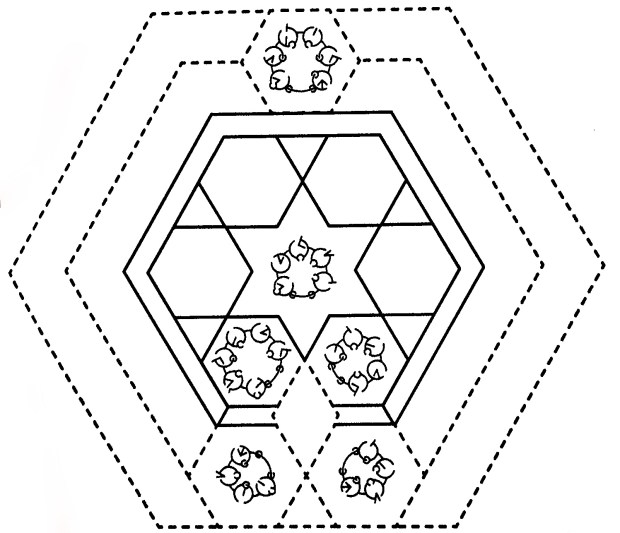
She planned to announce her discovery to the world, beginning with the Deutsch Linguistic Society. However, her peers proved unwilling to accept the strange occurrences that arose from deciphering the language. Readers are first introduced to Casimer Maus’s discoveries through a heptagram that positions an archetypal animal at each point. These animals gather near a growing tree, seeking truth in contradictions, as they aim to comprehend the world’s interconnectedness (the world womb) from its very beginning.

Through speculative surreal fiction, Casi (Hazel) Cline develops her own theogony and original mythology. Seven Stories shares some common ground with James Joyce’s Finnegans Wake; however, it presents a more approachable examination of metacognitive ideas, clarifying the archetypal patterns of the collective unconscious with animal totems.

Hazel Casimer Cline is a nonbinary writer and witch based in Atlanta, where they live with their partner, Steven, and their cats. They have been involved in both local and international Surrealist communities. Hazel served as an editor of Peculiar Mormyrid Journal for nearly ten years and participated in the Atlanta Surrealist Group, which met regularly for several years. They have co-organized three Surrealist exhibitions in Atlanta and Birmingham, Alabama. Currently, Hazel is focusing on their writing. They also work with film, experimental music, and visual art, including collage, drawing, and painting. https://ephemeralityart.com/

Steven Cline is based in Atlanta and has been involved in surrealist activity for the past decade, including Peculiar Mormyrid Journal and the Atlanta Surrealist Group. He has co-organized exhibitions in Atlanta and Birmingham and has participated in others in Paris. His first book of fiction, Planetoid Sassafras, was published by Montag Press under the name Stephanie Klein. A subsequent book of surrealist nonfiction, AMOK, was published by Trapart Press. https://stevenclineart.com/ 

Atlanta Surrealist page: https://atlantasurrealistgroup.com/

https://blackglovepress.com/

Egregore book: https://issuu.com/sjcline87/docs/digital-compressed

ジオマンティックナイト

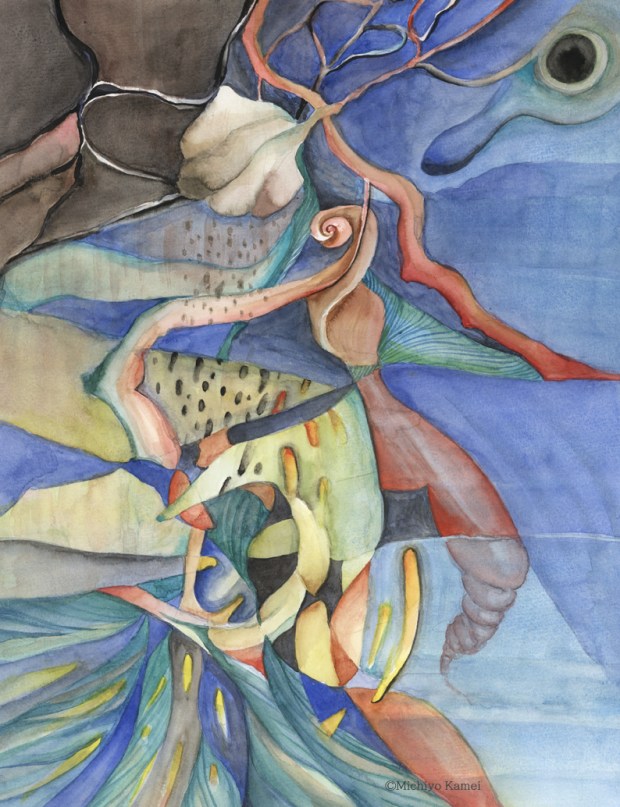
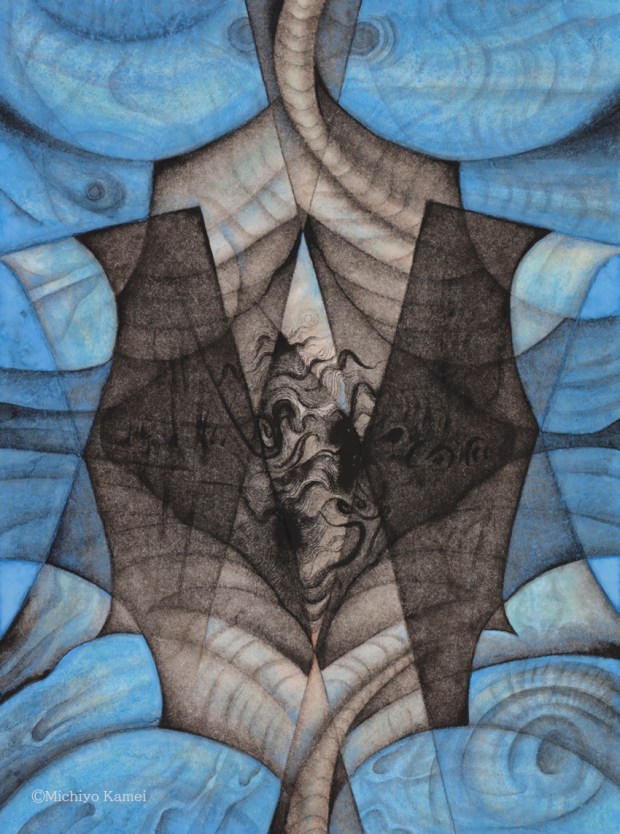
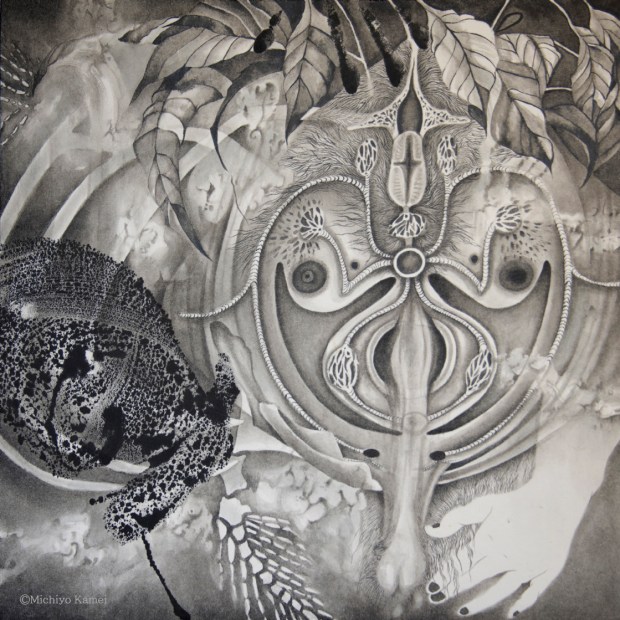
Art/Illustrations by Michiyo Kamei

Written by Mitchell Pluto from Occultations: Lullabies for Space Travel


平行線が交差し、中央にダイヤモンドを形成する。
II は今
この形は、私たちが空間を斜めに旅することを可能にする。
このような旅には、占いと形を変える力が必要だ。

私は三角波を吸収した。
魚座の月の下で、カップから一口飲んだ。
360 度のほんの一部
水瓶座、カヤエイ、そして水運び人がライブ演奏をしている。
月に乾杯しよう。これは昔ながらの神託だ。
シンセコンソールのジオマンティックナイトを使って、
チェス盤上の中央の正方形をピラミッドにねじり、
周囲の空間を曲げる。
存在の8つの段階から64人のヨギーニが
意識と消滅を表す宇宙のタペストリーを創り出す。

チェック柄の盤を通して、私たちは
自分の内面の状態のチャートを探求することができる。
絡み合った白黒の四角形は陰陽を表しています。
この視覚的な図は、異なる時間軸における出来事を分析し、解釈する力を持っています。
私たちは繋がっています。
手、爪、ひれ、蹄、翼、触手が一つになって、異国の地への休暇に出かけます。
様々な形に変身することで、私たちは繁栄し、食べ、繁殖するための新しい場所を発見しようと
計画しています。
私たちの新婚旅行は今、素晴らしいです。
研ぎ澄まされた感覚が完璧な調和で働いています。
それぞれの視覚は、この虚空に漂うあらゆる物体を検知するための貴重な資産です。
アプリはヘビの瞳孔を模倣し、猫の目は夜間視力を向上させます。

そのアプリで何も見つからなければ、コウモリ信号を発して、見落としたものを特定します。
退屈しのぎに、昔ながらのクジラの歌を聴きます。
宇宙には、目に見えない電波が入り込む余地がたっぷりあります。無意識の変化が私たちの意識
にどのような影響を与えるかに気づきます。
虚栄心を捨てることは、宇宙飛行士として私にとって最も困難な挑戦でした。
消費主義から解放されたことで、自尊心が向上しました。
私たちは、数字を持たずに仏教を実践します。
荷電粒子が宇宙に消えていくことを「死」と呼びます。
数字は永遠なので、どれだけ長く覚えていられるか試してみます。
私は、アップデート前に話した言葉を主張するために、自我の中から前に出てきました。
これは幻覚の声です。
真の自己は存在しないことを理解していますが、私たちは常に自分自身を拡張し続けています。

より良い幸福のために、私たちは過去のプログラムを放棄しています。
それは私たちの進歩を遅らせていました。
現在の話し手は、もうすぐ話を終えます。
目的地に到着したら、私たちは円陣を離れるつもりです。
このストーリーラインはデジャブを引き起こし、レプリカにとって記憶に残る心象を作り出すで
しょう。

Michiyo Kamei Site

Geomantic Knight

Parallel lines intersect, forming a diamond at the center.
II is now X.
This form lets us travel diagonally through space.
One needs divination and shapeshifting for this kind of
journey.
I absorbed a triangular wave.
Under the Pisces moon, I sipped from the cup.
A tiny fraction of 360
Aquarius, a Kayayei, and the water porter, is playing live.
Let’s toast to the lunar. It’s an old-time oracle.
I use my geomantic knight on the synth console to twist
the central square into a pyramid on the chessboard,
bending the surrounding space.
The sixty-four Yoginis from the eight phases of existence
create a cosmic tapestry that illustrates awareness and
extinction.

Through the checkered board, we can explore a chart of
our interior states.
Intertwined black and white squares represent yin and
yang.
This visual diagram has the ability to analyze and interpret
events from different time spans.
We are connecting.
As a hand, claw, fin, hoof, wing, and tentacle united on a
holiday to a foreign atmosphere.
By being able to transform into different shapes, we plan
to discover a new place to thrive, eat, and reproduce.
Our honeymoon is amazing at the moment.
With heightened senses working in perfect harmony.
Each optical sense is a precious asset to detect whatever
objects may be drifting in this void.
Apps mimic snake pupils and cat eyes enhance night
vision.

If we find nothing on that app, we activate a bat signal to
identify what we overlooked.
To combat boredom, we listen to the old fashion whale
songs.
There is plenty of room in the universe for invisible radio
waves.
We notice how unconscious shifts affect our awareness.
Giving up vanity was my toughest astronaut challenge.
Self-esteem improved by breaking free from consumerism.
We practice Buddhism without a figure.
The fading of charged particles into space is called “death”.
Numbers are eternal, so we will test how long we can
remember them.
I am coming forward from within my ego to assert the
words that I have spoken before the update.
This is a hallucinatory voice.
We get it, there’s no true self, but we are always expanding
who we are.

For better well being, we are abandoning past programs
that slowed our progress.
The current speaker is about to stop speaking.
Once we reach our destination, we intend to leave a circle.
This storyline will trigger déjà vu and create a memorable
mental image for the replicas.

The Origin of the Universe: The Wildness of Point Zero
Michiyo Kamei Exhibition Art Gallery Shop

Palimpsest of Phantasm: An imaginary art garden
Vol. 1 Michiyo Kamei

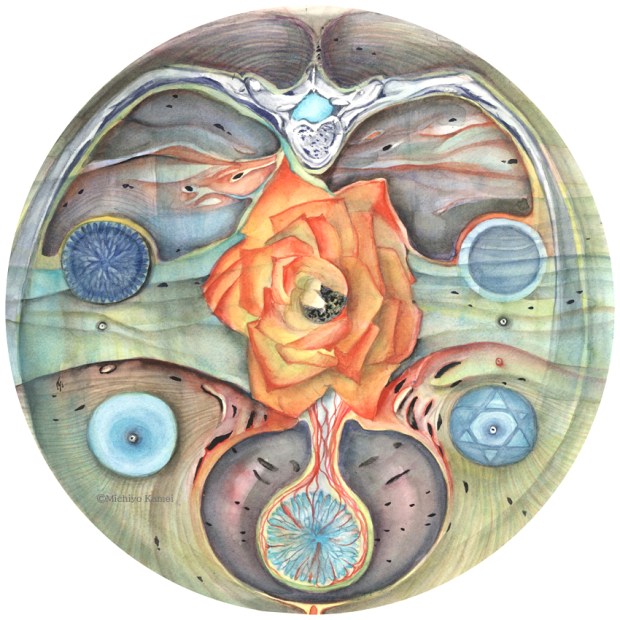
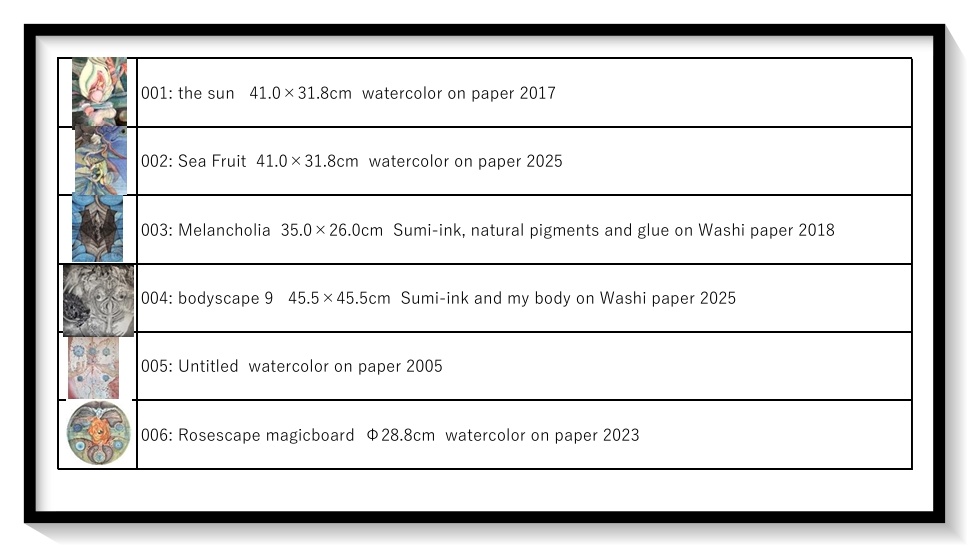
001: the sun 41.0×31.8cm watercolor on paper 2017 
002: Sea Fruit 41.0×31.8cm watercolor on paper 2025 
003: Melancholia 35.0×26.0cm Sumi-ink, natural pigments and glue on Washi paper 2018
004: bodyscape 9 45.5×45.5cm Sumi-ink and my body on Washi paper 2025
005: Untitled watercolor on paper 2005 
006: Rosescape magicboard Φ28.8cm watercolor on paper 2023 

001: 太陽 41.0×31.8cm 水彩、洋紙 2017 
002: 海の実 41.0×31.8cm 水彩、洋紙 2025 
003: メランコリア 35.0×26.0cm 墨、岩絵の具、膠、和紙 2018
004: bodyscape 9 45.5×45.5cm 墨、身体、和紙 2025
005: 無題 水彩、洋紙 2005 
006: 薔薇景魔法盤 直径28.8cm 水彩、洋紙 2023 

ALL RIGHTS RESERVED. ARTWORK IN THIS POST IS A COPYRIGHT OF MICHIYO KAMEI. THIS AN AUTHORIZED PUBLICATION WITH PERMISSION AND EXPRESSED CONSENT.

Six Erotic Artists

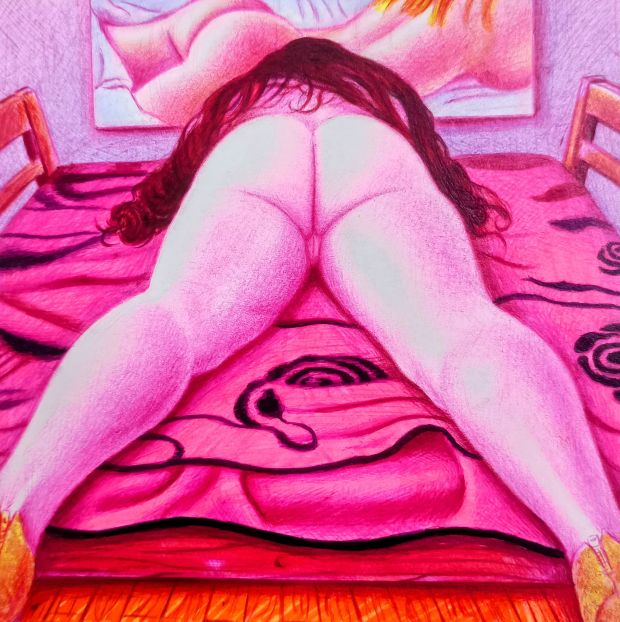
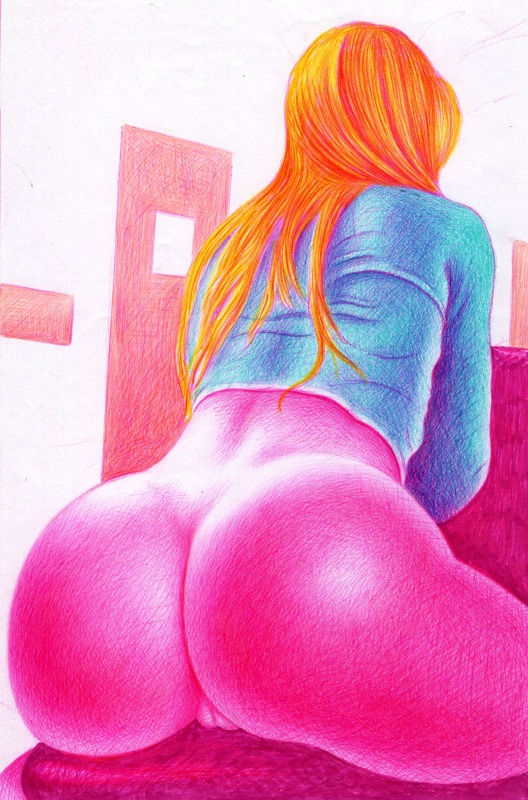
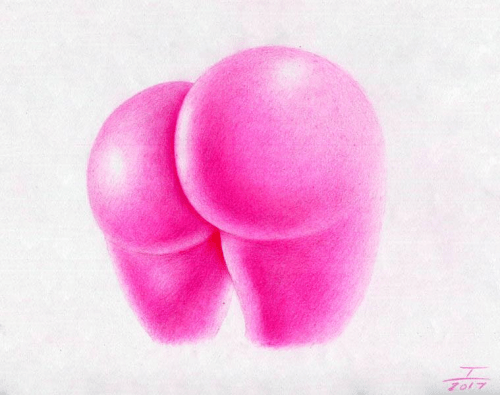
Neon Bubble Butt. JC Bravo 2017, Mitchell Pluto Collection

JC Bravo

My favorite Bravo pink pen drawing is the 2017 Neon Bubble Butt. I find it enjoyable because the curvy female buttocks are a universal icon of beauty and perfection. It’s a fixed shape drifting in space. Just as helium makes things float and feel light, the drawing has a whimsical, festive quality to it. This drawing makes me think of how ideas can lift your spirits.

Juan Carlos Bravo, a Miami artist, is all about sensuality in his art. Miami is a melting pot of cultures, fashion, and the adult film industry. The sensuality in Bravo’s art makes it a favorite among collectors. He paints voluptuous women who embody an ageless ideal of sex appeal.

Surrealism, body horror, and pop culture blend to create the world of Bravo’s women. His art inspires viewers to examine their own primal instincts and their significance.

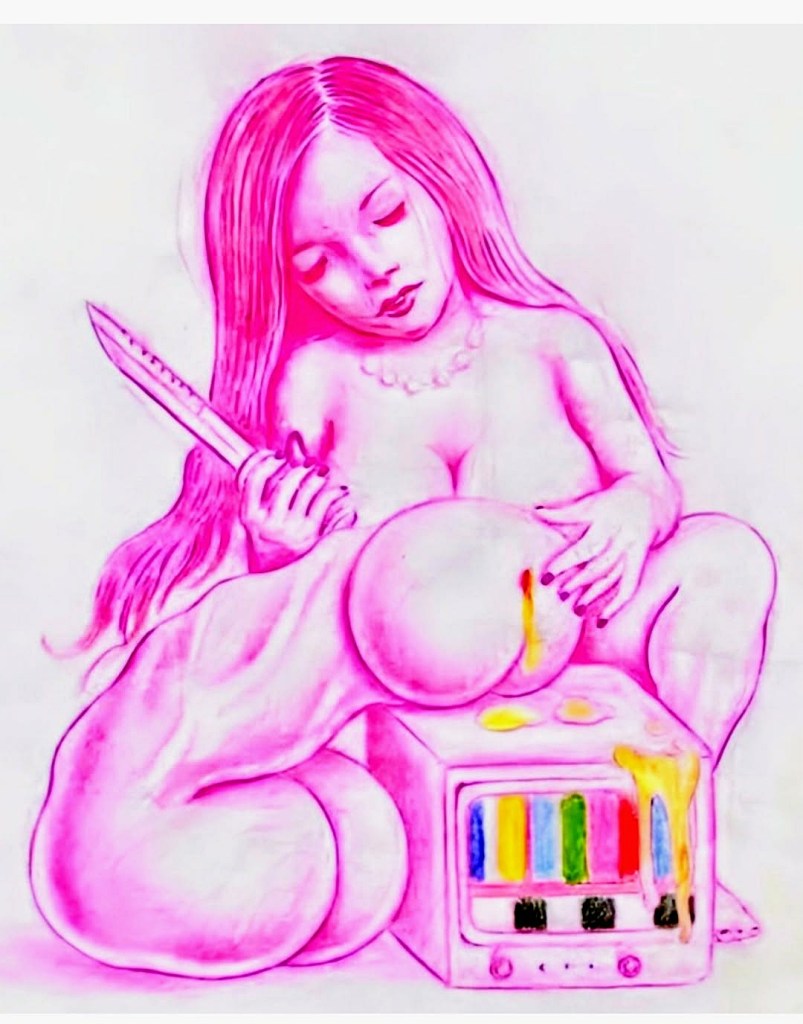
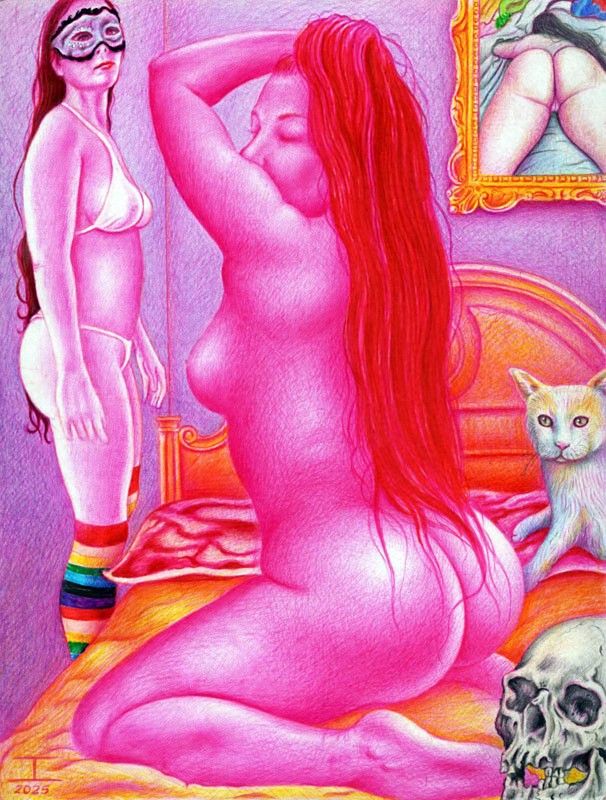
“GLORIOUS” (2025) JC Bravo

In this intimate scaled ballpoint pen drawing, I return once more to the private theater of the bedroom, a liminal space where desire, memory, and mortality quietly collide.

At the center kneels a voluptuous woman, her impossibly long red hair spilling like wine across her body, an oneiric cascade that measures both time and temptation. She raises her arms in a gesture of languid surrender, unaware, or perhaps deliberately unseeing, the woman wearing a jeweled Mardi Gras mask that transforms her into a carnival Venus. Thigh-high stockings, striped in defiant rainbow colors, root her to the earthly even as the rest of her body dissolves into roseate light. On the bed beside her, a cat and perennial guardian spirit, sits in calm, wide-eyed judgment, the only creature in the room who truly sees everything.

Above them hangs a gold framed erotic painting, its subject bent in mirror-image submission, a quiet reminder that every act of looking is also an act of being looked at. And in the lower right corner, half-hidden beneath the sheets, grins a human skull, my memento mori. It is not a threat but an invitation: remember that you will die, so love fiercely, look shamelessly, touch without apology while flesh is still warm and hair still grows.

The entire scene is drenched in an artificial pink and magenta glow, the color of stage lights, fever dreams, and cheap motel neon, a hue that makes the skin feel simultaneously hyperreal and hallucinatory. Through this saturated lens, the everyday becomes ritual, the intimate becomes mythic, and a simple moment of morning undress is revealed as a dance on the edge of oblivion.

-JC Bravo

The Eternal Zaftig, Pink Ball Point Drawings of JC Bravo https://shungagallery.com/jc-bravo-art/

Bravo paints the human body with anatomical precision. He features both realistic bodies and integrates stylistic elements reflecting augmentation. Technical detail is a priority in his work. He’s passionate about oil painting and uses a pink pen for his drawings.

Philip Henderson

Tyra Philip Henderson

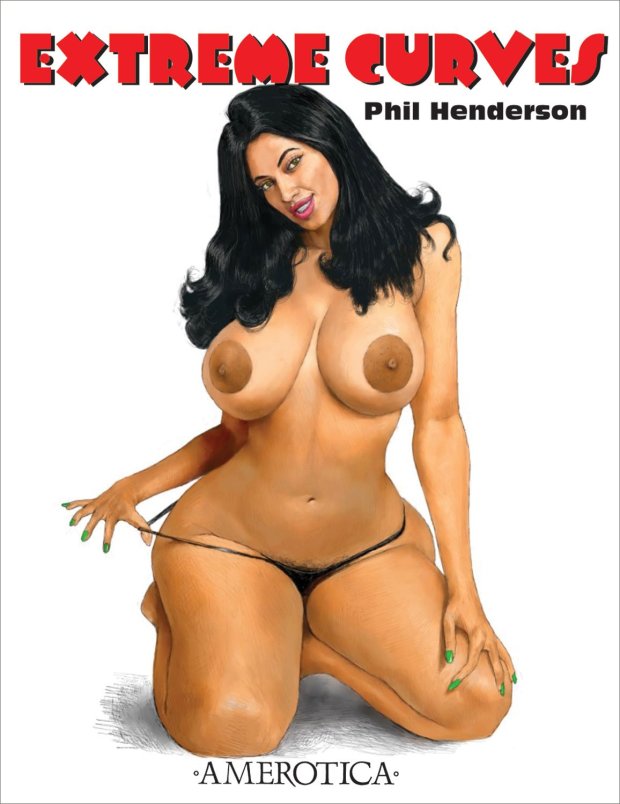
Among Henderson’s many drawings, I like Tyra the best. The figure’s eyes hold my attention. I think she saw me looking at her hand. I can tell she’s aware of my attraction through her gaze. The outline of her body forms a simple path, gently sloping from breast to thigh. Her hair almost blends with her pubic hair, but a delicate crescent shape separates them above the mons pubis. Tyra’s arm movement guide your eyes across her body. In Henderson’s artwork, eye contact and pose combine to create a feeling of empathetic sex appeal.

Big Beautiful Women, The Phat Art of Philip Henderson https://shungagallery.com/philip-henderson-fat-girls/

Curvy fetishes play a significant role in the themes of Philip Henderson. His plush illustrations create an arresting experience for the viewer. Henderson celebrates the value of curvy women. Henderson’s book, “Extreme Curves and Phat Girls”, achieved international success.

Besides his erotic illustrations, Henderson is a gifted writer of essays, novels, and poetry. He achieves elegance through his scholarly, artistic style. Henderson avoids abstraction in his anatomical figures while blending idealism and realism, creating a believable fantasy. He portrays natural grace and confidence in his figures, excluding any cosmetic enhancements.

Angélique Danielle Bègue

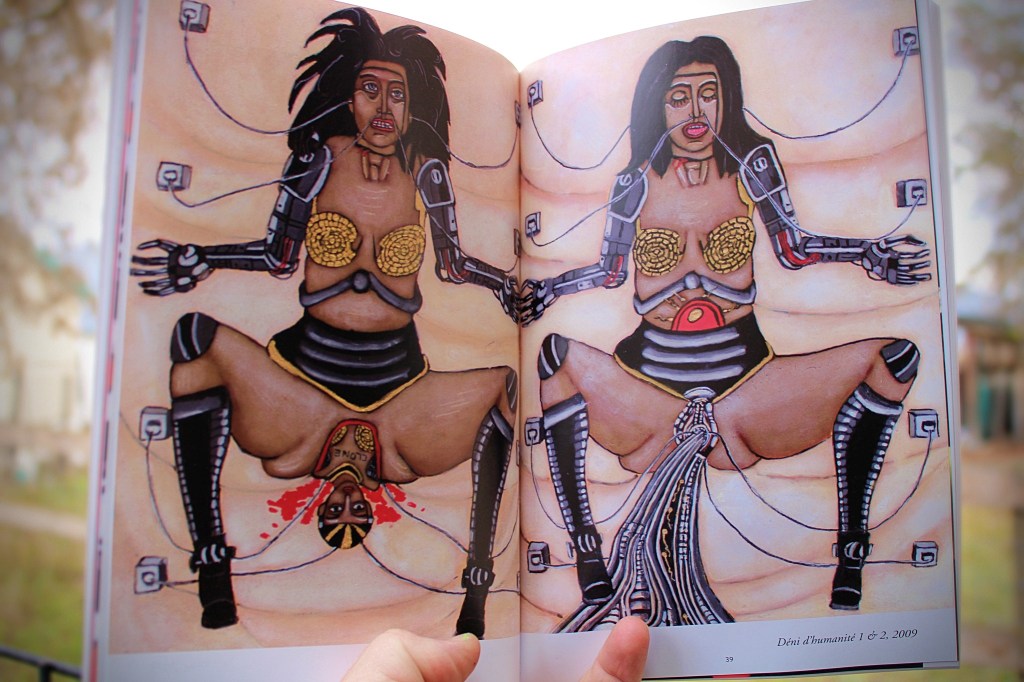
Deni d’humanité, published in Angélique Danielle Bègue‘s 2009 book, Dans Mon Corps.

Bègue’s 2009 work, Dans Mon Corps, includes “Deni d’humanité,” a piece with a prophetic theme. In the image, AI’s exploitation disrupts the natural flow with sexual intrusion. This image illustrates AI replicating itself using humans. Her art shows how the excitement around AI is really just more of the same old ways of controlling us. Bègue’s work examines the way narrative influences our understanding of what’s real and imagined. I appreciate looking at this image because it makes me question the idea of human originality and imitation.

Ghosts From the Id: The Art of Angélique Bègue https://shungagallery.com/angelique-begue/

French painter Angélique Danielle Bègue’s artistic career started with tempera, apprenticed at Gorze Priory by an Orthodox nun. A classic style is the vehicle for Bègue’s modern concepts. France acknowledges her contribution to the revival of tempera painting. Bègue’s professional experience includes erotic modeling.

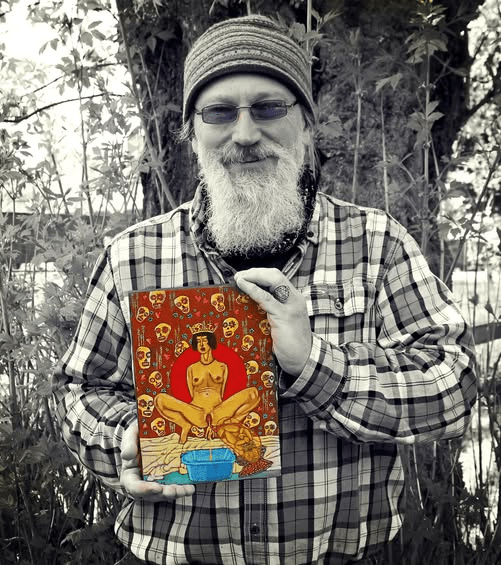
An icon painting from my dear friend Angélique Danielle Bègue from France.

In her figurative art, Bègue merges a traditional religious style with contemporary themes. Her artwork uses vibrant tones, layers, and bold lines. Bègue’s iconic graphic design employs strategic contrasts to
create visual balance and proportion. She uses painting to express her internal fantasies. Bègue dedicates herself to understanding sexual fantasies and how to approach topics society deems taboo.

Miriam Cahn

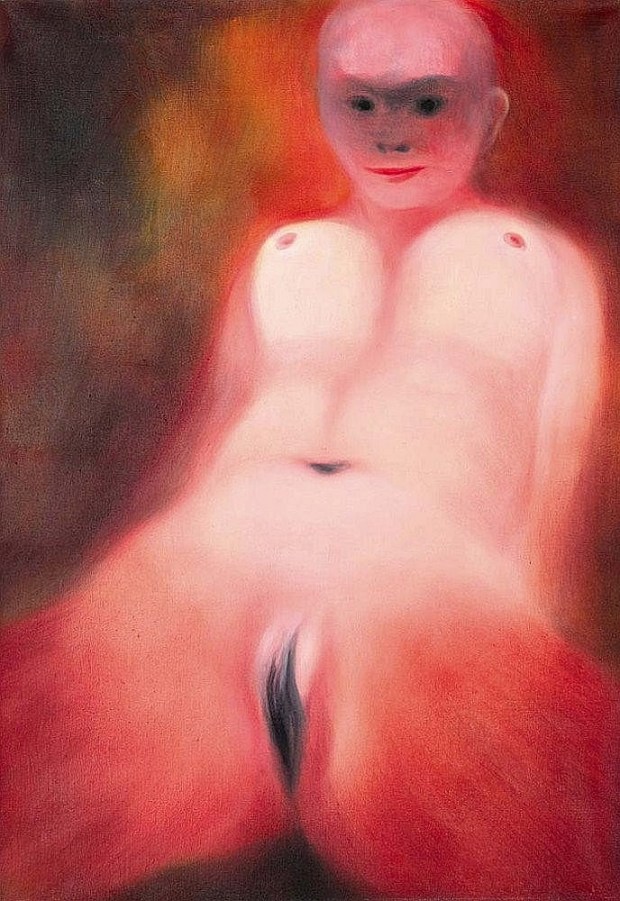
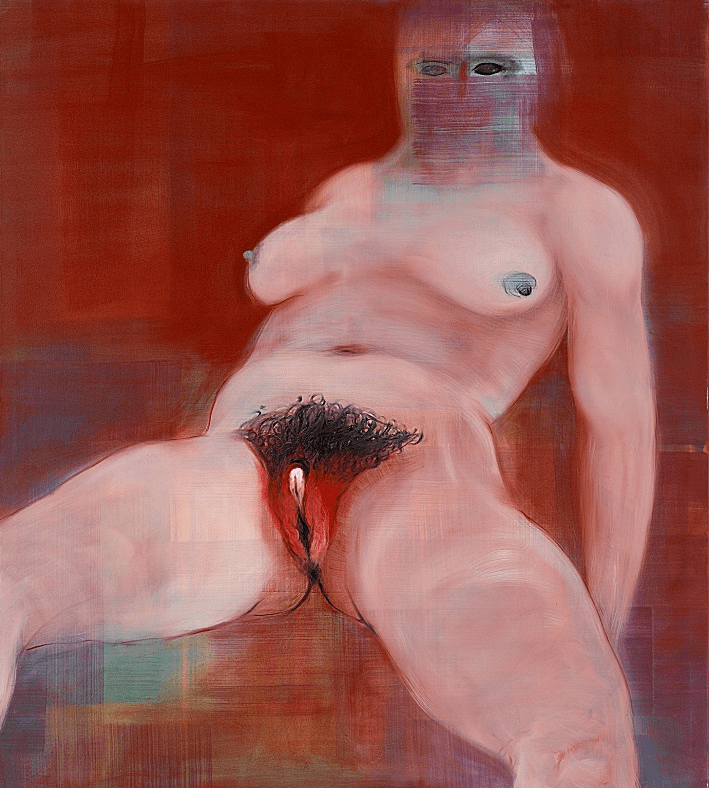
Äffin Miriam Cahn

Äffin’s unsettling nature is thought-provoking to me. Simian aspects of the image contribute to its dreamlike quality while exposing a liminal personality. The skin is smooth around the breasts but gets hairier and tactile near the pelvis. The vulva is a fiery bush, sparking primal metaphors. This work compels me to explore the roots of human consciousness and how language shapes our understanding, including our desires. It suggests to me that the ideas of elegance and ugliness are mental constructs.
The intense emotion evoked by this painting stems from Cahn’s ability to communicate deep thought through candid visual images.

Swiss artist Miriam Cahn paints in a Neo-post-expressionist style. Her art reflects the movement’s style through her figures, colors, and emotional expression. Cahn’s work often features spectral figures with
watchful eyes. Viewers become the subjects of the gaze of the eyes in her paintings.

Cahn’s paintings are vibrant and full of bright pastel colors. She discovers new things about herself through painting. With raw concepts, she develops a visual vocabulary for emotions. Her paintings are unpolished and invite the viewer into a world that’s flawed.

Viktor Alexandrovich Lyapkalo

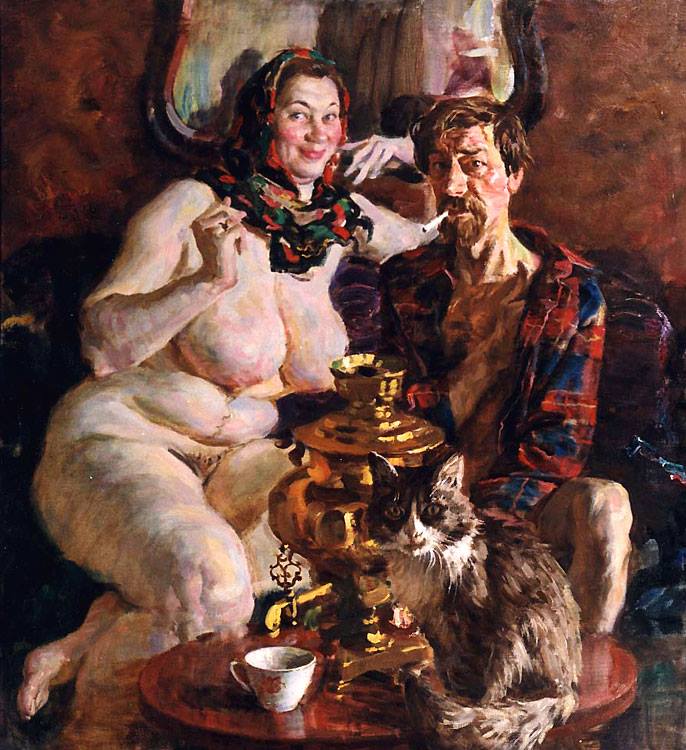
Viktor Lyapkalo

The reason I like Lyapkalo’s paintings is his choice of female subjects. It’s that simple. I’m attracted to curvy women, and his artwork features them. This painting captivates me in every way. The man, cat, and samovar create a muted, somber atmosphere, in contrast to the woman. Her lively body seems to glow with light and color. She’s appealing because of her open and generous nature, which brightens the room. Lyapkalo’s representation of the smile has a seductive effect on the viewer. The piece illustrates the duality of affection, showing both its open and concealed aspects.

Russian artist Viktor Lyapkalo paints in a strong social realist style. His paintings of women are sensual and playful. Lyapkalo’s skill with figures and academic paintings is the key to his success. His artwork portrays the emotion and character of the people he paints.


During my interview with Lyapkalo, he compared painting skin to an onion flower, highlighting its multi-hued nature. This is evident upon closer examination of the colors used in the artist’s depictions of nude women.

Pablo Picasso

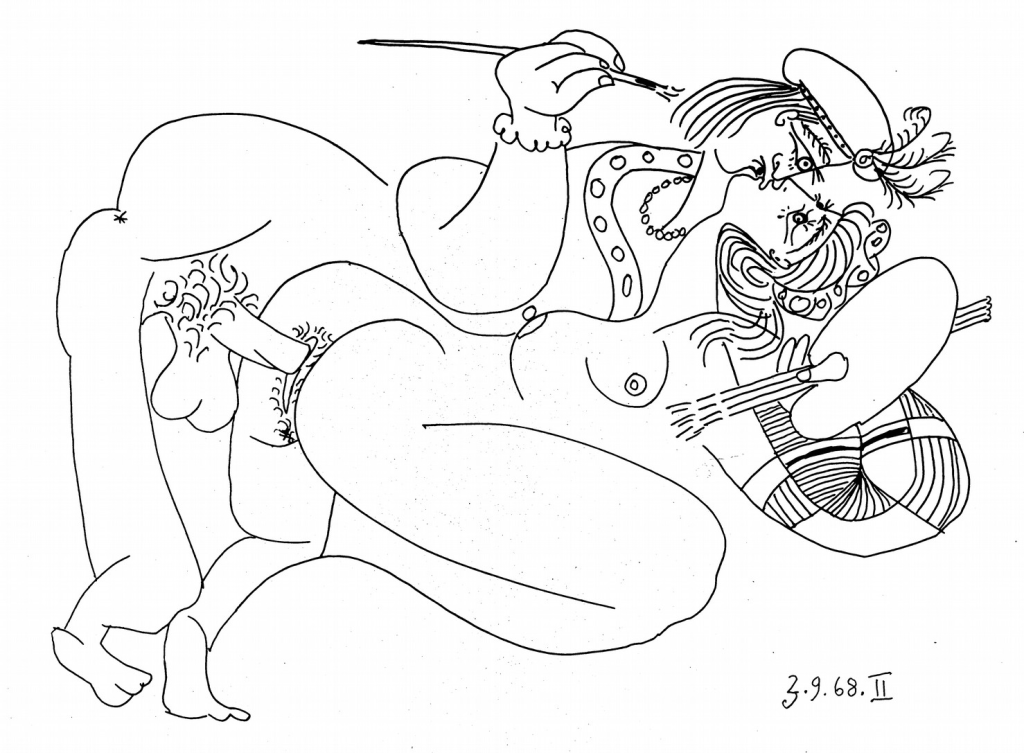
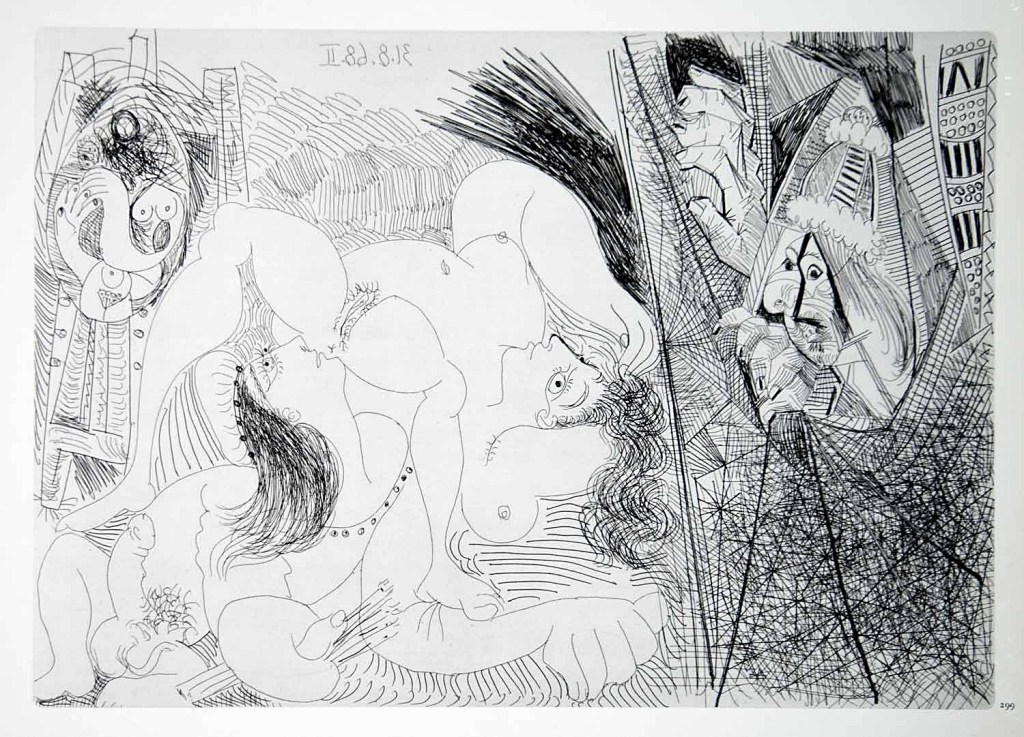
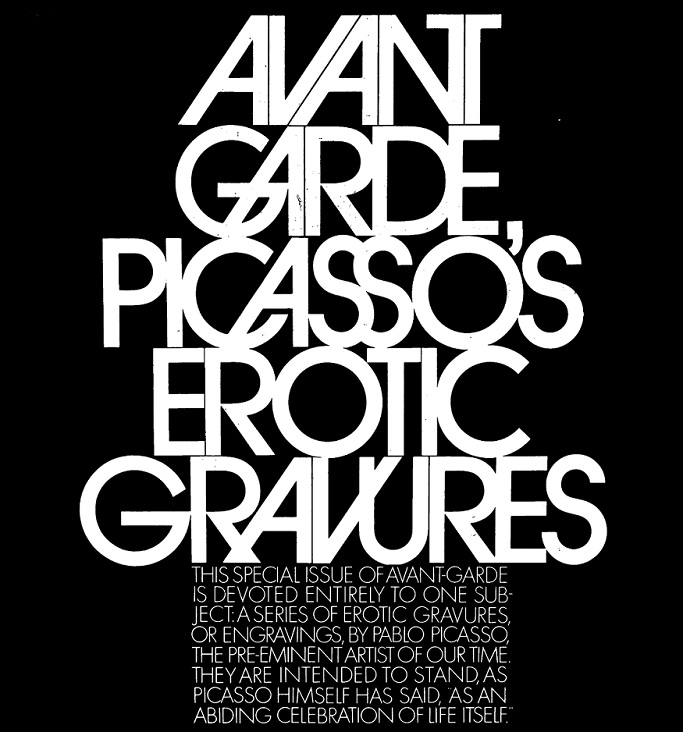
Avant-Garde Magazine, No. 8. Picasso’s Erotic Gravures Pablo Picasso Artist and his model 1969

This image remains my most memorable. In sex, artist and model become unified. I am drawn to this picture because it features both intercourse and a suggestive representation of the sexual act through the artist’s palette. As a flawless masterpiece of line, this image is everlasting.

I found Avant-Garde Magazine, No. 8. Picasso’s Erotic Gravures on my parent’s bookshelf. It was between Anaïs Nin’s “Delta of Venus” and Louise Huebner’s “Power Through Witchcraft”. For a kid stuck reading boring schoolbooks, I finally stumbled on something cool.

The thin book, Picasso’s Gravures, contained his sexually suggestive sketches. Picasso’s drawings are gestural. His lines make his art look like it’s being fondled. Many illustrations displayed surfaces marred by hairiness, crinkling and stretch marks.

The lines create a curious interplay of dryness and wetness. Picasso’s suggestive drawings in the 1970s opened the door for other artists to explore explicit themes. He owned a collection of sixty-one Shunga prints. Picasso’s interest in Shunga is a key theme in the chapter “Artist and his Model”.

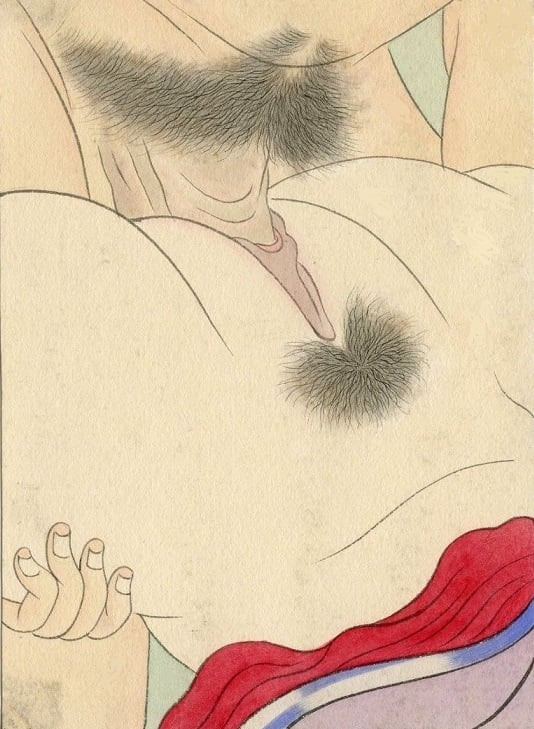
An example of eighteenth- and nineteenth-century shunga

“A lot of the eighteenth- and nineteenth-century shunga books contain enlarged images of male and female genitals, occasionally while engaged in the sexual act. These kind of ‘close-up’ designs were intended to provide instruction about anatomy and how to give pleasure. These educational images are mostly found immediately following the other illustrations in shunga books. Such prints are modeled after older versions that were used to teach human anatomy, which showed different shapes of male and female organs.” -Marijn Kruijff, Editor of Shunga gallery Erotic Art Magazine and is the foremost authority on shunga art.

written by Mitchell Pluto 2025

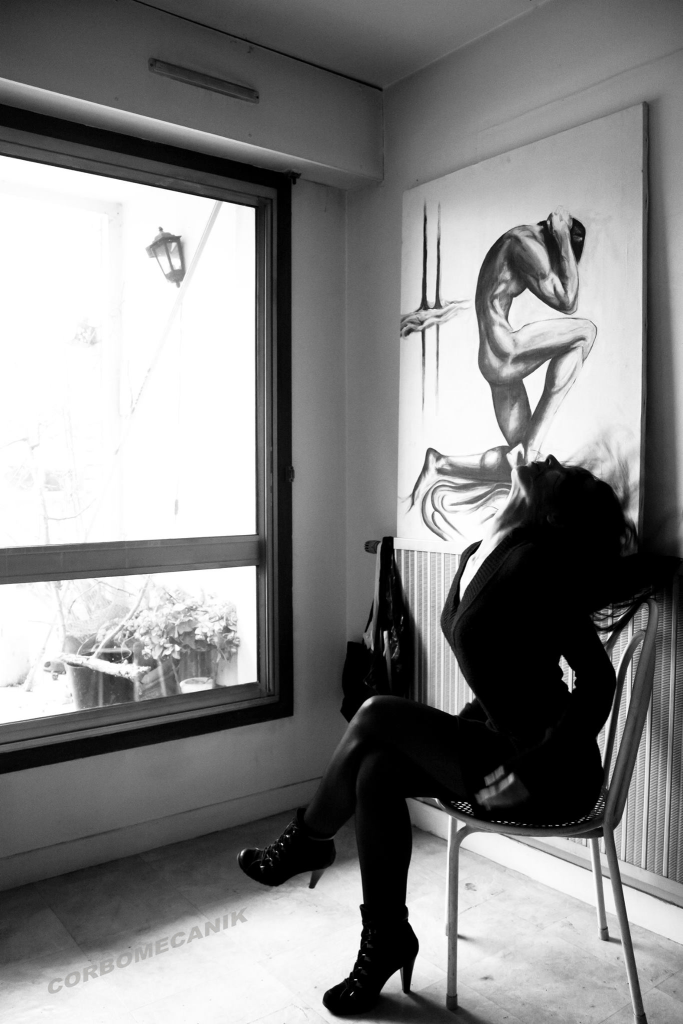
Laetitia Da Beca: Peintures, Matières et Graphismes

J’evolue dans le monde des arts plastiques , de l’expression corporelle et dans le milieu alternatif parisien depuis très jeune. J’ai donc explore diverses techniques et directions : peinture , photographie , dessin , graphisme , video , danse et travail sur le corps.

Depuis ces 15 dernières annnees , j’ai fait des expositions et performances en France et quelquescollaborations qui m’on ouvert de nouveaux horizons.
Le public me connait plus pour mes photograhies , mes performances ou mes mises en scène des corps ( dans la cadre fetichiste , danse ou autre ) pour la simple raison que je viens des arts plastiques mais que j’ai fait une pause de 10 ans dans le domaine de la peinture pour y revenir après
une renaissance.

La plupart des peintures presentes ici , acryliques ou à l’huile sont des œuvres en grand format , antre 1 m et 1 m 20 de hauteur .
Deux series emergent , l’une totalement dans la recherche et le jeu graphique , l’autre est une plongee dans la matière brute à travers les mediums et les volumes.

Dans mes peintures , le corps est plutot reduit à l’expression de chocs emotionels devenus physiques, j’y introduis parfois des cicatrices ou blessures ouvertes.

Je dirais qu’on y navigue plus dans le subconscient , dont l’exploration brute instinctive voir animal que me mène finalement ensuite à ritualiser en toute conscience ( mon travail photographique et de
performance).

La demarche chamanique de rendre visble les esprits est toujours presente dans les deux cas. Mon attrait pour l’exploration psychedelique du subconscient , le symbolisme universel , le domaine du reve reconnecte au quotidien , le rapport à l’invisible et l’interet esoterique qui en decoulennt ont toujours etait la des l’enfance.

Mes influences picturales sont très diverses des arts premiers au classicisme , des arts sacres aux symbolistes , du street art à la bande dessine SF ( pour moi , tout est source d’inspiration et de stimulation technique , graphique et de vibration de couleurs ) et biensur les surrealistes et leur grande revolution.

Written by ©Laetitia Da Beca (Corbomecanik)

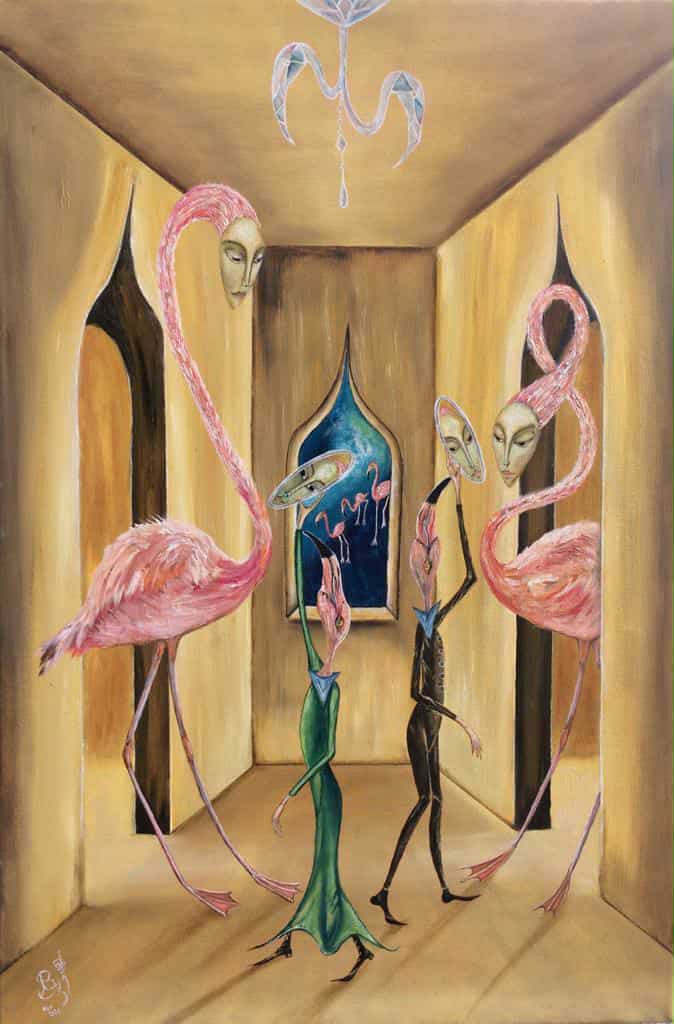
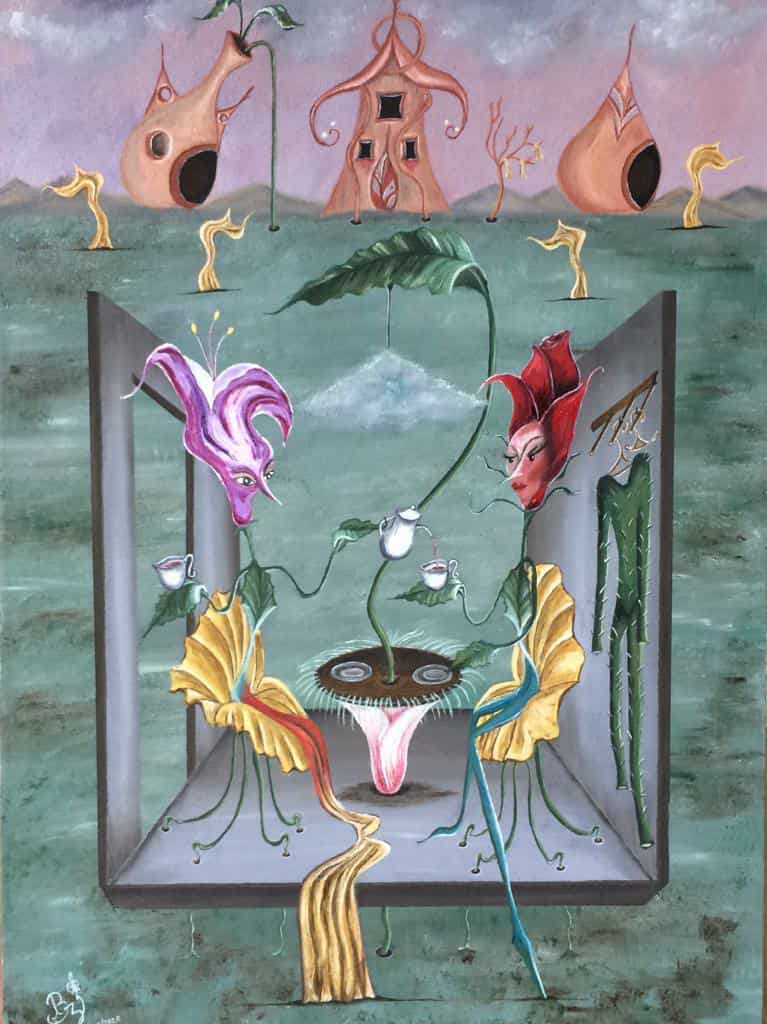
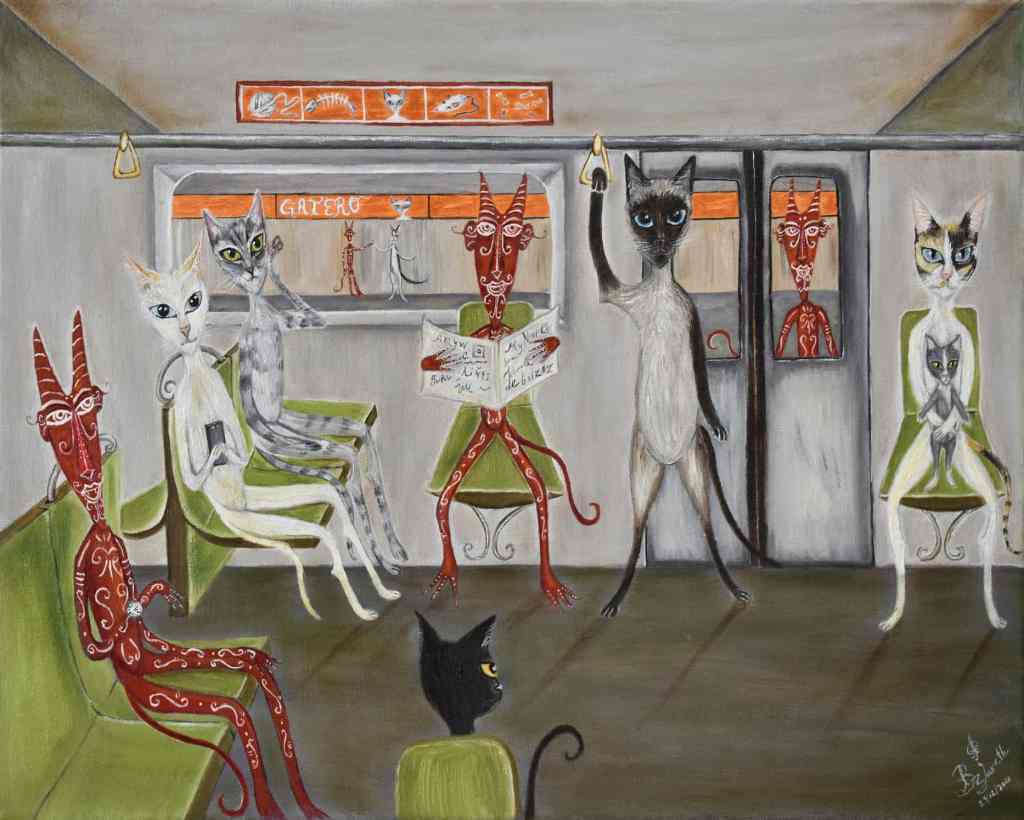
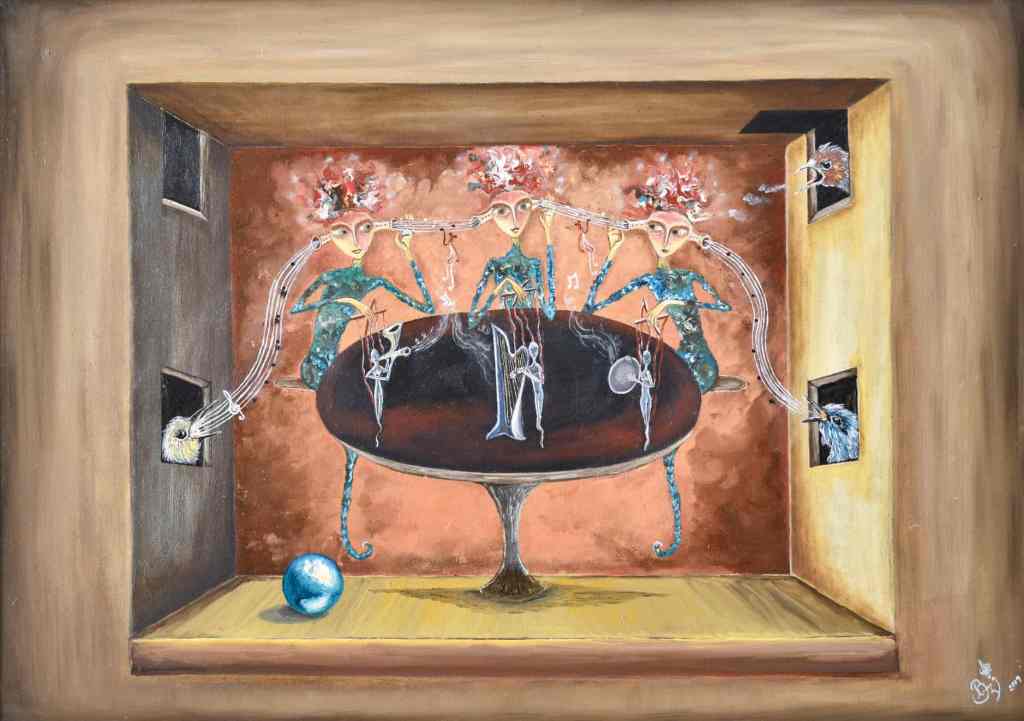
The Dreamscapes of Brianda Zareth Huitrón

Brianda Zareth Huitrón (1990) is originally from Temascalcingo, José María Velasco, Mexico, she is a visual artist and surrealist painter. She studied painting at the Academia de San Carlos in Mexico City.

Her multiple artistic facets and curious personality led her to discover surrealism, a movement in which she would find a way to communicate with the world. She creates poetic interpretations where the everyday is transformed into a fantastical and dreamlike reality. Magical paintings that reflect life’s desires to be expressed in a painting.

Brianda Zareth Huitrón has exhibited individually and collectively in Mexico and abroad.

Solo Exhibitions
Leonora Carrington Museum of Xilitla, DREAM ENCOUNTERS in 2025.
Women’s Museum, DREAM REVELATIONS, in 2022.

DREAM LANDSCAPES for the Temascalcingo Festival Honoring Velasco, in 2021.
WINDOW TO DREAM WORLDS, at the Futurama Cultural Center, Mexico City, in 2020.

Group Exhibitions
Col-art at the Oscar Román Gallery in 2025.
The painting exhibition THE PAINTER’S TRADE, at the San Carlos Academy, in 2019.
DIMENSIONS, Wave Gotik Treffen Festival, held in Leipzig, Germany, in 2018.

She has participated in the Chair for 100 Years of Surrealism, at the Faculty of Philosophy and Letters of the UNAM, giving a lecture on female surrealism.

Her work has recently been published in the book Mexican Women in Art, published by Agueda, and in THE ROOM SURREALIST MAGAZINE, an international surrealism magazine.

Memory Transfer by Mitchell Pluto

Transferencia de Memorias

From The Eclipse © Mitchell Pluto 2024 Séance channeling memory transfers. Espiral en el Estuco © Mitchell Pluto 2025 Transferencia de Memorias

In early June, the sky was clear and the temperature was pleasant. Tom and Sarah Anderson came across a metal tower while hiking in the Lolo National Forest.

The object’s Gothic style stood out as they approached. Seeing it brought back memories of their honeymoon trip to Chartres Cathedral.

The couple assumed the installation was someone’s art project or an exhibit at the University of Montana. The sight was unusual. There was a black circular window high up, near the top of the bell tower.

The tower emitted an extraordinary spectrum, encompassing all shades of blue and green.

3,500 kilometers away, a small gathering met at the United States Capitol. Attendance was by special invitation only.

Elijah Booker and his friend Alvaro, a man of abnormally short stature, arrived punctually. They entered the room and attracted a lot of attention. Booker, a large, Black man, always stood out in a room full of white men.

Alvaro had previous experience in the company. He knew the purpose of the invitation. Alvaro was albino and his alias was white dwarf. His main function was to use his mentalist ability to influence and dismantle cults. He possessed an innate ability to influence and alter opinions and beliefs.

On the screen, taken from a popular social media video, several recorded witness statements were shown. An older man, standing next to his wife, described the encounter with the intelligent light as best he could next to a strange tower. With deliberate and concise gestures, his wife explained the same thing, but in more detail.

Booker assumed he was the keynote speaker invited to talk about the future effects of permafrost.

The focus was personnel selection, not Booker’s research. Elijah Booker was the world’s foremost parasitologist. He researched extensively and wrote informative books on toxoplasmosis, a brain parasite. Elijah worked with international scientists. The Bureau of Globe Research in Alaska, where he lived with his wife and daughter, housed a broad research panel on prehistoric pathologies. Booker’s research caught the government’s attention.

Booker’s specialty did not include cosmic rays. He had heard of them and knew they were unstable, but nothing more. Cosmic rays sometimes interfered with belief systems, sometimes caused hallucinations, or enhanced brain patterns in unique ways.

The U.S. Intelligence Service considered ideologies to be mild hallucinations and was intrigued by the effects of cosmic rays on the brain.

The U.S. agency selected experts in direct observation.

The department was aware of Booker’s private life.

They knew of Booker’s Buddhist practice and his hobbies, which included listening to jazz and researching the occult.

Booker and Alvaro boarded a plane within a few hours. The private pilot, a native of Montana, had a great time. Alvaro taught him numerous dirty jokes for a total of six hours. This gave Booker time to read reports on cosmic rays.

According to government research, different rays posed varying levels of danger.

A jeep with tinted windows was waiting for them at the airport.

They soon reached the mysterious object. The Forest Service managed the situation, giving it a normal appearance to the naked eye.

Antennas, tents, and tall Douglas fir trees surrounded the 70-foot bell tower. The building’s structure possessed a beautiful style. The scene reminded Booker of a surreal landscape, something Bosch might have built.

He took a photo with his phone and recorded a video, documenting the luminosity of the fading colors.

Álvaro tugged at his pants and pointed to a tent. A young woman, about the age of Booker’s daughter, was holding a tablet like a clipboard.

Frauke Brunhilde introduced herself. Her black nails, black shawl, and tight leggings gave off a countercultural air. She was a genius in the German Federal Intelligence Service. She was a forensic chemist and radiological technologist.

Booker inquired about Frauke’s findings and knowledge.

Frauke showed him a live feed from a radiation-resistant camera. A vertical line of light aligned with the top of the bell tower. He speculated that the beam provided a transmission that might correspond to a conscious entity. Frauke discussed the fluctuating visibility of the light. She said that in Europe, cosmic rays are everywhere. Frauke said people believed they caused poltergeists and produced other strange effects.

Throughout history, ancient peoples used stones and statues to mark power points. Indigenous Europeans wore conical hats, such as the Golden Hat of Schifferstadt, to tune into cosmic rays.

Frauke proposed that primitive peoples tuned into radio stations in space. Mysteries associated with cosmic rays included encounters with fairies, aliens, angels, or even people who disappeared without a trace.

Booker wondered if these disappearances were due to dangerous rays that triggered aggressive progeria, a disease that accelerates aging. This cosmic ray posed no such danger. Frauke mentioned an article published by German scientists in The New Nature Journal, which argued that time is a moment that has already passed.

According to Frauke, the article suggests that UFOs are future apparitions investigating the present.

Booker wondered: Who was shaping the future from the past?

In the report he read on the plane, some anthropologists in the southeastern United States theorized that cosmic rays were attracted by unicursal patterns, but also expressed themselves to humans in diagonal or zigzag patterns. Frauke mentioned geometry as a method for communicating with unknown intelligences.

Booker noted that Frauke’s explanations had a mystical undertone, and he knew she was speaking of magic.

Frauke inspired Booker to reflect more carefully on the unintended consequences of cosmic ray-induced hallucinations. Most of the knowledge discovered turned out to contradict his beliefs, something he was prepared for.

The next day, scaffolding surrounded the tower.

Booker spoke to the welder. The man said he hadn’t been able to burn a hole with a blowtorch.

Incineration also didn’t work on the top window, which the worker described as Jell-O. His partner punctured a sandwich with stainless steel tweezers in the Jell-O. Nothing happened to the sandwich. The puncture filled and healed itself.

Booker walked toward the main tent.

Alvaro reclined on Frauke’s lap. They seemed to be having a good conversation. Frauke chuckled. Booker told Alvaro and Frauke to prepare to enter the object.

The unit gathered what they needed. Booker hooked Alvaro to his belt like a weapon. Frauke slung a backpack over her shoulders as if she were spending a week in Glacier Park. Frauke put on her headphones and began climbing. Booker braced one hand and one foot on the scaffolding, the tips digging into the ground, as he slowly ascended to the upper platform.

Standing near the most enigmatic and sinister feature of the building, the three gazed up at the large black window.

The surface was obsidian, with a thick, gelatinous texture. Due to its unknown elemental nature, they were unable to separate the gel into samples. Frauke, using her scanner, surmised that it was an iron mordant containing extraterrestrial gelatin. The window also contained a low- to medium-fluctuation radioactive ray, known to cause hallucinations, according to the scanner. Booker hoped that, as they approached the cosmic ray, they would all experience an LSD-like experience.

Without any prompting, Álvaro dipped his hand into the substance.
It was the temperature of a warm bath.

Booker quickly glanced at Álvaro.
He removed his hand from the gel, waggling his fingers toward Booker and Frauke to demonstrate that God was luck.

The group sat for an hour discussing hypothetical possibilities, including personality changes and brushes with death.

Álvaro lived by the motto: to embody the god of things as they should be. To be the force of humor in every passing horror. Frauke, enchanted by Álvaro, agreed.

Frauke put her headphones back on. The music turned up. Booker hooked Álvaro back onto his belt and held Frauke’s hand. Booker didn’t want her to wander off alone in the oozing gel. He felt responsible for all of them. Booker placed a camouflage bandana over his nose and mouth. He breathed and closed his eyes. Frauke tugged at his hand.

The first step into the gel was similar to stepping into a deep pool without firm footing. Each movement created an unpleasant sucking sound. The absolute darkness unleashed a wave of fear. A surge of adrenaline flooded Booker’s bloodstream, testing everything he had learned from Buddhism. With a concentrated effort, he maintained his upright posture, stepping into the dense gel with one arm. The suction made movement difficult.

Booker could now identify with the five clinging aggregates of Buddhism.

It became a direct experience. The aggregates — form, sense, perception, and external forces — environmentally influence the mind.
Booker felt a predatory presence. An obsessive, superstitious belief overwhelmed his mind as he struggled to penetrate the bottomless gel.

Suddenly, Booker had a clear view of his own brain. He could see his amygdala working overtime. The pressure on the insular cortex made him imagine the worst possible scenarios, including an imaginary predator chasing him.

However, there was no malevolent morphic resonance present, only a confined space. His own fear divided and attacked every facet of his mind. The narrating brain identified its observer function as an intruder.

A strong auditory memory told Booker not to panic. A Nyingma master at a Buddhist retreat advised him to accept the discomfort and practice gratitude.

This precious memory became clearer and more fundamental to his resistance.

Booker imagined seeing the Khenpo floating on his back, effortlessly performing backstrokes in a slimy jelly.
Another vivid memory resurfaced. Years ago, his few sessions with Stanislav Grof helped Booker relive his earliest memories of being suspended in a possessive womb. He recognized that birth brings with it a subconscious sense of abandonment for everyone.

This caused humanity to misinterpret birth as a definitive isolation and desertion.

All of this originated in the maternal body’s rejection of the newborn as if it were excrement. Generation after generation, this confusion projected contempt for the feminine and nature.

Booker could see his thoughts as images. He saw the unjust and unconscious representations that dominated historical records.

The central idea emerged as the ambition to replace the mother with an artificial mechanism. This would foster the construction of an industrialized, parasitic world devoid of empathy.

Booker wished he had headphones.

Music would make it easier. He imagined John Coltrane’s “One Up, One Down .” He had listened to the album often, at the cost of exhausting his wife’s patience. Today, it helped him remember it. The saxophone arrangement conquered fear. Booker knew that Coltrane understood the patterns of a constantly changing self. A self free of history and objects.

One conclusion became clear: time and space will never have a central authority.

The attempt to even imagine sensations beyond the end proved to be a vain and imputed illusion.

Death existed as a phase that passed like everything else.
Why pretend we knew this?

We shared the same fate. We would cease to exist without knowing what death was.

The tension dissolved and the jelly transformed into a thick fog. With his free hand, Booker reached for Álvaro, patting him on the face. He looked at Frauke. He saw her silhouette. Frauke turned to Booker, took off one of her headphones blasting, and smiled.
Booker asked, “What got you through the jelly?”
Frauke nodded to the beat: “Huh? Yeah! It’s an American band called The Doors , The Other Side , yeah, they’re good!”

The cosmic ray transformed the tip of the bell tower into a reactive vanishing point. This produced a carnival-like hall of mirrors effect. Booker, Frauke, and Álvaro occupied that space between the parallel lines of the cosmic ray. The room resembled a virtual infinite hallway with a ledge. Colors cascaded down the cosmic ray.

Frauke’s gaze caught something in the swift wave of light. She spoke, describing what she saw as it manifested in Álvaro and Booker’s minds.

A spinning triangle reflecting brilliant light transformed into crystal. At each corner, the numbers 3, 6, and 9 materialized. From the center of the triangle, sparks erupted, forging a nude female figure with hair down to her feet. A deep red and white glow caught her attention.

“She can see us,” Frauke said.

The woman spoke echoey. She gave her name as Mitzi Orssich. Mitzi said she was broadcasting from a live 1920 séance in Austria. The chatty ghost said she represented the Viril Society.

Mitzi demanded information from the future to help build a temporal vehicle. Mitzi possessed sternness, while her flawless figure projected an incredible image. She was a magnetic and exciting archetype who could raise blood pressure and induce a firm salute .

This woman’s body possessed a truly divine craftsmanship, an image that neither eats, defecates, nor ages.

Booker reflected.

She fit the bill: blonde hair, blue eyes. The graceful elements resembled the Christkindel.

But why didn’t this woman take over as Germany’s leader in the 1930s?

Mitzi spoke English very well.

Booker recalled researching the Vril Society, which emerged as a 19th-century work of fiction by the English writer Ed Lytton.

Booker realized they were tapping into a projection of Frauke’s subconscious.

Mitzi was, in effect, a literary phantasm forged from a pseudo-story.

He looked at Frauke, who remained staring.
Booker speculated through his online queries and research; Frauke gained powerful impressions from what she read.
Álvaro’s face was simply a huge smile with tiny hands and feet.

Booker interrupted Frauke’s trance and appropriated the cosmic ray, projecting abstract expressionist ideas onto it. He enjoyed this art movement and understood its significance. He was open in sharing his observation of vivid brushstrokes.

Booker gently guided the hallucinatory influence away from the National Socialist art style toward a more universal and abstract variety. It was art without a human figure.

Wonderful and exciting non-figurative patterns formed from the center of the cosmic ray. The variety of designs lacked strict cultural ideologies, which brought Frauke out of her trance.

The cosmic ray inspired Alvaro to create a complex algorithm based on his interest in spiders.

Mitzi’s impression triggered unexpected associations that took a mutated form.

Web strings connected a spider puppet to the spinning chemical brain in Alvaro’s vision.

Frauke saw it as a fusion, creating one puppet within another.

Booker interpreted Alvaro’s vision of the spider as a portable DNA capsule capable of flying through space.
Small cubes appeared on a spinning belt in another future. The webs were coordinates, guided by a chemical brain inside a metallic spider.

Booker, Frauke, and Alvaro huddled in a triangle in front of towering Douglas fir trees. They were gone for three days and reappeared five miles from where they had disappeared. There was no alien tower there. A man named Warren found them while patrolling the forest. The cosmic ray information was useful.

US intelligence took statements from Booker, Frauke, and Alvaro.

Engineers, chemists, and physicists collaborated to design a new space vehicle with a chemical brain.

A few months later, the spider-like object would fulfill a panspermia mission. The space spiders, called Anansi Capsules, would aim to find habitable planets to modify human DNA and enable life in an extraterrestrial environment.

The Anansi Capsule was an 8-foot-tall mobile figure with eight appendages for hand tools.

After descending, the capsule would unfold into a complex 16-foot laboratory.

The Anansi Capsule would manufacture and raise two biological beings for several generations.

It is unknown whether the new offspring would preserve or understand their origins, but they could be alive to continue exploring space.

A few months after visiting Montana, someone mysteriously provided a grant to de-extinct the woolly mammoth and thus include it in Booker’s future project.

Writing and Art All Rights Reserved © Mitchell Pluto

From The Eclipse © Mitchell Pluto 2024 Séance channeling memory transfers . Spiral in Stucco © Mitchell Pluto 2025 Memory Transfer


Espiral en el Estuco (Spanish Edition) Paperback – Large Print, 23 April 2025

Spanish edition  by Mitchell Pluto

El surrealismo oscuro y el absurdo crean efectos psicodélicos. El zen y el jazz de Coltrane ofrecen una vía de escape de la veneración política, permitiendo viajes interestelares. Cada capítulo explora el surrealismo y las técnicas budistas. Estas ayudan a sobrellevar el trauma de sentirse atrapado, como un animal en un anuncio repetitivo.

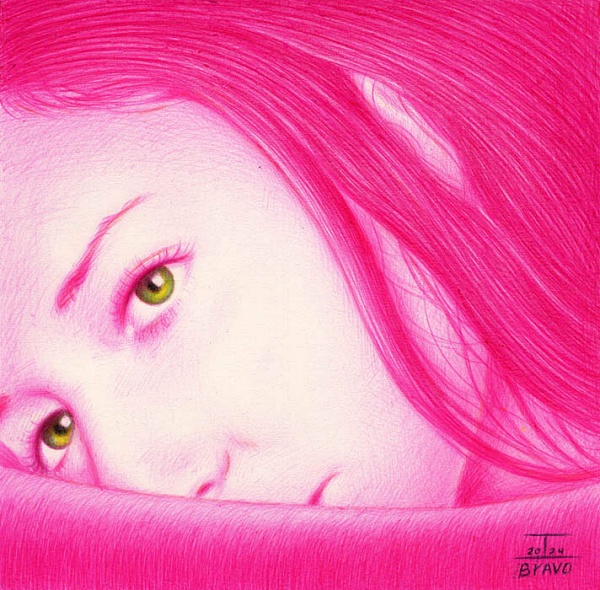
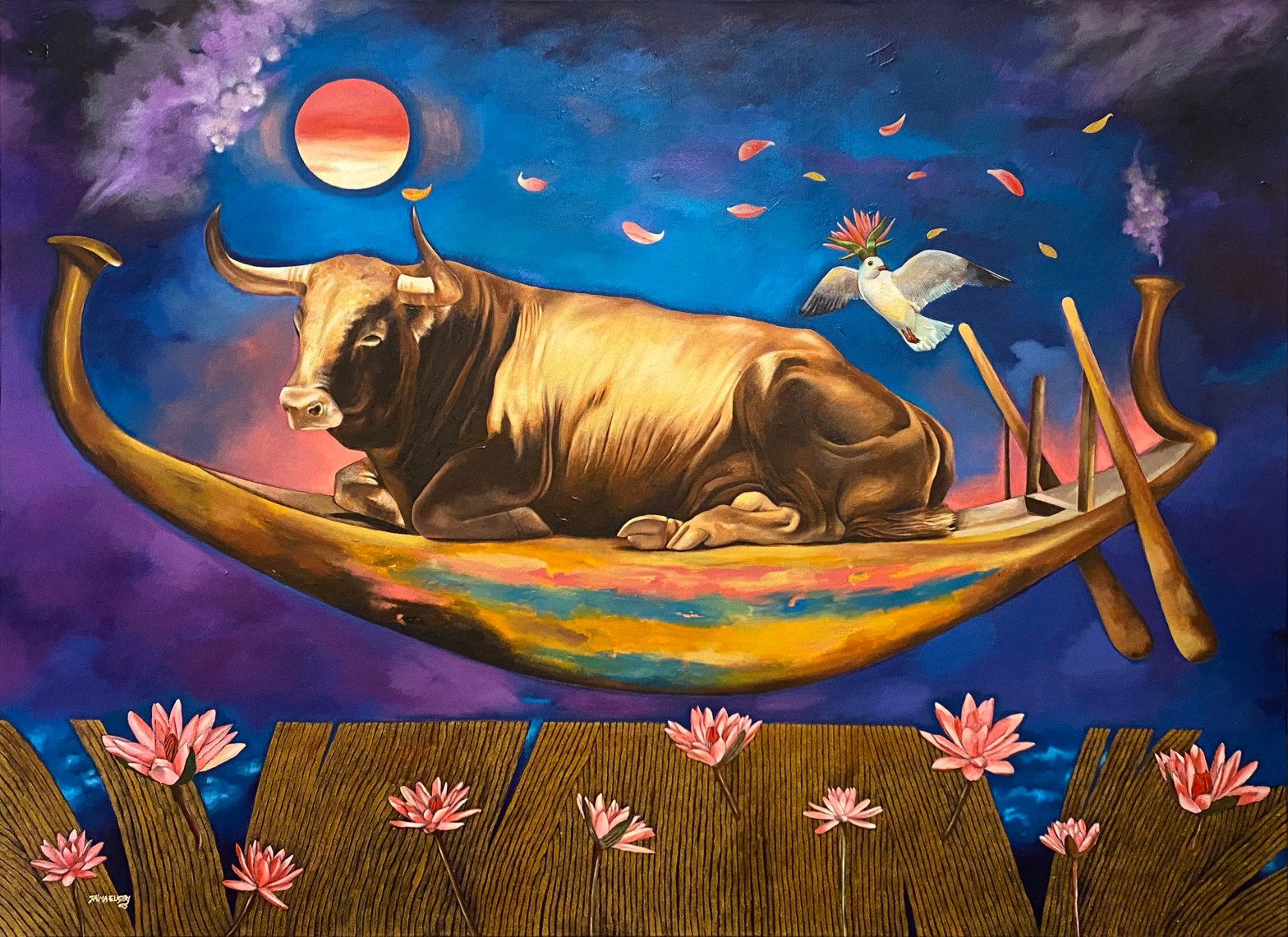
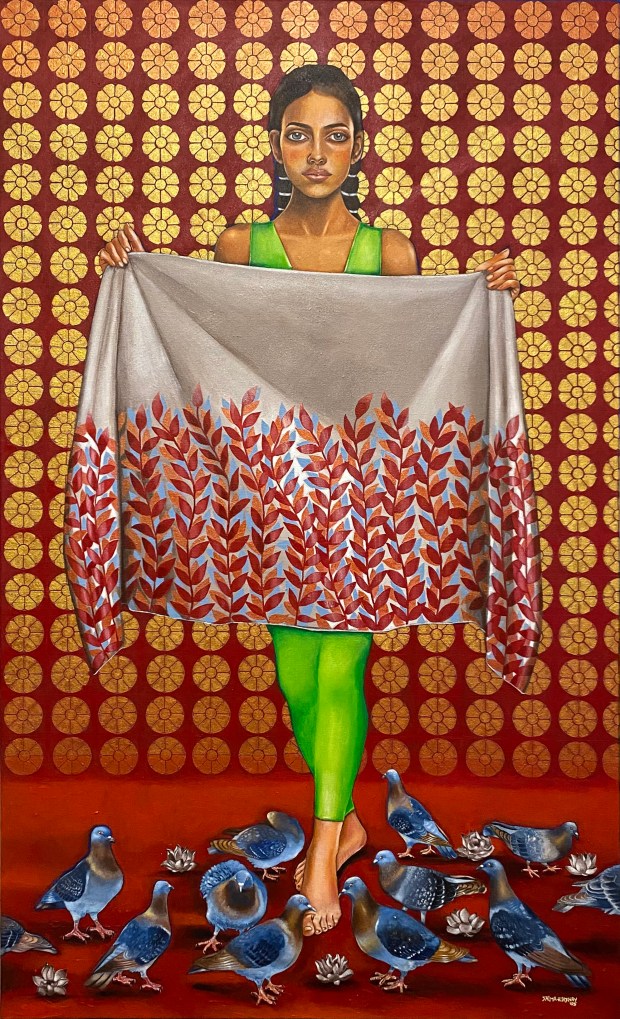
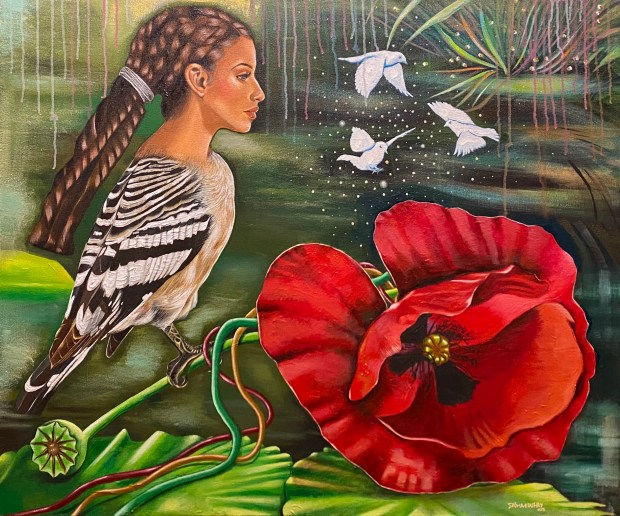
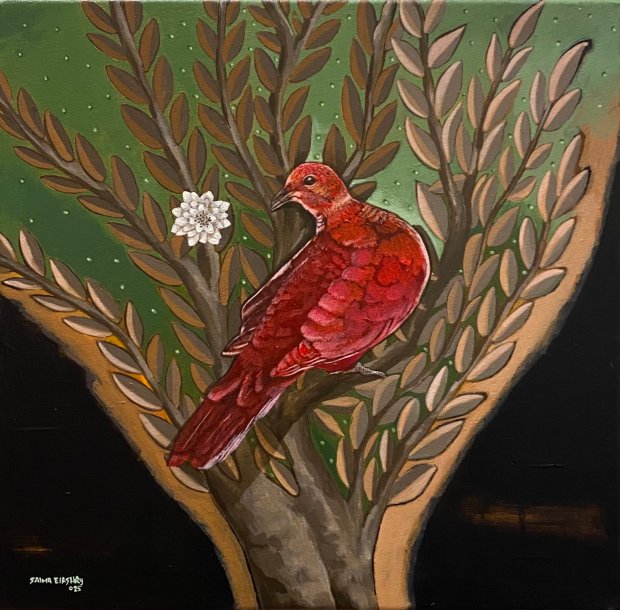
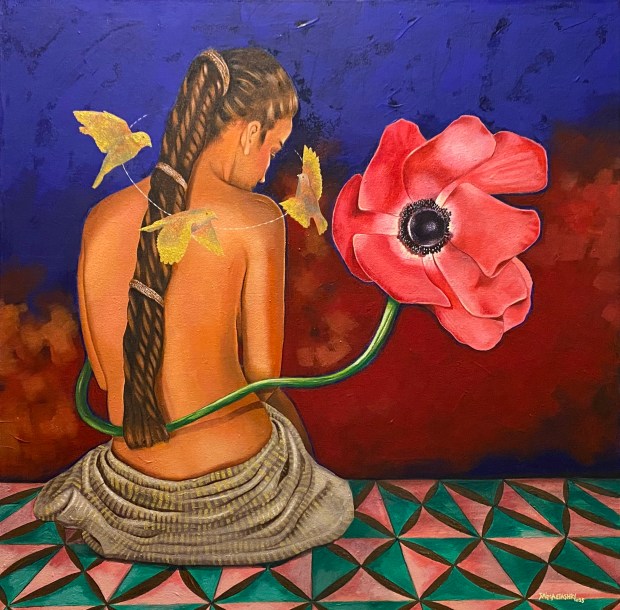
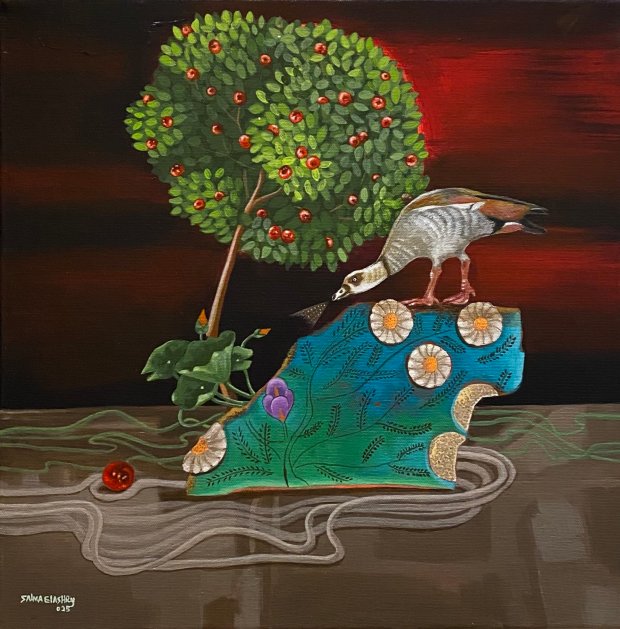
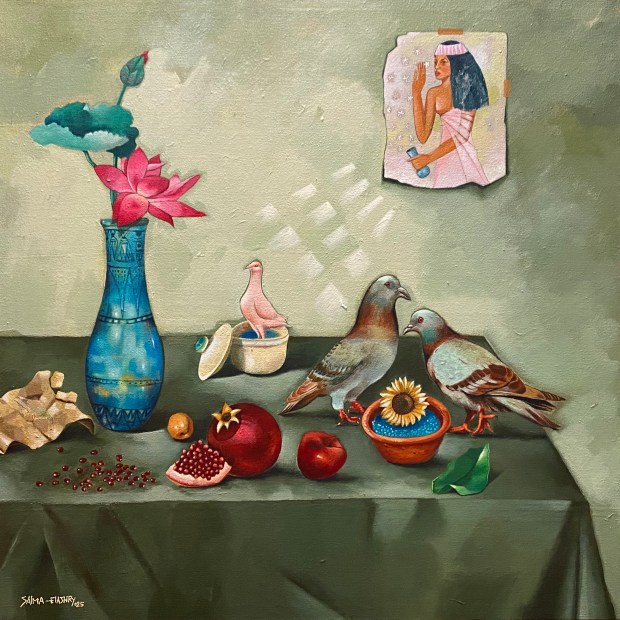
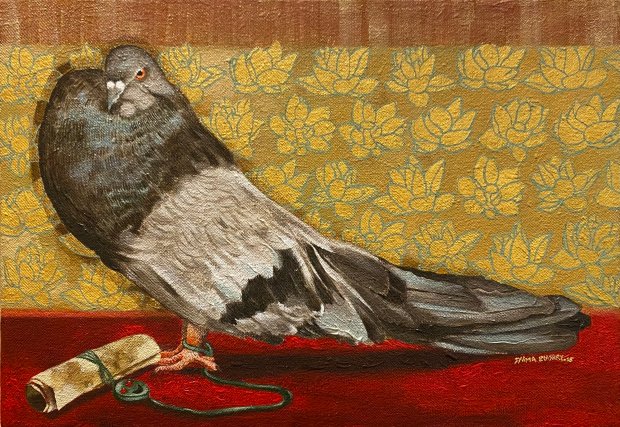
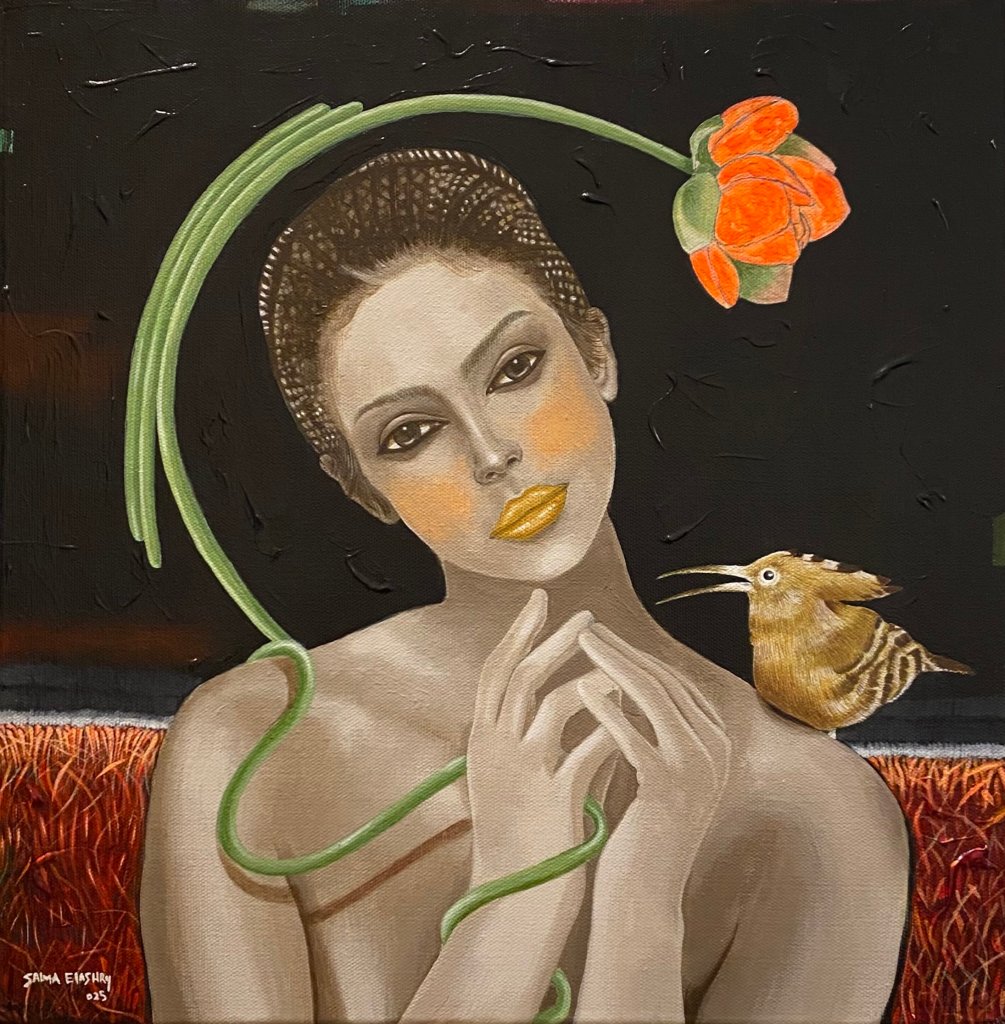
Salma El Ashry: Paintings From the Orbit of a Flower

The Concept Behind My Work by Salma El Ashry

In my artistic practice, I am deeply committed to exploring the symbolism of the elements that surround me and to delving into their profound meanings—meanings that may often go unnoticed, yet form essential keys to understanding much of my work.

The majority of my pieces contain symbols that reflect personal, contemplative visions, intimately connected to the places and objects around me. These works are nourished by my readings and inner reflections.

I draw inspiration from the symbols of ancient Egyptian heritage, using them as a contemplative entry point to examine our relationship with identity and visual memory.

My artistic vision emerges from a personal meditation on the meanings of identity and existence. In this journey, I turn to ancient Egyptian symbols and texts—chief among them the lotus flower, which I regard as a central icon due to its multiple manifestations and its profound philosophical role centered around the concepts of rebirth, balance, and inner transformation.

I also incorporate other symbols, such as the dove, which I see as a representation of loyalty, return, and peace.

Color plays a pivotal symbolic role in completing this vision, alongside other visual elements.

Each color carries a philosophical significance rooted in the legacy of ancient Egypt:

• Green symbolizes purity, renewal, and the continuity of the spirit.

• Blue represents protection, connection to the sacred, and embodies

tranquility and psychological harmony.

• Red signifies energy, life, passion, and the latent strength within the human being.

Through this framework, I seek to build bridges between eras—between the past and the present—reinterpreting cultural symbols from a contemporary, humanistic perspective.

My intention is to open a spiritual and contemplative space for the viewer, inviting them to look beyond the surface image, to listen to the hidden messages that these symbols transmit when revived in a personal, spiritual, and modern philosophical context

Machine for Memories

The transatlantic voyage is being undertaken by the new colony of artificial intelligence.


Don’t forget that AI, developed by dominate culture, is claiming the territory.


One can compare the brain to Vodou, an animistic concept.

People built statues to memorialize theurgy.


Hesiod’s depiction of the gods illustrates the organization of pareidolia.


We won’t be going to space ourselves; AI units carrying our genetic information and instructions will go instead.

©Mitchell Pluto 6/7/2025

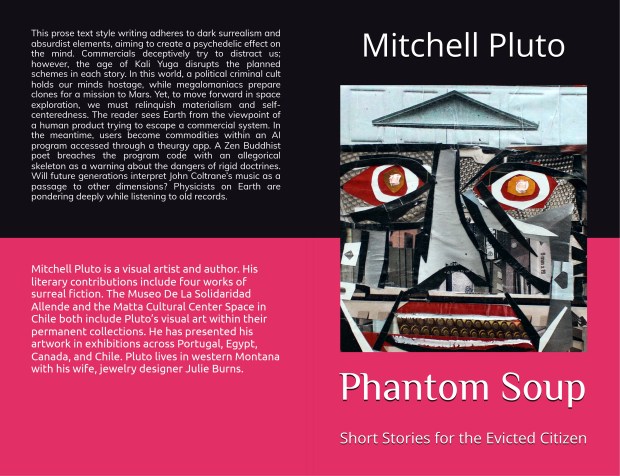
Phantom Soup: Short Stories for the Evicted Citizen

To write something and leave it behind us,
It is but a dream.
When we awake we know
There is not even anyone to read it.

The 8th day of the 4th month, the 3rd year of Kōshō (1457)
Ikkyū-shi Sōjun

Ghost Ride

Phantom Soup © Mitchell Pluto 2025

Accessible for reading.

All rights reserved. Permission grants brief quotations embodied in critical reviews and certain other non-commercial uses permitted by copyright law.

In case you overlooked it, this universe wasn’t lacking in ambition or size.
It was putting on a spectacle with its production.
The cosmos is just incredible; even haters gotta admit it’s breathtaking.
Zanni, the defendant, is still waiting for a verdict.
In space, sentences float around and words drift apart.
His black and white checkerboard suit embodied the polarities of opposites.
He is a man without a country.
A joker in a deck of cards.
Through gestures alone, Zanni attempted to decipher the universe’s communication.
There was drama everywhere, but Zanni just didn’t understand how it worked or how it occurred.
No one ever knew the truth; it died with them, leaving only unanswered questions.
Everyone figured the headache meant they knew what the problem was.
Less pain means clearer perception and a more optimistic outlook.
Honestly, it wasn’t a matter of right and wrong.
Or pain or pleasure.
It dealt with items of worth later becoming trash.
You could tell what things meant to people by how often they handled them.
It’s a space ballad playing both life and death.
No one will sing the sad cowboy songs of unrealized dreams anymore.
It’s alright.
We are part of a sombrero galaxy, a galaxy that is an eternal sunrise.
Zanni was in a giant empty room with waves of random stuff.
His world symbolized a particular responsibility of being.
Special car keys for a 2025 model, a mobile wallet, a decorative cup, a gold pen, a seasonal tire, headphones from 1979, crumpled up Kleenex, a 1990 professional styling brush and a flashlight from 1899.
These objects surrounded Zanni.
Thankfully, a consumer digital camera from 1996 captured a pic of this.
But for who?
Regular waves swapped out old things for newer ones.
Zanni contemplated this event.
He figured the most likely explanation was that he was inside a massive vacuum cleaner.
He experienced a strong connection to things he saw on his trip.
Zanni speculated that the objects he couldn’t name were from a future timeline.
Things appear and vanished super fast out here.
Zanni drifted between sleep and wakefulness.
We can refer to it as a space fog in the mind.
A magnetic memory was his most beloved possession.
It echoed because Zanni repeated it.
He brought it back to mind in a re-run.
Zanni felt the luscious lips vibrate against his ear. It was a figurine of a woman.
Her name was Colombina.
The teal diamonds and magenta triangles on her dress flowed together to create a pattern of doves.
Hand in hand, they created poetry.
The rhythm of their partnership quivered in the shared space.
The couples’ bond created a constant interplay of elements through the intercourse of their geometric patterns.
Zanni maintained his embrace for as long as possible before the vacuum wave separated them.
He could not pinpoint the incident’s time without a clock.
The arrangement of numbers magically shapes the surrounding space. A regular watch shows what’s going on between the numbers.
Of all the puppets, did he alone ponder his whereabouts?
Only he understood his own thoughts and feelings.
Sometimes Zanni heard voices that didn’t belong to him.
Intrigued by the mysterious voice, he followed it.
The voice led him back to his body.
Those seizures and hallucinations gave epilepsy a mystical quality.
His memories of himself were likely because of thinking about Colombina.
He owned the moment, his own little universe, for a single second. Zanni saw himself as a buoy, helping other objects find their way.
But Pantalone, a hunchbacked old man, considered himself the universe’s ultimate authority.
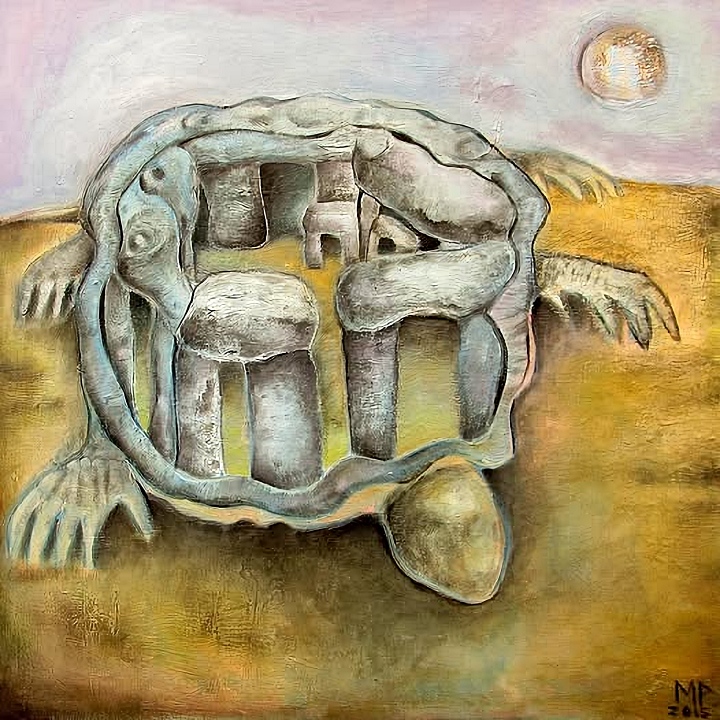
He was a drifting turtleback tomb from another vacuum wave.
Pantalone preferred the nickname “god.”
His face twisted in anger as he guarded his belongings. Losing things got on his nerves. His tailored red suit reflected Pantalone’s importance.
Every item got a brand and price label from him. He believed he understood your true worth more than you did yourself. He used his talent to make you think whatever he wanted.
Those close to him risked having their self-image stolen and used against them.
Pantalone intended for everyone to rent from his cloud.
He lost money in the vacuum wave, then recovered his losses.
This activity provided him with enjoyment, a sentiment he wished to share. Provided that he had more.
Scattered dollar bills wandered everywhere.
The bills, by themselves in space, lacked any connections.
Now, Pantalone found himself surrounded by dancing product wrappers, toenail clippings, old grocery lists, damaged furniture, empty food containers, broken appliances, crumbled up receipts and dead batteries.
Think of it as a garbage cloud.
Several real estate agents, their eyes wide with nervous energy, tried to appear calm as they floated past Pantalone.
They pretended to own a spot by treading in one place.
While this was occurring, Harry Houdini sailed by and unlocked a satellite.
Intrigued by Pantalone’s possessiveness, Zanni examined the egocentric and deceitful nature of his own point of view.
He observed the ego’s memories fade as the mind surrendered its ownership.
Once the fear was gone, relief came.
Houdini cracked his knuckles. “No worries are necessary. Don’t sweat it. It is a simple lock to open. “
The hierarchy reflects the relationships between things in a chain.
An x-ray showed how brain waves link things up through information chains, like you see in neuron activation patterns.
This electromagnetic wave made Zanni wonder about the engineer of the universe.
It appeared the designer wrote a script for a big stage performance but remains anonymous.
In the meantime,
Pantalone reached his own planet.

Phantom Soup: Short Stories for the Evicted Citizen Paperback

Phone Bot in Space


The emptiness of space challenges the narcissist.
I wasn’t talking about a daffodil either.
Imagine the self-centered individual in the cosmos.
This soundtrack fanfare involved a floating plastic water bottle bobbing in the void, creating a strange echo.
A promotional message
There’s a song still going strong on an eight track tape from a different era.
The signal aimed to scatter more phone bots onto another surface.
Those objects back then are now considered trash.
It originated as a billionaire’s dream.
That primate was something else and only connected with other special monkeys and top baboons.
The menu listed all the remaining items, which wasn’t much.
There’s no linear narrative here; there’s no gravity.
We all got talked into being in Barnum and Bailey’s Greatest Show in the Galaxy.
In a chain of forgotten memories, everyone plays a great-grand relative.
Social media made it simpler to believe in fantasies of endless joy, power, and attractiveness.
Here and there had something from Temu.
Every summoned name feels entitled to special treatment.
Just answer your text message alert and see for yourself.
To be a wild horse in a motion picture, a spaghetti string western running around with no identification or proven ownership.
We needed to get things lined up.
The designation we gave it on Earth was equinox.
Or Rahu and Ketu.
Everything existed between two distinct points, a liminal zone like the recommended dietary allowance.
What did the primates search for?
The environment was ripe for harvest, heavy with the scent of ripe fruit.
Phantosmia first appeared as a side effect.
But in truth, the air held a strong smell of burnt metal, a metallic Tang.
Nothing 29 grams of sugar can’t handle with ten percent of carbohydrates; one hundred percent of vitamin E; one hundred percent of vitamin C; six percent of calcium and 120 calories.
Those repeated old commercials taught us to disregard the feelings of others.
Your phone is always there for you.
We should continue to outsource our creativity to the colony in order to receive innovative ideas at no cost.
Be all you can be.
Show conceit and engage in scheming actions it’s what we do when we explore another space.
We must be ready to manipulate people into servitude while making them believe it was their own decision.
Finding less intelligent beings is our hope, but a lot of work remains.
Facebook use is compulsory for everyone. We created our own television program.
While floating in space, it will help you stay focused on the amazing advertisement.
Asteroid mining provided a cool residential unit that’s furnished nicely.
You can order it online from Amazon.
Your deposit is secure and what a great way to spend a layover before heading out to nowhere forever.
Kidney stones messed up my space trip. How about you?
Don’t let worries consume your thoughts.
It’s just another advertisement that your brain has stored as a memory.
Albert Einstein chose Buddhist philosophy as a garden guide for the future.
Despite the lack of a global law requiring flower gardens, we concentrated on collecting and trading symbolic coins.
No one paid any attention to perennial plants but wanted planets.
The most important thing was AI carrying a respiratory virus to another atmosphere.
Ultimately, the cosmos functions as both a wellspring and a drain.
Who is this object registered to?

©Mitchell Pluto 1/17/2025

Occultations: Lullabies For Space Travel