My painting can be understood best when looked at with an understanding of the Tibetan Buddhist ideas of Maitri and Tonglen. (Maitrī loving-kindness) and Tonglen (giving and taking) are two related practices in Buddhist traditions, particularly Tibetan Buddhism, focused on cultivating compassion and kindness. Maitrī involves cultivating a warm and benevolent attitude towards oneself and others, while Tonglen is a meditation practice that involves breathing in suffering and breathing out relief, compassion, or loving-kindness.
I didn’t start out as a kid practicing this meditation. I was adopted as an infant from South Korea when I was 3 months old. And my parents weren’t Buddhists. My dad told me he used to practice transcendental meditation as an adult, but never taught me how. I came to it, through wanting to connect more deeply with my Korean heritage. That was about 10 years ago.
I didn’t start, wanting to merge my meditation practice and my painting practice. But because of the visual nature of tonglen, the imagery was a naturally on my mind. And had no idea what I wanted my thesis to be. So, both created a synergy that helped me inadvertently heal, and explore the different relationships in my past and in my present. By the end of my graduate studies, my thesis was: Painting and Meditation: Paths to healing. I even tried my thesis out in the community. I had around 10 women come to learn tonglen meditation. And to use the imagery from their meditation, as the subject for their artwork. They painted a suffering and the opposite of that. They used photos, to help inform their work. And then they talked about the transformation. It was a beautiful and empowering workshop.
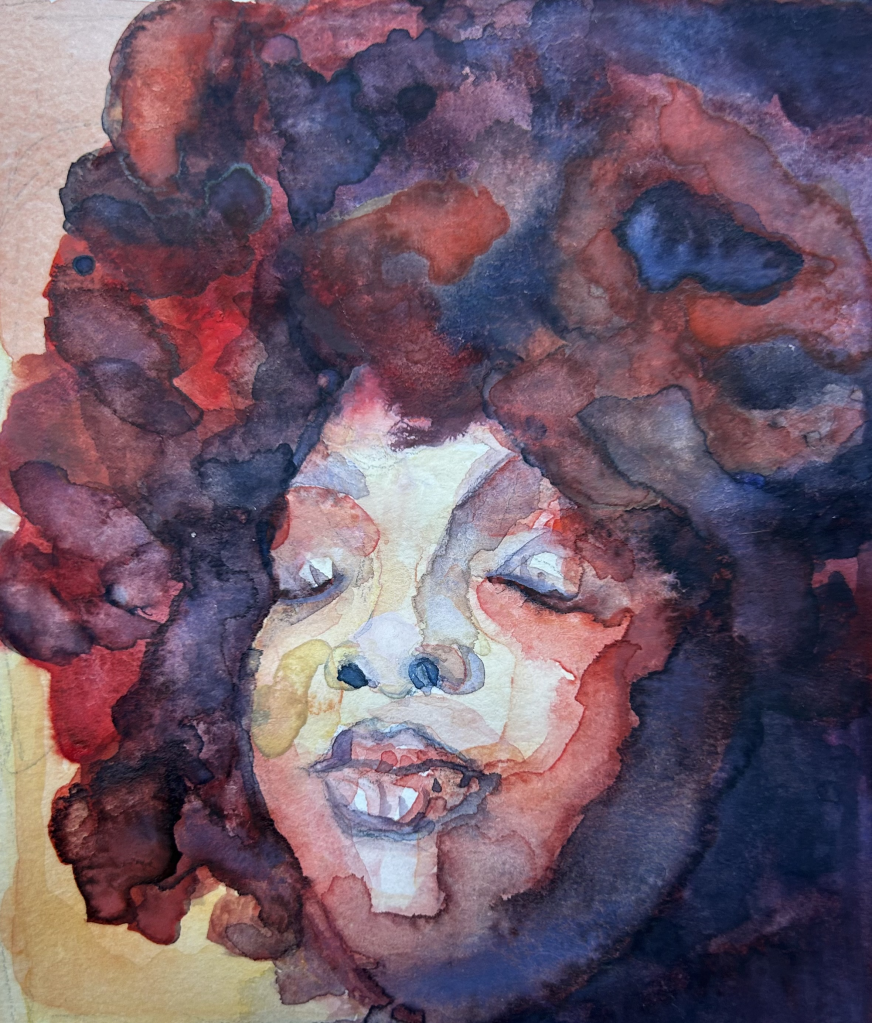
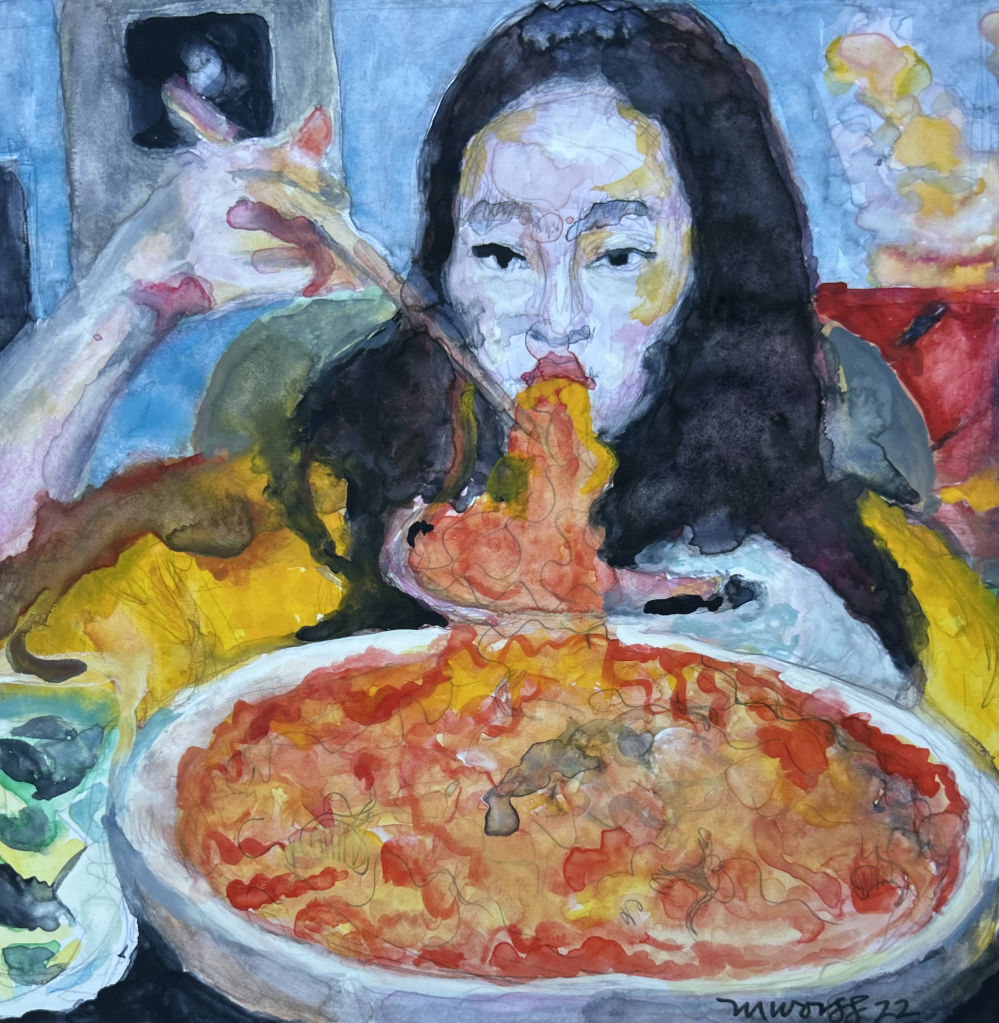
I love this tiny painting. It started out as a quick study as nothing serious. But I really just fell into the paint and managed to keep the essence of her being lost in what looked like to me as a state of pleasure or like she’s making a wish. Color tends to go anywhere, when I don’t think about it so much. I just let my hand choose and place it where it wants to go. It’s very instinctual and intuitive. I like not having to think so much. It’s more of an emotional application. Lately I’m in love with the soft plumes of color and line quality I can get with watercolor. I will paint a person just for the softness they have in their hair or body.
After placing myself in tonglen. It was shocking to discover that I had never really jumped off the hamster wheel of life to even talk or address the ambiguous loss I’d carried for years in my body and psyche. I had never even talked to anyone about how hard it was to miss a family I had never met. Or the woman who carried me and birthed me. But the loss is real. This meditation of compassion gave me the space to fully sit with that grief and actively tend to it. I seemed to have just fleshed it out more fully in my paintings.
I made my very complex and heavy feelings into a visualization in my mind. Then used those as a springboard for narrative paintings. Turning trauma into a concrete painting. Painting has played a part helping me make of sense this unique journey. Of what had missing pieces and lies. I’ve created a story with a start, beginning and ending, that made sense to me. Not the dominant narrative of the adoption industry, or lies or mystery surrounding my adoption. Not adoption from the parents perspective. Not adoption from a Christian perspective. But one that comes from historical facts and felt memories from my body and how I felt about being adopted and having gone through so much with so little.
“The Baby Catchers” 2015 Oil on wood panel 32″ 5/8 x 49′ 3/4
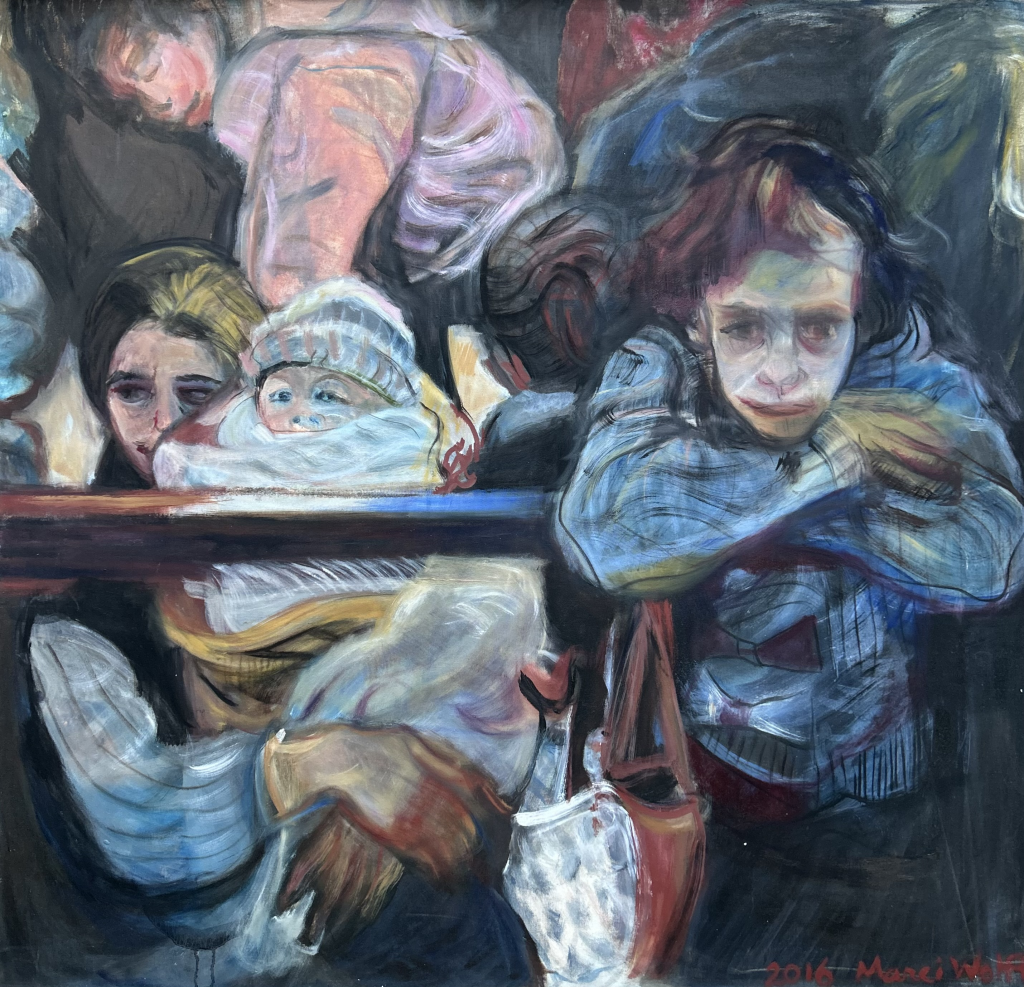
In 2016, I saw the photojournalism of these displaced refugee children at the gate in Kilis, Turkey. People were being shot as they tried to cross out of their war torn home of Syria. This photo captures kids becoming displaced people. Being a displaced person has made me an international citizen. Painting directly from the photo while changing small things like the gate colors to infuse America’s presence. I made the girl in pink to look like me as a toddler. I did change the baby’s eyes to look directly at the viewer. I was on a roll here, moving my meditation onto strangers I didn’t know. People on the news. I just so happened to be able to relate.
“At the border Gate in Kilis,Turkey” 2016. Oil on canvas. 41″ x 41″.
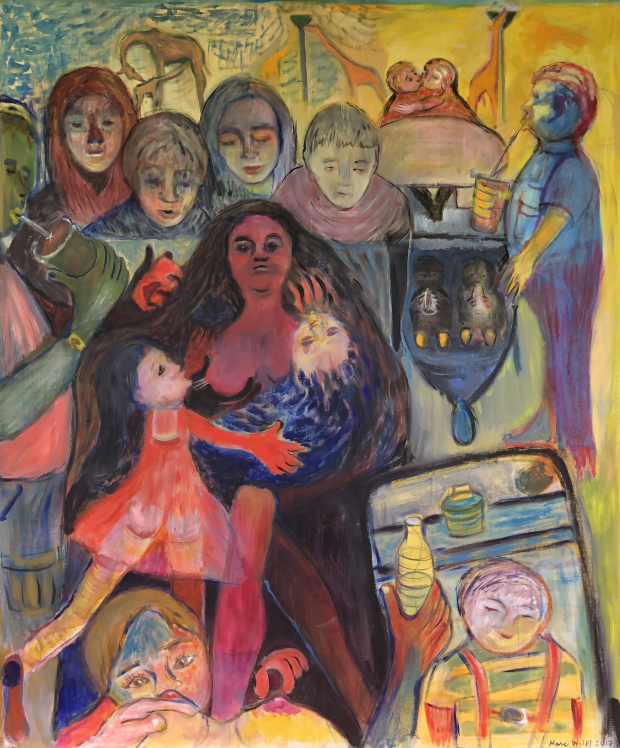
In ‘Feeding Time’ subject play with ideas of being nourished in captivity in an unnatural environment at the Wild Animal Park in San Diego. I was trying to express the absurdities, dangerous issues in American culture and realities of parenting in 2017. Child trafficking, abuse and the ridiculous standards and roles that are expected and fulfilled by mothers. Letting in those issues and risks, gave me a broader range of character to play with which was really fun. I really enjoyed designing the composition to create this cramped, foreboding space.
“Feeding Time” Oil on canvas. 67 3/4″ x 57″
Dancing brings me great joy. For me, It’s wildly feminine, spontaneous, expressive and cathartic. Dancing to DJ’d dance parties helped me get through Covid. So, when I found a photo of people doing tantric dance in the Netherlands. To me, this painting signifies freedom joy and sensual pleasures and a trust in the feminine and masculine moving in spontaneous harmony. I painted it for a public art viewing in downtown space. I wanted to make something that signaled the end of social distancing. At the same time, I liked that the men were letting the women lead them through space. It signaled to me a trust. Which, for in America, the Supreme Court had just reversed Roe v. Wade.
This dance was photographed in a very brightly lit ballroom with a bare wood floors, with random music stands and billowy curtains in the background. The color was too white, too bright and the figures were getting lost. So, I decided that blue would be a perfect color. I had been swimming and diving in the Lakes in Montana, and realized that blue of the water would be perfect balance to all the activity and detail in the figures. It is like they’re dancing underwater or in the sky, free flowing.
“The Tantric Dancers” Oil on canvas. 40″ X 60″
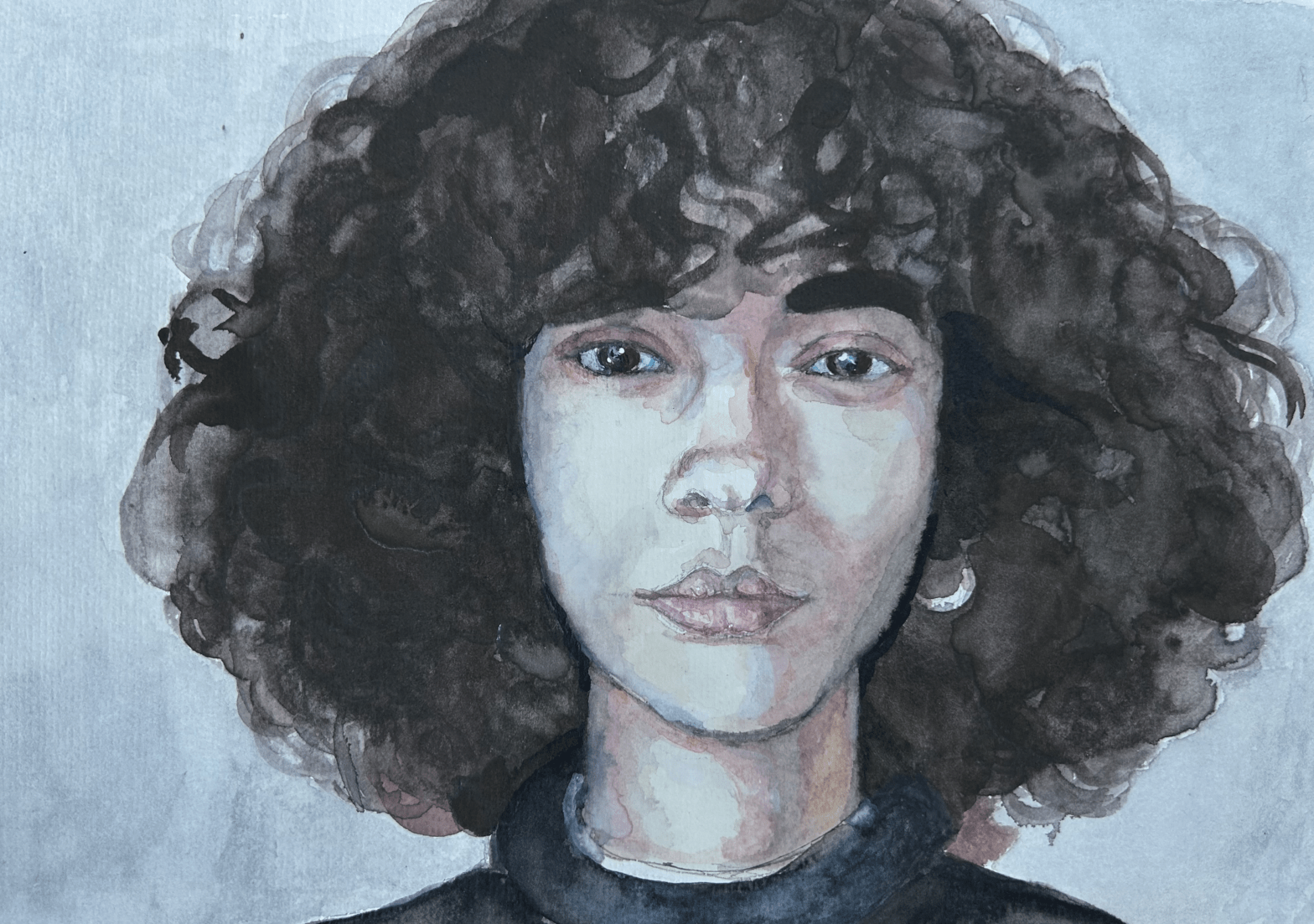
I painted a still from a YouTube video of a young Korean woman eating Korean noodles. Her name is Dorothy.
“Dorothy” (from her Mukbang video) watercolor on paper. 7″x7″
Mukbang is the art of eating Korean food as a performance for all those who click on the video. I enjoy watching these videos. And they are highly addictive and always inspire me to make Korean food. I’m not one for K-Dramas, but I am highly drawn to the Visual and audible feast. Plus I love seeing what South Koreans are eating.
When I was a little kid my first years were spent with my mom and dad until they parted ways when I was in kindergarten. Before that, I remember my mom walked a lot because we didn’t have a car. My last memory of my dad’s work was he was a taxi-cab driver in Billings, MT. I was their only child and spent a lot of time with my mom, dad, and paternal grandparents. My dad would sketch a lot and my grandfather would do Absaaloke (Crow) art by making artifacts he could sell throughout his travels in Montana and Wyoming. Art was always a part of my family’s life in some form.
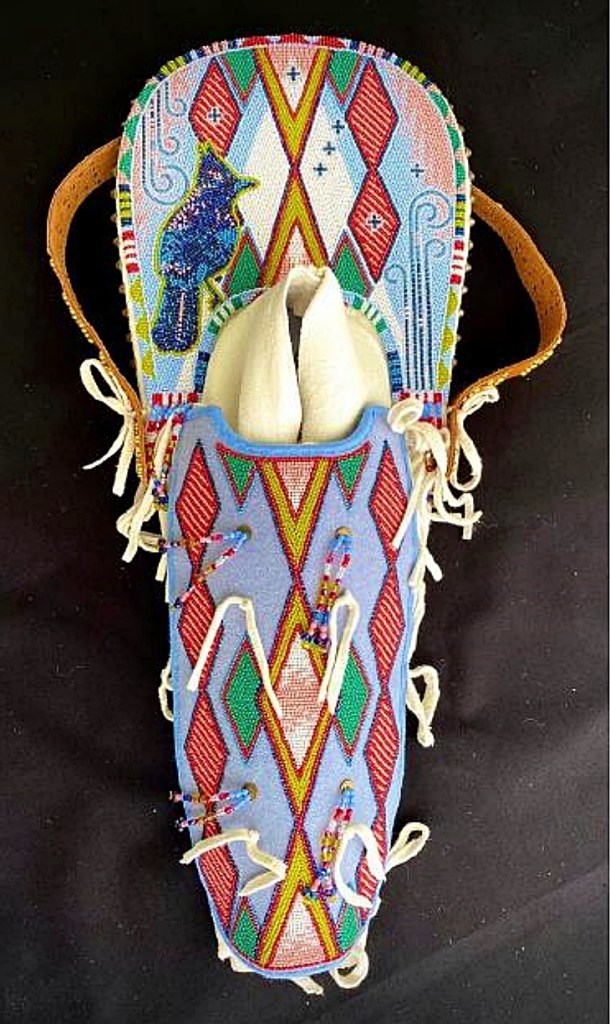
Qwasqwi, Storm, Five Friends & the Canoe (2021). 7.7″ x 1′ 7″. Red vintage true-cut, size 13 seed beads, true-cut, size 13 seed beads, deer hide, wood, cotton fabric, wool, leather, stabilizer, czech beads, nylon and cotton thread, brass tacks and spots. The first cradleboard in a series of four cradleboards, representing the four seasons. This board represents the winter season. Award: 63rd Annual Heard Museum Guild Indian Fair & Market: 1st place award in Division D-Functional objects such as bows and arrows, cradleboards, bows, weapons, shields, furniture, lamps, musical instruments, bull roarers, beaded bottles, and other objects. Exhibition: “Expressions of Resilience” at Bigfork Arts & Cultural Center showing May 8-June 26, 2021. Exhibition: “Finding Our Place: Beading and Weaving Our Culture Together” at City Scape Community Art Space, in North Vancouver BC, Oct. 8-Nov. 13, 2021. Awards 2022: Harrison Eiteljorg Purchase Award, Best of Division in Traditional Beadwork (Eiteljorg Museum), First Place in Traditional Beadwork (Eiteljorg Museum). This cradleboard is in the permanent collection of the Eiteljorg Museum.
When my mom and dad broke up, I moved with my mom to Salish country in Western Montana. For the first few years, we lived with my uncle Johnny Arlee, my aunt Joan, and my maternal grandmother Rachel Arlee Bowers. All three were prolific in their Indigenous skillsets. At the time, my uncle had his own painting business and was always out in his shop making large hand-painted signs. My aunt Joan was always doing beadwork or sewing and my grandmother did beadwork and taught at the local tribal college; her beadwork. She was also a great seamstress. Earlier than I can remember, my mom would send me with my grandmother Rachel often and she was always toting her beading supplies and beaded creations to sell.
Salish Bitterroot Story (2022), 7.7″ x 1′ 7″. Combination of vintage and contemporary size 13 seed beads, true-cut, deer hide, wood, cotton fabric, wool, leather, stabilizer, Czech beads, nylon and cotton thread, brass tacks and spots. The second cradleboard in a series of four cradleboards, representing the four seasons. This board represents the spring season. Shown at the 64th Annual Heard Museum Guild Indian Fair & Market Award 2022: Second Place in Traditional Beadwork (Eiteljorg Museum). This work is now owned by a private collector.
There were times we camped at Agne’s Camp, in Valley Creek, and she would spend summers with Agnes, helping to pass on the Salish culture. I don’t remember the earlier years but as I got older the summer was cut down to a week and my grandma would be there every year, camping out, teaching the tribal college students how to bead. I looked forward to that time and I would help her get her camp set up and do small chores so she could work. She would teach me how to bead too and I remember my first finished beadwork was a little clip-on barrette I wore with my dance regalia when I was in about 4th grade.
Felicite McDonald Digital Photograph 2021
By the time I was in high school I knew I wanted to practice art as a profession. I loved to draw and sketched on everything I was allowed to personalize. I wanted to know how to paint and I took every art class that was offered as an elective. I loved color theory and all of the challenges and assignments given to produce art. I wanted to go to art school but as I got older high school had a lot of social challenges for me; for a lot of different reasons; mainly adolescence and social factors. I was fast tracked through high school and when it came time to apply for colleges my mom didn’t agree that art would be the best declaration to pursue. I was so heart-broken but I minded and I ended up doing a lot of other things in college. I was never really satisfied with my majors, and mostly resentful of the ease that came to my classmates when they were following their career passions. I tried to stick it out as long as I could, which felt like my whole life.
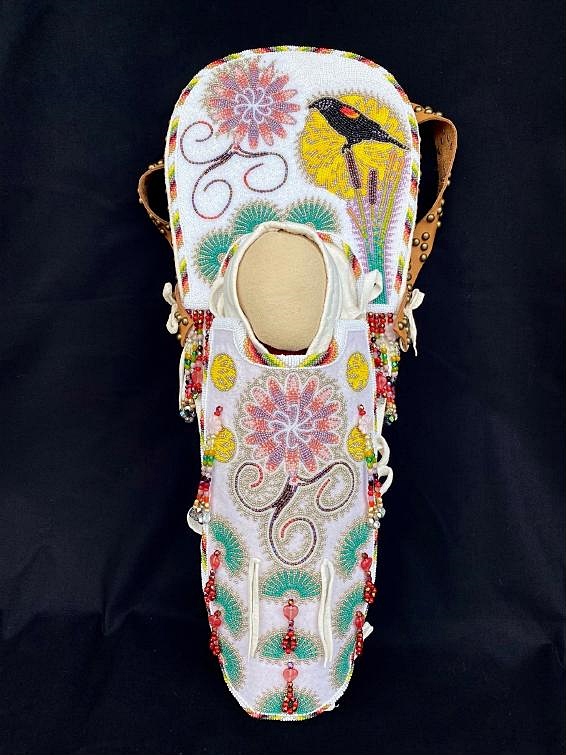
Remember That Night At Buffalo Camp (2022). 7.7″ x 1′ 7″. Red and Green vintage true-cut, size 13 seed beads, true-cut, size 13 seed beads, deer hide, wood, cotton fabric, wool, leather, stabilizer, czech beads, nylon and cotton thread, brass tacks and spots. The third cradleboard in a series of four cradleboards, representing the four seasons. This board represents the summer season. Award: 100th Annual Santa Fe Indian Market: 2nd place award in Classification VIII: Beadwork & Quillwork, Div. C: Other items, Category 3102. This cradleboard is apart of a private collection.
I feel that I’ve had a very hard adult life and I’ve somehow managed to take the road less travelled. Like everyone who takes this path, I would say I wouldn’t change my outcomes, but I get a lump in my throat thinking about everything I’ve endured to get to where I am today. I married at age 20 to a Salish man, since I had spent most of my life in Salish country. He had three daughters from a previous marriage that I helped raise. We had two sons of our own who are still young enough to be in elementary school. I used my college degrees to stay near home, in Arlee MT, but I couldn’t handle the local, you-need-to-grow-a-thicker-skin attitudes of home. I’m pretty sure I suffered from PTSD from working in a hostile working environment.
Bitterroot & Huckleberries (2021). 8.5″ x 11″ beadwork surface, not including fringe length. Combination of modern and vintage size 13 true-cut seed beads, stabilizer, deer hide, wool, cotton fabric, nylon thread, czech beads, brass bells, one plastic button. Technique is flat-stitch, two-needle, contour beadwork. Exhibition: Knowledge from Land (2021), University Center Gallery, Missoula MT Award: 100th Annual Santa Fe Indian Market: 2nd place award in Classification VII: Diverse Art Forms, Div. A: Functional objects, Category 2707. This purse is apart of a private collection
One day, I had enough. My youngest daughter was in her last year of high school and she was exploring colleges to attend. We went to a college visit with her in the spring and we sat in on the art major session. I remembered my existing broken heart from not being able to pursue art as a young adult. When I got back to work, I had a really bad day and decided enough was enough. I found out the University of Montana was beginning its first cohort of online art degree program majors and I enrolled. I took as many classes as I could handle, quit my job and got a different job. I worked full-time and took online classes until eventually I finished the program in 2021 and I finally got an art degree. I don’t think I’ve ever cried so much, throughout those few years, realizing that I should have put my foot down and did art school from the start.
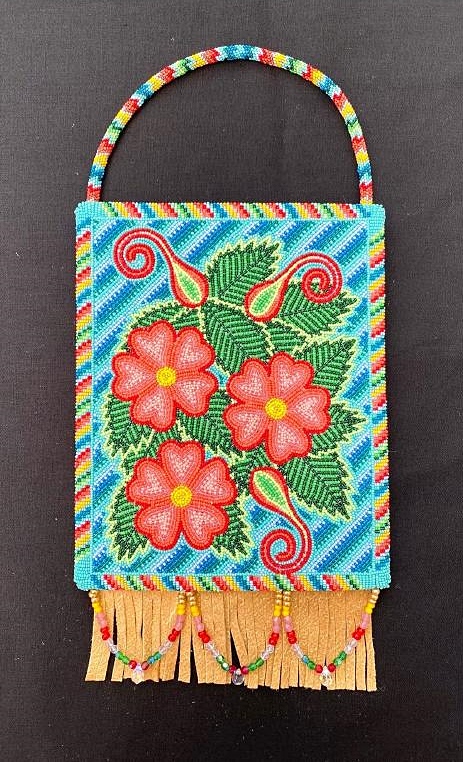
The Roses We Know (2023). 13″ x 6-3/16″ x .25″. Technique is flat-stitch, two-needle, beadwork. Materials are true cut, size 13 Czech modern and vintage seed beads, brain-tanned smoked deer hide, glass and crystal beads, nylon cord, stabilizer, thread, and cotton material. This purse shows the images of wild roses that grow in Western Montana. The plant is significant to the Bitterroot Salish people as the blooming represents the buffalo are fat and ready to hunt. It is currently in a virtual exhibit, “Stories From Bead Night,” hosted by Carrie McCleary and her Plain Soul beading group, Rock Your Beads at rockyourbeads.com. This purse now belongs to a private collector.
Towards the end of my degree program, I was finally able to do more extensive exploration into art that I was hoping to strongly focus. I was sad that I didn’t know much about being a professional artist so I soaked up any advice I could along the way—I’m still a beginner. I wanted to continue to do beadwork and also was very happy to get a formal educational background on art history. It helped me to better understand genres of the artworld as well as where I found interest. It turned out that all of my time before art school was not wasted. I used a lot of my educational background to express my interest in the type of art I like to create.
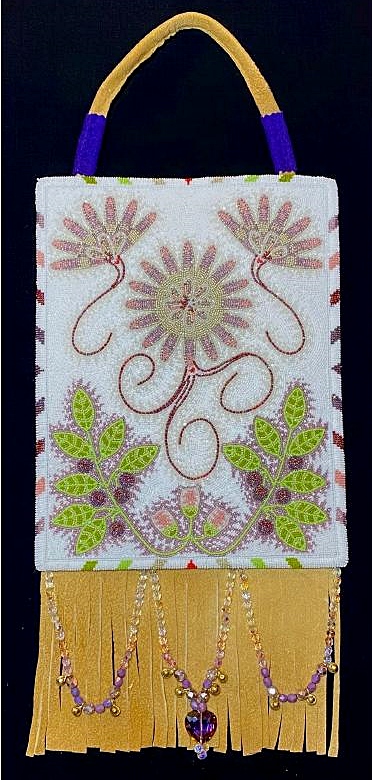
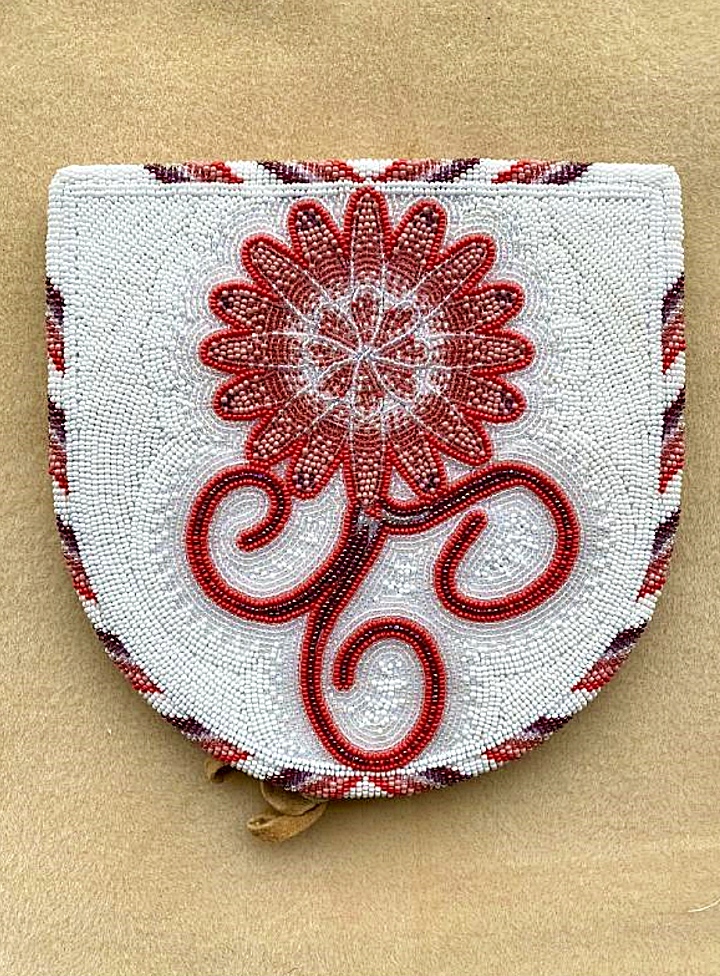
Salish Bitterroot Back Bag (2022). 6in. x 6 in., Size 13 true cut Czech beads (combination of modern and vintage). Brain-tanned, smoked, deer hide, nylon thread, stabilizer, and paper. This bag is in the permanent collection of the Montana Museum of Arts and Culture.
I like to focus on Indigenous knowledge and I like the idea of using empowerment to overcome systemic and racial oppression. The environment is most interesting and I try to express ecological concepts in my work, especially the beadwork. I enjoy lots of aspects of my culture, but feel that getting a formal education gave me a leg-up in life and it opened doors for me when I least expected it. Throughout my educational experience, I connected the idea of place-based learning and Indigenous ways of knowing. I believe that when a person is aware of their environment they can grow intellectually and pursue life beyond their basic needs—they are grounded and secure.
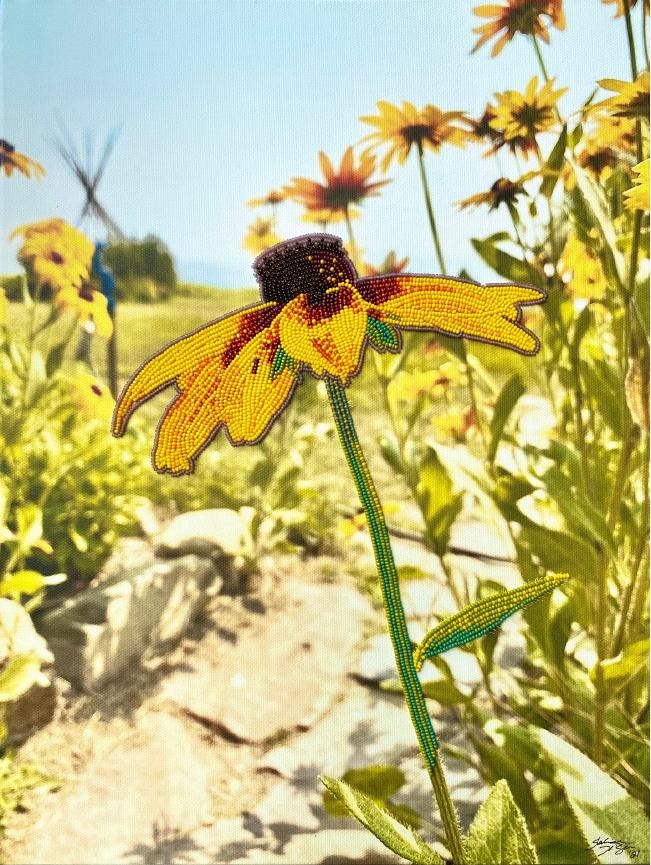
Susan At Thunderhead (2021). 12″ x 16″ original photograph and beadwork on canvas. Donated to Open Air for fundraiser.
Although beadwork is my go-to creative expression, I enjoy painting, drawing, and I aspire to improve my photography skills; I sometimes attempt to mix these medias. The past few years I’ve checked off some huge bucket list items, the biggest one being to participate in the Santa Fe Indian Market. Since 2021 I’ve found joy in participating in Indian Markets and learning how to make time to produce smaller items to vend during the market. It’s intense and physically challenging but I enjoy meeting Indigenous artists I’ve admired for years and having the honor of having artworks amongst the “greats.”
Indigenous Bitterroot Land 25” x 18”, Collage and beadwork on canvas 2021
In the future, I hope to calm down a bit and get a better handle of the business end of things. I hope to continue to grow artistically, continue to create art in a cultural sense, and to continue to support my family in this way. At the end of 2021 my husband got a new job and we moved part-time away from Arlee. But when that happened, we agreed that I would give it 100% to pursing professional art full-time. I’ve been doing this and slowly learning how to network and become more knowledgeable about the financial part of the deal. I’m thankful for my husband’s support of my journey and attribute his support to much of my ability to follow-through with life, up to this point. I’m also very thankful for the chance of being born into a family that valued art as a way of life.
Indigenous Hillshade (2020). 24″ x 36″ acrylic on canvas. Shown in the “We are Still Here and this is Our Story” exhibition in the Emerson Center for the Arts & Culture in Bozeman, Montana .
I know that I cannot change the past but if I had to give a small bit of advice, I would say that dreams are always worth pursuing. Hard work, consistency, belief in yourself seem to be at the core of carrying a dream. I’ve wanted to give it up a few times, but I stop and remember things I’ve heard other artists say, such as having hard times and easy times along the way. I know that if I can live a life that I didn’t want for so many years, I can definitely commit to a life I really want and do my best to be accountable to myself and to my children. I love creating art and I’m certain this is how I will live the rest of my life.
John Pelko on Florals Hard sketch crayon on heavy gift-wrapping paper 12 in. x 14 in. 2019
SALISHA ANNE OLD BULL ART, PHOTOS ANDWRITING IS AN AUTHORIZED DUPLICATION WITH PERMISSION AND EXPRESSED CONSENT
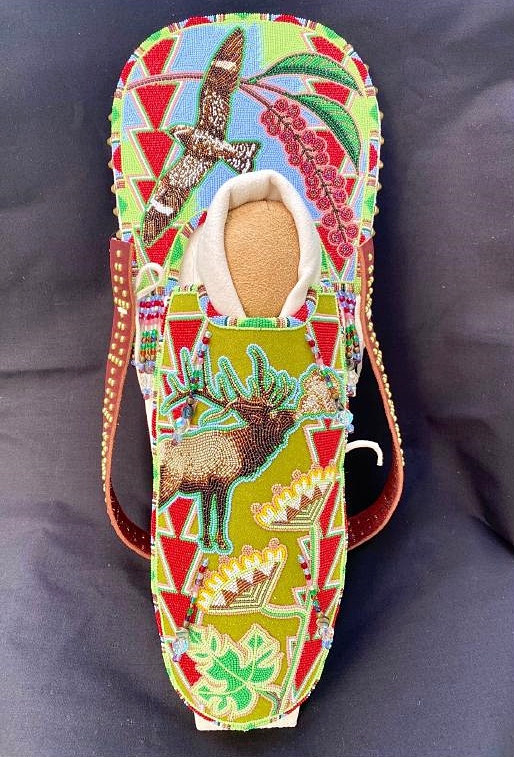
Feature photo:Signs of Autumn (2023). 7.7″ x 1′ 7″. Vintage and modern true-cut, size 13 seed beads, deer hide, wood, cotton fabric, wool, leather, stabilizer, glass beads, nylon and cotton thread, brass tacks and spots. The fourth cradleboard in a series of four cradleboards, representing the four seasons. This board represents the autumn season. Award: 65th Annual Heard Museum Guild Indian Fair & Market: Honorable Mention award in Division D-Functional objects such as bows and arrows, cradleboards, bows, weapons, shields, furniture, lamps, musical instruments, bull roarers, beaded bottles, and other objects. This work is now owned by a private collector.






 Mitchell Pluto