Brian J. McVeigh Decluttering My Mental Space

Decluttering My Mental Space

Collected Poems with Commentary

Brian J. McVeigh

My first encounter with haiku was not out of a love for poetry; rather it came from an educational motive. Many years ago, I was tasked with teaching Japanese students English. This was a bit of a challenge as the students had been taught what is pejoratively called the “grammar translation method” (emphasizing grammar rules; memorizing words as if each one only had a singular definition; focusing on error avoidance; rote exercises; testing for “only one correct answer”). Such a pedagogical approach not only instilled a fear of making mistakes but socialized students to see language learning as a terribly unimaginative enterprise. In an attempt to wean students off such a view, I had them translate Japanese haiku into English and English haiku into Japanese, hoping to impress upon them the inherent creativeness and flexibility of language. Most appreciated the purpose of utilizing haiku, though a few objected, apparently more comfortable with the unnaturalness and rigidities of textbook tutelage.
I also relied on haiku for another reason related to education that is a bit more involved. As I explain below, in one section of Interpreting Japan: Approaches and Applications for the Classroom (2014) I analyzed the aesthetics of haiku in order to show how ideas are built through sensory experiences. Haiku rely on perceptual immediacy to highlight an intuitive insight, thereby succinctly crystallizing a point. As such, they illustrate a crucial aspect about how human cognition operates and symbolic thought is created, i.e., the complex interplay between perception and conception. In other words, like other artistic expressions, haiku demonstrate how corporeal experiences facilitate looking at the world from a different angle, and sometimes that novel perspective possesses intellectual import.

The Body in the Mind
How do we come to believe or feel that something is true? To a large degree people are persuaded through aesthetics, and an appreciation of aesthetics emerges from bodily experiences and perception. Aesthetics is deeply implicated in what we think, how we interpret the social and natural environment, and the very words we use to communicate complex thoughts; this even includes super-abstract mental terms describing subjective introspectable self-awareness (i.e., consciousness as defined by the psychologist Julian Jaynes). In other words, the ideological and imaginary are grounded in physiology and embodied experiences.
We can categorize psychophysiological processes into sensate and ideational processes. The former has to do with what is seen, heard, felt, smelled, or tasted. It is the objective, perceptible world that comes to us through our senses. While the sensate is the experiential, the ideational refers to the conceptual; this form of knowing is not directly perceived through the senses (it is reasonable, of course, to argue that emotions are “felt,” and certainly strong affect is a physiological as well as a cognitive experience).
The sensate and ideational become linked in an individual’s psyche and mutually work together. We might say that the body is good with which to think. Sensate experiences are transformed into the ideational dimension, which in turn implicate different aspects of our corporeality: bodily parts (e.g., the belief that one’s personal essence is in one’s heart or head); spatial orientation or how the body is positioned in relation to objects and others (e.g., the universal assumption that what is up is always superior to what is below); interoceptive or internal sensations (experiences used to construct mental words as theorized by Julian Jaynes).
The relationship between the sensate and nonsensate is complex, but if simply stated, it may be viewed in the form of a two-tiered structure, with nonsensate knowledge generated from the senses. Perceptual experiences are borrowed to build nonsensate knowledge. Our mental worlds are based on the interchange of qualities of the corporeal and the cultural. Bodily experiences and the qualities of concrete things, then, become associated with belief. We do not and cannot just “think;” we can only think “of,” “about,” or “with” something borrowed from our interactions with the world. It is, therefore, the tangible and observable which is essential in defining our experience of mental events.

The Sensate and Ideational Dimensions of Symbols and Metaphors
Important symbols⸺religious icons, political emblems, commercial logos, key words, a meaningful piece of writing such as a poem⸺work their magic by having their perceptual aspects reinforce their ideational aspects and vice versa. In this way certain representations become powerful motivating mechanisms that influence behavior and beliefs. This was the great insight explored by the anthropologist Victor Turner.
Nonsensate knowledge is built upon and through sensate experiences via semantic shifting, i.e., metaphors. This is a type of knowing that is “from” but not “of” the senses, i.e., nonsensate knowledge refers to ideas that are not directly tied to or shaped by the immediate perceptual environment. Indeed, our conceptual processes are fundamentally metaphorical. The capability to organize experience and order our ideas of the world using tropes means that metaphor itself is a perception, just like seeing, hearing, touching, tasting, etc. Thus, metaphors (and their various cousins, such as similes and analogies) do not only give us a way of conceptualizing a preexisting reality, nor are they merely a matter of language; metaphors do more than just describe since they structure our engagement with the world.
The visible material world of things and objects interacts with the invisible, abstract realm of ideas and feelings. The exchange of these aspects is important because it reifies a symbol’s meanings, thereby adding to its persuasive power. This linkage sometimes involves a certain degree of “shouldness.” In other words, moral messages acquire a sensory immediacy and compellingness. This resonates with Ludwig Wittgenstein’s dictum that “ethics and aesthetics are one and the same.” The ideational (values and meanings; normative; proclaiming a prescriptive point; moral imperatives; obligations; what we need to do) becomes associated with the sensate (feelings and emotions; longings; appeals to our animal spirits; corporeal desires; the desirable; what we want to do).

Exorcising Demons
I decided to compose poems not because I wanted to write poetry, but because I felt coerced by personal demons kicking up psychic fragments that littered my mind. In some cases, it was a desire to rid my head of old and odd whisperings inspired by haunting “half-experiences” (dreamy, barely remembered memories that may or may not recount actual events), some of which have been with me since very early childhood. In other cases, I felt compelled to describe a scene whose sublimity unsettled me. “Therapeutic” might be too strong a word, but it is in the neighborhood as it describes why I wrote these poems.
Originally, I composed poems using the traditional Japanese haiku pattern of 5 morae/7 morae/5 morae (morae are not exactly syllables, e.g., in English a long vowel is counted as one syllable, but in Japanese it is considered two morae). I found the 17-morae pattern restricting, as was the convention that a Japanese haiku should contain a seasonal reference (kigo). Then I tried American-style haiku (lunes), both the styles developed by Jack Collom (3 words/5 words/3 words) and Robert Kelly (5 syllables/3 syllables/5 syllables). With a few exceptions, I settled on Collom lunes.
This short collection is categorized by themes (the poems lack titles) and curated from different versions of poems (the number of variants is indicated in parentheses). From these versions I selected my favorites and put the rest in storage. I have included commentary to illustrate the interchange between the sensate and ideational. While some think such an analysis detracts from an enigmatic vagueness and is overly clinical, my remarks are part of an attempt to calm troubling mental rumblings that, while not plaguing my mind, have to a degree preoccupied my thoughts.

The Collection

Enchanting Sound

Young boy points
To plane’s drone amid stars.
Listening to mystery.

I begin with this lune because several of its elements reappear in several other poems below. It emerges from a very old memory. I was quite young, perhaps a toddler, standing in an alley on a cold, clear night and I stopped to look up, captivated by the source of a strange sound in the dark, inky heavens. To this day I still associate the sensory experience of the humming drone of a distant plane with the unsettling curiosity of faraway, bewitching places, both geographical and within my psyche.

Listening to the Infinite

Toward the horizon
A droning, wraith-like plane edges.
To hear eternity.

This lune echoes the sentiments of the previous one. The perception of droning is both primal and transcendent, beautifully haunting but melancholy; it is listening to the music of the infinite or being allowed to eavesdrop on another, unearthly dimension. Visually the horizon leads to thoughts of foreverness. The plane is barely visible from earth, making it ghostly and making me wonder if it is really a man-made flying contraption or a gliding winged-spirit from another sphere of existence (three other versions).

The Sky Limitless

Boundless blue sky
Swallows up a tiny plane.
The vast infinite.

Another echo of the very first lune. This one does not include any reference to droning, but the plane’s existence implies it. In any case, one day I realized how the gentle pulsating resonance and unbounded, horizonless sky merge sound and spatiality into the same fabric of reality. The celestial domain, taken in by the eyes, suggests the abstract idea of the infinite, which leads to notions of insignificance, i.e., the solitary plane is lost, absorbed by the cosmos. Or the plane may represent the soul of each individual, confronting the overwhelming awesomeness of the absolute, tunneling through reality, pushing on through the universe on some unknown trajectory (three other versions).

The Forest Stares Back

At wood’s edge
Dog and master intensely stare.
Both are awed.

Though “night” and “dark” do not appear in this poem, it describes a wooded area in a misty evening, made ghostly white by snow covering the tree branches. Not only the human, but even his dog senses an otherworldly presence deep in the forest that keeps an eye on passersby (two versions).

The Race of Life

Gunshot, heavy panting.
Track curves, a finish line.
Life’s a race.

Even during an intense, high-pressure spurt of physical energy, the psyche finds a way to give other meanings to whatever we are doing. While competing in a high school track event my mind couldn’t resist searching for other interpretations of my bodily movements. Other versions of this poem describe chasing the “blinding sun” (i.e., interfering with focusing on some objective) and “finish line in sight” (i.e., meeting a challenge; about to reach an important personal goal; persistence pays off). Also appearing in other variants were “running within lines,” signifying the value of playing fair with others, “staying in one’s lane,” and maintaining appropriate boundaries (two other versions).

The Moon Goddess Visits

Moon Goddess descends,
A divine visit⸺great honor!
A mere dream.

This is based on an event that was probably the closest thing I’ve ever had to a religious experience. It is inspired by an actual dream I had in my late teens: I was in an iridescent pasture that could be accessed by a gate located on the street on which that my grandparents lived. In the dream the full moon suddenly floated down from the sky and transformed itself into a half-moon shaped boat. Riding upon this shimmering lunar ferry, with whitish, willowy sails, was a translucent, alabaster-skinned moon goddess, who appeared as if she had been lifted from a Wedgwood Cobalt Blue vase. I felt humbled and privileged to have received such a visitation. Surely, I concluded, such dignified beauty must have something of great import to deliver to me. But I was sorely disappointed when I awoke before she could convey to me any great revelation (one other version).

A Summer Night’s Swim with Spirits

The pool’s waves
Reflect on leaves of trees.
Ghosts dancing above.

A dip in a cool electric-blue pool on a quiet, sultry summer night is made more interesting when one’s senses are persuaded to see spirits manifested as flickerings and glimmerings. The gently lapping water project light onto the canopy formed by trees, conjuring up a spectral show.

Pool, Sky, and Soul

Under blue sky,
In placid water body floats.
Soul at peace.

§

The pool below,
Reflects cloudless blue sky above.
The infinite mirrored.

§

Sky above,
Pool below.
Soul between.

The first lune of this theme depicts me lying on my back on an inflatable lounge and looking up at the shining azure sky. I could see nothing but blueness, and this mirrored how the utter calmness of the soothing water had emptied my mind. Any thoughts were now “see-through,” i.e., I was cognizant of them but somehow distant from them. A profound restfulness and tranquility overcame me; meditation without trying (one other version). The second and third poem describe a spatial encapsulation of the totality of all existence. The pool is an earthly, this-world microcosm of the sky, which is the boundless empyreal macrocosm. Somewhere between “the above” and “the below” is the individual soul, an imperfect reflection of allness that futilely attempts to capture and control ultimate reality.

The Hall of Holiness in My House

At hallway’s end
The door strangely beckons me.
Night of revelations.

§

Dark hall,
Door beckons.
A presence.

If the hallway’s lights were off in the house I grew up in during the evening, walking to my room sent a chill down my spine. The hallway was long. And for some reason seeing the darkness behind my half-opened bedroom door instilled within me a sense of a numinous “otherness” waiting for me, a sacredness possessed of something waiting to be conveyed.

Running Alone at Dusk

Rolling green hills,
A golf course at dusk.
A lone runner.

Not far from my house was a municipal golf course in which I ran in the summer while in high school. I would have to wait until dusk, when most golfers had finished so as not to get beaned in the head by a stray golf ball. Not having anyone around afforded me an exhilarating freedom; no gazes from others, no cars or people to dodge as on the street. Being with myself among the manicured hilly lawns that stretched far in the distance made me feel small and effaced my ego, but in a reassuring sense. Like blue, green has an inherently comforting effect.

Walking Home in Winter

Walking, snow crunches,
A glowing warmth from windows.
Night cloaks me.

When in high school a bus would drop me off at a corner and then I would have to walk about a mile to my house. The walk was pleasurable, as I usually felt satisfied after a long day at school, and what seemed like an even longer workout for indoor track. Sometimes it was so cold that the snow made a funny squeaking sound with each footstep. The windows of each house emitted a reassuring yellow-orangish radiance. The contrasts of wintriness versus warmth, others versus myself, and darkness versus luminosity brought to mind indifference versus protection, exposure versus privacy, and the unfamiliar versus the welcoming. I wondered what went on in each household and if anyone could hear my squeaking footsteps. But I wasn’t too concerned as I felt anonymous, shrouded as I was by the night.

Pumpkin Patch and Graveyard

Side by side,
Orange pumpkins and grey tombstones.
Souls born anew.

I was in Massachusetts on a brilliant autumn day walking down a country road when I noticed a white fence separating two fields. In one were old gravestones, while in the other were growing finely ball-shaped pumpkins. The positioning of the fields cried out “the deceased are reborn as orange orbs!” I knew I was seeing death and the promise of rebirth in one glance⸺the circle of life. When I asked my wife to comment on this scene, she also noticed the juxtaposition, observing that the departed are granted new life (four other versions).

Grateful for Dinner

Silently she cooks.
Cold night in the city.
Warm meal arrives.

§

Hair pulled back,
Wife in a steamy kitchen.
Long day ends.

For many years I lived in Tokyo. This metropolitan monstrosity’s unnerving hustle and bustle, commuting crowds crammed onto public transportation, harsh neon nightscape, and surprisingly chilly winter nights could be draining. But my wife’s support and cozy apartment greatly assuaged my tired nerves. Preparing a meal without speaking hints at uncomplaining, while hair pulled-back suggests being ready for culinary action. Both lunes employ contrasts to drive home perceptual elements, though in the second poem they are only implied: cold versus warm, steaminess inside versus iciness outside. And both poems close the sensate–ideational divide by denoting how nourishment for the body signifies sustenance for the spirit (two other versions).

Coyote Eyes

Coyote eyes float,
My eyes must glimmer too.
I’m the ghost?

§

Walking at night.
Coyote eyes glow and glide.
Vanish like ghost.

Almost every night, when I walked a trail near our home in Tucson, I would see the eyes of coyotes looking back at me. Their eyes drifted, like small fireflies in the darkness. I often wondered what their sighting of me triggered in their minds (two other versions). The first lune highlights the hovering eyes of a creature, but these had the human experient think that undoubtedly the owners of those optical red beads are carefully observing him. In the second lune the darting eyes in the darkness invoked idea of how the night is full of unknown beings.

Praying in the Desert Night

To starry skies,
Hillside cacti lift their arms
In reverent prayer.

§

To saucer moon,
Man-shaped cacti raise their arms
In worshipful pose.

Another sight that captured my imagination in the desert were all the cacti crowded on hills, shaped like men, with their limbs held up as if praying; nature in an act of self-reverence. Person-shaped plants pointing to the beauty of the full moon or the star-studded heavens aroused within me the idea that there is more going in the world of nature than meets the eye (four other versions).

Observing Mountains

Walking toward mountains,
They look down at me.
I am judged.

§

At path’s end,
Observant hills trace my trail.
Guarding ancient wisdom.

§

Towards small mountains
I walk a giant ribbon.
Life lies ahead.

Besides spectral coyotes and reverential cacti, low-lying mountains and rolling hills also seemed to have an animistic presence. At the trailhead of a long path I used to hike were foothills and peaks whose grave and dignified immobility made me feel as if they were carefully watching me as I approached them on foot. These daily walks were spontaneously meditative (an opportunity to ponder my own life’s journey), and the gaze of mounds, perhaps protecting age-old wisdom filled me with a measure of humility, as if I were being interrogated by the desert landscape as I trekked out my narrative (three other versions).

Metallic Birds of the Urban Night

Helicopters circle above,
Chopping air, beams slicing darkness.
Trouble brews below.

The skies of southern Arizona, for whatever reason, always seemed to be abuzz with police, military, and other types of helicopters. One day, like a giant metallic bird, an ambulance helicopter landed in front of our house to take away an individual thrown from his ATV as he was racing up and down the street. From our house we frequently could hear and see what were presumably police helicopters in the evening, circling over an area and using their searchlights to pierce the night and shed light on the disturbance on the ground; perhaps a fleeing fugitive, a robbery gone wrong, or a car chase (three other versions). In a dream the cutting noise of the blades became the flapping wings of a flying dinosaur wearing a shiny crown, searching for its prey on the ground.

Heaven’s Special Show

Flying at night,
Lightning—giant cotton balls ablaze.
What earth misses.

“Flying through lightning” does not sound very inviting. “Flying above lightning” sounds a lot better, and one night I had the opportunity to witness billowing clouds on fire stretching toward the horizon. It looked as if the gods were at war, hurtling lightning bolts at each other that exploded behind banks of bulging clouds. Or as if celestial sky spirits were putting on an awe-inspiring performance just for us passengers. I thought about how people on the ground, fast asleep, were obliviousness to the stunning lightshow far above their heads. All this exciting razzle-dazzle made me ponder about how we can be totally unaware of places and spaces pregnant with spectacle, whether earthly or heavenly (four versions).

Dog Dreams

A busy intersection,
A dog looks to cross.
In which direction?

§

Dog close by,
Soulful eyes look at me.
Furry four-legged loyalty.

§

Slumped on couch,
Furry friend frets and whimpers.
A dog dreams.

The first lune of this theme pivots around the perceptual act of looking, but implicates some indecision and choice that require deliberation, as if the dog were planning his day amidst the comings and goings of others. In the second lune physical nearness, the touchability and softness of furriness, and the connecting power of eye contact evoke the ethics of unquestionable dependability and faithfulness. In the third lune movement and sound—sleeping, twitching, whining—suggest unseeable canine thoughts. All three poems attribute a sophisticated psychology to dogs. Of course, animal minds are different from those of humans. But we still anthropomorphize animals, especially our pets. We cannot truly know the mind of a canine, any more than we can completely understand the thoughts of another human being (though obviously in the case of the latter we actually understand a great deal). And yet a primitive bond ties us to our dogs. These creatures, grounding us with their pure, unadulterated affection and unconditional acceptance, are humanity’s most secure connection to the nonhuman world of nature.

The Observing Grandfather Clock

The staring face
Of the old grandfather clock.
I’m being watched.

Humans instinctively anthropomorphize objects, natural and made-man. I do not have a clear memory of seeing a particular grandfather clock that appeared animated. But through the years anytime I see one I can’t help but see it as somehow possessed of life. Their round face, imposing height, and distinctive “voice” heard as chiming make them seem as if they are alive. These tall timepieces tell two types of time, that of the hours and that of the passing hours and days of those the clock silently watched over for many years. Certainly, these standing time tellers have witnessed so much over the years that, having absorbed the life energy of others, they just might come to life (one other version).

written by ©Brian J. McVeigh

Brian J. McVeigh has an MA and a PhD in anthropology from Princeton University, as well as an MS in counseling. He is interested in how the human mind adapts, both through history and psychotherapeutically. Inspired by and using the theories of Julian Jaynes as a theoretical framework, he has published 16 books on the history of Japanese psychology, the origins of religions, the Bible, spirit possession, art and popular culture, linguistics, nationalism, and changing definitions of self, time, and space. He has lived and worked in Japan and China for many years, taught at the University of Arizona for ten years, and now works in private practice as a licensed mental health counselor.

Licensed Mental Health Counselor, Private Practice. BA Asian Studies & Poli Sci, MA Anthro, MS Counseling, U at Albany, State U of NY; PhD Anthro Dept, Princeton U. POSITIONS: Asst Prof, Kōryō International College, Nagoya; Assoc Prof, Tōyō Gakuen U, Tokyo; Dept Chair, Tokyo Jogakkan College, Tokyo; Dept of E Asian Studies, U of Arizona; Behavioral Health Counselor, St Peter’s Addiction & Recovery Center

Books by Brian J. McVeigh

Brian J. McVeigh Website

WRITTEN BY BRIAN J. MCVEIGH ALL RIGHTS RESERVED. ALL WRITING IN THIS POST IS A COPYRIGHT OF BRIAN J. MCVEIGH. THIS AN AUTHORIZED DUPLICATION WITH PERMISSION AND EXPRESSED CONSENT

Feature Photo by Mitchell Pluto

Tadeusz Baranowski Non-Obvious Painting

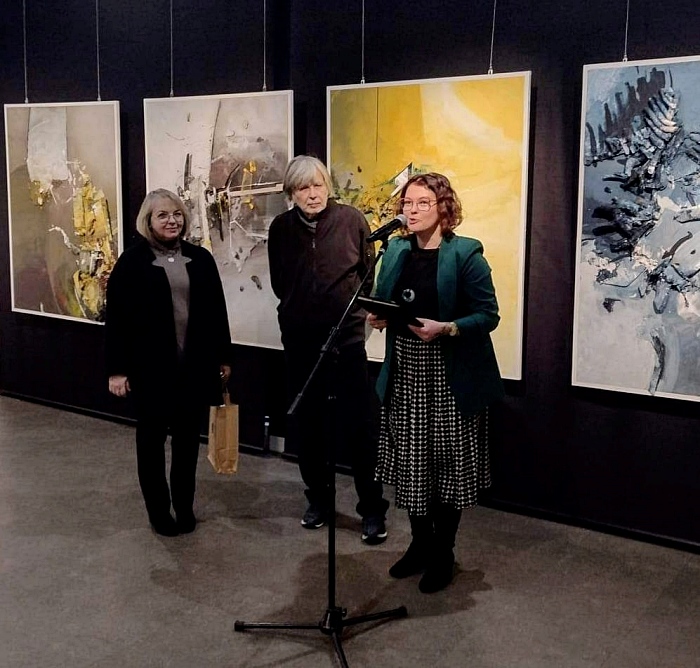
In November 2022 I invited Tadeusz Baranowski to talk a little bit about his life and his work. Tadeuszu graciously accepted which I am very grateful for, his thoughts on his life and abstract painting can be found here in Hidden Motion.

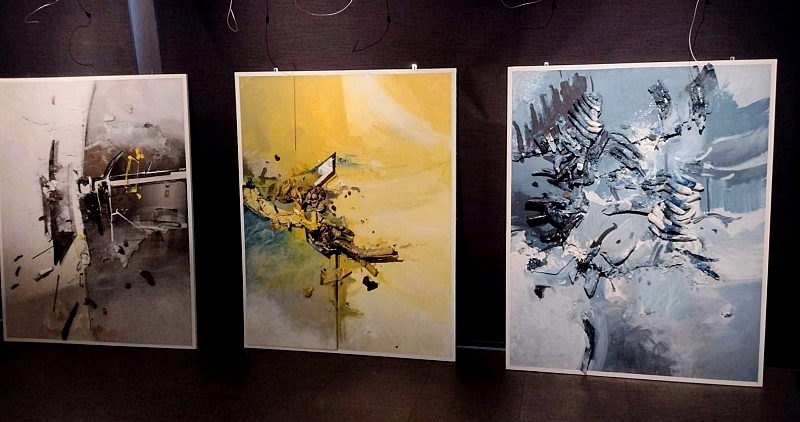
Tadeusz’s 2023 show organized by the Auschwitz Culture Center. Poster by Jarek Składanek

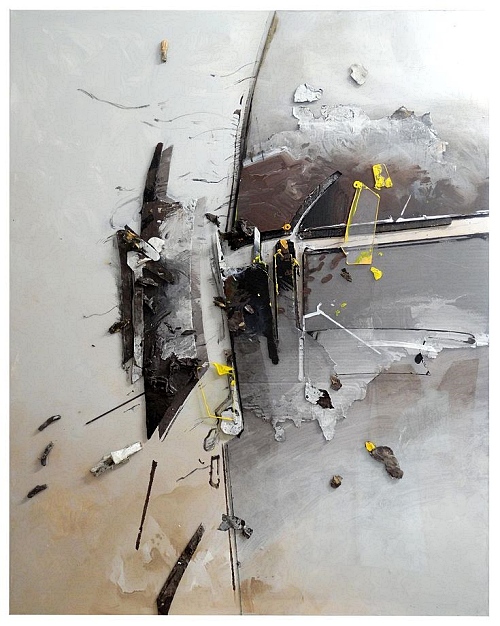
While known internationally for his original comic books, Tadeusz also paints Non-Obvious Painting that emphasizes free and spontaneous appearing expressions. Tadeusz’s paintings are deliberately built by a technique that uses wood, fabric, polystyrene, acrylics, and oils. One painting sometimes takes many months.

I spent several hours looking at Tadeusz’s work which I found universally appealing. Abstraction has a reputation that is not clearly understood like understanding quantum foam, synchronicity and the the nature of nothing. I think Tadeusz Baranowski’s paintings are a release of energy in a still life. There is no narrative or conventional images. There is a sense of time somewhere. The paintings convey a space scape with unidentified forces. These interactions influence the surface and time that contains them. Usually these tensions are dynamic, sometimes explosive, but firmly positioned so we can consciously see them. When I look into these paintings I apprehend different emotional and cognitive states. Each painting is worth meditating on.

Through our correspondence in email Tadeusz and I immediately found we shared a common love and respect of nature. Tadeusz mentioned trips to the Masurian country with his wife Anna. He said he currently lived next to a forest near Warsaw, Poland. Tadeusz considers himself a lone wolf in the universe. He enjoys swimming as a contemplative activity. A prolific amount of nature photos can be found on Tadeusz’s Facebook page. The photos capture a rhythm and pattern of nature. I speculate Tadeusz’s photos of flowing water, broken trees, flowers and insects may have provided a scaffolding or study for his paintings. Tadeusz Baranowski’s show was curated by Magdalena Grochowska and will be shown from February 10th to March 14, 2023 at the Oświęcimskie Centrum Kultury

Director of OCK, Monika .wi ,tek-Smrek, curator Magdalena Grochowska and Tadeusz Baranowski

Tierra Profunda Rene Ortega

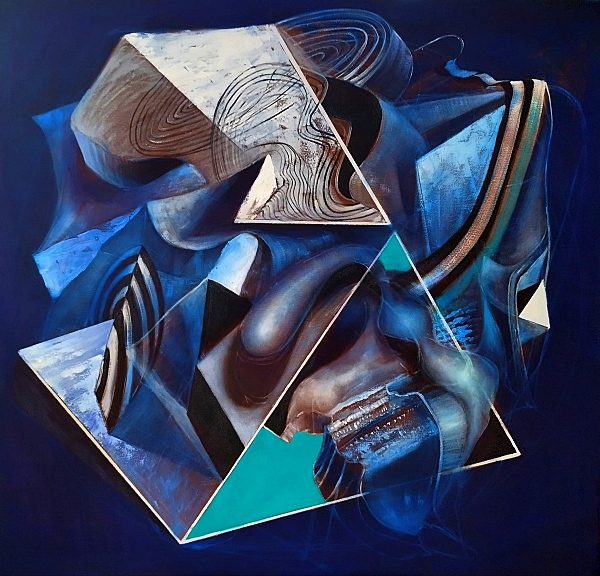
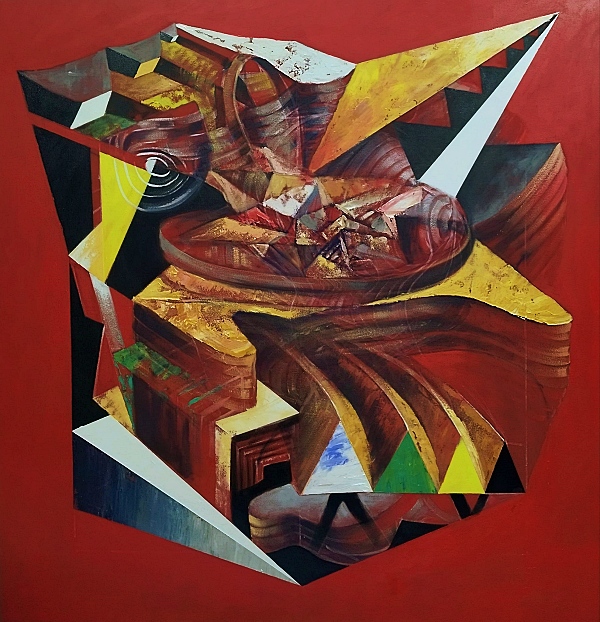
René Ortega utiliza fórmulas de liminalidad para iniciar al espectador a experimentar los misterios del inframundo. Hay una puerta de flores, una escalera de anillos a túneles, afinada con un aro de colores. Todo esto está aquí dentro de los secretos de nuestra tierra. En estos pasos buscamos un centro que ya es un estado completo, un lugar unido por los opuestos e igual a sí mismo. René agrega esquinas al círculo giratorio para crear una faceta para ver otros espacios y otros tiempos.

Mitchell Pluto

TIERRA PROFUNDA

Mi enfoque se enfatiza en la búsqueda de las respuestas transcendentales las problemáticas ecológicas y sociales de la humanidad que enfrentamos actualmente.

Con mis obras pretendo hacer conciencia para situar al ser humano como parte importante de la naturaleza es el volver encontrándose con muestro yo interno y nuestros sentidos que se encuentran en un estado dormido es el volver a mirar y observar como un niño para situarnos en las profundidades de los infinitos subsuelos y planos de tierra imaginaria de mundos micros organismos vivos subterráneos que se transmutan constantemente en máquinas orgánicas voladoras y así te llevo transportándote a mi imaginario poético donde danzan líneas interminables y planos de vida que se juntan y separan al mismo tiempo incansable búsqueda de lo desconocido como las estrellas y la naturaleza transmutando a infinitos planos profundo de colores y formas que voy realizando atreves de esta incansable y cambiante movimiento y sonido de la vida.

Escrito por ©René Ortega

Rene Fernando Ortega Villarroel

René Ortega, fue uno de los ganadores en la bienal internacional de arte contemporáneo 3 de octubre de 2022. René ha expuesto obra en Chile y Argentina. Está involucrado en muchos programas de arte cultural que se han relacionado con hospitales, niños y la enseñanza del arte profesionalmente. Su muestra más reciente fue Mental Labyrinths en la galería de arte del Centro Cultural Til Til el 18 de junio de 2022.

“Mi preocupación es la figura humana como sentimiento de estados primitivos e irracionales, cuyo punto principal son las cabezas, pensamiento universal de la creación del hombre y centro del universo. Todo ello condujo a una mutación del lenguaje plástico y pictórico”.

Voyeur Rising by Richard Gessner

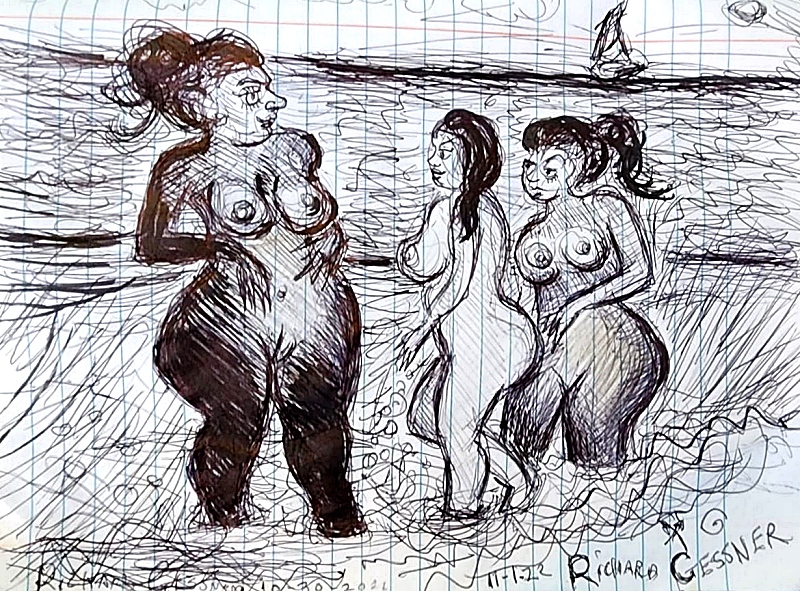
When I read Richard Gessner’s Voyeur Rising I imagined the story as an adult cartoon with liminal existential qualities. Voyeur Rising reminds me of Vladimir Nabokov’s use of an unreliable narrator who is found in most current social media video and reels. This collective trick usually deceives the viewer with a decoy. This is the place where Gessner’s work lurks, to induce the peripheral mind while feeding the predatory eye. Here we see the ultimate conflict and fantasy of the Freudian id haunting the masculine mind. A pleasure principle with an intrusive desire to poach voluptuous women without any commitment- but to squirt sperm, to clone more succulent women so they are everywhere. The fantasy has boundaries in Gessner’s character who is aware of his masculine delusion, that every women he find’s attractive isn’t a possession but an unfulfilled wish. All this takes place by the primordial ocean, a surface alive with waves.

-Mitchell Pluto
Strategically positioning his beach chair, pretending to be reading a daily newspaper, Joey Genauski, nonchalant, invisible, just by chance, settles in a tight rectangle of sand bordering the burgundy beach towels of two 19 year old college girls the age of his granddaughter.

The girls, an ash blonde, and a brunette with auburn highlights, have soft buttery skin, shapely, wide hipped—all curvaceous splendor—

Perfect brown bodies striped with pale tan lines sharply outlining pale pink asses and naturally large breasts jiggling slightly in the warm breeze of early summer.

The tan lines form a pale faded triangle V of panty line extending upwards. From butt crack to lower back, panty lines curving around thighs to below belly buttons—traces of cast of bikini no longer worn.

Gradations of pale pink skin merging to olive, cinnamon, golden brown, pale breasts encircled with D cup outlines of frilly brassieres. Burnt Sienna areoles and nipples a darker shade of brown than their overall tans.

Crisp yellow and gold designer bikinis, light summer dresses, brassieres. And panties are strewn across towels covered with tubes of sun screen, Purses, car keys, fruit, sandwiches cold drinks, a paperback of classic 19th century literature and a current glossy fashion magazine glistening in the sun.

Furtively, through dark sunglasses, Joey Genauski gazes longingly towards the girls’ spread open legs. Their Smoothly shaven vaginas, A reddish salmon pink, are soothed with cooling aloe vera. Blue and white beach umbrellas with a swordfish logo line the beach Landscape. Its a Saturday afternoon in early June, the weekend crowds work to Joey’s advantage, giving him an excuse to sit close to single women without being obvious about it. The crowds camouflaging his true intentions, allowing him to move frequently, unnoticed by the morally reproving beach patrol seeking to squelch his habit of constantly wandering the beach in quest of a perfect view.

Other voyeurs, Joey’s competition, watch the beach entrance from a distance, waiting for the arrival of young ladies, single or in groups. Approaching the ladies after they have gotten naked under their beach umbrellas.

Most women strip naked, but some keep their bikini bottoms on. Some wear Brazilian string bikinis, flesh toned thongs, almost nude, but not quite. Pale maidens wiggle out of floral print summer dresses, shorts, and candy striped one piece bathing suits.

Voluptuous brown girls peel off demure, white see-through-when-wet suits, revealing all to bulging male eyes, looking, gawking, looking away— Diaphanous mesh panties slide down svelte hips, falling to sand. Brightly colored, fancy brassieres pop off as delicate fingers reach behind unhooking clasps shining in the sun, catching the eye of a seagull flying in blue skies above.

Secret cameramen get up in the nooks and crannies of spread eagled women half asleep in the sun. Joey leaves the two girls, vanishing into thick masses of beach regulars, middle aged, tanned and leathery, marking their territory with windscreens, coolers and little plastic flags poked in the sand.

In Joey’s absence, competing beach voyeurs, some bold, well hung, smooth talkers, will succeed in engaging the ash blonde and brunette with auburn highlights in a lively conversation. Mastering bare body language a virile stud will advance to slow massage, rubbing baby oil of their perfect bodies glistening in the sun.

Slick voyeurs who remain at the top of the food chain will return to the beach, summer after summer, appearing like clockwork as in the legendary return of swallows to Mission San Juan Capistrano—

Their pick up routines with the ladies will remain similar and predictable year after year, decade after decade. Enticing the girls with superficial big talk of financial conquest, fancy cookies and little airplane bottles of alcohol.

In the tidal pools of voyeur nursery school, untested new generations of voyeurs emerge like baby sea turtle hatchlings making a mad dash seaward—

climbing the slippery slope of a succulent female ass just over the horizon,

Joey Genauski wanders into a gaggle of girls taking it all off for the first time-

In the distance, randy couples frolic in the surf, avoiding the June Jellyfish in the waves, out at sea, fishing boats come in close to shore, catching a panoramic eyeful of skin.

“Voyeur Rising” (C) 2022 Richard Gessner

Richard Gessner’s fiction has been published in Air Fish: an anthology of speculative work, Rampike, Ice River, Coe Review, Another Chicago Magazine, Happy, The Act, Sein und Werden, Skidrow Penthouse, The Pannus Index, Fiction International and many other magazines. A collection, Excerpts from the Diary of a Neanderthal Dilettante & The Man in the Couch was published by Bomb Shelter Props. Gessner’s drawings and paintings have appeared in Raw Vision, Courier News, Asbury Park Press, Rampike, Skidrow Penthouse, and exhibited at Pleiades Gallery, Hamilton Street Gallery, Cry Baby Gallery, The Court Gallery and the Donald B. Palmer Museum. Richard wrote The Conduit and Other Visionary Tales of Morphing Whimsy. He lives in Montclair, New Jersey.

The Conduit and Other Visionary Tales of Morphing Whimsy Audible

THIS WRITING IS AN AUTHORIZED DUPLICATION WITH PERMISSION AND EXPRESSED CONSENT

Mon Univers et ses Étrangetés Muriel Albert

La création est en soi un acte de transformation.

C’est un aller-retour entre le monde intérieur et l’effort pour
l”ex”térioriser.

Dans ce va et vient, les ressentis s”ex”priment et l’objet externe se
construit et la découverte relance le processus créatif.

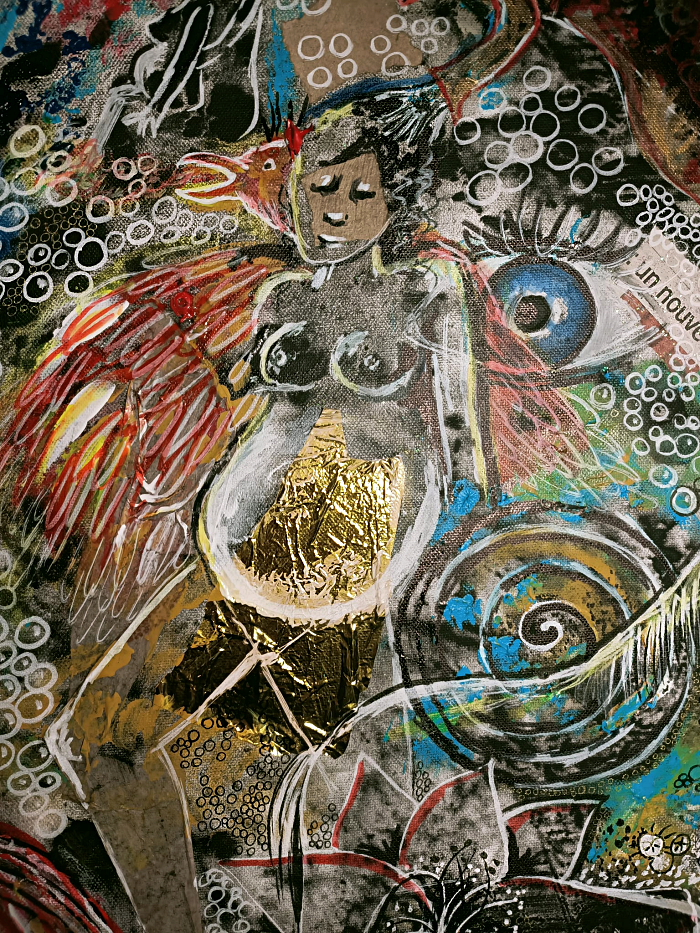
La toile du “cri kintsugi” illustre la douleur vécue et la transformation.

Le personnage central porte un masque de joie qui s’effondre pour laisser place à sa tristesse.

Il engage à accueillir les émotions et à lâcher prise.

Les cicatrices peuvent alors devenir une force. Dans le tableau les
cicatrices sont magnifiées par l’utilisation de papiers dorés.

Au cours du processus de création, je transfère, je transforme, je
m’allège. La joie authentique peut alors s’exprimer.

écrit par ©Muriel Albert

Muriel Albert

Muriel Albert Facebook

Muriel Albert Instagram

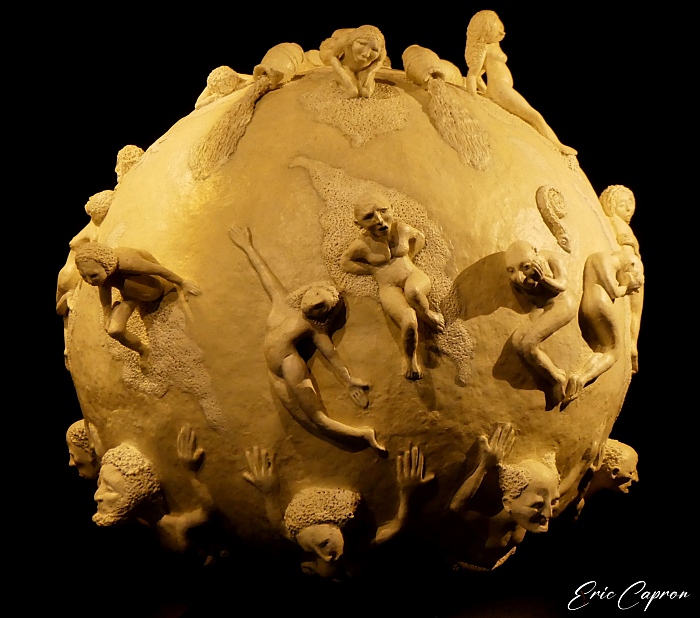
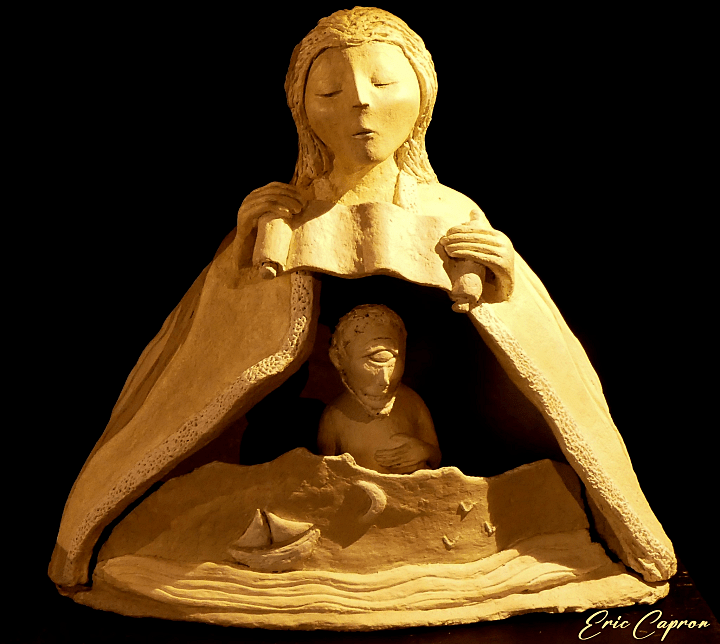
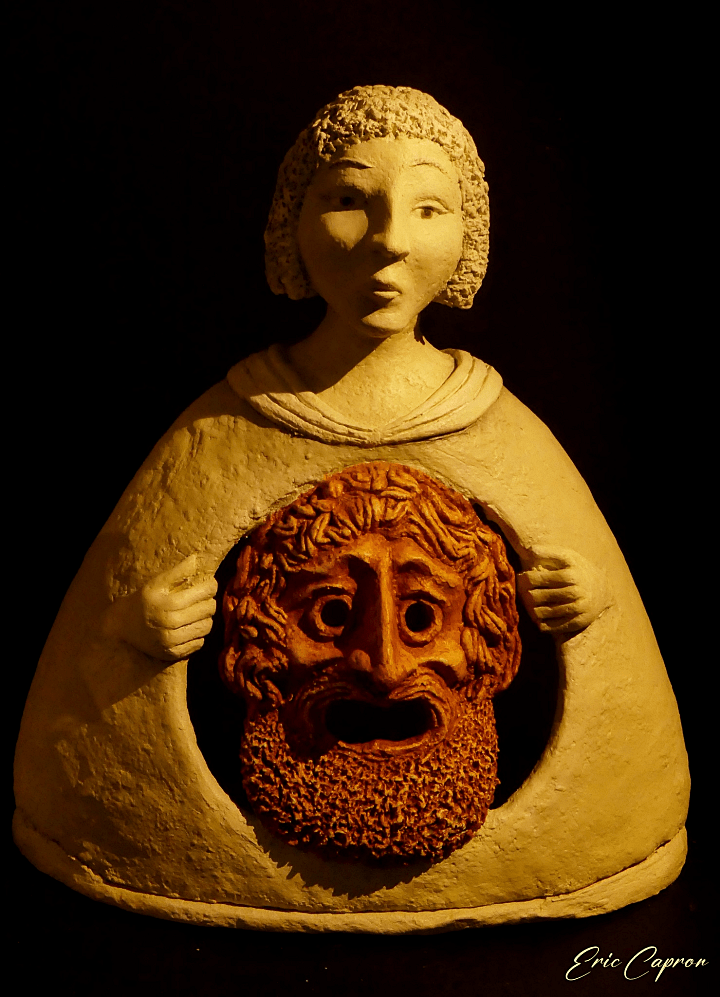
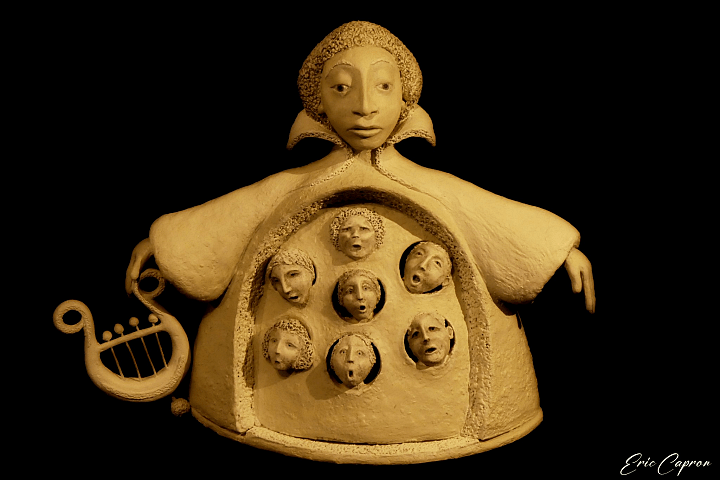
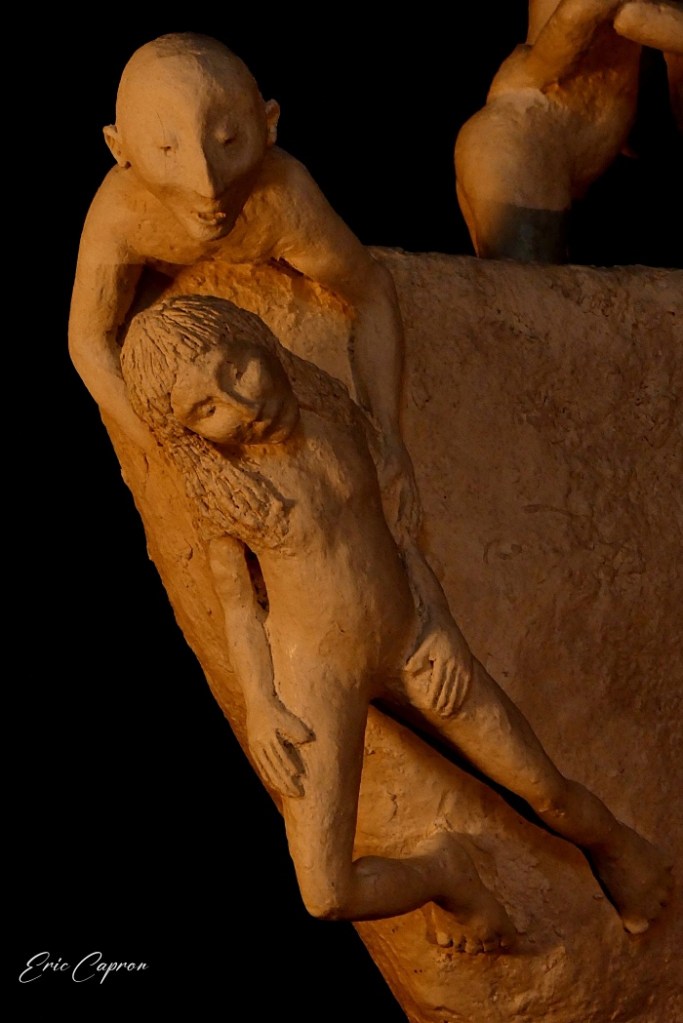
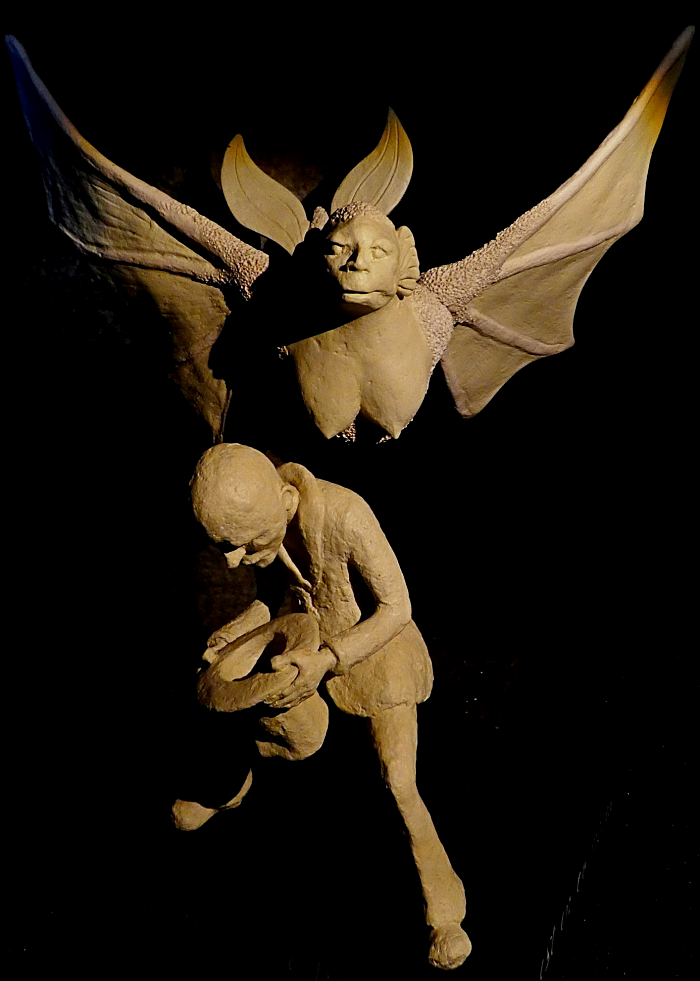
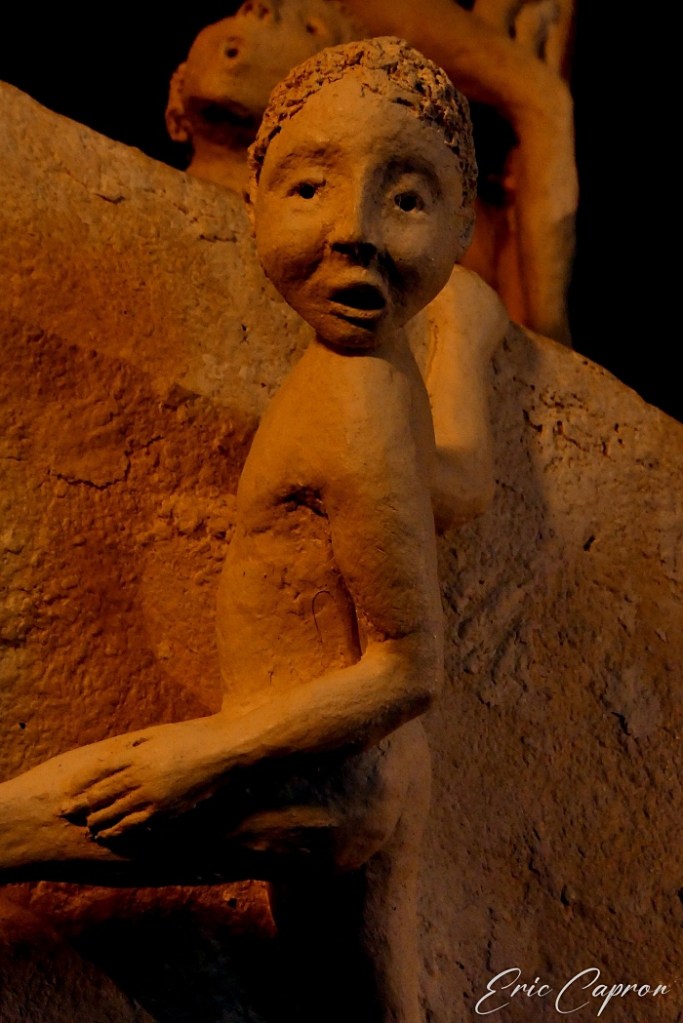
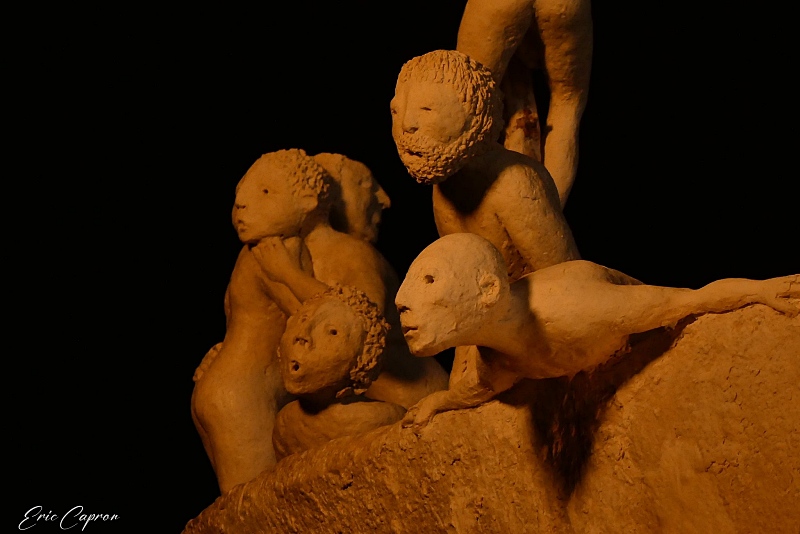
Eric Capron’s Circus of Dreams

Eric Capron is a self-taught artist. He discovers the arts of the circus and the world of the puppet.

Eric Capron. Artiste autodidacte au parcours singulier. Dès son plus jeune âge, la dyslexie le marginalise. Enfant solitaire, il quitte très tôt les bancs de l’école et l’univers familial. Commence une vie de saltimbanque, découvre les arts du cirque, le monde de la marionnette.

Artiste en perpétuelle mutation. Dorénavant un travail quotidien permanent de production d’œuvres en papier mâché : des corps mis en scène. Des corps non genrés, incolores, sans modèles, mais étonnamment présents à nos regards amis. Ils existent pour eux-mêmes, d’abord.

Les sculptures sensibles d’Eric Capron racontent l’âme humaine, la fragilité de nos destins. L’artiste revisite les mythes fondateurs, puisant ses références dans la mythologie, l’art sacré et profane, l’univers onirique, les grands textes de la littérature.

« J’ai le sentiment d’être l’instrument de quelque chose qui me dépasse, une sorte de miracle, une boite de Pandore qui s’est ouverte…» nous confie-t-il.

Suite for Monk, a Triadic Played by Heller Levinson 

MONK-LIKE

			like

lunge clump      canopy canister		fraught ganglia, chop
butterudder						back
								forward
								this way
							that
twist turn				vertiginate
		swallow     swelter
claim cluster clank crank		rustle roundabout
                           c     l     a     m
	bustle break bother broke brother
	bother bustle break brother broke
                   			bristle
								breathe
								    bombin-
ate		fables of late		bludgeon bark   bake
		   sleight slumber swell
	B Flat		line periphery-burst		stride
intervallic surge			sully sulk  skulk
																				 atti-T!ude
feud fidelity
                    ferm             en
                   		  ta		tion
			  
  	in-
 			  	stall

				un-
				install

FRIDAY THE 13TH

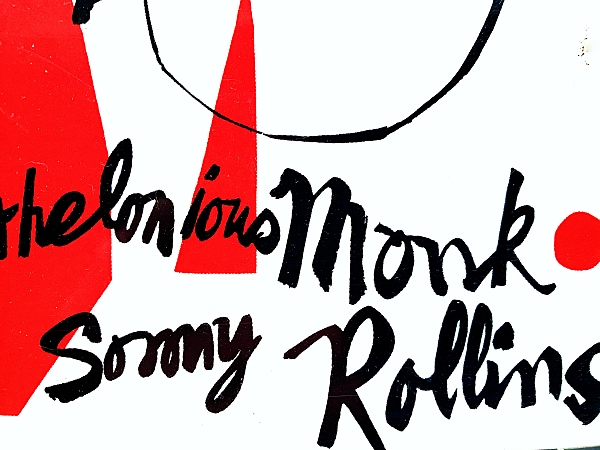
Mitchell Pluto inspired this Hinge to the Monk tune “Friday The 13th” Mitchell writes: One of my favorite tunes is Friday The 13th by Monk and Rollins, at first it takes the listener on a slant- a sort of drunk crab walk, and then the block chords, for me create a square spiral.

WOR studios 1953   thelonious Monk/Sonny Rollins
sloop-de-sloop whirl wind full intake reed fill throat splash slippery slant
peek-a-boo inebriate	peregrinate		in-
cubate 	square spiral boulder-roll stroll crab colossal 	 hi-hat crisp
chink snap crystalclarioncrystalline 	bosomy broth ivories wrought bath breadload beatitude	concuss allude	wedge hook link	sinkseepagelodge	
								laurel sling
								carrion fletch
				b e t r o t h 
	clump stump flummery block lump here
	come de Monk	scruff scamper liv-
ery lurch	paint a birch		fu-
rl fistful conflagrate agitate French horn ― fog-caster, frog-hopper ― conflate titillate aerate levitate brindle lop Bird-bop
							chordal congregation
							hymnal meditation
				scintilla aubergine
whisk brisk bask peculiar challenge the ruler
adumbrate gestate
spray a mandate
, man


EPISTROPHY FOR T. MONK

       ganglion frieze chop
splash melodic purl surge
/under
flirt slash the line tease conflate
the outer reaches skim borders
peripheries riff the mad notes cyclones
flush curling cuniculi mucid caves jettison spills
of color mutation migration never before
heard harmonic swoops triads
scribbled above bison head rage of
memory snarled rhythms stored in stone
circling and twirling a 
gathering of data raptorial fingers toolbox
of the soul aerial lift and poise
& strafe the keys
prey for salvation litanous chariots
a last chance passage
bump into the final
four bar essence is exhaustion
of complexity buck to the
ride cymbal 
bow to the bass

Heller Levinson is the originator of Hinge Theory.  His most recent books are Dialogics (Anvil Tongue Press, 2022), Lure, and jus’ sayn’ (Black Widow Press, 2022). His Query Caboodle and Shift Gristle are scheduled for a Spring 2023 release (also BWP). He lives in the Hudson Valley, NY.

written by ©Heller Levinson

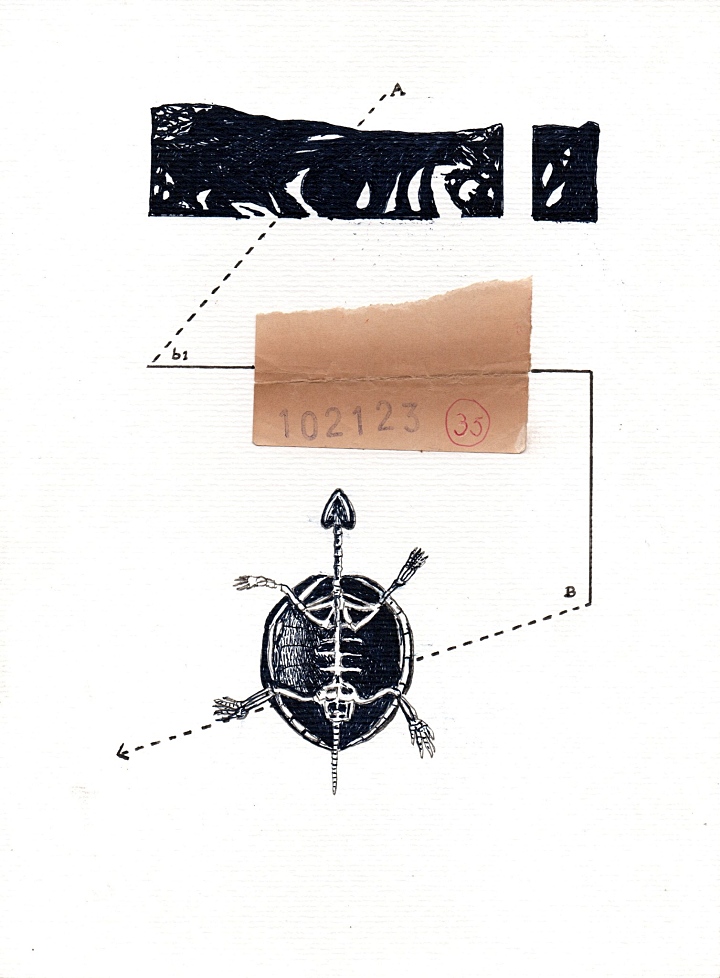
The Paleozoic Clock by Enrique de Santiago

Before to be

Before discriminating the grey hours of the clear

She lived the only and always ufana clarity of my imaginary friend

Time evaporated his muscles and nerves

To leave only impressions on the ether

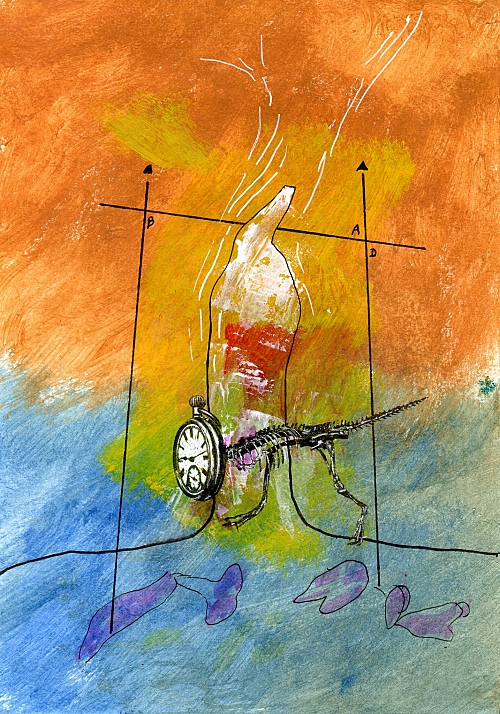
Featured Image: The clock that survived the paleozoic, acrylic and ink on Fabriano paper 250 gm. 21 x 28 cm. Enrique de Santiago

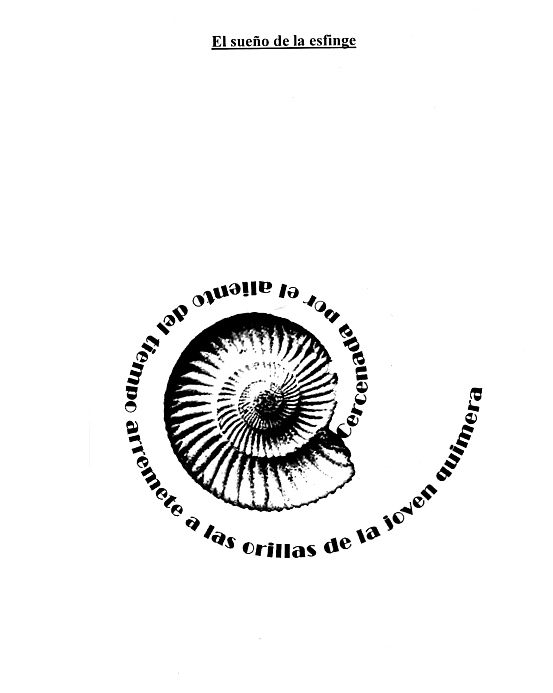
The dream of the sphinx

Bounded by the breath of time

Rush me to the shore

from the young chimera.

Aurea X-ray, acrylic and ink on Fabriano paper, 21 x 28 cm. Enrique de Santiago

SUM OF OPPORTUNITIES

“If the doors of perception were cleansed, everything would appear to men as it really is: infinite. “

William Blake

And I saw the impossible behind the possible

clinging to its subalternative limit that varies by century

because it responds to the movement of utopian tides

as I look into your eyes from the night glass

there everything was infinite in a tear lodged in your pupil

where she calculated the proper time

to go out into the light of tornadoes

and to the thick porcelain of desire.

Lithic Dreams of an Amazed Void, ink on 300gm Canson paper. 21 x 28 cm.
Enrique de Santiago

Perpendicular Imagination That Peeks Out

after the divine muscle

that bare your pelagic fate

to the one who lies at the feet of his limestone slab.

With every sun 666 mistakes arise

in the belly of the lunar word.

Appearance, ink and piece of paper, on 300 gm Canson paper. 21 x 28 cm. Enrique de Santiago

From the clouds held for centuries

of the air that snakes the knot violates sense

and every dark way that embraces the sound of the world

the maze light line emerges

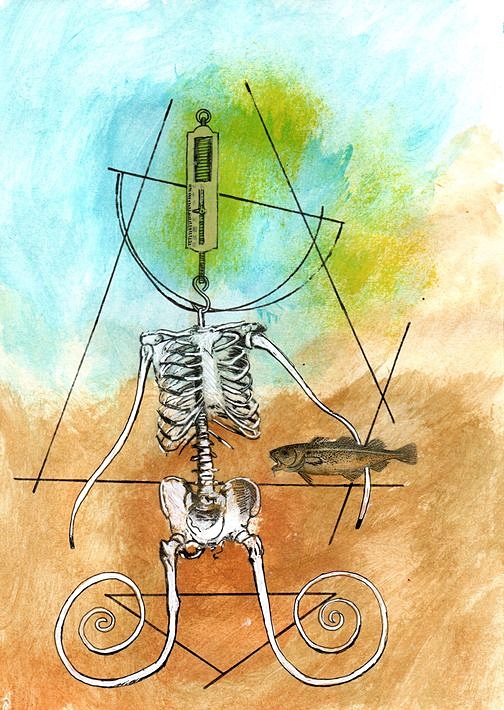
The Weight of Astral Utopia, acrylic and ink on Fabriano paper 250 gm. 29 x 21 cm. Enrique de Santiago

STARS TOPOGRAPHY

Only from the heart can you touch the sky. (Rumi)

So many times announced about my bone marrow

Bear Minor reduces his trades

while the diligent memory of your laughter

still loathing the twilight

and you will know by the occasional spurs

that had not taken my hands away from that oniric praise

and neither from the damp condition that bounced from his promised halo.

written and Illustrated by ©Enrique De Santiago

Enrique De Santiago. Poet, Artist and Philosopher

Recipes for Horizons by Enrique De Santiago

BLENDED IN THE HOURS
From the place where the abrupt sound of the loica ventures

(1)
the evanescence of your future breath appears
among the vegetation that hides your name
and the blue and gray stones of the primal mystery
there I will drink from the mist that shouts the perpendicular miracle
the only reason at all
that moistens the vegetal belly of the beloved
and shines the incessant desire.
How long does the star take to announce your coming?
or there will be no signs in this already long life of chordates

(2)
while the empty horn waits for its winds
and the opaque flame of sleep leans into oblivion

(1) Signature and unpredictable bird before being (A) bird
in the light areas that are shaken by the wind
mythical and loving red that drew a smile on a child
to open the celestial fields of my pupil
that stirred my early neurotransmitters
before the new cycle (B)
(A) Before being
Before discriminating the gray hours from the clear ones
I inhabited the only and always proud clarity of my imaginary friend
(B) New cycle
My lymph is rocked by the wind
in a theater of new opportunities
those that favor the sweetness of the coots of sober stride
mating in the repetition of miracles
so that the aromas perpetuate my arcane name
and the wandering clouds welcome their polar persistence.
I had the option of ascending to lightning by the cosmic warp
where perhaps the root of the word would have questioned
in coming times of etheric colors
where time would have curved for your eyes
and I would raise your elusive silhouette that lies in the angle of a sunset
irretrievably withers the thaumaturgical vowel (B1)
as simple as a smile
or the collapse of a galaxy
since everything is corresponding
and apparent
with its prodigious lightness (B2)
Like a breath from the forest.

TRAVEL
I went down to the inside of your belly
caressing the rafters of your cosmic cloud
the one that received me with the aroma of the sacred bulbs.
There you were the clear love of wood
and the vegetal wisdom that embraces the ancient verb
when the wind ceases its journey on the shoulders
of the floral liturgy
How many skies inhabit your seed that furrows the seer’s eye?
Is there a niche of smoke that hides your salty voice?
Or simply the root of everything has its home in that mystery.

Each step collects behind you, the daffodils
that inevitably lose your mark
the one that wanders in the deep sands
that in the empire of shadows shelters you.
The messenger has a singular noise
I’ll feel it that dreadful day
I will know then that the epitaphs for the sepulcher arrive,
where nothing else needs to be done,
the metal swallows are an illusory replacement,
since the truths remained in the lock,
and blind to certainties,
I only rest for a few moments
to give me strength in the pilgrim sea,
the one who confuses the epistolary tides
and enjoys seemingly innocuous sacrifices.

I will kiss your lips according to the prophecy

while the breeze will speak the unfinished language

And you will see me with your green eyes

that are not green

are brown

But when you laugh they turn green

and you can draw a different morning

with an approximate solstice

with snakes in the window,

so my useless life becomes useful

because I’m a hobo of solar systems

and I become a wanderer in your body,

as a geographer of your corpse altar

and intruder in your zodiac cenith.

At this moment the end of the thread

talk about the miracle of one day

unrepeatable and mild luck

How strange of an eclipse

under the brief abyssal tides

like ghostly cardamoms approaching

in the deserts of disease

appealing to the late corrections

as it did for millions of years

moss persistence with its epicness

selecting the right humidity

with your organic and fruity hug

in that I put my hope

in what you find in front of your eyes

because I am the one who reads in the borrascas

as I advance toward your directions

who fires violent canines

before those who offend you

to heal that sadness

that leaves the middle of the night when you slip

inevitably and persistently beneath

out the door.

Chandelier in the mornings

this useless armor

And the leaves are blank

soaking up her violently dance

they burn in front of the cabinets of dubious origin.

I hear the birds giving birth to the woods, in the upper angles of a nebula.

At this moment the end of the thread
talk about the miracle of one day
unrepeatable and mild luck
How strange of an eclipse
under the brief abyssal tides
like ghostly cardamoms approaching
in the deserts of disease
appealing to the late corrections
as it did for millions of years
moss persistence with its epicness
selecting the right humidity
with your organic and fruity hug
in that I put my hope
in what you find in front of your eyes
because I am the one who reads in the borrascas
as I advance toward your directions
who fires violent canines
before those who offend you
to heal that sadness
that leaves the middle of the night when you slip
inevitably and persistently beneath
out the door.

written and Illustrated by ©Enrique De Santiago
.

Enrique De Santiago. Poet, Artist and Philosopher

Featured Image: “Beyond the visible world is the non-Euclidean horizon for the dragonfly” acrylic and ink on 250 gm Fabriano paper by Enrique De Santiago

Shanta Lee, The Topography of One’s Body

What does it mean to have secrets as the topography of one’s body?

It is true, not all secrets are created equal. Some add a sway to the hips while others…well…they are a poison that eat us from the inside out.

I’m Tellin’

All unsaids, All secrets are not created equal. Some secrets kin with our bodies because our bodies know that they need to be the safe, the harbor for such things. This is not about that. Some secrets turn a walk, a regular gait to a saunter because the body tastes its sweetness. This is not about that. Certain kinds of othas, secrets that is, well….they bloom somethin else, the poison that eats us from the inside out.

This be bout dat. Dat latter kind. Dat otha kind.


It’s not just in the toxic we trust. We grow. We throw seeds. We replicate it. 

*

When I was a child , there was a statement that we would say that would check the perceived wrong doer. It would be something like, ’Oooooh, I’m tellin.’ What precedes the ‘tellin’ is the series of oooo’s mixed with the arrangement of vowels and consonants after that short phrase all together, in sum, in calculation, may make the 24 million miles long tail of Hailey’s comet green-eyed.

I’m tellin’ was a threat. 

It was to check the doer who was already in deep doin wrong. It was a  nod to the way one was willing to betray secrets, willing to betray the real monster who hid under covers.

The tellers of the toxic became the snitches, the snitches  is who we said would get stitches     In those streets

What does it mean to have secrets as the topography of one’s body?

Be damned, dare stitches,  dare the can of whoops ass…I’m tellin.

No threat…but invocation

Viens

Viens ici

Je ne te l’ai jamais dit mais

Oui je l’ai fait

*

Gwendolyn said it best, “…Even if you are not ready for the day,

It will not always be night.” By not ready, we mean whatever you are holding.
Whatever is hiding within the folds and wrinkles and twists of
unmade beds.
Whatever is being passed across through invisible notes

All ink doesn’t vanish. Some just wears…refusin’ ignoring

By not ready, we mean through the hush of phone calls.
The phone calls that contain whispers.
The phone calls that have no phone lines that require that and only THAT one other person picks up the receiver

The thing that returns to the pit spiraled tight behind the spiral of the belly’s button. The thing that makes it feel like each look by another means they know it because of the way it reads on the body. Tethered and bound. Whatever it is that you are holding and hoping that the sun won’t beat you to it…It’s coming

Je le referais

Je le referais juste pour le chemin

*

What if we said that the keepers of that kinda….  are the sleepers who never awake. What if we said we will nail their coffins shut

And forbid them from wake. What if we flipped the script on the secret keepers, the pain dwellers, all gates and their guards,


The bottom feeders who feed on the toxic blooms, the corpse eaters who grow fat full and bloated  off the bodies that become emaciated from thoooose kinda secrets

What if…We take their power back. We read the topography of the secret laden body and become fluent. Armed with the tongues that know how to untaste poison, daggers in hand.

We  the kind who realllll good with the way the sun sneaks up, how it creeps from behind the curtains of dark. The heat, we feel it on our shoulders. We refuse to hide from the way it will come get us

Nous  avons tous été pese

Nous sommes toujours trouve…voulant

Nous ne pouvons pas le nier

Something about the way a secret taste

Jevu hu fair sa

Shanta Lee Gander is an artist and multi-faceted professional. As an artist, her endeavors include writing prose, poetry, investigative journalism, and photography. Her poetry, prose, and personal essays have been featured in The Crisis Magazine, Rebelle Society, and on the Ms. Magazine Blog.

Exhibitions

Dark Goddess: An Exploration of the Sacred Feminine February 2022  – Spring 2023 * Fleming Museum of Art

Books

Black Metamorphoses  (Etruscan Press, 2023)

GHETTOCLAUSTROPHOBIA (Diode Editions)

Dreamin of Mama While Trying to Speak Woman in Woke Tongues

Shanta Lee, MBA, MFA Shantalee.com * (802) 275 – 8152

Feature Photo Credit © Shanta Lee 2015