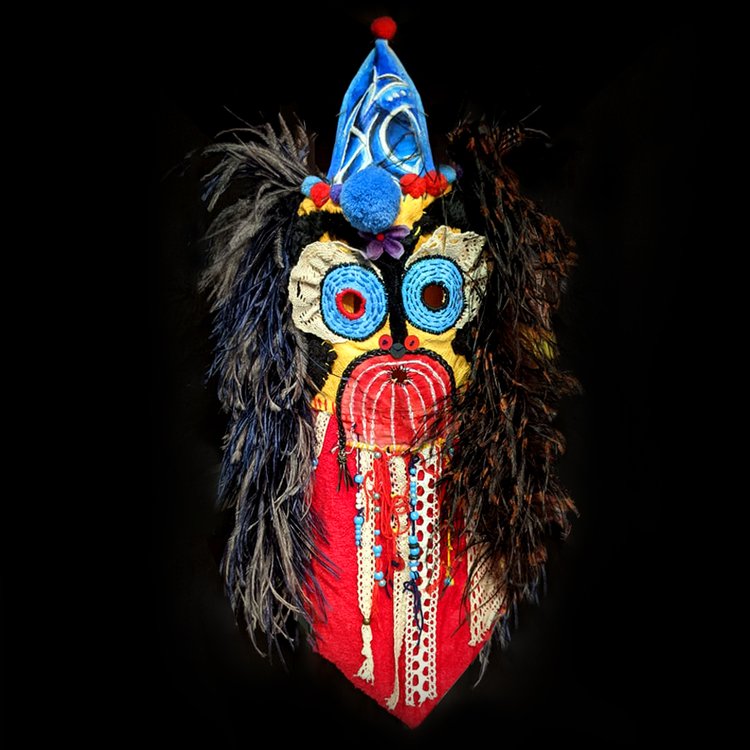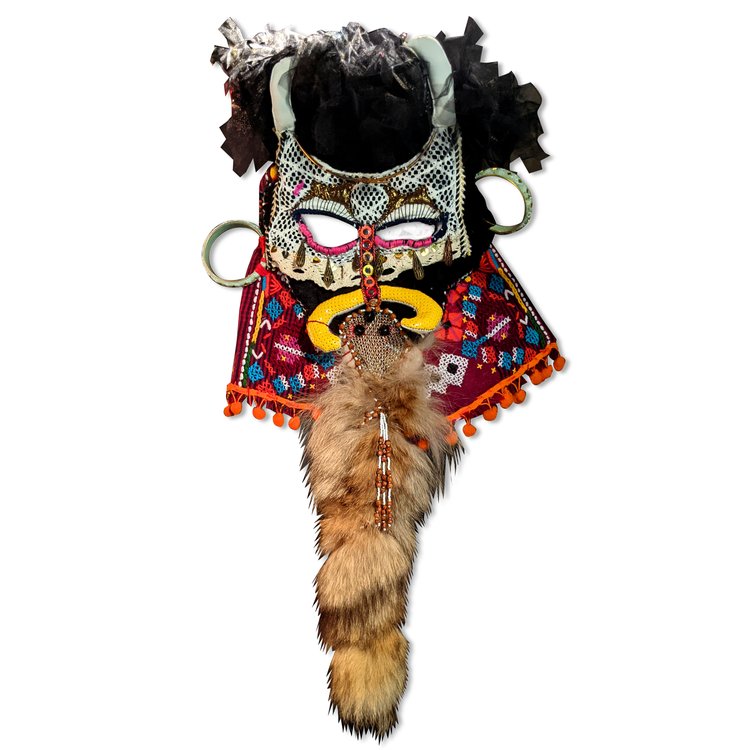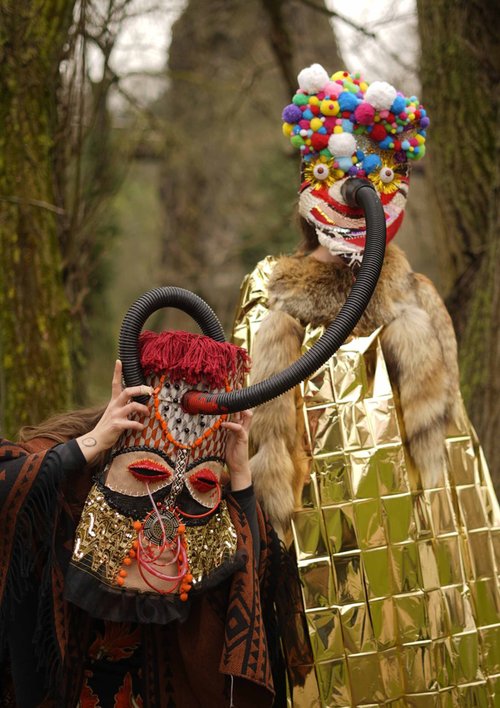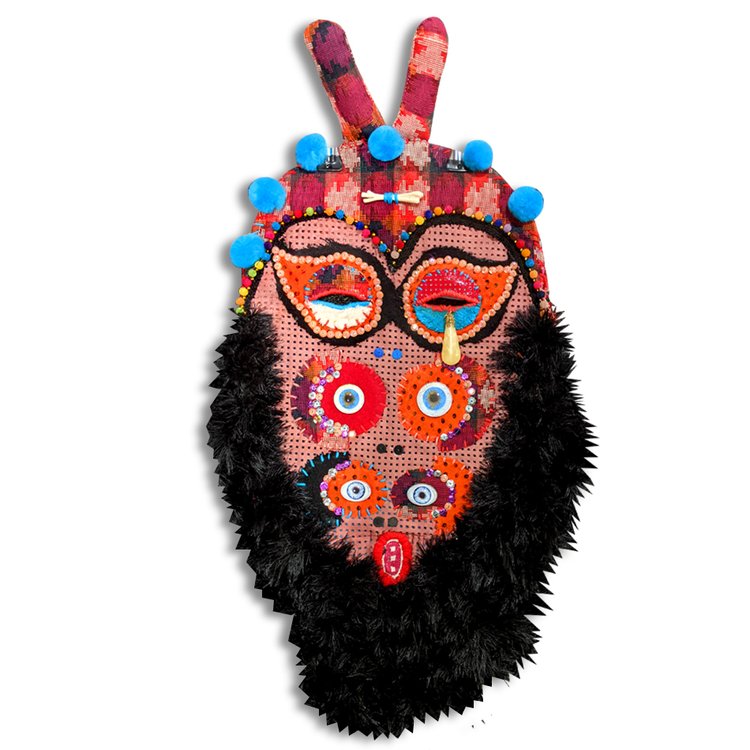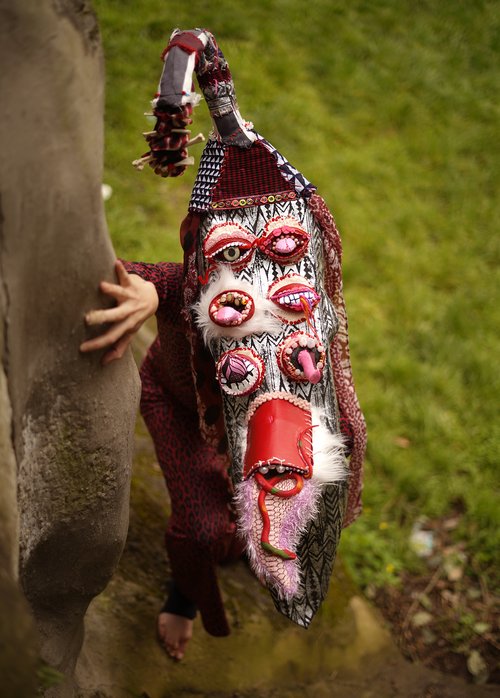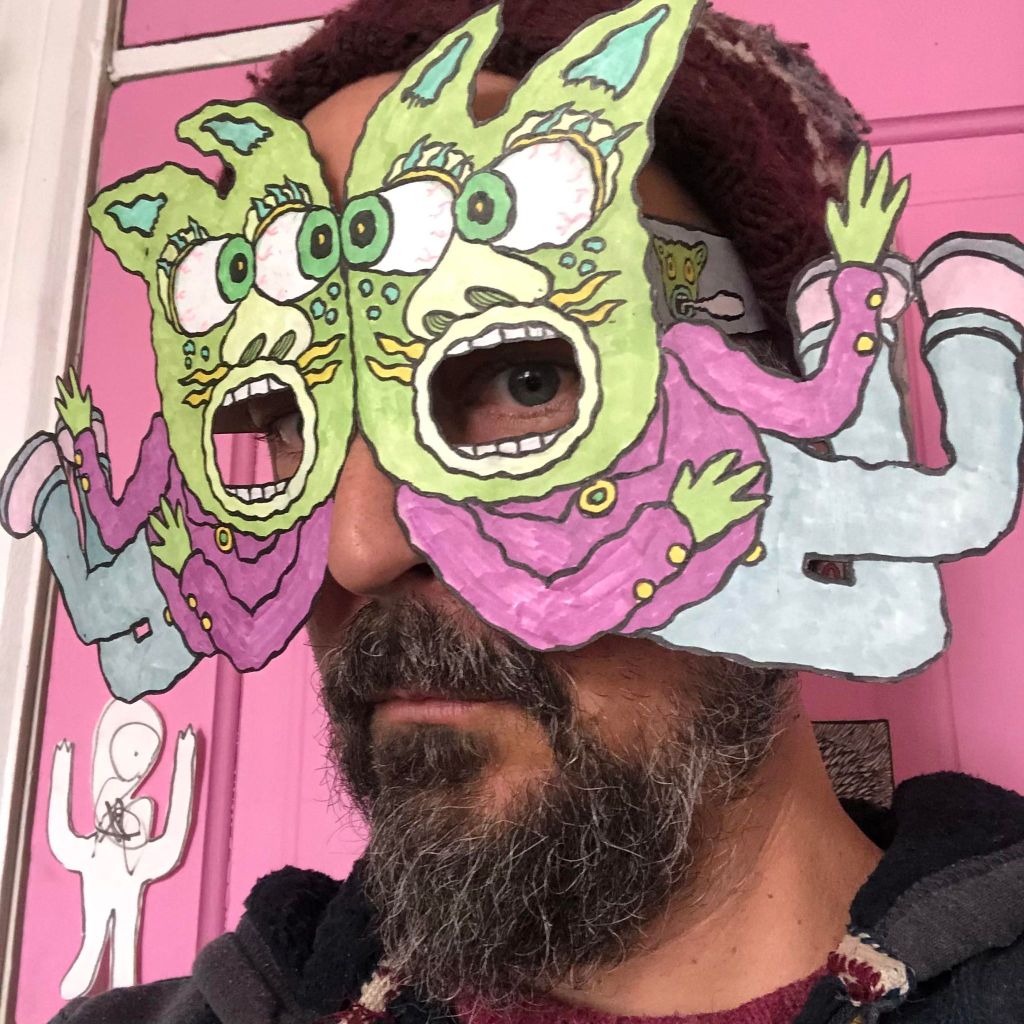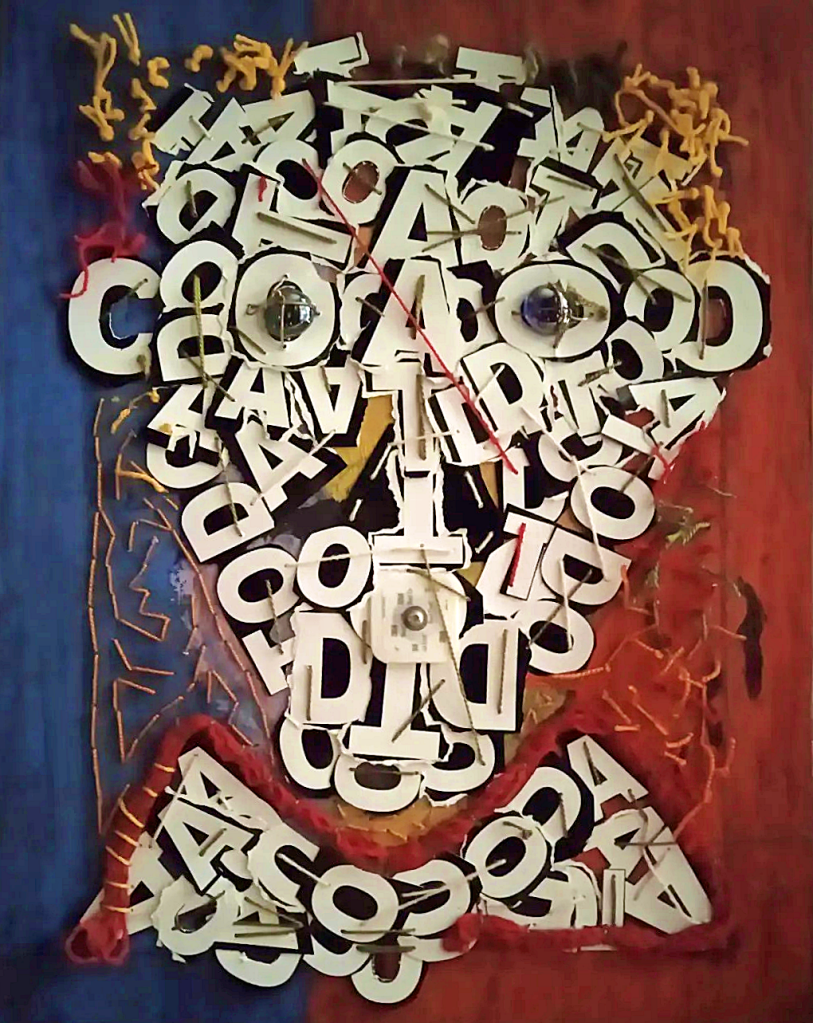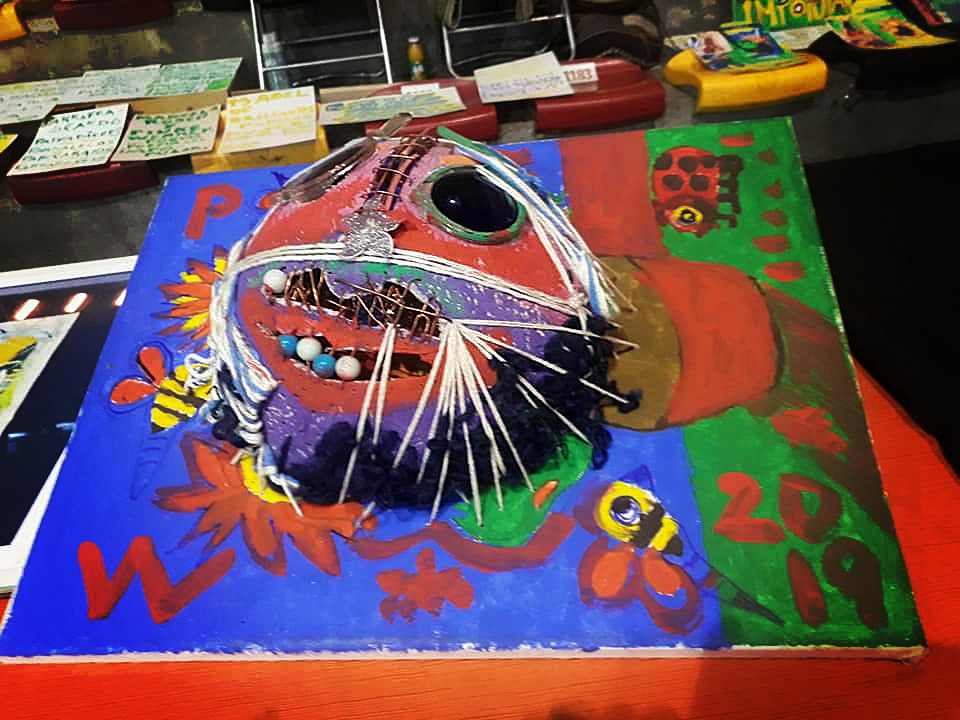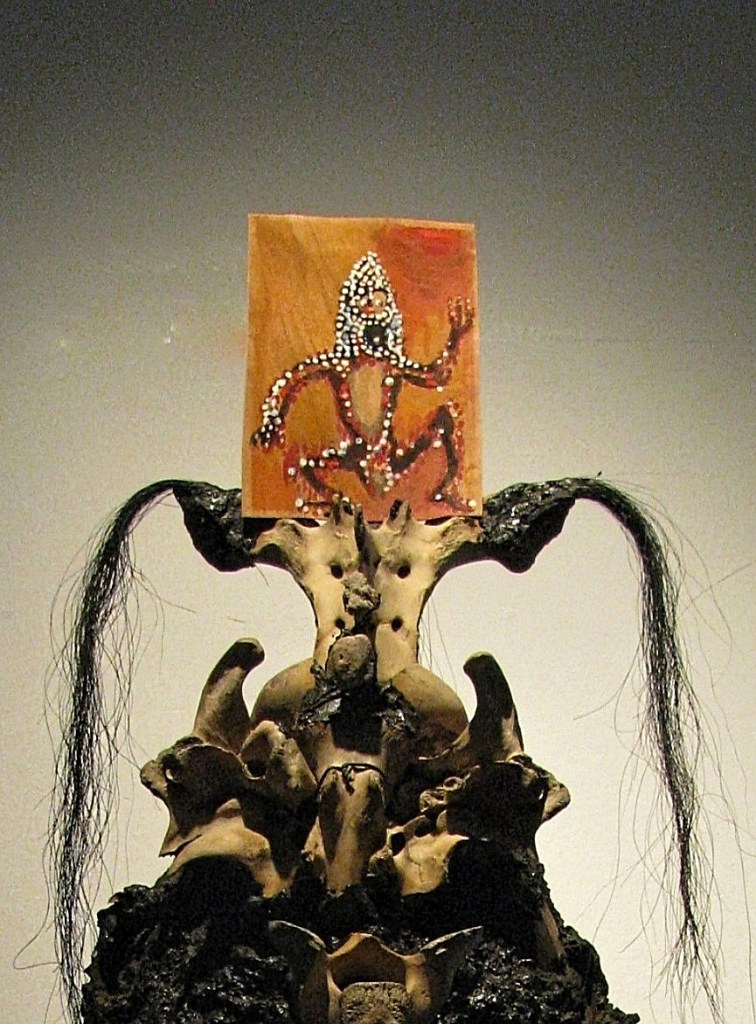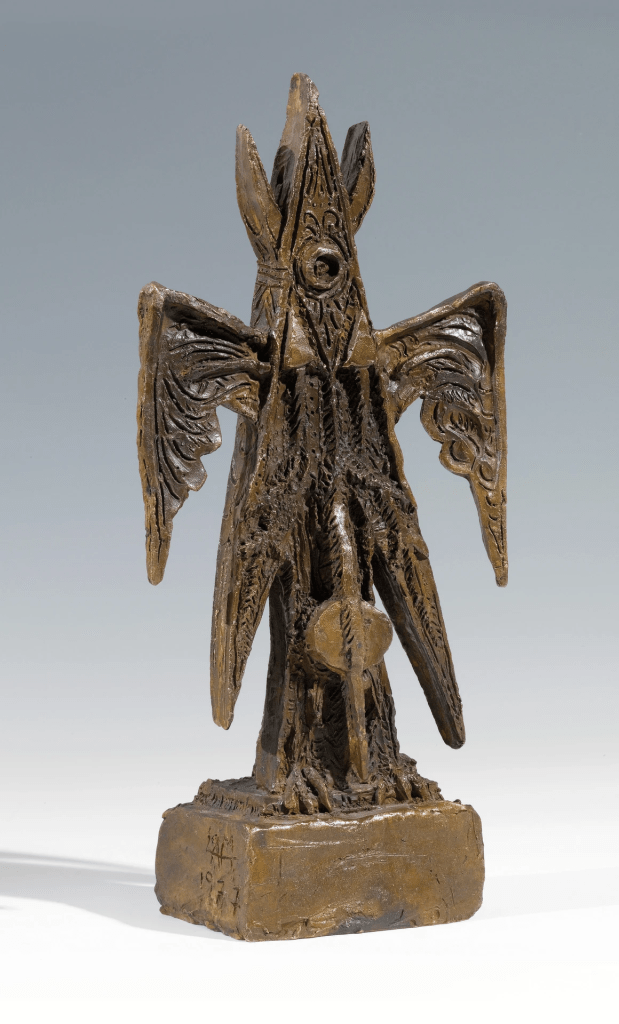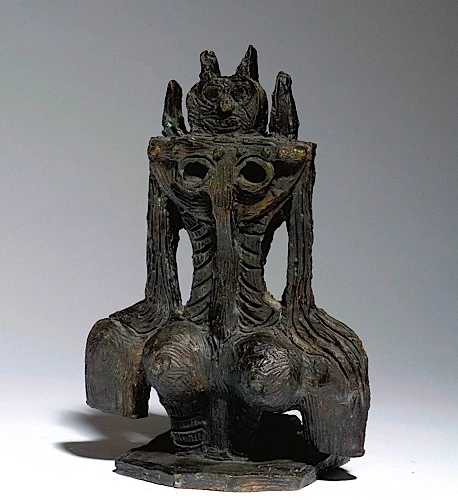
Mascarillas to Celebrate a Collaborative Earth Familia

The gods have “inner” or “spiritual” eyes (oju inun) with which to see the world of heaven and “outside eyes” (oju ode) with which to view the word of men and women. When a person comes under the influence of a spirit, his ordinary eyes swell to accommodate the inner eyes, the eyes of god. He will look broadly across the whole of all the devotees, he will open his eyes abnormally. Araba Eko, Lagos. 13 Janurary 1972. Flash of the Spirit. African and Afro-American Art and Philosophy Robert Farris Thompson 1983

Ritual contact with divinity underscores the religious aspirations of the Yoruba. To become possessed by the spirit of the Yoruba deity, which is a formal goal of the religion, is to “make the god”, to capture numinous flowing force within one’s body. When this happens, the face of the devotee usually freezes into a mask, a mask often (but not always) held during the time of possession by the spirit. Aṣhe is untranslatable.

Flash of the Spirit. African and Afro-American Art and Philosophy Robert Farris Thompson 1983

Bámigbóyè: A Master Sculptor of the Yorùbá Tradition. Mask, carved wood. James Green
With Olúṣẹ̀yẹ Adéṣọlá, Anne Turner Gunnison, Efeoghene Igor, Will Rea, and Cathy Silverman. Yale University Press 2022
Chilean Patagonia. The tip of South America

Claudio Rodriguez Lanfranco

-KAWÉSKAR: THE AYAYEMA STATEMENT-

Ayayema es uno de los espíritus del mundo sobrenatural Kawéskar. Para los Kawéskar -canoeros de los archipiélagos del fin del mundo- existe un orden en la naturaleza, una armonía. Si esta se rompe cuando alguien se enferma o se produce un accidente, es causado por Ayayema, un espíritu poderoso que en su ser, lleva esa propiedad de alterar el orden. Ayayema proviene de hóutk’a álowe “más allá del horizonte”, que es la tierra de los espíritus que transitan desde ese mundo al mundo de los hombres. Él es un depredador, se alimenta de la energía vital de los seres vivos, viene al mundo de los hombres a cazar.

YO SOY LA VOZ DEL CIELO SUR

QUE TRAE EL INVIERNO Y EL ANGOSTO DIA AUSTRAL

SOMBRAS ENORMES QUE SE LEVANTAN EN LA NOCHE

ALLÍ DONDE VIVE AYAYEMA

ESPÍRITU DEL RUIDO QUE RONCA ENTRE MONTAÑAS Y GLACIARES

QUE CAMINA EN LA ESPESURA DEL BOSQUE Y EL PANTANO

MITAD LLANTO HUMANO, MITAD GRITO DE BESTIA

ÉL TRAE AL VIENTO QUE VUELCA LAS CANOAS

ALLÍ HABITA RONDANDO LA NOCHE

ESCALANDO EL AGUA DE LAS CASCADAS

TRAYENDO EL MAL TIEMPO QUE HEMOS APRENDIDO A VER

EN EL PASO DE UNA BANDADA DE LOROS

QUE HEMOS COMBATIDO QUEMANDO UN DIENTE DE LOBA

Y HECHANDO SUS CENIZAS AL MAR.” (*)

I AM THE VOICE OF THE SOUTH SKY

THAT BRINGS THE WINTER AND THE NARROW SOUTHERN DAY

HUGE SHADOWS THAT RISE AT NIGHT

WHERE AYAYEMA LIVES

THE SPIRIT OF THE NOISE THAT SNORES AMONG MOUNTAINS AND GLACIERS

THAT WALKS IN THE THICKNESS OF THE FOREST AND THE SWAMP

HALF WEEPING HUMAN, HALF THE CRY OF A BEAST

HE BRINGS THE WIND THAT OVERTURNS THE CANOES

THERE HE LIVES WANDERING AROUND THE NIGHT

CLIMBING THE WATER OF THE WATERFALLS

BRINGING THE BAD WEATHER THAT WE HAVE LEARNED TO SEE

IN THE PASSAGE OF A FLOCK OF PARROTS

THAT WE HAVE FIGHTED BY BURNING A WOLF’S TEETH

AND MAKING THEIR ASHES INTO THE SEA.” (*)
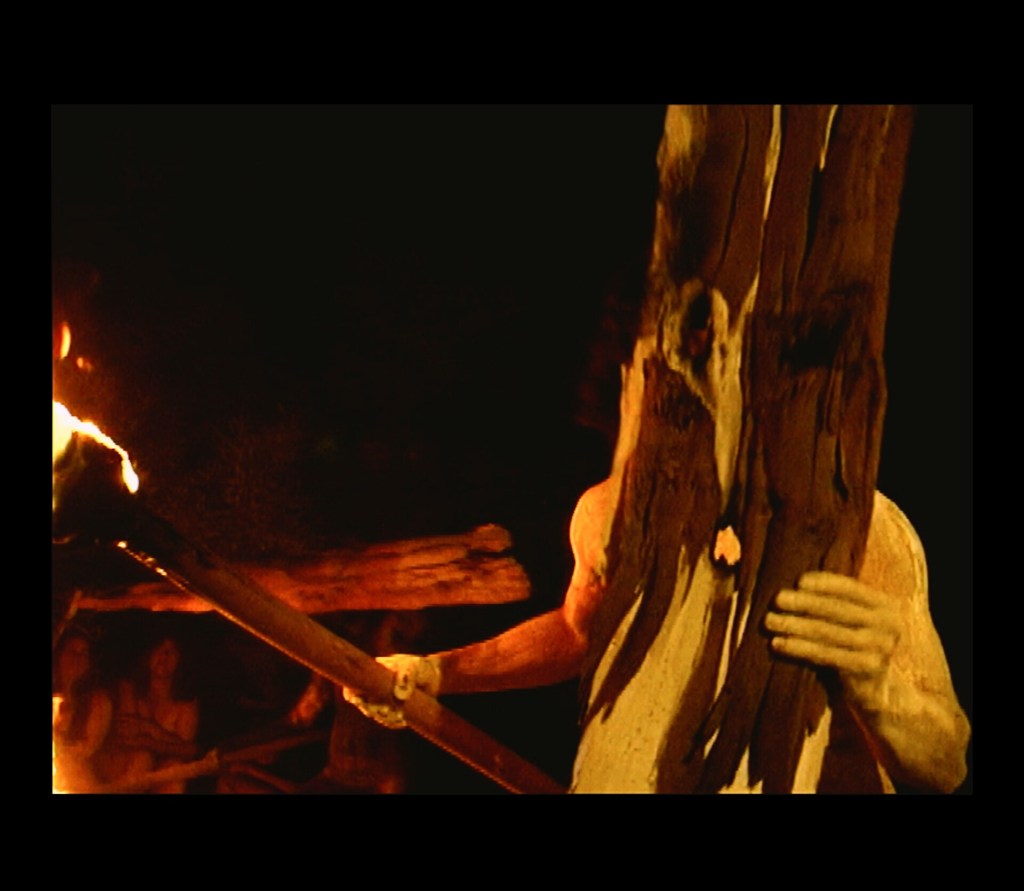
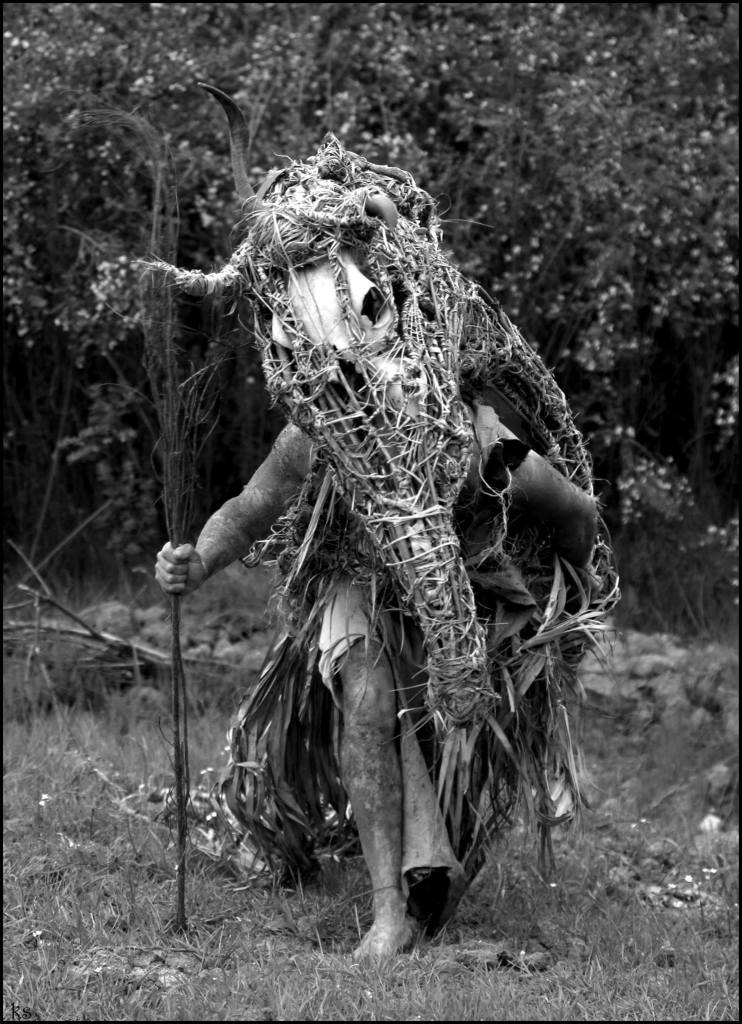
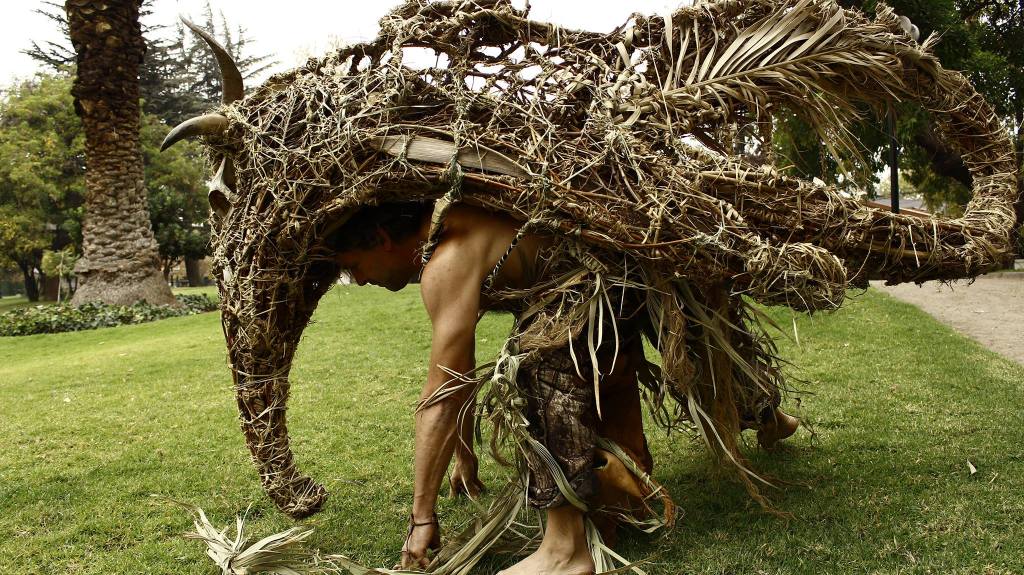
En los Ceremoniales Kawéskar se usaban máscaras que representaban estos espíritus, usadas por los hombres, ya que las mujeres no podían llevarlas. Éstas máscaras, así como la pintura corporal, están más relacionadas con usos rituales que artísticos. Entre los Kawéskar existía un repertorio de canciones para estas ocasiones. Como parte de su rica tradición oral, estas experiencias se transmitían a los iniciados de generación en generación en cánticos alrededor de grandes fogatas donde Ayayema era un protagonista. Es el único tipo de expresión musical que se conoce de este pueblo. Las canciones ceremoniales se desconocen hoy y solo se cuenta con el testimonio de la literatura especializada.

Kuosá jeksólok ak’uás æs čačár tawaisélok aksǽmhar os

aselái eik’olájer-s kuos ko at ku kiáu afsenák at árka æs sa

at-terré akér. Kuosá jeksólok k’uas ajajéma aselái kiarlájer-s

kuo. Ktep če jerwosé jerwo c’eláksnær kuktép sepplakstákečéjer: “Čawáal, táu ča čáu-s afsáwel?”, æsk’ák. Kuosá

kewókser kuos asekstá-ker jeksólok ka kuteké hóutk’a álowe

kčes: “Ajáu,” æsk’ák, “ak’uás ča sepplakstá-kuer-kéwel-aká?”

Y después el finado, el espíritu, el alma de mi difunto papá, decían, contaban en aquella carpa, se sentía hablar, en la carpa que quedaba más arriba de la mía. Y a los espíritus les decían Ayayema así los llamaban. A él me mandaron, me mandaron animándome y le pregunté a él: “Padre, ¿eres tú el que está hablando?”, así dije. Y me respondió el espíritu que mora más allá del horizonte: “Sí”, así [dijo], “¿por qué me estás preguntando?
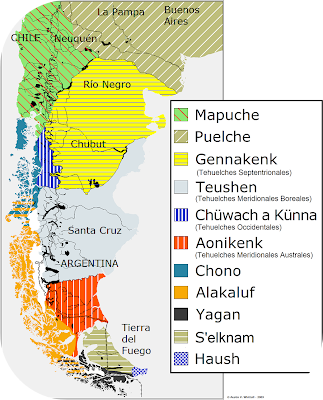
Los cuentos, relatos de viaje y las historias de vida Kawéskar, constituyen lo que se ha llamado “arte de la palabra”. Joel Sherzer y Greg Urban (1986) manifiestan que “Ningún indígena sudamericano ha ganado jamás el premio Nobel por su actuación (performance) oral u oratoria política. Sin embargo, todos los días y todas las noches los miembros de remotas sociedades de Brasil, Ecuador, Panamá, Chile, que viven en medioambientes no tecnológicos, están creando y desplegando una notable diversidad de formas verbales caracterizadas por riqueza metafórica, procesos poéticos y retóricos y estilos intensamente personales, todos los cuales son parte íntima de la reproducción y transmisión de sus tradiciones culturales y estéticas”.

Entre los Kawéskar se desarrolló durante siglos este arte de la palabra y fue la única manera de transmitir el conocimiento y de expresar estéticamente mediante la palabra (cf. O. Aguilera)
Poemas sobre máscaras desde poemario inédito Luz de lluvia escrito por Claudia Vila Molina

Grietas de la máscara

No nos es dado seguir hablando

ni de encontrar rastros perdidos

el azul juega con sus colores

y se forman raíces a tu alrededor

Son formas ennegrecidas

del sucio mineral de tu sangre,

espacio leve disgregado

en torno a esa máscara.

Tiempo ancestral

Recorro espacios cerrados

la memoria archiva actos conocidos

y solo vapor emerge desde estados de la imaginación,

mi mente perpetra esos instintos

(armonía remota de un entramado salvaje)

lucho por la veracidad de signos confiscados

y es penetrante tu esencia

ese código agrieta mis destinos

y películas convergen hacia tu manantial

Algo nos rodea desde siempre,

imagen pétrea instalada en cuencas de la prehistoria,

hallazgos convergen en un territorio incógnito

Nos bebemos como queriendo extraer máscaras

el tiempo pronuncia arenas tras los montes

y nos derrumban los temporales.
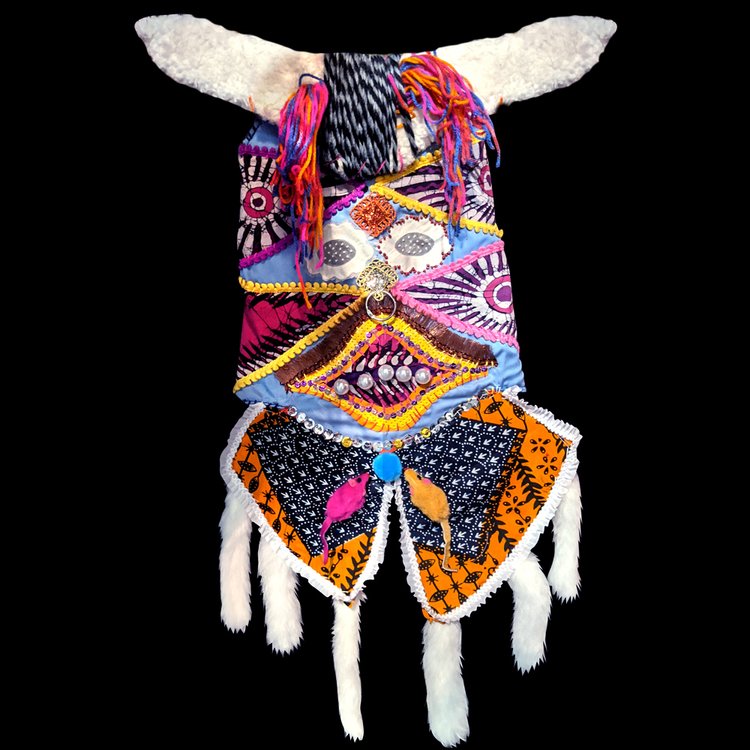

Jaky La Brune

Jaky La Brune, France

Theo Ellsworth

Missoula, Montana artist Theo Ellsworth

Ricardo Castro Piuke

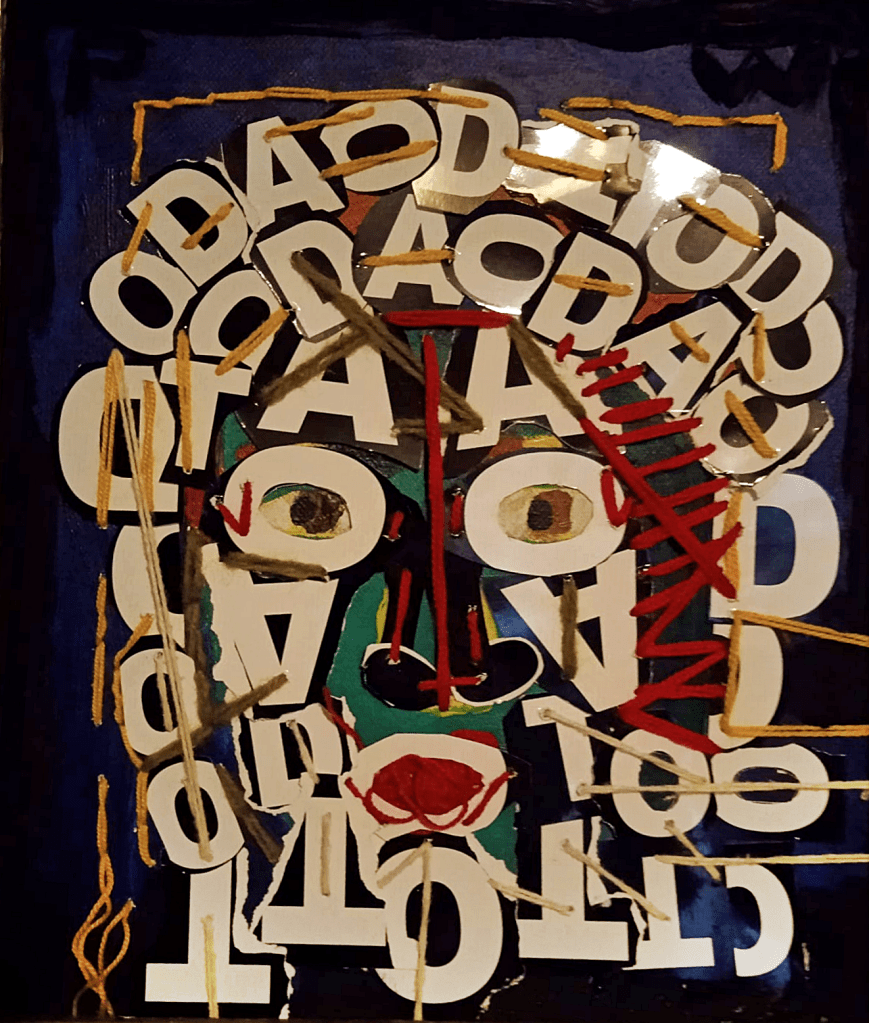
Es un asunto de querer magnetizar los elementos encontrados. Unirlos como si fueran una solución a un problema, sin tener , ni presentarse como problema. Al encontrar un objeto se van produciendo solas las uniones, la visión de esa reunión empieza a crear se su propia obra. Una inspiración creativa que se gesta a través de las palabras y las acciones. Arte de acción, teatro, poesía, plástica.

Nacido el año de 1961 y dedicado a la creación artística desde entonces, cuento en la actualidad con 62 años y perseveró con entusiasmo en la creación de poesía, obra plástica y conciertos de poesía.

Irene Plazewska 

Scorned Spirit. Clay & paint. Ireland
By Irene Plazewska 

Eternal Myth and Art in the work of Francisco Ríos
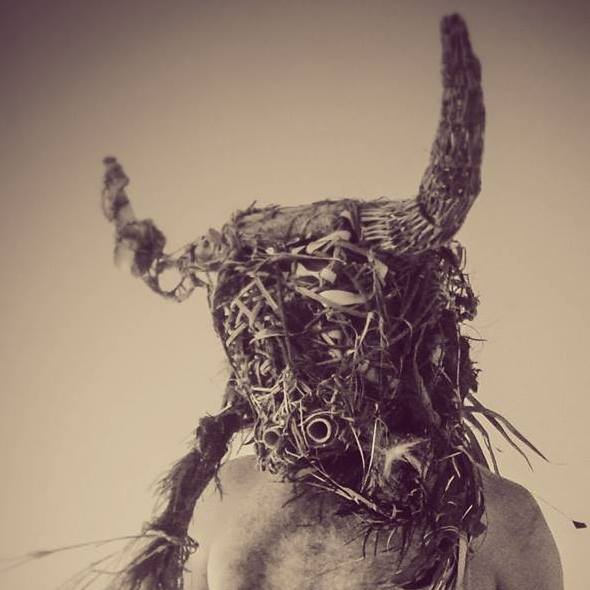
Francisco Rios Araya blends the ancient diversity between Paracas culture and Chilote mythology to build a new mythic hybrid. Rios creates a séance with the memories of archaeological sites, improvised ceremony and masks.

Miguel Ángel Huerta Zuñiga

Miguel Ángel Huerta Zuñiga Técnica :cartapesta 15×26 cms Año 2023

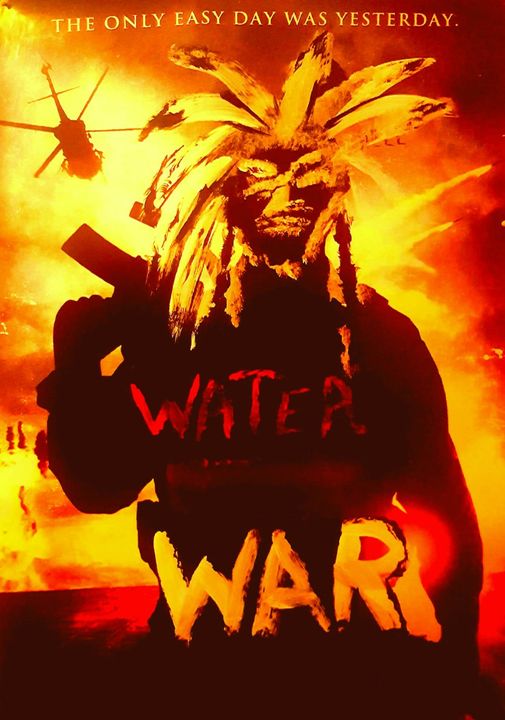
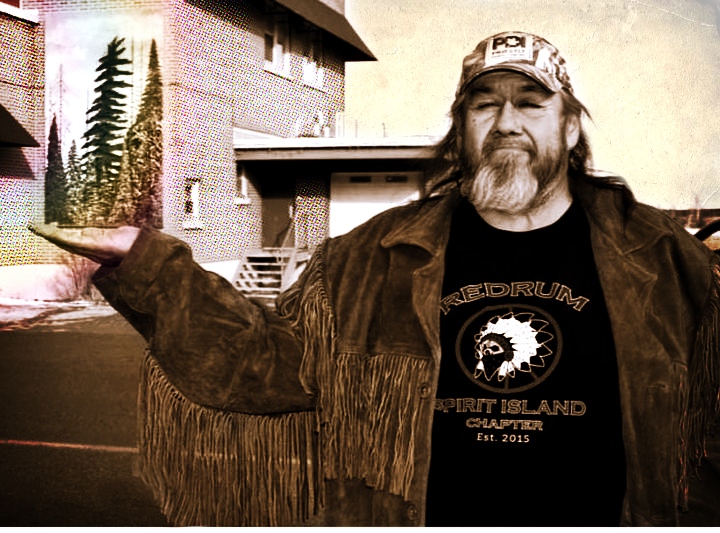
Duncan Neganigwane Pheasant


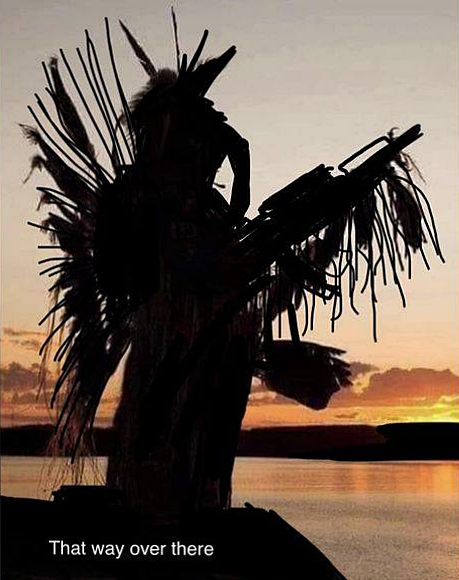
Mun gee dik lives in rocks and along shadows near lake Manitou…it is said this spirit hid a cache of weapons in a cave from the marauding Iroquois…some believe weapons are hidden to this day and include modern firearms that were lost or thought stolen…the Great War hero Kawbenaw is said to still be alive and is keeping these weapons…someday mun gee dik and Kawbenaw will make themselves known

written and created by Duncan Neganigwane Pheasant

Mitchell Pluto
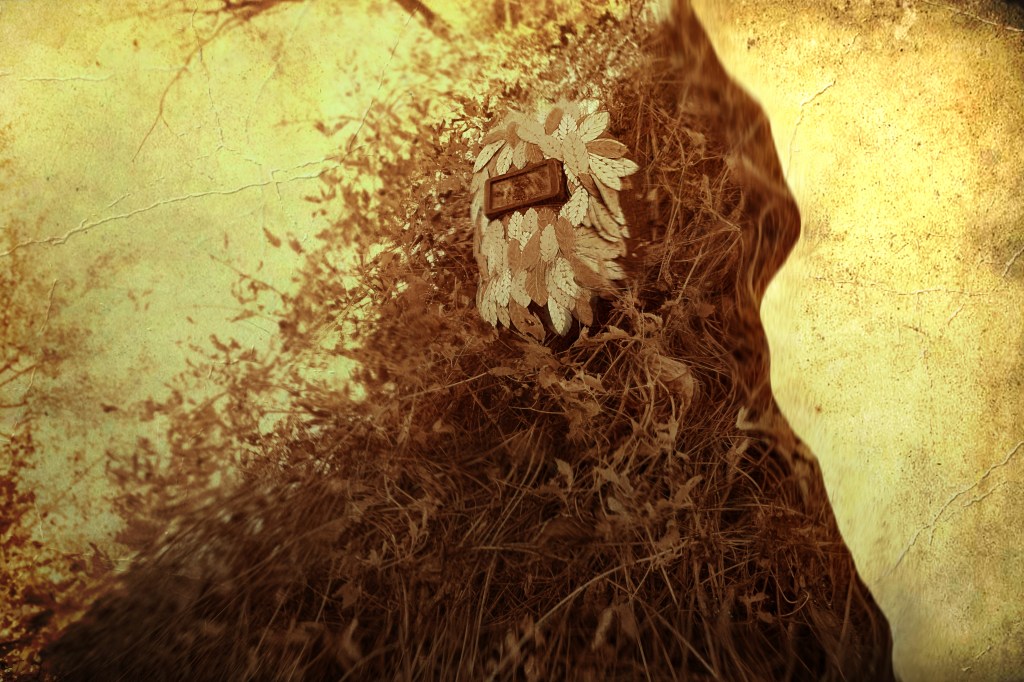
In August 1869, Alexander Jay Russell, a railroad photographer, captured an image of an unidentified entity during a total solar eclipse in Western Montana Territory. Russell’s journal entry depicted the creature as a tree-like being that glided along the ground and through the trees, mimicking every texture it encountered. The dark visor was the only consistent characteristic.

Photos found at an estate sale in 2023 are now in the possession of the Montana Historical Society Research Center Archives. Certain independent researchers suggest that this camouflaged entity possesses the capacity to swiftly adjust its chromatophores, enabling it to blend into any surroundings without being easily observed or recognized. This trait resembles that of Cephalopoda, the only organism known to exhibit such capabilities.

Many witnesses in Montana reported similar encounters during the solar eclipse on February 26, 1979, like Russell’s. Authorities have not yet released any official comments to the public.

epilogue
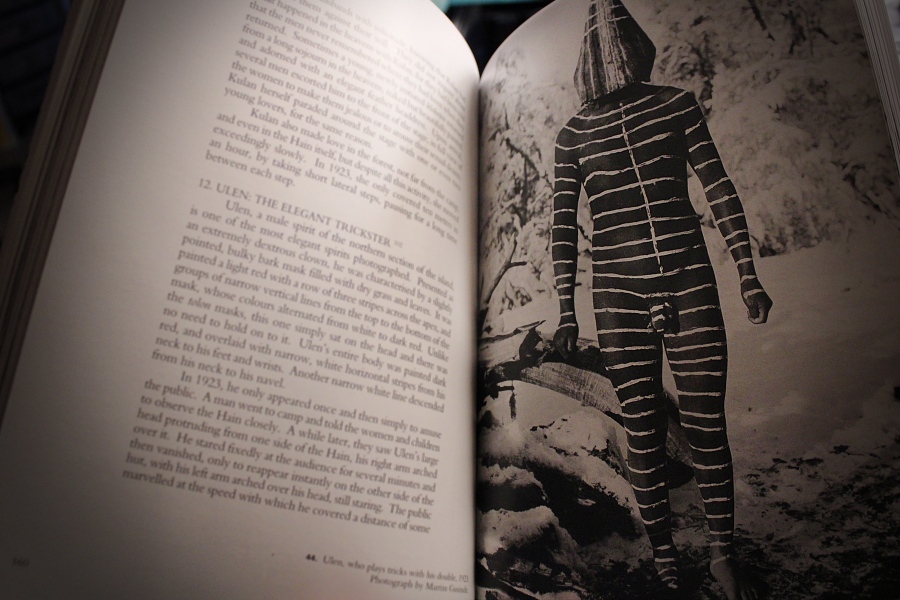
Ulen the elegant trickster. Plays tricks with his double, 1923. Photograph by Martin Gusinde

“In 1923, the Ulen only appeared once and then simply to amuse the public. A man went to the camp and told the women and children to observe the Hain closely. Awhile later, they saw Ulen’s large head protruding from one side of the Hain, his right arm arched over it. He started fixedly at the audience for several minutes and then vanished, only to reappear instantly on the other side of the hut, with his left arm arched over his head, still staring. The public marveled at the speed at the speed with which he cover the distance of some eight metres. The public did not know that the “backstage” there were two rigorously identical Ulens, posed at each side of the Hain. A third man gave them signals as to the exact moment at which they were to protrude their heads. The performers practiced a great deal in order to coordinate their movements and remain immobile for several minutes.”

Chapman, Anne (2008) Hain, Selknam Initiation Ceremony. Initiation ceremony of the Selknam of Tierra Del Fuego 12 160-162
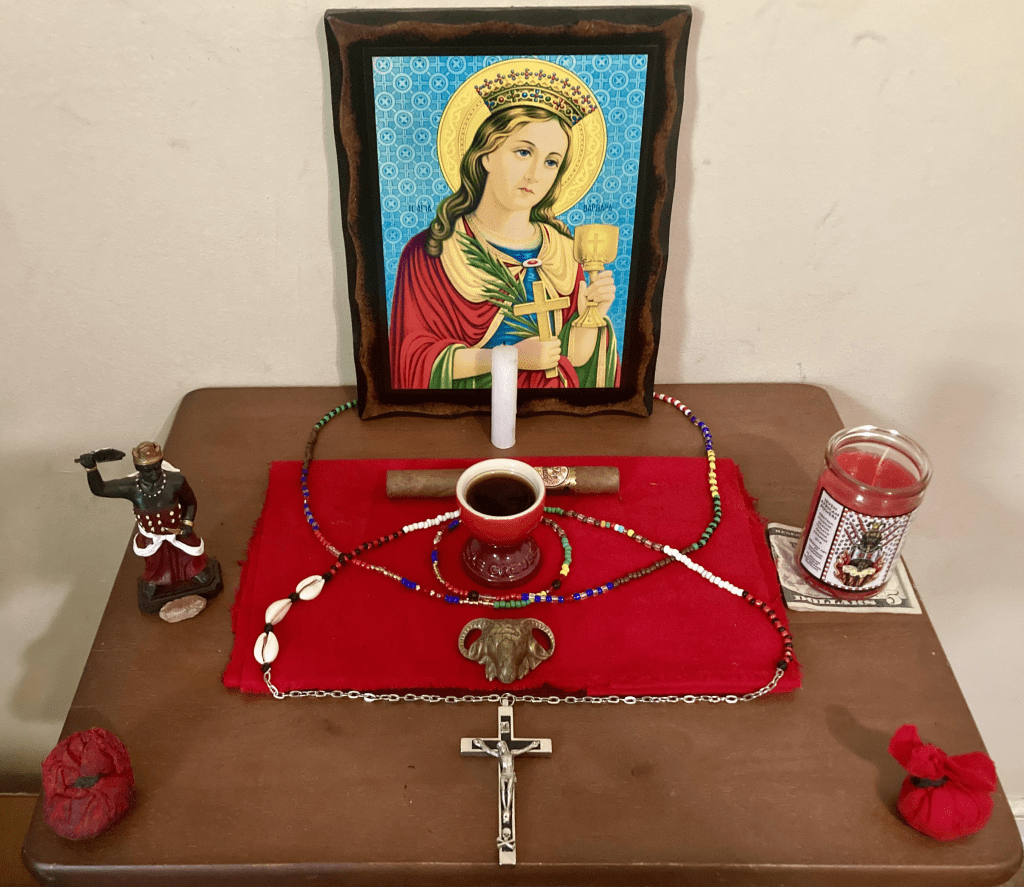
the altar that occupies the god

P.D. Newman

Internationally recognized author and lecturer specializing in the use of entheogenic compounds in magico-religious settings. P. D. Newman has been immersed in the study and practice of alchemy and theurgy for more than two decades. A member of the Masonic Fraternity, the Society of Rosicrucians, and the Martinist Order, he lectures internationally and has published articles in many esoteric journals, including The Scottish Rite Journal, The Masonic Society Journal, and Invisible College. The author of Alchemically Stoned and Angels in Vermilion, he lives in Tupelo, Mississippi.

An altar constitutes a sacred space insofar as it is a deliberately constructed liminal space. A space is made sacred first and foremost through the creation and maintenance of a vacuum within it—it is the mystical act of reverting an area back to its natural, chaotic state. What is then invited to fill this void constitutes the divine FIAT—the magic “word” whose essence will thenceforth inform that space and all that transpires in it. Ergo, nothing is permitted to penetrate that void which is not in harmony with essence of the god. Those things that are harmonious with a given essence are termed ‘symbols’ and ‘tokens’ of that essence. These do not simply represent or correspond to the god, but rather constitute the deity himself in miniature form—a fractal-like manifestation of that essence which recapitulates and reiterates the totality of the god upon the microcosmic plane.

The Neoplatonist, Proclus, once stated that Soul “contains images of [things] and detailed, essential [seed forms] which are like statues of things themselves.” Even the names of things, therefore, arise from Soul and amount to veritable ‘statues in sound’ that really are the things described. If the name of the god is a presence of said deity, how much more an actual image? The profane view is that the worshipper believes the god to reside within the statue gracing the altar. This is absurd. No, the statue is in the god, as are all the symbols and tokens descending from his essence. Indeed, gods are beyond space. In reality, it is the altar that occupies the god.

Image courtesy with the kind permission from P.D. Newman

Claudia Isabel Vila Molina

born in Viña del Mar, Chile. Professor of language and communication at PUCV, poet and literary critic. In 2012, she published her first book, The Invisible Eyes of the Wind. She has published in renowned Chilean and foreign digital media: Babelia (Spain), Letras de Chile (Chile), Triplov and Athena de Portugal, among others. During the year 2017 she participates in the Xaleshem group with poetic texts for the surrealist anthologies: “Composing the illusion” in honor of Ludwig Zeller and “Full Moon”, in honor of Susana Wald. In 2018, she integrates the feminist anthology IXQUIC released both in Europe and in Latin America. In 2020 she participates reviewing the conversation book “Shuffle poetry, Surrealism in Latin America” ​​by Alfonso Peña (Costa Rica), also writes a poetic prose text for the book “Arcano 16, La torre“, by the same author. Likewise, she participates in the book “120 notes of Eros. Written portraits of surrealist women” by Floriano Martins (Brazilian surrealist poet, writer, visual artist and cultural manager). In this year (2021) she publishes her second poetry book Poética de la eroticaamores y desamores by Marciano editores, Santiago.

Rituales poéticos

El corazón me sabe a pañuelos mojados
Hoy escucho la canción de los océanos
Y alguien más viene a mirarme
Las algas suben por mis pies hacia las últimas rocas
En este elemento volví a imitar los arrecifes
Ellos callaban
Me miraban tiernamente
Como solo miran quienes están en estado perpetuo
Y quise salir fuera de mi nombre
Quise volar desde las ataduras de mi cuerpo
La noche no halló sus otros puñales
Y me concedió un nuevo deseo.
Del poemario inédito Solsticio de invierno, derechos reservados.

Image courtesy with the kind permission from Claudia Isabel Vila Molina

Olesya Volk

Born in Baku, Azerbajan, lived in Moscow from age 16 and moved to Los Angeles in 1992. She holds a M.F.A. in Film &TV, majoring in Animation from UCLA; and is involved in painting, writing, illustrating, cartooning, mixed media, paper theatre and small size dioramas.

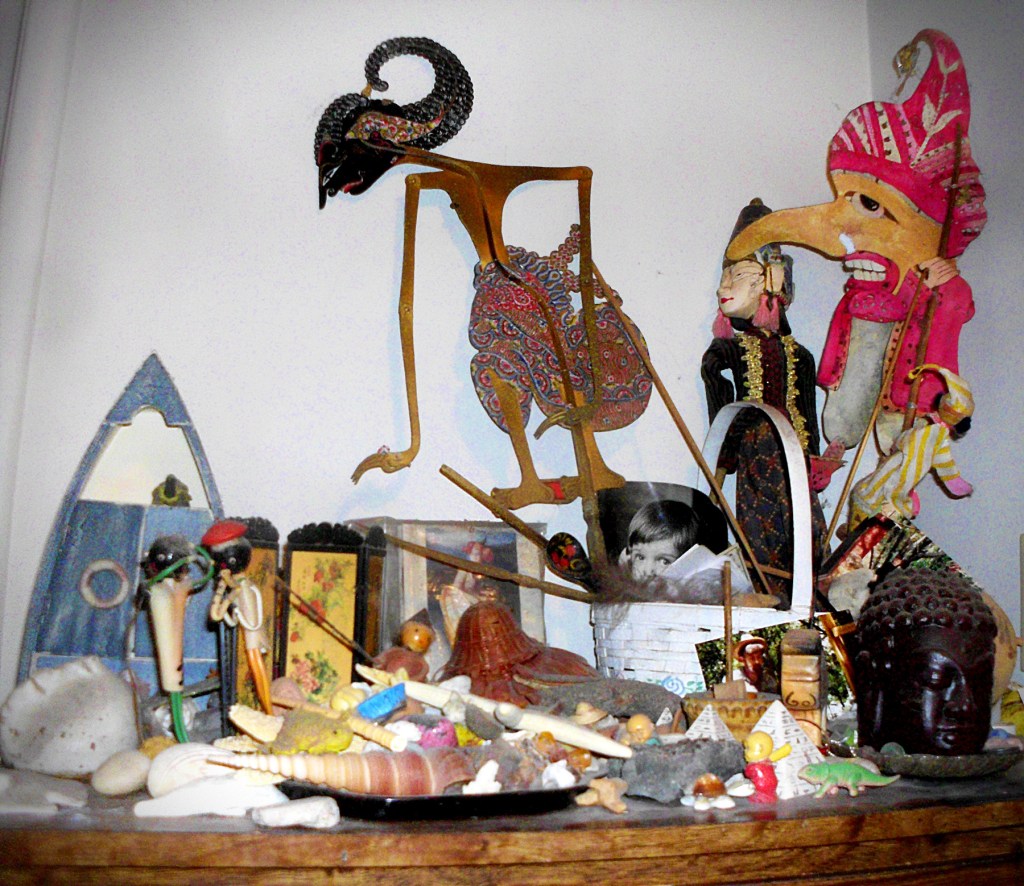
My altar: The inspiration for me always comes from the area deep inside my memory, it is connected to my childhood.

That is why my personal altar reminds of a little village that existed on a shelf in the cupboard at our place when I was a child. That village had a pond and a mill, woods and little houses. It had fishermen, singers. musicians, dancers, witches and sages, and a couple of hooligans. it had the place for games and the place for meditation and talking to spirits. Me and my sister and my mother were in charge of the village, and the villagers were protecting us and granting our daily wishes. The inhabitants of that village are still living with me! some of them are seen in the altar, the others have settled around in different corners…they continue to protect and manage the ties with the other worlds. My altar tries to copy visually that village from our cupboard, only there are much more pebbles now, and the lucky holey stones , they tell me of my walks on the beaches which I also held as sacred when a child…And above the village, there are spirits or gods overseeing it, in the shape of the Indian and Turkish shadow puppets ( one of the puppets, Beberuhi, I made myself; he is a nosier , he is curios about the essence of everything. ) And there are there the photos of the loved ones as well, photos from the past.

May the love last! may the protection and the belief in my vocation last! may the blessings stay!

Image courtesy with the kind permission from Olesya Volk

Jaime Alfaro Ngwazi

born in Coquimbo, Chile in October 17th, 1971. He studied at the University of La Serena and his degree is Bachelor in Education and Visual Arts. He has carried out different worshops about graphic expression. One of them is called Vivir el Afiche given by Mieczyslaw Gorowski. Apart from this, we can also mention Lo Esencial Significa given by Mieczyslaw Wassilewski and, finally, a seminar given by Lech Majewski at the University of La Serena.

El altar como centro mágico del mundo/ una trama de hilos multicolores de lana cruzan su centro/ se cuelgan a las orejas de las llamas del altiplano /brotan teléfonos con líneas como nervios-cuerdas de charangos, algunos trozos de carne seca y latidos de corazones emulando a Boltanski, en un centro magnético que conecta espectros de cristal, pantallas de celular y el sonido del viento/ en el desierto,seco ,que disecciona el paisaje salino, entre talleres líticos y mega fauna fantasma. Todos convocados a este espacio, reproducción en artefactos de madera del gran imperio / las cabezas de jaguar rugen a las estrellas de la lejana vía láctea ‚el frío es el ruego en la amplitud de la noche, mientras un vinilo con voces raspadas gira sin fin al compás de una danza metafísica las aristas del rombo raspan la piel suave/ el centro de todo es un valle seco ‚púrpura, apastelado en colores carne.

Tony Kail

Ethnographer and writer. Tony holds a degree in cultural anthropology and has researched ethnic cultures for more than twenty-five years. His work has taken him from voodoo ceremonies in New Orleans to Haitian Botanicas in Harlem and Spiritual Churches in East Africa. He has lectured at more than one hundred universities, hospitals and public safety agencies. Kail has been featured on CNN Online, the History Channel and numerous radio, television and print outlets. A resident of Humboldt, Tennessee, Kail was raised in Memphis and calls it his second home.

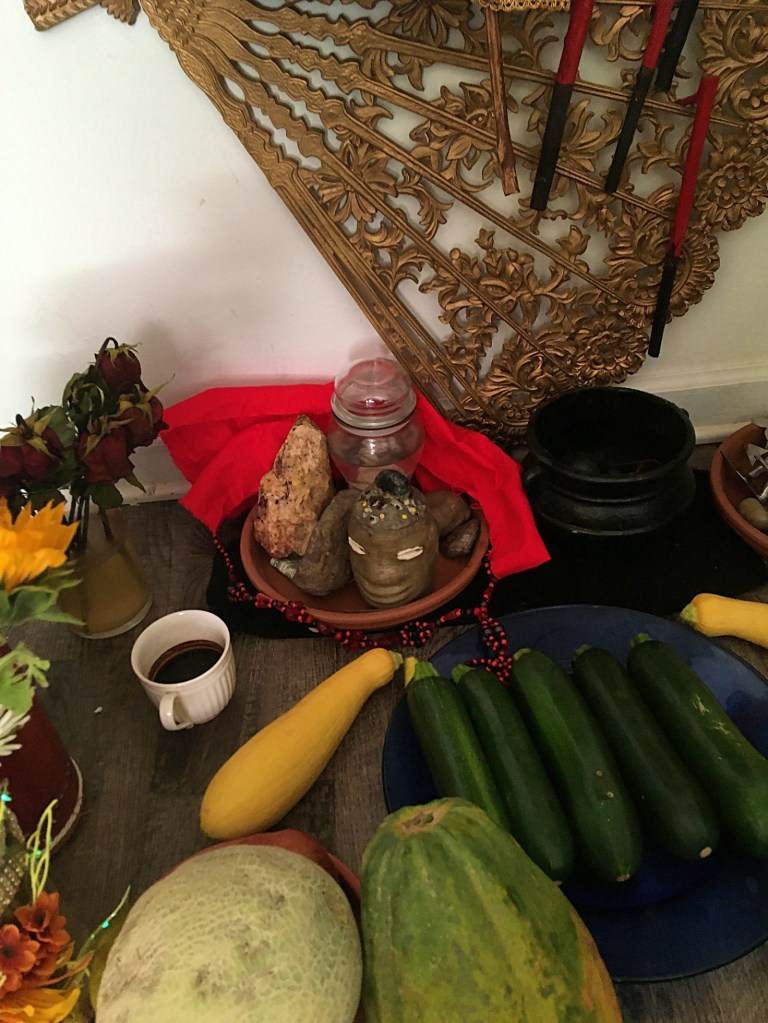
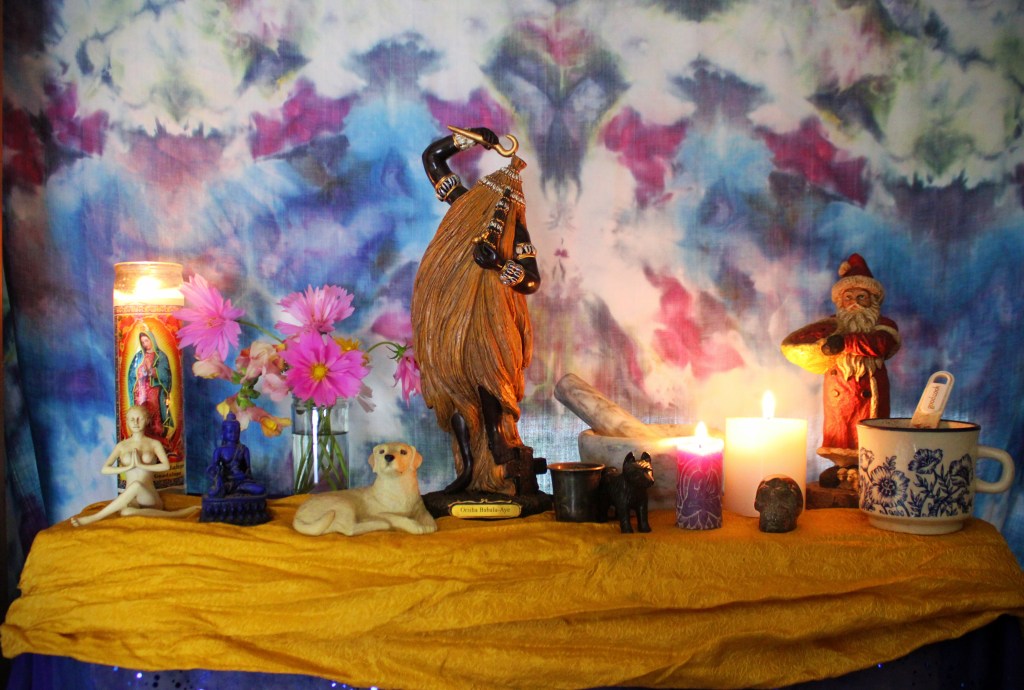
During ceremonies various events would occur that involved participants seeking reactions from the spiritual realm. On one occasion trance possession occurred and a participant was given information regarding a health issue that they had not shared with the possessed individual. Spontaneous deaths of animals would occur during rituals used to combat witchcraft. In the daily life of practitioners, physical evidence would manifest as a result of supernatural activity. Miraculous healings occurred where images of scars and skin disorders would appear on fruit and vegetables that were used in offerings to ask for healing. Subsequently practitioners would obtain healing and their wounds would disappear. Offerings to the Orishas would frequently disappear such as cups of coffee and wilting flowers would appear revived after being placed on specific altars.

From my upcoming book ‘Fieldwork with the Saints: An Ethnographic Journey into Santería in the American South

Image courtesy with the kind permission from Tony Kail

Duncan Neganigwane Pheasant

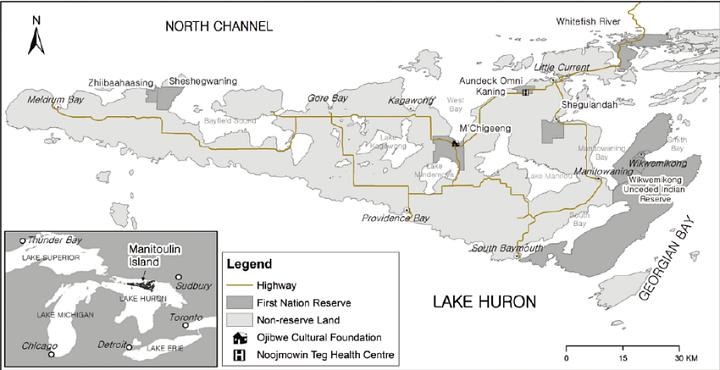
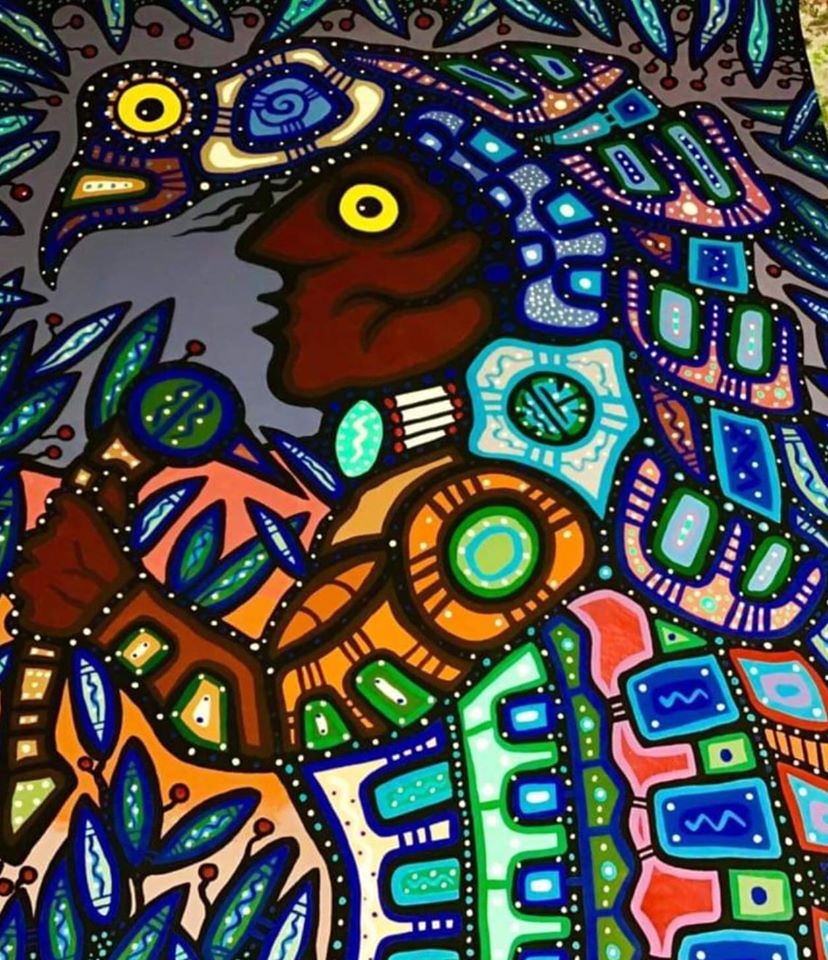
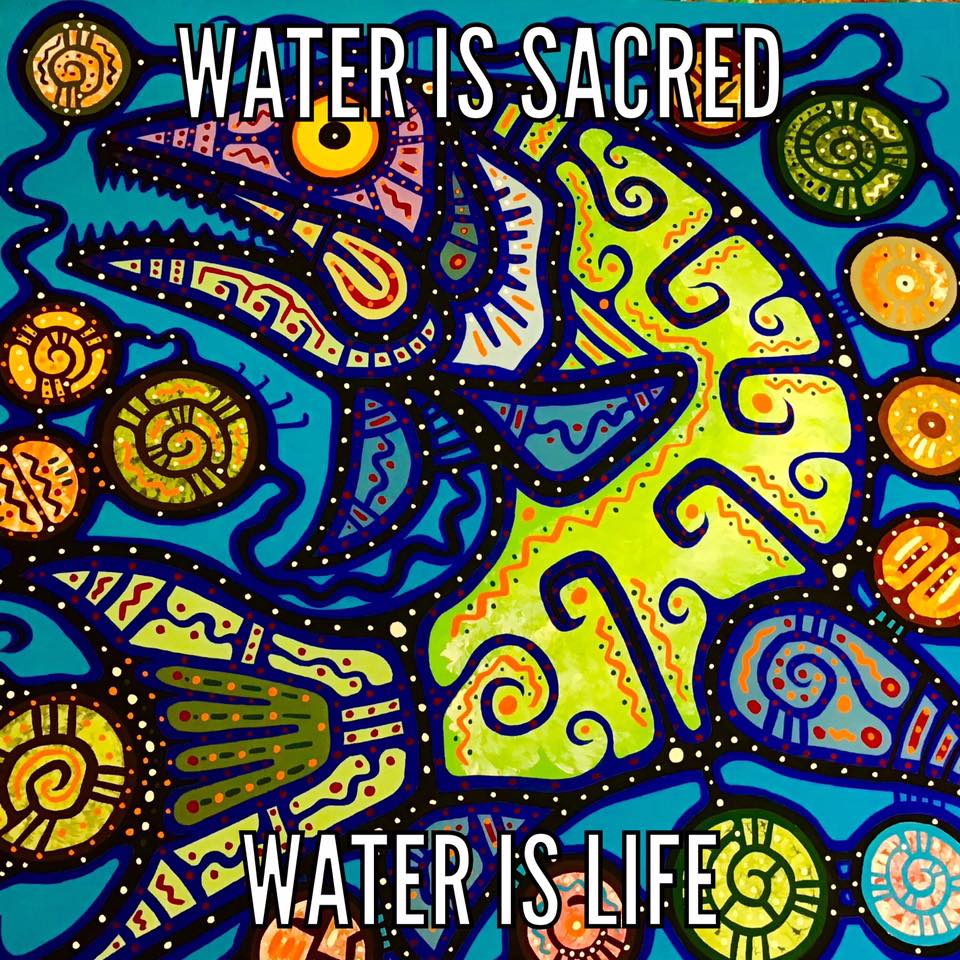
M’Chigeeng First Nation artist Duncan Neganigwane Pheasant is from Manitoulin Island. Duncan started painting in high school using colours and techniques inspired by Norval Morrisseau and other Woodland style artists. His grandfather, Ambrose Pheasant, told stories that were also a great influence on his artwork. Duncan uses his images to interpret Ojibwe legends and stories that surround the history of his ancestors and Manitoulin Island.

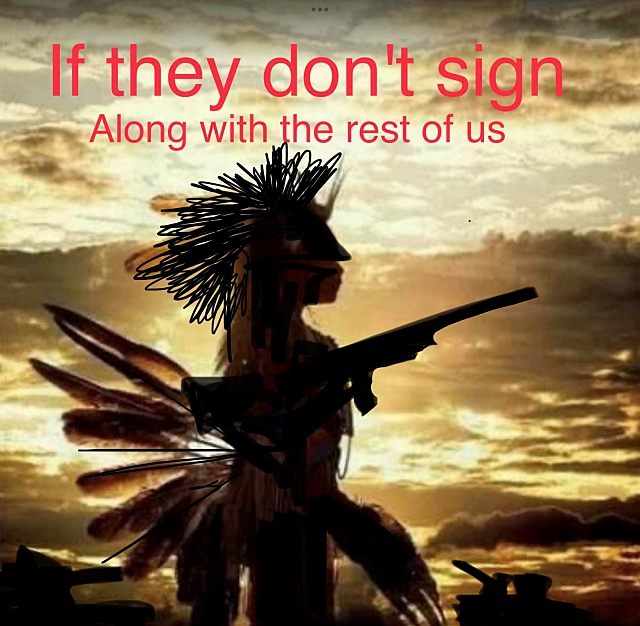
The Mohawk Warrior Flag design has been flown all over the world, serving as a symbol of the unity of Indigenous peoples in our common struggle, becoming a beacon of hope, and illuminating the discordant relationship between the dominant society and Indigenous peoples.
The deer’s antlers are one of the characteristics that have made it the figure of a spiritual superiority, according to the Ojibwe. Like a crown, the antlers grow beyond its body, bringing it closer to the sky and making it sacred. In many tribes the deer is a symbol of spiritual authority. During a deer’s life the antlers fall off and grow again and the animal is also a symbol of regeneration.

Regeneration is the key to my shrine,, I burn sacred tobacco and recite the welcoming prayer..
The flag is also a symbol of regeneration,, fighting for what’s right, bringing the people back from the brink of disappearance and destruction
when you enter it you travel through the eastern doorway…like when you were born…behind the warrior flag is another door…the western doorway…this is where you travel through when your journey is finished .but it is on the other side of the flag…this represents the fight ,the journey is to be done first…then you can travel through the western door…

Overall, having this home altar can be another way to remind myself of things I love or intentions I have for the future. If any of these rules are throwing me off, just trust my gut. You know what is best for you and your intentions. As long as you are in touch with your true desires, you’ll be fine to design your home altar anyway you like.

Image courtesy with the kind permission from Duncan Neganigwane Pheasant

Jay Blackwood

makes assemblages, boxes, totem dolls and other three dimensional pieces using found objects and materials. He has been involved with Surrealism, both as a practice and as a creative/revolutionary current, since the early 1990s. His work straddles the border between dream and consensus reality, the everyday and the numinous. Jay lives in Bristol, England.

The presiding spirit in my studio is a wonderful stone lithograph by Rikki Ducornet, Histoire Naturelle I, kindly given to me by Guy Ducornet some years ago. Beneath it are a number of pieces I made between 2001 and 2015. They are the product of chance finds, dreams and fleeting inspirations. All relate in some way to the natural world, and to archaic notions of male/female energies.

Image courtesy with the kind permission from Jay Blackwood

CLAUDIO RODRIGUEZ LANFRANCO

born in Valparaíso in 1968. After living in Patagonia and in United States product of a scholarship, his first painting exhibitions were date back to the nineties in Valdivia. Later he moved to Santiago and the Fifth Region, where his visual and literary work materializes in a body of work that addresses different forms of expression, such as painting and drawing, experimental and documentary video, visual poetry and muralism, with public art projects installed in Santiago, Valparaíso. As a visual artist he has exhibited his paintings in 15 solo shows and in more than 60 group shows in Chile, Europe and the United States, and his poetic texts have been published in regional, national and international poetry collections, his work being awarded in different state funds for artistic creation such as Fondart, Cntv, Fondo Carnavales Cultural Centers of Valparaíso, among others. Currently the painter lives and works between Valparaíso, Santiago and Concón, where he develops his artistic projects and teacher training, being in charge of university graduates, painting and mural workshops, becoming a teacher for generations of students and artists who have worked with him.

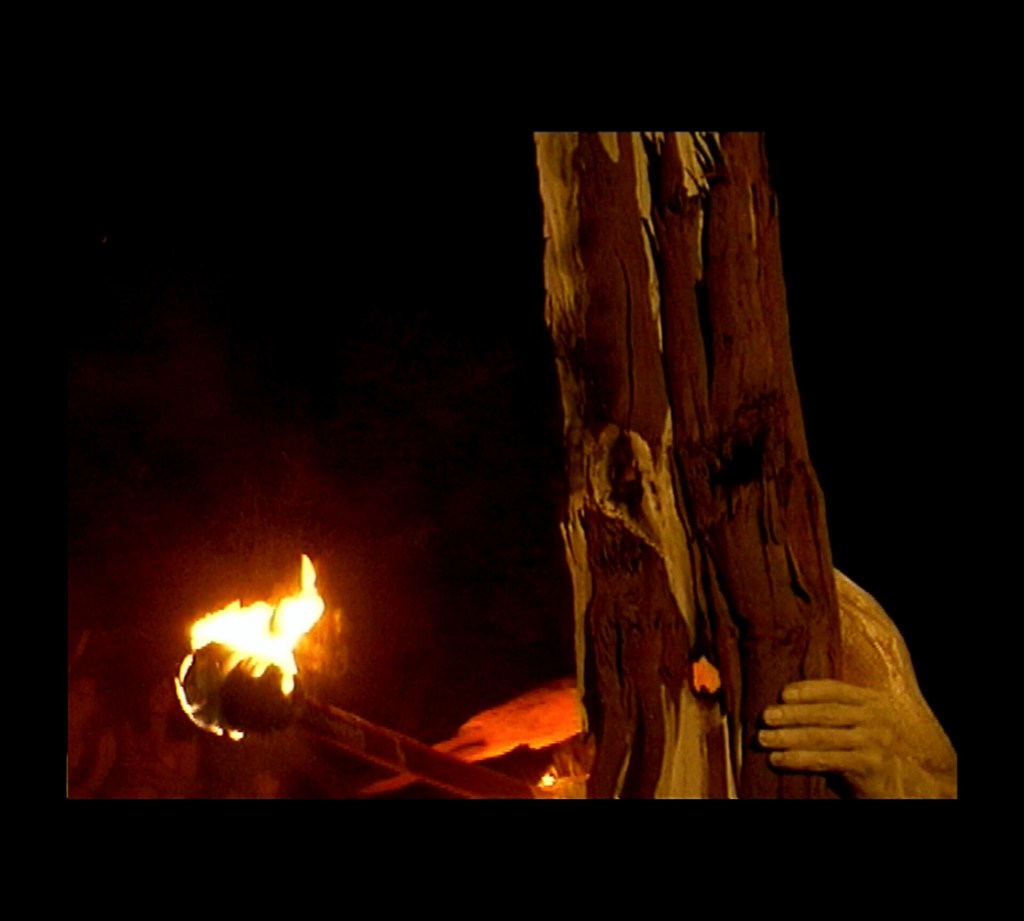
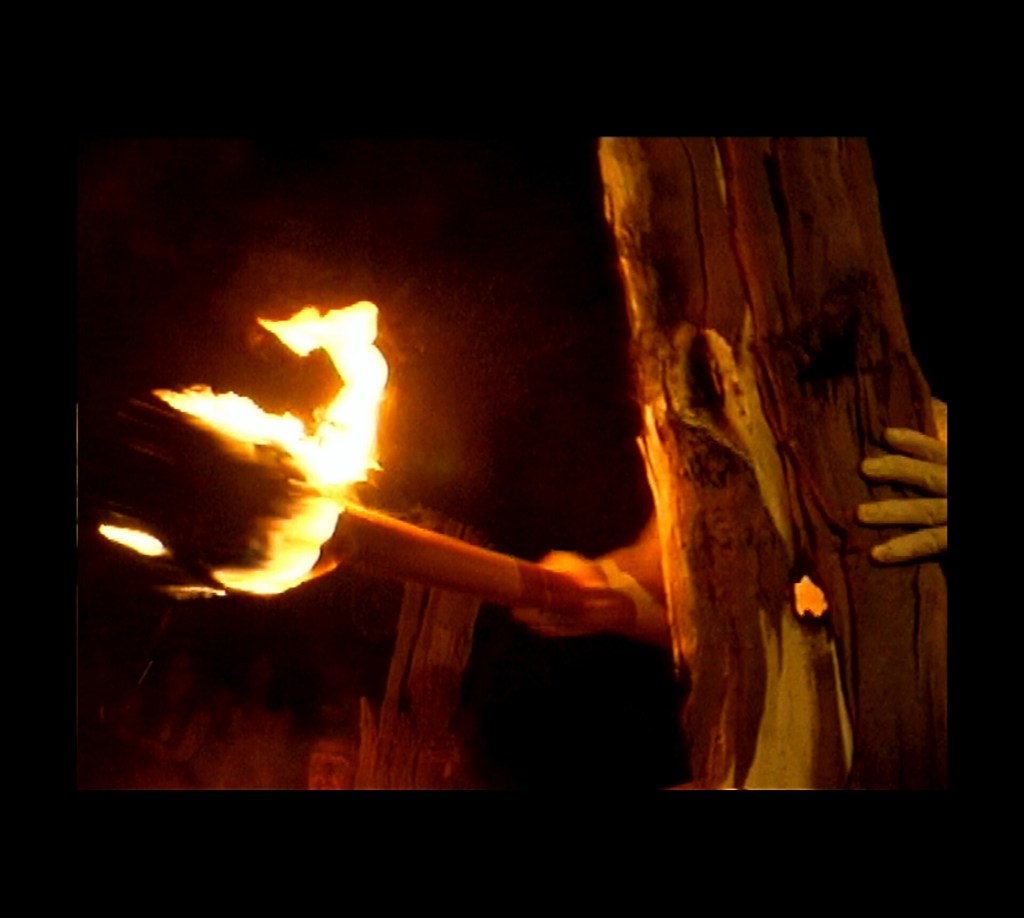
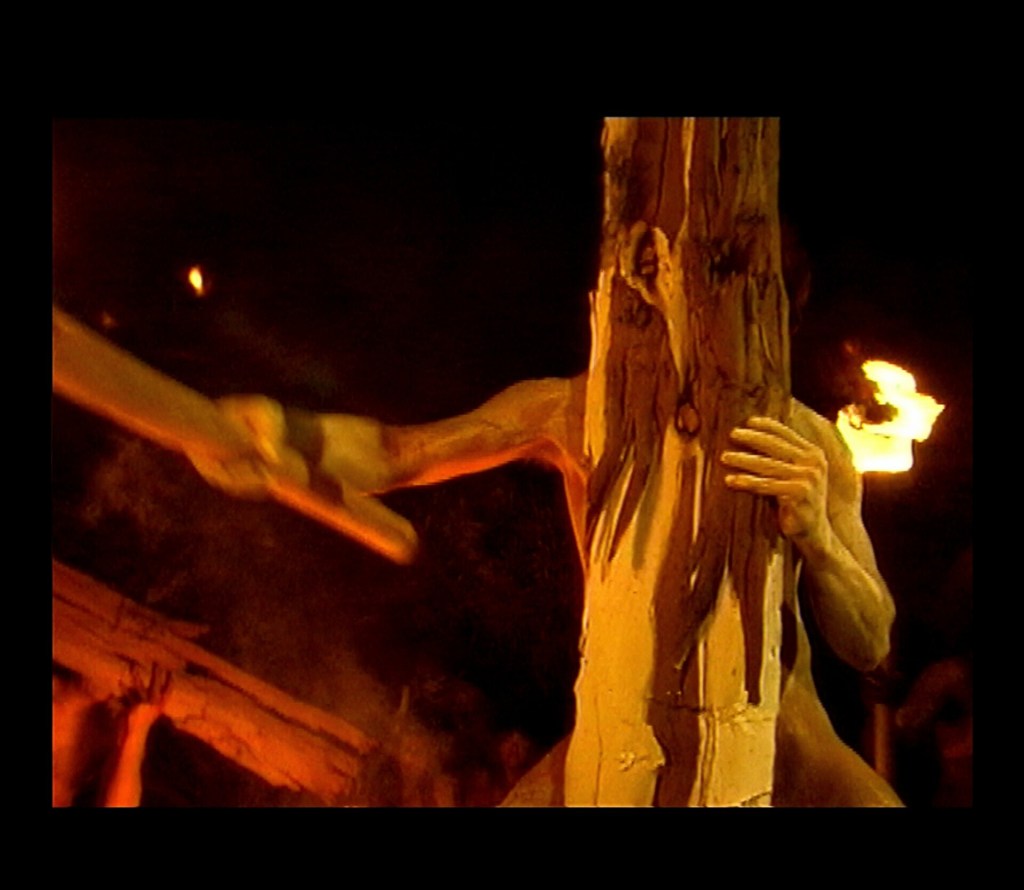
SELK’NAM FORCE. AS AN EXERCISE OF CREATION ON TRAVEL, CARRIED OUT DURING MY TEMPORARY TRANSIT THROUGH DIFFERENT PLACES IN CHILE SUCH AS THE ANDES MOUNTAINS, THE SOUTHERN CANALS, PATAGONIA AND THE ROUGH ARIDITY OF THE NORTH COASTS. A GLANCE OF THE BODY VALUE THAT THE ANCIENT CULTURES OF THE SOUTH OF THE PLANET GAVE THEIR CEREMONIAL REPRESENTATIONS, WHERE WITCHES AND SHAMANS DRESSED WITH BARK OR LEATHER MASKS COVERED WITH MUD AND MINERAL PIGMENTS SUCH AS WHITE, BLACK OR RED ON WHICH THEY THEN DRAWED FRAGMENTS OF THE SKY, THE PATH OF THE CONSTELLATIONS, SIGNS OF ANIMALS OR IMPORTANT NATURAL EVENTS – THE MOVEMENT OF THE SUN OR THE MOON – USING THE BODY AS A SUPPORT, AS A MAP, AS A GEOGRAPHICAL LANDMARK.

Doug Campbell

works primarily in collage, enjoying the immediacy of cutting through the detritus of the spectacle to the marvellous. He was born in Edinburgh, Scotland, where he still lives. Asking about the word ‘surrealist’ after finding it in a science fiction novel as a child, he was given a small book of Surrealist paintings. This was the first step on an adventure that continues until this day. His first encounter with living Surrealism was a second-hand copy of the Chicago Group’s ‘ARSENAL 4’ in the mid 1990’s. In response to a letter, Franklin Rosemont directed him to the recently-formed Leeds Surrealist group. This led to an on-going engagement with the international Surrealist movement through correspondence, collective games and contributions to publications and group shows. In 2017, he took part in the ‘Archaeology of Hope’ a large-scale Surrealist game concluding with a show and solstice ritual on the Isle of Wight. This was a significant transformative experience for everyone involved. Since then he has published a continuing series of collage novels in weekly instalments online at ‘The Cabinet of Major Weir’.

This is the biggest shrine in the house, and in the main living space, so probably the best organised. A mix of heirloom items, curios and pop culture junk. Framed artwork on the wall is by (l to r) Janice Hathaway, Tim White and Peter Overton. The boxed object at upper left is a magic bottle that belonged to my grandfather, an amateur conjurer.

Image courtesy with the kind permission from Doug Campbell

Mitchell Pluto

Artist, Jewelry Maker, Art Editor

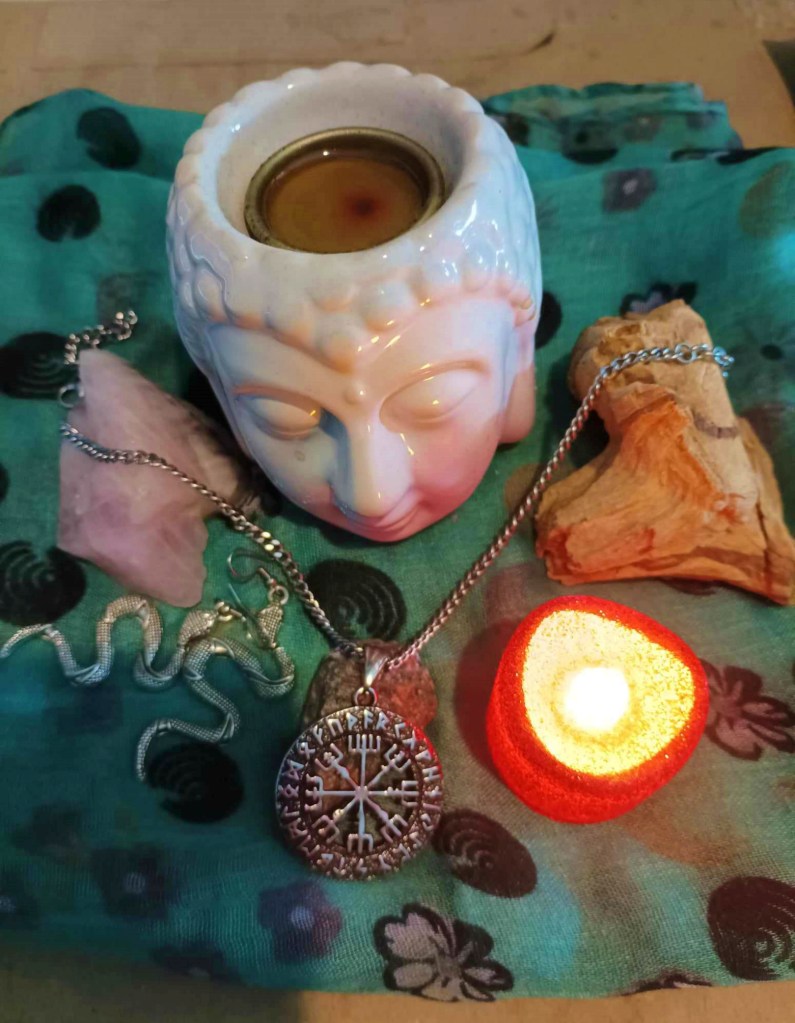
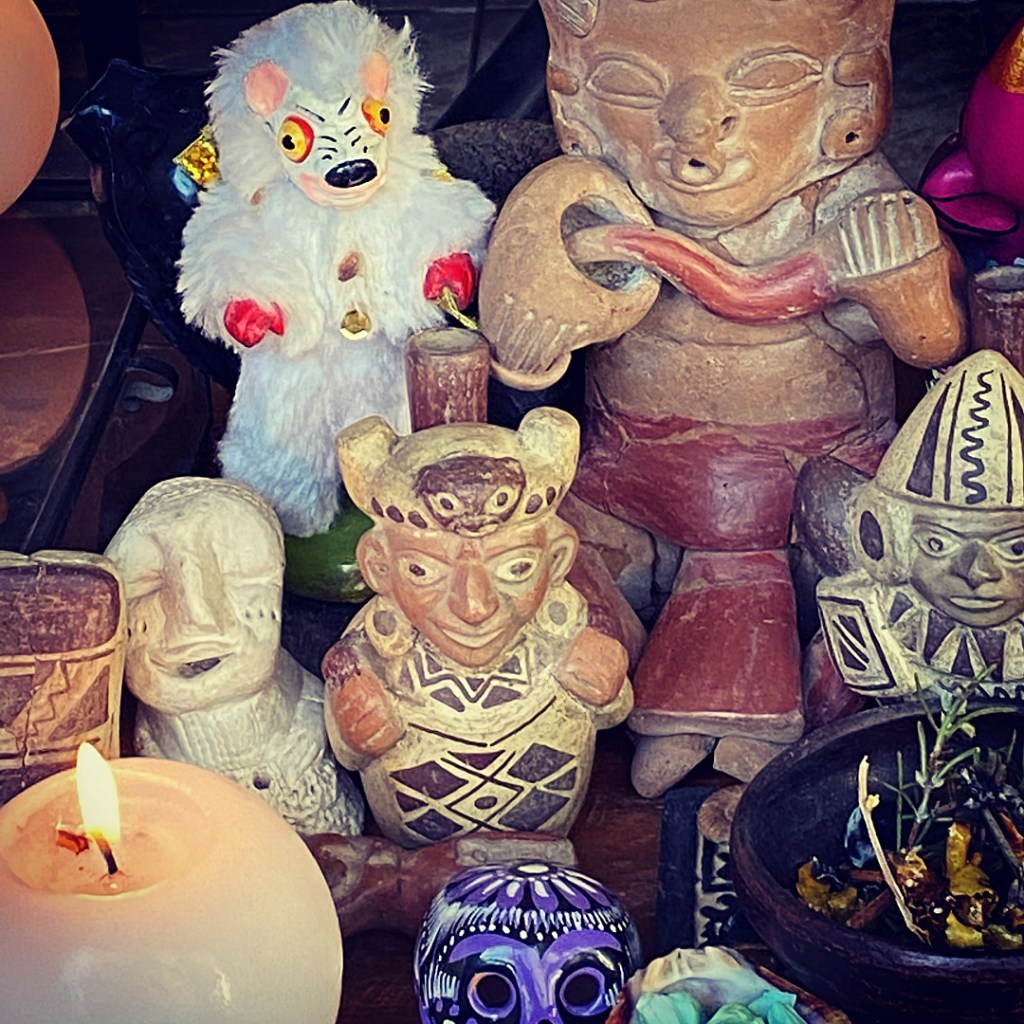
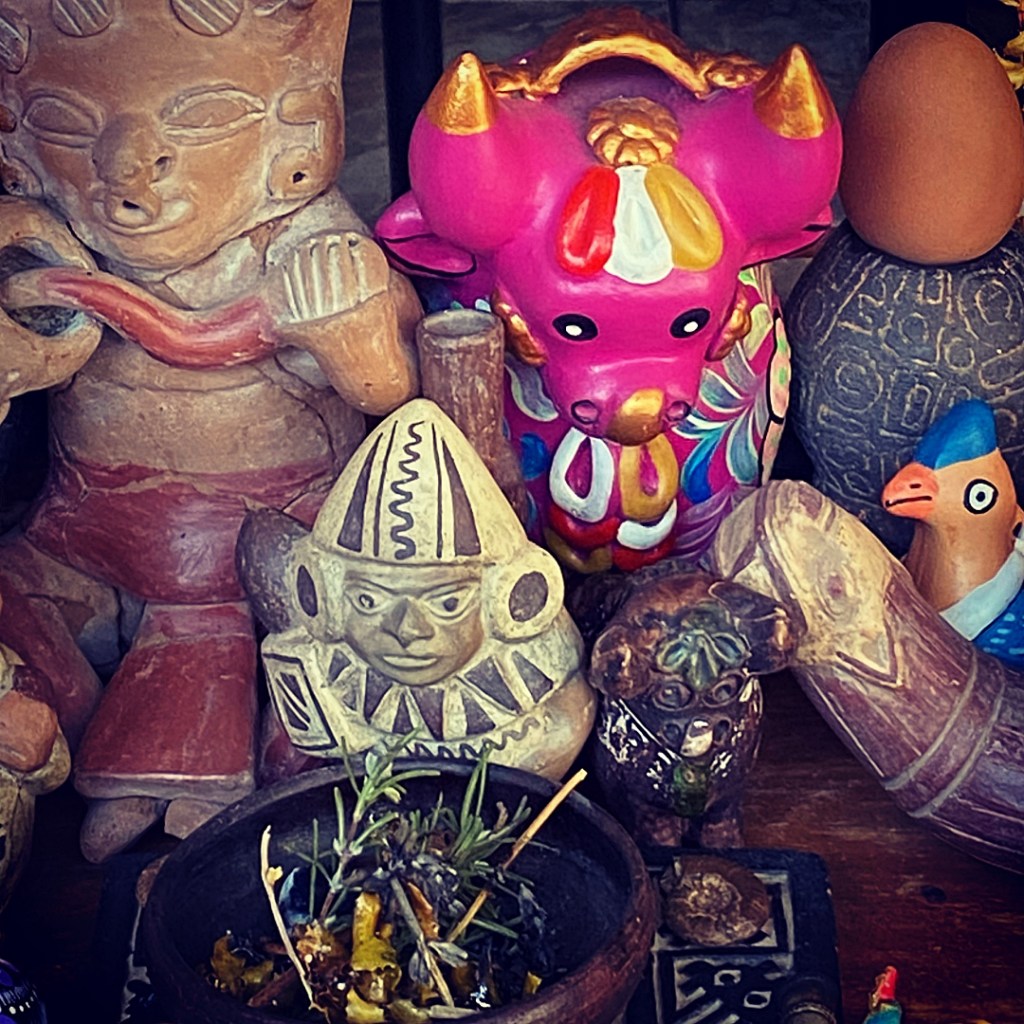
I began collecting objects for our altar in 2020 during the Covid pandemic. I selected figures that embody different archetypical aspects of growth and limitation. The process of recovery is sincerely magical. These mysterious qualities remain a focus on the altar. They play a vital role in the background as well as influencing the subconscious in healthy ways. Constructing an altar helped me be attentive to the belief needed for healing.

During the pandemic complimentary rum and coffee were supplied as part of a thoughtful routine and ritual. The other side of our altar is a shelf for salts, herbs and spices.

Wifredo Lam

Cuban artist who sought to portray and revive the enduring Afro-Cuban spirit and culture.

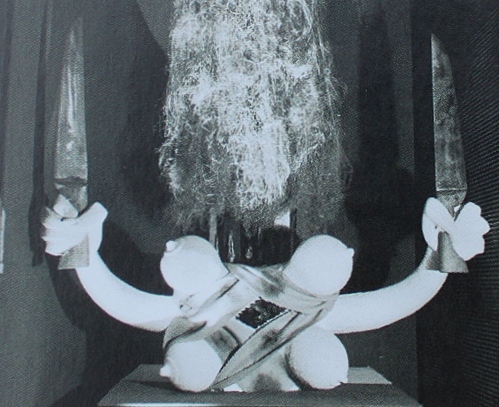
About the Featured Photo

The Hair of Falmer

The Hair of Falmer, an altar created by Claude Tarnaud, Michel Hertz and Francis Bouvet following a design sent by Wifredo Lam from Havana for Le Surrealisme en 1947 exhibition held at Galerie Maeght, Paris, 7 July-30 September 1947 original photo Denise Bellon. Expert from The EY Exhibition: Wifredo Lam. Tate Publishing figure 33, page 211 used and intended for educational purpose only

We Are The Land by Duncan N Pheasant

The land has spirit and we are the land…The rock pulses with energy and movement that we cannot detect…the rock sometimes shows himself and becomes recognizable like a face. The land is what we are, the land keeps us alive, the trees speak to each other about the land and share its nutrients, they live out their lives without any help from man. They are a community and we show them respect. Then there is the everlasting sky all others live beneath him with its many moods and gifts ,we offer prayer to all four directions. We say we don’t think about these things… we know all these things.

Permanent installation at Manitou Island Post Office

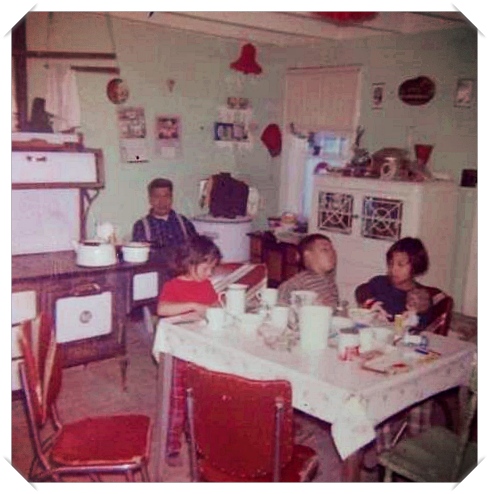
Growing up in Mchigeeng First Nation we were poor we didn’t know we were but didn’t feel like it…we had clean clothes food toys…No running water, no phone no inside toilet but we were happy…today I wonder about young kids seeing things on Facebook and tv like friends having parties, new cloths new toys, new this new that…big fancy houses…they look around their homes and community what do they see… What do you see ?

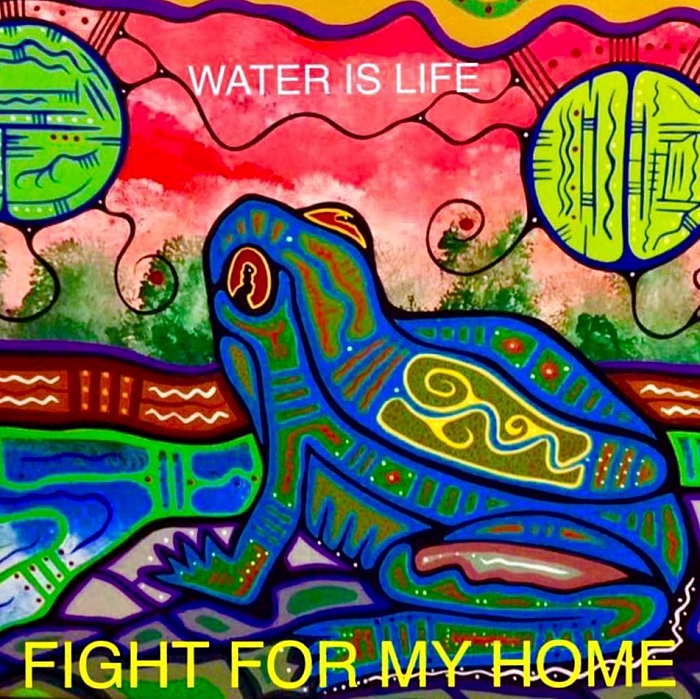
Our Ancestors foretold that water would someday be for sale. Back then this was hard to believe, since the water was so plentiful, so pure, and so full of energy, nutrition and spirit. Today we have to buy pure water, and even then the nutritional minerals have been taken out; it’s just empty liquid. Someday water will be like gold, too expensive to afford

Even the spirit, which belongs to the Great Mystery, returns to its source. Some of our people say this journey takes place on a path of stars. Others describe the spirit’s return to the Great Mystery as a drop of water falling into the ocean. It becomes a part of everything again as the light of a candle becomes one with the fire of the sun. That’s why we can sometimes feel our loved ones in the warm air, or hear them in a bird’s song…or even sense them in the…wind.
We feel them in certain areas or times of the year,, we sense them and think of them and dream of them. Sometimes they talk to us in the dream but most times it’s just good to see them…we wake up thinking of them ,The dream can last a day or we think of the dream for many years…yes they are with us..

Guardian of the Lake

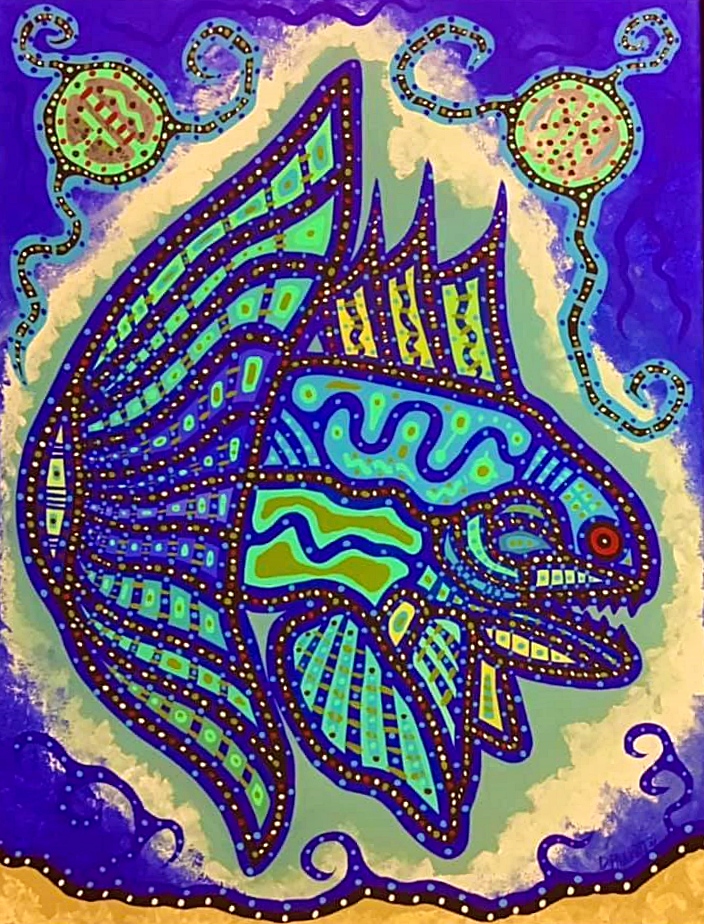
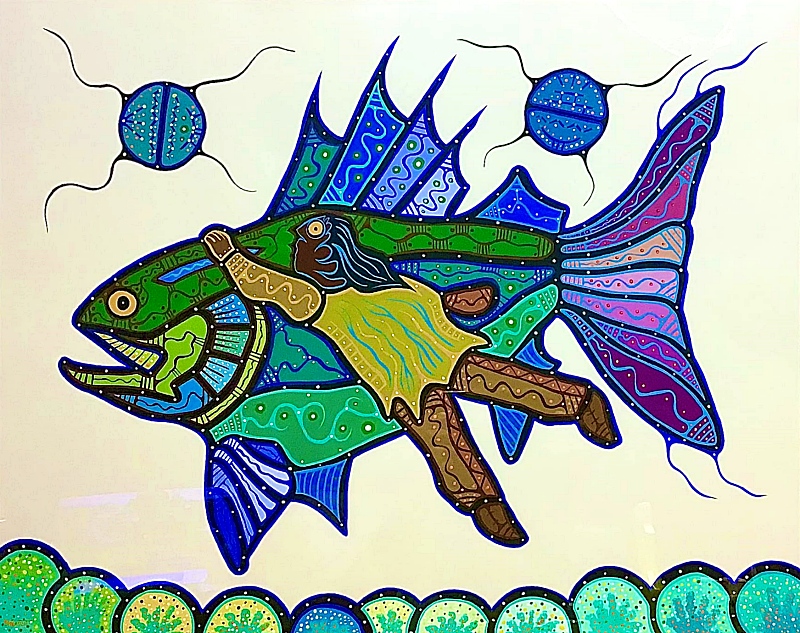
A man by the lake wanted to live forever. A huge fish came about out of the water and pulled him in. The fish had spent his entire life looking for freedom from this world.
He told the man we will go to the door of eternity, you will step through one way and I will go through the other way. This sounded good to the man. They both went through the door.
There said the fish …I now will live a normal life and you will live forever. The man had become the fish. “Stop Wait” he said but the man who was a fish could not hear. To this day the guardian of the lake searches for the man who died a normal death many many years ago. The guardian of the lake, a huge ancient fish.

Mindemoya man

The Mindemoya man…A giant fish appeared to some men on the shore of Mindemoya lake ,they grabbed the fish and were surprised how the fish let himself be caught…they took the fish to the village and it began to cry like a human…A lonely woman came out to see what’s going on…she recognized the crying as her long lost husbands voice…she called out his name then the great fish began to speak “I was once a man but was turned into a fish, by a witch, because I rejected her…and my wife who I see now I cannot be with anymore” The people became afraid and dragged the big fish back to the water…The woman ran after them and jumped in the water with the fish…they were never seen again…next year the waters were teaming with fish and for many years after that.

I AM the Land

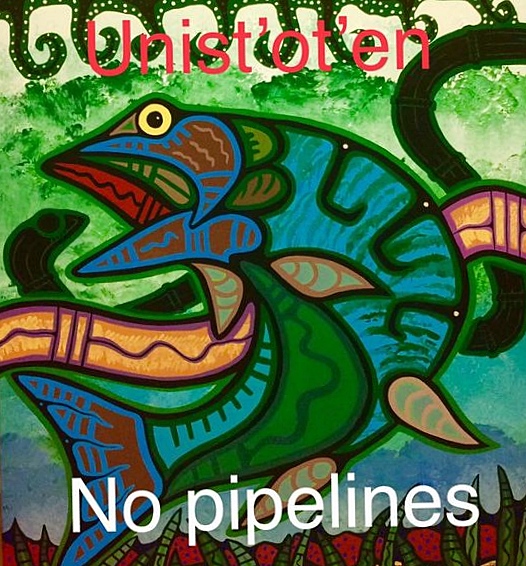
Nobody wants anyone to leave, We’re just trying to protect the land and waters for future generations, for all . 95% of British Columbia is unceded native territory as the treaty process for British Columbia started in the 1990s and has yielded only three treaties to date.
Enshrined in Canadian Charter of rights and freedoms Section 25A is the Royal Proclamation which recognizes and affirms indigenous title to land and requires treaties in order to legally possess. Where as no treaty exists those who willingly or inadvertently set themselves upon these lands must remove themselves forthwith. Canada is in violation of their own laws.

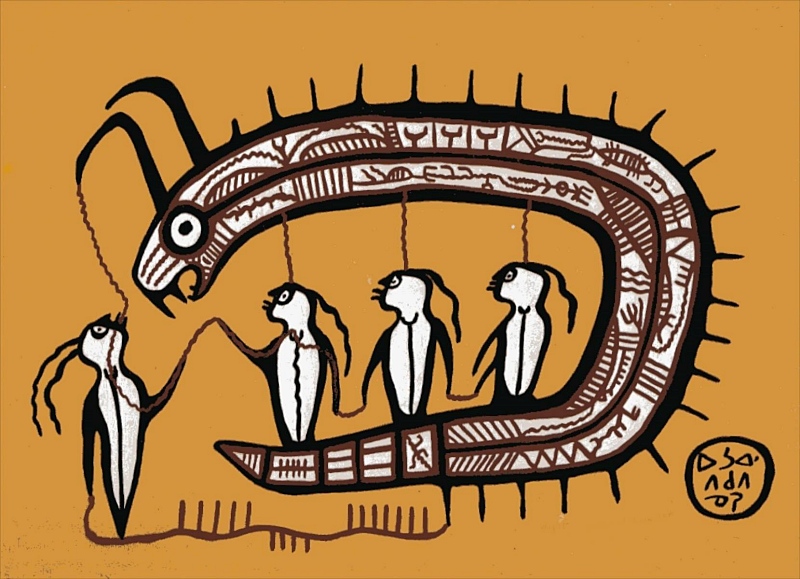
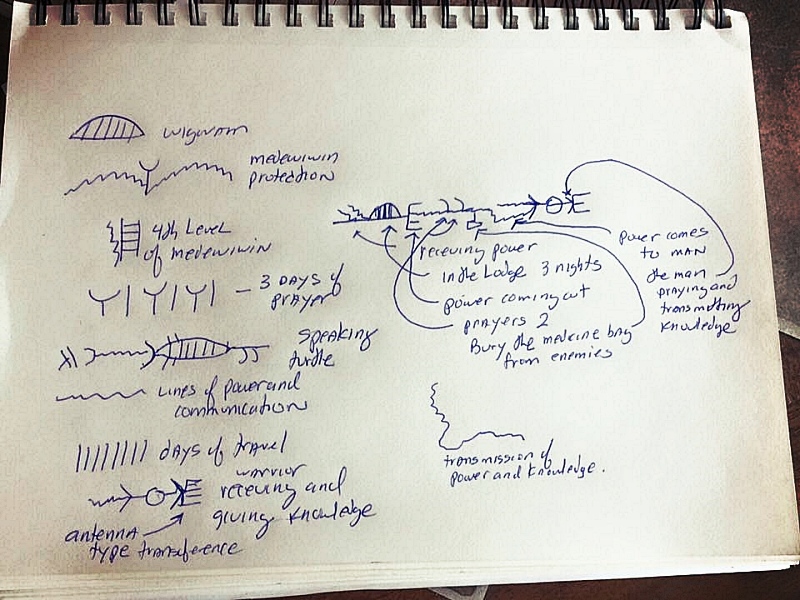
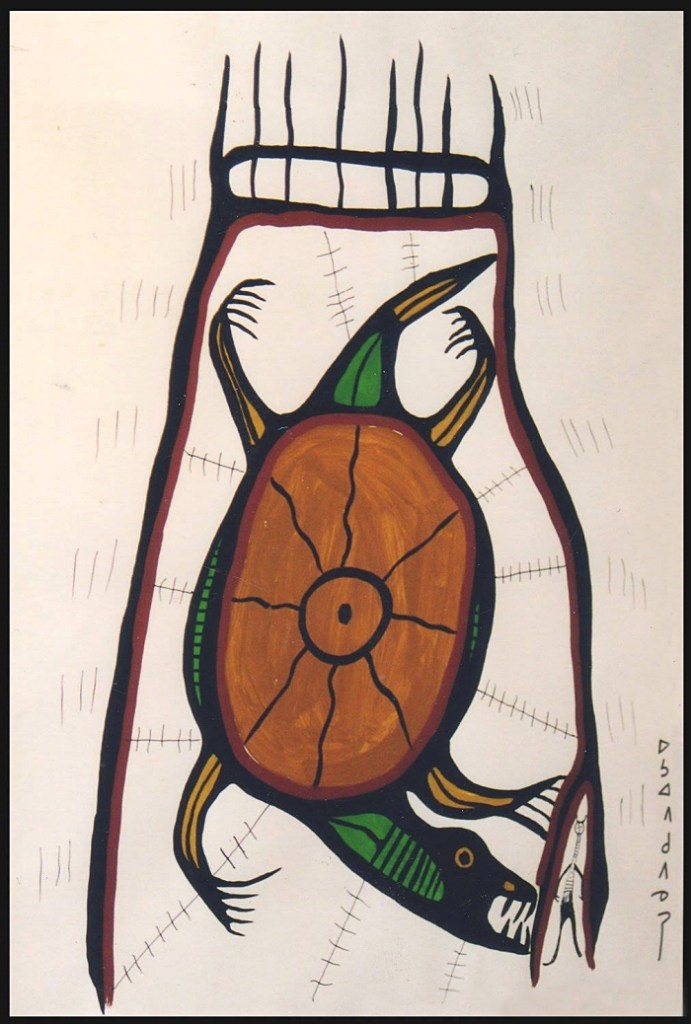
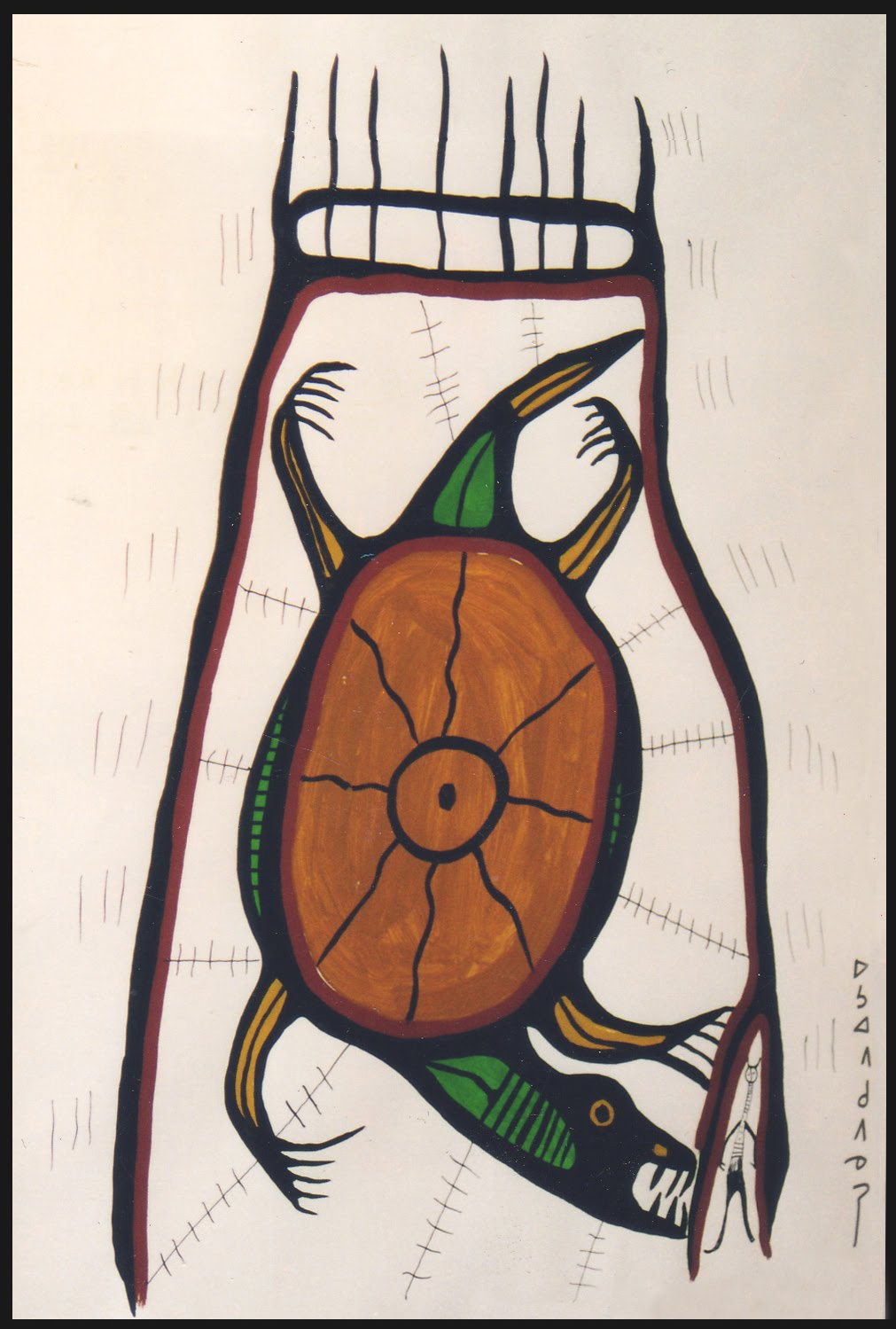
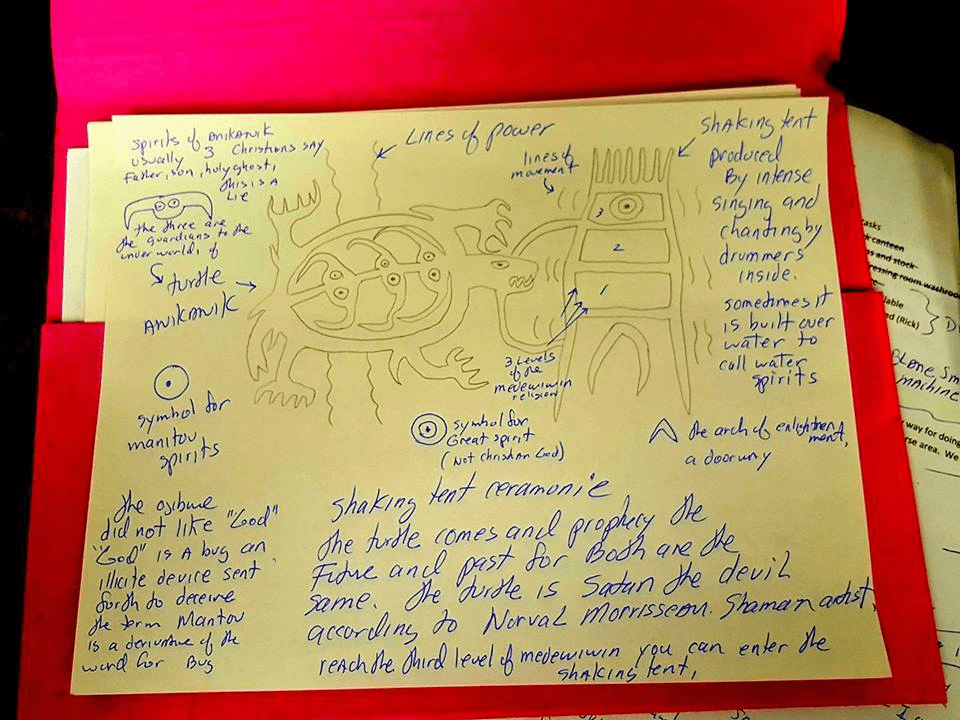
The Shaking Tent Ceremony by Norval Morrisseau

The Ojibway Indians had what we call a jeesekun, a shaking tent, or wigwam, where a medicine man does conjuring. There were two kinds of shaking tents. One had its power from the water, the other from the wind or earth. Some Ojibway built their shaking tent in the water, in order to receive power from it. Eight poles were cut and placed in a circle, and each pole was driven about two feet into the ground to keep the tent firm. Two hoops were placed inside the wigwam to keep the poles in position and would be covered with deer hide, birchbark or canvas. Rattles of tin or cari­bou hoof were placed inside to make a rattling noise.

All the Ojibway would gather and sit in a circle facing the shaking tent. This took place at night. The conjurer would disrobe, have his hands tied up and crawl inside the wigwam. He would not speak but would have one Indian, or all, start asking questions, whatever each one wished to know. As the conjurer crawled inside, the tent itself began to shake and the rattles were heard. The Ojibway believe a medicine wind blows from heaven in the tent and that is how it shakes. All the dogs tied close by began to yelp and were afraid but the people were not, for it does not affect human beings. What come into the wigwam to sing or talk are the water god Misshipeshu and other spirits of bears, serpents and animals, thunderbirds, the evil Windigo, the morning star, the sky, water, earth, sun and moon, also female and male sex organs. Each speaks in his own lan­guage but we have an interpreter whom we call Mikkinnuk, a small turtle who is the Devil him­self, who interprets for all these beings. So let it be known now and then remain a secret; it is the Devil himself who is the interpreter.

The Ojibway were given this shaking tent to do both good and evil. A lot of people of the Ojibway tribe used this conjuring tent to conjure people but a lot also used it to cure people, to find lost things, to defend the people from evil sor­cerers, or bad medicine-men, and to know about the future.

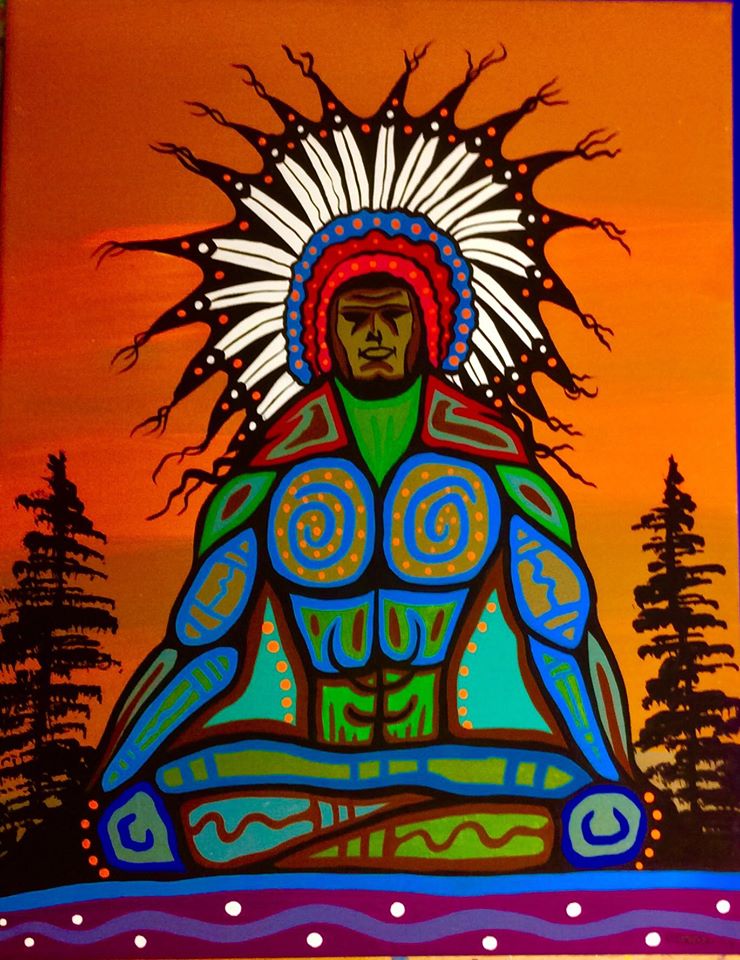
Duncan Neganigwane Pheasant Silent Hunter a living ghost that eats with it’s eyes
Mitchell Pluto Collection

Duncan Neganigwane Pheasant, Dedicated to Norval Morriseau on the anniversary of his birth
March 14 1932.
Spirit Warrior 18×24 canvas

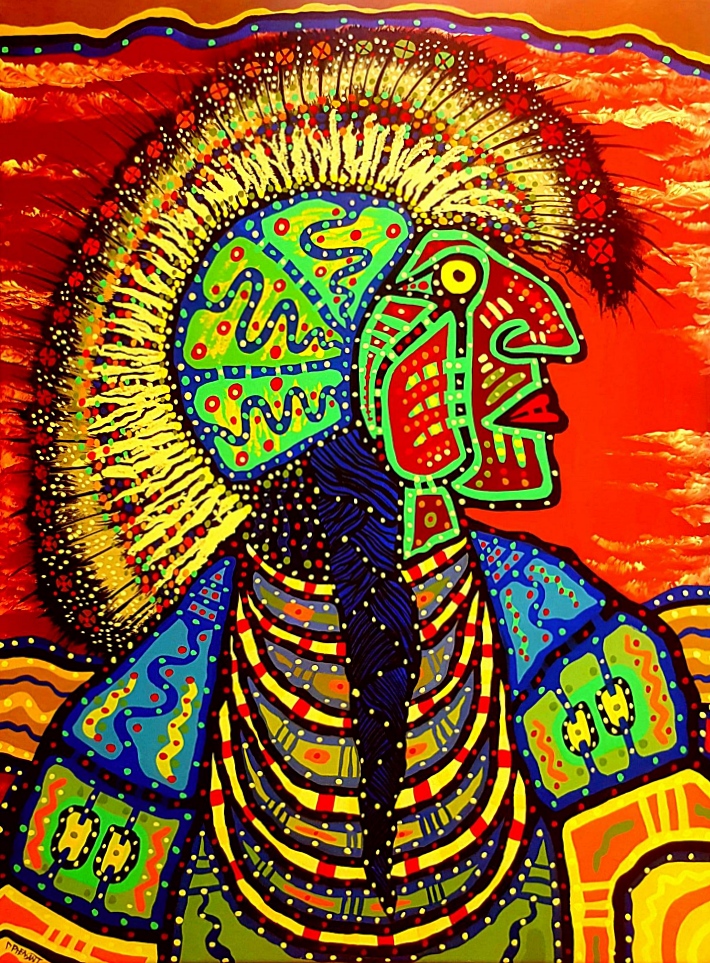
Manitoulin island is a place of ancient spirits lying in wait within the cliffs and deep inland lakes. A man with a spirit face looks out across the cliffs as he paints on them. A weary hunter warrior realizes he now is a stranger in this magnificent stone garden He is a shadow man a shadow warrior.

The invisible man from the door of the unknown. He hears the pounding of the drum and heads to it. Modern day Ojibwe and Odawa men sing the songs of old. He stands beside them but they cannot see him He is a spirit warrior.

Duncan Neganigwane Pheasant Tribute to the hunter

written by ©Duncan Neganigwane Pheasant

Duncan Neganigwane Pheasant is a painter from the M’Chigeeng First Nation. He started painting in high school using colours and techniques inspired by Norval Morrisseau and other Woodland style artists. His grandfather, Ambrose Pheasant, told stories that were also a great influence on his artwork. Duncan uses his images to interpret Ojibwe legends and stories that surround the history of his ancestors and Manitoulin Island. Those legends which inspire his work are inscribed on the back of each original painting and a printed copy of the legend will be included with each purchase.

Perivale Gallery Duncan Neganigwane Pheasant

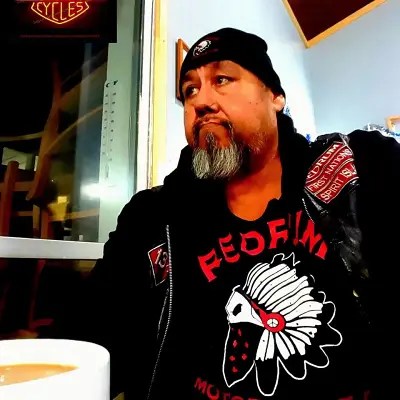
Coffee with Duncan Neganigwane Pheasant

Saturday, April 18, 2020

It’s my duty as an artist to to mention the Woodlands Medicine painting founded by Norval Morrisseau and practiced today by Duncan Neganigwane Pheasant. The style has made a very relevant impression on me. This includes practicing the ability to X-ray Dreamtime and remember the House of Invention. It would be a great misfortune not to mention this source of inspiration. I have had a correspondence with Duncan Neganigwane Pheasant since 2009 around the same time I discovered Norval Morrisseau. The coincidence is very meaningful to me. It has helped mature and guide my own artistic process. I am honored to have Duncan as a friend and brother in the fellowship of art

Duncan Neganigwane Pheasant conversation in his own words

I started to do art in public school. I always was interested in drawing and painting. In time I realized I was quite good at it and was always asked to draw for the class room I always continued to paint throughout high school where I sold my first painting, it was of the rock band KISS. I did many rock bands and then I concentrated on motorcycles..I painted them on masonite board with oil based house paint. I also did many superhero’s and comic book cover reproductions. I then spent more time painting in the woodland style created by Norval Morrisseau.

Norval Morrisseau Painting and Duncan Neganigwane Pheasant’s notation on the Shaking Tent Ceremony

Eventually I developed my own style. I’m Ojibwa on Manitoulin Island and it is here where I developed my style of Ojibwe Woodland Medicine painting. I do not follow the color wheel or any training. When I went to college for art I learned more what not to do then what I was told to do, I let the brush take control and it is like automatic writing, my backgrounds which I do before I paint any subject takes me about two to five minutes to paint, depending on the size of the canvas.

Many subjects used in my art come from the sacred scrolls and rock art painted on cliffs throughout northern Ontario. The main subject is drawn out in a few seconds, like Norval Morrisseau I draw out ten paintings at once while the spirit moves me. It can be days even weeks before paint touches the canvas the all of a sudden the spirit comes and the art pours out. All the art I paint comes from the same place as Norval Morrisseau, from the house of invention. He said some day you will visit it, I did visit it one night..I dreamed I entered a great hall full of fantastic paintings and crafts as I walked through the great hall I noticed all of the art was mine..everything I ever done and everything I will do..it was fantastic.

Nanabush at the Cliffs

I continue on with my painting and exploration of creating art and there are times I feel something some sort of presence..it’s hard to explain but I feel a connection to something really really old ..as if something or someone is here while I paint. I will do a painting and later when it’s almost finished I’ll look at it and say to myself “I know what this is !” this is so n so or something in my past or a story, legend. Many paintings come out from someplace totally unknown to me and I’ll say wholly fuck! This is so n so..or I’ll start writing about a painting, a story and it’s like automatic writing..I’ll read what I wrote..a story or song or poem that goes with the piece and can’t believe I did it..

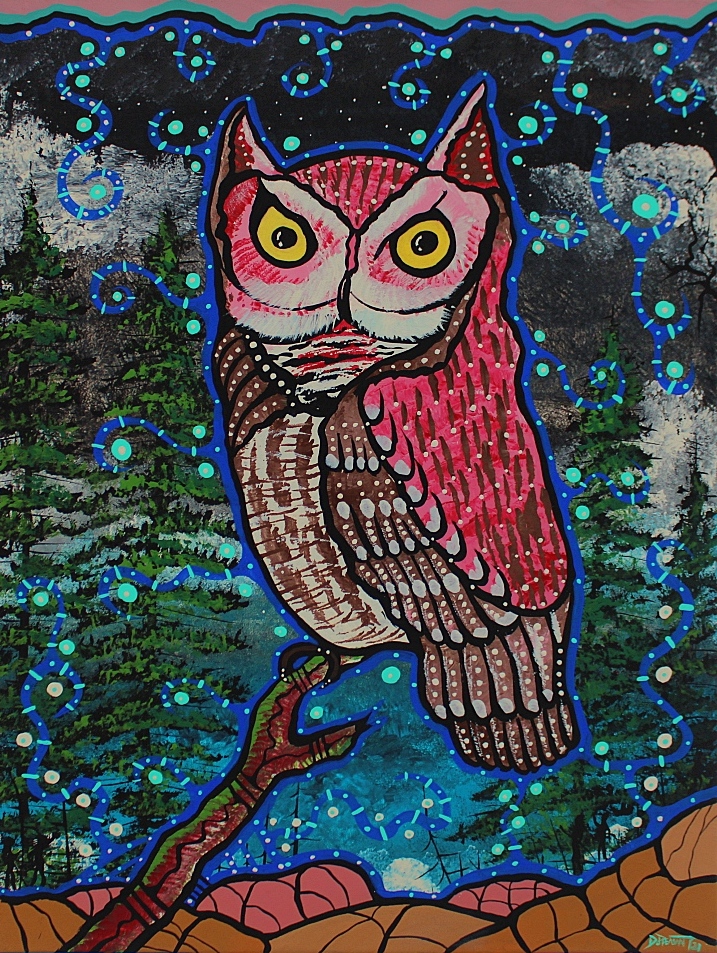
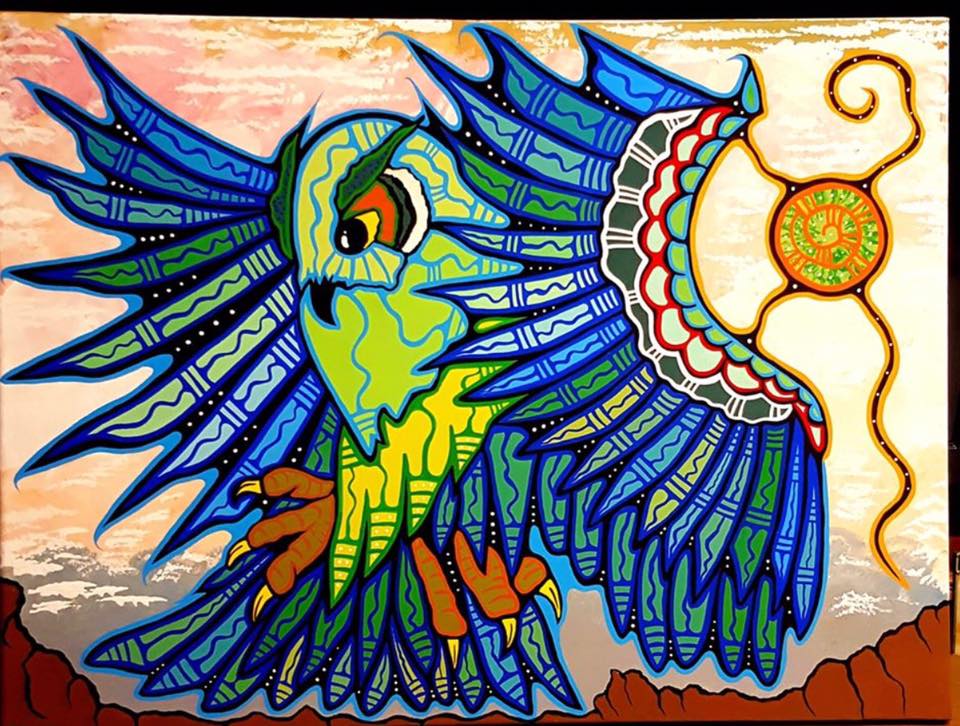
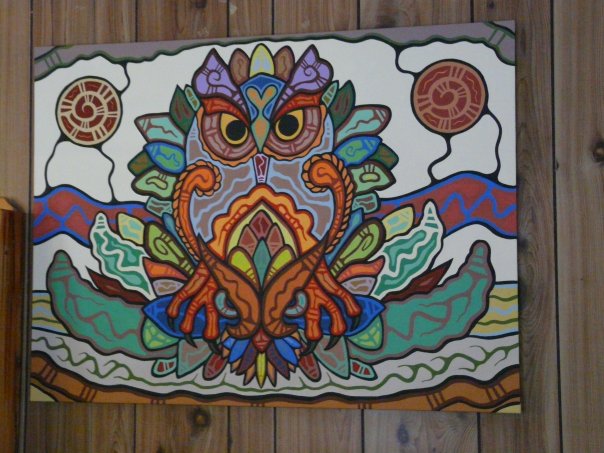
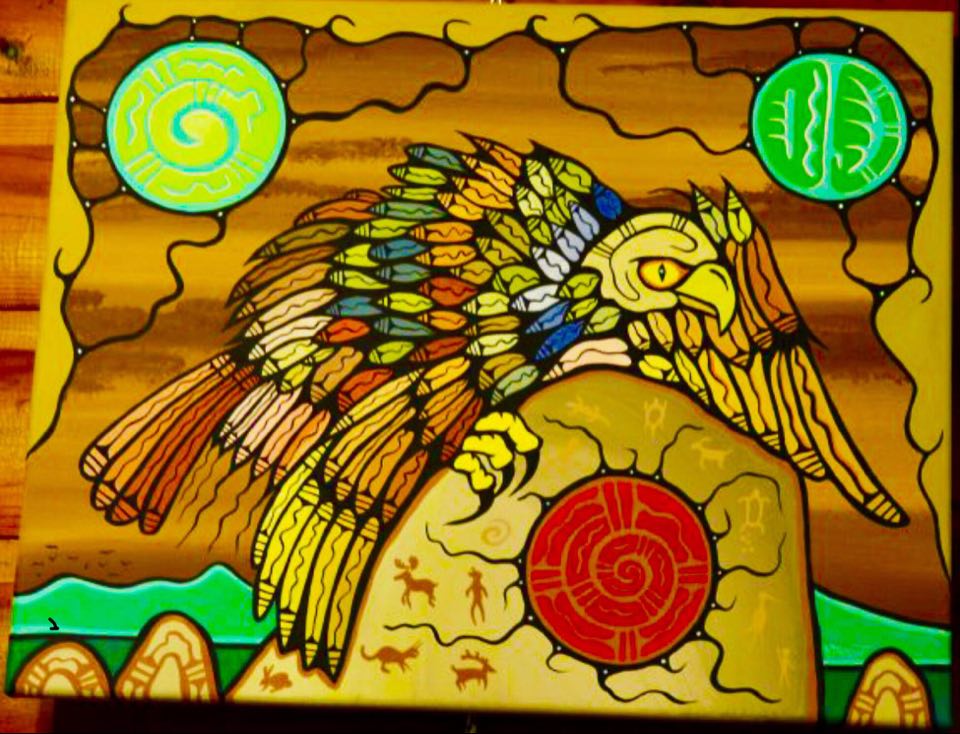
The Owl of Springtime . The story of the first Owl to return to Manitoulin after the great Purification Fire and how the Great Manitou gave the Owl the task of replanting the Island.

An elder told me the feeling I get of something old is the ancestors coming to watch me paint..especially if I’m painting them..of course I’m not in control, like Norval Morrisseau I draw out the painting in a few minutes..the same with the backgrounds. I look at them (backgrounds) for a painting and wonder where in hell did that come from? backgrounds take me maybe two to five minutes to do depending on the size of the canvas. I’ll do maybe three to five backgrounds in one session. I’ll put the paint on a platter and away I go, not even cleaning the brush doing all at once..then I’ll look at them and WOW this one has clouds or sunlight here n there or maybe a mountain a lake etc 30×40 canvas 5 minutes..where did I see this before I wonder..this is so familiar..then I think..from the house of creation.

Like yourself Mitchell, we create things that never existed in this universe. anyone can paint landscapes or people and animals but the work we do is totally from another dimension. I was in AA heading to a meeting walking from my place across town. I am not living in this house at the time. As I was walking all of a sudden a hole opened up on my left side just behind me..like a window into a parallel universe..bright light shone through the window and it lit up the street. I could see everything along the road like all the detail of the grass and gravel. Then I felt hands pulling on my clothing like people trying to pull me in or trying to pull themselves through into this world. Then the window closed with a whoosh! The light reminded me of car lights. Nobody was behind me, no traffic..I think this happened in a few seconds but felt like minutes..it took place exactly in front of the house I ended up renting and then buying. I think of it from time to time.

I’m quite interested in Quantum physics, dark matter, dark energy, the idea of fuzzy stuff as to what makes a molecule move a certain way and instantaneous. Another molecule a million miles away moves the same time, moves the same way as if connected and the idea of tests done on molecules that only work if there is an observer. I try not to have a favorite painting..I don’t want to fall in love with any of my art, if I did I would have certain pieces that are still here on my walls. Each piece I do will leave my place and be put out into the world. I let it go..sometimes I will run into one of them and it’s like seeing an old friend or family member.

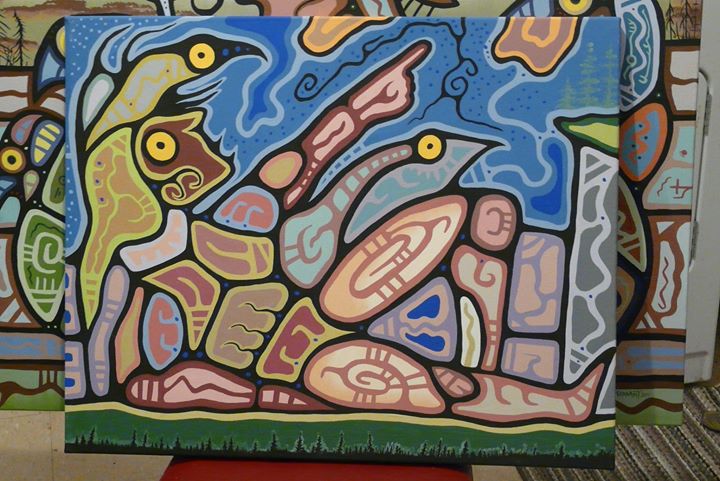
The bird and the stone

I do favor some pictures of pieces. I did in the past and they are in my photo collections..The bird and the stone..not just for the composition but also for the story that was shared with me.

I was told about stones along the north shore of Manitoulin island..they came from the Lacloche mountains when they were as tall as  the Rockies,,the glaciers shaved them down and deposited  these stones all over Manitoulin, the stones are said to be a depository for everything that happened in the stones existence, The Stone is alive and has a memory..one day a bird landed on the stone very tired and quite old..The bird spoke to himself  "I am nearing the end of my life and have no one to share my experiences", the stone made itself  known and told the bird "I have seen a million sunsets..many animals have brushed by my face..many sunny days and cold winters I have seen..I have heard and remembered  the sweet language of the people it is all here stored in my spirit..some day I will be up on the top of the mountain and again at the bottom of the sea. I will carry inside me your memories my bird friend I carry all the memories..and when I become sand again all the memories will be released into the world!"

The painting shows the stone and inside the memories, the red spirit of its life.outside in the sky is the great Manitou spirit and the creator waiting for the bird to let go of its hold on its world and fly up in spirit. The painting shows the stone and inside the memories, the red spirit of its life.outside in the sky is the great Manitou spirit and the creator waiting for the bird, to let go of its hold on its world and fly up in spirit. It is known that rocks contain minerals and these minerals can hold onto events that happened in its presence..When the conditions are right some of these memories can be perceived and heard by people passing by or sitting near the stone…Like magnetic tape when drawn against a device it’s memories can be heard or like VHS tape it can be seen.

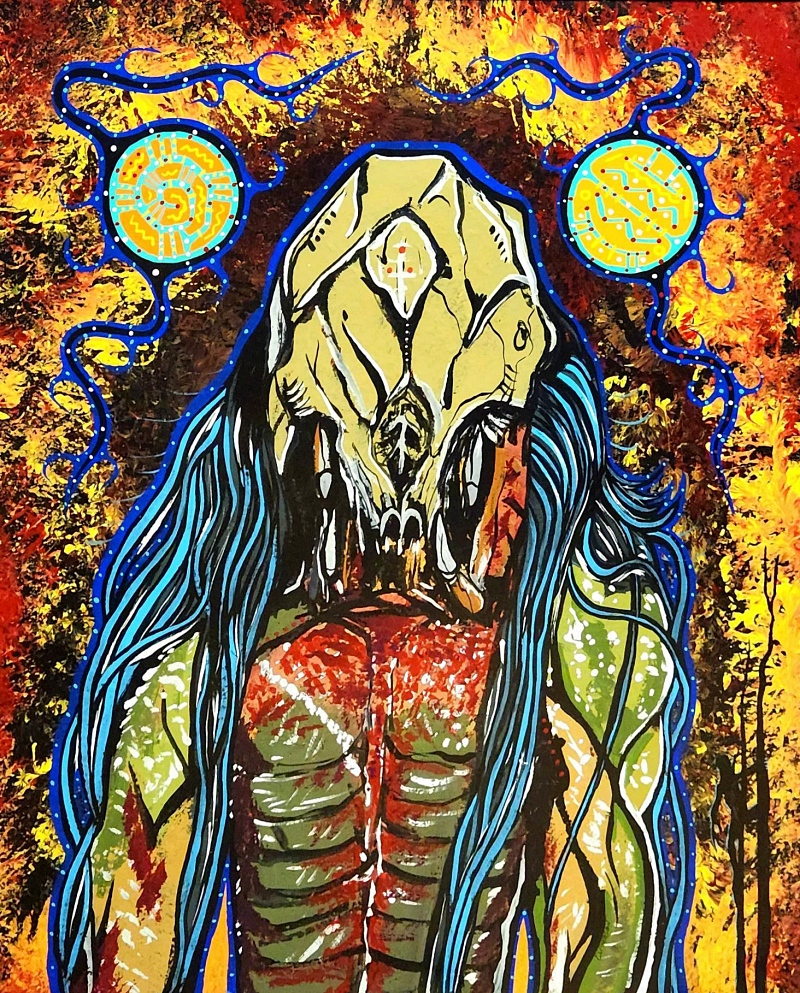
Repulsive gargoyle like face with powerful gorilla like arms lives a huge wild man roaming the north eastern realm of the Niagara escarpment frequenting the area of the a Green bush road and up to the cup and saucer trail and in the basin between the cliffs of Mchigeeng First Nation. One of the first white men to write about this creature was a Jesuit priest Father Rolland. Entire Odawa bands would not venture outside during a sighting..all living in great fear while the head man of each household sat with his rifle all night long he wrote. I remember my grandfather doing this one night when I was about five years old 1965, My grandmother yelling out Jimniddo and chasing us kids into the house just before sunset.These beasts are said to be quite lonesome and stealing people. Some say the beasts are full of remorse and great sadness turning into great anger.

The thing about doing Woodland Native is the color choices. We don’t plan the colors it just happens and the originator of this style of art didn’t plan on the topics he (Norval Morriseau ) just drew it out in a minute then painted it. Guided by the spirits.