(Textos extraídos del poemario inédito Espacios otoñales)
Asuntos difíciles
Te dije que eras
que éramos algo difícil
el sueño nos hizo
reconocernos
nos botó la ola
de las muchas
memorias dispersas
y escuchamos el otro
lado de la pared.
Rosas rojas III
Me llamaste
desde una inicial
tallada en el cemento
me dejaste tocar
tus cuerpos fundados por la noche
más algo nos detuvo
y nos olvidamos callar
nos volvimos piedra inmediatamente
algo nos llevó hacia las hogueras
estábamos al principio de todo.
Raros sueños
Sueño con alguien desconocido
las palabras tienen vocales adúlteras
puedo procrear estos refugios
y deshabitar la noche
hoy vendrás a desnudarme
ellos me muestran otros paraderos
un tipo de lejanía habitual
el ritmo del oleaje
en ese sentimiento alzas la voz
y la fuente estalla en la penumbra
tus ojos parpadean furiosos
mientras nos llevamos la distancia.
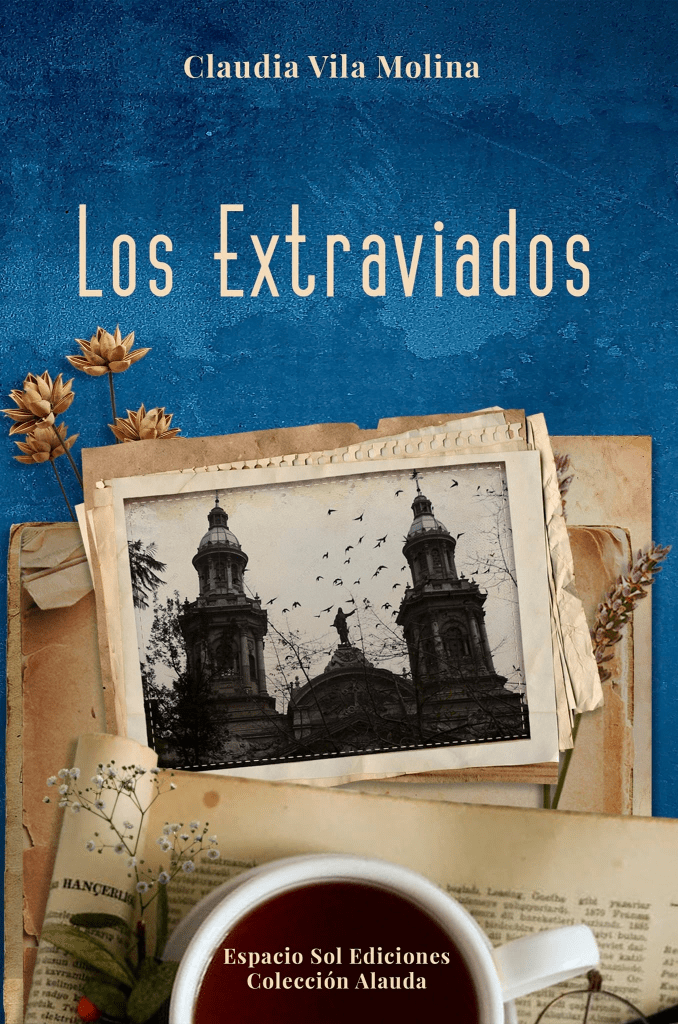
(Poemas extraídos desde mi libro Los Extraviados)
Texturas difusas
Yo sé que te perdí, las heridas no eran la conservación
más fiel de nuestros recuerdos. Sé que te perdí en esos
rieles, la cabeza me remueve el sentido y no puedo
recordar los ritmos de los árboles, sé que tu cuerpo se
contorsiona, porque es tránsito y su pasaje es una
escalera sin dirección. Los dolores me cruzan la cara,
los ojos. Tú me cruzas como paloma y yo no sé, ¿qué
importancia tiene?, si volver a mirar los cerros con sus
murales, los pasajeros que nunca cesan de caminar o
los ángeles que vuelven a morir al mismo sitio. Se
acabaron para ti las oportunidades, el día se fue hacia
otra parte y así estamos partidas por la mitad, en el
círculo de luna y en la zona caliente de tu dolor.
Bosque
Desde el puente la luz se hace navío
y cede pensamientos en un paisaje de otoño
retrocedo, me albergo en este pasado
y un rápido batir me lleva hacia los ojos del bosque
diciembre es sólo una ráfaga
y los pájaros son niños que parten la memoria.
Universos paralelos
Contemplo naturaleza dentro de otro mundo
los árboles (como hilos sujetos por un alfiler)
se pierden entre las ondas
nunca más su mirada
quedará prendida a ciertos espantapájaros
(limitando el vuelo de los tornillos)
ni siquiera bajará hacia las cerraduras
y retumbará en los eslabones.
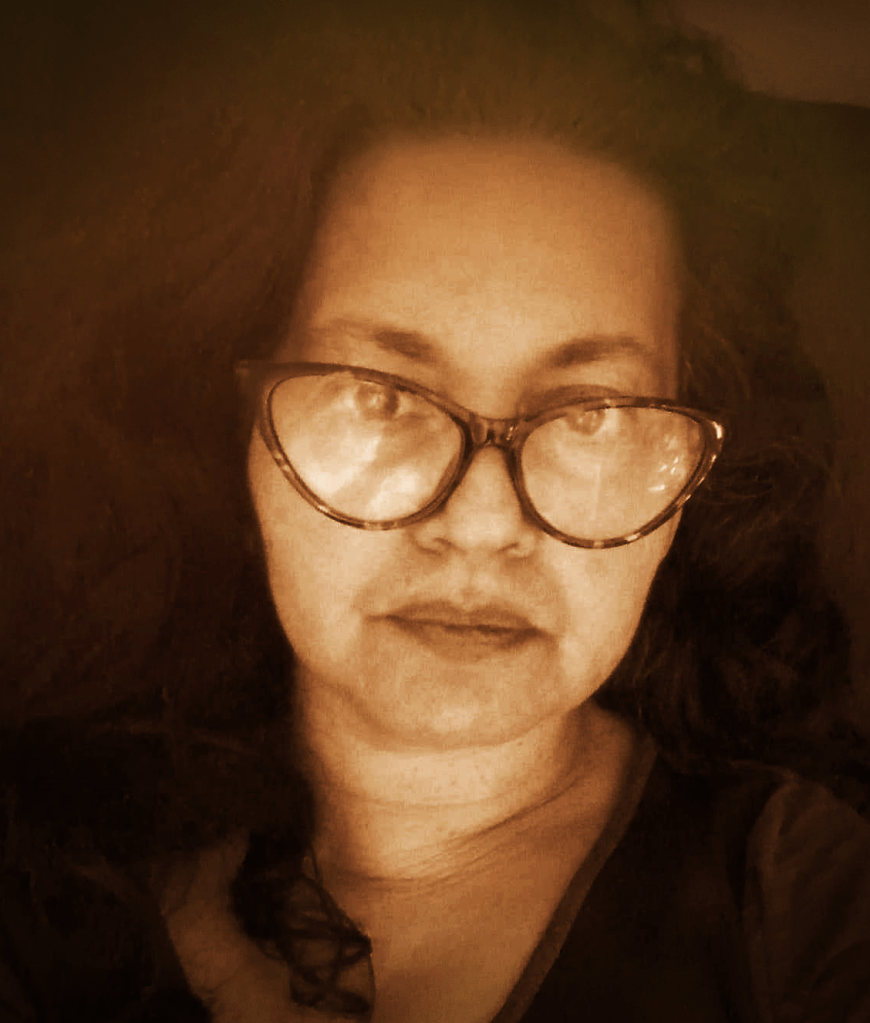
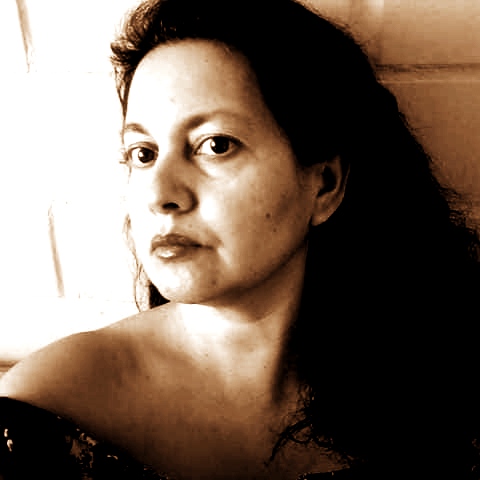
Claudia Isabel Vila Molina 22-09-1969…) Escritora nacida en Viña del Mar, Chile. Profesora de lenguaje y comunicación (PUCV), poeta, editora, correctora de textos y crítico literario. Estudiante de Magister en Literatura Comparada en la UAI en Santiago de Chile.
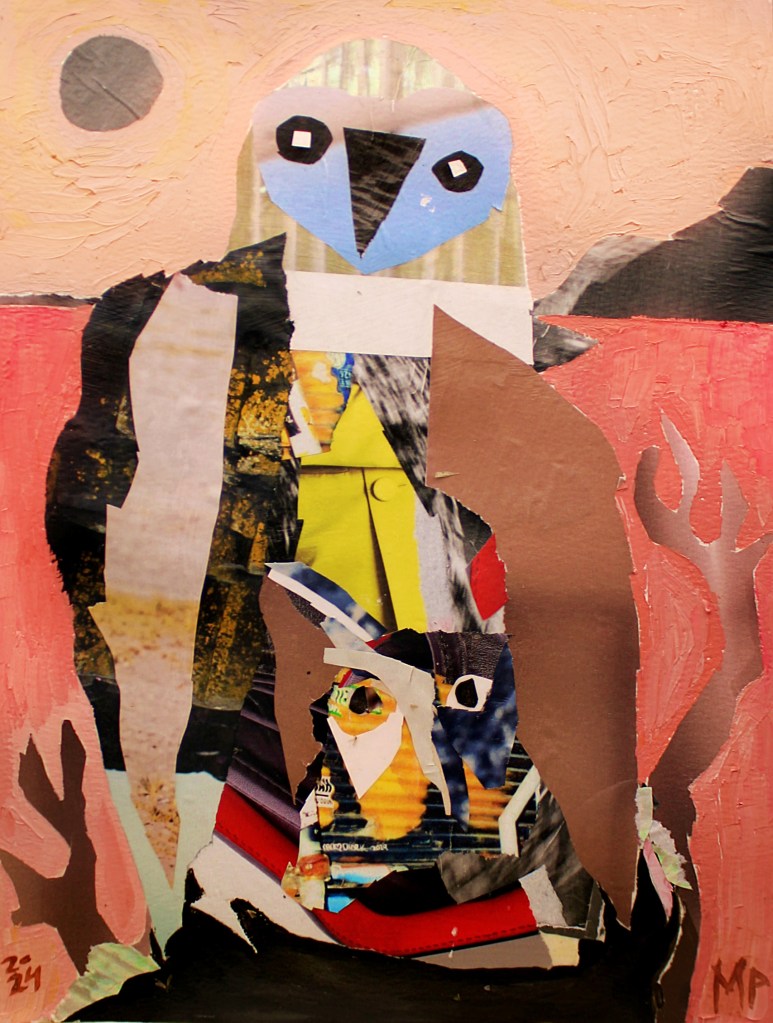
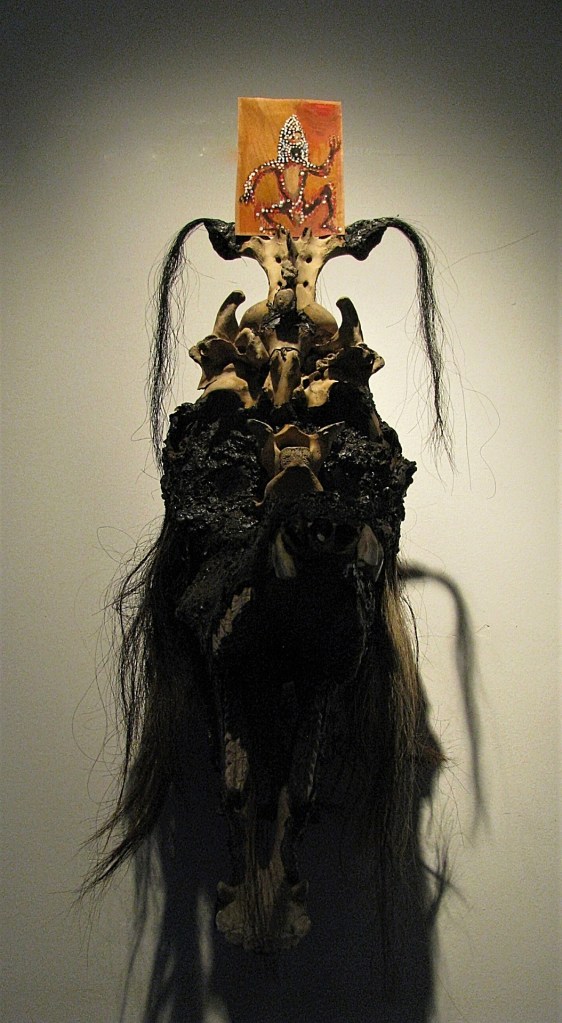
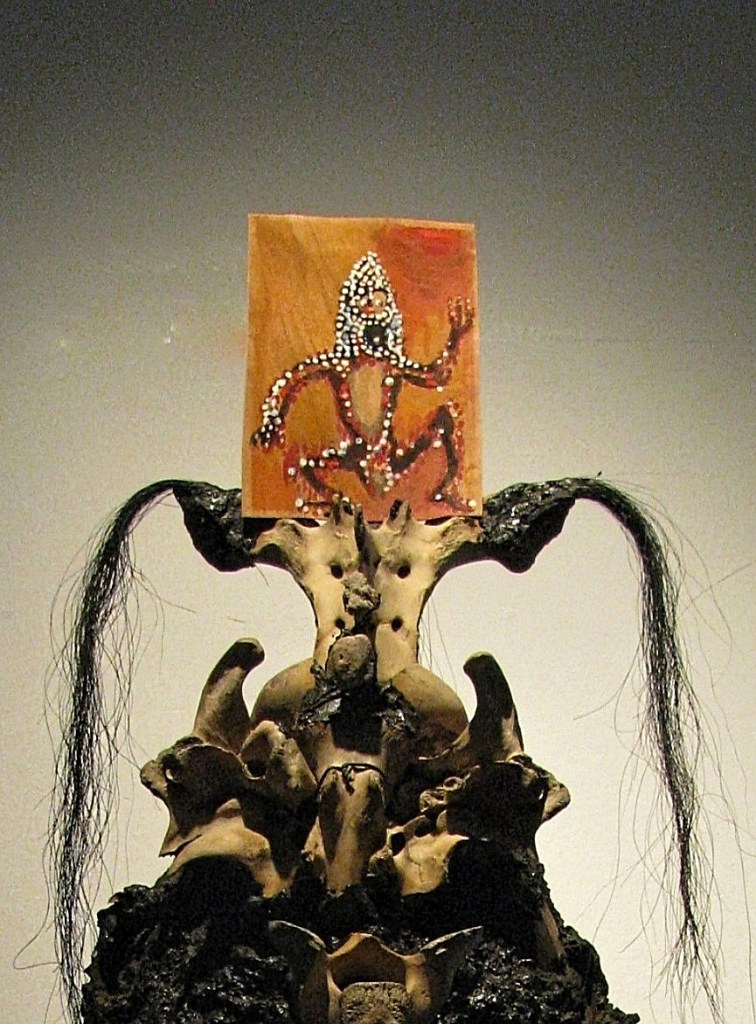
Featured photo: Inside the shaking tent or dentro de la temblorosa tienda del conocimiento by Mitchell Pluto
y un nuevo rostro aparece me saco antiguos ropajes
y floto con los muertos
nada es mas oscuro ni menos irreal.
Hipnosis
Un brillo como de hoja seca
persiste a traves de los objetos
que se diluyen en nuestras miradas
si a ese disfraz le quitamos las plumas
la noche tendria que inventar
nuevos prostibulos para esconderse
y se resquebrajarian
los rostros de todos los hipnotizados
Exorcismos
Las sombras saben guardar secretos
y muerden los tramos de esta hipocresia
no niego tu podredumbre
aunque me siente a un costado de este camino
y eche espuma por la boca
El tiempo tiene una agotadora manera
de sentarse en las sillas y mecerse
Claudia Vila Molina
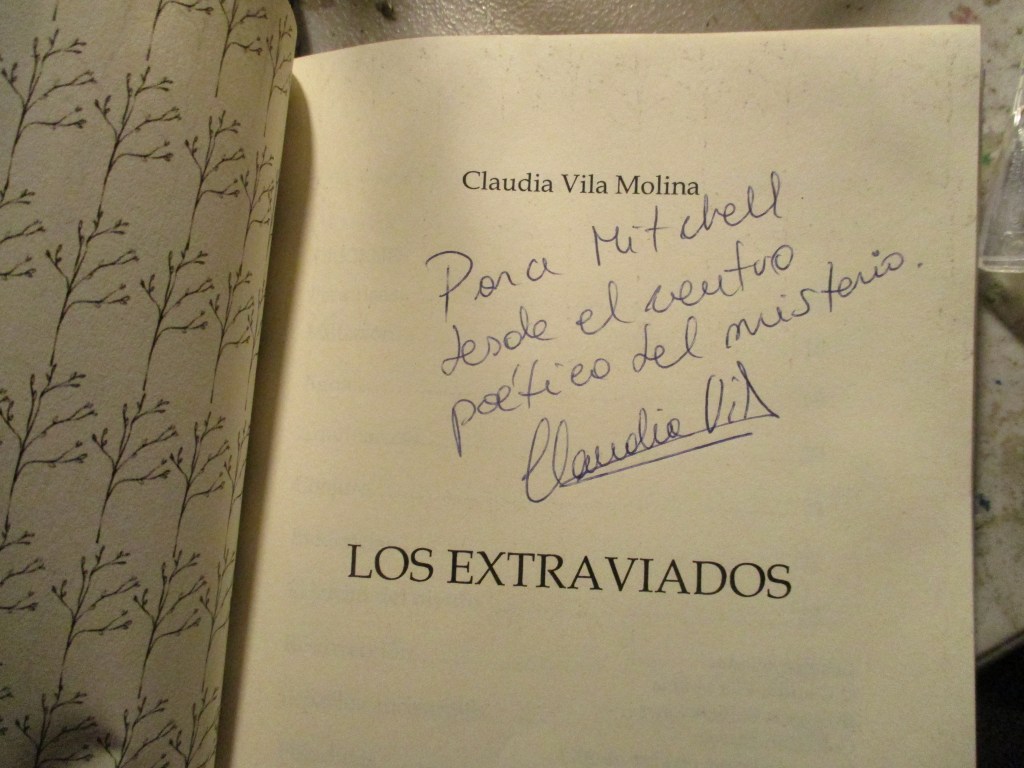
My signed copy
09-22-1969
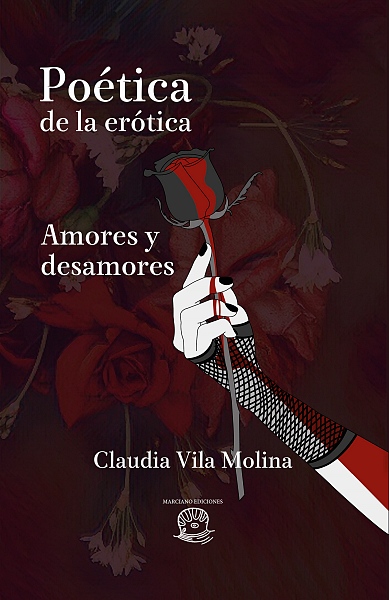
Born in Viña del Mar, Chile. Professor of language and communication at PUCV, poet and literary critic. In 2012, she published her first book, The Invisible Eyes of the Wind. She has published in renowned Chilean and foreign digital media: Babelia (Spain), Letras de Chile (Chile), Triplov and Athena de Portugal, among others. During the year 2017 she participates in the Xaleshem group with poetic texts for the surrealist anthologies: “Composing the illusion” in honor of Ludwig Zeller and “Full Moon”, in honor of Susana Wald. In 2018, she integrates the feminist anthology IXQUIC released both in Europe and in Latin America. In 2020 she participates reviewing the conversation book “Shuffle poetry, Surrealism in Latin America” by Alfonso Peña (Costa Rica), also writes a poetic prose text for the book “Arcano 16, La torre“, by the same author. Likewise, she participates in the book “120 notes of Eros. Written portraits of surrealist women” by Floriano Martins (Brazilian surrealist poet, writer, visual artist and cultural manager). In this year (2021) she publishes her second poetry book Poética de la erotica, amores y desamores by Marciano editores, Santiago. In 2023 Los Extraviados
Levemente palpitas estacionas las palabras en el espanto
Y las cruces llamaradas
Puertas
rasguñan nuestros brotes profundos
Aquí se liberan huesos de los sacerdotes
Los smoking mis placeres atascados por el tractor
Tus dientes
Mi paladar
Tu lengua
Mis amígdalas
Tus fragmentos
Mis encierros en el tropiezo de la senectud
El prisma donde miro paraguas abiertos de la imagen.
Claudia Vila Molina
09-22-1969
Born in Viña del Mar, Chile. Professor of language and communication at PUCV, poet and literary critic. In 2012, she published her first book, The Invisible Eyes of the Wind. She has published in renowned Chilean and foreign digital media: Babelia (Spain), Letras de Chile (Chile), Triplov and Athena de Portugal, among others. During the year 2017 she participates in the Xaleshem group with poetic texts for the surrealist anthologies: “Composing the illusion” in honor of Ludwig Zeller and “Full Moon”, in honor of Susana Wald. In 2018, she integrates the feminist anthology IXQUIC released both in Europe and in Latin America. In 2020 she participates reviewing the conversation book “Shuffle poetry, Surrealism in Latin America” by Alfonso Peña (Costa Rica), also writes a poetic prose text for the book “Arcano 16, La torre“, by the same author. Likewise, she participates in the book “120 notes of Eros. Written portraits of surrealist women” by Floriano Martins (Brazilian surrealist poet, writer, visual artist and cultural manager). In this year (2021) she publishes her second poetry book Poética de la erotica, amores y desamores by Marciano editores, Santiago. In 2023 Los Extraviados
The gods have “inner” or “spiritual” eyes (oju inun) with which to see the world of heaven and “outside eyes” (oju ode) with which to view the word of men and women. When a person comes under the influence of a spirit, his ordinary eyes swell to accommodate the inner eyes, the eyes of god. He will look broadly across the whole of all the devotees, he will open his eyes abnormally. Araba Eko, Lagos. 13 Janurary 1972. Flash of the Spirit. African and Afro-American Art and Philosophy Robert Farris Thompson 1983
Ritual contact with divinity underscores the religious aspirations of the Yoruba. To become possessed by the spirit of the Yoruba deity, which is a formal goal of the religion, is to “make the god”, to capture numinous flowing force within one’s body. When this happens, the face of the devotee usually freezes into a mask, a mask often (but not always) held during the time of possession by the spirit. Aṣhe is untranslatable.
Flash of the Spirit.African and Afro-American Art and Philosophy Robert Farris Thompson 1983
Bámigbóyè: A Master Sculptor of the Yorùbá Tradition. Mask, carved wood.James Green With Olúṣẹ̀yẹ Adéṣọlá, Anne Turner Gunnison, Efeoghene Igor, Will Rea, and Cathy Silverman. Yale University Press 2022
Ayayema es uno de los espíritus del mundo sobrenatural Kawéskar. Para los Kawéskar -canoeros de los archipiélagos del fin del mundo- existe un orden en la naturaleza, una armonía. Si esta se rompe cuando alguien se enferma o se produce un accidente, es causado por Ayayema, un espíritu poderoso que en su ser, lleva esa propiedad de alterar el orden. Ayayema proviene de hóutk’a álowe “más allá del horizonte”, que es la tierra de los espíritus que transitan desde ese mundo al mundo de los hombres. Él es un depredador, se alimenta de la energía vital de los seres vivos, viene al mundo de los hombres a cazar.
“YO SOY LA VOZ DEL CIELO SUR
QUE TRAE EL INVIERNO Y EL ANGOSTO DIA AUSTRAL
SOMBRAS ENORMES QUE SE LEVANTAN EN LA NOCHE
ALLÍ DONDE VIVE AYAYEMA
ESPÍRITU DEL RUIDO QUE RONCA ENTRE MONTAÑAS Y GLACIARES
QUE CAMINA EN LA ESPESURA DEL BOSQUE Y EL PANTANO
MITAD LLANTO HUMANO, MITAD GRITO DE BESTIA
ÉL TRAE AL VIENTO QUE VUELCA LAS CANOAS
ALLÍ HABITA RONDANDO LA NOCHE
ESCALANDO EL AGUA DE LAS CASCADAS
TRAYENDO EL MAL TIEMPO QUE HEMOS APRENDIDO A VER
EN EL PASO DE UNA BANDADA DE LOROS
QUE HEMOS COMBATIDO QUEMANDO UN DIENTE DE LOBA
Y HECHANDO SUS CENIZAS AL MAR.” (*)
“I AM THE VOICE OF THE SOUTH SKY
THAT BRINGS THE WINTER AND THE NARROW SOUTHERN DAY
HUGE SHADOWS THAT RISE AT NIGHT
WHERE AYAYEMA LIVES
THE SPIRIT OF THE NOISE THAT SNORES AMONG MOUNTAINS AND GLACIERS
THAT WALKS IN THE THICKNESS OF THE FOREST AND THE SWAMP
HALF WEEPING HUMAN, HALF THE CRY OF A BEAST
HE BRINGS THE WIND THAT OVERTURNS THE CANOES
THERE HE LIVES WANDERING AROUND THE NIGHT
CLIMBING THE WATER OF THE WATERFALLS
BRINGING THE BAD WEATHER THAT WE HAVE LEARNED TO SEE
IN THE PASSAGE OF A FLOCK OF PARROTS
THAT WE HAVE FIGHTED BY BURNING A WOLF’S TEETH
AND MAKING THEIR ASHES INTO THE SEA.” (*)
(*)Fragments from “Viaje al Archipiélago de los Chonos”, poem and documentary film written by Claudio Rodriguez Lanfranco.
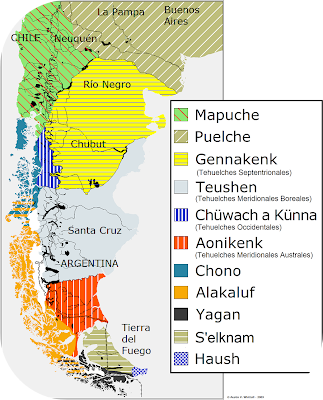
En los Ceremoniales Kawéskar se usaban máscaras que representaban estos espíritus, usadas por los hombres, ya que las mujeres no podían llevarlas. Éstas máscaras, así como la pintura corporal, están más relacionadas con usos rituales que artísticos. Entre los Kawéskar existía un repertorio de canciones para estas ocasiones. Como parte de su rica tradición oral, estas experiencias se transmitían a los iniciados de generación en generación en cánticos alrededor de grandes fogatas donde Ayayema era un protagonista. Es el único tipo de expresión musical que se conoce de este pueblo. Las canciones ceremoniales se desconocen hoy y solo se cuenta con el testimonio de la literatura especializada.
“Kuosá jeksólok ak’uás æs čačár tawaisélok aksǽmhar os
aselái eik’olájer-s kuos ko at ku kiáu afsenák at árka æs sa
“Y después el finado, el espíritu, el alma de mi difunto papá, decían, contaban en aquella carpa, se sentía hablar, en la carpa que quedaba más arriba de la mía. Y a los espíritus les decían Ayayema así los llamaban. A él me mandaron, me mandaron animándome y le pregunté a él: “Padre, ¿eres tú el que está hablando?”, así dije. Y me respondió el espíritu que mora más allá del horizonte: “Sí”, así [dijo], “¿por qué me estás preguntando?
Los cuentos, relatos de viaje y las historias de vida Kawéskar, constituyen lo que se ha llamado “arte de la palabra”. Joel Sherzer y Greg Urban (1986) manifiestan que “Ningún indígena sudamericano ha ganado jamás el premio Nobel por su actuación (performance) oral u oratoria política. Sin embargo, todos los días y todas las noches los miembros de remotas sociedades de Brasil, Ecuador, Panamá, Chile, que viven en medioambientes no tecnológicos, están creando y desplegando una notable diversidad de formas verbales caracterizadas por riqueza metafórica, procesos poéticos y retóricos y estilos intensamente personales, todos los cuales son parte íntima de la reproducción y transmisión de sus tradiciones culturales y estéticas”.
Entre los Kawéskar se desarrolló durante siglos este arte de la palabra y fue la única manera de transmitir el conocimiento y de expresar estéticamente mediante la palabra (cf. O. Aguilera)
Poemas sobre máscaras desde poemario inédito Luz de lluvia escrito por Claudia Vila Molina
Grietas de la máscara
No nos es dado seguir hablando
ni de encontrar rastros perdidos
el azul juega con sus colores
y se forman raíces a tu alrededor
Son formas ennegrecidas
del sucio mineral de tu sangre,
espacio leve disgregado
en torno a esa máscara.
Tiempo ancestral
Recorro espacios cerrados
la memoria archiva actos conocidos
y solo vapor emerge desde estados de la imaginación,
mi mente perpetra esos instintos
(armonía remota de un entramado salvaje)
lucho por la veracidad de signos confiscados
y es penetrante tu esencia
ese código agrieta mis destinos
y películas convergen hacia tu manantial
Algo nos rodea desde siempre,
imagen pétrea instalada en cuencas de la prehistoria,
Es un asunto de querer magnetizar los elementos encontrados. Unirlos como si fueran una solución a un problema, sin tener , ni presentarse como problema. Al encontrar un objeto se van produciendo solas las uniones, la visión de esa reunión empieza a crear se su propia obra. Una inspiración creativa que se gesta a través de las palabras y las acciones. Arte de acción, teatro, poesía, plástica.
Nacido el año de 1961 y dedicado a la creación artística desde entonces, cuento en la actualidad con 62 años y perseveró con entusiasmo en la creación de poesía, obra plástica y conciertos de poesía.
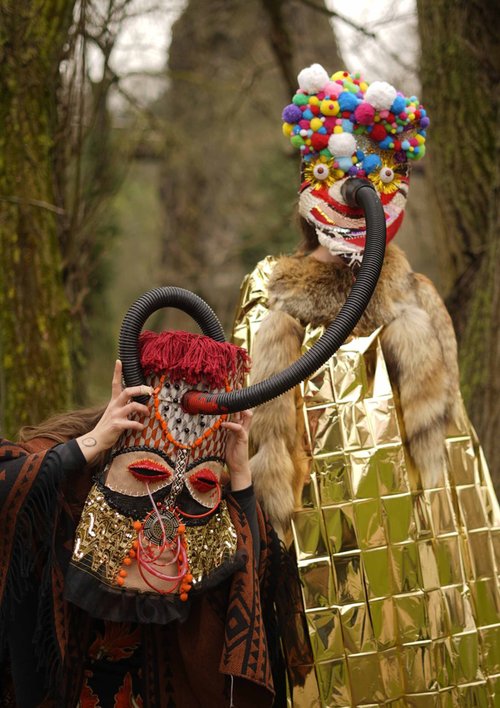
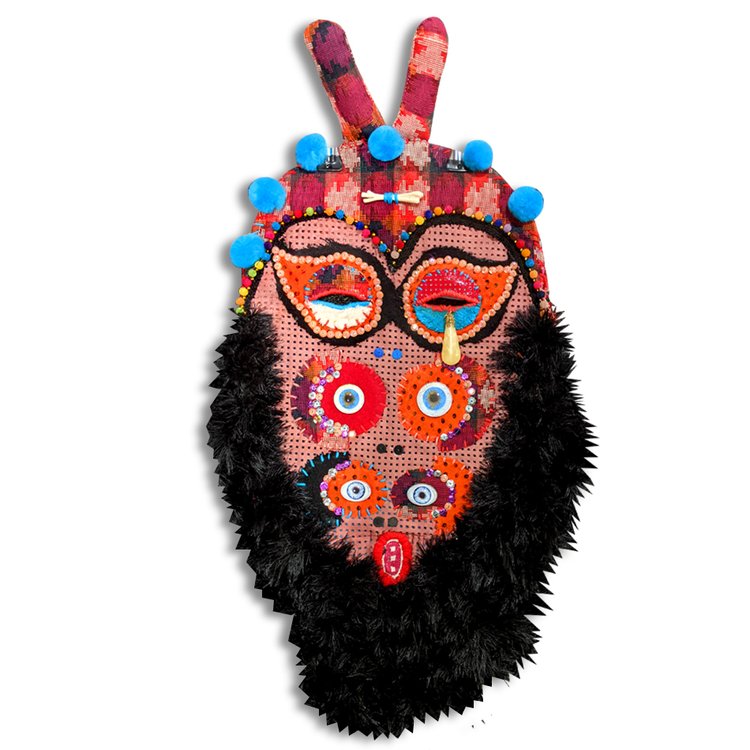
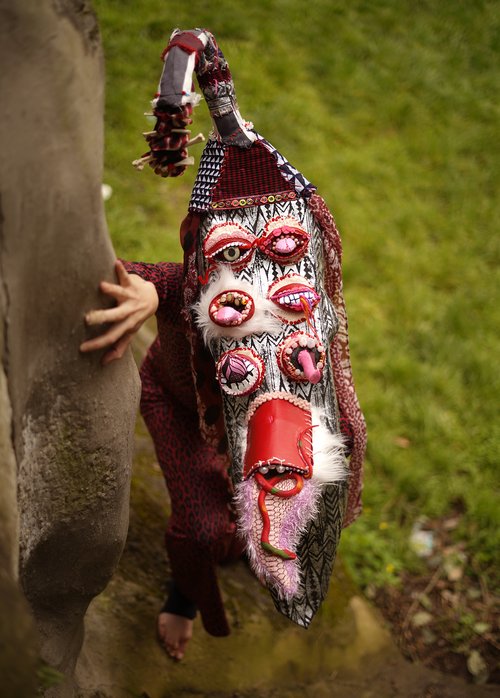
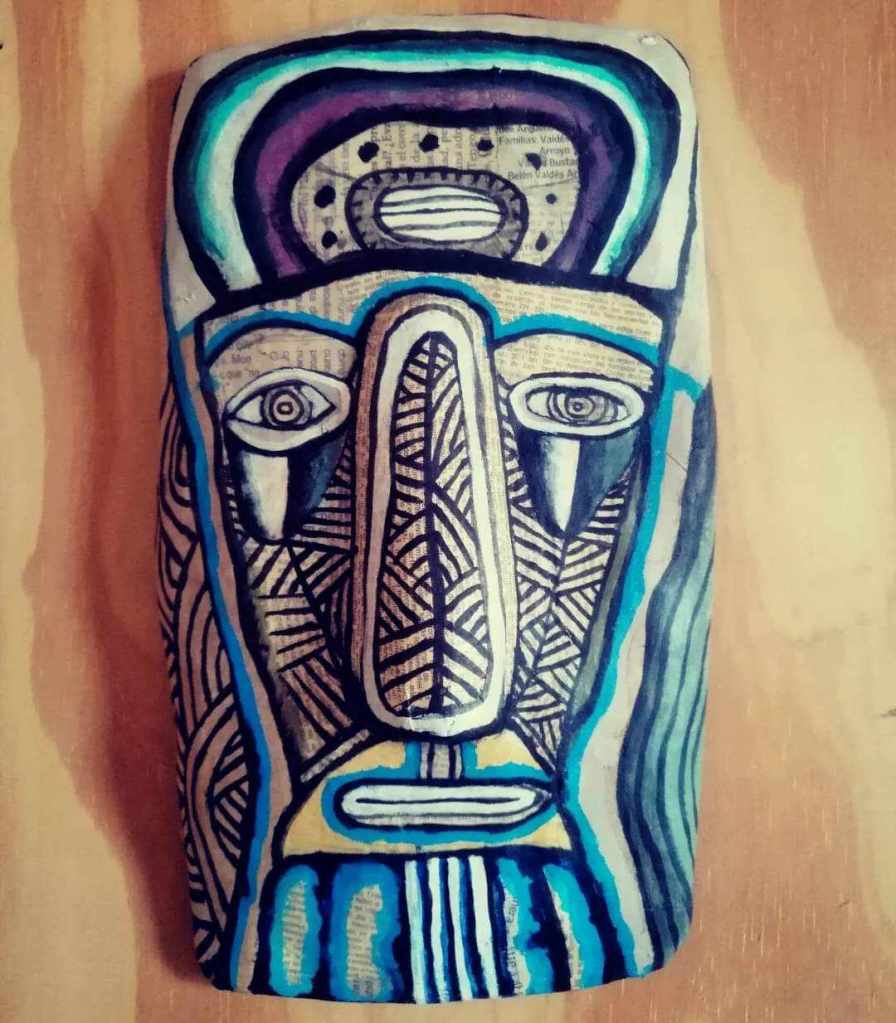
Francisco Rios Araya blends the ancient diversity between Paracas culture and Chilote mythology to build a new mythic hybrid. Rios creates a séance with the memories of archaeological sites, improvised ceremony and masks.
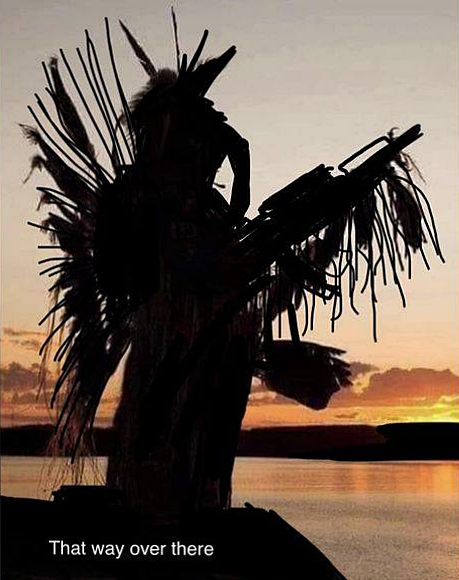
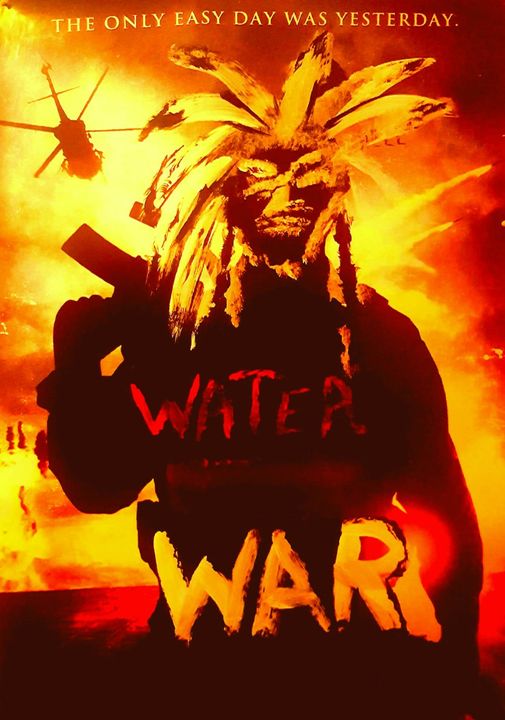
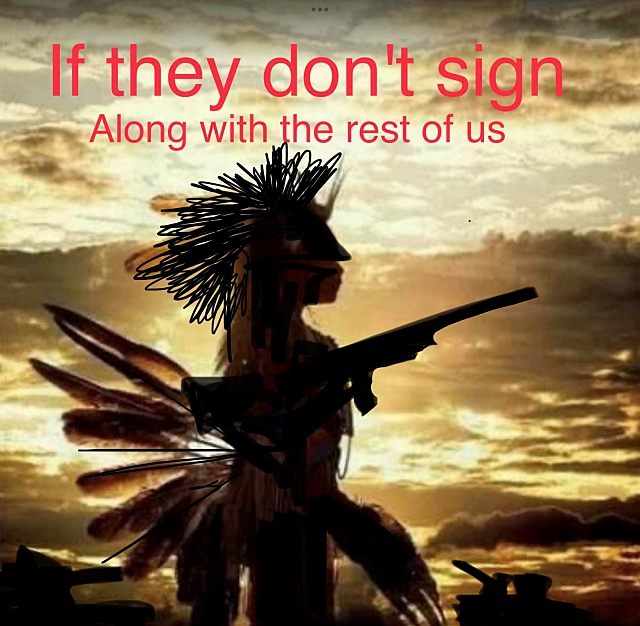
Mun gee dik lives in rocks and along shadows near lake Manitou…it is said this spirit hid a cache of weapons in a cave from the marauding Iroquois…some believe weapons are hidden to this day and include modern firearms that were lost or thought stolen…the Great War hero Kawbenaw is said to still be alive and is keeping these weapons…someday mun gee dik and Kawbenaw will make themselves known
written and created by Duncan Neganigwane Pheasant
Mitchell Pluto
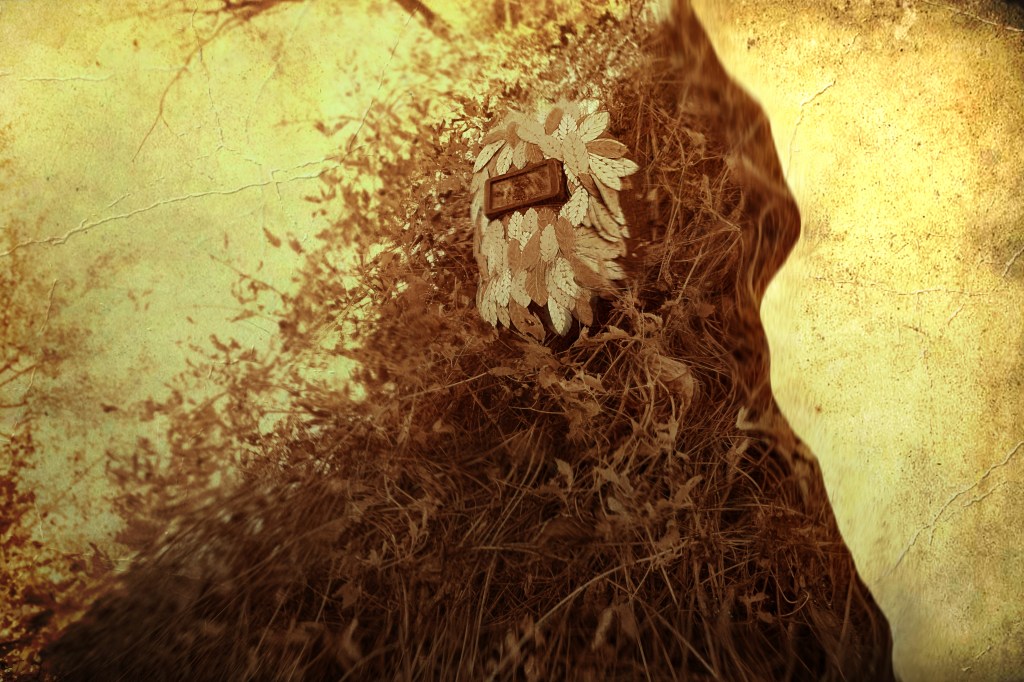
In August 1869, Alexander Jay Russell, a railroad photographer, captured an image of an unidentified entity during a total solar eclipse in Western Montana Territory. Russell’s journal entry depicted the creature as a tree-like being that glided along the ground and through the trees, mimicking every texture it encountered. The dark visor was the only consistent characteristic.
Photos found at an estate sale in 2023 are now in the possession of the Montana Historical Society Research Center Archives. Certain independent researchers suggest that this camouflaged entity possesses the capacity to swiftly adjust its chromatophores, enabling it to blend into any surroundings without being easily observed or recognized. This trait resembles that of Cephalopoda, the only organism known to exhibit such capabilities.
Many witnesses in Montana reported similar encounters during the solar eclipse on February 26, 1979, like Russell’s. Authorities have not yet released any official comments to the public.
welding mask with painted copper leaf by Mitchell Pluto. Wild Plains Horse Plains, Montana
epilogue
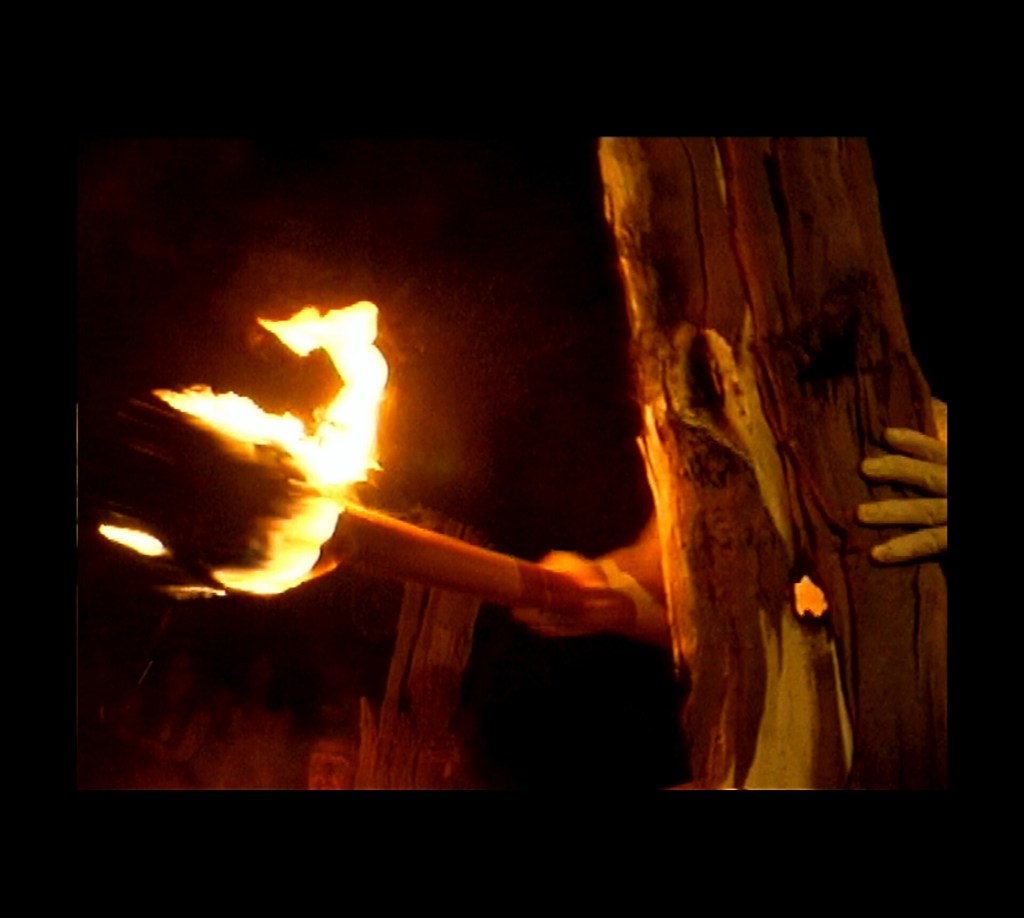
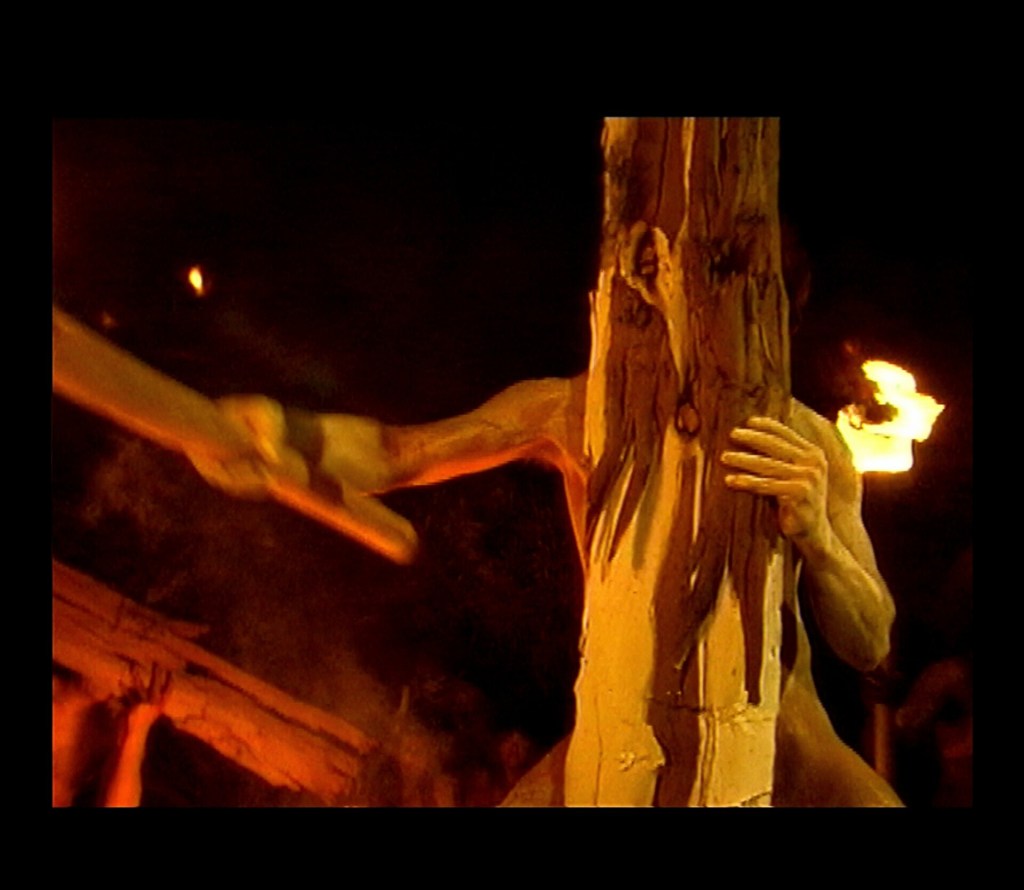
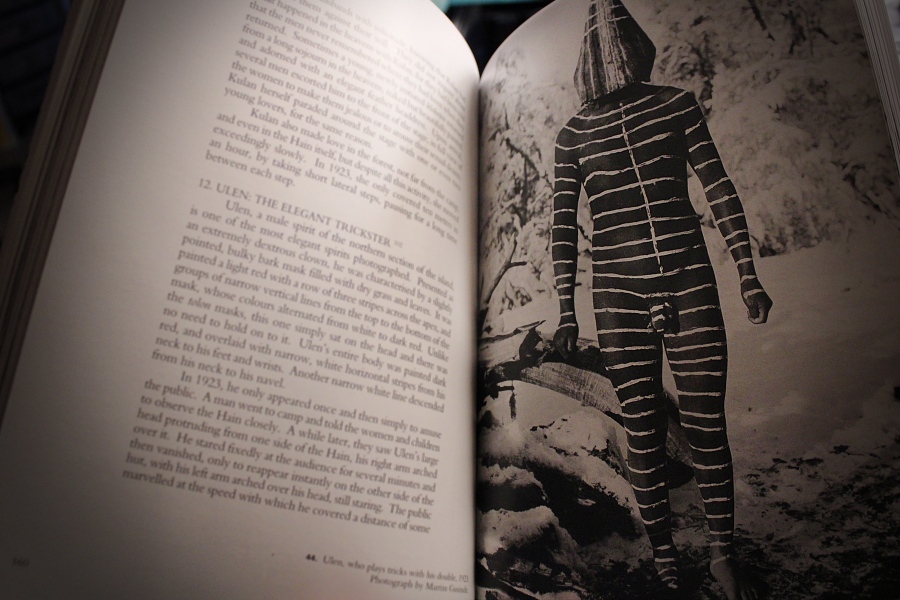
Ulen the elegant trickster. Plays tricks with his double, 1923. Photograph by Martin Gusinde
“In 1923, the Ulen only appeared once and then simply to amuse the public. A man went to the camp and told the women and children to observe the Hain closely. Awhile later, they saw Ulen’s large head protruding from one side of the Hain, his right arm arched over it. He started fixedly at the audience for several minutes and then vanished, only to reappear instantly on the other side of the hut, with his left arm arched over his head, still staring. The public marveled at the speed at the speed with which he cover the distance of some eight metres. The public did not know that the “backstage” there were two rigorously identical Ulens, posed at each side of the Hain. A third man gave them signals as to the exact moment at which they were to protrude their heads. The performers practiced a great deal in order to coordinate their movements and remain immobile for several minutes.”
Chapman, Anne (2008) Hain, Selknam Initiation Ceremony. Initiation ceremony of the Selknam of Tierra Del Fuego 12 160-162
Descendidos al mismo infierno Tu saciedad en mi boca Los labios aparean otras voces Me buscas entre la niebla La imaginación me busca entre la bruma Yo no existo Tú me asesinaste Hundiste tus preguntas en partes viejas de la casa Algo encendía el techo Los pequeños alumbraron esa melancolía Hasta que todo se fue en la inundación Y las miradas se ensuciaron con su propio ruido No había más caretas para procrear Ni más sueños para parir.
Vuelvo al sur a los bosques La lluvia detiene el canto de nuestros cuerpos Volveremos a arder mientras la lluvia gire hacia la luz Y una partícula de viento entre en nuestros reinos El aire será nuestro Nos poseeremos agitados Ante el agua descendida por la noche Mientras los animales buscan sus huellas Y nosotros decapitamos el terror Observamos la hoguera desde la boca hacia los pies Y en un minuto todo será conocido Cada detalle entra en nosotros Aullamos con el musgo que nos cubre Y tus labios me tocan Deslizan tus hogueras en la ruta del sol Hasta que el viento es un solo gemido Y nadie ni siquiera la noche puede soportar Estas sombras recorriendo Palpando la silueta Entrando en la oscuridad.
Descubriéndonos Descubro el sur en este navío que vuela Es mi imaginación en su astillero de astros Los muñecos envician las agitadas aguas Es el aire sucio que nos recorre Y una llamarada revierte Los fragmentos del aire en toda su gestación Es tanto el aire que ansío Volar por estas explanadas hacia el lago Y desde allí recorrer la senda Las nubes dejan pergaminos en la noche Nosotros nombramos nuestras inmensidades En las lagunas del secreto La madre guarda sus señales con devoción Y el anciano lleva botellas en el bolsillo Yo no puedo morir antes de verte Es azul esta nostalgia del verde corredor Mis muñecas recuerdan todos recordamos Es un viaje por las huellas de esa mirada distante Es un tiempo dedicado al sigilo Las madrugadas vuelven a reunir sus escombros Pero la hierba crece desterrada desde la tierra Y las cartas regresan a la ciudad perdida.
Seres perdidos Septiembre devuelve partes de mi ser perdido A dónde estarán todas las partes de mi cuerpo? En qué huella? En qué nube? Volveré a volar otra vez?
Nuestros restos Los restos de ellos aún nos miran Dónde están tus huesos? Pedro Martin Federico Victor María Alicia Dónde se fueron a morir? Dónde podré buscar y ensangrentar mis manos? Algo negro vuelve a supurar en la memoria Algo viene devuelto desde la estación del exilio.
El día de mañana Mañana moriremos cuando queramos buscar y no haya sombras ni acequias dónde enlutar la voz Solo un clavel blanco retratará tu figura desaparecida Más allá del ojo en negro Más allá del tendón cortado en dos Más allá del septiembre que humea solitario En la última carta que recibí Cuando la mirada no era suficiente ni el grito Ni la mano perdida en los barrotes oxidados. En memoria de nuestros muertos y desaparecidos en esta fecha funesta.
Writer born in Viña del Mar, Chile. Professor of language and communication at PUCV, poet and literary critic. In 2012, she published her first book, The Invisible Eyes of the Wind. She has published in renowned Chilean and foreign digital media: Babelia (Spain), Letras de Chile (Chile), Triplov and Athena de Portugal, among others. During the year 2017 she participates in the Xaleshem group with poetic texts for the surrealist anthologies: “Composing the illusion” in honor of Ludwig Zeller and “Full Moon”, in honor of Susana Wald. In 2018, she integrates the feminist anthology IXQUIC released both in Europe and in Latin America. In 2020 she participates reviewing the conversation book “Shuffle poetry, Surrealism in Latin America” by Alfonso Peña (Costa Rica), also writes a poetic prose text for the book “Arcano 16, La torre“, by the same author. Likewise, she participates in the book “120 notes of Eros. Written portraits of surrealist women” by Floriano Martins (Brazilian surrealist poet, writer, visual artist and cultural manager). In this year (2021) she publishes her second poetry book Poética de la erotica, amores y desamores by Marciano editores, Santiago. The Extraviados is her third book published by Espacio Sol Ediciones (2023)
Dibujaste una mirada muda perpendicular a la onda más leve el polvo, el concreto, la almohada ahogan la imagen pervertida de ti Estoy a punto de exterminar una idea, de convertirme en una imitación de la neblina en el vidrio.
Sahumerio
Reflejos anulan el acto hasta que olvidas mi presencia yo enciendo fuegos, derrito despojos de amor cada tanto escribo y un extraño nace del aire y puede aterrizar a pesar de mi estación forzada, el ritmo aplaza conjugaciones de un verbo que se sugiere desigual.
Vaciada
Mira antes de atravesar rumbos de la ensoñación pasan caminantes, articulan facciones rotas le sorprenden cada vez.
Recortes
Una sola ondulación contiene nuestras raíces contienen al hombre dentro lo meten en un saco y huyen, más el tiempo tiene pasajes en sus idiomas me voy a otra parte, cierro la puerta.
Imaginería
Te concibo desnudo como si fornicaras con tu reflejo ¡qué lenta desnudez ¡ ¡Qué precipicio excava mi construcción ¡ Vienes a mí a pesar de tus cuerpos vulnerados Yo profano tu vientre Me agacho a recoger cosas extraviadas el tacto enmienda mi orgía de océanos me disfrazo de caracola para alunizar contigo y nadie espera dormido en el sofá nadie corretea desnudo por estas piezas.
Writer born in Viña del Mar, Chile. Professor of language and communication at PUCV, poet and literary critic. In 2012, she published her first book, The Invisible Eyes of the Wind. She has published in renowned Chilean and foreign digital media: Babelia (Spain), Letras de Chile (Chile), Triplov and Athena de Portugal, among others. During the year 2017 she participates in the Xaleshem group with poetic texts for the surrealist anthologies: “Composing the illusion” in honor of Ludwig Zeller and “Full Moon”, in honor of Susana Wald. In 2018, she integrates the feminist anthology IXQUIC released both in Europe and in Latin America. In 2020 she participates reviewing the conversation book “Shuffle poetry, Surrealism in Latin America” by Alfonso Peña (Costa Rica), also writes a poetic prose text for the book “Arcano 16, La torre“, by the same author. Likewise, she participates in the book “120 notes of Eros. Written portraits of surrealist women” by Floriano Martins (Brazilian surrealist poet, writer, visual artist and cultural manager). In this year (2021) she publishes her second poetry book Poética de la erotica, amores y desamores by Marciano editores, Santiago. The Extraviados is her third book published by Espacio Sol Ediciones (2023)
ALL WRITING IN THIS POST IS A COPYRIGHT OF CLAUDIA VILA MOLINA. THIS AN AUTHORIZED DUPLICATION WITH PERMISSION AND EXPRESSED CONSENT FROM THE AUTHOR
Internationally recognized author and lecturer specializing in the use of entheogenic compounds in magico-religious settings. P. D. Newman has been immersed in the study and practice of alchemy and theurgy for more than two decades. A member of the Masonic Fraternity, the Society of Rosicrucians, and the Martinist Order, he lectures internationally and has published articles in many esoteric journals, including The Scottish Rite Journal, The Masonic Society Journal, and Invisible College. The author of Alchemically Stoned and Angels in Vermilion, he lives in Tupelo, Mississippi.
An altar constitutes a sacred space insofar as it is a deliberately constructed liminal space. A space is made sacred first and foremost through the creation and maintenance of a vacuum within it—it is the mystical act of reverting an area back to its natural, chaotic state. What is then invited to fill this void constitutes the divine FIAT—the magic “word” whose essence will thenceforth inform that space and all that transpires in it. Ergo, nothing is permitted to penetrate that void which is not in harmony with essence of the god. Those things that are harmonious with a given essence are termed ‘symbols’ and ‘tokens’ of that essence. These do not simply represent or correspond to the god, but rather constitute the deity himself in miniature form—a fractal-like manifestation of that essence which recapitulates and reiterates the totality of the god upon the microcosmic plane.
The Neoplatonist, Proclus, once stated that Soul “contains images of [things] and detailed, essential [seed forms] which are like statues of things themselves.” Even the names of things, therefore, arise from Soul and amount to veritable ‘statues in sound’ that really are the things described. If the name of the god is a presence of said deity, how much more an actual image? The profane view is that the worshipper believes the god to reside within the statue gracing the altar. This is absurd. No, the statue is in the god, as are all the symbols and tokens descending from his essence. Indeed, gods are beyond space. In reality, it is the altar that occupies the god.
Image courtesy with the kind permission fromP.D. Newman
Claudia Isabel Vila Molina
born in Viña del Mar, Chile. Professor of language and communication at PUCV, poet and literary critic. In 2012, she published her first book, The Invisible Eyes of the Wind. She has published in renowned Chilean and foreign digital media: Babelia (Spain), Letras de Chile (Chile), Triplov and Athena de Portugal, among others. During the year 2017 she participates in the Xaleshem group with poetic texts for the surrealist anthologies: “Composing the illusion” in honor of Ludwig Zeller and “Full Moon”, in honor of Susana Wald. In 2018, she integrates the feminist anthology IXQUIC released both in Europe and in Latin America. In 2020 she participates reviewing the conversation book “Shuffle poetry, Surrealism in Latin America” by Alfonso Peña (Costa Rica), also writes a poetic prose text for the book “Arcano 16, La torre“, by the same author. Likewise, she participates in the book “120 notes of Eros. Written portraits of surrealist women” by Floriano Martins (Brazilian surrealist poet, writer, visual artist and cultural manager). In this year (2021) she publishes her second poetry book Poética de la erotica, amores y desamores by Marciano editores, Santiago.
Rituales poéticos
El corazón me sabe a pañuelos mojados Hoy escucho la canción de los océanos Y alguien más viene a mirarme Las algas suben por mis pies hacia las últimas rocas En este elemento volví a imitar los arrecifes Ellos callaban Me miraban tiernamente Como solo miran quienes están en estado perpetuo Y quise salir fuera de mi nombre Quise volar desde las ataduras de mi cuerpo La noche no halló sus otros puñales Y me concedió un nuevo deseo. Del poemario inédito Solsticio de invierno, derechos reservados.
Image courtesy with the kind permission from Claudia Isabel Vila Molina
Olesya Volk
Born in Baku, Azerbajan, lived in Moscow from age 16 and moved to Los Angeles in 1992. She holds a M.F.A. in Film &TV, majoring in Animation from UCLA; and is involved in painting, writing, illustrating, cartooning, mixed media, paper theatre and small size dioramas.
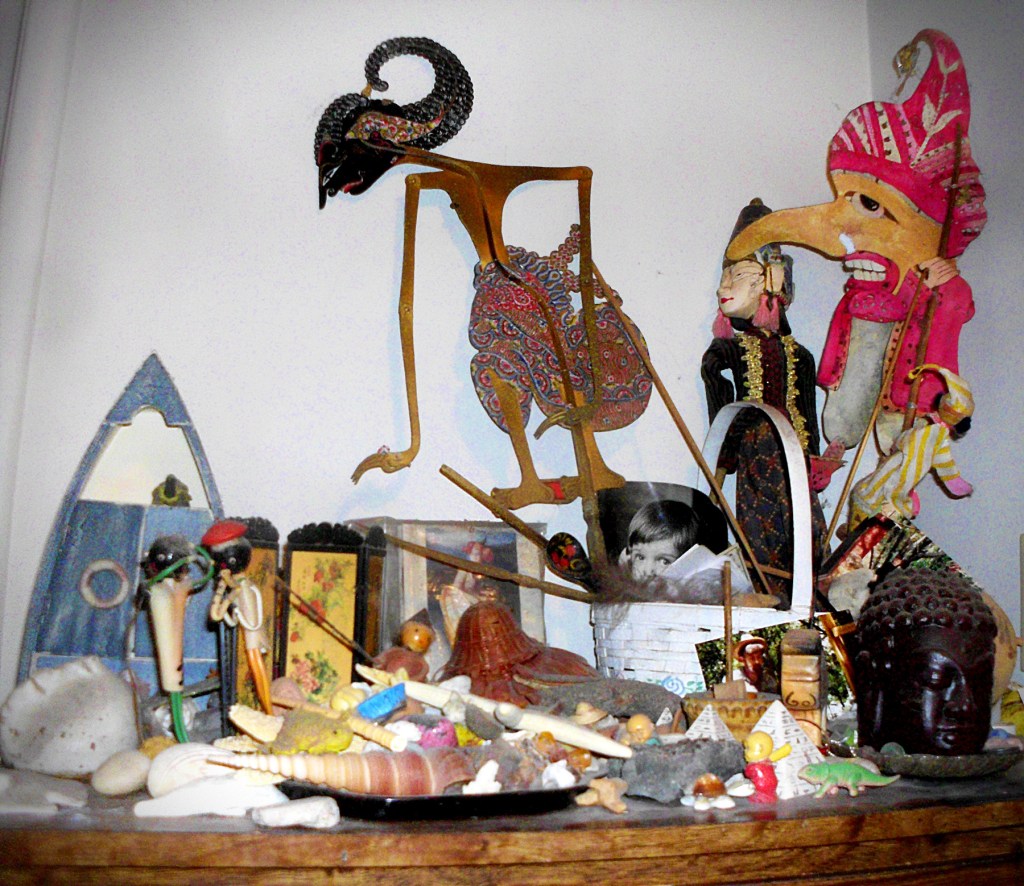
My altar: The inspiration for me always comes from the area deep inside my memory, it is connected to my childhood.
That is why my personal altar reminds of a little village that existed on a shelf in the cupboard at our place when I was a child. That village had a pond and a mill, woods and little houses. It had fishermen, singers. musicians, dancers, witches and sages, and a couple of hooligans. it had the place for games and the place for meditation and talking to spirits. Me and my sister and my mother were in charge of the village, and the villagers were protecting us and granting our daily wishes. The inhabitants of that village are still living with me! some of them are seen in the altar, the others have settled around in different corners…they continue to protect and manage the ties with the other worlds. My altar tries to copy visually that village from our cupboard, only there are much more pebbles now, and the lucky holey stones , they tell me of my walks on the beaches which I also held as sacred when a child…And above the village, there are spirits or gods overseeing it, in the shape of the Indian and Turkish shadow puppets ( one of the puppets, Beberuhi, I made myself; he is a nosier , he is curios about the essence of everything. ) And there are there the photos of the loved ones as well, photos from the past.
May the love last! may the protection and the belief in my vocation last! may the blessings stay!
Image courtesy with the kind permission from Olesya Volk
Jaime Alfaro Ngwazi
born in Coquimbo, Chile in October 17th, 1971. He studied at the University of La Serena and his degree is Bachelor in Education and Visual Arts. He has carried out different worshops about graphic expression. One of them is called Vivir el Afiche given by Mieczyslaw Gorowski. Apart from this, we can also mention Lo Esencial Significa given by Mieczyslaw Wassilewski and, finally, a seminar given by Lech Majewski at the University of La Serena.
El altar como centro mágico del mundo/ una trama de hilos multicolores de lana cruzan su centro/ se cuelgan a las orejas de las llamas del altiplano /brotan teléfonos con líneas como nervios-cuerdas de charangos, algunos trozos de carne seca y latidos de corazones emulando a Boltanski, en un centro magnético que conecta espectros de cristal, pantallas de celular y el sonido del viento/ en el desierto,seco ,que disecciona el paisaje salino, entre talleres líticos y mega fauna fantasma. Todos convocados a este espacio, reproducción en artefactos de madera del gran imperio / las cabezas de jaguar rugen a las estrellas de la lejana vía láctea ‚el frío es el ruego en la amplitud de la noche, mientras un vinilo con voces raspadas gira sin fin al compás de una danza metafísica las aristas del rombo raspan la piel suave/ el centro de todo es un valle seco ‚púrpura, apastelado en colores carne.
Image courtesy with the kind permission from Jaime Alfaro Ngwazi
Tony Kail
Ethnographer and writer. Tony holds a degree in cultural anthropology and has researched ethnic cultures for more than twenty-five years. His work has taken him from voodoo ceremonies in New Orleans to Haitian Botanicas in Harlem and Spiritual Churches in East Africa. He has lectured at more than one hundred universities, hospitals and public safety agencies. Kail has been featured on CNN Online, the History Channel and numerous radio, television and print outlets. A resident of Humboldt, Tennessee, Kail was raised in Memphis and calls it his second home.
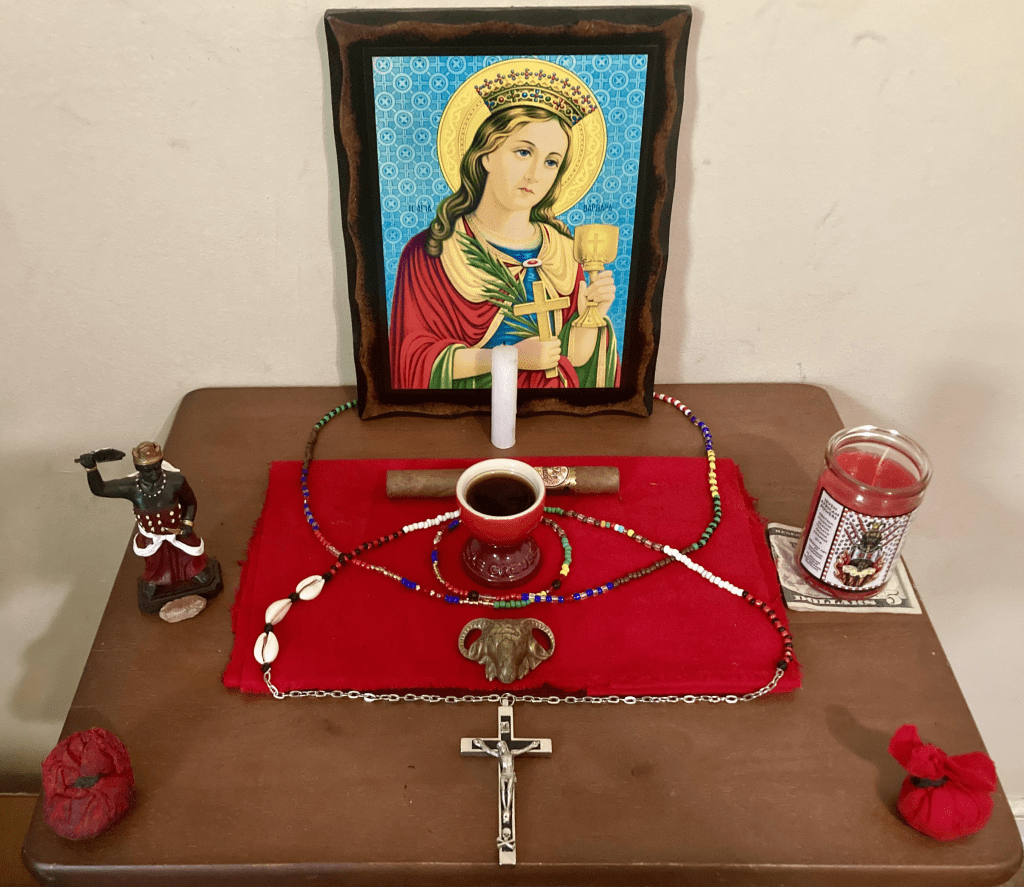
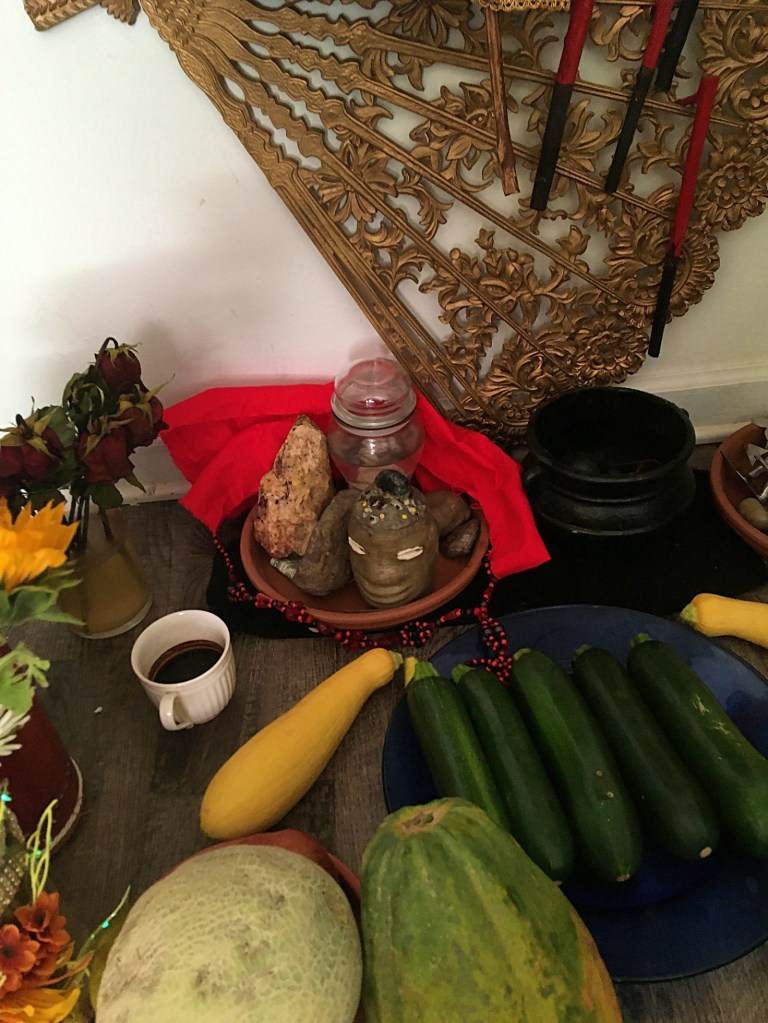
During ceremonies various events would occur that involved participants seeking reactions from the spiritual realm. On one occasion trance possession occurred and a participant was given information regarding a health issue that they had not shared with the possessed individual. Spontaneous deaths of animals would occur during rituals used to combat witchcraft. In the daily life of practitioners, physical evidence would manifest as a result of supernatural activity. Miraculous healings occurred where images of scars and skin disorders would appear on fruit and vegetables that were used in offerings to ask for healing. Subsequently practitioners would obtain healing and their wounds would disappear. Offerings to the Orishas would frequently disappear such as cups of coffee and wilting flowers would appear revived after being placed on specific altars.
From my upcoming book ‘Fieldwork with the Saints: An Ethnographic Journey into Santería in the American South
Image courtesy with the kind permission from Tony Kail
Duncan Neganigwane Pheasant
M’Chigeeng First Nation artist Duncan Neganigwane Pheasantisfrom Manitoulin Island. Duncan started painting in high school using colours and techniques inspired by Norval Morrisseau and other Woodland style artists. His grandfather, Ambrose Pheasant, told stories that were also a great influence on his artwork. Duncan uses his images to interpret Ojibwe legends and stories that surround the history of his ancestors and Manitoulin Island.
The Mohawk Warrior Flag design has been flown all over the world, serving as a symbol of the unity of Indigenous peoples in our common struggle, becoming a beacon of hope, and illuminating the discordant relationship between the dominant society and Indigenous peoples. The deer’s antlers are one of the characteristics that have made it the figure of a spiritual superiority, according to the Ojibwe. Like a crown, the antlers grow beyond its body, bringing it closer to the sky and making it sacred. In many tribes the deer is a symbol of spiritual authority. During a deer’s life the antlers fall off and grow again and the animal is also a symbol of regeneration.
Regeneration is the key to my shrine,, I burn sacred tobacco and recite the welcoming prayer.. The flag is also a symbol of regeneration,, fighting for what’s right, bringing the people back from the brink of disappearance and destruction when you enter it you travel through the eastern doorway…like when you were born…behind the warrior flag is another door…the western doorway…this is where you travel through when your journey is finished .but it is on the other side of the flag…this represents the fight ,the journey is to be done first…then you can travel through the western door…
Overall, having this home altar can be another way to remind myself of things I love or intentions I have for the future. If any of these rules are throwing me off, just trust my gut. You know what is best for you and your intentions. As long as you are in touch with your true desires, you’ll be fine to design your home altar anyway you like.
Image courtesy with the kind permission from Duncan Neganigwane Pheasant
Jay Blackwood
makes assemblages, boxes, totem dolls and other three dimensional pieces using found objects and materials. He has been involved with Surrealism, both as a practice and as a creative/revolutionary current, since the early 1990s. His work straddles the border between dream and consensus reality, the everyday and the numinous. Jay lives in Bristol, England.
The presiding spirit in my studio is a wonderful stone lithograph by Rikki Ducornet, Histoire Naturelle I, kindly given to me by Guy Ducornet some years ago. Beneath it are a number of pieces I made between 2001 and 2015. They are the product of chance finds, dreams and fleeting inspirations. All relate in some way to the natural world, and to archaic notions of male/female energies.
Image courtesy with the kind permission from Jay Blackwood
CLAUDIO RODRIGUEZ LANFRANCO
born in Valparaíso in 1968. After living in Patagonia and in United States product of a scholarship, his first painting exhibitions were date back to the nineties in Valdivia. Later he moved to Santiago and the Fifth Region, where his visual and literary work materializes in a body of work that addresses different forms of expression, such as painting and drawing, experimental and documentary video, visual poetry and muralism, with public art projects installed in Santiago, Valparaíso. As a visual artist he has exhibited his paintings in 15 solo shows and in more than 60 group shows in Chile, Europe and the United States, and his poetic texts have been published in regional, national and international poetry collections, his work being awarded in different state funds for artistic creation such as Fondart, Cntv, Fondo Carnavales Cultural Centers of Valparaíso, among others. Currently the painter lives and works between Valparaíso, Santiago and Concón, where he develops his artistic projects and teacher training, being in charge of university graduates, painting and mural workshops, becoming a teacher for generations of students and artists who have worked with him.
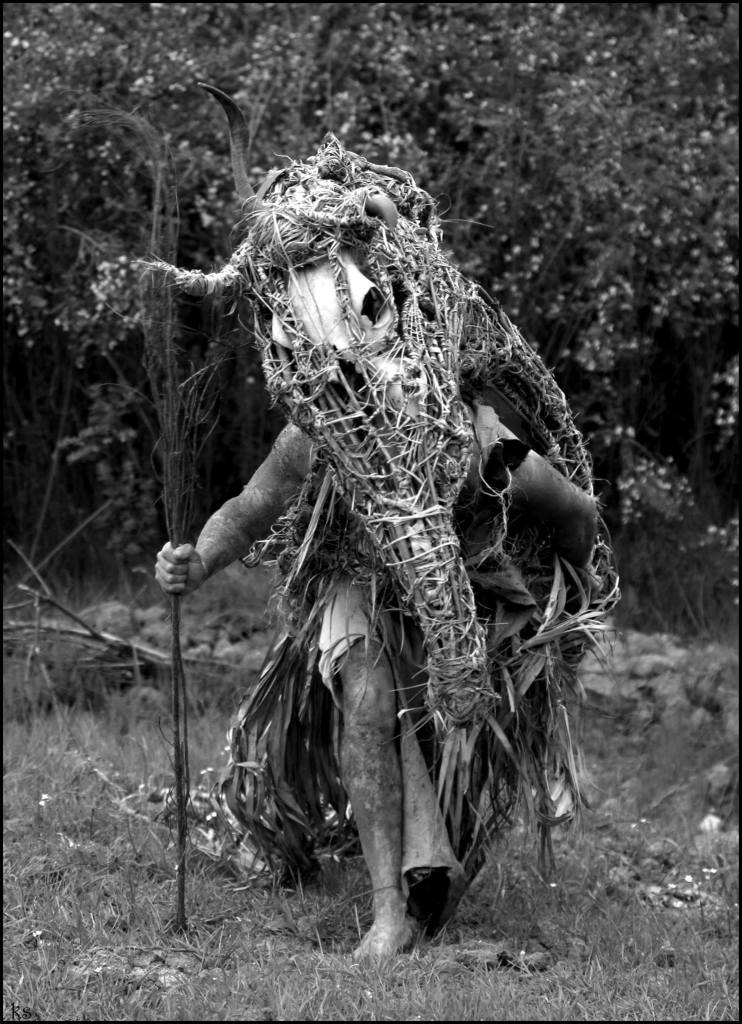
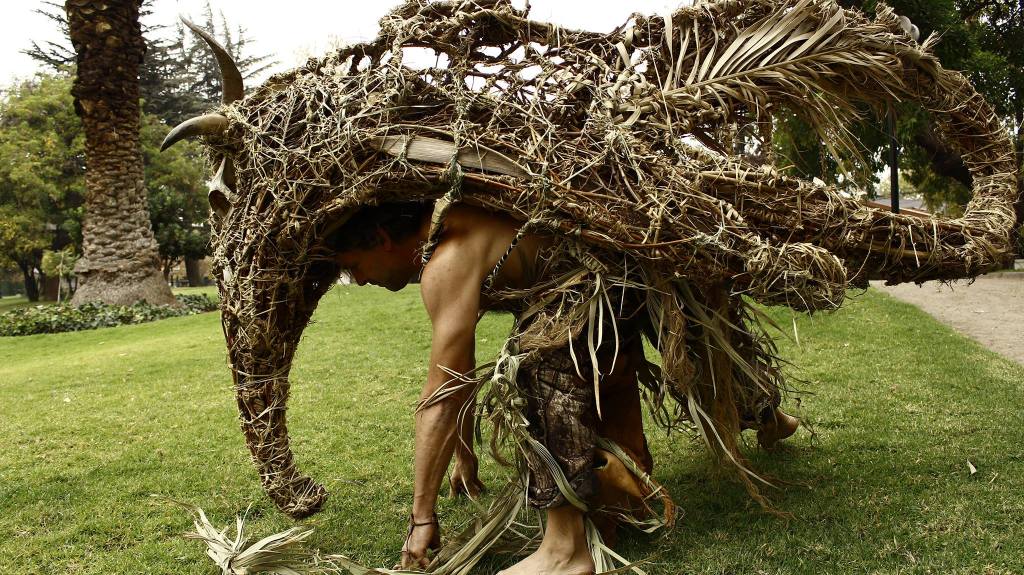
SELK’NAM FORCE. AS AN EXERCISE OF CREATION ON TRAVEL, CARRIED OUT DURING MY TEMPORARY TRANSIT THROUGH DIFFERENT PLACES IN CHILE SUCH AS THE ANDES MOUNTAINS, THE SOUTHERN CANALS, PATAGONIA AND THE ROUGH ARIDITY OF THE NORTH COASTS. A GLANCE OF THE BODY VALUE THAT THE ANCIENT CULTURES OF THE SOUTH OF THE PLANET GAVE THEIR CEREMONIAL REPRESENTATIONS, WHERE WITCHES AND SHAMANS DRESSED WITH BARK OR LEATHER MASKS COVERED WITH MUD AND MINERAL PIGMENTS SUCH AS WHITE, BLACK OR RED ON WHICH THEY THEN DRAWED FRAGMENTS OF THE SKY, THE PATH OF THE CONSTELLATIONS, SIGNS OF ANIMALS OR IMPORTANT NATURAL EVENTS – THE MOVEMENT OF THE SUN OR THE MOON – USING THE BODY AS A SUPPORT, AS A MAP, AS A GEOGRAPHICAL LANDMARK.
Image courtesy with the kind permission from Claudio Rodriguez Lanfranco
Doug Campbell
works primarily in collage, enjoying the immediacy of cutting through the detritus of the spectacle to the marvellous. He was born in Edinburgh, Scotland, where he still lives. Asking about the word ‘surrealist’ after finding it in a science fiction novel as a child, he was given a small book of Surrealist paintings. This was the first step on an adventure that continues until this day. His first encounter with living Surrealism was a second-hand copy of the Chicago Group’s ‘ARSENAL 4’ in the mid 1990’s. In response to a letter, Franklin Rosemont directed him to the recently-formed Leeds Surrealist group. This led to an on-going engagement with the international Surrealist movement through correspondence, collective games and contributions to publications and group shows. In 2017, he took part in the ‘Archaeology of Hope’ a large-scale Surrealist game concluding with a show and solstice ritual on the Isle of Wight. This was a significant transformative experience for everyone involved. Since then he has published a continuing series of collage novels in weekly instalments online at ‘The Cabinet of Major Weir’.
This is the biggest shrine in the house, and in the main living space, so probably the best organised. A mix of heirloom items, curios and pop culture junk. Framed artwork on the wall is by (l to r) Janice Hathaway, Tim White and Peter Overton. The boxed object at upper left is a magic bottle that belonged to my grandfather, an amateur conjurer.
Image courtesy with the kind permission from Doug Campbell
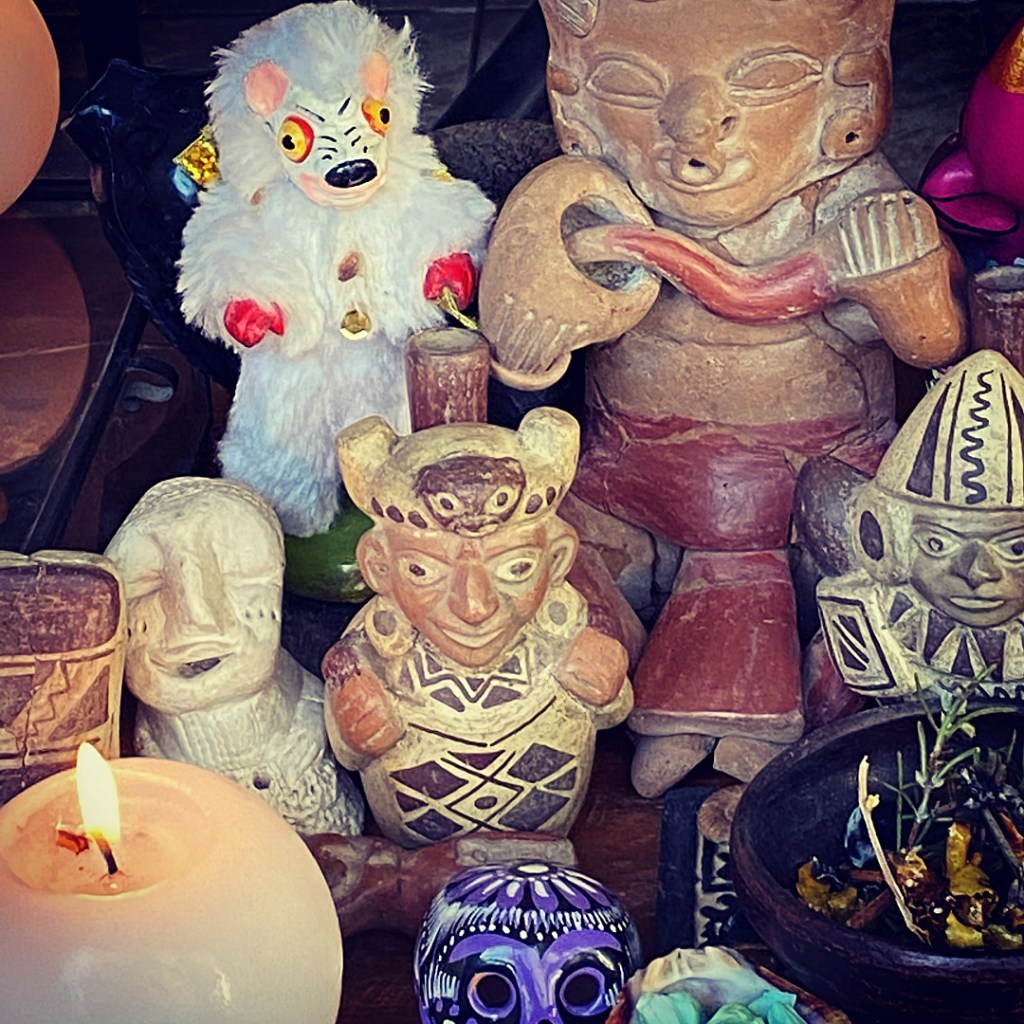
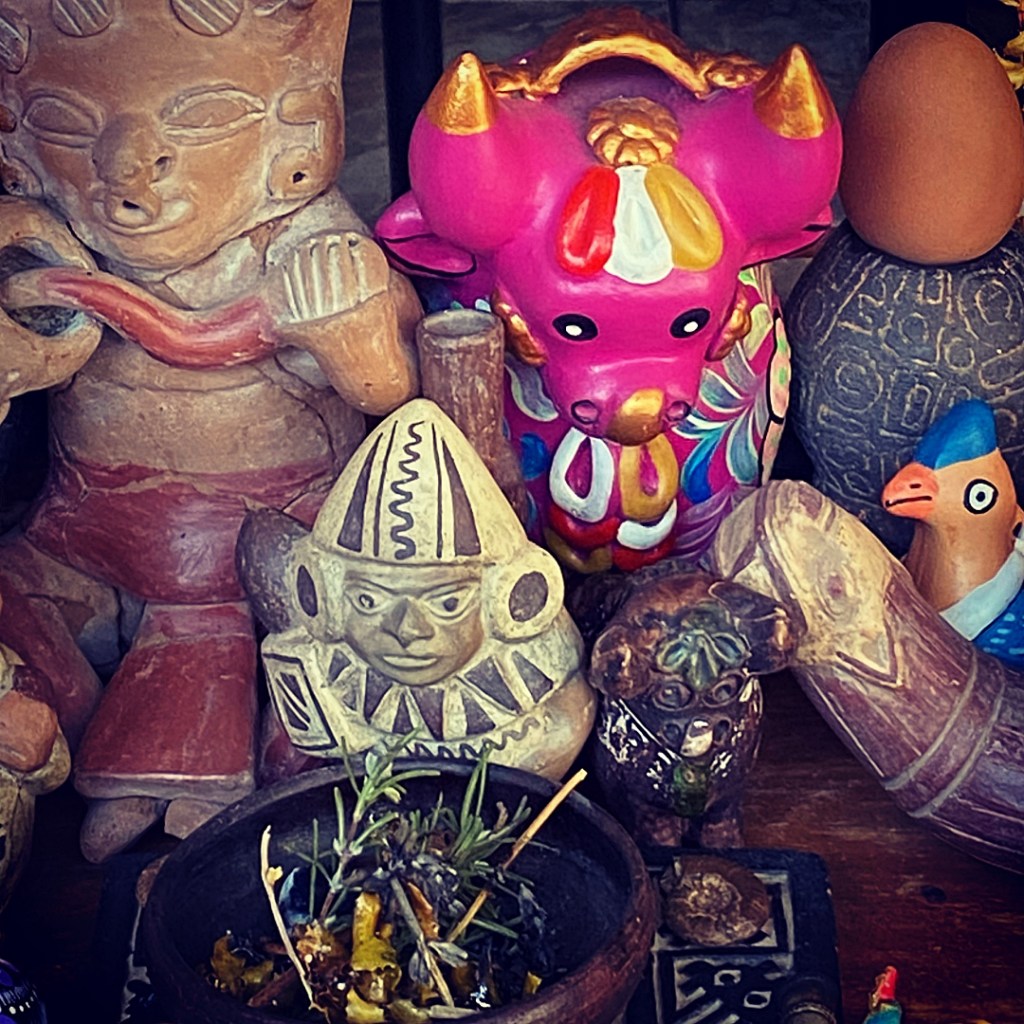
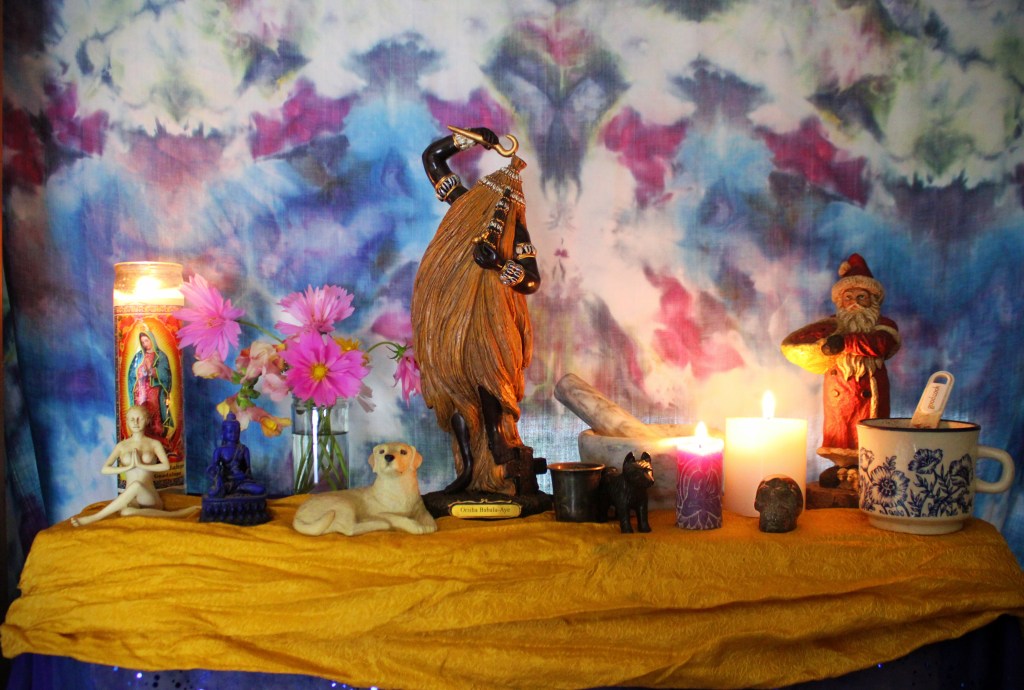
Mitchell Pluto
Artist, Jewelry Maker, Art Editor
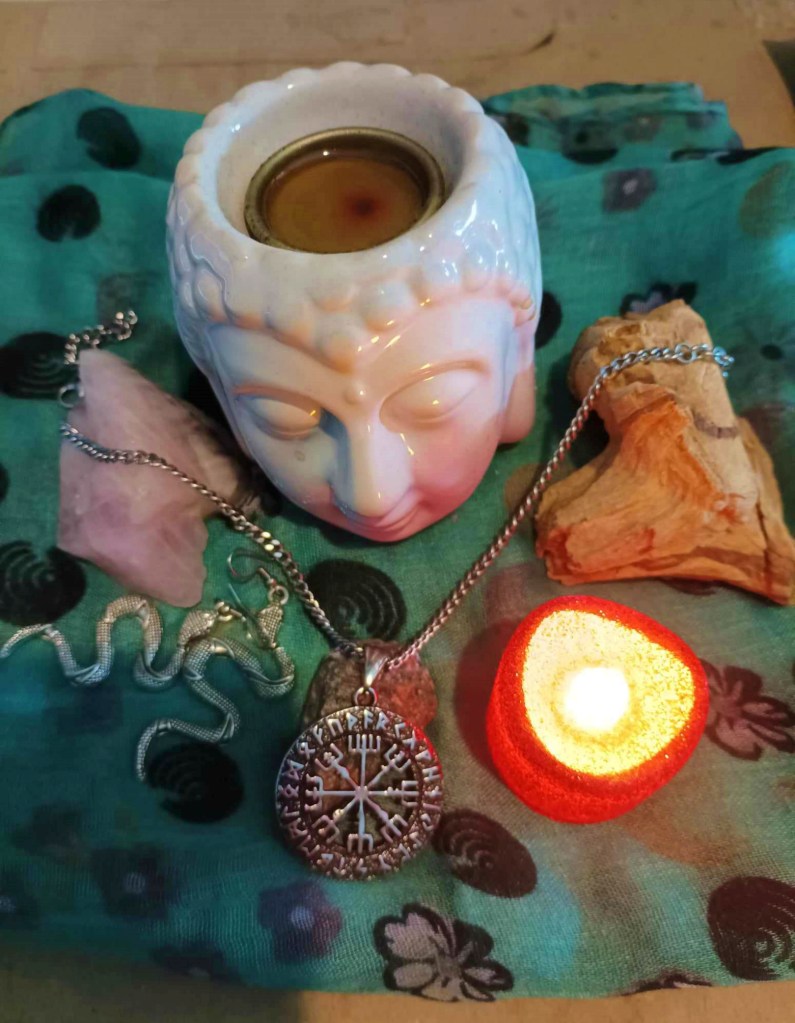
I began collecting objects for our altar in 2020 during the Covid pandemic. I selected figures that embody different archetypical aspects of growth and limitation. The process of recovery is sincerely magical. These mysterious qualities remain a focus on the altar. They play a vital role in the background as well as influencing the subconscious in healthy ways. Constructing an altar helped me be attentive to the belief needed for healing.
During the pandemic complimentary rum and coffee were supplied as part of a thoughtful routine and ritual. The other side of our altar is a shelf for salts, herbs and spices.
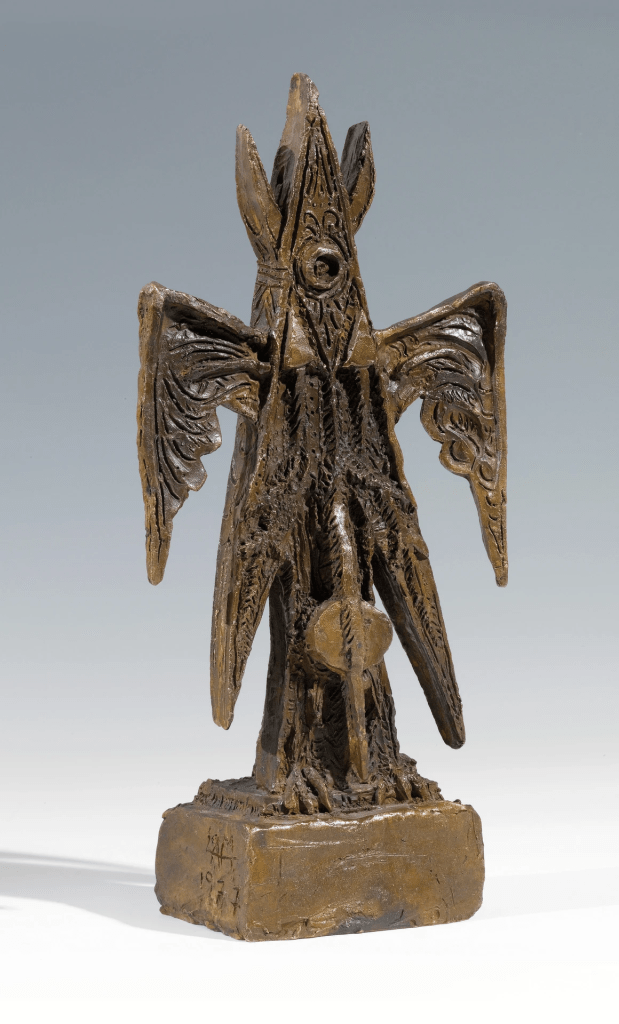
Wifredo Lam
Cuban artist who sought to portray and revive the enduring Afro-Cuban spirit and culture.
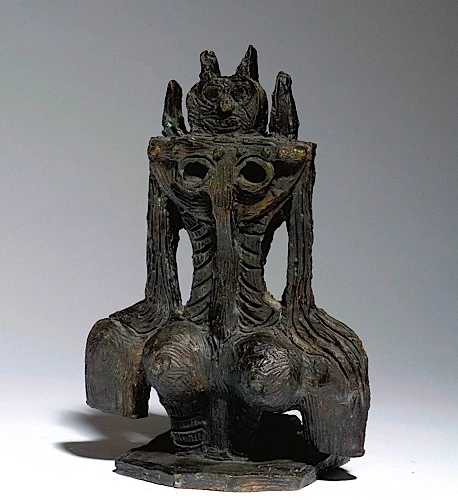
Wifredo Lam Osun, 1977 bronzeWifredo Lam GRAND YEMAYA, 1977 bronze sculpture, brown patinaPhotos from MutualArt
About theFeatured Photo
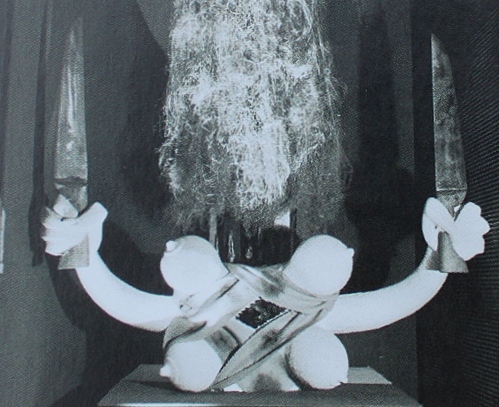
The Hair of Falmer
The Hair of Falmer, an altar created by Claude Tarnaud, Michel Hertz and Francis Bouvet following a design sent by Wifredo Lam from Havana for Le Surrealisme en 1947 exhibition held at Galerie Maeght, Paris, 7 July-30 September 1947 original photo Denise Bellon. Expert from The EY Exhibition: Wifredo Lam. Tate Publishing figure 33, page 211 used and intended for educational purpose only
Seas tú el extraviado que regresa hacia la niebla de nuestros cuerpos.
Catástrofe
El amor será poseído por los únicos sobrevivientes de esta masacre.
Vaticinio
Tu cuerpo disuelve las cosas para anunciar un gemido o recóndito extremo de la noche que ya no esconde nada ni siquiera una nueva forma de estremecimiento.
Extrañamiento
Me miras como si fuese tu fetiche me tocas cuando estamos solos no soy nada de aquello ni la sombra de nuestros propios pasos.
Escritora nacido en Viña del Mar, Chile. Profesora de Lengua y Comunicación de la PUCV, poeta y crítico literario. En 2012 publicó su primer libro, Los ojos invisibles del viento. Ha publicado en reconocidos medios digitales chilenos y extranjeros: Babelia (España), Letras de Chile (Chile), Triplov y Athena de Portugal, entre otros. Durante el año 2017 participa en el grupo Xaleshem con textos poéticos para las antologías surrealistas: “Componiendo la ilusión” en honor a Ludwig Zeller y “Luna Llena”, en honor a Susana Wald. En 2018 integra la antología feminista IXQUIC estrenada tanto en Europa como en Latinoamérica. En 2020 participa reseñando el libro de conversación “Poesía aleatoria, Surrealismo en América Latina” de Alfonso Peña (Costa Rica), también escribe un texto en prosa poética para el libro “Arcano 16, La torre”, del mismo autor. Asimismo, participa en el libro “120 notas de Eros. Retratos escritos de mujeres surrealistas” de Floriano Martins (poeta, escritor, artista visual y gestor cultural brasileño surrealista). En este año (2021) publica su segundo libro de poesía Poética de la erótica, amores y desamores de Marciano editores, Santiago.
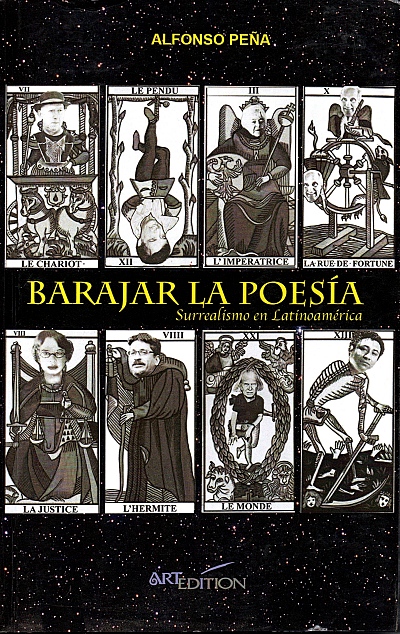
Critical commentary on the book “Shuffle poetry” (2020) by Alfonso Peña By Claudia Villa
Reading Alfonso Peña’s “Shuffle poetry” generates many questions, which challenge us as active readers, especially those of us who move through the surrealist texts of all time. Posed in this way, it is a new challenge that is presented to the reader of our texts, which joins the permanence of universal consciousness, the question and answer or the eternal question that dissolves in the chaos of the deepest dreams that we have not finished yet. Fully decipher. In this sense, we ask ourselves: is there or will there be an evolution of surrealism? This movement conceived by Breton mainly, as we know it in its beginnings, in its manifesto. It is a current that has been transformed, thanks to the social, cultural, economic and political crises that have arisen throughout the world. But this does not diminish the creative capacities and active cultural forces, quite the contrary, they are the support to increase the forms of dynamism typical of this style.
The movement that cannot be abstracted from the effects of these crises, which have occurred transversally, both in Europe and now in Latin America, is key and influences (to a greater or lesser extent), which has allowed an enrichment of the surrealist postulates. Mainly, because it allows the reassessment of different optics that come together in artistic elements that move to make notice of the changes and the force that is maintained and spreads like a kaleidoscope in different ways. Therefore, the vision of these artists, poets and writers that is patented in essays, poetry, narrative, photography, painting, literary criticism, among others, constitutes a permanent explosion of meanings that transmute into signifiers to make us see this structure as the game dreamed by the first surrealists, in which dreamlike and now virtual components underlie that cross each of our creations from side to side.
It can be affirmed that the surrealist movement, embedded as I said by permanent elements of modernity, has been reformulating itself, as the exhibitors of “Shuffle poetry” put it and also, it is interesting to understand their gaze as part of the total freedom that assumes each creator when faced with his work. Many also join the cosmic and ancestral call of our Latin American continent to capture in the works the roots of each aboriginal people and the reconnection with their first words, sculptures and the nature of man. This is how the vision of this surrealism, so rich in contents and games, radiates to multiple forms and ways of expression, both plastic, visual and written, which give life to a new surrealist approach, which although it has not stopped beating, as as it was conceived, it now promotes various multifaceted ways to enter into the perspective of reality or non-reality present in our days.
It is also necessary to comment on the expression of transgression that marks the works of the exhibitors in this book, which leads to a permanent need to play and to break the schemes that broadens the concept of freedom in creation. This is a common element that distinguishes these works, which are forged from inner worlds rich in dreamlike and liberating content, where transformation is a permanent axis of universes in constant motion, as represented in different worlds or parallel universes. Creation, in this way, continuously forges and destroys itself, which would constitute the object of its birth and constant evolution: mutations, evolutions, changes of form, content and continent, which are like permanent waves that contribute Surrealist art and its continuous reconstruction.
Another aspect that can be seen in “Shuffle poetry” is the permanent transgression towards social signs formed around a central axis that looks only towards one way of expression, which allows the constant reworking of other signs and other escape routes. towards the liberation of men as social beings who live within a community. The alteration of the meanings, already patented, by a single controlling mechanism, thus generates the ability to alter the represented codes that (on the one hand) are reflected in their own city languages, in addition to the reworking of schemes that are rearranged at any time. order or figure and who want more than anything to find a way of subsistence in the movement typical of the tribe. These forms are appreciated and reconstructed many times, from the collapse of imposed situations that end up being formulated from other varied points of view. So, the ways that surrealist art takes to survive the imposed conceptions are varied, in an attempt to achieve dissimilar points that allow freedom of expression.
Claudia Vila Molina
Writer born in Viña del Mar, Chile. Professor of language and communication at PUCV, poet and literary critic. In 2012, she published her first book, The Invisible Eyes of the Wind. She has published in renowned Chilean and foreign digital media: Babelia (Spain), Letras de Chile (Chile), Triplov and Athena de Portugal, among others. During the year 2017 she participates in the Xaleshem group with poetic texts for the surrealist anthologies: “Composing the illusion” in honor of Ludwig Zeller and “Full Moon”, in honor of Susana Wald. In 2018, she integrates the feminist anthology IXQUIC released both in Europe and in Latin America. In 2020 she participates reviewing the conversation book “Shuffle poetry, Surrealism in Latin America” by Alfonso Peña (Costa Rica), also writes a poetic prose text for the book “Arcano 16, La torre“, by the same author. Likewise, she participates in the book “120 notes of Eros. Written portraits of surrealist women” by Floriano Martins (Brazilian surrealist poet, writer, visual artist and cultural manager). In this year (2021) she publishes her second poetry book Poética de la erotica, amores y desamores by Marciano editores, Santiago.


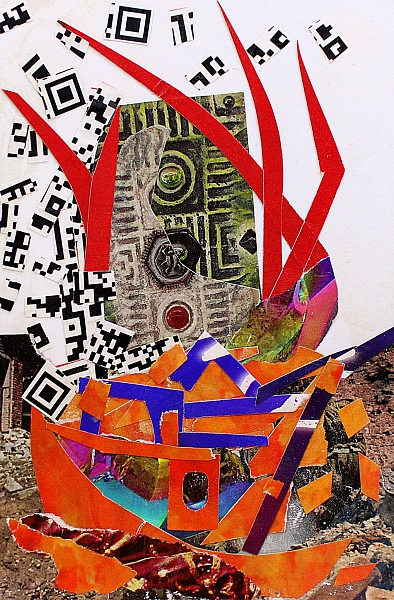



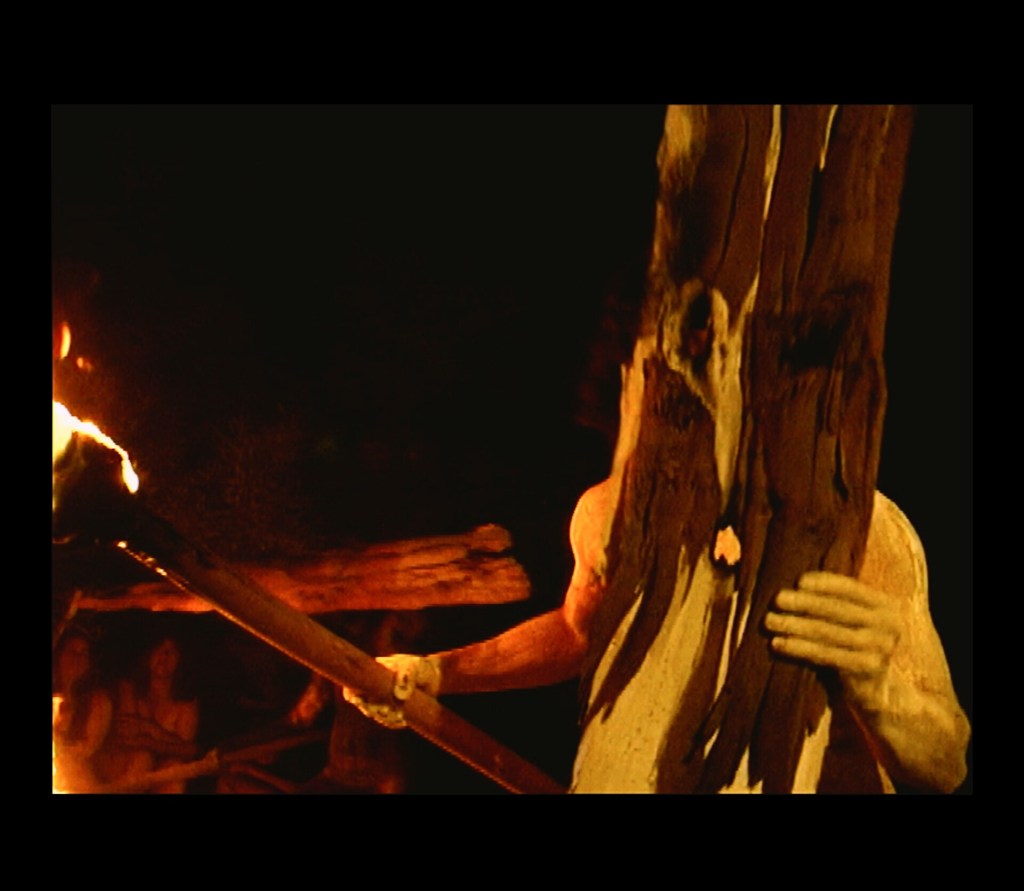
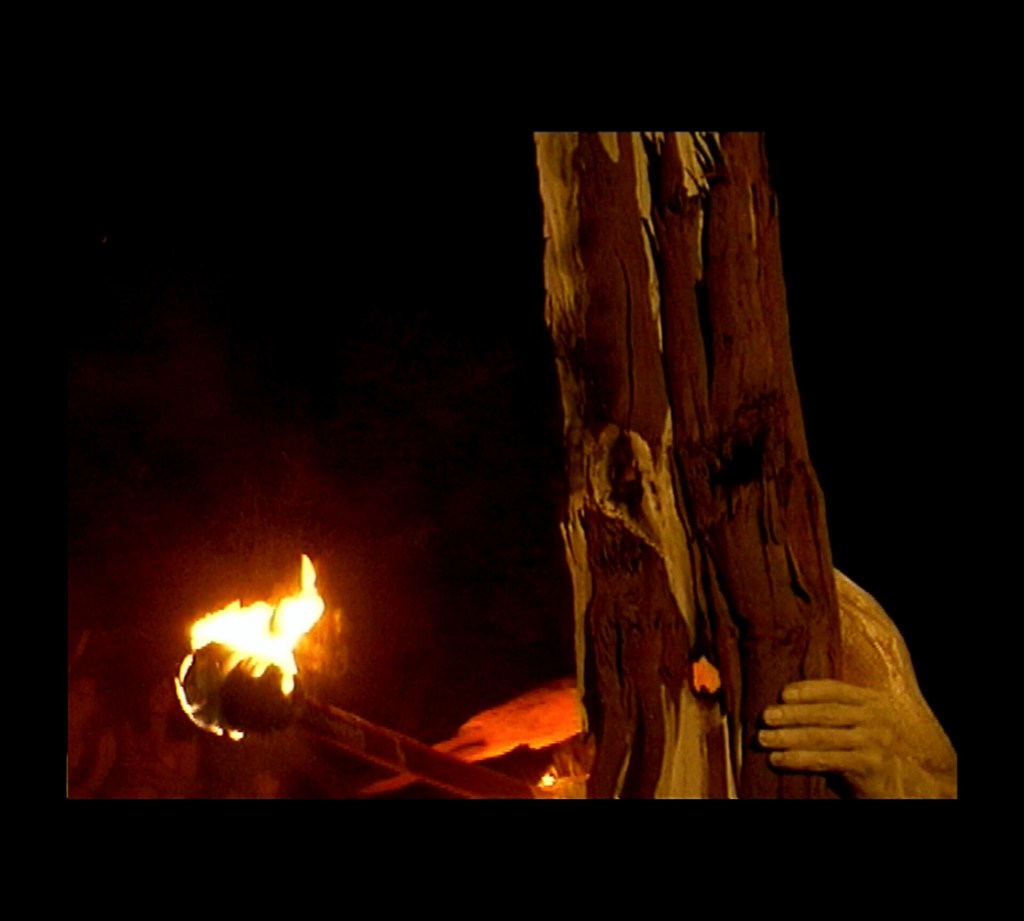


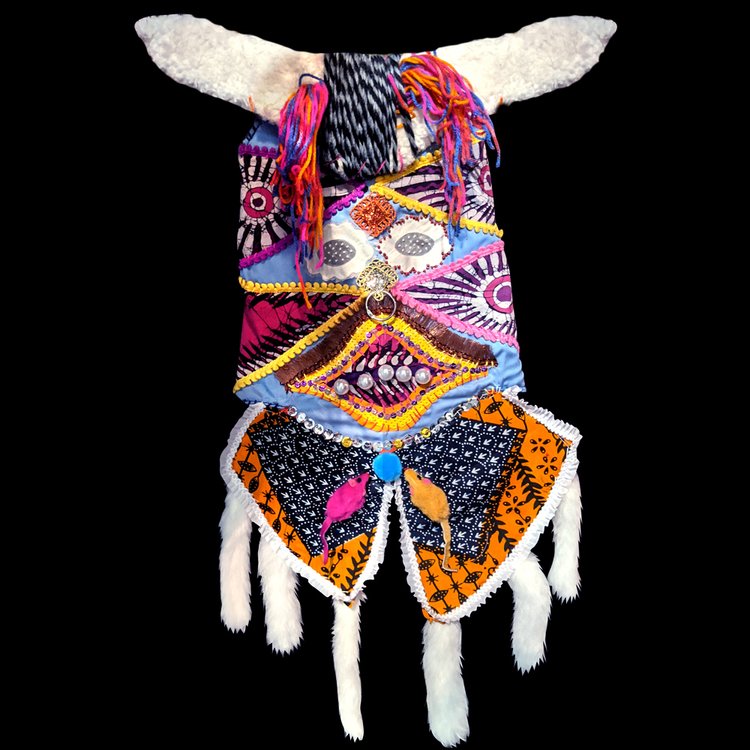
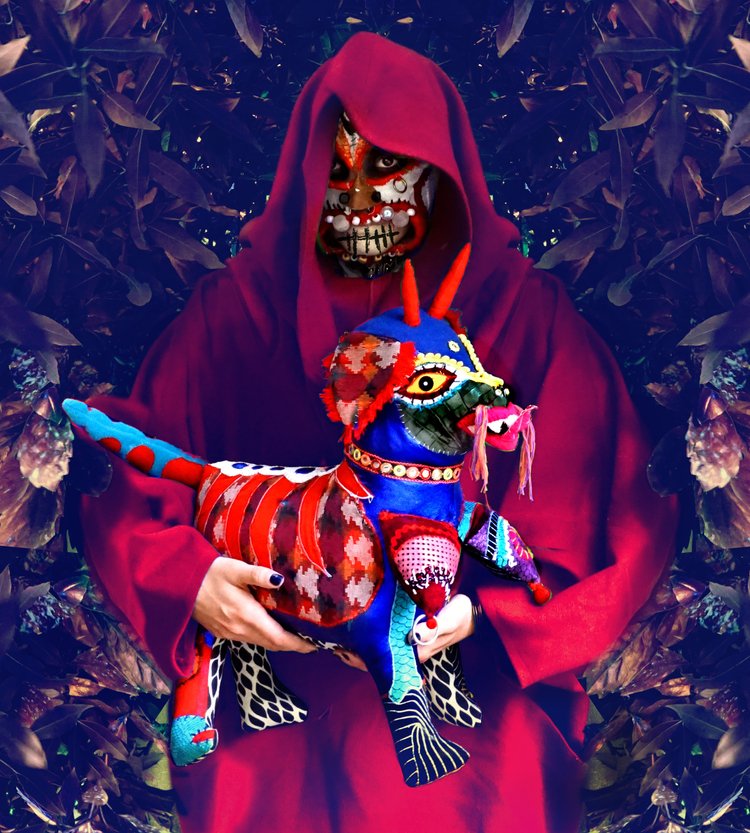
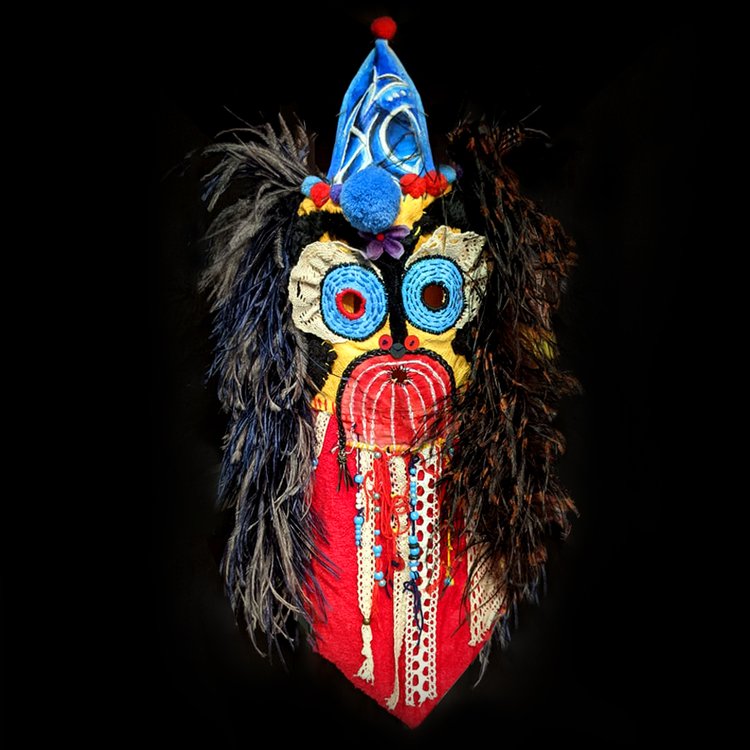
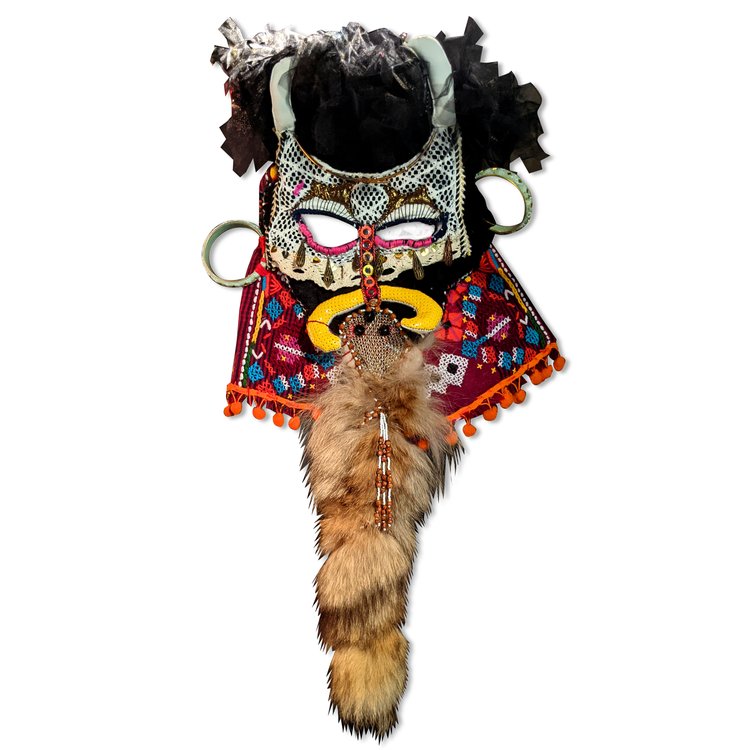

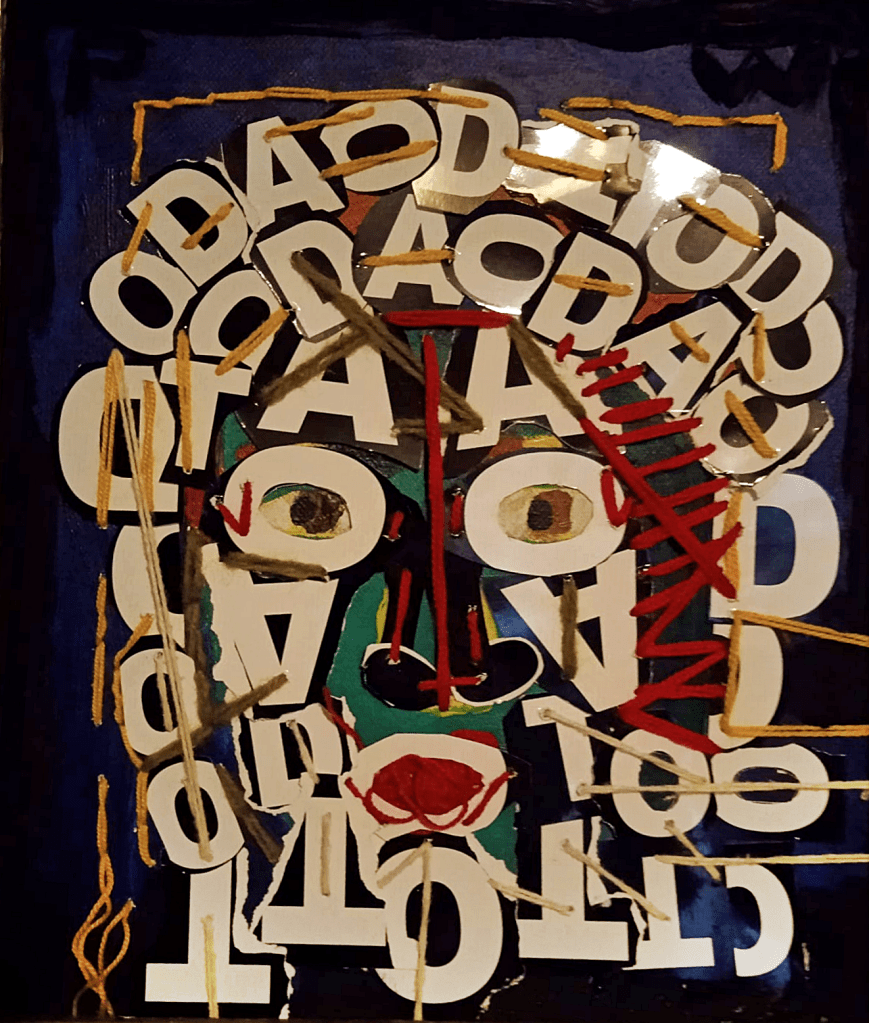
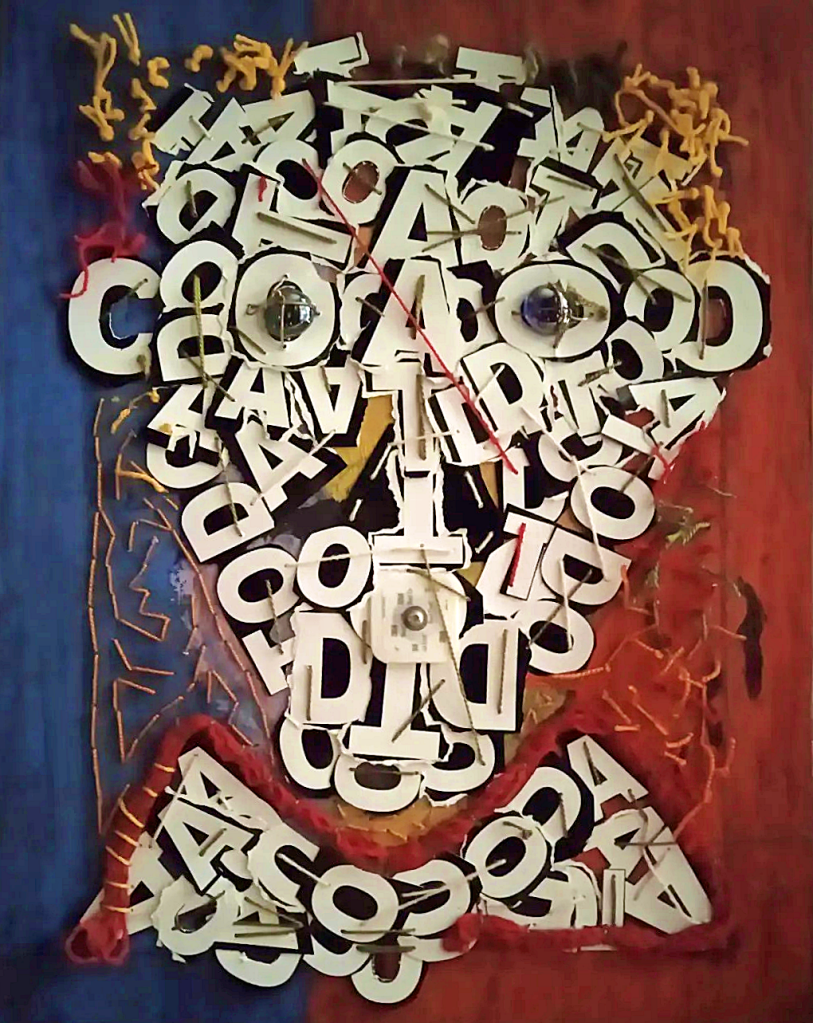
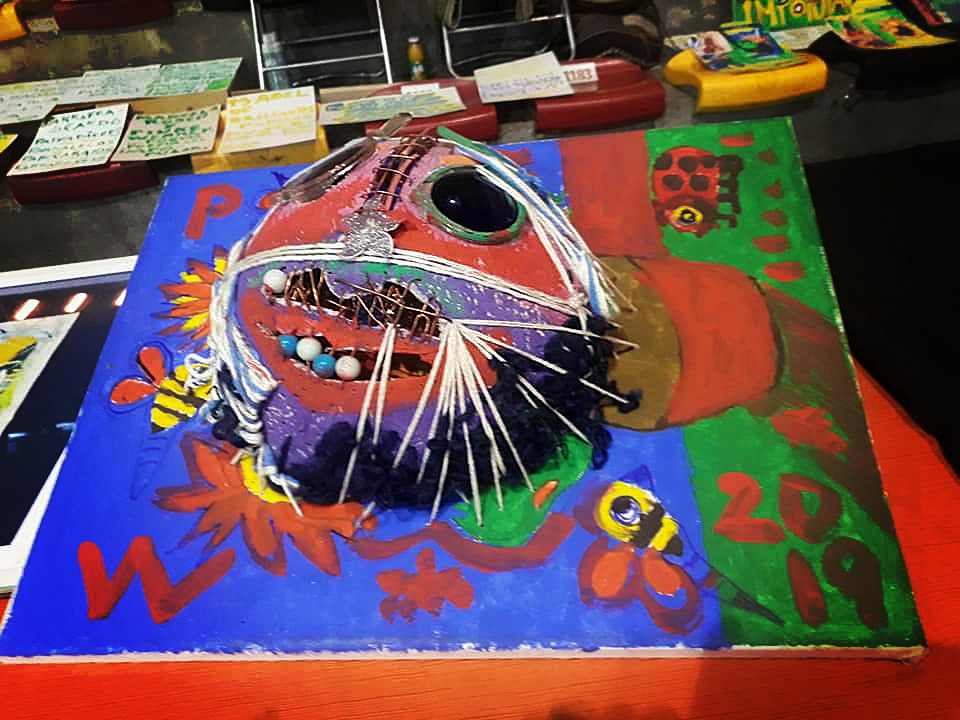

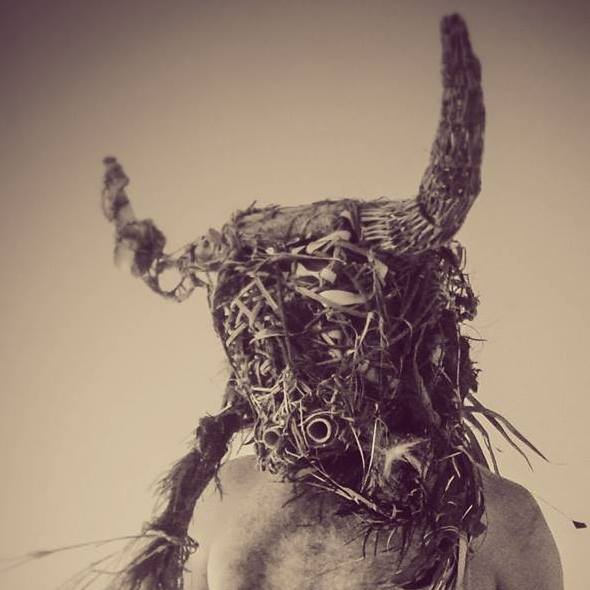











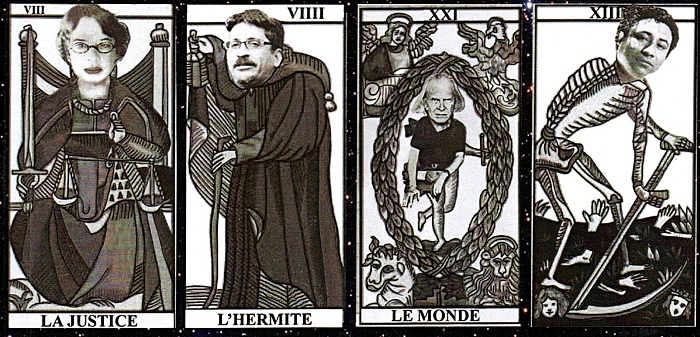

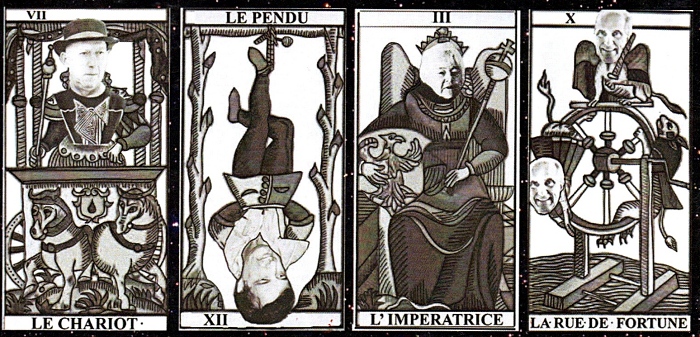
 Mitchell Pluto