JC Bravo CONFESSION (2026) ballpoint pen on paper.
In this neon pink ballpoint pen drawing, obsessive crosshatching builds a body laid bare in complete surrender. Neon pink pulses with the heated flush of skin, the electric thrill of longing, and the raw intensity of love and lust. Through thousands of meticulous strokes, the figure becomes a quiet confession of obsession, femininity, and the consuming ache of wanting — desire quietly witnessing itself in the mirror of another painted nude.
HOT FOR TEACHER (2024) Ballpoint pen on paper
THE END OF DESIRE 2026 JC Bravo
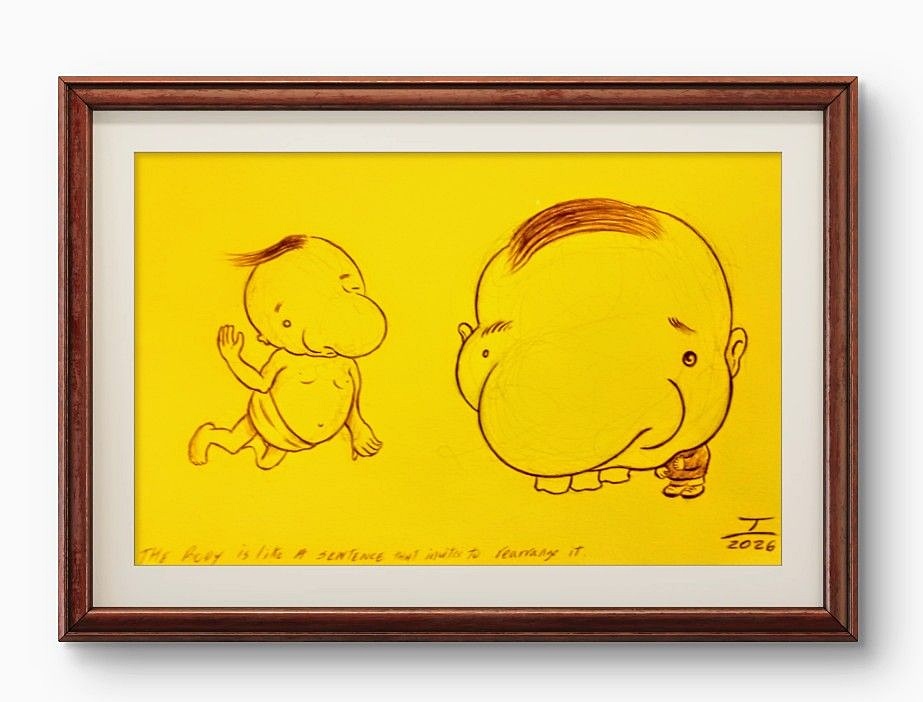
REARRANGED (2026)
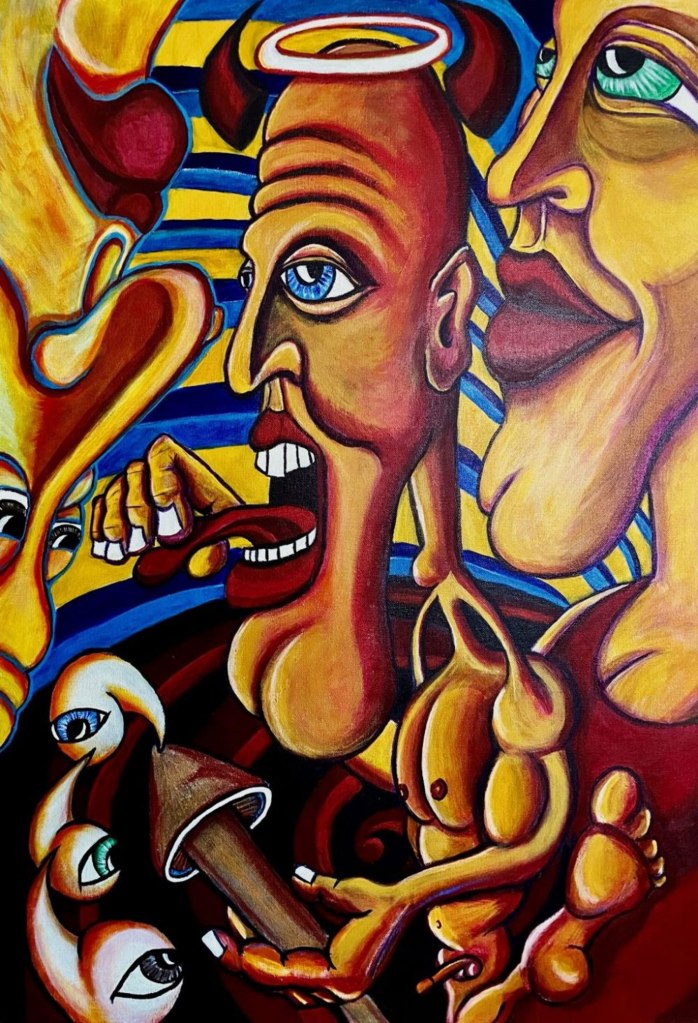
My swollen, bulbous characters are exaggerated vessels of the human condition. They are grotesque yet tender, absurd yet deeply familiar. Through them I explore inner chaos, vulnerability, desire, and the carnivalesque absurdity of simply being human.
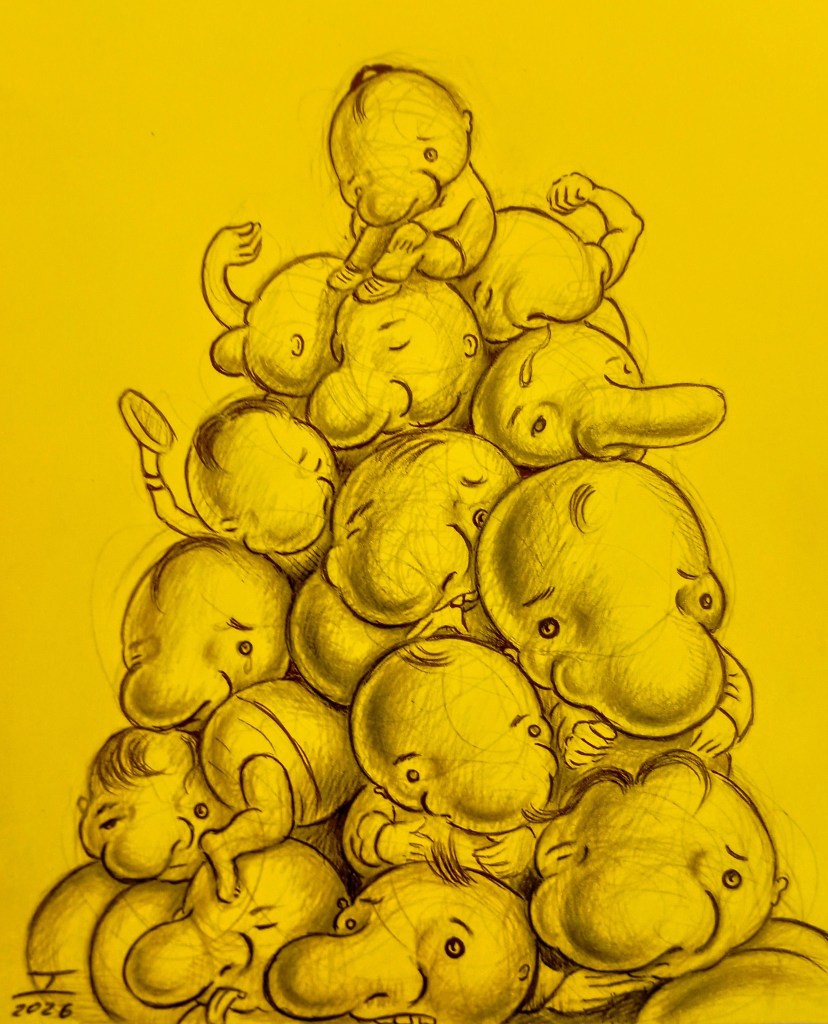
MENAGERIE (2026)
A towering pile of bulbous, round-headed baby-like creatures are stacked precariously on a bright yellow background. The way they’re climbing, clinging, and overlapping is both playful and deeply unsettling; like a living tower of innocence mixed with grotesque absurdity. Some look sleepy or content, others wide-eyed or struggling, and the whole mass has this frantic, organic energy and a carnivalesque spirit.
The pyramid shape draws the eye upward, and the yellow background makes the graphite figures pop with dramatic contrast. The details like tiny hands, varied expressions, the way limbs intertwine show great control and an unhinged imagination.
This drawing depicts a human menagerie at its most chaotic and biological: birth, multiplicity, piling up, struggling for space, yet somehow forming a single absurd existence.
I work primarily with oil paints. It is important for me to achieve a jewel like preciousness in my paintings in order to convey care and importance. I want to give my paintings a monumental and sensual quality that I believe can only be achieved with oil. Also, oil painting gives my work an elegance that balances the sometimes grotesque and fantastical subject matter.
If you would like to know more about me and see more of my work visit my website:
In my figurative art, I don’t see the figure as something to be copied but as an event that’s shaped by rhythm, gesture and emotion. I grew up close to nature and think of my painted and drawn lines as threads and fibres, veins and roots, feeding and defining the boundaries of colours, which are the emotions describing an inner life, memories and connections.
Each painting can be thought of almost like a conversation. As I work on a piece, whilst I usually have an overall concept that I’d like to express, the details and the manner in which that idea is expressed is often only discovered whilst I’m actually working on it. Some pieces end up looking more like physical time-lapses, with the figures moving on the canvas as they get painted then repainted, whilst others could be seen as long-exposure captures of emotional changes, with the shifting colours both mirroring and guiding my mood whilst I work.
Magdalena studied Artistic Textiles at the C.K. Norwid Art College in Lublin, Poland and earned her master’s degree in Painting from the nearby M.C. Skłodowska University. After living and exhibiting in England and Switzerland, she settled in Asturias in northern Spain, where she continues to develop her work. She has held numerous solo exhibitions and included in group exhibitions worldwide. Her work is represented by several international galleries and is held in collections around the world.
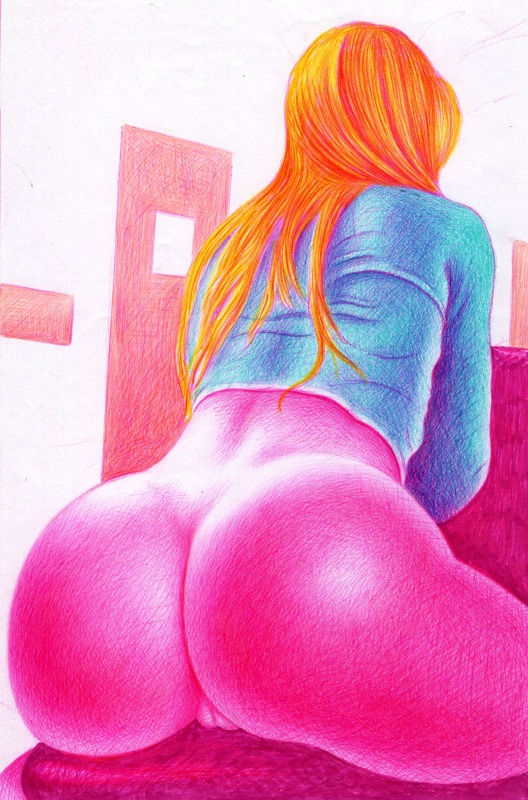
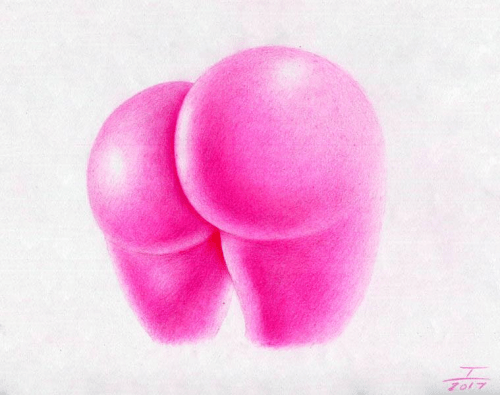
My favorite Bravo pink pen drawing is the 2017 Neon Bubble Butt. I find it enjoyable because the curvy female buttocks are a universal icon of beauty and perfection. It’s a fixed shape drifting in space. Just as helium makes things float and feel light, the drawing has a whimsical, festive quality to it. This drawing makes me think of how ideas can lift your spirits.
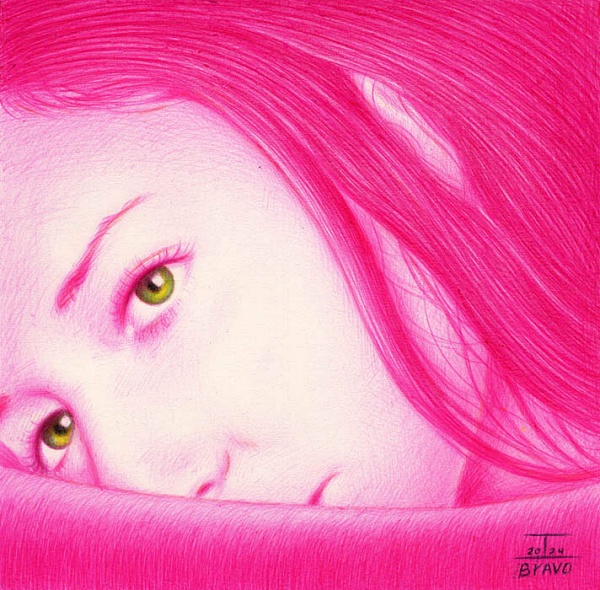
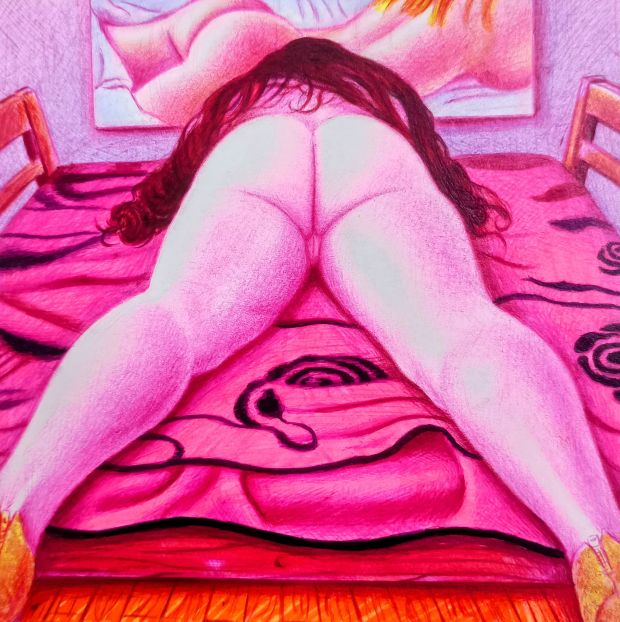
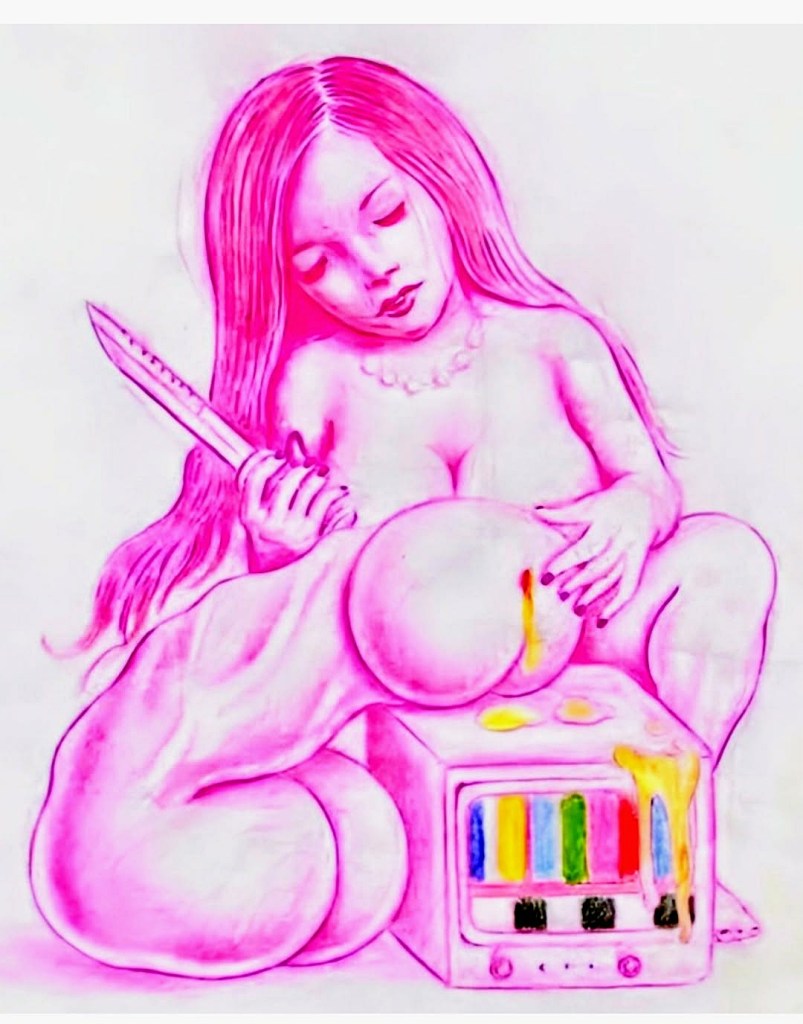
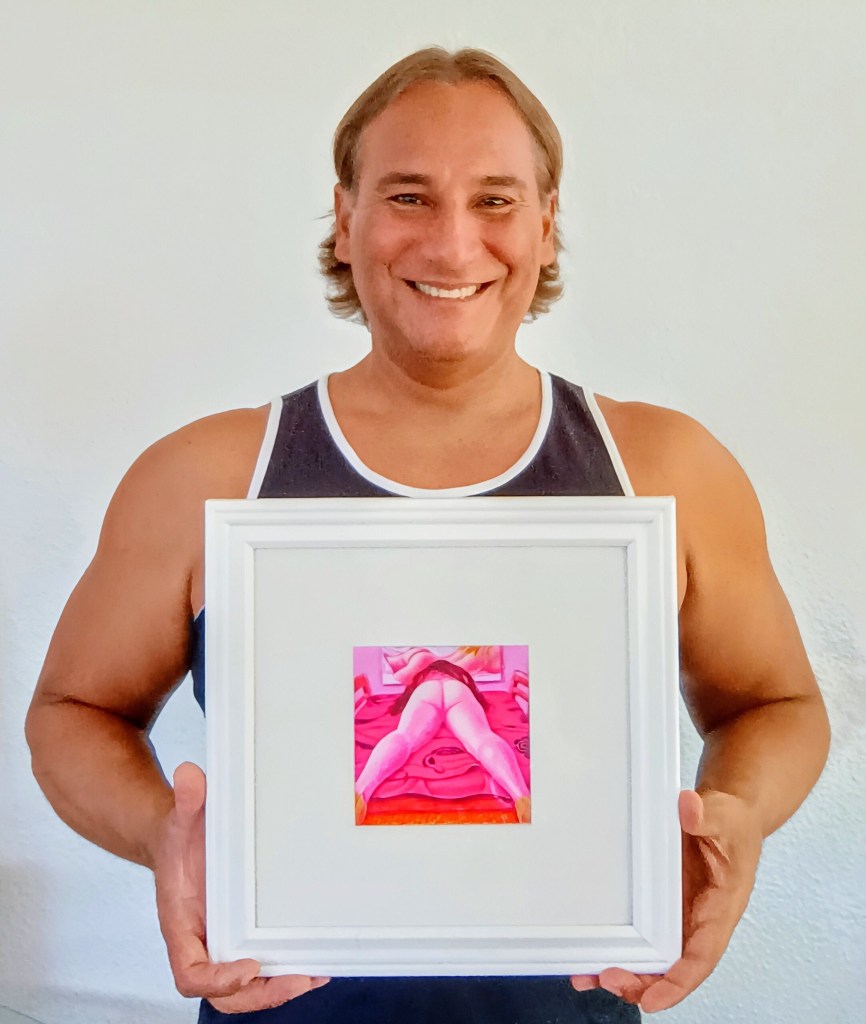
Juan Carlos Bravo, a Miami artist, is all about sensuality in his art. Miami is a melting pot of cultures, fashion, and the adult film industry. The sensuality in Bravo’s art makes it a favorite among collectors. He paints voluptuous women who embody an ageless ideal of sex appeal.
Surrealism, body horror, and pop culture blend to create the world of Bravo’s women. His art inspires viewers to examine their own primal instincts and their significance.
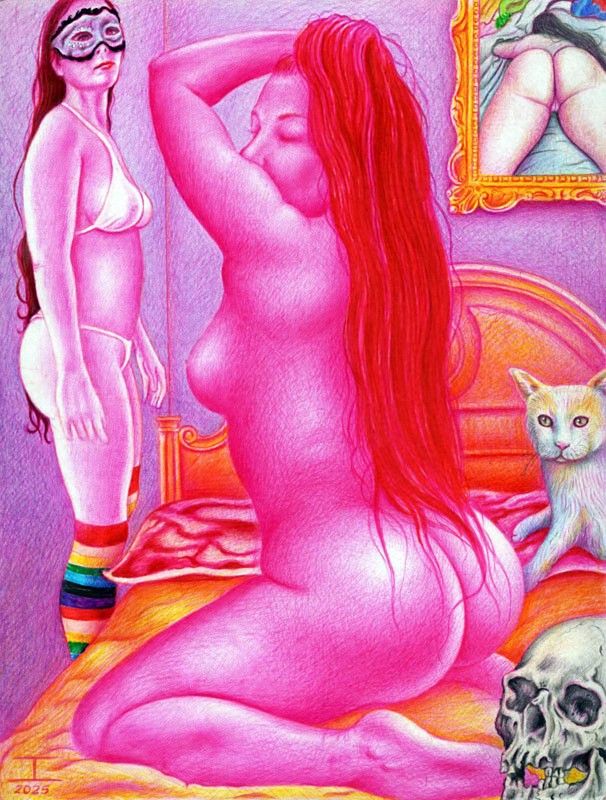
“GLORIOUS” (2025) JC Bravo
In this intimate scaled ballpoint pen drawing, I return once more to the private theater of the bedroom, a liminal space where desire, memory, and mortality quietly collide.
At the center kneels a voluptuous woman, her impossibly long red hair spilling like wine across her body, an oneiric cascade that measures both time and temptation. She raises her arms in a gesture of languid surrender, unaware, or perhaps deliberately unseeing, the woman wearing a jeweled Mardi Gras mask that transforms her into a carnival Venus. Thigh-high stockings, striped in defiant rainbow colors, root her to the earthly even as the rest of her body dissolves into roseate light. On the bed beside her, a cat and perennial guardian spirit, sits in calm, wide-eyed judgment, the only creature in the room who truly sees everything.
Above them hangs a gold framed erotic painting, its subject bent in mirror-image submission, a quiet reminder that every act of looking is also an act of being looked at. And in the lower right corner, half-hidden beneath the sheets, grins a human skull, my memento mori. It is not a threat but an invitation: remember that you will die, so love fiercely, look shamelessly, touch without apology while flesh is still warm and hair still grows.
The entire scene is drenched in an artificial pink and magenta glow, the color of stage lights, fever dreams, and cheap motel neon, a hue that makes the skin feel simultaneously hyperreal and hallucinatory. Through this saturated lens, the everyday becomes ritual, the intimate becomes mythic, and a simple moment of morning undress is revealed as a dance on the edge of oblivion.
Bravo paints the human body with anatomical precision. He features both realistic bodies and integrates stylistic elements reflecting augmentation. Technical detail is a priority in his work. He’s passionate about oil painting and uses a pink pen for his drawings.
Philip Henderson
Tyra Philip Henderson
Among Henderson’s many drawings, I like Tyra the best. The figure’s eyes hold my attention. I think she saw me looking at her hand. I can tell she’s aware of my attraction through her gaze. The outline of her body forms a simple path, gently sloping from breast to thigh. Her hair almost blends with her pubic hair, but a delicate crescent shape separates them above the mons pubis. Tyra’s arm movement guide your eyes across her body. In Henderson’s artwork, eye contact and pose combine to create a feeling of empathetic sex appeal.
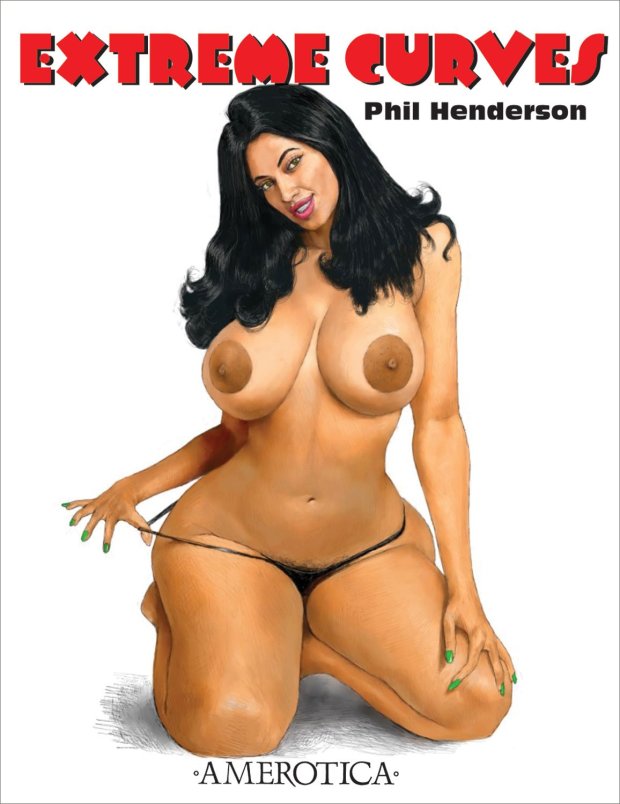
Curvy fetishes play a significant role in the themes of Philip Henderson. His plush illustrations create an arresting experience for the viewer. Henderson celebrates the value of curvy women. Henderson’s book, “Extreme Curves and Phat Girls”, achieved international success.
Besides his erotic illustrations, Henderson is a gifted writer of essays, novels, and poetry. He achieves elegance through his scholarly, artistic style. Henderson avoids abstraction in his anatomical figures while blending idealism and realism, creating a believable fantasy. He portrays natural grace and confidence in his figures, excluding any cosmetic enhancements.
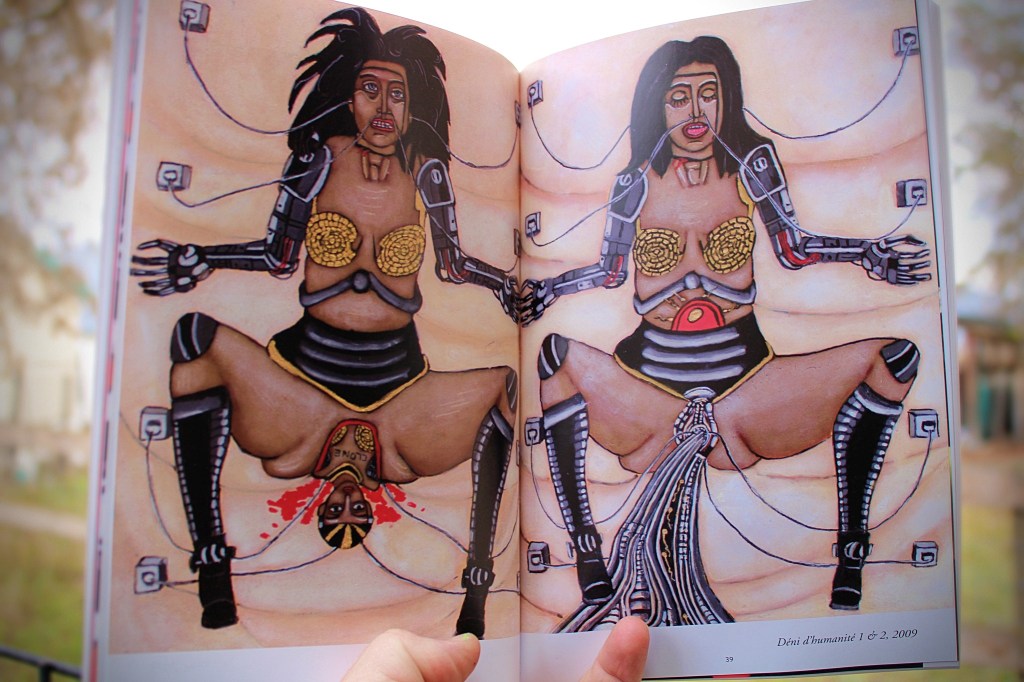
Angélique Danielle Bègue
Deni d’humanité, published in Angélique Danielle Bègue‘s 2009 book, Dans Mon Corps.
Bègue’s 2009 work, Dans Mon Corps, includes “Deni d’humanité,” a piece with a prophetic theme. In the image, AI’s exploitation disrupts the natural flow with sexual intrusion. This image illustrates AI replicating itself using humans. Her art shows how the excitement around AI is really just more of the same old ways of controlling us. Bègue’s work examines the way narrative influences our understanding of what’s real and imagined. I appreciate looking at this image because it makes me question the idea of human originality and imitation.
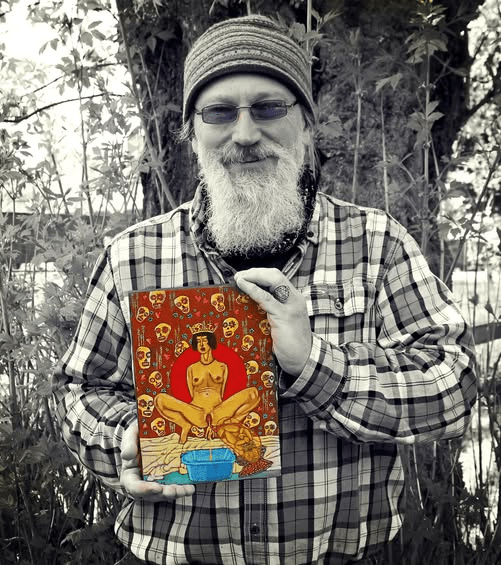
French painter Angélique Danielle Bègue’s artistic career started with tempera, apprenticed at Gorze Priory by an Orthodox nun. A classic style is the vehicle for Bègue’s modern concepts. France acknowledges her contribution to the revival of tempera painting. Bègue’s professional experience includes erotic modeling.
An icon painting from my dear friend Angélique Danielle Bègue from France.
In her figurative art, Bègue merges a traditional religious style with contemporary themes. Her artwork uses vibrant tones, layers, and bold lines. Bègue’s iconic graphic design employs strategic contrasts to create visual balance and proportion. She uses painting to express her internal fantasies. Bègue dedicates herself to understanding sexual fantasies and how to approach topics society deems taboo.
Miriam Cahn
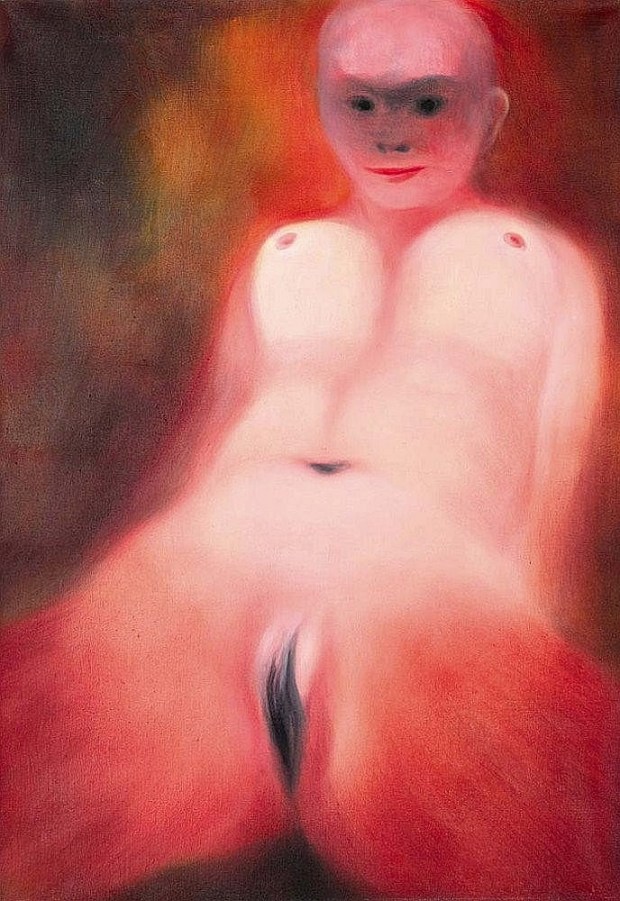
ÄffinMiriam Cahn
Äffin’s unsettling nature is thought-provoking to me. Simian aspects of the image contribute to its dreamlike quality while exposing a liminal personality. The skin is smooth around the breasts but gets hairier and tactile near the pelvis. The vulva is a fiery bush, sparking primal metaphors. This work compels me to explore the roots of human consciousness and how language shapes our understanding, including our desires. It suggests to me that the ideas of elegance and ugliness are mental constructs. The intense emotion evoked by this painting stems from Cahn’s ability to communicate deep thought through candid visual images.
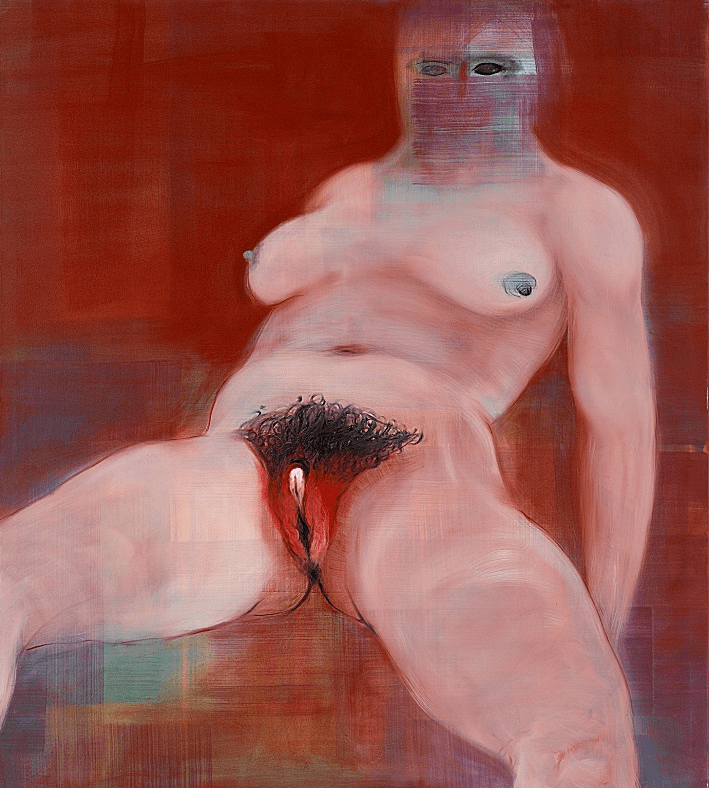
Swiss artist Miriam Cahn paints in a Neo-post-expressionist style. Her art reflects the movement’s style through her figures, colors, and emotional expression. Cahn’s work often features spectral figures with watchful eyes. Viewers become the subjects of the gaze of the eyes in her paintings.
Cahn’s paintings are vibrant and full of bright pastel colors. She discovers new things about herself through painting. With raw concepts, she develops a visual vocabulary for emotions. Her paintings are unpolished and invite the viewer into a world that’s flawed.
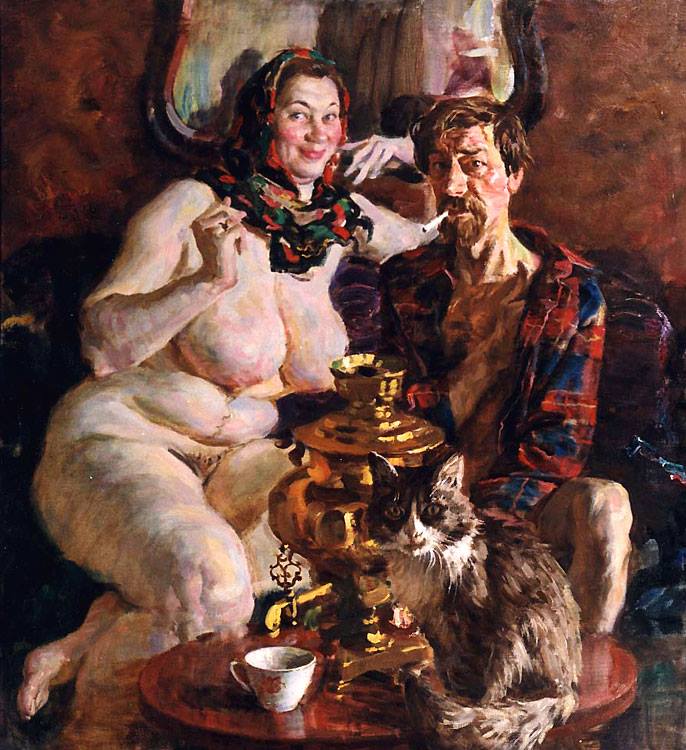
Viktor Alexandrovich Lyapkalo
Viktor Lyapkalo
The reason I like Lyapkalo’s paintings is his choice of female subjects. It’s that simple. I’m attracted to curvy women, and his artwork features them. This painting captivates me in every way. The man, cat, and samovar create a muted, somber atmosphere, in contrast to the woman. Her lively body seems to glow with light and color. She’s appealing because of her open and generous nature, which brightens the room. Lyapkalo’s representation of the smile has a seductive effect on the viewer. The piece illustrates the duality of affection, showing both its open and concealed aspects.
Russian artist Viktor Lyapkalo paints in a strong social realist style. His paintings of women are sensual and playful. Lyapkalo’s skill with figures and academic paintings is the key to his success. His artwork portrays the emotion and character of the people he paints.
During my interview with Lyapkalo, he compared painting skin to an onion flower, highlighting its multi-hued nature. This is evident upon closer examination of the colors used in the artist’s depictions of nude women.
Pablo Picasso
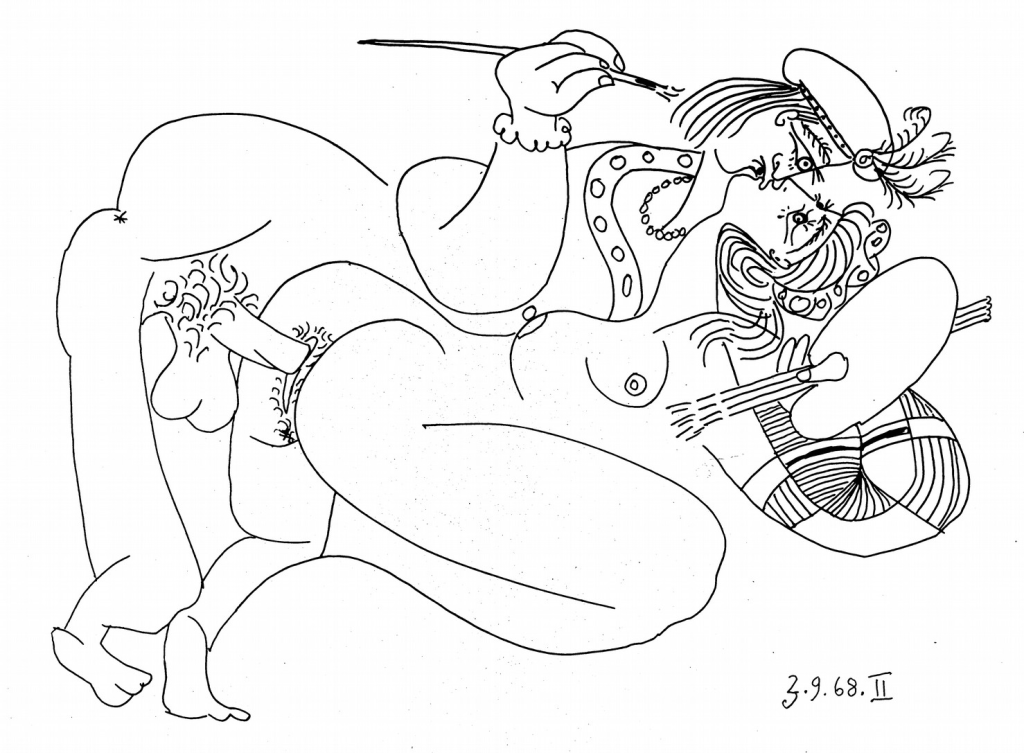
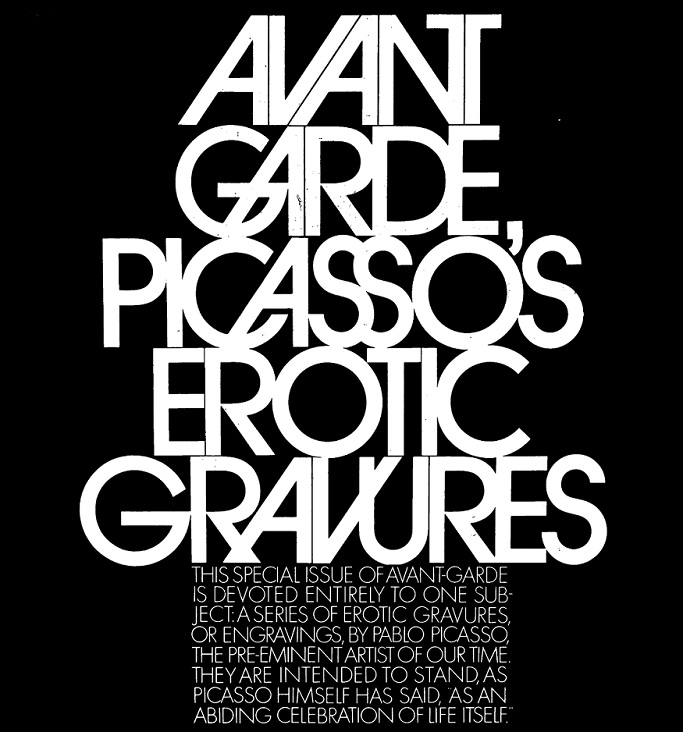
Avant-Garde Magazine, No. 8. Picasso’s Erotic Gravures Pablo PicassoArtist and his model 1969
This image remains my most memorable. In sex, artist and model become unified. I am drawn to this picture because it features both intercourse and a suggestive representation of the sexual act through the artist’s palette. As a flawless masterpiece of line, this image is everlasting.
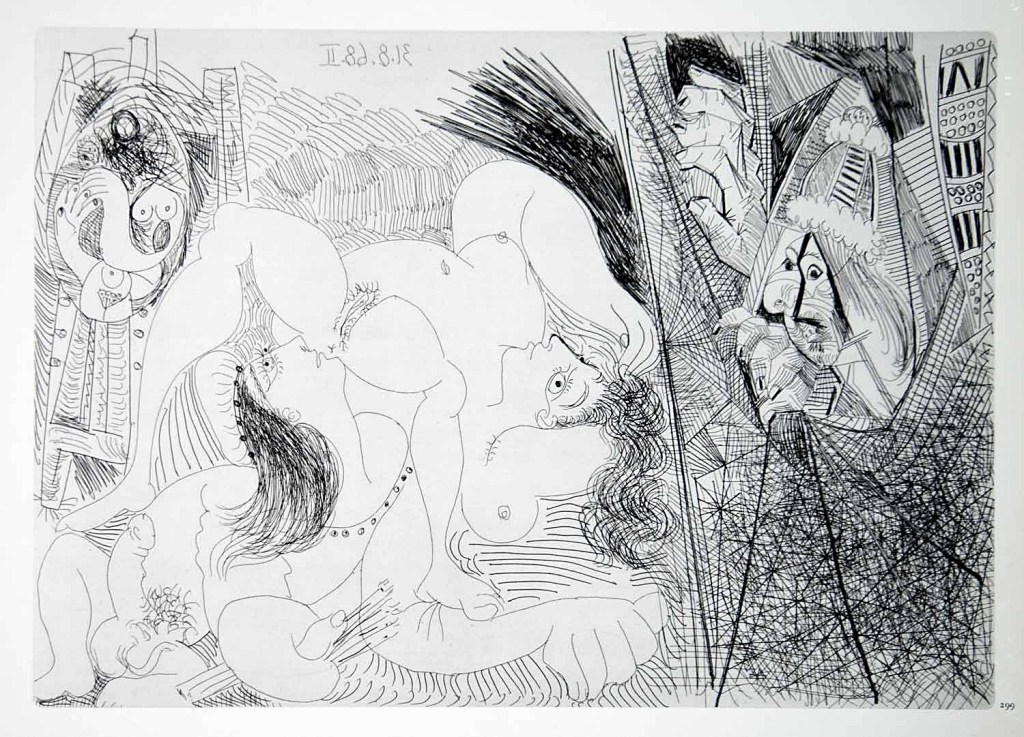
I found Avant-Garde Magazine, No. 8. Picasso’s Erotic Gravures on my parent’s bookshelf. It was between Anaïs Nin’s “Delta of Venus” and Louise Huebner’s “Power Through Witchcraft”. For a kid stuck reading boring schoolbooks, I finally stumbled on something cool.
The thin book, Picasso’s Gravures, contained his sexually suggestive sketches. Picasso’s drawings are gestural. His lines make his art look like it’s being fondled. Many illustrations displayed surfaces marred by hairiness, crinkling and stretch marks.
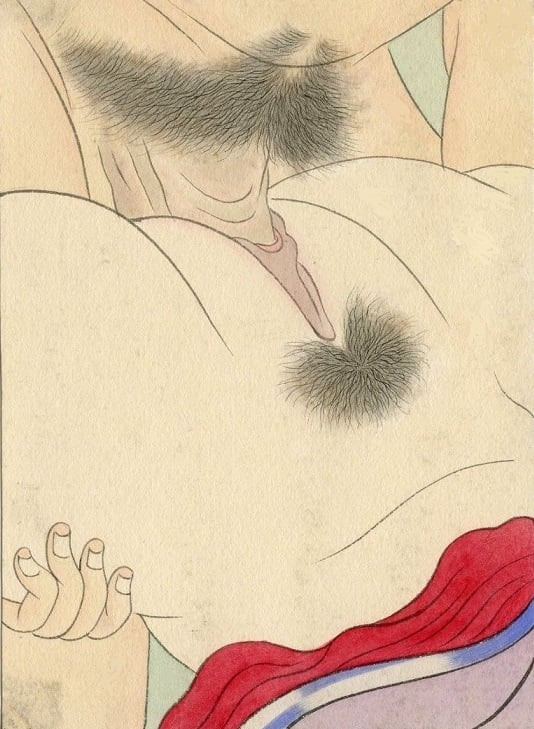
The lines create a curious interplay of dryness and wetness. Picasso’s suggestive drawings in the 1970s opened the door for other artists to explore explicit themes. He owned a collection of sixty-one Shunga prints. Picasso’s interest in Shunga is a key theme in the chapter “Artist and his Model”.
An example of eighteenth- and nineteenth-century shunga
“A lot of the eighteenth- and nineteenth-century shunga books contain enlarged images of male and female genitals, occasionally while engaged in the sexual act. These kind of ‘close-up’ designs were intended to provide instruction about anatomy and how to give pleasure. These educational images are mostly found immediately following the other illustrations in shunga books. Such prints are modeled after older versions that were used to teach human anatomy, which showed different shapes of male and female organs.” -Marijn Kruijff, Editor of Shunga gallery Erotic Art Magazine and is the foremost authority on shunga art.
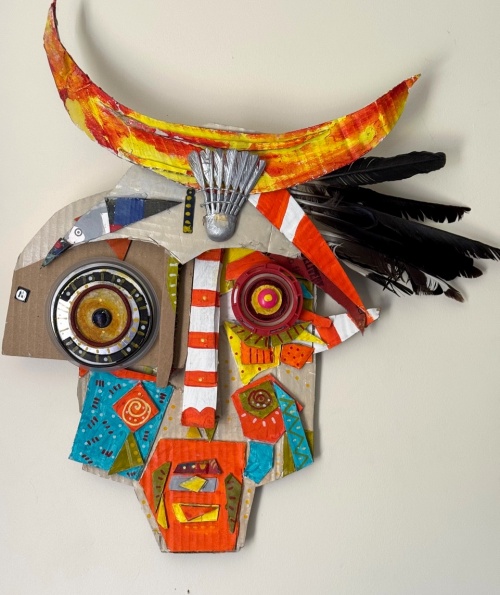
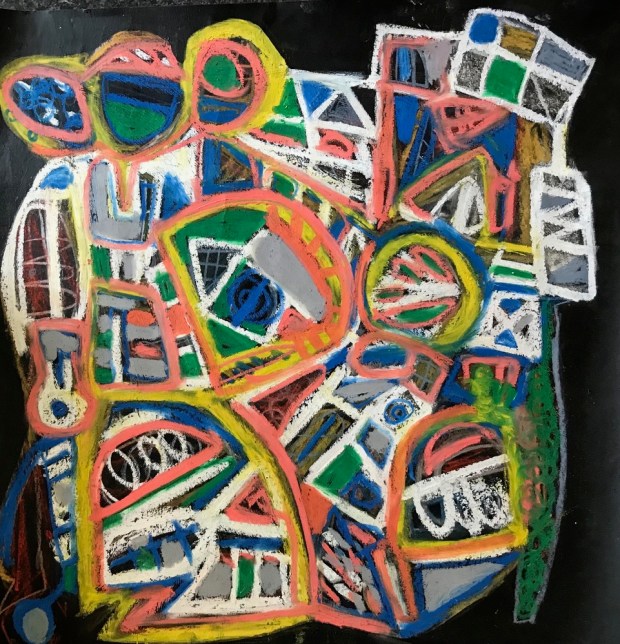
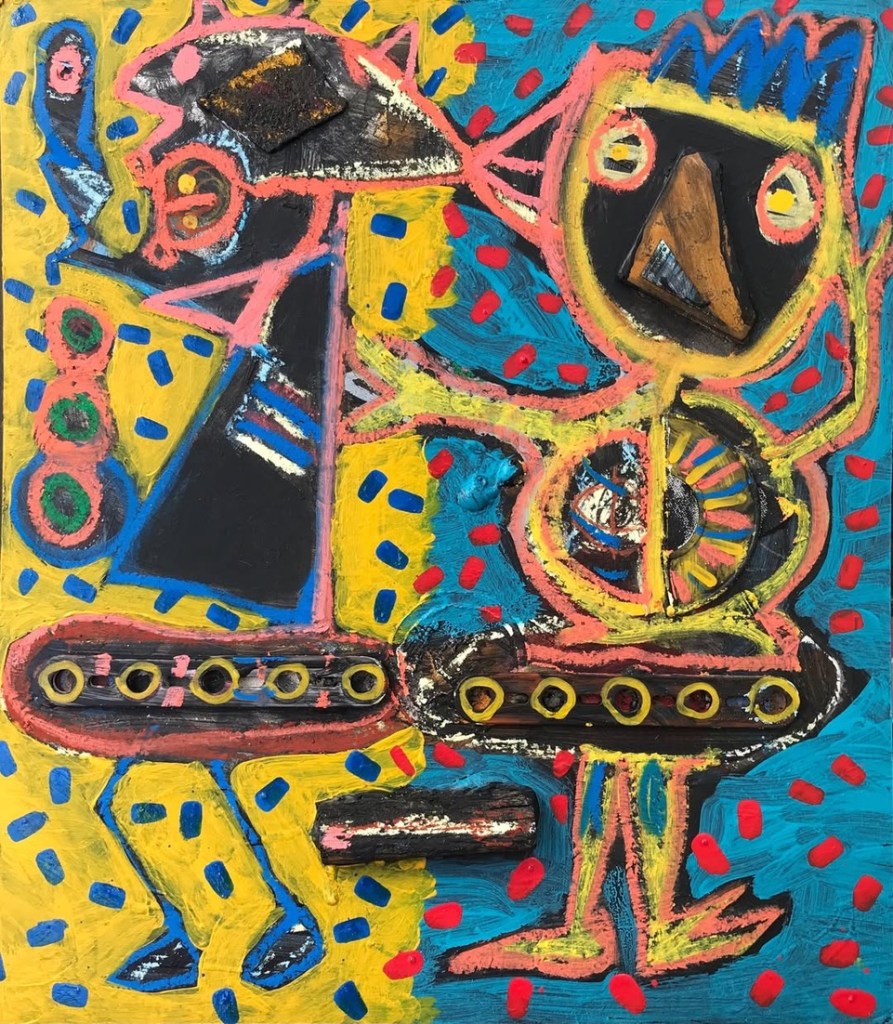
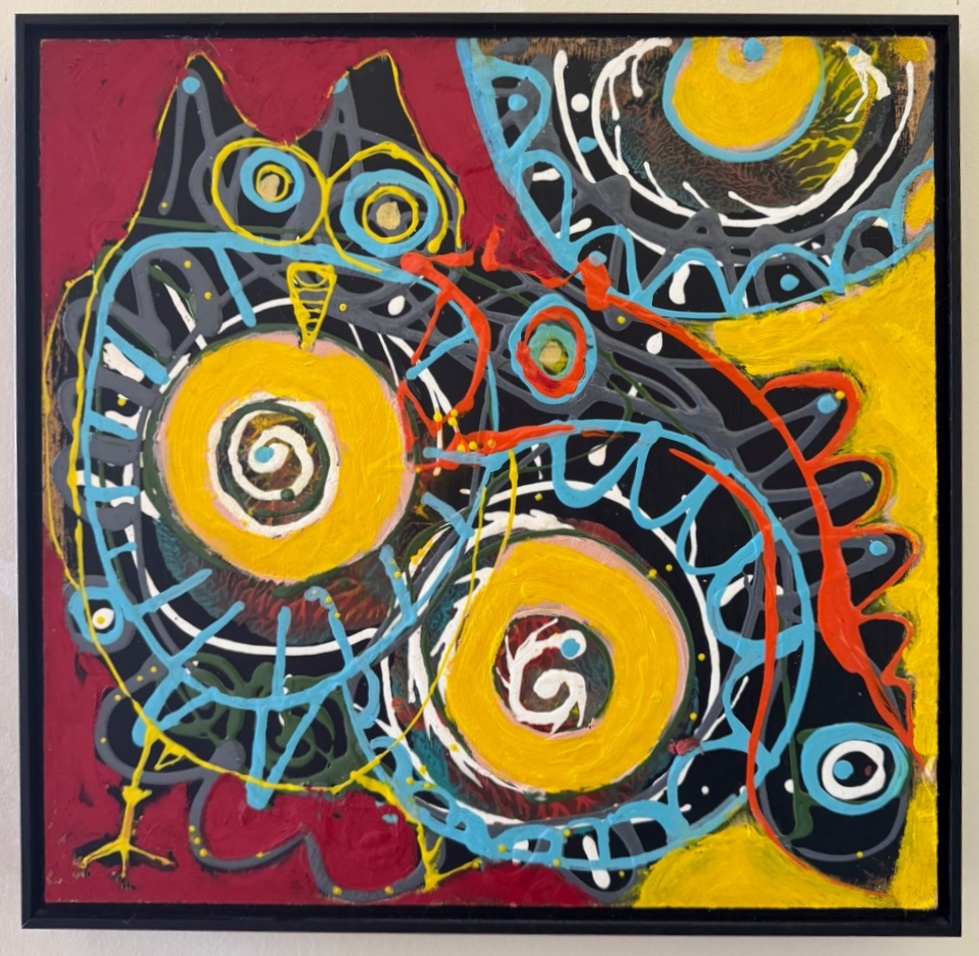
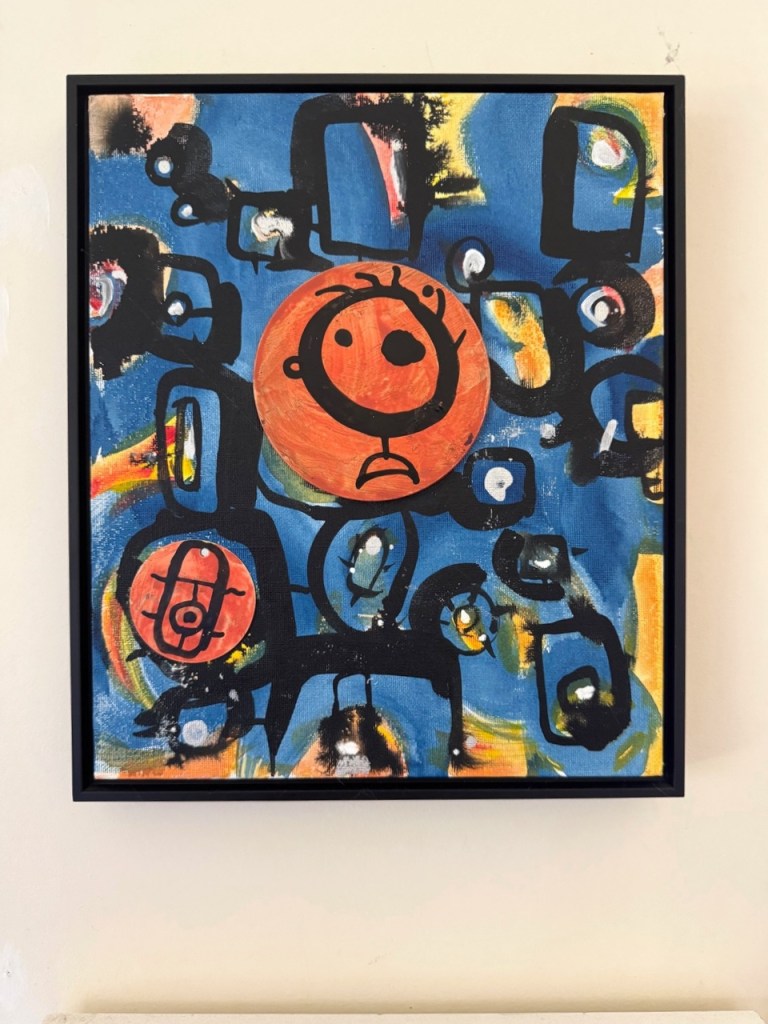
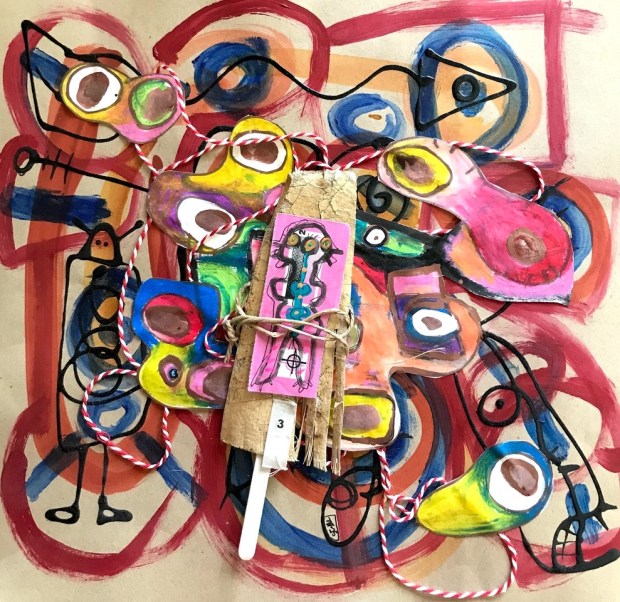
Ancestor, February 2024. Cardboard, feathers and found materials.
We live inside a culture whose overriding goal is to keep us distracted, afraid, addicted and constantly triggered and disconnected from our authentic selves.
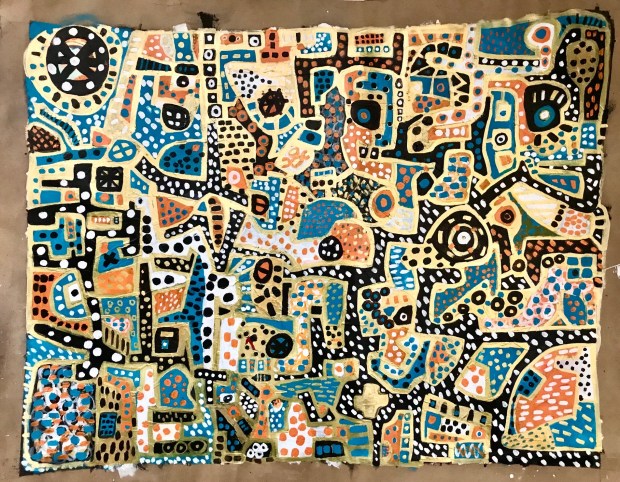
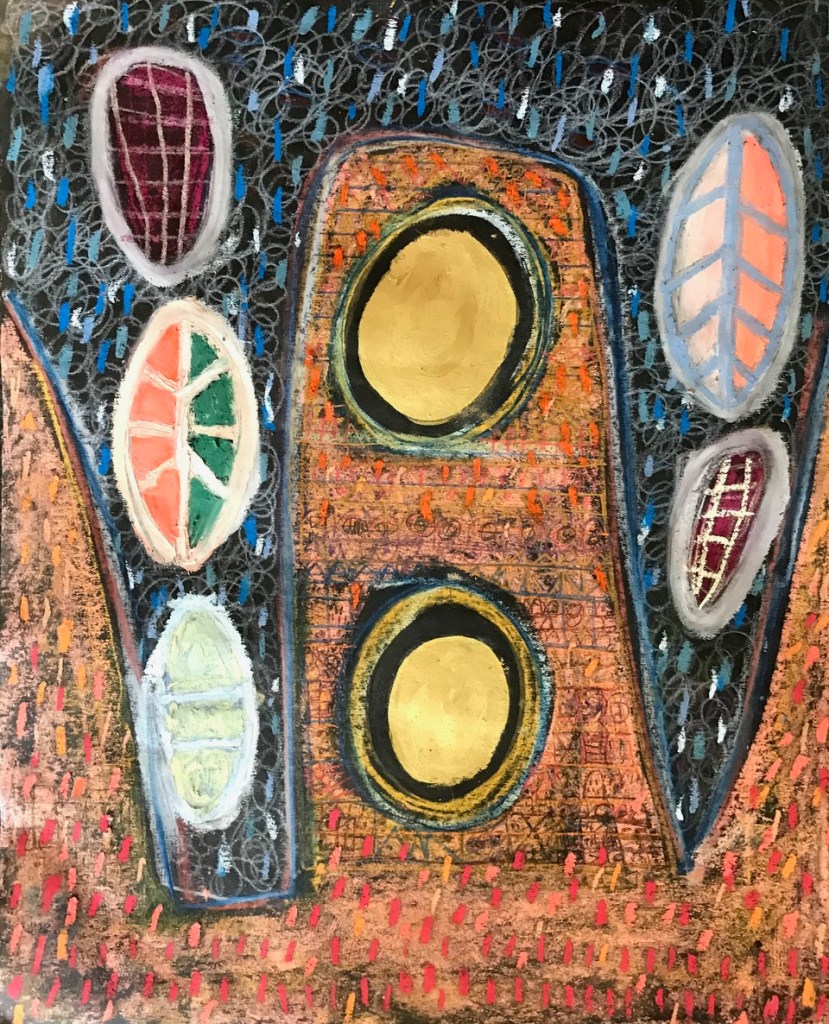
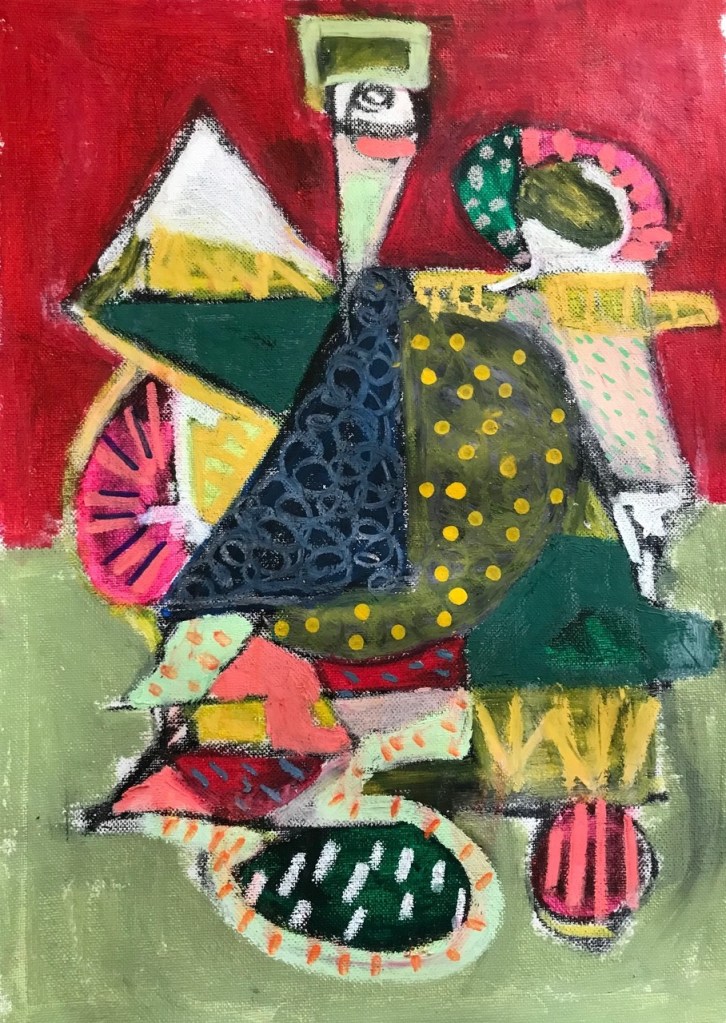
Snakes, ladders and chaos Tim White August 2025. Acrylic paint, oil pastel and paint marker on industrial paper
Art is an antidote, a map guiding us to an authentic lived experiences and a life-affirming revolutionary principle.
IlluminousDancing with the SpiritsThe Garden
John Trudell, North American Indigenous activist, declared, ‘When one lives in a society where people can no longer rely on the institutions to tell them the truth, the truth must come from culture and art’. In this context, of what therapist and medical doctor, Gabor Maté calls a ‘toxic culture’ the need for truth is critical and urgent.
FamiliarsLost child with beetle
The idea that art and poetry, and all the rich diverse forms of expression which connect us to each other can immunize us against the malignant virus of colonialism, capitalism and patriarchy is deeply appealing. That this wisdom comes from the deep spring of Indigenous knowledge and resistance, and despite the ongoing depredations of colonialism, is compelling.
Autonomic
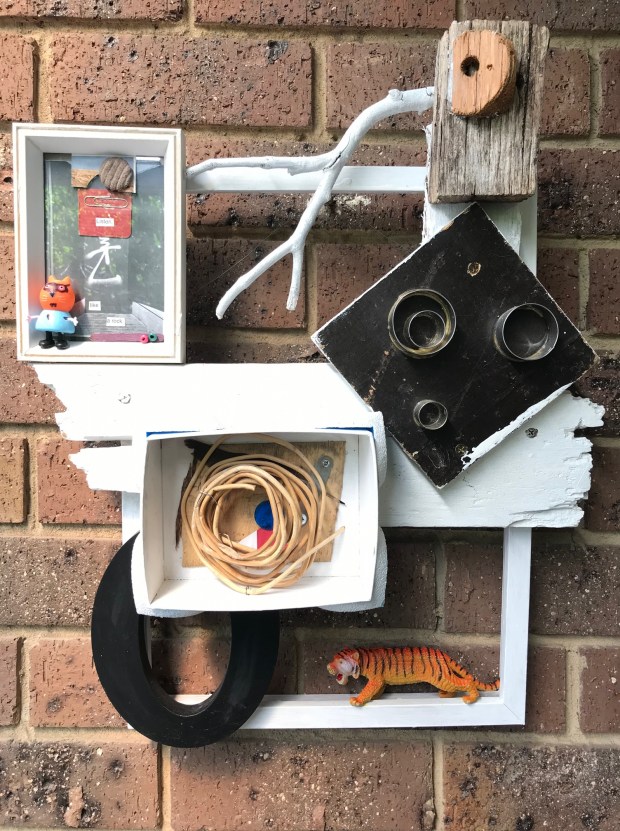
The broken bits of the world I collect and use: the scraps of paper, plastic and metal, the discarded and rejected materials are clues and tools helping me puzzle my way out of the colonial-capitalist labyrinth. They are medicines too, the materia of transmutation, which once distilled provide essential healing and deepened connection with the biosphere and all it nurtures.
Obscene icy pole
As African American feminist bell hooks writes, ‘The moment we choose to love we begin to move against oppression’. This process of resistance, of healing through love, is an essential part of overthrowing the dismal and diminished life the masters of misery want to force on us. And it is from this love, from the sources within our imagination and in solidarity with others we can assemble a ‘new world inside the shell of the old’.
Iron Hills of Adversity Prime Optimus Vs Panoptic Octopus
For me, the found and discarded objects and materials used in my art carry a promise and reminder of profound possibilities subsumed in everyday life beyond the superficial substitutions of a hollowed-out AI virtuality. That even everyday junk and detritus call out to be up-cycled and politicised demanding a place as emblems of a transformed future, and are always on hand as building blocks for a new world, is a source of joy and inspiration.
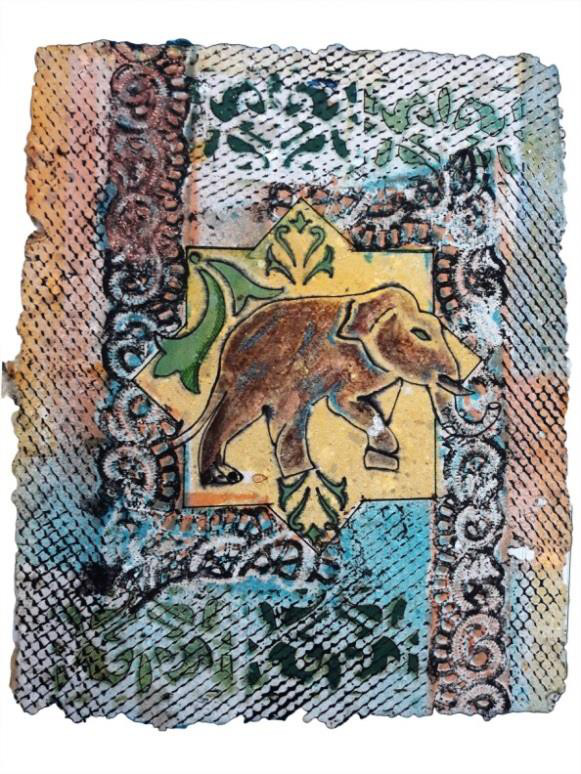
Abstract Human and Islamic pattern. Handmade Paper, dyes, rust, gold leaf. Dimensions with frame: 67.5 cm × 83 cm Production Year: 2019.
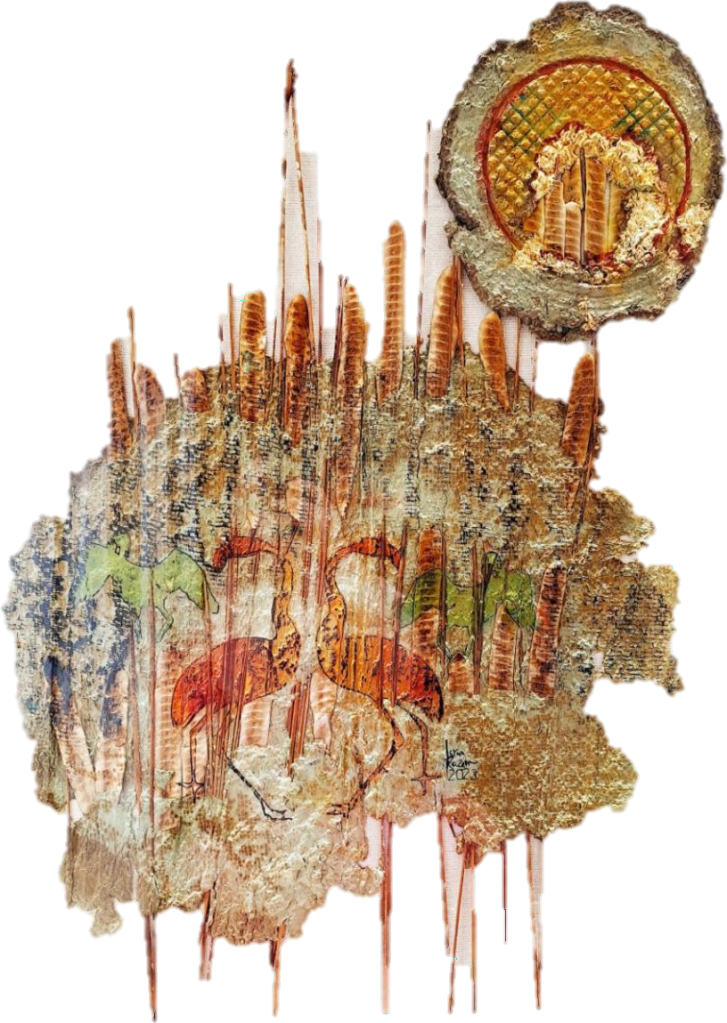
Israa Kazem uses handmade paper as her primary material, breathing new life into it. As it carries its own story. Her work merges the magic of nature with the aesthetics of ancient art civilizations, influenced by Islamic art and miniature paintings creating a style that is both vital and contemporary. The process demands precision, resulting in pieces free flowing lines and texture of the paper lend a unique character to the artwork, in addition to depth and expression—a return to roots. These frameworks surface in her approach to papermaking—a process where chaos (raw, recycled materials) yields order (structured sheets), mirroring the emergent patterns found in nature.
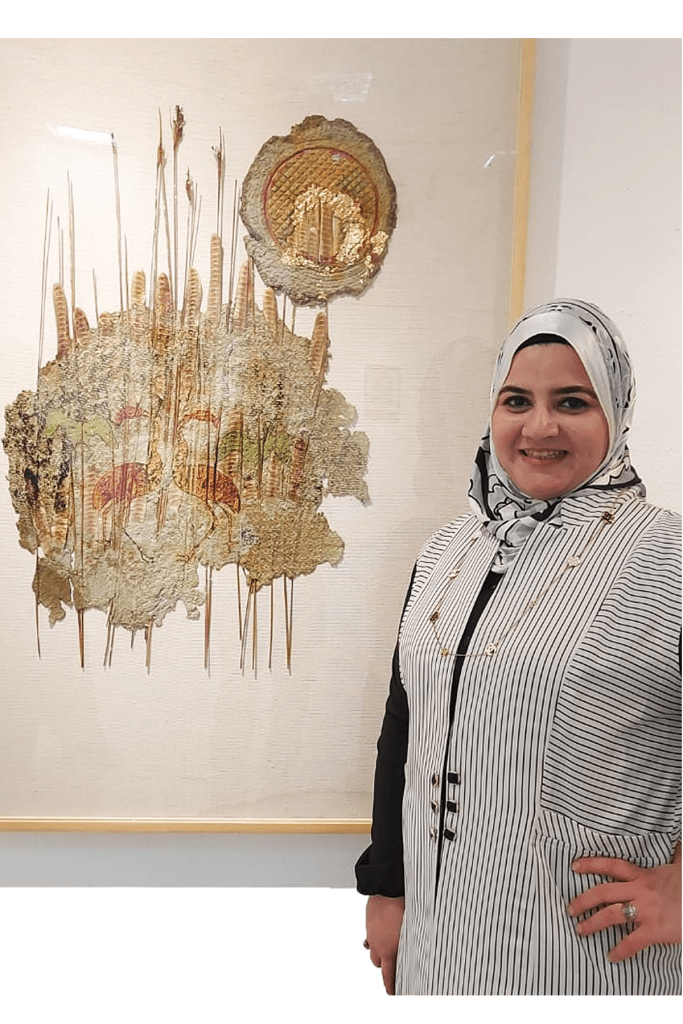
Flamingo reflection and the disk of sun Paper Pulp, Gold leaf, Dried Leaves, Stalks of Grain Plants, Ink, Color Dyes. Dimensions with frame: 132.5 cm × 102.5 cm Production Year: 2023
Her work transforms discarded fibers from wastes into delicate sheets of paper, each piece is a tactile archive, inviting the viewer to contemplation on sustainability and our relationship with the natural world.
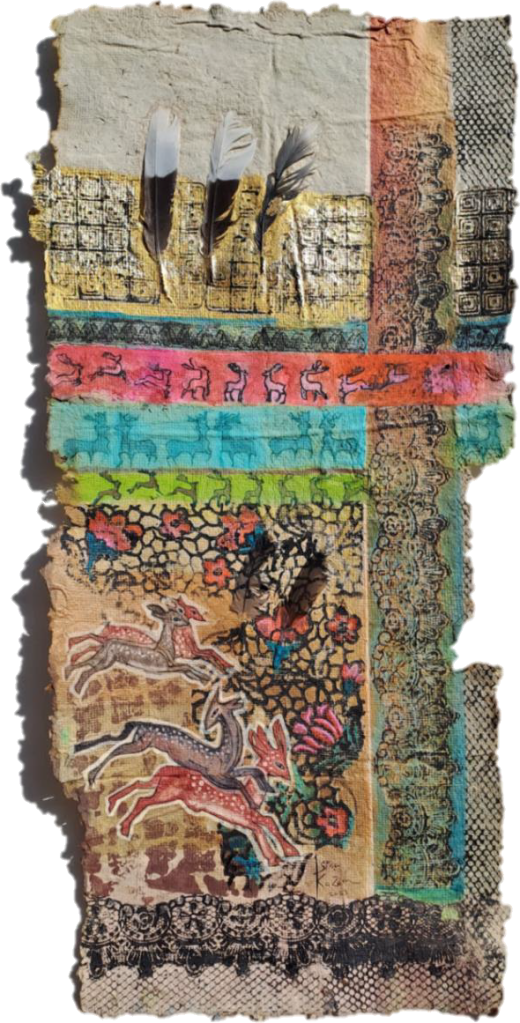
Deer are running on the mountain Handmade Paper, feather, gold leaf, dyes, ink, acrylic pens. Dimensions with frame: 85 cm × 50 cm Production Year: 2024.
She aims to highlight the diversity of living organisms and the different environments surrounding them, especially highly diverse ecological communities.
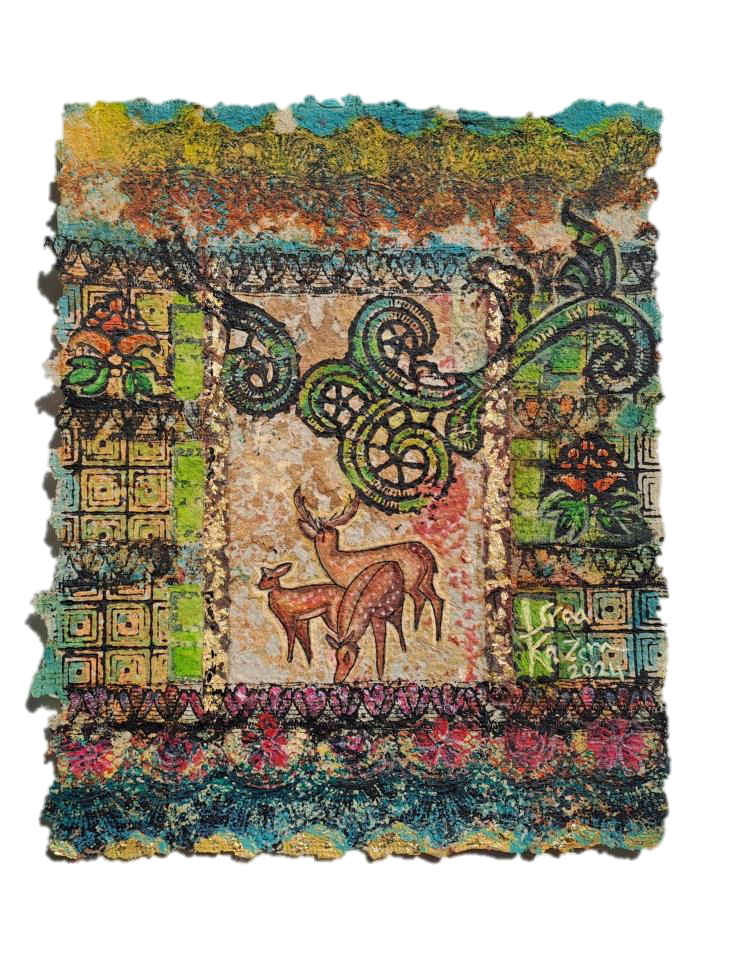
Deer are eating flowers Handmade Paper, dyes, ink, gold leaf. Dimensions with frame: 40 cm × 40 cm Production Year: 2024
This harmony is evident in her paintings, which may combine deer surrounded by geometric patterns, or blossoming flowers where the deer serves as a decorative motif. This fusion creates a visual language that speaks of the balance between two worlds: the world of spirituality and geometric perfection, and the world of life and growth in a timeless artwork.
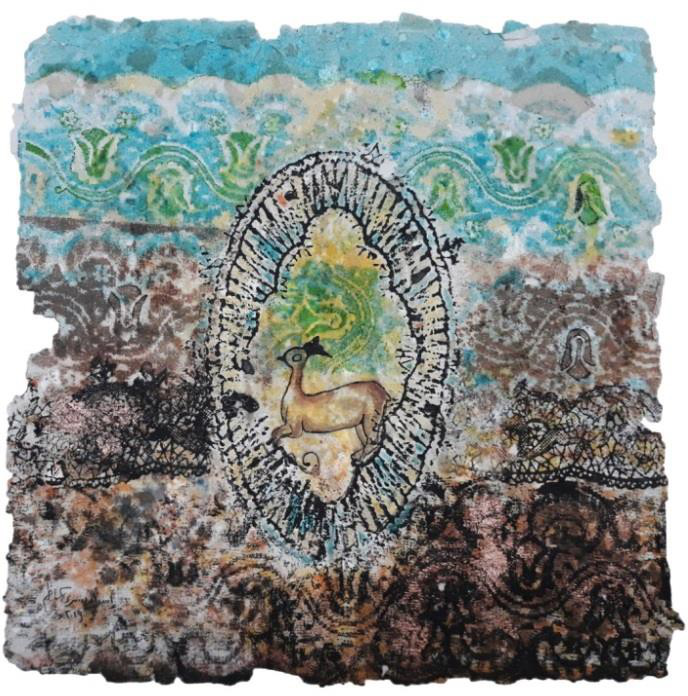
Handmade Paper, Dyes, ink Dimensions with frame: 50cm × 50 cm Production year: 2020
In her artworks collection, the deer refer as a main symbol, not merely appearing as an aesthetic form, but carrying various perspectives and meanings. The artist employs it as a symbol of optimism and new beginnings.
Handmade Paper, Dyes, ink Dimensions with frame: 50cm × 50 cm Production year: 2020
In its grace and lightness, the deer represent hope and the journey toward a better future. In Islamic art, the deer have always been associated with beauty and gentleness, making it the perfect choice to express her vision. The deer is painted in state of stillness and motion depicted in a style that combines simplicity of form and ornamental pattern, giving it a symbolic and contemporary dimension simultaneously. This demonstrates that art knows no bounds, and that the dialogue between past and present can produce creativity that transcends time and place.
Israa Kazem (B. 1987) is a Cairo based visual artist and researcher, holds Bachelor degree of Art Education, Helwan University.
She earned her master’s degree 2015, PHD 2020, in drawing and painting. Kazem is a member of the syndicate of plastic artists. She participated in many international and local Exhibitions. She found her creative inspiration in her drawings and paintings through nature. Kazem employed many drawing, painting, printing and mixed media techniques to achieve her artistic style.
Kazem uses handmade paper and paper pulp and combines them with different materials. Her use of natural materials not only adds depth and texture to her artwork but also focuses on the importance of sustainability in art and life. Her artistic practice reflects her respect for the surrounding environment and express its essence through her own vision.
Solo Exhibition: “Green Border”, Mahmoud Mokhtar Cultural Center, Nahdet Misr Gallery, 2023.
Group Exhibitions: – Agenda Exhibition, Conference Center, Bibliotheca Alexandrina, 12th, 14th, 15th, 16th sessions for the years 2019. 2021, 2022, 2023. – Cairo International Art District Exhibition (CIAD), Second Edition, Art D’Égypte, Downtown, 2022. – General Exhibition entitled “Art…The Memory of the Nation”, the 42nd session 2021, Arts Palace, Cairo Opera House. – White and Black Salon, 5th session, Gezira art center, 2020. – First Time Exhibition, 14th session, Conference Hall, Bibliotheca Alexandrina, 2019. – Second Exhibition: Artist’s Book, Mahmoud Mokhtar Cultural Center 2019. – Dai Festival of Arab Youth, Second Session, 2018. – Exhibition of the accompanied workshops for Cairo Salon 58, Artist book workshop, the Fine Arts Lovers Association, 2018. – South International Salon, Faculty of Fine Arts, Luxor – the 5 session 2017. – Youth Salon, 20th, 21st, 26th sessions Palace of Arts, Cairo Opera House, for the years 2015, 2010, 2009.
Awards and Grants: Kazem won the First Prize in Youth Visual Arts competition, 6th Edition, El Horreya Center for Creativity, Alexandria, Cultural Development Fund Sector, Ministry of Culture.
Sabbatical Grants Artist in the field of Fine Art specialized in Painting, Supreme Council of Culture, 2019, 2021, 2022, 2023.
Israa Kazem prepared the official representation of this article and has granted permission for this article to be published.
J’evolue dans le monde des arts plastiques , de l’expression corporelle et dans le milieu alternatif parisien depuis très jeune. J’ai donc explore diverses techniques et directions : peinture , photographie , dessin , graphisme , video , danse et travail sur le corps.
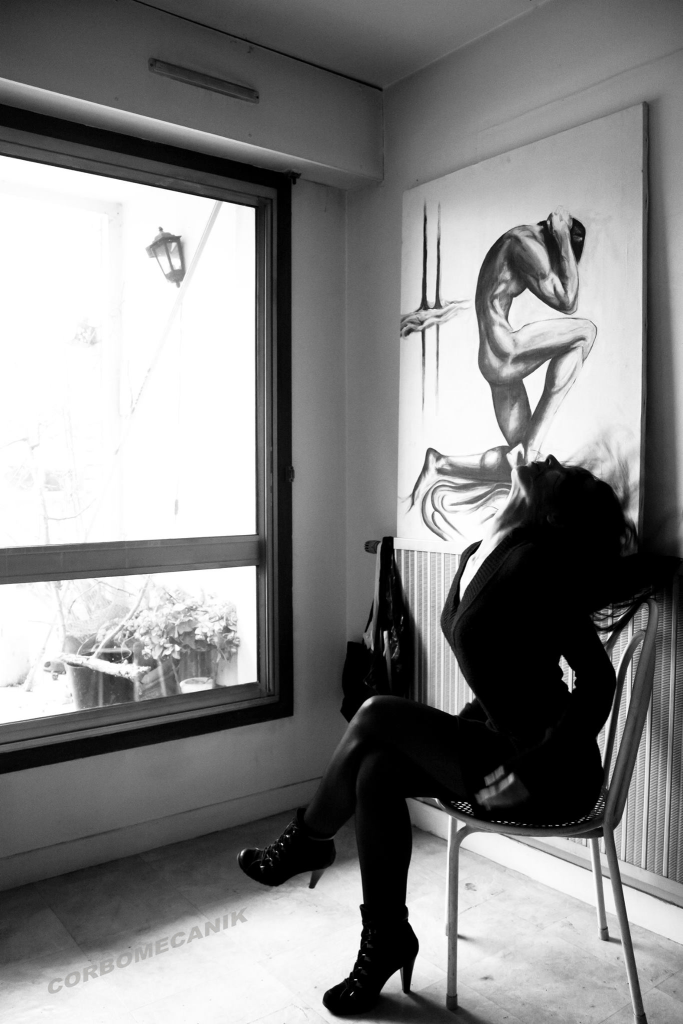
Depuis ces 15 dernières annnees , j’ai fait des expositions et performances en France et quelquescollaborations qui m’on ouvert de nouveaux horizons. Le public me connait plus pour mes photograhies , mes performances ou mes mises en scène des corps ( dans la cadre fetichiste , danse ou autre ) pour la simple raison que je viens des arts plastiques mais que j’ai fait une pause de 10 ans dans le domaine de la peinture pour y revenir après une renaissance.
La plupart des peintures presentes ici , acryliques ou à l’huile sont des œuvres en grand format , antre 1 m et 1 m 20 de hauteur . Deux series emergent , l’une totalement dans la recherche et le jeu graphique , l’autre est une plongee dans la matière brute à travers les mediums et les volumes.
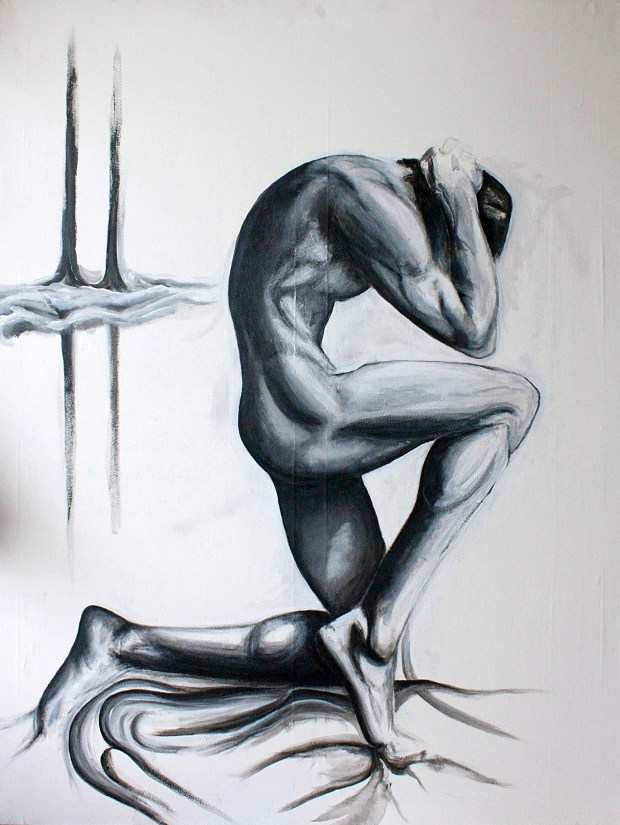
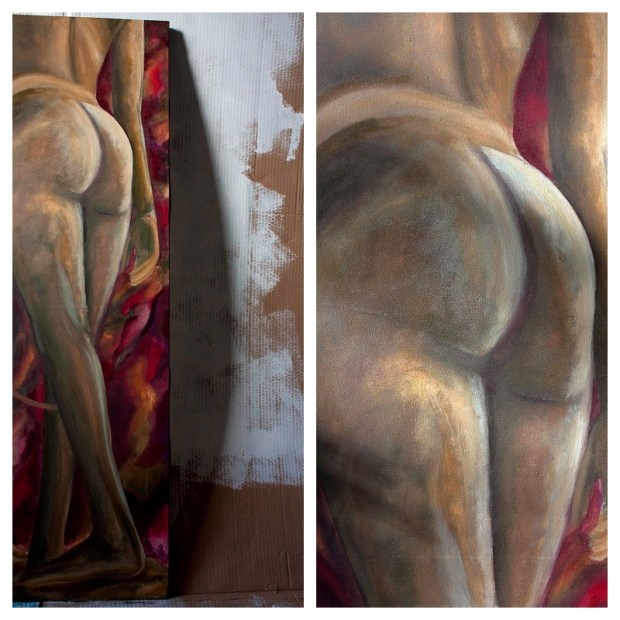
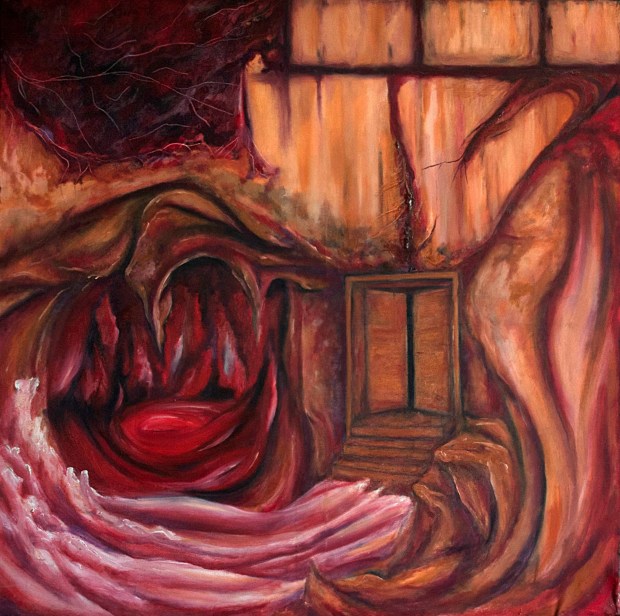
Dans mes peintures , le corps est plutot reduit à l’expression de chocs emotionels devenus physiques, j’y introduis parfois des cicatrices ou blessures ouvertes.
Je dirais qu’on y navigue plus dans le subconscient , dont l’exploration brute instinctive voir animal que me mène finalement ensuite à ritualiser en toute conscience ( mon travail photographique et de performance).
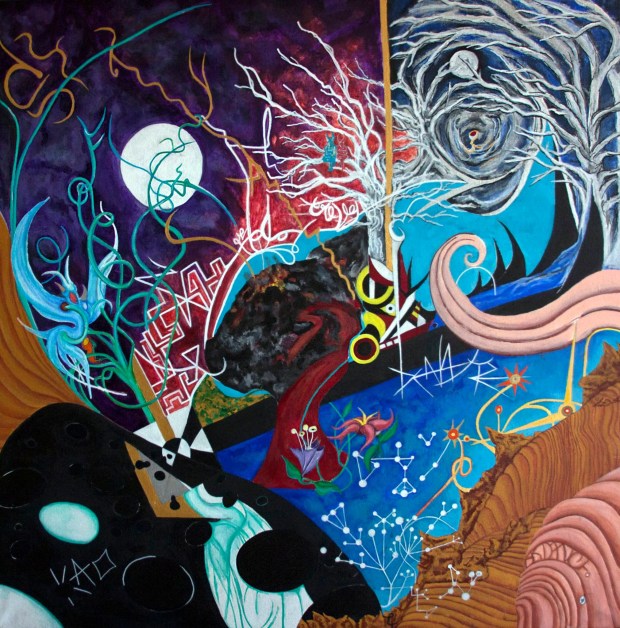
La demarche chamanique de rendre visble les esprits est toujours presente dans les deux cas. Mon attrait pour l’exploration psychedelique du subconscient , le symbolisme universel , le domaine du reve reconnecte au quotidien , le rapport à l’invisible et l’interet esoterique qui en decoulennt ont toujours etait la des l’enfance.
Mes influences picturales sont très diverses des arts premiers au classicisme , des arts sacres aux symbolistes , du street art à la bande dessine SF ( pour moi , tout est source d’inspiration et de stimulation technique , graphique et de vibration de couleurs ) et biensur les surrealistes et leur grande revolution.
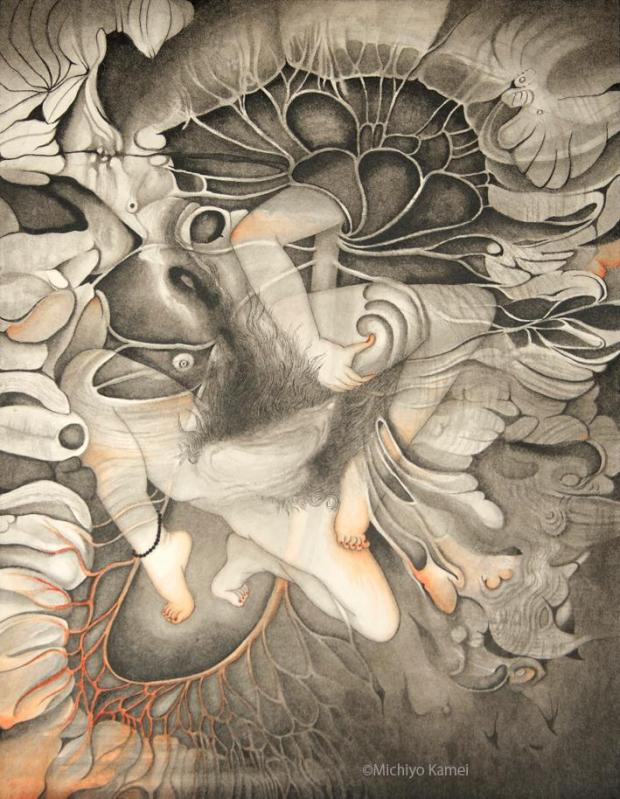
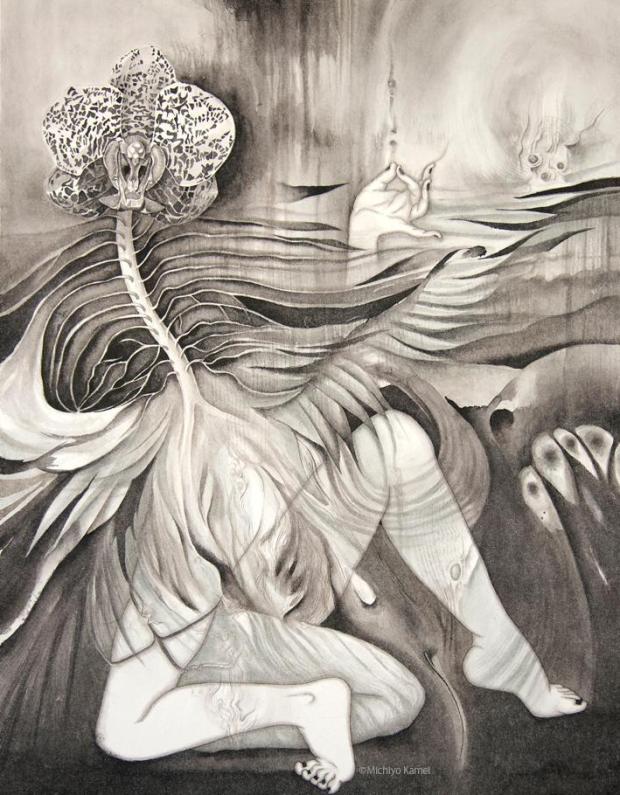
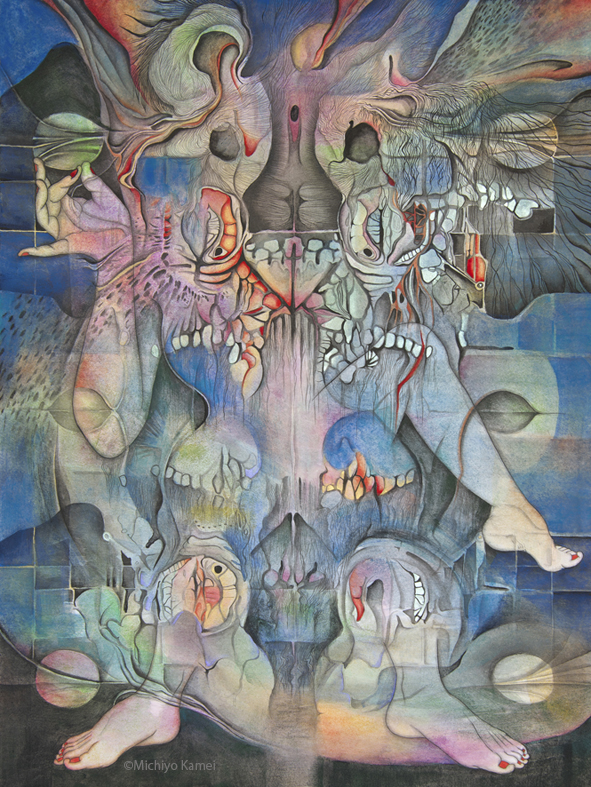
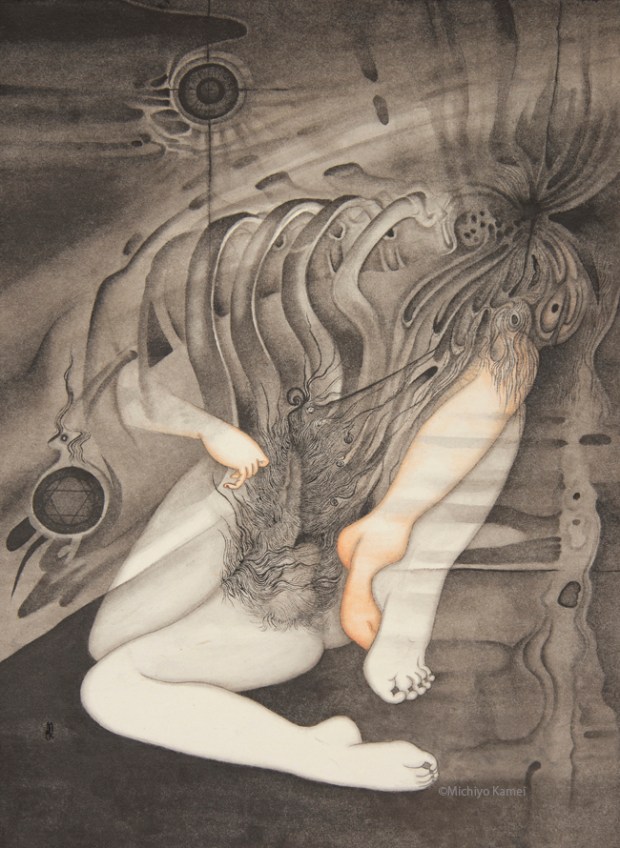
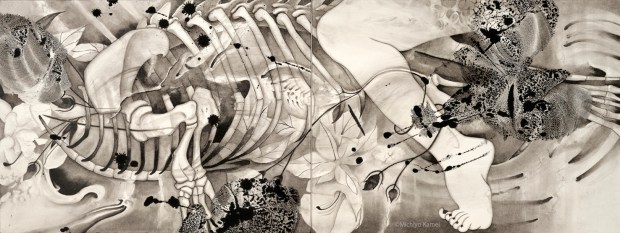
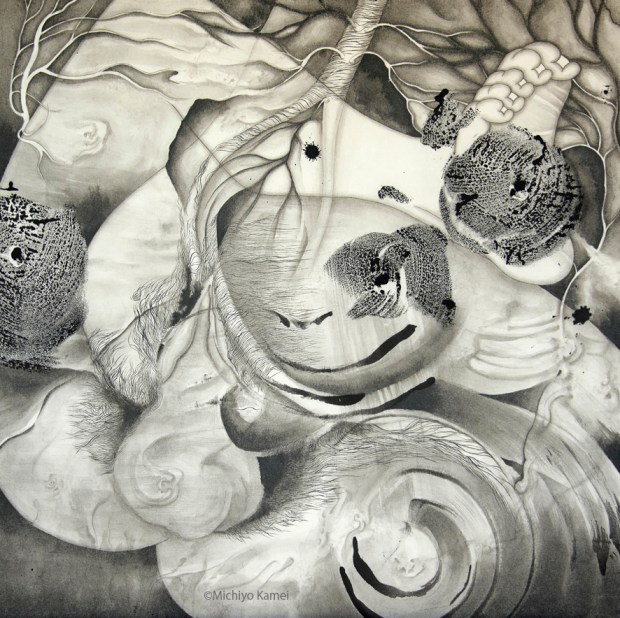
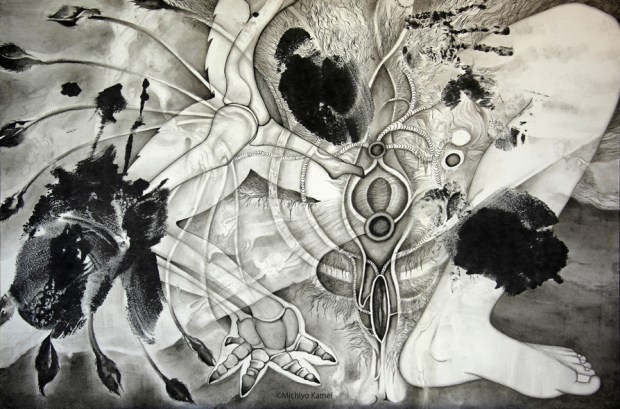
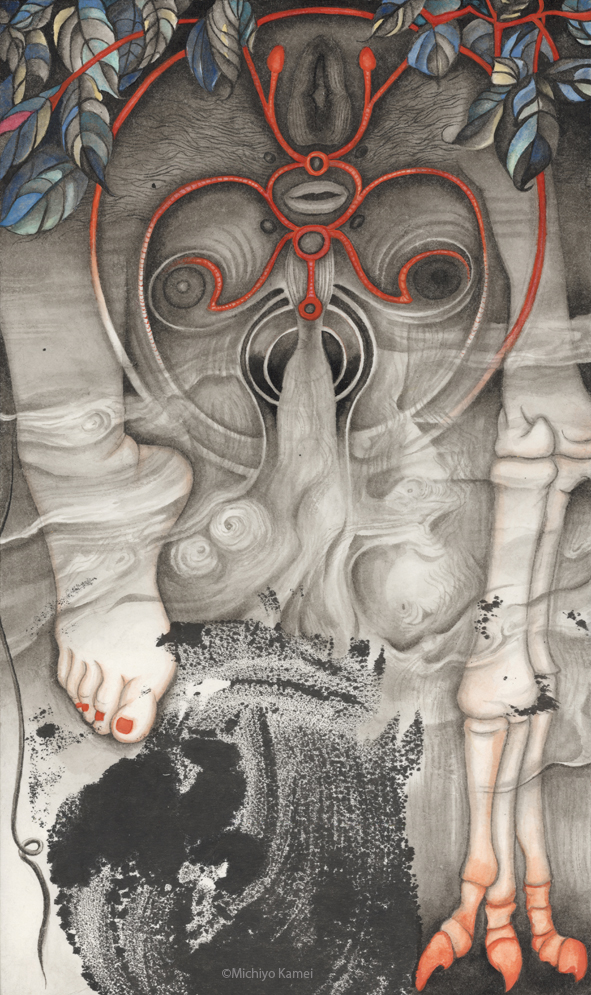
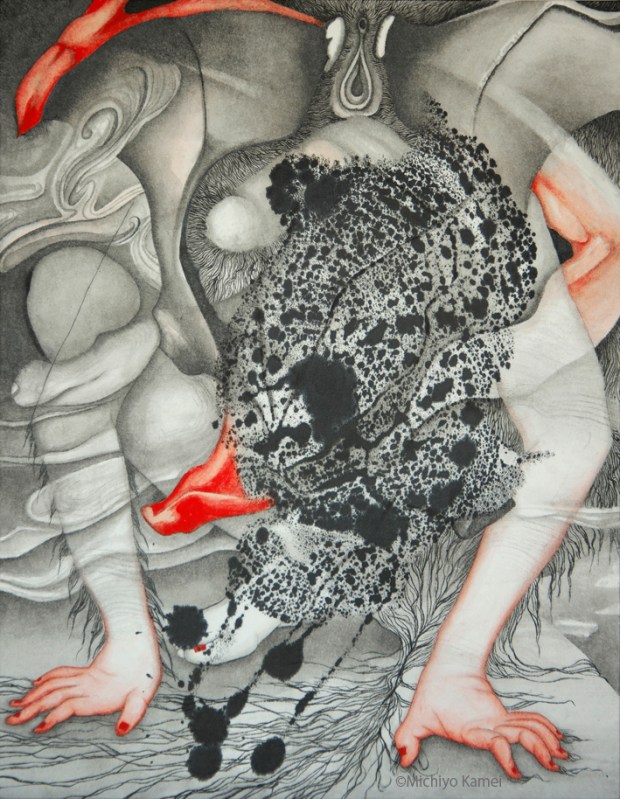
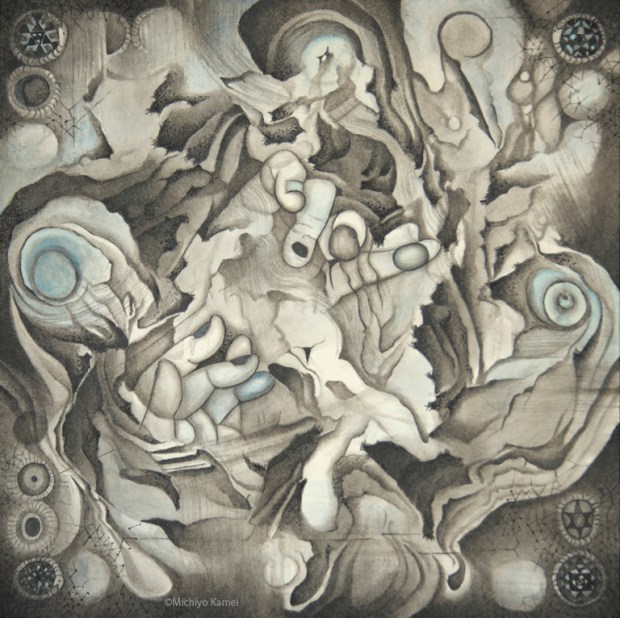
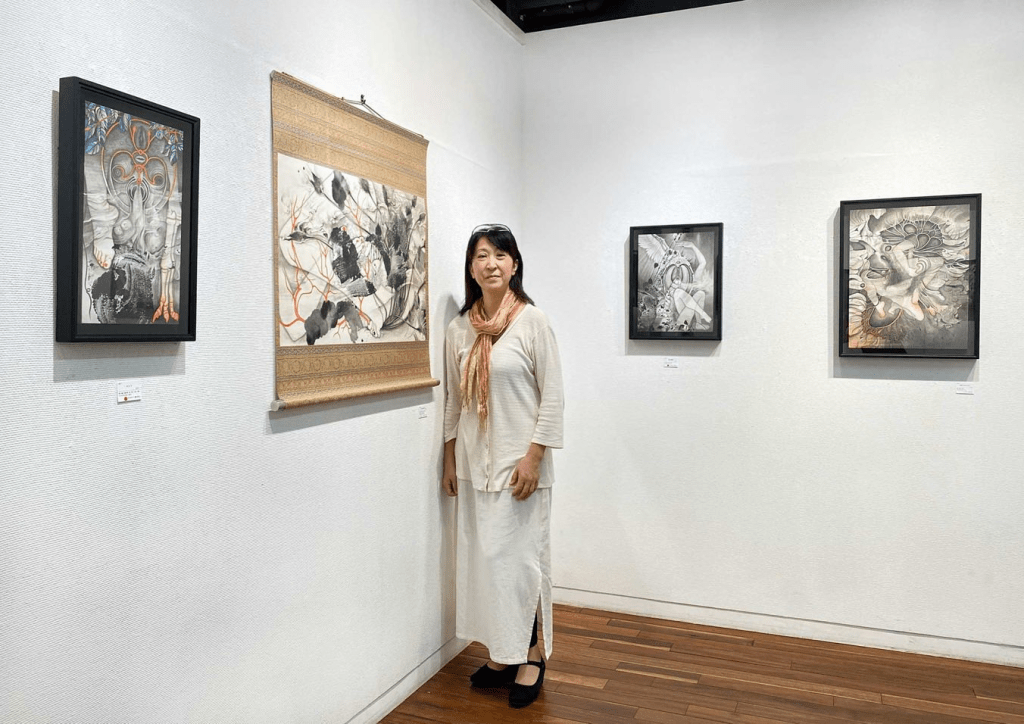
In her black ink paintings, Michiyo Kamei explores the concepts of impermanence, transformation, and the enduring nature of existence through a form she calls the bodymandala.
Mitchell Pluto: At what point did you realize you were an artist?
Michiyo Kamei: I originally studied anatomy at medical school and started out as a medical illustrator. It was only after I stopped working as an illustrator and began creating paintings that I realized I was an artist. Anatomical illustrations are created at the request of the medical field to follow the authors’ papers and wishes, so the illustrator cannot draw them freely. Paintings are free to be drawn by the creator, so the artist can freely incorporate their own ideas. This difference is significant to me.
Mitchell Pluto: How would you describe your art, given that it blends many traditional and modern genres?
Michiyo Kamei: When I was drawing anatomical illustrations, I studied the theory of modern anatomy and created my diagrams. After I quit this job and started painting, I began exhibiting at a gallery that collected ukiyo-e prints from the Edo period in Japan. Seeing many hand-painted ukiyo-e at the gallery, I rediscovered the beauty of traditional Japanese styles. When drawing the hands and feet in my work, I sketch my own body in front of a mirror, then deform it in the ukiyo-e style. In this way, I am influenced by both modern anatomical diagrams and ukiyo-e from the Edo period, which have a uniquely Japanese style.
Mitchell Pluto: When creating your artwork, what specific medium or materials do you prefer to work with?
Michiyo Kamei: I like oriental materials. Rather than just adding paint to the paper, I like to let the ink soak into the paper, letting it bleed and see how it moves within the paper fibers. Sometimes I don’t just create a picture, I let the ink create a picture on its own.
Mitchell Pluto: Could you describe and clarify what a bodymandala is?
Michiyo Kamei: Anatomical illustrations are pictures of the world of death drawn from corpses. Since I began painting, I have wanted to depict the world of life, so I have incorporated energetic shunga. Death and life are repeated in my paintings, and I hope to approach the theme of “eternity.” Mandalas represent the universe in Buddhist worldview, but I represent the universe through the body, and am exploring a new mandala form called the “bodymandala.”
Mitchell Pluto: What visual artists have influenced your work and given you inspiration?
Michiyo Kamei: I’ve been interested in the body since I was a child. It feels as though I am contained within this body, but at the same time it is also part of the natural world, the world outside of me. Which one does it belong to? And when I realized that I would die along with this body, I was terrified. Francis Bacon is an artist I admire for his expression of the body and anxiety. I’ve admired him ever since I discovered him in an illustrated catalogue as a teenager. Another artist is H.R. Giger. I think his organic expression in black and white is so beautiful.
Mitchell Pluto: Could you please tell me the central idea behind your current show?
Michiyo Kamei: I’m currently incorporating “jintaku” a technique in which ink is applied to my body and then transferred onto Japanese washi paper. Rather than painting with a paintbrush, jintaku involves pressing my body against the paper, resulting in completely uncontrollable and unexpected ink patterns. While observing the stains on my skin, I paint the “inside and outside” of the body in the blank spaces. It is meaningful to me to compose my paintings using three elements: the inside (anatomical illustrations) and outside (limbs, plants, natural world and the universe), and my living skin, which lies at the boundary between them. I call this “bodyscape,” and I hope to expand the image in my paintings from a small image of the body to a larger world. What kind of world can unfold from the body? And can humans have the imagination to do so?
Mitchell Pluto: What are your thoughts about the universe in relation to the philosophy of your art?
Michiyo Kamei: I believe that the universe in which we live has no beginning or end, but is a whole that is constantly transforming. There are times when I feel that even life and the body are merely a fleeting moment. Currently, I assume that the beginning of everything is the “zero point” of the universe, and my theme is the transformation and chaos of the body (form) that begins from there. In my paintings, I want to rewind time and explore the primordial form of life. I find a unique beauty in the cruelty and sacredness of the wild nature of evolution, which repeats selection and mating.
Mitchell Pluto: Who are your favorite writers for inspiration, and how do they influence your art and perspective?
Michiyo Kamei: I like Jorge Luis Borges, especially “The Library of Babel.” When I read this novel, I feel like an infinite universe is expanding in my head. I think his universe can only be expressed in novels (words), and can never be depicted. I would like to reach such a world someday, but life is short, and I feel that once is not enough for me.
“The original form of the universe: the wildness of the zero point” Michiyo Kamei exhibition at the Y art gallery in Osaka, Japan 2025
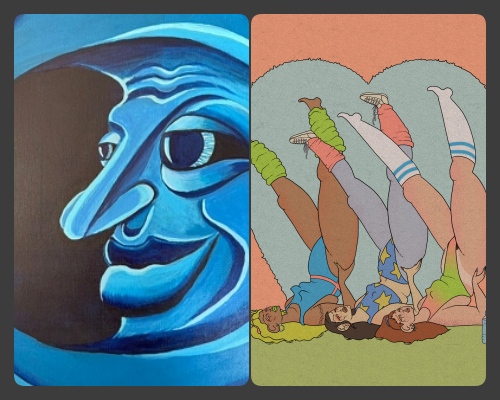
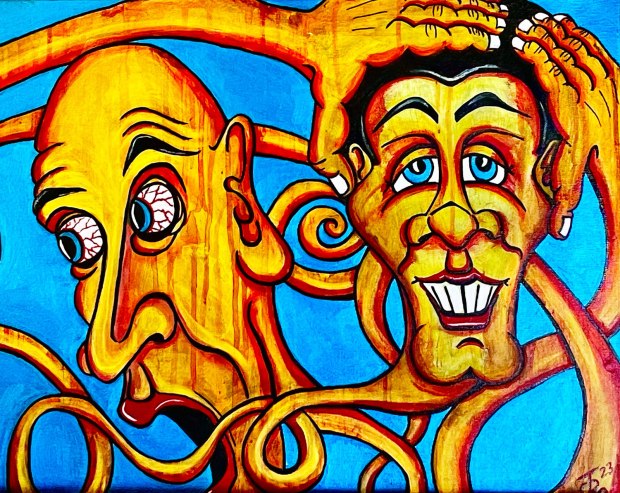
Mighty Fine Arts presents “Like Father, Like Daughter: Inherited Visions” featuring new work by Johnny Olson and Madelyn Olson. This show opens with a reception for the artists on Sept. 27 from 6-9 pm and will run till Oct. 26. It’s a family affair at MFA with a premiere exhibit by Mad Swirl spoken word master Johnny O and his exceptionally talented daughter Madelyn.
Both are figurative based artists who exaggerate and elaborate on the human condition. The characters they create derive from some overarching personal narrative but they manage to resonate on a mythic universal scale. Their approach is also filled with imaginative humor and playfulness with a touch of satire. The resultant effect is ebullient and energetic imagery imbued with creative fervor. Father and Daughter are cut from the same cloth and blessed with uncommon virtuosity.
Also on Opening Night Wordspace Artspeak presents a musical performance by Swirve! Chris Curiel fronts this avant garde collective of liberated musicians devoted to free thinking and improvisation. Their goal is to release your mind from convention and neurotic restraints with cosmic soundscapes. Come experience and get emancipated with Swirve!
Johnny Olson was born on a brisk November day in 1970 in Chicagoland. He found his feet & cut his teeth in the blue-collared working class neighborhoods of his hometown. In 1988 he was reborn in MCRD San Diego, where he found himself the new title of United States Marine. After surviving the Gulf War, he hung up his BDUs & turned in his rifle to instead grab his pen & brush where he rediscovered his passion for writing & painting. In 1998 he found himself in Dallas, where what was supposed to be a brief stint in the South turned into over two decades… & counting.
In 1999, Johnny, with a couple of other mad cohorts, started Mad Swirl. This ‘zine project has now evolved into a being all its’ own. After wearing too many hats, he now only wears a few at Mad Swirl: Chief Editor, Creative Director & Host at Mad Swirl’s monthly Open Mic night & Mad Swirl’s Quarterly podcast, “Inside the Eye.”
Johnny’s work first appeared in print in 1996 in the now defunct Lip Magazine. Since then, his words & images have found their way onto a few online and printed zines thru the years. To name a few: Mad Swirl: Issues I-VI, The Best of Mad Swirl : 2017-2024, Haggard & Halloo, 10k Poets, PAO Productions: The Open Mic Project.
My name is Madelyn Olson and i’m an artist (anyone else have a hard time claiming that title?), primarily creating in Procreate or on paper with ink & watercolor. i’ve been creating since i could hold a pencil in my tiny little hand. to me, artistic expression is one of the best things to exist. i hope to both create & admire it all till it hurts.when i’m not creating and admiring creation, i like to eat, hang out with my dog, laugh at silly things with my friends and frolic around outside in the sun.
My painting can be understood best when looked at with an understanding of the Tibetan Buddhist ideas of Maitri and Tonglen. (Maitrī loving-kindness) and Tonglen (giving and taking) are two related practices in Buddhist traditions, particularly Tibetan Buddhism, focused on cultivating compassion and kindness. Maitrī involves cultivating a warm and benevolent attitude towards oneself and others, while Tonglen is a meditation practice that involves breathing in suffering and breathing out relief, compassion, or loving-kindness.
I didn’t start out as a kid practicing this meditation. I was adopted as an infant from South Korea when I was 3 months old. And my parents weren’t Buddhists. My dad told me he used to practice transcendental meditation as an adult, but never taught me how. I came to it, through wanting to connect more deeply with my Korean heritage. That was about 10 years ago.
I didn’t start, wanting to merge my meditation practice and my painting practice. But because of the visual nature of tonglen, the imagery was a naturally on my mind. And had no idea what I wanted my thesis to be. So, both created a synergy that helped me inadvertently heal, and explore the different relationships in my past and in my present. By the end of my graduate studies, my thesis was: Painting and Meditation: Paths to healing. I even tried my thesis out in the community. I had around 10 women come to learn tonglen meditation. And to use the imagery from their meditation, as the subject for their artwork. They painted a suffering and the opposite of that. They used photos, to help inform their work. And then they talked about the transformation. It was a beautiful and empowering workshop.
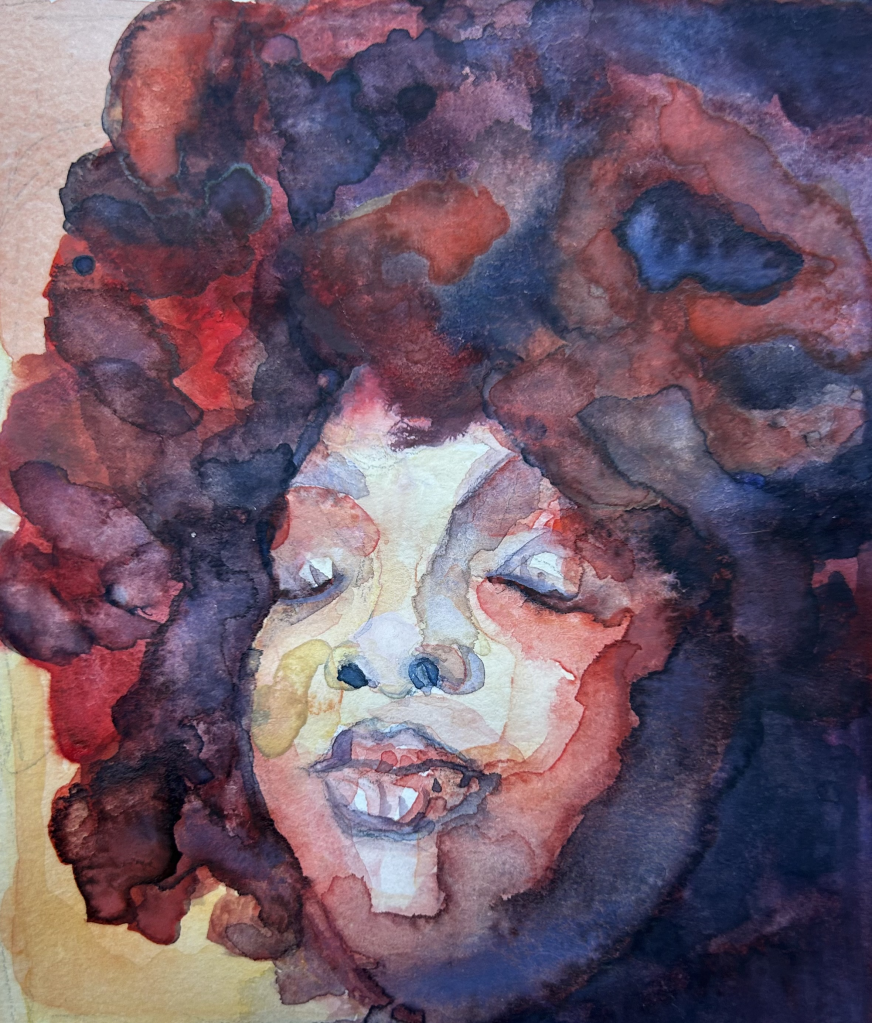
I love this tiny painting. It started out as a quick study as nothing serious. But I really just fell into the paint and managed to keep the essence of her being lost in what looked like to me as a state of pleasure or like she’s making a wish. Color tends to go anywhere, when I don’t think about it so much. I just let my hand choose and place it where it wants to go. It’s very instinctual and intuitive. I like not having to think so much. It’s more of an emotional application. Lately I’m in love with the soft plumes of color and line quality I can get with watercolor. I will paint a person just for the softness they have in their hair or body.
After placing myself in tonglen. It was shocking to discover that I had never really jumped off the hamster wheel of life to even talk or address the ambiguous loss I’d carried for years in my body and psyche. I had never even talked to anyone about how hard it was to miss a family I had never met. Or the woman who carried me and birthed me. But the loss is real. This meditation of compassion gave me the space to fully sit with that grief and actively tend to it. I seemed to have just fleshed it out more fully in my paintings.
I made my very complex and heavy feelings into a visualization in my mind. Then used those as a springboard for narrative paintings. Turning trauma into a concrete painting. Painting has played a part helping me make of sense this unique journey. Of what had missing pieces and lies. I’ve created a story with a start, beginning and ending, that made sense to me. Not the dominant narrative of the adoption industry, or lies or mystery surrounding my adoption. Not adoption from the parents perspective. Not adoption from a Christian perspective. But one that comes from historical facts and felt memories from my body and how I felt about being adopted and having gone through so much with so little.
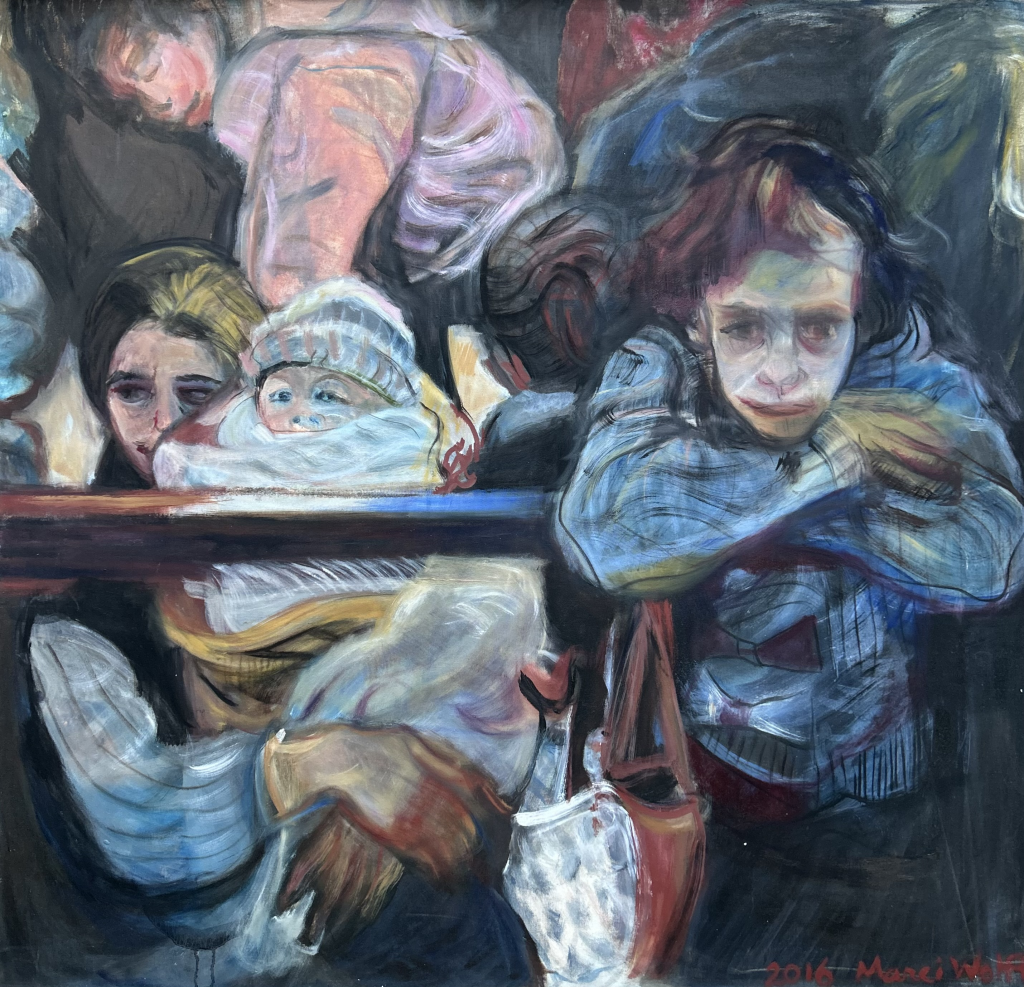
“The Baby Catchers” 2015 Oil on wood panel 32″ 5/8 x 49′ 3/4
In 2016, I saw the photojournalism of these displaced refugee children at the gate in Kilis, Turkey. People were being shot as they tried to cross out of their war torn home of Syria. This photo captures kids becoming displaced people. Being a displaced person has made me an international citizen. Painting directly from the photo while changing small things like the gate colors to infuse America’s presence. I made the girl in pink to look like me as a toddler. I did change the baby’s eyes to look directly at the viewer. I was on a roll here, moving my meditation onto strangers I didn’t know. People on the news. I just so happened to be able to relate.
“At the border Gate in Kilis,Turkey” 2016. Oil on canvas. 41″ x 41″.
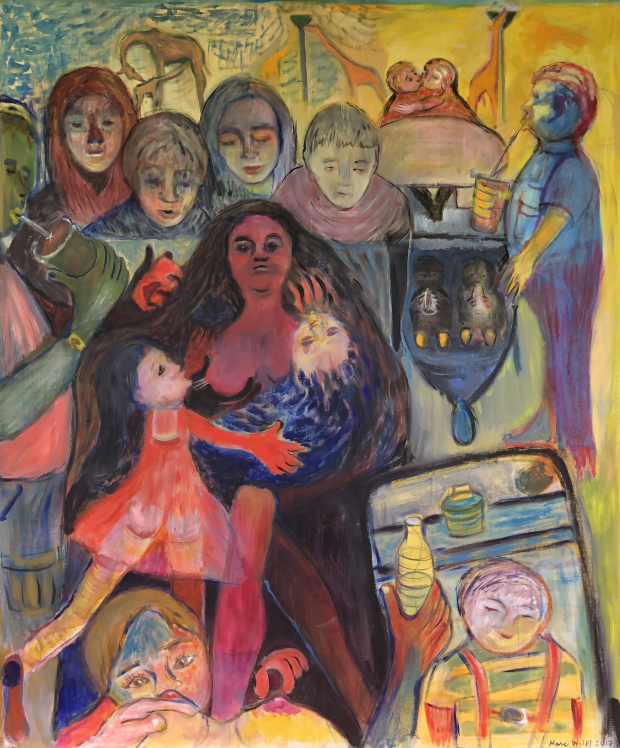
In ‘Feeding Time’ subject play with ideas of being nourished in captivity in an unnatural environment at the Wild Animal Park in San Diego. I was trying to express the absurdities, dangerous issues in American culture and realities of parenting in 2017. Child trafficking, abuse and the ridiculous standards and roles that are expected and fulfilled by mothers. Letting in those issues and risks, gave me a broader range of character to play with which was really fun. I really enjoyed designing the composition to create this cramped, foreboding space.
“Feeding Time” Oil on canvas. 67 3/4″ x 57″
Dancing brings me great joy. For me, It’s wildly feminine, spontaneous, expressive and cathartic. Dancing to DJ’d dance parties helped me get through Covid. So, when I found a photo of people doing tantric dance in the Netherlands. To me, this painting signifies freedom joy and sensual pleasures and a trust in the feminine and masculine moving in spontaneous harmony. I painted it for a public art viewing in downtown space. I wanted to make something that signaled the end of social distancing. At the same time, I liked that the men were letting the women lead them through space. It signaled to me a trust. Which, for in America, the Supreme Court had just reversed Roe v. Wade.
This dance was photographed in a very brightly lit ballroom with a bare wood floors, with random music stands and billowy curtains in the background. The color was too white, too bright and the figures were getting lost. So, I decided that blue would be a perfect color. I had been swimming and diving in the Lakes in Montana, and realized that blue of the water would be perfect balance to all the activity and detail in the figures. It is like they’re dancing underwater or in the sky, free flowing.
“The Tantric Dancers” Oil on canvas. 40″ X 60″
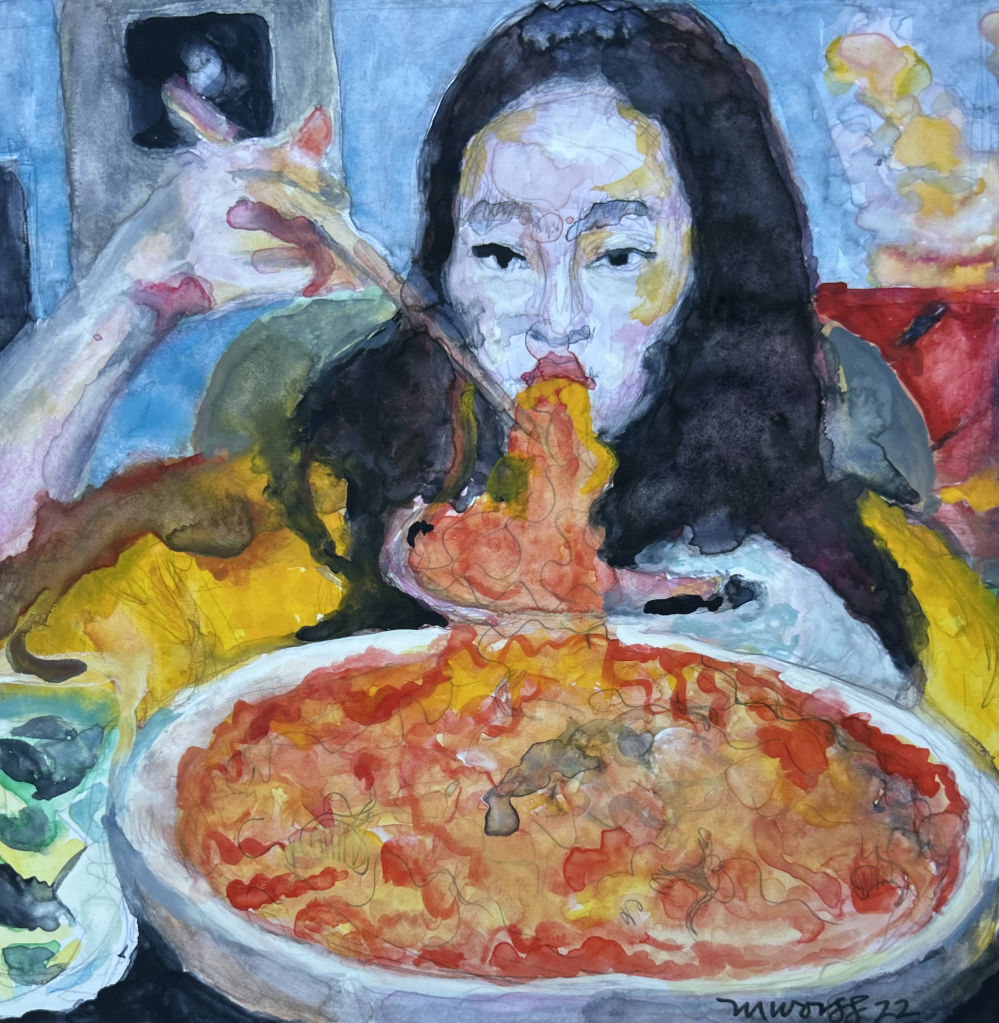
I painted a still from a YouTube video of a young Korean woman eating Korean noodles. Her name is Dorothy.
“Dorothy” (from her Mukbang video) watercolor on paper. 7″x7″
Mukbang is the art of eating Korean food as a performance for all those who click on the video. I enjoy watching these videos. And they are highly addictive and always inspire me to make Korean food. I’m not one for K-Dramas, but I am highly drawn to the Visual and audible feast. Plus I love seeing what South Koreans are eating.
I encountered difficulties in collecting factual information on Lyapkalo’s thoughts to write about. The following is a correspondence with Viktor Lyapkalo. I’m grateful that Viktor made time to reply. Before sharing our correspondence, I got Lyapkalo’s consent to share his thoughts on art.
Socialist Realism is a strong realistic school that takes its origins from the old Imperial Academy of Arts where Serov Vrubel Kustodiev Repin studied.
The political background of socialism is another story, but first it is a realistic school that still serves us as an example of gorgeous paintings of strong drawing.
Thanks to socialist realism, we have preserved a strong Russian school in the Academy of Arts, where very talented students who know how to draw and write still study
Artists of socialist realism Gerasimov use layer of layers still serves us as an example of pictorial skill and excellent drawing.
Their political paintings are already a tribute to the times, but they achieve a high artistic level in their execution. While in other countries, in other art schools, teaching underwent changes under the influence of new versions of new trends in art, our school, thanks to socialist realism, training remained at the same level as at the Imperial Academy of Arts, therefore our students can all write well, I have good painting qualities.
I believe you need to narrate what you love and what you like and then it will be sincere. Those works that are made for sale without love are immediately visible. They are fake and without a soul. Of course, my preferences are not for everyone. I look primarily at picturesque points of view when I narrate a painting with women. I really understand Renoir because of how he painted women. Skin is more like an onion flower that has all shades of colors.

















 Mitchell Pluto