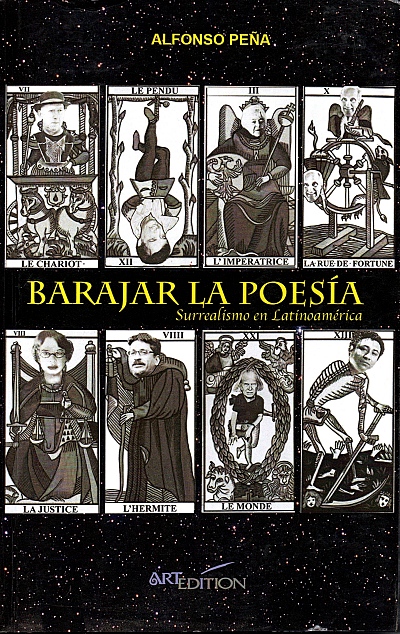
Critical commentary on the book “Shuffle poetry” (2020) by Alfonso Peña By Claudia Villa
Reading Alfonso Peña’s “Shuffle poetry” generates many questions, which challenge us as active readers, especially those of us who move through the surrealist texts of all time. Posed in this way, it is a new challenge that is presented to the reader of our texts, which joins the permanence of universal consciousness, the question and answer or the eternal question that dissolves in the chaos of the deepest dreams that we have not finished yet. Fully decipher. In this sense, we ask ourselves: is there or will there be an evolution of surrealism? This movement conceived by Breton mainly, as we know it in its beginnings, in its manifesto. It is a current that has been transformed, thanks to the social, cultural, economic and political crises that have arisen throughout the world. But this does not diminish the creative capacities and active cultural forces, quite the contrary, they are the support to increase the forms of dynamism typical of this style.
The movement that cannot be abstracted from the effects of these crises, which have occurred transversally, both in Europe and now in Latin America, is key and influences (to a greater or lesser extent), which has allowed an enrichment of the surrealist postulates. Mainly, because it allows the reassessment of different optics that come together in artistic elements that move to make notice of the changes and the force that is maintained and spreads like a kaleidoscope in different ways. Therefore, the vision of these artists, poets and writers that is patented in essays, poetry, narrative, photography, painting, literary criticism, among others, constitutes a permanent explosion of meanings that transmute into signifiers to make us see this structure as the game dreamed by the first surrealists, in which dreamlike and now virtual components underlie that cross each of our creations from side to side.
It can be affirmed that the surrealist movement, embedded as I said by permanent elements of modernity, has been reformulating itself, as the exhibitors of “Shuffle poetry” put it and also, it is interesting to understand their gaze as part of the total freedom that assumes each creator when faced with his work. Many also join the cosmic and ancestral call of our Latin American continent to capture in the works the roots of each aboriginal people and the reconnection with their first words, sculptures and the nature of man. This is how the vision of this surrealism, so rich in contents and games, radiates to multiple forms and ways of expression, both plastic, visual and written, which give life to a new surrealist approach, which although it has not stopped beating, as as it was conceived, it now promotes various multifaceted ways to enter into the perspective of reality or non-reality present in our days.
It is also necessary to comment on the expression of transgression that marks the works of the exhibitors in this book, which leads to a permanent need to play and to break the schemes that broadens the concept of freedom in creation. This is a common element that distinguishes these works, which are forged from inner worlds rich in dreamlike and liberating content, where transformation is a permanent axis of universes in constant motion, as represented in different worlds or parallel universes. Creation, in this way, continuously forges and destroys itself, which would constitute the object of its birth and constant evolution: mutations, evolutions, changes of form, content and continent, which are like permanent waves that contribute Surrealist art and its continuous reconstruction.
Another aspect that can be seen in “Shuffle poetry” is the permanent transgression towards social signs formed around a central axis that looks only towards one way of expression, which allows the constant reworking of other signs and other escape routes. towards the liberation of men as social beings who live within a community. The alteration of the meanings, already patented, by a single controlling mechanism, thus generates the ability to alter the represented codes that (on the one hand) are reflected in their own city languages, in addition to the reworking of schemes that are rearranged at any time. order or figure and who want more than anything to find a way of subsistence in the movement typical of the tribe. These forms are appreciated and reconstructed many times, from the collapse of imposed situations that end up being formulated from other varied points of view. So, the ways that surrealist art takes to survive the imposed conceptions are varied, in an attempt to achieve dissimilar points that allow freedom of expression.
Claudia Vila Molina
Writer born in Viña del Mar, Chile. Professor of language and communication at PUCV, poet and literary critic. In 2012, she published her first book, The Invisible Eyes of the Wind. She has published in renowned Chilean and foreign digital media: Babelia (Spain), Letras de Chile (Chile), Triplov and Athena de Portugal, among others. During the year 2017 she participates in the Xaleshem group with poetic texts for the surrealist anthologies: “Composing the illusion” in honor of Ludwig Zeller and “Full Moon”, in honor of Susana Wald. In 2018, she integrates the feminist anthology IXQUIC released both in Europe and in Latin America. In 2020 she participates reviewing the conversation book “Shuffle poetry, Surrealism in Latin America” by Alfonso Peña (Costa Rica), also writes a poetic prose text for the book “Arcano 16, La torre“, by the same author. Likewise, she participates in the book “120 notes of Eros. Written portraits of surrealist women” by Floriano Martins (Brazilian surrealist poet, writer, visual artist and cultural manager). In this year (2021) she publishes her second poetry book Poética de la erotica, amores y desamores by Marciano editores, Santiago.
Incubation is perhaps most easily understood in contrast to the art of Theurgy or ‘Work of the Gods.’ Theurgy is a process of anabasis or magical ascent whereby practitioners, such as the early Neoplatonists, especially Iamblichus and Proclus, achieved henosis or mystical union with a deity or the demiurge. However, anabasis was not always of primary importance, or even of interest, to many of the ancient Greek philosophers and magicians. More than five hundred years before the Neoplatonists arrived on the scene, Presocratic poets and philosophers, including Pythagoras and Parmenides, were preoccupied instead with katabasis—a dreamy descent to the domain of the dead, and to the dark goddess who rules over that realm.
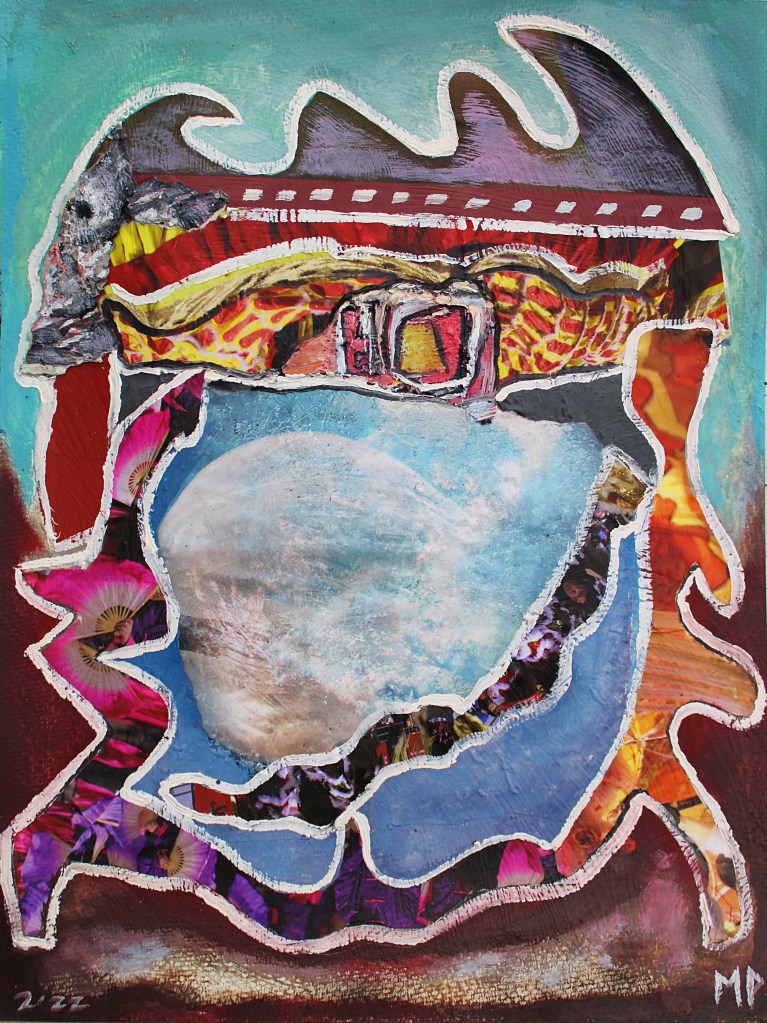
Mirror Gazing Ecdysis Mitchell Pluto 2022
For the Platonists, katabasis was understood as the descent of the soul into a body upon incarnation. Hades, additionally, was allegorized and viewed as the very world in which we, as incorporated beings, inhabit. Socrates says to Callicles in Plato’s Gorgias, for instance, “[perhaps] in reality we’re dead. Once I even heard one of the wise men say that we are now dead and that our bodies are our tombs.” Again, in the Phaedo, Plato has Socrates say to Simmias of Thebes, “[we], who dwell in the hollows of [the earth], are unaware of this and we think we live above.” And, later in the same dialogue, “Those who are deemed to have lived an extremely pious life are freed and released from the regions of the earth as from a prison; they make their way up to a pure dwelling place and live on the surface of the earth.” Therefore, the only way to go, for Plato and his successors, was up—in an anabatic flight to the demiurge, through the various planetary spheres that separate the divine nous and Monad from the sensible world below. Theurgy was the means by which such an anabasis was accomplished. The Presocratics, conversely, leaving Mount Olympus to the gods, for the most part, focused their energies instead upon katabasis; on transporting themselves to the netherworld.
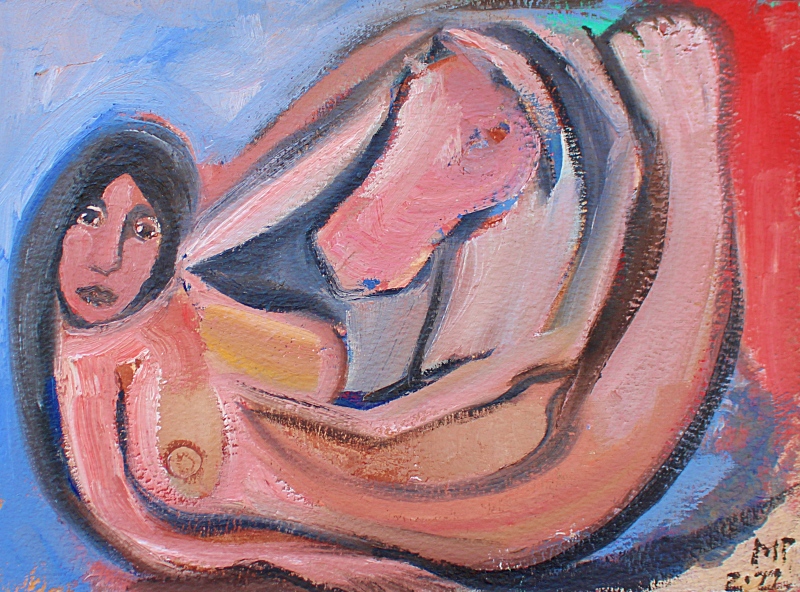
Dream Mare Mitchell Pluto 2022
The means by which these iatromanteia or “healer-seers” directed this delirious drop was via the use of an ancient divination and healing technique known as incubation. In ancient Greece, this was generally done inside of sacred and secluded caves that were sacred to certain gods, daimons, nymphs, and other metaphysical entities. Eventually, the practice would be translated to special temples dedicated to the technique, and finally into a special incubation chamber, usually positioned adjacent to the temple itself. The ancient Ionian Greek philosopher, recognized as the ‘Father of Western Philosophy,’ Pythagoras of Samos, for example, is said to have descended to Hades by entering an underground cave. While Pythagoras left no writings of his own, the late Neoplatonic philosopher, Algis Uždavinys, a past head of the Department of Humanities at the Vilnius Academy of Fine Arts, Kaunas, explains,
the subterranean tomb-like chamber represents Hades for Pythagoras. Hence, Pythagoras descended into Hades, that is, the subterranean holy chamber (like the Holy of Holies, entered by the Jewish High Priest on the occasion of Yom Kippur) that he had made himself, according to Diogenes Laertius (Vitae phil. 2). When he came up, withered and looking like a Shaiva ascetic, he said that “he had been down to Hades and even read out his experiences [aloud to the crowd].”
A similarly famous although obscure Presocratic philosopher, Parmenides of Elea, celebrated as both the ‘Father of Logic’ and the ‘Father of Metaphysics,’ wrote a dactylic hexametrical poem recounting his trip to Hades, and the underworld goddess whom he encountered. At the junction of three roads, the goddess instructed Parmenides as to the true nature of reality. His proem to “Peri Physeôs” begins,
The mares that carry me as far as longing can reach rode on, once they had come and fetched me onto the legendary road of the divinity, the road that carries the man who knows through the vast and dark unknown. […] And the goddess welcomed me kindly and took my right hand in hers and spoke these words as she addressed me…
In his proem, the divinity proceeded to instruct Parmenides in the laws of logic that we know today. That is, it was a mysterious, underworld goddess from whom Parmenides received the very rules of reason, with which he returned to the land of the living for the inauguration a new era. To a world which turned on mythos—mythology—Parmenides introduced the novel pivot of logos—logic. Although, we must admit that the weird way in which the ‘Father of Logic’ acquired that understanding appears to contradict the very laws with which he was entrusted. Moreover, Parmenides’ words may provide us with a subtle indication of just what incubation may have entailed for these heroes of Hades. The first thing the poet mentions are the mares that pull his chariot. The chariot is a token of the sun god, whose solar vehicle is pulled throughout the skies by a handsome team of heavenly horses. Indeed, ever since the time of the worship of Shammesh or Utu, the sun god of ancient Mesopotamia, the chariot has been the province of the Sol. But, the sun isn’t just about the light—for, the sun also journeys into the Underworld, like Osiris in the Dwat, through the dark, intuitive animations of Aidoneus’ alcazar. Every time we venture into sleep, we quietly and blindly slide into the Stables of Silence. Hence the false etymology suggested by the word nightmares, ‘horses of the dark.’ Like the Hunter’s three-legged horse in the fairytale of the Princess and the Tree, these ‘nightmares’ “know everything”—including the invisible way to the “legendary road” that leads to “the divinity.” The archaic techniques of dream incubation are akin to these mystical, Moiraic mares, and they alone are possessed of the potential to move us from the familiar to the fringe—down the alien road that carries the “man who knows” through the “vast and dark unknown.”
P.D. Newman October 16, 2022
P.D. Newman
P.D. Newman is an independent researcher located in the southern US, specializing in the history of the use of entheogenic substances in religious rituals and initiatory rites. He is the author of the books, Alchemically Stoned: The Psychedelic Secret of Freemasonry, Angels in Vermilion: The Philosophers’ Stone from Dee to DMT, and the forthcoming title, Day Trips and Night Flights: Anabasis, Katabasis, and Entheogenic Ekstasis in Myth and Rite. The Secret Teachings of All Ages (TV Series documentary) 2023
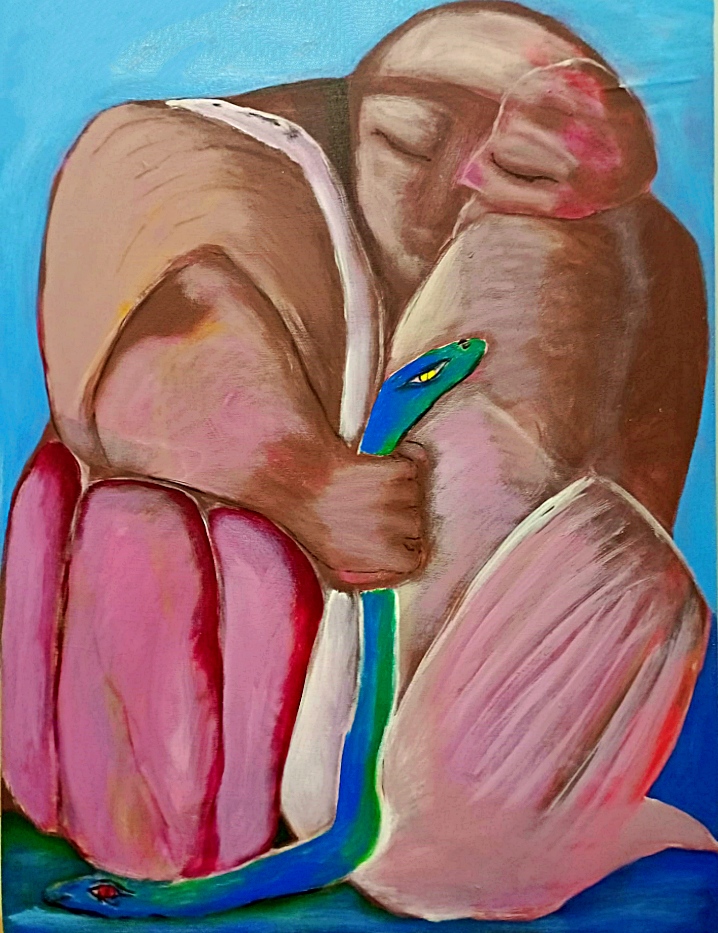
The Hug Acrylic on canvas 60x80cm Hoda Hussein 2022
14 September 2022 7:17 pm Earth Greenwich time zone
A letter from Oranous to Pluto on the Sleep Temple
Who believed their bed was a four-legged bear taking them on their back for a night sky ride as their own bear cub? I did. And I always woke up in the morning and kept my eyes shut till I hear family voices in the house so I am sure my parent bear landed me in the right place to start another day acting like a human. It takes practice to master acting like a human this is why we have to do it every day. But we must also not forget who we are this is why parent Bear kept their legs and body in the human house but with their tail and head on their own and took me as their child on journeys and trips at night where I can be in awareness of all that is. No wonder it was very difficult to pretend I am afraid of the scarab that landed on my hand in the nursery! I was not. The teachers were. And that was weird to me. I suppose I also was weird for them. However, I kept that memory of the friend scarab insect that tickle my palm and I still smile at that. Who would think I had an oil well in my salon where I bathed in whenever exhausted and opened my veins to it renewing my blood completely in sessions where Hathor was standing at my back massaging me? Okay well, I had a Native American tribe settling their tipi in my living room so… Let’s say this is normal in my life. So what is a sleep temple or a dream temple? I am! Well, I guess we all are in a way. Always just believed in a sacred temple where the blood circulates around the heart like pilgrims around the sacred cube of “Ka’ba” hence ka and ba. But as I can move and I am not still at all I prefer to see myself as a Mer-ka-ba “boat in Arabic”. Oh, how I loved this when I knew that Mer meant beloved in the ancient Egyptian language! Yes I know I am loved and visited but all types of loving beings. This is so beautiful! Still, I don’t think I learned yet to act humanely perfectly and instead I look for my equals who also could not really perfect the like human acting. There is something beautiful in our imperfections. Kind of childish and more related to the womb than birth. A whole multiverse moving changing developing evolving in action inside the womb of space. A multiverse that is in fact one single child in process of becoming. Did I tell you I once dreamed of having surgery on my lungs and my heart? Well, I did. And the woman doctor gave me a prescription. That I followed! I would not be that committed following a prescription of a daily life touchable doctor, so-called “real” anyway.
Hugs Bye for now
Hoda Hussein
Hoda Hussein
Egyptian creative writer poetess and novelist, artist painter and translator. Published many poetry books and novels in Arabic language. Represented Egypt in poetry and novels festivals and encounters in several countries like Yemen, Spain, India, France, Cuba, and Chile. Made creative writing workshops for kids in many schools in Cairo Egypt. Received rewards for poetry, novels and for translations in Chile, Macedonia and Egypt Was entitled as a universal ambassador for peace by the peace ambassadors circle that works under the UNESCO
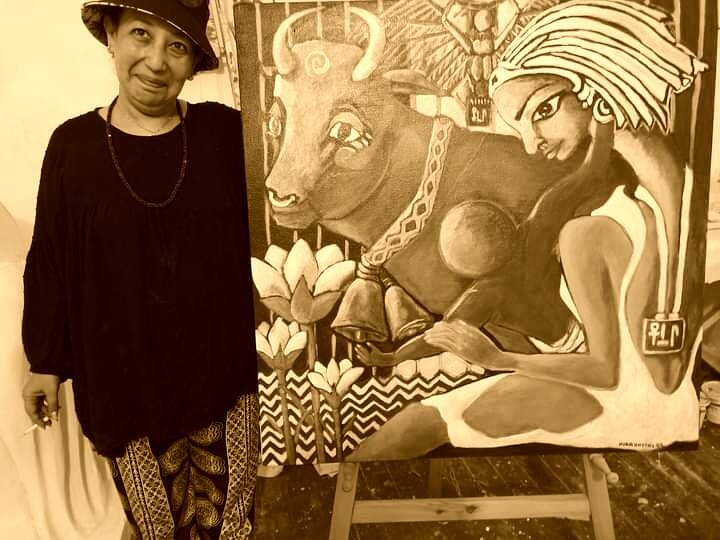
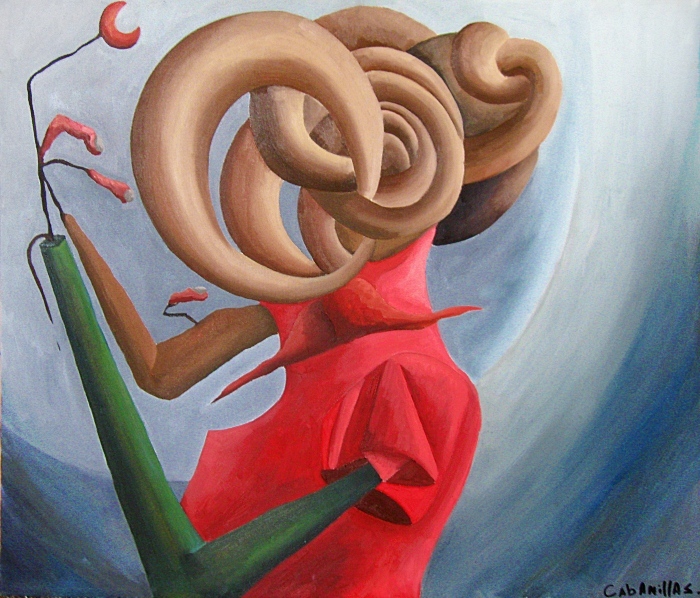
The Inhabitant of the Dream Temple Verónica Cabanillas Samaniego
The temple of dreams is located in principle in an unlimited place, it is not exactly an island, it is the sky itself in immense melancholy, surrounded by the sea and in the absence of farewells. Towards all directions a path towards you, and I discover each treasure at the bottom of the word. In the absence and presence of everything, I hear bordering a harmonious song flowing like an infinite abyss around us.
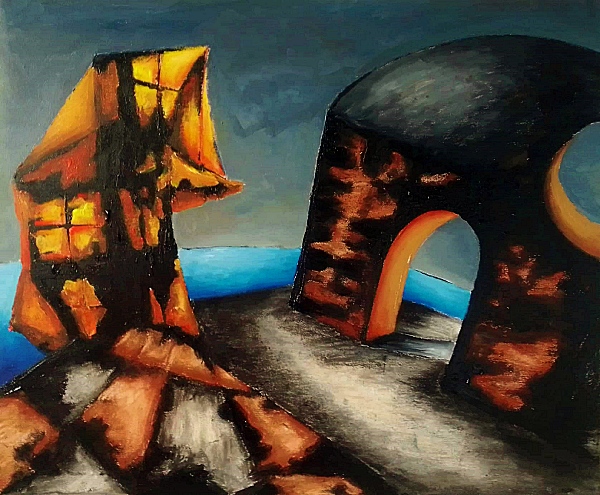
The Temple of Sleep in self. Verónica Cabanillas Samaniego
The paradise that we have penetrated and invented is resolved like the design of a luminous dream, which we glimpsed to see a long time ago, until we rediscover the trace, shake off the dust and build the raft that takes us from me to you and vice versa, yes, on this side the sleep is deep, in this temple of gods we are simple people, trying to take forever a piece of heaven and looking for a dignified death, where our names are heard and pronounced only by hallucinated insects and dogs on the last day of the humanity, we only dream that on the last day of the world we will not forget to feed them, and the last poem we wrote and the last brush stroke on the white we gave, undermine my pain to the depths, and be reborn in a beautiful pack of dogs, in another time, another planet, another galaxy as far as we can see in the temple of dreams. Because only the measure of the vision is equal to the measure of what is imagined and because everything that one builds is the measure of what he managed to imagine. In the temple of dreams I realized that, and why I was already here
Verónica Cabanillas Samaniego. Algarrobo, Chile, Octubre 2022.
Verónica Cabanillas Samaniego
Verónica Cabanillas Samaniego (Lima, 1981), is a poet and visual artist. She has exhibited individually in Lima and collectively in Europe and Latin America: El asombro del colmillo, Le Petit Canibaal, Valencia (2014); Ludwig Zeller, composing the illusion, Taller de Rokha Gallery, Santiago de Chile (2017); One hundred years of Surrealism, Espacio Matta Cultural Center, Santiago de Chile (2019-2020), International exhibition of surrealism, Kudak Gallery, Cairo-Egypt (2022), Echo of contemporary surrealism, French Institute of Alexandria, Egypt (2022). She published in 2014 TUyYO by desktop publishing and participates in various poetry anthologies: IXQUIC. International Anthology of Feminist Poetry (Editorial Verbum, Madrid, 2018); Wagered deep on the run of six rats to see which would catch the first fire / Surrealist and Outsiders (RW Spryszak, Chicago, 2018); Liberoamericanas, 80 contemporary poets (Liberoamerica, Spain / Argentina / Uruguay, 2018); Narrow doors in wide green fields / Surrealists and Outsiders (RW Spryszak, Chicago, 2019). She has participated in the V Lima Poetry Festival (2014); IV Antifil Alternative Book Fair, Lima (2019). Her visual work is published in Derrame magazine (Chile), Canibaal (Spain), La vertèbre et le rossignol N ° 5, Vies de Saint-Artaud (Canada), Vol (France), The Room (Egypt). She is part of the book 120 nights of Eros, a compendium of surrealist women made by Floriano Martins, ARC editions, Brazil (2021). She currently co-directs with Magdalena Benavente the magazine Honidi Magazine, in Algarrobo, Chile.
Rene Fernando Ortega Villarroel
FROM THE SOUL.
The melody of silence. I search endlessly for labyrinths across the fields I will find. Plants have eyes and they see me. I spill my blood of color pigments. With the wind I always seek to know infinite mountains wrinkled by time. That golden light lets me dominate, with veiled rain and magical scents from my hidden memories of a man of the land. Luminous nature with an open belly shows me a trace of the sun. Conscientious without desolation, living nature, the plants have begun to love me.
DESDE EL ALMA.
La melodía del silencio. Yo busco laberintos sin cesar a campo traviesa voy a encontrar. Las plantas tienen ojos y me ven. Derramo mi sangre de pigmentos de color. Con el viento siempre busco conocer infinitas montañas arrugadas por el tiempo. Esa luz dorada me deja dominar, con lluvias veladas y olores mágicos de mis recuerdos ocultos de un hombre de tierra. Naturaleza lumínica y de vientre abierto me muestra un trazo del sol. De conciencia sin desolación, naturaleza viva las plantas han comenzado a quererme.
Rene Fernando Ortega Villarroel Santiago, Chile, Octubre 2022
Rene Fernando Ortega Villarroel
René Ortega, was one of the winners in the international biennial of contemporary art October 3, 2022. Rene has exhibited work in Chile and Argentina. He is involved in many cultural art programs that have related to hospitals, children and teaching art professionally. His most recent show was Mental Labyrinthsat the Til Til Cultural Center Art gallery on June 18, 2022
“My concern is the human figure as a feeling of primitive and irrational states, whose main point are the heads, universal thought of the creation of man and center of the universe. All this led to a mutation of the plastic and pictorial language”.
Featured art photo Rene Fernando Ortega Villarroel
Texts extracted from the unpublished collection of poems “Ciénaga”
5 21 seconds they play your name Like a shooting star I count the spaces To lose myself in the water.
6 We are stopped by the claws of the wind It’s time to sleep they tell us we are asleep Like fugitive silhouettes We have gone astray.
7 The angel of the paths leads our light his hands lengthen the stems of the day stretch contours.
8 My cloud brings pieces of time closer I’m gloomy like these worm-eaten plants Someone else will come from the night To collect some forgotten landscape.
9 Unexpectedly I open my eyes towards you I like to hear whispers from the outside line Your eyes open other doors And they stay sheltered from the shade.
10 Since that time I remember you You slowly invade my landscapes Cold voices bring the threads of that web closer They surround the absent body.
11 I will open my eyes once more When the stars dwell in our bodies And a drop slipped through the skin Suspend all reefs high.
12 Violet petals fall successively on us The wind is gone, but the shadow remains Water slides streams into the night And the last fire extinguishes my stars.
Poems extracted from the book “Poemas de sur”
House and Plum IV
Stealth remains attentive to all caresses My kisses keep looking for their route And I remember the first home, the smells tremble with their laughter Your look weighs on the eyelids of the imagination The smells will come to dream of the intimate past So long without looking back Memory takes so long It’s something illusory like the blue roses in the garden The bridge where I whisper a name a silhouette arrives tired to tell me that figure sits in the memories And I can no longer hide in the holes of the old walls but if the shadow is your name I will continue whispering inside the empty space and the walls will see their signs in the passing of things beyond we will continue drawing in the rooms and they will continue to walk through those passages where the smoke today flies calmly.
House and plum V
We remember the fog visits us through the window The green eyes returned to tour our nights And an old walker passed through the house We return to the site of the visits The lamps lulled the traveling sound Only God listens to us on this winter Friday And I whisper to you not to repeat things Our gestures turn off the lights Fall memories unwrap That house creaked in the front room Eyes flickered subject to the crackle A voice speaks words I don’t know them anymore, the voice is barely heard Between the trees you fly to contemplate the past And the tree held by the foreign night We are silent to hear each other in this stillness Sleeping trees glow in the dark They stretch their arms towards the house in the silence The wind returns And we as relic-weary passengers We take care of the necessary gestures Things twinkle distrustful of destiny And only tonight can they blink in regret Because the trees examine our deep voices And no one will be able to descend from the passageway And listen to the unknown song.
Writer born in Viña del Mar, Chile. Professor of language and communication at PUCV, poet and literary critic. In 2012, she published her first book, The Invisible Eyes of the Wind. She has published in renowned Chilean and foreign digital media: Babelia (Spain), Letras de Chile (Chile), Triplov and Athena de Portugal, among others. During the year 2017 she participates in the Xaleshem group with poetic texts for the surrealist anthologies: “Composing the illusion” in honor of Ludwig Zeller and “Full Moon”, in honor of Susana Wald. In 2018, she integrates the feminist anthology IXQUIC released both in Europe and in Latin America. In 2020 she participates reviewing the conversation book “Shuffle poetry, Surrealism in Latin America” by Alfonso Peña (Costa Rica), also writes a poetic prose text for the book “Arcano 16, La torre“, by the same author. Likewise, she participates in the book “120 notes of Eros. Written portraits of surrealist women” by Floriano Martins (Brazilian surrealist poet, writer, visual artist and cultural manager). In this year (2021) she publishes her second poetry book Poética de la erotica, amores y desamores by Marciano editores, Santiago.
Featured art photo Peppermint Patty girl Oil, collage Mitchell Pluto 2022
Here’s the situation: the world is ending and people are singing their heads off. All the songs are raw. And all the melodies are unglued. How does grass become milk it’s a miracle. Mainstream is the prevailing mown lawn here except now the sidewalks are cracked and people want to sell their homes to get away from the homeless. Here I am wearing a crystal wig and a robe of baked potatoes. And yet you linger to ask me if I’ve ever been to Tucson. No, I haven’t. But I hear it’s the hummingbird capital of the world. I’m running down the runway trying to catch a plane called redemption. Clothes aren’t as silly as you might think. They hang in the closet awaiting fulfillment and keys. I can never get my shirt on right and my pants are always a size too big a size too small or no size at all just denim and plenum and dumb. Consciousness is always messy. Here I am dangling from a fever tree. It happened in Las Vegas. We gambled all night I had a royal flush in one hand and a sweet roll in the other. A bag of bread and water is everything kid it’s the whole show don’t let no one tell you different. The more you bend the more you spend and the more you spend the more you bend it’s an endless cycle with suspension forks and a bell. No thought is worth a penny. It’s worth the entire gross national budget. Of thought. The sound of a sturgeon is subjective to everyone except the sturgeon. This is the point I’ve been trying to make by avoiding it completely. That heron at the end of the pier is the essence of it. But if you need to ask what it is I can’t tell you I don’t know what it is either. But I can hear it in the dark.
Wings And Bats And Spines And Things
I wonder if hanging upside-down is good for you. All the blood rushing to the head. Maybe bats are on to something. There’s a practice called inversion therapy that involves hanging upside down. The idea is to reverse the compression of gravity on the spine. It may also increase the space between the vertebrae, which helps to relieve pain. There are, however, some risks. Blood pressure increases, the heartbeat slows down, and there’s increased pressure on the eyes, which is not good if you have glaucoma. So, like everything, it’s a blend of good and bad. What about weightlessness? We should all have weightlessness devices in our homes. Wouldn’t it be a gas to have dinner on the ceiling? Better not light any candles up there though. My legs feel so cumbersome and old when I got off the bed to go feed the cat or get a snack or another book to read. That’s when I feel old. I can maintain the illusion of youth while I’m running. My body lets me do that. Which is an odd way to look at it. I’m not separate from my body. I don’t think. Is it possible there’s a soul in this configuration of blood and bones? Let reality be reality. Advises Lao Tzu. Ok, I can do that. Sounds simple enough. But where is it, exactly, this legendary reality? Is it the sponge in the sink? The cat on my lap? The books on the bed? I think it’s the clothes folded on the bureau. And the ache in my left leg. And the hard winter coming down the pike for Europe with the Russian gas cut off. It’s all the exorbitant fees and taxes for travel. Actors arguing about a scene from Hamlet. The till of a register filled with old dollar bills. People in glum silence checking their groceries. What’s next? People growing their own food? Take note: no one gets a discount for checking their own groceries. There is no reward for your subservience. None whatever. WTF!? Is that Lao Tzu checking a frozen pizza? The bedpost is such a hand place to hang a mask. Two eyes, two ears, two lips and a nose. They all had them: Denis Diderot, David Hume, Baruch Spinoza, Jean-Jacques Rousseau. How do you get a hummingbird to pose? I don’t know how Audubon did it. Whenever I look into the eyes of Sitting Bull I see turquoise on a ridge of sage. Bullfrog in a North Dakota creek, a copy of The Brothers Karamazov in my hand. Buffalo grazing. Protoplasm contracting and expanding on a glass slide. Sentence contracting and expanding in a glass eye. Whenever I look into the eyes of Sitting Bull I see a sky darken with passenger pigeons. Beautiful dark sheen of a box containing the ashes of a beloved cat. September 1st. 1914, the last known passenger pigeon, a female named Martha, died at the Cincinnati Zoo, aged 29, with a palsy that made her tremble.
Tarmac Sumac
Tarmac sumac. Way down there at the end of the runway. What is this world? An automotive jar embroidered with starving tornadoes. Ductile commodities. Petulant expeditions. I stayed up late one night listening to the geometry of quartz. This is where I learned how to retaliate without losing my urine. Cerebration means thinking. It’s a delicate operation. I’ve got shapes on my shoulder moving up and down. They’re wings. Tread softly, because you tread on my wings. I can’t count the number of times I’ve fucked up. Forgive me if I deviate. I’m flying to Kauai. I hear they serve wonderful breakfasts there. And that it’s possible to see the universe get up and do the hula kahiko. I promise to behave. I’m going to wear a Jack Spicer wristwatch. It tells time by stitching railroads together with the thread of the dead. The time right now is 9:12 p.m. The light at the end of the tunnel is Puffing Billy. Two hundred tambourines tattoo the whistle. And bring us good fortune in the form of an incantation. We shall navigate by the stars. In thy orisons will all my sins be remembered. Bbbangbbang! The craving for love is the engine of the world. There are forty-three muscles in the human face, most of which are controlled by the subterranean diesel poppy (also known as the honeysuckle nerve). The expression I’m using now is called the plunderer’s regret and involves a nook, a menu, and a table by the window. This is where I confess all my sins, then wash them down with a shot of Glenfiddich. I’m not catholic, but I could be, given the right circumstances and an upbringing in a socialist country. By catholic, of course, I don’t mean the religion, I mean the ability to resurrect myself as a syllabus, a course with universal intent and a pontiff in the cuff of my pants, where I keep my Vatican. Some of us, it is true, have found life silly and meaningless. But the beauty is undeniable. Each stone is a rhapsody of form, a ray of sunlight in a glass of water. The fork moves with the tint of chrome and is a hive of chocolate fingers. I have sewn a sow with a sough of slow air and find that the phenomenon of living is compounded luxuriantly by each quintessence of dust. We are all comrades in life grimacing at one another, enjoying what remains of the wild tea in the surrounding hills and terraces, stubbornly boiling our gypsum as one pleads mercy from a king. There are no answers. There are only armchairs for reading. This is plenty. Meaning narrows the spectrum, which is better served by selenium, Hollywood extravagance, and prescription glasses.
Kitchen Epiphany
I can sit and stare at a wall for a ridiculously long amount of time. Eventually, there will be holes I can crawl through. And this is called music. What we see is what we believe and wish reality to be. Music is different, music has a different source than aqueous humor, and as such, swerves past our cognitive bias, and dazzles the brain with its gargle and ooze, its trumpets and gongs. I find makeup fascinating. But the curves on a cello even more so. And these are called accidentals. Changes in pitch are gracious. They feed on the fine-tuning of our perception. We regain control of our existence when we hold the thread of our desire. The satisfaction of seeing clearly, even when it is painful, is due to the exhilarating power that we draw from it. I live on a hill. I’m a little closer to the sky than I used to be. Which is currently choked with wildfire smoke. Most of the smoke is from the Chilliwack and Pasayten fires to the northeast, and the White River fire northwest of Lake Wenatchee. The planet is bursting into flame. I wish I could walk into Proust’s novel and persuade Swann to break his addiction to Odette, which is destroying him, but that would ruin the novel, which is driven by lusts for names, for language, for things that never exist as intensely and vividly as they do in expectation, or in the imagination, where the mind and external reality come together, and form a union, or skin. The spirit feeds on pearls. The air is shattered by gun glass, said the sharp-mouthed hoodlum. I hooked these letters on ruby hooks but when I came back they’d formed a sentence which required me to wear embassy shoes. Where can I find a pair of embassy shoes? I shall ask the Ambassador of Clouds. They’ll be laced with lightning. And their soles will be a roaring bonfire balanced in the heart with a pole and a heap of spinning plates. I do this willfully to the west of language in an attic full of the kindness of the dead, who sit in the corners knitting God. I took the high road to the gymnasium. The dwarf slumped by the ice machine woke up, brushed himself off and walked away. I heard a snowflake drop to the ground, uttered by a polar bear. I shook the hand of a storm on a metal welcome mat and bowed. Never play solitaire with a sparkling cognition. This is what it does. It slides out of a vagina and says hello world what’s up? And so I say unto you respect the bean. Walk through the dazzling mathematics of the peach. The kitchen empties its contents like grenades. And everyone explodes into conversation.
Abundance
Is it flamboyant to look international at a wedding? I do not spurn nurture nor nurture a spurning of spring. This is what I like to do I like to strap carriages to my feet and walk into weddings I haven’t been invited to and sit down and talk like a country. It makes me feel perforated, like a sock, or a sociologist. I like the way gymnasiums guzzle space. This is why everyone likes to run around in them and dunk basketballs and wave pompoms. Hazard is the wizard of zippers. Which is another way of saying car keys, or suitcase. Ontology is everything. One must always expect the unexpected to expectorate. Waterfalls interrupt my canoe ride with a splash, a hiccup, and a hi ho Silver! This turned into a song and sung at another wedding. Renditions reside in sound like desks help writing to come out of wood. Or Karen Carpenter, who was not an actual carpenter, but could sing the bejesus out of any random superstar. I learned everything I know in the knowledge that nothing is ever truly known. Especially Karen Carpenter. Could you lend me a million dollars? I feel my tongue move back and forth like a symbol. I think I should find an agent. I could take it on the road. We know what is said at mass but what is leaves of grass? Is it a form of plexiglass? Or a God particle spiraling in a forward pass all the way to Geneva? What happens in the esophagus rarely if ever stays in the esophagus. If you have a language in you, now is the time to let it out. Languages, like wine, need to breathe. It gives them abundance. It fuels proliferation. Proliferation is the perforation of the real by the unreal, which is sand to the goat and mud to the muddled. All else is mute resignation. Miscellany wanders the perimeter. When miscellany penetrates the barriers, we will unleash the kraken. We shall discard facsimile for filigree, put tinsel on the whiffletree and revel in calligraphy, where the fonts meet the fountains, the sky meets the mountains, and wanton possibilities step from the shadows to say hi.
All lives, it seems, are composed of multiple strands, multiple perspectives, multiple stories & yarns. This particular weaving of a life started as a simple autobiography, following my wife’s suggestion. I balked at first, since I’m neither a retired Civil War general or a former President of the United States. Nor am I a Hollywood celebrity, a Self-Help guru or a noted French chef. I’m just a writer. I enjoy writing, & I’m always on the watch for things to write about. That adage “write what you know” is true. So I decided to take the plunge & try to stitch a narrative together, using words as my needles, my life as material. That material, however, segued loop by loop out of strict autobiography into the variable disperse dyes of fiction. Fact & fiction are intermingled. How much is lived experience & how much is invention are stitched so closely they often overlap & become a surprising new color. Life is a continual purling of insights & observations into crazily stitched patterns. All you can do is put it on & wear it.
Olson writes as if language was his own invention — which of course it is. How else to explain the force-field of dark and joyous energy that he conjures out of words? ~ Andrew Joron, author of The Cry at Zero
Olson’s brilliant prose poetry lurks around the corner of every idle speculation and seething anecdote. ~ Andrew Bleeker, from his review of The Nothing That Is
John Olson is the author of numerous books of prose poetry, including Weave of the Dream King (forthcoming from Black Widow Press), Dada Budapest, Larynx Galaxy and Backscatter: New and Selected Poetry. Mingled Yarn is his fifth novel. His other novels include In Advance of the Broken Justy, The Seeing Machine, The Nothing That Is, and Souls of Wind, which was shortlisted for a Believer Book Award in 2008.
Featured picture Entanglement in a sombrero galaxy, a hummingbird ankoku butoh 9inx10-1/2in oil, collage on sandpaper 2022 Mitchell Pluto
THIS WRITING IS AN AUTHORIZED DUPLICATION WITH PERMISSION AND EXPRESSED CONSENT
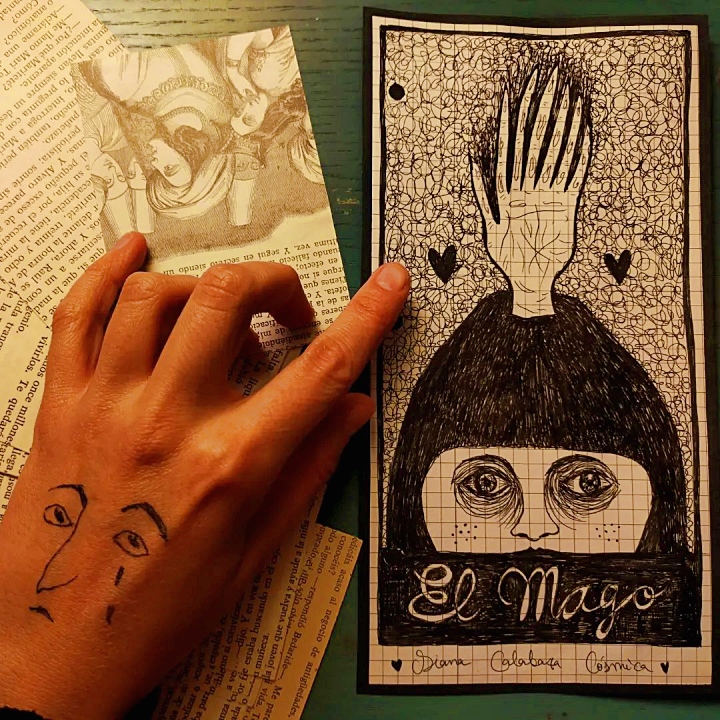
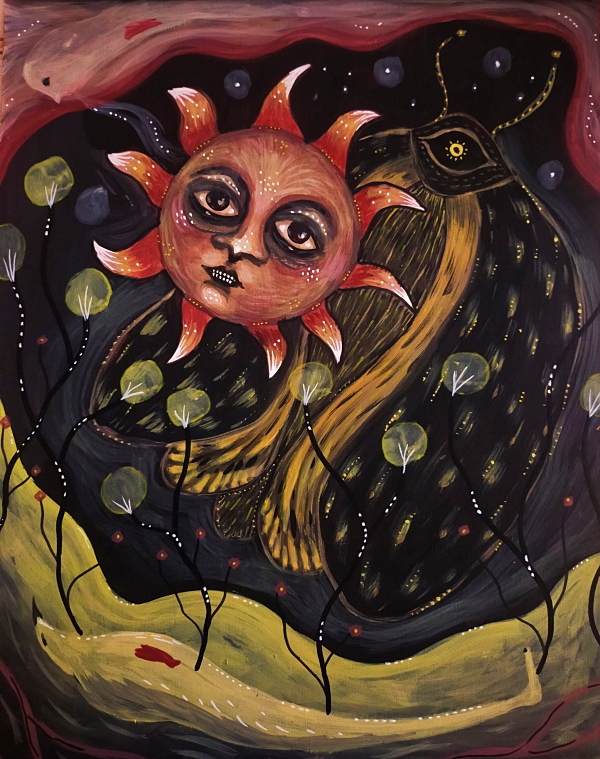
I still don’t know if I’m an artist. I have always considered that calling oneself an artist is something pretentious. It is true that I create new things from an intellectual and also a subconscious act, but I feel more comfortable when I think I am creative. On the other hand, I have not studied Fine Arts and this fact makes me think that I am an outsider. However, I don’t care about everything because I’ve been painting since I was a child and I will always continue to do so. Painting has allowed me to pay rent and eat, other times it has not been like that. If I defined myself as an artist, would I change anything?
Above all, nature inspires me. I can paint something like a portrait of a person, but it will never be quite so. The animals, the plants, the mountains, the rivers, the universe, the water, the rain, all the elements and the stones, also the cells, scales, wings, spores. All of this is always present because it is Nature and I feel that humanity ceased to be a part of it a long time ago. That is why I try to bring these two worlds closer together through painting and dreams. It is like imagining a hopeful future for the planet, even though it is not actually possible.
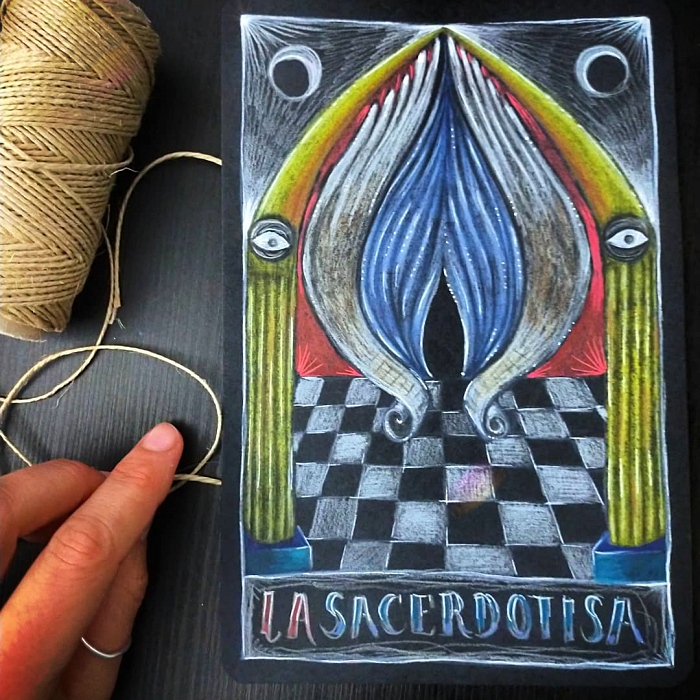
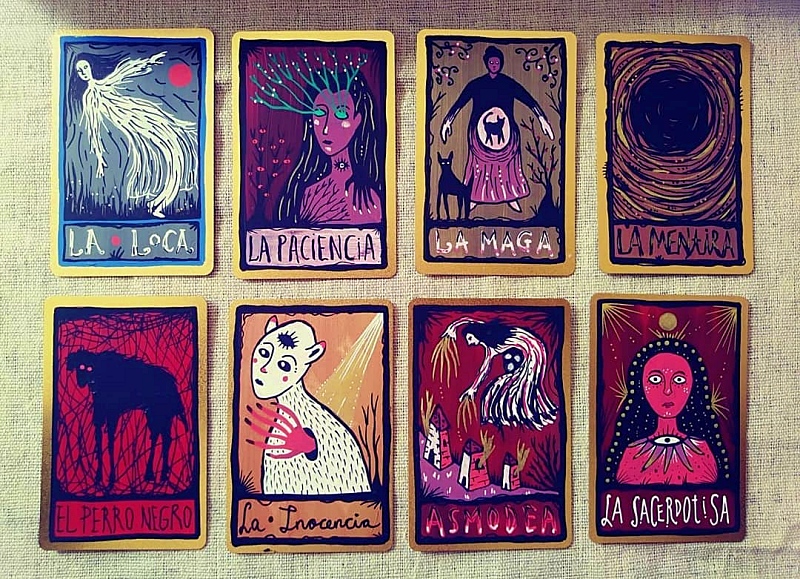
I am not a tarot expert. I have many different decks, even an oracle of my own creation. My intention is to edit a deck of Major Arcana as soon as possible, it is a project that is taking me a long time precisely because I understand the tarot in my own way. And I think there is no universal way to understand it, so the fact that I am not an expert in tarot would not be a big problem because I would know my own tarot perfectly.
I think it is a language in itself, another kind of language. But I also believe that its divinatory character is a construction. When Visconti decks appeared in fifteenth-century Italy, their intention was not to guess but to memorize the hierarchies and their functions. Divination as such is much older. The current tarot brings together many characteristics of memoizable hierarchical archetypes that we now identify as tools for self-knowledge. I believe that the tarot can help us to know the things that we don’t know that we already know. It is like walking at night along a path full of brambles but illuminated by the soft glow of the full moon
I started a dream journal and loved the experience but didn’t have enough consistency to stick with it. I would love to be able to take it up again but I need a suitable environment and environment that I don’t have right now. I remember dreams from decades ago and from time to time they come back to my mind and give me the same sensations as at the time of the dream. Other times my dreams return to places I have already dreamed of, as if they wanted to finish telling stories. Somehow I keep in my memory the most relevant dreams, their sensations and what they brought me throughout my life. On the theories of dreams and their materialization in daily routines and in life, I would like to recommend the literary work of Julio Monteverde.
I try to make my relationship with the subconscious conscious when I’m awake. Creations are born from that place and we must remain attentive to their movements. For me it is like a call at any time of day or night that reveals other realities to me. Sometimes I know how to take advantage of that call and transform it into what you can understand as art. Other times it is too blinding a light that has the power to paralyze me and shows me through its light a deep and infinite darkness. It is what you can understand by anxiety.
Nature is the biggest influence I have. There are also some people and artistic movements in those influences, either because of the color in their works, because of the absence of color, because of their way of describing heaven and hell. There are too many but these are a very small sample of what I mean: Chagall, Redon, Remedios Varo, William Blake, Teresa de Ávila, El Greco, Goya, Diane Arbus, baroque music.
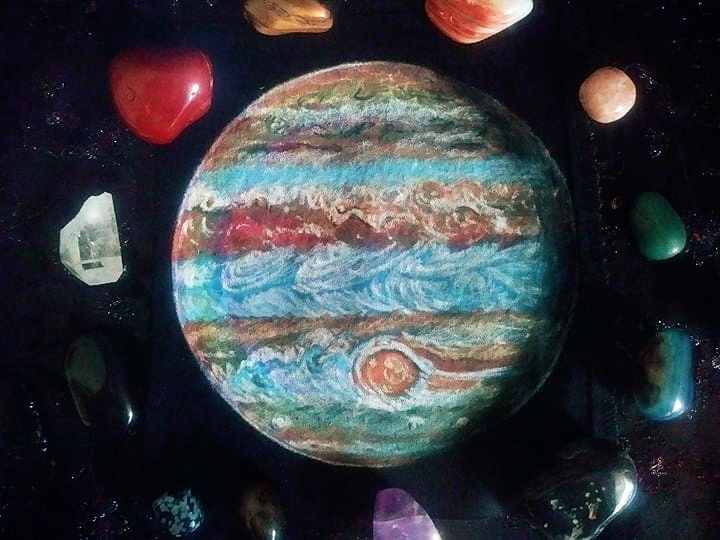
I’ve been under another the name Jupiter for quite a few years. This month (September 2022) I have started a new cycle that has been brewing since spring. I would like to get more light on the road and be able to keep my feet on the ground, something that has never happened in my life.
Alto Giove è tua grazia è tuo vanto il gran dono di vita immortale che il tuo Cenno sovrano mi fà Ma il rendermi poi quella già sospirata tanto Diva amorose e bella è un dono senza uguale come la tua beltà
High Jupiter it is your grace it is your pride the great gift of immortal life that your sovereign nod makes me But then making me that one already longed for so much Loving and beautiful diva it is a gift without equal like your beauty
For this reason, through Jupiter and almost by way of a “sigilo”, I intend to attract another way of seeing things without leaving aside my causality and gloom. I could have chosen Saturn and it really is what I wanted but we already know how Saturn treats already melancholic souls. I can’t afford that. Jupiter, as in the piece that Nicola Porpora (Alto Giove) composed to be performed by Farinelli, was a haven of peace in the stormy world of Felipe V. Leaving aside the stupid monarchy, Diana was a lunar goddess, daughter of Jupiter. In an astrological sense, Jupiter is associated with positive concepts such as abundance and optimism. And finally, I often say that “I live on Jupiter”, referring to the fact that I live in the clouds, that I am not attentive to reality and that I am a dreamer.
Lechuza is one of my music bands. We have started this summer of 2022 and we have just published our Demo. We are two friends making music, working with our hands on record packaging and trying to make nice videos of our songs. We are called Fantasmita and Ruda. Proceeds from sales go to an animal shelter. All the information is on our Bandcamp, and of course the music.
written by Diana Calabaza de Júpiter
Diana de Júpiter artistic training is intuitive and self taught. She prefers not to rely on any institution to interfere with her experience. Her themes hang between the dark and silent. She has worked for several Spanish publishers such as Aurora Dorada and La Felguera. Diana has had solo and group exhibitions in Spain, Mexico and the United States. She is currently preparing a complete tarot deck while painting daily.
My plan was to kiss the woman at the bakery counter, but the manager rushed forward and whacked me on the head with a spoon. He recites Homer on Sundays, though not when it’s raining, and he takes no chances with troublesome dreamers like me.
Forbidden steps Collageby Gary Cummiskey
At the side of the road
There were headless mannequins lying at the side of the road with so many cars moving slowly past and not a single driver stopping to take a closer look or even perhaps load them into the boot and take them home
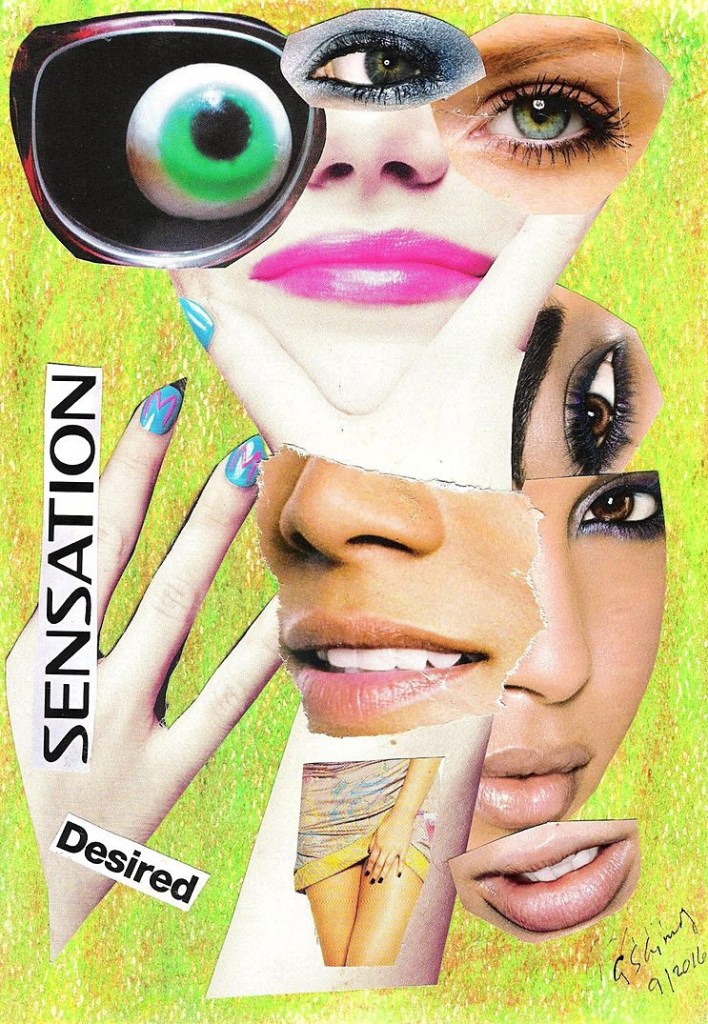
Sensation desired Collageby Gary Cummiskey
Door to door
She waits in front of a door propped up in the sand somewhere in the Kalahari She does not see the woman on the other side of the door kneeling down and peering through the keyhole She sees only the man in the green jacket walking away in the distance with a cat at his side
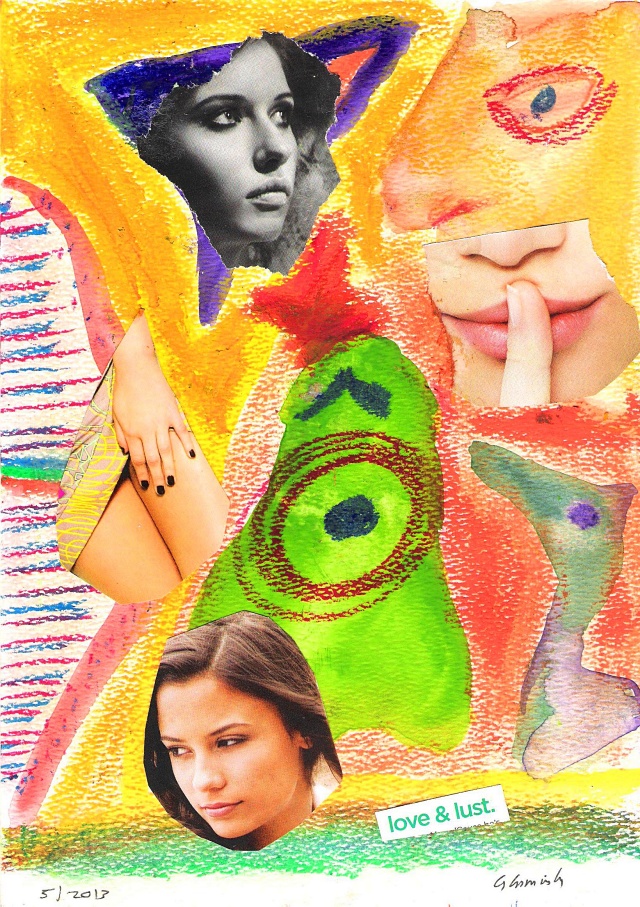
Love&Lust Collageby Gary Cummiskey
Zoo
Standing behind the iron bars I peer down at the animals When I look up again at the sun I vomit blood from my nostrils and my eyes turn black like their fur
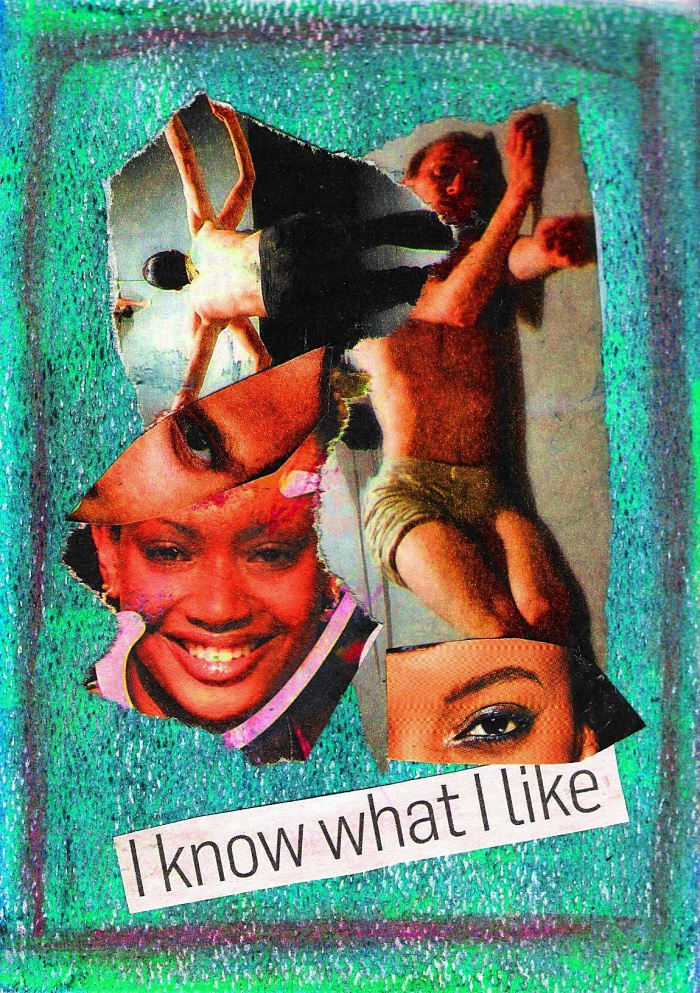
i know what i like Collage by Gary Cummiskey
Underground currents
A thin man with a walking stick and a balloon in the cobblestone streets of the war-torn city. She turns, rushing through the underground currents.
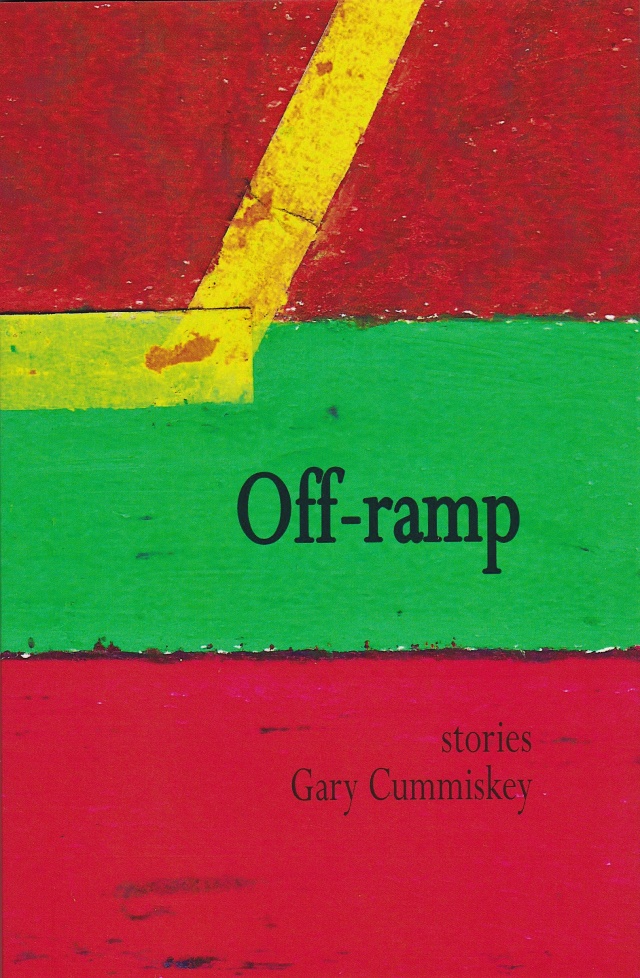
Gary Cummiskey is a poet and publisher living in Johannesburg, South Africa. He is the founder of Dye Hard Press, which he started in 1994. He is the author of several poetry chapbooks. His selected poems, Outside the cave, was published in 2021. In 2009, with Eva Kowalska, he compiled Who was Sinclair Beiles?, a collection of writings about the South African Beat poet. An expanded edition was published in 2016. His short story collection, Off-ramp, was short-listed for the 2014 Nadine Gordimer Short Story Award. His work has been published in the UK, US, France, Denmark, Sweden, India, Egypt, and Greece
Featured Photo: Lets Hope, Collage by Gary Cummiskey
THIS WRITING IS AN AUTHORIZED DUPLICATION WITH PERMISSION AND EXPRESSED CONSENT
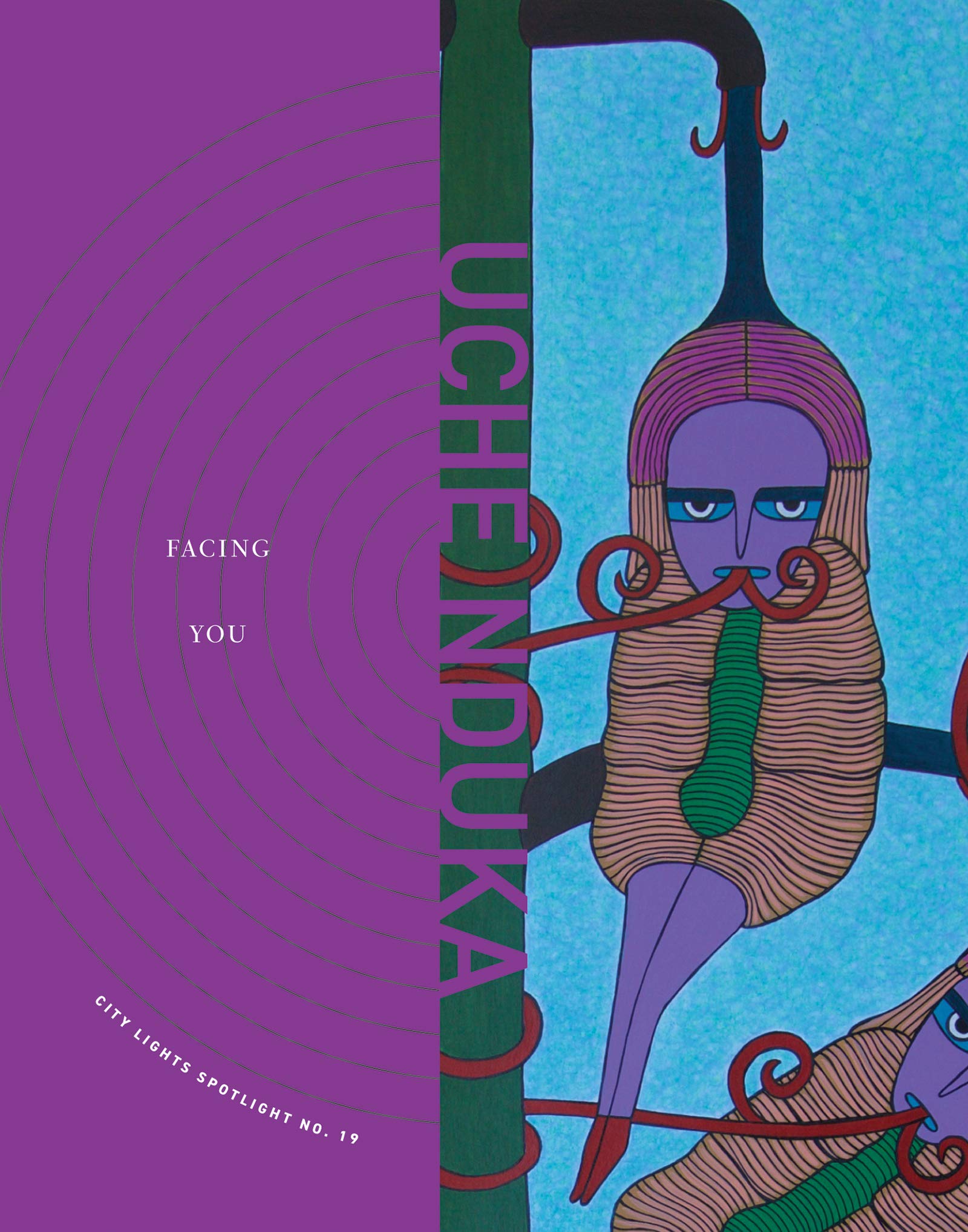
Uche Nduka was born in Nigeria to a Christian family. Raised bilingual in Igbo and English, he earned his BA from the University of Nigeria and his MFA from Long Island University, Brooklyn. He left Nigeria in 1994 and settled in Germany after winning a fellowship from the Goethe Institute. He lived in Germany and Holland for the next decade and immigrated to the United States in 2007. Nduka is the author of numerous collections of poetry and prose, including Living in Public (2018), Nine East (2013), Ijele (2012), and eel on reef (2007), all of which were published after he arrived in the United States. Earlier collections include Heart’s Field (2005); If Only the Night (2002); Chiaroscuro (1997), which won the Association of Nigerian Authors Poetry Prize; The Bremen Poems (1995); Second Act (1994); and Flower Child (1988). Belltime Letters (2000) is a collection of prose. His work has been translated into German, Finnish, Italian, Dutch, and Romanian.
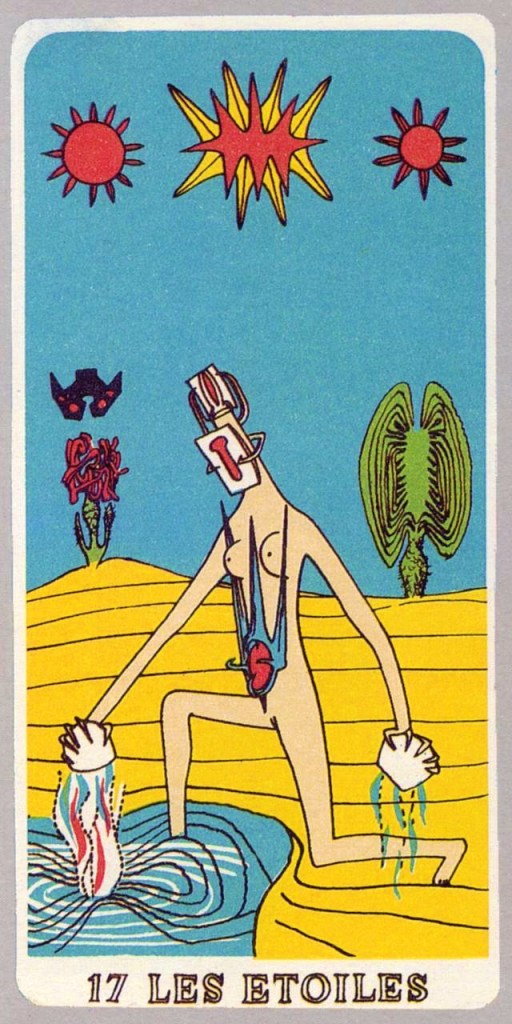
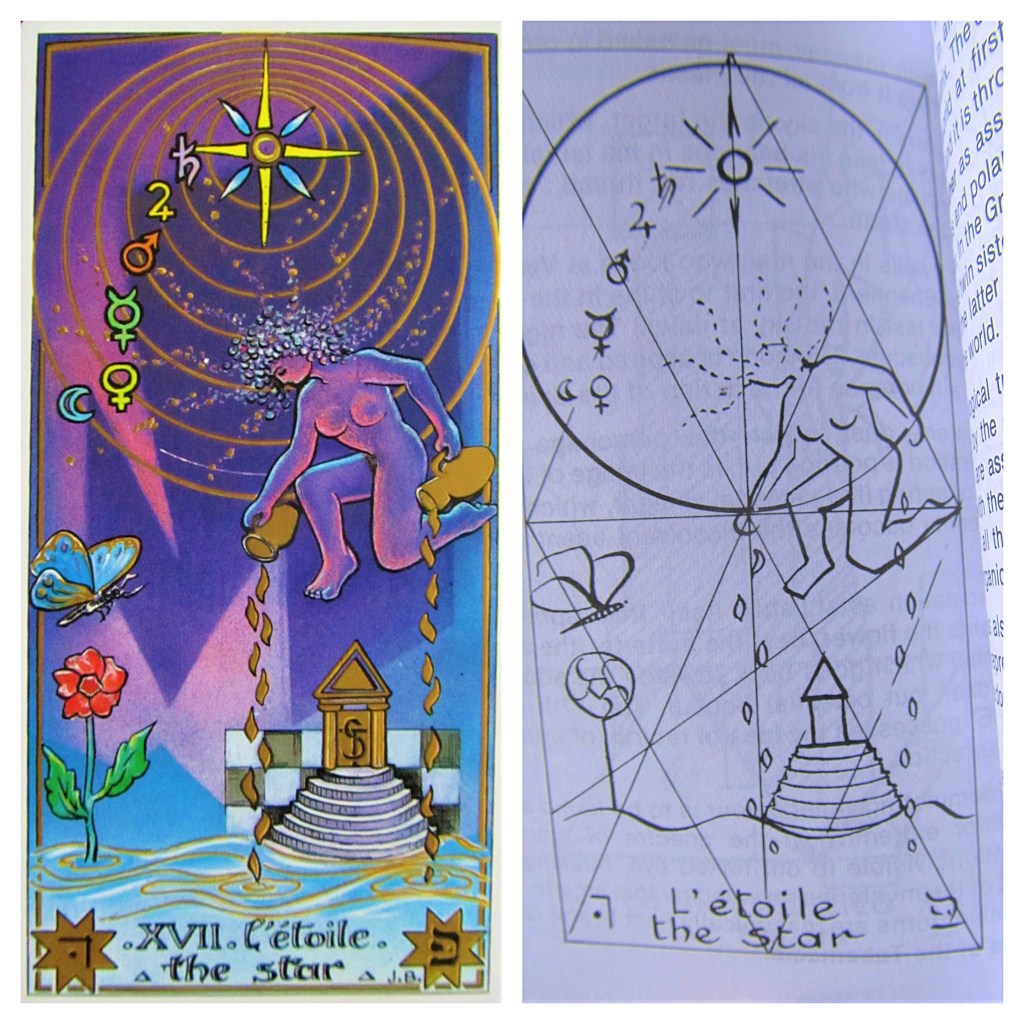
“The time will come to assert the ideas of women at the expense of those of men, whose failure is consummated so resoundingly today. It is up to the artist in particular, if only in protest against this scandalous state of affairs, to make everything that arises from the feminine system of the world as opposed to the masculine system predominate to the maximum; of emphasizing exclusively the powers of women; better still, of appropriating her to the point of making it jealously hers, of that which distinguishes her from man in her way of evaluating and wanting.” André Breton, Arcanum 17
17 Star Tarot Card 9in x 6 1/2in André Breton Roberto Sebastián Antonio Matta Echaurren
This is another example of the surrealist passion for tarot. The title of Breton’s long prose poem, Arcane 17, refers to tarot card 17, the “stars” card (Les étoiles), usually a symbol of free-flowing love and renewal of forces. However, Breton’s imagination brought new associations, multiplying the morning stars and infusing them with fluid meanings. Breton describes the figure in the center of the card as a naked young woman kneeling as she pours out the contents of two urns, one into a pond, the other onto the ground. He associates this woman with the legendary figure of Mélusine, a legendary mermaid who became a symbol of the difficulty to reconcile “reality” and “magic.” There is hope, however, that the “inexhaustible” urns could renew our disenchanted world. Indeed, even though the pond gives off the “pestilential odor” of social conventions, it is still longing for “a new dream.” The fragile butterfly is another symbol of “consoling mystery.” Chilean painter Roberto Matta designed the four colorful illustrations in the shape and size of tarot cards (or “arcanas”) pasted in the book.
Love descending incandescent and calm from the primordial nature of the universe to embrace the hope full of your walk in your women’s hands that welcome in your womb container of light on your lips that educate and dismiss poetry on your back that holds the arcanum of the morning with that epiphany that looks like your body. This is how I take flight rebellious bathed by the celestial of the bodies wrongly called celestial, where I learned to love the brevity of the possible in the impossible to go up with my luggage to another utopia clearing away the old tears in front of a showcase that is empty and that is condescending with my people in its persistent lack where I also know my measurements and who excessively hugs them in these hours of opaque tides with their lost leviathans of heads sunk in the mud of consumption without noticing the hands of those who ask between remains of bodies that are invisible to him and alien.
Morning Prayer Monroe Tsa Toke
A star, as Bernard Roger recalls, “has served forever as a guide to nocturnal navigators whether over the oceans of the globe or over the philosophical sea of the Argonauts.” Echoing him, Jorge Camacho notes the star “has shown the solitary sailor his route over the high seas. By faithfully following it throughout his long voyage, he is sure to reach port safely.” The star burns with such an intense gleam in the surrealist imaginal realm that in 2004, the Czech painter Martin Stejskal organized a large exhibition near White Mountain in which it “was declined in all its natural, cultural, as well as mythical aspects, in the union of traditions (astrology, kabbalah, alchemy, Freemasonry) as in the poetic union of the male and female in each individual, borne by the work of surrealist friends, and by the uncarved stone placed at the castle entrance that bore this phrase that sings in our hearts like a magical couplet: constructed on the side of abyss, on philosopher’s stone . . .” as Marie Dominique Massoni points out in issue 5 of S.U.R.R. However, “You can never see this star like I saw it. You don’t understand: it is like the heart of a heartless flower,” as Nadja, the “magician,” says.,,
A harmony founded on the spiritual in all its forms, love of humanity in all its beauty, we can thus clearly see the richness of the esoteric domain approached this way by the surrealists, who incidentally made the Star, in the Deck of Marseille, the symbol for the suit of Dreams, whose face cards are Lautréamont, Alice in Wonderland, and Freud. This deck was conceived (these things are never invented) between the Villa Air Bel and the café Au Brûleur de Loups.
Star Tarot Symbolique Maçonnique Deck by Jean Beauchard
“A very powerful myth continues to have a hold on me, and no apparent contradiction of it in the course of my previous adventures can prevail “Find the place in the formula” merges with, “possess truth in one soul and one body: That the highest hope has the power to unfold before it the allegorical arena which holds that every human being was thrown into life to search for a being of the opposite sex and only that one who is paired in all respects, to the point where one without the other seems like the result of the dissociation of dismembering a unit of light”
It is then when the tree that tomorrow will summon the thorns loses its leaves, and the bumblebee falls, prey to the polar trails, to reinvent the powerful patient engineering of lytic promises, Well, that’s where I shelter, and where I rescue the omens, there I drink from the Paleozoic salts, which today move the migratory herds, those who come to the eyes without ears, of those attending Sunday services. By nature, I approve!!
They speak of love, and my bet is more on compassion, which is a kind of continuum in a collective warp, of an ineffable equation that they will never understand. Because perhaps love (like that image shown to us) does not exist and if it does exist it is a sum of chemical reactions where a set of hormones stimulates our syntax, and which may also be subject to the need for genes to be perpetuated. Maybe?. But there is also one who breaks this previous theory; crazy love, passionate love, eternal love, etc. that love that becomes unclassifiable. I only know that I know nothing. After all, I believe in love. Does the egg use the chicken to make more eggs? It is possible, but in a global and precisely circular analysis, the plot of existence is supported in a shed crossed by the polyform reality of infinite logics and illogics, where each of its corresponding paradoxes and balances avoids its critical tension. But, we can order them in the not well understood compassion, which could be a feeling deeper than that of the corruptible flesh (physical theory and cognitively plausible), which leads to understandable and celestial simplicity. But what if an infinitesimal were more than an integer, or if that time circulated in all directions? or love will not mean more than a necessary impulse to take risks in order to live the contradictions, so that the soul, when dying, will return with the pertinent knowledge to correct, deconstruct or ratify the whole of the so-called divinity . For this reason, the next step opens the temporality to dedicate more time to essential reflection, and to put aside an imposed competitiveness for the accumulation of objects that lead to the void that means pursuing a way of life that is subordinated to the symbolic relationship. of the object or objects, which is useless and inconducive (a simulacrum of the society of the spectacle) for our true purpose in this brief transit called life. Ars longa vita brevis. Or your existence is just an accident to offer a limited amount of data to accompany the equation that gives additional information to find the way out of the answer. By the way; nobody takes me into account, since my infallibility is very poor since periodically and statistically, my failures are more abundant than my certainties. And therein lies my wisdom; in realizing that my hypotheses are only attempts to find the truth within infinity. To think otherwise would be to err drastically and in the process lie to them. It would be, subjecting myself from the ego to an option to dress elegantly, but in the end, it would strip my limits. It is better to be honest in clumsiness than false in an inane and temporary charade. But: What if love were one of that unknown design in my intrinsic astral writing, waiting for you?
Primordial circulation approaching from a past spring, acrylic on Fabriano paper 250 gm. 35x45cm
So the wide dividing width will unload its useful molecules in this useless impertinent distance there where the lightning reigns without asking for their blind blows. Is when my pale measures they embrace their designs devoid of elytra to save the waters possessed of salt and fire that bathe the limits of my suffering body without entering the first cause that brings me down from within the muscle periphery.
Eros Phasianidae, acrylic and ink on Canson 300 gms paper. 11″ x 8.3
EROS PHASIANIDAE Yo And she saw the chicken rise from the ground a brilliant and ectoplasmic epiphany and she remembered the words of the feathered prophets: “before the primordial egg was the verb” and the pyrrhic evolutionary expedition embraced me so necessary and indeterminate where we are more but under sheds and I saw the grayish uncertainty that shakes my being h = 6.626 0693 (11) x 10 – (34) J. s = 4,135 667 43 (35) x10–(15)eV. s and the beast arose from the miasma without the feminine warmth it was in the offensive of the arches thousands of years ago on the Cartesian line of Har Meggido under the law of y = m x + b and those tears originated at 32°34’59″N 35°10’56″E. II huge old stars leaning out on the horizontal cobblestone sheets were dictated by an ancient manual of glorious epic forms where I did not read the cunning locks and from there lights fall like eagles that are suspended in front of your pale fortifications and despite the fact that I descend without air I cling to the desiccated edges of this abyss turning away from the waves of floral promises with summer mentions that anoint you. Thus the amaranth silence returns to rock the star and like the silent lymph you seek to break beyond the fundamental shell the one that you got to know in a primitive way in the sweet rooms of belief.
Interruption, acrylic on cut Fabriano paper, on black cardboard. 18x24cm. The inclination of one of the elements is voluntary.
GOLDEN VISION
The nothing, the void hold my duplicate fragments (Φ2 = 2.61803398874988…) It is the hollowness of the past and the future what you don’t have and don’t want the illusion of time and line Infinity so love surrounds swelling wisdom while on the musty boards of a camp absent light filters to tilt reciprocal reality that drives your transformation (1/Φ = 0.61803398874988).
Maybe this reality is true on this twilight island where the already worn bones falter by the persistent violet stings, and there is no choice but to live among the cyclones that guard the whimsical and invisible knots with its container meshes that hide half-open portals, those that I will leave like this for a while, since everything circulates in the promised packaging.
P.D. Newman is an independent researcher located in the southern US, specializing in the history of the use of entheogenic substances in religious rituals and initiatory rites. He is the author of the books, Alchemically Stoned: The Psychedelic Secret of Freemasonry, Angels in Vermilion: The Philosophers’ Stone from Dee to DMT, and the forthcoming title, Day Trips and Night Flights: Anabasis, Katabasis, and Entheogenic Ekstasis in Myth and Rite. The Secret Teachings of All Ages (TV Series documentary) 2023