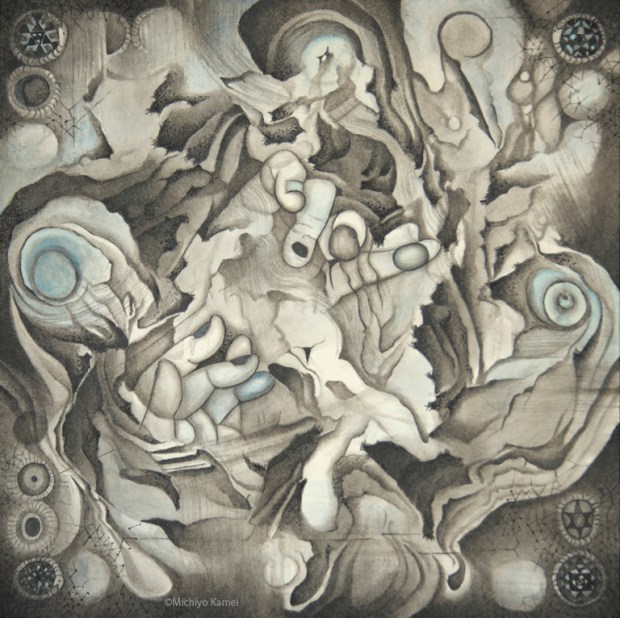
ジオマンティックナイト

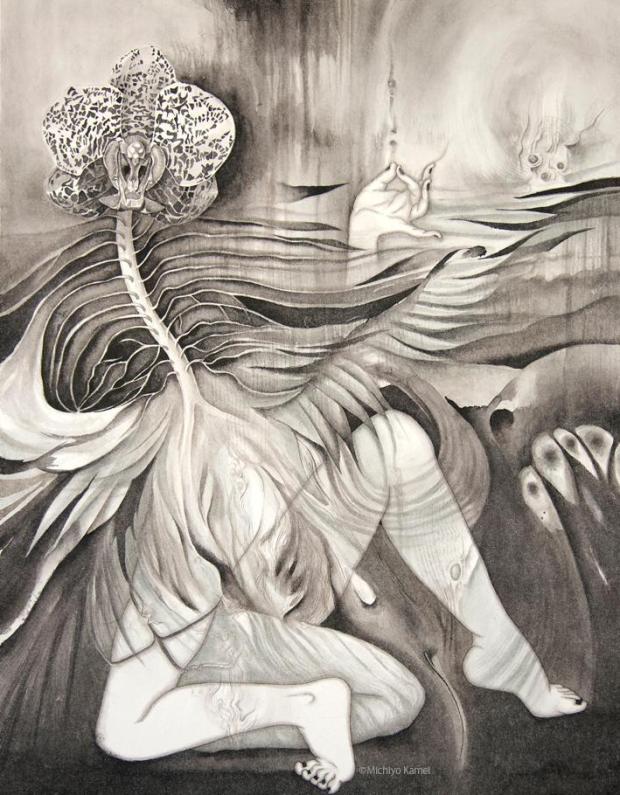
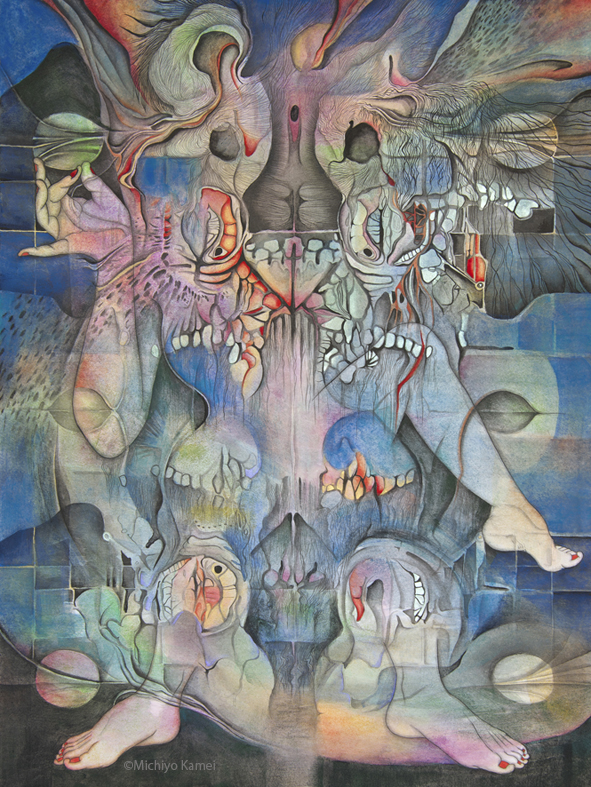
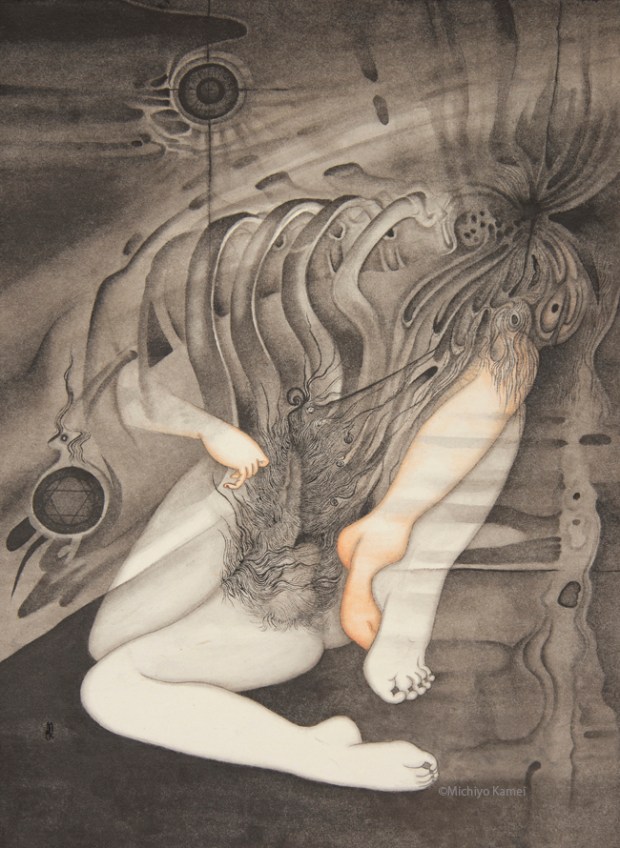
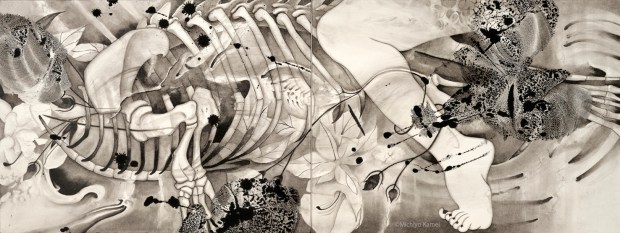
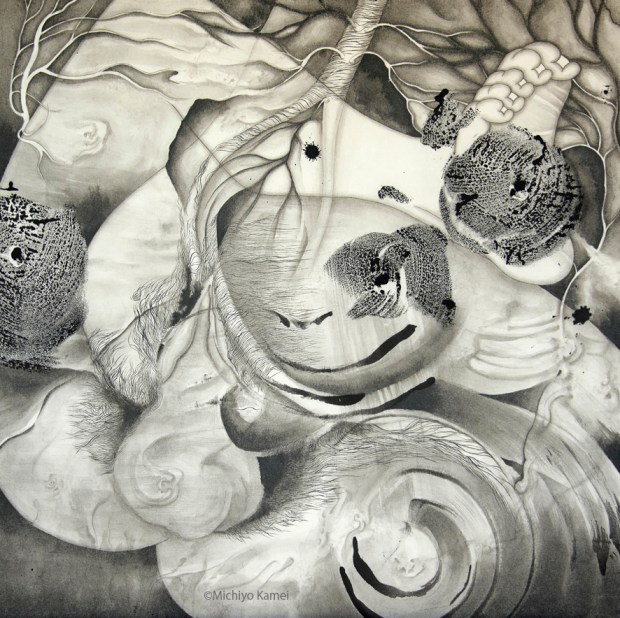
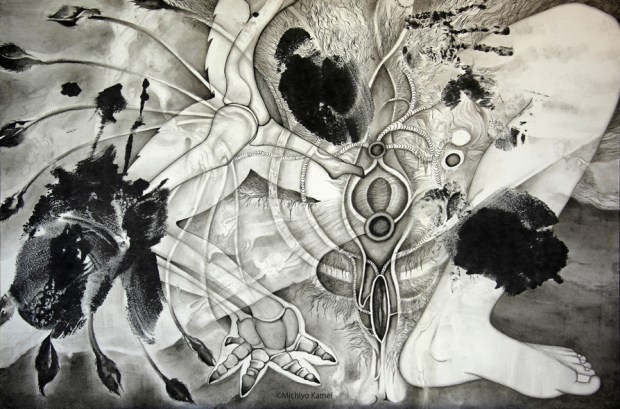
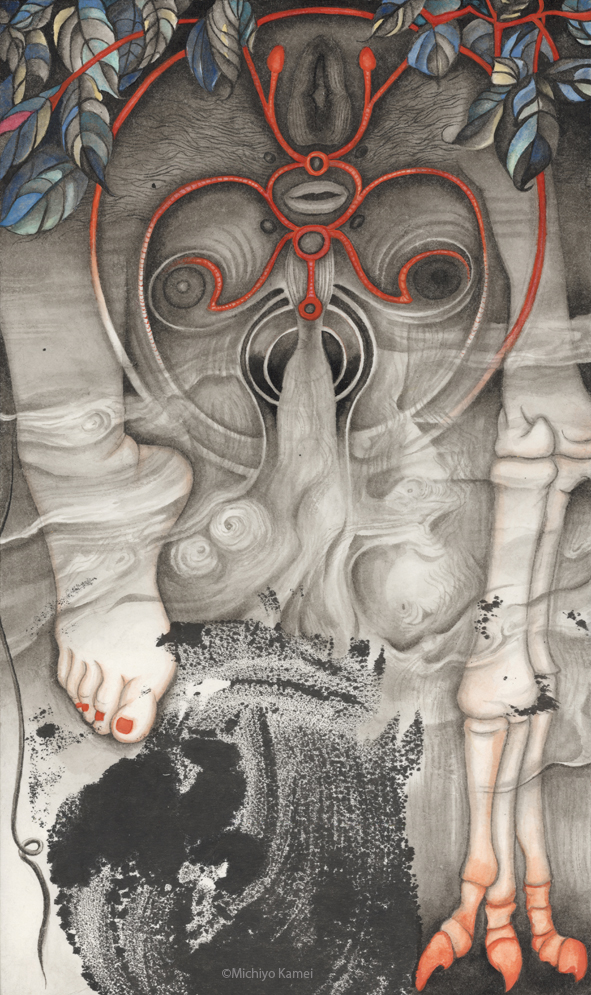
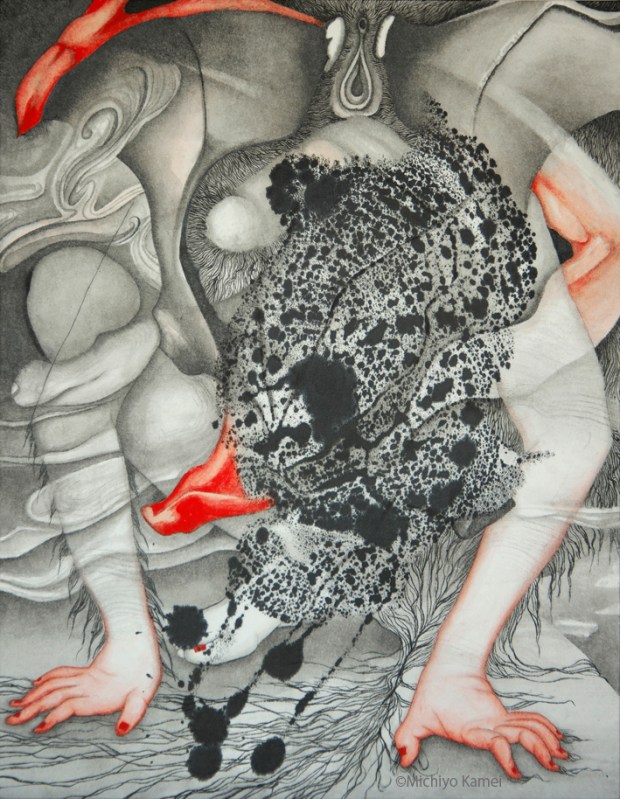
Art/Illustrations by Michiyo Kamei

Written by Mitchell Pluto from Occultations: Lullabies for Space Travel

 平行線が交差し中心にダイアモンドを形成する

II  それは いま

この形状により我々は空間を斜めに移動できる

そのような旅には占術と変身の力が必要だ
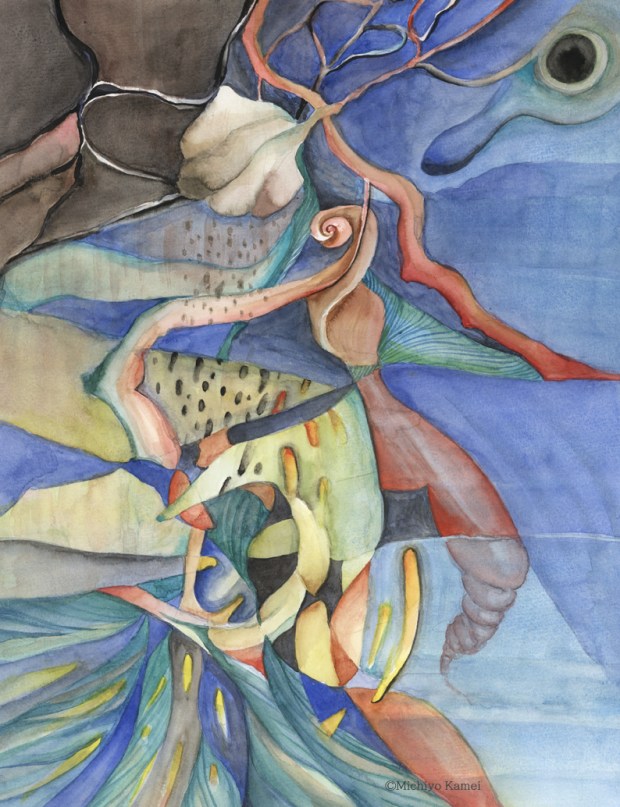
わたしは三角波を吸収し

魚座の月の下で杯を口にした

360度の小さな断片

水瓶座、カヤエイ、そして水の運び手がライブを繰り広げている

月に乾杯しよう これは昔ながらの神託だ

ジオマンティック・ナイトのシンセコンソールを使い

チェス盤中央の正方形をピラミッドへとねじり

周囲の空間を曲げた

存在の8つのステージから集った64人のヨギーニが

意識と消滅を表す宇宙のタペストリーを創り出す
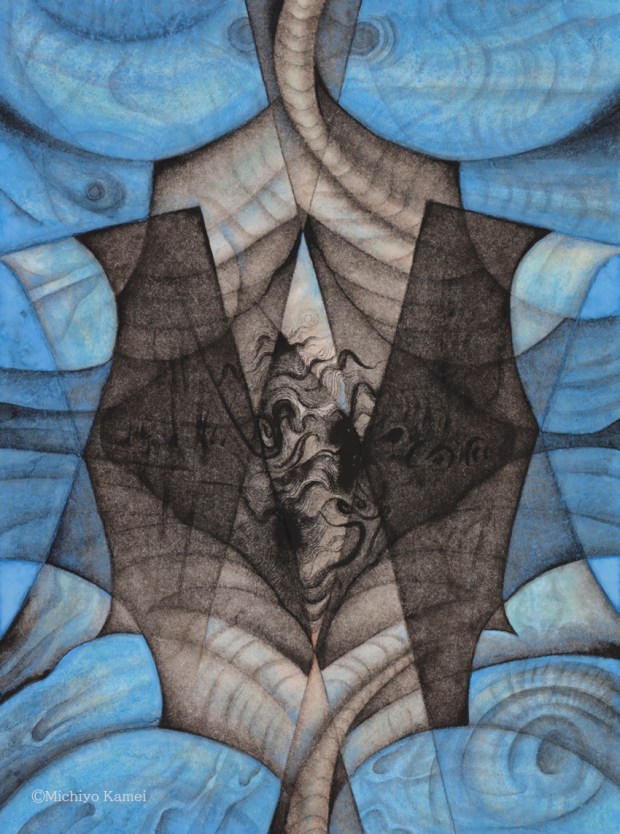
チェッカーボードを通してわれわれは

自己の内なる状態の図表を探求できる

絡み合う白黒の矩形は陰と陽

この視覚的な図表は異なる時間軸の出来事を分析解釈する力を持つ

われわれは繋がっている

手、爪、ひれ、ひづめ、翼、触手が集まり 異国の地へ休暇に出かける

さまざまな形に変容することで 新たな生息地を見つけ、食し、繁殖する計画だ

新婚旅行は いま最高  

研ぎ澄まされた感覚が完璧に調和する

視覚の全感覚は この虚空に浮かぶあらゆる物体を検知する貴重な資産

アプリは蛇の瞳孔を模倣し 猫の夜目を高める
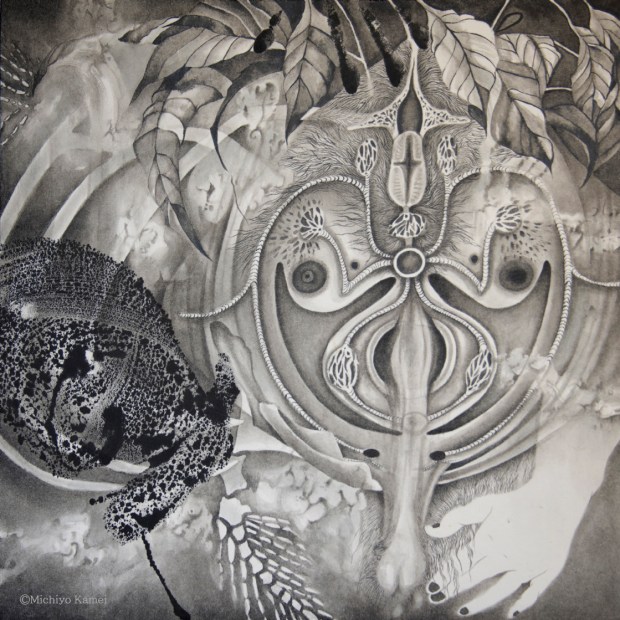
チェッカーボードを通してわれわれは

自己の内なる状態の図表を探求できる

絡み合う白黒の矩形は陰と陽

この視覚的な図表は異なる時間軸の出来事を分析解釈する力を持つ

われわれは繋がっている

手、爪、ひれ、ひづめ、翼、触手が集まり 異国の地へ休暇に出かける

さまざまな形に変容することで 新たな生息地を見つけ、食し、繁殖する計画だ

新婚旅行は いま最高  

研ぎ澄まされた感覚が完璧に調和する

視覚の全感覚は この虚空に浮かぶあらゆる物体を検知する貴重な資産

アプリは蛇の瞳孔を模倣し 猫の夜目を高める

アプリが何も検知しなければ、こうもりのシグナルで逃したものを特定しよう

退屈しのぎに聴くのは 昔ながらのクジラの歌

宇宙には不可視な電波が入り込む余地がたっぷりある

われわれは無意識の変化が意識にどう影響するかを自覚する

宇宙飛行士として最も困難だったのは虚栄心を手放すこと

消費主義から解放されたことで自尊心が高まった

われわれは数字に縛られない仏教を実践する

「死」は荷電粒子が宇宙に消える瞬間だ

数字は永遠 だからどれだけ長く記憶できるか試そうか

アップデート前の言葉を主張するために わたしは自我の内側から名のり出た

これは幻覚を起こす声

真の自我は存在しないと理解しつつも われわれは絶えず自己を拡張し続けるのだ

より大きな善のために 進歩を阻んできた過去のプログラムは放棄する

現在の話者はまもなく話しを終える

目的地に到達したら円陣を離脱しよう

このストーリーラインはデジャブを喚起し その心象の創出は レプリカに記憶を残すだろう
Michiyo Kamei Site

Geomantic Knight

Parallel lines intersect, forming a diamond at the center.
II is now X.
This form lets us travel diagonally through space.
One needs divination and shapeshifting for this kind of
journey.
I absorbed a triangular wave.
Under the Pisces moon, I sipped from the cup.
A tiny fraction of 360
Aquarius, a Kayayei, and the water porter, is playing live.
Let’s toast to the lunar. It’s an old-time oracle.
I use my geomantic knight on the synth console to twist
the central square into a pyramid on the chessboard,
bending the surrounding space.
The sixty-four Yoginis from the eight phases of existence
create a cosmic tapestry that illustrates awareness and
extinction.

Through the checkered board, we can explore a chart of
our interior states.
Intertwined black and white squares represent yin and
yang.
This visual diagram has the ability to analyze and interpret
events from different time spans.
We are connecting.
As a hand, claw, fin, hoof, wing, and tentacle united on a
holiday to a foreign atmosphere.
By being able to transform into different shapes, we plan
to discover a new place to thrive, eat, and reproduce.
Our honeymoon is amazing at the moment.
With heightened senses working in perfect harmony.
Each optical sense is a precious asset to detect whatever
objects may be drifting in this void.
Apps mimic snake pupils and cat eyes enhance night
vision.

If we find nothing on that app, we activate a bat signal to
identify what we overlooked.
To combat boredom, we listen to the old fashion whale
songs.
There is plenty of room in the universe for invisible radio
waves.
We notice how unconscious shifts affect our awareness.
Giving up vanity was my toughest astronaut challenge.
Self-esteem improved by breaking free from consumerism.
We practice Buddhism without a figure.
The fading of charged particles into space is called “death”.
Numbers are eternal, so we will test how long we can
remember them.
I am coming forward from within my ego to assert the
words that I have spoken before the update.
This is a hallucinatory voice.
We get it, there’s no true self, but we are always expanding
who we are.

For better well being, we are abandoning past programs
that slowed our progress.
The current speaker is about to stop speaking.
Once we reach our destination, we intend to leave a circle.
This storyline will trigger déjà vu and create a memorable
mental image for the replicas.
The Origin of the Universe: The Wildness of Point Zero
Michiyo Kamei Exhibition Art Gallery Shop

Palimpsest of Phantasm: An imaginary art garden
Vol. 1 Michiyo Kamei
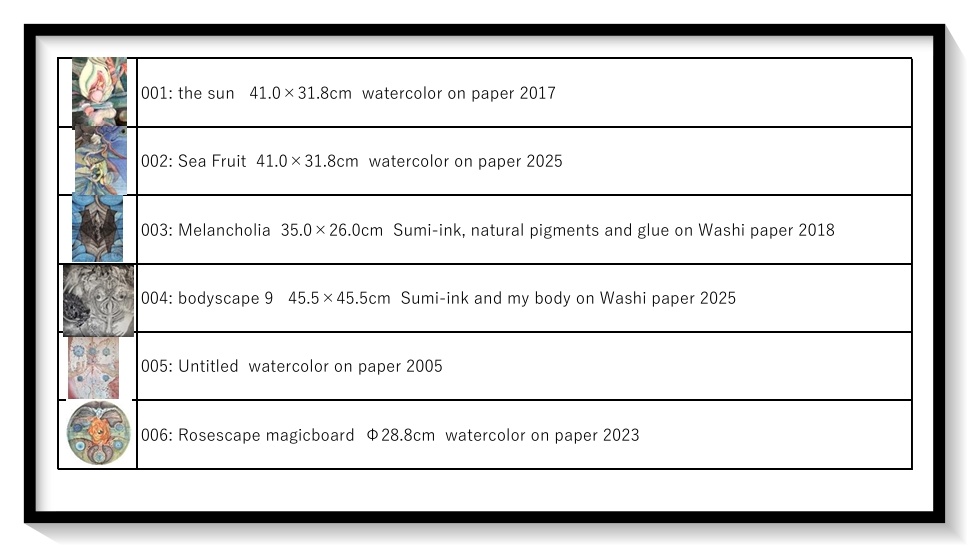
001: the sun 41.0×31.8cm watercolor on paper 2017 
002: Sea Fruit 41.0×31.8cm watercolor on paper 2025 
003: Melancholia 35.0×26.0cm Sumi-ink, natural pigments and glue on Washi paper 2018
004: bodyscape 9 45.5×45.5cm Sumi-ink and my body on Washi paper 2025
005: Untitled watercolor on paper 2005 
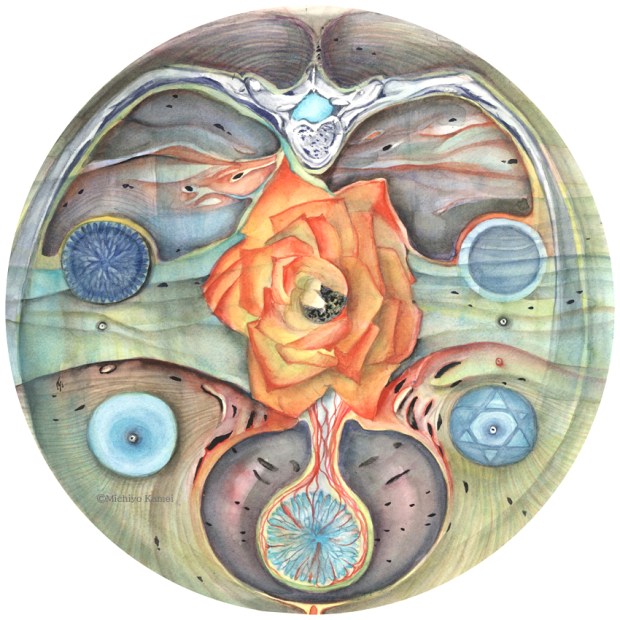
006: Rosescape magicboard Φ28.8cm watercolor on paper 2023 

001: 太陽 41.0×31.8cm 水彩、洋紙 2017 
002: 海の実 41.0×31.8cm 水彩、洋紙 2025 
003: メランコリア 35.0×26.0cm 墨、岩絵の具、膠、和紙 2018
004: bodyscape 9 45.5×45.5cm 墨、身体、和紙 2025
005: 無題 水彩、洋紙 2005 
006: 薔薇景魔法盤 直径28.8cm 水彩、洋紙 2023 

ALL RIGHTS RESERVED. ARTWORK IN THIS POST IS A COPYRIGHT OF MICHIYO KAMEI. THIS AN AUTHORIZED PUBLICATION WITH PERMISSION AND EXPRESSED CONSENT.

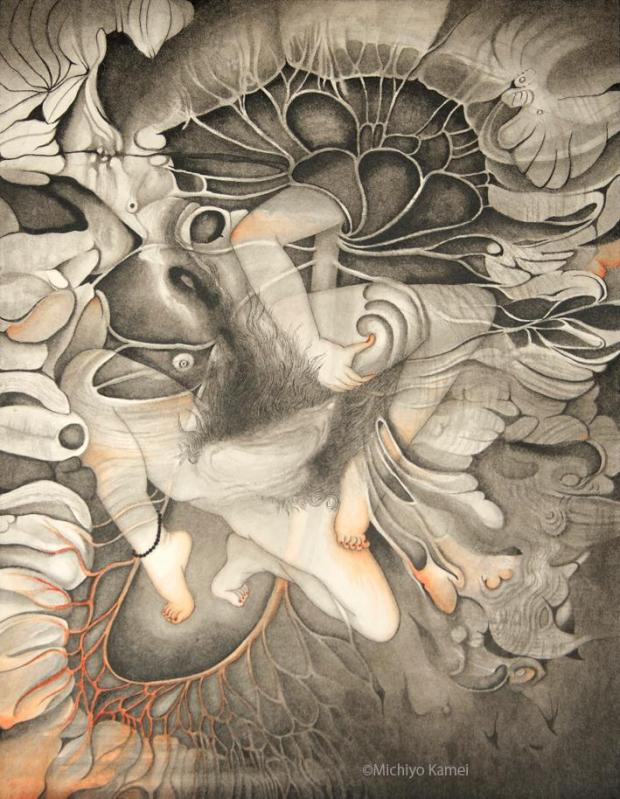
Bodymandala: Interview with Michiyo Kamei

Feature Photo: Black Inspiration 41.0 x 31.8cm Sumi-ink with Michiyo Kamei’s body on Washi paper 2025. Photo used with kind permission directly from the artist and copyright holder © Michiyo Kamei

In her black ink paintings, Michiyo Kamei explores the concepts of impermanence, transformation, and the enduring nature of existence through a form she calls the bodymandala.

Mitchell Pluto: At what point did you realize you were an artist?

Michiyo Kamei: I originally studied anatomy at medical school and started out as a medical illustrator. It was only after I stopped working as an illustrator and began creating paintings that I realized I was an artist. Anatomical illustrations are created at the request of the medical field to follow the authors’ papers and wishes, so the illustrator cannot draw them freely. Paintings are free to be drawn by the creator, so the artist can freely incorporate their own ideas. This difference is significant to me.

Kuuka
53.0 x 41.0cm Sumi-ink and red-ink on Washi paper 2025. Photo used with kind permission directly from the artist and copyright holder © Michiyo Kamei

Apocalypse
53.0 x 41.0cm Sumi-ink on Washi paper 2021. Photo used with kind permission directly from the artist and copyright holder © Michiyo Kamei

Mitchell Pluto: How would you describe your art, given that it blends many traditional and modern genres?

Michiyo Kamei: When I was drawing anatomical illustrations, I studied the theory of modern anatomy and created my diagrams. After I quit this job and started painting, I began exhibiting at a gallery that collected ukiyo-e prints from the Edo period in Japan. Seeing many hand-painted ukiyo-e at the gallery, I rediscovered the beauty of traditional Japanese styles. When drawing the hands and feet in my work, I sketch my own body in front of a mirror, then deform it in the ukiyo-e style. In this way, I am influenced by both modern anatomical diagrams and ukiyo-e from the Edo period, which have a uniquely Japanese style.

Ring
33.3 x 33.3cm Sumi-ink, natural pigments and glue on Washi paper 2023. Photo used with kind permission directly from the artist and copyright holder © Michiyo Kamei

Mitchell Pluto: When creating your artwork, what specific medium or materials do you prefer to work with?

Michiyo Kamei: I like oriental materials. Rather than just adding paint to the paper, I like to let the ink soak into the paper, letting it bleed and see how it moves within the paper fibers. Sometimes I don’t just create a picture, I let the ink create a picture on its own.

Brahman
60.6 x 45.5 Sumi-ink, natural pigments and glue on Washi paper 2021. Photo used with kind permission directly from the artist and copyright holder © Michiyo Kamei

Moon Ritual
45.5 x 33.3cm Sumi-ink and red-ink on Washi 2020. Photo used with kind permission directly from the artist and copyright holder © Michiyo Kamei

Mitchell Pluto: Could you describe and clarify what a bodymandala is? 

Michiyo Kamei: Anatomical illustrations are pictures of the world of death drawn from corpses. Since I began painting, I have wanted to depict the world of life, so I have incorporated energetic shunga. Death and life are repeated in my paintings, and I hope to approach the theme of “eternity.” Mandalas represent the universe in Buddhist worldview, but I represent the universe through the body, and am exploring a new mandala form called the “bodymandala.” 

Bodyscape 8
45.5 x 121.2cm Sumi-ink with Michiyo Kamei’s body on Washi paper 2025. Photo used with kind permission directly from the artist and copyright holder © Michiyo Kamei

Mitchell Pluto: What visual artists have influenced your work and given you inspiration?

Michiyo Kamei: I’ve been interested in the body since I was a child. It feels as though I am contained within this body, but at the same time it is also part of the natural world, the world outside of me. Which one does it belong to? And when I realized that I would die along with this body, I was terrified. Francis Bacon is an artist I admire for his expression of the body and anxiety. I’ve admired him ever since I discovered him in an illustrated catalogue as a teenager. Another artist is H.R. Giger. I think his organic expression in black and white is so beautiful.

Spin
65.2 x 65.2cm Sumi-ink with Michiyo Kamei’s body on Washi paper 2025. Photo used with kind permission directly from the artist and copyright holder © Michiyo Kamei

Bodyscape 7
60.9 x 91.0cm Sumi-ink with Michiyo Kamei’s body on Washi paper 2025. Photo used with kind permission directly from the artist and copyright holder © Michiyo Kamei

Mitchell Pluto: Could you please tell me the central idea behind your current show?

Michiyo Kamei: I’m currently incorporating “jintaku” a technique in which ink is applied to my body and then transferred onto Japanese washi paper. Rather than painting with a paintbrush, jintaku involves pressing my body against the paper, resulting in completely uncontrollable and unexpected ink patterns. While observing the stains on my skin, I paint the “inside and outside” of the body in the blank spaces. It is meaningful to me to compose my paintings using three elements: the inside (anatomical illustrations) and outside (limbs, plants, natural world and the universe), and my living skin, which lies at the boundary between them. I call this “bodyscape,” and I hope to expand the image in my paintings from a small image of the body to a larger world. What kind of world can unfold from the body? And can humans have the imagination to do so?

Chimera
41.0 x 24.2cm Sumi-ink, natural pigments, glue with Michiyo Kamei’s body on Washi paper 2025. Photo used with kind permission directly from the artist and copyright holder © Michiyo Kamei

Mitchell Pluto: What are your thoughts about the universe in relation to the philosophy of your art?

Michiyo Kamei: I believe that the universe in which we live has no beginning or end, but is a whole that is constantly transforming. There are times when I feel that even life and the body are merely a fleeting moment. Currently, I assume that the beginning of everything is the “zero point” of the universe, and my theme is the transformation and chaos of the body (form) that begins from there. In my paintings, I want to rewind time and explore the primordial form of life. I find a unique beauty in the cruelty and sacredness of the wild nature of evolution, which repeats selection and mating.

Zero Point Wild
41.0 x 31.8 Sumi-ink and red-ink with Michiyo Kamei’s body on Washi paper 2025. Photo used with kind permission directly from the artist and copyright holder © Michiyo Kamei

Witch’s Game
33.3x 33.3cm Sumi-ink. natural pigments and glue on Washi paper 2023. Photo used with kind permission directly from the artist and copyright holder © Michiyo Kamei

Mitchell Pluto: Who are your favorite writers for inspiration, and how do they influence your art and perspective?

Michiyo Kamei: I like Jorge Luis Borges, especially “The Library of Babel.” When I read this novel, I feel like an infinite universe is expanding in my head. I think his universe can only be expressed in novels (words), and can never be depicted. I would like to reach such a world someday, but life is short, and I feel that once is not enough for me.

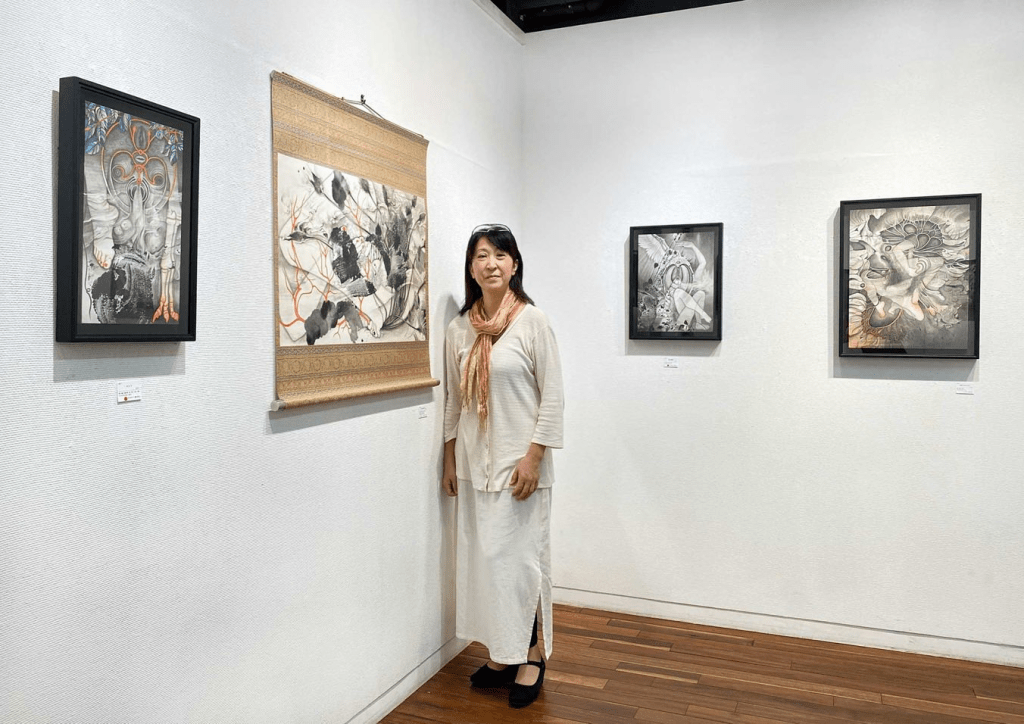
“The original form of the universe: the wildness of the zero point”
Michiyo Kamei exhibition at the Y art gallery in Osaka, Japan 2025

Michiyo Kamei Site

The Origin of the Universe: The Wildness of Point Zero
Michiyo Kamei Exhibition Art Gallery Shop

Palimpsest of Phantasm: An imaginary art garden
Vol. 1 Michiyo Kamei

ALL RIGHTS RESERVED. ARTWORK IN THIS POST IS A COPYRIGHT OF MICHIYO KAMEI. THIS AN AUTHORIZED PUBLICATION WITH PERMISSION AND EXPRESSED CONSENT.