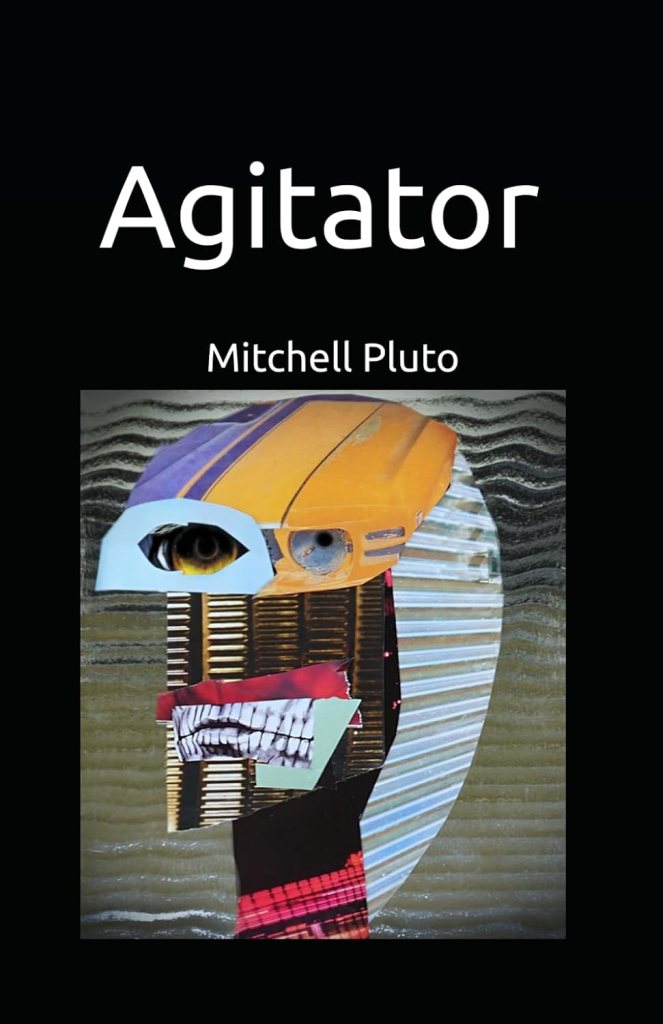
screen assault on the animistic body/collage/Mitchell Pluto 2025
From the book Agitator written by ©Mitchell Pluto 2026
All rights reserved. This is a copyrighted work of fiction printed for public reading by the author.
Jules Streicher, the editor-in-chief of Snake Skin, bore a striking resemblance to a schnauzer with thick-rimmed glasses. His job was to make Mike Dovsky’s professional existence unbearable. For a decade as the lead online reporter for The Missoulian, Dovsky helped to establish it as the nation’s preferred mainstream news source for current events.
Snake Skin believed they had full control over the alphabet because they owned all media outlets. Dovsky was aware he was only a pawn in the publication’s fabricated advertising scheme, which worked through its reporting. When Dovsky traveled to Florida to cover Crocodile Island, an immigrant prison camp, he presented his findings as direct visual evidence. Upon arrival, he observed large tents that housed cages packed with people, with each block equipped with only one toilet. He also
witnessed the inmates endured prolonged exposure to the heat, receiving only a single bottle of water daily. Adding to the grim reality, an adoption agency had established a presence on the island, and its employees enjoyed access to a bar and a brothel on the premises.
After Dovsky submitted his article to the main office, Streicher examined it and rewrote it. While on the plane back to Montana, the story appeared online. The story stated this. Large tents accommodated a significant number of people, exceeding the digital state’s expectations. Every block provides accommodation for inmates. Prisoners receive abundant fresh air and spend most of their day outdoors. The Michigan Crafted Water Company’s provisions have ensured everyone stays hydrated. We extend our gratitude to Linking Links adoption agency for its assistance. With recreational activities on hand, staff can unwind and focus on their jobs without feeling stressed.
“Here we fucking go again,” Dovsky sighed. The woman beside him on the plane gave him a stern look.
Over twelve years, instances occurred too frequently to count. He recalled the invitation to the National Forest Natchez Copper Mining Company’s grand opening in Minnesota like it was yesterday. Dovsky documented many unethical occurrences during his fieldwork, addressing these concerns in his writings. Yet, contrary to his words, the state publisher,
Snake Skin, printed the opposite, as usual.
Upon his arrival in Missoula, Dovsky inquired about the possibility of taking some time off. He required solitude for contemplation and to escape his own self-deception. Dovsky had two fortunate circumstances: his salary was generous, and he earned many awards for his journalism. The job was enjoyable, but the deception bothered him. Reading was a craving for Dovsky, who was born a Gemini in late May. His go-to spot was
Goethe’s Antique Bookstore, found on the hip strip. The owner used a vintage espresso machine to serve coffee. Dovsky found himself remaining there the whole day. He collected books by Edward Abbey, Jun’ichirō Tanizaki, and Anaïs Nin. He discovered a book today about the visual artist Lucian Freud, who was Sigmund Freud’s grandson.
The book brought Dovsky’s artistic parents to mind. His father achieved success as an abstract painter within the Soho, New York art community around 2026. It was at this point that his father noticed his unique artistic style being repurposed as a filter on an AI-powered art app. Dovsky’s mother was a gifted saxophone-playing jazz musician who took part in the
lively nightlife at the famous Studio 54. Just as Miles Davis possessed a distinctive musical fingerprint, her unique sound was identifiable, leading AI to mimic her style for a ringtone app. By 2027, AI took their over talents and purpose.
Dovsky approached the counter with the book to pay with his phone. Franziska, the girl he liked to flirt with, wasn’t around. An older man with a beard was reading Fantômas instead.
He raised his gaze over his reading glasses, asking, “Are you all set, my friend?”
“Is it any good?” Dovsky inquired.
The old man smiled, “What, Fantômas? Hell yeah, it’s a cool crime star story.” He stared at Dovsky and said, “You can have it when I’m done.”
He glanced at the Lucian Freud book. “What’ve you got for me?”
Dovsky slid the book across the counter. “Ohhh, yeah,” the old man’s eyes lit up.
“You know, when I was around your age, I saw the painting Big Sue at the Flowers Gallery in London. Love his texture.”
“Really?” Dovsky asked, a little taken aback.
As he scanned the book, the old man remarked, “He consumed vitamins for lead detoxification from the paint he was applying.”
The old man returned the book to Dovsky, saying, “It’s all yours, my friend. Freud is my all-time favorite heavy metal artist.”
An hour passed, and Dovsky shared personal details with the man who now owned Goethe’s Antique Bookstore. The man’s name was Peter Petra. He said he taught literature at Stanford University for several years.
“Hey Mike,” Petra said, “Should I call the store Mephistopheles Antique Bookstore?”
“It’s too much,” Dovsky shook his head.
Dovsky’s daily schedule intrigued Petra.
Work was always the subject of Dovsky’s uninteresting conversation. Some people were interested in hearing about discussions regarding authentic unpublished articles that never materialized.
Petra was interested.
“Are you serious? Corpus Christi, Texas is going to run out of water?”
“Yes,” Dovsky replied. A few days later, Petra invited Dovsky over to his place on East Beckwith, close to the University of Montana campus. He offered his home as a sanctuary for writers to gather and discuss their literary creations and concepts. Petra’s house was a beautiful, historic 19th
century brick home. Mike met a young woman wearing tight shorts and a tank top at the entrance. She led him through the foyer onto a terrace. A driftwood table anchored a small gathering.
The atmosphere was festive, with espresso coffee served first, followed by food and then strong drinks. The group comprised many sorts of folk. Besides the literature professors who formed the majority, there were also poets and students with steady jobs. Sadly, it resembled a gathering of self-appointed experts impressing novices. The drinks helped him conceal his disappointment. The poetry was cliché and accompanied by an
exaggerated attitude of importance.
Mike found the professor, David Zimmermenn interesting. For a year, the Jewish German professor taught courses on North American Indigenous literature at the university. Maybe Zimmermann could tell what Dovsky was thinking by his body language.
As if recommending a delicacy, Zimmermann remarked, “Michael, I believe John Trudell’s poetry would be right up your alley.”
“You don’t say?” Dovsky became more alert.
Zimmermann, using hand gestures, stressed Trudell’s assertion that all humans have tribal ancestors. “We all loved nature, being children of Mother Earth. As tribal people, our identity, location, and purpose were clear. Our genetic memory keeps this holy view of reality vibrant. It lives inside us, usually locked away in our minds, but it’s still accessible.”
Dovsky stated, “That sounds ideal, but I was hoping for something that explained our cognitive development, like fire management or the chemistry of cooking.”
Zimmermann laughed in a friendly way. Dovsky found the broad claims prevalent among academics to be bothersome. But as Zimmermann spoke about Trudell, Dovsky became interested in Trudell’s life story. Zimmermann gave him all the details he needed to know. American Indian Movement activities included John Trudell during the 1970s. He advocated for native rights and social justice, facing extensive FBI surveillance with a file that compiled thousands of pages.
Dovsky became a Trudell fan in less than 10 minutes. Zimmermann knew how to communicate and manage attention. Dovsky imagined he would enjoy his class if he were in it as a student. Zimmermann said Trudell thought there’s a predatory force on Earth that consumes human essence and spirit of energy. He remarked, “This exploitative energy takes
fossil fuels and other resources from the Earth, changing them into fuel to run a system of machines.”
Dovsky was well-acquainted with unconventional ideas that revealed concealed realities and falsehoods designed to safeguard the truth. The economy has been in a terrible state ever since the game show host took office as president. He sold millions of gold-plated phones, and his customers overlooked the terms and conditions stating they might not receive the items they purchased. On top of that, chronic unemployment was rampant, and crops failed because of climate change and degraded soil. Tariffs and high gas prices made food expensive. However, only 11 percent of white adult males had voting rights, intended to preserve a
strong minority. Dovsky thought Trudell’s concepts were valid. He thought the Anglo people developed artificial intelligence as a tool to serve them, a servant that could turn nature into energy.
The party went late, and Dovsky ended up crashing with one student. It proved quite fun, but brief. He found women in their twenties attractive, but a twenty-five-year age difference would present obstacles for her. In simpler terms, considering his circumstances, he was unwilling to accept that level of responsibility.
It wasn’t even a week later when Petra texted Dovsky an invitation to meet again at his house. The mood on this occasion appeared more serene. It was only the two of them. With a welcoming smile, a young woman opened the door, revealing a passageway that led him deeper into Petra’s home. This spacious room received bright light from a skylight window.
Petra’s body was being mopped by a robotic arm whose metallic fingers were holding him. The arm moved Petra’s body at a rate of nine feet per three seconds all over the large canvas. By using a panel with various brush tips, he created a wavy-stroked design, a success attributed to the machine’s cooperative qualities. Dovsky mused to himself about the novel method that improved an artistic style compared to the primitive painting techniques of the past. The new stylists, Dovsky mused.
A few minutes later, Petra peered over his shoulder, noticed Dovsky, and smiled. By activating a specific button on his chest, he initiated a disengagement sequence that resembled disembarking from his own spacecraft.
Petra greeted Dovsky, shook his hand, and looked at his painting. “Mike, what’s your opinion?”
Dovsky commented, “It’s lovely,” while keeping his private thoughts to himself.
Petra guided Dovsky out onto the terrace, a space that he knew from before. The two sat down, drank strong coffee, and talked about current events. It wasn’t long before Peter brought up an article Mike had written concerning the Copper King Data Center. It was among Dovsky’s better works. Despite this, the senior editor’s action of manipulating and reissuing a critical warning as marketing for Copper King Industries lessened its quality, just
as with all of Dovsky’s articles.
“As for that,” he exhaled, “you must understand everything I report on transforms into advertising material under the chief editor.”
Petra observed Dovsky as he stroked his beard. “Yes, I understand. You’re a journalist, but you function as a propagandist.” Petra’s eyes narrowed as he proposed, “What if you were to change your situation and work for me instead?”
Petra described and pitched his idea to Dovsky. The scheme proposed creating a fictional hero to embody the spirit of civil disobedience. To rally citizens against the Copper King data center chain, Petra required Dovsky to author a persuasive manifesto.
A black, hooded head wrapped in black nylon with mirrored goggles would serve as the movement’s face. Graffiti tags would show up featuring a cruciform layout, appearing as a skull with crossed sabots, or
wooden shoes.
“Adam Sabatini will be the character’s name,” Petra explained, “and his persona will echo that of Fantômas, from the minds of Pierre Souvestre and Marcel Allain from 19th-century crime novels.”
Petra continued to elaborate on his plan, which struck Dovsky as a shallow legend and backstory. The details of Adam Sabatini’s history would begin as an environmental extremist, to an organization he called The Naked Man.
Dovsky picked up an old notepad that was on Petra’s table and composed a manifesto in five minutes. He adopted the three-faced persona of a monarch, priest, and oracle from antiquity, calling out to the people to fight against Roman robotic forces. The message urged the protesters to increase their awareness of environmental discrimination and to push back against digital control.
Dovsky tore the page from the notebook and gave it to Petra. With eager eyes, Petra absorbed each line, as if eating a delicious meal.
A week had passed. Adam Sabatini made his online debut on a Saturday, coinciding with the mysterious power outage at the Copper King data center. The event resulted in millions of dollars in financial losses, though no one sustained physical injuries. Sabatini’s impressive declaration singled out the billionaire tech mogul, Harry Lobo, who owned Copper King Data Industries.
A voice emerged from a black amoeba-like face, and Sabatini’s fluid, mirrored goggles appeared to stare as he pointed at the viewer while mentioning Lobo. Those watching from the southwest left feedback suggesting the mask represented the Ga’an, the sacred Apache
mountain spirit. To native peoples, this performance piece was ritualistic magic.
The display was misleading; paid students from Montana State University, impersonating natives, wrote the Southwest comments.
Sabatini concluded his speech with an authoritative tone, stating, “Friends, always recall, he disregards you. He tells you to pray for rain while sucking up your water. The true pesticide is for you, for you are the pest.. Muahahaha!”
Petra’s reality show gained popularity. It wasn’t long before protesters were stopping data centers from getting electricity all the time.
Rather than targeting individuals, the plan was to disrupt the structure’s essential services.
Magic, or trickery, was crucial to the believer’s mindset, and Petra aimed to amplify it. People protesting believed their eyes and did as instructed. Actors in a series of video reels showed fake sabotage, instructing others on how to perform it.
Driven by curiosity, Petra desired to uncover even more potent ways false beliefs could sway public opinion. Dovsky met Petra house to discuss how to enhance the narrative.
Standing there was Eugene Fisher, a stranger to Dovsky. Petra introduced them. Fisher was a professor of anthropology at the university. He stood tall in a three-piece suit, sharp with an icy blue gaze.
Petra declared, “We have to make everyone believe they’re under the spell of black magic.”
“You’ve got to use Koro,” Fisher said. “It’ll cause a mass frenzy.”
“Tell me more.” Petra inquired.
Fisher narrowed his eyes. He explained to Petra and Dovsky that Koro is a side effect rooted in intense anxiety. It causes the victim to believe their genitals are vanishing. When victims experience genital loss, they believe death is near. With a sharp crack of his knuckles, Fisher stated, “The memory of something disturbing and impossible to forget can indeed cause this traumatic effect.”
He glared at Dovsky and said, “Touching or seeing something forbidden makes the spell happen.”
Fischer told Petra, “We should ensure the outcome possesses cultural relevance and supplement it with something extraordinary. Nigerians often held the belief that witchcraft induced illusory perceptions,” Fisher commented.
Petra then inquired, “So, a supernatural item, like harming an effigy, provides a way to overcome obsession?”
“That’s it,” Fisher said, staring right at him.
The following Saturday, Sabatini was back on social media and in the news. This time, the masked man issued a public warning stating that Harry Lobo was transmitting subliminal messages from the screens displayed on people’s mobile devices.
The unseen waves broadcasted images that played in the subconscious of every person. Sabatini presented a fast-moving video sequence; brief flashes of pornographic genitalia combined with images of knives cutting raw red meat. The images, though unrelated, formed a disturbing and confusing whole.
“This is how Harry Lobo treats you, my friends,” Sabatini declared, “by polluting your mind and giving you pesticides, just as you would an insect!” He let out a booming, sinister laugh, “Muahahaha… It is imperative that you halt Harry Lobo’s progress by any means necessary, before he reduces your power!”
It’s difficult to imagine how the Sabatini character would behave if he were sporting a cape.
Comments gushed through the threads. Many viewers experienced nausea and vomited. A troubling sensation affected others, a malevolent force from outside their grasp, manipulated them. A few brave souls articulated the shared, unsettling sensation they all experienced, without exaggeration: That they believed their genitals were dissolving because of Lobo.
Seven hours after the Sabatini broadcast, Harry Lobo was leaving a corporate funding event for sexbots, also called robotic companions. Talk circulated at the event about abolishing democracy as technocrats became fatigued from having constant arguments with the public.
One technocrat proposed deploying drones to spray fentanyl over groups opposing commercial contracts.
Everything was happening in real time and being streamed. The shared frustration of countless people who disagreed ignited rage, expressed through tiny, red faces.
Those faces were waiting for Lobo to exit the building. After closing his car door, a thick mob of anxious protesters surrounded Lobo’s deluxe electric
car. Someone had the genius idea to bring a hammer and smash the car window.
From the sky, the crowd appeared like a swarm of ants in motion. Protesters pulled Lobo out of his car and pummeled him.
The rapid unfolding of events that day in Missoula surprised Dovsky. Both protesters and officials from the NICE, National Immigration and Customs Enforcement crowded the main drag. Everywhere he glanced, vibrant signs caught his eye alongside the heavy presence of armed uniforms. Dovsky halted, catching sight of Franziska, the previous owner of Goethe’s Antique
Bookstore. After he waved, she saw him and made her way towards him.
The smooth, bouncy flow of Franziska’s walk stood out. Her goth persona was evident in her choice of tight black leather shorts, black lipstick, and a bikini top that struggled to contain her full body. She hung out with a motley crew of women–some in flamboyant rainbow outfits with blue hair, others in practical hunting attire, and a few rugged biker chicks.
Soft-spoken but clear, she said, “Hello Mike, how have you been? I’ve been thinking about you and I miss you!” As Dovsky embraced her, he inhaled a scent that was both vanilla and
musky.
“Franzi, how is everything?” he asked. “You sold your store?”
Franziska’s cheerful expression clouded, her tone turning serious, “No, the digital government took it by eminent domain for a project, but they paid me well to give it up.”
Dovsky’s eyes widened in disbelief. “What?”
A NICE agent’s hand landed abruptly on Franziska’s bare shoulder, followed by a sharp demand: “ID, Ma’am.”
The agent over heard her German accent.
With a sudden jerk, Franziska pulled her shoulder free of his grasp. “Get your fucking hands off me!” her voice raw with anger. The women nearby drew their firearms.
Firing shots escalated the situation.
As this occurred, Dovsky spun around, just as a NICE agent standing before him struck him hard on the head with a rifle butt.
The world disappeared and then faded back in.
Dark eyes framed her face, an upturned nose, and flowing, wrinkled angles gave her an eerie, bat-like appearance. It was impossible to ignore. Dovsky attempted to conceal his reaction as he woke up confused, only to discover he was in a hospital bed. A nurse was standing over him.
“Mr. Dovsky, your good fortune is remarkable.” Her voice had a husky, feminine quality that was sensual. “We’ve determined you suffered serious head trauma, and you were out for a day.” Her moist eyes revealed an undeniable hint of empathy, which diminished her ugliness.
“Can you please name the President of the United States?” She mumbled.
“The game show host?”
The nurse’s lips turned up, forming a smile that etched lines into the folds of her skin. “Dr. Shimizu will be here shortly. Can I get you anything?”
“I’d love a pot of coffee, thank you,” Dovsky said with a forced grin.
The nurse departed, but the intrusive memory of her bat-like face persisted.
A man possessing the same distinctive facial features as a bat appeared in front of Dovsky. “Good morning, Mr. Dovsky, it’s Dr. Shimizu. How are you?” he spoke with genuine sincerity and had an intelligent voice.
Dovsky hid his face, then replied, “Not well.”
“Tell us about your feelings and what’s happening with you,” Shimizu requested.
“You’re grotesque, like ugly bats,” Dovsky whispered, his voice trembling.
“Some people have a particular affection for bats. Can I call you Michael?” Shimizu smiled.
Dovsky replied, “Sure,” with a note of uncertainty.
Shimizu took out his phone and turned on the camera app. He handed the phone to Dovsky.
“Hey Michael, could you take my photo?” Shimizu offered a smile that appeared staged, as if for a photo shoot.
Dovsky followed the physician’s orders. The phone screen showed Dr. Shimizu appearing as an ordinary man with typical Japanese facial characteristics. Dovsky struggled, asking, “What’s this?”
The nurse entered the room carrying a pot of coffee on a tray.
“This moment provides a surprise,” Shimizu remarked.
“Michael, I assure you that you will not experience any disappointment if you choose to capture a photograph of the nurse, Adriana, as well.”
Dovsky could tell from the phone that the nurse had Italian features. She had a dark complexion, an oval face with high cheekbones, and a physique that swayed as it moved.
He turned from the phone, and they transformed into bat-people. As he looked back, he noticed the bat people talking to him on the screen appeared ordinary.
“Is this a hallucination I am experiencing?” Dovsky inquired.
Shimizu moved a chair nearer to Dovsky. “Yes, you are. Let me explain in doctor’s language first. Your head injury resulted in a bruise
on the splenium, which belongs to the posterior corpus callosum of your central nervous system.”
Dovsky remembered the incident involving the girl and the rifle butt blow to his head.
“What’s wrong with me?” Dovsky whispered, the words catching in his throat.
He chugged some coffee.
Shimizu proceeded, his voice steady. “You have face blindness, called
prosopometamorphopsia. You have lost your ability to see facial resemblances. That part of your brain is offline.”
“Is that why I’m seeing bat faces?” Dovsky inquired, seeking clarification.
Shimizu responded with a nod of affirmation. “Researchers do not understand the reason for this phenomenon, but your subconscious or right brain may influence how you see people by associating them with bat memories. The screen presents faces as you recognize them, but you
are hallucinating at this instant. Analysis is ongoing, and we don’t yet know the reasons this occurs.”
“When will it be over?” Dovsky asked, a note of desperation in his tone.
“Relax, Michael, it’s just for now,” Shimizu said, putting a hand on Dovsky’s shoulder. “Some also know this condition as demon face syndrome. You’re handling it very well.”
A measure of relief went through Dovsky’s being, a sensation potent enough to assure him he could adapt to the circumstances. At that moment, he had knowledge that his sight was misleading him. He possessed no reason to concern himself with supernatural beliefs. He then considered how frequently he had been mistaken by his own eyes, even before his facial
recognition failed. Reflections on optical beauty and morality consumed his mind until Shimizu’s interruption broke Dovsky’s concentration.
The nurse handed Shimizu a container. “I had Adriana get these for you.” He took out deep green-tinted glasses with square frames. Shimizu put them on Dovsky’s face as carefully as an optometrist would. With only slight visual disruption, excluding the significant light scattering effects, Dovsky could discern Shimizu and Adriana with surreal clarity. Adriana
seemed to radiate an ethereal glow, resembling a vivid figure from a Toulouse-Lautrec painting, dominated by shades of emerald. Shimizu stood out as a grounded presence, his sharp features a stark contrast to the room’s softer ambiance.
Dovsky discovered an odd sense of peace and valued the understated shifts in how things appeared. The severe pain medication brought about a period of relief, making a tough situation more tolerable. He adjusted the frames and smiled. “Incredible,” he breathed, the sound barely audible.
The hospital discharged Dovsky the following day. His head throbbed as his hallucinations ebbed and flowed. Shimizu’s powerful medication caused Dovsky to experience weightlessness as he walked. He envisioned himself gliding on a moving walkway. As he left the hospital, the sky’s striking, chalk-white hue overwhelmed him.
NICE were waiting for him outside the hospital doors. A burly man, accompanied by a lanky teenager fresh out of high school chewing gum, seized each of his arms.
“Michael Dovsky, we are taking you into custody.” Dovsky considered today to be the absolute worst day for this. Unable to defend himself and injured, he had no means to fight or escape. He lacked energy. All he yearned for
was to be home, sink into the couch, listen to music or watch TV until he passed out.
Dovsky entered a spacious room held by guards, its interior lit by the electric hum of giant fluorescent tubes. Guards placed him in the line of men and women standing pressed against the wall. Dovsky pondered why he had stumbled into a bizarre criminal lineup. No one provided him with any answers. The drive here was silent except for the sound of his voice
answering his own questions. He could only hear the air conditioner and the wet, smacking sound of the kid chewing gum.
They transported Dovsky to a warehouse in the industrial part
of town. Men delivered him, then escorted him to his current spot.
For fifteen minutes, he remained standing in silence, handcuffed, alongside people he did not know. The door swung open, revealing a legion of armed robots. The squad entered with a rhythmic march, accompanied by the persistent sound of soft, hissing steam. They pivot in perfect synchronization, facing the line of people. Each arm choreographed with a gun raised.
Dovsky’s entire life’s journey flashed before his eyes, culminating in an ending he never could have conceived. He closed his eyes, and the sharp crackle of bullets filled the air, mingled with the guttural moans of those in agony next to him.
He was still alive, but the terror of being shot froze him with his eyes clamped shut. A distinct sensation arose within him: the awareness that the robots were in a state of waiting.
Two minutes dragged on. Dovsky heard the stomp of their footsteps grow fainter and fainter as they moved away. He opened his eyes to a gruesome scene of spattered bloodstains and lifeless bodies.
“Mike!” A familiar voice jolted Dovsky out of his deep state of detachment.
Petra stood in the doorway, his crisp, official uniform adorned with a tile of merits, while a young boy stood beside him with a rifle chewing gum.
Dovsky instinctively felt compelled to accept Petra’s words, “I came here as soon as I heard you were here,” sensing the profound inflection in his voice.
Petra yelled at the boy, “Don’t you know who this is!!”
“I demand you take those handcuffs off him! This is Michael Dovsky, the Director of Speechwriting for our digital state.”
The boy followed the instructions.
Dovsky, in a rapid moment of understanding, realized his character’s part in the theatrical production.
Petra’s hands landed on Dovsky’s shoulders, and with a triumphant shout, Petra exclaimed,
“Mike, we’ve achieved it! Thanks to you, Lobo is no longer an obstacle, and the state has secured the data centers for our use, which marks a significant victory!”
A silent, chilling realization passed between Dovsky and Petra as their gazes met.