To the Grand Old Oak behind the Grapevine, To the Slippery Elm in the East, To the Multiflora Rose and Perilla Mint, And at the Blue Mistflower, do I cease.
Atop Ingomar Mound, I give Tobacco and thanks, Where Osage Orange and Honey-Locust defend A stone pyre kindled at the height of the heart Thy Holy Spirit, O my God, do Thee send!
Amen, amen, and amen!
Appear to me in the Frostweed— In the leaves and in the flowers and in the roots, In the scented bark of the ancient trees, And among the Sassafras shoots.
Arrow shafts of light pierce my eyelids, Icy feathers of wind caress my hands. Earth gathers Herself beneath my feet Where the rushing waters touch the land.
P. D. Newman has been immersed in the study and practice of alchemy and theurgy for more than two decades. A member of the Masonic Fraternity, the Society of Rosicrucians, and the Martinist Order, he lectures internationally and has published articles in many esoteric journals, including The Scottish Rite Journal, The Masonic Society Journal, and Invisible College. The author of Alchemically Stoned and Angels in Vermilion, he lives in Tupelo, Mississippi.
The psychedelic, psilocybin-rich species, Psilocybe cubensis, is a coprophilous mushroom. This means that it can only subsist in the wild upon the dung of certain animals, especially cattle. While native to Cuba (hence cubensis), this fantastic fungus has been documented in a number of southern states, including Florida, Georgia, Alabama, Mississippi, Tennessee, Arkansas, Louisiana, Texas, South Carolina, North Carolina, and even as far north as Oklahoma, Virginia, and West Virginia—albeit rarely in these latter three. The species is also found in Hawaii. It was in the state of Louisiana, however, amidst its humid cattle fields and dank, swampy marshes, where African American sharecropper, Denver Moore—then just a boy—first underwent what may be an early example of psilocybin mushroom use in North America.
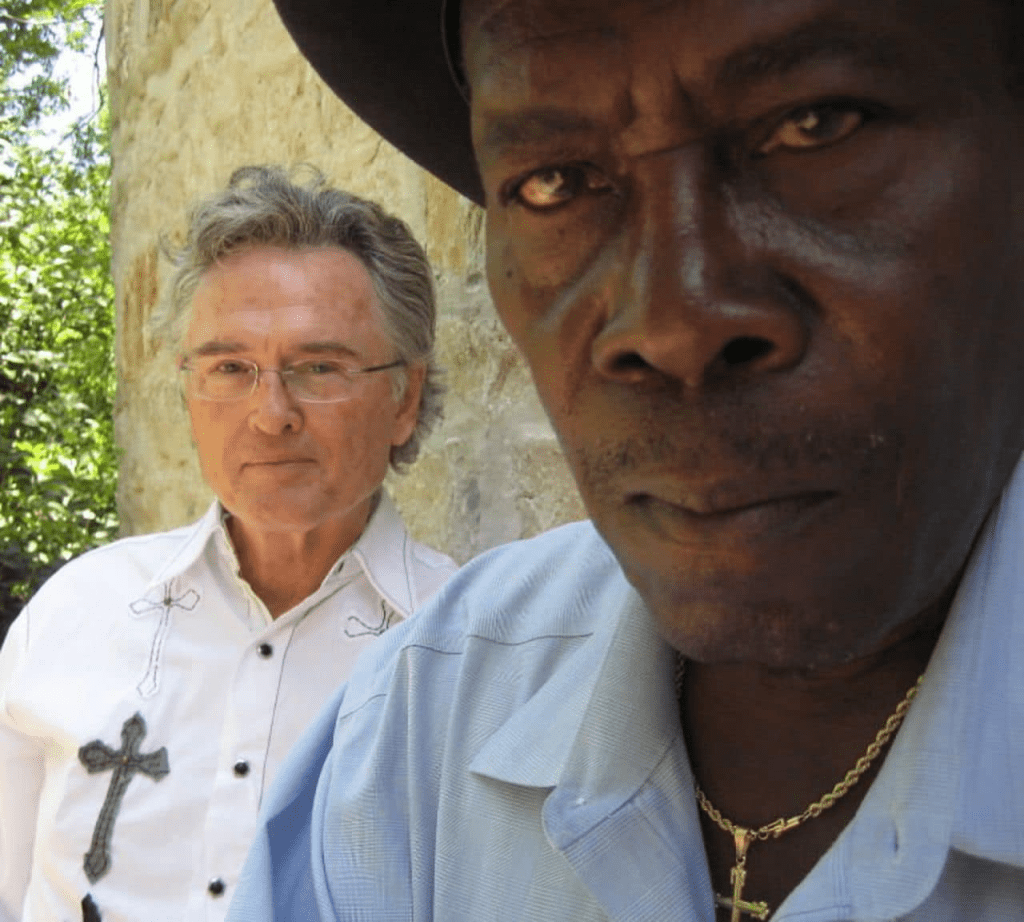
As the book says, Ron Hall and Denver Moore’s New York Times Bestseller, Same Kind of Different as Me—an amazing true tale of a modern-day slave, an international art dealer, and an unlikely woman who brought them together—is a story filled with hardship, betrayal, and the brutality that lines the hearts of some men. But, it’s also a story of hope and perseverance, mottled throughout with thought-provoking anecdotes about black life in the Deep South in the 1950s. Descended from African American slaves, Denver Moore was raised on a scorching southern plantation near the alligator-riddled, mosquito-infested swamps of Louisiana. Having very few monetary resources, Moore was blessed to have an incredibly resourceful wise woman of an aunt, a Conjure woman—called Auntie Etha—who, with the aid of traditional African American folk remedies, was able to help the Moore family make the most of an often difficult situation. Moore recalls,
Lookin back on it, I think Auntie was what you might call a spiritual healer, like a ‘medicine man,’ cept she was an elderly woman. […] Big Mama made me go show my respect and also to help Auntie gather up the fixins for her medicines.
She used to take me with her down by the swamp where she’d be gatherin up some leaves and roots. […] ‘Now Li’l Buddy, this here’s for takin the pain out of a wound,’ she’d say, pullin up a root and shakin off the earth. ‘And this here’s for pneumonia.’
[…] She had a room in her house with a big table in it covered with jars in all kinda sizes.
‘See them jars?’ she told me one time.
‘Yes, ma’am.’
‘In each of em, I got somethin for anything that happens to you.’
[…] She had some kinda spiritual thing goin on in that house. Every time I went in there, she made me sit on a little stool in the same spot, even facin in the same direction, like she didn’t want me to mess up whatever voodoo she had goin on in there.
Moore’s charming description of Auntie Etha clearly betrays her as a practitioner of Hoodoo, known in the Mississippi Delta as a “Rootwork” or “Conjure,” even going so far as to evoke the term, “voodoo,” in his account.
Hoodoo, a traditional African American spirituality that arose from several West African traditions as the same were imported into the New World, may not be stranger to psychoactive plants. For instance, while not entheogenic itself, one of the most common charms carried by Conjure practitioners is the root ball of the Ipomoea jalapa vine, referred to as a “High John the Conqueroo” root. Some species of Ipomoea (morning glory), such as Ipomoea tricolor and Ipomoea corymbosa, are possessed of the hallucinogenic compound, ergine, also known as d-lysergic acid amide (LSA)—a close cousin to Albert Hofmann’s “problem child,” lysergic acid diethylamide (LSD-25). In 1938, Ipomoea corymbosa (formerly Rivea corymbosa), for example, was discovered by American biologist, Richard Evans Schultes, to solve to problem of the identity of the ancient Mexican hallucinogen, Ololiuqui. The formidable effects of Ololiuqui were noted in the colonial document, The Florentine Codex, from the 16th century:
It inebriates one; it makes one crazy, stirs one up, makes one mad, makes one possessed. He who eats of it, he who drinks of it, sees many things that will make him afraid to a high degree. He is truly terrified of the great snake that he sees for this reason.
Francisco Hernandez, the famous Spanish physician, also discussed Ololiuqui in his book, Rerum medicarum Novae Hispaniae thesarus:
When the priests of the indians wish to commune with the spirits of the dead, they eat these seeds to induce a delirium and then see thousands of satanic figures and phantoms around them.
Ergo, there was already a history of the Native use of hallucinogenic morning glories in the Americas long before the arrival of African slaves. But, that doesn’t necessarily mean they learned of jalapa through Native Americans.
Century Illustrated Magazine (1881-1906), XLI, 825.
Before going any further, it is important to note that some African cultures are known to be in possession of their own rich, entheogenic traditions—independent of the export of African slaves to the New World. The Bwiti cult found among the Puna, Mitsogo, and Fang tribes in Gabon and Cameroon, for instance, employ the inebriating root bark of the West African shrub, Tabernanthe iboga, in their lively initiations. Like the “High John the Conqueroo” charms cherished by Southern practitioners of Hoodoo in North America, iboga is harvested from the roots of the shrub, linking the Bwiti cult, at least in spirit, to the black “rootwork” of Southern Hoodoo—a tradition whose own roots are to be sought in the religious practices of the Bantu of the former Kingdom of Kongo in west-central Africa. In fact, when iboga was first documented by the West, English traveler and author, Thomas Edward Bowdich, reported that,
The Eroga, a favourite but violent medicine, is no doubt a fungus, for they describe it as growing on a tree called the Ocamboo, when decaying; they burn it first, and take as muchas would lay on a shilling.
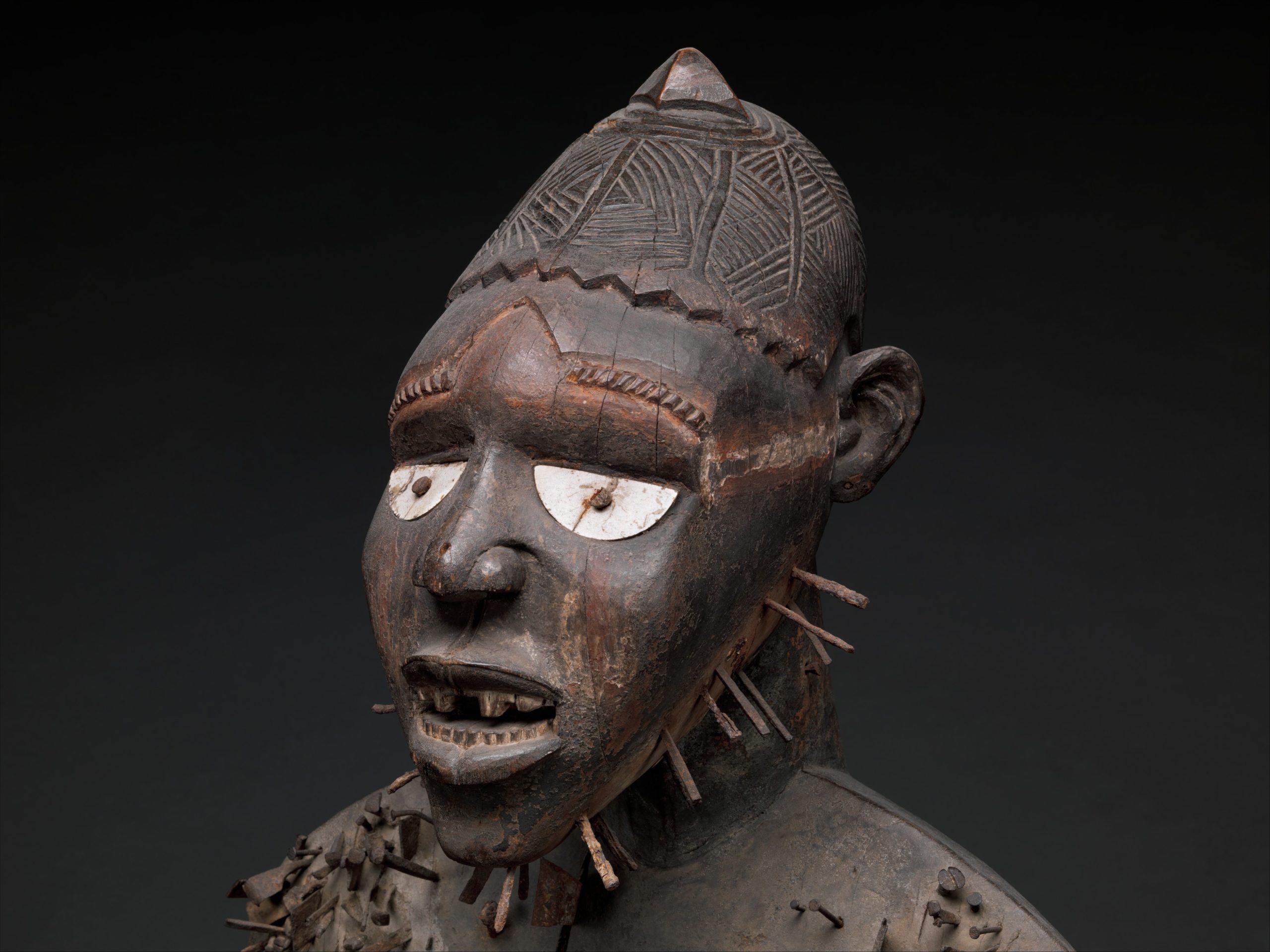
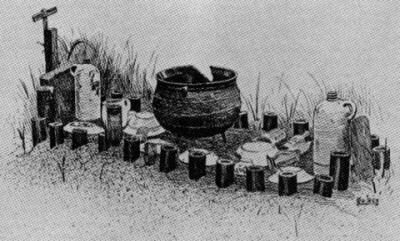
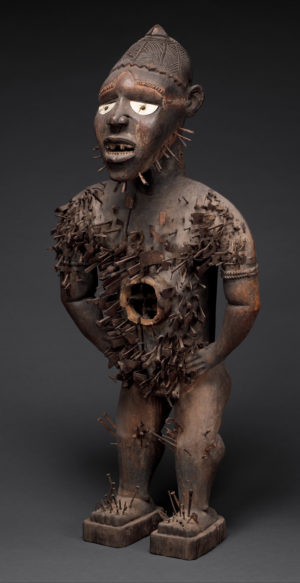
While this Englishman is no doubt in confusion regarding the identity of iboga, his observation suggests that some species of fungus was sacred to the Indigenous of the area. And, indeed, a tree fungus, known as tondo, was in fact central to the construction of nkisi statues, whose “kondu gland”—a hollow chamber in the belly of the statue—held samples of the unidentified specimen. One Bantu nganga, making an offering of the mushroom to the spirits, referred to tondo as “the key that opens everything.” The Kongolese and African American practice of surrounding the gravesite of a loved one with inverted plates and saucers, often resting atop poles or sticks, was believed to imitate the appearance of mushrooms around the burial. According to one source, this curious form of grave decoration was meant to recall and old Kongo play on words: tondo / matondo. For, in Bantu, the word for mushroom (tondo) is similar to the word for “to love” (matondo).
Power Figure (Nkisi N’Kondi: Mangaaka), Kongo peoples, mid to late nineteenth century, wood, paint, metal, resin, ceramic, 118 x 49.5 x 39.4 cm, Democratic Republic of Congo. Medicinal combinations called bilongo are sometimes stored in the head of the figure but frequently in the belly of the figure, which is shielded by a piece of glass, mirror, or other reflective surface. (The Metropolitan Museum of Art)
To return to the Americas, Schultes also identified the Aztec psychedelic, Teonanácatl, as belonging to the Psilocybe genus. But, Denver Moore’s would appear to be the first account of the possible use of a psilocybin mushroom within the context of Conjure, as the same was practiced by African American slaves in the Deep South. Many Hoodoo practices continue to be shrouded in secrecy. So, it may be impossible to determine just how far back this tradition among African Americans extends. But, as the famous Tennessee Hoodoo practitioner, Doc “Wash” Harris, founder of the infamous Saint Paul Spiritual Holy Temple in Memphis—inappropriately known by locals as “Voodoo Village”—once said in an interview with the Commercial Appeal in 1984,
God told the black man and the Indian somethings he didn’t tell nobody else.
One of those things may have concerned the powerful effects of a particular species of dung-loving mushroom.
Reminiscing about his great, wise Auntie, Moore briefly continues,
Aunt Etha took care of our bodies and souls. Mostly we never got very sick, but when we did, my auntie sure ‘nough had the cure: Somethin she called ‘cow-lip tea.’
Now cow-lip tea was brown and thin, kinda like the Lipton tea the Man sold at his store, but a durn sight more powerful. Cow-lip tea come from them white toadstools that sprout outta cow patties. […] That’s where cow-lip tea got its name. ‘Cow’ from the cow patties and ‘lip’ from the Lipton. Least that’s what Aunt Etha always told me.
The way you make cow-lip tea is you get the toadstools […] and grind em up in the sifter. [You] put it in a rag and tie a knot on top. Then you add a little honey to a boilin pot and drop that rag in the water til it bubbles up and turns good and brown. Now you got cow-lip tea.
If I was sick, Aunt Etha’d always make me drink a canful.
‘All good medicine tastes bad!’ she’d say, then put me in the bed underneath a whole pile a’ covers, no matter whether it was summertime or wintertime. In the mornin, the bed’d be soppin wet and the sheets’d be all yella, but I’d always be healed. I was nearly grown before I figured out what I was drinkin.
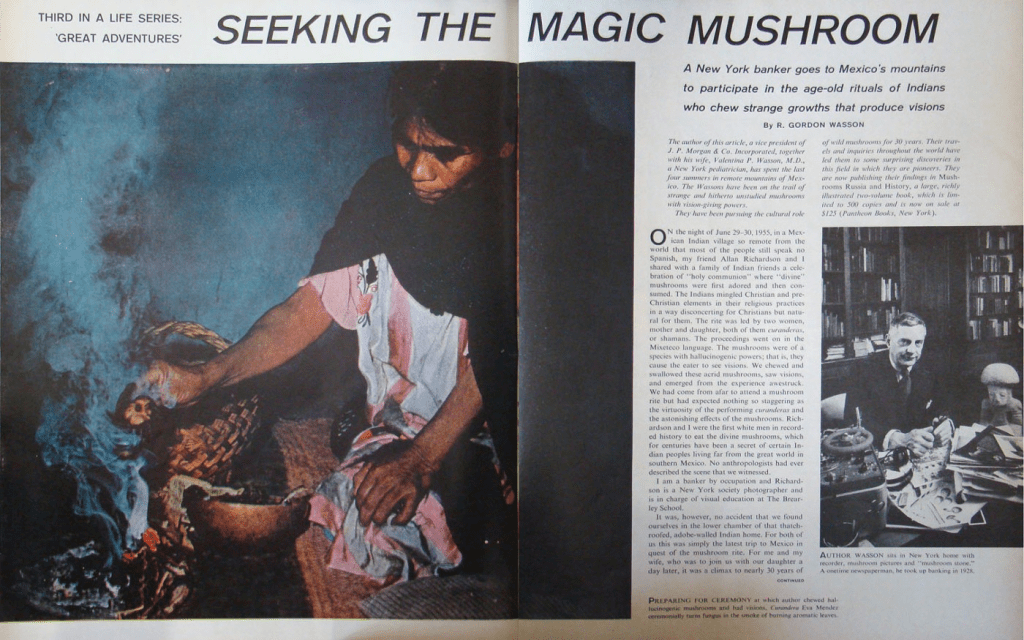
This historical narrative is simply amazing. Psilocybin mushrooms weren’t brought to the attention of the broader West until 1957, with the publication of the paradigm-shifting photo essay, “Seeking the Magic Mushroom,” in LIFE magazine by R. Gordon Wasson—the “father of ethnomycology.” Moore’s account is at least contemporaneous with Wasson’s publication. But, considering that this particular treatment was likely a timeworn tradition handed down to Auntie Etha by her own teacher(s), it is very probable that this particular use of the fungus went back much earlier than the time of Moore or his Auntie Etha. While no psychedelic effects were noted by the author, the mere fact the mushroom tea was administered in a medicinal context, to treat a sick boy, is highly significant. For, the Mazatec ceremony to which Mexican curandera, María Sabina, invited Wasson, the same wherein the psilocybin mushrooms were ingested, was also explicitly medicinal—velada being the traditional name given to the mushroom healing vigils carried out by Mazatec “shamans.” Moreover, if Moore was administered Auntie Etha’s tea while suffering a high fever, any psychedelic effects—including hallucinations—may have simply been attributed to the symptoms of the contracted illness.
“Seeking the Magic Mushroom,” in LIFE magazine by R. Gordon Wasson 1957
Importantly, Moore’s account is not the sole evidence of the use of entheogenic concoctions in the practice of Hoodoo. Over twenty years before the experience described in Same Kind of Different as Me, African American author, Zora Neale Hurston, in her 1935 classic, Mules and Men, revealed her own experience with what is quite clearly a powerful yet unnamed hallucinogen.
…I had to fast and “seek,” shut in a room that had been purged by smoke. Twenty-four hours without food except a special wine that was fed to me every four hours. It did not make me drunk in the accepted sense of the word. I merely seemed to lose my body, my mind seemed very clear. […] Maybe I went off in a trance. Great beast-like creatures thundered up to the circle from all sides. Indescribable noises, sights, feelings. Death was at hand! Seemed unavoidable! I don’t know.
While Hurston’s report does not mention hallucinogenic fungi specifically (or any other substance for that matter), the obvious psychedelic nature of her account is a good indication that entheogenic plants were not unknown to Hoodoo practitioners such as Denver Moore’s Auntie Etha.
Miguel Covarrubias’ Illustration for “Mules and Men” Zora Neale Hurston/ Lippincott, Philadelphia, 1935
Denver Moore passed away in 2012, so we were unable to interview him concerning his spectacular narration. But, it is our hope that Moore and his Auntie Etha would have been proud to know that their legacy not only lives on, but it may change the narrative as we know it regarding both the history of ethnomycology and the practices of Hoodoo and folk medicine among African Americans living in the Deep South.
P.D. Newman is an independent researcher located in the southern US, specializing in the history of the use of entheogenic substances in religious rituals and initiatory rites. He is the author of the books, Alchemically Stoned: The Psychedelic Secret of Freemasonry, Angels in Vermilion: The Philosophers’ Stone from Dee to DMT, and the forthcoming title, Day Trips and Night Flights: Anabasis, Katabasis, and Entheogenic Ekstasis in Myth and Rite. The Secret Teachings of All Ages (TV Series documentary) 2023.
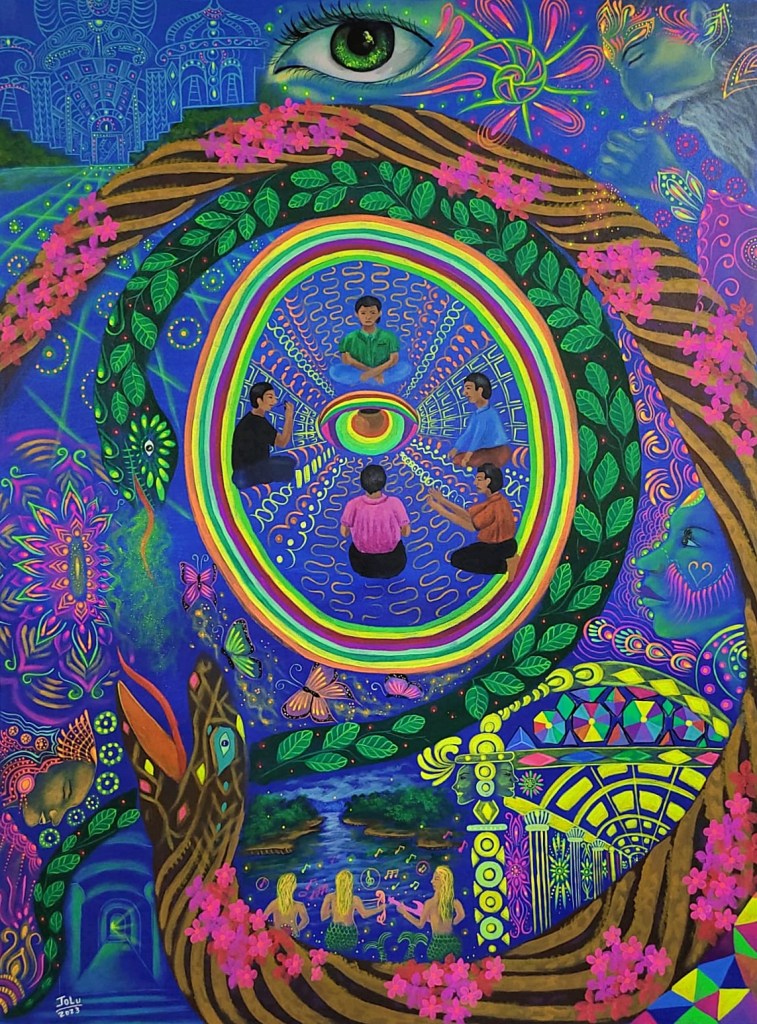
My visionary artworks are based on the two plants needed to prepare the ayahuasca brew. A snake emerges from the ayahuasca vine, surrounded by fuchsia flowers. There is also another snake, the chacruna snake, green in color with its luminous leaves. Radiation comes out of his mouth. The chacruna snake penetrates the ayahuasca snake, producing the visionary effect of these two magical plants.
In an Ayahuasca ceremony, the master and his disciples are covered by rainbow-colored radiation emanating from the ayahuasca and chacruna plants. The combined effect of these plants is esoteric: due to their supernatural properties, psychic bodies are created that the eyes have never perceived before, so that one is overwhelmed by this strange new dimension. This world penetrates the top of the head so that the aura stimulates a gland between the eyebrows and activates the third eye.
Ayahuasca reveals its deepest secrets when the visionary dizziness is strongest. They show that human beings need to create a balance between their good and bad sides.
Through ayahuasca you learn to express in thoughts, feelings and words that “I am” and “I exist”. If a person thinks or says, “I am nothing and I have nothing,” she is extinguishing his spiritual strength and is doomed to failure. It is important to think inspired thoughts and say empowering words about yourself and others, rather than complain about the negative aspects of a person, as we all embody both positive and negative qualities.
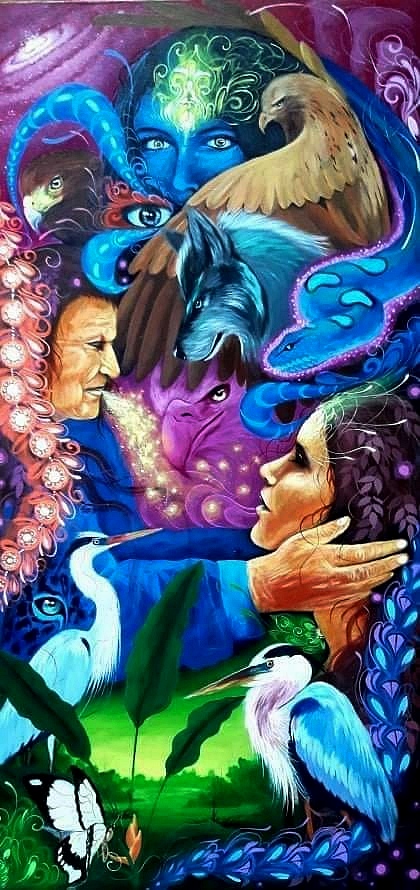
Ikaros
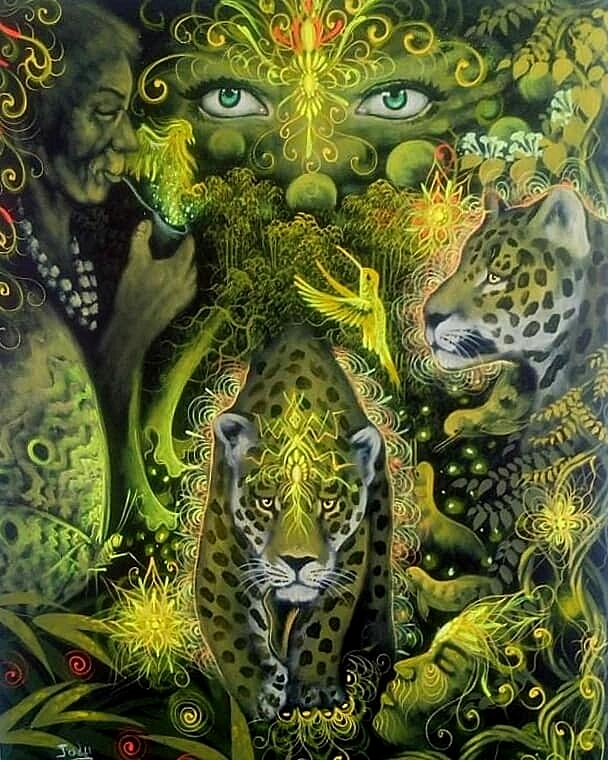
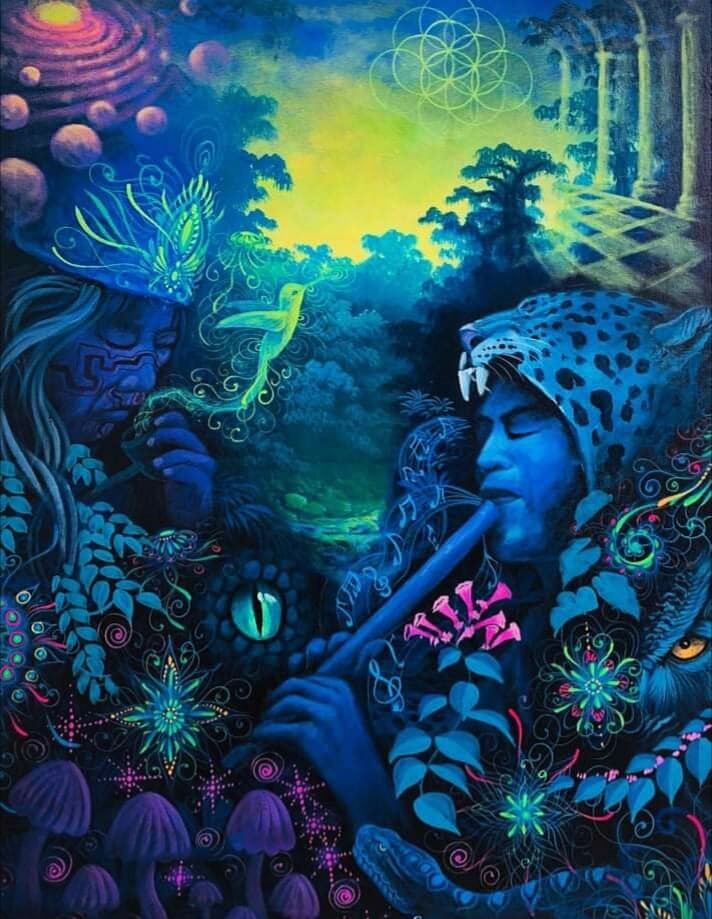
This work represents all the magic songs that shamans use to cure various diseases, these magic songs are called Ikaros. The ikaros or magic songs are taught by spiritual beings especially by animal spirits, that is why in this painting I have captured various animals with different powers.
The Eagle is considered the supreme emblem of the gods, rulers and warriors. It is a symbol of majesty, bravery and spiritual inspiration. Being seen as the lord of the air personifies power and speed.
The personality of the snake means wisdom, power and health, it is an animal that represents strength and unsurpassed superiority.
Some attributes of the Wolf are: intelligence, cunning, communication, friendship, loyalty, generosity and compassion.
In the realm of spirit animals, the tiger places a special emphasis on raw feelings and emotions. The tiger spirit symbolizes primal instincts, unpredictability and the ability to trust yourself. By affinity with this spirit animal, you can enjoy dealing with life issues spontaneously, relying on your intuition and acting quickly when necessary.
Finally the heron and the butterfly represent self-sufficiency, stability, tact and careful foresight. In other words, you will achieve great success through your efforts. Visioning with these animals signifies your ability to explore and delve into your subconscious.
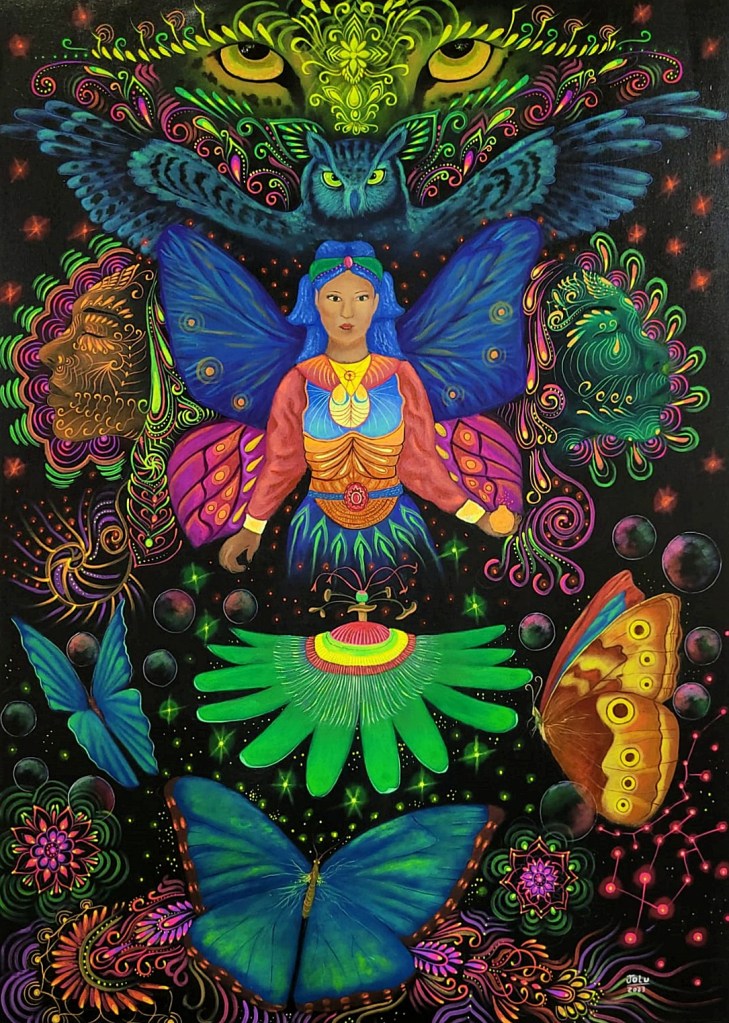
Arcanes of the Ayahuasca Star
In the Amazon there are several types of ayahuasca, these lianas go to the infinity of the universe, meandering many colors, among them the orange color, known as “Ayahuasca Star”, a color that shines in this visionary work of art.
The “Arcanes” are protection spirits of the shaman, and of the magic liana Ayahuasca, these are presented as people, animals and plants.
On the left side of the work you can see two arcana presented by a tiger and an owl. This is a vision that surprises shamans, because they emerge from the ayahuasca rope. The spiritual tiger contains the almost impenetrable depth of the science of ayahuasca and the spiritual owl represents the ayahuasca vine. These spirits are concerned with the esoteric force of ayahuasca. In these animals, the sense of smell and the eyes are full of hypnotism that are sharpened through rhythmic movements, when these animals prepare to act on something. The masters, who acquire the strength, the cunning and the sharp eye that hypnotizes these spiritual animals, become expert healers of both natural and artificial cures, because the shaman has learned from the intelligence and powerful and intelligent minds of these animals.
In the upper central part of the painting we distinguish a face with a yellow halo; this is the reflection of the mind. It is there that a master healer perceives and feels the rhythmic formation of life, with its forms and motifs that intermingle with its vibrant colors and sounds. There, the teacher is filled with knowledge, when he knows the value of colors; Color reflects human behavior, whether people are good or bad based on dark or light colors. This is also true for the sounds that we carry inside our bodies and external sounds.
In this painting you can see a master shaman, with the degree of “Sumi-Runa” (a man of much knowledge and hidden wisdom), he feels the astral ether very strong, something that is unknown to humans who do not know spiritual things , only with their physical eyes they see the matter that is the deformed space. The Sumi-Rune, Bank-Sumi, Murayas and others who have these high esoteric degrees were for the most part illiterate and naive Aborigines in what is modern culture, but they were integral human beings; a great Sumi-Runa teacher, or any other spiritual degree, seems like an innocent, that when one sees him, it appears that this person knows nothing, yet he covers the infinite knowledge of millions and millions of years, managing to know the kingdoms spiritual of sublime purity. When these great masters travel in time and infinite space they unite spiritual corpuscles to their bodies that form dimensional aureoles that encompass incalculable spaces in the universe, in the process of these trips they see present things where they understand that the past and the future is within the present. For these spiritual beings everything is present, there is no past or future.
Behind the master shaman “Sumi-Runa”, there is the Situlle plant, a plant that grows vines and bitter herbs. Then we see the hawk called “Tive-Mama”. The teacher uses this bird as a guardian who watches the depths of the rivers. The hummingbirds and yellow toad help people to be confident, diligent, active, prepared, optimistic and self-confident.
In the lower left part of the work, a blue snake with a pink aura is seen. The pink color represents Altruism, Philanthropy and Generosity. The blue color represents confidence and tranquility.
Ayahuasca offers a lot of spiritual teaching and physical, mental and moral health. Human wisdom produces various pleasures, such as the experience necessary to obtain material wealth, but not to bring true happiness or lasting satisfaction as spiritual knowledge and spiritual wisdom do. Whoever uses the ayahuasca drink must know how to diet to receive the cure; This is the basis for strengthening the health and proper functioning of the body. It is very, very good to meditate while looking at this painting; In this way you will hear the roidash (spiritual message).
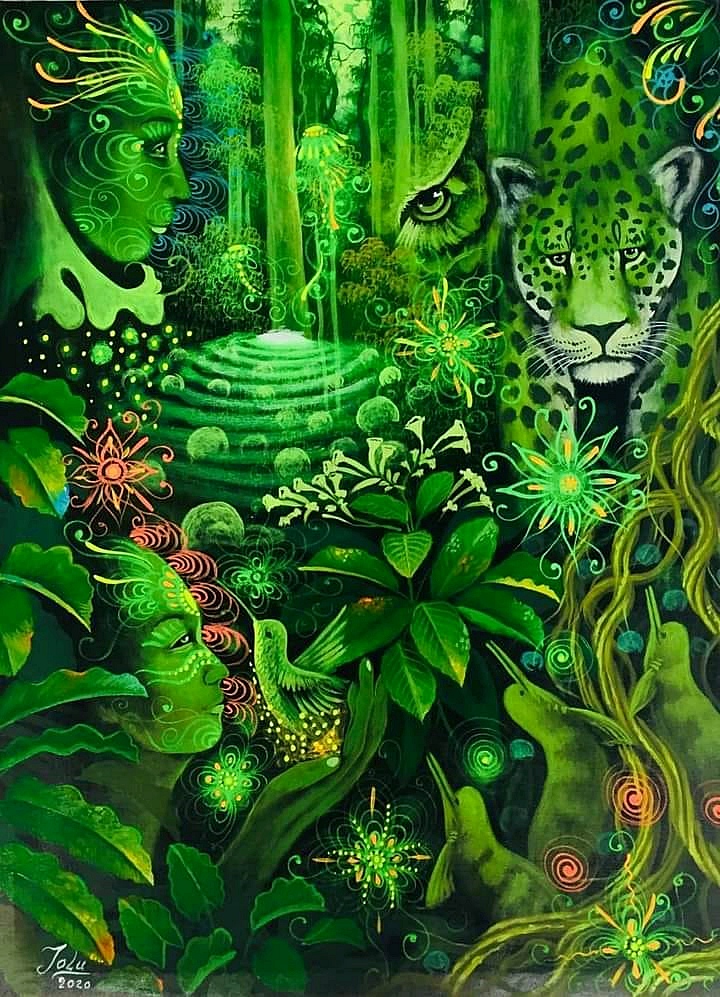
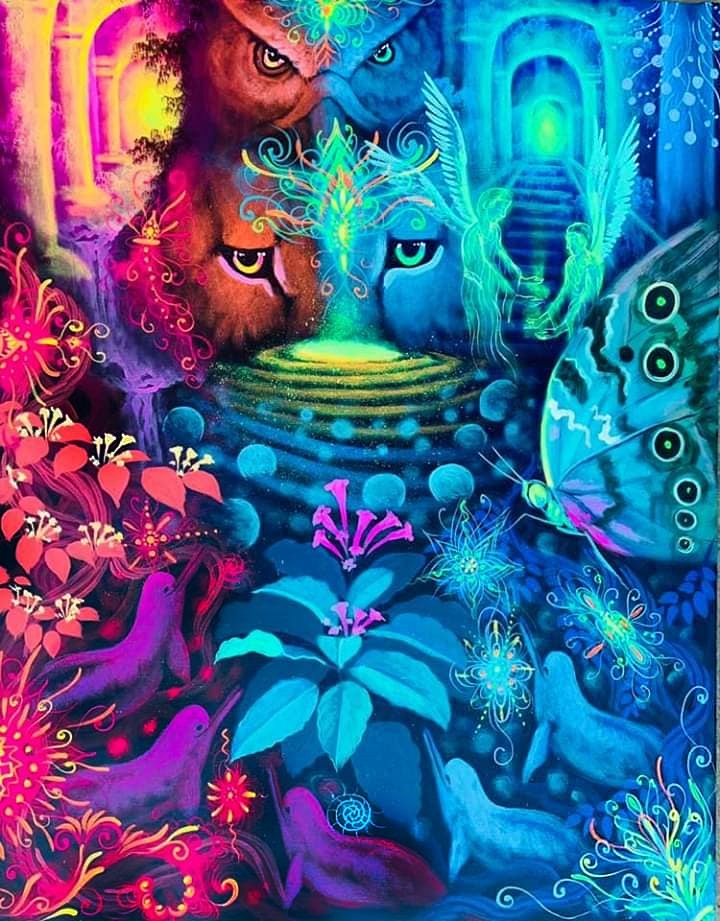
Arcane of the Ayahuasca Bell
There are different types of ayahuasca in the Amazon. These lianas go to the infinity of the universe and meander in many colors, including Campana Ayahuasca green, a color that shines in this visionary work of art.
The arcana are protective spirits of the shaman and the magic liana Ayahuasca, who are represented as people, animals and plants.
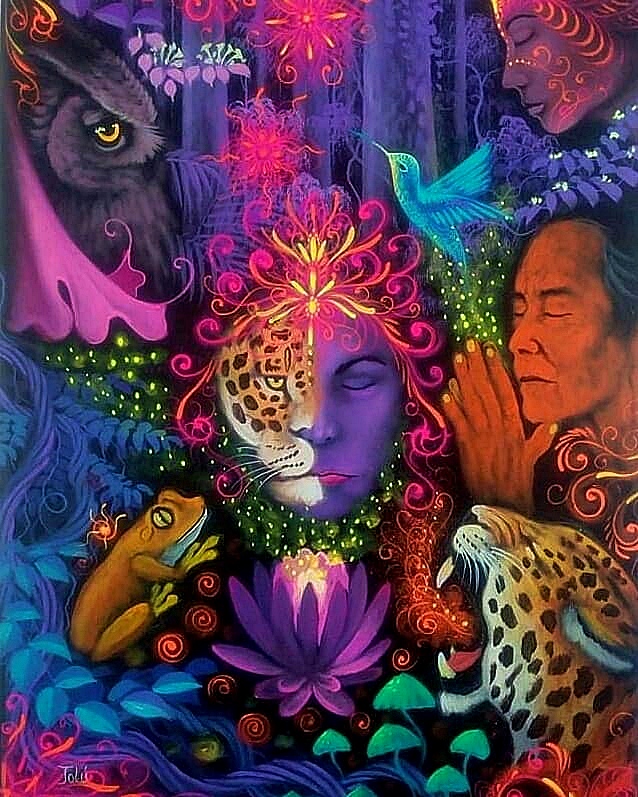
At the top and bottom left of the work are the faces of two female spirits with healing abilities, the female spirits take care of the vegetation and the water. These spirits are called “Sacha – Huarmi”, which means “wild woman”; Therefore, plants and flowers together as “Toé”, the “Toé” flower can be seen at the top next to the spiritual face and in the central part of the work, this flower represents the strength that it has. The Floripondio The plant full of electromagnetism, that of The use of shamans for defense is also used for harmful and contagious diseases and for the relief of blood.
In the upper middle part of the work you can see the eye of an owl, these birds that the Master’s healing shaman uses to defend himself from his enemies that attack him from the ground.
We also observe a spiritually named tiger called “Puyo – Puma” in the upper right part of the work, which means “tiger in the cloud”. One of its characteristics is knowing the movement of the earth and making each enemy inactive. . He is very brave in his attacks, but he is very careful. These tigers go through the session or ceremony and give the shaman great healing power for vibrations and powers to fend off the evil of a magician acting against him and his disciples.
The dolphins or bufeos that can be seen in the lower right part of the work are spiritually present in the Ayahuasca ceremony or ritual to allow better vision and meditation. There are the spiritual powers of the gods and goddesses, these energies are conjectures.
“Looking at the spiritual world means seeing another latent world”.
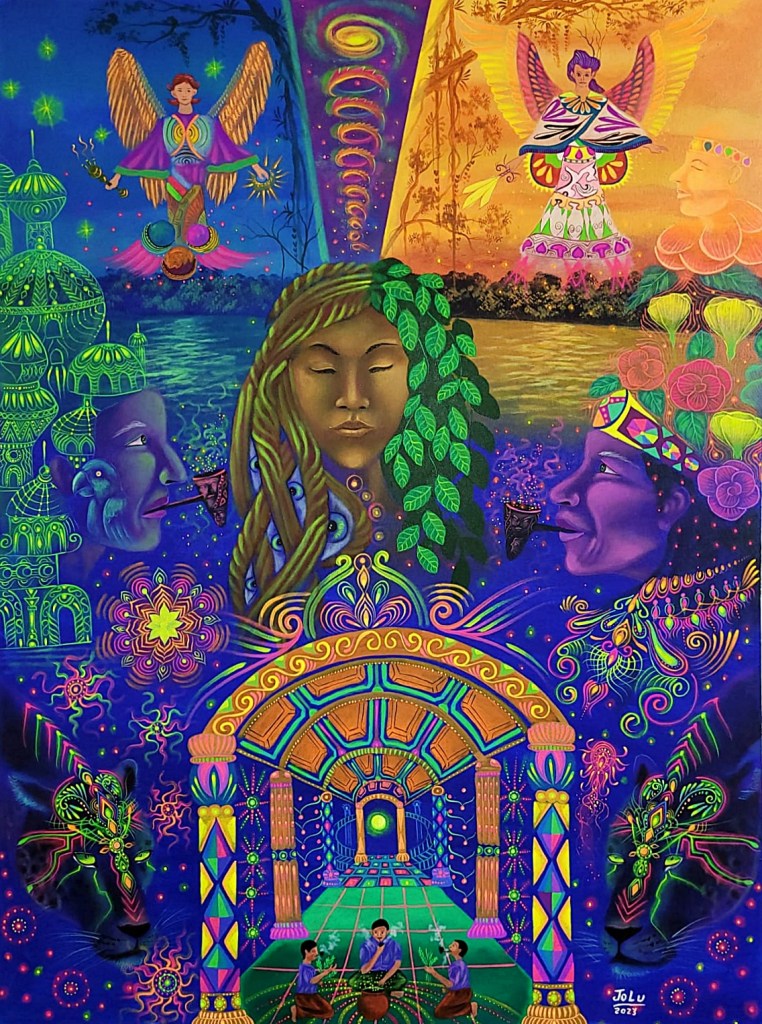
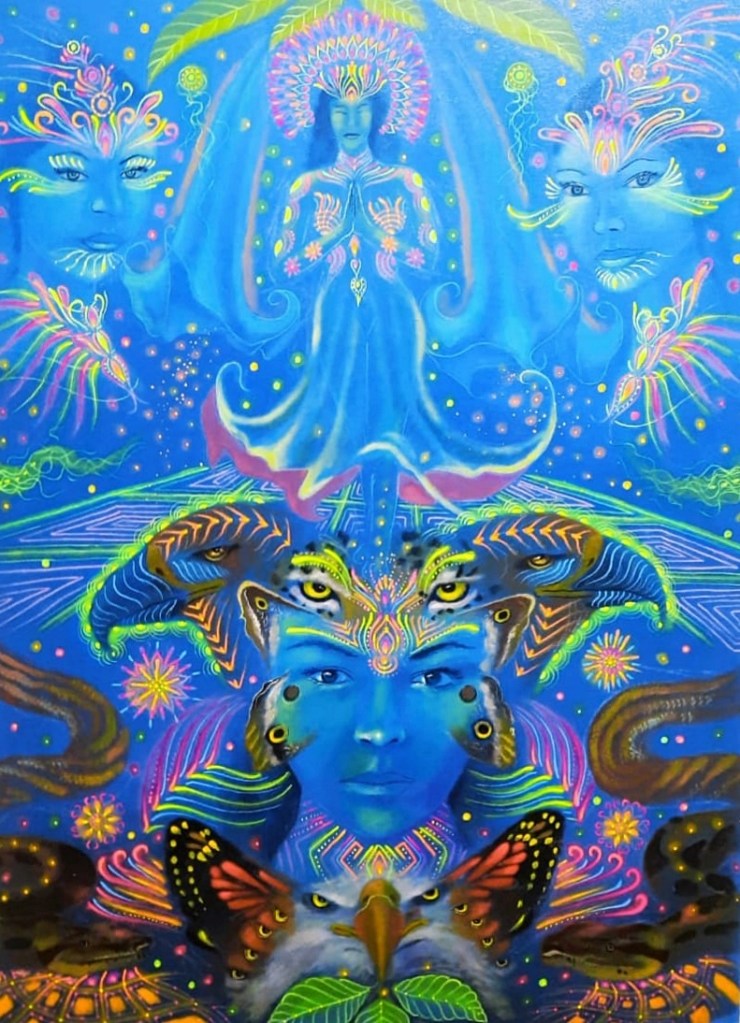
Arcanes of Heaven Ayahuasca
In the Amazon there are several types of ayahuasca, these lianas go to the infinity of the universe, meandering many colors, among them the color blue, known as Cielo Ayahuasca, a color that shines in this visionary work of art.
The Arcanes, are protection spirits of the shaman, and of the magic liana Ayahuasca, these are presented as people, animals and plants.
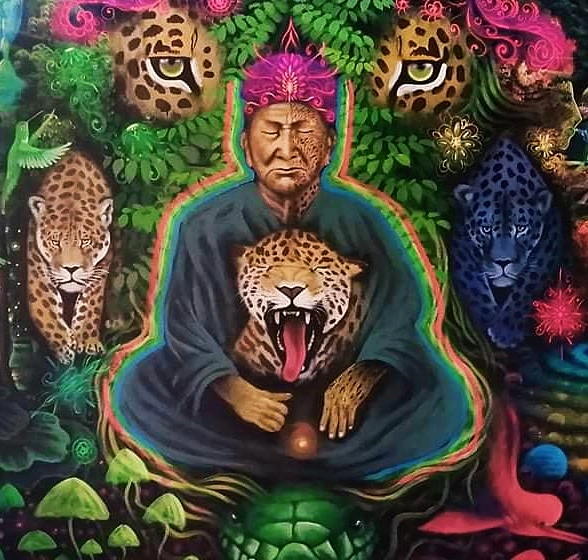
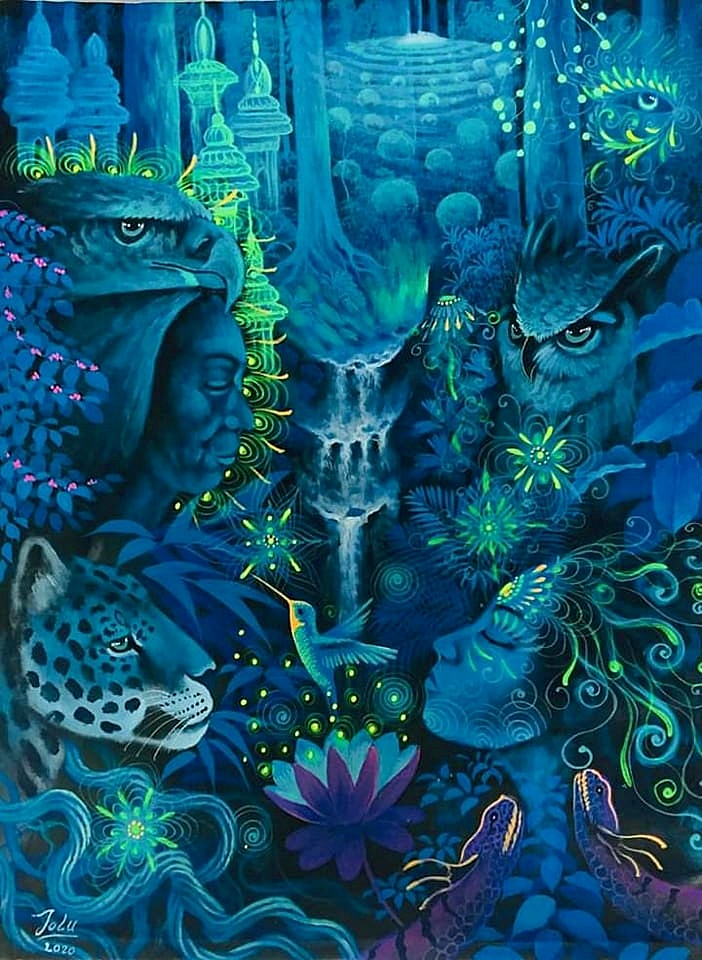
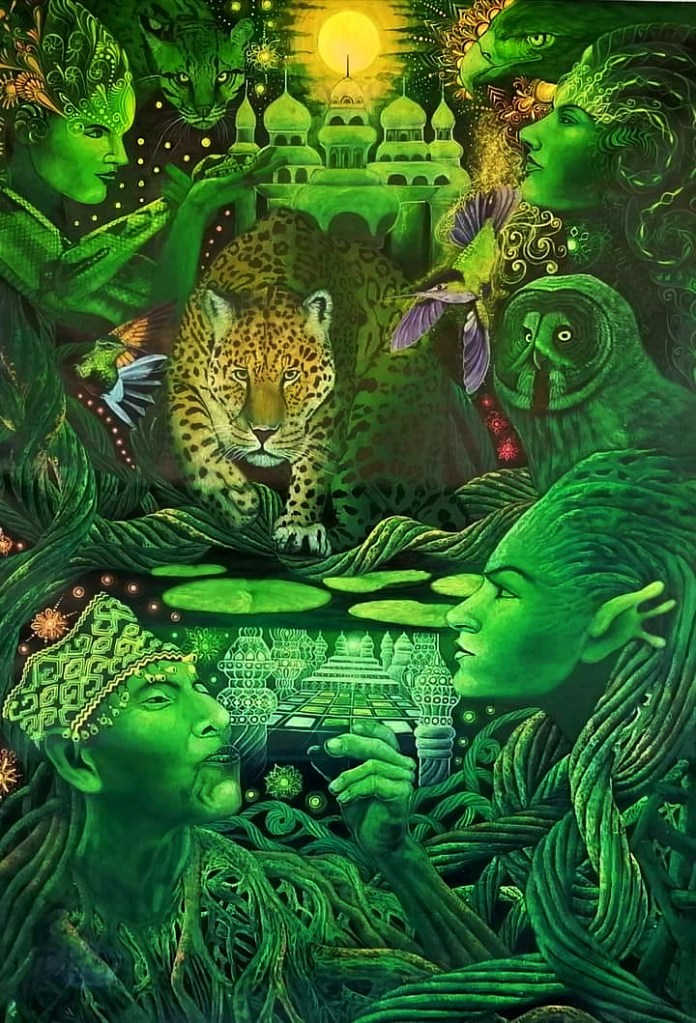
On the upper left side of the work, you can see the monumental “Celestial Towers”, which serves as an angular protector for the earth. From there come the white zigzags of cosmic energy that in their magnitude can control many other moving energies that serve to develop more life. A little further down you can see the face of the visionary shaman teacher along with her two protectors known as arcana presented as hawk and jaguar.
This visionary shaman teacher is called “Sinchi Muscui Huarmi”, which means “Strong Woman”; This master shaman practices the science of curanderismo, and is much stronger than a male shaman, because the spirits sharpen more with women than with men, because the woman contains the ovule that can make a being fertilize, while with the male does not happen that way, a woman can more easily defeat sorcerers and sorcerers. Her protectors (hawk, jaguar and owl), who are next to her, know how to hypnotize perfectly and can neutralize the Icarus of the enemies and paralyze any damage.
In this session the shaman teacher in her concentration with her power can bring trees, plants, shrubs, plant parasites, waterfalls and all kinds of animals such as birds, snakes, among other animals in a spiritual way, as can be seen in all the work; then the physical practically disappears only the spiritual can be seen, in such a way the vibratory waves of the ayahuasca appear, surrounding the master shaman, where one feels a very high concentration, that one almost feels like being a spirit and not a Being physical with ailments and mental disturbances, one leaves everything physical aside and feels like a super man, full of knowledge, wisdom and intelligence with the intention of living not for centuries but forever, at this moment the person greatly appreciates and values life, because it sees that each one fulfills its function fully, it is something very nice and fair, to see plants that fulfill their function of generating healing forces and food oxygen, to preserve living beings on planet earth where life Physics is in stock.
In the lower right part there is a woman’s face, called “Chuya Huarmi”, which means “Clean Woman”, this woman is an expert in the use of floral aromas. She indicates the invisible force of life present in all the forms found in the universe. In these free-flowing circles, as they accumulate there is abundant and lasting health embodying the art of curing chronic disease.
The flower that is observed in the lower central part of the work, carries the perfumes that symbolize the reproductive organs, because each petal indicates: root, leaf, flower, fruit and seed, and this does its work through the spirit, which works through the mind. One has to better learn the knowledge that ayahuasca gives us, remake the mind to introduce the new knowledge that the sacred plant gives us without being stubborn with what it teaches and shows us.
Everything is valid in life; you just need to know how to use it at the right time and in the right place.
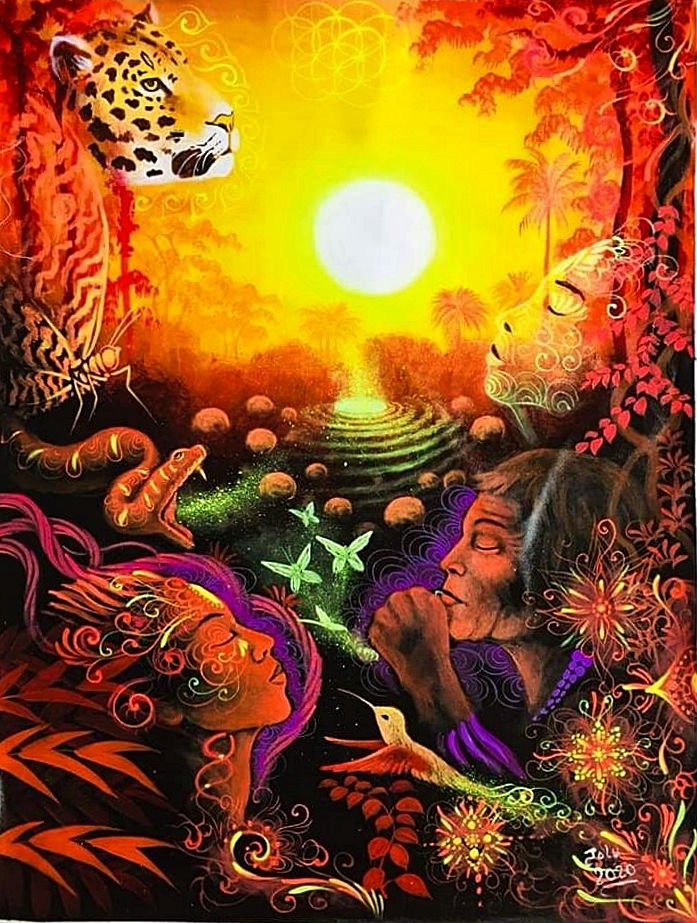
Sanctuary of Onaya
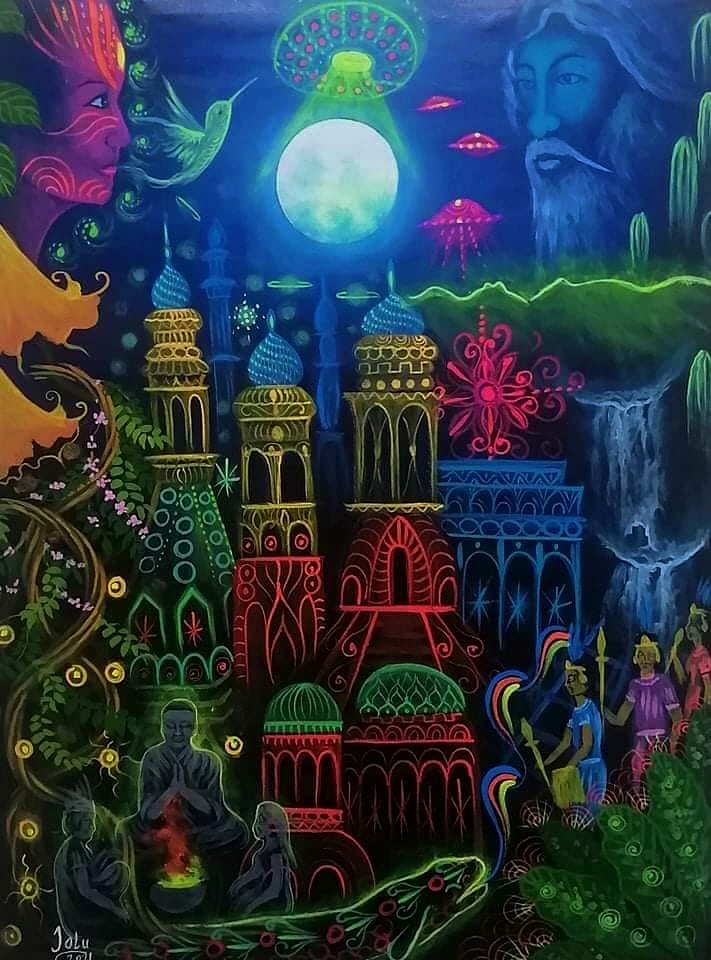
In this visionary artwork we can see the shrine of the sublime master Onaya in this temple we can find the path to heavenly wisdom. The spirits encountered by the vegetalist in this journey are his masters, and from them he gets the entrance to the spiritual temple, which is composed of living pearls and precious gems. The columns of this sanctuary are made of flawless diamonds that can never be defiled. Only the pure of heart enlightened by love, humility and wisdom can enter the magnificent and sacrosanct temple. In the water of the waterfall we see on the right side of the temple are the anguilamamas, who discharge electromagnetic rays that protect the sanctity of the temple. Also visible are the indigenous warriors who also act as guardians. The extraterrestrial ships at the top are from another galaxy and have traveled for thousands of years and visited many worlds to extract minerals and reach the Amazon jungle to receive vital energy. The green patiquina in the lower right is used to represent a person’s lungs; the different shades of green from the edge of the leaf to its center indicate the state of the person’s lungs. The hummingbird we see in this visionary work acts as a messenger. Its sweet trills are the most delicate and sublime icaros to sing to people seeking new strength or suffering from dreadful diseases. However, they must be sung with the utmost precision. These celestial spirits inhabit the palaces and temples at the top, where they gather to sing songs of worship. Finally below is the sachamama (mother of the forest). She projects an electromagnetic rainbow symbolizing the elements that fertilize the plants. The healers in the ceremony are chanting the icaro of the sachamama to prevent the sorcerers from thwarting their work.
I am Jose Luis Vasquez Gonzales, known as JoLu Amaringo, I was born in the cradle of art on December 5, 1991, in the city of Pucallpa_ Peru, when my famous grandfather, the Peruvian painter International Amazonian Visionary Pablo Amaringo Shuña, flew to Japan to present one of his famous exhibitions on visionary and neo-Amazon art.
During my life in my grandfather Pablo Amaringo’s house with my father Juan Vasquez Amaringo and my mother Lidia Gonzales Laulate, I drank countless stories that I heard in frequent meetings around a table. I also drank the vocation for the art of painting.
I am very thankful to God for making me spiritual brothers and sisters, and that my paintings convey my love, energy and healing to each of you. Many blessings, peace, love and good health to all.
Imperfect seeds also germinate, in a more difficult way; painful stem grows of the tormented plant What will this spring concoction be? that the drug that saves it
has turned into glycine – creamy smell bittersweet sugar, citrus undertones in disguised purple. Wild birds recite verses in the air Has the song of the mother bird healed her?
Am I really here, watching the miracle of my fertile land or is it my mind that imitates to the dying man who escapes from the barren land and look for the seed to save the world?
We are the witch poets, the ones with the mark on the face my trade is the botany of the imperfect that mutates to the perfect, to see the beauty in the “not graceful” is to live many lives, give wisdom to the marrow spinal cord of the brain in the seed of the plant. The noose around the neck is the plant tied to the cross, slowly stop breathing and die And what is life for? if we don’t manage to be captivated with all the trees in the world? the intelligence and wisdom of flowers is assimilated to the cunning of orphaned children nameless beautiful bastards, no handkerchief on the lapel, they feed on fresh drops; Those left by loving widows in the tomb of the dancing moon.
the dead dance imperfect seeds also flourish, they love dew in rain of scarlet evenings in the smell of smoke, fire and mapacho tobacco.
At night … the frost settles on the petal of her lip; nice to freeze like this, being kissed because of the cold that rests in the water garden. I caress each stem without prejudice to its appearance for me, the witch plant is so beautiful like the scent of the holy white rose. The twisted and mutilated lemon tree has taken refuge in the grape vine red wine lemon
Beneath the cement has grown blooming dandelion and sphere healing herb for the healer and sage. Rescuing damaged seeds is the art of the reasonable We are the ancient poets, the ones with the mark on the face Here I bring roots to decorate your hair.
I resurface in my garden
The wind blows hard, breaks promises. Catastrophic hiss, fractures everything. My hand no longer touches your figure; broken marble. underwater love nest stifled desire. You interrupted my spring cold storm; wet paper, You have erased all my love poems. What do you keep in those pockets how much do you protect? the wind asked me (the burden of my corpse) Suffering for love deforms my face -I disappear-. I neglect my garden, I leave it without dew, I turn to stone and I cry my gloomy sadness. Decay, I look in the rocks the calm of my weight.
I’m sorry for you ungrateful root, when I suffer, I become bad. I take shelter in the dead trunk, I am dry firewood I have no foolish claim to be perfect for you. Today I have seen butterfly lilies bloom, -They talk about rebirth- There is no end of the world, if the birds at night they recite poems. I resurface in my garden, I breathe, I smile. My flowers, my steps where I recover my voice, my singing My silent cat and devoted friend. imperfect seeds, we also bloom at dawn. What do you keep in those pockets how much do you protect? the wind asked me.
Victoria Morrison, Chile 1977, Social worker, poetry and short story writer. Current and active member of SECH (Chilean Writers Society) P.E.N Chile (Poets, essayists and novelists) Published books: A room in hell (2016) Ediciones La Horca Evicted poems (2017) Editorial Ovejas Negras Pupilas de Loco (2020) Rumbos Editores (Her writings are characterized by evoking psychological themes. A lover of nature, the author explains that in each word there is healing; if we assimilate that word to the roots of each plant, just as there are imperfect seeds, there are also humans imperfect; are not the goods called “crooked trees” those that, without water, shade, or fertile soil, continue to breathe on the earth. If the fragile plant resists the cold, the weather, the human flesh sheltered in wool and scarf I should be grateful and silent, listen in silence, the frozen and brave song of the frosty hour





 Mitchell Pluto