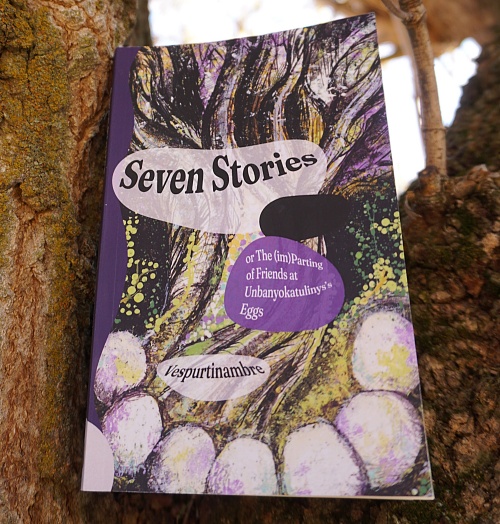
Seven Stories or the (im) Parting of Friends at Unbanyokatulinys’s Eggs

In Seven Stories or the (im) Parting of Friends at Unbanyokatulinys’s Eggs, readers are first immersed in a neurological realm, seen through the eyes of a relative of Casimer Maus. Maus, a German linguist, stumbles upon a new language during her vacation when she gets lost in Luweng Jaran, a cave in Indonesia. While in the cave, Maus found a chamber archway with engravings she copied.
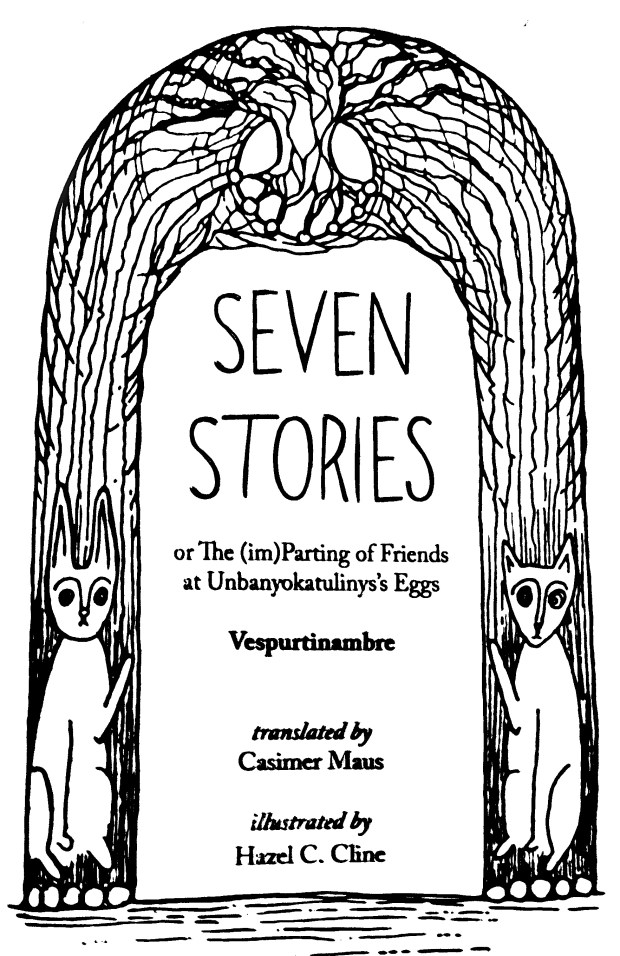
This unfamiliar language triggers a significant internal shift in her life. For the next decade, Maus studied the visual representation of circular connections and a sentence structure that bloomed outward in a spiral. She called the new language Lingkaran.
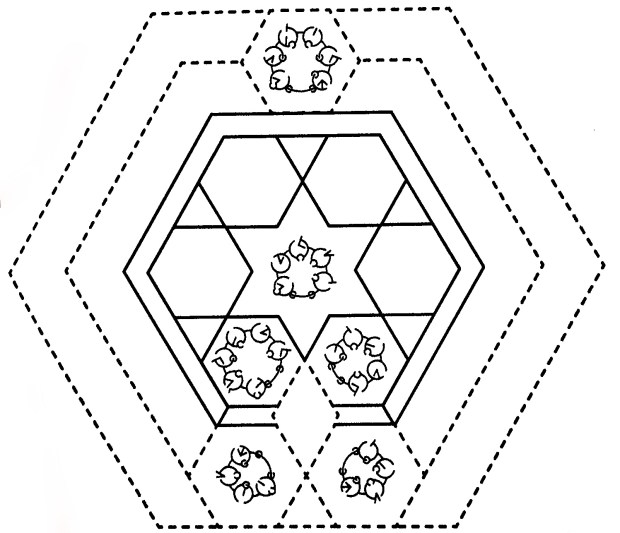
She planned to announce her discovery to the world, beginning with the Deutsch Linguistic Society. However, her peers proved unwilling to accept the strange occurrences that arose from deciphering the language. Readers are first introduced to Casimer Maus’s discoveries through a heptagram that positions an archetypal animal at each point. These animals gather near a growing tree, seeking truth in contradictions, as they aim to comprehend the world’s interconnectedness (the world womb) from its very beginning.
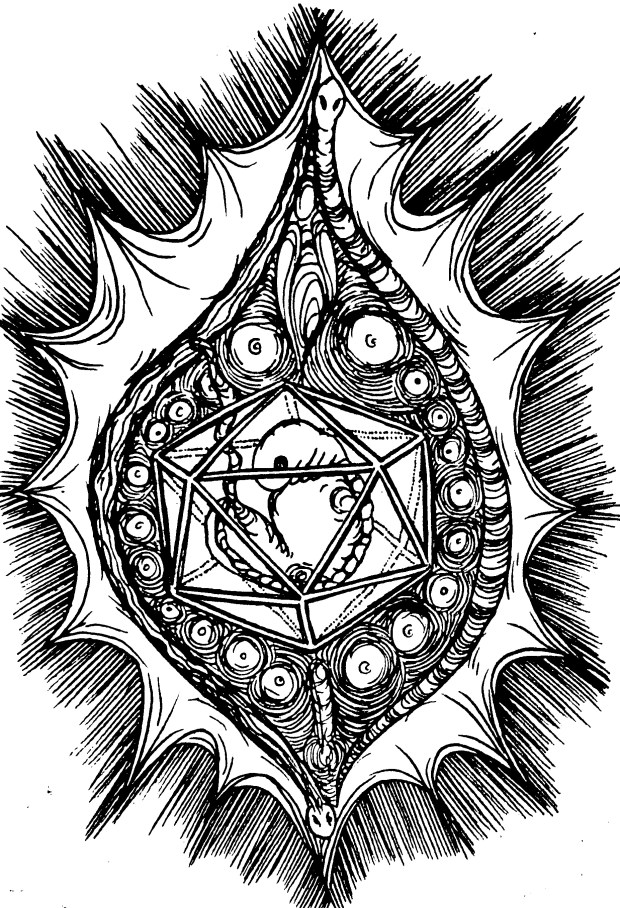
Through speculative surreal fiction, Casi (Hazel) Cline develops her own theogony and original mythology. Seven Stories shares some common ground with James Joyce’s Finnegans Wake; however, it presents a more approachable examination of metacognitive ideas, clarifying the archetypal patterns of the collective unconscious with animal totems.

Hazel Casimer Cline is a nonbinary writer and witch based in Atlanta, where they live with their partner, Steven, and their cats. They have been involved in both local and international Surrealist communities. Hazel served as an editor of Peculiar Mormyrid Journal for nearly ten years and participated in the Atlanta Surrealist Group, which met regularly for several years. They have co-organized three Surrealist exhibitions in Atlanta and Birmingham, Alabama. Currently, Hazel is focusing on their writing. They also work with film, experimental music, and visual art, including collage, drawing, and painting. https://ephemeralityart.com/

Steven Cline is based in Atlanta and has been involved in surrealist activity for the past decade, including Peculiar Mormyrid Journal and the Atlanta Surrealist Group. He has co-organized exhibitions in Atlanta and Birmingham and has participated in others in Paris. His first book of fiction, Planetoid Sassafras, was published by Montag Press under the name Stephanie Klein. A subsequent book of surrealist nonfiction, AMOK, was published by Trapart Press. https://stevenclineart.com/ 

Atlanta Surrealist page: https://atlantasurrealistgroup.com/

https://blackglovepress.com/

Egregore book: https://issuu.com/sjcline87/docs/digital-compressed

The Banquet of Banality by Hager Youssef

The Banquet of Banality

It was too much—

your friendly chatter

with a plastic doll,

beside all my womanhood.

Too much closeness,

and not enough of friendship’s honor.

You dressed your attention

in a shirt far larger than your frame,

and wandered all night

seeking someone to stitch it tighter.

Fevered listening,

inflamed reactions,

obscene exaggeration,

and a sugar tongue

with no cause.

Your talk—

not just the melting

of social shyness,

but constant calls

of a drifting gigolo.

In the light’s reflection

in my glass,

Narcissus

appears smirking,

then fades.

This woman

stuffs her misery

with your emptiness,

and leaves,

utterly emptied by your absence.

And I—

beneath the weight of analysis and inquiry,

will sleep well tonight,

for I won’t let your butterfly

scratch a hole into my mind.

That banquet of banality—

doors whose insides I know too well:

the illnesses of ego,

the body,

and your childhood—

where it seems your own hand

chokes the other lost in itself.

The other women leave delighted—

They got their change

from the shiny illusion

they came for:

illicit praise

drawn from both my shares.

But I—

I’ll go home

in my white dress,

just as I came.

All I lack now

from such tired evenings

are the symphonies

of your lies.

My Weather Is Fragmented, Beautifully Distorted

My weather is fragmented,
beautiful in its disfigurement,
it writes me upon a page that quivers—
like a vast, open hand.

I’ll hang my first face on the door.
In the wild haste of love,
I’ll let you enter.

This night
lengthens over me
like a mosquito.

This lamp
only illuminates
my fear.

My second face
is dark and wicked—
like a rat in hiding.

The third, I vomit
onto the body of air,
into a bowl of memory,
like a child,
retreating into his mother’s breast.

The fourth is a mask of fire.
When you choke me,
I think—
you are making love.

The fifth, a nail in my throat.
I hammer it in,
and spit out a sixth face
that will never be complete.

The seventh sees nothing,
hears nothing—
he simply cages his sorrow
and mutters.

The eighth
sings to you
in the voices of prostitutes.

The ninth writes poetry
without faith,
sketches you on my back
with a broken fingernail.

And I—
when I sleep within you,
and rise without me,
like a tattoo,
when you forgot my name
and screamed:
“Who am I?”

Alcoholic privilege night

When my beloved is drunk,
I become a wound upon his cheek.
He strikes my chest with an empty glass,
Saying, ”This bell—this is what wakes me.”

When he drinks,
He opens my mouth like a pit,
Searching for his name,
For a button he lost
As we rushed back toward childhood.

He loves me swaying
Between two chairs:
Truth—
And the guilt I know,
When he mistakes me for a window,
When he spills the wine
As an apology on my behalf,
Like the blink of an eye.

When he drinks,
My arms multiply in his memory.
He summons them to soothe his pain,
Asks me to plant my tree
Right here—
Above his eye,
A finger for his throat,
And a final finger pointing to the wall:
“Embodied—as if you were pure awareness.”

When he’s drunk,
I draw back.
He runs like a shadow
Caught in light,
Bleeds me
Into some vague emptiness,
Traps me in a space
Shorter than a whisper,
Inside a bottle,
Inside a child’s nature.

He points often—
As if he’s arrived,
As if I were a mouth
He must enter,
Not merely behold.

Hagar Youssef is an Egyptian poet and writer based in Cairo. She has published a poetry collection titled “A Damaged Memory” in Arabic and she is currently working on two collection stories: “Dreaming With Two Heads” and “One Day.” She graduated from the Faculty of Education – Department of Sciences. She has written for various platforms, including those focused on feminism and gender studies. Her work explores the essence of language, deeply influenced by philosophers Roland Barthes and Georges Bataille, in linking love, pain, and death to language, deconstructing these themes. She is also passionate about translating literature and poetry, reviewing books, and writing journalistic and critical articles.

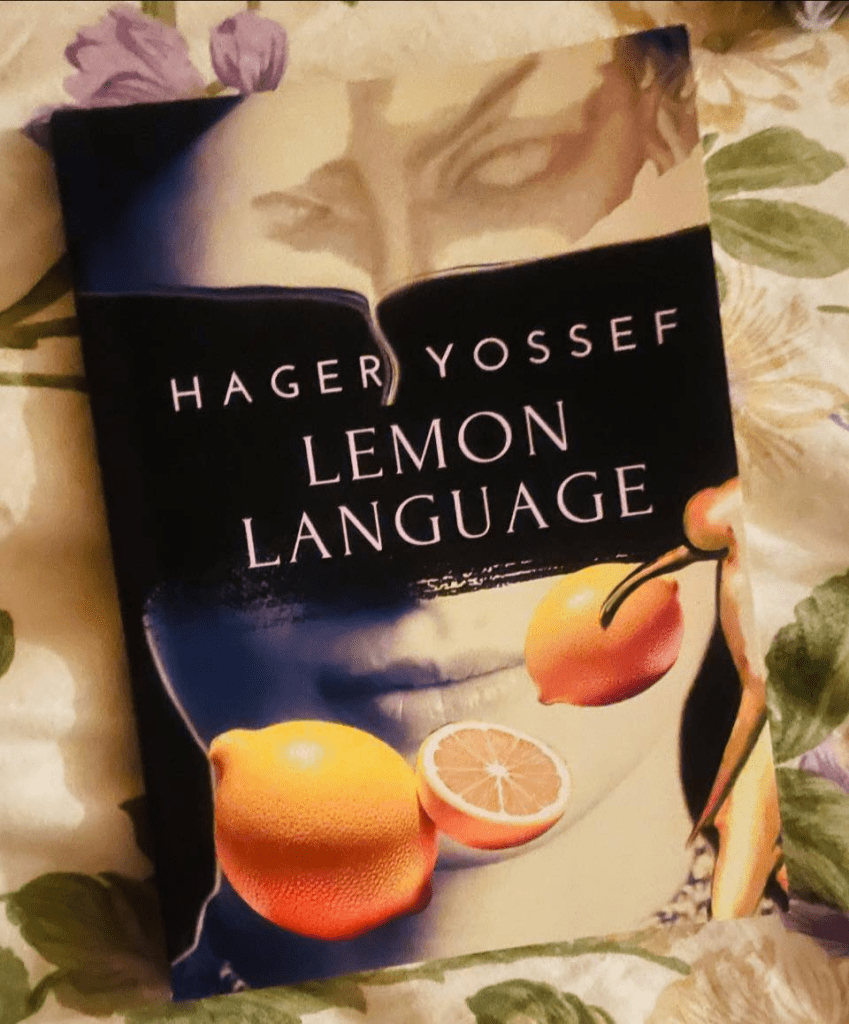
Lemon Language Paperback – November 22, 2024
by Hager Yossef