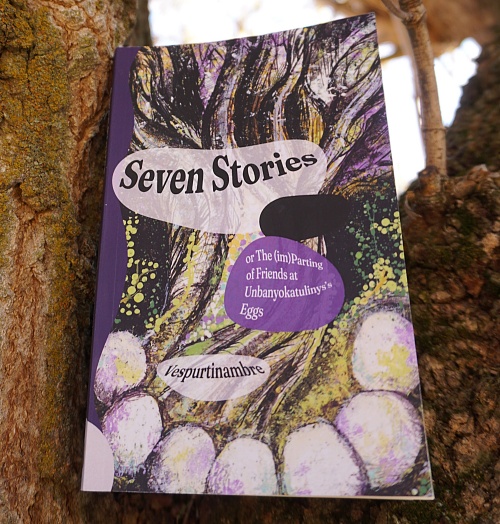
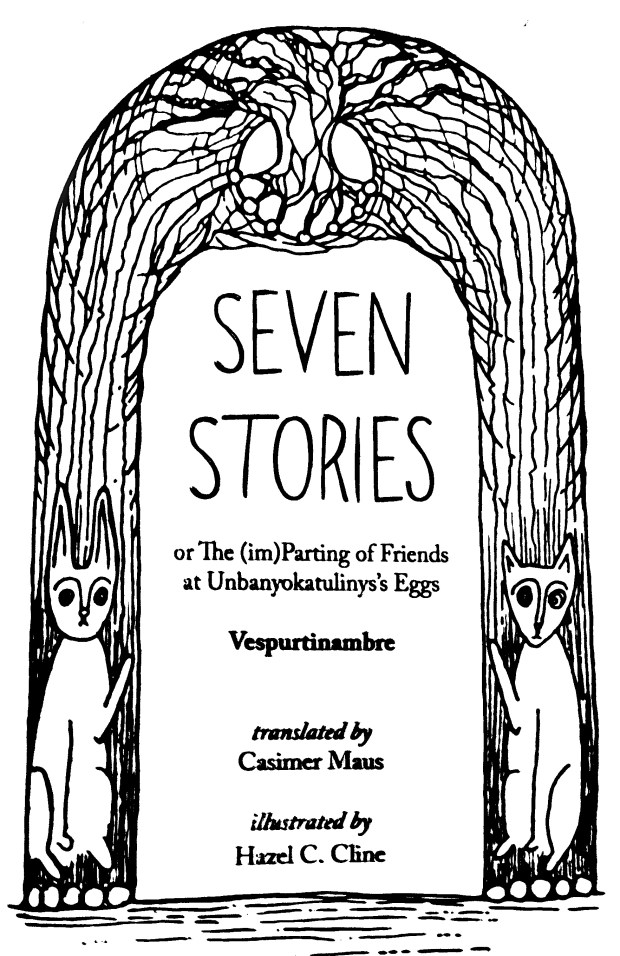
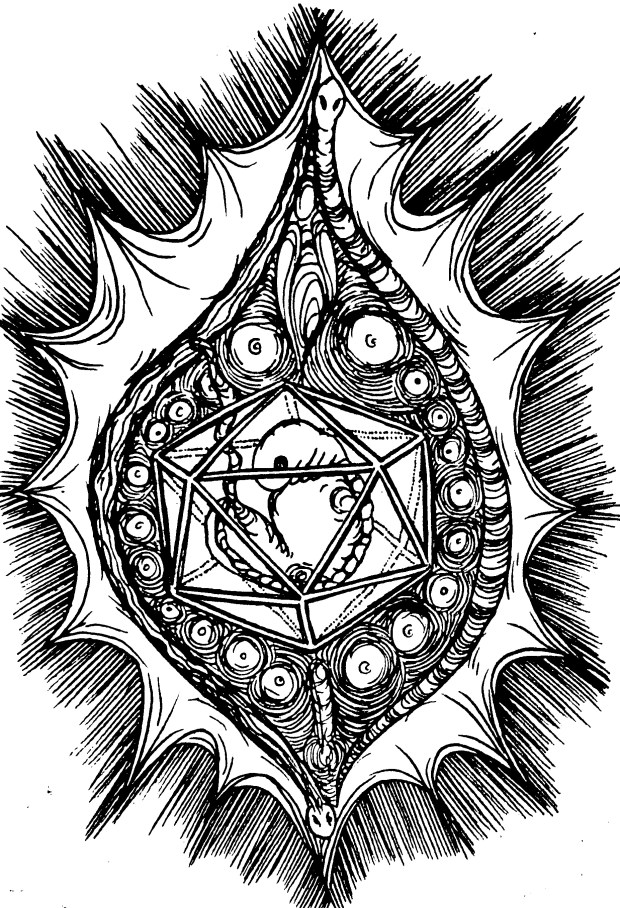
In Seven Stories or the (im) Parting of Friends at Unbanyokatulinys’s Eggs, readers are first immersed in a neurological realm, seen through the eyes of a relative of Casimer Maus. Maus, a German linguist, stumbles upon a new language during her vacation when she gets lost in Luweng Jaran, a cave in Indonesia. While in the cave, Maus found a chamber archway with engravings she copied.
This unfamiliar language triggers a significant internal shift in her life. For the next decade, Maus studied the visual representation of circular connections and a sentence structure that bloomed outward in a spiral. She called the new language Lingkaran.
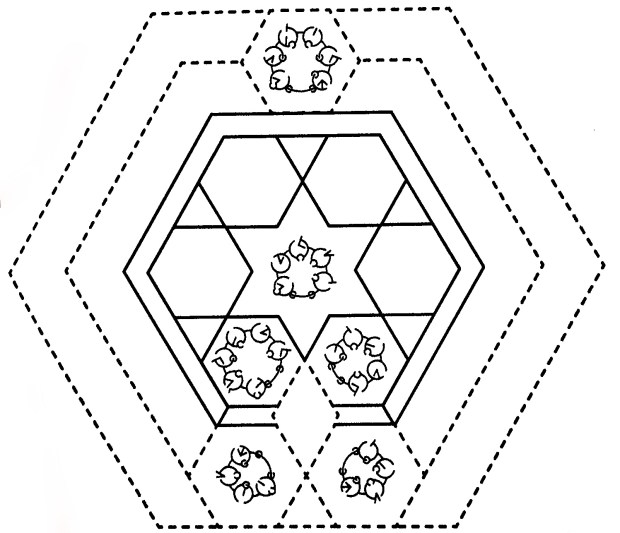
She planned to announce her discovery to the world, beginning with the Deutsch Linguistic Society. However, her peers proved unwilling to accept the strange occurrences that arose from deciphering the language. Readers are first introduced to Casimer Maus’s discoveries through a heptagram that positions an archetypal animal at each point. These animals gather near a growing tree, seeking truth in contradictions, as they aim to comprehend the world’s interconnectedness (the world womb) from its very beginning.
Through speculative surreal fiction, Casi (Hazel) Cline develops her own theogony and original mythology. Seven Stories shares some common ground with James Joyce’s Finnegans Wake; however, it presents a more approachable examination of metacognitive ideas, clarifying the archetypal patterns of the collective unconscious with animal totems.
Hazel Casimer Cline is a nonbinary writer and witch based in Atlanta, where they live with their partner, Steven, and their cats. They have been involved in both local and international Surrealist communities. Hazel served as an editor of Peculiar Mormyrid Journal for nearly ten years and participated in the Atlanta Surrealist Group, which met regularly for several years. They have co-organized three Surrealist exhibitions in Atlanta and Birmingham, Alabama. Currently, Hazel is focusing on their writing. They also work with film, experimental music, and visual art, including collage, drawing, and painting. https://ephemeralityart.com/
Steven Cline is based in Atlanta and has been involved in surrealist activity for the past decade, including Peculiar Mormyrid Journal and the Atlanta Surrealist Group. He has co-organized exhibitions in Atlanta and Birmingham and has participated in others in Paris. His first book of fiction, Planetoid Sassafras, was published by Montag Press under the name Stephanie Klein. A subsequent book of surrealist nonfiction, AMOK, was published by Trapart Press. https://stevenclineart.com/
My painting can be understood best when looked at with an understanding of the Tibetan Buddhist ideas of Maitri and Tonglen. (Maitrī loving-kindness) and Tonglen (giving and taking) are two related practices in Buddhist traditions, particularly Tibetan Buddhism, focused on cultivating compassion and kindness. Maitrī involves cultivating a warm and benevolent attitude towards oneself and others, while Tonglen is a meditation practice that involves breathing in suffering and breathing out relief, compassion, or loving-kindness.
I didn’t start out as a kid practicing this meditation. I was adopted as an infant from South Korea when I was 3 months old. And my parents weren’t Buddhists. My dad told me he used to practice transcendental meditation as an adult, but never taught me how. I came to it, through wanting to connect more deeply with my Korean heritage. That was about 10 years ago.
I didn’t start, wanting to merge my meditation practice and my painting practice. But because of the visual nature of tonglen, the imagery was a naturally on my mind. And had no idea what I wanted my thesis to be. So, both created a synergy that helped me inadvertently heal, and explore the different relationships in my past and in my present. By the end of my graduate studies, my thesis was: Painting and Meditation: Paths to healing. I even tried my thesis out in the community. I had around 10 women come to learn tonglen meditation. And to use the imagery from their meditation, as the subject for their artwork. They painted a suffering and the opposite of that. They used photos, to help inform their work. And then they talked about the transformation. It was a beautiful and empowering workshop.
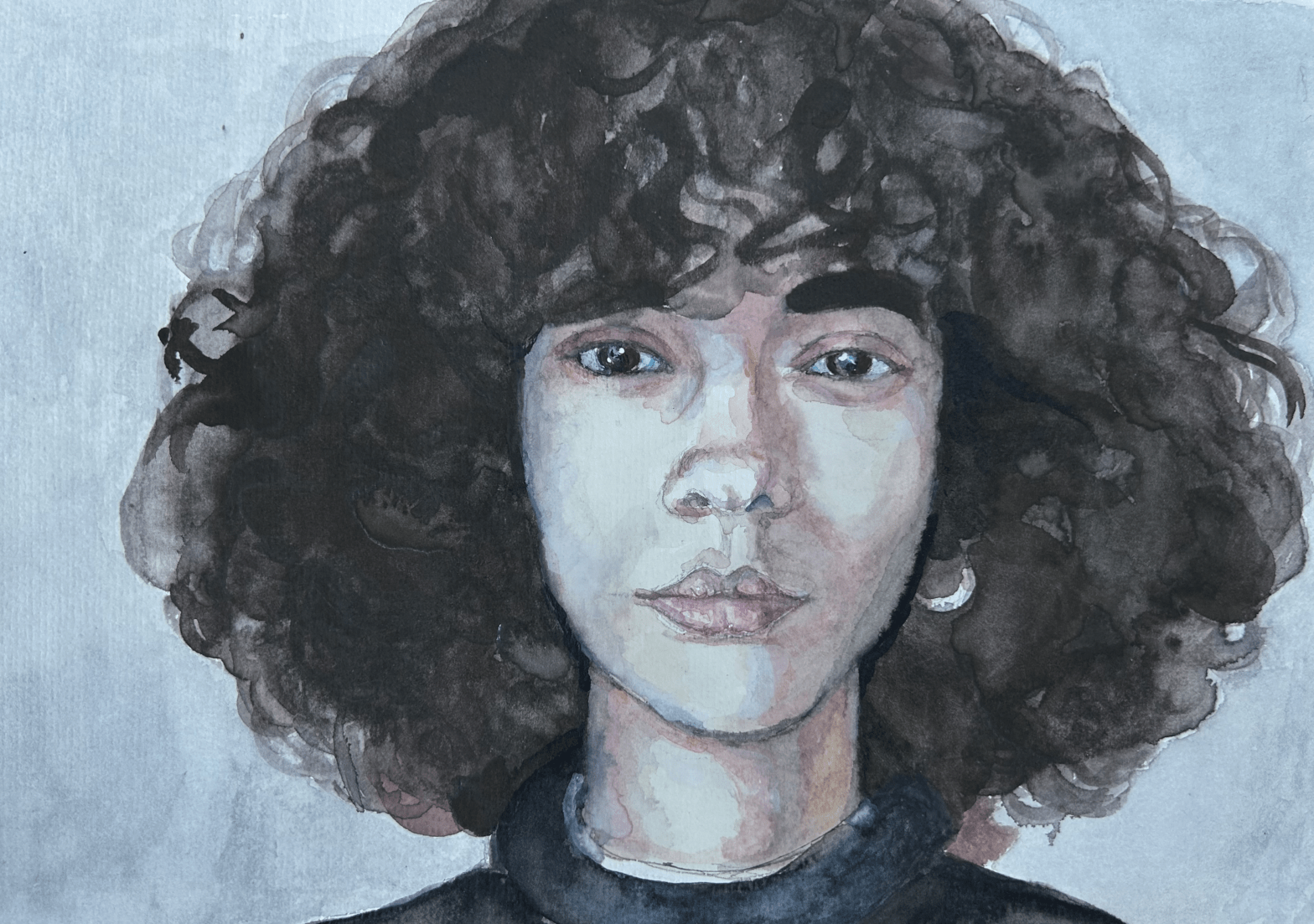
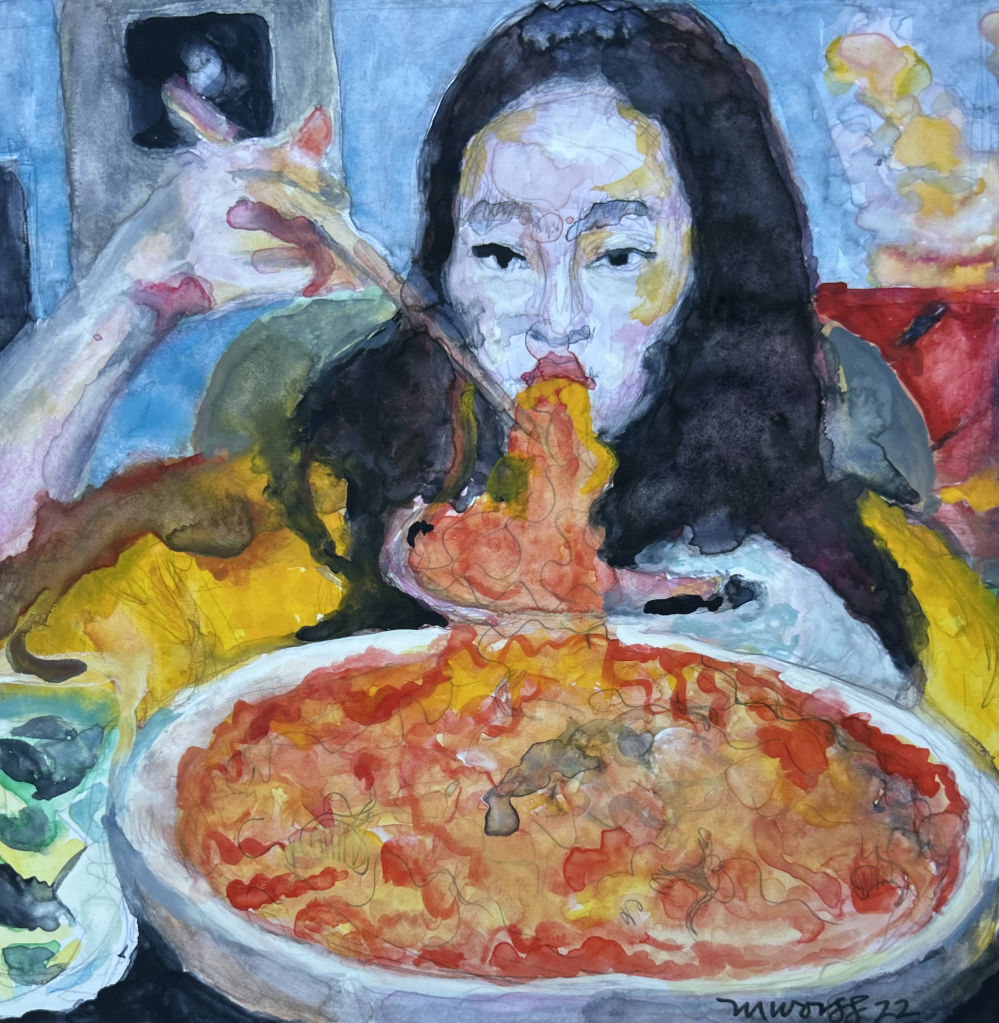
I love this tiny painting. It started out as a quick study as nothing serious. But I really just fell into the paint and managed to keep the essence of her being lost in what looked like to me as a state of pleasure or like she’s making a wish. Color tends to go anywhere, when I don’t think about it so much. I just let my hand choose and place it where it wants to go. It’s very instinctual and intuitive. I like not having to think so much. It’s more of an emotional application. Lately I’m in love with the soft plumes of color and line quality I can get with watercolor. I will paint a person just for the softness they have in their hair or body.
After placing myself in tonglen. It was shocking to discover that I had never really jumped off the hamster wheel of life to even talk or address the ambiguous loss I’d carried for years in my body and psyche. I had never even talked to anyone about how hard it was to miss a family I had never met. Or the woman who carried me and birthed me. But the loss is real. This meditation of compassion gave me the space to fully sit with that grief and actively tend to it. I seemed to have just fleshed it out more fully in my paintings.
I made my very complex and heavy feelings into a visualization in my mind. Then used those as a springboard for narrative paintings. Turning trauma into a concrete painting. Painting has played a part helping me make of sense this unique journey. Of what had missing pieces and lies. I’ve created a story with a start, beginning and ending, that made sense to me. Not the dominant narrative of the adoption industry, or lies or mystery surrounding my adoption. Not adoption from the parents perspective. Not adoption from a Christian perspective. But one that comes from historical facts and felt memories from my body and how I felt about being adopted and having gone through so much with so little.
“The Baby Catchers” 2015 Oil on wood panel 32″ 5/8 x 49′ 3/4
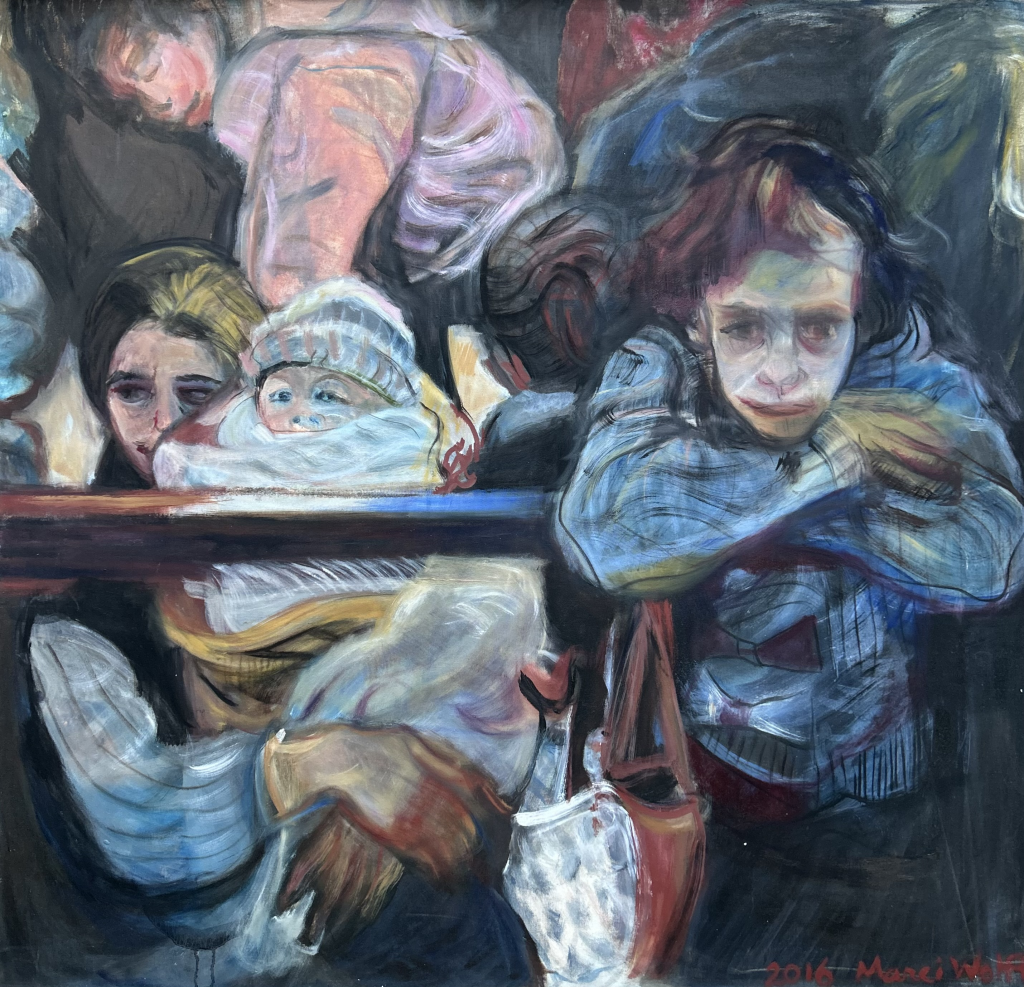
In 2016, I saw the photojournalism of these displaced refugee children at the gate in Kilis, Turkey. People were being shot as they tried to cross out of their war torn home of Syria. This photo captures kids becoming displaced people. Being a displaced person has made me an international citizen. Painting directly from the photo while changing small things like the gate colors to infuse America’s presence. I made the girl in pink to look like me as a toddler. I did change the baby’s eyes to look directly at the viewer. I was on a roll here, moving my meditation onto strangers I didn’t know. People on the news. I just so happened to be able to relate.
“At the border Gate in Kilis,Turkey” 2016. Oil on canvas. 41″ x 41″.
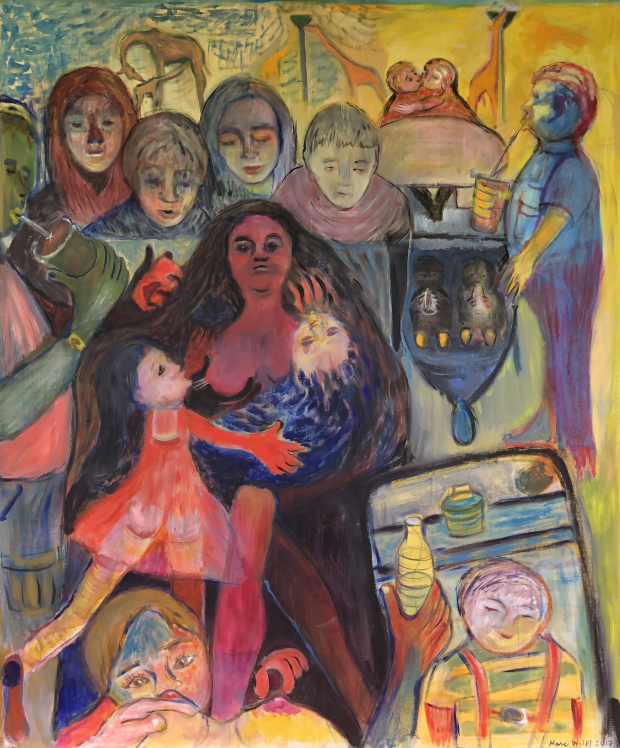
In ‘Feeding Time’ subject play with ideas of being nourished in captivity in an unnatural environment at the Wild Animal Park in San Diego. I was trying to express the absurdities, dangerous issues in American culture and realities of parenting in 2017. Child trafficking, abuse and the ridiculous standards and roles that are expected and fulfilled by mothers. Letting in those issues and risks, gave me a broader range of character to play with which was really fun. I really enjoyed designing the composition to create this cramped, foreboding space.
“Feeding Time” Oil on canvas. 67 3/4″ x 57″
Dancing brings me great joy. For me, It’s wildly feminine, spontaneous, expressive and cathartic. Dancing to DJ’d dance parties helped me get through Covid. So, when I found a photo of people doing tantric dance in the Netherlands. To me, this painting signifies freedom joy and sensual pleasures and a trust in the feminine and masculine moving in spontaneous harmony. I painted it for a public art viewing in downtown space. I wanted to make something that signaled the end of social distancing. At the same time, I liked that the men were letting the women lead them through space. It signaled to me a trust. Which, for in America, the Supreme Court had just reversed Roe v. Wade.
This dance was photographed in a very brightly lit ballroom with a bare wood floors, with random music stands and billowy curtains in the background. The color was too white, too bright and the figures were getting lost. So, I decided that blue would be a perfect color. I had been swimming and diving in the Lakes in Montana, and realized that blue of the water would be perfect balance to all the activity and detail in the figures. It is like they’re dancing underwater or in the sky, free flowing.
“The Tantric Dancers” Oil on canvas. 40″ X 60″
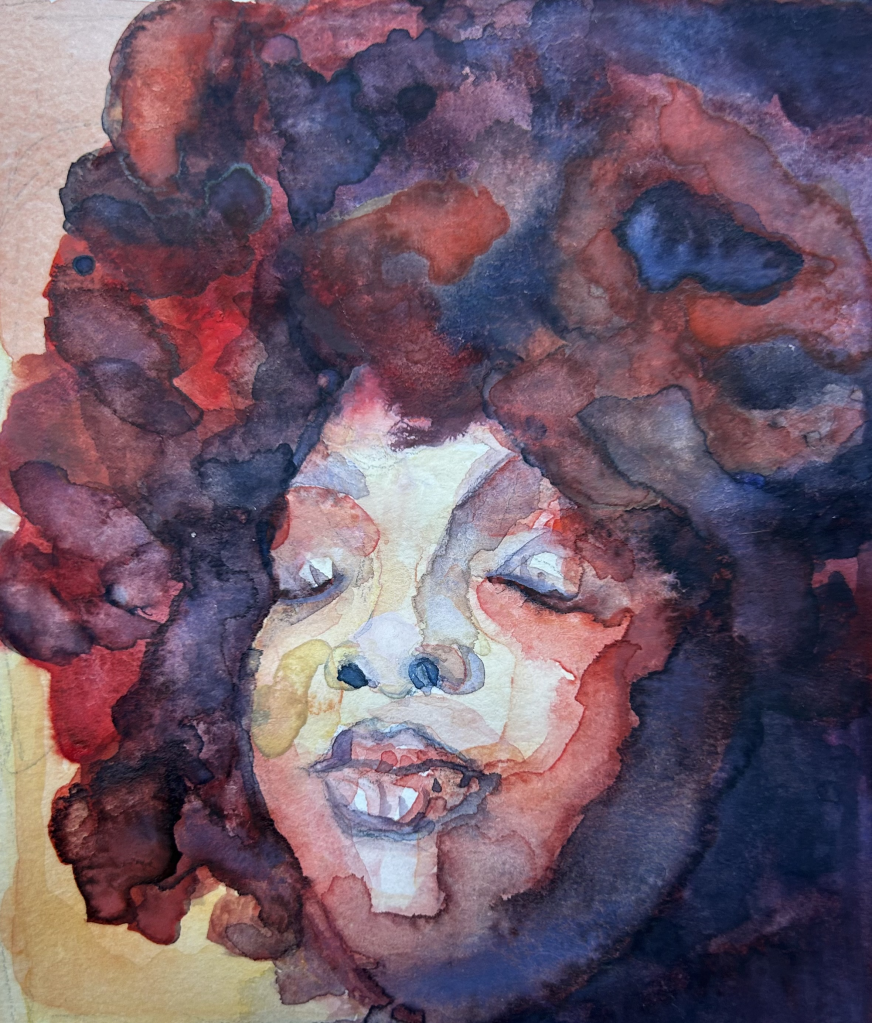
I painted a still from a YouTube video of a young Korean woman eating Korean noodles. Her name is Dorothy.
“Dorothy” (from her Mukbang video) watercolor on paper. 7″x7″
Mukbang is the art of eating Korean food as a performance for all those who click on the video. I enjoy watching these videos. And they are highly addictive and always inspire me to make Korean food. I’m not one for K-Dramas, but I am highly drawn to the Visual and audible feast. Plus I love seeing what South Koreans are eating.
Being comfortable with calling myself an artist happened very recently. I have been drawing and painting since I was old enough to hold a crayon, but never considered myself an artist. It may have been imposter syndrome, but only in the past couple years have I fully embraced the title of artist, that I am one, and allowed myself to really lean into that. I feel like accepting that title has allowed me to break past some barriers I had unknowingly placed onto myself.
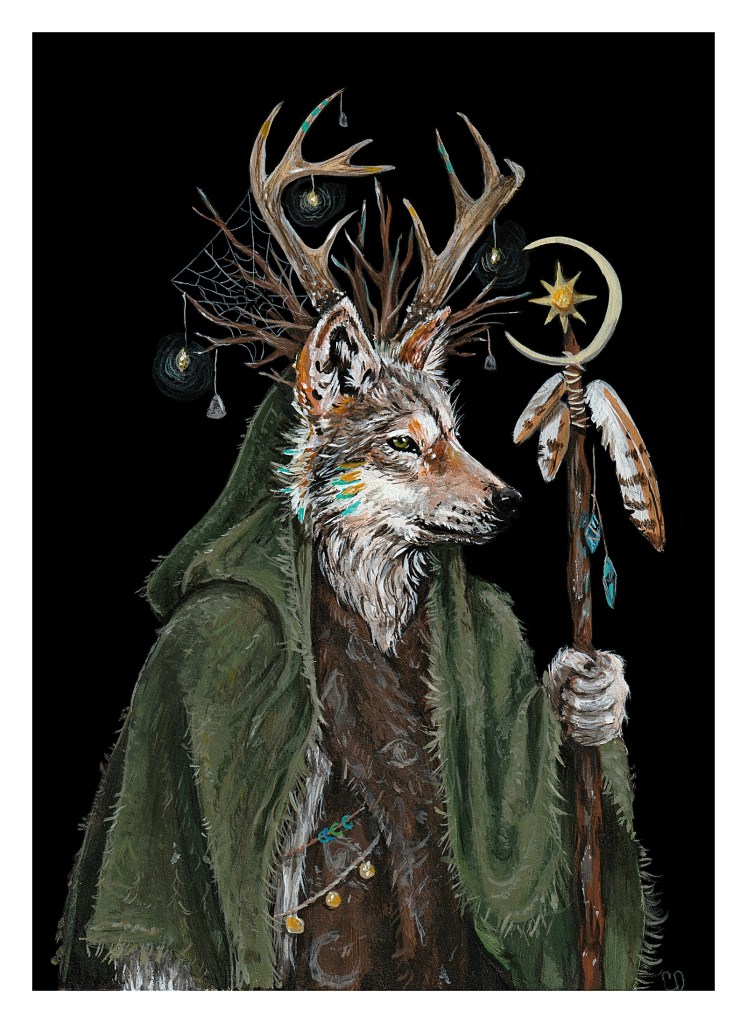
The Hermit. Acrylic on panel.Gentle. Acrylic on Panel.
I love history, folklore and nature. I go on hikes to be inspired and try to paint this unwritten language that is inside each of us. The one that connects us to our core and our roots with Mother Earth, and shows that every living creature is connected.
Bearn. Oil on canvas.
My greatest love is oil, but I’m very eclectic in my studio. Some things can only be brought to life in oil, some in acrylic, some in ink and some in relief printing or clay.
Bittersweet. Acrylic on panel.
I’m constantly inspired by other artists and there are so many great ones. The very first artist that made me believe I could do this was Brian Froud. My family couldn’t afford his amazing books when I was a kid, so my grandma would take me to the bookstore and I would sit in the aisle and pour over them. As an adult I’ve collected almost all of his work and he is a huge inspiration for me. He makes magic seem possible.
The Witches Assistant. Oil on canvas.
I grew up on fantasy and historical fiction. Middle Earth and Hogwarts were my safe places as a kid. I still read Tolkien over and over. Edgar Allen Poe shows beauty in darkness, which is a theme I explore a lot in my work. Susanna Kearsley and Simone St. James are both incredible historical fiction authors. I collect books about mythology, spirits, history, Paganism and folklore; much of the symbolism I find in them ends up in my work. I would have a full library at my house if I could.
How do you put yourself into a trance or into a place that’s receptive to the subconsciousness?
I find the act of drawing in itself to be trance inducing. I first became obsessed with automatic drawing in high school because it felt like it would light up my brain and smooth out all of my anxious energy. It would literally feel like I was drawing my way out of a stupor and waking up to the strangeness of my own mind.
Drawing helps me reach that valuable state where I can feel awake and alert, yet simultaneously relaxed. I find that my breathing slows down when I’m drawing and time feels more fluid. It helps to have a quiet studio where I can go and disappear for hours at a time. I think of the imagination as a living thing that I have an ever evolving relationship with. If I meet it halfway and submerse myself in the creative process, I get to interact with and explore the subconscious and come back with artistic documentation.
What interests inform and inspire you?
So many things. I love outsider, folk, visionary, and ancient art. Whenever art is made from an inner need or impulse, I find it extremely valuable. I love children’s art. I have 2 kids and love watching the way their minds work. I love creative collaboration as a way to relate to another person’s mind and bring out something totally unexpected and new.
I’m interested in neuroscience and new scientific thought around the so called Hard Problem of Consciousness and Theories of Everything. I love to read. Especially speculative fiction, strange fiction, and comics. I’m hugely inspired by nature and spend a lot of time in the woods. Learning some carpentry skills is another thing that’s been opening me up to new art possibilities. Just sitting and trying to clearly see images or hear music in my head is an ongoing practice.
What role do you think the artist has in the 21st century?
The best thing an artist can do is follow their own unique impulse. Artists need to push back against the bizarre human drive to homogenize everything. They need to reach beyond the inadequate systems we live inside.
I think diversity of culture and human expression is the most valuable thing we can cultivate as a species. I also think it’s important for artists to have an anti-cruelty stance. There’s so much cruelty in our history and baked into our systems. I think the artist’s role is to look unflinchingly at this and attempt to untie those knots. Art can be part of the antidote to the bad ideas that seem to cling to our brains and stunt our evolution.
Have you experienced Lucid Dreaming or any kind of encounter with cosmic consciousness?
Yes, I’ve had quite a few experiences that have felt outside of normal cognitive experience. Each of these experiences feel incredibly valuable to me and I’m thankful for them. Mostly I’ve regretted it whenever I’ve tried to describe them to people. They feel like something to internalize and hold close. It’s easy to discount things that don’t fit with the narrative of the everyday, so I try to think about those experiences a lot and not let them fade into doubt.
When did you create or discover your own archetypical patterns?
I started with automatic drawing, just letting my hand draw without knowing where it would go. Through that, a lot of patterns and imagery naturally began to emerge and I would just kind of follow that. Through years of working in this way and contemplating the recurring symbols, a lot of ideas and feelings started taking shape. Making comics became a way to explore that more actively by trying to unlock the stories and concepts that my drawings were revealing to me.
Has your work ever lead you to an experience of intuition or synchronicity?
Following an artistic impulse is in itself an intuitive and synchronistic experience. It adds an extra dimension to my daily life and when I have positive momentum in my work, I feel like that crosses over into my daily life and helps me see connections and meaning. Putting my work out into the world has also allowed me to meet a lot of people I wouldn’t have met otherwise, so in that way, I feel like dedicating myself to making art has allowed me to have important friendships that have inspired and helped me grow.
What do you like to cook?
I love cooking. I cook almost every night. I like to make enchiladas with sauce made from scratch. I like making sushi, jambalaya, grilled pizza, salmon. It’s just fun to work a kitchen and try to be efficient with all the different elements in play and it’s satisfying to serve up something good to my family. Cleaning up the kitchen afterwards is not as fun.
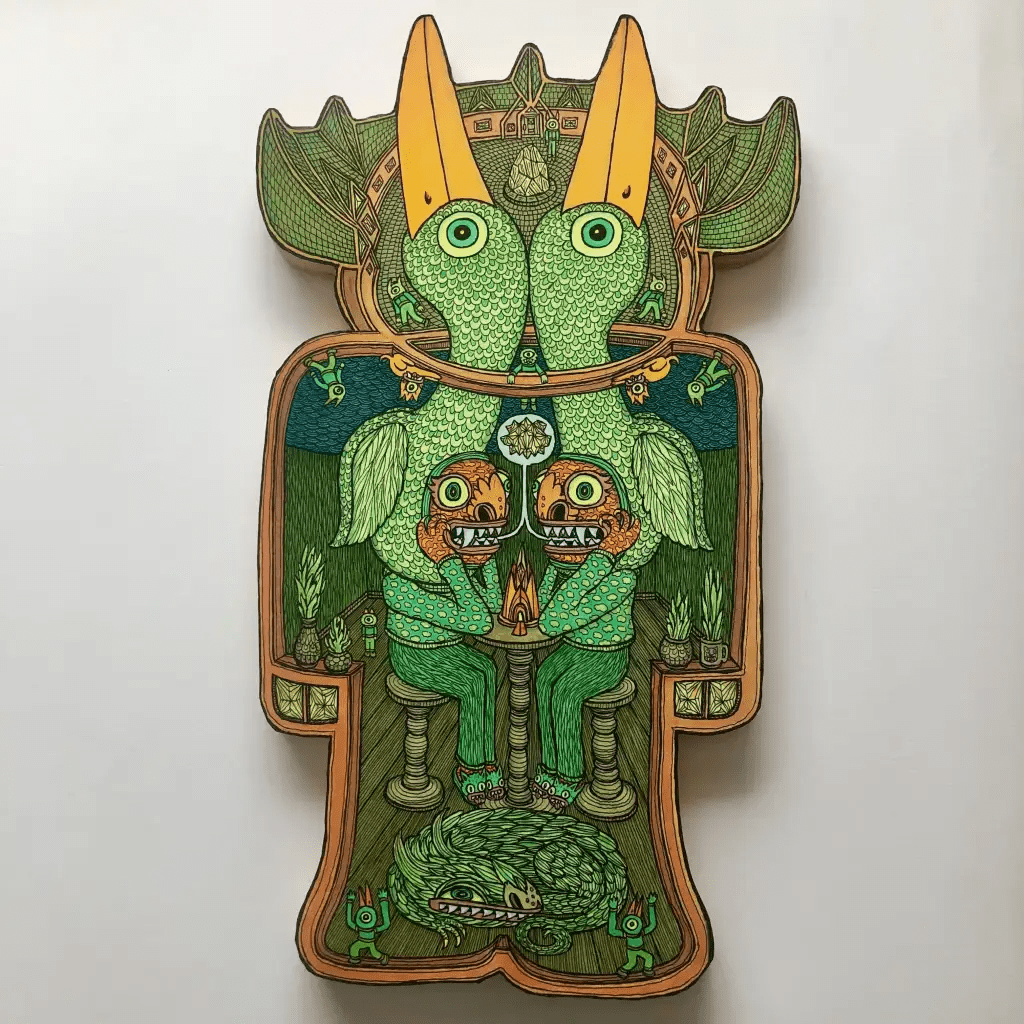
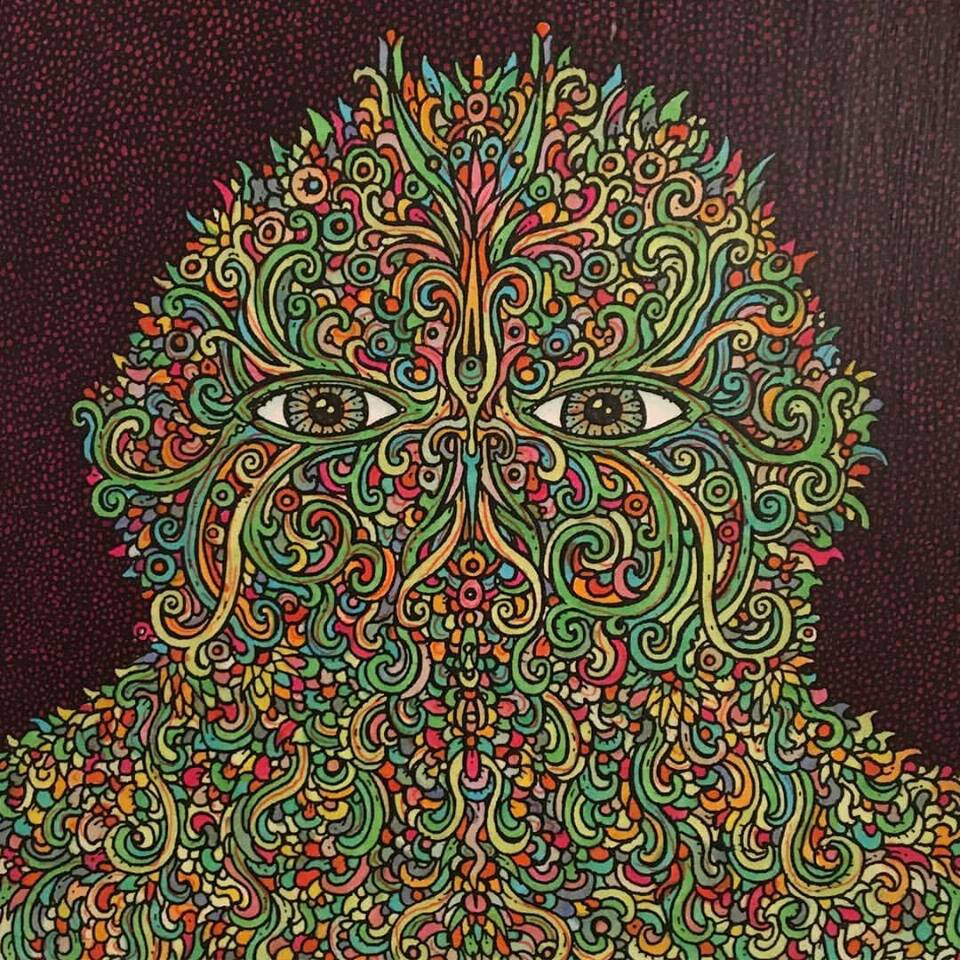
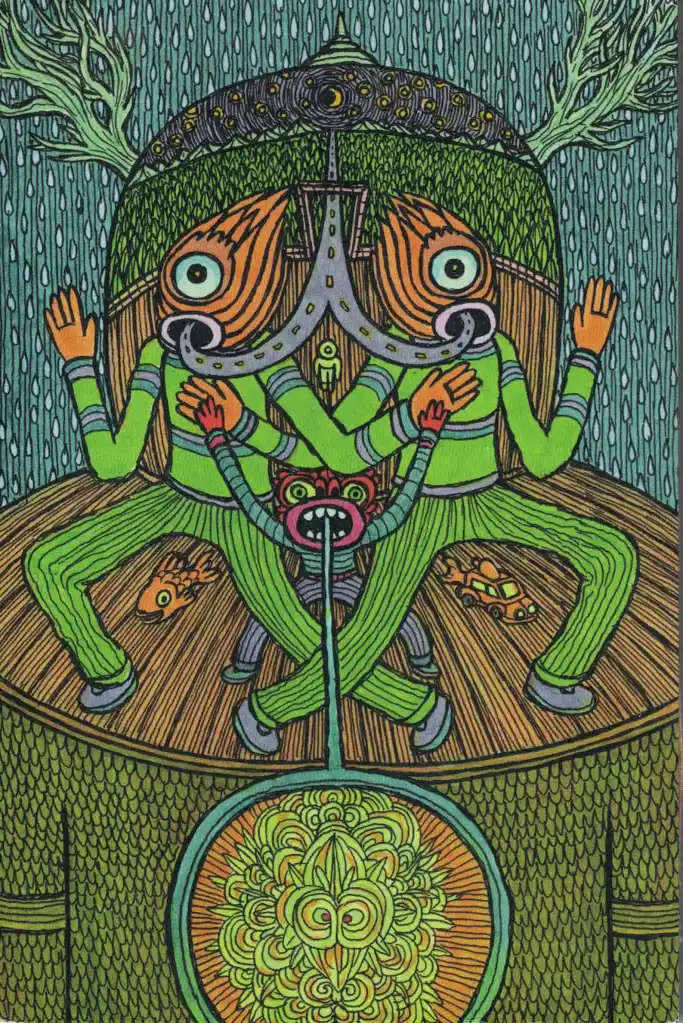
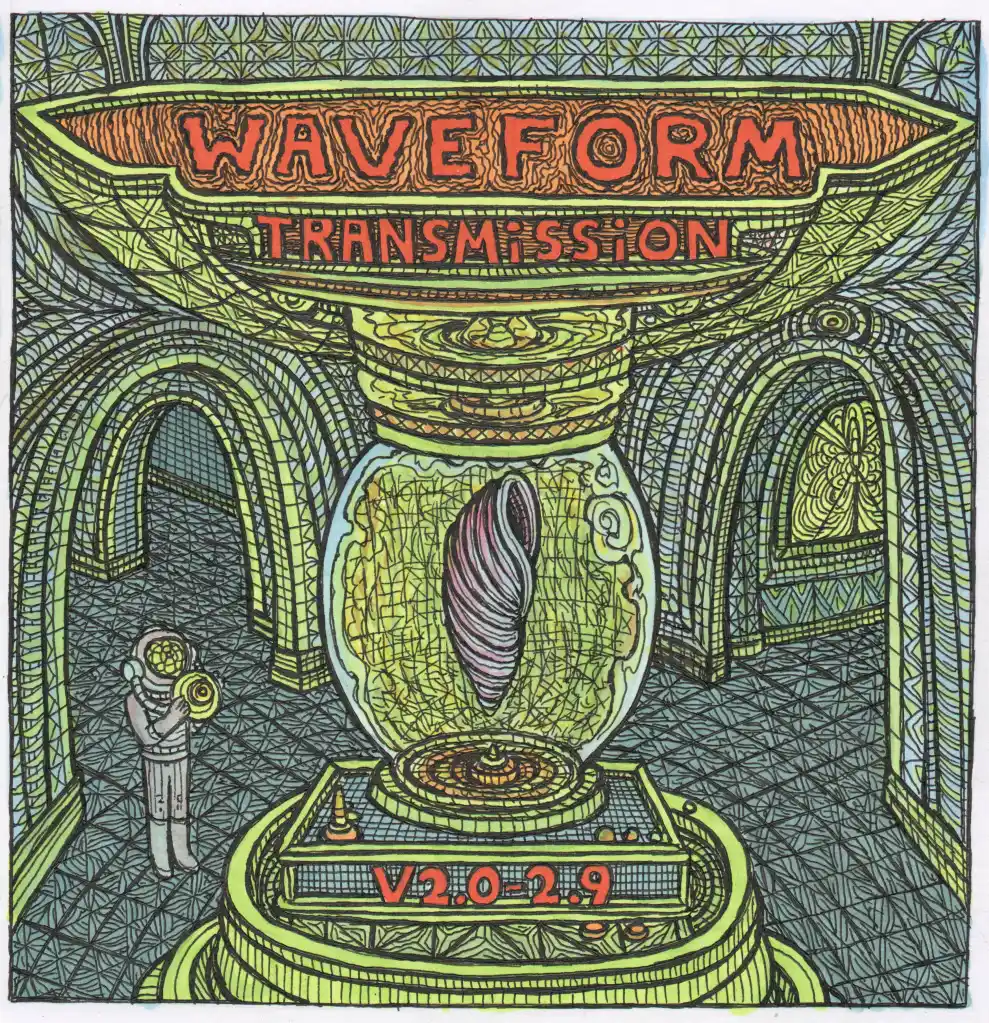
Theo Ellsworth is a self-taught artist living in Montana. His previously published comics include Capacity, The Understanding Monster, Sleeper Car, and An Exorcism. The New York Times once called his work, Imagination at firehose intensity. He has been the recipient of the Lynd Ward Honor Book Prize and an Artist Innovation Award. He loves creative collaboration, cooking, and making family folk art with his kids. He is constantly making invisible performance art in his head that no one will ever see.
My art is a way for me to navigate difficult subjects and emotions, and as I work on each piece, I am able to meditate on, process and organize my emotions about the subject matter I am addressing.
I started really getting into art after finishing a five-year enlistment in the US Navy. I spent most of my time in the service overseas and felt completely lost when I returned to California in July 1999. I had few friends, no social life or hobbies, and an extremely difficult time finding work. I had a ton of anxiety, felt out of place, would go through episodes of depression followed by manic insomnia, and the only way I’d learned to deal with those emotions in the service was to drink excessively. I wandered into an art supply store one day, looking for something to keep my mind busy and provide an outlet for my manic energy. I started with pastels and watercolor pencils. At first, I just did my own thing, with no direction, technique, or theme. I think that’s probably the best way to get into art. It’s what children do. And they don’t compare their drawing with the other kid’s drawing, they just draw. They don’t strive for photo realism either—if you don’t see the boa constrictor eating an elephant, that’s your failing because they drew it perfectly. I was only in this golden state of mind for a short time, though.
After going through several jobs in Bakersfield, and working two years in Dutch Harbor at a seafood processing plant, I bought a tiny, run-down mobile on the property next to my parents up in Bodfish, CA. I started painting with acrylics, and I took every art class offered at the local community college. I took classes in ceramics, sculpture, drawing, and painting. I also started comparing my work to my classmates’ work. People would compliment my paintings, but I was never happy with them. I loved the classes and instructors but hated myself. I got hung up on every stray mark or brushstroke. Instead of loosening up and becoming more expressive, I was hyper-focusing on the most ridiculous things.
Blue Lotus Scratchboard with India inks. 2021
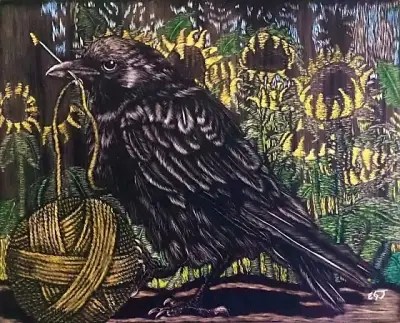
Scratchboard, oddly enough, helped get me out of this creativity-destroying state of mind. I picked up an 8×10 Ampersand Scratchboard at the art supply store one day. I grabbed a hobby knife and started digging into the clay. But as soon as I made a mistake, I realized this medium doesn’t lend itself well to corrections, and promptly threw it away. Months later, I picked up another scratchboard. There was something about it I found really satisfying, and I wanted to keep working with this medium. I use Ampersand Scratchboards, and they aren’t cheap. So, when I made an errant mark with the knife, I reimagined the scene to incorporate the mistake. I slowly began to worry less about being as realistic as possible and began working from my imagination again. I also realized that I had retained much more technical knowledge from those art classes than I thought, and I found a few artists who were always willing to impart knowledge, advice, and encouragement whenever I needed it. Thank you, Chris Owen and Chet Zar!
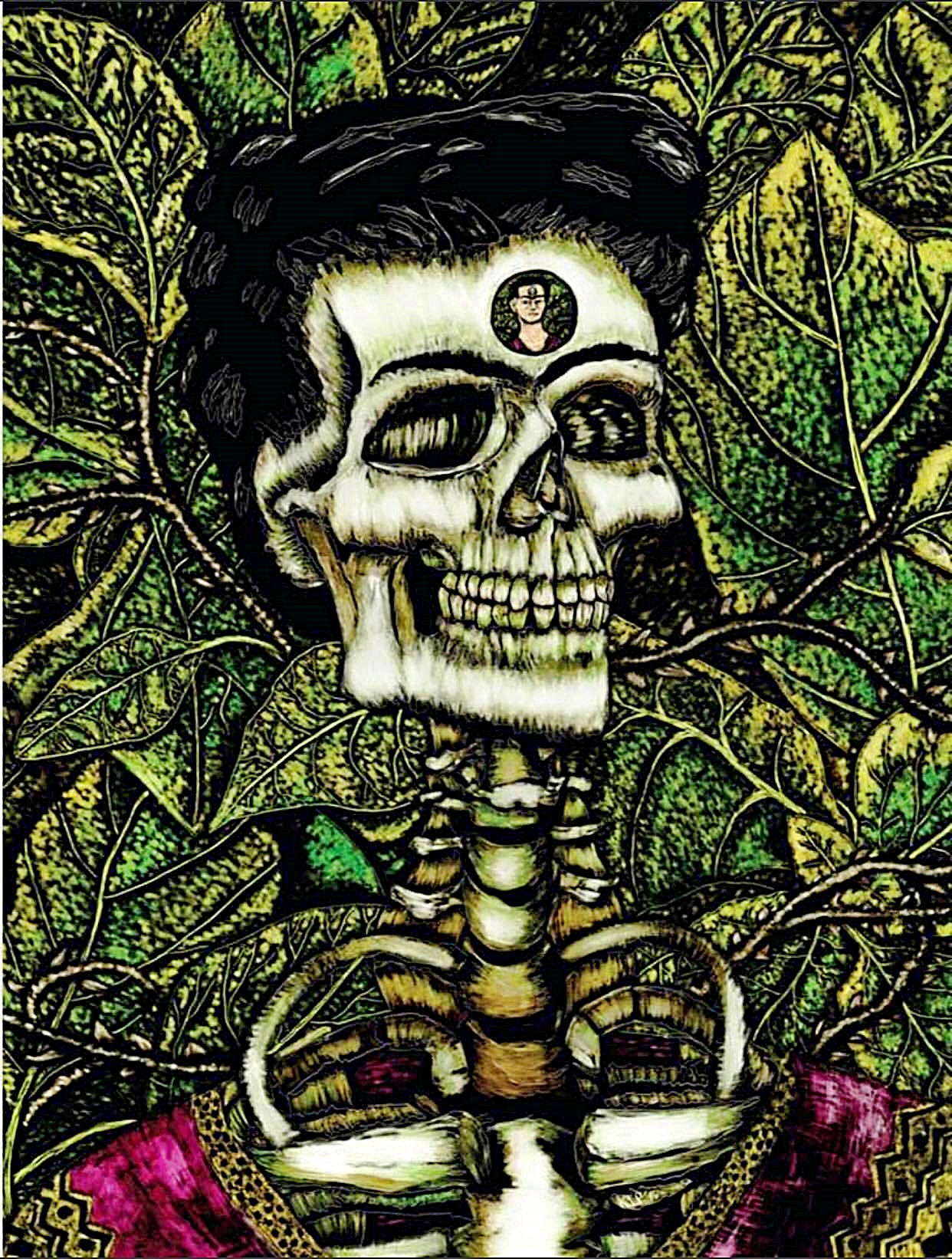
Left: Thinking about FridaMiddle:Prairie GhostsRight:Meeting Death in a Forest
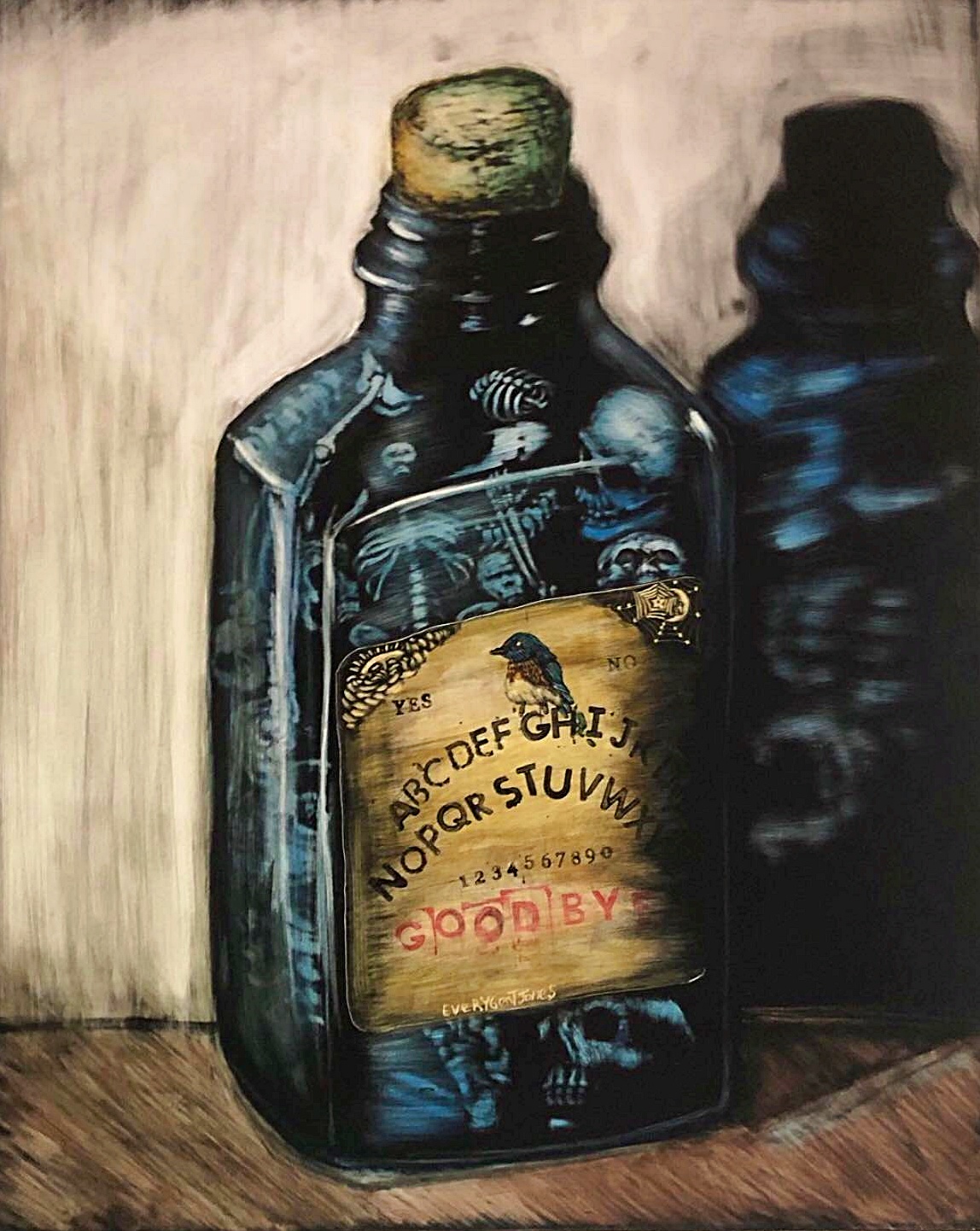
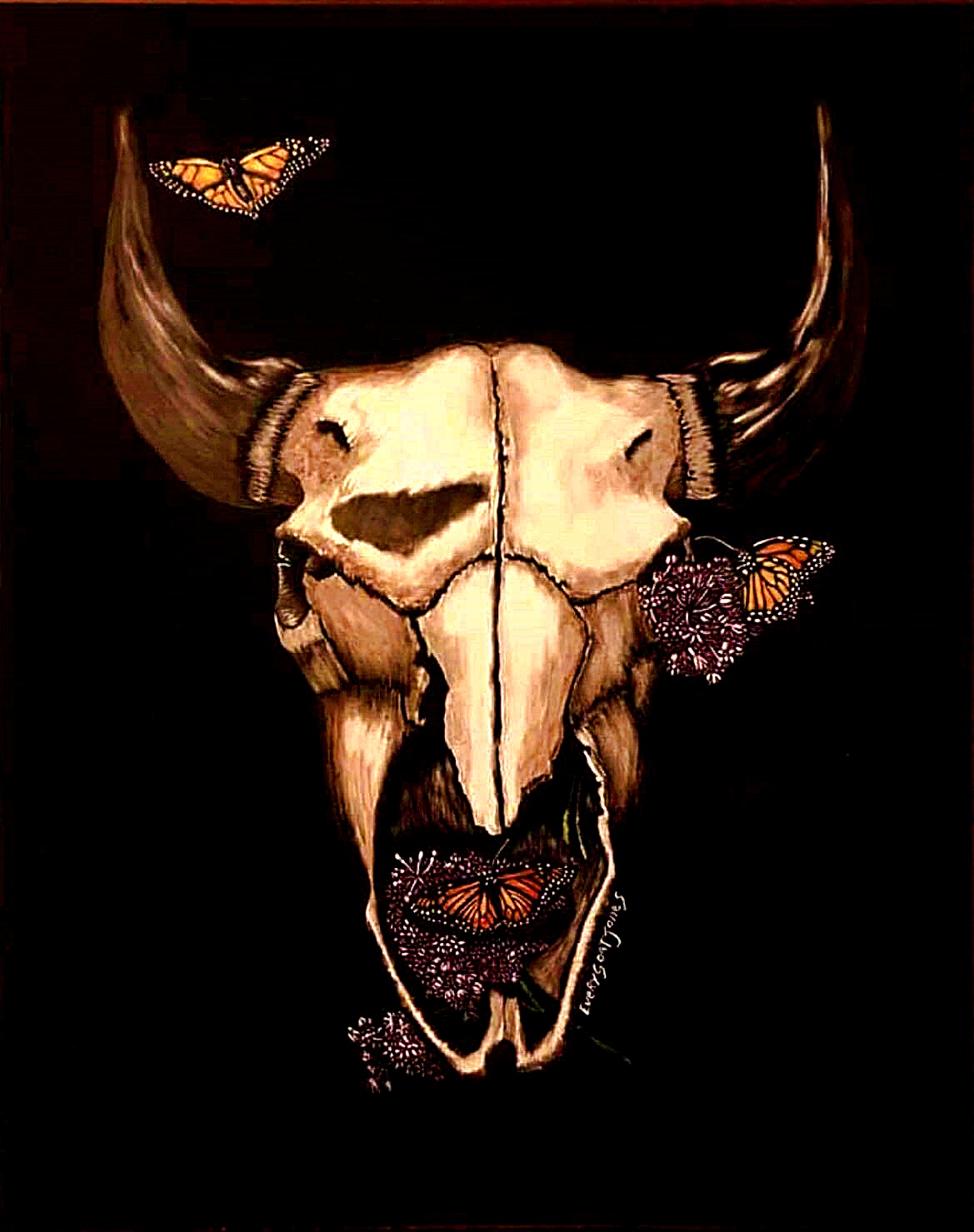
Encouragement and acceptance from others definitely helped me to keep going. I practiced all the time. I studied how other scratchboard artists worked. Then, I would experiment with various techniques and different tools while developing my own style. I used my art to deal with difficult feelings and subjects that were triggering my depression and anxiety. Mortality, loss, kindness and cruelty, spirituality and purpose are all there, represented by skeletons, birds, flowers and cats.
Left:Enoch’s Gone Home Scratchboard, Inks Right:Empathy Scratchboard, Inks
One of the most therapeutic boards I did is Enoch’s Gone Home. I was caring for a colony of cats left behind when a neighbor died. She was a cat hoarder. It was terrible. There was one small kitten I named Enoch, who didn’t thrive. He always seemed weak. He wasn’t very assertive and often got pushed away by the others during meal times. I tried to help him, but I had very little experience with caring for community cats. One day, I noticed him looking really bad. He seemed listless and weak. I rushed him to the vet, but it was too late. I was unwilling to give up, however, so I brought him home and tried to give him water and food. Poor little guy died in my arms the same day. I felt so guilty. I took it personally. I Couldn’t stop thinking about it, so I started working on Enoch’s Gone Home.
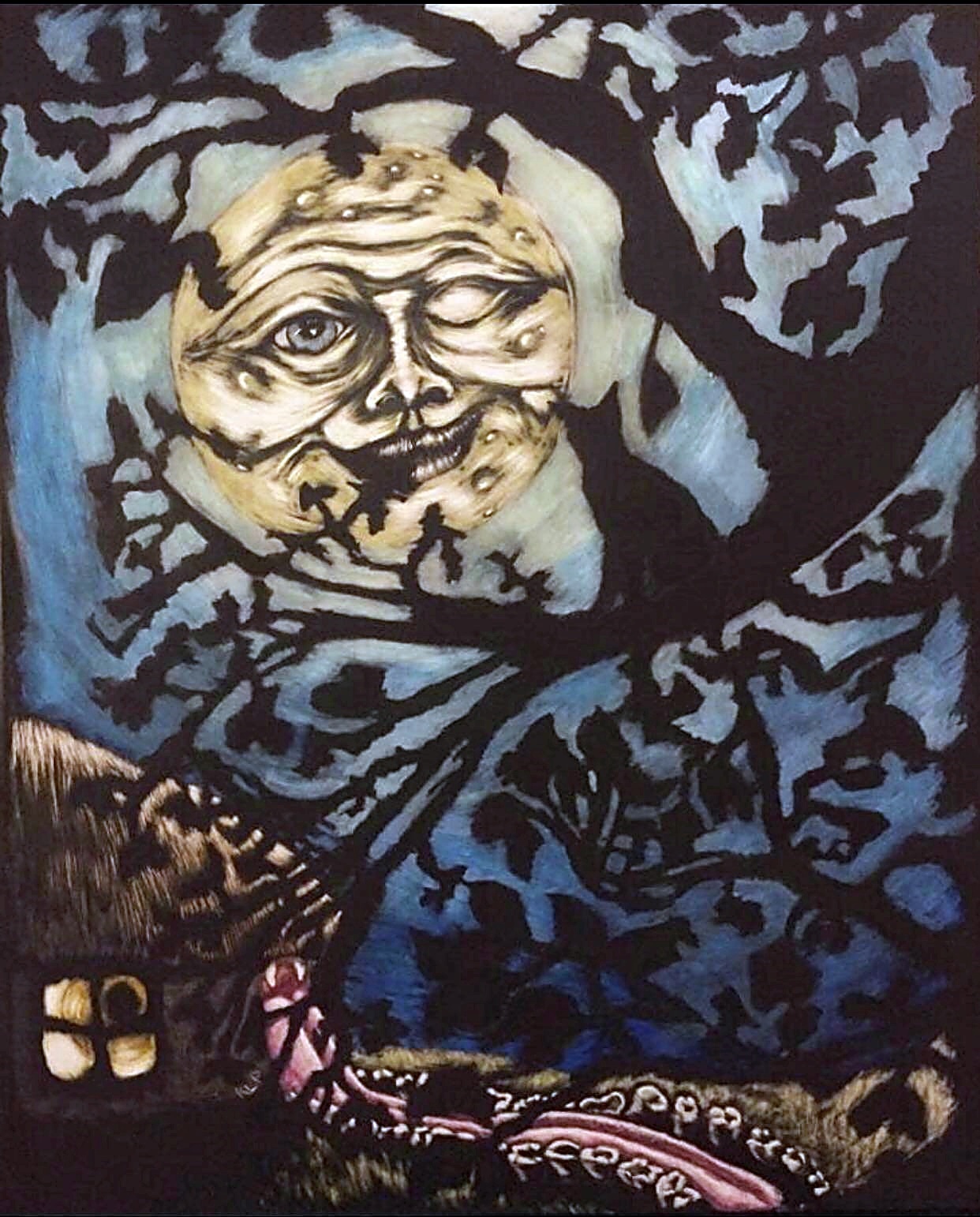
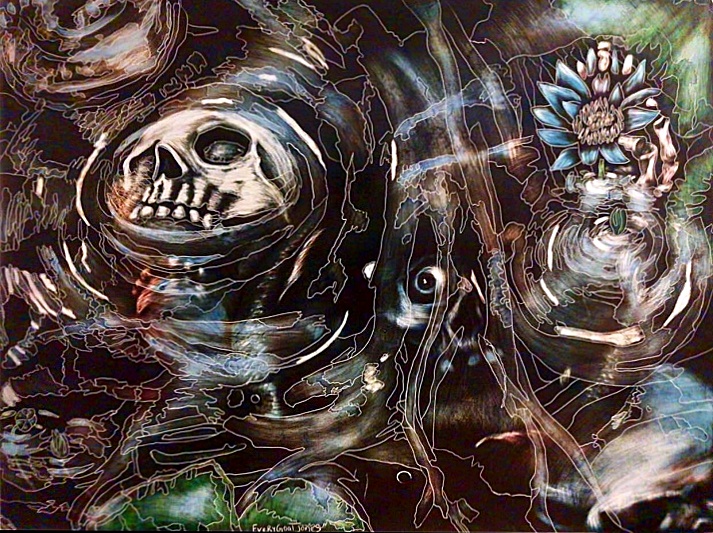
Another favorite is this 24×36 scratchboard I did, titled, Meeting Death in a Forest. The viewer is looking up at Death, who is escorting a nest of birds into the afterlife. Everything from the perspective, light and shadow placement, and the direction of Death’s gaze is important to me. I use skeletons much of the time to represent Death, but not always. Sometimes they are not the personification of Death, but are symbolic of other human attributes or experiences. I also like to do a visual definition of a particular word as the subject of my work. Empathy and Feral are two examples. Again, everything from the feathers in Empathy to the tooth-lined tongue path leading to the cottage door in Feral is important to my definition of those words.
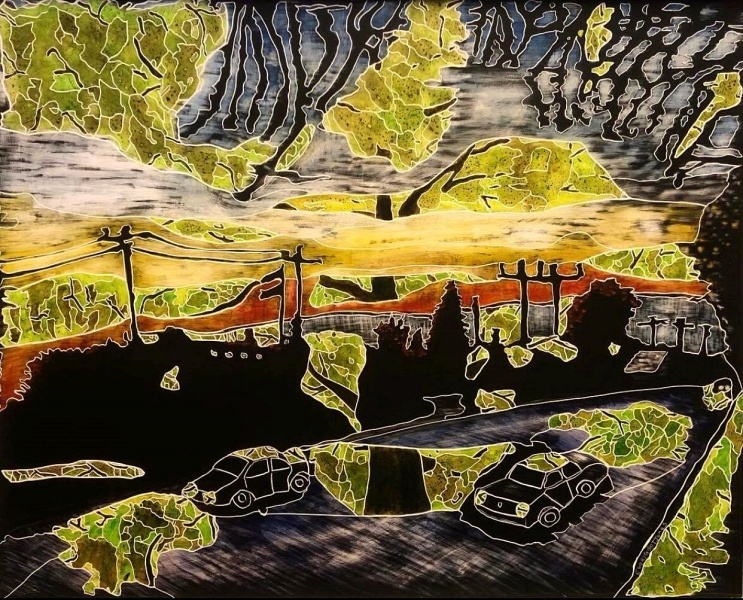
Wildland Urban Interface Scratchboard, inks. 2020
I take commissions, occasionally. Pet portraits are a popular request, and scratchboard is a favorite medium of pet portrait and animal artists, as it lends well to very fine details. I have seen some amazing, hyper-realistic animals on scratchboard. I think I may be the only scratchboard artist in the world who hasn’t done a lion, tiger, or zebra. But I have done human portraits—only a few though, and only of close friends and family.
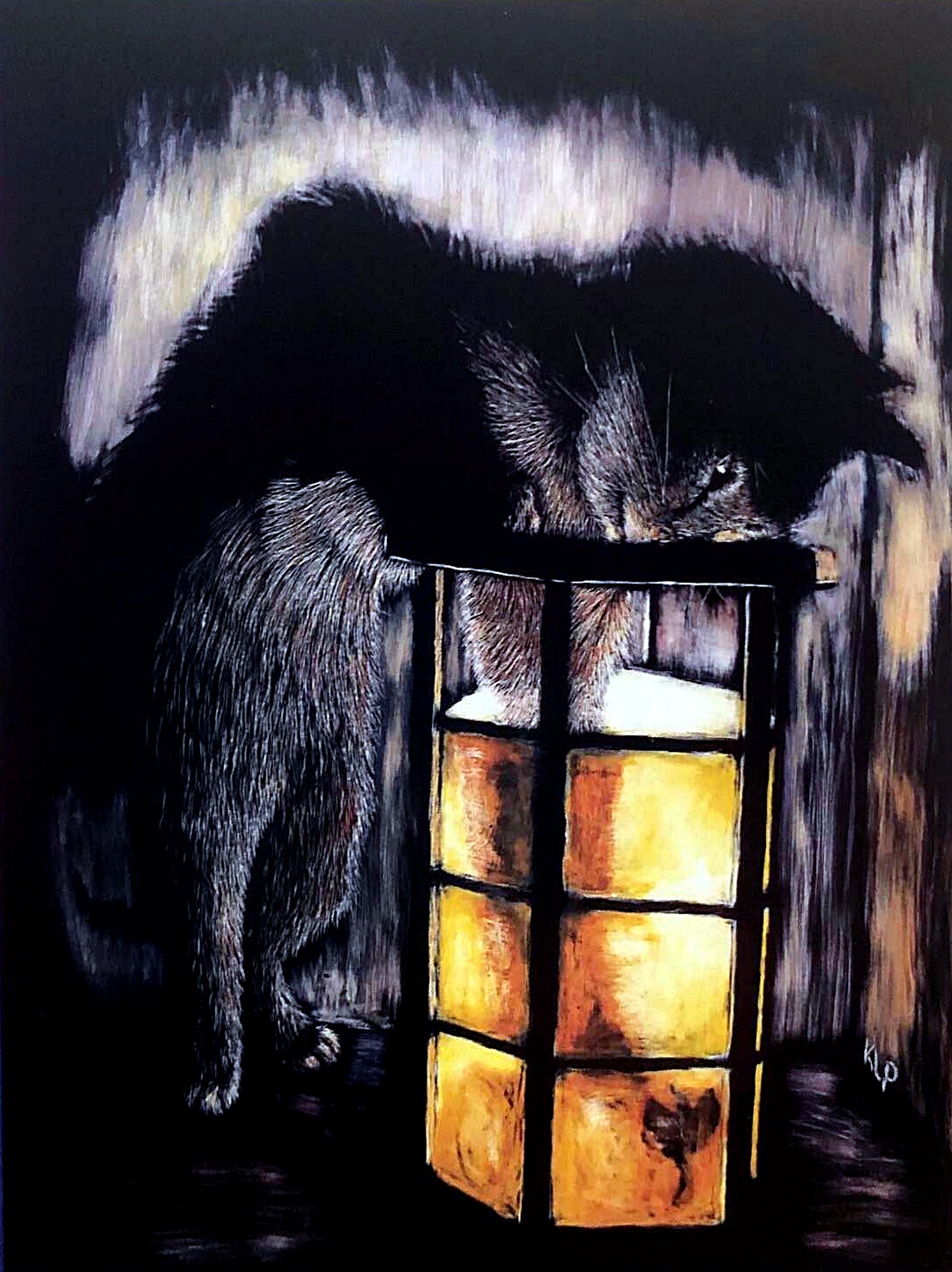
Left: Battle of Nightstand Middle:The QuestRight:Seamus
I really enjoy doing studies of many different subjects. Anything that happens to catch my attention is a potential subject for a study or even a larger work. I’m constantly taking photos of anything I see around me that looks like it could be challenging, interesting, ugly or beautiful on a scratchboard.
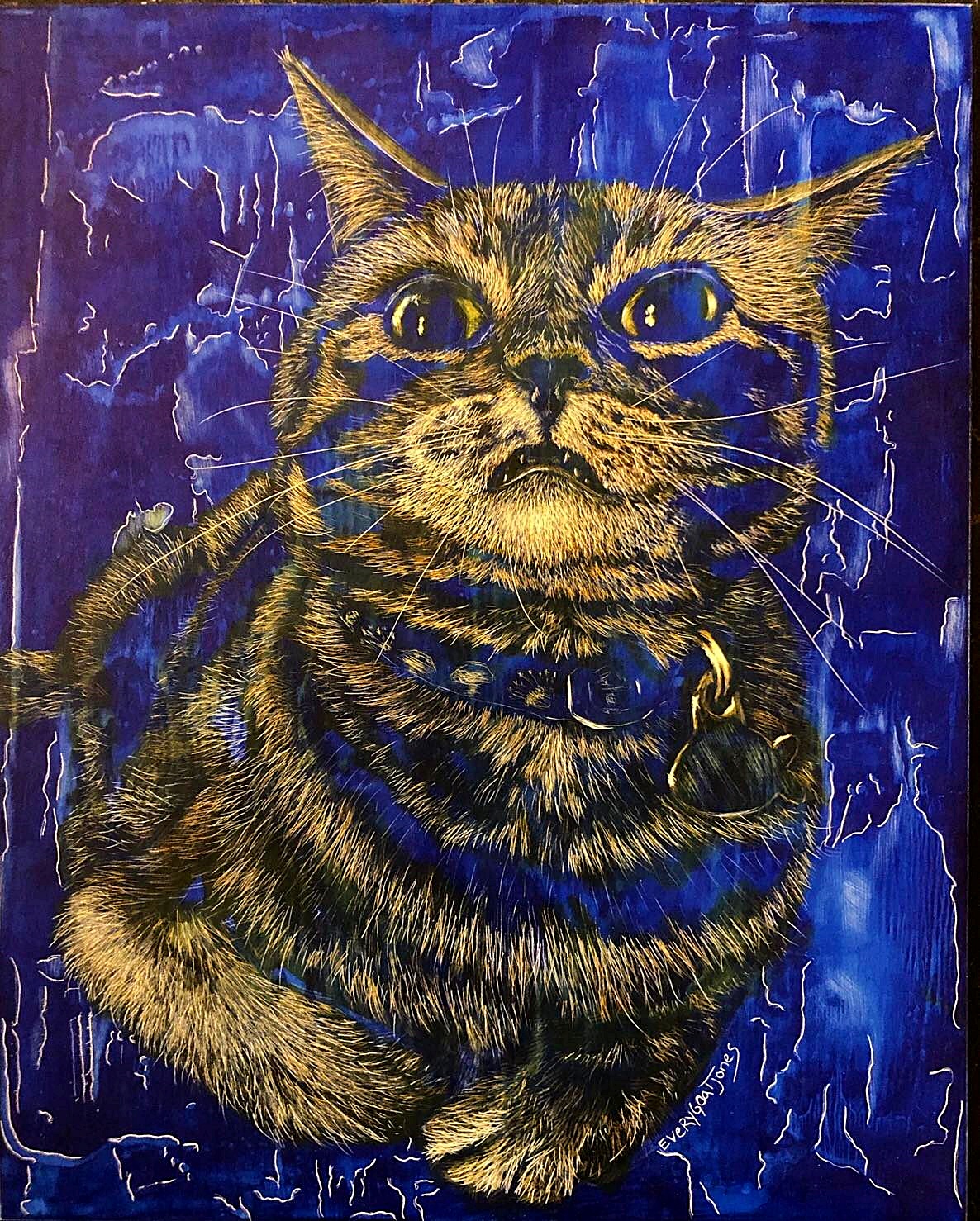
Left: Ginger Cat Clayboard with Scratchboard inks, 2020. Right:Bamboo Clayboard with India inks, (commissioned portrait) 2019.
I do not like to be limited on what themes I address or style I use in my art. If I forced myself to focus on only a narrow theme or style, I would feel stifled and claustrophobic. I never know what I’ll work on next (unless it’s a commission). It’s always a spontaneous decision for me. I may hear a word, see something, get a feeling or be overcome with some emotion or experience that I cannot separate myself from—and that will probably be the subject of my next scratchboard.
Exhibitions: Kern Valley Museum- Kernville, Ca October 2016 Bakersfield Museum of Art- Bakersfield, Ca May 2019 Visual Arts Festival Kern Valley Museum- Kernville, Ca June 2019 Work used by Ampersand Art to advertise Fall Scratchbord sale, 2019] Arts Illiana Gallery “The Crow Show” February-April 2020
Publications and Reviews: KRV’s Hidden Gems: Kernville Arts and Crafts Festival Kern Valley Sun, September 2019 Skilled Hands Bakersfield Magazine, February 2018 [No Link Avail.] Artist Finds Focus Kern Valley Sun, June 28, 2017 First Friday, Dagny’s Coffee, November 2019
Awards and Recognition: Best in Show, The Crow Show, Arts Illiana Gallery, Terre Haute, IN 2020 1st Place, Kern County Fair, Professional Scratchboard Art- Bakersfield, Ca 2019 1st Place, Kern County Fair, Professional Scratchboard Art-Bakersfield, Ca 2018
Collections: Alex Joya, La Costa Mariscos Bakersfield, Stockdale Hwy Bakersfield Veteran’s Clinic, Bakersfield, Ca, Westwind Dr. Kern Veterinary Hospital, Lake Isabella, Ca, Lake Isabella Blvd. The Cyclesmiths, Kernville, Ca The Starlite Lounge, Kernville, Ca












 Mitchell Pluto