
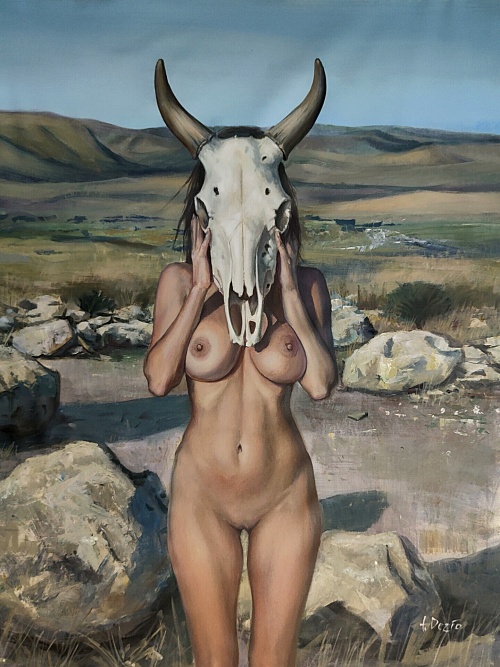
Written by ©Francesco Dezio
I paint because desire needs a body to exist, and painting is the slowest, most honest way I know to truly look at it. I’m not interested in eroticism as a subject — I’m interested in it as a state: that threshold where modesty becomes gesture, exposure becomes power, and the viewer’s gaze ends up as much on trial as the body it’s watching. My figures are built with the discipline of the great oil painting tradition — Caravaggio, Velázquez, the patient, cruel light of chiaroscuro — but somewhere, usually right where the viewer feels safest, something cracks: a background that stops being real, a detail that belongs to a dream rather than the room. That’s my way of saying desire is never simple, never harmless, never just beautiful — it’s also unsettling, and it’s also true.
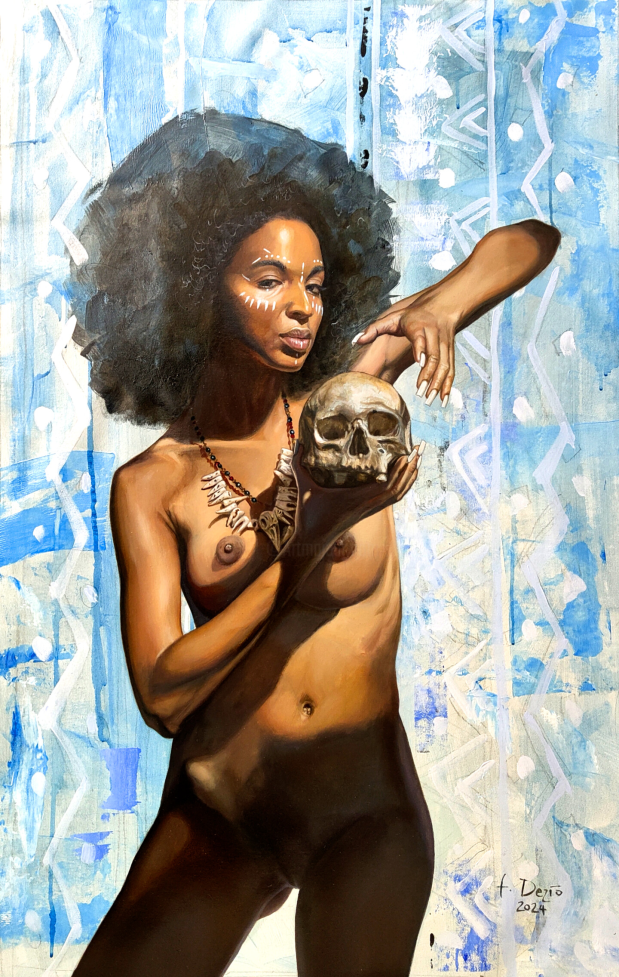
I owe a great deal here to Dalí and Magritte, to the distorted, diseased lens — and its weight of anguish over modern man — of Francis Bacon, to the diaphanous flesh of Klimt, and to the formal perfection of Bouguereau: arguably the most erotic painter of the 19th century, too often dismissed by critics for his sentimental shepherdesses, when his real peak comes in his mythological subjects.

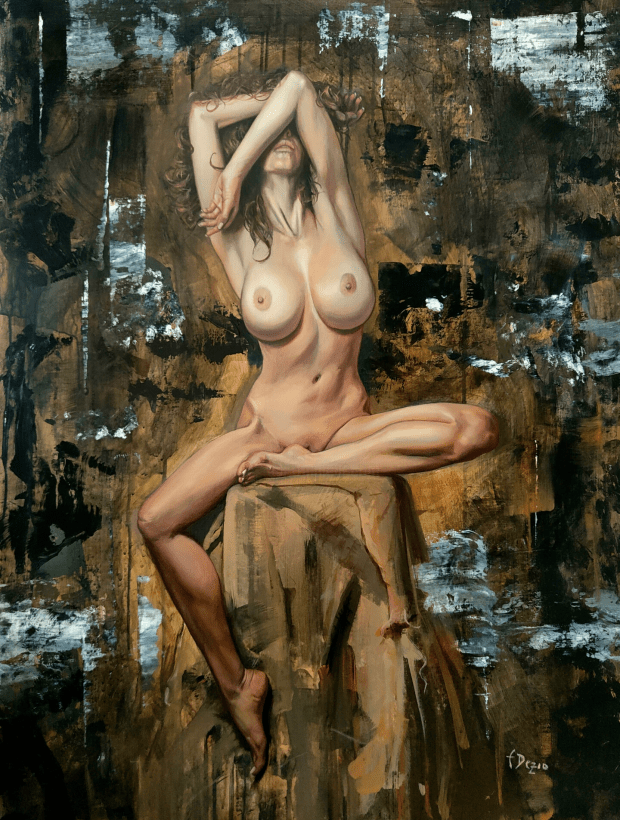
And then there’s cinema, which made eroticism a philosophical language before it was ever a visual one: the sun-drenched, Mediterranean, unapologetic eros of Tinto Brass, and above all the visionary, hallucinated, almost religious transgression of Walerian Borowczyk, for whom the naked body was always also a territory of dream.
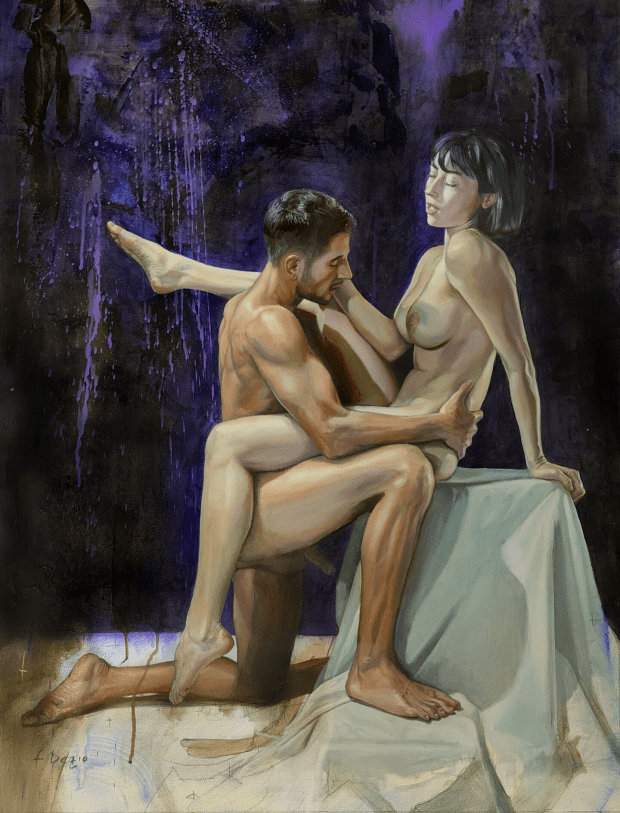
I look with the same attention at contemporary painting working this same edge — Roberto Ferri, Jenny Saville, Eric Fischl, John Currin, Martin Eder — and at a more popular imagery that shaped me as much as the museums did: Milo Manara, Moebius, the American illustrator Robert McGinnis, Boris Vallejo and Julie Bell, and the great Italian masters of painted covers for erotic pulp comics, Alessandro Biffignandi and Emanuele Taglietti — artists who only ever painted the covers, almost always more powerful and memorable than the stories they promised to illustrate, and still, for me, the images that remain.


I started painting in 1985, self-taught, already working in surrealist territory shot through with an openly erotic streak. For many years painting coexisted with — and then gave way to — another path: writing. I returned to painting steadily in 2021, during the pandemic, and my visual language has grown more mature and defined ever since.

Before I was a painter I was, and remain, a writer. In 2004 I published the novel Nicola Rubino è entrato in fabbrica (Nicola Rubino Started Work at the Factory) with Feltrinelli, now considered the founding text of Italy’s new fiction about precarious labor — a genre that, through the 2000s, gave voice to a whole generation’s disillusionment. Roberto Saviano, the author of Gomorrah and one of Italy’s most internationally recognized voices, wrote that it was one of the rare novels that truly earns the word “true.” I’ve published two further novels, La gente per bene (2018) and La meccanica del divano (2021), the latter longlisted for the Premio Strega, Italy’s most prestigious literary prize.


Today I also work as an editorial illustrator, designing covers for the independent Italian publishers TerraRossa Edizioni and Revolver Edizioni — including covers for two novels that went on to become Premio Strega finalists, in 2021 and 2025. My work is exhibited at the Artimmagine gallery in Altamura and the Galleria Michelangiolo in Trani. I live and work in Altamura, in Puglia, southern Italy.

The mechanics of the sofa
by Francesco Dezio
Amazon: https://www.amazon.it/-/en/meccanica-del-divano-Francesco-Dezio/dp/8868818388
Instagram: @francescodezioart
ArtMajeur: https://www.artmajeur.com/francesco-dezio
 Mitchell Pluto