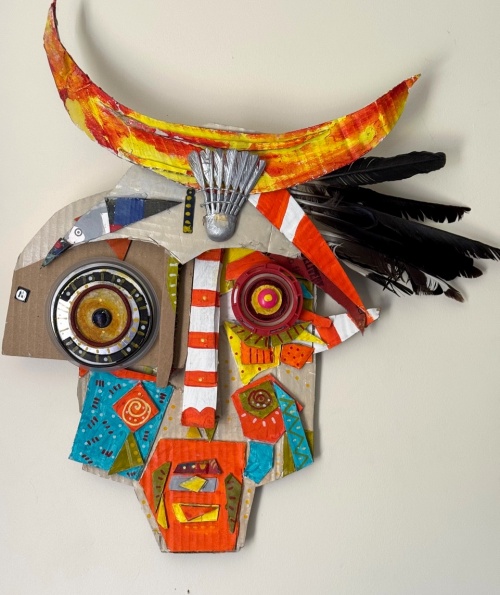
Ancestor, February 2024. Cardboard, feathers and found materials.
We live inside a culture whose overriding goal is to keep us distracted, afraid, addicted and constantly triggered and disconnected from our authentic selves.
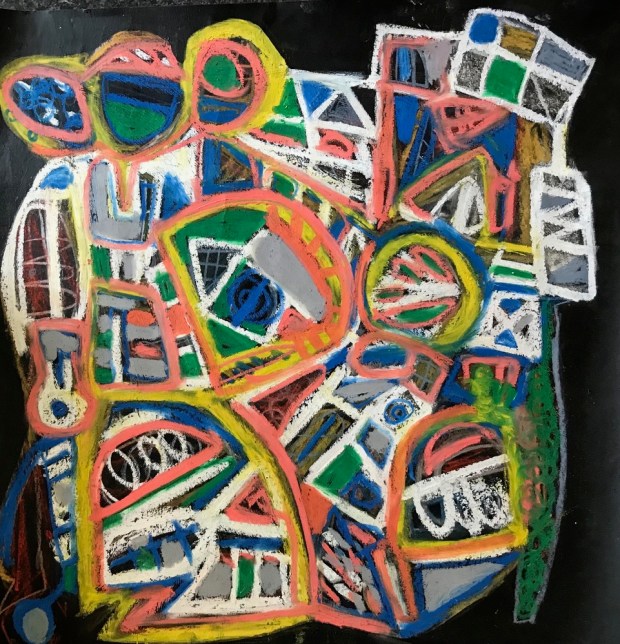
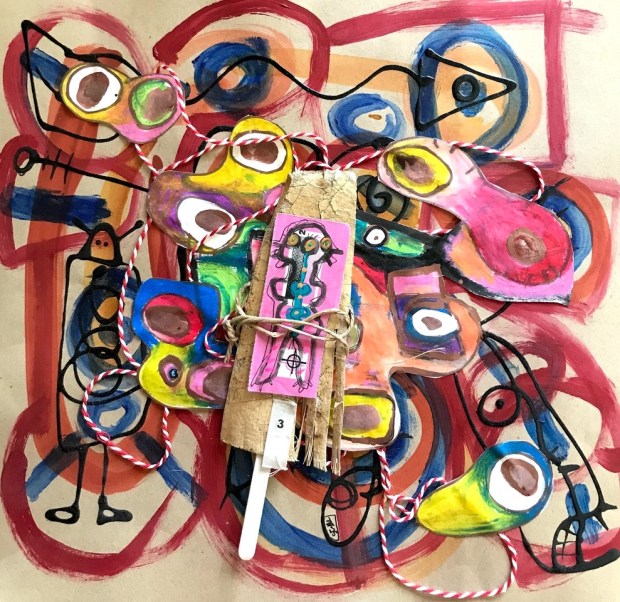
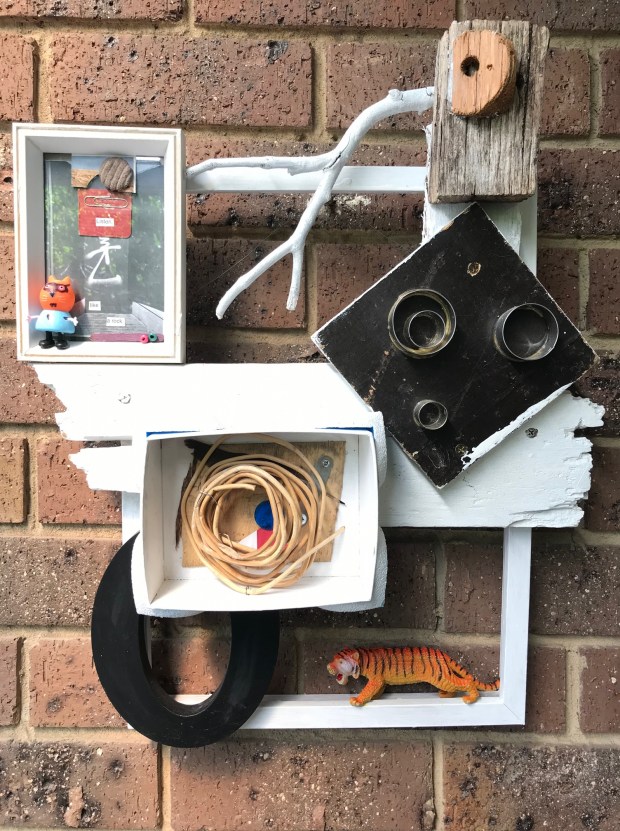
Snakes, ladders and chaos Tim White August 2025. Acrylic paint, oil pastel and paint marker on industrial paper
Art is an antidote, a map guiding us to an authentic lived experiences and a life-affirming revolutionary principle.
IlluminousDancing with the SpiritsThe Garden
John Trudell, North American Indigenous activist, declared, ‘When one lives in a society where people can no longer rely on the institutions to tell them the truth, the truth must come from culture and art’. In this context, of what therapist and medical doctor, Gabor Maté calls a ‘toxic culture’ the need for truth is critical and urgent.
FamiliarsLost child with beetle
The idea that art and poetry, and all the rich diverse forms of expression which connect us to each other can immunize us against the malignant virus of colonialism, capitalism and patriarchy is deeply appealing. That this wisdom comes from the deep spring of Indigenous knowledge and resistance, and despite the ongoing depredations of colonialism, is compelling.
Autonomic
The broken bits of the world I collect and use: the scraps of paper, plastic and metal, the discarded and rejected materials are clues and tools helping me puzzle my way out of the colonial-capitalist labyrinth. They are medicines too, the materia of transmutation, which once distilled provide essential healing and deepened connection with the biosphere and all it nurtures.
Obscene icy pole
As African American feminist bell hooks writes, ‘The moment we choose to love we begin to move against oppression’. This process of resistance, of healing through love, is an essential part of overthrowing the dismal and diminished life the masters of misery want to force on us. And it is from this love, from the sources within our imagination and in solidarity with others we can assemble a ‘new world inside the shell of the old’.
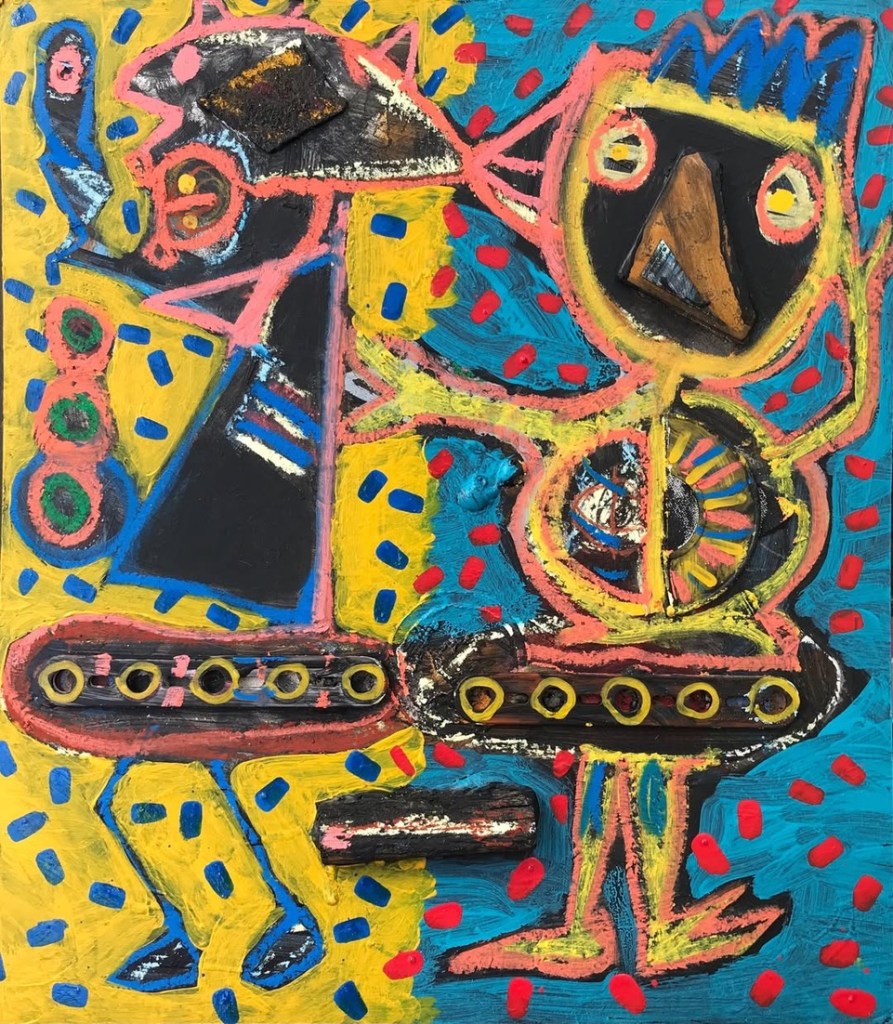
Iron Hills of Adversity Prime Optimus Vs Panoptic Octopus
For me, the found and discarded objects and materials used in my art carry a promise and reminder of profound possibilities subsumed in everyday life beyond the superficial substitutions of a hollowed-out AI virtuality. That even everyday junk and detritus call out to be up-cycled and politicised demanding a place as emblems of a transformed future, and are always on hand as building blocks for a new world, is a source of joy and inspiration.
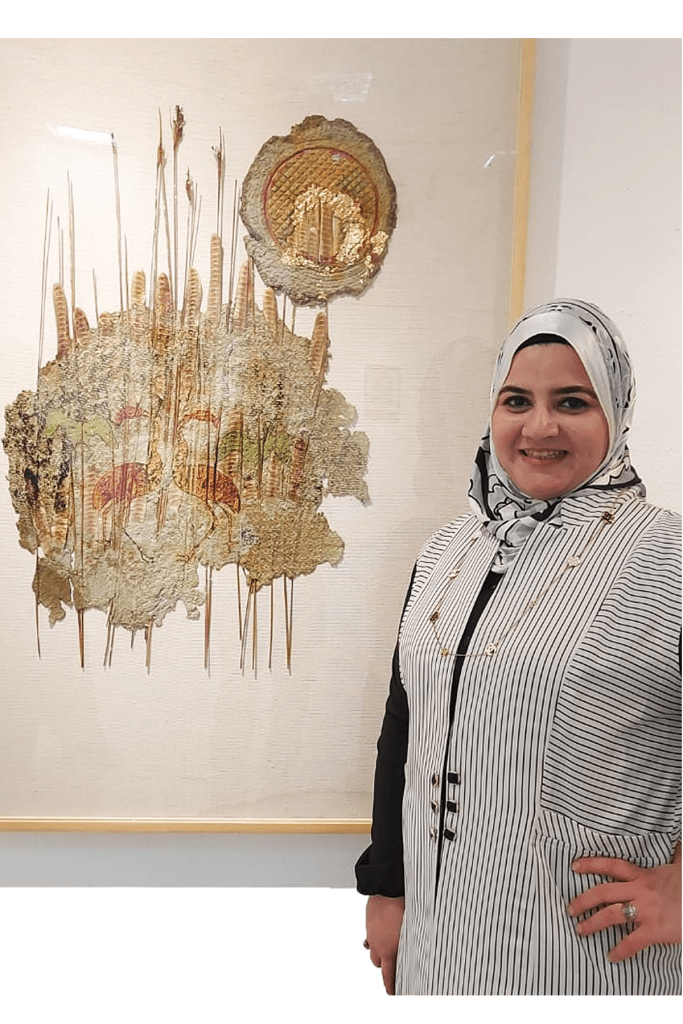
Abstract Human and Islamic pattern. Handmade Paper, dyes, rust, gold leaf. Dimensions with frame: 67.5 cm × 83 cm Production Year: 2019.
Israa Kazem uses handmade paper as her primary material, breathing new life into it. As it carries its own story. Her work merges the magic of nature with the aesthetics of ancient art civilizations, influenced by Islamic art and miniature paintings creating a style that is both vital and contemporary. The process demands precision, resulting in pieces free flowing lines and texture of the paper lend a unique character to the artwork, in addition to depth and expression—a return to roots. These frameworks surface in her approach to papermaking—a process where chaos (raw, recycled materials) yields order (structured sheets), mirroring the emergent patterns found in nature.
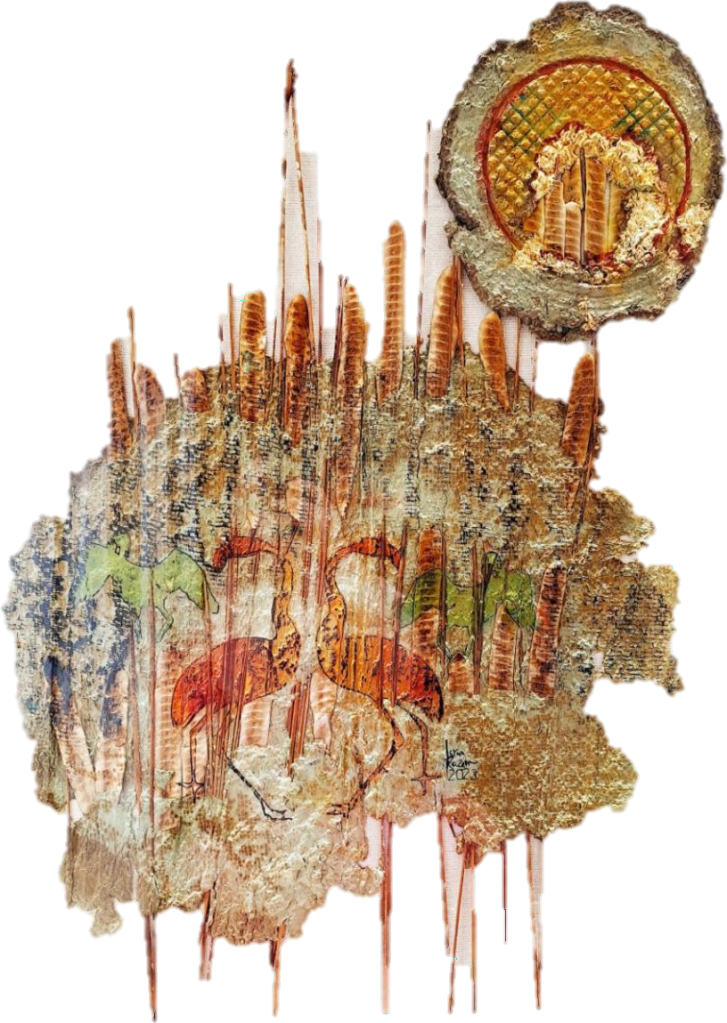
Flamingo reflection and the disk of sun Paper Pulp, Gold leaf, Dried Leaves, Stalks of Grain Plants, Ink, Color Dyes. Dimensions with frame: 132.5 cm × 102.5 cm Production Year: 2023
Her work transforms discarded fibers from wastes into delicate sheets of paper, each piece is a tactile archive, inviting the viewer to contemplation on sustainability and our relationship with the natural world.
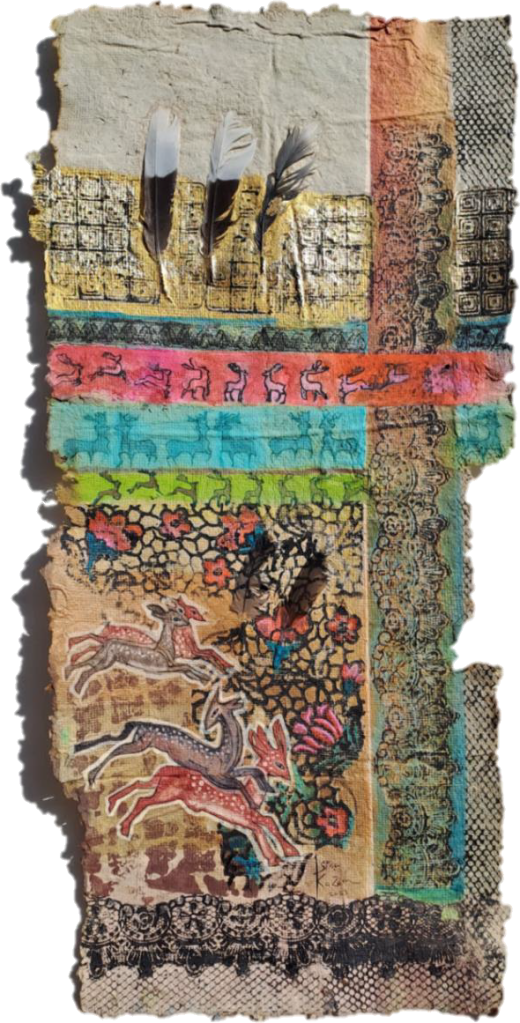
Deer are running on the mountain Handmade Paper, feather, gold leaf, dyes, ink, acrylic pens. Dimensions with frame: 85 cm × 50 cm Production Year: 2024.
She aims to highlight the diversity of living organisms and the different environments surrounding them, especially highly diverse ecological communities.
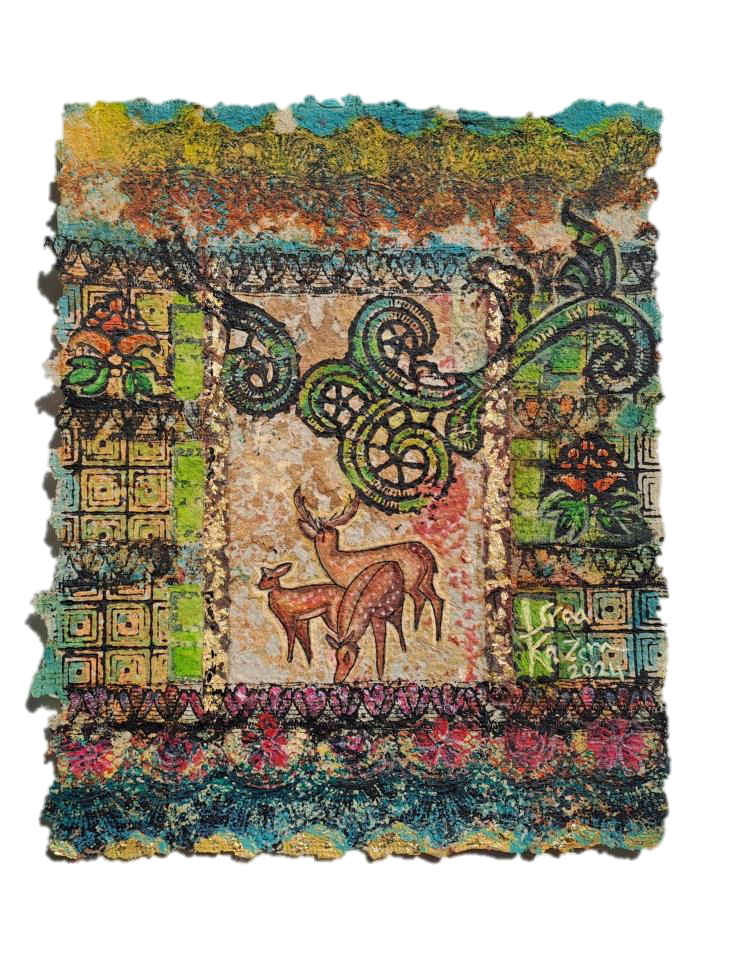
Deer are eating flowers Handmade Paper, dyes, ink, gold leaf. Dimensions with frame: 40 cm × 40 cm Production Year: 2024
This harmony is evident in her paintings, which may combine deer surrounded by geometric patterns, or blossoming flowers where the deer serves as a decorative motif. This fusion creates a visual language that speaks of the balance between two worlds: the world of spirituality and geometric perfection, and the world of life and growth in a timeless artwork.
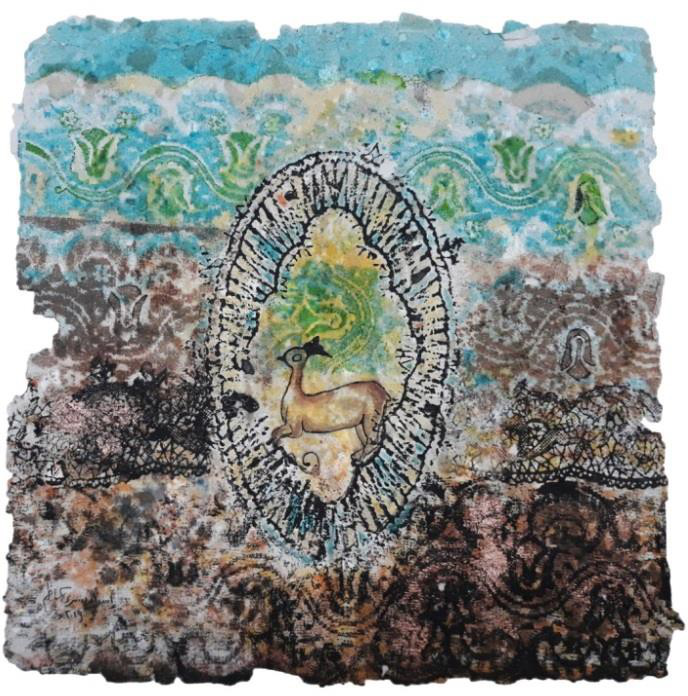
Handmade Paper, Dyes, ink Dimensions with frame: 50cm × 50 cm Production year: 2020
In her artworks collection, the deer refer as a main symbol, not merely appearing as an aesthetic form, but carrying various perspectives and meanings. The artist employs it as a symbol of optimism and new beginnings.
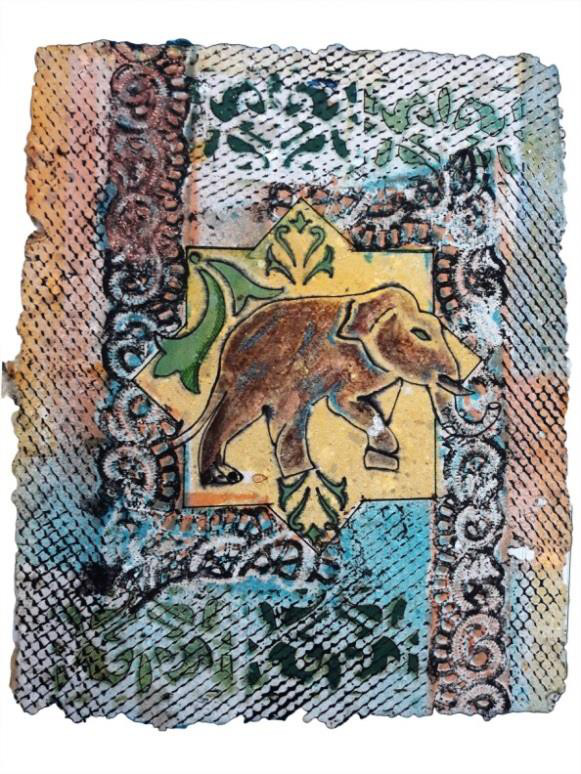
Handmade Paper, Dyes, ink Dimensions with frame: 50cm × 50 cm Production year: 2020
In its grace and lightness, the deer represent hope and the journey toward a better future. In Islamic art, the deer have always been associated with beauty and gentleness, making it the perfect choice to express her vision. The deer is painted in state of stillness and motion depicted in a style that combines simplicity of form and ornamental pattern, giving it a symbolic and contemporary dimension simultaneously. This demonstrates that art knows no bounds, and that the dialogue between past and present can produce creativity that transcends time and place.
Israa Kazem (B. 1987) is a Cairo based visual artist and researcher, holds Bachelor degree of Art Education, Helwan University.
She earned her master’s degree 2015, PHD 2020, in drawing and painting. Kazem is a member of the syndicate of plastic artists. She participated in many international and local Exhibitions. She found her creative inspiration in her drawings and paintings through nature. Kazem employed many drawing, painting, printing and mixed media techniques to achieve her artistic style.
Kazem uses handmade paper and paper pulp and combines them with different materials. Her use of natural materials not only adds depth and texture to her artwork but also focuses on the importance of sustainability in art and life. Her artistic practice reflects her respect for the surrounding environment and express its essence through her own vision.
Solo Exhibition: “Green Border”, Mahmoud Mokhtar Cultural Center, Nahdet Misr Gallery, 2023.
Group Exhibitions: – Agenda Exhibition, Conference Center, Bibliotheca Alexandrina, 12th, 14th, 15th, 16th sessions for the years 2019. 2021, 2022, 2023. – Cairo International Art District Exhibition (CIAD), Second Edition, Art D’Égypte, Downtown, 2022. – General Exhibition entitled “Art…The Memory of the Nation”, the 42nd session 2021, Arts Palace, Cairo Opera House. – White and Black Salon, 5th session, Gezira art center, 2020. – First Time Exhibition, 14th session, Conference Hall, Bibliotheca Alexandrina, 2019. – Second Exhibition: Artist’s Book, Mahmoud Mokhtar Cultural Center 2019. – Dai Festival of Arab Youth, Second Session, 2018. – Exhibition of the accompanied workshops for Cairo Salon 58, Artist book workshop, the Fine Arts Lovers Association, 2018. – South International Salon, Faculty of Fine Arts, Luxor – the 5 session 2017. – Youth Salon, 20th, 21st, 26th sessions Palace of Arts, Cairo Opera House, for the years 2015, 2010, 2009.
Awards and Grants: Kazem won the First Prize in Youth Visual Arts competition, 6th Edition, El Horreya Center for Creativity, Alexandria, Cultural Development Fund Sector, Ministry of Culture.
Sabbatical Grants Artist in the field of Fine Art specialized in Painting, Supreme Council of Culture, 2019, 2021, 2022, 2023.
Israa Kazem prepared the official representation of this article and has granted permission for this article to be published.
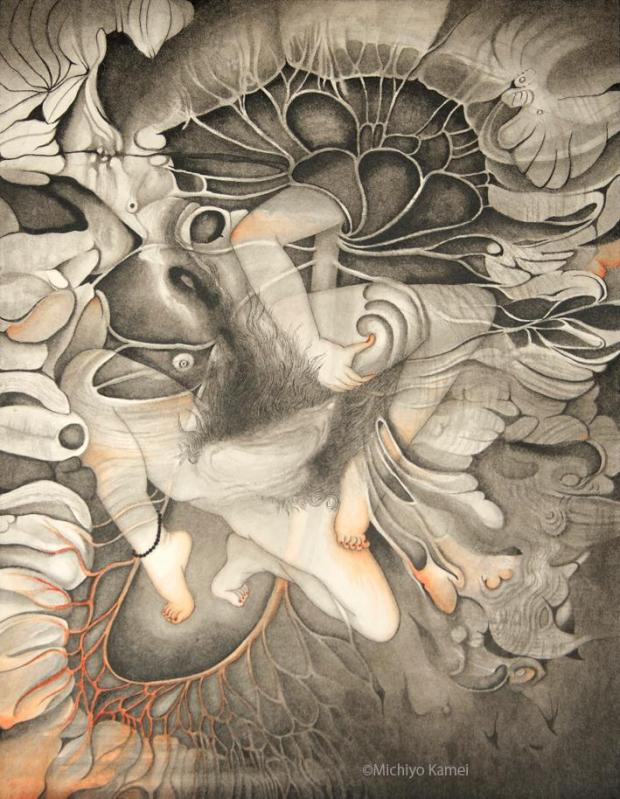
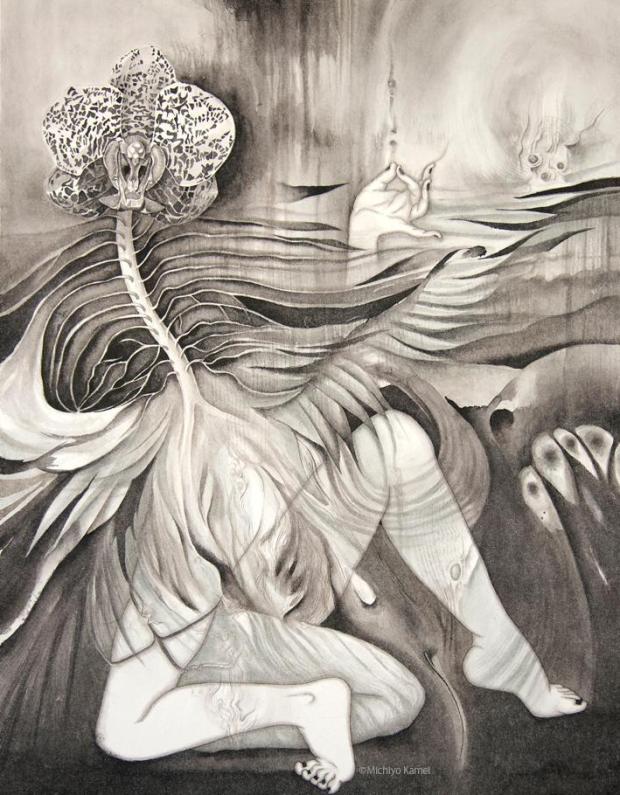
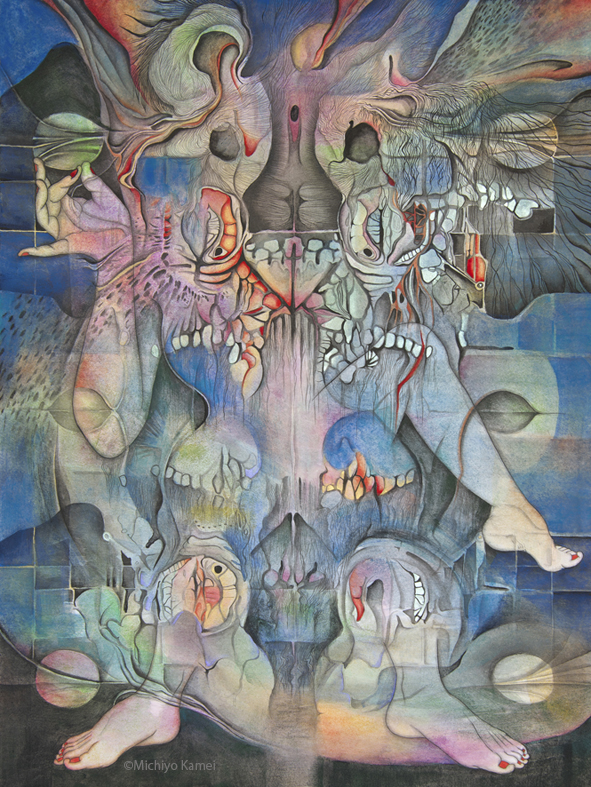
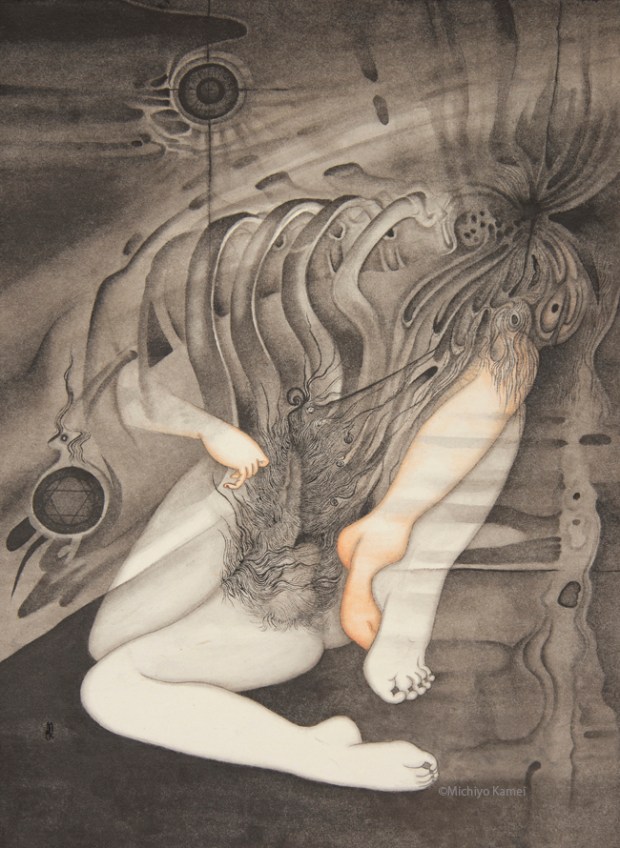
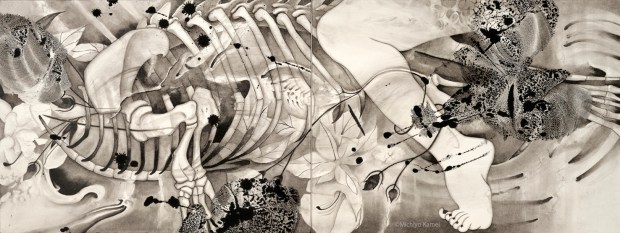
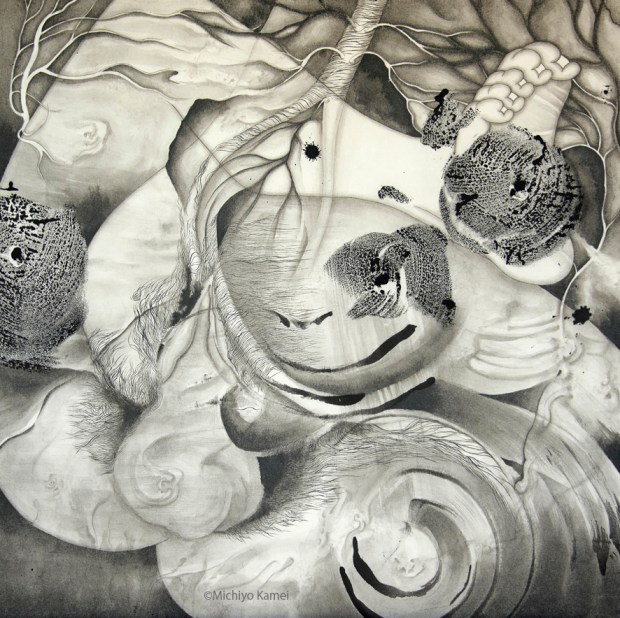
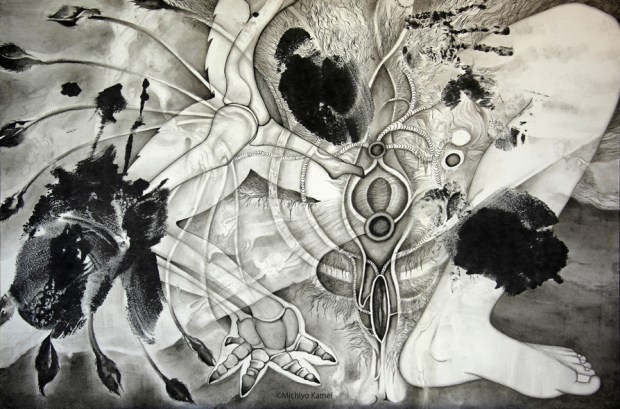
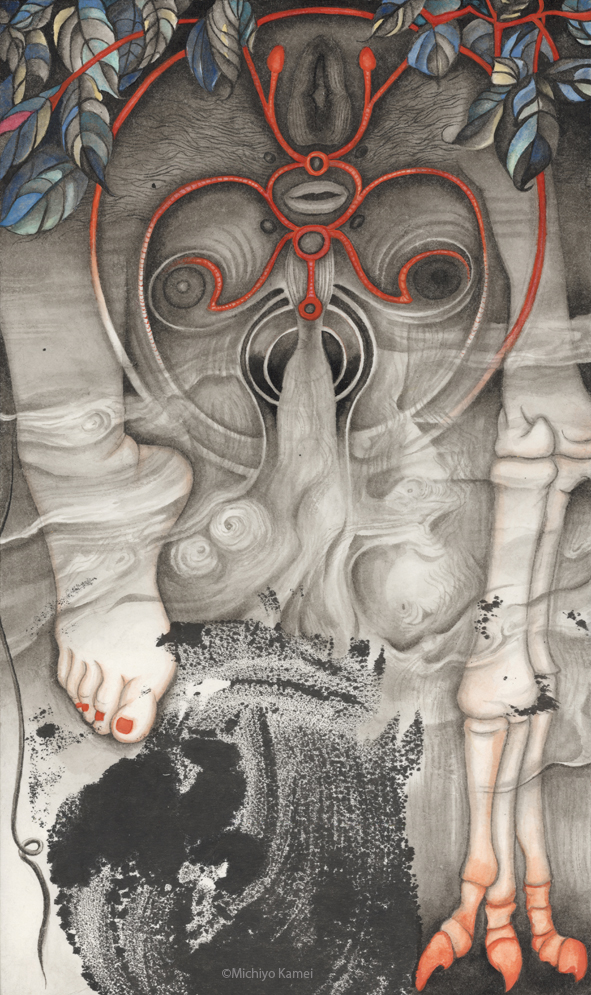
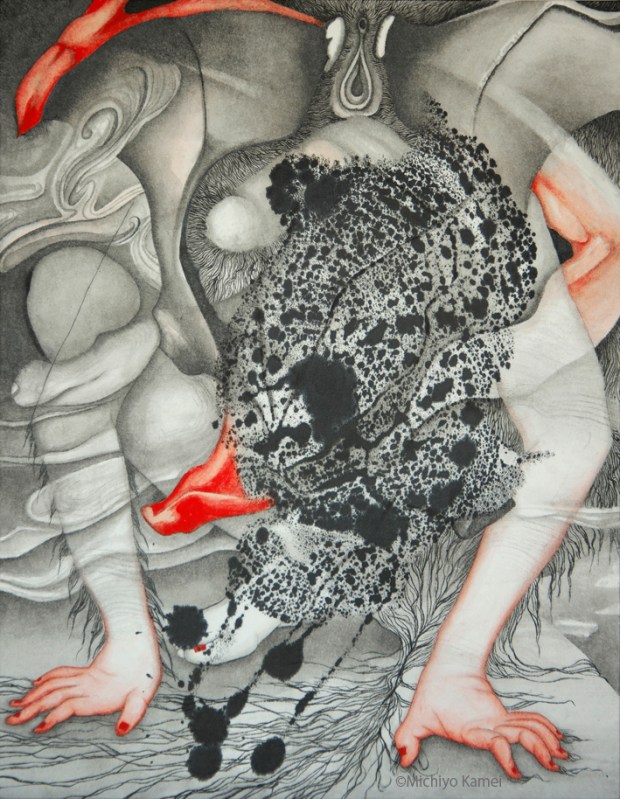
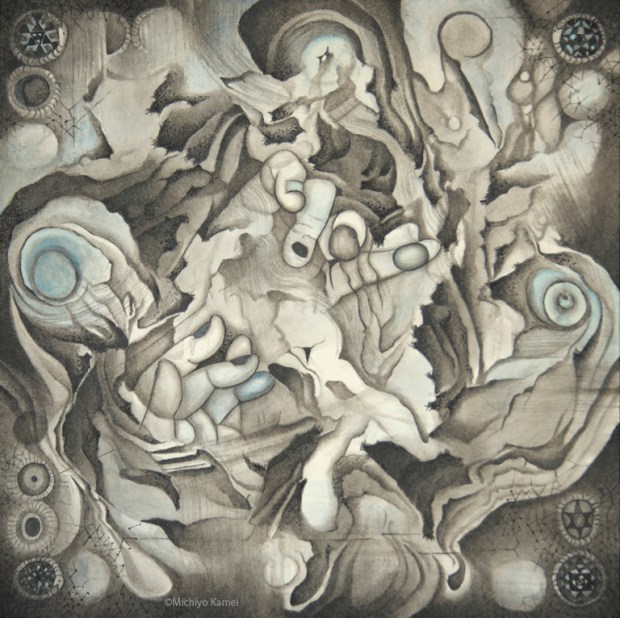
In her black ink paintings, Michiyo Kamei explores the concepts of impermanence, transformation, and the enduring nature of existence through a form she calls the bodymandala.
Mitchell Pluto: At what point did you realize you were an artist?
Michiyo Kamei: I originally studied anatomy at medical school and started out as a medical illustrator. It was only after I stopped working as an illustrator and began creating paintings that I realized I was an artist. Anatomical illustrations are created at the request of the medical field to follow the authors’ papers and wishes, so the illustrator cannot draw them freely. Paintings are free to be drawn by the creator, so the artist can freely incorporate their own ideas. This difference is significant to me.
Mitchell Pluto: How would you describe your art, given that it blends many traditional and modern genres?
Michiyo Kamei: When I was drawing anatomical illustrations, I studied the theory of modern anatomy and created my diagrams. After I quit this job and started painting, I began exhibiting at a gallery that collected ukiyo-e prints from the Edo period in Japan. Seeing many hand-painted ukiyo-e at the gallery, I rediscovered the beauty of traditional Japanese styles. When drawing the hands and feet in my work, I sketch my own body in front of a mirror, then deform it in the ukiyo-e style. In this way, I am influenced by both modern anatomical diagrams and ukiyo-e from the Edo period, which have a uniquely Japanese style.
Mitchell Pluto: When creating your artwork, what specific medium or materials do you prefer to work with?
Michiyo Kamei: I like oriental materials. Rather than just adding paint to the paper, I like to let the ink soak into the paper, letting it bleed and see how it moves within the paper fibers. Sometimes I don’t just create a picture, I let the ink create a picture on its own.
Mitchell Pluto: Could you describe and clarify what a bodymandala is?
Michiyo Kamei: Anatomical illustrations are pictures of the world of death drawn from corpses. Since I began painting, I have wanted to depict the world of life, so I have incorporated energetic shunga. Death and life are repeated in my paintings, and I hope to approach the theme of “eternity.” Mandalas represent the universe in Buddhist worldview, but I represent the universe through the body, and am exploring a new mandala form called the “bodymandala.”
Mitchell Pluto: What visual artists have influenced your work and given you inspiration?
Michiyo Kamei: I’ve been interested in the body since I was a child. It feels as though I am contained within this body, but at the same time it is also part of the natural world, the world outside of me. Which one does it belong to? And when I realized that I would die along with this body, I was terrified. Francis Bacon is an artist I admire for his expression of the body and anxiety. I’ve admired him ever since I discovered him in an illustrated catalogue as a teenager. Another artist is H.R. Giger. I think his organic expression in black and white is so beautiful.
Mitchell Pluto: Could you please tell me the central idea behind your current show?
Michiyo Kamei: I’m currently incorporating “jintaku” a technique in which ink is applied to my body and then transferred onto Japanese washi paper. Rather than painting with a paintbrush, jintaku involves pressing my body against the paper, resulting in completely uncontrollable and unexpected ink patterns. While observing the stains on my skin, I paint the “inside and outside” of the body in the blank spaces. It is meaningful to me to compose my paintings using three elements: the inside (anatomical illustrations) and outside (limbs, plants, natural world and the universe), and my living skin, which lies at the boundary between them. I call this “bodyscape,” and I hope to expand the image in my paintings from a small image of the body to a larger world. What kind of world can unfold from the body? And can humans have the imagination to do so?
Mitchell Pluto: What are your thoughts about the universe in relation to the philosophy of your art?
Michiyo Kamei: I believe that the universe in which we live has no beginning or end, but is a whole that is constantly transforming. There are times when I feel that even life and the body are merely a fleeting moment. Currently, I assume that the beginning of everything is the “zero point” of the universe, and my theme is the transformation and chaos of the body (form) that begins from there. In my paintings, I want to rewind time and explore the primordial form of life. I find a unique beauty in the cruelty and sacredness of the wild nature of evolution, which repeats selection and mating.
Mitchell Pluto: Who are your favorite writers for inspiration, and how do they influence your art and perspective?
Michiyo Kamei: I like Jorge Luis Borges, especially “The Library of Babel.” When I read this novel, I feel like an infinite universe is expanding in my head. I think his universe can only be expressed in novels (words), and can never be depicted. I would like to reach such a world someday, but life is short, and I feel that once is not enough for me.
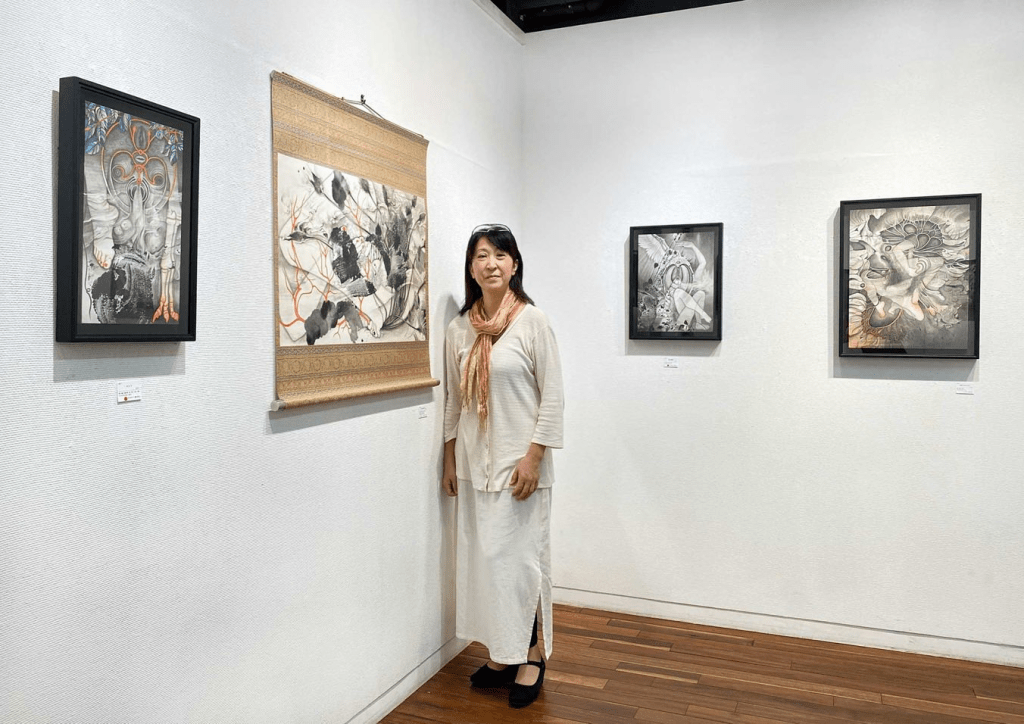
“The original form of the universe: the wildness of the zero point” Michiyo Kamei exhibition at the Y art gallery in Osaka, Japan 2025
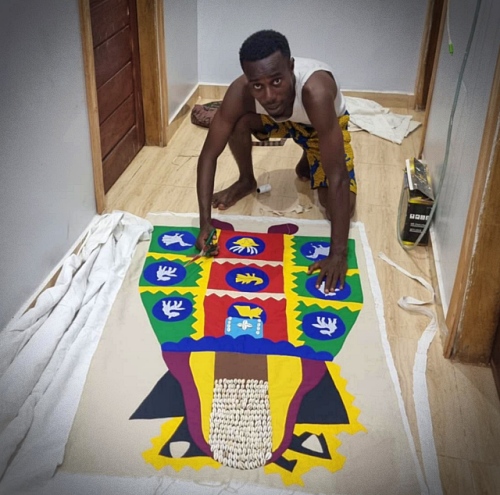
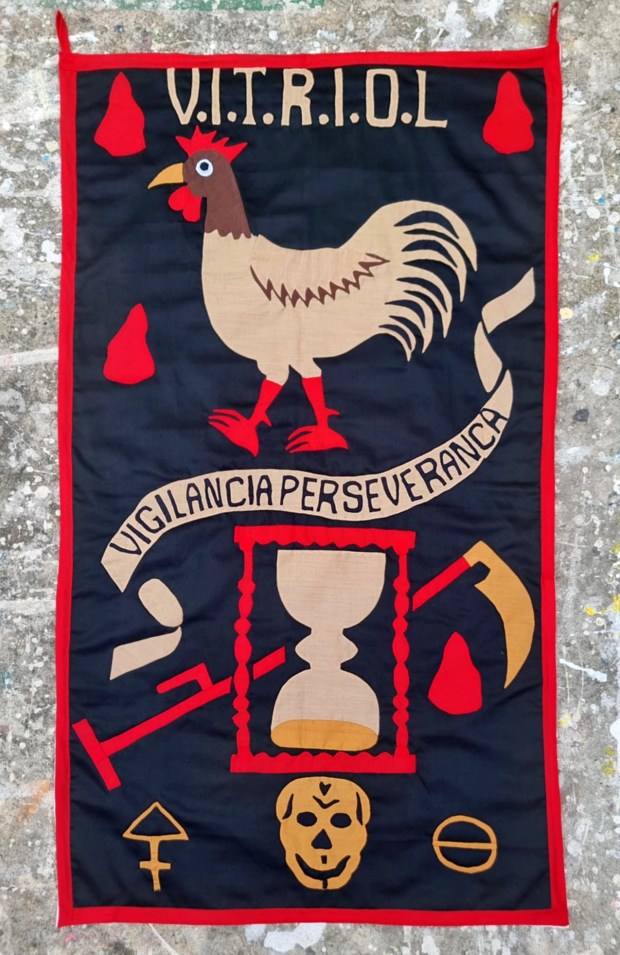
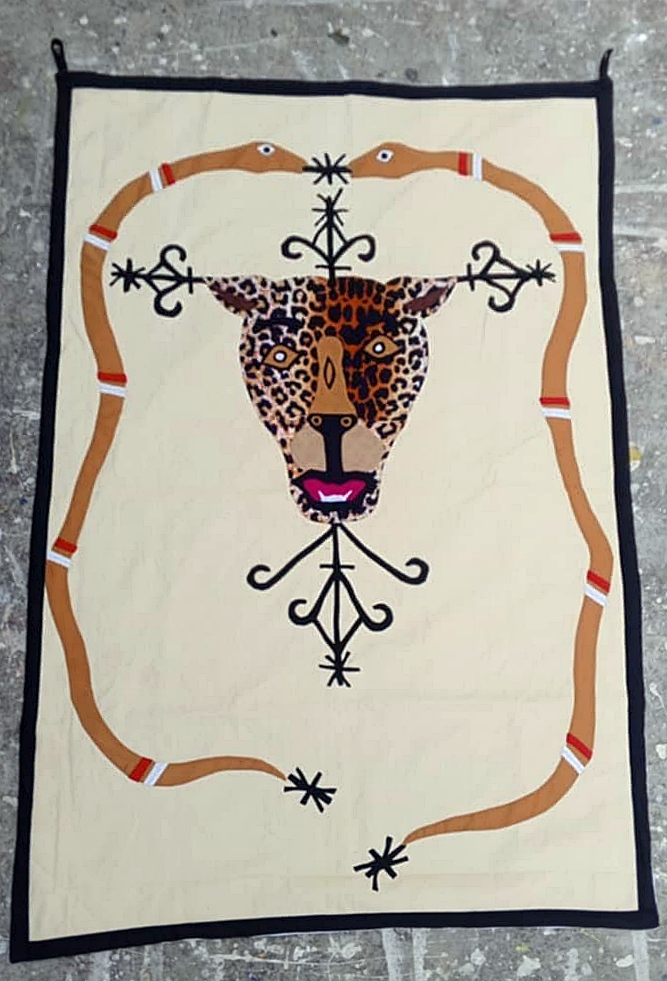
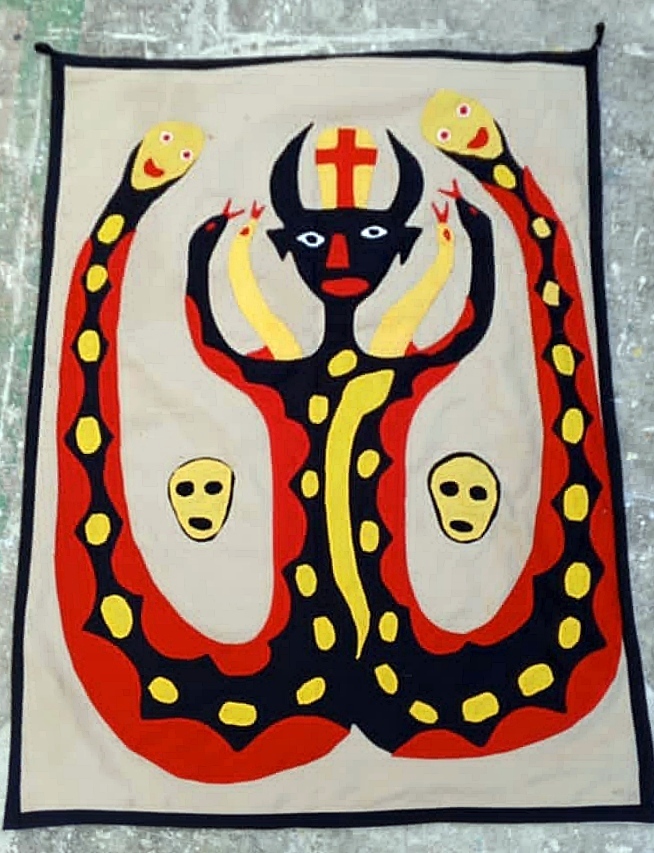
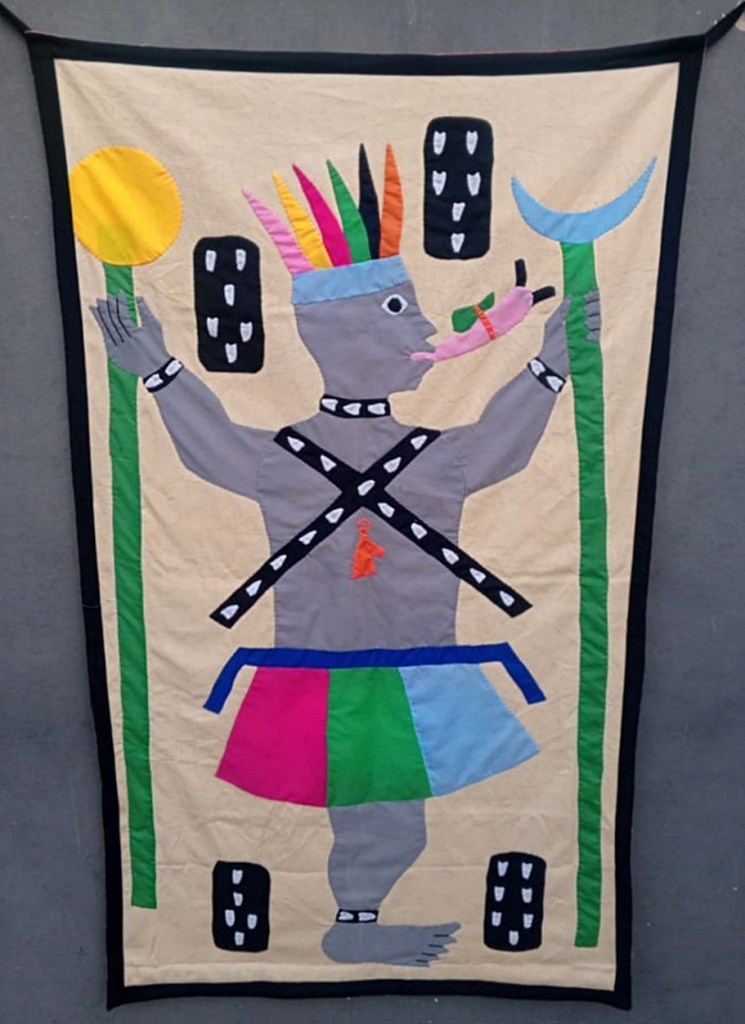
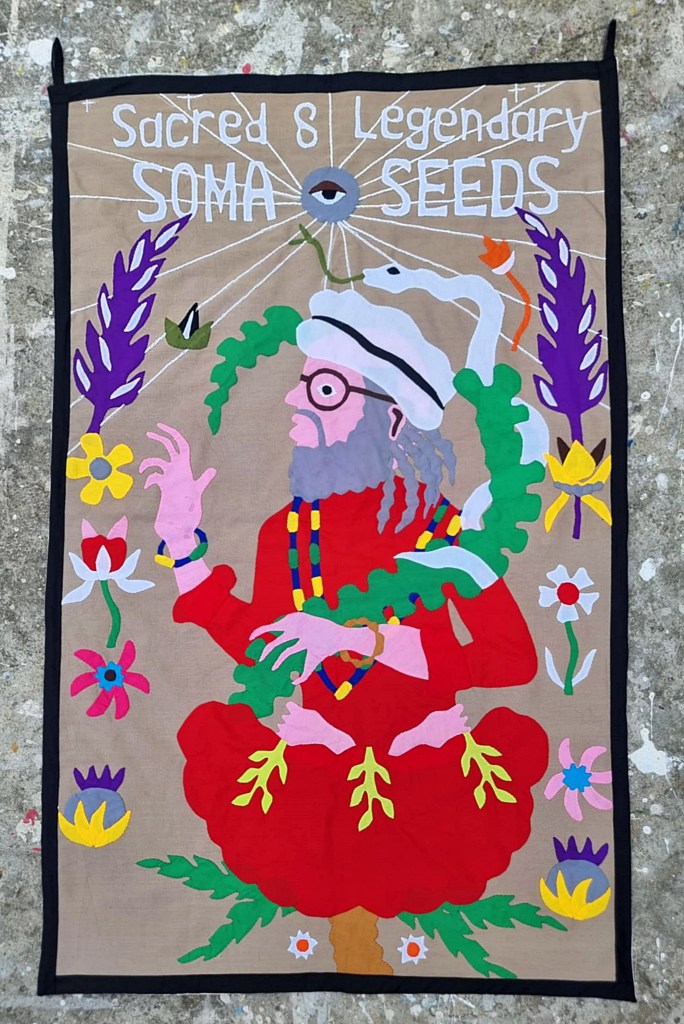
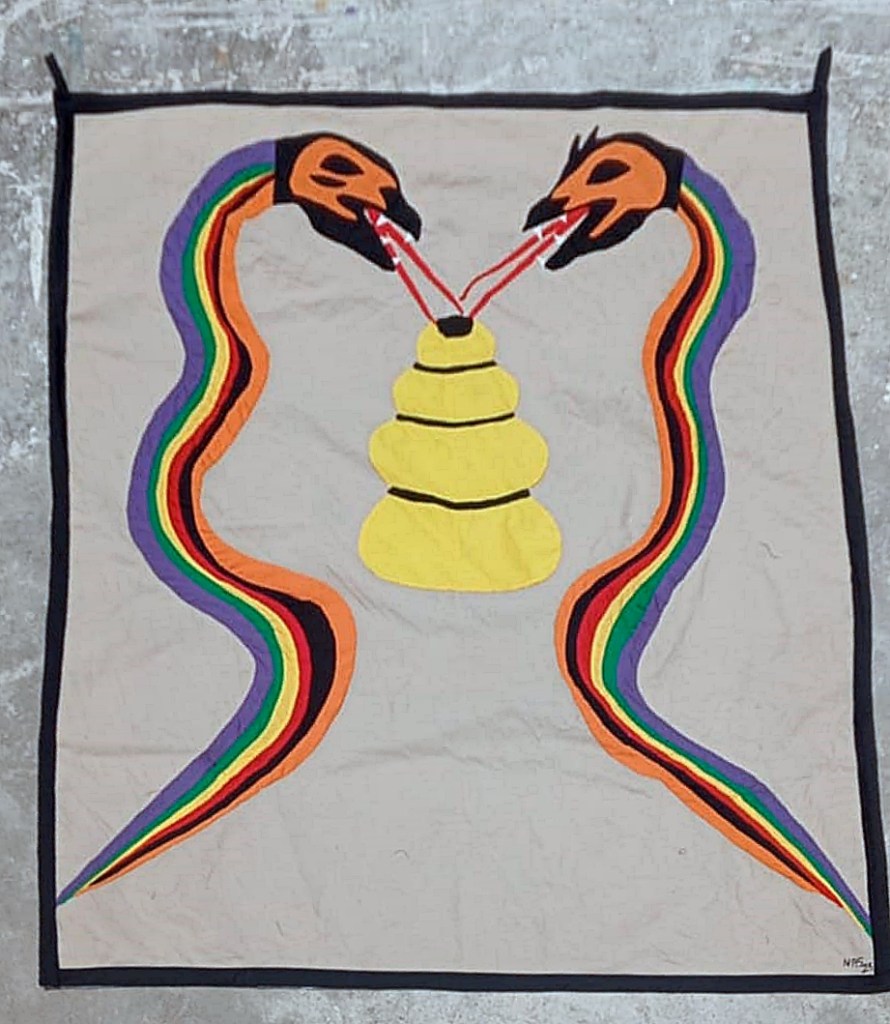
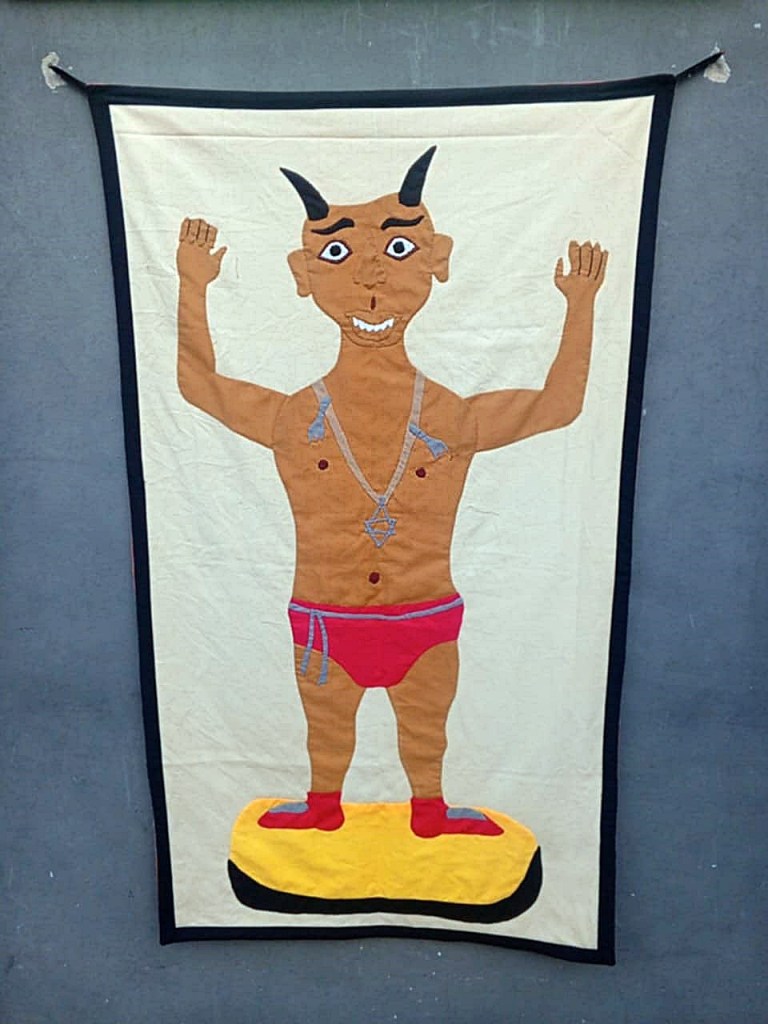
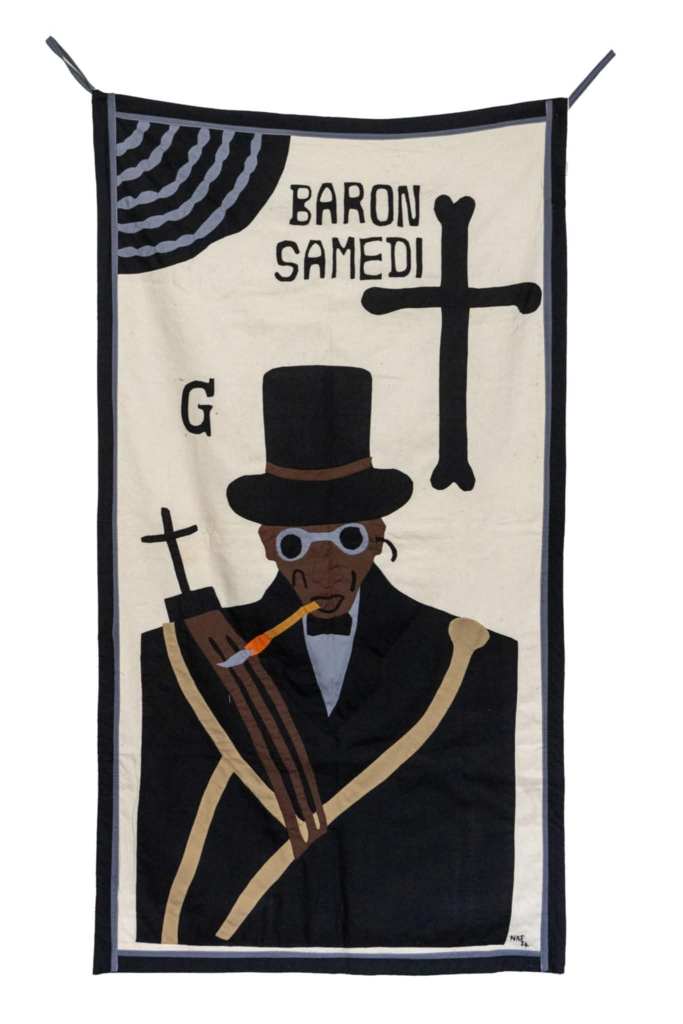
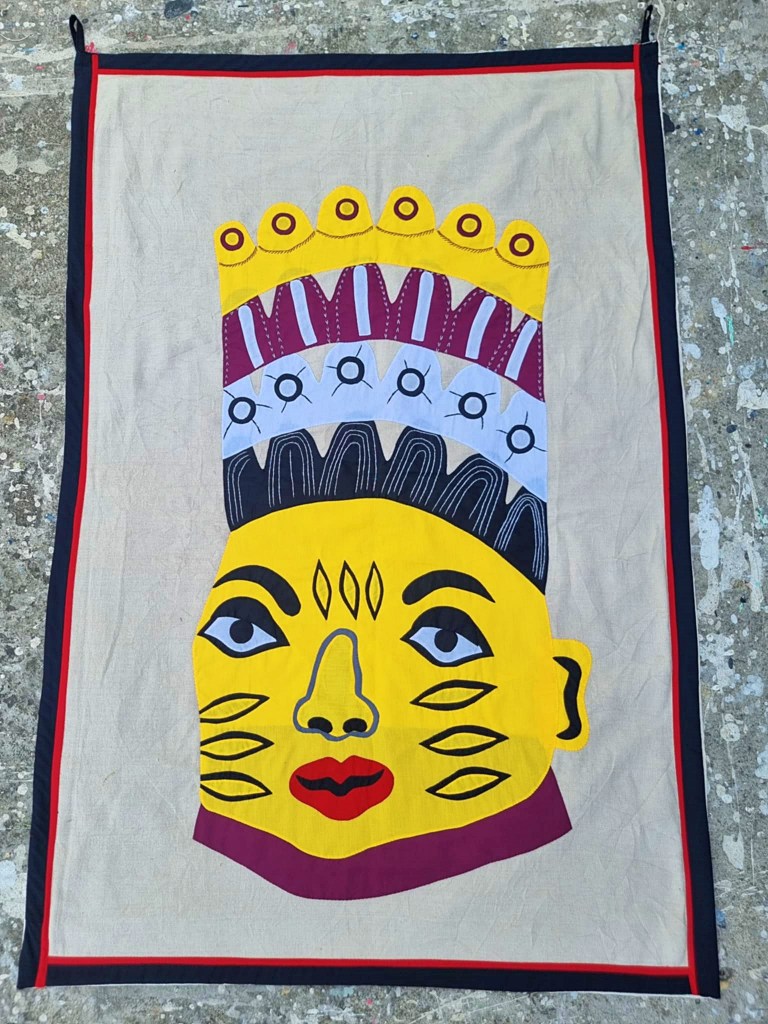
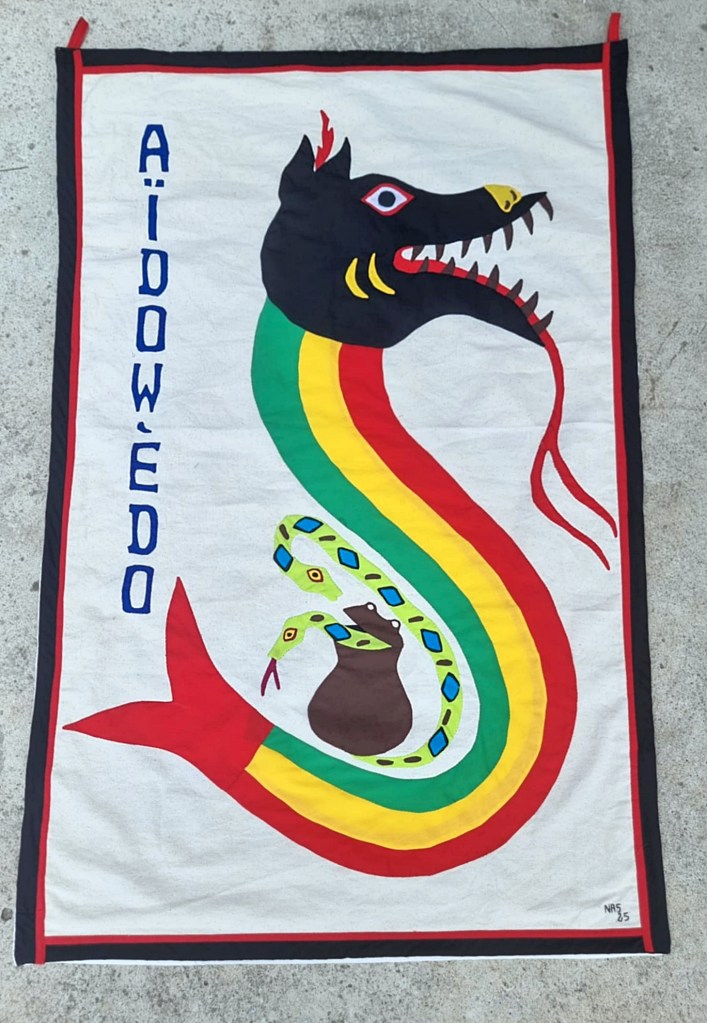
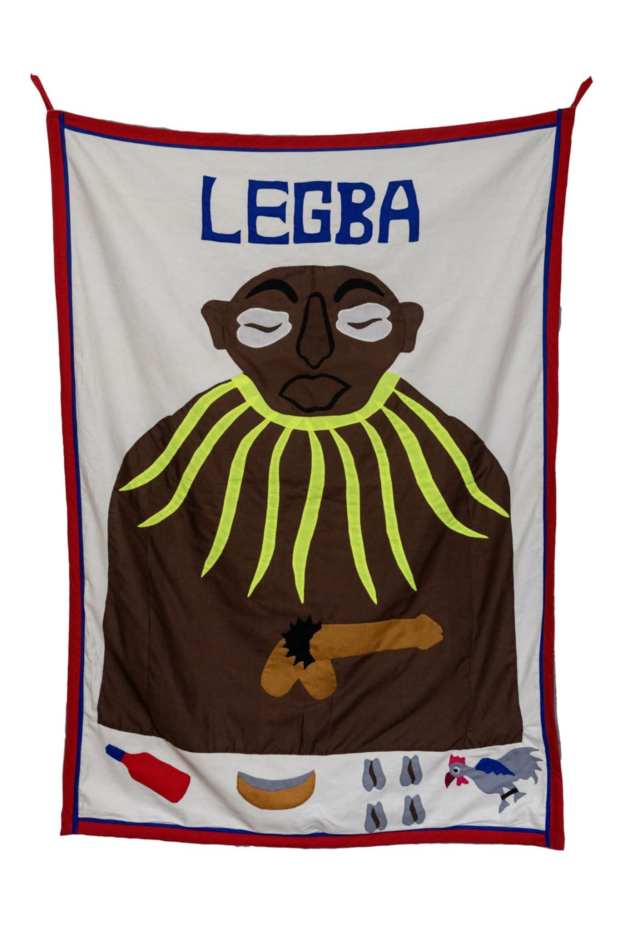
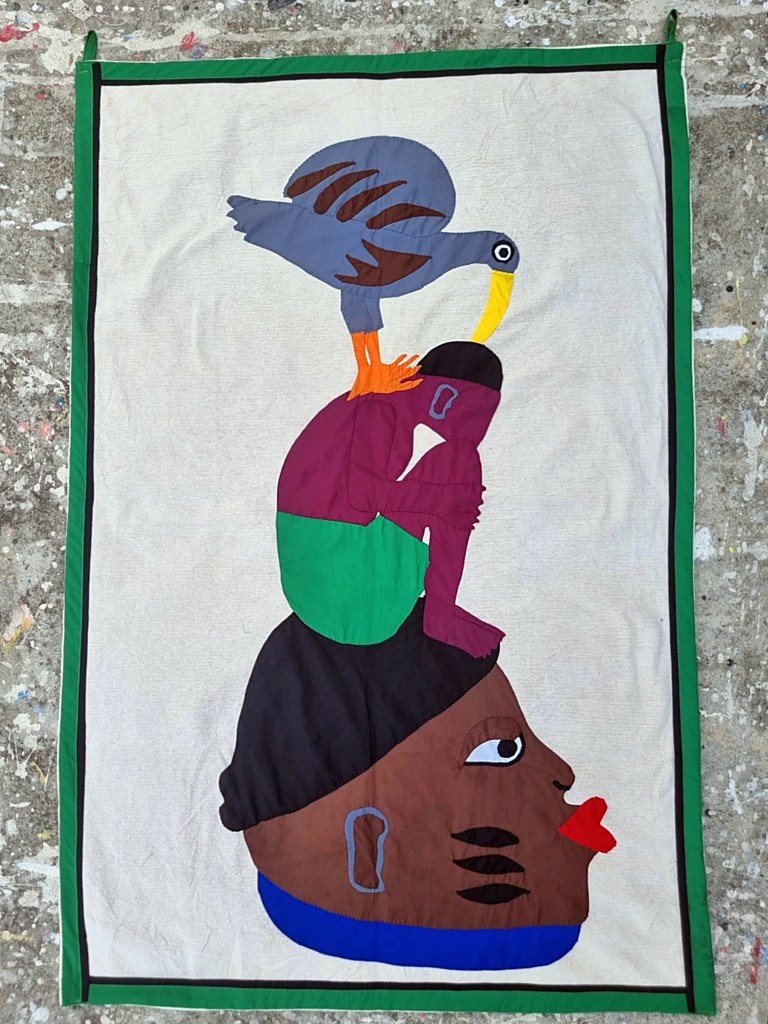
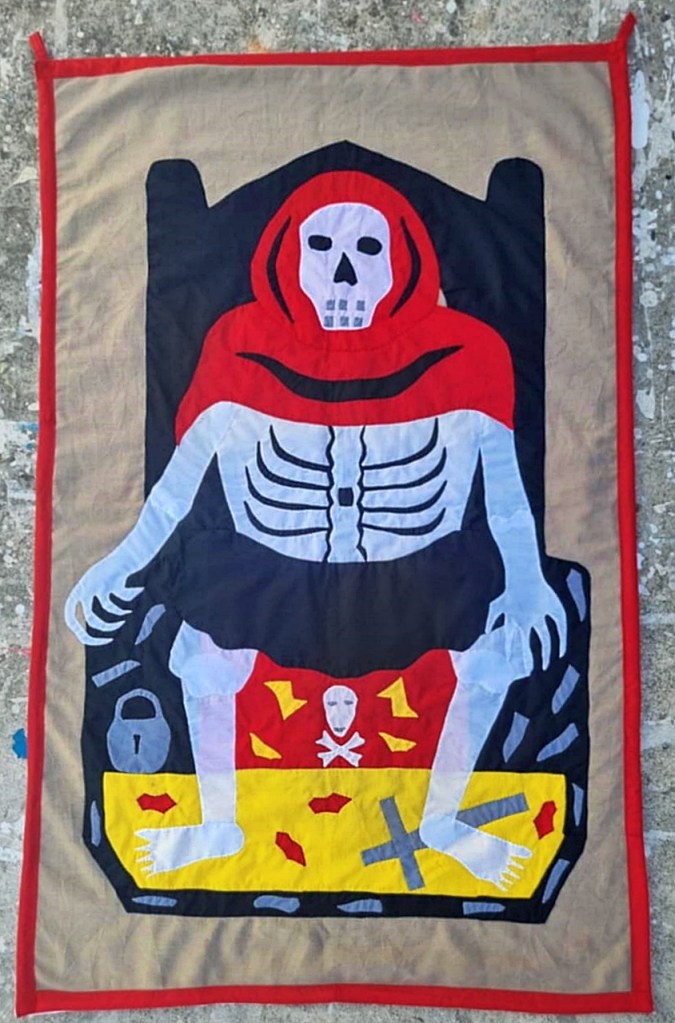
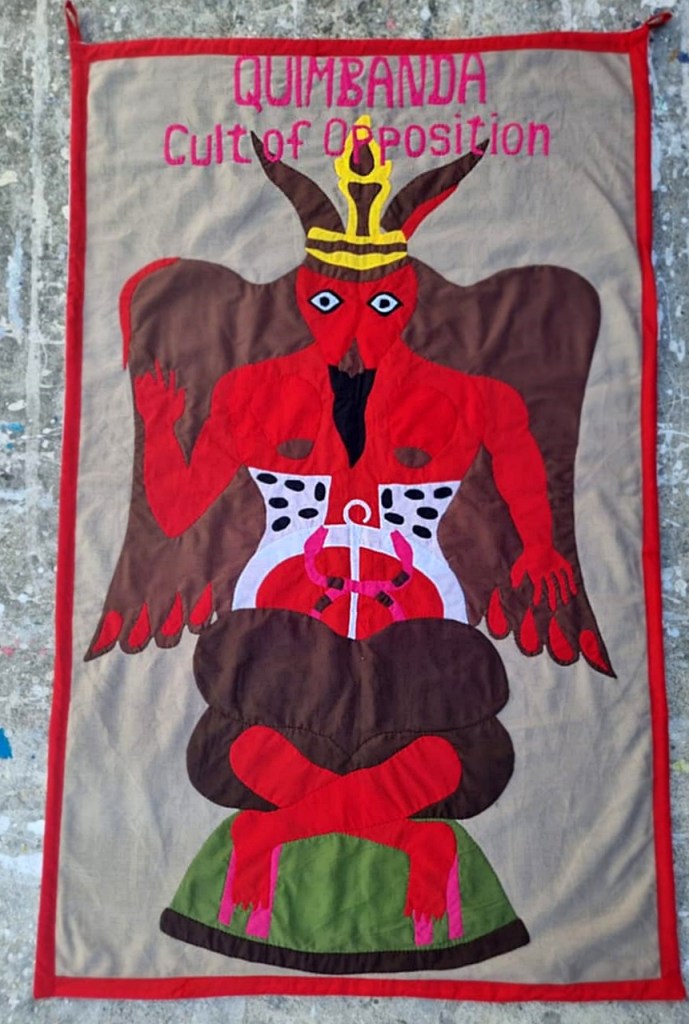
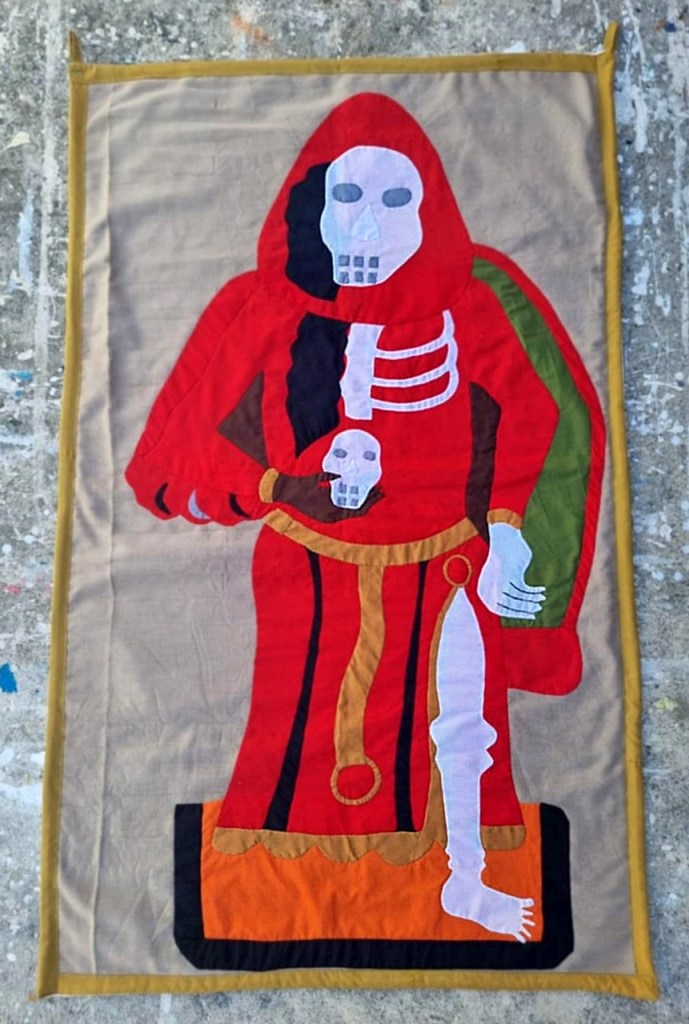
Narcisse Daphnée Dotou crafts symbolic appliqués representing Vodun gods and African diaspora spirits. Dotou’s images encourage introspection, offering a visual journey into one’s inner self. The viewer is asked to concentrate on the visuals and consider them thoughtfully, just as one would with a tarot card. Only then can the object’s grandeur gain a mystical and meaningful quality.
To make an appliqué like this, you need at least three weeks before doing it. We make the drawings on paper and then we start by cutting things out. Materials include sewing needles scissors cotton fabric of different colors fabric. Everything is done by hand except the border which was done by machine. My teacher was François Codjo Yemadje who is from Abomey, Benin.
Narcisse Daphnée Dotou
Narcisse Daphnée Dotou was born on October 31, 1991 in Benin and has lived in the Mono department for a long time. He is an artist trained in the traditional art of tapestry sewing. The motifs of his refined works cover a wide spectrum. These include the varied symbolism of the ancient kings of Benin, which is the former Danhomey, representations of the traditional gods of Benin voodoo, Haitian voodoo, Cuba, but also modern themes and works made especially at the request of customers. In addition, Narcisse is an excellent connoisseur of the Cotonou art scene. He is happy to advise you and act as an intermediary if you have any wishes or requests.
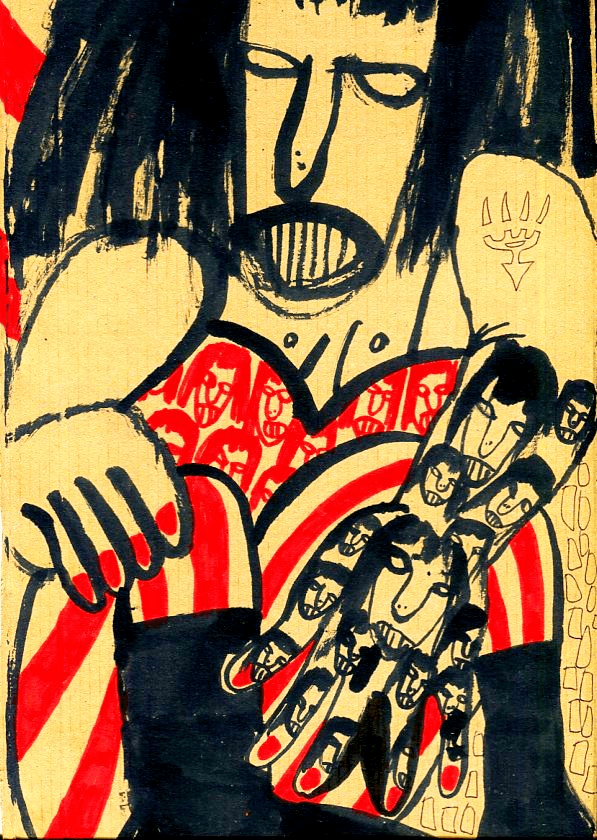
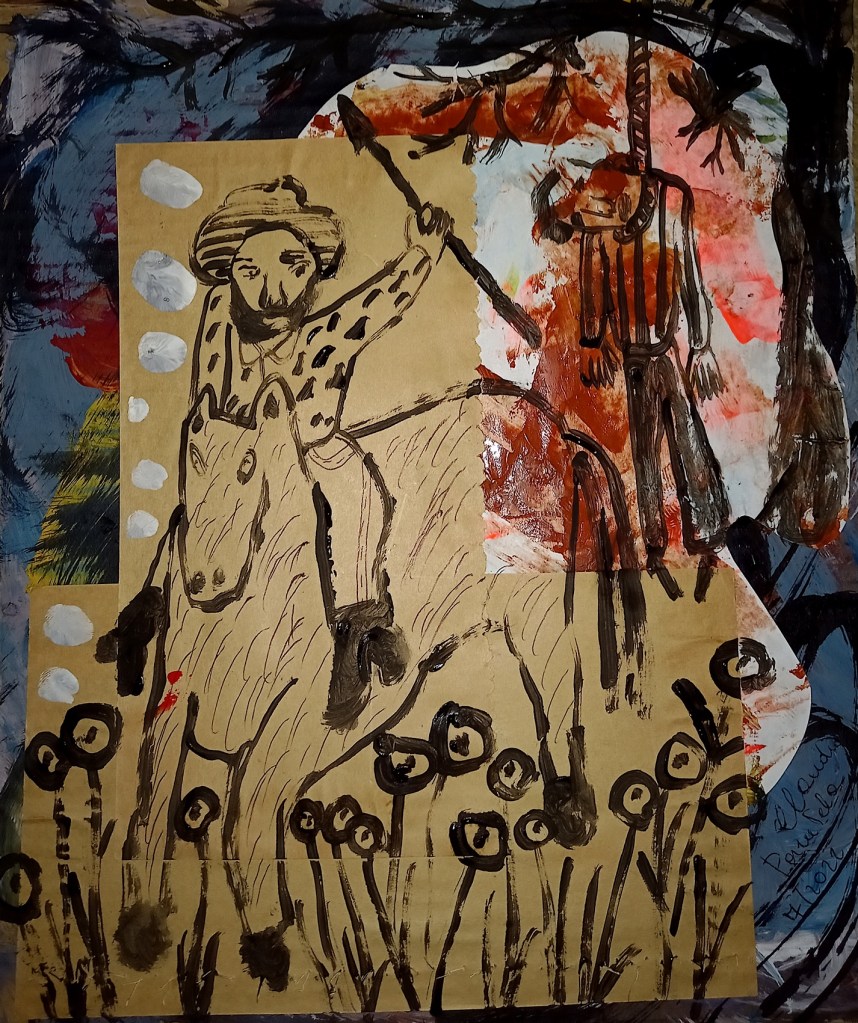
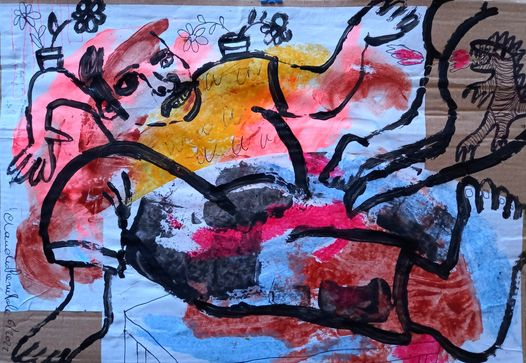
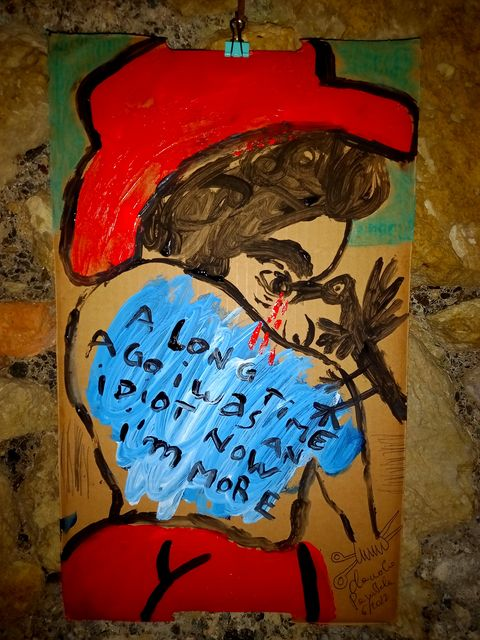
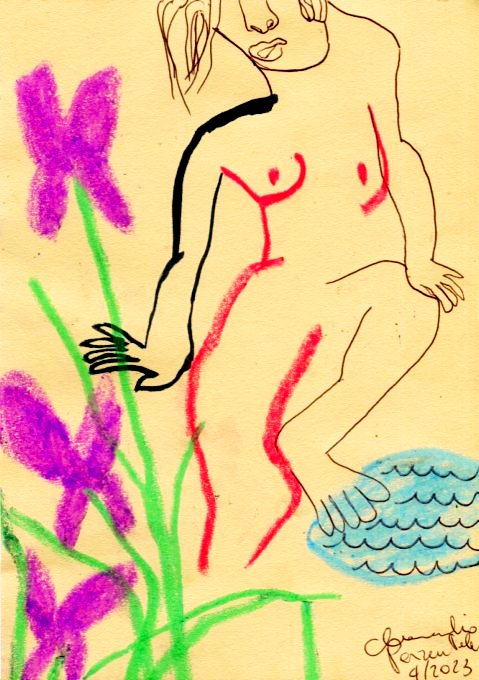
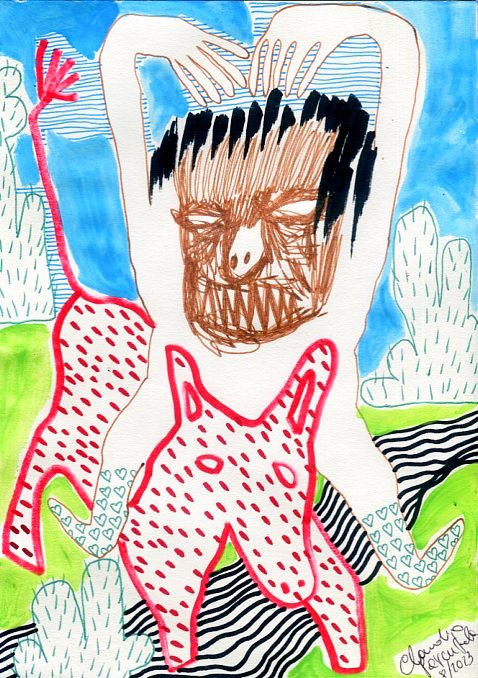
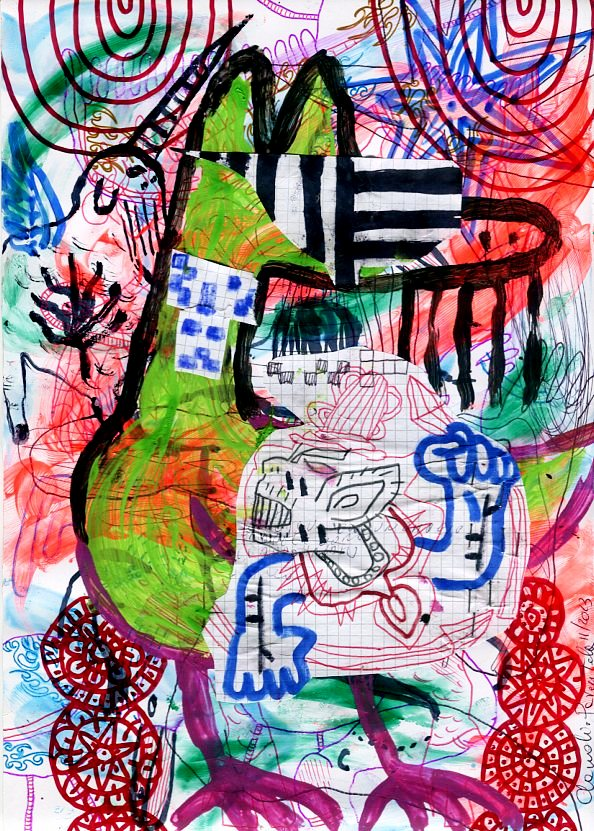
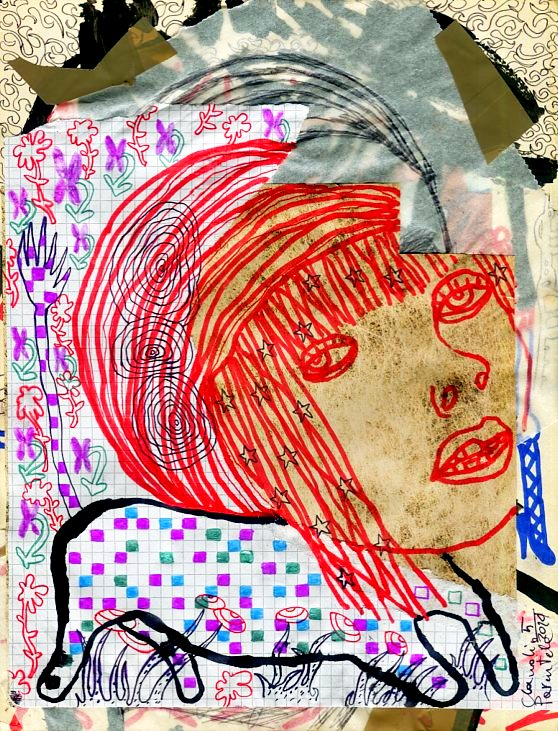
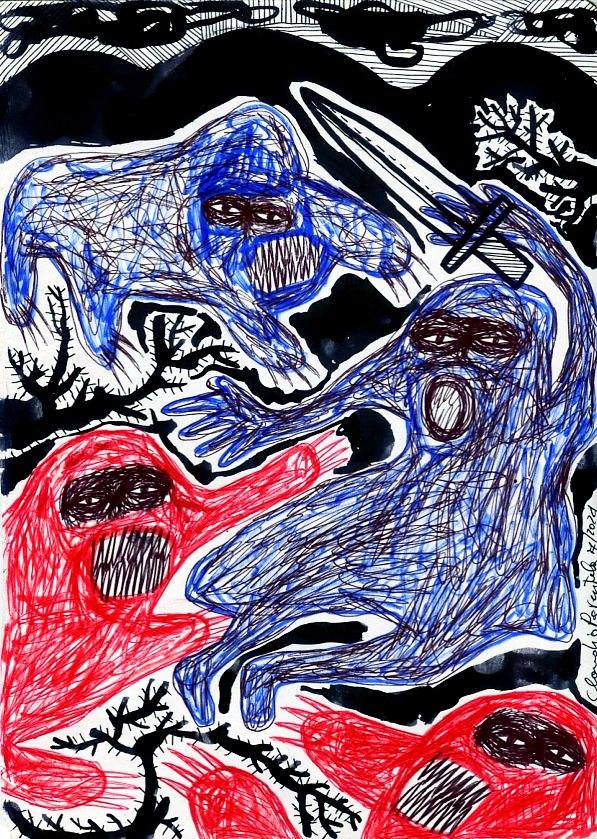
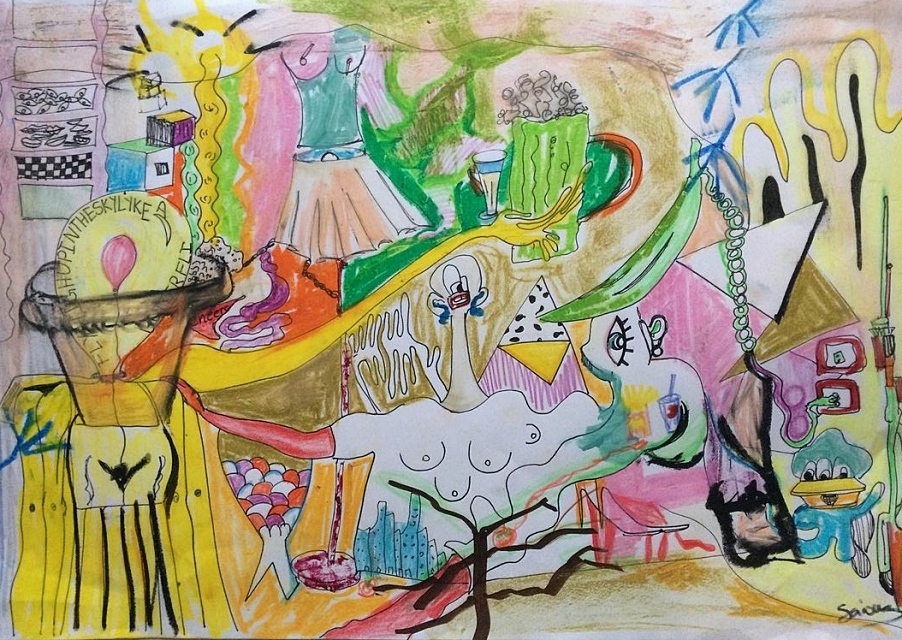
I am 62 years old and I live in Calabria, in the ancient Magna Graecia. I am harsh and solitary, wild, introverted, anarchic and autistically proud like my land, which is full of stormy seas, turquoise and crystalline seas, and rugged and desolate mountains, very colorful and rich in lakes and impenetrable woods. I have been painting, drawing, photographing, cutting, sewing, gluing professionally since 1995, since I decided that I wanted to breathe art every moment of my life.
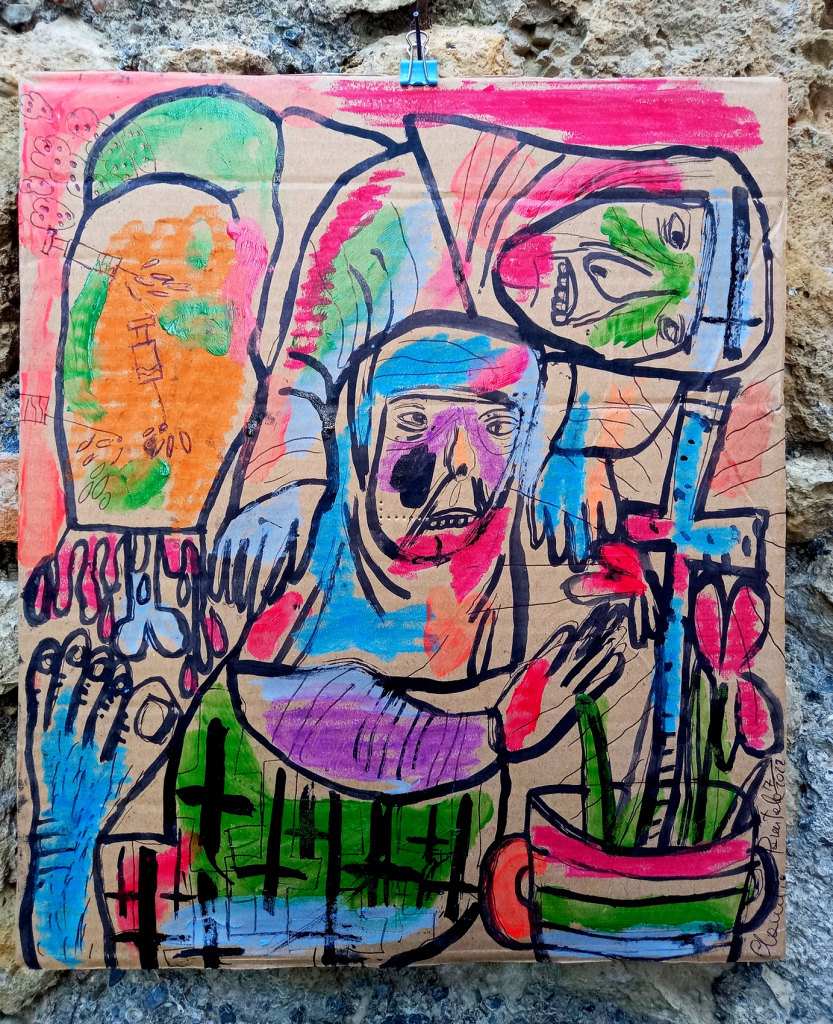
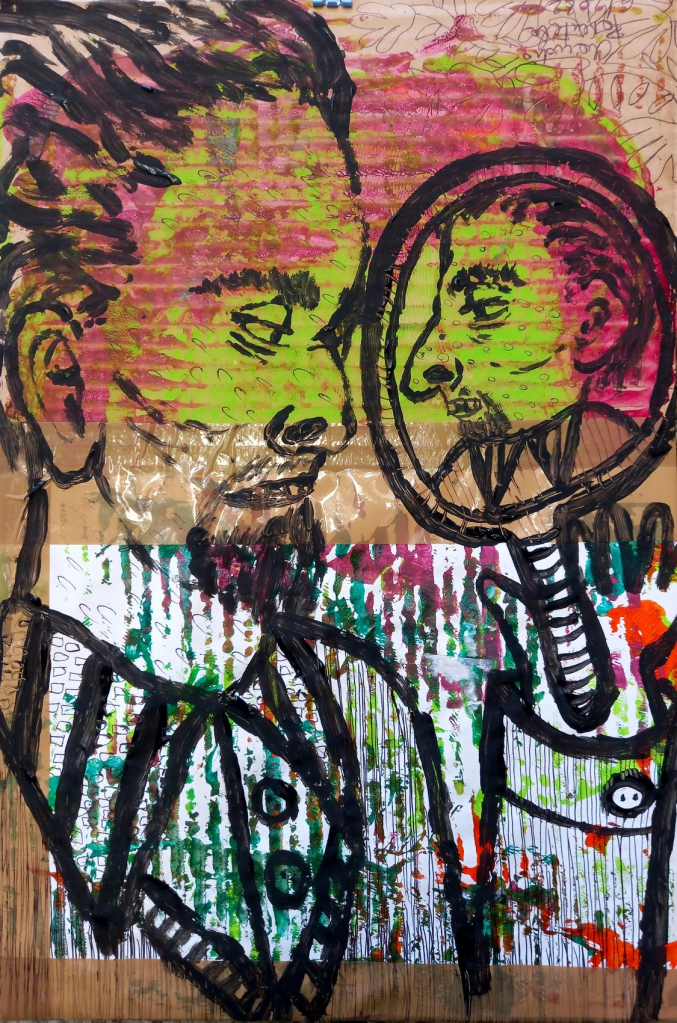
I like to experiment with everything I have at hand,mixing incompatible, different materials in absurd ways. I like to scratch and dirty my photos. Sew them together and with my paintings. I like to sew my paintings endlessly.
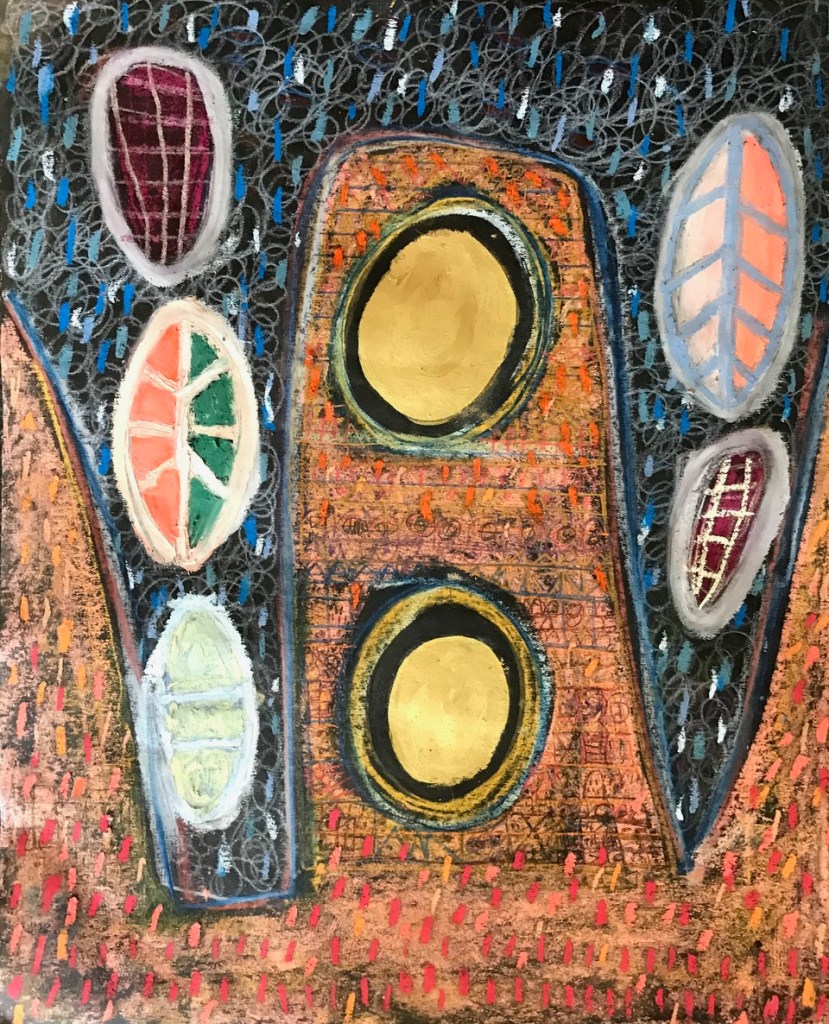
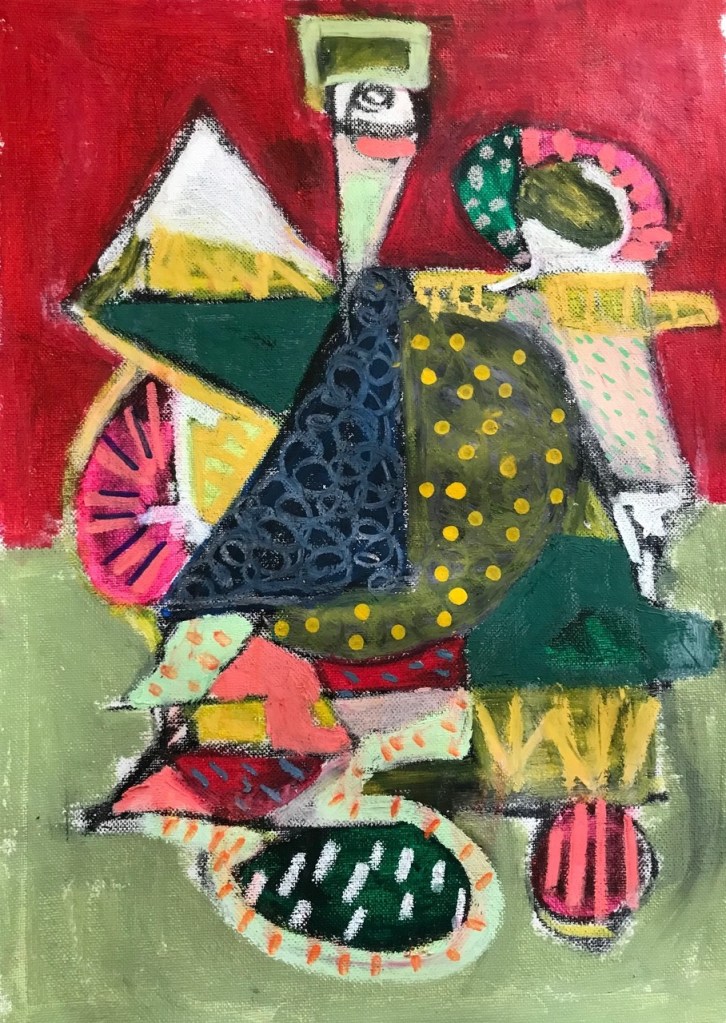
PAINTING2812-MIXED MEDIA ON CARDBOARD-YEAR:2022-SIZE:31CM X 36CM
I never know what I’ll do, what of new or old I’m going to create. I don’t like to plan anything, I want things to happen as and when they have to happen, I don’t do anything at all…. I put on some music, maybe with a good glass of red wine…. I sit at my work table where I have all my colors, my beloved books, my photos, my colors….and the magic happens every time.
PAINTING2807-MIXED MEDIA ON CARDBOARD-YEAR:2022-SIZE:27CM X 39CM
After a while I start to draw dots, lines, knotted lines, I choose the colors….and so on….it’s wonderful what happens every time. It’s a continuous catharsis, a going inside myself, and always opening new doors to go deeper and deeper.
PAINTING2805-MIXED MEDIA ON CARDBOARD-YEAR:2022-SIZE:37CM X 26CM
To know, to discover and open parts of me that were sealed and that now by magic I was able to open and penetrate. Art has been my autistic way to be in the world, the only way I know and have to communicate my words, what I have in my mind and heart. It is the dance that I have chosen to dance in harmony with my breathing.
PAINTING2798-MIXED MEDIA ON CARDBOARD-YEAR:2022-SIZE:24CM X 38CM
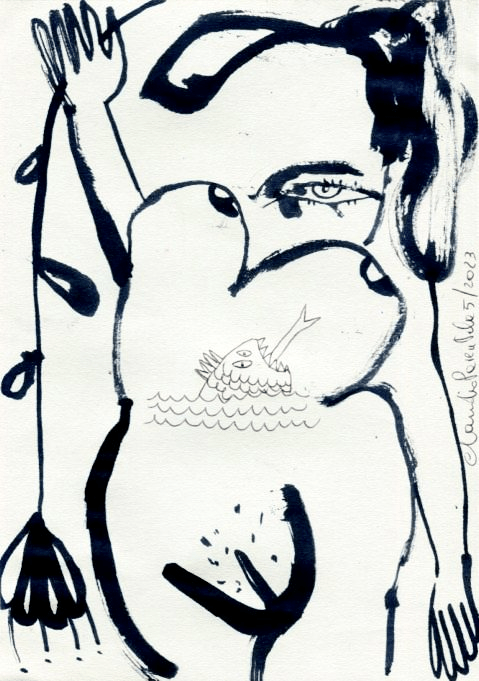
It is my freedom, the freedom that is essential for me to live, to feel sincere and true. For the first 14 years of my ”professional” career I drew and painted only in black and white with rivers of ink and lots and lots of paper. I love black indian ink, and its thousand shades…..they are like the thousand shades of my soul, they are like the clouds that hide the faint glow of the moon….like the thousand thoughts that crowd the mind before it can choose the right word.
PAINTING2941-INK AND PEN ON CARDBOARD-YEAR:2023-SIZE:15CM X21CM
I started drawing frantically and joyfully on many many zines and magazines from all over the world, I collaborated with noise, metal, industrial, techno music bands….did a lot of mail art…drew for everyone, everything. I have never stopped since then, obviously because I like it, because it is the job I have chosen, it is my life, the life I have chosen to live freely. I never stop looking for freedom in everything I do, it is essential to me. Art is freedom, dance, joy, pain, art is life.
The transition to color was an obvious, natural necessity, and collage too. Collage is an extraordinary bridge to and with infinite potential, it is a labyrinth, a puzzle that never ceases to amaze me. I love experimenting, measuring myself and having fun with everything that attracts my attention, it helps me grow artistically, to discover many new games.
My inspirations are many, many….. my beloved books, underground comics, fashion magazines, so much contemporary art, medieval and Renaissance art….Osho , Aurobindo and Mère, Sara Vaughan, Patty Waters, Evan Parker and Ornette Coleman, Can, Nicke Drake and Van Morrison, Joni Mitchell…. Diamanda Galas and Joel Peter Witkink…. many, much more… the laughter of my friends, the noises of the street, my beloved cats, the winter sea and mountain lakes.
…and of course the tarot cards….I have been studying, reading and painting tarot cards since I was a boy….I love them and I can’t stop studying them, contemplating them, collecting them. For the International Tarot Museum I have created 5 tarot decks and in these days I will start the sixth. I hope and want to continue to create and be free as I am today
PAINTING3134-PEN, ACRYLICS ON CARDBOARD-YEAR:2024-SIZE:20CM X26CM
Listen to the mysterious, revealing and fierce voices within you.
And if you are caught up by fear of doing so, remember that it is wrong for the senses to belong to the everyday, lived world.
For me any discovery that changes the nature or direction or a phenomenon constitutes
of something or is a surrealist /poetic truth.
Objective chance , the subtlety of the intuition of the expectation, and the constant search for its flash .
Going without a destination, the poet has an unknown encounter with the word, freed from any linguistic logic.
In poetry the mind blows out of the mind. It aims at the spontaneous reclassification of things into a deeper and freer order, which is impossible to explain by the means of the ordinary mind.
The poet alternately is a deadwood pruner, a transformer, and a thunderbolt.
Silence is a complete poetic and surrealist work.
The word must be left in suspense for a moment before it is transferred to a physical state on paper. At dawn or dusk, we walk down the road and sometimes come across the silhouette of a silent fairy woman, whose silence is the most comprehensive concept of poetry, and surrealism.
an absolutely possessed throat, echoing between howls and silence.
the secrets of the world created, within the poetic mystery, darkness unfolds while questioning is stripped.
Earthly legend and mystery doors open to infinity.
The poet is an enemy of the Sufist .
The poet is not bound by a vision or a superior authority.
Poetry is a momentary extraction of the unknown from the veins of every language.
If the poem does not have a chaotic body that smells of demolition, negation and destruction of all existing literary forms, genres,
Then what is living poetry?
Poetry should be the color of dried blood
The poem is the beginning and end of the world, it revives the world and its death, dismantles all self- and collective censorship, esoteric and physical, and drops every daily living dictionary.
The poem is an arena for the execution of all linguistic paralysis by burning with the napalm of the lust.
Poetry is not a linguistic expression, but a visual, physical and perhaps biological expression as well.
Real poetry employs itself to monitor a waking dream which is resentful of its fate, re-sculpting it with dough baked by chaos inside the bone furnace called the human head.
I believe that enhancing poetic esoteric awareness does not come only by enhancing the possession of language or general cognitive awareness, but by developing and training the eye on scenes of logic disintegration always, whether they are daily or artistic works.
Even with everyday mind games
Thus, the magnetic linguistic ability self-develops and expands not only through the subconscious mind, but also through the nerves of the eye’s practice of strenuous imaginative sports to extract the faculties of impossible earthy miracles in all its forms and templates.
I treat the Arabic language rules as a relationship between oppression and freedom; understand it
As a repressive social specter that must be removed and rebuilt anew every moment with vast doors to spend the free desire.
Poetry is the chaotic condensation of the inner momentary realization, but the seer poet must tame the tools of this condensation towards a permanent quest for the human interior, a quest fertilized by doubts in everything outside the individual.
Every human being has a poetic companion who lives behind his eye, the cunning poet who makes him constantly jump like a kangaroo and always seeks to protect this kangaroo from drowning in the prior cement lakes and to teach this kangaroo that there is no limit to what is called verbal maturity,
poetry is a permanent electrical revolution inside the mind It is not controlled by something imaginary or even social.
The chief function of poetry is to impart sharp disturbances to language and to overthrow every possible holiness it bears. For me grammarians and academics of language are the social police of the imagination.
I despise even the inherited Arab aspirations to rebel against the Arabic language, except of course à few poets I see the deceptive horizon of most Arab poets now that they throw themselves in the recycling factories of closed poetic ambitions.
Surrealism relates to expressing «the real functioning of thought […] in the absence of any control exercised by reason and apart from any aesthetic or moral concern ».
– We think that not only language, but the whole world in all its aspects, was given to humanity to make surrealist use of it.
“All things are called to other uses than those generally attributed to them.” – André Breton, Le Point du Jour.
– We think that surrealists should make use of whatever materials and tools that they find attractive. Whether a feather, a cloud or a computer, any single object in this world becomes a surrealist object as soon as surrealist use is made of it.
– We think that the results of surrealist activities do not have to conform to any type of listed art form, nor even to whatever is considered art.
– Restrictions regarding materials and tools, as well as compliance with traditional artistic categories are views that were already considered and experienced as obsolete by most artists of the Renaissance period. We think that an attempt to liberate the human mind may in no way be successfully achieved on the basis of a narrower scope of practices and intellectual freedom than that which was already acquired by artists at that time.
-‘we are interested in how surrealism appears in everyday life, whether it’s from surrealists or not, but we understand this is not the same as a surrealist movement.”
-“We are interested in certain parallel currents that might overlap with surrealism. Surrealism may -appear- or be present- within avant garde or popular art but it’s not necessarily the same thing.”
– We categorically reject mixing surrealism with whatever form of religion, and we reject the presence of any religious persons within the group.
– We reject any aesthetic attribute that directly or indirectly integrates into the life of this society or that would tend to reconcile with it.
– Realistic daily life erases the perception of the unique characteristics of objects. We will always seek to break this mechanism and its dynamics by means of words, plastic art, music and cinema or any other means.
– Collective automatism is self-contained in everyday life. It floats in the air, dissolving every entrenched and worn-out intellectual authority.
– The poem is a collective work, even if it is from one’s individual imagination.
– We have nothing but contempt for the guardians of grammar because they are the protectors of the heavy legacy of linguistic dependence that erases the ecstasy of all free desire.
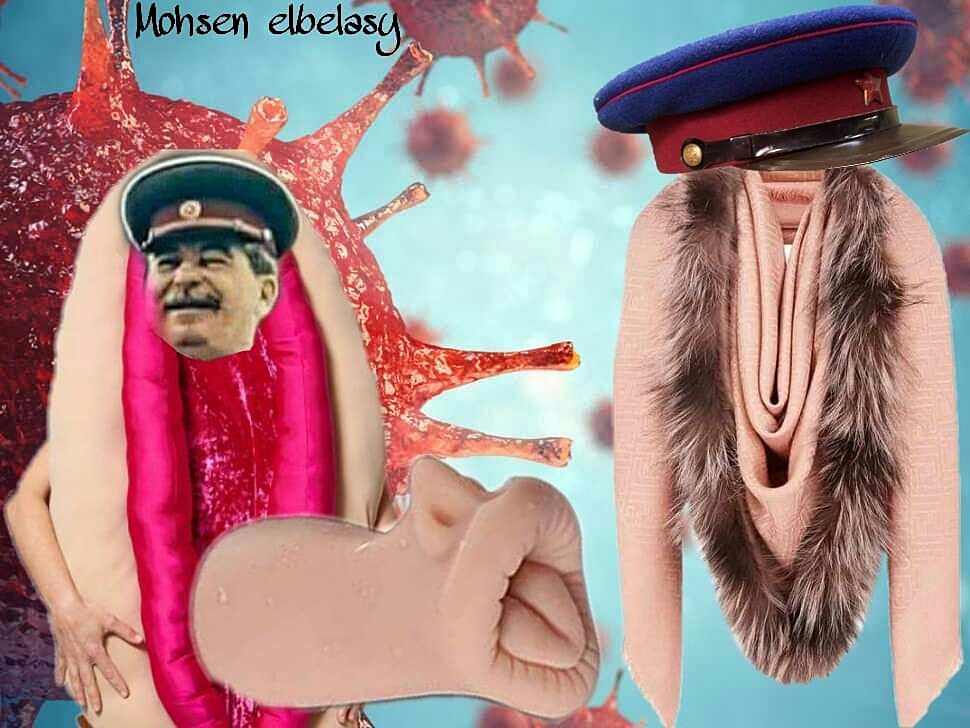
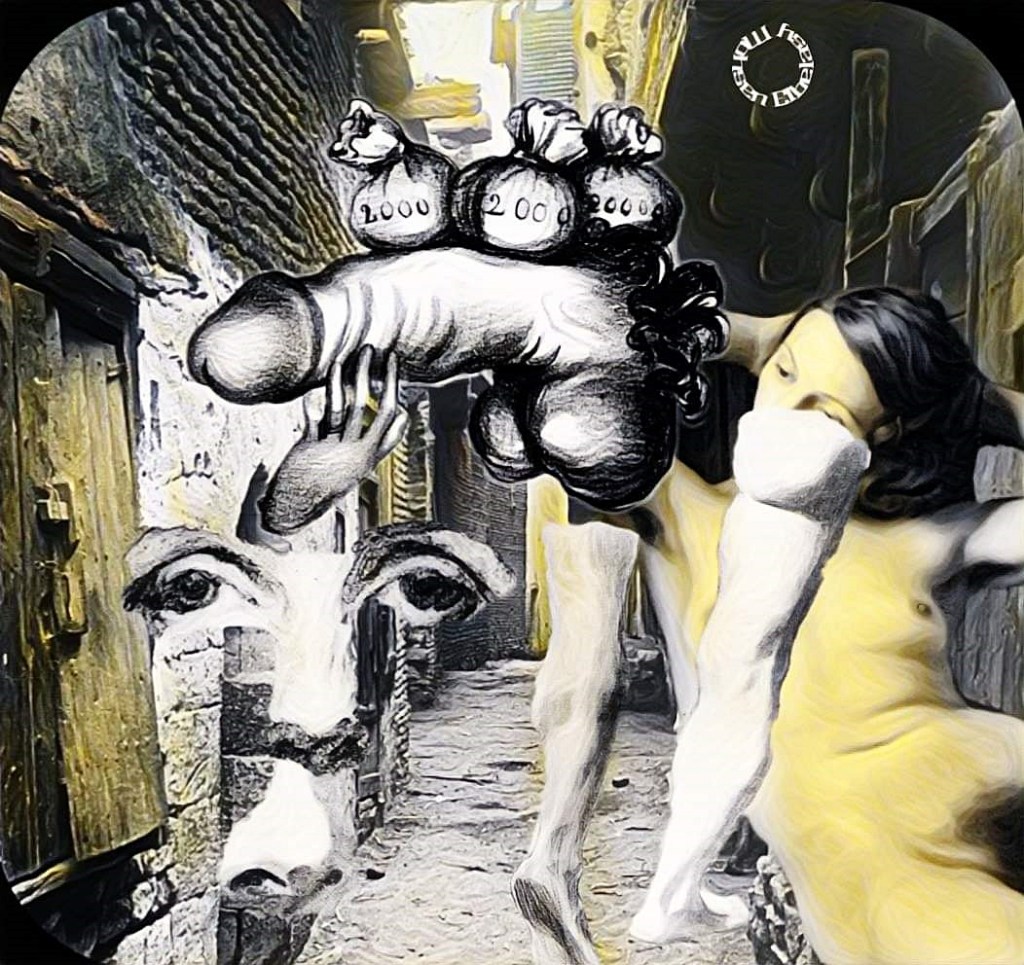
– We support every creative act that contributes to the wondrous conquest of everyday life and the conquest of mad love. Everything that has been physically neglected in the city, and every sexual explosion that social fascism hides, is for us the dough with which we form our written and visual poems.
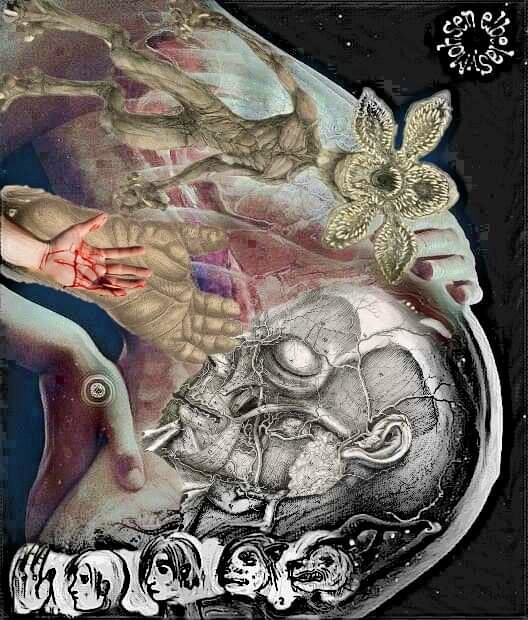
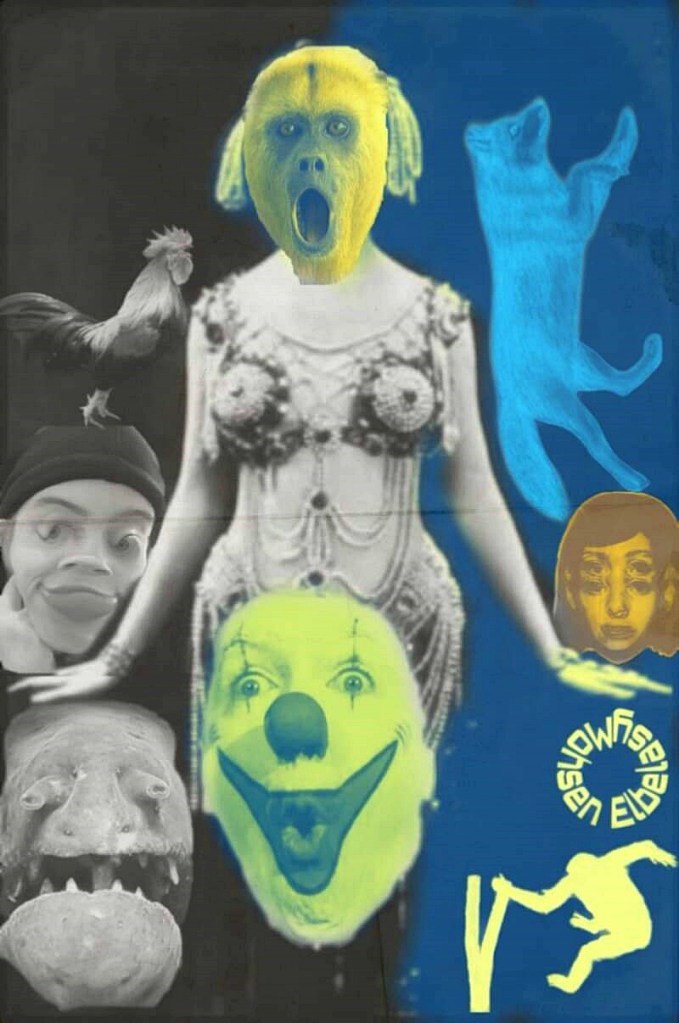
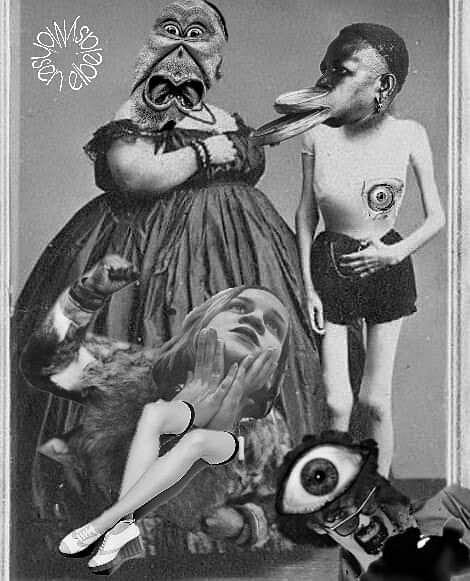
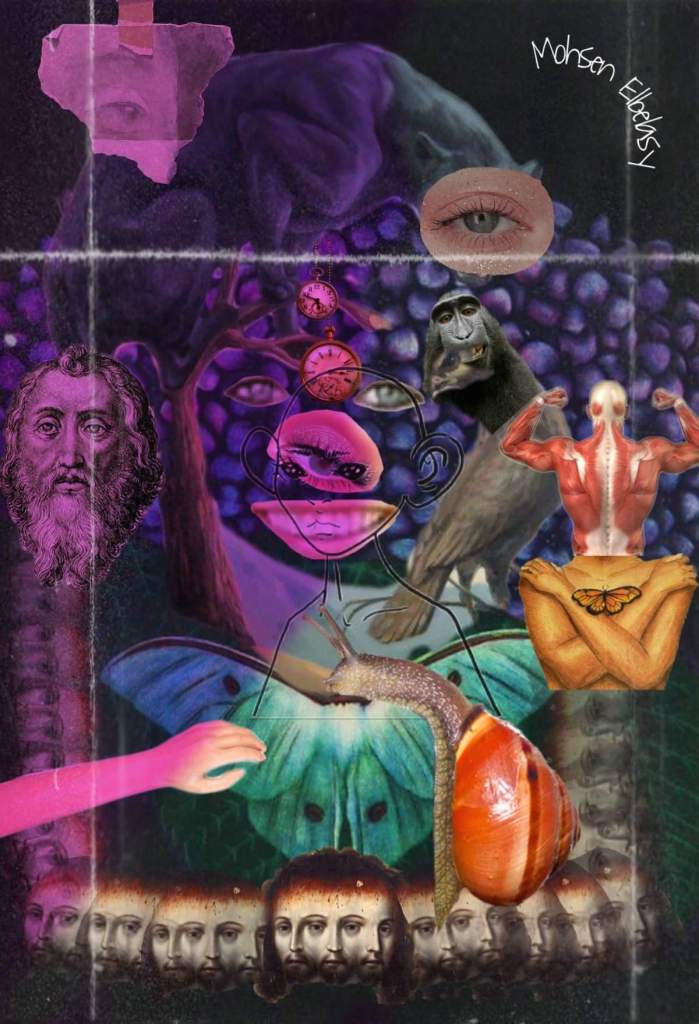
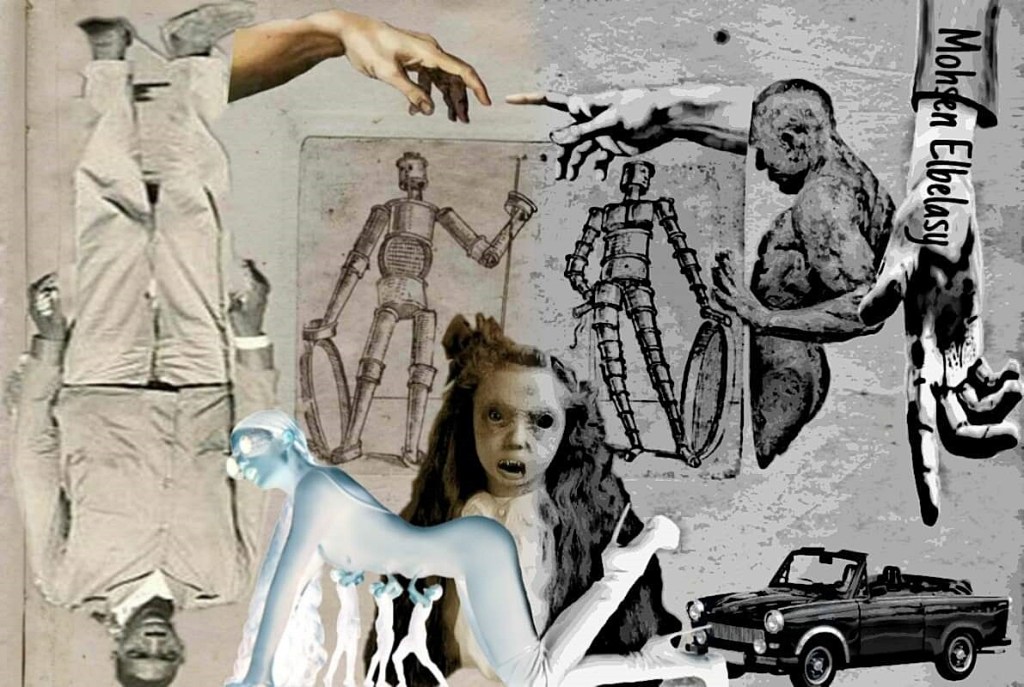
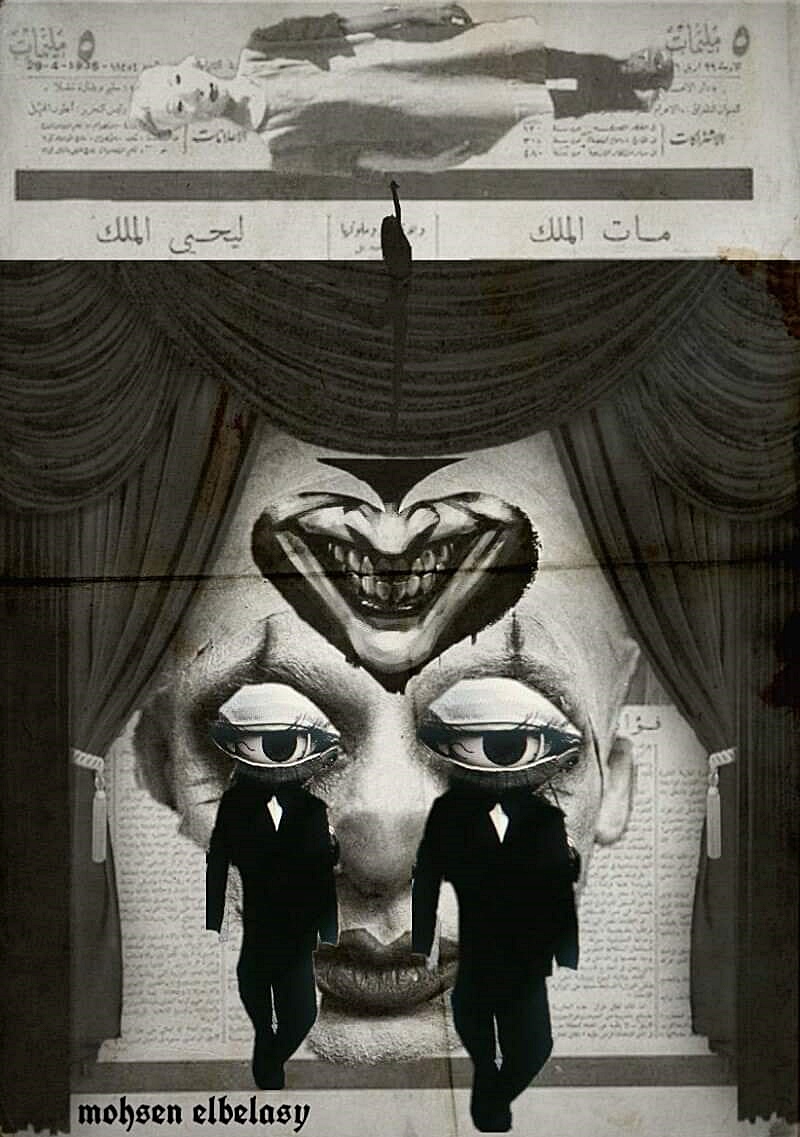
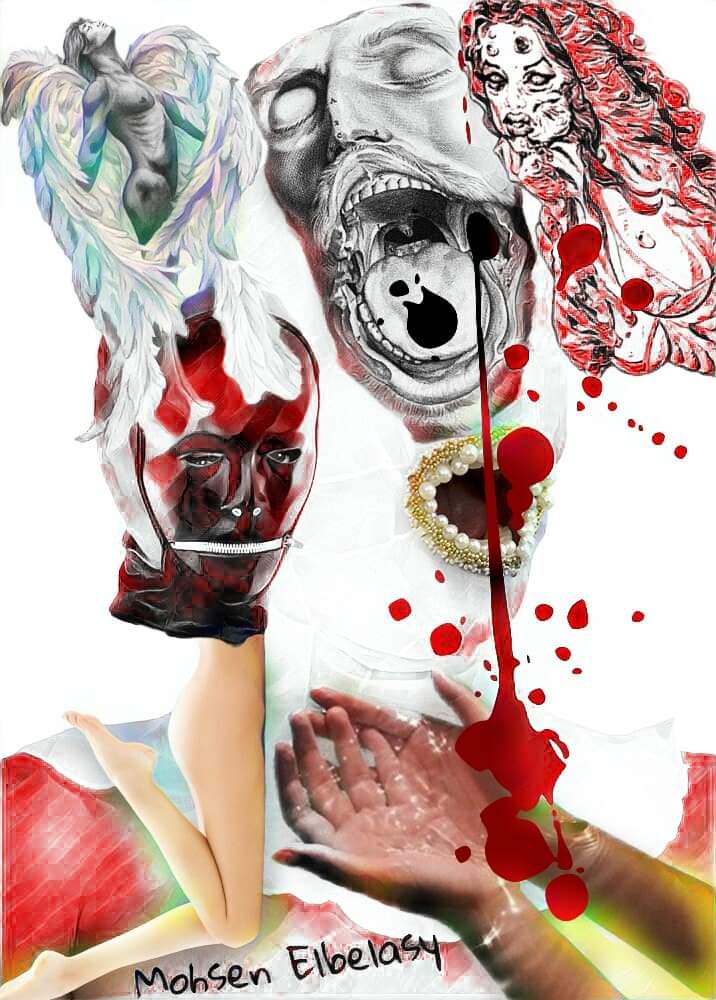
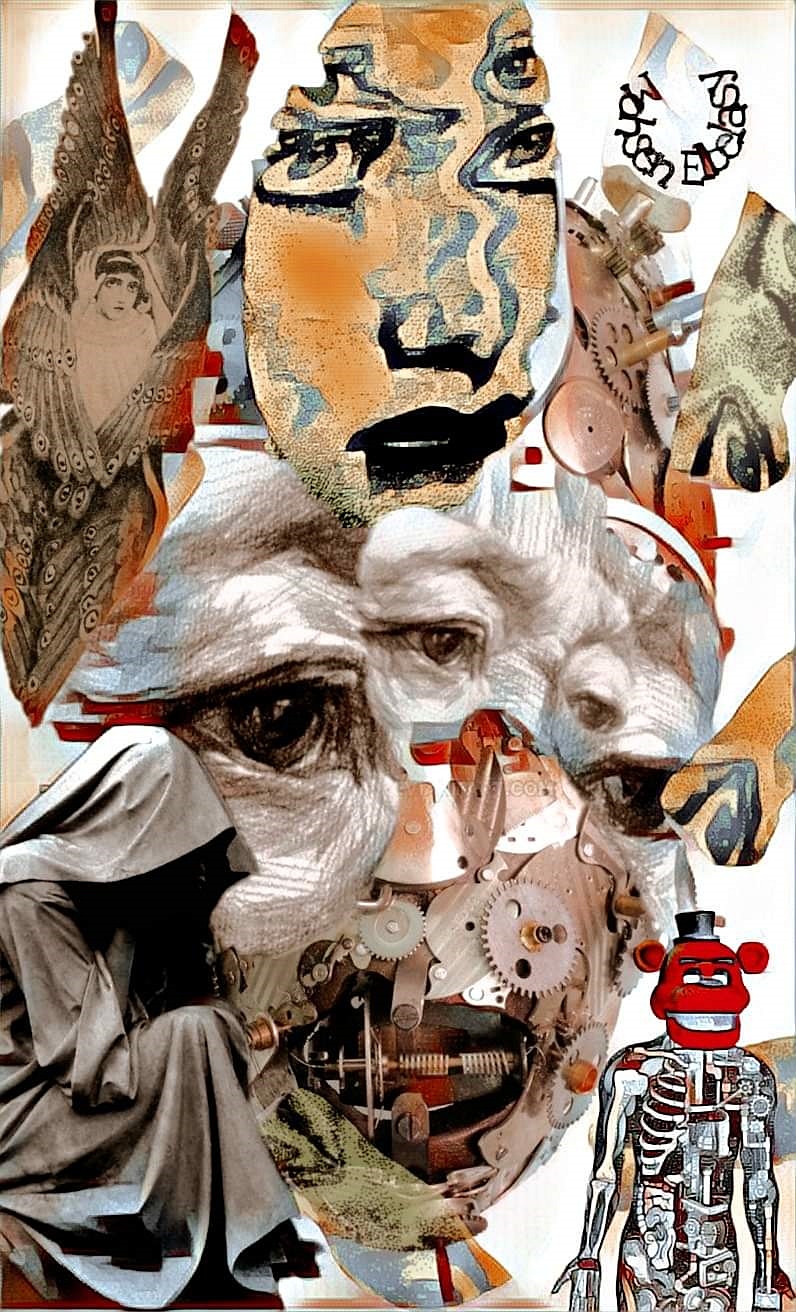
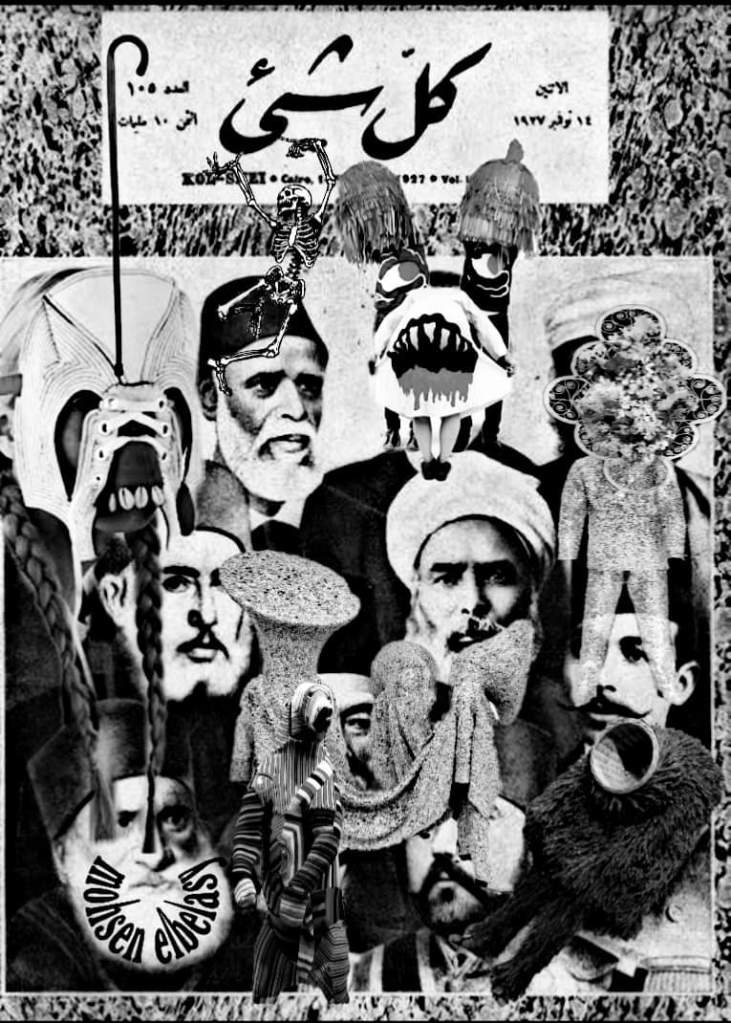
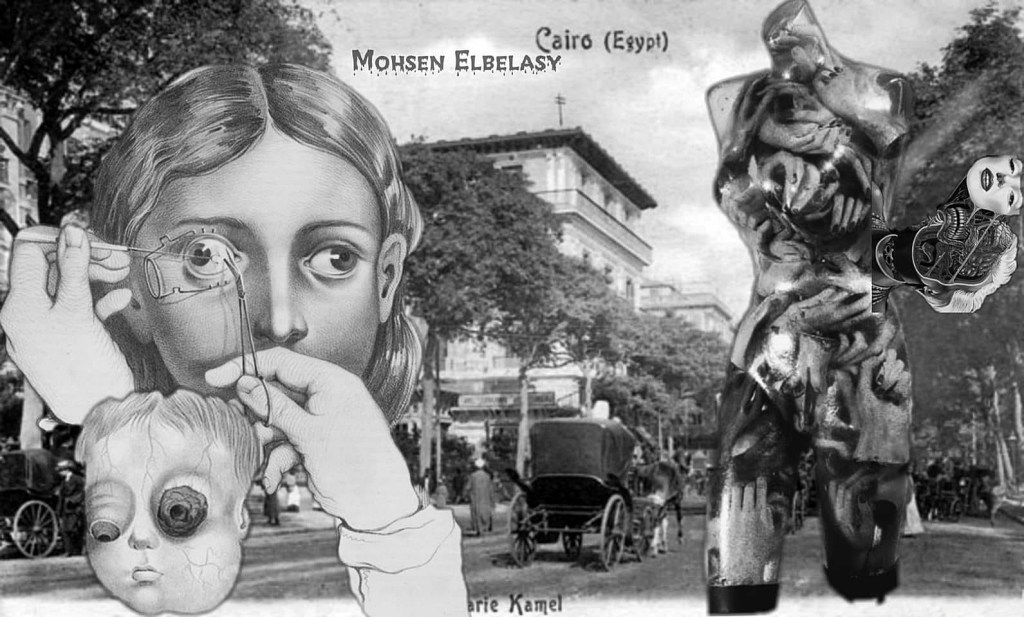
written by Mohsen Elbelasy
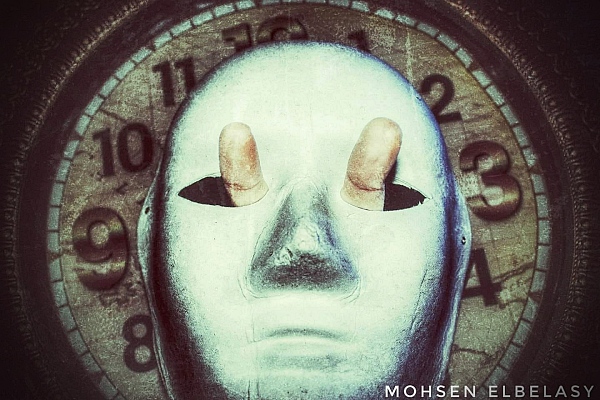
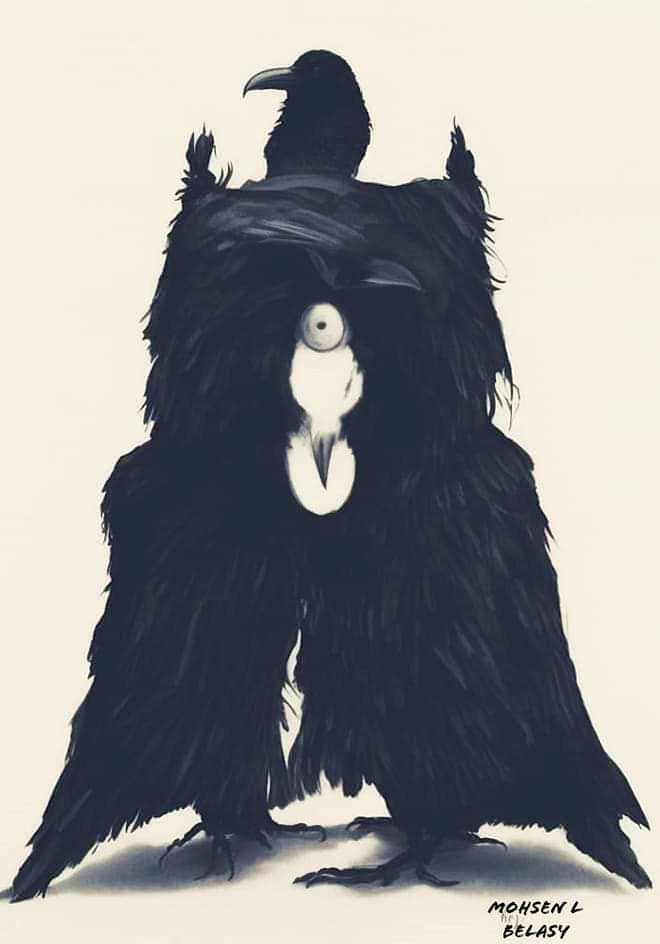
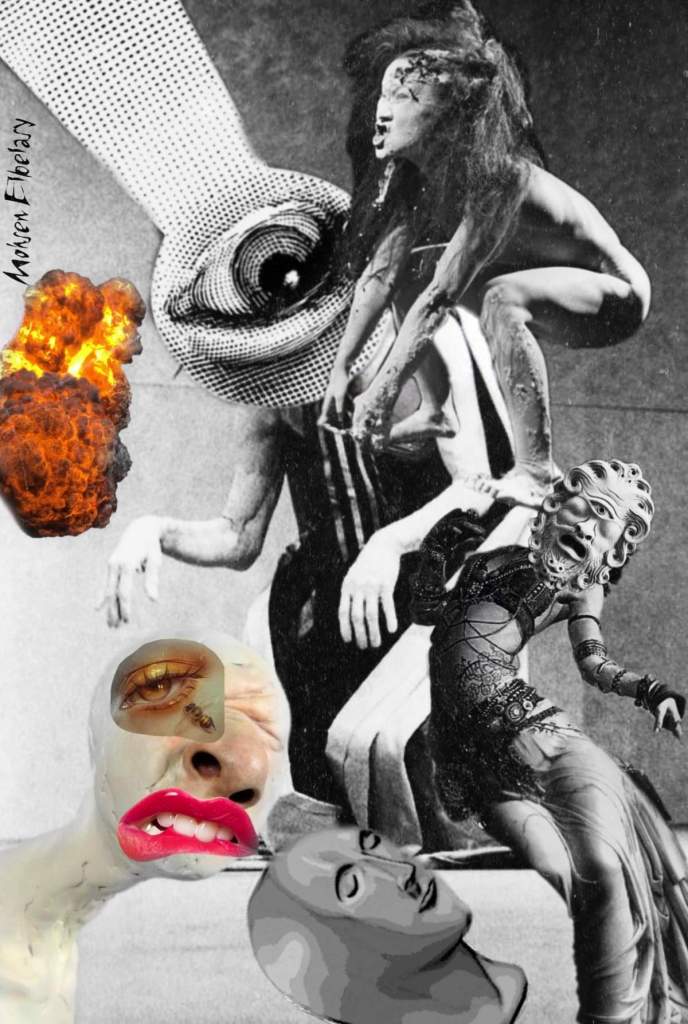
Mohsen Elbelasy Egyptian surrealist artist and poet and researcher and editor in chief of the Room surrealist Magazine and sulfur-surrealist-jungle.com and the co manager of the international exhibition of surrealism Cairo Saint-Cirq-Lapopie and Echoes of Contemporary Surrealism Exhibition. And co-founder of the Middle East and North Africa Surrealist Group. (MENA) and He also worked as a translator, cultural journalist and organizer of cultural and artistic events in Egypt and internationally. Chrysopoeia Surrealist union /Cooperative. In 2022, his book The Trip of Kamel Al Tilmissany won the Sawiris Grand Prize of Literary Criticism
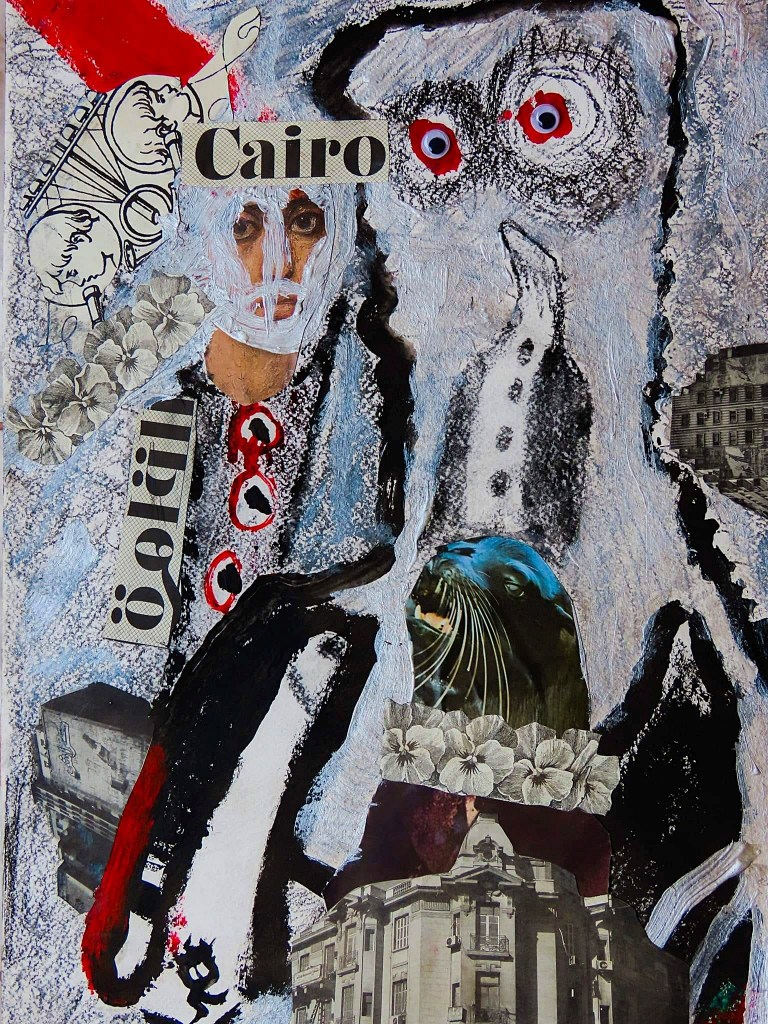
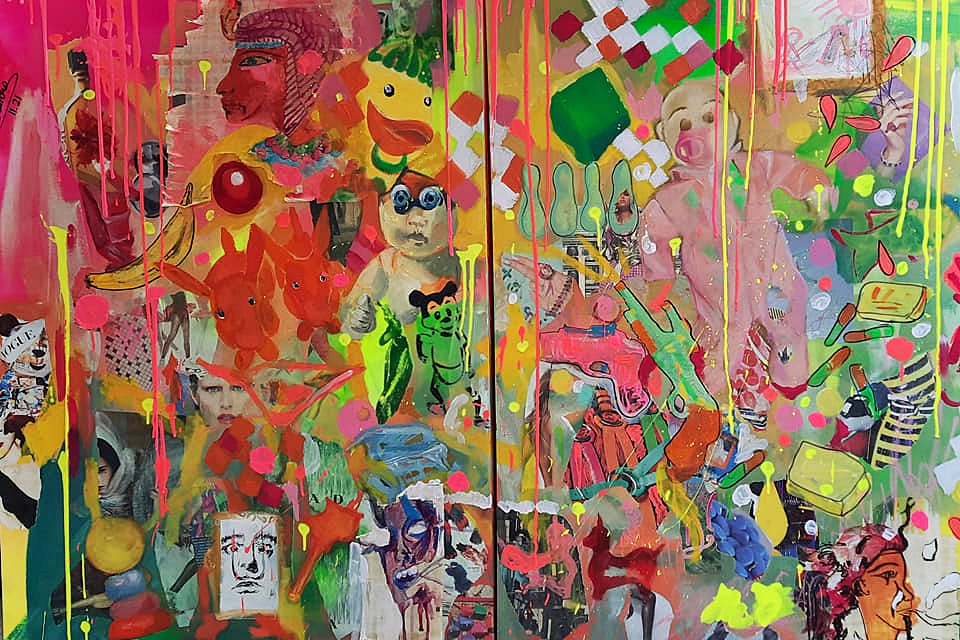
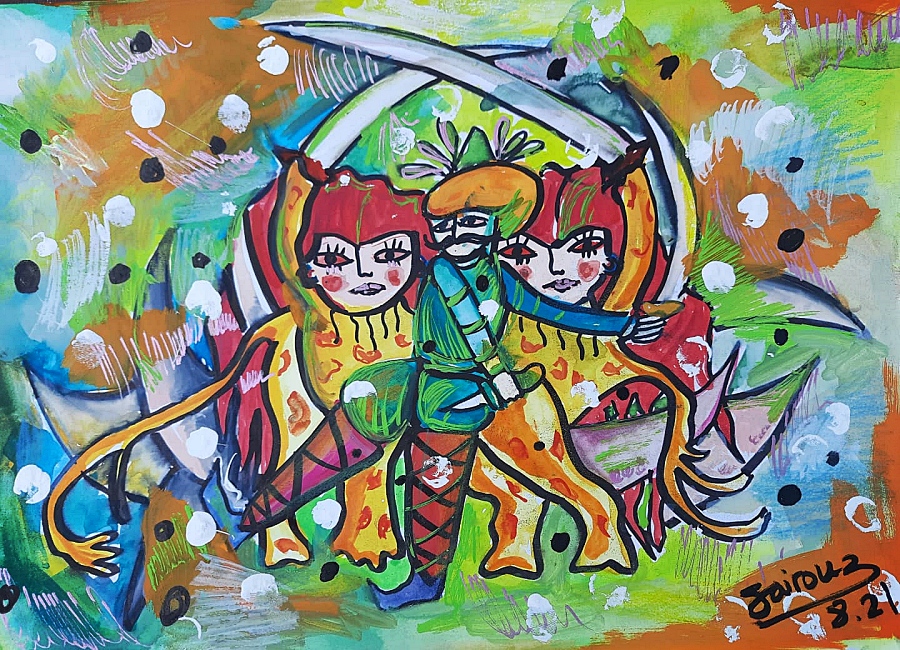
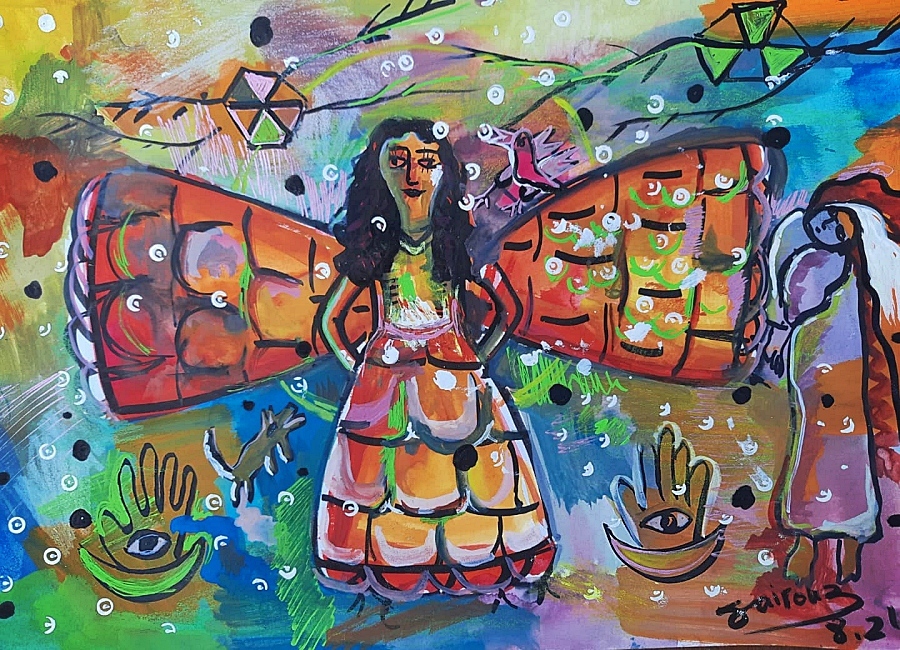
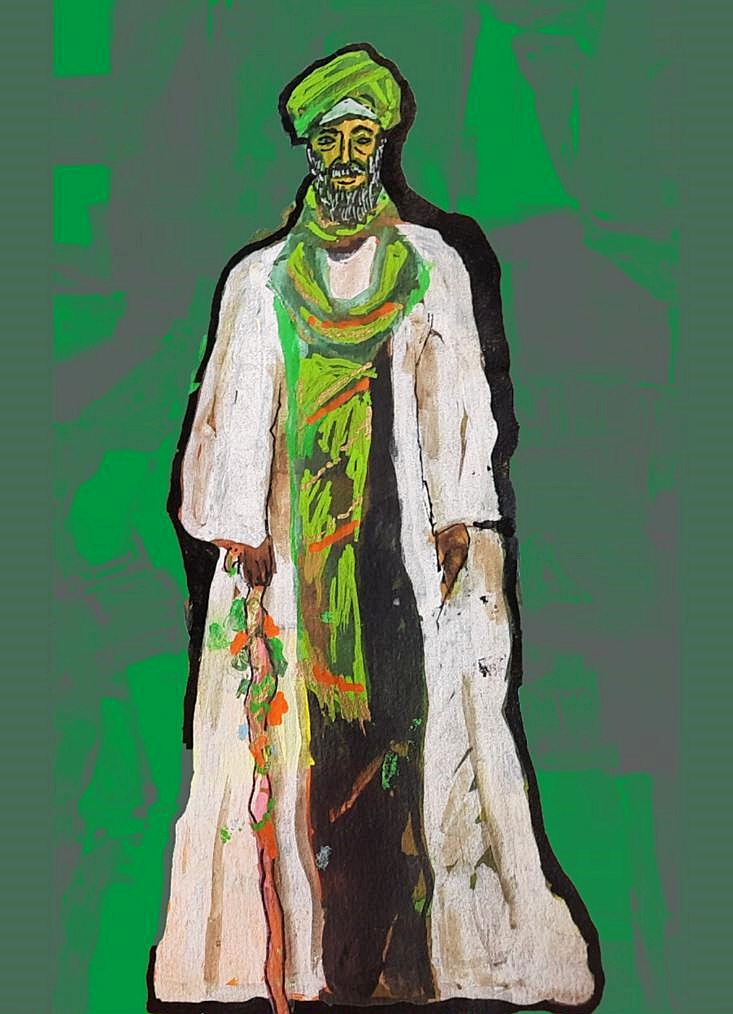
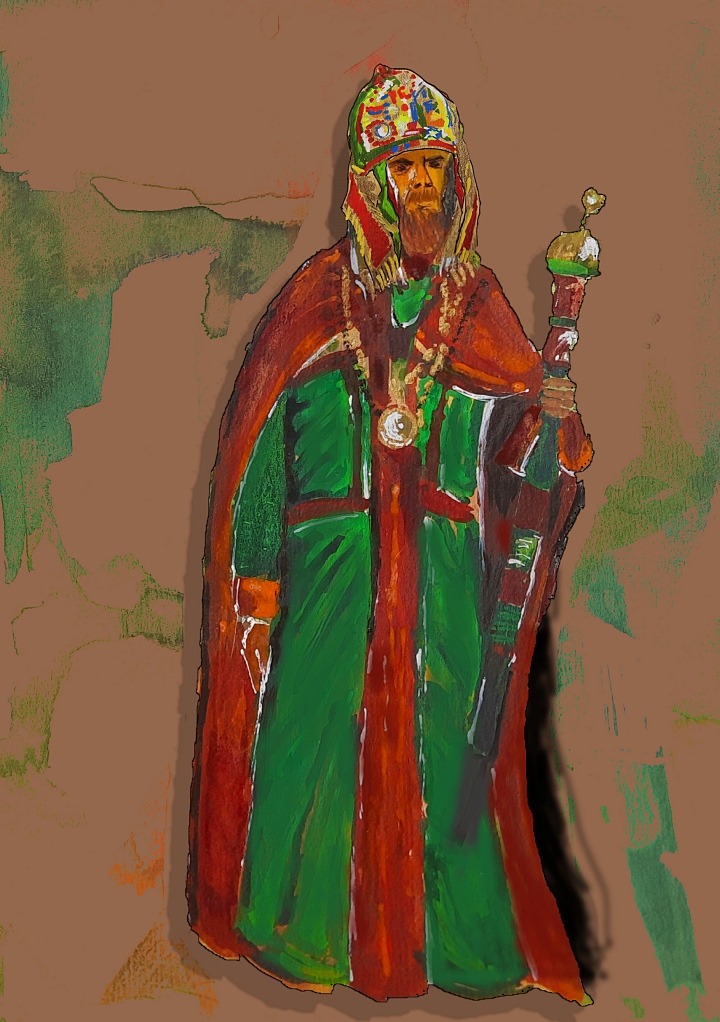
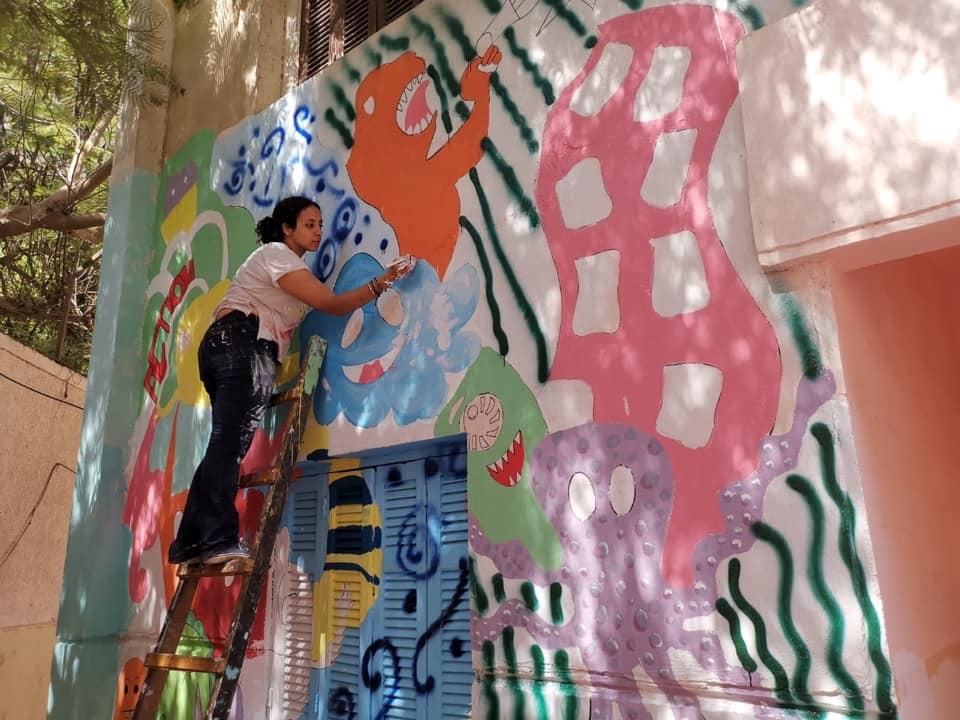
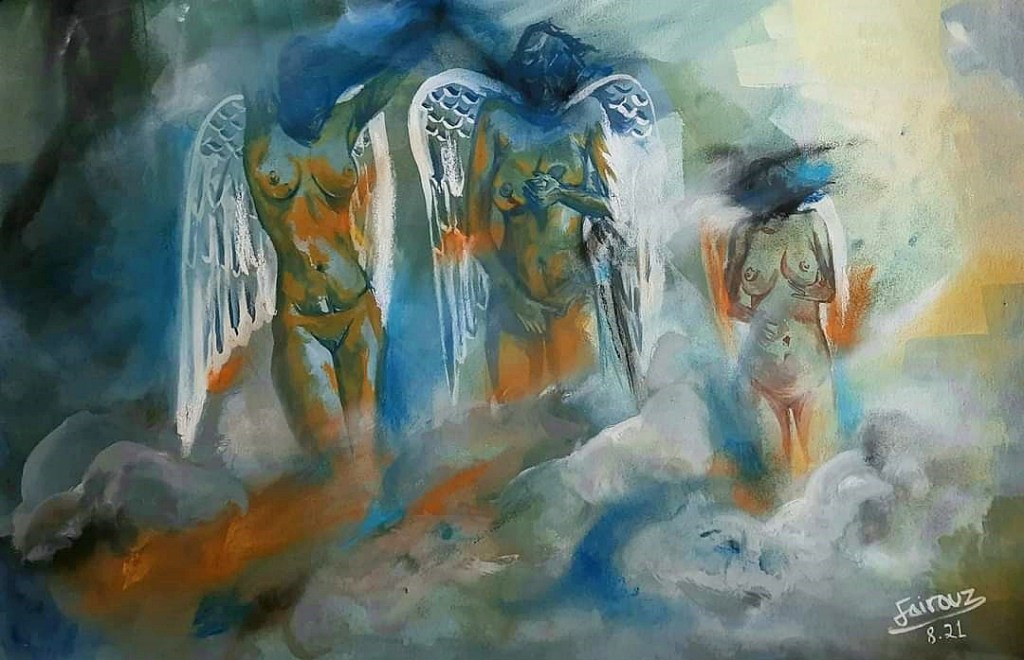
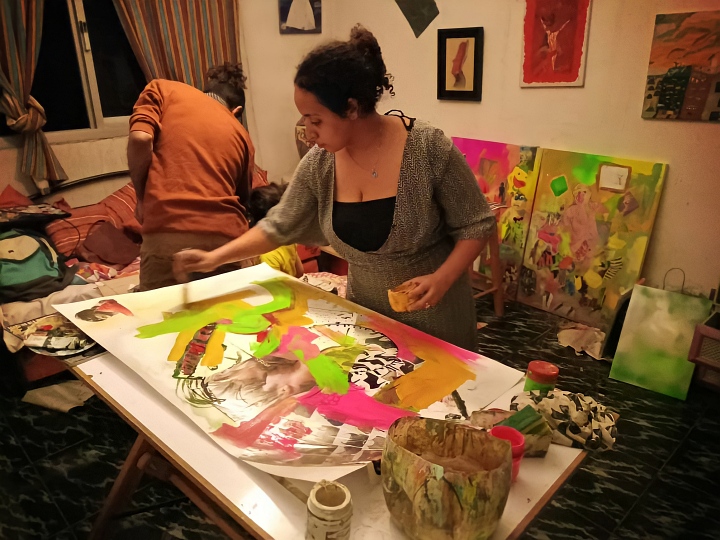
I am a multidisciplinary visual artist interested in painting, alternative sculpting, photography, digital art, collage and mixed media arts. I held my first solo painting exhibition at the age of 14 at Al Gezira Arts Center and have since participated in multiple art workshops and collaborations. I recently graduated from MSA University faculty of Arts & Design majoring in Cinema and Theatre.
Most of my work explores the theme of ‘play’ as a form of resistance. Further expanding and searching how the visual identities of my various roots all meet in a space that feeds on contemporary imagery and ideals.
Coming from a culturally rich background I am drawn to the visual richness of my city Cairo, particularly the slums where street art happens accidentally as a coincidence unravelling the many great textures and layers of the city, as well as having family roots in Upper Egypt and Delta, I began exploring the relationship between the urban and rural space and how it can be visually contextualized.
My inner child holds the pencils, untangling all the fears that have accumulated within my head and sarcastically mocks them. My inner child giggles and makes all the decisions now. I can only contemplate from afar ,a foreign spectator, as I watch dreams from my subconscious unfold and my inner child continues to laugh at me.
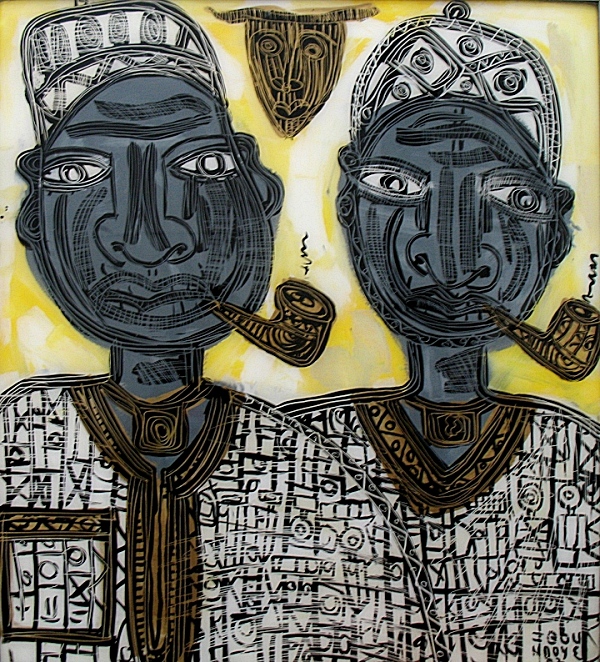
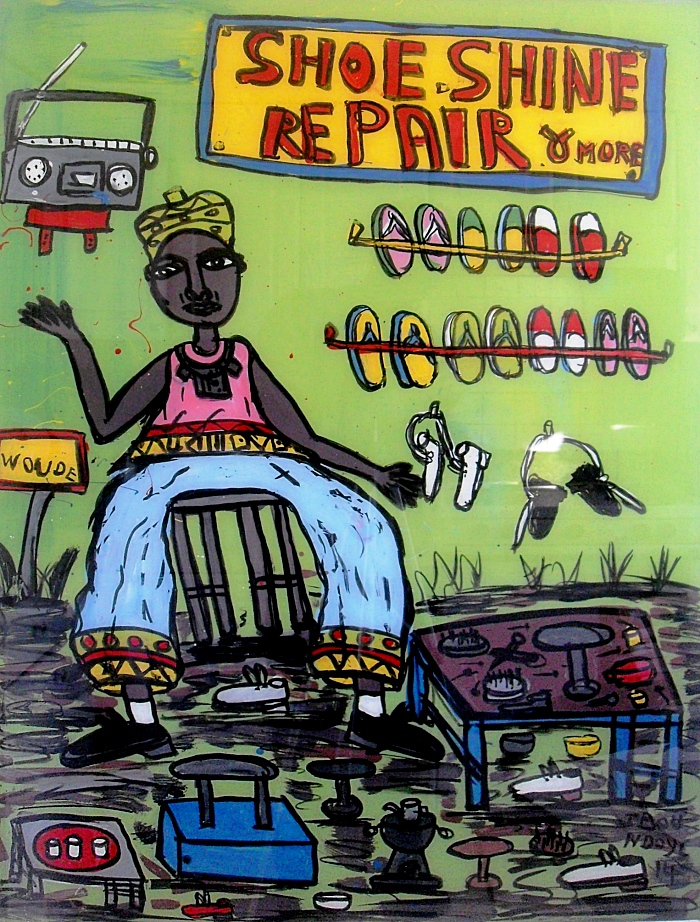
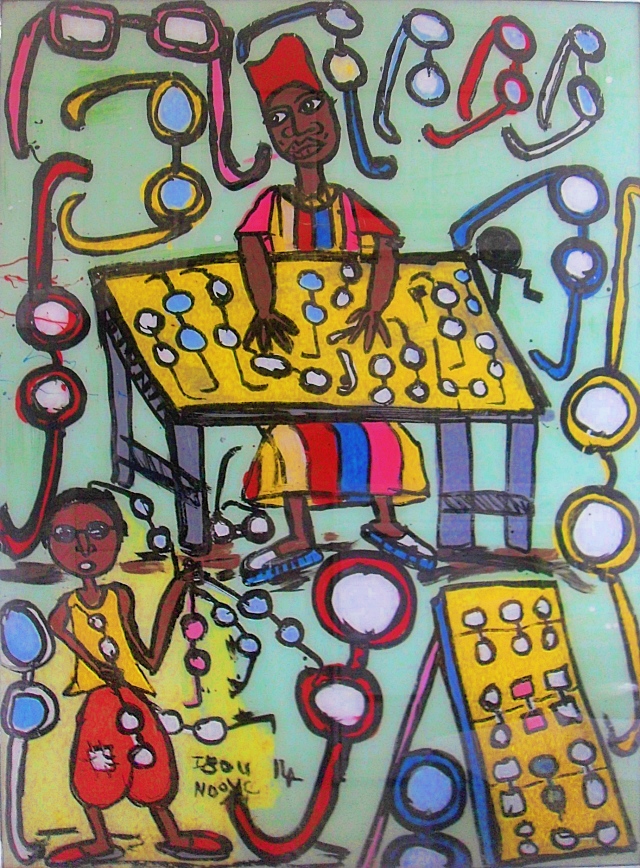
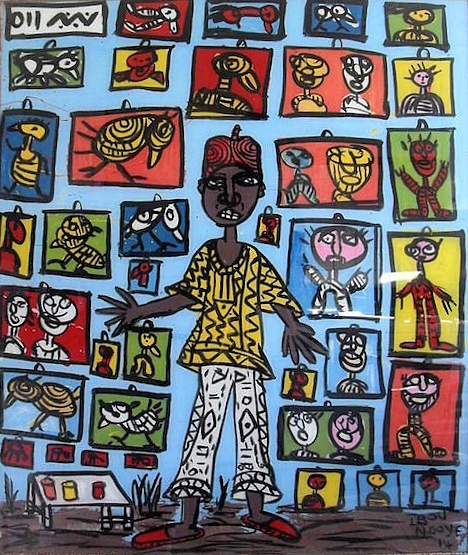
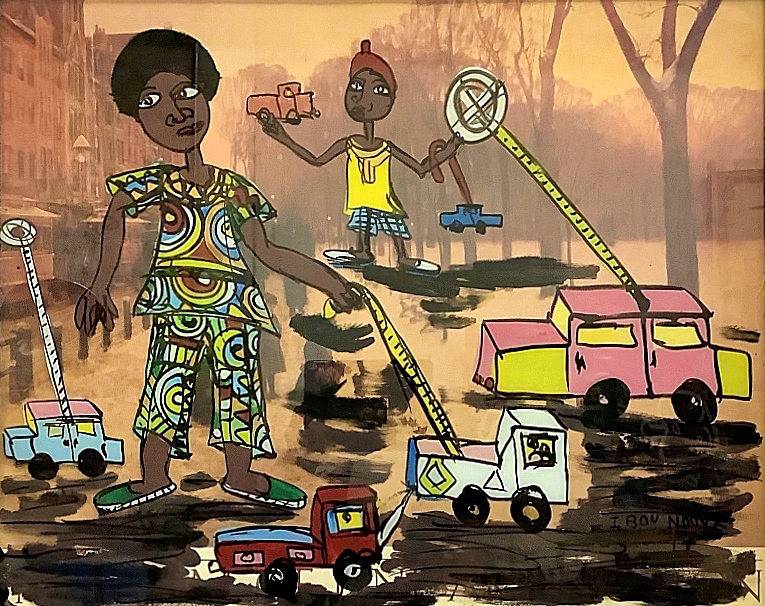
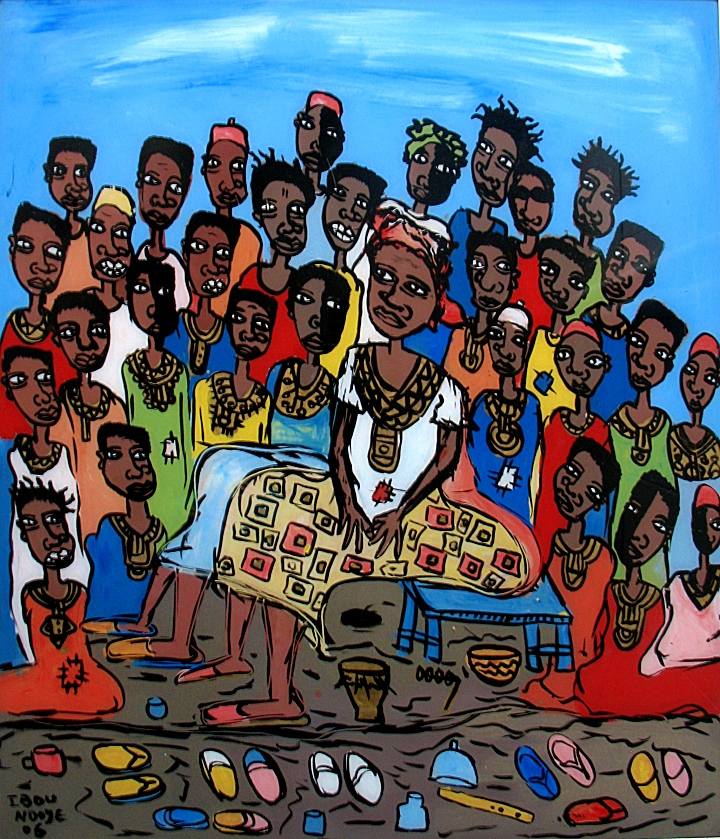
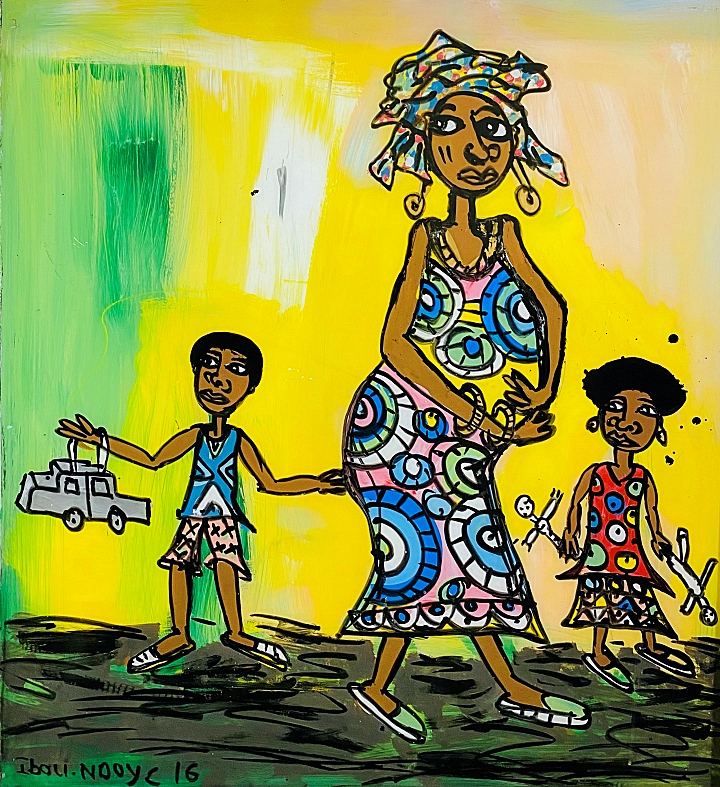
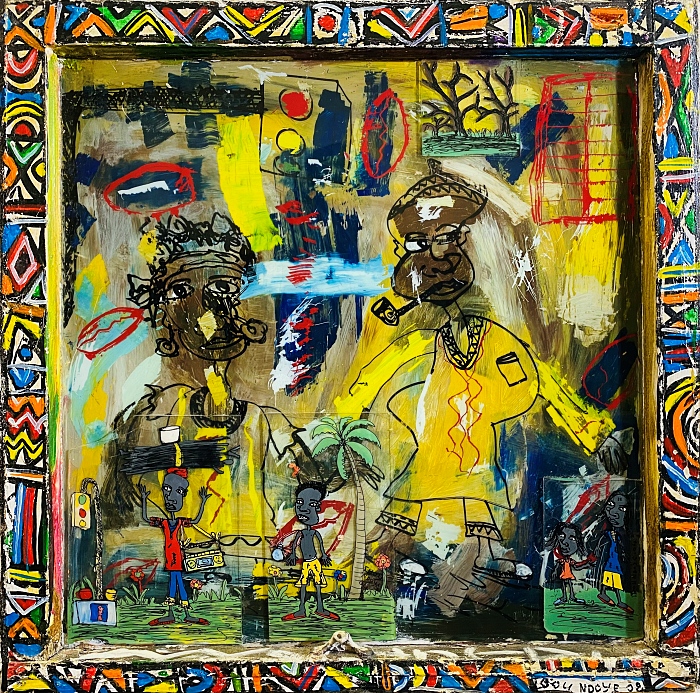
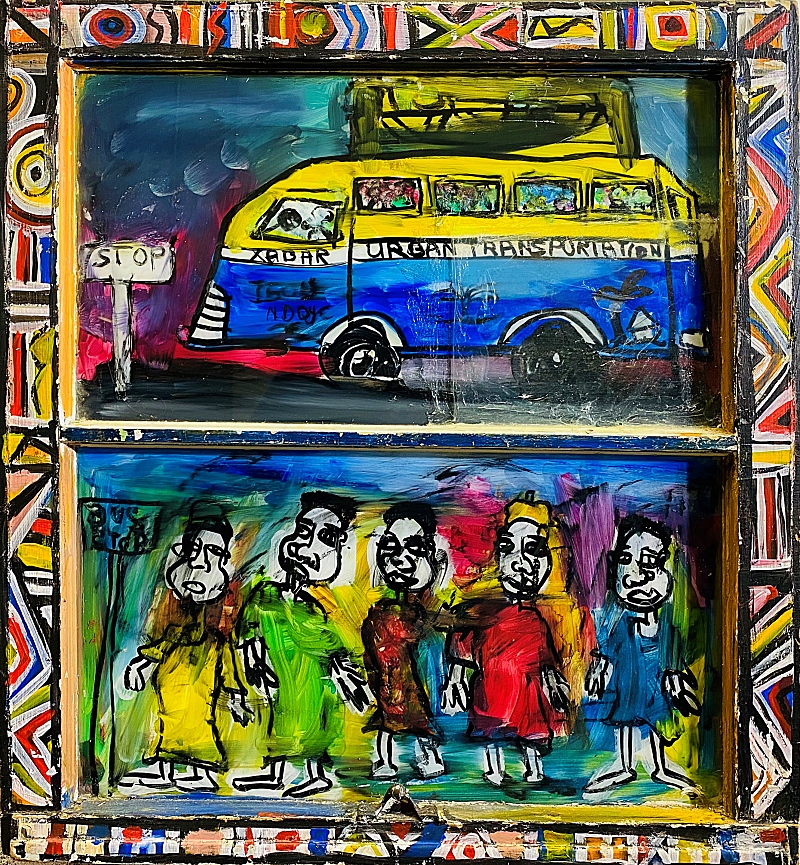
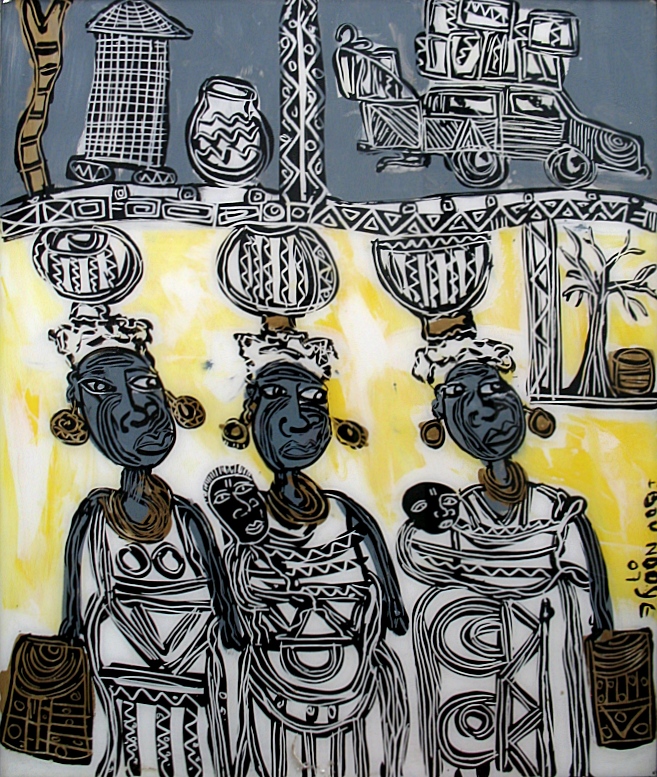
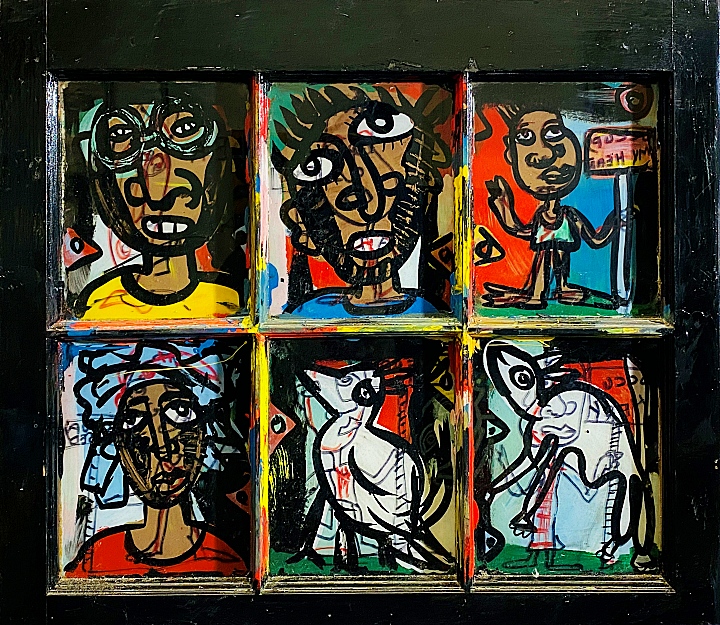
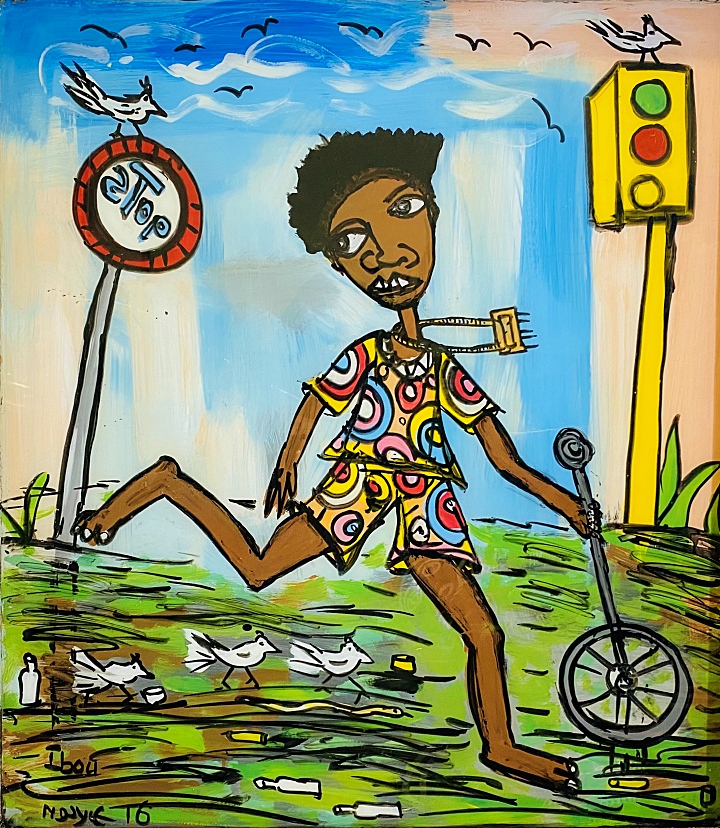
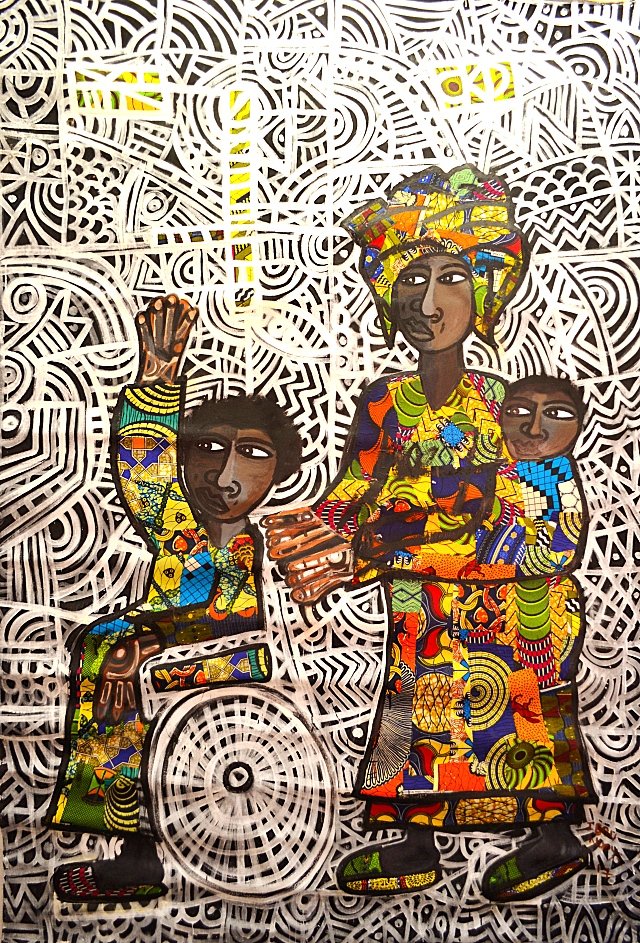
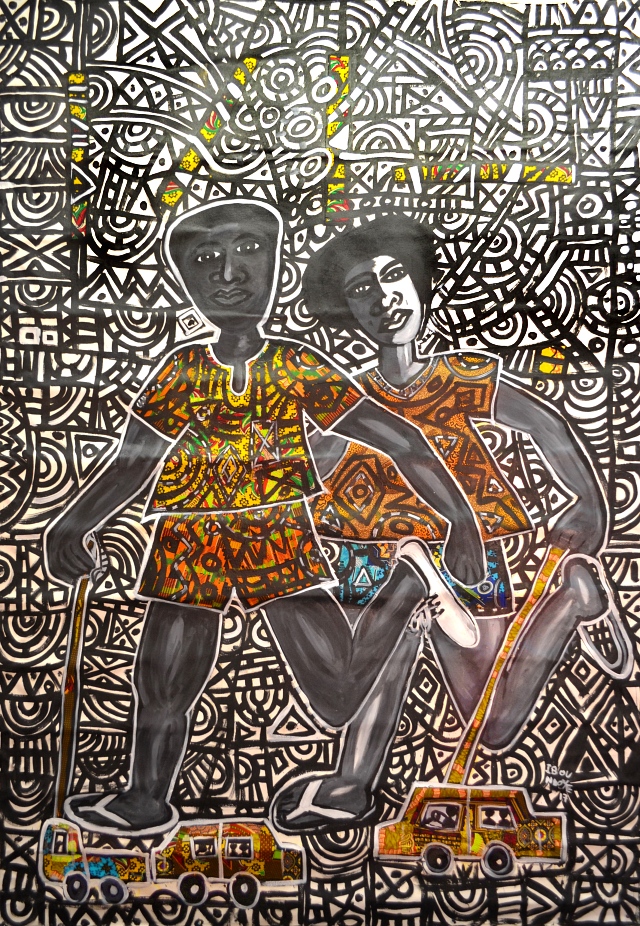
MY PAINTINGS ARE 100% SOCIAL, IN THE SENSE THAT THEY HAVE SOCIAL FUNCTIONS WHICH ALLOW THE VIEWER TO DEAL WITH ALL THE SOCIAL ETHICS OF MODERN AND TRADITIONAL LIFE. THEY ARE THE SHORT STORIES FROM ORAL TRADITIONS THAT TEACH, INFORM, AWAKE AND COMMUNICATE WITH YOUR SUBCONSCIOUS. IBOU NDOYE
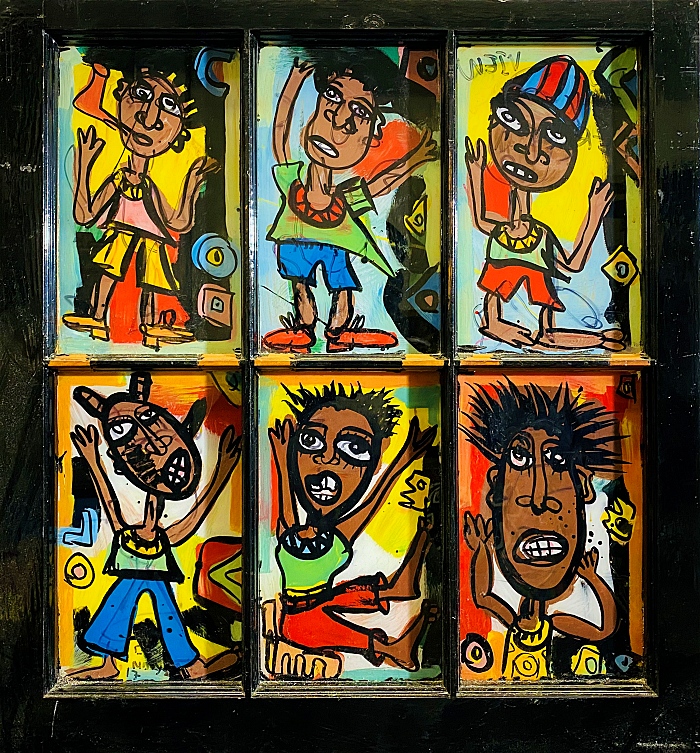
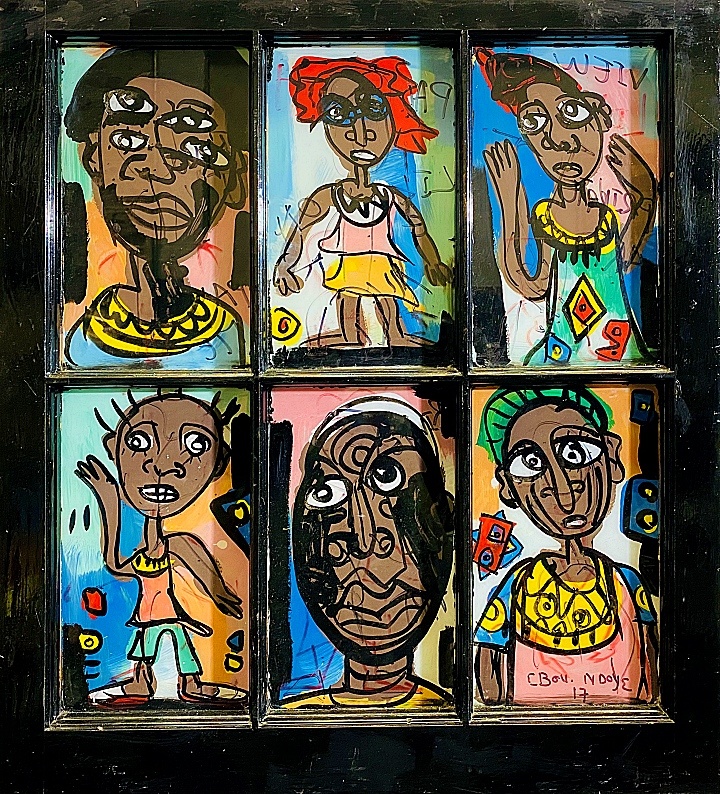
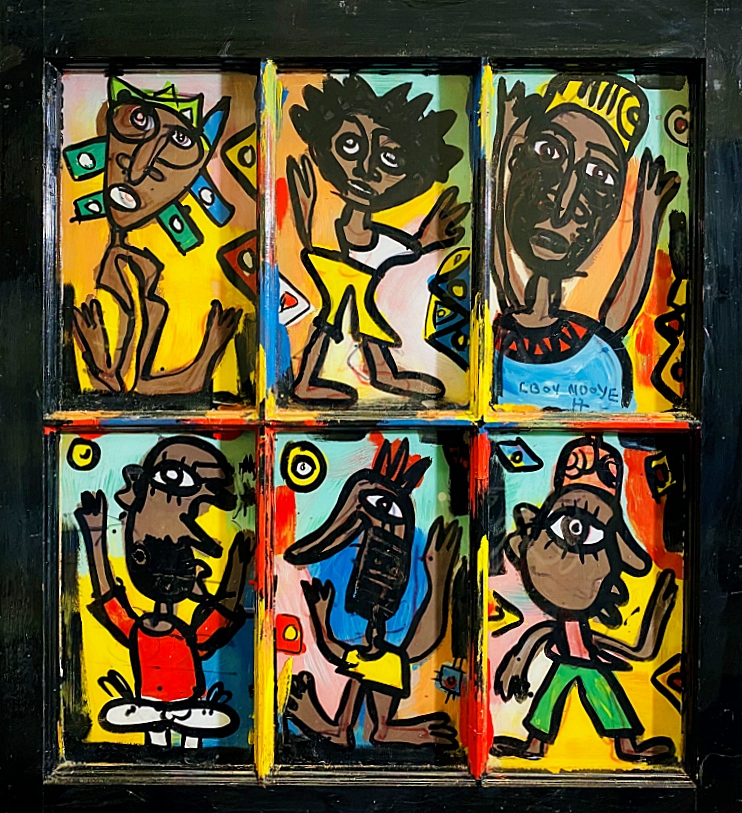
All Glass paintings are done on found windows. Please Click Image to Enlarge
Shoe Shiner, Glass PaintingEye glass repair, Glass PaintingAfrican art dealer, Glass PaintingImaginary childhood, Glass Painting and Found Print 2017
Born in West Africa’s most progressive capital city, Dakar, Senegal, glass-painting artist Ibrahima Ndoye has combined modernism and traditionalism to create a style unique to himself. Ibrahima, commonly known as “Ibou,” grew up as the oldest child of a family of four boys in the suburbs of Dakar. Ibou’s mother made her living as a dressmaker while his grandmother worked as a tie-dye artist. Regularly surrounded by colorful African textiles and fabrics, it is not surprising that Ibou says he “socialized with art and cohabited with colors” from a very young age.
The Family, Glass Painting 2016Story Teller, Glass PaintingMother and twins, Glass Painting 2016
Ibou began his career as a painter in the late 1980s during a period in Senegal called the “Set Setal,” or clean-up movement. The movement encouraged artists to embellish the environment by expressing themselves through murals on buildings and walls. It was during this time that Ibou painted several murals in the suburban city of Pikine. Some of Ibou’s murals were selected to appear in a French-produced documentary in 1990.
The Foulany couple, Glass Painting 2002Car rapide, Glass Painting 2007
Eventually Ibou’s interests changed. Following a tradition brought from the Middle East to Senegal one hundred years prior, Ibou entered and renovated the world of glass painting. When the technique was first introduced to the Senegalese, the subject matter was predominated by religious scenes- i.e. Abraham’s sacrifice, Noah’s Ark, Mary and Jesus. It wasn’t until after Senegal gained its independence from its French colonizers (1960) that glass painting expanded in new directions. However, through the 1980s only those holding degrees in fine art dared to play with the century-old tradition. These initial innovators tended to create images in such a way that the traditional style was barely recognizable through their abstractions.
From village to village, Broken Glass Painting
It was in the early 90s that a third wave of glass painters surfaced in Dakar. People like Ibou began to look back at the traditional style of their predecessors with a new inspiration. Instead of painting traditional African scenes on clean sheets of regularly shaped glass, Ibou started breaking and layering the glass to create new textures and effects. The incorporation of various other materials including copper wire, broken bottles, wood, bone, and animal skin began to appear in Ibou’s work as well. Later in his life, upon relocating to America, Ibou took one step further by mixing glass with plastics and other materials common to our modern environment. It is not unusual to find Ibou stapling scraps of soda cans and detergent boxes onto vibrantly painted CD cases portraying images of African women carrying jugs of water above their heads. As the times changed, so did Ibou’s work, creating a new style from an old tradition.
Happy kids, Glass Painting 2017Eyes of people, Glass Painting 2017Happiness in the Family, Glass Painting 2017Non Verbal Communication, Glass Painting 2017
In the late 90s Ibou began exhibiting his work around Africa and Europe in local and internationally touring shows. The Biannual of African Art hosted in Dakar regularly accepts Ibou’s work for exhibition in a show titled “The Salon of Glass Painting.” In 1999 Ibou expanded his involvement in Senegal’s art scene when he started running glass painting workshops at the El Hadji Doudou Mbath Primary School, and later at the Dakar YMCA.
Playful Child, Glass Painting 2016
In 2001 Ibou found himself on his way to join a friend in New England. For several months Ibou taught painting classes at Allen Special Needs Camp for the disabled in Bedford, New Hampshire. Later that year Ibou moved to Rhode Island where he acted as an art instructor for a program entitled “Kids at Risk” run by the Urban Collaborative Accelerated Program (UCAP). Ibou also appeared as a guest speaker on the Cox Television production “Cultural Tapestry.”
Wheelchair, Mixed Media, Acrylic And African Fabric On Canvas 2017Two Playful Kids, Mixed Media Acrylic And African Fabric On Canvas 2017
Now Ibou resides in Jersey City, New Jersey, and regularly exhibits his art both locally and internationally in addition to holding glass painting workshops at libraries and schools. Ibou intends to continue promoting and expanding his artistic vision through exhibition, education and cultural exchange.
Jaclyn Pedalino African Art Manager
When i paint i become blind and turn my painting brushes into walking stick ,then fumble until i reach where i want to be




















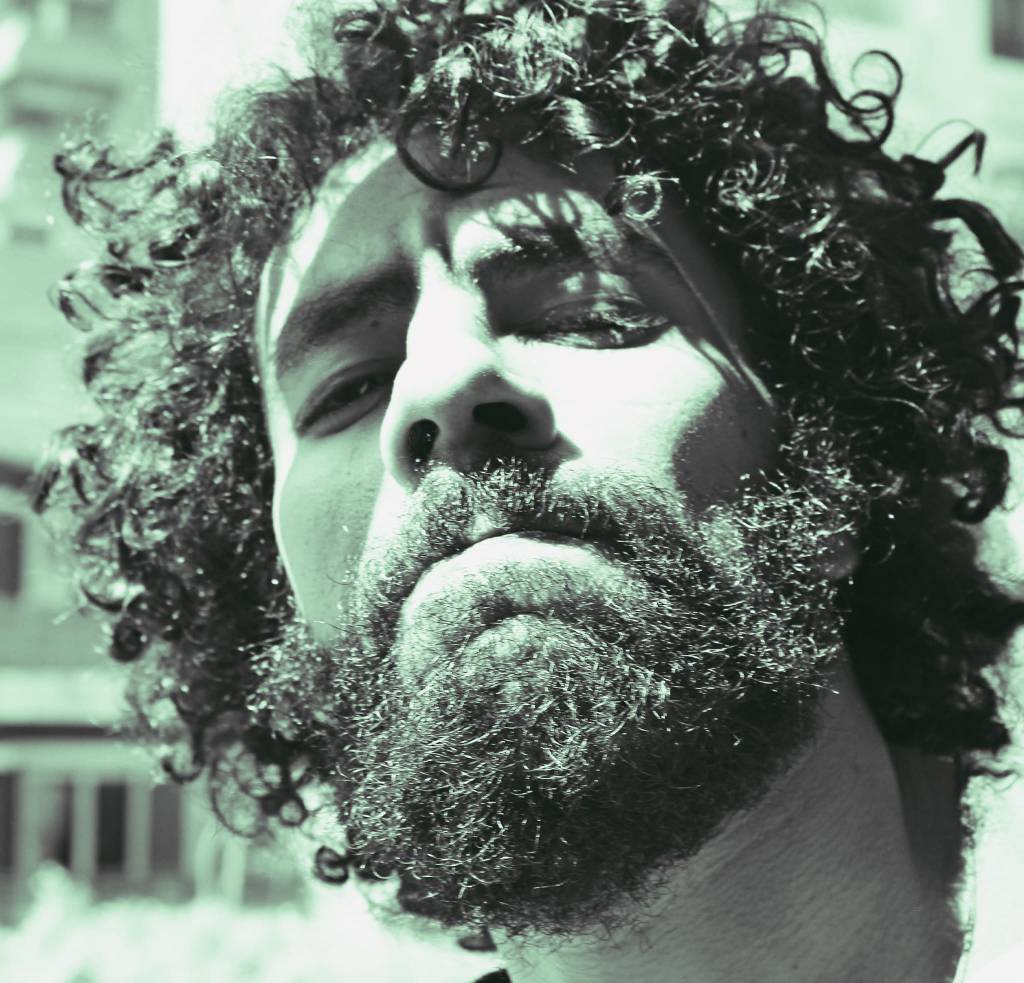
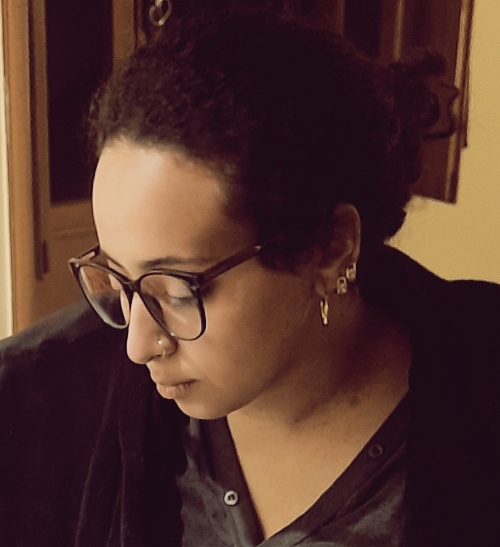



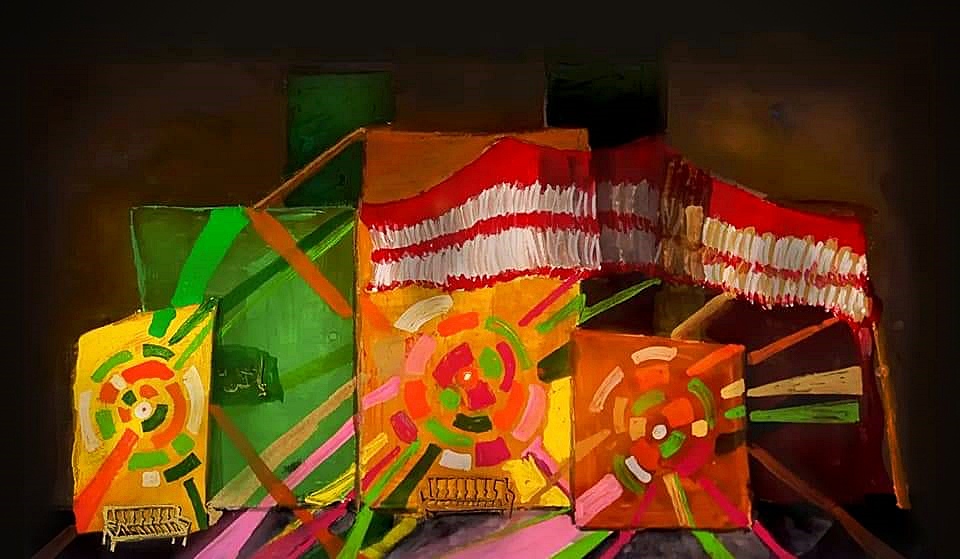
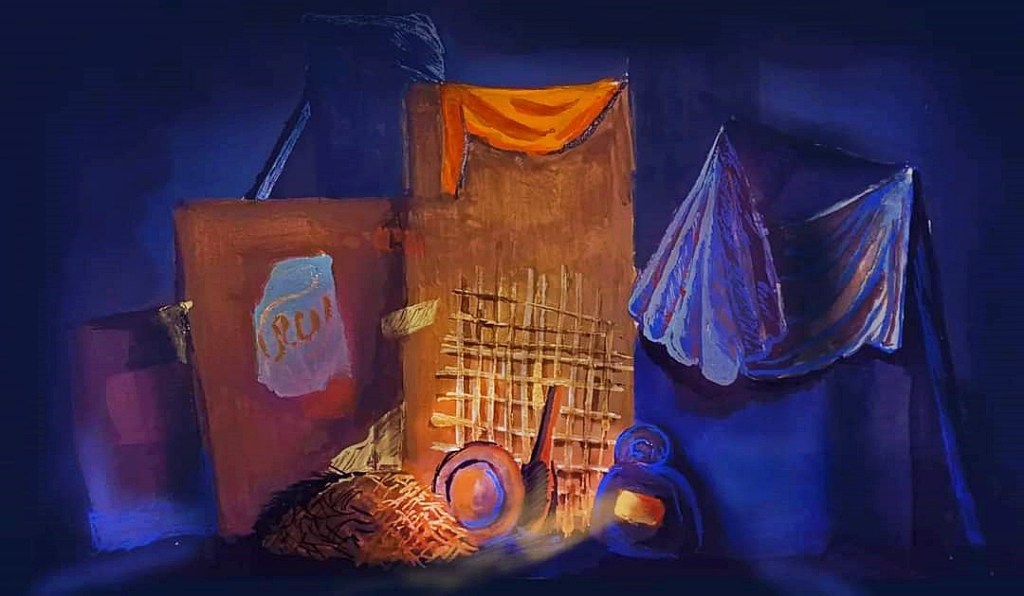
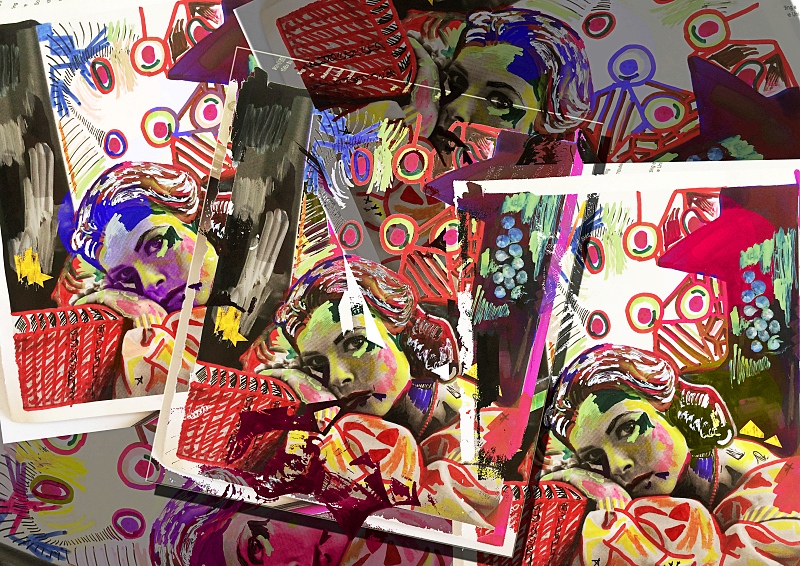
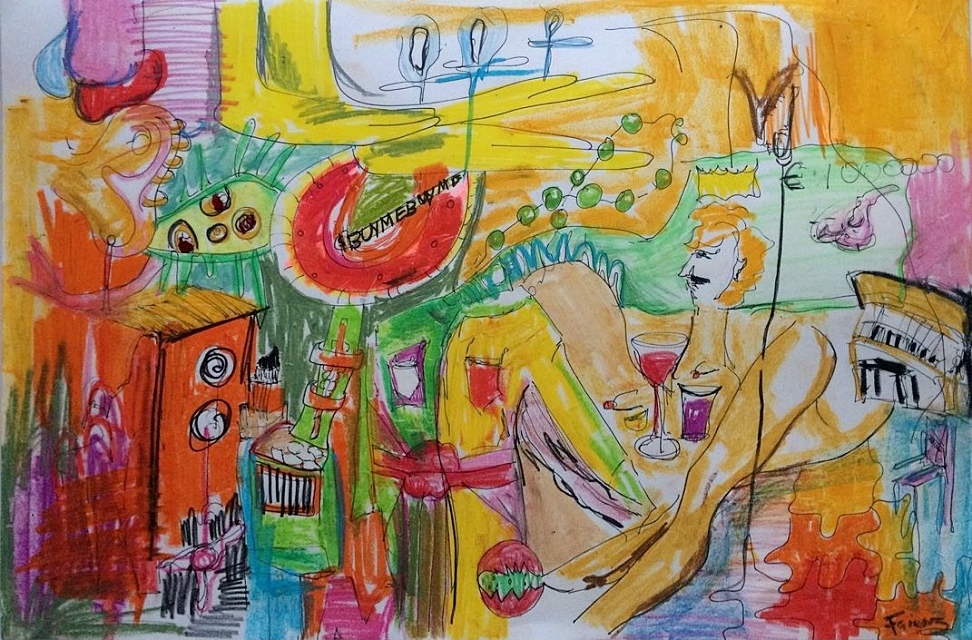




 Mitchell Pluto