Auntie Etha’s Cow-Lip Tea by P.D. Newman

AUNTIE ETHA’S COW-LIP TEA: An Early Case of the Use of a Coprophilous, Possibly Entheogenic, Fungus in African American Folk Healing
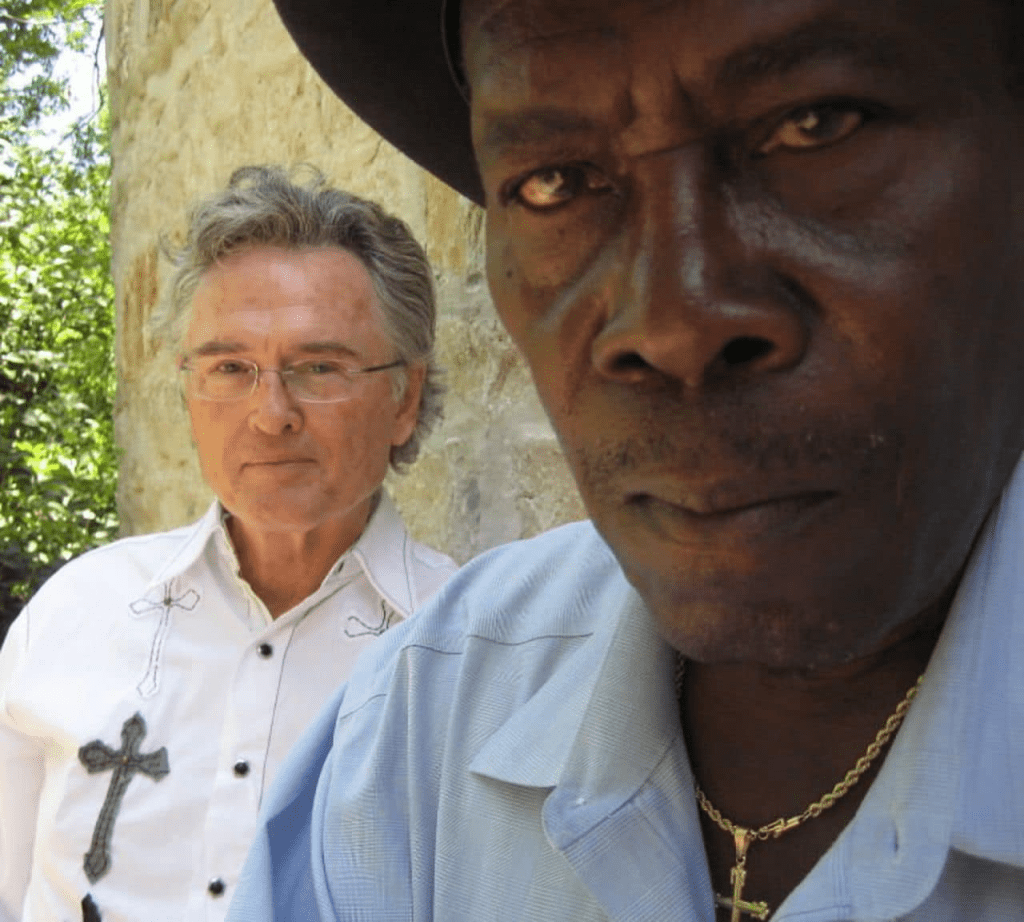
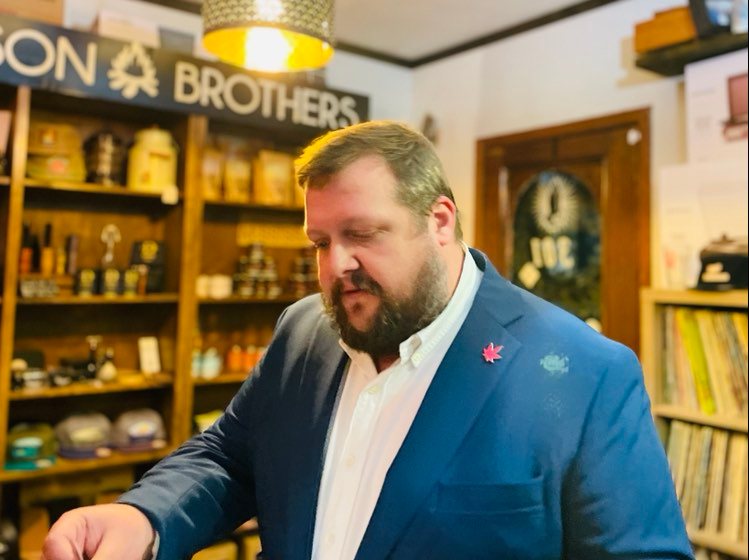
Ron Hall and Denver Moore’

written by ©P.D. Newman

The psychedelic, psilocybin-rich species, Psilocybe cubensis, is a coprophilous mushroom. This means that it can only subsist in the wild upon the dung of certain animals, especially cattle. While native to Cuba (hence cubensis), this fantastic fungus has been documented in a number of southern states, including Florida, Georgia, Alabama, Mississippi, Tennessee, Arkansas, Louisiana, Texas, South Carolina, North Carolina, and even as far north as Oklahoma, Virginia, and West Virginia—albeit rarely in these latter three. The species is also found in Hawaii. It was in the state of Louisiana, however, amidst its humid cattle fields and dank, swampy marshes, where African American sharecropper, Denver Moore—then just a boy—first underwent what may be an early example of psilocybin mushroom use in North America.

As the book says, Ron Hall and Denver Moore’s New York Times Bestseller, Same Kind of Different as Me—an amazing true tale of a modern-day slave, an international art dealer, and an unlikely woman who brought them together—is a story filled with hardship, betrayal, and the brutality that lines the hearts of some men. But, it’s also a story of hope and perseverance, mottled throughout with thought-provoking anecdotes about black life in the Deep South in the 1950s. Descended from African American slaves, Denver Moore was raised on a scorching southern plantation near the alligator-riddled, mosquito-infested swamps of Louisiana. Having very few monetary resources, Moore was blessed to have an incredibly resourceful wise woman of an aunt, a Conjure woman—called Auntie Etha—who, with the aid of traditional African American folk remedies, was able to help the Moore family make the most of an often difficult situation. Moore recalls,

Lookin back on it, I think Auntie was what you might call a spiritual healer, like a ‘medicine man,’ cept she was an elderly woman. […] Big Mama made me go show my respect and also to help Auntie gather up the fixins for her medicines.

She used to take me with her down by the swamp where she’d be gatherin up some leaves and roots. […] ‘Now Li’l Buddy, this here’s for takin the pain out of a wound,’ she’d say, pullin up a root and shakin off the earth. ‘And this here’s for pneumonia.’

[…] She had a room in her house with a big table in it covered with jars in all kinda sizes.

See them jars?’ she told me one time.

Yes, ma’am.’

In each of em, I got somethin for anything that happens to you.’

[…] She had some kinda spiritual thing goin on in that house. Every time I went in there, she made me sit on a little stool in the same spot, even facin in the same direction, like she didn’t want me to mess up whatever voodoo she had goin on in there.

Moore’s charming description of Auntie Etha clearly betrays her as a practitioner of Hoodoo, known in the Mississippi Delta as a “Rootwork” or “Conjure,” even going so far as to evoke the term, “voodoo,” in his account.

Hoodoo, a traditional African American spirituality that arose from several West African traditions as the same were imported into the New World, may not be stranger to psychoactive plants. For instance, while not entheogenic itself, one of the most common charms carried by Conjure practitioners is the root ball of the Ipomoea jalapa vine, referred to as a “High John the Conqueroo” root. Some species of Ipomoea (morning glory), such as Ipomoea tricolor and Ipomoea corymbosa, are possessed of the hallucinogenic compound, ergine, also known as d-lysergic acid amide (LSA)—a close cousin to Albert Hofmann’s “problem child,” lysergic acid diethylamide (LSD-25). In 1938, Ipomoea corymbosa (formerly Rivea corymbosa), for example, was discovered by American biologist, Richard Evans Schultes, to solve to problem of the identity of the ancient Mexican hallucinogen, Ololiuqui. The formidable effects of Ololiuqui were noted in the colonial document, The Florentine Codex, from the 16th century:

It inebriates one; it makes one crazy, stirs one up, makes one mad, makes one possessed. He who eats of it, he who drinks of it, sees many things that will make him afraid to a high degree. He is truly terrified of the great snake that he sees for this reason.

Francisco Hernandez, the famous Spanish physician, also discussed Ololiuqui in his book, Rerum medicarum Novae Hispaniae thesarus:

When the priests of the indians wish to commune with the spirits of the dead, they eat these seeds to induce a delirium and then see thousands of satanic figures and phantoms around them.

Ergo, there was already a history of the Native use of hallucinogenic morning glories in the Americas long before the arrival of African slaves. But, that doesn’t necessarily mean they learned of jalapa through Native Americans.
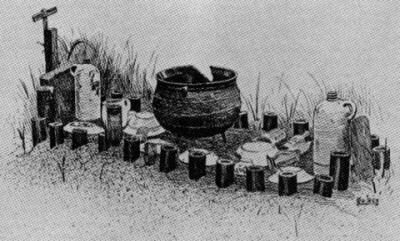
Century Illustrated Magazine (1881-1906), XLI, 825.

Before going any further, it is important to note that some African cultures are known to be in possession of their own rich, entheogenic traditions—independent of the export of African slaves to the New World. The Bwiti cult found among the Puna, Mitsogo, and Fang tribes in Gabon and Cameroon, for instance, employ the inebriating root bark of the West African shrub, Tabernanthe iboga, in their lively initiations. Like the “High John the Conqueroo” charms cherished by Southern practitioners of Hoodoo in North America, iboga is harvested from the roots of the shrub, linking the Bwiti cult, at least in spirit, to the black “rootwork” of Southern Hoodoo—a tradition whose own roots are to be sought in the religious practices of the Bantu of the former Kingdom of Kongo in west-central Africa. In fact, when iboga was first documented by the West, English traveler and author, Thomas Edward Bowdich, reported that,

The Eroga, a favourite but violent medicine, is no doubt a fungus, for they describe it as growing on a tree called the Ocamboo, when decaying; they burn it first, and take as much as would lay on a shilling.

While this Englishman is no doubt in confusion regarding the identity of iboga, his observation suggests that some species of fungus was sacred to the Indigenous of the area. And, indeed, a tree fungus, known as tondo, was in fact central to the construction of nkisi statues, whose “kondu gland”—a hollow chamber in the belly of the statue—held samples of the unidentified specimen. One Bantu nganga, making an offering of the mushroom to the spirits, referred to tondo as “the key that opens everything.” The Kongolese and African American practice of surrounding the gravesite of a loved one with inverted plates and saucers, often resting atop poles or sticks, was believed to imitate the appearance of mushrooms around the burial. According to one source, this curious form of grave decoration was meant to recall and old Kongo play on words: tondo / matondo. For, in Bantu, the word for mushroom (tondo) is similar to the word for “to love” (matondo).
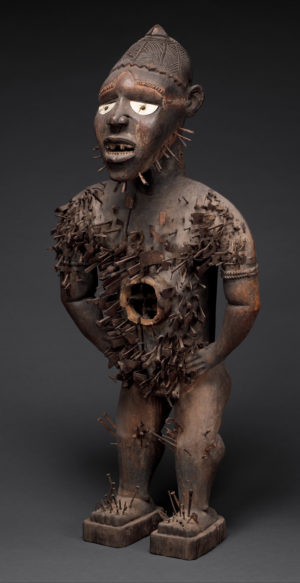
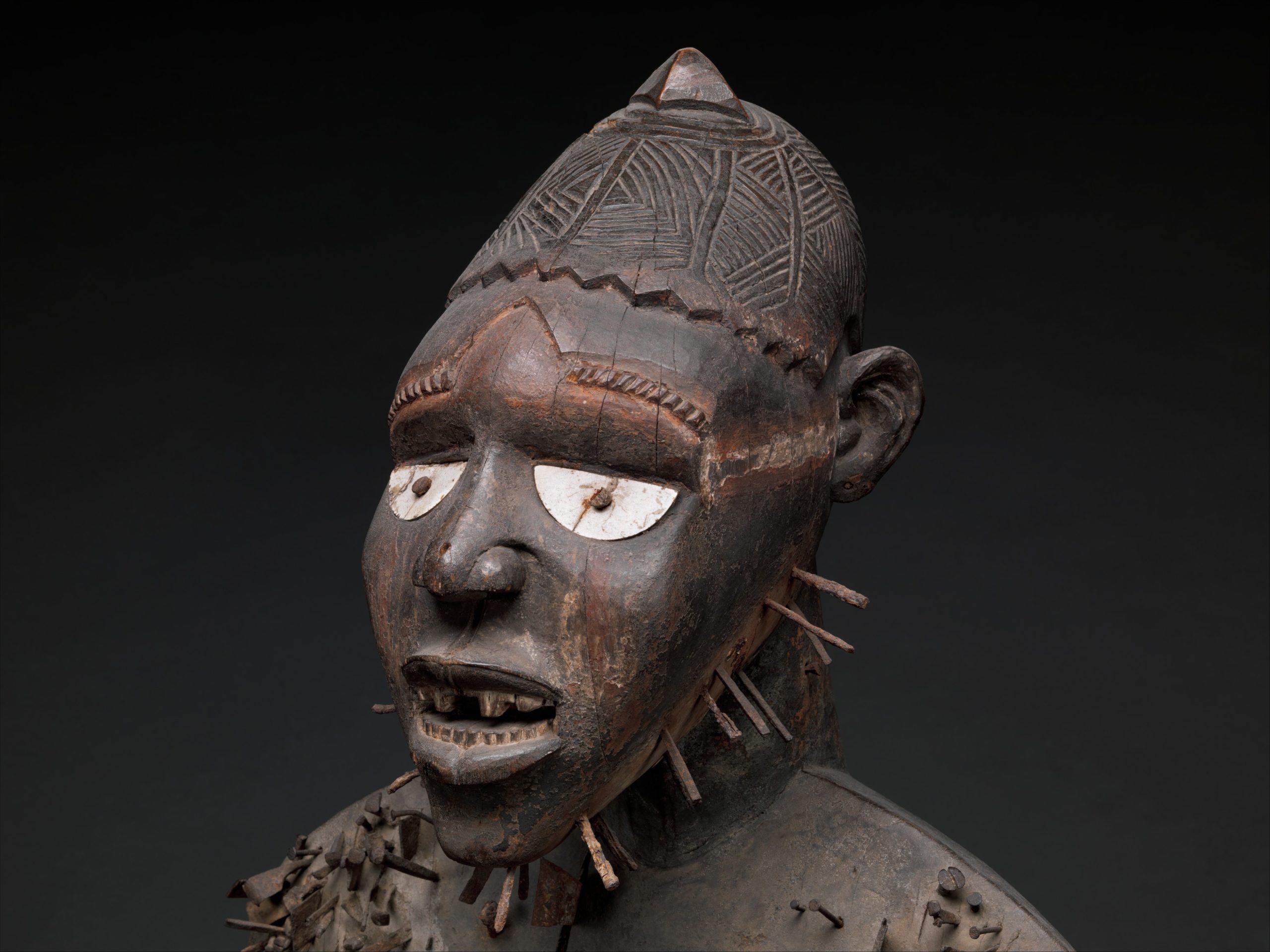
Power Figure (Nkisi N’Kondi: Mangaaka), Kongo peoples, mid to late nineteenth century, wood, paint, metal, resin, ceramic, 118 x 49.5 x 39.4 cm, Democratic Republic of Congo. Medicinal combinations called bilongo are sometimes stored in the head of the figure but frequently in the belly of the figure, which is shielded by a piece of glass, mirror, or other reflective surface. (The Metropolitan Museum of Art)

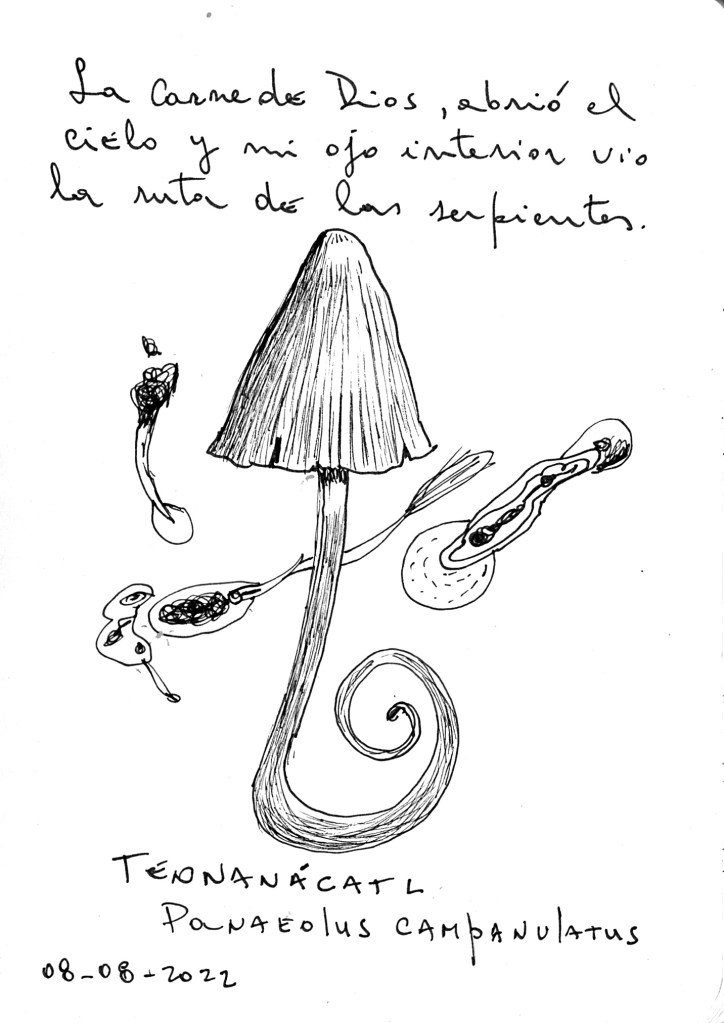
To return to the Americas, Schultes also identified the Aztec psychedelic, Teonanácatl, as belonging to the Psilocybe genus. But, Denver Moore’s would appear to be the first account of the possible use of a psilocybin mushroom within the context of Conjure, as the same was practiced by African American slaves in the Deep South. Many Hoodoo practices continue to be shrouded in secrecy. So, it may be impossible to determine just how far back this tradition among African Americans extends. But, as the famous Tennessee Hoodoo practitioner, Doc “Wash” Harris, founder of the infamous Saint Paul Spiritual Holy Temple in Memphis—inappropriately known by locals as “Voodoo Village”—once said in an interview with the Commercial Appeal in 1984,

God told the black man and the Indian somethings he didn’t tell nobody else.

One of those things may have concerned the powerful effects of a particular species of dung-loving mushroom.

Reminiscing about his great, wise Auntie, Moore briefly continues,

Aunt Etha took care of our bodies and souls. Mostly we never got very sick, but when we did, my auntie sure ‘nough had the cure: Somethin she called ‘cow-lip tea.’

Now cow-lip tea was brown and thin, kinda like the Lipton tea the Man sold at his store, but a durn sight more powerful. Cow-lip tea come from them white toadstools that sprout outta cow patties. […] That’s where cow-lip tea got its name. ‘Cow’ from the cow patties and ‘lip’ from the Lipton. Least that’s what Aunt Etha always told me.

The way you make cow-lip tea is you get the toadstools […] and grind em up in the sifter. [You] put it in a rag and tie a knot on top. Then you add a little honey to a boilin pot and drop that rag in the water til it bubbles up and turns good and brown. Now you got cow-lip tea.

If I was sick, Aunt Etha’d always make me drink a canful.

All good medicine tastes bad!’ she’d say, then put me in the bed underneath a whole pile a’ covers, no matter whether it was summertime or wintertime. In the mornin, the bed’d be soppin wet and the sheets’d be all yella, but I’d always be healed. I was nearly grown before I figured out what I was drinkin.

This historical narrative is simply amazing. Psilocybin mushrooms weren’t brought to the attention of the broader West until 1957, with the publication of the paradigm-shifting photo essay, “Seeking the Magic Mushroom,” in LIFE magazine by R. Gordon Wasson—the “father of ethnomycology.” Moore’s account is at least contemporaneous with Wasson’s publication. But, considering that this particular treatment was likely a timeworn tradition handed down to Auntie Etha by her own teacher(s), it is very probable that this particular use of the fungus went back much earlier than the time of Moore or his Auntie Etha. While no psychedelic effects were noted by the author, the mere fact the mushroom tea was administered in a medicinal context, to treat a sick boy, is highly significant. For, the Mazatec ceremony to which Mexican curandera, María Sabina, invited Wasson, the same wherein the psilocybin mushrooms were ingested, was also explicitly medicinal—velada being the traditional name given to the mushroom healing vigils carried out by Mazatec “shamans.” Moreover, if Moore was administered Auntie Etha’s tea while suffering a high fever, any psychedelic effects—including hallucinations—may have simply been attributed to the symptoms of the contracted illness.
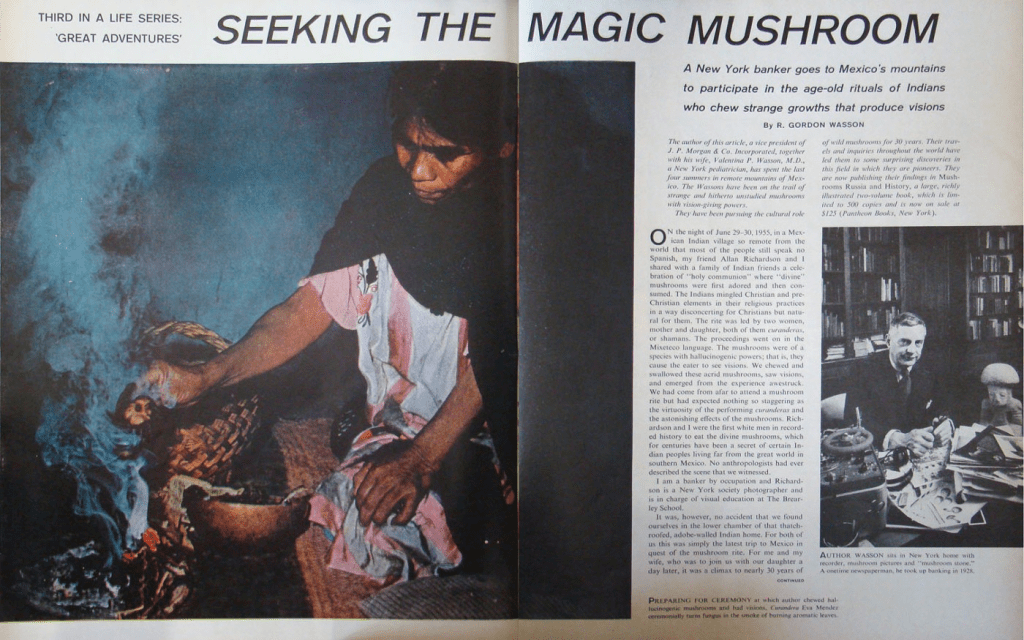
“Seeking the Magic Mushroom,” in LIFE magazine by R. Gordon Wasson 1957

Importantly, Moore’s account is not the sole evidence of the use of entheogenic concoctions in the practice of Hoodoo. Over twenty years before the experience described in Same Kind of Different as Me, African American author, Zora Neale Hurston, in her 1935 classic, Mules and Men, revealed her own experience with what is quite clearly a powerful yet unnamed hallucinogen.

I had to fast and “seek,” shut in a room that had been purged by smoke. Twenty-four hours without food except a special wine that was fed to me every four hours. It did not make me drunk in the accepted sense of the word. I merely seemed to lose my body, my mind seemed very clear. […] Maybe I went off in a trance. Great beast-like creatures thundered up to the circle from all sides. Indescribable noises, sights, feelings. Death was at hand! Seemed unavoidable! I don’t know.

While Hurston’s report does not mention hallucinogenic fungi specifically (or any other substance for that matter), the obvious psychedelic nature of her account is a good indication that entheogenic plants were not unknown to Hoodoo practitioners such as Denver Moore’s Auntie Etha.

Miguel Covarrubias’ Illustration for “Mules and Men” Zora Neale Hurston/ Lippincott, Philadelphia, 1935

 Denver Moore passed away in 2012, so we were unable to interview him concerning his spectacular narration. But, it is our hope that Moore and his Auntie Etha would have been proud to know that their legacy not only lives on, but it may change the narrative as we know it regarding both the history of ethnomycology and the practices of Hoodoo and folk medicine among African Americans living in the Deep South.
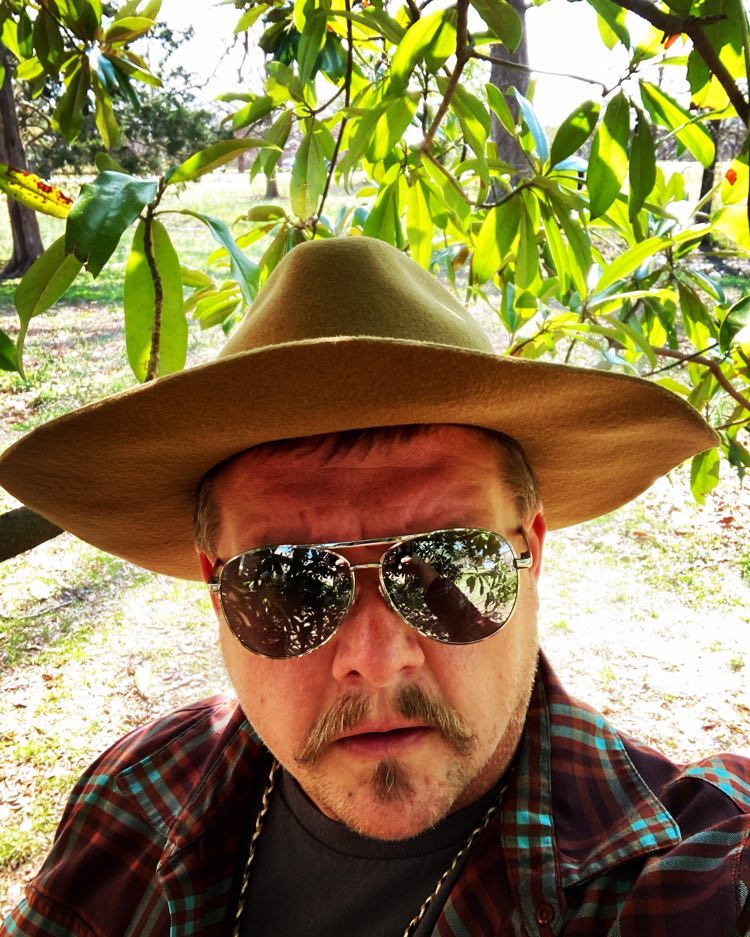
Quimbisero + Polypharmakos + Alchemist + Theurgist + Marseillaise Tarotist 

P.D. Newman is an independent researcher located in the southern US, specializing in the history of the use of entheogenic substances in religious rituals and initiatory rites. He is the author of the books, Alchemically Stoned: The Psychedelic Secret of FreemasonryAngels in Vermilion: The Philosophers’ Stone from Dee to DMT, and the forthcoming title, Day Trips and Night Flights: Anabasis, Katabasis, and Entheogenic Ekstasis in Myth and Rite. The Secret Teachings of All Ages (TV Series documentary) 2023.

Theurgy: Theory and Practice: The Mysteries of the Ascent to the Divine by P.D. Newman, published by Inner Traditions, Bear & Company will be available on December 5, 2023

Recipes for Horizons by Enrique De Santiago

BLENDED IN THE HOURS
From the place where the abrupt sound of the loica ventures

(1)
the evanescence of your future breath appears
among the vegetation that hides your name
and the blue and gray stones of the primal mystery
there I will drink from the mist that shouts the perpendicular miracle
the only reason at all
that moistens the vegetal belly of the beloved
and shines the incessant desire.
How long does the star take to announce your coming?
or there will be no signs in this already long life of chordates

(2)
while the empty horn waits for its winds
and the opaque flame of sleep leans into oblivion

(1) Signature and unpredictable bird before being (A) bird
in the light areas that are shaken by the wind
mythical and loving red that drew a smile on a child
to open the celestial fields of my pupil
that stirred my early neurotransmitters
before the new cycle (B)
(A) Before being
Before discriminating the gray hours from the clear ones
I inhabited the only and always proud clarity of my imaginary friend
(B) New cycle
My lymph is rocked by the wind
in a theater of new opportunities
those that favor the sweetness of the coots of sober stride
mating in the repetition of miracles
so that the aromas perpetuate my arcane name
and the wandering clouds welcome their polar persistence.
I had the option of ascending to lightning by the cosmic warp
where perhaps the root of the word would have questioned
in coming times of etheric colors
where time would have curved for your eyes
and I would raise your elusive silhouette that lies in the angle of a sunset
irretrievably withers the thaumaturgical vowel (B1)
as simple as a smile
or the collapse of a galaxy
since everything is corresponding
and apparent
with its prodigious lightness (B2)
Like a breath from the forest.

TRAVEL
I went down to the inside of your belly
caressing the rafters of your cosmic cloud
the one that received me with the aroma of the sacred bulbs.
There you were the clear love of wood
and the vegetal wisdom that embraces the ancient verb
when the wind ceases its journey on the shoulders
of the floral liturgy
How many skies inhabit your seed that furrows the seer’s eye?
Is there a niche of smoke that hides your salty voice?
Or simply the root of everything has its home in that mystery.

Each step collects behind you, the daffodils
that inevitably lose your mark
the one that wanders in the deep sands
that in the empire of shadows shelters you.
The messenger has a singular noise
I’ll feel it that dreadful day
I will know then that the epitaphs for the sepulcher arrive,
where nothing else needs to be done,
the metal swallows are an illusory replacement,
since the truths remained in the lock,
and blind to certainties,
I only rest for a few moments
to give me strength in the pilgrim sea,
the one who confuses the epistolary tides
and enjoys seemingly innocuous sacrifices.

I will kiss your lips according to the prophecy

while the breeze will speak the unfinished language

And you will see me with your green eyes

that are not green

are brown

But when you laugh they turn green

and you can draw a different morning

with an approximate solstice

with snakes in the window,

so my useless life becomes useful

because I’m a hobo of solar systems

and I become a wanderer in your body,

as a geographer of your corpse altar

and intruder in your zodiac cenith.

At this moment the end of the thread

talk about the miracle of one day

unrepeatable and mild luck

How strange of an eclipse

under the brief abyssal tides

like ghostly cardamoms approaching

in the deserts of disease

appealing to the late corrections

as it did for millions of years

moss persistence with its epicness

selecting the right humidity

with your organic and fruity hug

in that I put my hope

in what you find in front of your eyes

because I am the one who reads in the borrascas

as I advance toward your directions

who fires violent canines

before those who offend you

to heal that sadness

that leaves the middle of the night when you slip

inevitably and persistently beneath

out the door.

Chandelier in the mornings

this useless armor

And the leaves are blank

soaking up her violently dance

they burn in front of the cabinets of dubious origin.

I hear the birds giving birth to the woods, in the upper angles of a nebula.

At this moment the end of the thread
talk about the miracle of one day
unrepeatable and mild luck
How strange of an eclipse
under the brief abyssal tides
like ghostly cardamoms approaching
in the deserts of disease
appealing to the late corrections
as it did for millions of years
moss persistence with its epicness
selecting the right humidity
with your organic and fruity hug
in that I put my hope
in what you find in front of your eyes
because I am the one who reads in the borrascas
as I advance toward your directions
who fires violent canines
before those who offend you
to heal that sadness
that leaves the middle of the night when you slip
inevitably and persistently beneath
out the door.

written and Illustrated by ©Enrique De Santiago
.

Enrique De Santiago. Poet, Artist and Philosopher

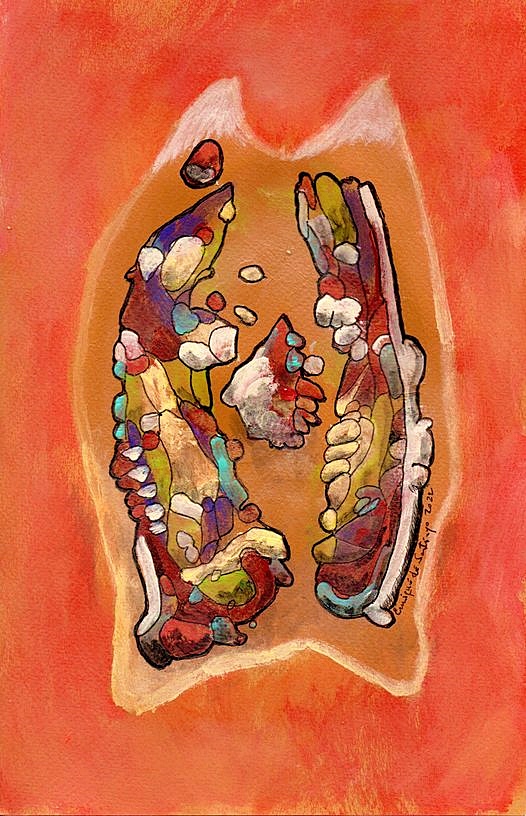
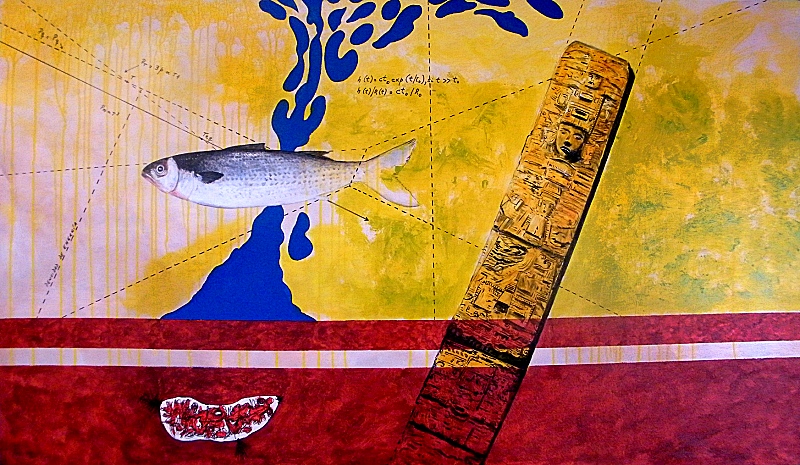
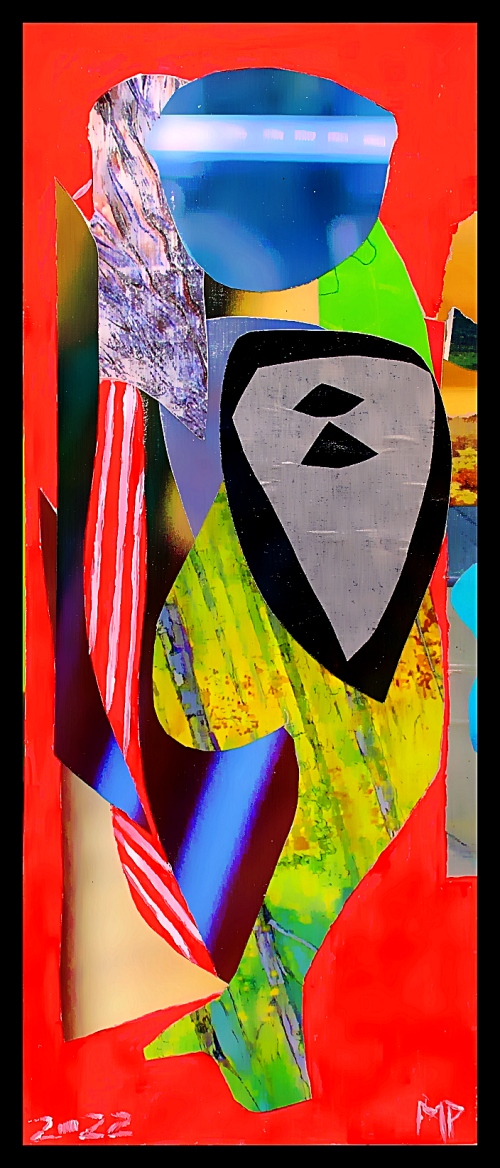
Featured Image: “Beyond the visible world is the non-Euclidean horizon for the dragonfly” acrylic and ink on 250 gm Fabriano paper by Enrique De Santiago

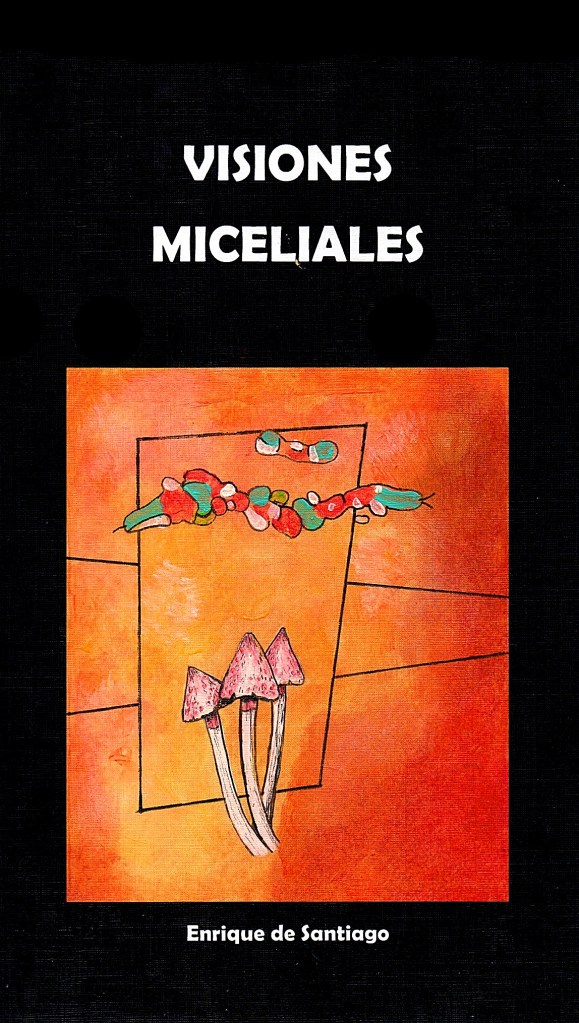
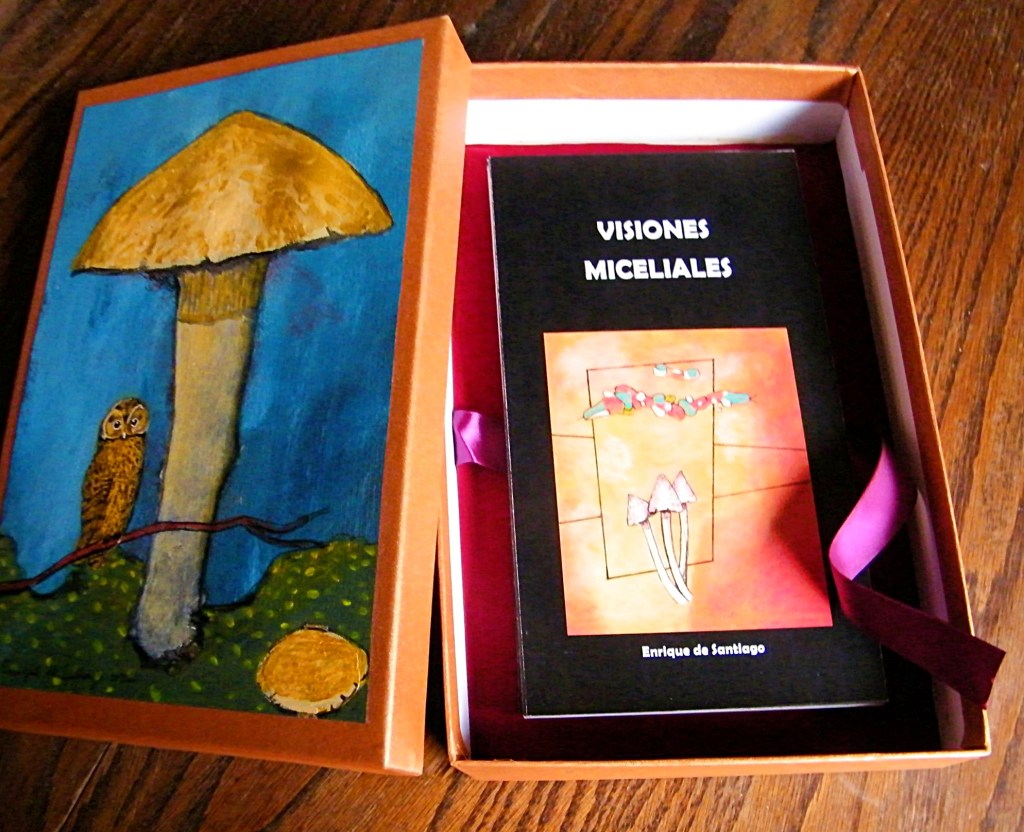
Mycelial Visions Enrique de Santiago

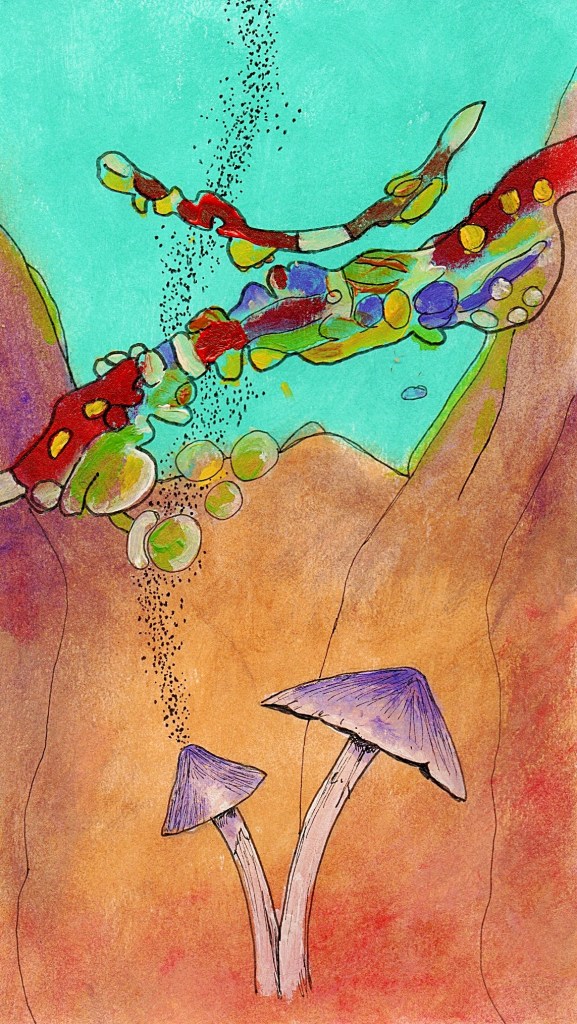
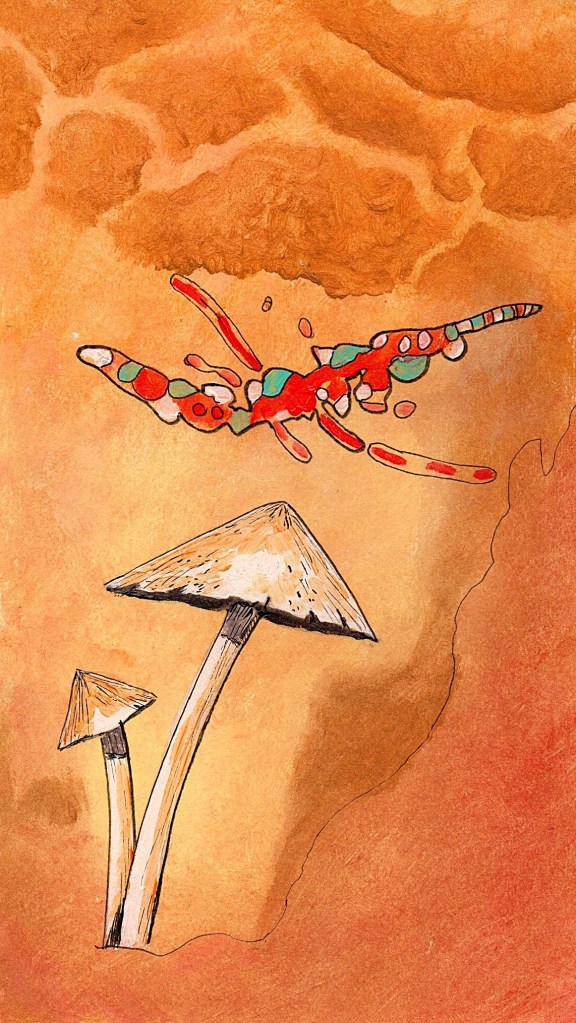
Mycelial Visions is a work that I have been maturing for months and that deals with the wonders and mysteries that the Fungi Kingdom contains, a name that is used to designate a group of eukaryotic organisms where fungi or mushrooms, molds and yeasts are found. This kingdom is one of the 5 great ones that make up others, such as animalia, plantae, protista or monera, having very own characteristics that distinguish it from these others due to its taxonomy and complex life cycles.


Specifically, the so-called mushrooms of the Psilocybe family caught my attention and their role as sacred psychotropics (hallucinogenic or neurotropic) in vast cultures, with records of this use, from the Paleolithic (Siberia, Sahara and Spain) to the present day. The power that these have to expand the mind and open unsuspected portals is well known, and that it has a certain analogy with what Eliphas Levi explained, regarding the 3 states to know the secrets of the universe, such as the embryonic state, dreams and delirium.


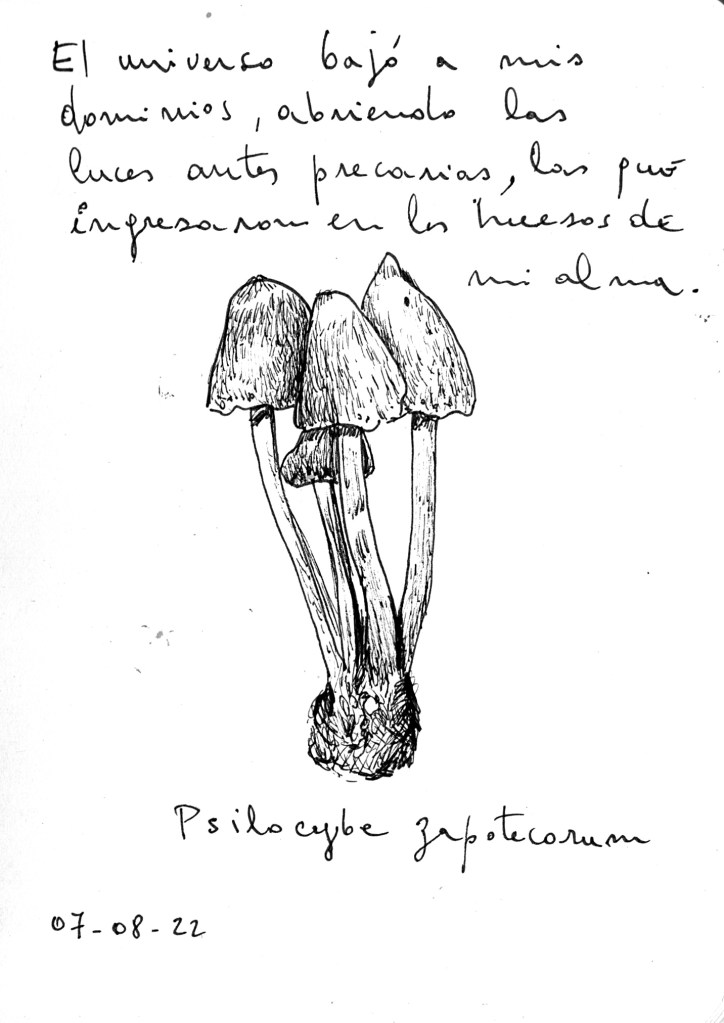
Thus, since the dawn of animism, these mushrooms have revealed, with the guidance of healers and shamans, that which is invisible and also ineffable, since those who experience these trips cannot express or relate what they have experienced on these trips to what is supposedly the depth of being and soul. These mushrooms usually occur in the dung of animals and it is plausible that prehistoric nomads followed herds not only for their meat but also to collect these mushrooms that were found growing in the feces of the herds. Among these mushrooms are the Psilocybe Mairei in North Africa, Psilocybe Cyanescens, present in Europe, America and Oceania, or Psilocybe Zapotecorum in Mesoamerica, to name three of the most recognized.


They are heterotrophic organisms, that is, they acquire their nutrients from abroad. Their form of reproduction is by spores and they have specific anatomical structures for their production, such as asci (contain ascospores) and basidia (with basidiospores). In fungi, reproduction can be asexual (without formation of a fruiting body) as well as sexual. Like the other kingdoms, they have different shapes, colors and sizes. Its habitat and location varies according to species, being able to grow in treetops or at the foot of it, as well as on rocks or soil, preferably where there is humidity and shade.

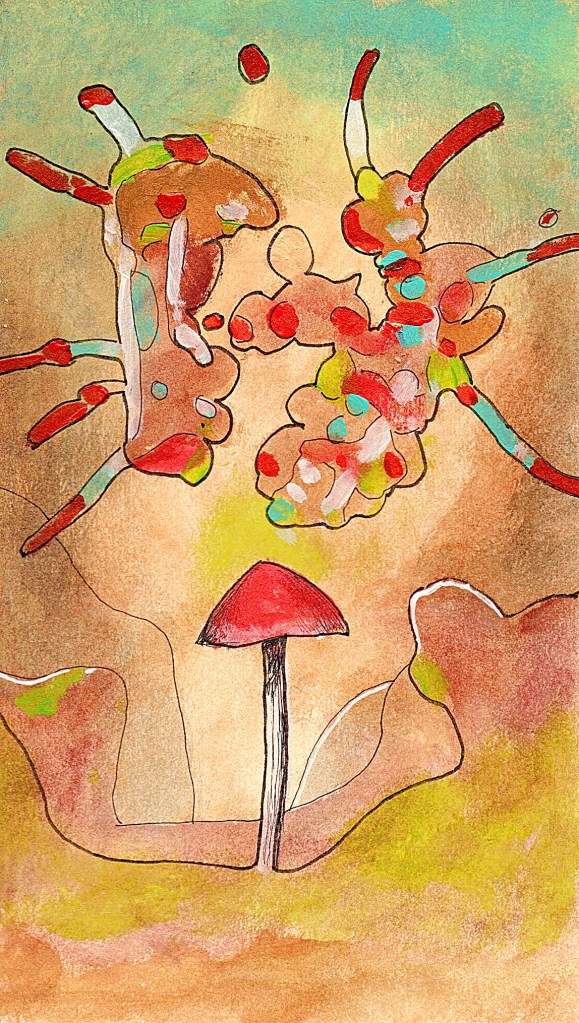
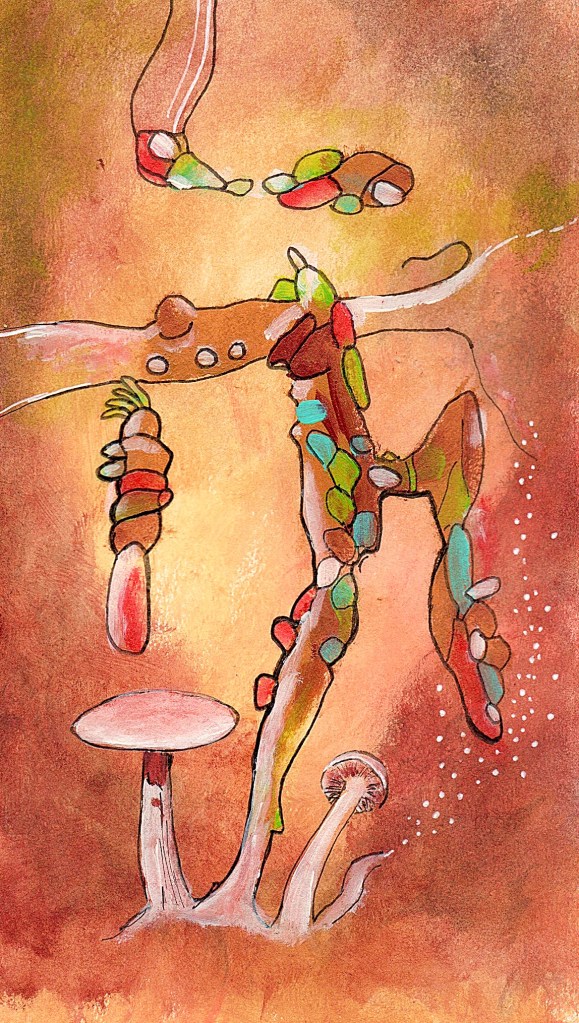
written by Enrique de Santiago. The art works are acrylic and ink on 300 gm Conqueror paper. Each painting and poem is a door.

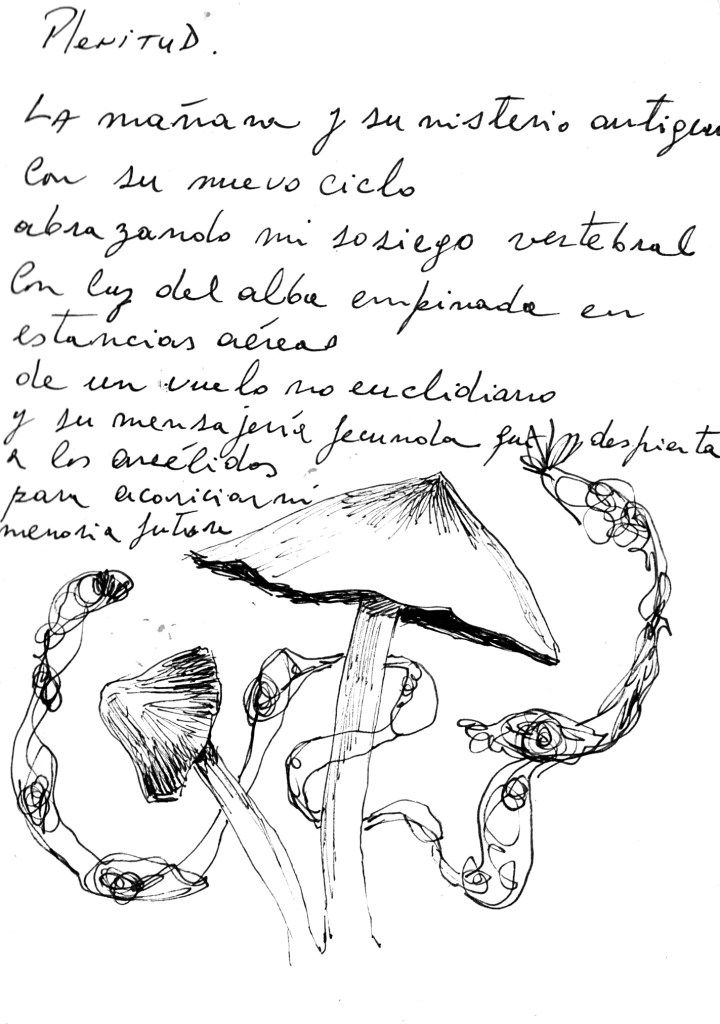
FULLNESS
A secret freedom opens through a crack
that you can barely see.
Rumi
The morning and its ancient mystery
with his new cycle
embracing my vertebral calm
with dawn light steep in aerial stays
of a non-Euclidean flight
and its fertile messaging that awakens the annelids
to caress my future memory.

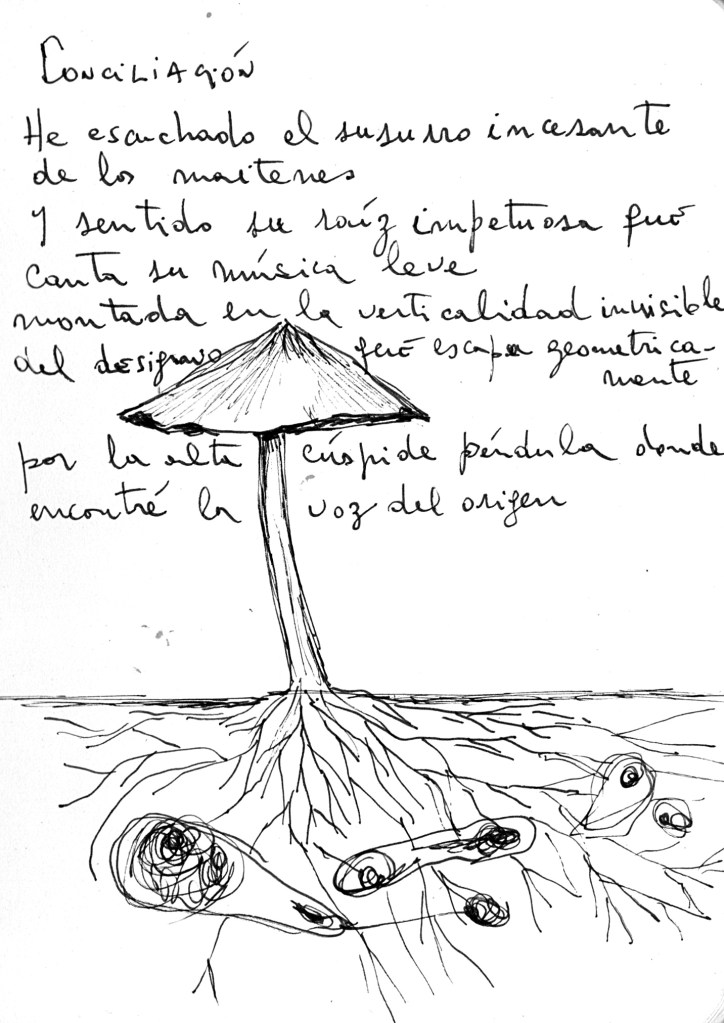
CONCILIATION
There are times when all the accumulated anxiety and effort
they rest in the infinite indolence and repose of nature.
Henry David Thoreau
I have heard the incessant whisper of the maitenes
and felt its impetuous root that sings its light music
mounted on the invisible verticality of design
that escapes geometrically
by the high pendulum cusp where I found the voice of the origin
so I became a body in the bark
adding myself to the essential channel that pulsates in the hollow
where the bird flies
with his outburst of winged love
that awakens the astral eyelid
and light the new dawn.

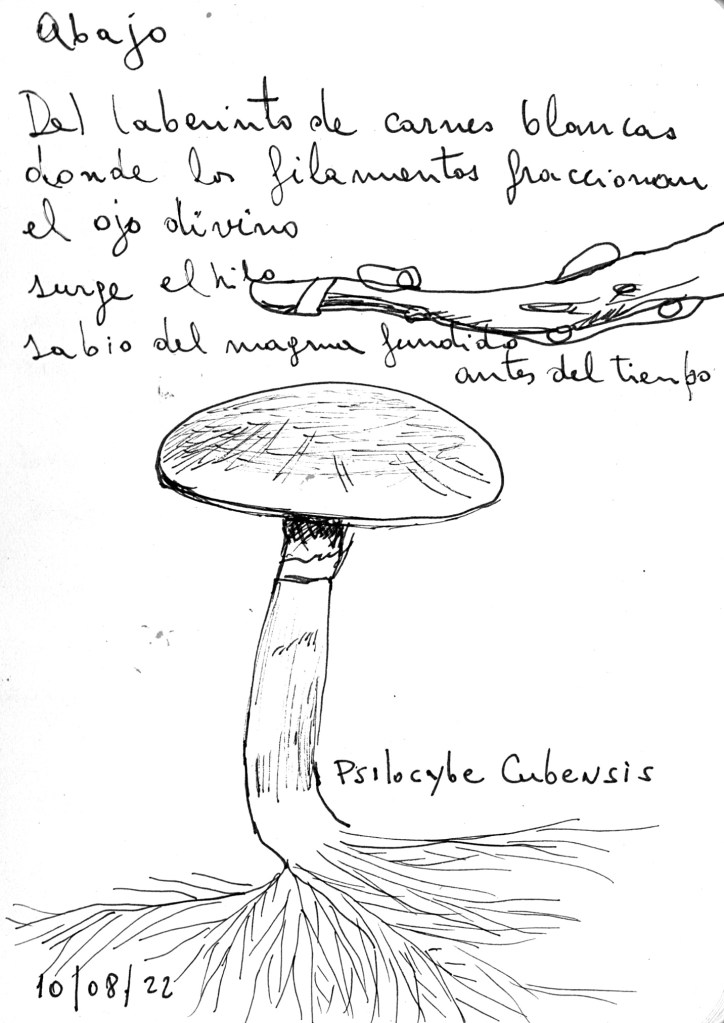
DOWN
From the labyrinth of white meats
where the filaments fractionate the divine eye
the wise thread emerges from the molten magma before time.

DREAMS
in the belly of the stone
the dragon’s breath is hidden
and in every cosmic cycle
stir your energy that moves
the suns and their destinies.
You’ll know when the word goes on
in that object that radiates silent voices
by a demiurge who lost
love in a vortex
in that surprising weather.

HUGGING THE BELLY
Diverse waters nest
in the hidden embryonic embraces
where the blade of time
pick up the promise
made to the stem
in that sacred way.
And I saw a new way
and their metals hugged tightly
the sign of the night
dropping urgent shadows
as field dams
one upright and down
in his immobility.

LIGHT
The universe came down to my domain
Opening the lights before precarious
those who entered
In the bones of my soul.
Light of the hidden.

SEEING EYE
the flesh of god
opened the sky
and my inner eye
saw the route of the serpents.

HEAVENLY LANDSCAPES
In the surroundings of the uranic gem
the voices of the magicians are raised
that bear ancestral flowers
to heal the wounds of oblivion.

REVELATION
There was his high imponderable crown
on the distinguished and lukewarm verticality of the mystery
without leaving a shadow in the mirror of the high magistracy
of the verb
pouring her violet love towards his moist horizon
and restlessly embracing your silhouette that I don’t know
That’s how I saw you behind the meanders of destiny
in the sudden revelation of the morning birds
Will you be the trail to be followed in unknown times?
perhaps I will drink of your honey under the sign of the equinox
coming
As soon as you feel your eyelids full of the light of your
redemption
and rest the incandescent pearl that comes down from the dew
this will be the floral beginning of the silent explosion
like the one that leaves the pollen in the aerial possibilities
while I await your coming.
Someday they’ll die out under the rust
the gears that bind us to reality.

DIRECTIONS
My constellations that guide me
pushing my mild matter
in this immense sum of fiery spheres
and finite
inside the womb of mystery
with its unsuspected breath of flowers
because as above so below
since nebulae have their own pistils
and here I am with my steps apprehended
waved and sacramented
right and wrong
taking up the path dictated by the stars
smiling under high serene clouds
looking for other paths
that will bring a new hand to dream.

only one Mycelial Visions was made

Enrique de Santiago

It is better to be an oracle than a king by P.D. Newman

It is better to be an oracle than a king

To play the lyre, and the aulos, and sing

Leading maenads ‘round in a ring

Yes, ‘tis better to be an oracle than a king

written by ©P.D. Newman

P.D. Newman is an independent researcher located in the southern US, specializing in the history of the use of entheogenic substances in religious rituals and initiatory rites. He is the author of the books, Alchemically Stoned: The Psychedelic Secret of Freemasonry, Angels in Vermilion: The Philosophers’ Stone from Dee to DMT, and the forthcoming title, Day Trips and Night Flights: Anabasis, Katabasis, and Entheogenic Ekstasis in Myth and Rite. The Secret Teachings of All Ages (TV Series documentary) 2023